Private Equity Strategies
By Ascanio Rossini
Outline
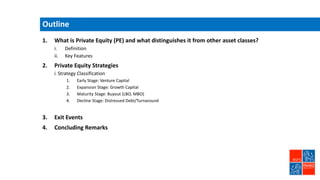
1. What is Private Equity (PE) and what distinguishes it from other asset classes?
i. Definition
ii. Key Features
2. Private Equity Strategies
i. Strategy Classification
1. Early Stage: Venture Capital
2. Expansion Stage: Growth Capital
3. Maturity Stage: Buyout (LBO, MBO)
4. Decline Stage: Distressed Debt/Turnaround
3. Exit Events
4. Concluding Remarks
1. WHAT IS PRIVATE EQUITY (PE) AND WHAT DISTINGUISHES IT
FROM OTHER ASSET CLASSES?
i. Definition
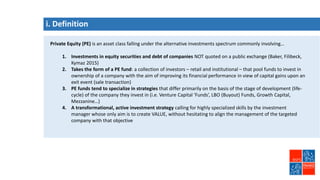
Private Equity (PE) is an asset class falling under the alternative investments spectrum commonly involving…
1. Investments in equity securities and debt of companies NOT quoted on a public exchange (Baker, Filibeck,
Kymaz 2015)
2. Takes the form of a PE fund: a collection of investors – retail and institutional – that pool funds to invest in
ownership of a company with the aim of improving its financial performance in view of capital gains upon an
exit event (sale transaction)
3. PE funds tend to specialize in strategies that differ primarily on the basis of the stage of development (life-
cycle) of the company they invest in (i.e. Venture Capital ‘Funds’, LBO (Buyout) Funds, Growth Capital,
Mezzanine…)
4. A transformational, active investment strategy calling for highly specialized skills by the investment
manager whose only aim is to create VALUE, without hesitating to align the management of the targeted
company with that objective
iii. Key Features
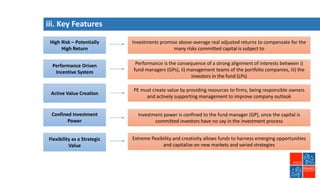
High Risk – Potentially
High Return
Performance Driven
Incentive System
Active Value Creation
Confined Investment
Power
Flexibility as a Strategic
Value
Investments promise above-average real adjusted returns to compensate for the
many risks committed capital is subject to
Performance is the consequence of a strong alignment of interests between i)
fund managers (GPs), ii) management teams of the portfolio companies, iii) the
investors in the fund (LPs)
PE must create value by providing resources to firms, being responsible owners
and actively supporting management to improve company outlook
Investment power is confined to the fund manager (GP), once the capital is
committed investors have no say in the investment process
Extreme flexibility and creativity allows funds to harness emerging opportunities
and capitalize on new markets and varied strategies
iii. Key Features (cont’d)
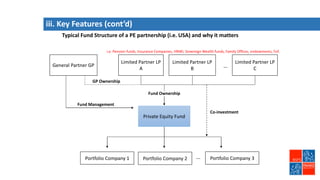
General Partner GP
Limited Partner LP
A
Limited Partner LP
B
Limited Partner LP
C…
Private Equity Fund
Fund Ownership
GP Ownership
Fund Management
Portfolio Company 1 Portfolio Company 2 Portfolio Company 3…
Co-investment
Typical Fund Structure of a PE partnership (i.e. USA) and why it matters
i.e. Pension funds, Insurance Companies, HNWi, Sovereign Wealth funds, Family Offices, endowments, FoF.
iii. Key Features (cont’d)
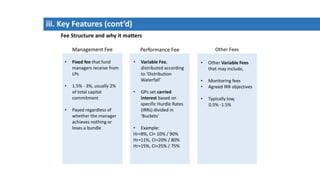
Fee Structure and why it matters
Management Fee Performance Fee Other Fees
• Fixed fee that fund
managers receive from
LPs
• 1.5% - 3%, usually 2%
of total capital
commitment
• Payed regardless of
whether the manager
achieves nothing or
loses a bundle
• Variable Fee,
distributed according
to ‘Distribution
Waterfall’
• GPs set carried
interest based on
specific Hurdle Rates
(IRRs) divided in
‘Buckets’
• Example:
Hr=8%, CI= 10% / 90%
Hr=11%, CI=20% / 80%
Hr=15%, CI=25% / 75%
• Other Variable Fees
that may include,
• Monitoring fees
• Agreed IRR objectives
• Typically low,
0.5% -1.5%
2. PRIVATE EQUITY STRATEGIES
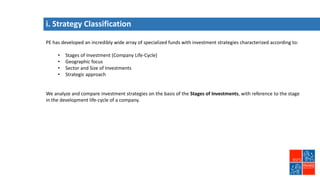
i. Strategy Classification
PE has developed an incredibly wide array of specialized funds with investment strategies characterized according to:
• Stages of Investment (Company Life-Cycle)
• Geographic focus
• Sector and Size of Investments
• Strategic approach
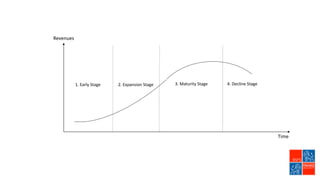
We analyze and compare investment strategies on the basis of the Stages of Investments, with reference to the stage
in the development life-cycle of a company.
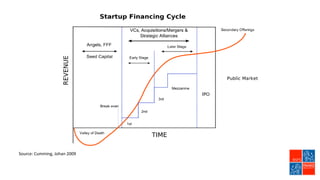
Source: Cumming, Johan 2009
Revenues
Time
1. Early Stage 2. Expansion Stage 3. Maturity Stage 4. Decline Stage
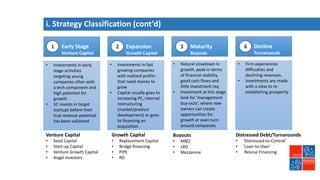
i. Strategy Classification (cont’d)
Early Stage
Venture Capital
Expansion
Growth Capital
Maturity
Buyouts
Decline
Turnarounds
• Investments in early
stage activities
targeting young
companies often with
a tech component and
high potential for
growth
• VC invests in target
startups before their
true revenue potential
has been validated
• Investments in fast
growing companies
with realized profits
that need money to
grow
• Capital usually goes to
increasing PC, internal
restructuring
(market/product
development) or goes
to financing an
acquisition
Venture Capital
• Seed Capital
• Start-up Capital
• Venture Growth Capital
• Angel Investors
Growth Capital
• Replacement Capital
• Bridge financing
• PIPE
• RD
• Natural slowdown in
growth, peak in terms
of financial stability,
good cash flows and
little investment req
• Investment at this stage
look for ‘management
buy-outs’, where new
owners can create
opportunities for
growth or even turn
around companies
Buyouts
• MBO
• LBO
• Mezzanine
• Firm experiences
difficulties and
declining revenues.
• Investments are made
with a view to re-
establishing prosperity
Distressed Debt/Turnarounds
• ‘Distressed-to-Control’
• ‘Loan-to-Own’
• Rescue Financing
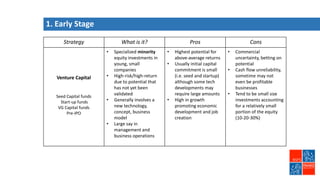
1. Early Stage
Strategy What is it? Pros Cons
Venture Capital
Seed Capital funds
Start-up funds
VG Capital funds
Pre-IPO
• Specialized minority
equity investments in
young, small
companies
• High-risk/high-return
due to potential that
has not yet been
validated
• Generally involves a
new technology,
concept, business
model
• Large say in
management and
business operations
• Highest potential for
above-average returns
• Usually initial capital
commitment is small
(i.e. seed and startup)
although some tech
developments may
require large amounts
• High in growth
promoting economic
development and job
creation
• Commercial
uncertainty, betting on
potential
• Cash flow unreliability,
sometime may not
even be profitable
businesses
• Tend to be small size
investments accounting
for a relatively small
portion of the equity
(10-20-30%)
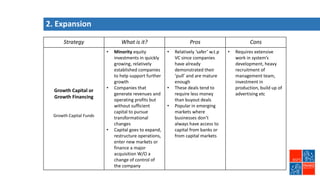
2. Expansion
Strategy What is it? Pros Cons
Growth Capital or
Growth Financing
Growth Capital Funds
• Minority equity
investments in quickly
growing, relatively
established companies
to help support further
growth
• Companies that
generate revenues and
operating profits but
without sufficient
capital to pursue
transformational
changes
• Capital goes to expand,
restructure operations,
enter new markets or
finance a major
acquisition W/O a
change of control of
the company
• Relatively ‘safer’ w.t.p
VC since companies
have already
demonstrated their
‘pull’ and are mature
enough
• These deals tend to
require less money
than buyout deals
• Popular in emerging
markets where
businesses don’t
always have access to
capital from banks or
from capital markets
• Requires extensive
work in system’s
development, heavy
recruitment of
management team,
investment in
production, build up of
advertising etc
Strategy What is it? Pros Cons
Buyout;
Leveraged Buyout LBOs
Management Buyout MBOs
Management Buy-in MBIs
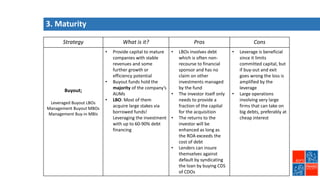
• Provide capital to mature
companies with stable
revenues and some
further growth or
efficiency potential
• Buyout funds hold the
majority of the company’s
AUMs
• LBO: Most of them
acquire large stakes via
borrowed funds!
Leveraging the investment
with up to 60-90% debt
financing
• LBOs involves debt
which is often non-
recourse to financial
sponsor and has no
claim on other
investments managed
by the fund
• The investor itself only
needs to provide a
fraction of the capital
for the acquisition
• The returns to the
investor will be
enhanced as long as
the ROA exceeds the
cost of debt
• Lenders can insure
themselves against
default by syndicating
the loan by buying CDS
of CDOs
• Leverage is beneficial
since it limits
committed capital, but
if buy-out and exit
goes wrong the loss is
amplified by the
leverage
• Large operations
involving very large
firms that can take on
big debts, preferably at
cheap interest
3. Maturity
4. Decline
Strategy What is it? Pros Cons
Distressed Debt and
Turnaround
Control-oriented Approach
Turnaround Approach
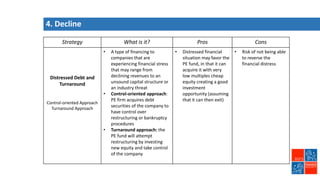
• A type of financing to
companies that are
experiencing financial stress
that may range from
declining revenues to an
unsound capital structure or
an industry threat
• Control-oriented approach:
PE firm acquires debt
securities of the company to
have control over
restructuring or bankruptcy
procedures
• Turnaround approach: the
PE fund will attempt
restructuring by investing
new equity and take control
of the company
• Distressed financial
situation may favor the
PE fund, in that it can
acquire it with very
low multiples cheap
equity creating a good
investment
opportunity (assuming
that it can then exit)
• Risk of not being able
to reverse the
financial distress
3. EXIT EVENTS
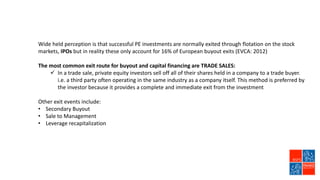
Wide held perception is that successful PE investments are normally exited through flotation on the stock
markets, IPOs but in reality these only account for 16% of European buyout exits (EVCA: 2012)
The most common exit route for buyout and capital financing are TRADE SALES:
 In a trade sale, private equity investors sell off all of their shares held in a company to a trade buyer.
i.e. a third party often operating in the same industry as a company itself. This method is preferred by
the investor because it provides a complete and immediate exit from the investment
Other exit events include:
• Secondary Buyout
• Sale to Management
• Leverage recapitalization
3. CONCLUDING REMARKS

PE_STRATEGIES_FINAL

  • 1.
  • 2.
    Outline 1. What isPrivate Equity (PE) and what distinguishes it from other asset classes? i. Definition ii. Key Features 2. Private Equity Strategies i. Strategy Classification 1. Early Stage: Venture Capital 2. Expansion Stage: Growth Capital 3. Maturity Stage: Buyout (LBO, MBO) 4. Decline Stage: Distressed Debt/Turnaround 3. Exit Events 4. Concluding Remarks
  • 3.
    1. WHAT ISPRIVATE EQUITY (PE) AND WHAT DISTINGUISHES IT FROM OTHER ASSET CLASSES?
  • 4.
    i. Definition Private Equity(PE) is an asset class falling under the alternative investments spectrum commonly involving… 1. Investments in equity securities and debt of companies NOT quoted on a public exchange (Baker, Filibeck, Kymaz 2015) 2. Takes the form of a PE fund: a collection of investors – retail and institutional – that pool funds to invest in ownership of a company with the aim of improving its financial performance in view of capital gains upon an exit event (sale transaction) 3. PE funds tend to specialize in strategies that differ primarily on the basis of the stage of development (life- cycle) of the company they invest in (i.e. Venture Capital ‘Funds’, LBO (Buyout) Funds, Growth Capital, Mezzanine…) 4. A transformational, active investment strategy calling for highly specialized skills by the investment manager whose only aim is to create VALUE, without hesitating to align the management of the targeted company with that objective
  • 5.
    iii. Key Features HighRisk – Potentially High Return Performance Driven Incentive System Active Value Creation Confined Investment Power Flexibility as a Strategic Value Investments promise above-average real adjusted returns to compensate for the many risks committed capital is subject to Performance is the consequence of a strong alignment of interests between i) fund managers (GPs), ii) management teams of the portfolio companies, iii) the investors in the fund (LPs) PE must create value by providing resources to firms, being responsible owners and actively supporting management to improve company outlook Investment power is confined to the fund manager (GP), once the capital is committed investors have no say in the investment process Extreme flexibility and creativity allows funds to harness emerging opportunities and capitalize on new markets and varied strategies
  • 6.
    iii. Key Features(cont’d) General Partner GP Limited Partner LP A Limited Partner LP B Limited Partner LP C… Private Equity Fund Fund Ownership GP Ownership Fund Management Portfolio Company 1 Portfolio Company 2 Portfolio Company 3… Co-investment Typical Fund Structure of a PE partnership (i.e. USA) and why it matters i.e. Pension funds, Insurance Companies, HNWi, Sovereign Wealth funds, Family Offices, endowments, FoF.
  • 7.
    iii. Key Features(cont’d) Fee Structure and why it matters Management Fee Performance Fee Other Fees • Fixed fee that fund managers receive from LPs • 1.5% - 3%, usually 2% of total capital commitment • Payed regardless of whether the manager achieves nothing or loses a bundle • Variable Fee, distributed according to ‘Distribution Waterfall’ • GPs set carried interest based on specific Hurdle Rates (IRRs) divided in ‘Buckets’ • Example: Hr=8%, CI= 10% / 90% Hr=11%, CI=20% / 80% Hr=15%, CI=25% / 75% • Other Variable Fees that may include, • Monitoring fees • Agreed IRR objectives • Typically low, 0.5% -1.5%
  • 8.
  • 9.
    i. Strategy Classification PEhas developed an incredibly wide array of specialized funds with investment strategies characterized according to: • Stages of Investment (Company Life-Cycle) • Geographic focus • Sector and Size of Investments • Strategic approach We analyze and compare investment strategies on the basis of the Stages of Investments, with reference to the stage in the development life-cycle of a company.
  • 10.
  • 11.
    Revenues Time 1. Early Stage2. Expansion Stage 3. Maturity Stage 4. Decline Stage
  • 12.
    i. Strategy Classification(cont’d) Early Stage Venture Capital Expansion Growth Capital Maturity Buyouts Decline Turnarounds • Investments in early stage activities targeting young companies often with a tech component and high potential for growth • VC invests in target startups before their true revenue potential has been validated • Investments in fast growing companies with realized profits that need money to grow • Capital usually goes to increasing PC, internal restructuring (market/product development) or goes to financing an acquisition Venture Capital • Seed Capital • Start-up Capital • Venture Growth Capital • Angel Investors Growth Capital • Replacement Capital • Bridge financing • PIPE • RD • Natural slowdown in growth, peak in terms of financial stability, good cash flows and little investment req • Investment at this stage look for ‘management buy-outs’, where new owners can create opportunities for growth or even turn around companies Buyouts • MBO • LBO • Mezzanine • Firm experiences difficulties and declining revenues. • Investments are made with a view to re- establishing prosperity Distressed Debt/Turnarounds • ‘Distressed-to-Control’ • ‘Loan-to-Own’ • Rescue Financing
  • 13.
    1. Early Stage StrategyWhat is it? Pros Cons Venture Capital Seed Capital funds Start-up funds VG Capital funds Pre-IPO • Specialized minority equity investments in young, small companies • High-risk/high-return due to potential that has not yet been validated • Generally involves a new technology, concept, business model • Large say in management and business operations • Highest potential for above-average returns • Usually initial capital commitment is small (i.e. seed and startup) although some tech developments may require large amounts • High in growth promoting economic development and job creation • Commercial uncertainty, betting on potential • Cash flow unreliability, sometime may not even be profitable businesses • Tend to be small size investments accounting for a relatively small portion of the equity (10-20-30%)
  • 14.
    2. Expansion Strategy Whatis it? Pros Cons Growth Capital or Growth Financing Growth Capital Funds • Minority equity investments in quickly growing, relatively established companies to help support further growth • Companies that generate revenues and operating profits but without sufficient capital to pursue transformational changes • Capital goes to expand, restructure operations, enter new markets or finance a major acquisition W/O a change of control of the company • Relatively ‘safer’ w.t.p VC since companies have already demonstrated their ‘pull’ and are mature enough • These deals tend to require less money than buyout deals • Popular in emerging markets where businesses don’t always have access to capital from banks or from capital markets • Requires extensive work in system’s development, heavy recruitment of management team, investment in production, build up of advertising etc
  • 15.
    Strategy What isit? Pros Cons Buyout; Leveraged Buyout LBOs Management Buyout MBOs Management Buy-in MBIs • Provide capital to mature companies with stable revenues and some further growth or efficiency potential • Buyout funds hold the majority of the company’s AUMs • LBO: Most of them acquire large stakes via borrowed funds! Leveraging the investment with up to 60-90% debt financing • LBOs involves debt which is often non- recourse to financial sponsor and has no claim on other investments managed by the fund • The investor itself only needs to provide a fraction of the capital for the acquisition • The returns to the investor will be enhanced as long as the ROA exceeds the cost of debt • Lenders can insure themselves against default by syndicating the loan by buying CDS of CDOs • Leverage is beneficial since it limits committed capital, but if buy-out and exit goes wrong the loss is amplified by the leverage • Large operations involving very large firms that can take on big debts, preferably at cheap interest 3. Maturity
  • 16.
    4. Decline Strategy Whatis it? Pros Cons Distressed Debt and Turnaround Control-oriented Approach Turnaround Approach • A type of financing to companies that are experiencing financial stress that may range from declining revenues to an unsound capital structure or an industry threat • Control-oriented approach: PE firm acquires debt securities of the company to have control over restructuring or bankruptcy procedures • Turnaround approach: the PE fund will attempt restructuring by investing new equity and take control of the company • Distressed financial situation may favor the PE fund, in that it can acquire it with very low multiples cheap equity creating a good investment opportunity (assuming that it can then exit) • Risk of not being able to reverse the financial distress
  • 17.
  • 18.
    Wide held perceptionis that successful PE investments are normally exited through flotation on the stock markets, IPOs but in reality these only account for 16% of European buyout exits (EVCA: 2012) The most common exit route for buyout and capital financing are TRADE SALES:  In a trade sale, private equity investors sell off all of their shares held in a company to a trade buyer. i.e. a third party often operating in the same industry as a company itself. This method is preferred by the investor because it provides a complete and immediate exit from the investment Other exit events include: • Secondary Buyout • Sale to Management • Leverage recapitalization
  • 19.