The Perception Model of MindByPeter Anyebe(http://www.linkedin.com/pub/peter-anyebe/17/292/589)                                                                                AGAPE                 CONSULTANTS                                       The Perception Model of MindWe follow the three, 3 principles listed below to outline the Natural Order, N-O:Relativity
Normality
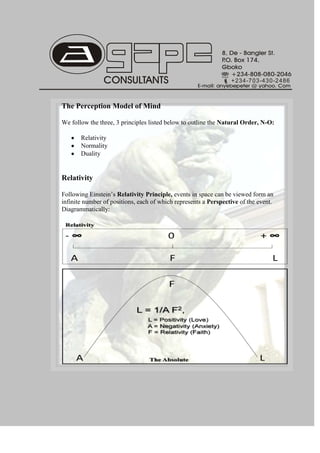
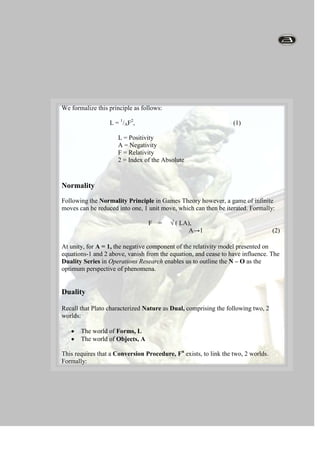
Duality                                                                                                                                        RelativityFollowing Einstein’s Relativity Principle, events in space can be viewed form an infinite number of positions, each of which represents a Perspective of the event. Diagrammatically:- ∞                               0                               + ∞  A                                 F                                   LRelativityThe AbsoluteAFLL = 1/A F2,L = Positivity (Love)      A = Negativity (Anxiety)      F = Relativity (Faith)                                                                                                                                                 We formalize this principle as follows:                                                                                                                                                   L = 1/AF2,                                                             (1)                       L = Positivity                       A = Negativity                       F = Relativity                       2 = Index of the AbsoluteNormalityFollowing the Normality Principle in Games Theory however, a game of infinite moves can be reduced into one, 1 unit move, which can then be iterated. Formally:                                F    =     √ ( LA),                                             A→1                                           (2)At unity, for A = 1, the negative component of the relativity model presented on equations-1 and 2 above, vanish from the equation, and cease to have influence. The Duality Series in Operations Research enables us to outline the N – O as the optimum perspective of phenomena.                                                                                                                                         DualityRecall that Plato characterized Nature as Dual, comprising the following two, 2 worlds:The world of Forms, L
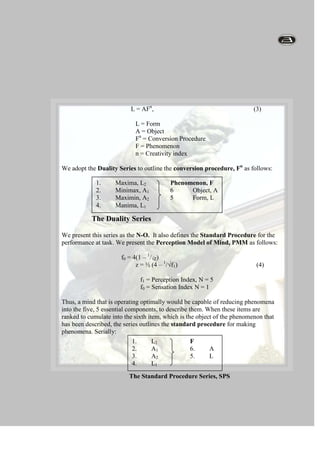
The world of Objects, AThis requires that a Conversion Procedure, Fn exists, to link the two, 2 worlds. Formally:                                                                                                                                                                                                                                                                                                                               L = AFn,                                                              (3)L = FormA = ObjectFn = Conversion ProcedureF = Phenomenonn = Creativity indexWe adopt the Duality Series to outline the conversion procedure, Fn as follows:1.Maxima, L2               Phenomenon, F2.Minimax, A1          6Object, A3.Maximin, A2          5Form, L4.Manima, L1                                                                                                                         The Duality SeriesWe present this series as the N-O.  It also defines the Standard Procedure for the performance at task. We present the Perception Model of Mind, PMM as follows:                         f0 = 4(1 – 1/√Z)z = ½ (4 – 1/√f1)                                                 (4)               f1 = Perception Index, N = 5               f0 = Sensation Index N = 1                                                                                                                    Thus, a mind that is operating optimally would be capable of reducing phenomena into the five, 5 essential components, to describe them. When these items are ranked to cumulate into the sixth item, which is the object of the phenomenon that has been described, the series outlines the standard procedure for making phenomena. Serially:1.L2F2.A16.A3.A25.L4.L1                                                                             The Standard Procedure Series, SPS                                                                                                                                                                                                                                                                     The mind therefore functions to perform at the following two, 2 tasks:Analysis
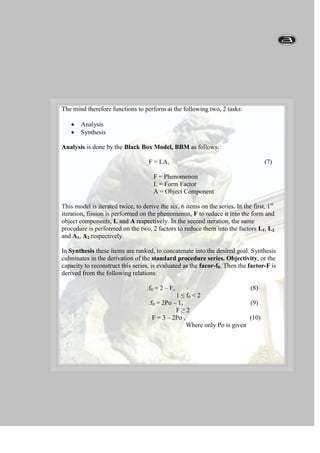
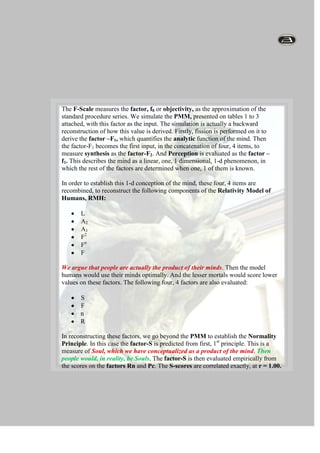
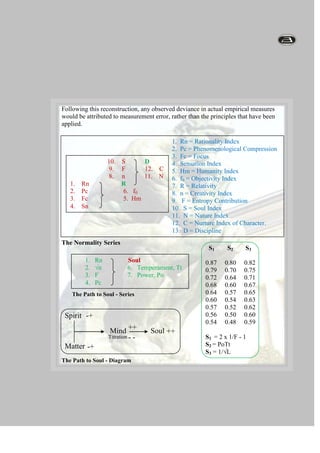
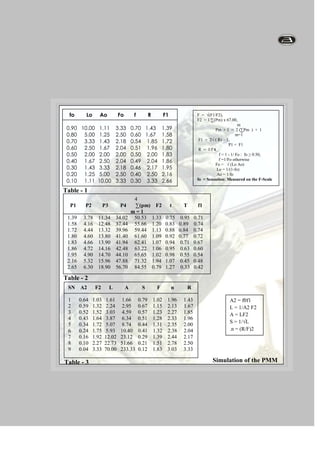
SynthesisAnalysis is done by the Black Box Model, BBM as follows:                                                      F = LA,                                                           (7)                                                         F = Phenomenon                                                         L = Form Factor                                                         A = Object ComponentThis model is iterated twice, to derive the six, 6 items on the series. In the first, 1st iteration, fission is performed on the phenomenon, F to reduce it into the form and object components, L and A respectively. In the second iteration, the same procedure is performed on the two, 2 factors to reduce them into the factors L1, L2 and A1, A2 respectively. In Synthesis these items are ranked, to concatenate into the desired goal. Synthesis culminates in the derivation of the standard procedure series. Objectivity, or the capacity to reconstruct this series, is evaluated as the facor-f0. Then the factor-F is derived from the following relations:                                                     .f0 = 2 – F,                                               (8)                                                                       1 ≤ f0                                                       .f0 = 2Po – 1,                                          (9)                                                                       F ≥ 2                                                         F = 3 – 2Po ,                                        (10)                                                                             Where only Po is given                                                                                                                                                                                                                                                                     The F-Scale measures the factor, f0 or objectivity, as the approximation of the standard procedure series. We simulate the PMM, presented on tables 1 to 3 attached, with this factor as the input. The simulation is actually a backward reconstruction of how this value is derived. Firstly, fission is performed on it to derive the factor –F1, which quantifies the analytic function of the mind. Then the factor-F1 becomes the first input, in the concatenation of four, 4 items, to measure synthesis as the factor-F2. And Perception is evaluated as the factor – f1. This describes the mind as a linear, one, 1 dimensional, 1-d phenomenon, in which the rest of the factors are determined when one, 1 of them is known.In order to establish this 1-d conception of the mind, these four, 4 items are recombined, to reconstruct the following components of the Relativity Model of Humans, RMH:L
A2
A1
F2

The Perception Model Of Mind

  • 1.
    The PerceptionModel of MindByPeter Anyebe(http://www.linkedin.com/pub/peter-anyebe/17/292/589) AGAPE CONSULTANTS The Perception Model of MindWe follow the three, 3 principles listed below to outline the Natural Order, N-O:Relativity
  • 2.
  • 3.
    Duality RelativityFollowing Einstein’s Relativity Principle, events in space can be viewed form an infinite number of positions, each of which represents a Perspective of the event. Diagrammatically:- ∞ 0 + ∞ A F LRelativityThe AbsoluteAFLL = 1/A F2,L = Positivity (Love) A = Negativity (Anxiety) F = Relativity (Faith) We formalize this principle as follows: L = 1/AF2, (1) L = Positivity A = Negativity F = Relativity 2 = Index of the AbsoluteNormalityFollowing the Normality Principle in Games Theory however, a game of infinite moves can be reduced into one, 1 unit move, which can then be iterated. Formally: F = √ ( LA), A→1 (2)At unity, for A = 1, the negative component of the relativity model presented on equations-1 and 2 above, vanish from the equation, and cease to have influence. The Duality Series in Operations Research enables us to outline the N – O as the optimum perspective of phenomena. DualityRecall that Plato characterized Nature as Dual, comprising the following two, 2 worlds:The world of Forms, L
  • 4.
    The world ofObjects, AThis requires that a Conversion Procedure, Fn exists, to link the two, 2 worlds. Formally: L = AFn, (3)L = FormA = ObjectFn = Conversion ProcedureF = Phenomenonn = Creativity indexWe adopt the Duality Series to outline the conversion procedure, Fn as follows:1.Maxima, L2 Phenomenon, F2.Minimax, A1 6Object, A3.Maximin, A2 5Form, L4.Manima, L1 The Duality SeriesWe present this series as the N-O. It also defines the Standard Procedure for the performance at task. We present the Perception Model of Mind, PMM as follows: f0 = 4(1 – 1/√Z)z = ½ (4 – 1/√f1) (4) f1 = Perception Index, N = 5 f0 = Sensation Index N = 1 Thus, a mind that is operating optimally would be capable of reducing phenomena into the five, 5 essential components, to describe them. When these items are ranked to cumulate into the sixth item, which is the object of the phenomenon that has been described, the series outlines the standard procedure for making phenomena. Serially:1.L2F2.A16.A3.A25.L4.L1 The Standard Procedure Series, SPS The mind therefore functions to perform at the following two, 2 tasks:Analysis
  • 5.
    SynthesisAnalysis is doneby the Black Box Model, BBM as follows: F = LA, (7) F = Phenomenon L = Form Factor A = Object ComponentThis model is iterated twice, to derive the six, 6 items on the series. In the first, 1st iteration, fission is performed on the phenomenon, F to reduce it into the form and object components, L and A respectively. In the second iteration, the same procedure is performed on the two, 2 factors to reduce them into the factors L1, L2 and A1, A2 respectively. In Synthesis these items are ranked, to concatenate into the desired goal. Synthesis culminates in the derivation of the standard procedure series. Objectivity, or the capacity to reconstruct this series, is evaluated as the facor-f0. Then the factor-F is derived from the following relations: .f0 = 2 – F, (8) 1 ≤ f0 .f0 = 2Po – 1, (9) F ≥ 2 F = 3 – 2Po , (10) Where only Po is given The F-Scale measures the factor, f0 or objectivity, as the approximation of the standard procedure series. We simulate the PMM, presented on tables 1 to 3 attached, with this factor as the input. The simulation is actually a backward reconstruction of how this value is derived. Firstly, fission is performed on it to derive the factor –F1, which quantifies the analytic function of the mind. Then the factor-F1 becomes the first input, in the concatenation of four, 4 items, to measure synthesis as the factor-F2. And Perception is evaluated as the factor – f1. This describes the mind as a linear, one, 1 dimensional, 1-d phenomenon, in which the rest of the factors are determined when one, 1 of them is known.In order to establish this 1-d conception of the mind, these four, 4 items are recombined, to reconstruct the following components of the Relativity Model of Humans, RMH:L
  • 6.
  • 7.
  • 8.