A Bayesian Adaptive Dose Selection Procedure with
      Semi-Parametric Dose-Response Modeling


                          Luca Pozzi
                      University of California, Berkeley


                          p.luc@stat.berkeley.edu


January 24, 2012 - 5th Annual Bayesian Biostatistics Conference, Houston, TX
Predictive Probability in Clinical Trials


   Berry et al. 2010, Chapter 4
   “The Predictive Probability approach looks into the future based on
   the current observed data to project whether a positive conclusion
   at the end of the study is likely or not, and then makes a sensible
   decision at the present time accordingly.”
Predictive Probability of Success (PPS)
   For the ease of notation let us define:
   Y = {Past Data} i.e. interim data;
   Y ∗ = {Future Data} i.e. post interim data.
   In our setting, as in Berry et al. (2010)

               PPS = P{Success|Y } = P{Y ∗ ∈ YS |Y } =             p (Y ∗ |Y )dY ∗   (1)
                                                              YS

   being YS defined as

                      {Success} = YS = {Y ∗ : P{θ ∈ ΘE |Y ∗ , Y } > t }

   for some efficacy domain ΘE and some threshold t, the predictive quantity (??)
   then becomes


                   PPS =         1{P{θ ∈ ΘE |Y ∗ , Y } > t }p (Y ∗ |Y )dY ∗          (2)

   where P{θ ∈ ΘE |Y ∗ , Y } =   ΘE
                                      p (θ|Y ∗ , Y )dθ.
Motivating Example: Problem Setting

      Objective: Lowest Effective Dose (LED), i.e. dose whose efficacy is
                 at least 50% better than placebo (Dose 1) and
                 at most 20% worse than the highest dose (Dose 5);
   Design of the Study: Start with initial allocation 1:a:b:c:1 then at interim
                  stop or select the most promising dose d for a second
                  phase with only placebo, Dose d and Dose 5;
       Endpoint: Overdispersed count data Y modeled by the negative
                 binomial distribution (Gamma-Poisson mixture):

                                       Y |λ   ∼   Pois(λ)
                                   λ|(α, β) ∼     Gamma(α, β)

   Pharmacodynamic: Sigmoidal relationship
                                                       EMAX ·D
                  e.g. EMAX -model: E (D ) = E0 1 −    D50% +D
                                                                 .
                  Strong prior information available for placebo (E0 ) and
                  highest dose (EMAX );
Modeling Dose-Response Relationship


  1st challenge: Modeling
  Too few doses to adopt Parametric Dose-Response model.
  (Adaptive design will start with only one lower dose)

  Strategy: Semiparametric Specification
  The mode of action of the drug and Ph.III outcomes suggest that a
  monotonicity constraint holds for the dose-response relationship:


     Mm = µj ≡ E[Yij ] : E0 = µ1 ≥ µ2 ≥ µ3 ≥ µ4 ≥ µ5 = EMAX
Modeling Approach

  Bayesian Model Averaging: Ingredients

    1   A set of mutually exclusive models M = {M1 , ..., MM }.
        To each model corresponds a probability distribution
        f (y |θ(m) , Mm );
    2   One set of priors g (θ(m) |Mm ) on θ(m) for each Mm ;
    3   A vector of prior model probabilities π = (π1 , ..., πM ), πm = P{Mm },
        (e.g. πm = M ), ∀ m = 1, ..., M.
                    1


  We have then:


                                   M
                 P{success|y } =         P{success|Mm , y }P{Mm |y }
                                   m=1
Bayesian model


  Gamma-Poisson:
  for the i-th patient and the j-th dose group

                            Yij |λij   ∼ dpois(λij )
                          λij |αj , β ∼ dgamma(αj , β)

  So Yij marginal distribution is a dnegbin(αj , β)
  Priors:

                            log(α1 )    ∼   N(µα , σ2 );
                                                    α
                                α|m     ∼ fm      λd (m)
                             log(β)     ∼   N(0, σ2 )
                                                  β
Monotonicity Constraints
   We introduce the jump variables

                       δk = log(αk ) − log(αk −1 ) ≥ 0
                                δk       0 iff αk > αk +1

   and we put a truncated normal prior on
                   4
          δsum =        δk = log(α1 ) − log(α5 ) ∼ T N(µsum , σ2 )
                                                               sum
                   1

   being T N a normal distribution folded around its mean: formally if
   Z ∼ N(0, 1) then X ∼ T N(ν, τ2 ) ⇐⇒ X = ν + τ|Z |


                   α1     ≥ α2       ≥ α3      ≥ α4      ≥ α5
                         δ1,m     δ2,m        δ3,m      δ4,m
Jump×Model Matrix


      δ1,1 0 δ1,3 δ1,4 0               0 δ1,10
                                                  
                            0   0  0              
                                                   
      δ
      2,1 δ2,2 δ2,3 δ2,4 0 δ2,6 0 δ2,8 0
     
                                            0
                                                   
                                                   
                                                   
   ∆=
                                                  
                                                   
      δ
      3,1 δ3,2 δ3,3 0 δ3,5 δ3,6 0
     
     
                                   0 δ3,9  0
                                                   
                                                   
                                                   
                                                   
                                                   
                                                  
       δ4,1 δ4,2 0    0 δ4,5 0 δ4,7
                                                  
                                    0   0   0


  e.g. M5 : µ1 = µ2 = µ3 > µ4 > µ5

                   α1 = α2 = α3      > α4   > α5
                                     δ3,5   δ4,5
Criteria


   Futility-Success

   Exclusion Criterion P{µd /µ1 ≥ 0.7|data} ≥ 50%, i.e. Dose d is not
                  superior to placebo.
   Efficacy Criterion is the intersection of the following events:
                              (i) the dose is far enough from Dose 1

                                           P{µd /µ1 < 1|data} ≥ 95%
                             (ii) the dose is either at least 50% better than
                                  Dose 1, or at most 20% worse than Dose 5.

                                             P{µd /µ1 ≤ 0.5|data}
                                     max                            ≥ 50%
                                             P{µd /µ5 ≤ 1.2|data}
Interim Decision


   At Interim
     • if Dose 4 meets Exclusion Criterion stop for futility: no dose
       lower than Dose 5 is effective;
     • if Dose 2 meets Efficacy Criteria stop for success: Dose 2 is
       the LED;
     • otherwise, for each not futile Dose d calculate the Predictive
       Probability of Success (PPS) and allocate to the lowest
       dose for which

                P (i) Ad , Y , Y ∗ ∩ (ii) Ad , Y , Y ∗ > 50% Y ≥ t      (3)

       with Ad = {allocate to Dose d }.
Decision Tree


                                                           LED = d3
                                    
                                    LED = d4


                                                   A4


                                                             LED = d2
                                       
                                       LED


                                                                                        LED = d4
                         
                         LED = d5
                                                                         LED


       Start the Trial                         Decision at Interim                 A3


                         LED = d2                                       
                                                                        LED = d2        
                                                                                        LED = d3


                                     LED = d2
                                                               
                                                               LED


                                                   A2


                                    LED = d3
                                                           
                                                           LED = d4
Performing Predictive Probability Calculations


   2nd challenge: Computational
   Not feasible to use WinBUGS for Predictive Calculations

   Stategy: Importance Sampling
   Sample from the posterior sample using weighted resampling:

                     (α, β)(1) , ..., (α, β)(N ) → (α, β)∗
Algorithm: Predictive Resample

      1   Sample (α, β)(1) , ..., (α, β)(k ) , ..., (α, β)(N ) ;
      2   Select Dose d;
      3   for l = 1, ..., L draw (α, β)(l ) from the posterior sample at
          interim of size N;
                                                 ∗(l )
      4   Simulate one dataset Yd |(α, β)(l ) , Ad ;

   SIR
                            (l )
      5   Compute p Yd |(α, β)(k ) , k = 1, ..., N;
                                                                       ∗(l )
                                   l (θk ;Y ∗ )               p (Yd |(α,β)(k ) )
      6   Compute wk =                         ∗    =                       ∗(l )        ;
                                     j l (θj ;Y )              j    p (Yd |(α,β)(j ) )
                                                             (l )
      7   Compute by resampling PPd [criterion] for each criteria;

   In the end:
                                                                                             L
                                                                                                   
                                            1                        (l )
                                                         {PPd [criterion]  c }
                                        
                                                                                                   
                                                                                                    
                       PPd = mean
                                 
                                 
                                 
                                                                                                    
                                                                                                    
                                                                                                    
                                                                                                    
                                                {criteria}                                   l =1
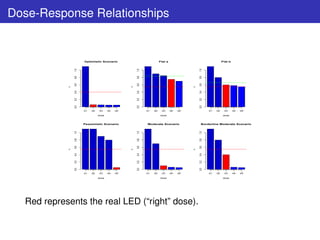
Dose-Response Relationships


                      Optimistic Scenario                            Flat a                                 Flat b


                1.0


                                                     1.0


                                                                                            1.0
                0.8


                                                     0.8


                                                                                            0.8
                0.6


                                                     0.6


                                                                                            0.6
            α


                                                 α


                                                                                        α
                0.4


                                                     0.4


                                                                                            0.4
                0.2


                                                     0.2


                                                                                            0.2
                0.0


                                                     0.0


                                                                                            0.0
                      d1   d2   d3     d4   d5             d1   d2    d3      d4   d5             d1   d2    d3      d4   d5

                                dose                                 dose                                   dose


                      Pessimistic Scenario                 Moderate Scenario                 Borderline Moderate Scenario
                1.0


                                                     1.0


                                                                                            1.0
                0.8


                                                     0.8


                                                                                            0.8
                0.6


                                                     0.6


                                                                                            0.6
            α


                                                 α


                                                                                        α
                0.4


                                                     0.4


                                                                                            0.4
                0.2


                                                     0.2


                                                                                            0.2
                0.0


                                                     0.0


                                                                                            0.0
                      d1   d2   d3     d4   d5             d1   d2    d3      d4   d5             d1   d2    d3      d4   d5

                                dose                                 dose                                   dose


  Red represents the real LED (“right” dose).
Simulation Setup


   Initial Allocation: assuming we start with 1 : a : b : c : 1:
                      • a = 0, b = 1, c = 0, i.e. 1:0:1:0:1;
                      • a = 1, b = 1, c = 1, i.e. 1:1:1:1:1;
                      • a = 1, b = 2, c = 1, i.e. 1:1:2:1:1.
                                           0.4
                                          
                                          
   Predictive Probability Threshold: t =  0.5
                                          
                                          
                                          
                                           0.6
                                          

   Number of Patients: split the 250 patients between the first and
               the second phase:
                  • 30% at interim and 70% for the next phase;
                  • half at interim and half for the next phase.
          Size: 500 simulations with 500 simulated studies for
                prediction and N = 104 for the resampling.
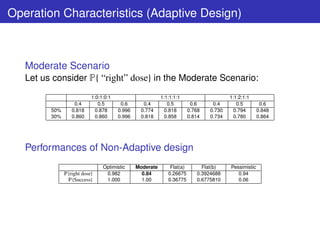
Operation Characteristics (Adaptive Design)


   Moderate Scenario
   Let us consider P{ “right” dose} in the Moderate Scenario:
                           1:0:1:0:1                      1:1:1:1:1                     1:1:2:1:1
                   0.4        0.5       0.6      0.4         0.5         0.6     0.4       0.5         0.6
         50%      0.818      0.878     0.996    0.774      0.818        0.768   0.730     0.794       0.848
         30%      0.860      0.860     0.996    0.818      0.858        0.814   0.734     0.780       0.864


   Performances of Non-Adaptive design
                                Optimistic     Moderate       Flat(a)        Flat(b)    Pessimistic
               P{right dose}     0.982           0.84        0.26675       0.3924688       0.94
                P{Success}       1.000           1.00        0.36775       0.6775810       0.06
Operation Characteristics: Cheaper Solution


   Expected number of patients (total sample size = 250)
                             1:0:1:0:1                 1:1:1:1:1                 1:1:2:1:1
                      50%-50%       30%-70%    50%-50%        30%-70%    50%-50%        30%-70%
         Optimistic     250            250      137.75          129.67     144.5          149.67
         Moderate       250            250      232.25          236.67    237.75          238.67
           Flat (a)    191.88          178       180.5          151.17    168.12           151.5
           Flat (b)    231.88         216.17     216.5          191.33     216.5          195.33
        Pessimistic     250            250        183           177.33    188.67          188.33
Operation Characteristics: Effect of Thresholds

                   Optimistic 010−30 (t=0.4)                 Optimistic 010−30 (t=0.5)                 Optimistic 010−30 (t=0.6)


                                                       0.7
             0.7


                                                       0.6


                                                                                                 0.8
             0.6


                                                       0.5
             0.5


                                                                                                 0.6
                                                       0.4
             0.4


                                                       0.3


                                                                                                 0.4
             0.3


                                                       0.2
             0.2


                                                                                                 0.2
                                                       0.1
             0.1
             0.0


                                                       0.0


                                                                                                 0.0
                           2                   3                     2                   3                     2                   3

                                 PPS LED                                   PPS LED                                   PPS LED


                   Optimistic 010−30 (t=0.4)                 Optimistic 010−30 (t=0.5)                 Optimistic 010−30 (t=0.6)
             0.5


                                                       0.5


                                                                                                 0.5
             0.4


                                                       0.4


                                                                                                 0.4
             0.3


                                                       0.3


                                                                                                 0.3
             0.2


                                                       0.2


                                                                                                 0.2
             0.1


                                                       0.1


                                                                                                 0.1
             0.0


                                                       0.0


                                                                                                 0.0

                       2            3              5             2            3              5             2            3              5

                               Posterior LED                             Posterior LED                             Posterior LED
Summary


   1   The procedure succeeds in detecting the properties of
       different Scenarios.
   2   The Adaptive Design, when using an appropriate threshold, is
       more efficient than the Non-Adaptive one in terms of number
       of patients and not inferior in terms of sensitivity and
       specificity.
   3   The BMA allows for correction of suboptimal interim
       decisions about the allocation.
   4   Increasing the threshold we require the dose to have a
       higher margin of superiority (0.6 too strict).
   5   The 30%-70% proportion and the 1:0:1:0:1 allocation are
       definitely less efficient than the other configurations.
Some References


    1                                        ¨
        S. Berry, B. Carlin, J. Lee, and P. Muller, Bayesian Adaptive
        Methods for Clinical Trials, CRC Press, (2010);
    2   D.Ohlssen, A.Racine, A Flexible Bayesian Approach for
        Modeling Monotonic Dose-Response Relationships in Clinical
        Trials with Applications in Drug Development, Computational
        Statistics and Data Analysis,(Under Revision);
    3   A.F.M Smith, A.E. Gelfand, Bayesian Statistics without Tears,
        The American Statistician, (1992);
    4   J.A.Hoeting, D.Madigan, A.E.Raftery , C.T.Volinsky, Bayesian
        Model Averaging: a Tutorial (with Discussion). Statistical
        Science, (1999);
Acknowledgements


              Thank You for Your Attention!!!

  Joint work with:
  Heinz Schmidli, Novartis AG, Statistical Methodology
  Mauro Gasparini, Politecnico di Torino, Department of Mathematics
  Amy Racine, Novartis AG, Modeling  Simulations

  Special thanks to:
  David Ohlssen, Novartis Pharma, Statistical Methodology

Luca Pozzi 5thBCC 2012

  • 1.
    A Bayesian AdaptiveDose Selection Procedure with Semi-Parametric Dose-Response Modeling Luca Pozzi University of California, Berkeley p.luc@stat.berkeley.edu January 24, 2012 - 5th Annual Bayesian Biostatistics Conference, Houston, TX
  • 2.
    Predictive Probability inClinical Trials Berry et al. 2010, Chapter 4 “The Predictive Probability approach looks into the future based on the current observed data to project whether a positive conclusion at the end of the study is likely or not, and then makes a sensible decision at the present time accordingly.”
  • 3.
    Predictive Probability ofSuccess (PPS) For the ease of notation let us define: Y = {Past Data} i.e. interim data; Y ∗ = {Future Data} i.e. post interim data. In our setting, as in Berry et al. (2010) PPS = P{Success|Y } = P{Y ∗ ∈ YS |Y } = p (Y ∗ |Y )dY ∗ (1) YS being YS defined as {Success} = YS = {Y ∗ : P{θ ∈ ΘE |Y ∗ , Y } > t } for some efficacy domain ΘE and some threshold t, the predictive quantity (??) then becomes PPS = 1{P{θ ∈ ΘE |Y ∗ , Y } > t }p (Y ∗ |Y )dY ∗ (2) where P{θ ∈ ΘE |Y ∗ , Y } = ΘE p (θ|Y ∗ , Y )dθ.
  • 4.
    Motivating Example: ProblemSetting Objective: Lowest Effective Dose (LED), i.e. dose whose efficacy is at least 50% better than placebo (Dose 1) and at most 20% worse than the highest dose (Dose 5); Design of the Study: Start with initial allocation 1:a:b:c:1 then at interim stop or select the most promising dose d for a second phase with only placebo, Dose d and Dose 5; Endpoint: Overdispersed count data Y modeled by the negative binomial distribution (Gamma-Poisson mixture): Y |λ ∼ Pois(λ) λ|(α, β) ∼ Gamma(α, β) Pharmacodynamic: Sigmoidal relationship EMAX ·D e.g. EMAX -model: E (D ) = E0 1 − D50% +D . Strong prior information available for placebo (E0 ) and highest dose (EMAX );
  • 5.
    Modeling Dose-Response Relationship 1st challenge: Modeling Too few doses to adopt Parametric Dose-Response model. (Adaptive design will start with only one lower dose) Strategy: Semiparametric Specification The mode of action of the drug and Ph.III outcomes suggest that a monotonicity constraint holds for the dose-response relationship: Mm = µj ≡ E[Yij ] : E0 = µ1 ≥ µ2 ≥ µ3 ≥ µ4 ≥ µ5 = EMAX
  • 6.
    Modeling Approach Bayesian Model Averaging: Ingredients 1 A set of mutually exclusive models M = {M1 , ..., MM }. To each model corresponds a probability distribution f (y |θ(m) , Mm ); 2 One set of priors g (θ(m) |Mm ) on θ(m) for each Mm ; 3 A vector of prior model probabilities π = (π1 , ..., πM ), πm = P{Mm }, (e.g. πm = M ), ∀ m = 1, ..., M. 1 We have then: M P{success|y } = P{success|Mm , y }P{Mm |y } m=1
  • 7.
    Bayesian model Gamma-Poisson: for the i-th patient and the j-th dose group Yij |λij ∼ dpois(λij ) λij |αj , β ∼ dgamma(αj , β) So Yij marginal distribution is a dnegbin(αj , β) Priors: log(α1 ) ∼ N(µα , σ2 ); α α|m ∼ fm λd (m) log(β) ∼ N(0, σ2 ) β
  • 8.
    Monotonicity Constraints We introduce the jump variables δk = log(αk ) − log(αk −1 ) ≥ 0 δk 0 iff αk > αk +1 and we put a truncated normal prior on 4 δsum = δk = log(α1 ) − log(α5 ) ∼ T N(µsum , σ2 ) sum 1 being T N a normal distribution folded around its mean: formally if Z ∼ N(0, 1) then X ∼ T N(ν, τ2 ) ⇐⇒ X = ν + τ|Z | α1 ≥ α2 ≥ α3 ≥ α4 ≥ α5 δ1,m δ2,m δ3,m δ4,m
  • 9.
    Jump×Model Matrix  δ1,1 0 δ1,3 δ1,4 0 0 δ1,10    0 0 0    δ  2,1 δ2,2 δ2,3 δ2,4 0 δ2,6 0 δ2,8 0  0    ∆=     δ  3,1 δ3,2 δ3,3 0 δ3,5 δ3,6 0    0 δ3,9 0        δ4,1 δ4,2 0 0 δ4,5 0 δ4,7   0 0 0 e.g. M5 : µ1 = µ2 = µ3 > µ4 > µ5 α1 = α2 = α3 > α4 > α5 δ3,5 δ4,5
  • 10.
    Criteria Futility-Success Exclusion Criterion P{µd /µ1 ≥ 0.7|data} ≥ 50%, i.e. Dose d is not superior to placebo. Efficacy Criterion is the intersection of the following events: (i) the dose is far enough from Dose 1 P{µd /µ1 < 1|data} ≥ 95% (ii) the dose is either at least 50% better than Dose 1, or at most 20% worse than Dose 5. P{µd /µ1 ≤ 0.5|data} max ≥ 50% P{µd /µ5 ≤ 1.2|data}
  • 11.
    Interim Decision At Interim • if Dose 4 meets Exclusion Criterion stop for futility: no dose lower than Dose 5 is effective; • if Dose 2 meets Efficacy Criteria stop for success: Dose 2 is the LED; • otherwise, for each not futile Dose d calculate the Predictive Probability of Success (PPS) and allocate to the lowest dose for which P (i) Ad , Y , Y ∗ ∩ (ii) Ad , Y , Y ∗ > 50% Y ≥ t (3) with Ad = {allocate to Dose d }.
  • 12.
    Decision Tree LED = d3 LED = d4 A4 LED = d2 LED LED = d4 LED = d5 LED Start the Trial Decision at Interim A3 LED = d2 LED = d2 LED = d3 LED = d2 LED A2 LED = d3 LED = d4
  • 13.
    Performing Predictive ProbabilityCalculations 2nd challenge: Computational Not feasible to use WinBUGS for Predictive Calculations Stategy: Importance Sampling Sample from the posterior sample using weighted resampling: (α, β)(1) , ..., (α, β)(N ) → (α, β)∗
  • 14.
    Algorithm: Predictive Resample 1 Sample (α, β)(1) , ..., (α, β)(k ) , ..., (α, β)(N ) ; 2 Select Dose d; 3 for l = 1, ..., L draw (α, β)(l ) from the posterior sample at interim of size N; ∗(l ) 4 Simulate one dataset Yd |(α, β)(l ) , Ad ; SIR (l ) 5 Compute p Yd |(α, β)(k ) , k = 1, ..., N; ∗(l ) l (θk ;Y ∗ ) p (Yd |(α,β)(k ) ) 6 Compute wk = ∗ = ∗(l ) ; j l (θj ;Y ) j p (Yd |(α,β)(j ) ) (l ) 7 Compute by resampling PPd [criterion] for each criteria; In the end: L   1 (l ) {PPd [criterion] c }     PPd = mean        {criteria} l =1
  • 15.
    Dose-Response Relationships Optimistic Scenario Flat a Flat b 1.0 1.0 1.0 0.8 0.8 0.8 0.6 0.6 0.6 α α α 0.4 0.4 0.4 0.2 0.2 0.2 0.0 0.0 0.0 d1 d2 d3 d4 d5 d1 d2 d3 d4 d5 d1 d2 d3 d4 d5 dose dose dose Pessimistic Scenario Moderate Scenario Borderline Moderate Scenario 1.0 1.0 1.0 0.8 0.8 0.8 0.6 0.6 0.6 α α α 0.4 0.4 0.4 0.2 0.2 0.2 0.0 0.0 0.0 d1 d2 d3 d4 d5 d1 d2 d3 d4 d5 d1 d2 d3 d4 d5 dose dose dose Red represents the real LED (“right” dose).
  • 16.
    Simulation Setup Initial Allocation: assuming we start with 1 : a : b : c : 1: • a = 0, b = 1, c = 0, i.e. 1:0:1:0:1; • a = 1, b = 1, c = 1, i.e. 1:1:1:1:1; • a = 1, b = 2, c = 1, i.e. 1:1:2:1:1.  0.4   Predictive Probability Threshold: t =  0.5     0.6  Number of Patients: split the 250 patients between the first and the second phase: • 30% at interim and 70% for the next phase; • half at interim and half for the next phase. Size: 500 simulations with 500 simulated studies for prediction and N = 104 for the resampling.
  • 17.
    Operation Characteristics (AdaptiveDesign) Moderate Scenario Let us consider P{ “right” dose} in the Moderate Scenario: 1:0:1:0:1 1:1:1:1:1 1:1:2:1:1 0.4 0.5 0.6 0.4 0.5 0.6 0.4 0.5 0.6 50% 0.818 0.878 0.996 0.774 0.818 0.768 0.730 0.794 0.848 30% 0.860 0.860 0.996 0.818 0.858 0.814 0.734 0.780 0.864 Performances of Non-Adaptive design Optimistic Moderate Flat(a) Flat(b) Pessimistic P{right dose} 0.982 0.84 0.26675 0.3924688 0.94 P{Success} 1.000 1.00 0.36775 0.6775810 0.06
  • 18.
    Operation Characteristics: CheaperSolution Expected number of patients (total sample size = 250) 1:0:1:0:1 1:1:1:1:1 1:1:2:1:1 50%-50% 30%-70% 50%-50% 30%-70% 50%-50% 30%-70% Optimistic 250 250 137.75 129.67 144.5 149.67 Moderate 250 250 232.25 236.67 237.75 238.67 Flat (a) 191.88 178 180.5 151.17 168.12 151.5 Flat (b) 231.88 216.17 216.5 191.33 216.5 195.33 Pessimistic 250 250 183 177.33 188.67 188.33
  • 19.
    Operation Characteristics: Effectof Thresholds Optimistic 010−30 (t=0.4) Optimistic 010−30 (t=0.5) Optimistic 010−30 (t=0.6) 0.7 0.7 0.6 0.8 0.6 0.5 0.5 0.6 0.4 0.4 0.3 0.4 0.3 0.2 0.2 0.2 0.1 0.1 0.0 0.0 0.0 2 3 2 3 2 3 PPS LED PPS LED PPS LED Optimistic 010−30 (t=0.4) Optimistic 010−30 (t=0.5) Optimistic 010−30 (t=0.6) 0.5 0.5 0.5 0.4 0.4 0.4 0.3 0.3 0.3 0.2 0.2 0.2 0.1 0.1 0.1 0.0 0.0 0.0 2 3 5 2 3 5 2 3 5 Posterior LED Posterior LED Posterior LED
  • 20.
    Summary 1 The procedure succeeds in detecting the properties of different Scenarios. 2 The Adaptive Design, when using an appropriate threshold, is more efficient than the Non-Adaptive one in terms of number of patients and not inferior in terms of sensitivity and specificity. 3 The BMA allows for correction of suboptimal interim decisions about the allocation. 4 Increasing the threshold we require the dose to have a higher margin of superiority (0.6 too strict). 5 The 30%-70% proportion and the 1:0:1:0:1 allocation are definitely less efficient than the other configurations.
  • 21.
    Some References 1 ¨ S. Berry, B. Carlin, J. Lee, and P. Muller, Bayesian Adaptive Methods for Clinical Trials, CRC Press, (2010); 2 D.Ohlssen, A.Racine, A Flexible Bayesian Approach for Modeling Monotonic Dose-Response Relationships in Clinical Trials with Applications in Drug Development, Computational Statistics and Data Analysis,(Under Revision); 3 A.F.M Smith, A.E. Gelfand, Bayesian Statistics without Tears, The American Statistician, (1992); 4 J.A.Hoeting, D.Madigan, A.E.Raftery , C.T.Volinsky, Bayesian Model Averaging: a Tutorial (with Discussion). Statistical Science, (1999);
  • 22.
    Acknowledgements Thank You for Your Attention!!! Joint work with: Heinz Schmidli, Novartis AG, Statistical Methodology Mauro Gasparini, Politecnico di Torino, Department of Mathematics Amy Racine, Novartis AG, Modeling Simulations Special thanks to: David Ohlssen, Novartis Pharma, Statistical Methodology