The passive voice
Guillermo Pérez Ferrand
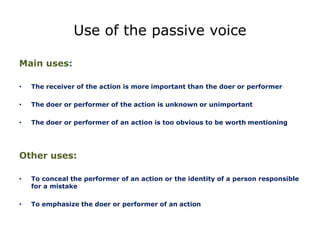
Use of the passive voice
Main uses:
• The receiver of the action is more important than the doer or performer
• The doer or performer of the action is unknown or unimportant
• The doer or performer of an action is too obvious to be worth mentioning
Other uses:
• To conceal the performer of an action or the identity of a person responsible
for a mistake
• To emphasize the doer or performer of an action
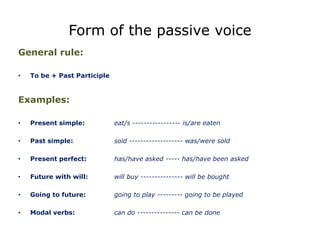
Form of the passive voice
General rule:
• To be + Past Participle
Examples:
• Present simple: eat/s ----------------- is/are eaten
• Past simple: sold ------------------- was/were sold
• Present perfect: has/have asked ----- has/have been asked
• Future with will: will buy --------------- will be bought
• Going to future: going to play --------- going to be played
• Modal verbs: can do --------------- can be done
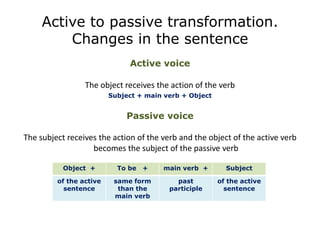
Active to passive transformation.
Changes in the sentence
Active voice
The object receives the action of the verb
Subject + main verb + Object
Passive voice
The subject receives the action of the verb and the object of the active verb
becomes the subject of the passive verb
Object + To be + main verb + Subject
of the active
sentence
same form
than the
main verb
past
participle
of the active
sentence
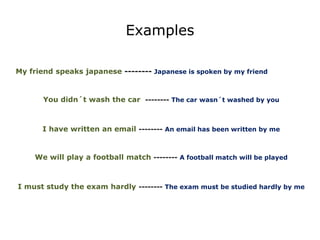
Examples
My friend speaks japanese -------- Japanese is spoken by my friend
You didn´t wash the car -------- The car wasn´t washed by you
I have written an email -------- An email has been written by me
We will play a football match -------- A football match will be played
I must study the exam hardly -------- The exam must be studied hardly by me

The passive voice

  • 1.
  • 2.
    Use of thepassive voice Main uses: • The receiver of the action is more important than the doer or performer • The doer or performer of the action is unknown or unimportant • The doer or performer of an action is too obvious to be worth mentioning Other uses: • To conceal the performer of an action or the identity of a person responsible for a mistake • To emphasize the doer or performer of an action
  • 3.
    Form of thepassive voice General rule: • To be + Past Participle Examples: • Present simple: eat/s ----------------- is/are eaten • Past simple: sold ------------------- was/were sold • Present perfect: has/have asked ----- has/have been asked • Future with will: will buy --------------- will be bought • Going to future: going to play --------- going to be played • Modal verbs: can do --------------- can be done
  • 4.
    Active to passivetransformation. Changes in the sentence Active voice The object receives the action of the verb Subject + main verb + Object Passive voice The subject receives the action of the verb and the object of the active verb becomes the subject of the passive verb Object + To be + main verb + Subject of the active sentence same form than the main verb past participle of the active sentence
  • 5.
    Examples My friend speaksjapanese -------- Japanese is spoken by my friend You didn´t wash the car -------- The car wasn´t washed by you I have written an email -------- An email has been written by me We will play a football match -------- A football match will be played I must study the exam hardly -------- The exam must be studied hardly by me