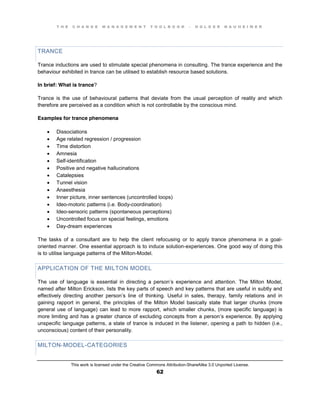
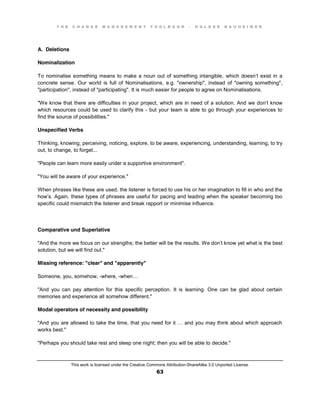
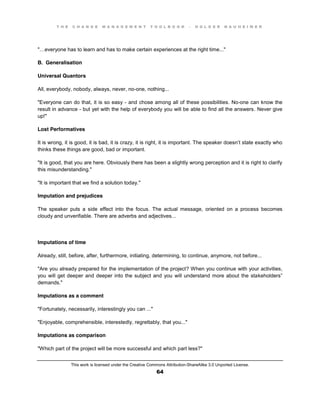
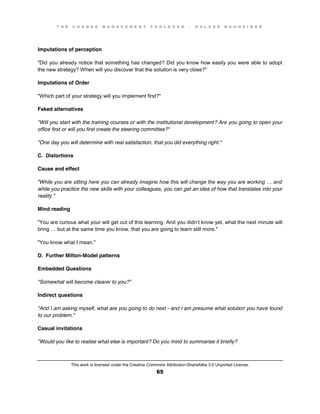
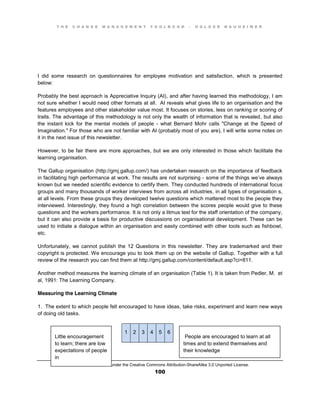
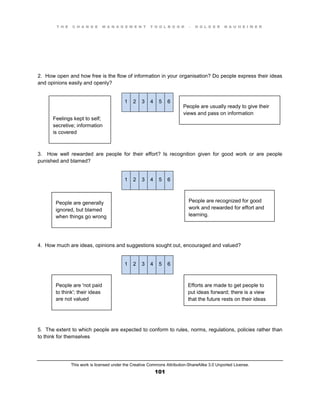
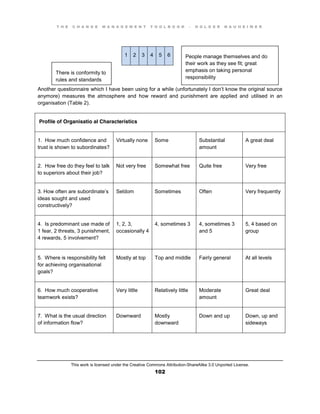
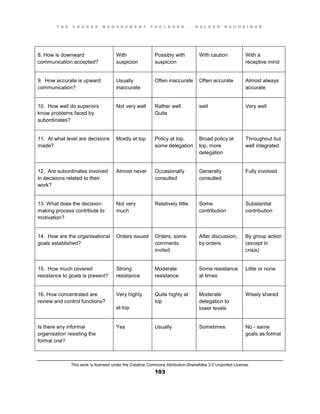
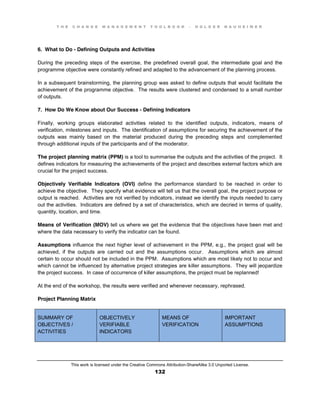
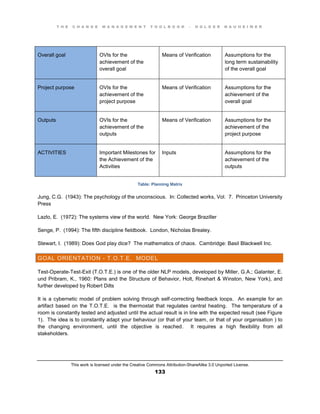
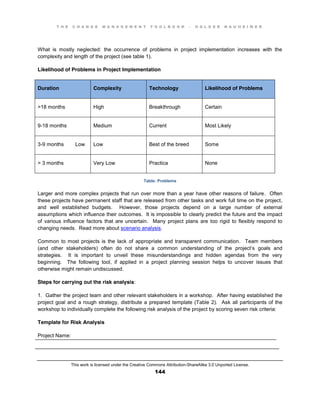
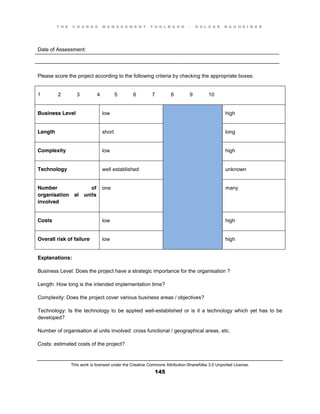
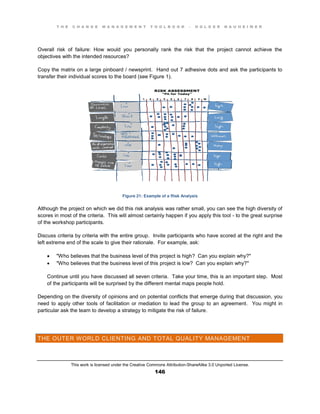
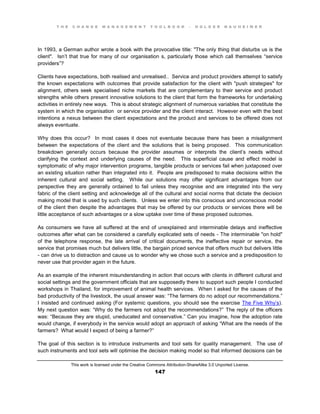
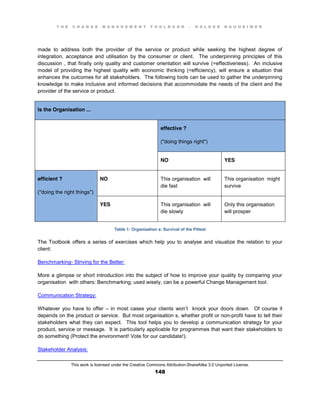
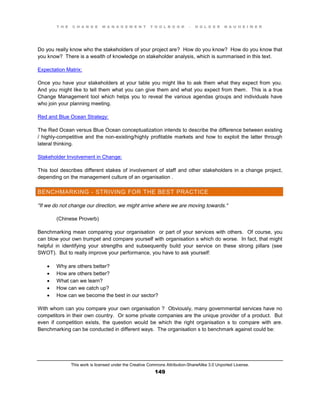
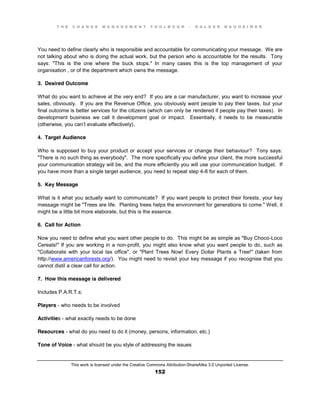
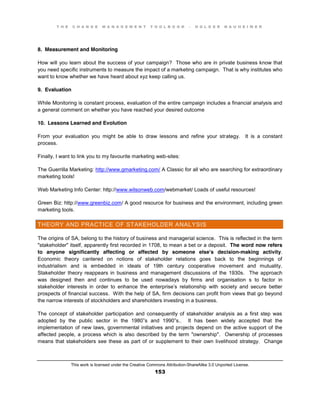
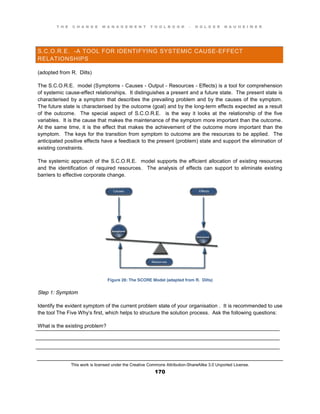
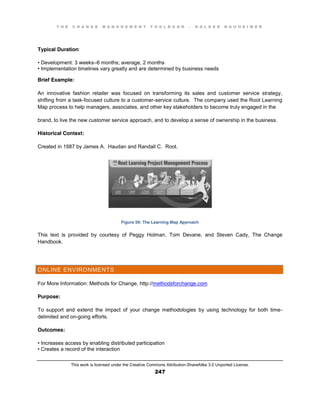
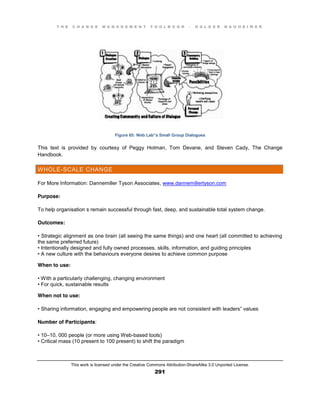
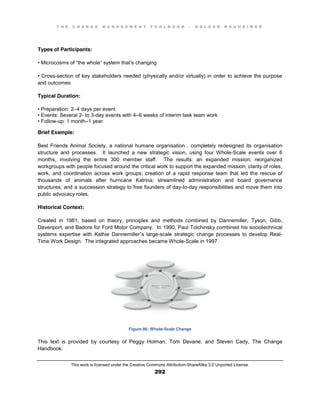
T H E C H A N G E M A N A G E M E N T T O O L B O O K – H O L G E R N A U H E I M E R
This work is licensed under the Creative Commons Attribution-ShareAlike 3.0 Unported License.
1
T H E C H A N G E M A N A G E M E N T T O O L B O O K – H O L G E R N A U H E I M E R
This work is licensed under the Creative Commons Attribution-ShareAlike 3.0 Unported License.
2
Contents
welcome! ................................................................................................9
Introduction to Change Management....................................................10
What skills are required for change facilitation? ............................12
Self ................................................................................................16
Creativity Applied: Defining Your Goals......................................................................16
Tool: Goal Orientation - T.O.T.E. Model ...................................................................17
Tool: The Walt Disney Circle - Refining Personal and Corporate Goals....................19
Tool: Mindmapping......................................................................................................25
Team .............................................................................................48
eurobiology Applied - How Individual Mental Maps Influence our Behaviour.............49
Mental Maps - how the Individual Perceives Reality ..................................................50
The Meta Model of Language .....................................................................................52
The Surface: The Meta Model of Language ...............................................................53
Information Gathering (Deletions)...............................................................................54
Limitations of the Speaker”s  Model  (Generalisations)................................................58
A Few Words on Deep Structures ..............................................................................59
The Milton Model.........................................................................................................60
The Wonder Question.................................................................................................66
The Wheel of Multiple Perspectives............................................................................67
Conflict Solving - Belief Outframing Pattern ...............................................................69
The  Prisoner”s  Dilemma .............................................................................................73
Teamwork and Team Learning: ..................................................................................74
Feedback Exercise......................................................................................................77
Working with Diversity.................................................................................................78
T H E C H A N G E M A N A G E M E N T T O O L B O O K – H O L G E R N A U H E I M E R
This work is licensed under the Creative Commons Attribution-ShareAlike 3.0 Unported License.
3
Fish Bowl.....................................................................................................................80
Creative Solutions - Intervison with Drawings ............................................................81
After Action Review (AAR)..........................................................................................82
Expectation Matrix.......................................................................................................83
Gentle Evaluation........................................................................................................85
Peer Mentoring............................................................................................................86
Ways of democratic decision making or "The art of dividing a pumpkin" ...................87
A Matrix for Training Needs Analysis..........................................................................90
Larger Systems .............................................................................93
Analysis  of  an  Organisation  ‘s  Learning  Climate ........................................................93
Aspects of Organisational Development.....................................................................93
Scoping - Delineating the Systemic Context of Consulting Assignments...................95
SWOT-Analysis...........................................................................................................97
Questionnaires for Satisfaction at the Workplace.......................................................99
Organisation al Timeline: Writing the History of Your Organisation .........................104
Exploring the Conscious and the Unconscious Mind of Organisation s ...................106
Systemic Constellations............................................................................................109
Analyze Change Drivers on Different Levels of Change ..........................................112
Ralph  Stacey”s  Agreement  &  Certainty  Matrix .........................................................114
Creating  an  Organisation  ”s  Vision: ..........................................................................116
Logical level alignment - defining your identity .........................................................118
Planning and Project Management...........................................................................122
Project Cycle Management (PCM): New Project Management Tools or Recycled
Approaches from Yesterday? ...................................................................................124
Goal Orientation - T.O.T.E. Model ...........................................................................133
T H E C H A N G E M A N A G E M E N T T O O L B O O K – H O L G E R N A U H E I M E R
This work is licensed under the Creative Commons Attribution-ShareAlike 3.0 Unported License.
4
The Walt Disney Circle - Refining Personal and Corporate Goals ...........................135
Scenario Workshops - a Tool for Challenging Collective Mental Maps....................141
Risk Assessment for Projects ...................................................................................143
The Outer World Clienting and Total Quality Management......................................146
Benchmarking - Striving for the Best Practice ..........................................................149
Tell what you sell - Developing a Communication Strategy......................................151
Theory and Practice of Stakeholder Analysis ...........................................................153
Expectation Matrix.....................................................................................................156
Red and Blue Ocean Strategy ..................................................................................158
Stakeholder Involvement in Change.........................................................................161
Systems  Thinking:  You  can”t  have  the  Butter  and  the  Money  from  the  Butter.........163
Personal Scenarios...................................................................................................167
The Five Whys ..........................................................................................................168
S.C.O.R.E. -A Tool for Identifying Systemic Cause-Effect Relationships................170
Scenario Workshops - a Tool for Challenging Collective Mental Maps....................174
Presencing–Allocating the Blind Spot of Leadership - Theory U..............................176
Dnn,  Dnn,  Dnn…  Another  One Swept in the Spiral of War ......................................177
Large Systems Change ...............................................................182
OPEN SPACE - A Tool for Effective Stakeholder Consultation ...............................183
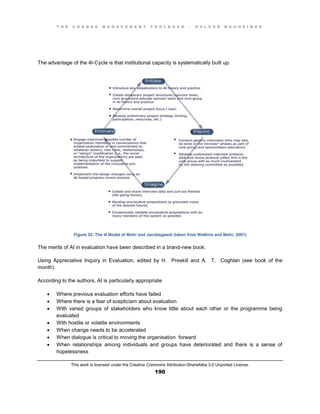
Appreciative Inquiry Revisited...................................................................................187
A New Approach for Monitoring and Evaluation .......................................................187
Future Search ...........................................................................................................191
The World Café.........................................................................................................192
History and Background............................................................................................192
The Change Handbook.............................................................................................195
T H E C H A N G E M A N A G E M E N T T O O L B O O K – H O L G E R N A U H E I M E R
This work is licensed under the Creative Commons Attribution-ShareAlike 3.0 Unported License.
5
Action Learning .........................................................................................................198
Action Review Cycle/AAR.........................................................................................200
Ancient Wisdom Council ...........................................................................................202
Appreciative Inquiry...................................................................................................203
Appreciative Inquiry Summit .....................................................................................205
Balanced Scorecard..................................................................................................207
Civic Engagement.....................................................................................................208
Collaborative Loops ..................................................................................................210
Collaborative Work Systems Design.........................................................................211
Community Summits.................................................................................................213
Community Weaving.................................................................................................215
The Conference Model .............................................................................................217
Consensus Decision Making.....................................................................................218
Conversation Cafe ....................................................................................................219
The Cycle of Resolution............................................................................................221
Dialogue and Deliberation.........................................................................................223
The Drum Cafe..........................................................................................................224
Dynamic Facilitation..................................................................................................226
Dynamic Planning Charrettes ...................................................................................228
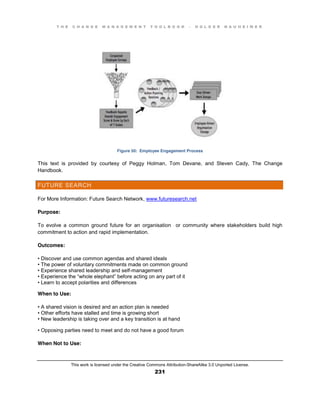
Employee Engagement Process...............................................................................229
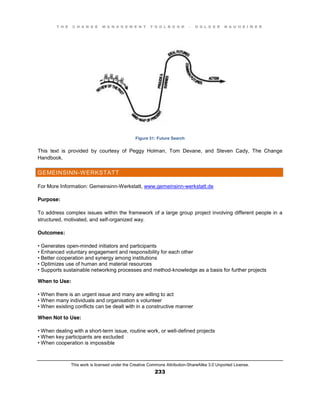
Future Search ...........................................................................................................231
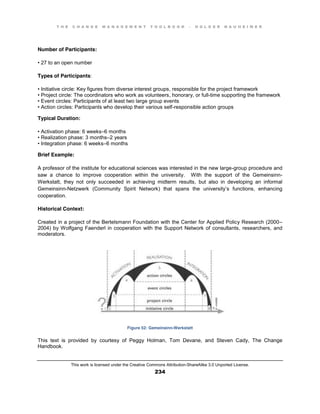
Gemeinsinn-Werkstatt...............................................................................................233
The Genuine Contact Program .................................................................................235
Human Systems Dynamics.......................................................................................236
Idealized Design........................................................................................................238
T H E C H A N G E M A N A G E M E N T T O O L B O O K – H O L G E R N A U H E I M E R
This work is licensed under the Creative Commons Attribution-ShareAlike 3.0 Unported License.
6
Integrated Clarity.......................................................................................................239
Jazz Lab....................................................................................................................241
Large Group Scenario Planning................................................................................242
Leadership Dojo........................................................................................................244
The Learning Map Approach ....................................................................................246
Online Environments.................................................................................................247
Open Space Technology ..........................................................................................249
Open Systems Theory ..............................................................................................251
OpenSpace-Online Real-Time Methodology............................................................252
Organisation Workshop ...........................................................................................254
Participative Design Workshop .................................................................................256
PeerSpirit Circling .....................................................................................................257
Playback Theatre ......................................................................................................259
Power of Imagination Studio .....................................................................................260
The Practice of Empowerment..................................................................................262
Rapid Results............................................................................................................263
Real Time Strategic Change.....................................................................................265
Scenario Thinking .....................................................................................................267
Search Conference ...................................................................................................268
SimuReal...................................................................................................................270
The Six Sigma Approach ..........................................................................................272
SOAR ........................................................................................................................273
Strategic Forum.........................................................................................................275
Strategic Visioning ....................................................................................................276
Study Circles .............................................................................................................278
T H E C H A N G E M A N A G E M E N T T O O L B O O K – H O L G E R N A U H E I M E R
This work is licensed under the Creative Commons Attribution-ShareAlike 3.0 Unported License.
7
Technology of Participation.......................................................................................280
Think Like a Genius ..................................................................................................281
21st Century Town Meeting ......................................................................................283
Values Into Action .....................................................................................................284
Visual Explorer..........................................................................................................286
Visual Recording and Graphic Facilitation................................................................288
Web  Lab”s  Small  Group  Dialogues...........................................................................289
Whole-Scale Change ................................................................................................291
Whole Systems Approach.........................................................................................293
WorkOut....................................................................................................................294
The World Cafe.........................................................................................................296
Book Reviews.....................................................................................298
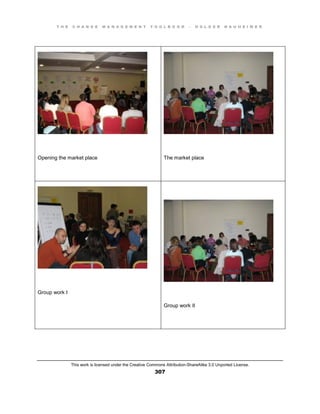
Images from Open Space Conference in Sofia, March 2005 ..............305
T H E C H A N G E M A N A G E M E N T T O O L B O O K – H O L G E R N A U H E I M E R
This work is licensed under the Creative Commons Attribution-ShareAlike 3.0 Unported License.
8
This work is licensed under the Creative Commons Attribution-
ShareAlike 3.0 Unported License.
To view a copy of this license, visit
http://creativecommons.org/licenses/by-sa/3.0/
T H E C H A N G E M A N A G E M E N T T O O L B O O K – H O L G E R N A U H E I M E R
This work is licensed under the Creative Commons Attribution-ShareAlike 3.0 Unported License.
9
WELCOME!
Are you personally ready for change? Is your team in serious need of new ways of working together?
How can your organisation deal with a change project that lacks focus or direction? Do you want to
know why change is inevitable but often difficult to realise? Do you want to surf on the waves of
change? Read on, you may find answers to your questions here...
The Change Management Toolbook is a collection of more than 120 tools, methods and strategies
that you can apply during different stages of personal, team and organisational development, in
training, facilitation and consulting. It is divided into three principal sections (if you like, you can jump
straight to each section by clicking on the links below):
 Self
Change Management starts and ends with individuals. As system theory says, you cannot
really predict how a person reacts to a certain stimulus. So, if you want to introduce change
into a system, you will most likely need to think about what skills, behaviours and belief
systems the members of the system will need to be part of the change effort ...more
 Team
At the heart of modern organisations are teams that share the responsibility and the
resources for getting things done. Most projects are too complex to be implemented by one
person, most services need different specialists and support staff to be delivered, and most
products are the result of the work of a larger resources team or supply chain. We know that
teams can either perform at their peak, or can be terribly inefficient …more
 Larger Systems
Change processes are mostly initiated by either individuals or small teams, but the focus of
change is one which goes beyond that small unit. It is directed towards the entire
organisation, or towards other organisations. A change project might be related to a
community, a region or an entire society (and, yes: to the world as a whole)…more.
T H E C H A N G E M A N A G E M E N T T O O L B O O K – H O L G E R N A U H E I M E R
This work is licensed under the Creative Commons Attribution-ShareAlike 3.0 Unported License.
10
INTRODUCTION TO CHANGE MANAGEMENT
Change Management is a process and a utilisation of tools and techniques to manage the people side of
change processes to achieve the required outcomes and to realise the change effectively within the
individual change agent, the inner team, and the wider system
There are a multitude of concepts relating to Change Management and it is very difficult to distil a
common denominator from all the sources that are applying the phrase to their understanding of
organisational development. However, common amongst these varying concepts is the notion of a
learning organisation.
Only when organisations and individuals who make up the organisations learn, will they be able to master
positive change. In other words, change is the result of organisational learning processes that engage
the following questions:
“In order to sustain and grow as an organisation and as individuals within; what are the procedures, what
is the know-how we need to maintain and where do we need to change?”,  and,  “How can we manage
change that is in harmony with the values we hold as individuals and as organisations?”
Change Management has to be viewed in relation to Knowledge Management, which took several turns
during the nineties. When the establishment of an intranet was suddenly feasible to any large
organisation, IT and management scientists declared the beginning of the "knowledge society". The
premature anticipation of knowledge management was that every member of an organisation would be
highly motivated to share information through a common platform and a quality improvement process
would be enabled more or less by itself. It only took a couple of years to realise that this assumption was
false. To date there are no examples of companies which transformational learning is facilitated by an IT
system only, because the early protagonists forgot that information does not equal knowledge and that
human knowledge is in hands of the people who make-up the larger system.
As in the Renaissance, it will be an exciting time, a time of great opportunities for those who
can see and seize them, but of a great threat and fear for many. It will be more difficult to
hold organizations and societies together. The softer words of leadership and vision and
common purpose will replace the tougher words of control and authority because the tough
words won't bite anymore. Organizations will have to become communities rather than
properties, with members, not employees, because few will be content to be owned by
others. Societies will break down into smaller units but will also regroup into even larger ones
than now for particular purposes.
Charles Handy – Beyond Certainty: The Changing Worlds of Organizations, 1995
T H E C H A N G E M A N A G E M E N T T O O L B O O K – H O L G E R N A U H E I M E R
This work is licensed under the Creative Commons Attribution-ShareAlike 3.0 Unported License.
11
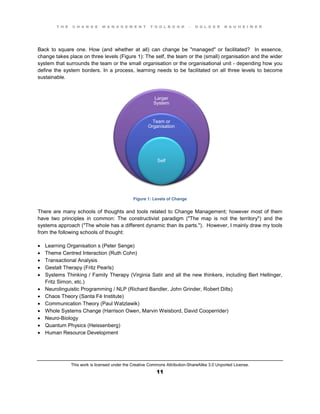
Back to square one. How (and whether at all) can change be "managed" or facilitated? In essence,
change takes place on three levels (Figure 1): The self, the team or the (small) organisation and the wider
system that surrounds the team or the small organisation or the organisational unit - depending how you
define the system borders. In a process, learning needs to be facilitated on all three levels to become
sustainable.
Figure 1: Levels of Change
There are many schools of thoughts and tools related to Change Management; however most of them
have two principles in common: The constructivist paradigm ("The map is not the territory") and the
systems approach ("The whole has a different dynamic than its parts."). However, I mainly draw my tools
from the following schools of thought:
 Learning Organisation s (Peter Senge)
 Theme Centred Interaction (Ruth Cohn)
 Transactional Analysis
 Gestalt Therapy (Fritz Pearls)
 Systems Thinking / Family Therapy (Virginia Satir and all the new thinkers, including Bert Hellinger,
Fritz Simon, etc.)
 Neurolinguistic Programming / NLP (Richard Bandler, John Grinder, Robert Dilts)
 Chaos Theory (Santa Fé Institute)
 Communication Theory (Paul Watzlawik)
 Whole Systems Change (Harrison Owen, Marvin Weisbord, David Cooperrider)
 Neuro-Biology
 Quantum Physics (Heissenberg)
 Human Resource Development
Larger
System
Team or
Organisation
Self
T H E C H A N G E M A N A G E M E N T T O O L B O O K – H O L G E R N A U H E I M E R
This work is licensed under the Creative Commons Attribution-ShareAlike 3.0 Unported License.
12
 Total Quality Management
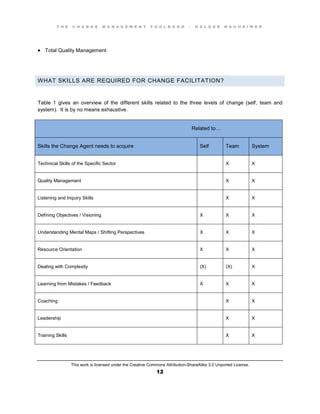
WHAT SKILLS ARE REQUIRED FOR CHANGE FACILITATION?
Table 1 gives an overview of the different skills related to the three levels of change (self, team and
system). It is by no means exhaustive.
Related to…
Skills the Change Agent needs to acquire Self Team System
Technical Skills of the Specific Sector X X
Quality Management X X
Listening and Inquiry Skills X X
Defining Objectives / Visioning X X X
Understanding Mental Maps / Shifting Perspectives X X X
Resource Orientation X X X
Dealing with Complexity (X) (X) X
Learning from Mistakes / Feedback X X X
Coaching X X
Leadership X X
Training Skills X X
T H E C H A N G E M A N A G E M E N T T O O L B O O K – H O L G E R N A U H E I M E R
This work is licensed under the Creative Commons Attribution-ShareAlike 3.0 Unported License.
13
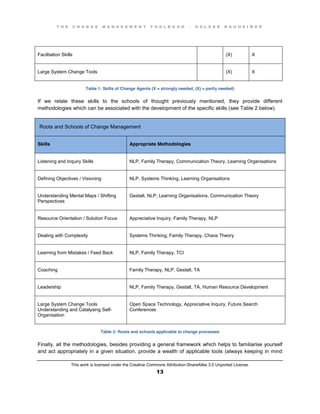
Facilitation Skills (X) X
Large System Change Tools (X) X
Table 1: Skills of Change Agents (X = strongly needed, (X) = partly needed)
If we relate these skills to the schools of thought previously mentioned, they provide different
methodologies which can be associated with the development of the specific skills (see Table 2 below).
Roots and Schools of Change Management
Skills Appropriate Methodologies
Listening and Inquiry Skills NLP, Family Therapy, Communication Theory, Learning Organisations
Defining Objectives / Visioning NLP, Systems Thinking, Learning Organisations
Understanding Mental Maps / Shifting
Perspectives
Gestalt, NLP, Learning Organisations, Communication Theory
Resource Orientation / Solution Focus Appreciative Inquiry, Family Therapy, NLP
Dealing with Complexity Systems Thinking, Family Therapy, Chaos Theory
Learning from Mistakes / Feed Back NLP, Family Therapy, TCI
Coaching Family Therapy, NLP, Gestalt, TA
Leadership NLP, Family Therapy, Gestalt, TA, Human Resource Development
Large System Change Tools
Understanding and Catalysing Self-
Organisation
Open Space Technology, Appreciative Inquiry, Future Search
Conferences
Table 2: Roots and schools applicable to change processes
Finally, all the methodologies, besides providing a general framework which helps to familiarise yourself
and act appropriately in a given situation, provide a wealth of applicable tools (always keeping in mind
T H E C H A N G E M A N A G E M E N T T O O L B O O K – H O L G E R N A U H E I M E R
This work is licensed under the Creative Commons Attribution-ShareAlike 3.0 Unported License.
14
that only fools worship their tools). I try to collect these tools and through my work aim to maintain an
overview, using the simple assumption: "If something does not work, try something else". I am not in the
position (and I will never be) to list them all. But if you browse through our website and the old
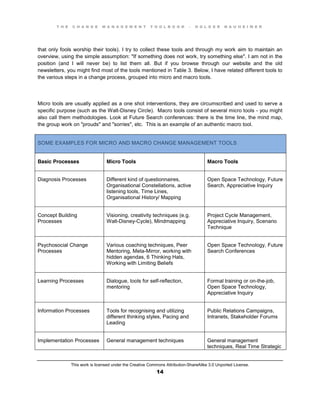
newsletters, you might find most of the tools mentioned in Table 3. Below, I have related different tools to
the various steps in a change process, grouped into micro and macro tools.
Micro tools are usually applied as a one shot interventions, they are circumscribed and used to serve a
specific purpose (such as the Walt-Disney Circle). Macro tools consist of several micro tools - you might
also call them methodologies. Look at Future Search conferences: there is the time line, the mind map,
the group work on "prouds" and "sorries", etc. This is an example of an authentic macro tool.
SOME EXAMPLES FOR MICRO AND MACRO CHANGE MANAGEMENT TOOLS
Basic Processes Micro Tools Macro Tools
Diagnosis Processes Different kind of questionnaires,
Organisational Constellations, active
listening tools, Time Lines,
Organisational History/ Mapping
Open Space Technology, Future
Search, Appreciative Inquiry
Concept Building
Processes
Visioning, creativity techniques (e.g.
Walt-Disney-Cycle), Mindmapping
Project Cycle Management,
Appreciative Inquiry, Scenario
Technique
Psychosocial Change
Processes
Various coaching techniques, Peer
Mentoring, Meta-Mirror, working with
hidden agendas, 6 Thinking Hats,
Working with Limiting Beliefs
Open Space Technology, Future
Search Conferences
Learning Processes Dialogue, tools for self-reflection,
mentoring
Formal training or on-the-job,
Open Space Technology,
Appreciative Inquiry
Information Processes Tools for recognising and utilizing
different thinking styles, Pacing and
Leading
Public Relations Campaigns,
Intranets, Stakeholder Forums
Implementation Processes General management techniques General management
techniques, Real Time Strategic
T H E C H A N G E M A N A G E M E N T T O O L B O O K – H O L G E R N A U H E I M E R
This work is licensed under the Creative Commons Attribution-ShareAlike 3.0 Unported License.
15
Change (RTSC)
Management of all Change
Processes
General management techniques General management
techniques (e.g. participatory
monitoring), TQM
Table 3: Some tools for different steps of the change process
T H E C H A N G E M A N A G E M E N T T O O L B O O K – H O L G E R N A U H E I M E R
This work is licensed under the Creative Commons Attribution-ShareAlike 3.0 Unported License.
16
SELF
Change Management starts and ends with individuals. Systems theory asserts that you cannot really
predict how a person reacts to a stimulus. As a result, if you want to introduce change into a system, you
will most likely need to think about the skills, behaviours and belief systems the members of a system will
need to be part of the change effort. An idea worth considering would be to start with yourself. Read
more about concepts and tools of personal change in this section, which are divided in two parts:
Goals and Creativity - Tools that help you think outside of the box and to think about your personal
goals in the process ...more
Personal Growth - These tools help you to define your personal vision, goals as well as remove the
barriers that may hinder your achievement of these goals ... more
CREATIVITY APPLIED: DEFINING YOUR GOALS
The precondition for personal planning is creativity - one of the main characteristics that distinguishes
mankind from animals. Everything around us exists because someone had a dream, which was later on
realised.
We know about the creativity of our great masters, like, for example, Leonardo Da Vinci, who could
imagine/conceptualise technical innovations, which at this time were not based on any common
knowledge. 500 years later, the helicopter, which had been imagined/conceptualised by Leonardo, was
invented. Or look at Albert Einstein, who was sitting in his (boring) math classes, imagining himself sitting
on a light beam traveling through space. This was once the birth of the general theory of relativity. If you
want to know more about these creative geniuses, I recommend you the series of R. Dilts (Strategies of
Genius I-III).
The famous contemporary German artist Joseph Beuys often was cited with his quote:
"Everybody is an artist!"
(Please check my favourite website on Beuys, who says, "To make people free is the aim of art,
therefore art for me is the science of freedom."!)
In essence, it means that each of us can be creative. In fact, each of us is creative in some parts of our
lives. We may be artists when furnishing our house, when playing an instrument or when formatting
computer documents. But we rarely consider applying this creativity to other sectors. I’m of the opinion
that creativity is a congenital characteristic. Not being creative in a particular sense (e.g. in painting, or
speaking to public) is not a matter of skills, but a matter of belief. Of course, we won’t   become a
Rubinstein on the piano within 5 days, but we have the ability to learn an instrument. Mind you - I myself
for 38 years had the ingrained belief that I couldn’t  draw or paint. Then I changed my belief - and you
should see my dynamic sketches now. I confess, it resembles more to Beuys than to Rembrandt, but my
T H E C H A N G E M A N A G E M E N T T O O L B O O K – H O L G E R N A U H E I M E R
This work is licensed under the Creative Commons Attribution-ShareAlike 3.0 Unported License.
17
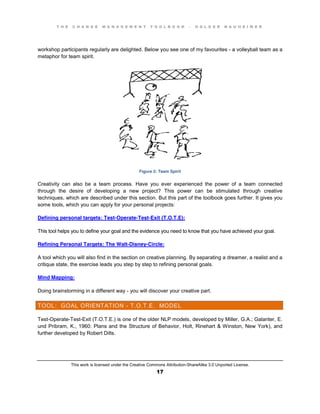
workshop participants regularly are delighted. Below you see one of my favourites - a volleyball team as a
metaphor for team spirit.
Figure 2: Team Spirit
Creativity can also be a team process. Have you ever experienced the power of a team connected
through the desire of developing a new project? This power can be stimulated through creative
techniques, which are described under this section. But this part of the toolbook goes further. It gives you
some tools, which you can apply for your personal projects:
Defining personal targets: Test-Operate-Test-Exit (T.O.T.E):
This tool helps you to define your goal and the evidence you need to know that you have achieved your goal.
Refining Personal Targets: The Walt-Disney-Circle:
A tool which you will also find in the section on creative planning. By separating a dreamer, a realist and a
critique state, the exercise leads you step by step to refining personal goals.
Mind Mapping:
Doing brainstorming in a different way - you will discover your creative part.
TOOL: GOAL ORIENTATION - T.O.T.E. MODEL
Test-Operate-Test-Exit (T.O.T.E.) is one of the older NLP models, developed by Miller, G.A.; Galanter, E.
und Pribram, K., 1960: Plans and the Structure of Behavior, Holt, Rinehart & Winston, New York), and
further developed by Robert Dilts.
T H E C H A N G E M A N A G E M E N T T O O L B O O K – H O L G E R N A U H E I M E R
This work is licensed under the Creative Commons Attribution-ShareAlike 3.0 Unported License.
18
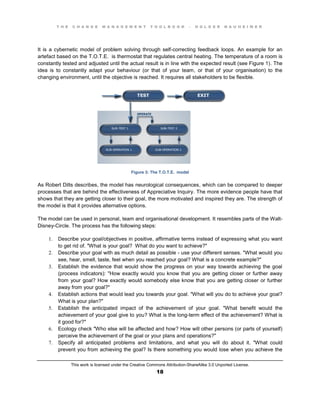
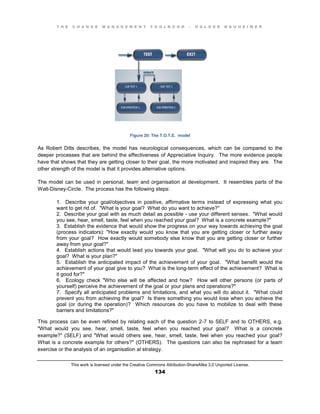
It is a cybernetic model of problem solving through self-correcting feedback loops. An example for an
artefact based on the T.O.T.E. is thermostat that regulates central heating. The temperature of a room is
constantly tested and adjusted until the actual result is in line with the expected result (see Figure 1). The
idea is to constantly adapt your behaviour (or that of your team, or that of your organisation) to the
changing environment, until the objective is reached. It requires all stakeholders to be flexible.
Figure 3: The T.O.T.E. model
As Robert Dilts describes, the model has neurological consequences, which can be compared to deeper
processes that are behind the effectiveness of Appreciative Inquiry. The more evidence people have that
shows that they are getting closer to their goal, the more motivated and inspired they are. The strength of
the model is that it provides alternative options.
The model can be used in personal, team and organisational development. It resembles parts of the Walt-
Disney-Circle. The process has the following steps:
1. Describe your goal/objectives in positive, affirmative terms instead of expressing what you want
to get rid of. "What is your goal? What do you want to achieve?"
2. Describe your goal with as much detail as possible - use your different senses. "What would you
see, hear, smell, taste, feel when you reached your goal? What is a concrete example?"
3. Establish the evidence that would show the progress on your way towards achieving the goal
(process indicators): "How exactly would you know that you are getting closer or further away
from your goal? How exactly would somebody else know that you are getting closer or further
away from your goal?"
4. Establish actions that would lead you towards your goal. "What will you do to achieve your goal?
What is your plan?"
5. Establish the anticipated impact of the achievement of your goal. "What benefit would the
achievement of your goal give to you? What is the long-term effect of the achievement? What is
it good for?"
6. Ecology check "Who else will be affected and how? How will other persons (or parts of yourself)
perceive the achievement of the goal or your plans and operations?"
7. Specify all anticipated problems and limitations, and what you will do about it. "What could
prevent you from achieving the goal? Is there something you would lose when you achieve the
T H E C H A N G E M A N A G E M E N T T O O L B O O K – H O L G E R N A U H E I M E R
This work is licensed under the Creative Commons Attribution-ShareAlike 3.0 Unported License.
19
goal (or during the operation)? Which resources do you have to mobilize to deal with these
barriers and limitations?"
This process can be even more refined by relating each of the questions 2-7 to SELF and to OTHERS,
e.g. "What would you see, hear, smell, taste, feel when you reached your goal? What is a concrete
example?" (SELF) and "What would others see, hear, smell, taste, feel when you reached your goal?
What is a concrete example for others?" (OTHERS). The questions can also be rephrased for a team
exercise or the analysis of an organisational strategy.
Your task as a consultant in carrying out a T.O.T.E. interview is to adapt the idea to the language of the
client and to take an outside perspective, particularly when the client is unable to develop alternative
options for changing behaviour.
TOOL: THE WALT DISNEY CIRCLE - REFINING PERSONAL AND CORPORATE
GOALS
(Adapted from: R. Dilts)
Walt Disney has been known as one of the most outstanding and most successful business leaders of the
20th century. Like Bill Gates, the founder of Microsoft, he has not only influenced our way of processing
information he has also changed the way we perceive reality. The secret of his nearly unlimited creativity
- unconscious to him - has been moulded into a model that can be applied to any personal and
organisational planning operation.
The Circle of Creativity was developed by R. Dilts based on the successful strategies of Walt Disney. The
approach was developed through individual interviews with friends and colleagues of Disney. It is a model
for effective and creative development of personal and professional plans. It also helps in the
transformation of an idea to a plan.
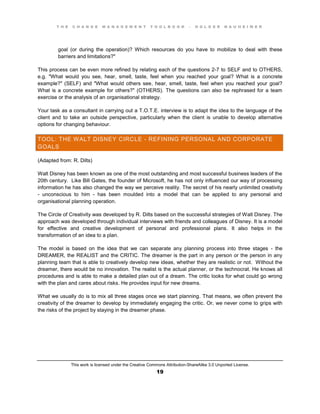
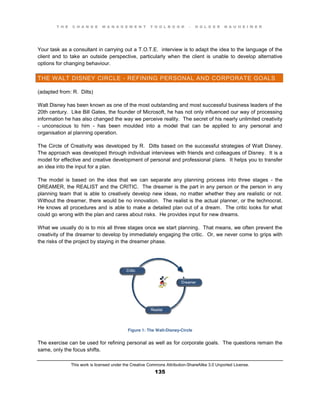
The model is based on the idea that we can separate any planning process into three stages - the
DREAMER, the REALIST and the CRITIC. The dreamer is the part in any person or the person in any
planning team that is able to creatively develop new ideas, whether they are realistic or not. Without the
dreamer, there would be no innovation. The realist is the actual planner, or the technocrat. He knows all
procedures and is able to make a detailed plan out of a dream. The critic looks for what could go wrong
with the plan and cares about risks. He provides input for new dreams.
What we usually do is to mix all three stages once we start planning. That means, we often prevent the
creativity of the dreamer to develop by immediately engaging the critic. Or, we never come to grips with
the risks of the project by staying in the dreamer phase.
T H E C H A N G E M A N A G E M E N T T O O L B O O K – H O L G E R N A U H E I M E R
This work is licensed under the Creative Commons Attribution-ShareAlike 3.0 Unported License.
20
____________________________________________________________________________________
____________________________________________________________________________________
____________________________________________________________________________________
____________________________________________________________________________________
____________________________________________________________________________________
____________________________________________________________________________________
____________________________________________________________________________________
____________________________________________________________________________________
____________________________________________________________________________________
Figure 4: The Walt-Disney-Circle
The exercise can be used for refining personal as well as for corporate goals. The questions remain the
same but only shift in their focus
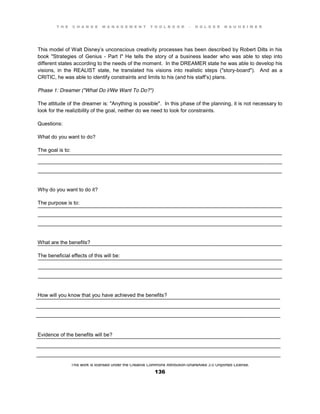
This model of Walt Disney’s unconscious creativity processes has been described by Robert Dilts in his
book "Strategies of Genius - Part I". He tells the story of a business leader who was able to step into
different states according to the needs of the moment. In the DREAMER state he was able to develop his
visions, in the REALIST state; he translated his visions into realistic steps ("story-board"). And as a
CRITIC, he was able to identify constraints and limits to his (and his staff’s) plans.
Phase 1: Dreamer ("What Do I/We Want To Do?")
The attitude of the dreamer is: "Anything is possible". In this phase of the planning, it is not necessary to
look for the realisibility of the goal, neither do we need to look for constraints.
Questions:
What do you want to do?
The goal is to:
Why do you want to do it?
The purpose is:
What are the benefits?
The beneficial effects of this will be:
Dreamer
RealistCritic
T H E C H A N G E M A N A G E M E N T T O O L B O O K – H O L G E R N A U H E I M E R
This work is licensed under the Creative Commons Attribution-ShareAlike 3.0 Unported License.
21
____________________________________________________________________________________
____________________________________________________________________________________
____________________________________________________________________________________
____________________________________________________________________________________
____________________________________________________________________________________
____________________________________________________________________________________
____________________________________________________________________________________
____________________________________________________________________________________
____________________________________________________________________________________
____________________________________________________________________________________
____________________________________________________________________________________
____________________________________________________________________________________
____________________________________________________________________________________
____________________________________________________________________________________
____________________________________________________________________________________
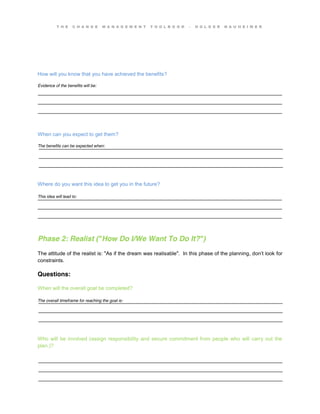
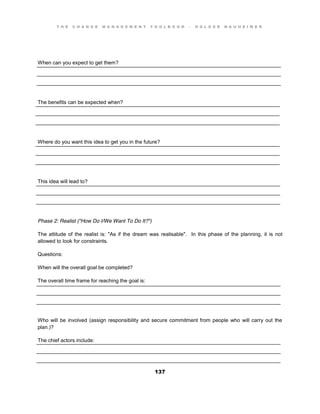
How will you know that you have achieved the benefits?
Evidence of the benefits will be:
When can you expect to get them?
The benefits can be expected when:
Where do you want this idea to get you in the future?
This idea will lead to:
Phase 2: Realist ("How Do I/We Want To Do It?")
The attitude of the realist is: "As if the dream was realisable". In this phase of the planning,  don’t  look for
constraints.
Questions:
When will the overall goal be completed?
The overall timeframe for reaching the goal is:
Who will be involved (assign responsibility and secure commitment from people who will carry out the
plan.)?
T H E C H A N G E M A N A G E M E N T T O O L B O O K – H O L G E R N A U H E I M E R
This work is licensed under the Creative Commons Attribution-ShareAlike 3.0 Unported License.
22
____________________________________________________________________________________
____________________________________________________________________________________
____________________________________________________________________________________
____________________________________________________________________________________
____________________________________________________________________________________
____________________________________________________________________________________
____________________________________________________________________________________
____________________________________________________________________________________
____________________________________________________________________________________
____________________________________________________________________________________
____________________________________________________________________________________
____________________________________________________________________________________
____________________________________________________________________________________
____________________________________________________________________________________
____________________________________________________________________________________
____________________________________________________________________________________
____________________________________________________________________________________
____________________________________________________________________________________
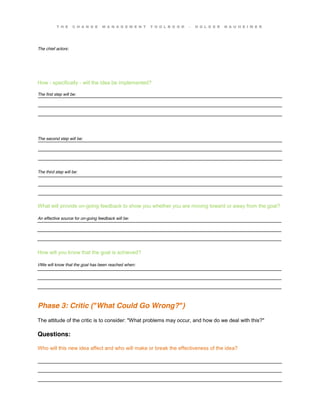
The chief actors:
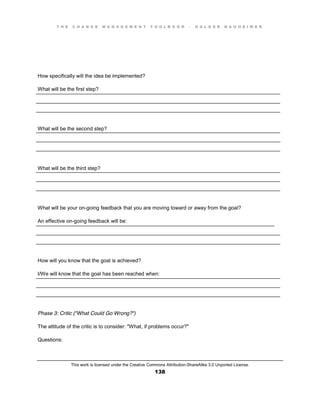
How - specifically - will the idea be implemented?
The first step will be:
The second step will be:
The third step will be:
What will provide on-going feedback to show you whether you are moving toward or away from the goal?
An effective source for on-going feedback will be:
How will you know that the goal is achieved?
I/We will know that the goal has been reached when:
Phase 3: Critic ("What Could Go Wrong?")
The attitude of the critic is to consider: "What problems may occur, and how do we deal with this?"
Questions:
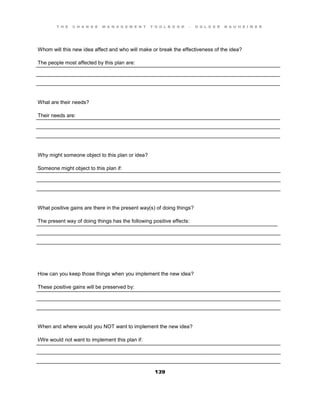
Who will this new idea affect and who will make or break the effectiveness of the idea?
T H E C H A N G E M A N A G E M E N T T O O L B O O K – H O L G E R N A U H E I M E R
This work is licensed under the Creative Commons Attribution-ShareAlike 3.0 Unported License.
23
____________________________________________________________________________________
____________________________________________________________________________________
____________________________________________________________________________________
____________________________________________________________________________________
____________________________________________________________________________________
____________________________________________________________________________________
____________________________________________________________________________________
____________________________________________________________________________________
____________________________________________________________________________________
____________________________________________________________________________________
____________________________________________________________________________________
____________________________________________________________________________________
____________________________________________________________________________________
____________________________________________________________________________________
____________________________________________________________________________________
____________________________________________________________________________________
____________________________________________________________________________________
____________________________________________________________________________________
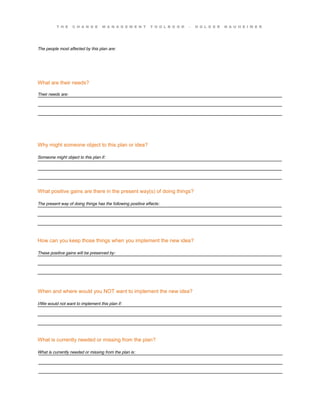
The people most affected by this plan are:
What are their needs?
Their needs are:
Why might someone object to this plan or idea?
Someone might object to this plan if:
What positive gains are there in the present way(s) of doing things?
The present way of doing things has the following positive effects:
How can you keep those things when you implement the new idea?
These positive gains will be preserved by:
When and where would you NOT want to implement the new idea?
I/We would not want to implement this plan if:
What is currently needed or missing from the plan?
What is currently needed or missing from the plan is:
T H E C H A N G E M A N A G E M E N T T O O L B O O K – H O L G E R N A U H E I M E R
This work is licensed under the Creative Commons Attribution-ShareAlike 3.0 Unported License.
24
____________________________________________________________________________________
____________________________________________________________________________________
____________________________________________________________________________________
____________________________________________________________________________________
____________________________________________________________________________________
____________________________________________________________________________________
____________________________________________________________________________________
____________________________________________________________________________________
____________________________________________________________________________________
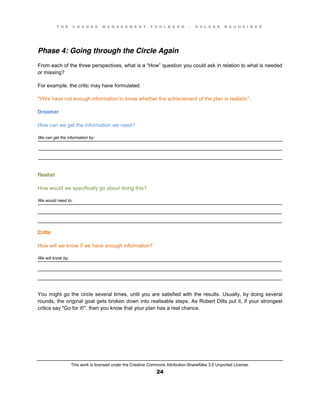
Phase 4: Going through the Circle Again
From each of the three perspectives, what is a “How” question you could ask in relation to what is needed
or missing?
For example, the critic may have formulated:
"I/We have not enough information to know whether the achievement of the plan is realistic".
Dreamer
How can we get the information we need?
We can get the information by:
Realist
How would we specifically go about doing this?
We would need to:
Critic
How will we know if we have enough information?
We will know by:
You might go the circle several times, until you are satisfied with the results. Usually, by doing several
rounds, the original goal gets broken down into realisable steps. As Robert Dilts put it, if your strongest
critics say "Go for it!", then you know that your plan has a real chance.
T H E C H A N G E M A N A G E M E N T T O O L B O O K – H O L G E R N A U H E I M E R
This work is licensed under the Creative Commons Attribution-ShareAlike 3.0 Unported License.
25
TOOL: MINDMAPPING
In our world which mainly concentrates on the spoken and written word we tend to limit ourselves to
rationality, forgetting that intuition has always been a great source of creativity. Although the knowledge of
the differences between the left and the right hemispheres of our brain is still insufficient in fully
understanding how rationality and intuition work together, we all have experienced in our life the power of
inspiration through graphical art? We adore the craftsmanship of the Islamic calligraphy, and we enjoy
visiting art galleries and museums. Each of us has had the experience that during a long and boring
telephone conversation or during a meeting, the pen in our hand suddenly takes on a life of its own,
composing sketches and patterns on the notepad which obviously come from our deeper consciousness.
They are never planned or designed, they are spontaneous. After ending the telephone conversation, we
are often surprised at our artistic skills.
These skills can be utilised for creative planning. A method now widely applied to awaken the artist in
ourselves is called Mindmapping. Take some coloured pens, markers, or crayons. You can do this
exercise on your own, you might only need small sheets of paper. I do it regularly when I start to plan a
new project. But it is fun to do it in groups! You may then need large sheets of paper such as those used
for flip-charts or for pin-boards.
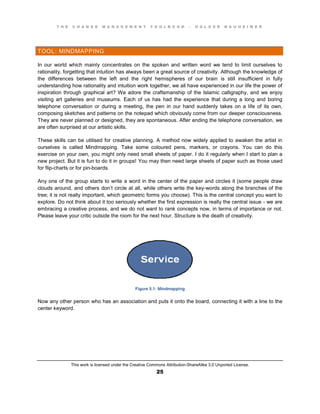
Any one of the group starts to write a word in the center of the paper and circles it (some people draw
clouds around, and others don’t circle at all, while others write the key-words along the branches of the
tree; it is not really important, which geometric forms you choose). This is the central concept you want to
explore. Do not think about it too seriously whether the first expression is really the central issue - we are
embracing a creative process, and we do not want to rank concepts now, in terms of importance or not.
Please leave your critic outside the room for the next hour. Structure is the death of creativity.
Figure 5.1: Mindmapping
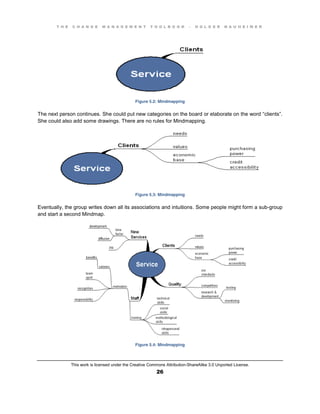
Now any other person who has an association and puts it onto the board, connecting it with a line to the
center keyword.
T H E C H A N G E M A N A G E M E N T T O O L B O O K – H O L G E R N A U H E I M E R
This work is licensed under the Creative Commons Attribution-ShareAlike 3.0 Unported License.
26
Figure 5.2: Mindmapping
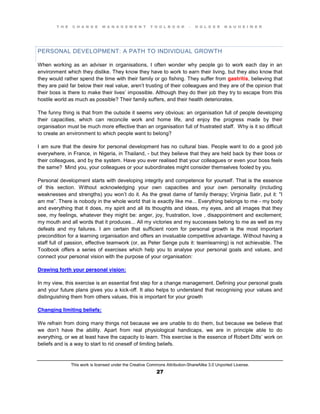
The next person continues. She could put new categories on the board or elaborate on the word “clients”.
She could also add some drawings. There are no rules for Mindmapping.
Figure 5.3: Mindmapping
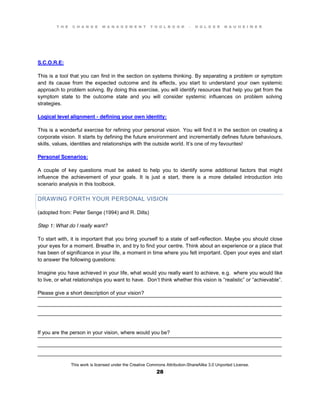
Eventually, the group writes down all its associations and intuitions. Some people might form a sub-group
and start a second Mindmap.
Figure 5.4: Mindmapping
T H E C H A N G E M A N A G E M E N T T O O L B O O K – H O L G E R N A U H E I M E R
This work is licensed under the Creative Commons Attribution-ShareAlike 3.0 Unported License.
27
PERSONAL DEVELOPMENT: A PATH TO INDIVIDUAL GROWTH
When working as an adviser in organisations, I often wonder why people go to work each day in an
environment which they dislike. They know they have to work to earn their living, but they also know that
they would rather spend the time with their family or go fishing. They suffer from gastritis, believing that
they are paid far below their real value, aren’t trusting of their colleagues and they are of the opinion that
their boss is there to make their  lives’ impossible. Although they do their job they try to escape from this
hostile world as much as possible? Their family suffers, and their health deteriorates.
The funny thing is that from the outside it seems very obvious: an organisation full of people developing
their capacities, which can reconcile work and home life, and enjoy the progress made by their
organisation must be much more effective than an organisation full of frustrated staff. Why is it so difficult
to create an environment to which people want to belong?
I am sure that the desire for personal development has no cultural bias. People want to do a good job
everywhere, in France, in Nigeria, in Thailand, - but they believe that they are held back by their boss or
their colleagues, and by the system. Have you ever realised that your colleagues or even your boss feels
the same? Mind you, your colleagues or your subordinates might consider themselves fooled by you.
Personal development starts with developing integrity and competence for yourself. That is the essence
of this section. Without acknowledging your own capacities and your own personality (including
weaknesses and strengths) you won’t  do it. As the great dame of family therapy; Virginia Satir, put it: "I
am me”. There is nobody in the whole world that is exactly like me... Everything belongs to me - my body
and everything that it does, my spirit and all its thoughts and ideas, my eyes, and all images that they
see, my feelings, whatever they might be: anger, joy, frustration, love , disappointment and excitement;
my mouth and all words that it produces... All my victories and my successes belong to me as well as my
defeats and my failures. I am certain that sufficient room for personal growth is the most important
precondition for a learning organisation and offers an invaluable competitive advantage. Without having a
staff full of passion, effective teamwork (or, as Peter Senge puts it: teamlearning) is not achievable. The
Toolbook offers a series of exercises which help you to analyse your personal goals and values, and
connect your personal vision with the purpose of your organisation:
Drawing forth your personal vision:
In my view, this exercise is an essential first step for a change management. Defining your personal goals
and your future plans gives you a kick-off. It also helps to understand that recognising your values and
distinguishing them from others values, this is important for your growth
Changing limiting beliefs:
We refrain from doing many things not because we are unable to do them, but because we believe that
we don’t have the ability. Apart from real physiological handicaps, we are in principle able to do
everything, or we at least have the capacity to learn. This exercise is the essence of Robert Dilts’ work on
beliefs and is a way to start to rid oneself of limiting beliefs.
T H E C H A N G E M A N A G E M E N T T O O L B O O K – H O L G E R N A U H E I M E R
This work is licensed under the Creative Commons Attribution-ShareAlike 3.0 Unported License.
28
____________________________________________________________________________________
____________________________________________________________________________________
____________________________________________________________________________________
____________________________________________________________________________________
____________________________________________________________________________________
____________________________________________________________________________________
S.C.O.R.E:
This is a tool that you can find in the section on systems thinking. By separating a problem or symptom
and its cause from the expected outcome and its effects, you start to understand your own systemic
approach to problem solving. By doing this exercise, you will identify resources that help you get from the
symptom state to the outcome state and you will consider systemic influences on problem solving
strategies.
Logical level alignment - defining your own identity:
This is a wonderful exercise for refining your personal vision. You will find it in the section on creating a
corporate vision. It starts by defining the future environment and incrementally defines future behaviours,
skills, values, identities and relationships with the outside world. It’s one of my favourites!
Personal Scenarios:
A couple of key questions must be asked to help you to identify some additional factors that might
influence the achievement of your goals. It is just a start, there is a more detailed introduction into
scenario analysis in this toolbook.
DRAWING FORTH YOUR PERSONAL VISION
(adopted from: Peter Senge (1994) and R. Dilts)
Step 1: What do I really want?
To start with, it is important that you bring yourself to a state of self-reflection. Maybe you should close
your eyes for a moment. Breathe in, and try to find your centre. Think about an experience or a place that
has been of significance in your life, a moment in time where you felt important. Open your eyes and start
to answer the following questions:
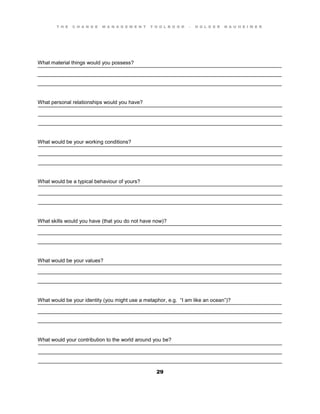
Imagine you have achieved in your life, what would you really want to achieve, e.g. where you would like
to live, or what relationships you want to have. Don’t think whether this vision is “realistic” or “achievable”.
Please give a short description of your vision?
If you are the person in your vision, where would you be?
T H E C H A N G E M A N A G E M E N T T O O L B O O K – H O L G E R N A U H E I M E R
This work is licensed under the Creative Commons Attribution-ShareAlike 3.0 Unported License.
29
____________________________________________________________________________________
____________________________________________________________________________________
____________________________________________________________________________________
____________________________________________________________________________________
____________________________________________________________________________________
____________________________________________________________________________________
____________________________________________________________________________________
____________________________________________________________________________________
____________________________________________________________________________________
____________________________________________________________________________________
____________________________________________________________________________________
____________________________________________________________________________________
____________________________________________________________________________________
____________________________________________________________________________________
____________________________________________________________________________________
____________________________________________________________________________________
____________________________________________________________________________________
____________________________________________________________________________________
____________________________________________________________________________________
____________________________________________________________________________________
____________________________________________________________________________________
____________________________________________________________________________________
____________________________________________________________________________________
____________________________________________________________________________________
What material things would you possess?
What personal relationships would you have?
What would be your working conditions?
What would be a typical behaviour of yours?
What skills would you have (that you do not have now)?
What would be your values?
What would be your identity (you might use a metaphor, e.g.    “I am like an ocean”)?
What would your contribution to the world around you be?
T H E C H A N G E M A N A G E M E N T T O O L B O O K – H O L G E R N A U H E I M E R
This work is licensed under the Creative Commons Attribution-ShareAlike 3.0 Unported License.
30
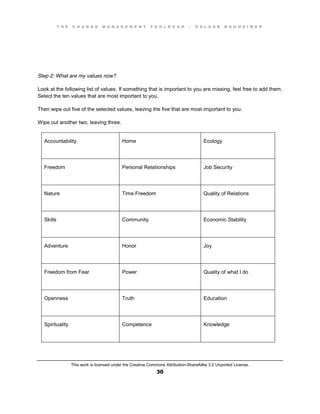
Step 2: What are my values now?
Look at the following list of values. If something that is important to you are missing, feel free to add them.
Select the ten values that are most important to you.
Then wipe out five of the selected values, leaving the five that are most important to you.
Wipe out another two, leaving three.
Accountability Home Ecology
Freedom Personal Relationships Job Security
Nature Time Freedom Quality of Relations
Skills Community Economic Stability
Adventure Honor Joy
Freedom from Fear Power Quality of what I do
Openness Truth Education
Spirituality Competence Knowledge
T H E C H A N G E M A N A G E M E N T T O O L B O O K – H O L G E R N A U H E I M E R
This work is licensed under the Creative Commons Attribution-ShareAlike 3.0 Unported License.
31
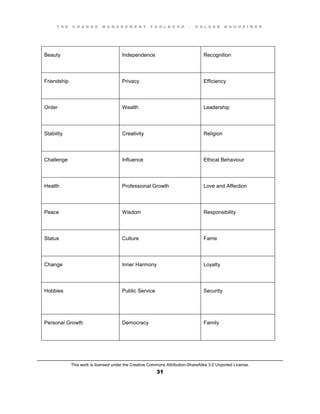
Beauty Independence Recognition
Friendship Privacy Efficiency
Order Wealth Leadership
Stability Creativity Religion
Challenge Influence Ethical Behaviour
Health Professional Growth Love and Affection
Peace Wisdom Responsibility
Status Culture Fame
Change Inner Harmony Loyalty
Hobbies Public Service Security
Personal Growth Democracy Family
T H E C H A N G E M A N A G E M E N T T O O L B O O K – H O L G E R N A U H E I M E R
This work is licensed under the Creative Commons Attribution-ShareAlike 3.0 Unported License.
32
____________________________________________________________________________________
____________________________________________________________________________________
____________________________________________________________________________________
____________________________________________________________________________________
____________________________________________________________________________________
____________________________________________________________________________________
____________________________________________________________________________________
____________________________________________________________________________________
____________________________________________________________________________________
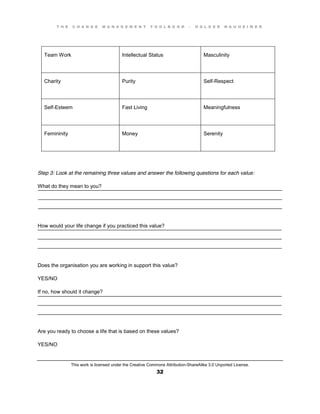
Team Work Intellectual Status Masculinity
Charity Purity Self-Respect
Self-Esteem Fast Living Meaningfulness
Femininity Money Serenity
Step 3: Look at the remaining three values and answer the following questions for each value:
What do they mean to you?
How would your life change if you practiced this value?
Does the organisation you are working in support this value?
YES/NO
If no, how should it change?
Are you ready to choose a life that is based on these values?
YES/NO
T H E C H A N G E M A N A G E M E N T T O O L B O O K – H O L G E R N A U H E I M E R
This work is licensed under the Creative Commons Attribution-ShareAlike 3.0 Unported License.
33
____________________________________________________________________________________
____________________________________________________________________________________
____________________________________________________________________________________
____________________________________________________________________________________
____________________________________________________________________________________
____________________________________________________________________________________
ASSESSMENT AND CHANGE OF LIMITING BELIEFS
(adapted from R. Dilts)
This is a trigger exercise that helps you to identify the beliefs that limit you from changing something or
achieving your personal goals. You can do it alone or together with a coach. It works a little bit like
Appreciative  Inquiry  (“Change  at  the  speed  of  imagination”).
Step 1: Define Your Goal
Describe a goal you want to achieve:
Describe the present plan you have for achieving the goal:
Rank your beliefs concerning the achievability of the goal at a scale from 1 to 5, 1 being the lowest and 5
the highest rank:
The goal is desirable?
(1) (2) (3) (4) (5)
It is possible to achieve the goal?
(1) (2) (3) (4) (5)
What has to be done to achieve the goal is clear and ecological?
(1) (2) (3) (4) (5)
I have the capacity to achieve the goal?
(1) (2) (3) (4) (5)
Do I deserve to achieve the goal?
T H E C H A N G E M A N A G E M E N T T O O L B O O K – H O L G E R N A U H E I M E R
This work is licensed under the Creative Commons Attribution-ShareAlike 3.0 Unported License.
34
____________________________________________________________________________________
____________________________________________________________________________________
____________________________________________________________________________________
____________________________________________________________________________________
____________________________________________________________________________________
____________________________________________________________________________________
____________________________________________________________________________________
____________________________________________________________________________________
____________________________________________________________________________________
____________________________________________________________________________________
____________________________________________________________________________________
____________________________________________________________________________________
____________________________________________________________________________________
____________________________________________________________________________________
____________________________________________________________________________________
____________________________________________________________________________________
____________________________________________________________________________________
____________________________________________________________________________________
____________________________________________________________________________________
____________________________________________________________________________________
____________________________________________________________________________________
____________________________________________________________________________________
____________________________________________________________________________________
____________________________________________________________________________________
(1) (2) (3) (4) (5)
Step 2: Identify limiting Beliefs
Find a limiting belief which hinders you from achieving the goal (e.g,  “I will not have the persistence” or
“Everybody will be against me”,  etc.) You will find an example at the end of the exercise.
Connect the limiting belief with the following words and complete the sentence, e.g.  “I will not have the
persistence, because I get easily frustrated”,  etc.
,because
,therefore
,after
,while
,if
T H E C H A N G E M A N A G E M E N T T O O L B O O K – H O L G E R N A U H E I M E R
This work is licensed under the Creative Commons Attribution-ShareAlike 3.0 Unported License.
35
____________________________________________________________________________________
____________________________________________________________________________________
____________________________________________________________________________________
____________________________________________________________________________________
____________________________________________________________________________________
____________________________________________________________________________________
____________________________________________________________________________________
____________________________________________________________________________________
____________________________________________________________________________________
____________________________________________________________________________________
____________________________________________________________________________________
____________________________________________________________________________________
____________________________________________________________________________________
____________________________________________________________________________________
____________________________________________________________________________________
____________________________________________________________________________________
____________________________________________________________________________________
____________________________________________________________________________________
,so that
,although
Step 3: Change Your Beliefs
What was your goal like (maybe it has changed)?
Do something about your motivation and complete the following sentence.
I have the capacity to achieve my goal, (write the goal here):
,because
I have the capacity to achieve my goal,
T H E C H A N G E M A N A G E M E N T T O O L B O O K – H O L G E R N A U H E I M E R
This work is licensed under the Creative Commons Attribution-ShareAlike 3.0 Unported License.
36
____________________________________________________________________________________
____________________________________________________________________________________
____________________________________________________________________________________
____________________________________________________________________________________
____________________________________________________________________________________
____________________________________________________________________________________
____________________________________________________________________________________
____________________________________________________________________________________
____________________________________________________________________________________
____________________________________________________________________________________
____________________________________________________________________________________
____________________________________________________________________________________
____________________________________________________________________________________
____________________________________________________________________________________
____________________________________________________________________________________
____________________________________________________________________________________
____________________________________________________________________________________
____________________________________________________________________________________
____________________________________________________________________________________
____________________________________________________________________________________
____________________________________________________________________________________
____________________________________________________________________________________
____________________________________________________________________________________
____________________________________________________________________________________
,therefore
I have the capacity to achieve my goal,
,after
I have the capacity to achieve my goal,
,while
I have the capacity to achieve my goal,
,if
I have the capacity to achieve my goal,
T H E C H A N G E M A N A G E M E N T T O O L B O O K – H O L G E R N A U H E I M E R
This work is licensed under the Creative Commons Attribution-ShareAlike 3.0 Unported License.
37
____________________________________________________________________________________
____________________________________________________________________________________
____________________________________________________________________________________
____________________________________________________________________________________
____________________________________________________________________________________
____________________________________________________________________________________
____________________________________________________________________________________
____________________________________________________________________________________
____________________________________________________________________________________
,so that
I have the capacity to achieve my goal,
,although
My goal is to write a toolbook for change management.
The plan is to start collecting ideas and material, than commence writing. When I have a preliminary yet
presentable result, I will publish it on the Internet. While waiting for feedback, I will continue to improve
the Toolbook. I will look for partners who will support and review the edition. And there will be a lot of
international exchange.
The goal is desirable?
(1) (2) (3) (4) (X)
It is possible to achieve the goal ?
(1) (2) (3) (X) (5)
What has to be done to achieve the goal is clear and ecological?
(1) (2) (X) (4) (5)
I have the capacity to achieve the goal?
(1) (X) (3) (4) (5)
I deserve to achieve the goal?
(1) (2) (3) (X) (5)
T H E C H A N G E M A N A G E M E N T T O O L B O O K – H O L G E R N A U H E I M E R
This work is licensed under the Creative Commons Attribution-ShareAlike 3.0 Unported License.
38
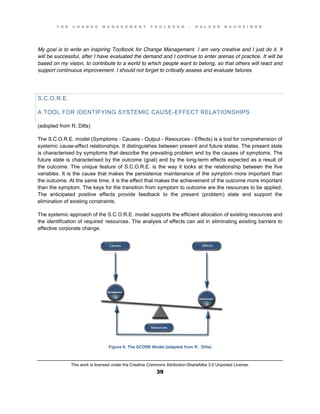
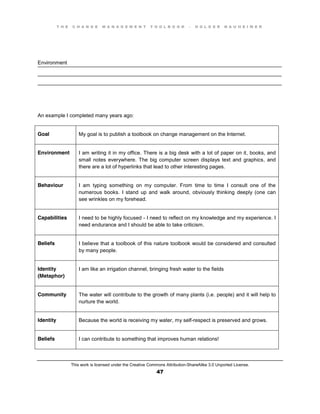
Example:
The form and the content of the Toolbook might not generate sufficient interest. Finally, the idea will die.
The form and the content of the Toolbook might not generate sufficient interest, because it does not meet
an actual demand.
The form and the content of the Toolbook might not generate sufficient interest therefore it will not be
used by many people.
The form and the content of the Toolbook might not generate sufficient interest; after visiting it, it will be
forgotten.
The form and the content of the Toolbook might not generate sufficient interest, while other specialists in
change management can sell themselves in a better way.
The form and the content of the Toolbook might not generate sufficient interest, if the idea is not well
advocated.
The form and the content of the Toolbook might not generate sufficient interest, so that eventually I will
have spent a lot of effort for nothing.
The form and the content of the Toolbook might not generate sufficient interest, although it really creates
a valuable resource. What was my goal? My goal is to write an inspiring Toolbook for Change
Management.
I have the capacity to write an inspiring Toolbook for Change Management, because I am very creative.
I have the capacity to write an inspiring Toolbook for Change Management, therefore I just do it.
I have the capacity to write an inspiring Toolbook for Change Management, after really having evaluated
the demand.
I have the capacity to write an inspiring Toolbook for Change Management, while I continue to enter the
arena of practice.
I have the capacity to write an inspiring Toolbook for Change Management, if I focus on my vision - to
contribute to a world to which people want to belong.
I have the capacity to write an inspiring Toolbook for Change Management, so that people will react and
support continuous improvement.
I have the capacity to write an inspiring Toolbook for Change Management, although I should critically
assess and evaluate failures. Summary:
T H E C H A N G E M A N A G E M E N T T O O L B O O K – H O L G E R N A U H E I M E R
This work is licensed under the Creative Commons Attribution-ShareAlike 3.0 Unported License.
39
My goal is to write an inspiring Toolbook for Change Management. I am very creative and I just do it. It
will be successful, after I have evaluated the demand and I continue to enter arenas of practice. It will be
based on my vision, to contribute to a world to which people want to belong, so that others will react and
support continuous improvement. I should not forget to critically assess and evaluate failures.
S.C.O.R.E.
A TOOL FOR IDENTIFYING SYSTEMIC CAUSE-EFFECT RELATIONSHIPS
(adopted from R. Dilts)
The S.C.O.R.E. model (Symptoms - Causes - Output - Resources - Effects) is a tool for comprehension of
systemic cause-effect relationships. It distinguishes between present and future states. The present state
is characterised by symptoms that describe the prevailing problem and by the causes of symptoms. The
future state is characterised by the outcome (goal) and by the long-term effects expected as a result of
the outcome. The unique feature of S.C.O.R.E. is the way it looks at the relationship between the five
variables. It is the cause that makes the persistence maintenance of the symptom more important than
the outcome. At the same time, it is the effect that makes the achievement of the outcome more important
than the symptom. The keys for the transition from symptom to outcome are the resources to be applied.
The anticipated positive effects provide feedback to the present (problem) state and support the
elimination of existing constraints.
The systemic approach of the S.C.O.R.E. model supports the efficient allocation of existing resources and
the identification of required resources. The analysis of effects can aid in eliminating existing barriers to
effective corporate change.
Figure 6: The SCORE Model (adapted from R. Dilts)
T H E C H A N G E M A N A G E M E N T T O O L B O O K – H O L G E R N A U H E I M E R
This work is licensed under the Creative Commons Attribution-ShareAlike 3.0 Unported License.
40
____________________________________________________________________________________
____________________________________________________________________________________
____________________________________________________________________________________
____________________________________________________________________________________
____________________________________________________________________________________
____________________________________________________________________________________
____________________________________________________________________________________
____________________________________________________________________________________
____________________________________________________________________________________
____________________________________________________________________________________
____________________________________________________________________________________
____________________________________________________________________________________
____________________________________________________________________________________
____________________________________________________________________________________
____________________________________________________________________________________
Step 1: Symptom
Identify the evident symptoms of the current problem state of your organisation. It is recommended to use
the tool; The Five Why’s first, which helps to structure the solution process. Ask the following questions:
What is the existing problem?
How do we know that it is a problem?
Write the symptom on a board.
Step 2: Outcome
Identify the outcome?
What would be the desired state?
What would the outcome be if we cure our symptom?
Write the cause under the symptom, linking both with an arrow.
T H E C H A N G E M A N A G E M E N T T O O L B O O K – H O L G E R N A U H E I M E R
This work is licensed under the Creative Commons Attribution-ShareAlike 3.0 Unported License.
41
____________________________________________________________________________________
____________________________________________________________________________________
____________________________________________________________________________________
____________________________________________________________________________________
____________________________________________________________________________________
____________________________________________________________________________________
____________________________________________________________________________________
____________________________________________________________________________________
____________________________________________________________________________________
____________________________________________________________________________________
____________________________________________________________________________________
____________________________________________________________________________________
____________________________________________________________________________________
____________________________________________________________________________________
____________________________________________________________________________________
____________________________________________________________________________________
____________________________________________________________________________________
____________________________________________________________________________________
Step 3: Cause
Identify the deeper cause of the symptom (maybe you have identified it in The Five Why’s)?
What makes the symptom more important than the outcome?
What is the good intention of doing things the old-fashioned way?
What is more important than the outcome?
Write the cause under the symptom, linking both with an arrow.
Step 4: Effect
Identify the long-term effect of the outcome?
Why do we want to achieve the outcome?
T H E C H A N G E M A N A G E M E N T T O O L B O O K – H O L G E R N A U H E I M E R
This work is licensed under the Creative Commons Attribution-ShareAlike 3.0 Unported License.
42
____________________________________________________________________________________
____________________________________________________________________________________
____________________________________________________________________________________
____________________________________________________________________________________
____________________________________________________________________________________
____________________________________________________________________________________
____________________________________________________________________________________
____________________________________________________________________________________
____________________________________________________________________________________
____________________________________________________________________________________
____________________________________________________________________________________
____________________________________________________________________________________
____________________________________________________________________________________
____________________________________________________________________________________
____________________________________________________________________________________
____________________________________________________________________________________
____________________________________________________________________________________
____________________________________________________________________________________
What would make the outcome more important than the cause?
What will be the long-term benefits?
Write the effect above the outcome, linking both with an arrow.
Step 5: Resources
Identify the resources needed to get from the symptom to the outcome?
What capabilities do we need to overcome the symptom?
What assumptions are required as a base for overcoming the symptom?
Where can we get the resources within our organisation? What additional efforts are required?
T H E C H A N G E M A N A G E M E N T T O O L B O O K – H O L G E R N A U H E I M E R
This work is licensed under the Creative Commons Attribution-ShareAlike 3.0 Unported License.
43
____________________________________________________________________________________
____________________________________________________________________________________
____________________________________________________________________________________
____________________________________________________________________________________
____________________________________________________________________________________
____________________________________________________________________________________
____________________________________________________________________________________
____________________________________________________________________________________
____________________________________________________________________________________
Write the resources in the space between symptom and outcome.
Step 6: Systemic Relationships
Identify systemic impacts of the effects?
If we had the outcome and the effects today, how would that change the cause and the relative
significance of the symptom?
What, if the problem (cause-symptom) would be a solution?
LOGICAL LEVEL ALIGNMENT - DEFINING YOUR IDENTITY
(adapted from R. DILTS)
Based on the work of Gregory Bateson, Robert Dilts has delineated a model of human behaviour, which
is called the Model of the Logical Levels. It assumes that human processes can be described along a
ladder of categories that influence each other. The lowest level is the environment, followed by behaviour,
capabilities, beliefs/values and identity. Beyond identity, the model opens up to "the other", i.e. systems
that include other human beings - the family, the community, and the world.
T H E C H A N G E M A N A G E M E N T T O O L B O O K – H O L G E R N A U H E I M E R
This work is licensed under the Creative Commons Attribution-ShareAlike 3.0 Unported License.
44
Figure 7: Levels of Change
According to the model, the levels influence each other in both directions, but a change on a higher level
will have a greater impact on the lower levels than vice versa. E.g. learning a new skill at first instance
(capability level), e.g. a language, might open up to the importance of other cultures (values level) and my
identity - I belong to the world (identity level). It certainly changes my behaviour - suddenly I able to talk to
people to whom I would not have talked to before. There might even be a dramatic change in my
environment - I might move to another country.
If, on the other hand, the belief level is changed first, e.g. from: I do not have the capacity to learn foreign
languages to: It’s easy for me to learn languages; the consequences for the lower levels are tremendous!
Before this exercise, you should have worked on defining your goals, e.g. with the T.O.T.E. or The Walt-
Disney Circle.
Step 1: Identifying the future Environment
Start with the future environment in which you want to achieve the goal. This is a creative exercise, there
are no limits! Choose the nicest offices or houses, in which you really would love to work or live.
Step 2: Identifying Future Behaviours
Imagine you got filmed performing in that wonderful environment you have just described. What would an
outsider observe on the video? What are people doing there? Are they writing, talking, wandering around,
dancing etc.? Again, do not describe content, but behaviour.
Step 3: Identifying Future Capabilities
In the environment you have described, and with the behaviours one could identify on a video film, what
new capabilities and skills would you need to get closer to your goal? Try to think in different categories.
Certainly, technical skills might be necessary. Do you need new capabilities of communication and
collaboration?
Step 4: Identifying your Future Values and Beliefs
T H E C H A N G E M A N A G E M E N T T O O L B O O K – H O L G E R N A U H E I M E R
This work is licensed under the Creative Commons Attribution-ShareAlike 3.0 Unported License.
45
____________________________________________________________________________________
____________________________________________________________________________________
____________________________________________________________________________________
____________________________________________________________________________________
____________________________________________________________________________________
____________________________________________________________________________________
____________________________________________________________________________________
____________________________________________________________________________________
____________________________________________________________________________________
____________________________________________________________________________________
____________________________________________________________________________________
____________________________________________________________________________________
You have managed to live and work in a pleasant environment, exercising new behaviours and learning
new skills and capabilities, what new values would you need to realise your vision? What must you
believe to be motivated to go for your goal? What values do you need as a human being?
Step 5: What´s your Identity?
Often, people find it difficult to put their own identity into words. It helps very much to find a metaphor that
describes your identity. If you look for it, it will be very easy to make out an appropriate image. (e.g., I am
a mountain which stands solid and still, or, I am a tiger, ready to attack everything that wants to approach
me). Try to visualize the metaphor. In your inner eye, try to listen for sounds, and recognise the deep
feelings in yourself.
Step 6: Is there anything else? How do you serve the community?
If you agree that every individual has a responsibility to the outer world - our families, our communities,
our state, the earth and the universe - you will find it very satisfying to continue this step. Take on the
metaphor you have found in STEP 5 and ask yourself: What else is around us? How do we contribute?
Answer the questions by spinning the metaphor, i.e. people can rest on me, or we I can protect the
weakest...
Step 7: Check the image by going down the ladder:
You have now reached the top of the logical levels, and you have written your vision. You might now
follow the way back, checking every single step of ladder. While doing so, you take the metaphor you
have found for expressing your identity. Go back to the identity level. By taking into account the effects
the metaphor has on the outer world, would the identity change? By taking the - maybe strengthened
identity - what about your values? How would the capacities and skills be affected? What other
behaviours would a video camera register by observing you? Does the environment look different?
Step 8: Write down your vision and enjoy it
Goal
Environment
Behaviour
T H E C H A N G E M A N A G E M E N T T O O L B O O K – H O L G E R N A U H E I M E R
This work is licensed under the Creative Commons Attribution-ShareAlike 3.0 Unported License.
46
____________________________________________________________________________________
____________________________________________________________________________________
____________________________________________________________________________________
____________________________________________________________________________________
____________________________________________________________________________________
____________________________________________________________________________________
____________________________________________________________________________________
____________________________________________________________________________________
____________________________________________________________________________________
____________________________________________________________________________________
____________________________________________________________________________________
____________________________________________________________________________________
____________________________________________________________________________________
____________________________________________________________________________________
____________________________________________________________________________________
____________________________________________________________________________________
____________________________________________________________________________________
____________________________________________________________________________________
____________________________________________________________________________________
____________________________________________________________________________________
____________________________________________________________________________________
____________________________________________________________________________________
____________________________________________________________________________________
____________________________________________________________________________________
Capabilities
Beliefs
Identify (Metaphor)
Community
Identity
Beliefs
Capabilities
Behaviour
T H E C H A N G E M A N A G E M E N T T O O L B O O K – H O L G E R N A U H E I M E R
This work is licensed under the Creative Commons Attribution-ShareAlike 3.0 Unported License.
47
____________________________________________________________________________________
____________________________________________________________________________________
____________________________________________________________________________________
Environment
An example I completed many years ago:
Goal My goal is to publish a toolbook on change management on the Internet.
Environment I am writing it in my office. There is a big desk with a lot of paper on it, books, and
small notes everywhere. The big computer screen displays text and graphics, and
there are a lot of hyperlinks that lead to other interesting pages.
Behaviour I am typing something on my computer. From time to time I consult one of the
numerous books. I stand up and walk around, obviously thinking deeply (one can
see wrinkles on my forehead.
Capabilities I need to be highly focused - I need to reflect on my knowledge and my experience. I
need endurance and I should be able to take criticism.
Beliefs I believe that a toolbook of this nature toolbook would be considered and consulted
by many people.
Identity
(Metaphor)
I am like an irrigation channel, bringing fresh water to the fields
Community The water will contribute to the growth of many plants (i.e. people) and it will help to
nurture the world.
Identity Because the world is receiving my water, my self-respect is preserved and grows.
Beliefs I can contribute to something that improves human relations!
T H E C H A N G E M A N A G E M E N T T O O L B O O K – H O L G E R N A U H E I M E R
This work is licensed under the Creative Commons Attribution-ShareAlike 3.0 Unported License.
48
Capabilities Because there is a real demand for my water (= my book), I will be able to produce
the good quality that is expected. And I never stop flowing.
Behaviour I am doing more and more other things that put me into connection with the outer
world; writing takes less and less time.
Environment There is much more around me than the small cramped office. I am surrounded by
others.
PERSONAL SCENARIOS
(from P. Senge)
This trigger exercise is a start for personal planning. It helps you to identify some potential outcomes of
the plans you are about to develop. Take some time to go through the questions, one by one.
1. Which two questions (concerning your future) would you be most likely to ask an oracle.
2. What is a good scenario? How would the oracle answer your own questions?
3. What is a bad scenario? What if the world would turn into your worst nightmare?
4. If you look back two years, what would have been a useful scenario then?
5. What would have been good to foresee?
6. By contrast, what did you actually think was going to happen?
7. What are the most important decisions you are facing right now?
8. What constraints do you feel in making these decisions?
TEAM
At the heart of modern organisations are teams that share the responsibility and the resources for “getting
things done”. Most projects are too complex to be implemented by one person; most services need
different specialists and support staff to be delivered as well as most products being the result of the work
of large teams. We know that teams can either perform at their peak, or can be terribly inefficient. Teams
are also the second smallest unit of a change process. Read more about concepts of how teams can
learn and change together in this section, which we have also divided into two parts:
Maps
The map is not the territory - how to deal with different perceptions of reality within social relationships
....more
Team Learning
T H E C H A N G E M A N A G E M E N T T O O L B O O K – H O L G E R N A U H E I M E R
This work is licensed under the Creative Commons Attribution-ShareAlike 3.0 Unported License.
49
For a quantum leap of their performance, teams need to learn from what they are doing. These tools help
your team to create a spirit in which such learning processes are possible. ...more
EUROBIOLOGY APPLIED - HOW INDIVIDUAL MENTAL MAPS INFLUENCE OUR
BEHAVIOUR
To know more about the scientific background of the abovementioned concept and its consequences for
management, please read:
Mental Maps - how the Individual Perceives Reality:
These tools help you understand your own mental maps and other’s mental maps. They also provide you
with the skills to deal.
Meta Model:
The Meta Model of language was developed 30 years ago by Bandler and Grinder. It was a founding
source and the first methodology of NLP (long before NLP received its name). It describes how human
beings delete, distort and generalize information through language. Further, it helps you to discover lost
information in a communication process. The relevance of this linguistic model for human communication
cannot be underestimated.
Milton Model:
The Milton-Model turns the Meta-Model upside down. While the objective of the Meta-Model is to
increase the specificity of language use and to collect specific and precise information, the Milton-Model
leads to a more varied use of language. Here, the listener has to find the missing information by and in
himself.
Wonder Question:
The wonder question, which comes from family therapy, helps the consultant/coach accelerate projects
which are struggling to take off.
The Wheel of Multiple Perspectives:
An exercise that helps you to identify and understand the mental maps of others.
Conflict Solving Exercise (Belief Outframing Pattern):
A questionnaire which analyses the beliefs that are behind a conflict and shows alternative perspectives
for conflict solving.
The Prisoners” Dilemma:
T H E C H A N G E M A N A G E M E N T T O O L B O O K – H O L G E R N A U H E I M E R
This work is licensed under the Creative Commons Attribution-ShareAlike 3.0 Unported License.
50
This exercise demonstrates alternative strategies to solve competitive situations through collaboration. It
supports the strengthening of teams.
MENTAL MAPS - HOW THE INDIVIDUAL PERCEIVES REALITY
When individuals or social systems are confronted with new experiences, they need to bring these
experiences in line with their concept of self (identity). They might
 Explore the new experience, categorise and accept it, and then relate it to their concept of self
(accommodation),
 Ignore the new experience or part of it, because it may conflict with their concept of self (deletion,
self-deception), or
 Alter the new experience until it fits into their concept of self (assimilation, distortion,
generalization). [Richard Bandler and John Grinder (1975): the structure of magic 1. A book
about language & therapy. Palo Alto, California: Science and Behavior Books.]
These mechanisms of information processing (simplification, categorisation, deletion, distortion,
generalization) can be observed on a day-to-day basis. "The map is not the reality", the famous quote of
Alfred Korsybski is now supported by the results of neurobiological research on cognition and neuronal
data processing. Peter Senge has described the “Ladder of Inference” which is based on the inner
confidence that “our map of the reality is the truth”, and “the truth is obvious” as a sequence of cognitive
steps [Peter Senge et.al. (1994),p.243]:
 We receive data through our senses (observation).
 We select data from what we observe (filter, subtraction).
 We add meaning to the data (colour, augmentation).
 We draw assumptions on base of the selected data and the meaning we added.
 We adopt beliefs (mental models) about the reality and continue to select data (as per step 2) that
correspond to these beliefs.
 We act upon our beliefs.
Figure 8: How we shape our mental maps (from Senge, 1994, adapted by Ian Metcalf)
T H E C H A N G E M A N A G E M E N T T O O L B O O K – H O L G E R N A U H E I M E R
This work is licensed under the Creative Commons Attribution-ShareAlike 3.0 Unported License.
51
Our understanding of mental models and the underlying processes that shape them is drawn from various
research disciplines. Mainly, geographers, epistemologists, communication scientists, cognitive
psychologists and neurobiologists have contributed to a holistic concept which is one of the basic
principles in understanding the successful management of knowledge and change.
Paul Watzlawick’s books are full of anecdotal evidence for the process of mental mapping. In his book
“How Real Is Real? : Confusion, Disinformation, Communication” he describes a phenomenon which
occurred in Seattle at the end of the 1950”s. Many owners of vehicles realised, that their windscreens
were full of small scratches. A commission sent by President Eisenhower investigated the phenomenon
and found out that among the citizens of Seattle there were two persisting theories about the causes of
that phenomenon: one theory attributed the damage to a suspected Russian nuclear test, and the other to
a chemical reaction of the fresh tarmac which had been put on the State of Washington’s highways. After
the investigation was completed, the commission concluded that there was no significant increase of
scratched windscreens in Seattle. [Paul Watzlawick: How Real Is Real? : Confusion, Disinformation,
Communication” (1977). Vintage Books.]
From a neurobiological perspective, the constructivist paradigm that the brain creates its own version of
reality seems obvious. In our neurological processes, the retained information is constantly mixed in a
never ending number of different cocktails and complemented with meaning. Each time we reflect on an
experience or remember something, the cocktail has a different colour. There is no constancy in our
brain, no static files that are filled with stacks of objective facts - all our collected wisdom is constantly
altered, depending on our emotional state and the current task we are following.
There is nothing like an image in the brain (like the projection of a slide) and the taste of a good Bordeaux
is nothing but a certain flow of electricity. Among all different scientists, neurobiologists are probably the
only group that has no doubt about the insight image that cognitions is generate in the brain and that two
world exists - the world of things outside and the world of cognition inside our brain. If the neuronal code
of all senses is neutral, how do we distinguish a visual from an aural perception? It is the different areas
of the neo-cortex, which receive electrical impulses that originate from the senses, which interpret the
signal as visual or aural. If, for example, during a brain surgery the respective areas are stimulated with
electrodes, the patient might have a sensual experience, such as an image or a sound. The quality and
intensity of a cognitive process is not encoded in the singular neuronal impulses, but rather an
interpretative performance of the neo-cortex. Gerhard Roth, by education philosopher, but as the Director
of the Bremer Institute for Brain Research one of the leading neurobiologists says that the shift from the
physical and chemical environment is a radical one. The complexity of the environment is “destroyed” by
chunking it down to singular neuronal impulses of the receptors in the senses. From this, the brain has to
regenerate - through a multitude of processes - the complexity of the environment, as far as it is relevant
for the survival. Through new combinations on different levels of the cognitive system, new information
and meaning is produced.
The product of the cognitive process is different from the original, like the image reproduced by a digital
camera is a compression of the data that only represents the original. As we know, the human senses are
only sensitive for a certain spectrum of the offered information, e.g. a certain wavelength of the entire
spectrum of light. Some information packages do not elicit a neuronal reaction in the senses, because
they do not exceed a certain critical threshold potential. Finally, the senses and the descriptive parts of
T H E C H A N G E M A N A G E M E N T T O O L B O O K – H O L G E R N A U H E I M E R
This work is licensed under the Creative Commons Attribution-ShareAlike 3.0 Unported License.
52
the brain have a limited capacity to process information - like a digital camera - and the data available to
the senses are reduced by a factor of at least 10[Daniel L. Schacter (1996): Searching for Memory. The
Brain; the Mind and the Past. New York, HarperCollins].
We are entering the field of cognitive psychologists, who are able to ascertain the core information that
is retained and how the amount of data is reduced in cognitive processes. A comprehensive account of
cognitive processes is provided by Daniel L. Schacter; professor of psychology at the Harvard University.
He explains how our past experiences determine, what information we select from the continuous flow of
data reaching our senses and which we memorize.
There is no equivalent of a fixed disk in the brain; memories are singular constructions made in
accordance with present needs, desires, and influences. No two memories of the same episode or
subject are identical, because the brain synthesises each reminiscence just-in-time, from an ever-
changing mix of images, meanings and emotions. Memory is more like a collage or a jigsaw puzzle than a
“tape recordings, “pictures” or “video clips” stored as wholes. Most sense data is not stored at all. We
have to dispel the notion that memories are ready made packages of related information that are waiting
for retrieval. Rather, it is a complicated construction process which depends on the quality of the encoded
engram and the type of the retrieval cue.
"When we memorize, we complete a pattern with the best approximation that is available in the brain.
But we do not focus a head light on a stored image." [Daniel L. Schacter (1996)]
In recent years, researchers have documented in detail how the processes of social influence shape our
mental maps.
"The impact of a message depends both on its content and style and on the individual motivations and
characteristics of those exposed to it. Experimental studies have revealed, for example, that persuasive
efforts that present thoughtful, detailed arguments can be very effective in changing people’s attitudes but
only if the audience has the knowledge and motivation to comprehend, scrutinize, and evaluate the
message... People consciously and unconsciously process their experiences in accord with pre-existing
views (or filters) of reality. Because these views are unique to individual social histories, each person
interprets reality in a distinct way and responds differently to events."[National Institute of Mental Health
(1999): Social Influence and Social Cognition. [WWW document]. URL: http://www.nimh.nih.gov]
THE META MODEL OF LANGUAGE
"With false hope of a firm foundation gone, with the world displaced by words that are but versions, with
substance dissolved into function, and with the given acknowledged as taken, we face the questions of
how worlds are made, tested, and known."
(Nelson Goodman Ways of Worldmaking)
Neurobiological and linguistic evidence has recently opened a new path to understanding how people
shape their perception of reality and consequently the way they think and act:
T H E C H A N G E M A N A G E M E N T T O O L B O O K – H O L G E R N A U H E I M E R
This work is licensed under the Creative Commons Attribution-ShareAlike 3.0 Unported License.
53
The map is not the reality
(Alfred Korzybski)
This statement implies that human beings do not react to reality, but build their own mental model of
reality. The human brain can be seen as a black box, which constantly stores terabytes of information
from the five senses. Only small quantities of this information actually reach the neo-cortex, where it is
filtered and altered. The final consequence of this process can’t be determined a priori, because it is
mixed with experiences, knowledge and emotions -- like a cocktail in which you cannot identify the
original ingredients. It is naive to believe that you can understand somebody only because of your ability
to repeat the same words. Because these words internally recall different experiences, there is always a
different meaning attached to them.
Accepting this scientific fact has fundamental consequences: the mental models of individuals who meet
and try to exchange information never match - virtually never! But people have the ability to widen their
mental models through an understanding of other people’s.
Social systems seek to maintain a balance (homoeostasis), which optimises energy consumption.
Consequently, systems might resist change. New information or proposals for change might be neglected
or altered in order to fit into the existing system. If individuals or social systems are confronted with new
experiences, they need to bring these experiences in line with their concept of self (identity). They might
 Accept the new experience and relate it to their concept of self,
 Ignore the new experience or part of it, because it does not relate to their concept of self
(deletion), or
 Alter the new experience until it fits into their concept of self (distortion, generalization).
The three mechanisms of information processing (deletion, distortion, generalisation) can be observed on
a day-to-day basis. They occur on a deep structure level (cognition) and on a surface level (language).
THE SURFACE: THE META MODEL OF LANGUAGE
If you are concerned with change management processes, you need to know more about the mental
models of the people you are working with and you need to make implicit information explicit. This can be
done with the help of the Meta Model of Language. It was developed by the psychologist Richard Bandler
and the linguist John Grinder and it is described in their wonderful book, Structure of Magic.
We might, for the purpose of understanding, draw the analogy between brains and computers (which, as
we know, does not reflect current neuro-biological wisdom). In line with analogy, we can assume that the
brain "saves" human experience in different "files": emotions and feelings, images, sounds, smells and
tastes. This is already the end of the analogy: in our neurological processes, these different kinds of
information are constantly mixed in a never ending number of different cocktails and complemented with
meaning. Each time we reflect on an experience or remember something, the cocktail has a different
colour. There is no constancy in our brain, no static files that are filled with volumes of objective facts.
T H E C H A N G E M A N A G E M E N T T O O L B O O K – H O L G E R N A U H E I M E R
This work is licensed under the Creative Commons Attribution-ShareAlike 3.0 Unported License.
54
Our experiences are continuously altered, depending on our emotional state, and the current task we are
undertaking. There might be also a process that produces random mixtures of information.
Consequently, we communicate through language patterns that mirror the individual mix of experience.
The information intake through the senses is analogue, but language is digital - we do not only delete
information in the input but also in the output phase. To draw another analogy from technology, a
recording of an orchestra can never exactly represent the original sound. Both the process of recording
as well as playing the record delete information. Additionally, our brain adds meaning and distorts
information and it generalizes other information (we will reflect on this in other issues of this newsletter).
The objective of the Meta Model is to recover some of the information which gets lost during the
transformation processes. Recovery of deleted information can be done through analysis of the surface
structure of language and through asking specific questions which look at the deeper structures.
INFORMATION GATHERING (DELETIONS)
We are not able to process all the information that reaches our senses. It is said that each second our
senses are exposed to 10 MBytes of information, but the brain is only able to process 40 Bytes per
second. (If any of my readers have information that is contradictory, please let me know). We filter out an
enormous amount of information, even before it reaches the cognitive areas of our brain. This process is
called deletion, and it is continuous in the brain. There are only a few people in the world who can
memorize the entire telephone book of Greater London after having read it once. Just try to remember all
sounds or noises that were around you for the last 10 minutes.
One of the most useful ways to use the Meta Model is to recover more information that is linguistically
being left out. Sometimes just having more information can make us better communicators. Knowledge of
the Meta Model helps to understand better the assumptions people have when change takes place.
The deletion is the first category of the Meta Model. We will report on generalisations and distortions
later.
1. Simple Deletion
In a simple deletion, the speaker omits some important information without the full context of
which the statement can’t be understood.
Some examples:
"There is a problem."
The following information is missing:
T H E C H A N G E M A N A G E M E N T T O O L B O O K – H O L G E R N A U H E I M E R
This work is licensed under the Creative Commons Attribution-ShareAlike 3.0 Unported License.
55
WHO has a problem?
WHAT is the problem?
"I have talked it over."
The following information is missing:
About WHAT have you talked?
With WHOM have you talked?
WHEN have you talked?
"We cannot do anything."
The following information is missing:
You cannot do anything related to WHAT?
WHO exactly cannot do anything
2. Deleted Comparison
Sometimes, a comparison is deleted (big, older, lower, the smallest, etc.)
For example:
"Our output is too small."
The following information is missing:
Small compared to what/whom/when?
"This is the best strategy."
The following information is missing:
Better compared to WHICH OTHER strategies?
T H E C H A N G E M A N A G E M E N T T O O L B O O K – H O L G E R N A U H E I M E R
This work is licensed under the Creative Commons Attribution-ShareAlike 3.0 Unported License.
56
3. Nominalisations
Nominalisations are process verbs that have been turned into nouns hence the process character
is deleted. Think about a simple word like "relationship". The original process word is "related to"
(in German: "bezogen auf", in Spanish "relacionado con", etc.)
Nominalisations are common in our modern world, most of the mega buzz words are in fact
Nominalisations. Think about words like "sustainability" (What exactly is to be sustained?),
"participation" (Who is exactly participating in what?), "ownership" (Who owns what?). We usually
accept Nominalisations without questioning them, but if you turn them back into their original
process, you will immediately understand, how different the concepts of people differ.
Think about a sentence like
"We don’t have leadership."
If you return the nominalisation into the original word, it becomes "leading". Then, you can ask the
following questions:
"What is it that should be led?"
"Who is to be led?"
or,
"I  can’t arrive at a decision?"
Challenge: "How, specifically are you deciding?"
"What are you supposed to decide?"
4. Unspecified Referential Index
In this case, the noun of object is not specified, e.g.
"People just don’t learn"
You can challenge this statement by clarifying to whom the statement is referring, e.g.
"Which people, specifically?"
Semantically Ill-formed (Distortion)
T H E C H A N G E M A N A G E M E N T T O O L B O O K – H O L G E R N A U H E I M E R
This work is licensed under the Creative Commons Attribution-ShareAlike 3.0 Unported License.
57
Neurobiologists have found out that every time we recall a particular event in our life the recognition
differs. We mix our sensual perceptions with our assumptions of reality and in doing so distort the reality.
The following terms are a collection of processes that we as humans engage in to distort reality. This
does not mean it is bad. There is no truth, just perceptions of reality, which through our filters defines
truth.
The main distortions are:
Nominalisation (verbs, changed into nouns).
For example:
"He is a loser"
What did he LOSE?
"We are stuck with our decision."
What hinders in DECIDING?
Assumptions (patterns of other persons accepted without cross checking).
For example:
"My boss does not know that we are in big trouble."
How do you know THAT YOUR BOSS DOES NOT KNOW that you are in big trouble?
Mind reading (One person pretending to read the mind of the other)
For example:
"You know what I want to say."
How do you know THAT I KNOW?
Complex Equivalence (Cause and Effect are connected without proof)
For example:
"The new boss is incapable of performing his job. That’s why our programme is halted."
T H E C H A N G E M A N A G E M E N T T O O L B O O K – H O L G E R N A U H E I M E R
This work is licensed under the Creative Commons Attribution-ShareAlike 3.0 Unported License.
58
How do you know that the halt of your programme is connected to the capacity of the boss? (There is
also a deletion: WHAT is it exactly the boss is incapable of doing?)
LIMITATIONS OF THE SPEAKER”S MODEL (GENERALISATIONS)
Generalisations are important strategies for the brain to reduction of complexity. We draw conclusions
and we learn based on our generalisations. For example, we recognise a particular chair as a chair, even
when we have never seen its shape. We identify a person as French by her accent, although we don’t
know her. We decide to change to the other side of the road to prevent an encounter with a big dog,
although we don’t know anything about this particular dog. Generalisations are strategies people need in
order to make quick decisions.
It goes without saying that many generalisations result in incorrect/erroneous judgments. This is one of
the major traps of thinking. We are ready to accept information given to us without crosschecking, if it fits
into our mental model. It is even more serious if we select the information we want to process further on
the basis of those generalisations.
It is easy to recognise generalisations from one’s language. For example, statements without concrete
reference are often the results of generalisations. They are often paired with expressions like never,
always, nobody, all, etc. (universal quantifiers). Recognising generalisations helps us to expand our
model. If we do not pay attention we can linguistically limit ourselves.
For example:
"Nobody loves me."
WHO EXACTLY does not love you?
Has there never been a single person who loved you?
"It is impossible to get promoted in this organisation."
Has there never been somebody in this organisation who has been promoted?
"Everybody in this organisation is just interested in his personal benefit."
Really? Everybody?
"This organisation has never had such a good boss."
Really? Never?
Another form of generalisation can be recognised by the lack of referential index. This is characterised by
the limitations set by the speaker, expressed through certain verbs, which determine other verbs of the
sentence: can/cannot, want to, must/must not, should/should not, etc.
T H E C H A N G E M A N A G E M E N T T O O L B O O K – H O L G E R N A U H E I M E R
This work is licensed under the Creative Commons Attribution-ShareAlike 3.0 Unported License.
59
A sentence like
"I can’t do it."
(which already has a simple deletion - WHAT is it that you can’t do?), usually evokes a question started
with WHY? In the sense of the Meta Model, WHY is not an appropriate question, because it does not
challenge the mental model on which the question was phrased. To get more information hidden by the
missing referential index, you need a different approach.
For example:
"I can’t do it."
What would happen, if you did it?
What exactly hinders you to do it?
"I need to change something."
What would happen, if you didn’t change anything?
"In this organisation, it is not possible to speak out frankly."
Who stops you from speaking out frankly?
A FEW WORDS ON DEEP STRUCTURES
The described processes of deletion, distortion and generalization happen on a surface level (language)
as well as a deep structure level (Cognitive). Language can give some hints to cognition, but it does not
provide a correct representation of the cognitive processes. The following example is given by Seana
Coulson 1:
Schank & Abelson (1977), for example, points to the somewhat surprising difficulty of constructing a
computational model capable of understanding simple stories like this one:
Seana went to a restaurant.
She ordered chicken.
She left a large tip.
Although one might conceivably build a model that could construct meanings for each individual
sentence, Schank & Abelson argued that such a model would fail to compute a number of things human
readers would naturally assume to have transpired.
Seana went to a restaurant.
T H E C H A N G E M A N A G E M E N T T O O L B O O K – H O L G E R N A U H E I M E R
This work is licensed under the Creative Commons Attribution-ShareAlike 3.0 Unported License.
60
(She sat down.)
She ordered chicken.
(She ate the chicken.)
(She paid the check.)
She left a large tip.
(She left the restaurant.)
The problem by now is a familiar one: the interpretation of the combined utterances is much richer than
that one might derive from formal composition of its components. Moreover, it arises because the literal
content of the sentences underspecify Seana”s adventures in the restaurant. Because understanding
what happened to Seana in this story seems to require a more general understanding of what goes on in
restaurants.1
THE MILTON MODEL
Werner Krejny
The Milton-Model turns the Meta-Model upside down. While the objective of the Meta-Model is to
increase the specificity of language use and to collect specific and precise information, the Milton-Model
leads to a more varied use of language. The deletions, distortions and generalisations that are analysed
and questioned with the Meta-Model are exactly those language patterns that are utilised in the Milton-
Model. Here, the listener is to find the missing information by and in himself.
In earlier newsletters, we had reported on the Meta Model which can be useful in increasing complexity
within communication through enriching the joint experience of the communicators with more information
(Meta Model). The Milton-Model turns the Meta-Model upside down. While the objective of the Meta-
Model is to increase the specificity of language use and to collect specific and precise information, the
Milton-Model leads to a more unspecific use of language. The deletions, distortions and generalisations
that are analysed and questioned with the Meta-Model are exactly those language patterns that are
utilised in the Milton-Model. Here, the listener has to find the missing information by and in himself.
Both models help to revive lost or forgotten experiences and bring to them into everyday life. Only the
strategies are different.
1
(Coulson, Seana. 2001. Semantic Leaps: Frame-shifting and Conceptual Blending in Meaning
Construction. New York and Cambridge: Cambridge University Press.)
T H E C H A N G E M A N A G E M E N T T O O L B O O K – H O L G E R N A U H E I M E R
This work is licensed under the Creative Commons Attribution-ShareAlike 3.0 Unported License.
61
BACKGROUND
Research in psycho-neuro-immunology has shown that all conscious processes, emotions and behaviour
are a result of the focus of attention. A modern, systemic idea of consulting is guided by so called
solution, competence and systemic driven models. The objective should be to gain support of all group
members to form a goal oriented team.
This is in contrast to classic concepts, which usually focus on a problem analysis. A modern and systemic
focus is solution driven and centred on the resources and goals of individuals and groups. At the start of a
consultancy assignment, the client usually focuses on his problems, often having deficit orientated
perceptions of his working environment (such as team problems, etc.). As a result, adaptive behavioural
patterns aren’t explored. This is an automatic process, which in a reflective loop supports the
conservation of the original problem process. This is well explained by modern concepts of hypnosis.
An analysis of group processes reveals that hypnotic patterns are self-generating and that on an
unconscious level all actors contribute to the problem state: they hypnotize themselves.
CONCEPTS OF HYPNOSIS
Hypnosis and systemic based consulting is focused on the inner (psychic) structure and organisation of
human beings and their effects on others. These concepts are mainly derived from the work of Milton
Erickson. He introduced hypnosis as a special form of therapy (and consulting), under his motto:
"Unique consultants do unique interventions with unique clients in unique situations."
A basic principle of this approach is the concept of "focusing of attention."
IMPLICATIONS FOR COMMUNICATION
Hypnotic experiences and hypnotic communication can be understood and described as a prototype of
every-day communication. What one perceives as "real" depends very much on his focus. In
communication, the quality of focus can differ in the following respects:
 How do you categorise it?
 How do you label it?
 How do you match it with your mental map?
 How do you evaluate it?
If clients focus is on their problems and therefore deficits (usually accompanied with a lot of
generalisations), theirs and even the consultant’s consciousness tend to drift more and more into the
problem pattern. Again, this is a self-sustaining mechanism. In such a state, it is difficult to refocus on the
available competencies and solutions that might be successful or have already proven successful. This is
what we call a "trance".
T H E C H A N G E M A N A G E M E N T T O O L B O O K – H O L G E R N A U H E I M E R
This work is licensed under the Creative Commons Attribution-ShareAlike 3.0 Unported License.
62
TRANCE
Trance inductions are used to stimulate special phenomena in consulting. The trance experience and the
behaviour exhibited in trance can be utilised to establish resource based solutions.
In brief: What is trance?
Trance is the use of behavioural patterns that deviate from the usual perception of reality and which
therefore are perceived as a condition which is not controllable by the conscious mind.
Examples for trance phenomena
 Dissociations
 Age related regression / progression
 Time distortion
 Amnesia
 Self-identification
 Positive and negative hallucinations
 Catalepsies
 Tunnel vision
 Anaesthesia
 Inner picture, inner sentences (uncontrolled loops)
 Ideo-motoric patterns (i.e. Body-coordination)
 Ideo-sensoric patterns (spontaneous perceptions)
 Uncontrolled focus on special feelings, emotions
 Day-dream experiences
The tasks of a consultant are to help the client refocusing or to apply trance phenomena in a goal-
oriented manner. One essential approach is to induce solution-experiences. One good way of doing this
is to utilise language patterns of the Milton-Model.
APPLICATION OF THE MILTON MODEL
The use of language is essential in directing a person’s experience and attention. The Milton Model,
named after Milton Erickson, lists the key parts of speech and key patterns that are useful in subtly and
effectively directing another person’s line of thinking. Useful in sales, therapy, family relations and in
gaining rapport in general, the principles of the Milton Model basically state that larger chunks (more
general use of language) can lead to more rapport, which smaller chunks, (more specific language) is
more limiting and has a greater chance of excluding concepts from a person’s experience. By applying
unspecific language patterns, a state of trance is induced in the listener, opening a path to hidden (i.e.,
unconscious) content of their personality.
MILTON-MODEL-CATEGORIES
T H E C H A N G E M A N A G E M E N T T O O L B O O K – H O L G E R N A U H E I M E R
This work is licensed under the Creative Commons Attribution-ShareAlike 3.0 Unported License.
63
A. Deletions
Nominalization
To nominalise something means to make a noun out of something intangible, which doesn’t exist in a
concrete sense. Our world is full of Nominalisations, e.g. "ownership", instead of "owning something",
"participation", instead of "participating". It is much easier for people to agree on Nominalisations.
"We know that there are difficulties in your project, which are in need of a solution. And we don’t know
which resources could be used to clarify this - but your team is able to go through your experiences to
find the source of possibilities."
Unspecified Verbs
Thinking, knowing, perceiving, noticing, explore, to be aware, experiencing, understanding, learning, to try
out, to change, to forget...
"People can learn more easily under a supportive environment".
"You will be aware of your experience."
When phrases like these are used, the listener is forced to use his or her imagination to fill in who and the
how’s. Again, these types of phrases are useful for pacing and leading when the speaker becoming too
specific could mismatch the listener and break rapport or minimise influence.
Comparative und Superlative
"And the more we focus on our strengths; the better will be the results. We don’t know yet what is the best
solution, but we will find out."
Missing reference: "clear" and "apparently"
Someone, you, somehow, -where, -when…
"And you can pay attention for this specific perception. It is learning. One can be glad about certain
memories and experience all somehow different."
Modal operators of necessity and possibility
"And you are allowed to take the time, that  you  need  for  it  …  and  you  may  think  about  which  approach  
works best."
"Perhaps you should take rest and sleep one night; then you will be able to decide."
T H E C H A N G E M A N A G E M E N T T O O L B O O K – H O L G E R N A U H E I M E R
This work is licensed under the Creative Commons Attribution-ShareAlike 3.0 Unported License.
64
"…everyone  has  to  learn  and  has  to  make  certain  experiences  at  the  right  time..."
B. Generalisation
Universal Quantors
All, everybody, nobody, always, never, no-one, nothing...
"Everyone can do that, it is so easy - and chose among all of these possibilities. No-one can know the
result in advance - but yet with the help of everybody you will be able to find all the answers. Never give
up!"
Lost Performatives
It is wrong, it is good, it is bad, it is crazy, it is right, it is important. The speaker doesn’t state exactly who
thinks these things are good, bad or important.
"It is good, that you are here. Obviously there has been a slightly wrong perception and it is right to clarify
this misunderstanding."
"It is important that we find a solution today."
Imputation and prejudices
The speaker puts a side effect into the focus. The actual message, oriented on a process becomes
cloudy and unverifiable. There are adverbs and adjectives...
Imputations of time
Already, still, before, after, furthermore, initiating, determining, to continue, anymore, not before...
"Are you already prepared for the implementation of the project? When you continue with your activities,
you will get deeper and deeper into the subject and you will understand more about the stakeholders”
demands."
Imputations as a comment
"Fortunately, necessarily, interestingly you can ..."
"Enjoyable, comprehensible, interestedly, regrettably, that you..."
Imputations as comparison
"Which part of the project will be more successful and which part less?"
T H E C H A N G E M A N A G E M E N T T O O L B O O K – H O L G E R N A U H E I M E R
This work is licensed under the Creative Commons Attribution-ShareAlike 3.0 Unported License.
65
Imputations of perception
"Did you already notice that something has changed? Did you know how easily you were able to adopt
the new strategy? When will you discover that the solution is very close?"
Imputations of Order
"Which part of your strategy will you implement first?"
Faked alternatives
"Will you start with the training courses or with the institutional development? Are you going to open your
office first or will you first create the steering committee?"
"One day you will determine with real satisfaction, that you did everything right."
C. Distortions
Cause and effect
"While  you  are  sitting  here  you  can  already  imagine  how  this  will  change  the  way  you  are  working  …  and  
while you practice the new skills with your colleagues, you can get an idea of how that translates into your
reality."
Mind reading
"You are curious what your will get out of this learning. And you didn’t know yet, what the next minute will
bring  …  but  at  the  same  time  you  know, that you are going to learn still more."
"You know what I mean."
D. Further Milton-Model patterns
Embedded Questions
"Somewhat will become clearer to you?"
Indirect questions
"And I am asking myself, what are you going to do next - and I am presume what solution you have found
to our problem."
Casual invitations
"Would you like to realise what else is important? Do you mind to summarise it briefly?
T H E C H A N G E M A N A G E M E N T T O O L B O O K – H O L G E R N A U H E I M E R
This work is licensed under the Creative Commons Attribution-ShareAlike 3.0 Unported License.
66
You don’t have something against my proposal, don’t you?"
Negation
"You don’t have to remember, what I have told you and it is not required that you study at home. One
doesn’t need a collection of books on Change Management."
Unawareness
"I don’t know for whether you need further information. I still do not understand it very well."
Inability
"I do not find an appropriate solution for this problem!"
Ambiguity/ double meaning
"Potentially you are already on the right track."
Metaphors, commonplaces, puns, citations
"Never change a winning team!"
"I know you will be examining the project’s performance with a vulture’s eye."
"Einstein said: Never try to solve problems on the level they were created."
THE WONDER QUESTION
Have you found yourself in a consultancy or coaching situation in which your client just had a "There is no
way out of here" feeling? Whenever you face a situation in which you want to switch your client’s attention
from problem to the solution state, there are a couple of questions that offer help. Try this one:
"Imagine that you woke up tomorrow morning, and everything had changed in the best way that you could
imagine. The solution to your problem would be readily available. What exactly would you see, hear, feel?
How would you recognise that something significant had changed?"
More systemic approaches to problem solving can be found in the book:
Furman, B. and Ahola, T., 1992: Pickpockets in a Nudist Camp. The Systemic Revolution in
Psychotherapy. Adelaide, Dulwich Centre Publications.
T H E C H A N G E M A N A G E M E N T T O O L B O O K – H O L G E R N A U H E I M E R
This work is licensed under the Creative Commons Attribution-ShareAlike 3.0 Unported License.
67
This book offers a good selection of systemic techniques used in psychotherapy, many of them applicable
in business coaching.
THE WHEEL OF MULTIPLE PERSPECTIVES
(adopted from: P. Senge)
This approach will enable you to develop a profile of each team member or contributor so as to ensure
their maximum input within a decision making model. As a team or discussion leader your knowledge of
the particular strengths and weaknesses of each team member or participant will give you a significant
advantage in effectively synthesizing collective wisdom of the group and an ability to gain a complete
range of perspectives that will reflect the collective intelligence of the group. Under these circumstances
buy-in and ownership will lead to a focused approach for problem solving and decision-making. There is
an increasing need to collaborate, form partnerships and fuzzy alliances, while understanding and
including expectations and needs of individuals and groups i.e. seeing the world through their eyes.
Initiatives such as these have become critical when the success and failure of an initiative is considered.
When starting a project, we tend to forget that people have different understandings of the initiative they
are involved in. The magic of efficient teamwork is to understand the different perspectives of team
members and stakeholder groups involved in a project. The more perspectives on an issue that can be
considered by a team, the more possibilities emerge for effective action. The point is not just to look at
one or two extremely different perspectives, but also to capture as many nuances as possible.
Step 1:
Prepare a wheel about 50cm in diameter out of thick paper or card box. Write the name of the project, or
the task in the center and, by drawing lines, divide the wheel into equal portions of a cake, one for each
member of the team. Write the name of one of the team members present in each of the portions. Fix the
wheel to the centre of a pin board in a way that it can be moved. If no pin board is available, you can
place the wheel on a table. Write cards with the titles of the major stakeholders; e.g. director, PR officer,
controller, client, supplier, competitor, etc. Place the name cards around the wheel. If possible, find as
many stakeholders as persons are present in the group.
T H E C H A N G E M A N A G E M E N T T O O L B O O K – H O L G E R N A U H E I M E R
This work is licensed under the Creative Commons Attribution-ShareAlike 3.0 Unported License.
68
Figure 9: Wheel 3
Step 2:
Turn the wheel. After it stops, each team member will be related to one of the stakeholders. Each team
member should develop a perspective for the stakeholder to which they have been assigned.
In developing the stakeholder’s perspective the focus should be on the questions:
"What are the main constraints we have to solve and how can we solve them?"
Each team member should start their comment with:
"From my perspective as sales agent (customer, etc.), the constraints we face, are .... We should look for
a solution in ..."
The limit of each contribution’s should be 3 minutes.
To help to understand this stakeholder’s perspective, ask yourself these questions, from the stakeholder’s
point of view:
Time: What is the time frame I am relating to? When did I become aware of the problem? When will it,
effectively, be a non-issue for me?
Expectation: What do I expect to happen, if the project continues as expected? What do I hope to
happen? Who expects me to deal with this? What do they want me to do?
Examination: How closely am I willing to examine the problem? From how far away do I see it? What else
is connected with this problem as I see it?
T H E C H A N G E M A N A G E M E N T T O O L B O O K – H O L G E R N A U H E I M E R
This work is licensed under the Creative Commons Attribution-ShareAlike 3.0 Unported License.
69
Understanding: What do I see about the problem that no-one else sees? What is my understanding of the
problem? What data is my understanding of the problem based upon?
Visualize all inputs; you might want to use them later or come back to them in the discussion. You can
then ask yourself: What do the different perspectives mean for our work? How can we utilise the
differences for improving our effectiveness?"
CONFLICT SOLVING - BELIEF OUTFRAMING PATTERN
(adapted from R. Dilts)
The following model assumes that most inter-personal conflicts are based on assumptions people make
about the conflict partner. These assumptions are, as long as they are not proven, nothing other than
beliefs. We assume that the other person has a particular frame of mind about us, which limits our
freedom of choice (“limiting belief”). Furthermore, when we experience the behaviour of the other person,
we consider the behaviour to be false, wrong, or sometimes simply egoistic or bad - this is a “colliding
belief”.  However, the conflict is not based on these conflicting beliefs, but on a third belief that the people
in conflict together, the “colluding belief”.  Without this colluding belief we would be able to ignore the other
person. N.B. all three categories are in your mind - it is your mental map of the conflict.
Figure 10: Triangle
A classic example can be found in many relationships:
Person A is in conflict with person B.
Person A assumes that Person B believes:
"A does not care for me." (other’s limiting belief)
T H E C H A N G E M A N A G E M E N T T O O L B O O K – H O L G E R N A U H E I M E R
This work is licensed under the Creative Commons Attribution-ShareAlike 3.0 Unported License.
70
____________________________________________________________________________________
____________________________________________________________________________________
____________________________________________________________________________________
____________________________________________________________________________________
____________________________________________________________________________________
____________________________________________________________________________________
____________________________________________________________________________________
____________________________________________________________________________________
____________________________________________________________________________________
____________________________________________________________________________________
____________________________________________________________________________________
____________________________________________________________________________________
Person A also thinks:
"B is so dependent" (your colliding belief), and
"We ought to be a couple" (your colluding belief)
Without the colluding belief, the conflict would not have any base, e.g. in the given example, A and B
would not care about the other person and the limiting belief.
The following exercise is not an exercise that you do together with the person you are in conflict with, it is
meant to help identify solutions for yourself (person A). It could be done individually. However, it is helpful
to employ a coach or an intervisor interviewer (which can be a peer), to ask the questions and support A
in finding alternative behaviours.
Step 1: Identifying the system
Identify a person (B) who is in conflict with you (A). Describe the conflict.
What does this person believe about you (limiting belief of B)?
B believes that I
What do you believe about B that brings you in conflict with her/his limiting belief (colliding belief)?
I believe that B
What do you both believe, i.e. what makes the conflict a conflict (colluding belief)?
We both think that
T H E C H A N G E M A N A G E M E N T T O O L B O O K – H O L G E R N A U H E I M E R
This work is licensed under the Creative Commons Attribution-ShareAlike 3.0 Unported License.
71
____________________________________________________________________________________
____________________________________________________________________________________
____________________________________________________________________________________
____________________________________________________________________________________
____________________________________________________________________________________
____________________________________________________________________________________
____________________________________________________________________________________
____________________________________________________________________________________
____________________________________________________________________________________
____________________________________________________________________________________
____________________________________________________________________________________
____________________________________________________________________________________
____________________________________________________________________________________
____________________________________________________________________________________
____________________________________________________________________________________
____________________________________________________________________________________
____________________________________________________________________________________
____________________________________________________________________________________
____________________________________________________________________________________
____________________________________________________________________________________
____________________________________________________________________________________
Step 2: META-Position
Try to step back for a moment and to watch the conflict from “outside”.  Try to see you (A) and the other
(B) as if they acting on a stage
What are your observations about the behaviour of the two?
Step 3: Answer the following questions:
What is the good intention behind the behaviour of B? I.e. what is the behaviour good for?
What is the good intention behind your behaviour? I.e. what is your behaviour good for?
What is the good intention behind your common (colluding) belief? What is it good for that you
communicate at all?
What could be the other’s “map” of the situation? If you could see the other through his eyes, how would
you see the situation?
If the other would see the world through your eyes, how would he see the situation?
If a third, neutral person would see you both with his eyes, how would he see the situation?
T H E C H A N G E M A N A G E M E N T T O O L B O O K – H O L G E R N A U H E I M E R
This work is licensed under the Creative Commons Attribution-ShareAlike 3.0 Unported License.
72
____________________________________________________________________________________
____________________________________________________________________________________
____________________________________________________________________________________
____________________________________________________________________________________
____________________________________________________________________________________
____________________________________________________________________________________
____________________________________________________________________________________
____________________________________________________________________________________
____________________________________________________________________________________
____________________________________________________________________________________
____________________________________________________________________________________
____________________________________________________________________________________
____________________________________________________________________________________
____________________________________________________________________________________
____________________________________________________________________________________
____________________________________________________________________________________
____________________________________________________________________________________
____________________________________________________________________________________
____________________________________________________________________________________
____________________________________________________________________________________
____________________________________________________________________________________
____________________________________________________________________________________
____________________________________________________________________________________
____________________________________________________________________________________
What additional resources (mental, intellectual, emotional, etc.) would B need to solve the conflict?
What additional resources would you (A) need to solve the conflict?
In which way could you change your behaviour and try a different one?
In which way could B change his behaviour and try a different one?
How would you have seen the relations with B one year ago?
How will you see the relations with B in one year from now?
What if the problem would be the solution?
How could you become more open with each other?
T H E C H A N G E M A N A G E M E N T T O O L B O O K – H O L G E R N A U H E I M E R
This work is licensed under the Creative Commons Attribution-ShareAlike 3.0 Unported License.
73
____________________________________________________________________________________
____________________________________________________________________________________
____________________________________________________________________________________
How could you both introduce a new viewpoint by concentrating on your common (colluding) belief?
THE PRISONER”S DILEMMA
(Taken from Pretty et al.,1995. Original source: Pfeiffer and Jones: Structured Experiences for Human
Relations Training)
This game helps participants to see how different strategies can solve competitive situations through
collaboration. It aids in the strengthening of teams.
Step 1:
Participants are divided into two equal groups, the A and the B group. The groups cannot communicate
with each other team except when specifically advised by the instructor (see Step3 below).
The groups are instructed that they can play the RED or the BLUE strategy. The words RED and BLUE
are written on cards and each team gets one of each. They are told that the objective of the exercise is to
get maximum points.
Step 2:
In each round, the groups discuss amongst themselves whether they will play the RED or the BLUE
strategy. After a sign from the instructor, each team will hold up the card they have agreed on.
Step 3:
After a round the scores are recorded for each team:
both teams choose red: both score 2 points
both teams choose blue: both score 1 point
one chooses blue and other choose red: blue gets three and red 0
The game is played over ten rounds. After round five, the teams can meet to negotiate (optional).
T H E C H A N G E M A N A G E M E N T T O O L B O O K – H O L G E R N A U H E I M E R
This work is licensed under the Creative Commons Attribution-ShareAlike 3.0 Unported License.
74
Step 4:
After round ten, the final score is counted and a debriefing session is held.
Comment:
There are different scenarios for the outcome of the game. At the beginning, both teams may decide to
choose red to maximize scoring, until one group decides blue. In a next phase, teams might try to trust
each other and both play red until one group tries the blue. The maximum number of points team can get
is 30 points, if the other gets nil. The maximum aggregate score of both groups is 40, if both play red
each time.
TEAMWORK AND TEAM LEARNING:
Expressed in a more popular way, we consist of an accumulation of emotional crooks, who hide their real
identity, play hazardous games and call everything society.(V. Satir)
We cannot not communicate. Whenever two people come into contact, they will exchange information,
consciously or unconsciously, verbally or non-verbally. The tricky thing though is that in a communication
process there is a transmitter and a receiver and the meaning of the message is not controlled by the
intent transmitter, but the reaction it elicits at the receiver. At breakfast, a mother might ask her
adolescent son: "Where were you yesterday night?" with the intention of partaking in her son’s life . The
son might understand a different message, like: "As long as you live in my house, I would like to have
control of your movements." The son perceives this statement negatively and sulks. You think this
scenario is negative, well consider the following scenario. A director of an organisation calls a meeting for
the entire staff. He tells them: "We have developed a new vision for the future. We want to be the first
company in our sector, the brightest star among all others. We would like you to come on board and
share this bright future with us." Three quarters of the staff understand: "I want you to work harder, and
those who do not come on board as far as the new vision is concerned w will be left behind." Who is right,
the boss or the staff? Or is it a tricky question?
The map is not the reality. This famous quote from Gregory Bateson, now equivocally used by
psychologists and neuro-biologists, means that we all create our own reality in our minds informed by our
experiences and maybe even according to our genes (nobody knows that exactly) - we form our own
maps. No single map is truer or better than any other - like the city plan of New York is not better than the
Michelin map of East Africa. But try to find the Empire State Building on the Michelin. The problem is that
if people’s maps do not overlap, they will have a communication problem. Have you tried to step into the
shoes of your colleague, whose favourite task brings you displeasure?
Team learning is more than a simple training of strategies for collaboration. It includes communication
skills, sharing visions, acceptance of mental models and recognition of the unique contribution of the
individual actors. Team learning facilitates future planning through the continuous processing of feedback
information.
T H E C H A N G E M A N A G E M E N T T O O L B O O K – H O L G E R N A U H E I M E R
This work is licensed under the Creative Commons Attribution-ShareAlike 3.0 Unported License.
75
Key questions
How can we give feedback to colleagues in a constructive way? How can we improve our communication
structures? Which resources do we need as a team to increase our effectiveness? What would I
see/hear/feel being in the shoes of the other? What is the good intention of her behaviour?
Enriching individual maps is the key for successful cooperation and communication. Yes, communication
patterns can be improved substantially, and I am offering you a set of tools that will enhance teamwork
and create synergy.
Positive Feedback:
An exercise that helps you to give feedback and critique in a pleasant and constructive way.
Working with diversity:
Utilizing the power of diversity for team building.
Fishbowl:
A tool for introducing skilful dialogue to a group. It is usually a pain for groups that are in the norming and
forming stage, but it helps them to get into the performing stage.
Creative Solutions - Intervision with Drawings:
Got into the stuck state with your project? This is a creative way to get a new view on your problems.
After Action Review:
A tool that helps your team to quickly review the outcome of your activities. Applying IT, it can be used for
knowledge management in your organisation.
Expectation Matrix:
A powerful tool for revealing different mental maps between sub-groups of a team (or individuals) and for
negotiating what the different parties can contribute to a successful outcome.
Gentle Evaluation:
A nice way of closing a training workshop, particularly if participants will not instantly meet again after the
training. It helps to sustain the training impact.
Peer Mentoring:
T H E C H A N G E M A N A G E M E N T T O O L B O O K – H O L G E R N A U H E I M E R
This work is licensed under the Creative Commons Attribution-ShareAlike 3.0 Unported License.
76
Peer Mentoring is a tool that is widely used for team development and creative problem solving.
The Art of Dividing a Pumpkin:
The exercise offers a tool that tries to induce quality in change processes by fostering a deeper
understanding of what democratic decision making processes entail. It assists the participants in gaining
insights into dealing with the needs of all stakeholders in such a way that the principle of equal rights for
everybody involved is respected.
A Matrix for Training Needs Analysis:
This tool provides a systematic approach to conceptualisation of training by combining different stages
and methods of training needs analysis.
T H E C H A N G E M A N A G E M E N T T O O L B O O K – H O L G E R N A U H E I M E R
This work is licensed under the Creative Commons Attribution-ShareAlike 3.0 Unported License.
77
FEEDBACK EXERCISE
Giving and receiving feedback is a tricky. We may need to criticize others, particularly our subordinates,
but it’s often difficult to find the right words. We have to strike a balance between the critic, who needs to
express their feelings, and, the needs of the person being criticized, who has to receive criticism without
losing confidence. This tool helps you to reframe your criticism into acceptable and positive feedback.
Because of the indirect nature of the feedback it is easier for them to hear and act on the feedback.
The feedback exercise needs to be referred to a particular event; I regularly ask participants in training
after a presentation round or individual performances to give feedback. After a group assignment, each of
the participants in the group gives and receives feedback from everybody.
The feedback exercise usually is introduced after a presentation or a round of group work. Each of the
group members gives and receives feedback. The following description gives an overview of the process
and an example of the tool being used.
Step 1: Writing down the Feedback
Put the chairs into a circle, remove all tables. Everybody in the group prepares feedback for all the other
people in the group. On an individual sheet for each participant write a statement, answering the following
questions:
1. What did I like about (Name) performance/collaboration?
2. Of the things that I like what would I like to see more of?
3. What features / behaviours / application of skills did I miss?
Step 2: Giving the Feedback
One participant starts by standing up behind his chair. He calls on one of the group members, who also
stands behind his chair. The “giver” presents his feedback by addressing the empty chair, using the third
person singular.
Let us assume, the giver is Charles, and the recipient is Peter: "Charles particularly liked the way Peter
collaborated by making sure everybody in the team could bring in their ideas. He also liked the creative
way, Peter solved the problem with our client X.
Charles would like to see even more of this creativity, maybe extended to other group problems.
Charles would have liked to have seen more documentation on Peter’s activities in the development of
the project."
After giving the feedback orally, the “giver” hands over the feedback sheet to the recipient. The rest of the
group then continues providing feedback to the same person. This should continue until everybody has
given feedback to everybody.
T H E C H A N G E M A N A G E M E N T T O O L B O O K – H O L G E R N A U H E I M E R
This work is licensed under the Creative Commons Attribution-ShareAlike 3.0 Unported License.
78
____________________________________________________________________________________
____________________________________________________________________________________
____________________________________________________________________________________
____________________________________________________________________________________
____________________________________________________________________________________
____________________________________________________________________________________
____________________________________________________________________________________
____________________________________________________________________________________
____________________________________________________________________________________
____________________________________________________________________________________
____________________________________________________________________________________
____________________________________________________________________________________
WORKING WITH DIVERSITY
(from: M. Pedler et al.)
"Diversity is one of the most vital aspects of the Learning Company. How a company manages to work
with the diversity it has is one of the keys to learning and productivity. For many years companies have
tried to suppress diversity, preferring sameness and uniformity because this is easier to manage. ... How
can we positively use the differences between us to create power in the Learning Company?"
(M. Pedler et al.)
This exercise is a powerful tool for recognising diversity. It lays the groundwork for other tools that deal
with different mental maps.
Step 1: Find out the Diversity that exists in the group
In a plenary session, identify categories that apply to group members; e.g. gender, age, nationality,
education, position, etc. Write them down on a flip chart.
Select one of the categories e.g. gender, and identify the possible options i.e. in our example it would be
men and women. The group should then be split to reflect the options identified. (e.g. women and men,
national and expatriate staff; technical and administrative staff, managers and employees, nationalities,
etc.).
Step 2: Recognise the importance of Differences
The sub-groups reflect the options within the category and then split into pairs. In the pairs, each of the
participants answers the following four questions as fully as they can:
"What’s important to me about being a
,is
"As a
,I bring to this organisation
T H E C H A N G E M A N A G E M E N T T O O L B O O K – H O L G E R N A U H E I M E R
This work is licensed under the Creative Commons Attribution-ShareAlike 3.0 Unported License.
79
____________________________________________________________________________________
____________________________________________________________________________________
____________________________________________________________________________________
____________________________________________________________________________________
____________________________________________________________________________________
____________________________________________________________________________________
____________________________________________________________________________________
____________________________________________________________________________________
____________________________________________________________________________________
"Our organisation empowers me to live out my special character as a
,by
"What I value about those who are different, is
Step 3:
The sub-groups reconvene and summarise the results from the pairs. Going back into a plenary session,
the groups read their answers to the other groups.
Step 4:
Repeat STEP 1-3 several times, focusing on other differences - until all major categories of diversity are
explored.
T H E C H A N G E M A N A G E M E N T T O O L B O O K – H O L G E R N A U H E I M E R
This work is licensed under the Creative Commons Attribution-ShareAlike 3.0 Unported License.
80
FISH BOWL
(adopted from Peter Senge)
I love the fish bowl. It is a problem solver, particularly for strong opposing views. Although people do not
always instantly see the benefit of it - there is often a moment of awareness that comes sometimes even
days after people had been exposed to Fish Bowl. It is the task of the trainer to emphasise this moment of
awareness. In my experience as a facilitator, I’ve learned that you need to introduce this tool carefully and
explain the objectives and benefits.
Fish Bowl can be a part of leadership training. I would love to see it utilised more often in practice,
because it works wonderfully. It originates from the theory and practice of dialogue and is described in the
Fifth Discipline Fieldbook of Peter Senge.
The objective of the tool is to find common ground for a controversial issue, to learn how structures
determine outcome, and to learn how to give and receive feedback.
Step 1:
Announce that there will be dialogue around a controversial issue.
Ask each participant of in to select a coach from the group. If your number of participants is odd,
nominate one as an independent observer of discussion culture.
In real life, you would start a fish bowl when there is a controversial issue amongst team members and
there’s no agreement is in sight. In a training workshop you would select a topic which you expect the
participants to hold conflicting views over.
Step 2:
The pairs retreat for 10 minutes. They prepare for the first round for the following dialogue in which one of
the participants will take part actively, the other will be the observer and coach. In the preparation phase
the coaches ask their partners about their views on the chosen topic, on their intended discussion
strategy. Are they prepared to change their view? What are their expectations for a good outcome of the
dialogue?
Step 3:
Form two concentric circles of chairs. The team members who have been chosen to participate in the first
round of the dialogue take a seat in the inner circle, opposite to their coaches who will sit in the outer
circle, facing their partner. Give the start signal for the dialogue. Do not intervene for the next 20 minutes
and then stop the dialogue.
T H E C H A N G E M A N A G E M E N T T O O L B O O K – H O L G E R N A U H E I M E R
This work is licensed under the Creative Commons Attribution-ShareAlike 3.0 Unported License.
81
Step 4:
The partners retreat again. The coaches give their feed-back about what they had observed during the
dialogue - with emphasis on the communication culture of their coaches.
Step 5:
Depending on the time and the outcome achieved so far, you have two choices; either the same round
meets again and continues their dialogue for another 20 minutes - then you would look for changes in
communication styles; or, the roles change and the coach becomes the coaches and then sit in the inner
circle. Or, you do both steps subsequently.
Step 6:
Debrief. In a training course, focus on the meta-level and discuss the change in communication culture.
In a real life situation, the way you continue the process depends on the outcome of the fish bowl.
CREATIVE SOLUTIONS - INTERVISON WITH DRAWINGS
Intervision is a word which cannot be found in the dictionary. I learned it from my teacher, Ulrike
Harlander (who died prematurely in 2001), and she in turn had probably learned the word from Robert
Dilts. Compared to supervision, it refers to a feedback mechanism between peers.
The exercise is particularly useful after a session in which several constraints of a project have been
identified (e.g. SWOT). It can be integrated as part of Strategic Planning Workshops. The Intervision
Exercise can also be applied for personal project planning.
Material: you need flip-chart paper, and pens or crayons in different colours.
Step 1: Open the problem space
One member of the group is the presenter, while the others act as intervisors. The presenter describes in
her/his words how a particular problem appears to her.
Step 2: Drawing the Map
The presenter and the intervisors each draw a picture of the problem. The drawings might be realistic,
symbolic, metaphoric, abstract - however you like it.
Step 3: Presenting the Maps- Opening the solution space
The presenter and the intervisors present their drawings and, if necessary, give a short explanation.
Each of the intervisors ends her presentation with a question that indicates a possible solution or that
opens a new space for possible solutions.
T H E C H A N G E M A N A G E M E N T T O O L B O O K – H O L G E R N A U H E I M E R
This work is licensed under the Creative Commons Attribution-ShareAlike 3.0 Unported License.
82
An example: The problem of the presenter was: The contact between staff in the provinces has
deteriorated during the last years due to our lack of transport. We only meet occasionally. After the
presentation of the drawings, one intervisor might ask: How could you increase the motivation of the field
staff, so that they want to exchange ideas with you?
Step 4: Enriching the map
Each intervisor and the presenter now enrich the map of the presenter by indicating a solution through
either:
1. Making a new drawing, or
2. Adding a new feature to the first drawing, or
3. Adding something to the drawing of the presenter.
Finally, the new maps are shown and explained and the roles change in turn.
AFTER ACTION REVIEW (AAR)
It is not surprising that organisational development practitioners can learn from the army. I am not totally
sure whether this tool has actually been developed by the American Army, but obviously it is applied by
them - you can read more about it at the Centre for Army Lessons Learned (CALL: http://call.army.mil).
The method of AAR is also applied by more peaceful organisation s such as a Christian NGO called
Tearfund (http://www.tearfund.org/) which works against poverty. It is a part of their very interesting
organisational learning set-up. They say:
"We aspire to get to a place where we:
The AAR is done on a regular base - every day, shift or other significant action, immediately, before
leaving the job. It takes about 15 minutes, makes learning conscious and explicit. It is the actual piece of
work which is reviewed. Because it is documented, it can feed into the learning system of an organisation.
It is done by individuals, or better, by the team.
The After Action Review process is shaped around 4 questions:
1. What was supposed to happen?
 What was the objective of this task?
 Was there a clear objective?
 Was it measurable?
 Does everyone agree? Maybe there were different understandings.
 You could try asking people to write down what they thought the objective was
2. What actually happened?
 What was the result?
 Was it measurable?
 Does everyone agree? What is “ground truth”?
T H E C H A N G E M A N A G E M E N T T O O L B O O K – H O L G E R N A U H E I M E R
This work is licensed under the Creative Commons Attribution-ShareAlike 3.0 Unported License.
83
 You are not looking for blame or praise. This is not finger pointing.
 It will help if there was some sort of record of the proceedings.
3. What were the positive and negative factors here?
 Was there a difference between the supposed and the actual?
 Did you do better/worse than expected?
 What helped the success, or caused the failure?
 You may need to question quite deeply to find out the facts. Ask the “Five why’s”
(Note: The “5 whys” are in response to the theory that you need to ask “why” a maximum of five times to
find out the real tangible reason behind something. If asking the question “why” repeatedly is causing
irritation, re-phrase as “what were the reasons for....” instead).
4. What have we learned?
 This is where you express your learning, considering what you would do in the future -
specific actionable recommendations (SARs).
 If any actions arise, make sure they are adopted
a) Learn Before - Before we tackle any sizeable project we ask ourselves who has done it before,
and what can we learn from them?
b) Learn During - At intervals during the project we pause, check we are on course and ask what
have we learnt?
c) Learn After - At the end of the project, we take time to stop and capture our learning and present
it in a way that a future user could find it and re-use it."
EXPECTATION MATRIX
If you had different stakeholder groups involved in planning a project, you might share the experience of
finding out that what works well on paper can look very different during implementation. Often, it turns out
that some stakeholder groups or individual players have quite different perceptions of who is supposed to
do what in the implementation. This is often leads to conflict , which leads to a decline in the efficiency
and effectiveness of the project.
You should use this tool at the end of a workshop - or you could organize a special event for this - and
you might prevent some of the conflicts described above.
There is a long and a short version of this tool. The long one takes about an afternoon, the short one can
be done in about one to one and one-half hours.
List the main groups involved in the project implementation. If it turns out that key players are missing,
you’d better get them involved or represented in your workshop. Draw a matrix on one or two pin boards,
where the columns as well as the rows represent the titles of the groups. Cross out those boxes of the
matrix which match. If you have five groups, consequently you will have five columns and five rows, i.e.
25 fields of which 5 are crossed out.
T H E C H A N G E M A N A G E M E N T T O O L B O O K – H O L G E R N A U H E I M E R
This work is licensed under the Creative Commons Attribution-ShareAlike 3.0 Unported License.
84
Table 1: Step 1
Now, start with the group, which represents the first row, i.e. "project management team". Proceed in a
horizontal sequence and ask the representatives of that respective group, what they expect from the
other groups in terms of roles and responsibilities during project implementation. Go column by column
and write the answers into the respective boxes. At that stage of the exercise, the group is not supposed
to comment on what role they want to assume by themselves, and the other groups are not supposed to
make remarks either.
Once you finished the first group, continue with the second row, and repeat the process.
T H E C H A N G E M A N A G E M E N T T O O L B O O K – H O L G E R N A U H E I M E R
This work is licensed under the Creative Commons Attribution-ShareAlike 3.0 Unported License.
85
Table 2: Step 2
After having filled all the squares, you go back to the first group. Now are working in a vertical sequence.
Read all the statements in column 1 aloud and ask the representatives of group number one (in this
example, the project management team) for their reaction to what is expected from them. Are they willing
to comply with these expectations? If not, mark disagreements. Finally, ask the representatives of group 1
to add additional tasks and responsibilities they want to assume for themselves.
Continue the process for the other groups. Debrief thoroughly. If there are any disagreements left, you
might need to add an additional negotiation process until there is a consensus of all participants.
Summarise and debrief.
Long version:
Instead of doing the entire process in the plenary, you might send the respective stakeholders into
working groups, in which they discuss what they expect from the others. They write their statements on
paper cards and present them in the subsequent plenary session. The paper cards are traded and the
groups again retreat. In the following working session they discuss, with which of the expectations they
want or can comply. These results again are presented in the plenary, and the process continues as
described above.
GENTLE EVALUATION
This is a nice way to evaluate workshops and training courses and to boost the motivation of the outgoing
participants to apply what they have learned in the course. I liked it in particular because it encourages
the participants to reflect on their experience after the seminar ends and also because the trainer has a
chance to learn about this reflection.
This is the tool:
1. When preparing for the seminar, print small cards, which should have the size of business cards.
On the front side write: "My Name" (and a space where participants can put their names) and "My
E-Mail" (and a space where participants can put their e-mail address). On the back side, write the
following text:
 Sometime during next week, write an email note to your partner.
 In this note, describe how you plan to apply your new skills and knowledge to your workplace.
 If you have already begun applying the new skills and knowledge, briefly describe how you
have done so.
 Add information about your experiences in the training sessions. Specify what you enjoyed
and what you disliked during the session.
 Send the email note to your partner. Send a copy of this note to the trainer
 If you don’t hear from your partner after three or four days, send them a gentle reminder.
2. At the end of the seminar, distribute the cards. Ask every participant to write their names and e-
mails on the card and to find a partner, with whom they do not interact with on a daily basis. Ask
T H E C H A N G E M A N A G E M E N T T O O L B O O K – H O L G E R N A U H E I M E R
This work is licensed under the Creative Commons Attribution-ShareAlike 3.0 Unported License.
86
them to exchange cards, to keep the cards either in their wallet or stick it to their computer and to
act according to what is written on the back of the card.
3. The exchange of cards could be also utilised for a small intimate chat on what they liked in
particular and what they want to apply.
Sometime during next week, write an email note to
your partner.
In this note, describe how you plan to apply your
new skills and knowledge to your workplace.
If you have already begun applying the new skills
and knowledge, briefly describe how you have done
so.
Add information about your experiences in the
training sessions. Specify what you enjoyed and
what you disliked during the session.
Send the email note to your partner. Send a copy of
this note to the trainer
If you don’t hear from your partner after three or
four days, send them a gentle reminder.
Title of Seminar
Name
Email-Address
Figure 11: Template for Gentle Evaluation
PEER MENTORING
Peer Mentoring is a tool widely utilised for team development and creative problem solving. The German
name is "Kollegiale Beratung" and I have not really found the appropriate English term (some people call
it "collegiate counselling" or "colleague counselling").
This is the procedure
The procedure works best in groups of 4-7 persons. One of participants is the client, the others are the
counsellors. If there are more people, identify additional client(s) and separate not multiple groups.
1. The "client" selects one issue which he/she wants to be coached on and explains the background
of his/her case to the counsellors. No questions by the counsellors are allowed at this stage.
(15 min.)
2. If necessary, counsellors can ask additional questions for clarification (no comments, no leading
questions!) (10 min.)
T H E C H A N G E M A N A G E M E N T T O O L B O O K – H O L G E R N A U H E I M E R
This work is licensed under the Creative Commons Attribution-ShareAlike 3.0 Unported License.
87
3. The counsellors split up into two groups and retreat (if the no. of counsellors are less than 4, do
not them split up). Each group analyses the story they just have been told and develops a
hypothesis about the underlying problems. (Alternatively, the group does not retreat and the client
listens to the group discussion without commenting - but I prefer the other version)
(30 min.)
4. The counsellors present their hypothesis to the client, who listens carefully. He/she is allowed to
ask questions for better understanding, and accepts or rejects the hypothesis. (10 min.)
5. If accepted, the counsellor retreat again in their two groups and work out possible solutions for
the problem of the client. (30 min.)
6. The counsellors present their ideas for solutions/interventions to the client, who listens
carefully.(10 min.)
7. The client reacts to the solutions. (5 min.)
8. Joint feedback of the mentoring session (10 min.)
Total (120 min.)
WAYS OF DEMOCRATIC DECISION MAKING OR "THE ART OF DIVIDING A
PUMPKIN"
(by Stefan Meister (http://www.intercultures.de/)
DESCRIPTION
This exercise is derived from a similar exercise from the "Betzavta" ("together") Program developed by
the Adam Institute for Democracy and Peace in Jerusalem, Israel (http://www.adaminstitute.org.il/), which
was adopted by the Centre for Applied Political Science (CAP) of the Ludwig Maximilian University in
Munich, Germany (German speakers can check under http://www.intercultures.de/, Dienste / Toleranz
und Antirassimus).
The exercise offers a tool that tries to induce quality in change processes by fostering a deeper
understanding of what democratic decision making processes entail. It assists the participants in gaining
insights into dealing with the needs of all stakeholders in such a way that the principle of equal rights for
everybody involved is respected.
GOALS
Possible realizations by participants during or after the exercise are:
 Decisions are often made on the basis of silent assumptions
 Many times, "acting in a democratic way" is understood as the readiness to accept compromises
or majority decisions
 Problems are often approached from a solutions orientation and not with a needs orientation
 The acknowledgement of "equal right to freedom of the other" is a stance which not only serves
the advancement of the individual, but also of society
T H E C H A N G E M A N A G E M E N T T O O L B O O K – H O L G E R N A U H E I M E R
This work is licensed under the Creative Commons Attribution-ShareAlike 3.0 Unported License.
88
 For democratic decision making not only the result but, more importantly, the process is relevant
EXERCISE SET UP
Starting the exercise, the facilitator should ask for three volunteers. The volunteers are placed in the
middle of the circle of participants, seated around a still hidden object. Drawing the cover away, the object
is revealed as a pumpkin.
The situation is described as follows: the three volunteers are three people who have found the pumpkin
at the same time. They all claim the pumpkin for themselves. How can this situation be solved in a
democratic way?
In the next steps, the facilitator always asks questions of the volunteers first and then the other
participants. All comments and suggestions should be written on a flipchart or board. It is good to facilitate
in a pair, so one can write and the other concentrate on the process.
EXERCISE FACILITATION
Four steps of democratic decision making
1. Determining whether a conflict is real / assessing the needs involved
Some participants normally suggest dividing the pumpkin in three equal parts for the three
persons. The facilitator asks whether everybody agrees with this suggestion. Here some
participants may already ask whether that is truly democratic. One important aspect might be
what to assess what the three volunteers need with the pumpkin.
The facilitator should pursue this particular path further or introduce the question herself/himself. It
involves the assessment of needs before decision making. It could i.e. be possible in the example that
 One person needs the pumpkin to make a Halloween mask out of it,
 The second the fruit fibre to prepare a meal,
 And the third the seeds to roast them.
Thus, in this case, the pumpkin can be divided in such a way that nobody needs to accept any
restrictions. No conflict can be determined and all parties involved will be satisfied with the result.
2. Changing the situation as a creative solution to the problem
T H E C H A N G E M A N A G E M E N T T O O L B O O K – H O L G E R N A U H E I M E R
This work is licensed under the Creative Commons Attribution-ShareAlike 3.0 Unported License.
89
The facilitator now asks what advice could be given if after the assessment of the needs it
becomes clear that all three persons need the fruit fibre. Some participants will suggest that now
the pumpkin definitely needs to be split in three even pieces. The facilitator now has to ask
participants to name and challenge all possible assumptions involved in this situation. Possible
examples could be:
Assumption 1:
There is only one pumpkin.
Counterassumption:
Maybe there is an easy way to get two other pumpkins. If this is the case, the conflict is solved. If
not, then...
Assumption 2:
There is money available for one pumpkin.
Counterassumption:
Maybe we have the money to buy two other pumpkins. If this is the case, the conflict is solved. If
not, then...
Assumption 3:
All three participants need the pumpkin at the same time.
Counterassumption:
Maybe only one of the three participants needs the pumpkin immediately and the other two could
wait for another pumpkin at a later time.
These examples aim to illustrate that situations are often judged and solved on the basis of
hidden assumptions and with the prevailing idea that "time is money". This may result in
decisions which at first sight appear "democratic" but are not satisfactory because they leave out
the real needs of stakeholders, thus leading to new conflicts.
3. Equal restriction of all stakeholders (compromise) and/or
4. Majority decision
T H E C H A N G E M A N A G E M E N T T O O L B O O K – H O L G E R N A U H E I M E R
This work is licensed under the Creative Commons Attribution-ShareAlike 3.0 Unported License.
90
The facilitator now suggests that after the critical evaluation of all hidden assumptions, they are all valid
and that all three persons are really claiming the same pumpkin at the same time. Participants now
usually suggest (again) slicing the pumpkin into three equal parts. The facilitator explains that this might
be a valid solution in this case. But what happens if the desired object to is a car In this case a car could
still be shared accommodate the needs of people sharing.
But what if it is something that is difficult to divide (i.e. a job)? Only if a compromise cannot be reached
will the majority decision becomes an option.
Dealing with the actual problems of the stakeholders
After this introductory exercise, the stakeholders are asked to choose one or two so as to chunk it down
into small processes that participants can handle) conflict situations that they want to deal with and that
under normal circumstances would be solved through a majority vote.
They are then asked to work in subgroups (4-6 participants), describe the conflict as detailed as possible
and take it through the four steps. The goal here is not complete all four steps, but by going through step
one or two making a compromise or a majority vote superfluous. Afterwards; the group’s report on their
processes to each other.
Here are the four steps again:
1. Determining whether a conflict is real / assessing the needs involved
2. Changing the situation as a creative solution of the problem
3. Equal restriction of all stakeholders (compromise) and/or
4. Majority decision
Taking decision making processes through these steps is a powerful tool to ensure the satisfaction of all
stakeholders involved in the process, thus reaching a sustainable and democratic result.
For questions or comments:
Stefan Meister, intercultures
<u>meister@intercultures.de</u>
A MATRIX FOR TRAINING NEEDS ANALYSIS
I’ve searched long and hard for a good and simplified model for Training Needs Analysis (TNA). For
trainers’ training that I developed together with two colleagues from Lebanon and Jordan, I did some
research and I came up with two models which were calling for a combination of both:
T H E C H A N G E M A N A G E M E N T T O O L B O O K – H O L G E R N A U H E I M E R
This work is licensed under the Creative Commons Attribution-ShareAlike 3.0 Unported License.
91
a) Different components (stages) of TNA, which I found at the website of the UK based THE HRD
GROUP LTD,
B) Different methods for TNA, from http://www.hr-guide.com. In our training workshop we
combined both, and the result was an instrument for decisions on the tools to be applied in
different stages of the TNA:
Figure 12: Training Need Analysis
What are the types of TNA?
Context Analysis
The context analysis looks at the institutional background of your client (decision makers, commitment,
preferred learning methods, other contextual information).
Beneficiaries Analysis
The beneficiaries’ analysis looks at the knowledge level, the expectations, and learning styles of the
intended target group.
Work Flow Analysis
The work flow analysis looks at the processes that need to be improved, and the existing skills levels.
Content Analysis
T H E C H A N G E M A N A G E M E N T T O O L B O O K – H O L G E R N A U H E I M E R
This work is licensed under the Creative Commons Attribution-ShareAlike 3.0 Unported License.
92
The content analysis is the first sketch of the training programme, the building blocks of the training, the
intended methods, tools and exercises, the content.
Suitability Analysis
The suitability analysis looks at whether the intended training programme will serve the objectives of the
training (i.e. the improvement of certain work flows, and the enhancement of knowledge, skills and
attitudes of the beneficiaries), and whether the intended training style fits into the organisational culture
and learning patterns of your host.
Cost/Benefit Analysis
The cost-benefit analysis looks at whether the costs of the training will produce a tangible outcome and
analysis whether the planned costs of the training programme will be justified by the short and long term
economic benefits of the training.
These are the tools and methods of TNA
 Direct Observation
 Questionnaires
 Standardised/Semi-standardised interviews
 Consultations with internal /external resource persons
 Focus groups
 Tests
 Work samples
 External references (Internet, literature, reports, etc.)
 Trainer’s/training planner’s experience
Combine both, stages and tools, and you have a good indication of what to do in a TNA.
T H E C H A N G E M A N A G E M E N T T O O L B O O K – H O L G E R N A U H E I M E R
This work is licensed under the Creative Commons Attribution-ShareAlike 3.0 Unported License.
93
LARGER SYSTEMS
Change processes are mostly initiated by either individuals or small teams, but the focus of change is one
which goes beyond that small unit. It is directed towards the entire organisation or towards other
organisations. A change project might be related to a community, a region or an entire society (and, yes:
to the world as a whole). How do you understand such social systems which have their own principles?
how do you to plan and implement change? This section engages these questions. The subdivisions are:
Organisation al Analysis
Tools for understanding the core principles and resources which a larger social system is based. ...more
Vision, Values and Goals
The beginning of the change process: What do we want to achieve, and why? ...more
Planning and Project Management
Linear planning has reached its limits. The real world is much more complex than plans make us believe.
How can you make plans in a non-linear reality? ...more
Clients and Stakeholders
Without clients and stakeholders, your organisation would not have any justification to exist. How can you
please your clients and how can you understand your stakeholder’s demands? ...more
Systems Thinking
It is hard, or maybe impossible, to really understand what drives larger social systems. These tools help
you to reduce (or increase) the complexity of a system, in order to understand better and to find leverage
for change. ...more
Large Systems Change
Bringing the Whole System into the Room - approaches to work with systems that consist of a large
number of actors ...more
ANALYSIS OF AN ORGANISATION ‘S LEARNING CLIMATE
ASPECTS OF ORGANISATIONAL DEVELOPMENT
Analysis of an organisation’s learning climate allows for a fertile learning environment that helps
organisations to grow. Systemic analysis helps to identify constraints for growth of your organisation and
its employees. It is an invitation to people to take interest in their organisation.
T H E C H A N G E M A N A G E M E N T T O O L B O O K – H O L G E R N A U H E I M E R
This work is licensed under the Creative Commons Attribution-ShareAlike 3.0 Unported License.
94
There is no blueprint for a successful structure of an organisation - and no generalized approach to
organisational development. To a large extent, communication structures in an organisation mirror
cultural patterns. How you react on the patterns is up to you. But once you start to analyse your
organisation and involve your staff, you have to tell them about the results, and listen to their comments.
Then, it is up to the management to decide whether they continue the path and become a learning
organisation or not. You might adopt only a few ideas of the concept. But if you want to start a real
process of change, you need the full support of your staff - otherwise it will inevitably fail.
The Toolbook offers a series of exercises which help you to analyse and visualize structures of your
organisation.
Scoping:
This is a systemic tool that gives you a structure for the first analysis of your consulting assignment. A
questionnaire that applies is for any kind of situation where your task is to advise an individual or an
organisation.
SWOT:
Strength, weaknesses, opportunities and threats has meanwhile become a standard tool for
organisational analysis. It works as a Change Management tool if applied in the right setting.
Questionnaires for Satisfaction at the Workplace:
An introduction into classical motivation theory and two questionnaires for analysing the satisfaction of
your staff.
Timeline:
A tool which is used in Future Search conferences. I found it helpful also in other settings to create a
common understanding of a group about where they come from.
Exploring the conscious and the unconscious of your organisation :
A questionnaire that looks behind the obvious structures and tries to explore the hidden agendas of
organisations.
Systemic Constellations:
Systemic constellations’ is the newest kid on the block. Although its foundation dates back 30 years to the
work of Virginia Satir, just recently it has been applied to analysis and change of organisations. It is
disputed and criticized; however, I found a lot of situations where constellation really helped my clients to
understand what is going wrong and to conceive some alternative options.
T H E C H A N G E M A N A G E M E N T T O O L B O O K – H O L G E R N A U H E I M E R
This work is licensed under the Creative Commons Attribution-ShareAlike 3.0 Unported License.
95
Analyse Change Drivers on Different Levels of Change:
A tool that helps people to realise the change drivers they are affected by.
Ralph Stacey’s Agreement & Certainty Matrix:
In management and organisational consulting, we are faced with different levels of complexity,
uncertainty and agreement of stakeholders to what should be done. This analytical tool helps you to
select the relevant instruments to intervene into a system.
SCOPING - DELINEATING THE SYSTEMIC CONTEXT OF CONSULTING
ASSIGNMENTS
This is a wonderful tool not only for professional consultants but for anybody who is concerned with
analysing others” problems in counselling, consulting or team learning (in what follows, the term “adviser”
also stands for “consultant”,  “team member” etc.). I apply this tool regularly at the start of any consulting
assignment. The idea is taken from the enlightening book of Fritz Simon "Zirkuläres Fragen" (Circular
Interviews) which unfortunately is not yet available in English. For those who are interested in the theory
of constructivism, I strongly recommend his book.
My Psychosis, My Bicycle, and I : The Self-Organisation of Madness
by Fritz B. Simon, translated by Sally Hofmeister and Bernd Hofmeister
I have adapted the interview, which comes from psychiatry, to the needs of consultants. Delegates who
attend my course particularly like this tool. It is not meant as a list which should to be followed strictly but
rather a guideline on which you can develop your own thoughts. I also helps to post hum analyse
consulting assignments.
The tool is divided into 9 phases.
Phase 1: Analyse the context
1. When was the idea of asking somebody for advice born? What is the general situation of the
client?
2. Who had the idea? How was the decision to ask an external adviser arrived at/achieved? What
do the clients expect?
3. How was the adviser chosen? Why particularly that adviser? Which information do the clients
have about him/her?
4. Is there anybody who is against the process of consulting/counselling? What are the objections?
5. Any previous experience with external advice? If so, are there any parallels? Anything the adviser
should do in the same way that the previous adviser did? Anything he/she should do definitely in
a different way?
T H E C H A N G E M A N A G E M E N T T O O L B O O K – H O L G E R N A U H E I M E R
This work is licensed under the Creative Commons Attribution-ShareAlike 3.0 Unported License.
96
Phase 2: Specify Objectives
1. Who will recognise that the goal is achieved? How will somebody recognise that the goal is
achieved?
2. What exactly is to be changed?
3. Who is affected positively or negatively by the change that is expected?
4. What exactly is the positive or negative impact of the change?
Phase 3: Analyse Previous Strategies to Solve the Problem
1. What has been proven successfully?
2. Has the goal already been achieved at an earlier stage?
3. If so, what were the conditions? What had those concerned done to achieve the goal?
4. If not, how do the clients know that the objectives are realistic at all?
Phase 4: Look at Leverage
1. Who could prevent the change? Or even reverse the change (in case the objective was
achieved)? What could he/she do?
2. Who could increase the existing problems?
Phase 5: Be Aware about Expectations and Fears
1. What can the adviser do to increase the chance of achieving the goal?
2. What can the adviser do to decrease the chance of achieving the goal?
3. Does the client make an implicit offer that would influence the adviser to leave his/her neutrality?
4. Is the function assigned to the adviser geared towards others (employees, customers,
management, beneficiaries, etc.)?
Phase 6: Look at Leverage
1. Without the adviser, how would things proceed? How would goals be achieved?
2. If the goal will not be achieved (with or without adviser), how will things proceed?
Phase 7: Delineate Time Perspectives
1. How long will it take (according to the clients” views) to achieve the goal?
2. What is the difference in terms of time between achieving the goal with or without the adviser?
What is the economic difference?
Phase 8: Look at Your Position
1. According to the perspective of the clients, has the adviser been perceived as neutral?
2. If not, did he/she loose his/her neutrality with regard to people or with regard to strategies? .
T H E C H A N G E M A N A G E M E N T T O O L B O O K – H O L G E R N A U H E I M E R
This work is licensed under the Creative Commons Attribution-ShareAlike 3.0 Unported License.
97
Phase 9: Ask any Final Question
1. Any issue that has not been raised yet?
2. If, in the course of the process, the adviser has developed an idea for continuation of the process,
who would react on such a proposal and how would he/she react?
3. Who could increase the existing problems?
SWOT-ANALYSIS
(more information: Pedler, et al.)
Definition Typical examples
Strengths Any internal asset (know-how, motivation,
technology, finance, business links) which will
help to meet demands and to fight off threats.
Key Questions:
 What are we good at?
 How are we doing competitively?
 What are our resources?
 well-trained man-power
 well established knowledge
base
 good contact to target group
 technology, etc.
Weaknesses Internal deficits hindering the organisation in
meeting demands
Key Questions:
 What are we doing badly?
 What annoys our customers most?
 lack of motivation
 lack of transport facilities
 problems in distribution of
services or products
 low reputation
 (the lack of a particular
strength)
Opportunities Any external circumstance or trend that favours
the demand for an organisation’s specific
competence
Key Questions:
 What changes of demand do you
expect to see over the next years?
 increasing purchasing power
 development of new markets
for high quality products
 new technologies that favour
our product
Threats any external circumstance or trend which will
decrease the demand for the organisation’s
 establishment of strong
competitors
 lack of cash at household
level.
T H E C H A N G E M A N A G E M E N T T O O L B O O K – H O L G E R N A U H E I M E R
This work is licensed under the Creative Commons Attribution-ShareAlike 3.0 Unported License.
98
competence
Key Questions:
 What do other people do that we don’t
do?
 What future changes will affect our
organisation ?
 governmental regulations that
limit free distribution of our
product.
Table 1: SWOT Analysis
SWOT-Analysis focuses on the following questions:
 What are our objectives?
 What do our customers want?
 How do we distinguish ourselves from competitors?
 How can we improve our services?
 How can we distinguish internal framework conditions (strengths and weaknesses) from external
framework conditions (opportunities and threats)
As a precondition for a SWOT session, the organisation’s vision or the project’s objective should have
been outlined. People should share a common understanding of what are the medium and long term
purposes.
Step 1:
Start a brainstorming on the strengths of the organisation. Distribute paper cards and ask participants to
write one idea per card on what they consider as strengths. Everybody can give as many inputs as
possible. Collect the cards, and display them on a board. Cluster ideas and remove redundant inputs.
Make sure that all ideas are real strengths, i.e. internal conditions of the project/organisation as opposed
to opportunities.
Step 2:
Repeat step 1 and collect inputs on weaknesses. Some participants might bring up weaknesses that
contradict strengths which have been identified in step 1 (e.g., one participant might have written "high
motivation of staff" as strength, and another "low motivation" as a weakness. In this case, you should start
a discussion either in the plenary or in working groups. If you are not able to solve the contradictions by
consensus of all participants, you should leave the question open and ask for new information. It may be
necessary to break the workshop and meet again after a few weeks. You might use other analytic tools,
which you will find under Analysing your company’s learning climate. At this point you can also go deeper
into detail by applying The Five Why’s or S.C.O.R.E.
T H E C H A N G E M A N A G E M E N T T O O L B O O K – H O L G E R N A U H E I M E R
This work is licensed under the Creative Commons Attribution-ShareAlike 3.0 Unported License.
99
Step 3:
Repeat step 1 by moving to the analysis of opportunities. Look for real opportunities and not idealistic
ones. While it is necessary to identify indicators for all steps, it is particularly important for the analysis of
opportunities. How do we know that the assumed opportunities are real ones?
Step 4:
Repeat step 1 by analysing the threats. If you find that step particularly difficult, you might first do a
session on creating scenarios, or you go to the systemic exercises, such as applying "The Five Why’s"
or S.C.O.R.E. and then come back to this exercise.
QUESTIONNAIRES FOR SATISFACTION AT THE WORKPLACE
These tools are about measuring employee satisfaction. We would like to know how you are dealing with
this issue in your organisation. Please send us questionnaires and approaches you use or have used,
maybe with some details on how it worked, what are the myths, advantages etc. We would like to compile
those tests and questionnaires and make available on our website.
The essential assumption of Learning Organisation s is that people perform at higher level if they are
working in an empowering and motivating environment. It goes back to Abraham Maslow’s hierarchy of
needs (see figure 1). A good summary of his theory can be found at
http://en.wikipedia.org/wiki/Maslow”s_hierarchy_of_needs.
Figure 13: A. Maslow’s Hierarchy of Need
T H E C H A N G E M A N A G E M E N T T O O L B O O K – H O L G E R N A U H E I M E R
This work is licensed under the Creative Commons Attribution-ShareAlike 3.0 Unported License.
100
I did some research on questionnaires for employee motivation and satisfaction, which is presented
below:
Probably the best approach is Appreciative Inquiry (AI), and after having learned this methodology, I am
not sure whether I would need other formats at all. AI reveals what gives life to an organisation and the
features employees and other stakeholder value most. It focuses on stories, less on ranking or scoring of
traits. The advantage of this methodology is not only the wealth of information that is revealed, but also
the instant kick for the mental models of people - what Bernard Mohr calls "Change at the Speed of
Imagination." For those who are not familiar with AI (probably most of you are), I will write some notes on
it in the next issue of this newsletter.
However, to be fair there are more approaches, but we are only interested in those which facilitate the
learning organisation.
The Gallup organisation (http://gmj.gallup.com/) has undertaken research on the importance of feedback
in facilitating high performance at work. The results are not surprising - some of the things we’ve always
known but we needed scientific evidence to certify them. They conducted hundreds of international focus
groups and many thousands of worker interviews from across all industries, in all types of organisation s,
at all levels. From these groups they developed twelve questions which mattered most to the people they
interviewed. Interestingly, they found a high correlation between the scores people would give to these
questions and the workers performance. It is not only a litmus test for the staff orientation of the company,
but it can also provide a basis for productive discussions on organisational development. These can be
used to initiate a dialogue within an organisation and easily combined with other tools such as fishbowl,
etc.
Unfortunately, we cannot publish the 12 Questions in this newsletter. They are trademarked and their
copyright is protected. We encourage you to look them up on the website of Gallup. Together with a full
review of the research you can find them at http://gmj.gallup.com/content/default.asp?ci=811.
Another method measures the learning climate of an organisation (Table 1). It is taken from Pedler, M. et
al, 1991: The Learning Company.
Measuring the Learning Climate
1. The extent to which people felt encouraged to have ideas, take risks, experiment and learn new ways
of doing old tasks.
1 2 3 4 5 6
Little encouragement
to learn; there are low
expectations of people
in
terms of new skills
and abilities
People are encouraged to learn at all
times and to extend themselves and
their knowledge
T H E C H A N G E M A N A G E M E N T T O O L B O O K – H O L G E R N A U H E I M E R
This work is licensed under the Creative Commons Attribution-ShareAlike 3.0 Unported License.
101
2. How open and how free is the flow of information in your organisation? Do people express their ideas
and opinions easily and openly?
3. How well rewarded are people for their effort? Is recognition given for good work or are people
punished and blamed?
4. How much are ideas, opinions and suggestions sought out, encouraged and valued?
5. The extent to which people are expected to conform to rules, norms, regulations, policies rather than
to think for themselves
1 2 3 4 5 6
1 2 3 4 5 6
1 2 3 4 5 6
Feelings kept to self;
secretive; information
is covered
People are usually ready to give their
views and pass on information
People are generally
ignored, but blamed
when things go wrong
People are recognized for good
work and rewarded for effort and
learning.
People are 'not paid
to think'; their ideas
are not valued
Efforts are made to get people to
put ideas forward; there is a view
that the future rests on their ideas
T H E C H A N G E M A N A G E M E N T T O O L B O O K – H O L G E R N A U H E I M E R
This work is licensed under the Creative Commons Attribution-ShareAlike 3.0 Unported License.
102
Another questionnaire which I have been using for a while (unfortunately I don’t know the original source
anymore) measures the atmosphere and how reward and punishment are applied and utilised in an
organisation (Table 2).
Profile of Organisatio al Characteristics
1. How much confidence and
trust is shown to subordinates?
Virtually none Some Substantial
amount
A great deal
2. How free do they feel to talk
to superiors about their job?
Not very free Somewhat free Quite free Very free
3. How often are subordinate’s
ideas sought and used
constructively?
Seldom Sometimes Often Very frequently
4. Is predominant use made of
1 fear, 2 threats, 3 punishment,
4 rewards, 5 involvement?
1, 2, 3,
occasionally 4
4, sometimes 3 4, sometimes 3
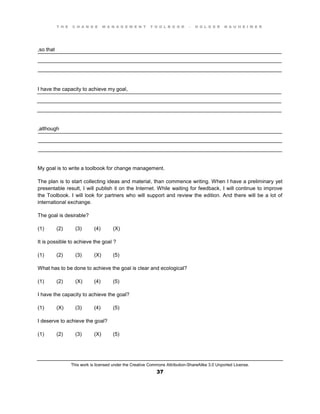
and 5
5, 4 based on
group
5. Where is responsibility felt
for achieving organisational
goals?
Mostly at top Top and middle Fairly general At all levels
6. How much cooperative
teamwork exists?
Very little Relatively little Moderate
amount
Great deal
7. What is the usual direction
of information flow?
Downward Mostly
downward
Down and up Down, up and
sideways
1 2 3 4 5 6
There is conformity to
rules and standards
at all times - no
personal
responsibility given
People manage themselves and do
their work as they see fit; great
emphasis on taking personal
responsibility
T H E C H A N G E M A N A G E M E N T T O O L B O O K – H O L G E R N A U H E I M E R
This work is licensed under the Creative Commons Attribution-ShareAlike 3.0 Unported License.
103
8. How is downward
communication accepted?
With
suspicion
Possibly with
suspicion
With caution With a
receptive mind
9. How accurate is upward
communication?
Usually
inaccurate
Often inaccurate Often accurate Almost always
accurate
10. How well do superiors
know problems faced by
subordinates?
Not very well Rather well
Quite
well Very well
11. At what level are decisions
made?
Mostly at top Policy at top,
some delegation
Broad policy at
top, more
delegation
Throughout but
well integrated
12. Are subordinates involved
in decisions related to their
work?
Almost never Occasionally
consulted
Generally
consulted
Fully involved
13. What does the decision-
making process contribute to
motivation?
Not very
much
Relatively little Some
contribution
Substantial
contribution
14. How are the organisational
goals established?
Orders issued Orders, some
comments
invited
After discussion,
by orders
By group action
(except in
crisis)
15. How much covered
resistance to goals is present?
Strong
resistance
Moderate
resistance
Some resistance
at times
Little or none
16. How concentrated are
review and control functions?
Very highly
at top
Quite highly at
top
Moderate
delegation to
lower levels
Wisely shared
Is there any informal
organisation resisting the
formal one?
Yes Usually Sometimes No - same
goals as formal
T H E C H A N G E M A N A G E M E N T T O O L B O O K – H O L G E R N A U H E I M E R
This work is licensed under the Creative Commons Attribution-ShareAlike 3.0 Unported License.
104
What are cost, productivity,
and other control data used
for?
Punishment Reward and
punishment
Reward,
sometimes self-
guidance
Self-guidance,
problem -
solving
You probably have seen a variation of this on our website. However, looking at it from today’s perspective
we find it rather static and rigid and we don’t apply it often. In general, we have shifted our focus to open
questions which allow people to tell their story (like AI). Whatever you do, it matters how you put it into a
process. There is no blueprint And questionnaires can do more harm than good when administered in
environments that aren’t conducive.
ORGANISATION AL TIMELINE: WRITING THE HISTORY OF YOUR
ORGANISATION
The objective of the Tool is to appreciate our history, trends we have experienced, as well as what the
past means to us.
In an institution, it is important to create a common body of history in a participatory way. Historians
accept, to a growing extent, the findings of cognitive psychology and neuro-biology. As Wolf Singer, the
director of a private German research organisation for brain sciences puts it: "We just perceive what we
expect anyhow." That means that history, in particular the recording of oral history, is always related to
the construction of reality that people make-up in their minds. Whoever is recording the history of the
organisation will be selective, often over generalize, and sometimes distort information. The more views
on organisational history are collected, the more people are involved in the selection of relevant issues to
be interpreted and recorded, the greater the chance for successful organisational change.
Time lines are a part of an organisation’s history. They encourage people to tell their own stories and to
compare them with those of colleagues. Overall, they help to identify trends and important events that
changed the of the organisation’s history.
Worksheet for participants to be used in a workshop:
Step 1: Drawing the time line
1. Alone, think about events that represent notable milestones and/or turning points in your personal
life, globally and in the history of your organisation. Try to identify a couple of assumptions that
you made at certain times of the history. There are some sheets attached that will help you to
focus on important events.
2. Use a marker to write (or draw) your milestones on the time line which is displayed on the pin-
boards. Use black markers for the "facts" that happened and red markers for the "assumptions".
T H E C H A N G E M A N A G E M E N T T O O L B O O K – H O L G E R N A U H E I M E R
This work is licensed under the Creative Commons Attribution-ShareAlike 3.0 Unported License.
105
Step 2: Analysing the time line
3. The participants form groups of 6-8 persons. Each group will analyse one of the three different
time lines with the following questions:
 What were important trends are noticed at different times?
 What assumptions did/do people make on the future?
 How did the trends and assumptions shape what happened next?
 Are there important lessons for the future?
 What does the personal time line say about the people working within your organisation?
 What does the global time line say about the position of your organisation in the world and
 How the organisation has reacted to global trends?
 What does the institutional time line say about the learning processes within the
organisation?
4. The group should prepare one flip chart that summarises their main findings. We have prepared
templates for the preparation of individual time lines, which you can download as PDF.
PERSONAL: What you did and what happened to you?
1974-1984 (what happened) what did you expect to happen next?)
1984-1994 (what happened) what did you expect to happen next?)
1994 to 2004 (what happened) what did you expect to happen next?)
2004-2014 (what do you expect to happen next)
Table 1: Template for Personal Timeline
GLOBAL TRENDS: What outside influences shaped the work you are doing?
1974-1984 (what happened) what did you expect to happen next?)
1984-1994 (what happened) what did you expect to happen next?)
1994 to 2004 (what happened) what did you expect to happen next?)
2004-2014 (what do you expect to happen next)
T H E C H A N G E M A N A G E M E N T T O O L B O O K – H O L G E R N A U H E I M E R
This work is licensed under the Creative Commons Attribution-ShareAlike 3.0 Unported License.
106
Table 2: Template for Global Timeline
YOUR ORGANISATION What happened in your organisation ?
1974-1984 (what happened) what did you expect to happen next?)
1984-1994 (what happened) what did you expect to happen next?)
1994 to 2004 (what happened) what did you expect to happen next?)
2004-2014 (what do you expect to happen next)
Table 3: Template for Organisation al Timeline
EXPLORING THE CONSCIOUS AND THE UNCONSCIOUS MIND OF
ORGANISATION S
The theory of complex systems has shown that the components of a complex system share
characteristics of the whole system. A metaphor for this relation has been given by Mandelbrot”s
appletree, a mathematical model, of which each smaller unit consists of the same design like the larger
ones. The structure and the behaviour of organisations and groups mirrors the structure of human
behaviour. Like mankind has universal inherent features and other, acquired characteristics,
organisations have fixed and flexible qualities. For example, the need for a legal structure of a profit or
non-profit-organisation in most countries is a fixed quality. Like different ethnic groups, organisations
differ in their legal structure. The internal organisation is much more flexible. Part of it might be
predetermined by the "genetic" (legal) structure, e.g. the need for an executive director, others might be
self-determined. The way, different parts of the organisation interact, is an acquired - or "learned" quality.
However, we know how difficult it is to de-learn something once we have acquired it.
Organisations and groups - like human beings - have a conscious and an unconscious “mind”.
Conscious elements are all the written regulations, the way communication between parts of the
organisation are organized officially, reporting formats, etc. Unconscious elements are all the rules that
everybody adheres to but aren’t express verbally or in writing. They might, for example, refer to how you
address superiors (or inferiors). Or, how to adopt goals established by the higher management. Clothing
rules are conscious (i.e., explicit) in some organisations while they’re unconscious in others. People don’t
usually talk about these about these unconscious rules; it’s as if these unconscious rules are hot
potatoes.
It’s clear that unconscious rules an organisation exist for a reason. Like the unconsciousness processes
of humans, they help us to navigate through day-to-day life without having to be concerned about too
many things. Without them we would not be able to focus on important things. When we drive a manual
vehicle, our unconscious navigates us through the process of pressing the clutch and the acceleration at
T H E C H A N G E M A N A G E M E N T T O O L B O O K – H O L G E R N A U H E I M E R
This work is licensed under the Creative Commons Attribution-ShareAlike 3.0 Unported License.
107
the right time. But, when we drive automatic we have to unlearn the unconscious behaviour of shifting
gears, this is also true for societies. For example, many countries still have problems when it comes to
integrating foreign nationalities into their communities. The law of citizenship, which would allow
immigrants to become legal residents, can be amended in parliament. But people will still resist against
integration of the "aliens" into their society for many years, if not decades. Recent work in family therapy
has shown how social groups inherit belief systems from their forefathers / ancestors.
In the same way, if the focus, task or the official structure of an organisation changes, new behaviours
have to be learned. For that to place it may be helpful to bring the unconscious rules of the group to the
surface. It is highly recommended that you employ an unbiased outsider to facilitate a session of this
nature and people should be prepared that they will feel a lot of resistance. It is always easier to change
written rules and structures than the collective knowledge of a group.
The following model helps to structure the consciousness and the unconsciousness of organisations. It
can be applied together with other tools, were there other people responsible for initiating organisational
change. It introduces different levels of identity.
Each individual member of the organisation has his own identity, his own values, capabilities and typical
behaviours. He or she has a personal motivation to work for the organisation. As well, he or she might
have other priorities in life, which can be in conflict with the interest of the organisation.
The organisation has also a common identity which is defined through the way people interact. It is the
social roles. Besides, the organisation is predetermined by its task (sometimes also called “mission”).
Furthermore, there is the client of the organisation (if it is not exclusively focused on its interior, like social
clubs that are just producing value for their own members). Finally, the organisation is influenced by
social, political, economic and cultural f conditions and has to interact with the “outside” society, its
representatives or other groups and organisations i.e. "The Universe".
The direct relations to the outer world are called the environment, but there is something more.
According to chaos theory, every action of an individual or a group of individuals elicits an effect, or a
chain of reactions. Like the famous flapping of a butterfly’s wing in America, which might change the state
of the atmosphere and cause a tornado in the Indonesian coast. Obviously; the bigger the action, the
greater the probability of a strong reaction. Some organisations were explicitly created to change the
world (e.g., Greenpeace, Amnesty International). Other organisations’ targets, particularly those of
enterprises, seem to be directed towards increasing shareholders’ values. But still, every organisation has
a spiritual value. That’s what I call the level of the universe. The tool Companies that belong to the planet
elaborates more on this subject.
T H E C H A N G E M A N A G E M E N T T O O L B O O K – H O L G E R N A U H E I M E R
This work is licensed under the Creative Commons Attribution-ShareAlike 3.0 Unported License.
108
Figure 14: Unconscious
Sphere Conscious Unconscious
I What is my intention to work for this
organisation?
What do I not want to know?
We What is allowed to be known about our
organisation?
What is not allowed to be known in our
organisation?
Task How do we produce value for our clients How do we maintain ecology and at what
cost?
Client What do our clients expect from us? What is the identity, what are the beliefs
of our clients?
Environment What are the obvious trends in our business? What two questions would we most like
to ask an oracle?
Universe Is there anything more important than success
of the organisation?
Is there anything we will never know?
T H E C H A N G E M A N A G E M E N T T O O L B O O K – H O L G E R N A U H E I M E R
This work is licensed under the Creative Commons Attribution-ShareAlike 3.0 Unported License.
109
Table: Guiding Questions
SYSTEMIC CONSTELLATIONS
Systemic constellations have been introduced into family therapy by Virginia Satir (described in her book
"New Peoplemaking) and further developed by Bert Hellinger (described in many of his books, e.g.
"Love’s Hidden Symmetry: What Makes Love Work in Relationships"). This development was based on
the philosophy that conflict/deviance in families cannot be attributed to a single member only but to the
entire system. The method has been further adapted to other social systems such as organisations, and
is now widely used in organisational development. The efficiency and effectiveness of this method in
finding adequate solutions for institutional problems is impressive.
Organisations, like families, follow systemic principles and violation of these (extrinsic or intrinsic)
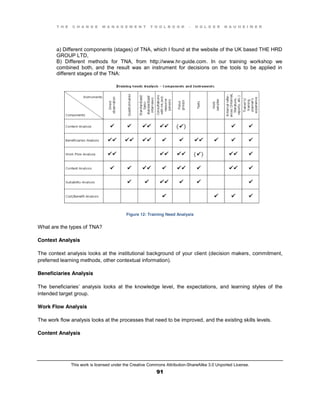
principles lead to disturbances, which affect members of an organisation. The objective of Systemic
Constellations is to "put things in order", e.g. to find the best conceivable constellation of the system
which is under consideration.
Systemic constellations have only recently received a growing attention in a corporate context. They are
perceived as highly effective in supporting the human resources of an organisation. People, teams and
organisations, like soccer players, are successful when they have the "right position on the field."
(However, the last world championship has shown; that soccer needs a good constellation as well as
perfect individual players - the leaders of the pack). The better the relative positions in a system, the
higher the synergy.
Some examples for application areas of systemic constellations:
* Information for personnel decisions:
Which applicant fits more in our system?
How can our team perform better?
Do we have the right number of people in our system?
How can we improve our core competencies?
Am I (as an individual) at the right position?
* The dynamics of an organisation:
What are the reasons for problems in our information flow?
Why do people leave our team?
Do we have leadership in our system?
Which kind of leadership do we need?
* The culture:
T H E C H A N G E M A N A G E M E N T T O O L B O O K – H O L G E R N A U H E I M E R
This work is licensed under the Creative Commons Attribution-ShareAlike 3.0 Unported License.
110
How can we focus on our goal?
Are we attractive to other people?
What is the reason for the lacking support for our programme?
What about loyalty and trust?
* The approach:
The principle of representation as the core of systemic constellations
Displaying the inner picture of the client into the room
Systemic constellations need to be done under the guidance of an experienced facilitator who has the
ability to create a safe environment in case problems arise, as well as having the knack for asking right
questions at the right time. The starting point of a systemic constellation is the expression of an
institutional issue or problem by one participant of the group, who in following will be called "The Star".
The Star gives a very brief explanation of the "problem space", without going into further details. Then he
selects, from the other participants, representatives for the various elements of the system. The elements
of the system could be individuals or groups in the organisation. Individuals who are part of the problem
space should not be included as players and they should not represent themselves (however, in a group
that has developed a certain degree of trust, the constellation could also be established with the
characters involved in real life).
The Star places the representatives in the room according to his understanding of the problem space. He
would particularly look for
* Distance / closeness of the elements
* Relative position between the elements (are they looking at each other, etc.)
* Body posture
The result of this first step is a draft picture of the problem space that symbolizes the mental map of the
Star. The sculpture can reveal structures and dynamics within social systems that had been covered for a
long time. The Star would then be encouraged to review the whole picture and adjust the individual
positions.
Moving the problem space towards a solution
There are several options for continuing the exercise. The facilitator who is able to analyse what action
would help to improve what the system makes with a selection of the appropriate process. Systemic
constellations have rules and principles, but also involve a lot of intuition.
A first option is to ask the players how they feel about their position. They may raise concerns like "I feel
very isolated from the rest of the group." or they might express satisfaction with their position.
T H E C H A N G E M A N A G E M E N T T O O L B O O K – H O L G E R N A U H E I M E R
This work is licensed under the Creative Commons Attribution-ShareAlike 3.0 Unported License.
111
The next step is decisive. The sculpture will be rearranged until a better constellation is achieved; in
which all have their appropriate position relative to the rest of the system. The rearrangement is made by
The Star, but could be supported by other players. At the same time, a facilitator who is trained in
systemic coaching techniques will, by asking appropriate questions, initiate change processes.
The Practice of Systemic Constellations
In 2001, I was invited to support a horticulture project in a country of South Asia. The project was
supported by an external donor organisation and intended to contribute to higher income of the rural
population by introduction of improved fruit and vegetable orchards. One aspect of the project was to
create a small profit-oriented extension service organisation that would give advice to the farmers on a
cost-recovery base. (For the sake of this example, let’s call them "VEGGIES CONSULT").
When I came, the team of VEGGIES CONSULT had already started their operations, but they were still
dependent on the financial support of the project. The European project adviser had contracted a national
consultant who was supposed to help in the management development of VEGGIES CONSULT. I was
called in to do a one-day team training with the entire team, consisting of consisting of more than 7
consultants.
Since I did not know the group and I had only one day to conduct training, I started with a "classical" team
building approach, doing some soft exercises on values, communication, brainstorming on issues and so
on (you all know this stuff). During the lunch break, one participant took me aside and said: "Well, Holger,
what you are doing with us is really nice, but we need something else." When I asked her what she was
referring to, she told me that the team had a real problem, which needed to be fixed now.
I hesitated, bearing in mind that I had only three hours left for the workshop. Not knowing the exact
subject of the conflict (although I had an idea), I feared that I was about to open a Pandora’s box which I
would not be able to close again (in fact, my departure was scheduled for the following day).
After the break, I addressed the entire group and presented my dilemma. I asked everybody what their
opinion was - to continue the course as planned or to work on the problem. A strong minority suggested
to work on the problem, and I felt that most of the others were just too polite to tell me what really
mattered. I took a ten minute break and then decided to do a constellation with them.
My next problem was that I had only the real life actors involved in the problematic situation and no other
representatives whom I could have engaged for the constellation (the theory says, always take
representatives!). Together with the group we chose one lady to actually do the constellation on the basis
that her position in the problem space was marginal (according to herself and the group).
Still not knowing the problem, I asked her to position individuals in the room, taking into account their
respective distance from each other and their direction. Were they facing each other? Who was close
together and who was detached from the rest of the group? The others were told not to comment, while
she was doing her work. The last to be positioned was the consultant he was placed in the inner circle of
the management team of VEGGIES CONSULT.
T H E C H A N G E M A N A G E M E N T T O O L B O O K – H O L G E R N A U H E I M E R
This work is licensed under the Creative Commons Attribution-ShareAlike 3.0 Unported License.
112
Consequently, I asked everybody to talk about their feelings. We quickly identified two problems: the
isolation of the outpost staff from the centre and the position of the consultant. While appreciating the
problem of the outpost staff, we then proceeded and concentrated on the consultant. It became clear that
he had been appointed and placed by the international team leader (who was not present at the session )
and through this support he had partly adopted a management role rather than a consultant role. This is
a classic consultant conflict: The client ( whom you work with) differs from the customer ( who pays you).
This might work, but often find conflicting interests
Finding a solution to the system was easy, the team (including the consultant himself) proposed that the
consultant, rather than standing in the middle of the management team, should circle the team, i.e. movie
around and by this be able to change his perspective permanently. Everybody was happy with this
solution (even the customer, who came later), and we were able to continue our workshop, dealing with
other issues in a straightforward way.
A couple of weeks later I came back. Although the team was far from having solved all their problems,
the relation between management of VEGGIES CONSULT and the consultant had taken a different
shape and was acceptable to all stakeholders. He had taken a more advisory approach without
interfering into the decision processes.
During the exercise, we did not talk much, and afterwards we did not analyse the constellation and its
consequences in detail. The solution that had emerged was instantly clear to everybody and helped the
system to heal by itself.
ANALYZE CHANGE DRIVERS ON DIFFERENT LEVELS OF CHANGE
In the daily activities of an organisation individuals identify themselves on three levels. As the individual
self, as part of a team or unit and as part of the organisation or a larger system. In essence, sustainable
change requires a transformation on all three levels. Through various learning processes, the consultant
or facilitator assists the individual, unit and organisation to comprehend and reflect the various aspects
affecting them and to realise positive opportunities for change.
T H E C H A N G E M A N A G E M E N T T O O L B O O K – H O L G E R N A U H E I M E R
This work is licensed under the Creative Commons Attribution-ShareAlike 3.0 Unported License.
113
Figure 15: Levels of Change
Group Exercise: Change Drivers and Change Levels (45 minutes)
Step 1: Get together in groups of 7-8. Identify a facilitator, a time keeper and a presenter. (5 minutes)
Step 2: Each group member identifies one change driver that affects them in person, their core team, or
organisation as a whole. Write those change drivers on paper cards and fix them at the pin board
(column 1). Do not discuss these change drivers, all opinions are valid. Contradictions are appreciated!
(10 minutes)
Step 3: Having completed step one, each member of the group marks those change drivers that affect
her/him personally, her/his team, or the organisation as a whole. Use the sticky dots for marking those in
column 2. Again, do not discuss this step. Differences are appreciated! (10 minutes)
Step 4: Discuss with the other group members, whether those change drivers affect individuals, teams,
and/or the organisation as a whole, and make corresponding remarks in column 3 (I= individual;
T=Team; O=Organisation ). A change driver might affect only one of the three levels, or two, or all three.
If you cannot agree, mark the respective field with a red arrow (10 minutes)
Step 5: Together as a group, identify one consequence for the organisation as a result of the change
driver. The facilitator writes them on a paper cards and fixes them at column 4. (10 minutes)
Step 6: Present your results in the plenary.
Figure 16: Example
T H E C H A N G E M A N A G E M E N T T O O L B O O K – H O L G E R N A U H E I M E R
This work is licensed under the Creative Commons Attribution-ShareAlike 3.0 Unported License.
114
RALPH STACEY”S AGREEMENT & CERTAINTY MATRIX
In the last ten years, complexity science had a strong impact on the theory and practice of change
facilitation. Tools like Open Space Technology, Appreciative Inquiry and others are based on the
assumption that highly complex social systems like organisations follow certain generic principles and
resemble other systems such as the body, colonies of ants, swarms of fish or birds, etc. Also, cybernetic
models have been applied, for example for the description of systems archetypes by Peter Senge.
Searching for a model that gives a simple road map for dealing with complexity, I found the model of
Ralph Stacey.
As seen in Figure 1, Stacey has proposed a matrix that introduces two dimensions with regards to the
management of organisation s: Certainty and Agreement:
Certainty depends on the quality of the information base that facilitates individual and joint decisions in
organisations. Rational management has tried hard to increase uncertainty by introducing tools like
fishbone analysis, the Boston Matrix, customer research, etc. And, in fact there are many day-to-day
decisions in management, where analytical decision making is highly successful. There are, however,
many situations in which decision is made on assumptions. Depending on the number of stakeholders
involved, the projected time frame, the susceptibility of the project to external influence factors, etc.,
projects might become very complex and it becomes impossible to realistically predict outcomes.
Modern social systems such as organisations are mainly self-organised on the basis of negotiation
processes. The degree of agreement among the people directly involved on what should be done ("the
truth") with respect to the implementation methodology of a project is an important factor determining
success.
T H E C H A N G E M A N A G E M E N T T O O L B O O K – H O L G E R N A U H E I M E R
This work is licensed under the Creative Commons Attribution-ShareAlike 3.0 Unported License.
115
Figure 17: Ralph Stacey’s Agreement & Certainty Matrix - (modified from: Brenda Zimmerman)
1. Many simple business processes are situated at a level in which it is certain what needs to be
done and people involved agree on that. Here, traditional management approaches, e.g.
management by objectives apply and work well. However, leaders should always question
themselves, "How do we know that we know?", "Have we assessed all the critical variables?"
and, "What have we done to assure that people in our organisation share a common
perspective?" Often, managers are blinded by their own vision. A tool to assess different
perspectives is a participatory risk analysis (see Risk Assessment for Projects).
2. Very often, strategic analyses show a strategy that is most likely to lead to a better business
performance. What has to be done, and what will be the outcome, is quite obvious to analysts.
However, members of the organisation might not agree or for some reason show resistance to
the planned changes. Take, for example, the implementation of companywide software platforms
that facilitates management of business processes. There are hundreds of examples where such
projects have faced severe problems during the implementation phase. A case study how Nestlé
has learned this the hard way can be found at http://www.cio.com/archive/051502/nestle.html.
So, what should be done in a situations characterised by certainty but disagreement and
resistance? If you can’t (or don’t want) to fire all that are blocking your plans, there is no other
way than selling your project. This takes time and resources but will save you a lot of money in
the end. Of the modern Change Management approaches, Real Time Strategic Change (RTSC)
is certainly one methodological framework to be applied in such situations.
3. The other extreme in which managers find themselves and their organisations is characterised by
a high agreement of stakeholders - what Senge calls "shared vision", but a high degree of
uncertainty. "How will our business sector evolve?", "What new technologies will be available
tomorrow?", "Which political decisions will influence our future?", etc. are just some key
questions that apply. This is the area of scenario design, see Scenario Analysis.
4. Also, the current theories of Otto Scharmer (http://www.ottoscharmer.com/) provide leverage to
navigate through such environments. Also, participatory approaches for defining strategies apply
very well in such situations.
5. You wouldn’t want to be in the hot seat of a manager who faces a situation in which the future is
highly uncertain and the stakeholders are far beyond any agreement. However, many political
leaders are operating in exactly such an environment. In an organisation you would do
everything to avoid that situation, because it is what complexity scientists call "The Edge of
Chaos". The fall of the Berlin wall, one of my favourite stories that illustrate complexity, is such a
story, where a system that had been stable for 40 years, collapsed in one night of freedom
celebration.
6. Most contemporary management processes are situated in a field that fluctuates between the
extremes that have been delineated above. Characterised by a medium to high level of
uncertainty and by stakeholders with highly diversified perspectives on what should be done.
Here, laws of complexity science and neurobiology apply to change in organisations, because
change is the norm. In such environments, the main task of management is to facilitate the co-
creation of the organisation’s future, to provide room for self-organisation and to let people decide
themselves about their own and their organisation’s issues. I firmly believe that such strategies
are the only way to lead out of the political crisis of the world, and that more profit and non-profit
T H E C H A N G E M A N A G E M E N T T O O L B O O K – H O L G E R N A U H E I M E R
This work is licensed under the Creative Commons Attribution-ShareAlike 3.0 Unported License.
116
organisations will adapt management tools for co-creation, such as Open Space Technology,
Appreciative Inquiry, World Café, and other tools to come.
CREATING AN ORGANISATION ”S VISION:
How to create a corporate identity to which people like to subscribe
"Every organisation has a destiny: a deep purpose that expresses the organisation’s reason for
existence. Visions exist on different levels of the organisation’s identity. Every telephone
organisation , for example, is tied to the original vision of Graham Bell - to provide a tool for
universal communication. Many members of the organisation have a collective sense of its
underlying purpose - but in day-to-day operations those visions are often obscured. To become
more aware of an organisation’s vision, one must ask the members and learn to listen for their
answers.
People sometimes say that it is pointless to develop a sense of purpose for a company. There
already is a purpose: "To maximize return on investment to shareholders." Obviously, making
money is important. But to confuse the essential requirement for advancing in the game with the
deeper rationale, is a profound confusion. Focusing on the purpose of making money at the
expense of other purposes, will naturally distract an organisation’s competitive advantage."
(P. Senge)
In the last 10 years, defining corporate or organisation al visions and missions became have become
"flavours of the month" in organisation al development. To my knowledge, the idea mainly comes from
the US, but has been widely accepted and adapted by profit and non-profit organisation s.
Obviously, the idea behind defining an organisation al vision is three-fold:
Firstly, to have a tool for aligning members of the organisation and to increase their motivation to
cooperate.
Secondly, to attract customers, in particular growing the share of environmentally or ethically
conscious consumers.
Thirdly, to address the concerns of shareholders who are monitoring the companies”
expenditures so capital is not wasted.
Here comes the trick: If you are not an NGO, I don’t believe that it is always possible to achieve all three
objectives with one hit. Employees of a company or a government organisation might first look at
working conditions and not be so interested in, let’s say, the environmental record of the organisation .
The shareholders” view is obviously directed towards short- or medium-term return-on-investment. To
have a vision that satisfies all is, so to say, a little bit naive (at least in times of recession).
T H E C H A N G E M A N A G E M E N T T O O L B O O K – H O L G E R N A U H E I M E R
This work is licensed under the Creative Commons Attribution-ShareAlike 3.0 Unported License.
117
In a nutshell: I believe that organisation s need to ask first: Why do we need a vision? What is the
objective for it? Whom do we want to attract with the vision? Can we achieve our objective by other
means?
An example: I had the management of a social welfare organisation ask me to organize a workshop with
all their staff which sought to define their vision. I found out, that the main objectives were
1. To get more ideas for new services that the organisation could offer and
2. the alignment of the staff with the new management. They were not in the position to pay for a
longer and moderated OD process, just a 2day event.
I convinced them not to focus on the vision but to hold a 2 day Open Space on the future of the
organisation . The outcome was (1) a variety of practical and implementable proposals which are now
put into practice and (2) a boost for the motivation of the staff. Maybe the vision comes next year...
Don’t get me wrong - I still believe in visions and that co-creating a vision is an important step in an
organisation al development process. But I recognise that organisation s are more cautious when
spending money for an OD process. So we all have to think of when, where and with whom it is
appropriate to define a vision. A vision shared by the members of an organisation helps people set goals
to advance the organisation and is key for motivation and empowerment. Without an understanding of
the organisation’s purpose, its actions are confined to management by objectives, i.e. the goals that have
been set by the higher management level or often in the case of public institutions, by outsiders.
Consequently, members of an organisation that doesn’t have a vision are not able to really take part in
creating their own professional future - and the future of their working environment.
Visions can be created at different levels of an organisation . They can be developed by the CEO of the
director and then published in the organisation’s newsletter or by other communication methods. The
message to the staff is, "That is the view of our future, and we want you to come on board." Or they can
be developed in a process that involves every member of the staff, from the driver to the boss. Of course,
there are many shades between both extremes. Visions can be created at a higher level of the
organisation and then developed by working groups of the staff. Or the other way around. The
management could also consult the members of the organisation before creating the actual vision.
There is no right or wrong way, but there are appropriate or inappropriate approaches. Members of an
organisation who have been traditionally managed autocratically might not be able to describe their
vision of the future freely at first. Cultural values might impede equal sharing of visions. You have to
assess the degree of participation that is specific for your environment. The exercise "Is your
organisation a participatory one?" might help you in the assessment.
From those who subscribe to of our newsletter we have collected vision and mission statements that
allow us to compare cultural and industry specific visions.
The tools that are provided for the development of visions can be used in different settings. They can be
applied by individuals, by a confined group of decision makers, or they can be adapted to serve as a base
for a company-wide co-creation process. The Toolbook offers a series of exercises which help you to
analyse and visualize structures of your organisation :
T H E C H A N G E M A N A G E M E N T T O O L B O O K – H O L G E R N A U H E I M E R
This work is licensed under the Creative Commons Attribution-ShareAlike 3.0 Unported License.
118
Logical level alignment - defining the organisation’s identity:
is another wonderful exercise for vision sharing. It starts by delineating the future
environment, and then sequentially defines future behaviours, skills, values, identities
and relations to the outside world. It is one of my favourites!
LOGICAL LEVEL ALIGNMENT - DEFINING YOUR IDENTITY
(adapted from R. DILTS)
Based on the work of Gregory Bateson, Robert Dilts has delineated a model of human behaviour, which
is called the Model of the Logical Levels. It assumes that human processes can be described along a
ladder of categories that influence each other. The lowest level is the environment, followed by
behaviour, capabilities, beliefs/values and identity. Beyond identity, the model opens up to "the other",
i.e. systems that include other human beings - the family, the community, and the world.
Figure 18: Levels of Change
According to the model, the levels influence each other in both directions but changes on the higher level
will have a greater impact on the lower levels than the opposite. For example, learning a new skill at first
instance (capability level), might open me up both to the importance of other cultures (values level) and
my identity - I belong to the world (identity level). It certainly changes my behaviour -suddenly I can talk
to people whom I would not have talked before. There might even be a dramatic change in my
environment - I might move to another country.
If on the other side, the belief level is changed first, e.g., from: I do not have the capacity to learn foreign
languages to: It’s easy for me to learn languages, the consequences for the lower levels are tremendous!
Before this exercise, you should have worked on defining your goals, e.g. with the T.O.T.E. or The Walt-
Disney Circle.
T H E C H A N G E M A N A G E M E N T T O O L B O O K – H O L G E R N A U H E I M E R
This work is licensed under the Creative Commons Attribution-ShareAlike 3.0 Unported License.
119
Step 1: Identifying the future Environment
Start with the future environment in which you want to achieve the goal. This is a creative exercise, there
are no limits! Choose the nicest offices or houses, in which you really would love to work or live.
Step 2: Identifying Future Behaviours
Imagine, a video camera filmed you performing in that wonderful environment you have just described.
What would an outsider observe on the video? What are people doing there? Are they writing, talking,
wandering around, dancing etc.? Again, do not describe content but behaviour.
Step 3: Identifying Future Capabilities
In the environment you have described, and with the behaviour one could identify on a video film, what
new capabilities and skills would you need to get closer to your goal? Try to think in different categories.
Certainly, technical skills might be necessary. Do you need new capabilities of communication and
collaboration?
Step 4: Identifying your Future Values and Beliefs
You have managed to live and work in a pleasant environment, exercising new behaviours and learning
new skills and capabilities, what new values would you need to realise your vision? What must you
believe to be motivated to go for your goal? What values do you need as a human being?
Step 5: What´s your Identity?
Often, people find it difficult to put their own identity into words. It helps very much to find a metaphor that
describes your identity. If you look for it, it will be very easy to make out an appropriate image. (e.g., I am
a mountain which stands solid and still, or, I am a tiger, ready to attack everything that wants to approach
me). Try to visualize the metaphor. In your inner eye, try to listen for sounds, and recognise the deep
feelings within yourself.
Step 6: Is there anything else? How do you serve the community?
If you agree that every individual has a responsibility to the outer world - our families, our communities,
our state, the earth and the universe - you will find it very satisfying to continue this step. Take on the
metaphor you utilised in STEP 5 and ask yourself: What else is around us? How do we contribute?
Answer the questions by contextualizing the metaphor, i.e. people can rest on me, or we I can protect the
weakest...
Step 7: Check the image by going down the ladder
You have now reached the top of the logical levels and have written created your vision. You may go
back to the beginning, checking every single step of ladder. While doing so, you utilise the metaphor you
created for expressing your identity. Go back to the identity level, taking into account the effects the
T H E C H A N G E M A N A G E M E N T T O O L B O O K – H O L G E R N A U H E I M E R
This work is licensed under the Creative Commons Attribution-ShareAlike 3.0 Unported License.
120
____________________________________________________________________________________
____________________________________________________________________________________
____________________________________________________________________________________
____________________________________________________________________________________
____________________________________________________________________________________
____________________________________________________________________________________
____________________________________________________________________________________
____________________________________________________________________________________
____________________________________________________________________________________
____________________________________________________________________________________
____________________________________________________________________________________
____________________________________________________________________________________
____________________________________________________________________________________
____________________________________________________________________________________
____________________________________________________________________________________
____________________________________________________________________________________
____________________________________________________________________________________
____________________________________________________________________________________
____________________________________________________________________________________
____________________________________________________________________________________
____________________________________________________________________________________
metaphor has on the outer world, would the identity change? By taking the - maybe strengthened identity
- what about your values? How would your capacities and skills be affected? What other behaviours
would a video camera record by observing you? Does the environment look different?
Step 8: Write down your vision and enjoy it:
Goal
Environment
Behaviour
Capabilities
Beliefs
Identify (Metaphor)
T H E C H A N G E M A N A G E M E N T T O O L B O O K – H O L G E R N A U H E I M E R
This work is licensed under the Creative Commons Attribution-ShareAlike 3.0 Unported License.
121
____________________________________________________________________________________
____________________________________________________________________________________
____________________________________________________________________________________
____________________________________________________________________________________
____________________________________________________________________________________
____________________________________________________________________________________
____________________________________________________________________________________
____________________________________________________________________________________
____________________________________________________________________________________
____________________________________________________________________________________
____________________________________________________________________________________
____________________________________________________________________________________
____________________________________________________________________________________
____________________________________________________________________________________
____________________________________________________________________________________
____________________________________________________________________________________
____________________________________________________________________________________
____________________________________________________________________________________
Community
Identity
Beliefs
Capabilities
Behaviour
Environment
An example I completed many years ago:
Goal My goal is to publish a toolbook on the internet that discusses change
management.
Environment I am writing it in my office . There is a big desk with a lot of paper on it, books and
small notes everywhere. The big computer screen displays text and graphics, and
T H E C H A N G E M A N A G E M E N T T O O L B O O K – H O L G E R N A U H E I M E R
This work is licensed under the Creative Commons Attribution-ShareAlike 3.0 Unported License.
122
there are a lot of hyperlinks that lead to other interesting pages.
Behaviour I am typing something on my computer. Occasionally, I consult one of the
numerous books. I stand up and walk around, thinking deeply (one can see
wrinkles on my forehead).
Capabilities I need to be focused - I need to draw upon my knowledge and my experience. I
need endurance and I should be able to receive criticism.
Beliefs I believe that a toolbook of this nature , would be consulted by many people.
Identity (Metaphor I am like an irrigation channel, bringing fresh water to the fields.
Community The water will contribute to the growth of many plants (i.e. people) and it will help
to nurture the world
Identity Because the world is receiving my water, my self-respect is enhanced.
Beliefs I really can contribute to something that will improve human relations!
Capabilities Because there is a real demand for my water (= my book), I will be able to produce
work of a high standard which is expected of me. And I never stop flowing
Behaviour I am doing more other things that connect with the outside world; writing takes less
and less time.
Environment There is much more around me than the small cramped office. I am surrounded by
others.
PLANNING AND PROJECT MANAGEMENT
The reason I have included planning and project management (PM) in a Change Management Toolbook
is because Change Management originates in the crisis that classical PM faces right now. Originally
developed as a sub-discipline of engineering, PM assumes that if you design a concise plan and put the
resources right in place, you will achieve your predefined objectives.
T H E C H A N G E M A N A G E M E N T T O O L B O O K – H O L G E R N A U H E I M E R
This work is licensed under the Creative Commons Attribution-ShareAlike 3.0 Unported License.
123
Reality has proven this is rarely the case. More than 50% of projects fail in the sense that they:
1. do not achieve their objectives, or
2. do not deliver the promised results, or
3. sacrifice the predefined quality, or
4. are not completed in the given time schedule, or
5. use more resources than originally planned.
(For a more detailed description of the reasons for project failure, go to Risk Analysis).
However, I still believe that the classical PM tools have their merits and can help for example, aiding a
team in structuring their tasks. In my work I have found out that many project teams are open to Change
Management intervention, particularly if they have already started their journey and experienced the first
flaws. They start to ask, "Why don’t we achieve what we want to achieve?", and "What can we do
differently?" That is a perfect entrance point for a Change Management facilitator. Depending on the
project, and on the limitations the team experiences, any of the tools described in this Toolbook might be
applicable. There are, however, some general considerations (and some very specific tools) that should
be applied at the beginning of a planning process:
Project Cycle Management:
Many agencies which assist in development have adopted the PCM method as a general tool for
planning. While in general, this approach has some real advantages, it has limitations. These are some
general thoughts on PCM, which I published 7 years ago: Some of them are still valid.
Applying Chaos Theory to Planning:
Over the years, I have developed several different approaches to a planning workshop. I have used this
one successfully.
T.O.T.E
A tool for defining your desired outcome. A good starter exercise for a planning process.
Walt-Disney:
A nice tool developed by Robert Dilts which allows creativity to creep in planning sessions.
Scenario Analysis:
This is nowadays my preferred approach for strategic planning. Scenarios alter /challenge the mental
maps of those who develop them by inventing stories about what cannot be known - the future.
Risk Analysis of Projects:
T H E C H A N G E M A N A G E M E N T T O O L B O O K – H O L G E R N A U H E I M E R
This work is licensed under the Creative Commons Attribution-ShareAlike 3.0 Unported License.
124
Although originally not conceived as a change management tool, this kind of risk analysis can really help
teams to get a breakthrough. It helps to identify communication gaps and risks that have not been
recognised.
PROJECT CYCLE MANAGEMENT (PCM): NEW PROJECT MANAGEMENT TOOLS
OR RECYCLED APPROACHES FROM YESTERDAY?
(by Holger Nauheimer published in : AT-Forum, No. 9, 1997)
Recently, rumours have been circulating, saying "GTZ replaces ZOPP through PCM!", and: "PCM is
nothing but ZOPP - old vine in new bottles!" Both statements are principally wrong but bear - like all
rumours - a true core. So what’s this all about
In the mid-eighties , GTZ (Deutsche Gesellschaft für Technische Zusammenarbeit) – was main agency
for execution of the Technical Collaboration of the German Government, introduced a standardised
project planning method. This method consisted of consecutive steps for appraisal, planning,
implementation, monitoring and evaluation of projects. These steps were mediated and facilitated by a
planning tool that was called ZOPP (Zielorientierte Projektplanung - Objectives Oriented Project
Planning). ZOPP was meant to structure the planning approach i to include stakeholders analysis,
problem analysis, objectives and alternatives analysis and into the project planning matrix (PPM), also
known as Logical Framework Approach.
The planning procedure was formalized, and a series of planning workshops were made compulsory for
the live cycle of every project. Soon after introduction of ZOPP everybody mistook the
workshops(planning) with the method, without considering the ZOPP as a flexible tool, but as a rigidly
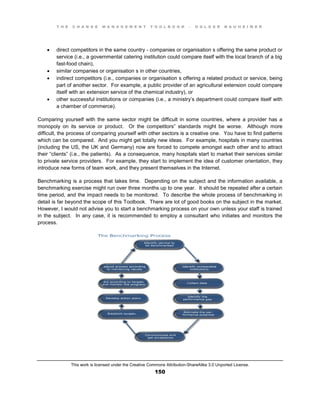
structured 3-days or 5-days seminar that started with the participation analysis and ended with the
formulation of indicators and assumptions.
During the last ten years, many GTZ advisors and consultants working for GTZ got acquainted with the
ZOPP workshop approach; and the monitoring and reporting system was totally adapted to the outcome
of the workshop. If a project failed to achieve its planned results, blame could be placed on the external
assumptions which had not been met. Nevertheless, since its introduction of ZOPP has been criticized
and a change was due in the early nineties. .
The GTZ recently has introduced a new concept of project management that might have significant
consequences for the work which consultants do and could change the general approach to project
planning and implementation. It followed the earlier step of the European Union. This concept which has
been labelled "Project Cycle Management" (PCM) and aims to elicit a paradigm shift regarding the
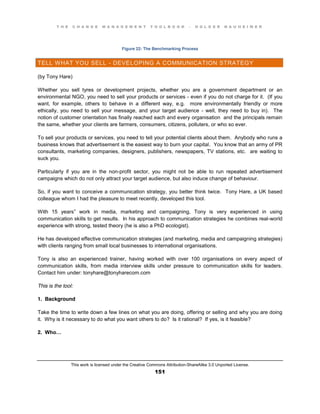
understanding of  “technical assistance" and should influence everybody who works in the development
assistance community.
The PCM concept incorporates the application of project planning and appraisal tools like ZOPP, PRA
(Participatory Rural Appraisal), gender-analysis and others. These tools are not replaced by PCM but put
into a flexible context of a planning cycle.
T H E C H A N G E M A N A G E M E N T T O O L B O O K – H O L G E R N A U H E I M E R
This work is licensed under the Creative Commons Attribution-ShareAlike 3.0 Unported License.
125
The core of the philosophy of Project Cycle Management is based on the principle that the initiative for a
technical cooperation project must be born from a self-help development process, in which only the
genuine actors, are involved.
Figure 18: Project Cycle Management
Only if the actors are unable to affect the transition from the present problem state to the desired state, a
national governmental or non-governmental organisation might interfere and assist the process for a
limited period of time. This is called a project.
Only if the national organisation of the partner country is short supply of the required skills and inputs for
the project, the German government might intervene and support the project through technical
assistance. A project supported by GTZ always is mediated by the partner organisation to the
beneficiaries.
This philosophy is not new. In fact it has been the official language of German development policy for the
last twenty years, but what’s new is that the GTZ has put it into the spotlight. . In the past and currently ,
projects have generally been influenced by the perceptions of German experts. Official programmes
called for participation of beneficiaries and new tools were introduced that seemed to secure the
involvement of target groups. However, participation was often reduced to a symbolic application of
participatory rural appraisal (PRA). The validity and the applicability of this method often was not related
to the context but was used as a blueprint approach.
There is a constant inherited conflict that runs through nearly all projects: target groups and partner
organisation s often, if not mostly have a different perception of projects, different desires, different
technical concepts. If partner organisation s would plan projects on their own they would look different.
UNDP has already introduced its new concept of "national execution" of projects. I had the opportunity to
observe such a project in Thailand, among other components sort to support small-scale milk production.
The project had support at the highest - the king of Thailand himself. Although officially it was called a
"poverty alleviation project", its main objective was to reduce the Thai dependency on imports of dairy
products. Therefore the project was not questioned for a long time. Through heavy subsidizes to
feedstuffs, extension, animal health services, and credits, production was economically feasible for a
period of time. However, the high performance breeds introduced were not adapting to the extreme
T H E C H A N G E M A N A G E M E N T T O O L B O O K – H O L G E R N A U H E I M E R
This work is licensed under the Creative Commons Attribution-ShareAlike 3.0 Unported License.
126
climate and the restricted feeding during the long dry season; their milk yield was sub-optimum. Finally,
the prices for concentrate feeds which were constantly rising, exceeded the limit that allowed feasible
production. Farmers who in the past were either forced or attracted by subsidies started to protest and
refused to continue dairying.
If there is any economic or moral sense justifying development assistance, one question should be
allowed:
Are we (the experienced experts from the North) smarter?
Sitting in my German office, I really don’t know. Working on a particular concept as a consultant, of
course, I am convinced that I am expert ; otherwise I could not justify the salary I earn. (which is
sometimes hundred times higher than the salary that my counterpart receives.).
If I look at the results of development aid of the last decades, I doubt that we are smarter. Maybe we are
better sometimes, and our solar cookers look very fancy, but our project approaches were often not really
accepted by the "target groups" and our partners. This relates to mainstream and so-called "alternative"
project approaches. We all know that the predominant view of partner governments and partner
organisation s is: "We don’t love the foreign experts, but we accept them as long as there is money
involved."
Despite the all different approaches that have been tried out since social-democratic values form the base
of development assistance - AT, participation, etc. - sustainability of projects which rely on foreign
experts or volunteers have not improved significantly.
There are some challenging questions to answer regarding the future:
 What can we do to increase acceptance of advisory service?
 How can we make ourselves understandable to our partners, making them truly believe that we
come with best intentions?
 Do we experts, have to radically change our concept of Technical Assistance?
 How can we and our partners work together as a great team sharing responsibility and using all
our creativity?
In this sense, the task of consultants in development assistance will be more process oriented. Ideally,
they could be unbiased observers, who visit a project periodically, facilitate real participation of all actors
and help to bring people’s minds and hearts together - not only including the poor farmers, but also the
national experts and bureaucrats. Such a consultant would first of all need social skills and secondly the
ability to move to a meta-level, i.e. to step back and to critically assess the roles of the participants -
including his/her own. The long-term advisers acting as team leaders in German Technical Assistance
projects will in many cases be overburdened with the triple responsibility of giving technical advice ,
organizing personnel and material inputs, and managing social processes. Consultants might in future
act as process supervisors and personal coaches to project managers.
T H E C H A N G E M A N A G E M E N T T O O L B O O K – H O L G E R N A U H E I M E R
This work is licensed under the Creative Commons Attribution-ShareAlike 3.0 Unported License.
127
The Objective Oriented Project Planning method has been released from its straitjacket and positioned
into a process. That means that planning workshops will not be obligatory any more within the project
cycle - the German teamleader or backstopper can decide . If workshops are conducted decisions
regarding the applied methods are in the hands of the moderator. They have to be chosen according to
the status of the project. At a certain period of time, it might be necessary to do a problem analysis in a
workshop, at a different point of time, a group might work on the project vision or elaborate the project
planning matrix. But things could be done also without workshops, e.g. in small project groups. For
example, a stakeholders analysis will require detailed studies which might include application of tools like
PRA and gender analysis. The project team is free to apply other tools like vision sharing, future
conferences, etc. However, the project planning matrix will most likely remain as an important tool of
quality control and as a base for operational planning, monitoring and evaluation . Indicators will become
a base to reach a common understanding on the project quality between advisers and partners ("What is
it that we want to achieve?").
A NEW APPROACH TO OBJECTIVES ORIENTED PROJECT PLANNING
by H. Nauheimer
INTRODUCTION
The idea of assembling people for a planning workshop is based firstly, on the believe that the creativity
of a group is more than the sum of the creative potential of the individuals and secondly, that ownership
of a programme can only be achieved, if stakeholders participate in the planning process. The main
targets of such a workshop therefore are to provide tools and opportunities for brain storming, and to
create the environment for mutual agreement.
The success of a project or a programme is influenced by a magnitude of factors, which influence each
other. All processes of a system (like an organisation , group, project, society, etc.) are principally
dynamic and can only be influenced in a systemic context. It is not possible to foresee all effects and
relations between the factors, which are basically chaotic. The expression of sustainability, during the
last 10 years used as a key word in development assistance is misleading: open systems are per se not
sustainable. They change constantly. A slow speed of change might suggest temporary sustainability of
a system; however, systems change faster today than twenty or two hundred or two thousand years ago.
It is proposed to omit the expression sustainability, or, alternatively, to specify the time frame for which
sustainability in a given context should be secured.
In a complex environment, linear planning tools lose their effectiveness. This is true for most
development projects; the failure of the classic methods like ZOPP is now widely recognised. To
T H E C H A N G E M A N A G E M E N T T O O L B O O K – H O L G E R N A U H E I M E R
This work is licensed under the Creative Commons Attribution-ShareAlike 3.0 Unported License.
128
elaborate a planning base that facilitates the enrichment of the system, the most important factors must
be identified and arranged in a context that considers systemic effects.
COMPONENTS OF A PLANNING PROCESS
Figure 19: Complexity
Of course, it is quite possible that we could fully account for the properties of each whole if we could know
the characteristics of all the parts and know in addition all existing relationships among them. The we
could reduce the characteristics of all the parts and know in addition all existing relationships among
them. Then we could reduce the characteristics of the whole to the sum of the characteristics of the parts
in interaction. But this involves integrating the data not merely for three bodies, but for three thousands,
three million, three billion, or more, depending on the whole we are considering. And since science
cannot perform this feat even for a set of three parts, it is quite hopeless to think it can do it for any of the
more complex phenomena it comes across in nature, man, and society. Hence, to all practical purposes,
the characteristics of complex wholes remain irreducible to the characteristics of the parts.
(E. Lazlo)
Following the introduction of new project management tools into the practice of development
collaboration, like for example, Project Cycle Management (PCM), the blue-print approach of the ZOPP
(Zielorientierte Projektplanung - Objectives Oriented Project Planning) method has been challenged. One
of the main criticism has been the linear process implied during planning workshops. Because they often
had been carried out n a rigid manner, those workshops have been criticized. New concepts of
development planning emphasize the process character of planning; a process cannot be concluded
within a week. However, introducing a workshop at the appropriate time into the planning process has
the advantages of, firstly, enhancing creativity and secondly, increasing the ownership of the workshop
participants with respect to the project. Considering the uncertainty of all planning, it is important that the
outcome of such a workshop is used in a flexible way and constantly adapted to reality.
T H E C H A N G E M A N A G E M E N T T O O L B O O K – H O L G E R N A U H E I M E R
This work is licensed under the Creative Commons Attribution-ShareAlike 3.0 Unported License.
129
Of course: projects require a planning base, for forecasting costs and necessary inputs. And projects
also need a monitoring base to facilitate comprehension of the project’s progress. The Project Planning
Matrix (PPM) - a part of the ZOPP methodology - provides an effective format for structuring project goals
and activities and serves as a base for monitoring and evaluation of projects. How can a PPM be
elaborated during a four days’ workshop, without following the rigid structure of ZOPP which had been
applied until recently? In the traditional way, the PPM was the outcome of a workshop procedure, mainly
based on a detailed problem analysis. But putting the problems into the centre of the discussion often
demotivates. And many problem analyses ended with the final verdict "shortage of funds/inputs" - which
does not really serve to increase self-help of the actors.
Would it be possible to base a planning process on a vision, without negating the problems to be solved?
Can the linear planning process be substituted by a more cyclical approach, respecting the
interdependencies of the various planning steps?
A new approach to elaborate a planning base was applied during an international conference of multi-
lateral agencies involved in control of human and animal diseases in Africa. The goal of the conference
(The Programme Against African Trypanosomiasis (FAO/WHO/IAEA/OAU): Planning Workshop at
CIRAD, Montpellier, April 7-10, 1997 ) was to work out a PPM for an umbrella programme, having the
objective of processing and disseminating information and co-ordinating activities of different research,
funding and executing agencies. The four-days’ workshop succeeded in finalizing a complete PPM,
including goals, objectives and activities of the programme, as well as defining objectively verifiable
indicators, means of verification, milestones for activities, inputs and assumptions for the achievement of
the project goals and outputs.
WORKSHOP APPROACH AND METHODS APPLIED
The workshop approach was based on an iterative process. By introducing different perceptual positions,
it was intended to elicit conscious and unconscious information from the participants. This was based on
the assumption, that all information required for a project plan can be obtained in such a workshop if a
critical mass of people involved in the subject participate in the planning session.
The planning approach consisted of the following steps:
1. Report and Analysis of the Past Programme Activities
2. Creating a Vision - Defining Overall and Programme Goals
3. Who Will Be Involved - Stakeholder Analysis
4. Creating Scenarios - Assumptions Analysis
5. Who Can We Deal with the Constraints - Problem and Solution Analysis
6. What to Do - Defining Outputs and Activities
7. How Do We Know about Our Success - Defining Indicators
The workshop was constantly visualized, using paper cards, pin-boards and flip charts. The material
produced in the different steps was continuously up-dated and utilised as an information base for the
subsequent steps.
T H E C H A N G E M A N A G E M E N T T O O L B O O K – H O L G E R N A U H E I M E R
This work is licensed under the Creative Commons Attribution-ShareAlike 3.0 Unported License.
130
1. Report and Analysis of the Past Programme Activities
The planning process started with a presentation and analysis of the first phase of the programme.
Members of the programme committee reported about the organisation s involved and about what had
been achieved in the first phase of the programme. Subsequently, the participants were divided into five
groups consisting of two persons each, which summarised the reports. The respective groups focused
on the (i) the goals of the programme, (ii) the activities carried out so far. (iii) the organisation s involved,
(iv) the existing constraints of the programme, and (v) indicators for programme success which had been
used so far. The material produced during this session was used as a base for the following planning
steps. The working groups analysed the reports of the programme committee according to the following
questions:
 Until now, what have been the goals of the programme?
 What have been the major activities? What has been achieved?
 Which organisation s are involved? What are their resources (finance, manpower, know-how,
technology?)
 What were the major constraints and limitations?
 What information was available for monitoring of programme progress?
2. Creating a Vision - Defining Overall and Programme Goals
As a next step, the participants of the workshop were asked to brainstorm on the following questions by
writing their inputs on paper card which subsequently were displayed on a pin-board.
 What do we want to do? What is our goal?
 Why do we want to do it?
 What will be the long-term benefit?
After clustering the statements, the group found an agreement on a common programme purpose, on an
intermediate goal and on an overall goal. The goals were displayed at the wall of the seminar room and,
after each of the subsequent steps, the planning group was asked to verify the validity of the goals. If
necessary, the objectives were up-dated according to new aspects which arose during the planning
process.
3. Who Will Be Involved - Stakeholder Analysis
In a next step, a stakeholders analysis was carried out. In a first approach, the major institutions involved
in the programme were identified by plenary discussion and brainstorming.
 Who will be involved?
The analysis was subsequently completed on base of the following questions:
 What are the strengths of the respective stakeholders? (consider finances, human resources,
know-how, technology, links, etc.)
T H E C H A N G E M A N A G E M E N T T O O L B O O K – H O L G E R N A U H E I M E R
This work is licensed under the Creative Commons Attribution-ShareAlike 3.0 Unported License.
131
 What are their weaknesses?
 What benefits could they receive from the Programme?
 Why could they resist against the Programme?
The material produced during this session was used as a base for the constraints analysis.
4. Creating Scenarios - Assumptions Analysis
In a next step, assumptions for the success of the programme were identified by means of a scenario
planning exercise. The plenary was divided into three groups of four persons each. The groups were
asked to work on the following questions:
 What two questions (regarding the future of the Programme) you most want to ask an oracle?
This question was introduced by Peter Senge (1994). It can be applied in individual interviews and for
group processes; it always elicits a lot of conscious and unconscious material.
 What is a good scenario? Assume the world works out well, how would the oracle answer your
own questions?
 What is a bad scenario? What if the world would turn into your worst nightmare?
 If you look back two years, what would have been a useful scenario then? What would it have
been good to foresee? By contrast, what did you actually think was going to happen?
 What are the most important decisions the Programme faces right now?
 What constraints do you feel from the Programme’s culture in making these decisions?
Each group member, in a first approach, answered the initial question by writing their ideas on paper
cards. The group subsequently selected two questions on which they continued to elaborate in more
detail by answering the other five questions. The material produced in this session was used for the
constraints analysis and for the identification of the assumptions which were later incorporated into the
project planning matrix.
5. How Can We Deal with the Constraints - Problem and Solution Analysis
In the following plenary session, the constraints, resistance and unfavourable scenarios identified in all of
the proceeding parts of the workshop were displayed on paper cards. Some of the constraints were
analysed in detail, and for each of the constraints, the plenary responded to the two questions:
 How can we deal with the constraints?
 How can we break the resistance?
This analysis served to separate internal and external influence factors. The material produced was used
to define output and activities. Those constraints and unfavourable scenarios that could not be influenced
by alternative programme strategies were included in the Project Planning Matrix as assumptions.
T H E C H A N G E M A N A G E M E N T T O O L B O O K – H O L G E R N A U H E I M E R
This work is licensed under the Creative Commons Attribution-ShareAlike 3.0 Unported License.
132
6. What to Do - Defining Outputs and Activities
During the preceding steps of the exercise, the predefined overall goal, the intermediate goal and the
programme objective were constantly refined and adapted to the advancement of the planning process.
In a subsequent brainstorming, the planning group was asked to define outputs that would facilitate the
achievement of the programme objective. The results were clustered and condensed to a small number
of outputs.
7. How Do We Know about Our Success - Defining Indicators
Finally, working groups elaborated activities related to the identified outputs, indicators, means of
verification, milestones and inputs. The identification of assumptions for securing the achievement of the
outputs was mainly based on the material produced during the preceding steps and complemented
through additional inputs of the participants and of the moderator.
The project planning matrix (PPM) is a tool to summarise the outputs and the activities of the project. It
defines indicators for measuring the achievements of the project and describes external factors which are
crucial for the project success.
Objectively Verifiable Indicators (OVI) define the performance standard to be reached in order to
achieve the objective. They specify what evidence will tell us that the overall goal, the project purpose or
output is reached. Activities are not verified by indicators, instead we identify the inputs needed to carry
out the activities. Indicators are defined by a set of characteristics, which are decried in terms of quality,
quantity, location, and time.
Means of Verification (MOV) tell us where we get the evidence that the objectives have been met and
where the data necessary to verify the indicator can be found.
Assumptions influence the next higher level of achievement in the PPM, e.g., the project goal will be
achieved, if the outputs are carried out and the assumptions occur. Assumptions which are almost
certain to occur should not be included in the PPM. Assumptions which are most likely not to occur and
which cannot be influenced by alternative project strategies are killer assumptions. They will jeopardize
the project success. In case of occurrence of killer assumptions, the project must be replanned!
At the end of the workshop, the results were verified and whenever necessary, rephrased.
Project Planning Matrix
SUMMARY OF
OBJECTIVES /
ACTIVITIES
OBJECTIVELY
VERIFIABLE
INDICATORS
MEANS OF
VERIFICATION
IMPORTANT
ASSUMPTIONS
T H E C H A N G E M A N A G E M E N T T O O L B O O K – H O L G E R N A U H E I M E R
This work is licensed under the Creative Commons Attribution-ShareAlike 3.0 Unported License.
133
Overall goal OVIs for the
achievement of the
overall goal
Means of Verification Assumptions for the
long term sustainability
of the overall goal
Project purpose OVIs for the
achievement of the
project purpose
Means of Verification Assumptions for the
achievement of the
overall goal
Outputs OVIs for the
achievement of the
outputs
Means of Verification Assumptions for the
achievement of the
project purpose
ACTIVITIES Important Milestones for
the Achievement of the
Activities
Inputs Assumptions for the
achievement of the
outputs
Table: Planning Matrix
Jung, C.G. (1943): The psychology of the unconscious. In: Collected works, Vol. 7. Princeton University
Press
Lazlo, E. (1972): The systems view of the world. New York: George Braziller
Senge, P. (1994): The fifth discipline fieldbook. London, Nicholas Brealey.
Stewart, I. (1989): Does God play dice? The mathematics of chaos. Cambridge: Basil Blackwell Inc.
GOAL ORIENTATION - T.O.T.E. MODEL
Test-Operate-Test-Exit (T.O.T.E.) is one of the older NLP models, developed by Miller, G.A.; Galanter, E.
und Pribram, K., 1960: Plans and the Structure of Behavior, Holt, Rinehart & Winston, New York), and
further developed by Robert Dilts
It is a cybernetic model of problem solving through self-correcting feedback loops. An example for an
artifact based on the T.O.T.E. is the thermostat that regulates central heating. The temperature of a
room is constantly tested and adjusted until the actual result is in line with the expected result (see Figure
1). The idea is to constantly adapt your behaviour (or that of your team, or that of your organisation ) to
the changing environment, until the objective is reached. It requires a high flexibility from all
stakeholders.
T H E C H A N G E M A N A G E M E N T T O O L B O O K – H O L G E R N A U H E I M E R
This work is licensed under the Creative Commons Attribution-ShareAlike 3.0 Unported License.
134
Figure 20: The T.O.T.E. model
As Robert Dilts describes, the model has neurological consequences, which can be compared to the
deeper processes that are behind the effectiveness of Appreciative Inquiry. The more evidence people
have that shows that they are getting closer to their goal, the more motivated and inspired they are. The
other strength of the model is that it provides alternative options.
The model can be used in personal, team and organisation al development. It resembles parts of the
Walt-Disney-Circle. The process has the following steps:
1. Describe your goal/objectives in positive, affirmative terms instead of expressing what you
want to get rid of. "What is your goal? What do you want to achieve?"
2. Describe your goal with as much detail as possible - use your different senses. "What would
you see, hear, smell, taste, feel when you reached your goal? What is a concrete example?"
3. Establish the evidence that would show the progress on your way towards achieving the goal
(process indicators): "How exactly would you know that you are getting closer or further away
from your goal? How exactly would somebody else know that you are getting closer or further
away from your goal?"
4. Establish actions that would lead you towards your goal. "What will you do to achieve your
goal? What is your plan?"
5. Establish the anticipated impact of the achievement of your goal. "What benefit would the
achievement of your goal give to you? What is the long-term effect of the achievement? What is
it good for?"
6. Ecology check "Who else will be affected and how? How will other persons (or parts of
yourself) perceive the achievement of the goal or your plans and operations?"
7. Specify all anticipated problems and limitations, and what you will do about it. "What could
prevent you from achieving the goal? Is there something you would lose when you achieve the
goal (or during the operation)? Which resources do you have to mobilize to deal with these
barriers and limitations?"
This process can be even refined by relating each of the question 2-7 to SELF and to OTHERS, e.g.
"What would you see, hear, smell, taste, feel when you reached your goal? What is a concrete
example?" (SELF) and "What would others see, hear, smell, taste, feel when you reached your goal?
What is a concrete example for others?" (OTHERS). The questions can also be rephrased for a team
exercise or the analysis of an organisation al strategy.
T H E C H A N G E M A N A G E M E N T T O O L B O O K – H O L G E R N A U H E I M E R
This work is licensed under the Creative Commons Attribution-ShareAlike 3.0 Unported License.
135
Your task as a consultant in carrying out a T.O.T.E. interview is to adapt the idea to the language of the
client and to take an outside perspective, particularly when the client is unable to develop alternative
options for changing behaviour.
THE WALT DISNEY CIRCLE - REFINING PERSONAL AND CORPORATE GOALS
(adapted from: R. Dilts)
Walt Disney has been known as one of the most outstanding and most successful business leaders of the
20th century. Like Bill Gates, the founder of Microsoft, he has not only influenced our way of processing
information he has also changed the way we perceive reality. The secret of his nearly unlimited creativity
- unconscious to him - has been moulded into a model that can be applied to any personal and
organisation al planning operation.
The Circle of Creativity was developed by R. Dilts based on the successful strategies of Walt Disney.
The approach was developed through individual interviews with friends and colleagues of Disney. It is a
model for effective and creative development of personal and professional plans. It helps you to transfer
an idea into the input for a plan.
The model is based on the idea that we can separate any planning process into three stages - the
DREAMER, the REALIST and the CRITIC. The dreamer is the part in any person or the person in any
planning team that is able to creatively develop new ideas, no matter whether they are realistic or not.
Without the dreamer, there would be no innovation. The realist is the actual planner, or the technocrat.
He knows all procedures and is able to make a detailed plan out of a dream. The critic looks for what
could go wrong with the plan and cares about risks. He provides input for new dreams.
What we usually do is to mix all three stages once we start planning. That means, we often prevent the
creativity of the dreamer to develop by immediately engaging the critic. Or, we never come to grips with
the risks of the project by staying in the dreamer phase.
Figure 1: The Walt-Disney-Circle
The exercise can be used for refining personal as well as for corporate goals. The questions remain the
same, only the focus shifts.
T H E C H A N G E M A N A G E M E N T T O O L B O O K – H O L G E R N A U H E I M E R
This work is licensed under the Creative Commons Attribution-ShareAlike 3.0 Unported License.
136
____________________________________________________________________________________
____________________________________________________________________________________
____________________________________________________________________________________
____________________________________________________________________________________
____________________________________________________________________________________
____________________________________________________________________________________
____________________________________________________________________________________
____________________________________________________________________________________
____________________________________________________________________________________
____________________________________________________________________________________
____________________________________________________________________________________
____________________________________________________________________________________
____________________________________________________________________________________
____________________________________________________________________________________
____________________________________________________________________________________
____________________________________________________________________________________
____________________________________________________________________________________
____________________________________________________________________________________
This model of Walt Disney’s unconscious creativity processes has been described by Robert Dilts in his
book "Strategies of Genius - Part I" He tells the story of a business leader who was able to step into
different states according to the needs of the moment. In the DREAMER state he was able to develop his
visions, in the REALIST state, he translated his visions into realistic steps ("story-board"). And as a
CRITIC, he was able to identify constraints and limits to his (and his staff’s) plans.
Phase 1: Dreamer ("What Do I/We Want To Do?")
The attitude of the dreamer is: "Anything is possible". In this phase of the planning, it is not necessary to
look for the realizibility of the goal, neither do we need to look for constraints.
Questions:
What do you want to do?
The goal is to:
Why do you want to do it?
The purpose is to:
What are the benefits?
The beneficial effects of this will be:
How will you know that you have achieved the benefits?
Evidence of the benefits will be?
T H E C H A N G E M A N A G E M E N T T O O L B O O K – H O L G E R N A U H E I M E R
This work is licensed under the Creative Commons Attribution-ShareAlike 3.0 Unported License.
137
____________________________________________________________________________________
____________________________________________________________________________________
____________________________________________________________________________________
____________________________________________________________________________________
____________________________________________________________________________________
____________________________________________________________________________________
____________________________________________________________________________________
____________________________________________________________________________________
____________________________________________________________________________________
____________________________________________________________________________________
____________________________________________________________________________________
____________________________________________________________________________________
____________________________________________________________________________________
____________________________________________________________________________________
____________________________________________________________________________________
____________________________________________________________________________________
____________________________________________________________________________________
____________________________________________________________________________________
____________________________________________________________________________________
____________________________________________________________________________________
____________________________________________________________________________________
When can you expect to get them?
The benefits can be expected when?
Where do you want this idea to get you in the future?
This idea will lead to?
Phase 2: Realist ("How Do I/We Want To Do It?")
The attitude of the realist is: "As if the dream was realisable". In this phase of the planning, it is not
allowed to look for constraints.
Questions:
When will the overall goal be completed?
The overall time frame for reaching the goal is:
Who will be involved (assign responsibility and secure commitment from people who will carry out the
plan.)?
The chief actors include:
T H E C H A N G E M A N A G E M E N T T O O L B O O K – H O L G E R N A U H E I M E R
This work is licensed under the Creative Commons Attribution-ShareAlike 3.0 Unported License.
138
____________________________________________________________________________________
____________________________________________________________________________________
____________________________________________________________________________________
____________________________________________________________________________________
____________________________________________________________________________________
____________________________________________________________________________________
____________________________________________________________________________________
____________________________________________________________________________________
____________________________________________________________________________________
__________________________________________________________________________________
____________________________________________________________________________________
____________________________________________________________________________________
____________________________________________________________________________________
____________________________________________________________________________________
____________________________________________________________________________________
How specifically will the idea be implemented?
What will be the first step?
What will be the second step?
What will be the third step?
What will be your on-going feedback that you are moving toward or away from the goal?
An effective on-going feedback will be:
How will you know that the goal is achieved?
I/We will know that the goal has been reached when:
Phase 3: Critic ("What Could Go Wrong?")
The attitude of the critic is to consider: "What, if problems occur?"
Questions:
T H E C H A N G E M A N A G E M E N T T O O L B O O K – H O L G E R N A U H E I M E R
This work is licensed under the Creative Commons Attribution-ShareAlike 3.0 Unported License.
139
____________________________________________________________________________________
____________________________________________________________________________________
____________________________________________________________________________________
____________________________________________________________________________________
____________________________________________________________________________________
____________________________________________________________________________________
____________________________________________________________________________________
____________________________________________________________________________________
____________________________________________________________________________________
___________________________________________________________________________________
____________________________________________________________________________________
____________________________________________________________________________________
____________________________________________________________________________________
____________________________________________________________________________________
____________________________________________________________________________________
____________________________________________________________________________________
____________________________________________________________________________________
____________________________________________________________________________________
Whom will this new idea affect and who will make or break the effectiveness of the idea?
The people most affected by this plan are:
What are their needs?
Their needs are:
Why might someone object to this plan or idea?
Someone might object to this plan if:
What positive gains are there in the present way(s) of doing things?
The present way of doing things has the following positive effects:
How can you keep those things when you implement the new idea?
These positive gains will be preserved by:
When and where would you NOT want to implement the new idea?
I/We would not want to implement this plan if:
T H E C H A N G E M A N A G E M E N T T O O L B O O K – H O L G E R N A U H E I M E R
This work is licensed under the Creative Commons Attribution-ShareAlike 3.0 Unported License.
140
____________________________________________________________________________________
____________________________________________________________________________________
____________________________________________________________________________________
____________________________________________________________________________________
____________________________________________________________________________________
____________________________________________________________________________________
____________________________________________________________________________________
____________________________________________________________________________________
____________________________________________________________________________________
____________________________________________________________________________________
____________________________________________________________________________________
____________________________________________________________________________________
What is currently needed or missing from the plan?
What is currently needed or missing from the plan is:
Phase 4: Going the Circle Again
What is a “How” question you could ask in relation to what is needed or missing?
How:
For example, the critic may have formulated:
"I/We have not enough information to know whether the achievement of the plan is realistic". Then, a
how question would be: "How can I/We get more information on the background conditions of my/our
plan?"
Dreamer
How could you take care of what is needed or missing in the plan?
A possible solution would be:
T H E C H A N G E M A N A G E M E N T T O O L B O O K – H O L G E R N A U H E I M E R
This work is licensed under the Creative Commons Attribution-ShareAlike 3.0 Unported License.
141
____________________________________________________________________________________
____________________________________________________________________________________
____________________________________________________________________________________
Realist
How specifically could this be implemented?
This can be implemented by:
Critic
What else is currently needed or missing from the plan?
What is currently needed or missing from the plan is:
You might go the circle several times, until you are satisfied with the results. Usually, by doing several
rounds, the original goal gets broken down into realisable steps. As Robert Dilts put it, if your strongest
critics say "Go for it!", then you know that your plan has a real chance.
SCENARIO WORKSHOPS - A TOOL FOR CHALLENGING COLLECTIVE MENTAL
MAPS
There are an indefinite number of stories about the future, our purpose is to tell those that matter.
(Lawrence Wilkinson)
WHAT ARE SCENARIOS?
Scenarios are specially constructed stories about the future. Every scenario represents a different but
plausible world. The objective of scenario planning is to show how different forces can manipulate the
future towards opposite directions. Scenarios enrich our mental maps and increase the number of
options to act on coming events.
A complexity reduction of systems, based on secure information, is a typical outcome of a scenario
planning exercise. A workshop therefore cannot substitute a longer process of information gathering.
However, scenario workshops do utilise the collective consciousness of a large group of different
stakeholders. The higher the diversity, the better the results of the workshop.
Scenarios have been used for 30 years in different sectors. The famous scenario group of Shell Oil
anticipated the rise of crude oil prices in 1973, thus enabling the company to be the first to react to the
T H E C H A N G E M A N A G E M E N T T O O L B O O K – H O L G E R N A U H E I M E R
This work is licensed under the Creative Commons Attribution-ShareAlike 3.0 Unported License.
142
changing conditions. The Austrian-based insurance company Erste Allgemeine Versicherung foresaw
the fall of the Iron Curtain and strategically planned its expansion into the countries of the former Eastern
bloc.
There is no blueprint approach for a scenario workshop. However, it has been shown that a series of
steps can bring good results in a short time. When applied to visioning, elements from future search can
be included as well. The individual steps can be organized in different ways, of which one is described in
the following example. This example originates from a two and a half days workshop which was
conducted by the Deutsche Gesellschaft für Technische Zusammenarbeit (GTZ) on the future of
environmental policy advice to developing countries.
Step 1: Identification of influence factors
This is the base on which the rest on the work is conducted. Scenarios are related to people’s current
reality of , and describe and reorganize what they have in mind. The information- gathering starts with a
brainstorming of all the factors which can shape the question under consideration. In our example, about
50 influence factors were grouped into
 economic-political framework conditions
 science and technology
 new models of society
 future of development cooperation
 public interest in environmental policy
In this first attempt, it is of no concern whether these factors are internal or external, opportunities or
threats. Sorting takes place in the next phase.
Step 2: Questions to an oracle
In this part, workshop participants identify information gaps, and brainstorm questions they would like to
ask an oracle (because they would like to know what they don’t know). These questions are based on
the influence factors identified in the first step. In our example, 30 questions were drawn up, such as
 "What will be the importance of national governments?"
 "Can we solve environmental problems through technological progress?"
 "Will there be development assistance in 10 years?"
A sorting process then takes place in which questions are ranked and divided into critical uncertainties
and important trends. The critical uncertainties are grouped and summarised into few questions which
are the base for the design of scenarios.
Step 3: Scenario design
All critical uncertainties have their particular influence on the development of the future. They serve as a
base for scenario design. It is not enough to describe them in a linear cause-effect relation - the
T H E C H A N G E M A N A G E M E N T T O O L B O O K – H O L G E R N A U H E I M E R
This work is licensed under the Creative Commons Attribution-ShareAlike 3.0 Unported License.
143
combination of different factors is what matters for a scenario. The problem is that the number of
potential scenarios rises exponentially with the number of critical uncertainties: If only the two extreme
ends of each uncertainty are combined, a set of 2 factors leads to 4 scenarios; 4 factors mean 16
potential scenarios and 6 factors result in 68 scenarios. The task of the planning team therefore is to
reduce complexity and look at those models that bear the highest learning effect. In our example, the
critical uncertainties were reduced to 3, and the extreme options were looked at:
How will environmental awareness develop?
Which will be the prevailing models of society?
In which way will partner governments in developing countries accept interventions from donor agencies?
Next is scenario design. From the possible combinations of extreme outcomes, the most plausible are
selected and described. Different kind of analogue methods, e.g. theatre play, can be used to display
the scenarios.
What to do with the scenarios depends on the objective of the exercise. An organisation might look at
the scenario that bears the greatest threat and try to minimise the risk - or it might look at the scenario
with the highest potential and shape their own future by trying to maximize the probability of the
respective scenario developing. At the end of a scenario workshop, the work has just begun.
Schwartz, P., 1991: The Art of the Long View. New York, Doubleday.
Ringland, G., 1998: Scenario Planning. Managing for the Future. Chichester, Wiley.
RISK ASSESSMENT FOR PROJECTS
The discipline of project management has come into a crisis. Despite the sophisticated tools that have
been developed over the last 40 years, still many projects fail. No real figures exist about the rate of
failure, but at least 50% of all projects (if not much more) are not successful in the sense that they
1. Do not achieve their objectives, or
2. Do not deliver the promised results, or
3. Sacrifice the predefined quality, or
4. Are not completed in the given time schedule, or
5. Use much more resources than originally planned.
All who have worked in projects know that there is a multitude of reasons for projects to fail. Projects
often come on top of the usual work load and members of the project team belong to different
departments, i.e. they have their first accountability to their line manager which often brings them into
conflict with the project work. Team members have to work overtime if they want to complete their project
tasks. At the end, project work is often sacrificed, and time budgets are often not sufficient.
T H E C H A N G E M A N A G E M E N T T O O L B O O K – H O L G E R N A U H E I M E R
This work is licensed under the Creative Commons Attribution-ShareAlike 3.0 Unported License.
144
___________________________________________________________________________________
____________________________________________________________________________________
What is mostly neglected: the occurrence of problems in project implementation increases with the
complexity and length of the project (see table 1).
Likelihood of Problems in Project Implementation
Duration Complexity Technology Likelihood of Problems
>18 months High Breakthrough Certain
9-18 months Medium Current Most Likely
3-9 months Low Low Best of the breed Some
> 3 months Very Low Practica None
Table: Problems
Larger and more complex projects that run over more than a year have other reasons of failure. Often
these projects have permanent staff that are released from other tasks and work full time on the project,
and well established budgets. However, those projects depend on a large number of external
assumptions which influence their outcomes. It is impossible to clearly predict the future and the impact
of various influence factors that are uncertain. Many project plans are too rigid to flexibly respond to
changing needs. Read more about scenario analysis.
Common to most projects is the lack of appropriate and transparent communication. Team members
(and other stakeholders) often do not share a common understanding of the project’s goals and
strategies. It is important to unveil these misunderstandings and hidden agendas from the very
beginning. The following tool, if applied in a project planning session helps to uncover issues that
otherwise might remain undiscussed.
Steps for carrying out the risk analysis:
1. Gather the project team and other relevant stakeholders in a workshop. After having established the
project goal and a rough strategy, distribute a prepared template (Table 2). Ask all participants of the
workshop to individually complete the following risk analysis of the project by scoring seven risk criteria:
Template for Risk Analysis
Project Name:
T H E C H A N G E M A N A G E M E N T T O O L B O O K – H O L G E R N A U H E I M E R
This work is licensed under the Creative Commons Attribution-ShareAlike 3.0 Unported License.
145
____________________________________________________________________________________
____________________________________________________________________________________
Date of Assessment:
Please score the project according to the following criteria by checking the appropriate boxes:
1 2 3 4 5 6 7 8 9 10
Business Level low high
Length short long
Complexity low high
Technology well established unknown
Number of
organisation al units
involved
one many
Costs low high
Overall risk of failure low high
Explanations:
Business Level: Does the project have a strategic importance for the organisation ?
Length: How long is the intended implementation time?
Complexity: Does the project cover various business areas / objectives?
Technology: Is the technology to be applied well-established or is it a technology which yet has to be
developed?
Number of organisation al units involved: cross functional / geographical areas, etc.
Costs: estimated costs of the project?
T H E C H A N G E M A N A G E M E N T T O O L B O O K – H O L G E R N A U H E I M E R
This work is licensed under the Creative Commons Attribution-ShareAlike 3.0 Unported License.
146
Overall risk of failure: How would you personally rank the risk that the project cannot achieve the
objectives with the intended resources?
Copy the matrix on a large pinboard / newsprint. Hand out 7 adhesive dots and ask the participants to
transfer their individual scores to the board (see Figure 1).
Figure 21: Example of a Risk Analysis
Although the project on which we did this risk analysis was rather small, you can see the high diversity of
scores in most of the criteria. This will almost certainly happen if you apply this tool - to the great surprise
of the workshop participants.
Discuss criteria by criteria with the entire group. Invite participants who have scored at the right and the
left extreme end of the scale to give their rationale. For example, ask:
 "Who believes that the business level of this project is high? Can you explain why?"
 "Who believes that the business level of this project is low? Can you explain why?"
Continue until you have discussed all seven criteria. Take your time, this is an important step. Most
of the participants will be surprised by the different mental maps people hold.
Depending on the diversity of opinions and on potential conflicts that emerge during that discussion, you
need to apply other tools of facilitation or mediation to lead the group to an agreement. You might in
particular ask the team to develop a strategy to mitigate the risk of failure.
THE OUTER WORLD CLIENTING AND TOTAL QUALITY MANAGEMENT
T H E C H A N G E M A N A G E M E N T T O O L B O O K – H O L G E R N A U H E I M E R
This work is licensed under the Creative Commons Attribution-ShareAlike 3.0 Unported License.
147
In 1993, a German author wrote a book with the provocative title: "The only thing that disturbs us is the
client". Isn’t that true for many of our organisation s, particularly those which call themselves “service
providers”?
Clients have expectations, both realised and unrealised.. Service and product providers attempt to satisfy
the known expectations with outcomes that provide satisfaction for the client with "push strategies" for
alignment, others seek specialised niche markets that are complementary to their service and product
strengths while others present innovative solutions to the client that form the frameworks for undertaking
activities in entirely new ways. This is about strategic alignment of numerous variables that constitute the
system in which the organisation or service provider and the client interact. However even with the best
intentions a nexus between the client expectations and the product and services to be offered does not
always eventuate.
Why does this occur? In most cases it does not eventuate because there has been a misalignment
between the expectations of the client and the solutions that is being proposed. This communication
breakdown generally occurs because the provider assumes or interprets the client’s needs without
clarifying the context and underlying causes of the need. This superficial cause and effect model is
symptomatic of why major intervention programs, tangible products or services fail when juxtaposed over
an existing situation rather than integrated into it. People are predisposed to make decisions within the
inherent cultural and social setting. While our solutions may offer significant advantages from our
perspective they are generally ordained to fail unless they recognise and are integrated into the very
fabric of the client setting and acknowledge all of the cultural and social norms that dictate the decision
making model that is used by such clients. Unless we enter into this conscious and unconscious model
of the client then despite the advantages that may be offered by our products or services there will be
little acceptance of such advantages or a slow uptake over time of these proposed outcomes.
As consumers we have all suffered at the end of unexplained and interminable delays and ineffective
outcomes after what can be considered a carefully explicated sets of needs - The interminable "on hold"
of the telephone response, the late arrival of critical documents, the ineffective repair or service, the
service that promises much but delivers little, the bargain priced service that offers much but delivers little
- can drive us to distraction and cause us to wonder why we chose such a service and a predisposition to
never use that provider again in the future.
As an example of the inherent misunderstanding in action that occurs with clients in different cultural and
social settings and the government officials that are supposedly there to support such people I conducted
workshops in Thailand, for improvement of animal health services. When I asked for the causes of the
bad productivity of the livestock, the usual answer was: “The farmers do no adopt our recommendations.”
I insisted and continued asking (For systemic questions, you should see the exercise The Five Why’s).
My next question was: “Why do the farmers not adopt the recommendations?” The reply of the officers
was: “Because they are stupid, uneducated and conservative.” Can you imagine, how the adoption rate
would change, if everybody in the service would adopt an approach of asking “What are the needs of the
farmers? What would I expect of being a farmer?”
The goal of this section is to introduce instruments and tool sets for quality management. The use of
such instruments and tool sets will optimise the decision making model so that informed decisions can be
T H E C H A N G E M A N A G E M E N T T O O L B O O K – H O L G E R N A U H E I M E R
This work is licensed under the Creative Commons Attribution-ShareAlike 3.0 Unported License.
148
made to address both the provider of the service or product while seeking the highest degree of
integration, acceptance and utilisation by the consumer or client. The underpinning principles of this
discussion , that finally only quality and customer orientation will survive (=effectiveness). An inclusive
model of providing the highest quality with economic thinking (=efficiency), will ensure a situation that
enhances the outcomes for all stakeholders. The following tools can be used to gather the underpinning
knowledge to make inclusive and informed decisions that accommodate the needs of the client and the
provider of the service or product.
Is the Organisation ...
effective ?
("doing things right")
NO YES
efficient ?
("doing the right things")
NO This organisation will
die fast
This organisation might
survive
YES This organisation will
die slowly
Only this organisation
will prosper
Table 1: Organisation s: Survival of the Fittest
The Toolbook offers a series of exercises which help you to analyse and visualize the relation to your
client:
Benchmarking- Striving for the Better:
More a glimpse or short introduction into the subject of how to improve your quality by comparing your
organisation with others: Benchmarking; used wisely, can be a powerful Change Management tool.
Communication Strategy:
Whatever you have to offer – in most cases your clients won’t   knock your doors down. Of course it
depends on the product or service. But most organisation s, whether profit or non-profit have to tell their
stakeholders what they can expect. This tool helps you to develop a communication strategy for your
product, service or message. It is particularly applicable for programmes that want their stakeholders to
do something (Protect the environment! Vote for our candidate!).
Stakeholder Analysis:
T H E C H A N G E M A N A G E M E N T T O O L B O O K – H O L G E R N A U H E I M E R
This work is licensed under the Creative Commons Attribution-ShareAlike 3.0 Unported License.
149
Do you really know who the stakeholders of your project are? How do you know? How do you know that
you know? There is a wealth of knowledge on stakeholder analysis, which is summarised in this text.
Expectation Matrix:
Once you have your stakeholders at your table you might like to ask them what they expect from you.
And you might like to tell them what you can give them and what you expect from them. This is a true
Change Management tool which helps you to reveal the various agendas groups and individuals have
who join your planning meeting.
Red and Blue Ocean Strategy:
The Red Ocean versus Blue Ocean conceptualization intends to describe the difference between existing
/ highly-competitive and the non-existing/highly profitable markets and how to exploit the latter through
lateral thinking.
Stakeholder Involvement in Change:
This tool describes different stakes of involvement of staff and other stakeholders in a change project,
depending on the management culture of an organisation .
BENCHMARKING - STRIVING FOR THE BEST PRACTICE
"If we do not change our direction, we might arrive where we are moving towards."
(Chinese Proverb)
Benchmarking mean comparing your organisation or part of your services with others. Of course, you
can blow your own trumpet and compare yourself with organisation s which do worse. In fact, that might
helpful in identifying your strengths and subsequently build your service on these strong pillars (see
SWOT). But to really improve your performance, you have to ask yourself:
 Why are others better?
 How are others better?
 What can we learn?
 How can we catch up?
 How can we become the best in our sector?
With whom can you compare your own organisation ? Obviously, many governmental services have no
competitors in their own country. Or some private companies are the unique provider of a product. But
even if competition exists, the question would be which the right organisation s to compare with are.
Benchmarking can be conducted in different ways. The organisation s to benchmark against could be:
T H E C H A N G E M A N A G E M E N T T O O L B O O K – H O L G E R N A U H E I M E R
This work is licensed under the Creative Commons Attribution-ShareAlike 3.0 Unported License.
150
 direct competitors in the same country - companies or organisation s offering the same product or
service (i.e., a governmental catering institution could compare itself with the local branch of a big
fast-food chain),
 similar companies or organisation s in other countries,
 indirect competitors (i.e., companies or organisation s offering a related product or service, being
part of another sector. For example, a public provider of an agricultural extension could compare
itself with an extension service of the chemical industry), or
 other successful institutions or companies (i.e., a ministry’s department could compare itself with
a chamber of commerce).
Comparing yourself with the same sector might be difficult in some countries, where a provider has a
monopoly on its service or product. Or the competitors” standards might be worse. Although more
difficult, the process of comparing yourself with other sectors is a creative one. You have to find patterns
which can be compared. And you might get totally new ideas. For example, hospitals in many countries
(including the US, the UK and Germany) now are forced to compete amongst each other and to attract
their “clients” (i.e., the patients). As a consequence, many hospitals start to market their services similar
to private service providers. For example, they start to implement the idea of customer orientation, they
introduce new forms of team work, and they present themselves in the Internet.
Benchmarking is a process that takes time. Depending on the subject and the information available, a
benchmarking exercise might run over three months up to one year. It should be repeated after a certain
time period, and the impact needs to be monitored. To describe the whole process of benchmarking in
detail is far beyond the scope of this Toolbook. There are lot of good books on the subject in the market.
However, I would not advise you to start a benchmarking process on your own unless your staff is trained
in the subject. In any case, it is recommended to employ a consultant who initiates and monitors the
process.
T H E C H A N G E M A N A G E M E N T T O O L B O O K – H O L G E R N A U H E I M E R
This work is licensed under the Creative Commons Attribution-ShareAlike 3.0 Unported License.
151
Figure 22: The Benchmarking Process
TELL WHAT YOU SELL - DEVELOPING A COMMUNICATION STRATEGY
(by Tony Hare)
Whether you sell tyres or development projects, whether you are a government department or an
environmental NGO, you need to sell your products or services - even if you do not charge for it. (If you
want, for example, others to behave in a different way, e.g. more environmentally friendly or more
ethically, you need to sell your message, and your target audience - well, they need to buy in). The
notion of customer orientation has finally reached each and every organisation and the principals remain
the same, whether your clients are farmers, consumers, citizens, polluters, or who so ever.
To sell your products or services, you need to tell your potential clients about them. Anybody who runs a
business knows that advertisement is the easiest way to burn your capital. You know that an army of PR
consultants, marketing companies, designers, publishers, newspapers, TV stations, etc. are waiting to
suck you.
Particularly if you are in the non-profit sector, you might not be able to run repeated advertisement
campaigns which do not only attract your target audience, but also induce change of behaviour.
So, if you want to conceive a communication strategy, you better think twice. Tony Hare, a UK based
colleague whom I had the pleasure to meet recently, developed this tool.
With 15 years” work in media, marketing and campaigning, Tony is very experienced in using
communication skills to get results. In his approach to communication strategies he combines real-world
experience with strong, tested theory (he is also a PhD ecologist).
He has developed effective communication strategies (and marketing, media and campaigning strategies)
with clients ranging from small local businesses to international organisations.
Tony is also an experienced trainer, having worked with over 100 organisations on every aspect of
communication skills, from media interview skills under pressure to communication skills for leaders.
Contact him under: tonyhare@tonyharecom.com
This is the tool:
1. Background
Take the time to write down a few lines on what you are doing, offering or selling and why you are doing
it. Why is it necessary to do what you want others to do? Is it rational? If yes, is it feasible?
2. Who…
T H E C H A N G E M A N A G E M E N T T O O L B O O K – H O L G E R N A U H E I M E R
This work is licensed under the Creative Commons Attribution-ShareAlike 3.0 Unported License.
152
You need to define clearly who is responsible and accountable for communicating your message. We are
not talking about who is doing the actual work, but the person who is accountable for the results. Tony
says: "This is the one where the buck stops." In many cases this is the top management of your
organisation , or of the department which owns the message.
3. Desired Outcome
What do you want to achieve at the very end? If you are a car manufacturer, you want to increase your
sales, obviously. If you are the Revenue Office, you obviously want people to pay their taxes, but your
final outcome is better services for the citizens (which can only be rendered if people pay their taxes). In
development business we call it development goal or impact. Essentially, it needs to be measurable
(otherwise, you can’t evaluate effectively).
4. Target Audience
Who is supposed to buy your product or accept your services or change their behaviour? Tony says:
"There is no such thing as everybody". The more specifically you define your client, the more successful
your communication strategy will be, and the more efficiently you will use your communication budget. If
you have more than a single target audience, you need to repeat step 4-8 for each of them.
5. Key Message
What is it what you actually want to communicate? If you want people to protect their forests, your key
message might be "Trees are life. Planting trees helps the environment for generations to come." Well, it
might be a little bit more elaborate, but this is the essence.
6. Call for Action
Now you need to define what you want other people to do. This might be as simple as "Buy Choco-Loco
Cereals!" If you are working in a non-profit, you might also know what you want people to do, such as
"Collaborate with your local tax office", or "Plant Trees Now! Every Dollar Plants a Tree!" (taken from
http://www.americanforests.org/). You might need to revisit your key message if you recognise that you
cannot distil a clear call for action.
7. How this message is delivered
Includes P.A.R.T.s:
Players - who needs to be involved
Activities - what exactly needs to be done
Resources - what do you need to do it (money, persons, information, etc.)
Tone of Voice - what should be you style of addressing the issues
T H E C H A N G E M A N A G E M E N T T O O L B O O K – H O L G E R N A U H E I M E R
This work is licensed under the Creative Commons Attribution-ShareAlike 3.0 Unported License.
153
8. Measurement and Monitoring
How will you learn about the success of your campaign? Those who are in private business know that
you need specific instruments to measure the impact of a marketing campaign. That is why institutes who
want to know whether we have heard about xyz keep calling us.
9. Evaluation
While Monitoring is constant process, evaluation of the entire campaign includes a financial analysis and
a general comment on whether you have reached your desired outcome
10. Lessons Learned and Evolution
From your evaluation you might be able to draw lessons and refine your strategy. It is a constant
process.
Finally, I want to link you to my favourite marketing web-sites:
The Guerrilla Marketing: http://www.gmarketing.com/ A Classic for all who are searching for extraordinary
marketing tools!
Web Marketing Info Center: http://www.wilsonweb.com/webmarket/ Loads of useful resources!
Green Biz: http://www.greenbiz.com/ A good resource for business and the environment, including green
marketing tools.
THEORY AND PRACTICE OF STAKEHOLDER ANALYSIS
The origins of SA, belong to the history of business and managerial science. This is reflected in the term
"stakeholder" itself, apparently first recorded in 1708, to mean a bet or a deposit. The word now refers
to anyone significantly affecting or affected by someone else’s decision-making activity.
Economic theory cantered on notions of stakeholder relations goes back to the beginnings of
industrialism and is embedded in ideals of 19th century cooperative movement and mutuality.
Stakeholder theory reappears in business and management discussions of the 1930s. The approach
was designed then and continues to be used nowadays by firms and organisation s to factor in
stakeholder interests in order to enhance the enterprise’s relationship with society and secure better
prospects of financial success. With the help of SA, firm decisions can profit from views that go beyond
the narrow interests of stockholders and shareholders investing in a business.
The concept of stakeholder participation and consequently of stakeholder analysis as a first step was
adopted by the public sector in the 1980”s and 1990”s.. It has been widely accepted that the
implementation of new laws, governmental initiatives and projects depend on the active support of the
affected people, a process which is also described by the term "ownership". Ownership of processes
means that stakeholders see these as part of or supplement to their own livelihood strategy. Change
T H E C H A N G E M A N A G E M E N T T O O L B O O K – H O L G E R N A U H E I M E R
This work is licensed under the Creative Commons Attribution-ShareAlike 3.0 Unported License.
154
management theory has established that many well-conceived public initiatives fail because of lack of
ownership and consequent widespread resistance of stakeholders.
Stakeholders can only speak for themselves. The entire notion of clearly defined stakeholder groups is a
model which helps to reduce complexity for planning. People belong to many different groups (economic,
social, ethnic, religious, age, etc.), and the individual mix of interests and economic objectives can never
be exactly the same between two persons. However, stakeholder analysis assumes that there are
common denominators of people belonging to the same stakeholder group.
A stakeholder analysis made without the participation of the actual stakeholders is usually the first step.
However, elected or self-declared representatives can never entirely refrain from their own perception of
reality. Therefore, each statement that is made on behalf of other stakeholders is no more than an
assumption which yet has to be proven. Only the stakeholders themselves, however, can prove the
assumption to be true.
Since stakeholder identification is a consequential matter, analyses done without participation are likely to
reflect the interests and agenda of the agency directing the exercise in social assessment. SA should be
an iterative, action-oriented exercise in social analysis. If not revised during the project management
cycle, an SA matrix may become obsolete; i.e., stakeholders and their interests and views may evolve,
new actors may appear on the scene, or central issues and stakes may shift over time. The notion that
SA is a one-shot, quick-and-dirty exercise constitutes a disservice to the programme as a whole.
Tools for Stakeholder Analysis
Prepare a matrix in which you rank stakeholders according to their stake in the process versus their
influence:
Stakeholder power / potential High Stake / Importance Low Stake/ Importance
High Influence / Power Most critical stakeholder group:
collaborate with
Useful for decision and opinion
formulation, brokering: mitigate
impacts, defend against
Low Influence / Power Important stakeholder group, in
need of empowerment: involve,
build capacity and secure
interests
Least priority stakeholder group:
Monitor or ignore
Table 1: Influence / Importance Matrix
Salience: Power, Legitimacy and Urgency (adapted from Jacques M. Chevalier)
T H E C H A N G E M A N A G E M E N T T O O L B O O K – H O L G E R N A U H E I M E R
This work is licensed under the Creative Commons Attribution-ShareAlike 3.0 Unported License.
155
While legitimacy (=normative appropriateness) is an important variable, two other factors must be
considered when mapping out stakeholder class relationships. One factor consists in power defined as
the ability to influence the actions of other stakeholders and to bring out the desired outcomes. This is
done through the use of coercive-physical, material-financial and normative-symbolic resources at one’s
disposal. The other factor is that of urgency or attention-getting capacity. This is the ability to impress
the critical and pressing character of one’s claims or interests, goals that are time-sensitive and will be
costly if delayed. These three "other-directed" attributes (legitimacy, power, urgency) are highly variable;
they are socially constructed; and they can be possessed with or without consciousness.
Consequently, there are 8 different stakeholder groups:
1. Dormant stakeholders (Power, no legitimacy and no urgency)
2. Discretionary stakeholders (Legitimacy, but no power and no urgency)
3. Demanding stakeholders (Urgency, but no legitimacy and no power)
4. Dominant stakeholders (Power and legitimacy, but no urgency)
5. Dangerous stakeholders (Power and urgency, but no legitimacy)
6. Dependent stakeholders (Legitimacy and urgency, but no power)
7. Definite stakeholders (Power, legitimacy and urgency)
8. Nonstakeholders (No power, no legitimacy and no urgency)
Figure 23: Power, Legitimacy and Urgency
Marketing has to address demanding and dangerous stakeholders, and try to win dominant, dependent
and definite stakeholders.
For public participation, the groups a project needs to cooperate are the dominant and definitive
stakeholders; their ownership of the activities has to be won. The capacity of discretionary and of
T H E C H A N G E M A N A G E M E N T T O O L B O O K – H O L G E R N A U H E I M E R
This work is licensed under the Creative Commons Attribution-ShareAlike 3.0 Unported License.
156
dependent stakeholders to participate needs to be built up, and any programme for participation needs to
monitor activities of demanding and "dangerous" stakeholders; their impact on project results needs to be
mitigated. Dormant stakeholders need to be brought on board.
EXPECTATION MATRIX
If you had different stakeholder groups involved in planning a project, you might share the experience of
finding out that what works well on paper can look very different during implementation. Often, it turns out
that some stakeholder groups or individual players have quite different perceptions of who is supposed to
do what in the implementation. This is often the start of a big controversy, which leads to a decline in the
efficiency and effectiveness of project implementation.
You should use this tool at the end of a workshop - or you could organize a special event for this - and
you might prevent some of the conflicts described above.
There is a long and a short version of this tool. The long one takes about an afternoon, the short one can
be done in about one to one and one-half hours.
List the main groups involved in the project implementation. If it turns out that key players are missing,
you’d better get them involved or represented in your workshop. Draw a matrix on one or two pin boards,
where the columns as well as the rows represent the titles of the groups. Cross out those boxes of the
matrix which match. If you have five groups, consequently you will have five columns and five rows, i.e.
25 fields of which 5 are crossed out.
Table 1: Step 1
Now, start with the group, which represents the first row, i.e. "project management team". Proceed in a
horizontal sequence and ask the representatives of that respective group, what they expect from the
T H E C H A N G E M A N A G E M E N T T O O L B O O K – H O L G E R N A U H E I M E R
This work is licensed under the Creative Commons Attribution-ShareAlike 3.0 Unported License.
157
other groups in terms of roles and responsibilities during project implementation. Go column by column
and write the answers into the respective boxes. At that stage of the exercise, the group is not supposed to
comment on what role they want to assume by themselves, and the other groups are not supposed to make remarks
either.
Once you finished the first group, continue with the second row, and repeat the process.
Table 2: Step 2
After having filled all the squares, you go back to the first group. Now are working in a vertical sequence.
Read all the statements in column 1 aloud and ask the representatives of group number one (in this
example, the project management team) for their reaction to what is expected from them. Are they willing
to comply with these expectations? If not, mark disagreements. Finally, ask the representatives of group
1 to add additional tasks and responsibilities they want to assume for themselves.
Continue the process for the other groups. Debrief thoroughly. If there are any disagreements left, you
might need to add an additional negotiation process until there is a consensus of all participants.
Summarise and debrief.
Long version:
Instead of doing the entire process in the plenary, you might send the respective stakeholders into
working groups, in which they discuss what they expect from the others. They write their statements on
paper cards and present them in the subsequent plenary session. The paper cards are traded and the
groups again retreat. In the following working session they discuss, with which of the expectations they
want or can comply. These results again are presented in the plenary, and the process continues as
described above.
T H E C H A N G E M A N A G E M E N T T O O L B O O K – H O L G E R N A U H E I M E R
This work is licensed under the Creative Commons Attribution-ShareAlike 3.0 Unported License.
158
RED AND BLUE OCEAN STRATEGY
This article has been provided by our staff member Mohammad Jamil. Contact him at
mohammad@change-facilitation.org.
(1) Blue Ocean versus Red Ocean Strategies
For the past five decades, competition was in the heart of any corporate strategy. Not only the positions
of different managerial positions” naming-chief executive officer, headquarters and other military
connotations-strengthen that sense, but reflects the real situation on how business management think,
strategize, or envision their intervention to be able to sustain their business in highly competitive
environment. In such situations, good analysis of the economic structure, that might include
supply/demand ratio and the availability of resources, might generate profit for some, which are active
within a specific industry, over others. But still, profit margins have limits as all would be competing on a
definite demand scale. The form of strategizing within a definite economic structure, dictated by demand
and availability of resources, is termed Red Ocean Strategy. As described by Kim and Mauborgne(1),
Red Ocean represents all of the existing industries in a market place.
On the same note and in the past decades, the growth of the communication sector and the number of
players in a market arena limited profit and at the same time facilitated the emergence of new industries
that created new demand rather than served an existing one. Hence Blue Ocean describes all of the
markets that do not exist, whereby the strategizing to create demand and rotate about competition for
large and fast profit margins is termed Blue Ocean Strategy, according to Kim and Mauborgne. Blue
Ocean Strategies are usually more risky than those developed for well-known and definite markets. This
is the major reason why despite the profitability margins of blue strategies, most of the world prefers to
strive in a competitive yet known return to investment markets, hence contributing to the formation of a
larger Red Ocean.
Though the Red and Blue Ocean Strategies seem offer two different disciplines of strategizing, they are
very interrelated and would constantly feed one another. That is, most of the times, it is the Red Ocean
bloody competitiveness is what favours or drive entrepreneurs to foresee and create new and profitable
markets. At the same time, new markets, which directly contribute to the Blue Ocean, would draw the
attention of investors that want to benefit from the tested and uncovered assumptions and hence would
soon turn the blue into red. The table below (adopted from the Blue Ocean Strategy paper; refer to the
reference section for more details) summarises the main difference between Red and Blue Strategies;
Red Ocean Strategy Blue Ocean Strategy
T H E C H A N G E M A N A G E M E N T T O O L B O O K – H O L G E R N A U H E I M E R
This work is licensed under the Creative Commons Attribution-ShareAlike 3.0 Unported License.
159
Compete in an existing market place Create an uncontested market place
Beat the competition Make the competition irrelevant
Exploit existing demand Create and capture new demand
Make the value/cost trade off Beat the value/cost trade off
Align the whole system of a
company’s activities with its strategic
choice of differentiation or low cost
Align the whole system of a
company’s activities in pursuit of
differentiation and low cost
(2) Out of the Red and into the Blue Management
Taking the above mentioned description of the world existing and emerging markets. And taking into
consideration that the red was blue and the blue mostly emerges from the red. Change management
practitioners and managerial units staff must develop management strategies that would preserve an
existing/red market niche (decrease cost while maximizing value) and develop new ones that would pave
the way for new profitable demand. That is, management strategies should be able to analyse moves or
possible change rather than analysing the industry or the product alone. As noticed, the blue colour
refers to innovation. Actually, it refers to this specific innovation that would create a new demand and/or
provide alternatives for an already existing market audience. And since innovation brings along change,
and change shakes an already existing equilibrium within a highly networked and connected market; it
would be essential that innovation realises several factors that it should be tested upon for it to be
successful. In this regard, this research issue rotates about a four framework pillar model(2) while
reflecting on a case study for the creation and success of Adobe Company within a highly saturated
market with the beasts of software creators. The four pillars of the framework model are:
1. Reason Back from a Target Endgame: envisage and formulate scenarios about future market
equilibrium as affected by the intervention of all of the market players as well as potential trends that
might arise from the evolution of those markets. This is the major step that would lead to the creation of a
successful innovation.
2. Complement Power players: Position your innovation as a complementary product to the most
essential products of powerful producers in the a networked market. In this way, you can easily buy
power players and hence would assist infuse your innovation rather than resisting it.
3. Offer Coordinated Switching: establish partnerships with market players that would add value to the
product and assist in its dissemination and promotion. That is, distribute potential profit.
T H E C H A N G E M A N A G E M E N T T O O L B O O K – H O L G E R N A U H E I M E R
This work is licensed under the Creative Commons Attribution-ShareAlike 3.0 Unported License.
160
4. Preserve Flexibility: Design your product and marketing plans to be flexible. That is being able to cope
with market changes and evolutions.
The four pillar framework model can be also viewed as a cycle; whereby the first two stages of the cycle
are roam in the blue ocean and the two in the red one. it is important to note that blue oceans soon
become red, and to maintain innovative thinking, new endgames should be always given room to for the
emergence of new blue ones.
As a reflection of the theoretical model is the Adobe Acrobat Portable Document Format Software. An
innovation that emerged in the early 1990”s in a highly competitive software companies have either failed,
remained niche players, or been preserved by giant companies such as Microsoft. In other words, Adobe
is a successful blue initiative that emerged from the almost static red ocean. John Warnock and his team
started by envisioning the future and elaborating a winner target endgame. They noticed that that most of
the electronic documents needed the creator software for reading them, which most of the time the reader
might not be interested in buying based on the frequent use. Form this endpoint, Adobe envisioned
software that can assist document craters to preserve their creation and readers to be able to read any
documents even if they did not possess the creators software. That is, Adobe came to complement power
players such as content software creator industry rather than competing with it; whereby Microsoft agreed
to integrate Adobe within its software packages as it did not compete with its Office or Explorer software.
And as Adobe facilitated the creation of one for all reader software, the very end-user of the software got
it for free if in the reader format. This tempted users as well as distributors to adopt this program;
therefore, Adobe was able to also coordinate the effort for switching to use the new program. It is also
worth to mention that Adobe did not offer its reader version of the software for free. It started by selling
the reader to an end-user that did not see his interest in buying the reader version of the program.
Moreover, the content creators did not seem to want the product if the reader is not buying the software.
Based on this observation, and after four years of its creation, Adobe realised its benefit is from the
creator and was flexible to change its strategy and offer the reader version for free. After five years of
implementing this strategy Adobe was able to market more than five million creator copies and was able
to disseminate more than 300 million reader-copy of its software.
The successful experience of Adobe and similar initiatives was not only because they were able to
envisage the future and find their role. As their future scenarios were full of assumptions, they took the
risks. Backed up by the Blue Ocean strategizing scheme, they were able to beat their assumptions and
create an evolutionary multi million dollars business in an industry that had no room for new players. That
is, and to relate the table presented in the previous section; Adobe was able to initiate their business in an
uncontested environment, whereby they were able to rotate about competition by creating a new market
demand out of an existing market audience. Furthermore, they managed to beat the value/cost trade and
aligned with a whole system of sector like companies and end-users. What is most valuable of their
experience is that they concentrated efforts not only to create change but facilitated a new equilibrium
afterwards with existing stakeholders.
Think differently and think equilibrium if you wish to succeed infusing your innovation in an interchanging
and interdependent world.
T H E C H A N G E M A N A G E M E N T T O O L B O O K – H O L G E R N A U H E I M E R
This work is licensed under the Creative Commons Attribution-ShareAlike 3.0 Unported License.
161
Footnotes
(1) W. Chan Kim is the Boston Consulting Group Bruce D. Henderson Chair Professor of Strategy and
International Management at Insead in Fountainbleau, France. Renee Mauborgne is the Insead
Distinguished Fellow and a Professor of Strategy and Management at Insead.
W. Chan Kim and Renee Mauborgne: Blue Ocean Strategy. Harvard Business Review. October 2004
W. Chan Kim and Renee Mauborgne: Blue Ocean Strategy. From Theory to Practice. Californian
Management Review. Spring 2005
(2) As cited from the Baskar Charkrovorti”s article "The Rules for Brining Innovations to Markets", Harvard
Business Review. March 2004. Charkrovorti is a partner at Monitor Group, a global strategy firm
headquartered in Cambridge, Massachusetts. He is also the author of: The Slow Pace for Fast Change:
Brining innovations in a Highly Connected World (Harvard Business School Press 2003).
Further Reading:
http://www.blueoceanstrategy.com/
W. Chan Kim and Renee Mauborgne: Blue Ocean Strategy. Harvard Business School Press. 2005.
STAKEHOLDER INVOLVEMENT IN CHANGE
Everybody talks about change and Change Management. Few people actually know what it means in
practice. And, yes, we know that 90% of Change Management is good leadership, transparency, a little
bit of good luck and a strong belief in the higher Gods of management.
On the other side, most large organisation s run so many change projects at the same time, that change
fatigue predominates the attitude of their staff: new companywide software (ERP), new training programs,
new leadership guidelines, merger and acquisitions, implementation of matrix organisation , new
customer relation management programs, etc. - all this happens, if not in parallel, then at least in a short
subsequence.
And, as we have shown in a recent Change Management survey, more than 50% of change projects fail.
The reports "Taking Stock. A Survey on the Practice and Future of Change Management" is available
here.
Seeing the reality of many companies, what often surprises (and fascinates) me is the fact that they still
produce and sell (and often very successfully)!
So, if organisation s want to change, what is the best route? A central question for a manager who is
about to start a new project is the question of stakeholder involvement. In few cases, those who want to
initiate a change process ask themselves, whether top down or bottom up is the right direction to drive the
change. The history of failures shows that in many cases those who are affected by the change are not
T H E C H A N G E M A N A G E M E N T T O O L B O O K – H O L G E R N A U H E I M E R
This work is licensed under the Creative Commons Attribution-ShareAlike 3.0 Unported License.
162
consulted before the start of a project. A good example is Nestlés ERP story. Read more at:
http://www.cio.com/archive/051502/nestle.html. Whoever thought that companywide projects for
implementation of a new software has something to do with Change Management - this the proof!
"Nestlé learned the hard way that an enterprisewide rollout involves much more than simply installing
software.    “When you move to SAP, you are changing the way people work,  “ Jeri Dunn, CIO of Nestle,
USA, says.      “You are challenging their principles, their beliefs and the way they have done things for
many, many years.”"
For a systems thinker, there is no alternative than involving the whole system in the change. Because of
the auto-poetic forces of a complex system, it will always try to rearrange internally to avoid change.
Because change is firstly a threat, and only secondly an opportunity.
However, the reality of many organisation s is different. Involving many stakeholders in a change process
does not only need a lot of resources. It also needs a new approach to leadership that identifies more
with process facilitation than with process control. Not all companies qualify for that call.
Therefore, although we advocate whole systems change, we know that not all organisation s are ready to
go along that path. Should we leave those alone? Should we talk them into organisation of large
stakeholder conventions in which the vision and the strategy of the company is delivered from bottom up -
even if they are not ready? The answer is a clear NO. As change practitioners, we need to see the
reality of the organisation , and make appropriate suggestions for a change strategy. This could an
advice to strong and charismatic boss of a medium size company to implement her dreams against all
odds. Or it could be helping the well-established international organisation promoting new tools and
techniques for planning. Or, it could be a large institutional learning process involving the "Whole
System". The following matrix is based on a design Peter Senge has provided in his famous Fifth
Discipline Fieldbook. It shows the different steps of involvement and participation in change processes:
"Telling" means that decisions about the change process are taken on the highest managerial level.
Stakeholders / employees have only the choice of accepting the top-down plan or to leave the system.
Implementing an entire chance process top-down leads to frustration and refusal of co-operation.
"Selling" means that change plans are designed at top-level and stakeholders are invited to join in--the
change is advocated. The limitation of selling lays in the fact that the top management wants to hear a
"yes", and the staff wants to hear that they will keep their jobs. So, most will give a compliant "yes", which
is not a safe base for commitment.
"Testing", whilst still a top-down approach, lays the vision out for inspection by the stakeholders and asks
for their comments. The management intends to find out whether stakeholders support the change
process, and opens up for proposals. Testing can be done on a limited scale ("piloting") perhaps better to
expand, to differentiate between representation and piloting, but could also concern the whole system.
The vision remains as is, but the way to reach the vision is subject to negotiations between the different
stakeholder groups.
T H E C H A N G E M A N A G E M E N T T O O L B O O K – H O L G E R N A U H E I M E R
This work is licensed under the Creative Commons Attribution-ShareAlike 3.0 Unported License.
163
"Consulting" is the preferred mechanism for a management that recognises that it cannot possibly have
all the answers. Consulting the stakeholders about the change, strengthens the vision of change. In
recent time, many tools have been developed to allow a large number of stakeholders to participate in the
planning process. However, such a process takes time and requires commitment at the top-level to
correct initial decisions.
"Co-creating" means developing a vision jointly with stakeholders from the very beginning. It secures the
highest degree of ownership.
Have a look at a figure that shows tools that are related to the five different steps, and the required
degree and type of leadership.
Figure 24: Stages Stakeholder Involvement
SYSTEMS THINKING: YOU CAN”T HAVE THE BUTTER AND THE MONEY FROM
THE BUTTER
"The flapping of a single butterfly’s wing today produces a tiny change in the state of the atmosphere.
Over a period of time, what the atmosphere actually does diverges from what it would have done. So, in
a month’s time, a tornado that would have devastated the Indonesian coast doesn’t happen. Or maybe
one that wasn’t going to happen, does."
(I. Stewart)
What is it?
Systemic thinking means considering cause-effect relationships of decisions.
What is the benefit?
T H E C H A N G E M A N A G E M E N T T O O L B O O K – H O L G E R N A U H E I M E R
This work is licensed under the Creative Commons Attribution-ShareAlike 3.0 Unported License.
164
Systemic thinking facilitates the creation of alternative scenarios for the future. Be prepared for the
unexpectable!
Key questions
What is the underlying cause for our problem? What are the positive aspects of doing things the old-
fashioned way? What effects do we expect from reaching our goals? How does the anticipation of
effects influence the status quo? What question would I like to ask an oracle?
This section deals with complexity. Although our brain certainly is one of the most complex devices ever
invented by God, human beings strive to simplify their perception of the world - we create our individual
mental maps. In fact, without simplistic models that help us navigating through the world, we would be
lost, and in most cases our models do work. Generally, it is not necessary to know how microchips and
hard-disks work to use a computer. Even we don’t need to know all the features of a complex text
processing programme to write and print a letter. But many of us know the Friday afternoon horror:
we have to have some work done over the weekend, and our desk-top breaks down exactly a 6 p.m.,
leaving us lonely with a blank screen and the message.
< UNKNOWN FILE OR COMMAND, please press F1 for help >
Of course, if it works at all, it only tells us the things we already know. In this situation, our model is
clearly limited. The complexity of the world and of social and technological systems is increasing at
indescribable speed. For an example, a person who utilises an electrical device like a drill does this not
in the way one uses a simple tool like a hammer, which one can either hold in the hand or put aside.
Rather, he is connected to a worldwide system of electricity production and supply. Maybe the best
current model of complexity is the medium you just tuned in, the Internet, which developed structures by
itself. If you want to know more about complexity, search the internet for the key word "chaos". Since
1984, researchers at the Santa Fé Institute try to find common principles of chaos and order, which can
be applied to economical, biological and social systems. (Waldrup, M.M., 1992: Complexity: The
Emerging Science at the Edge of Order and Chaos).
Most projects have reached a level of complexity which hardly can be understood or managed by
traditional means. This becomes evident for example in so-called integrated rural development projects.
These are programmes that tend to influence the entire social and economic setting of the project region.
They often concentrate on increasing productivity of agriculture, and by the same time provide inputs to
create off-farm employment generation, improve health and social systems, education, environment,
women’s groups, etc. They try to consider every aspect of the rural life. But they are hardly prepared for
the systemic effects of external and internal influences. To invent a few examples:
Eventually, the world price of the main agricultural commodity (let’s say wheat) of a project region drops
by 40%. Cheap wheat is imported.
Then, production becomes uneconomic for small-scale farmers.
T H E C H A N G E M A N A G E M E N T T O O L B O O K – H O L G E R N A U H E I M E R
This work is licensed under the Creative Commons Attribution-ShareAlike 3.0 Unported License.
165
Then, farmers sell their land.
Then, size of land holdings increase.
Then, because of the effects of production of scale, local medium and large-scale farmers produce wheat
a lower price. This increases the pressure on small-scale farmers.
Figure 25: Example 1 for Feedback in Systems
Another example that deals with a private manufacturing company has been described by M. Goodman
and R. Karash in P. Senge”s The Fifth Discipline Fieldbook:
The General Manager of a Manufacturing division faces a series of budget crises. She is told to shrink
her facility, to make it run "lean and mean". So she reluctantly decides to reduce her staff, sacks some
employees, reduces also maintenance and cuts back marketing activities. Her costs go down for a while,
but then rise again. So she continues to cut down everything. The reduction of marketing activities has a
depressing impact on her market share, the reduced maintenance leads to equipment failure (and
increasing costs), and the motivation of staff declines. Eventually, everything collapses.
T H E C H A N G E M A N A G E M E N T T O O L B O O K – H O L G E R N A U H E I M E R
This work is licensed under the Creative Commons Attribution-ShareAlike 3.0 Unported License.
166
Figure 26: Example 2 for Feedback in Systems
The success of a project or an organisation is influenced by a magnitude of factors. In each case, it is
possible to identify at least a dozen of such factors, but there are many others of subordinate and partially
not identifiable variables, which influence each other. All processes of a system (like an organisation ,
group, project, society, etc.) are principally dynamic and can only be influenced in a systemic context. It
is not possible to foresee all effects and relations between the factors. For example, 12 variables result in
66 linear and 220 triangular relations. To elaborate a planning base that facilitates sustainable growth the
most important factors must be identified and arranged in a context that considers systemic effects. In
such a complex environment, linear planning tools lose their effectiveness.
Figure 27: Interrelation in Complex Systems
Of course, it is quite possible that we could fully account for the properties of each whole if we could know
the characteristics of all the parts and know in addition all existing relationships among them. The we
could reduce the characteristics of all the parts and know in addition all existing relationships among
them. Then we could reduce the characteristics of the whole to the sum of the characteristics of the parts
in interaction. But this involves integrating the data not merely for three bodies, but for three thousands,
three million, three billion, or more, depending on the whole we are considering. And since science
cannot perform this feat even for a set of three parts, it is quite hopeless to think it can do it for any of the
more complex phenomena it comes across in nature, man, and society. Hence, to all practical purposes,
the characteristics of complex wholes remain irreducible to the characteristics of the parts.
(E. Lazlo)
In the eighties, planning tools for projects were introduced that tried to structure the complexity through a
series of consecutive steps of linear analysis. In Germany, it was called ZOPP (Zielorientierte
Projektplanung - Objectives Oriented Project Planning). A variation of this method is now widely used
under the name PCM (Project Cycle Management) and widely applied in the projects of European Union.
For more explanations on PCM, see the articles: Project Cycle Management, and: Applying Chaos
Theory to Planning Workshops.
T H E C H A N G E M A N A G E M E N T T O O L B O O K – H O L G E R N A U H E I M E R
This work is licensed under the Creative Commons Attribution-ShareAlike 3.0 Unported License.
167
In the section about system thinking, you will find some tools to analyse systemic cause-effect
relationships and to identify the lever that has the greatest impact on the system.
Personal Scenarios:
This is a tool for identifying solutions that are out of our “normal” map of reality.
The Five Why’s:
A tool that helps to identify systemic causes of a problem.
S.C.O.R.E:
A tool for systemic cause-effect analysis. It helps to find resources for the transformation from problem to
desired state.
Scenario Planning:
Scenario planning is one of the main areas of practice of systems thinking. In this exercise, a
questionnaire helps you to find alternative options for the future.
The U-Process (Presencing):
Presencing is a principle recently proposed by Otto Scharmer that supports people concerned with
management of larger social systems to learn from the future.
Spiral Dynamics (case study):
Spiral Dynamics provides a developmental model on human and organisation al behaviour. Based on the
work of Clare Graves, Chris Cowan and Don Beck have developed the model further, which has
tremendous implications on the way we work with organisation s. Here is a fictious case study that
describes the Spiral Dynamics levels based on the 30 years history of Lebanese civil war.
PERSONAL SCENARIOS
(from P. Senge)
This trigger exercise is a start for personal planning. It helps you to identify some potential outcomes of
the plans you are about to develop. Take some time to go through the questions, one by one.
1. What two questions (regarding your future) you most want to ask an oracle?
2. What is a good scenario? Assume the world works out well, how would the oracle answer your
own questions?
3. What is a bad scenario? What if the world would turn into your worst nightmare?
4. If you look back two years, what would have been a useful scenario then?
T H E C H A N G E M A N A G E M E N T T O O L B O O K – H O L G E R N A U H E I M E R
This work is licensed under the Creative Commons Attribution-ShareAlike 3.0 Unported License.
168
5. What would it have been good to foresee?
6. By contrast, what did you actually think was going to happen?
7. What are the most important decisions you are facing right now?
8. What constraints do you feel in making these decisions?
THE FIVE WHYS
(originally from R. Ross, cited by: P. Senge, 1994)
"Because of no nail, the horseshoe got lost,
Because of no horseshoe, the horse got lost,
Because of no horse, the rider got lost,
Because of no rider, the battle got lost,
Because of no battle, the kingdom got lost"
(traditional, cited by Lynch and Kordis, 1992)
Step 1:
Identify singular problems of your organisation by brainstorming. Ideally, the members of the working
group write paper cards, answering the question: "What problem do we have to solve in the near future?"
Write one problem per one paper card, and display them on a board.
Step 2:
Cluster the problems and eliminate double descriptions. Write or pin all problems on a board and give
some limited room for explanation, but not for discussion.
Step 3:
Pick the symptom you want to start with by ranking: every group member can distribute six votes: one for
the most burning issue, two for the second and one for the third important problem. Identify the problem
that received highest number of votes. You might come back to the other problems in a second and in
consecutive turns, until you have analysed all issues. Take your time!
Problems Votes Rank
T H E C H A N G E M A N A G E M E N T T O O L B O O K – H O L G E R N A U H E I M E R
This work is licensed under the Creative Commons Attribution-ShareAlike 3.0 Unported License.
169
new marketing campaign did not
attract new customers
2
advertising campaign was very
expensive
4
salaries too low 3
too much over-time 5
increased customers complaints
about new product
1
high frequency of computer
breakdowns in our office
6
Table 1: Example: A session of the marketing section
Step 4:
Ask the first WHY.
In this example: "Why do we have increased customers complaints about our new product?"
Let people give answers on paper cards, or speak them out. Everything will be displayed on the board.
You have moved to the first level of answers.
Step 5:
Start with one of the answers.
In this example the answer might be: "Because of the frequent occurrence of break-downs."
For every answer, ask a consecutive WHY.
In this example: "Why do frequent break-downs occur?"
Repeat the process for the other first-hand answers. You have then moved to the second level of
answers.
T H E C H A N G E M A N A G E M E N T T O O L B O O K – H O L G E R N A U H E I M E R
This work is licensed under the Creative Commons Attribution-ShareAlike 3.0 Unported License.
170
____________________________________________________________________________________
____________________________________________________________________________________
____________________________________________________________________________________
S.C.O.R.E. -A TOOL FOR IDENTIFYING SYSTEMIC CAUSE-EFFECT
RELATIONSHIPS
(adopted from R. Dilts)
The S.C.O.R.E. model (Symptoms - Causes - Output - Resources - Effects) is a tool for comprehension
of systemic cause-effect relationships. It distinguishes a present and a future state. The present state is
characterised by a symptom that describes the prevailing problem and by the causes of the symptom.
The future state is characterised by the outcome (goal) and by the long-term effects expected as a result
of the outcome. The special aspect of S.C.O.R.E. is the way it looks at the relationship of the five
variables. It is the cause that makes the maintenance of the symptom more important than the outcome.
At the same time, it is the effect that makes the achievement of the outcome more important than the
symptom. The keys for the transition from symptom to outcome are the resources to be applied. The
anticipated positive effects have a feedback to the present (problem) state and support the elimination of
existing constraints.
The systemic approach of the S.C.O.R.E. model supports the efficient allocation of existing resources
and the identification of required resources. The analysis of effects can support to eliminate existing
barriers to effective corporate change.
Figure 28: The SCORE Model (adapted from R. Dilts)
Step 1: Symptom
Identify the evident symptom of the current problem state of your organisation . It is recommended to use
the tool The Five Why’s first, which helps to structure the solution process. Ask the following questions:
What is the existing problem?
T H E C H A N G E M A N A G E M E N T T O O L B O O K – H O L G E R N A U H E I M E R
This work is licensed under the Creative Commons Attribution-ShareAlike 3.0 Unported License.
171
____________________________________________________________________________________
____________________________________________________________________________________
____________________________________________________________________________________
____________________________________________________________________________________
____________________________________________________________________________________
____________________________________________________________________________________
____________________________________________________________________________________
____________________________________________________________________________________
____________________________________________________________________________________
____________________________________________________________________________________
____________________________________________________________________________________
____________________________________________________________________________________
____________________________________________________________________________________
____________________________________________________________________________________
____________________________________________________________________________________
How do we know that it is a problem?
Write the symptom on a board.
Step 2: Outcome
Identify the outcome?
What would be the desired state?
What would be the outcome if we cure our symptom?
Write the cause under the symptom, linking both with an arrow.
Step 3: Cause
Identify the deeper cause of the symptom (maybe you have identified it in The Five Why’s).
What makes the symptom more important than the outcome?
T H E C H A N G E M A N A G E M E N T T O O L B O O K – H O L G E R N A U H E I M E R
This work is licensed under the Creative Commons Attribution-ShareAlike 3.0 Unported License.
172
____________________________________________________________________________________
____________________________________________________________________________________
____________________________________________________________________________________
____________________________________________________________________________________
____________________________________________________________________________________
____________________________________________________________________________________
____________________________________________________________________________________
____________________________________________________________________________________
____________________________________________________________________________________
____________________________________________________________________________________
____________________________________________________________________________________
____________________________________________________________________________________
____________________________________________________________________________________
____________________________________________________________________________________
____________________________________________________________________________________
What is the good intention of doing things the old-fashioned way?
What is more important than the outcome?
Write the cause under the symptom, linking both with an arrow.
Step 4: Effect
Identify the long-term effect of the outcome.
Why do we want to achieve the outcome?
What would make the outcome more important than the cause?
What will be the long-term benefits?
Write the effect above the outcome, linking both with an arrow.
T H E C H A N G E M A N A G E M E N T T O O L B O O K – H O L G E R N A U H E I M E R
This work is licensed under the Creative Commons Attribution-ShareAlike 3.0 Unported License.
173
____________________________________________________________________________________
____________________________________________________________________________________
____________________________________________________________________________________
____________________________________________________________________________________
____________________________________________________________________________________
____________________________________________________________________________________
____________________________________________________________________________________
____________________________________________________________________________________
____________________________________________________________________________________
____________________________________________________________________________________
____________________________________________________________________________________
____________________________________________________________________________________
____________________________________________________________________________________
____________________________________________________________________________________
____________________________________________________________________________________
Step 5: Resources
Identify the resources needed to get from the symptom to the outcome.
What capabilities do we need to overcome the symptom?
What assumptions are required as a base for overcoming the symptom?
Where can we get the resources within our organisation ? What additional efforts are required?
Write the resources in the space between symptom and outcome.
Step 6: Systemic Relationships
Identify systemic impacts of the effects.
If we had the outcome and the effects today, how would that change the cause and the relative
significance of the symptom?
What, if the problem (cause-symptom) would be a solution?
T H E C H A N G E M A N A G E M E N T T O O L B O O K – H O L G E R N A U H E I M E R
This work is licensed under the Creative Commons Attribution-ShareAlike 3.0 Unported License.
174
SCENARIO WORKSHOPS - A TOOL FOR CHALLENGING COLLECTIVE MENTAL
MAPS
There are an indefinite number of stories about the future, our purpose is to tell those that matter.
(Lawrence Wilkinson)
What are Scenarios?
Scenarios are specially constructed stories about the future. Every scenario represents a different but
plausible world. The objective of scenario planning is to show how different forces can manipulate the
future towards opposite directions. Scenarios enrich our mental maps and increase the number of
options to act on coming events.
A complexity reduction of systems, based on secure information, is a typical outcome of a scenario
planning exercise. A workshop therefore cannot substitute a longer process of information gathering.
However, scenario workshops do utilise the collective consciousness of a large group of different
stakeholders. The higher the diversity, the better the results of the workshop.
Scenarios have been used for 30 years in different sectors. The famous scenario group of Shell Oil
anticipated the rise of crude oil prices in 1973, thus enabling the company to be the first to react to the
changing conditions. The Austrian-based insurance company Erste Allgemeine Versicherung foresaw
the fall of the Iron Curtain and strategically planned its expansion into the countries of the former Eastern
bloc.
There is no blueprint approach for a scenario workshop. However, it has been shown that a series of
steps can bring good results in a short time. When applied to visioning, elements from future search can
be included as well. The individual steps can be organized in different ways, of which one is described in
the following example. This example originates from a two and a half days workshop which was
conducted by the Deutsche Gesellschaft für Technische Zusammenarbeit (GTZ) on the future of
environmental policy advice to developing countries.
Step 1: Identification of influence factors
This is the base on which the rest on the work is conducted. Scenarios are related to people’s current
reality of , and describe and reorganize what they have in mind. The information- gathering starts with a
brainstorming of all the factors which can shape the question under consideration. In our example, about
50 influence factors were grouped into
 economic-political framework conditions
 science and technology
 new models of society
 future of development cooperation
 public interest in environmental policy
T H E C H A N G E M A N A G E M E N T T O O L B O O K – H O L G E R N A U H E I M E R
This work is licensed under the Creative Commons Attribution-ShareAlike 3.0 Unported License.
175
 In this first attempt, it is of no concern whether these factors are internal or external, opportunities
or threats. Sorting takes place in the next phase.
Step 2: Questions to an oracle
In this part, workshop participants identify information gaps, and brainstorm questions they would like to
ask an oracle (because they would like to know what they don’t know). These questions are based on
the influence factors identified in the first step. In our example, 30 questions were drawn up, such as
 "What will be the importance of national governments?"
 "Can we solve environmental problems through technological progress?"
 "Will there be development assistance in 10 years?"
A sorting process then takes place in which questions are ranked and divided into critical uncertainties
and important trends. The critical uncertainties are grouped and summarised into few questions which
are the base for the design of scenarios.
Step 3: Scenario design
All critical uncertainties have their particular influence on the development of the future. They serve as a
base for scenario design. It is not enough to describe them in a linear cause-effect relation - the
combination of different factors is what matters for a scenario. The problem is that the number of
potential scenarios rises exponentially with the number of critical uncertainties: If only the two extreme
ends of each uncertainty are combined, a set of 2 factors leads to 4 scenarios; 4 factors mean 16
potential scenarios and 6 factors result in 68 scenarios. The task of the planning team therefore is to
reduce complexity and look at those models that bear the highest learning effect. In our example, the
critical uncertainties were reduced to 3, and the extreme options were looked at:
How will environmental awareness develop?
Which will be the prevailing models of society?
In which way will partner governments in developing countries accept interventions from donor agencies?
Next is scenario design. From the possible combinations of extreme outcomes, the most plausible are
selected and described. Different kind of analogue methods, e.g. theatre play, can be used to display
the scenarios.
What to do with the scenarios depends on the objective of the exercise. An organisation might look at
the scenario that bears the greatest threat and try to minimise the risk - or it might look at the scenario
with the highest potential and shape their own future by trying to maximize the probability of the
respective scenario developing. At the end of a scenario workshop, the work has just begun.
Schwartz, P., 1991: The Art of the Long View. New York, Doubleday.
T H E C H A N G E M A N A G E M E N T T O O L B O O K – H O L G E R N A U H E I M E R
This work is licensed under the Creative Commons Attribution-ShareAlike 3.0 Unported License.
176
Ringland, G., 1998: Scenario Planning. Managing for the Future. Chichester, Wiley.
PRESENCING–ALLOCATING THE BLIND SPOT OF LEADERSHIP - THEORY U
(based on the work of Otto Scharmer)
Theory U addresses an area of leadership of which most people are not aware.
The usual pattern with which we approach complex tasks in leadership is by applying analytical tools
which seem to help us predicting the future from the past: downloading, followed by reacting, followed by
performing. This pattern might produce short term gains - it might also induce systemic reactions that we
have not anticipated. One of the best examples was the fall of the Berlin wall on October 9, 1989. The
already rotten GDR government had tried to stabilize the system by introducing a new law that would
enable citizens to travel to the West - a privilege only few people had enjoyed before. It was the GDR
government’s intend to channel their citizen’s dissatisfaction with the system. We all know that the
strategy did not work out - the system collapsed on that very day. Although this kind of counter-reaction
regularly happens in business, we usually try to apply the Ostrich technique - cover our heads in the sand
and just hope everything works well. This is supported by mechanistically tools of project management
that suggest that if we just apply the right resources, we will get from A to B.
Figure 29: The U-Process: Source: Otto Scharmer, 2005
New patterns of looking at our systems have emerged during the last 10-20 years. One of the significant
innovations was the introduction of the Dialogue principle by David Bohm (described by Peter Senge in
his "Fifth Discipline Fieldbook" and by Joseph Jaworski, in his book: "Synchronicity - the Inner Path of
Leadership"). The principle of Dialogue is based on the suspension of our assumptions, which can help
team members to learn from each other. Dialogue can lead to redesigning of processes, followed by
prototyping, i.e. generating new processes that reply to a common mental map of the team.
T H E C H A N G E M A N A G E M E N T T O O L B O O K – H O L G E R N A U H E I M E R
This work is licensed under the Creative Commons Attribution-ShareAlike 3.0 Unported License.
177
Otto Scharmer has described two more levels of understanding systems, which are based on suspension
but go deeper. He calls the next level "sensing from the field", which can be translated to "learning from
the future." Here we can apply some modern techniques of scenario analysis, leading to establishment of
a common vision of how the future could be. Based on that image, a team can then start to prototype, i.e.
developing a process that builds on this vision. Most likely, this stage can be combined with techniques
of Appreciative Inquiry, where in the "Dream Phase" members of organisation s co-create their future.
The deepest level - the U-turn - is just emerging, and we can expect more practical applications to come
in the future. It is about "presencing", i.e. listening to and learning from the future by letting go all our
assumptions, preconceived models, answers, and even questions we have in mind when we approach
the future, as Otto Scharmer calls it "allowing inner knowledge to emerge". "When we suspend and
redirect our attention, perception starts to arise from within the living process of the whole. When we are
presencing, it moves further, to arise from the highest future possibility that connects self and whole.
The real challenge in understanding presencing lies not in its abstractness but in the subtlety of the
experience." (Senge, et al., 2004: Presence, p. 89)
Presencing  is  described  in  the  book  “Presence”, an exploration into human ratio and the future of learning
organisation s, by Peter Senge, Otto Scharmer, Joseph Jaworski and Betty Sue Flowers.
Otto Scharmer is publishing a more comprehensive and practical presentation of the Presencing Process
and its principles and practices in a forthcoming book titled "Theory U: Leading from the Emerging Future.
Presencing Profound Change in Business, Society and the Self" (working title). An excerpt of this book
will soon be available at http://www.ottoscharmer.com/.
DNN, DNN, DNN…  ANOTHER  ONE  SWEPT IN THE SPIRAL OF WAR
Although there’s little published research to substantiate this, it can be hypothesized that Beck & Cowan’s
containers can be mapped to the experiences of a predisposed individual throughout the duration of an
extended modern civil war. For the purpose of this analysis, we’ll demonstrate the reasoning through a
young male, who is residing in Kin Spirits at the time when unrest escalates to a level where it is first
described as "civil war". While this will be typified by a fictitious individual, Fadi, the chosen Lebanese
war scenario is documented historical fact.
Bordered by Israel and Syria, Lebanon is a country on the east shore of the Mediterranean Sea that is
almost the size of Connecticut State. It was among the first democratic republics in the Middle East, and
it has above average economic freedom in the region. Following independence from French
mandatehood in 1943, Lebanon’s tourism industry witnessed considerable growth to become a popular
upmarket leisure destination through the 1960”s, until the interplay of external interventions and
underlying internal fidelities became the root cause for a 16-year conflict. As the war developed, so did
Fadi. Aside from the irreversible damage it wreaked on his scholarly growth, it paradoxically thrust him
into constructive opportunities for significant personal growth.
Consider this:
T H E C H A N G E M A N A G E M E N T T O O L B O O K – H O L G E R N A U H E I M E R
This work is licensed under the Creative Commons Attribution-ShareAlike 3.0 Unported License.
178
Individual v Meme War Stage Age Dynamic
Kin Spirits Antebellum 0-14
1 Survival Sense :
Express Self
Phase 1
1975-1977
14-
16
Means of escape blocked. Intense trauma and fresh food
shortages resulted in a hard-forced acceptance of the new
reality. Fadi ”s humanity hardened as he saw that good
Samaritans who ventured out to help the injured in the
streets were themselves rewarded with death. Instinctively,
he drew on his primal beige capacities in order to keep
functioning. He expressed indifference to even his brother
being caught in the crossfire, provided he was able to obtain
rations for his parents. Fadi sharpened his urban warfare
survival tactics and faculties, such as sandbagging his
family’s apartment balcony and proactively seeking refuge in
safer, inner stairways upon the "cold silence" (a sort of ESP
described by many preceding a forthcoming airborne
bombardment).
2 Kin Spirits:
Sacrifice Self
Phase 2
1977-1982
16-
21
Increasingly adapted to life in a war setting, the rebalanced,
but isolated Fadi sought camaraderie and protection from the
psychological and physical havoc that the hostility was
inflicting on his community. The return to his pre-war purple
values led him to connect with the sectarian group closest to
home, wherein basic needs, a sense of security, and
powerful group bonds were guaranteed. Fadi was fascinated
by the frequent chants of phrases - ones that prophetically fit
the circumstances - from a holy book, inside the group’s
congregation. He was lured regularly to it by the mysterious
way that cigarette smoke danced out of his elder cousin’s
nostrils, who sometimes lingered outside its doorway to
exchange stories with others. Every time they were there,
Fadi found meaning in their mesmerizing tales of martyrdom
and divinely intervened combat miracles.
3
Power Gods
Express Self
Climax
1982-1983
21-
23
Meaning is fulfilled by action. Overcoming his fears and
those of his family, Fadi exercised the ideology he
represented by declaring himself as one of its soldiers so he
can take up weapons. Arguments and multiple loyalties
proliferated even within his very unit. Emboldened, he hit the
rooftops alone in an effort to assert his supremacy over all
T H E C H A N G E M A N A G E M E N T T O O L B O O K – H O L G E R N A U H E I M E R
This work is licensed under the Creative Commons Attribution-ShareAlike 3.0 Unported License.
179
factions. Meaning became the last thing on his mind - it was
all about the feeling; life was for the smell of bullet casings
and the adrenaline of battle. Driven by a heroic need for
triumph, he was filled with energy and a proud, masculine
agency he had never before experienced.
4
Truth Force
Sacrifice Self
Dénoue-
Ment
1984-1989
23-
28
Partial ceasefires prompted disciplinary action that brought
"Rambo-wannabe" fighters like Fadi in check. Only now did
Fadi begin to discover the purpose and deeper principles
behind the group cause he submitted to. The prolonged
nature of the war and lack of total victory from previous
clashes meant that Fadi had to expand his organisation al
perspective. Having lost close friends, he came to recognise
that physical means had its limits in advancing his group’s
agenda  …  and  that  an  alternative  expression  of  its  merit  was  
via patriotic self-control, subject to the authority of its now
legendary leader. Peer pressure reverberated through his
now enlarged group network, and he felt responsible to the
younger ones in the community who saw him as a role
model. He lectured to them in order to spread the
righteousness of his group’s perspective, and to ensure that
the other perspectives were seen as morally unjust and
unacceptable. Fadi also married his childhood friend during
this period.
5
Strive Drive
Express Self
Post
Bellum
1989-1991
28-
30
Since the war was declared officially over, and being
regarded somewhat as the "rooster" of his neighbourhood,
Fadi saw an occasion to gain from his status like so many
others before him had been doing. He embraced practices
that are deemed corrupt, such as having been paid to allow
burial of imported nuclear waste barrels on land his unit
controlled and distributing stolen luxury cars. Yet he also
leveraged his power for legitimate business, such as the sale
of portable electricity generators. Substantial earnings from
many of these non-group-sanctioned activities went not to
group funds, but to the foreign accounts of some of its
seniors, who incentivized Fadi through gifts that he and his
wife used lavishly to make up for years of lost youth. Fadi “s
having been branded "nouveau riche" by degree-educated,
repatriated Lebanese only bolstered his self-esteem.
T H E C H A N G E M A N A G E M E N T T O O L B O O K – H O L G E R N A U H E I M E R
This work is licensed under the Creative Commons Attribution-ShareAlike 3.0 Unported License.
180
6
Human Bond
Sacrifice Self
Peace
1991-2005
30-
44
Fadi “s first travel outside Lebanon was a glimpse that
"people are people wherever you go" and that it is very
possible for diverse societies to live together harmoniously.
After returning, he slowly grew increasingly disillusioned with
the lasting impairment that the war had made on people’s
quality of life and aspirations, with mass unemployment and
brain drain to boot. Enduring the general devastation of
infrastructure, and the epiphany that this environment could
not sustain his lifestyle and his children’s future indefinitely,
led Fadi to halt his money-for-waste profiteering. He felt
drawn to the more cooperative and compromising tendencies
of the new unity power-sharing government, compared to the
martial law (if not anarchy) of the previous decade, and thus
began volunteering as a negotiator between political parties.
Against his firmly ingrained sectarian affinities and activities
that continued to define who he was, he began the process
of reconciliation and forgiveness. He did not oppose
initiatives for de-sectification of the national army and
invested in municipal reconstruction, which had an interfaith
worship-place layout plan.
The assassination of Prime Minister Hariri in 2005, the IDF-Hezbollah war in 2006, and a spate of other
murders rekindled the conducive factors for a second civil war, which is inhibiting Fadi from responding to
Flex Flow stimuli. Rather, he is once again attuning to his Survival Sense, and therefore, his psyche is
busied with more foundational vMemes.
Whole-systems change agents, business continuity advisors, immigration policymakers, emerging-region
staffing planners, conflict mediators, and other readers alike must remember that the more realistic the
individual case, the less applicable it is as a holistic, sequential example to comprehend SD theory. One
scenario cannot encompass the entirety of the field. In other words, the complexity of human encounters
means that various value cocktails --from all over the spectrum of SD stages- would have radiated upon
Fadi within each war stage. These would both invoke existing abilities as well as provoke new ones.
Furthermore, there are healthy and unhealthy expressions of each vMeme, not all of which were
elaborated on or considered in our example. Fadi did not necessarily get any "smarter" nor more
"moralized" (or demoralized) through the war, but simply, he became more versatile.
Comparisons can indeed be made to other wars like the 2003-to-date one in Iraq or the Thirty-Year War
of Germany. Whereas other conflicts like the Chinese or American civil wars may have been too short or
bipolar to spiral their soldiers through these development stages, the applicable wartime quote of "some
are born great, some achieve greatness, and some have greatness thrust upon them" does suggest an
aura of Gravesian biopsychosocial systems if it’s the same person in all three cases.
T H E C H A N G E M A N A G E M E N T T O O L B O O K – H O L G E R N A U H E I M E R
This work is licensed under the Creative Commons Attribution-ShareAlike 3.0 Unported License.
181
With that said, greatness - at least in terms of meme dexterity - is not always an overnight thing. Many
people spend a lifetime never reaching orange or green, let alone tier 2. Some SD practitioners have
deduced that a stage transition takes a decade or longer, which raises questions about just how many
individuals who partook in the Lebanese civil war actually underwent the unusually rapid cognitive
expansion that the fictitious Fadi did, even if they did experience the same course of events.
Scientific, quantitative SD research has been primarily based on Western populations in more idyllic
settings. It is possible that a protracted war in today’s culturally intertwined world, fought by multiple,
equally-equipped convictions in one dense urban habitat, would catalyse stage transitions for
exceptionally adaptable individuals. Without a doubt, the wartime Fadi transcended from Kin Spirits to
gain new Power Gods capacities, all the while including his Survival Sense capacities. But did he really
uplevel to Truth Force and onwards to spiral wizardry? Or was he just upleveling to temporary states (not
lasting stages), unwittingly craving the first break to shift back to his latter Power Gods center of gravity?
The answer lies in what Fadi will do next, when a car bomb goes off in his very own neighbourhood.
Habib El-As”aad is an operations specialist at the Middle East and Africa offices of a multinational
corporation in Dubai, UAE, and is a pro-bono node in the Change Facilitation Associates Network. E-mail
him your comments at:habib@change-facilitation.orgDavid Butlein is a clinical psychologist and
sustainable business consultant in the California Bay Area. He can be contacted at habib@change-
facilitation.org
T H E C H A N G E M A N A G E M E N T T O O L B O O K – H O L G E R N A U H E I M E R
This work is licensed under the Creative Commons Attribution-ShareAlike 3.0 Unported License.
182
LARGE SYSTEMS CHANGE
How to create a corporate identity to which people like to subscribe
There are a couple of well-known reasons why initiatives to change a large system often fail to produce
all intended results. You will find that, for example, whenever customer orientation is to be introduced
into public service, or two mega-companies are to be merged. The causes might be lack of management
commitment, lack of sufficient resources, and others that apply for all kind of large projects. However,
there are root causes that are a consequence of the features of systems that are often not considered in
change projects.
What are the main characteristics of systems? They have rich interconnections, redundancy, and
frequent constructive feedback. Think of the nervous system as a model - through these features the
system maintains its integrity, even if parts of the system are lost (no single point of failure). It is a matter
of self-protection. Haven’t you ever wondered that the human body maintains its shape although cells are
constantly replaced? Now try to transfer this example to a large organisation . How can those exist and
maintain shape, although there is a constant exchange of personal? Another obvious example is the
architecture of the Internet.
On the other side, systems are always at the edge of chaos, in which emerging phenomena can suddenly
cause the system to change its direction or to collapse. Remember the fall of the Berlin wall. The East
German system was quite destabilized through the high number of people who fled the country through
Hungary and Czechoslovakia over the summer of 1989. But it was a small incidence in a press
conference, which caused the system to collapse. A party official announced that in future, East
Germans will be entitled to receive exit visa for travelling to the West. This was cabled to all major news
agencies and suddenly everybody knew: "The wall is open." Consequently, tens of thousands flooded the
borders to the West on November 9, 1989, and the border police lost control. After that night, the East
German system was not able to return to normality and within 11 months, East and West Germany were
united.
How can we deal with these features of systems? As a consequence for change projects, we have to
create critical mass of people who want to change and want to change in the same direction. And all of
that simultaneously, because otherwise the self-protecting mechanisms of the system will cut back any
initiative to change - like the autoimmune system of the body.
Over the last 20 years, a couple of new methodologies have been developed, to help large systems to
change. They rely on the self-organisation of the system and attempt to create common ground among
stakeholders. Among the various techniques, these are the most frequently applied:
Open Space Technology:
I don’t know any other tool which creates such an excitement among participants. Open Space,
developed by Harrison Owen, can be applied for groups from 5 to 2000 (or more? we don’t know yet).
T H E C H A N G E M A N A G E M E N T T O O L B O O K – H O L G E R N A U H E I M E R
This work is licensed under the Creative Commons Attribution-ShareAlike 3.0 Unported License.
183
Of all methods, it has the highest the degree of self-organisation among participants. Learn more about
this technique in our text.
Appreciative Inquiry (AI):
AI seems to be the tool of the 21st century. It is increasingly applied in a variety of change initiatives.
Bernard Mohr and Jane Watkins have called it, "Change at the Speed of Imagination". Developed by
David Cooperrider, it concentrates on what gives life to an organisation . Instead of presenting a general
introduction to AI, our text is a concrete application of AI to the field for monitoring purposes."
Future Search Conferences:
Future Search is a fantastic tool, if you have a diverse group of stakeholders, and you want a joined
vision as well as concrete action. It is largely self-organized and you cannot predict the outcome (like in
all other large stakeholder approaches).
The World Café:
The World Café is a methodology developed by David Isaacs and Juanita Brown to create meaningful
dialogue in large groups.
The Change Handbook:
Peggy Holman, Tom Devane, and Steven Cady, in their fabulous Change Handbook, have described
exactly 61 methods to facilitate Large Systems Change, 57 more than what we have described above.
With the permission of the authors, we are opening this treasure chest for the visitors of the Change
Management Toolbook. Please have a look at the wealth of methods and find out what you would like to
explore deeper.
OPEN SPACE - A TOOL FOR EFFECTIVE STAKEHOLDER CONSULTATION
Organisations, communities, whole countries and the entire world today are changing at breath-taking
speed. New ways of co-operation and collaboration in this rapidly changing environment are urgently
needed. Navigating this complex situation requires new strategies and technologies to explore
opportunities, design and redesign work practices, adapt to the new challenges and recognise the
potential in new possibilities...and to do all of these effectively and quickly, involving players from all
levels of the organisation or the community.
The information and expertise needed to operate in this changing climate is available but scattered. We
do not possess it individually but it is available in the groups, subsystems, organisations, networks and
communities we work and live in. Collectively, we are able to address the challenges, issues and
opportunities we presently face. Working productively in the changing world of organisations and
communities requires the commitment of many people from different parts of an organisation and from
different interest groups.
T H E C H A N G E M A N A G E M E N T T O O L B O O K – H O L G E R N A U H E I M E R
This work is licensed under the Creative Commons Attribution-ShareAlike 3.0 Unported License.
184
During the last years, private companies as well as public agencies have been realised that consultation
of stakeholder groups is an indispensable step for achievement of results and improvement of impacts.
Consequently, companies like The Body Shop, IBM, or Shell have developed their own tools to ensure
that management decisions can be significantly influenced by customers, shareholders, employees,
suppliers, the public opinion and other important groups. The World Bank, through the New Development
Framework, will ensure stakeholder participation in identification, planning, implementation and
monitoring of its programmes.
A multi-stakeholder process is based on the idea that any organisation to be effective in the long run has
to make sure that
 its products and services match the expectations of the clients,
 the return on investment (or on public spending respectively) satisfies the sponsors,
 the working conditions motivate the employees,
 the procurement policy does not suffocate the suppliers, and
 the overall conduct delights the public opinion.
In the past, it seemed difficult to involve large groups in a participatory manner. For example, the upper
limit of participants of a workshop was considered to be around twenty persons. In most cases, this limit
was just exceeded by inviting key persons from the involved agencies or departments. In contrast, it was
difficult to bring a large and diverse group of people to interact.
Recently, several new tools for large group facilitation have been developed, among them Future Search
(by Marvin Weisbord and Sandra Janoff) and Open Space Technology (by Harrison Owen).
Open Space Technology supports systems of all sizes in navigating and adapting to the major changes
we all experience. It provides a framework of time and space in which people self organise their own
process and work on issues they feel passionate about and for which they will take responsibility. Since
Harrison Owen discovered this unique and radical workshop technique 20 years ago, it was successfully
applied by thousands of communities and non-profit organisation s, as well as by private companies such
as AT&T, BBC, Mercedes Benz AG, Pepsi Cola, and Boeing. The number of participants in such an
interactive workshop is virtually unlimited - recently, an Open Space Conferences with 1, 700 street kids
and 300 adults was held in Colombia. Read more about this in the November archives of the OSLIST.
You can’t beat the elegance and clarity of OPEN SPACE technology. To all stakeholders, it offers the
opportunity to work on complex and burning issues. Simple rules support a highly participatory, reflecting
and task oriented cooperation for 5 to 500 participants of a meeting, which can go on for one to three
days. Each collaborator is empowered to contribute to the success of the workshop with his/her own
competency and ideas. The methodology is particularly appropriate for initiating and establishing self-
referenced learning and development processes in communities, organisation s and companies.
Michael M Pannwitz has created a worldmap of countries in which Open Space events have been hosted.
T H E C H A N G E M A N A G E M E N T T O O L B O O K – H O L G E R N A U H E I M E R
This work is licensed under the Creative Commons Attribution-ShareAlike 3.0 Unported License.
185
Figure 30: The market place, in which focus groups are negotiated - (Photo: Michael M Pannwitz)
What is the principle?
Any Open Space event is predefined by a question which is to be discussed during a one to three days
meeting. The question has to be selected carefully by the management, supported by the facilitator. It
should address a burning and conflicting issue and ensure a high diversity of opinions. One day means a
good exchange of ideas, two days means a good exchange of ideas and the elaboration of
recommendations and three days means a good exchange of ideas, elaboration of recommendations and
the priorization of actions.
Such a meeting would have neither a fixed agenda nor invited speakers. Management should be aware
that the lay-out of the conference would not allow any status differences ("no ranks, no titles") and should
commit themselves to the outcomes of the conference. Within the first two hours of an Open Space
event, the participants themselves have set the agenda. Initial resistance or uncertainty disappears,
when suddenly more issues have been identified that anybody would have expected beforehand. On
average, 30 focus groups are set up in a conference of one hundred participants.
Workshop results are constantly documented and displayed. At the end of the conference, each
participants will take the conference proceedings home.
The process is based on a set of four Principles and one Law:
Principle: Whoever comes is the right people.
Open Space works with those who are interested and ready to commit themselves. Only those who are
present can contribute. Although the invitation list might be limited, an Open Space conference is
principally open for everybody; often, outsiders bring in fresh and independent views that can cause a
quantum leap for the process.
Principle: Whatever happens is the only thing that could have.
This principle gives the base for sustainable involvement of stakeholders. Those issues for which people
have a passion and in which they would engage themselves are discussed, not less, not more. In Open
T H E C H A N G E M A N A G E M E N T T O O L B O O K – H O L G E R N A U H E I M E R
This work is licensed under the Creative Commons Attribution-ShareAlike 3.0 Unported License.
186
Space, everything that happens has a meaning. In contrast, issues that have been identified before the
conference had started might not be considered. Open Space creates transparency and facilitates
identification of those areas that bear the highest probability of implementation.
Principle: Whenever it starts is the right time.
Principle: When it’s over, it’s over. (When it’s not over, it’s not over.).
These principles describe an obvious and well-known fact: it is not possible to force processes. If people
are committed to make a change, they will take the process in their hand. Although time and place are
predefined in an Open Space event, clocks play a minor role in setting the pace. Participants themselves
decide, how much time is needed to work on an issue – ten minutes, two hours, one day – or not at all.
The Law of the Two Feet
The only law that guides Open Space requires that whenever a participant feels that he/she is neither
contributing nor learning, he/she is encouraged to use their capacity to move to a another place of
interest. Thus, the Law of Two Feet creates a process of cross-fertilization between the different focus
groups.
OPEN SPACE can be applied for:
 stakeholder consultation,
 solution finding for corporate uncertainties ,
 networking of institutions on local, regional and international level,
 creating synergy and growth among representatives of different pressure groups,
 mergers of companies,
 creativity, research and development,
 solving technical problems,
 vision sharing,
 opening event for projects and programmes or for change processes in larger organisation s,
 community planning,
 and others.
 Open Space was successfully applied by AT&T, BBC, Mercedes Benz AG, Pepsi Cola, Boeing,
Peace Corps, the World Bank and thousands of other organisation s.
Debited to its simplicity and the sensual aspects of comprehension that will be offered by an experienced
facilitator, OPEN SPACE can be employed for all cultures, educational levels and age groups – even for
children. Therefore it is also applied in schools and educational programmes.
Look at some images from an international Open Space conference which took place in Sofia in March
2005.
A great resource to all Open Space related issues, training, case studies:
http://www.openspaceworld.org/
T H E C H A N G E M A N A G E M E N T T O O L B O O K – H O L G E R N A U H E I M E R
This work is licensed under the Creative Commons Attribution-ShareAlike 3.0 Unported License.
187
Find Open Space Facilitators in your geographical region: http://www.openspaceworldmap.org/
APPRECIATIVE INQUIRY REVISITED
A NEW APPROACH FOR MONITORING AND EVALUATION
Change at the Speed of Imagination
"Those who do not have power over the stories that dominate their lives, power to retell them, rethink
them, deconstruct them, joke about them, and change them as times change, truly are powerless
because they cannot think new thoughts."
(Salman Rushdie: One Thousand Days in a Balloon)
WHAT IS APPRECIATIVE INQUIRY?
Of all new tools, schools and methods for change in organisation s and communities that have dominated
the discussions of the last years, Appreciative Inquiry (AI) sticks out. It is not a new tool. It is not a new
school. And it is not a method.
AI can be best described with a new paradigm in how we approach change in organisation s and
communities. It invites people to tell the stories they want to tell, and to jointly search for what gives life to
organisation s and communities. It is increasingly applied for both small and large change processes,
ranging from small personal change to mega-cities or entire regions and multi-national companies such
as McDonald’s or British Airways.
Although (or because) AI is not another organisation al development intervention, it can be applied to
organisation al development - it changes the way OD practitioners approach their task, such as strategic
planning, evaluation, community participation, etc.
It builds on the power and the experience of the stakeholders, it values what people are ready to
contribute and it changes human mind-sets by switching the focus of their attention - "Change at the
Speed of Imagination".
AI relates to what OD practitioners call the "power of mental models". I refer to our newsletter on mental
models from February 2003, which can be downloaded at http://www.change-management-
toolbook.com/media/mentalmaps.pdf
The concept of mental models (or mental maps - a term that I favour) has been described by most
authors on personal and organisation al change. It goes to the heart of NLP (neuro-linguistics
programming), where one of the key presuppositions is "The Map is not the Territory". To learn more
about the foundations of NLP, please visit Robert Dilts” homepage at http://www.nlpu.com. Peter Senge
has also devoted one of his famous five disciplines on the issue of mental models (see our literature
review here). An artist of describing how mental models distort reality is Paul Watzlawik, e.g. in his
books "In Pursuit of Unhappiness" or "How Real is Real?". However, most of these authors have written
T H E C H A N G E M A N A G E M E N T T O O L B O O K – H O L G E R N A U H E I M E R
This work is licensed under the Creative Commons Attribution-ShareAlike 3.0 Unported License.
188
about the limitations to human communication and behaviour that result from mental maps, for example
the "limiting beliefs" described by Dilts.
What is radically new in AI is the notion that the adaptation of certain, resourceful mental models can help
us overcome limitations - as Watkins and Mohr describe it: "Change at the Speed of Imagination". By
focusing a group of people on "What has been there already", and "What could be", the system receives
an implicit intervention which creates a shift. Referring to the famous metaphor of system thinkers, the
introduction of AI into an organisation is not a single butterfly (that causes a tornado 5000 miles away by
a single flap of its wing), it is a large group of butterflies. Or an entire flock of birds. I was very fascinated
by reading Kevin Kelly’s "Out of Control", where he describes that a flock of wild geese (or any other bird)
reacts as a whole when they change the direction of their flight. This is what AI does, when done with an
entire organisation or community - it changes the direction of people’s actions.
The recent development of AI is dominated by a desire to put the philosophy into a process, which can be
applied to many different assignments, e.g. strategic planning, visioning, or monitoring and evaluation.
Figure 31: The 4D Model of Cooperrider and Srivastva (taken from Watkins and Mohr, 2001)
The models and how they can be applied for Monitoring and Evaluation
AI, as it was developed by Cooperrider and Srivastva is based on the 4-D Cycle, which runs through 4
stages (see Figure 1):
 Discovery (Appreciating That Which Gives Life)
 Dream (Envisioning Impact)
 Design (Co-Constructing the Future)
 Delivery (Sustaining the Change)
In the Discovery phase, people start to explore the resources of the organisation or the community the
relate to, by conducting interview cross the organisation , and even including external resources, such as
clients, etc. Interviews are principally "appreciative", and are developed together with a steering group
composed of different stakeholders. In monitoring of a project, an interview could look like:
T H E C H A N G E M A N A G E M E N T T O O L B O O K – H O L G E R N A U H E I M E R
This work is licensed under the Creative Commons Attribution-ShareAlike 3.0 Unported License.
189
 If you revisit the history of the project XYZ and your engagement in the project, which was a
moment when you felt deeply connected to the core of the project? A moment in which you were
able to contribute to the achievement of project purpose and overall objective? Please describe
this moment in detail.
 What was your particular contribution? What did you do to help others to contribute?
 What were the nurturing framework conditions that supported that extraordinary performance of
yours and other stakeholders?
 What was the particular outcome at that time?
 If you had three wishes for the future of your organisation (or the project), which would they be?
 In that phase, people share stories and write down the answers in interview protocols, which are
the base for the next phase.
In the Dream phase, stakeholders engage in a conversation about the organisation’s or community’s
potential, future or vision. The future is describes in a "Provocative Proposition": In an evaluation, this
proposition could be about what should be changed in the set-up of the project to replicate the peak
performances that have been experienced by the stakeholders. But the provocative proposition can go
far beyond and describe a vision which had so far not been conceptualised.
In monitoring, this is the coaching phase. The team sits together with the stakeholders to find out, what
parts of the project are worth to expand on.
In the Design phase, the results are transferred into an architecture. Structures that are existing might
have to change (or to be strengthened) to facilitate the replication of the peak performance and the
implementation of the new dream.
In monitoring, this is the time for concrete recommendations for action that concern all involved
stakeholders.
The final Delivery phase is the phase of implementation and experimenting. The design is put into
practice, and a constant learning environment is created, which then is the base for a new monitoring
cycle, which now is not out of the blue, but grounded in constant research on what gives life to the
organisation or community.
The 4-D Model has been altered by Bernhard Mohr and Mette Jacobsgaard into a Four-I model, which
has the following steps (see Figure 2):
 Initiate: Introduce AI to key stakeholders and create temporary structures
 Inquire: Conduct generic interviews
 Imagine: Collate and share interview data; develop provocative propositions
 Innovate: Engage maximum number of stakeholders in conversations; implement design
changes.
T H E C H A N G E M A N A G E M E N T T O O L B O O K – H O L G E R N A U H E I M E R
This work is licensed under the Creative Commons Attribution-ShareAlike 3.0 Unported License.
190
The advantage of the 4I-Cycle is that institutional capacity is systematically built up.
Figure 32: The 4I Model of Mohr and Jacobsgaard (taken from Watkins and Mohr, 2001)
The merits of AI in evaluation have been described in a brand-new book:
Using Appreciative Inquiry in Evaluation, edited by H. Preskill and A. T. Coghlan (see book of the
month).
According to the authors, AI is particularly appropriate
 Where previous evaluation efforts have failed
 Where there is a fear of scepticism about evaluation
 With varied groups of stakeholders who know little about each other or the programme being
evaluated
 With hostile or volatile environments
 When change needs to be accelerated
 When dialogue is critical to moving the organisation forward
 When relationships among individuals and groups have deteriorated and there is a sense of
hopelessness
T H E C H A N G E M A N A G E M E N T T O O L B O O K – H O L G E R N A U H E I M E R
This work is licensed under the Creative Commons Attribution-ShareAlike 3.0 Unported License.
191
 When there is a desire to build evaluation capacity - to help others learn from evaluation practice
 When there is a desire to build a community of practice
 When it is important to increase support for evaluation and possibly the programme being
evaluated
FUTURE SEARCH
Future Search is an innovative planning conference used world-wide by hundreds of communities and
organisation s. It helps to transform the capability of organisation s for cooperative action in a relatively
short time. Future search is especially helpful in complex, uncertain, and/or fast-changing situations.
Because people build on what they already have and know, they need no prior training or expertise.
In Future Search conferences, topics focus on a wide range of purposes but the title is always, "The
Future of ...". Because Future Search is largely culture free, it has been adopted with success by people
from all walks of life in North and South America, Africa, Australia, Europe, Scandinavia, Eastern
European nations, the Soviet Union, South Asia and the Middle East. (We applied the method, for
example, in the context of educational reform in Pakistan). As criteria for success, Future search
conferences call for diverse stakeholder groups to come together for a pre-designed series of tasks. In
the above mentioned example of “Education Reform in Pakistan”,  stakeholders ranged from high ranking
ministry officials to parents and teachers. There were also women who never before had left their home
village! The approach empowered everyone to work on their own issues and discuss these freely with the
other participants.
How Future Search Works
A future search usually involves 50 to 70 people. The magic number is 64 participants, because then 8
times 8 working groups can be formed. Equal numbers of participants are invited from all relevant
stakeholder groups. In a business context it could be: employees, management, shareholders, suppliers,
customers, the public, etc. It is intended that within stakeholder groups a cross section of gender, ethnic
groups, powerful and non-powerful people, etc. are represented. When applied in a planning process,
Future Search allows planners to learn about the issues that really concern people and constituencies.
One of the unique features that distinguish Future Search from other planning methods is that people
participate in some tasks according to their stakeholder group (e.g., have common perspectives to offer
and/or interest in the outcome) and some tasks in groups that include representatives of all the
stakeholders (“max-mix”). For example, in a conference in Pakistan, all teachers, all parents, all ministry
employees, all donors, etc. met separately to present their unique perspectives and understanding
around the conference theme, and for other tasks, groups are mixed to the highest degree possible (i.e.,
one member of each stakeholder group) so that all of the dialogues within each mixed-group carry the
perspectives of each stakeholder group.
The conference is designed to principles that enable people to work together without having to defend or
sell a particular agenda:
 "Whole system" in the room
T H E C H A N G E M A N A G E M E N T T O O L B O O K – H O L G E R N A U H E I M E R
This work is licensed under the Creative Commons Attribution-ShareAlike 3.0 Unported License.
192
 Global exploration before local action
 Future focus on Common Ground
 Self-Management and Responsibility
The first principle involves "getting the whole system in the room." That means inviting people with a
stake in the purpose who don’t usually meet, thus enhancing everybody’s potential for learning and
action. The second principle involves putting the focal issue in global perspective, helping each person to
see the same larger picture of which they all have a part. The third principle applies to treating problems
and conflicts as information rather than action items, while searching for common ground and desirable
futures. The fourth principle invites people to manage their own small groups in talking about and acting
on what they learn.
The Future Search Agenda
The work is done in two and a half days. There are five tasks. The first task establishes a common
history: participants draw time lines on big sheets of wall paper and explore their personal history, the
history of the theme of the conference, and major global events leading up to the present. The second
task is done as a large group: a mind map of trends which influence the conference theme (e.g.,  “trends
that influence the future of education in Pakistan”). This task can create confusion and mixed feelings.
People tend to experience the complexity of circumstances and dynamics in which they are living. Using
coloured dots, participants vote on those trends they feel are most significant with regard to the focus of
the conference. This helps to narrow everyone focus and prioritize items to use for planning emphasis.
The third task is the first time that stakeholders work within their own peer groups. This task calls for
stakeholders to assess what they are doing now that they are proud of and sorry about, with regard to
their response to the significant trends identified on the mind map (or, what they are doing now they want
to continue to be doing, and what they are not doing they would like to be doing). This is an important
and powerful step that helps groups take some responsibility for the status quo, and for other groups to
understand more of each other’s motives. The next task involves people, now in mixed groups, to create
ideal future scenarios and bring these scenarios to life through role plays. Following this, all groups work
together to identify common ground themes--key features that appear in every scenario. The whole
group confirms their common desired future, acknowledges differences and makes choices about what
they want to accomplish and how to use their energy. In the final segment, participants volunteer and
make public commitments to work together on desired plans and actions.
(edited by Shem Cohen, Future Search Network)
THE WORLD CAFÉ
HISTORY AND BACKGROUND
World Café has been invented incidentally. Juanita Brown, one of the co-developers, writes:
It is Friday, January 27th, 1995--a very rainy dawn at our home in Mill Valley, California. A thick mist
hangs over Mt. Tamalpais as I look out beyond the massive oak tree which rings the patio outside our
T H E C H A N G E M A N A G E M E N T T O O L B O O K – H O L G E R N A U H E I M E R
This work is licensed under the Creative Commons Attribution-ShareAlike 3.0 Unported License.
193
living room. I’m worried. We have 20 people arriving in half an hour for the second day of a strategic
dialogue on Intellectual Capital which my partner, David, and I are hosting...
As I set out the breakfast and prepare the coffee I wonder how we will manage if the pouring rain
continues and no-one can go outside on the patio to "hang out" and visit when they arrive. David
suggests, "Why don’t we put up our TV tables in the living room and just have people get their coffee and
hang out around the tables while we’re waiting for everyone to arrive and then we can do our formal start
up and check-in.
Tomi Nagai Rothe, arrives and adds "Gee, those look like café tables. I think they need some
tablecloths." She puts white easel sheets over each of the paired TV tables. Now it’s getting kind of
playful. I’ve stopped worrying about the rain, which is now coming down in sheets. I decide we need
flowers on the café tables, and go for the small vases downstairs. In the meantime, Tomi adds coloured
markers on each of the tables, just like those in many neighbourhood cafés. She makes a lovely sign for
our front door: "Welcome to the Homestead Café."
Just as I get the flowers on the tables, folks begin to arrive. They are delighted and amused. As people
get their coffee and croissants they gather in informal groups around the café tables. People are really
engaged. They begin to scribble on the tablecloths. David and I have a quick huddle and decide that,
rather than have a formal opening to the gathering, we will simply encourage people to continue to share
"what’s bubbling up" from their conversations the day before that they think could shed light on the
essence of the relationship between leadership and intellectual capital.
Forty-five minutes pass and the conversation is still going strong. Someone in the room calls out, "I’d
love to have a feel for what’s happening in the other conversations in the room. Why don’t we leave one
host at the table and have our other members “travel” to different tables, carrying the seed ideas from our
conversation and connecting and linking with the threads that are being woven at other tables." There’s
consensus that the suggestion seems like fun. After a few minutes of wrap-up, folks begin to move
around the room. One host remains. Their table mates each go to a different café table to continue the
conversations..."
(from: The Birth of The World Café By Juanita Brown)
This was the start and these few words already give a clear description of how World Cafés work.
THE PROCESS
World Cafés can be used as a general structure for 1-3 days workshops or as a tool for organizing one or
more sessions of generative dialogue. The method can be even applied within workshops that follow
other approaches. For example, we applied it for the "Delivery" phase of an Appreciative Inquiry
workshop. These are the steps of preparing and facilitating a World Café.
 Clarify The Context
 Create Hospitable Space
 Explore Questions That Matter
T H E C H A N G E M A N A G E M E N T T O O L B O O K – H O L G E R N A U H E I M E R
This work is licensed under the Creative Commons Attribution-ShareAlike 3.0 Unported License.
194
 Encourage Everyone’s Contribution
 Connect Diverse Perspectives
 Listen Together and Notice Patterns
Clarify The Context: Like all other interventions into systems, the main role of the facilitators is to prepare
the event, together with client. It is important to listen to the client’s aspirations, hopes and fears and to
find out whether this methodology is the appropriate for their specific goal. A World Café usually focuses
on an issue that matters to the organisation , a problem that needs to be solved yesterday, or a topic of
generative change in that organisation (or community).
Create Hospitable Space: In a typical World Café, participants sit at round or square tables that fit 4. The
tables are distributed in a large room that allows for movement between the tables. Try to create a real
Café atmosphere by putting nice tablecloth on top. We usually have flours on the tables, and some
drinks including coffee. The entire room is decorated in a warm fashion, and in between discussions, we
play some music which can be soft or energizing, depending on what mood you want to generate.
Explore Questions That Matter: At the tables, participants start to dialogue about a question that is
introduced by the facilitator. In large meetings, we project the question at the wall with an LCD projector.
The questions should be compelling and energizing and appropriate to generate meaningful dialogue.
Appreciative Inquiry style questions can be applied. Encourage Everyone’s Contribution: Because of the
hospitable space, and the small groups that gather around the tables, usually everybody feels
comfortable to contribute. However, the facilitator might introduce some general rules of dialogue at the
beginning.
Connect Diverse Perspectives: A World Café round usually lasts between 20-30 minutes. After that,
participants are encouraged to swap tables, while one host stays behind to great the incoming guests and
to summarise what has been explored so far at the table. This pattern is repeated 2-3 times. In the
subsequent rounds, either the same question could be applied to drill deeper, or additional questions
could be introduced. Short presentations to the plenary help to capture results.
Listen Together and Notice Patterns: Participants are encouraged to listen to their peers at the tables,
share common themes and develop ideas further. The paper table cloth (or flip chart paper is used for
taking notes, drawings, etc. These documents can later be displayed in an exhibition style presentation.
WHEN IT WORKS AND WHEN NOT
Like Open Space Technology and Appreciative Inquiry,
the World Café is based on the generative and self-organizing power of a system. Consequently, it
should not be applied for processes in which the desired outcome is already known. It has its particular
beauty with large groups of people, and has been applied with up to 3, 000 (or more?) participants. Read
a recent inspiring story about
World Café on democratic change in Thailand, written by Chaiwat Thirapantu, a wonderful colleague who
I met 7 years ago on an AI training in Riccione / Italy, and then again in Vienna last year:
T H E C H A N G E M A N A G E M E N T T O O L B O O K – H O L G E R N A U H E I M E R
This work is licensed under the Creative Commons Attribution-ShareAlike 3.0 Unported License.
195
http://www.theworldcafe.com/Thailand.html
Resources
David Isaacs and Juanita Brown run a great website on the World Café:
http://www.theworldcafe.com/
They have just published a comprehensive book:
The World Café: Shaping Our Futures Through Conversations That Matter By Juanita Brown and
David Isaacs with the World Café Community
Foreword by Meg Wheatley, afterword by Peter Senge
Berett-Koehler Publishers
I really enjoy every World Café; the method creates a wonderful atmosphere which is distinct from all
other workshops.
THE CHANGE HANDBOOK
Peggy Holman, Tom Devane, and Steven Cady, in their fabulous Change Handbook, have described
exactly 61 methods to facilitate Large Systems Change, 57 more than what we have described above.
With the permission of the authors, we are opening this treasure chest for the visitors of the Change
Management Toolbook. Please have a look at the wealth of methods and find out what you would like to
explore deeper.
Action Learning
Action Review Cycle/AAR
Ancient Wisdom Council
Appreciative Inquiry
Appreciative Inquiry Summit
Balanced Scorecard
Civic Engagement
Collaborative Loops
T H E C H A N G E M A N A G E M E N T T O O L B O O K – H O L G E R N A U H E I M E R
This work is licensed under the Creative Commons Attribution-ShareAlike 3.0 Unported License.
196
Collaborative Work Systems Design
Community Summits
Community Weaving
The Conference Model
Consensus Decision Making
Conversation Cafe
The Cycle of Resolution
Dialogue and Deliberation
The Drum Cafe
Dynamic Facilitation
Dynamic Planning Charrettes
Employee Engagement Process
Future Search
Gemeinsinn-Werkstatt
The Genuine Contact Program
Human Systems Dynamics
Idealized Design
Integrated Clarity
Jazz Lab
Large Group Scenario Planning
Leadership Dojo
The Learning Map Approach
Online Environments
T H E C H A N G E M A N A G E M E N T T O O L B O O K – H O L G E R N A U H E I M E R
This work is licensed under the Creative Commons Attribution-ShareAlike 3.0 Unported License.
197
Open Space Technology
Open Systems Theory
OpenSpace-Online Real-Time Methodology
Organisation Workshop
Participative Design Workshop
PeerSpirit Circling
Playback Theatre
Power of Imagination Studio
The Practice of Empowerment
Rapid Results
Real Time Strategic Change
Scenario Thinking
Search Conference
SimuReal
The Six Sigma Approach
SOAR
Strategic Forum
Strategic Visioning
Study Circles
Technology of Participation
Think Like a Genius
21st Century Town Meeting
Values Into Action
T H E C H A N G E M A N A G E M E N T T O O L B O O K – H O L G E R N A U H E I M E R
This work is licensed under the Creative Commons Attribution-ShareAlike 3.0 Unported License.
198
Visual Explorer
Visual Recording and Graphic Facilitation
Web Lab”s Small Group Dialogues
Whole-Scale Change
Whole Systems Approach
WorkOut
The World Cafe
Interested in more? Buy The Change Handbook.
This text is provided by courtesy of Peggy Holman, Tom Devane, and Steven Cady, The Change
Handbook.
ACTION LEARNING
For More Information: Waterline Consulting, http://www.waterlineconsulting.com/
Purpose:
To develop the practices that advance organisation al strategy in the midst of complexity by developing
essential skills for thinking creatively, coaching through questioning, and finding leverage points for
action.
Outcomes:
•  Increased  ability  to  accomplish  strategic  change  
•  Improved  cross-functional teamwork
•  More  strategic  and  focused  leadership  
•  Ability  to  address  complex  challenges
When to Use:
•  Changes  in  strategy  require  new  leadership  behaviours
•  Teams  are  undertaking  long, complex projects
•  Cross-functional teamwork needs strengthening
•  Strategic thinking is needed throughout the organisation
When Not to Use:
•  For  refining  established  processes, roles, and structures
•  When  the  right  people  are  not  on  the  team  
T H E C H A N G E M A N A G E M E N T T O O L B O O K – H O L G E R N A U H E I M E R
This work is licensed under the Creative Commons Attribution-ShareAlike 3.0 Unported License.
199
•  For  doing  basic  problem  solving  
•  Cannot  commit  to  meet  over  the  length  of the cycle
Number of Participants:
•  Peer  Coaching  group:3–10 people
•  Team  Learning  groups:3–30 people
Types of Participants:
•  Peers  from  different  functional  areas  
•  Leadership  teams  
•  Professionals  with  similar  work  
•  Intact  teams  responsible for strategic change
Typical Duration:
•  Orientation:4–16 hours
•  Sessions:Over  6–12 months
•  Follow-up:Optional custom design
Brief Example:
Canadian Tire, one of Canada’s most shopped retailers, used Action Learning to create culture change in
its IT organisation . Ninety-one present of participants said it increased cross-functional teamwork and
broke down silos. The IT organisation became more performance oriented and aligned to business
priorities.
Historical Context:
The Quakers have used a similar method (Clearness Committee) for more than 400 years. Reginald
Revans pioneered Action Learning groups with organisation s beginning in the 1940s.
T H E C H A N G E M A N A G E M E N T T O O L B O O K – H O L G E R N A U H E I M E R
This work is licensed under the Creative Commons Attribution-ShareAlike 3.0 Unported License.
200
Figure 33: Action Learning
This text is provided by courtesy of Peggy Holman, Tom Devane, and Steven Cady, The Change
Handbook.
ACTION REVIEW CYCLE/AAR
For More Information: Signet Research & Consulting, www.signetconsulting.com
Purpose:
To continually raise the bar on performance, build a culture of accountability, and sustain success in a
changing environment.
Outcomes:
•  Actionable  knowledge  against  key  performance  measures  
•  Confident  yet  humble  leaders, empowered teams
•  Leadership, learning, and execution are integrated in the way work is done every day
•  An  agile  organisation that embraces change
When to Use:
•  Where  there  are  high  stakes  and/or  complexity  of  interdependent  actions  and  decision-making
•  As  a  practical  way  to  build  or  sustain  a  learning  culture  
•  Built  into  existing  operating  cycles
When Not to Use:
T H E C H A N G E M A N A G E M E N T T O O L B O O K – H O L G E R N A U H E I M E R
This work is licensed under the Creative Commons Attribution-ShareAlike 3.0 Unported License.
201
•  As  a  one-time, backward-looking post-mortem
•   With   a   team   or   who   will   not   be   expected   to   take   action–focusing After Action Reviews (AARs) on
creating reports or recommendations for others not present undermines the ability to use it as a living
practice.
Number of Participants:
•  5–15 in a session (sessions can be cascaded to involve entire organisation )
Types of Participants:
•  Teams  and  leaders   with   direct  responsibility  for  an   action  or  mission. Interdependent teams can do
Before Action Reviews (BARs) and AARs together
Typical Duration:
•  Preparation:  Collect  performance  data  during  action  
•  Depending  on  scope  and  skill:  BAR:  15  minutes–2 hours; AAR:15 minutes–3 hours
•  Follow-up is continuous—this is a cycle
Brief Example:
For Jeff Clanon of the Society of Organisation al Learning, the ARC was a mechanism to get organisation
al members engaged in collectively taking responsibility for what happened in their quarterly meetings
and acting on the implications of their discussions going forward. Using the BAR/AAR contributed to a
step change in the way the coalesced in the last two years. Interactions became more grounded and
disciplined, and embody what the organisation preaches
Historical Context:
Originated in 1981 at the U.S.Army's National Training Center, has evolved over 25 years. World’s Best
Practitioners: NTC Opposing Force (11th ACR).
Figure 34 Review Cycle
T H E C H A N G E M A N A G E M E N T T O O L B O O K – H O L G E R N A U H E I M E R
This work is licensed under the Creative Commons Attribution-ShareAlike 3.0 Unported License.
202
This text is provided by courtesy of Peggy Holman, Tom Devane, and Steven Cady, The Change
Handbook.
ANCIENT WISDOM COUNCIL
For More Information: Ehama Institute, www.ehama.org
Purpose:
To  awaken  “whole”  thinking  using  a  holistic  and  collaborative  process  for  deeper  wisdom.
Outcomes:
•  Enhances  cohesion  and  energetic  motivation  
•  Increases  use  of  people  resources  
•  Develops  balanced  and  unbiased  perspectives  
•  Clears  blocked  communication  
•  Builds  trust  and  deepens  relationships
When to Use:
•  For  complex  issues  that  require  innovation
•  To  slow  down  the  cycle  of  act  and  react  
•  When  dominant  voices  close  out  valuable  contributions  
•  To  make  decisions  that  affect  the  collective ”s longevity
•  To  bring  a  more  holistic  view  when  many  biases  are  present
When Not to Use:
•  Leadership  is  unwilling  to  co-create
•  Decisions  have  already  been  made  
•  The  climate  is  one  of  mistrust  and  disrespect  
•  No  trained  facilitator  is  present
Number of Participants:
•  1–500
•  16  is  ideal;;  one  man  and  one  woman  in  each  of  eight  perspectives
•  Can  include  a  group  in  each  perspective  acting  as  a  society  or  be  used  within  oneself
Types of Participants:
•  Any  team, community group, or board
•  All  those  affected  by  decisions
Typical Duration:
T H E C H A N G E M A N A G E M E N T T O O L B O O K – H O L G E R N A U H E I M E R
This work is licensed under the Creative Commons Attribution-ShareAlike 3.0 Unported License.
203
•  Preparation:  2–5 days
•  Wisdom  Council:  2–5 days
•  Follow-up: 1–3 months
•  On-going: 0.5 day monthly
Brief Example:
World Business Academy called a meeting to bring together the diversity of issues among 80+ members.
Over four days, using the Ancient Wisdom Council, the people worked through 60+ issues to become a
cohesive group. The WBA adopted the Ancient Wisdom Council for their decision-making process,
resulting in a sharp increase in morale, a deeper connection, and a renewed vision in the organisation .
Historical Context:
Deeply rooted in Native American and pre-Mayan tribal cultures and made relevant to our current culture
by WindEagle and RainbowHawk Kinney-Linton in 1987.
This text is provided by courtesy of Peggy Holman, Tom Devane, and Steven Cady, The Change
Handbook.
Figure 35 Ancient Wisdom Council
This text is provided by courtesy of Peggy Holman, Tom Devane, and Steven Cady, The Change
Handbook.
APPRECIATIVE INQUIRY
FOR MORE INFORMATION: Appreciative Inquiry Commons, http://ai.cwru.edu
Purpose:
T H E C H A N G E M A N A G E M E N T T O O L B O O K – H O L G E R N A U H E I M E R
This work is licensed under the Creative Commons Attribution-ShareAlike 3.0 Unported License.
204
To enable full-voice appreciative participation that taps the organisation’s positive change core and
inspires collaborative action that serves the whole system.
Outcomes:
•  Fundamental  shift toward cooperation, equality of voice, and high participation
•  A  positive  revolution, inquiry, and improvisational learning as daily practices
•  Focus  on  life-giving forces—socially, financially, and ecologically
When to Use:
•  To  create  a  positive  revolution  
•  To  enhance  strategic  cooperation  overcoming  conflict, competition
•  To  catalyse whole system culture change
•  To  facilitate  high-participation planning
•  To  mobilize  global  organisation design and development
•  To  integrate multiple initiatives into a focused whole system effort
•  To  support  large-scale mergers and acquisitions
When Not to Use:
•  If  you  are  getting  the  results  you  desire  
•  When  lacking  commitment  to  a  positive  approach  to  change
Number of Participants:
•  20–2, 000 involved in interviews, large-scale meetings, and collaborative actions
Types of Participants:
•  Internal  and  external  stakeholders  who  hold  images  and  tell  stories  about  the  organisation
Typical Duration:
•  Preparation: Work begins with the first question asked
•  Process:  1  day–many months in nonconference format
•  Appreciative  Inquiry  (AI)  Summit:  4–6 days
•  Total  Transition:  3  months–1 year
Brief Example:
Nutrimental Brazil closed the food processing plant for five days and invited 700 people to an AI Summit
resulting in full-voice commitment to a renewed strategic plan and a 300 present increase in sales within
three months. The company chose to meet as a large group twice a year to ensure progress on the
strategic plan.
Historical Context:
T H E C H A N G E M A N A G E M E N T T O O L B O O K – H O L G E R N A U H E I M E R
This work is licensed under the Creative Commons Attribution-ShareAlike 3.0 Unported License.
205
Created in 1987 by David Cooperrider and Suresh Srivastva, colleagues at Case Western Reserve
University and the Taos Institute. Theory: Social Construction, Anticipatory Imagery Theory, and
Narrative Theory.
Figure 36: Appreciative Inquiry
This text is provided by courtesy of Peggy Holman, Tom Devane, and Steven Cady, The Change
Handbook.
APPRECIATIVE INQUIRY SUMMIT
For More Information: Appreciative Inquiry Commons, http://ai.cwru.edu
Purpose:
To accelerate positive change in organisation s and communities by involving a broad range of internal
and external stakeholders in the change process in real time.
Outcomes:
•  Energizes  the  organisation by putting the focus on strengths and potentials (rather than deficits and
deficiencies)
•  Generates  innovation  by  connecting  people  in  new  configurations  around  promising  ideas  
•  Builds  leadership  at  all  levels  by  involving  everyone  in  envisioning, designing, and implementing change
When to Use:
•  When  you  want  to  engage  people, capitalize on their best thinking, and mobilize the entire organisation
quickly around a strategic change agenda
T H E C H A N G E M A N A G E M E N T T O O L B O O K – H O L G E R N A U H E I M E R
This work is licensed under the Creative Commons Attribution-ShareAlike 3.0 Unported License.
206
When Not to Use:
•  When  leaders  are  not  committed  to  full  engagement, positive dialogue, and innovation throughout the
organisation
Number of Participants:
•  30–3, 000 people, more using online technology
Types of Participants:
•  Ideally, every member of the system (e.g., internal or external stakeholders, multifunction, entire value
chain)
Typical Duration:
•  Planning:  2–6 months
•  Conducting:  3–5 days
•  Follow-up: 2 months–1 year; strategies and organisation designs are altered for years to come
Brief Example:
Since 2000, Roadway Express has held close to 40 summits across the organisation to engage the
workforce, improve margins, create service innovations, launch new strategies, and consolidate its
merger with Yellow Corporation. The process has energized the workforce, produced millions of dollars
of cost savings, and generated millions more in new revenues.
Historical Context:
Created in the early 1990s by Frank Barrett, John Carter, David Cooperrider, Ron Fry, Jim Ludema,
Suresh Srivastva, Jane Watkins, Diana Whitney, and others at Case Western Reserve University; early
roots in the work of Lewin, Homans, Bion, Von Bertalanffy, Emery and Trist, Berger and Luckmann, and
Paulo Freire. More recent influences include Ken and Mary Gergen, Cooperrider and Srivastva,
Weisbord, Owen, Dannemiller, and works from positive psychology and positive organisation al
scholarship.
T H E C H A N G E M A N A G E M E N T T O O L B O O K – H O L G E R N A U H E I M E R
This work is licensed under the Creative Commons Attribution-ShareAlike 3.0 Unported License.
207
Figure 37: Appreciative Inquiry Summit
This text is provided by courtesy of Peggy Holman, Tom Devane, and Steven Cady, The Change
Handbook.
BALANCED SCORECARD
For More Information: The Balanced Scorecard Institute, www.balancedscorecard.org
Purpose:
To align everyone with financial and nonfinancial performance measures relevant to strategy
implementation.
Outcomes:
•  People  think  in  terms of multiple types of organisation al objectives that range from financial goals to
people development goals
•  Local  behaviour is driven by the overall strategy and relationships with other groups
•  The  strategic  plan  is  shaped  by  feedback  from  all  parts of the organisation
When to Use:
•   When   you   want   people   all   working   toward   the   same   balanced   objectives   that   include   financial,
customer, process, learning, and innovation perspectives.
When Not to Use:
•  When  the  organisation’s leadership desires a singular focus that is used to manage the organisation ,
for example, managing only to financial goals.
Number of Participants:
•  Up  to  20  in  the  initial  direction-setting session followed by the entire organisation as they (a) align local
activities to the strategy and (b) contribute to the strategy based on customer and internal organisation al
feedback.
Types of Participants:
•  All  people  in  the  organisation participate in local goal setting, measurement, continuous improvement,
and providing feedback for the next iteration of strategic planning.
Typical Duration:
T H E C H A N G E M A N A G E M E N T T O O L B O O K – H O L G E R N A U H E I M E R
This work is licensed under the Creative Commons Attribution-ShareAlike 3.0 Unported License.
208
•  Prework:  2–6 weeks
•  Planning  sessions:  1–3 days
•  Local  goal  setting  and  feedback  on  the  previous  strategy  and  goals:  5  days–2 months, depending on the
size of the organisation
•  Follow-up: 2–4 months
Brief Example:
A biopharmaceutical company used the Balanced Scorecard to establish a portfolio of high-leverage
goals to successfully move the company from a research and development mode to a commercial mode.
Within 14 months, the company captured 63 present of the market share.
Historical Context:
Created in the early 1990s by Robert Kaplan and David Norton.
Figure 38: Balanced Scorecard
This text is provided by courtesy of Peggy Holman, Tom Devane, and Steven Cady, The Change
Handbook.
CIVIC ENGAGEMENT
For More Information: A Small Group, www.asmallgroup.net
Purpose:
To shift the language of civic debate to questions that build accountability and commitment for a restored
and reconciled community.
Outcomes:
•  Shifts  perspective  to  accountability  and  commitment  belonging  to  the  individuals  in  the  community
When to Use:
T H E C H A N G E M A N A G E M E N T T O O L B O O K – H O L G E R N A U H E I M E R
This work is licensed under the Creative Commons Attribution-ShareAlike 3.0 Unported License.
209
•   When   a   group   wants   to   create   an   alternative   and   intentional   future   through   accountability and
commitment
When Not to Use:
•  When  patriarchy  is  the  dominant  and  preferred  method  for  engagement  
•  When  individuals  can  achieve  the  same  outcomes  as  the  group
Number of Participants:
•  15–200
Types of Participants:
•  Internal  and  external  stakeholders (all levels of an organisation )—volunteers for the cause!
Typical Duration:
•  Preparation:  1  week  
•  Process:  2  weeks  
•  Follow-up: 1 week–6 months
Brief Example:
Youth Dialogue: Adults (30+) and youth (under 25) were invited into conversations to establish an on-
going dialogue. Youth were required to attend (draftees). The questions, such  as  “What  don’t adults get
about  you?”  made  the  most  difference  between  the  two groups. Breakthrough listening occurred. The
result: The context shifted how adults see, hear, and respond to youth. The youth stopped posturing
defensively   and   got   “real.”   A   diverse   group   made   contact   in   a   way   they   didn’t think possible. The
outcome: the group made a commitment to continue the conversation.
Historical Context:
Created in 1995, amended in 1999 and again in 2003 by Peter Block. This work is based on the works of
Robert Putnam, John McKnight, and Peter Block.
T H E C H A N G E M A N A G E M E N T T O O L B O O K – H O L G E R N A U H E I M E R
This work is licensed under the Creative Commons Attribution-ShareAlike 3.0 Unported License.
210
Figure 39: Civic Engagement
This text is provided by courtesy of Peggy Holman, Tom Devane, and Steven Cady, The Change
Handbook.
COLLABORATIVE LOOPS
For More Information: The Axelrod Group, www.AxelrodGroup.com
Purpose:
To teach people how to create their own change methodology.
Outcomes:
•   Collaborative   organisation al and community change through a series of well-designed, strategically
placed events
•  People  learn  how  to  create  their  own  change  methodology  
•  People move from thinking they have to do everything themselves to working cooperatively with others
When to Use:
•  The  issues  require  employee  engagement  for  success  
•  You  have  many  different  change  projects  going  on  in  your  organisation
•  To  build  organisation al capacity for change
•  To  create  partnerships  throughout  your  organisation
•  If  you  want  people  to  take  responsibility  for  a  change
When Not to Use:
•  If  the  results  are  predetermined  
•  If  there  isn’t support for the people doing the work
•  If you want complete control
T H E C H A N G E M A N A G E M E N T T O O L B O O K – H O L G E R N A U H E I M E R
This work is licensed under the Creative Commons Attribution-ShareAlike 3.0 Unported License.
211
Number of Participants:
•  6  teams  of  10  people  each  is  ideal, up to 20 teams possible
•  100–200 participants in events designed by teams
Types of Participants:
•  A  broad  range  of  internal  and  external  stakeholders
Typical Duration:
•  Workshop  planning:  4–6 weeks
•  Length:  2–3 days (workshop), 0.5 day–2 days (events designed during workshop)
•  Follow-up: 3–12 months
Brief Example:
Following the 1999 strike by Boeing engineers, Boeing Commercial Airplane engineering organisation
(20, 000 people) and the Society of Professional Engineering Employees in Aerospace (SPEEA), the
union that represents Boeing’s engineers, addressed post-strike issues using engagement-based
Collaborative Loops. Three years later, the same people who went on strike approved a new contract by
80 present, and employee satisfaction in the engineering organisation increased 40 present.
Historical Context:
Created in 1995 by Dick and Emily Axelrod. Influenced by Von Bertalanffy, Malcolm Knowles, Emery and
Trist, Marvin Weisbord, and Sandra Janoff.
Figure 40: Collaborative Loop
This text is provided by courtesy of Peggy Holman, Tom Devane, and Steven Cady, The Change
Handbook.
COLLABORATIVE WORK SYSTEMS DESIGN
T H E C H A N G E M A N A G E M E N T T O O L B O O K – H O L G E R N A U H E I M E R
This work is licensed under the Creative Commons Attribution-ShareAlike 3.0 Unported License.
212
For More Information: Center for Collaborative Organisation s, University of North Texas,
www.workteams.unt.edu
Purpose:
To create a framework for successfully changing the organisation to support collaboration and improve
business results.
Outcomes:
•  A  holistic  framework  that  incorporates  the  perspectives  of  a  cross-section of the organisation .
•  A  plan  of  concrete  actions  to  be  accomplished  
•  Opportunity  to  bridge  work  across  traditional  boundaries
When to Use:
•  Planning  or  renewing  organisation al change
•  Building  collaboration  into  the  organisation
•  Integrating  multiple  change  efforts
When Not to Use:
•  No  commitment  by  decision  makers  to  participate  or  act  on  the  results  
•  Insufficient  infrastructure and resources
Number of Participants:
•  5–30 per design event
•  Multiple  sessions  may  accommodate  the  whole  organisation
Types of Participants:
•  Change  leaders  
•  Steering  Committee  members  
•  Design  Team  members  
•  Line  managers  
• Other internal stakeholders
Typical Duration:
•  Assessment:  2–6 weeks
•  Workshop:  1–5 days
•  Change  Process:  Several  months  to  many  years, depending on scope of change
T H E C H A N G E M A N A G E M E N T T O O L B O O K – H O L G E R N A U H E I M E R
This work is licensed under the Creative Commons Attribution-ShareAlike 3.0 Unported License.
213
Brief Example:
A glass plant recognised the need for broad organisation al changes to achieve its desired business
goals. The company used Collaborative Work Systems Design in conjunction with existing process,
quality, and cultural initiatives. The result was a comprehensive, integrated design to take the
organisation to the next level.
Historical Context:
Created in 2000 by Michael Beyerlein, Cheryl Harris, and Sarah Bodner.
Figure 41: Collaborative Work Systems Design
This text is provided by courtesy of Peggy Holman, Tom Devane, and Steven Cady, The Change
Handbook.
COMMUNITY SUMMITS
For More Information: Community Summits, www.gilsteil.com/communitysummits
Purpose:
To help communities and large organisation s invested in a complex issue quickly find the common
ground necessary to support action.
Outcomes:
•  Alignment  of  the  broad  community  around  a  specific  course  of  action  
•  The  mobilization  of  energy  for  implementation  
•  The  enlistment  of  individuals  and  organisation s in follow-up
T H E C H A N G E M A N A G E M E N T T O O L B O O K – H O L G E R N A U H E I M E R
This work is licensed under the Creative Commons Attribution-ShareAlike 3.0 Unported License.
214
When to Use:
•  When  community  alignment and participation around a course of action is required for the success of a
change initiative
When Not to Use:
•   When   all   critical   decisions   have   been   made, and there is a desire to present the appearance of
participation
Number of Participants:
•  64–2, 048
Types of Participants:
•  All  stakeholders, internal and external, necessary to achieve action around the central issue
Typical Duration:
•  Plan:  2–4 weeks
•  Solicit  participants:  10–12 weeks
•  Summit  meeting:  2–3 days
•  Follow-up: 6 months
Brief Example:
United Way of Rhode Island used summits involving a microcosm of the state to build support for change
from a dispersed funding model to a concentrated impact project model.
Historical Context:
Created in 2003 by Gil Steil and Mal Watlington. Emery”s Open Systems Theory and Search
Conference, Weisbord and Janoff”s Future Search, Dannemiller”s Whole Scale Change, and Harrison
Owen”s Open Space.
T H E C H A N G E M A N A G E M E N T T O O L B O O K – H O L G E R N A U H E I M E R
This work is licensed under the Creative Commons Attribution-ShareAlike 3.0 Unported License.
215
Figure 42: Community Summits.
This text is provided by courtesy of Peggy Holman, Tom Devane, and Steven Cady, The Change
Handbook.
COMMUNITY WEAVING
For More Information: Community Weaving, www.communityweaving.org
Purpose:
To weave the human and tangible resources of the grass roots with the knowledge and skills of formal
systems using Web-based technology.
Outcomes:
•  Builds  and  bridges  social  and  human  capital  
•  Maps  and  measures  assets  for  community  development  
•  Creates  resilient, interdependent social networks
•  Increases  protective factors linked to community health and well-being
•  Sparks  initiative, innovation, ingenuity
•  Creates  microenterprises
When to use:
•  For  establishing  or  strengthening  social  networks  
•  For  collaborating  among  individuals, organisation s, and systems
•  For  identifying  assets  and  resources
When not to use:
•  There  is  no  openness  to  outcomes  
T H E C H A N G E M A N A G E M E N T T O O L B O O K – H O L G E R N A U H E I M E R
This work is licensed under the Creative Commons Attribution-ShareAlike 3.0 Unported License.
216
•  There  is  no  support  for  individual  initiative
Number of Participants:
•  Trainings:  25  maximum  
•  Events:  Up  to  2, 500
•  Formal  Partners:  Unlimited  
•  Participants:  Infinite
Types of Participants:
•   Community   members, community leaders, organisation members, group members, students and
parents, employees and managers, staff and clients
Typical Duration:
•  Preparation:  
•  Grassroots:  None  
•  Organisation s: 2–4 weeks
•  Community-wide: 4–6 weeks
•  Training:  1–4 days
•  Summit:  1  day  
•  Total  transition:  On-going
Brief Example:
One Community Weaver recruited, trained, and mobilized more than 150 Family Advocates and 800
Good Neighbours and established the Family Support Network, a non-profit based in Bothell,
Washington, with 15 agency partners.
Historical Context:
Created in 1993 by Cheryl Honey, C.P.P.
T H E C H A N G E M A N A G E M E N T T O O L B O O K – H O L G E R N A U H E I M E R
This work is licensed under the Creative Commons Attribution-ShareAlike 3.0 Unported License.
217
Figure 43: Community Weaving
This text is provided by courtesy of Peggy Holman, Tom Devane, and Steven Cady, The Change
Handbook.
THE CONFERENCE MODEL
For More Information: The Axelrod Group, www.AxelrodGroup.com
Purpose:
To involve internal and external stakeholders in the redesign of processes and organisation s.
Outcomes:
•  People  think  systemically  
•  People  think  about  whom  to  include  when  addressing  issues  
•  Information  and  decision  making  are  shared
When to Use:
•  When  you  want  to  involve  a  critical  mass  of  employees  in  the  redesign  of  a  process  or  organisation
When Not to Use:
•  When  the  outcomes  are  known  or  you  want  the  redesign  done  by  a  select  few
Number of Participants:
•  Up  to  100  per  conference  
•  Multiple conferences of 100 people can be run in parallel
Types of Participants:
T H E C H A N G E M A N A G E M E N T T O O L B O O K – H O L G E R N A U H E I M E R
This work is licensed under the Creative Commons Attribution-ShareAlike 3.0 Unported License.
218
•  Internal  and  external  stakeholders, multilevel, multifunction
Typical Duration:
•  Prework:  1–3 months
•  Sessions:  Three  2-day conferences, held 6 weeks apart
•  Follow-up: 6 months–1 year
Brief Example:
At Detroit Edison, a stalled supply-chain improvement process was revitalized using the Conference
Model. Two 250-person conferences were held, resulting in 26 active supply-chain improvement process
projects, with millions of dollars in savings.
Historical Context:
Created in 1991 by Dick and Emily Axelrod. Emery and Trist, Von Bertalanffy, Weisbord and Janoff.
This text is provided by courtesy of Peggy Holman, Tom Devane, and Steven Cady, The Change
Handbook.
CONSENSUS DECISION MAKING
For More Information: Seeds for Change, http://seedsforchange.org.uk/free/consens
Purpose:
To synthesize collective wisdom in order to generate decisions that best serves the needs of the whole.
Outcomes:
•  High-quality decisions with strong support for follow-through and enhanced sense of connection among
the participants.
When to Use:
•  When  the  group  participating  has  authority  to  make  decisions  
•  When  creative  solutions  are  required to meet all the needs that are present
•  When  implementation  will  be  ineffective  unless  everyone  involved  is  really  on  board
When Not to Use:
•  When  there  is  no  common  purpose  or  willingness  to  cooperate  
•  When  there  is  strictly  limited  time  combined with low trust within the group
•  When  the  decision  would  more  appropriately  be  delegated  to  an  individual  or  committee
Number of Participants:
T H E C H A N G E M A N A G E M E N T T O O L B O O K – H O L G E R N A U H E I M E R
This work is licensed under the Creative Commons Attribution-ShareAlike 3.0 Unported License.
219
•  2–1, 000+
Types of Participants:
•  All  the  members  who  are  entrusted  to  make  group  decisions
Typical Duration:
•  Preparation:  Typically  1  hour  outside  meeting  for  every  hour  in  the  meeting  
•  Events:  One  or  more  meetings  of  <1  hour  to  several  days  
•  Follow-up: Implementation of whatever decisions are reached
Brief Example:
The Federation of Egalitarian Communities runs programs to support its affiliated groups in areas such as
recruitment, labour exchange, and health care. In 2001, two of its groups were seeking to move the
organisation in a more politically active direction, drawing concerns from the largest community that such
a change would alienate its membership base. The solution that emerged was to become more politically
engaged in ways that also supported existing goals, for example, by doing recruitment at political events.
Historical Context:
Method of group decision making throughout human history. Contemporary secular tradition has roots in
Quaker practices (1647), Free Speech Movement (1964), Movement for a New Society (1971).
This text is provided by courtesy of Peggy Holman, Tom Devane, and Steven Cady, The Change
Handbook.
CONVERSATION CAFE
For More Information: Conversation Cafe?, www.conversationcafe.org
Purpose:
To build social trust and cohesion through safe, open, lively conversations in public places.
Outcomes:
•  Conversation  Cafes impact is the culture itself—it is hard to measure its impact on social trust, greater
citizen capacity for critical thinking, friendliness, and so on.
When to Use:
•  To  increase  social  glue
•  To  meet  thoughtful  neighbours
•  To  engage  in  meaningful  conversation  
T H E C H A N G E M A N A G E M E N T T O O L B O O K – H O L G E R N A U H E I M E R
This work is licensed under the Creative Commons Attribution-ShareAlike 3.0 Unported License.
220
•  To  shift, as we say, from small talk to BIG talk
When Not to Use:
•  Two  traditions  allow  for  the  Conversation  Cafes safety  and  openness:  “No  committees  will  be  formed”  
and  “No  marketing”  
•   Do   not   use   Conversation   Cafe’s to organize or motivate people toward a specific end, to convince
others, or to form a club
Number of Participants:
•  3–8, plus a host per table with as many tables as the location can hold
Types of Participants:
•  Whoever  comes;;  diverse  members  of  the  public
Typical Duration:
•  Preparation:  None  
•  Process:  60–90 minutes
•  At  conferences, “lite”  Conversation  Cafes of 30–60 minutes can be held
•  Follow-up: None
Brief Example:
The late Larry Gaffin hosted a Conversation Cafe? for three years in several different cafes in Seattle,
Washington. Participants ranged in age from their twenties to eighties, across the political spectrum, and
while mostly white, had some cultural diversity. A core of a dozen people participated regularly, with
newcomers at almost every meeting. A former minister, Larry easily generated topics each week ranging
from ethical to philosophical to political to common personal issues and topics—people counted on this
Conversation Cafe? to make meaning of current events and said it felt a bit like church without the
preaching. Ten to 20 other Conversation Cafe’s also met weekly, fostering civility—and community.
Historical Context:
Created in 2001 by Vicki Robin with Susan Partnow. Roots in a communication ritual called Heart
Sharing, using similar agreements to dialogue circles and indigenous talking circles.
T H E C H A N G E M A N A G E M E N T T O O L B O O K – H O L G E R N A U H E I M E R
This work is licensed under the Creative Commons Attribution-ShareAlike 3.0 Unported License.
221
Figure 44: Conversation Cafe
This text is provided by courtesy of Peggy Holman, Tom Devane, and Steven Cady, The Change
Handbook.
THE CYCLE OF RESOLUTION
Purpose:
To generate a real, heartfelt, authentic dialogue that drives the creation of a joint vision and a detailed
road map to desired results through conversational models and communication tools that get people
unstuck.
Outcomes:
•  Hierarchy  flattened  
•  Individuals  empowered  to  talk  about  anything;;  no  fear  sharing  feelings  and  observations;;  feelings  matter
When to Use:
•  People  not  collaborating  effectively  
•  Need  for  a  clear  unified  vision
When Not to Use:
•  People  won’t   engage or consider their own behaviour
Number of Participants:
•  2–25 per group with up to 4 groups
Types of Participants:
T H E C H A N G E M A N A G E M E N T T O O L B O O K – H O L G E R N A U H E I M E R
This work is licensed under the Creative Commons Attribution-ShareAlike 3.0 Unported License.
222
•  All  essential  members  of  the  system
Typical Duration:
•  Preparation:  Interview  key  players  
•  Process: 1–3 days
•  Follow-up: 4–6 weeks with sustainability tool in the form of an eLearning program.
Brief Example:
Total partnership breakdown between a private adoption agency and a county department of child
welfare. The conflicts were resolved and an agreement was structured as the foundation for a healthy,
productive working relationship with a new vision of collaborative partnership. In the following year, 109
“unadoptable”  children  destined  for  a  life  of foster care were placed in permanent families.
Historical Context:
Created in 1991 by Stewart Levine. Influenced by Dr. Stephen Covey and Dr. Fernando Flores.
For More Information: Resolution Works, www.resolutionworks.org
Figure 45: The Cycle of Resolution
This text is provided by courtesy of Peggy Holman, Tom Devane, and Steven Cady, The Change
Handbook.
T H E C H A N G E M A N A G E M E N T T O O L B O O K – H O L G E R N A U H E I M E R
This work is licensed under the Creative Commons Attribution-ShareAlike 3.0 Unported License.
223
DIALOGUE AND DELIBERATION
For More Information: National Coalition for Dialogue and Deliberation, www.thataway.org
Purpose:
To build and strengthen relationships, bridge gaps, resolve conflicts, generate innovative solutions to
problems, inspire collaborative action, give people a voice in governance, and strengthen decision
making.
Outcomes:
•  Convinces  those  in  power  that  ordinary  people  can   understand complex issues, grapple with multiple
perspectives and choices, and find common ground
•  Convinces  participants  that  a  diverse  group  of  people  can  make  better  decisions  on  tough  issues  than  
interest groups and power holders.
When to Use:
•  To create clarity/provide group with direction on an issue or situation
•  To  address  contentious  issues  that attracts only argument and debate
•  To  resolve  long-standing conflicts and poor relations
•  To  inspire  people  to  change, expand, or take time to reflect and heal
•  To  influence  policy  
•  To  empower  people  to  solve  complex  problems
When Not to Use:
•  If  there  is  not  an  adequately  representative  group  participating  
•  When  the  organizing  group  is  wedded  to  a  specific  outcome  
•  When  buy-in and accountability cannot be obtained from those implementing the results
•  If  policy  decision  needs  to  be  made  before  deliberative  process  is  complete  
•  If  the  initiative  is  viewed  as  advocating  for  a  particular  group  or  interest
Number of Participants:
•  5–5, 000
Types of Participants:
•  All  major  views/perspectives/roles  on  the  issue  at  hand
Typical Duration:
•  Preparation:  1–6 months
T H E C H A N G E M A N A G E M E N T T O O L B O O K – H O L G E R N A U H E I M E R
This work is licensed under the Creative Commons Attribution-ShareAlike 3.0 Unported License.
224
•  Process:  From  a  90-minute forum to a multiyear sustained dialogue
•  Follow-up: 1–3 months
Brief Example:
The City of Waterloo Commission on Human Rights organized community-wide  “study  circles”—multiple
small group dialogues held throughout the community culminating in collective action based on common
ground.
Historical Context:
David Bohm's present-day revival—1985. Dialogue was created in indigenous cultures and used for
centuries. Deliberation was born when people first developed the ability to consider options rationally.
Created by numerous human societies over time.
Figure 46: Dialogue and Deliberation
This text is provided by courtesy of Peggy Holman, Tom Devane, and Steven Cady, The Change
Handbook.
THE DRUM CAFE
For More Information: Drum Cafe? www.drumcafe.com
Purpose:
To break down barriers; promote unity and team building; leave the group stimulated, relaxed, and more
receptive; challenge assumptions of what can be achieved as a group; spark creativity; have fun and
transform colleagues into friends; and relieve stress.
Outcomes:
T H E C H A N G E M A N A G E M E N T T O O L B O O K – H O L G E R N A U H E I M E R
This work is licensed under the Creative Commons Attribution-ShareAlike 3.0 Unported License.
225
•  The  whole  is  greater  than  the sum of its parts—the individual must start to see him/herself as a function
of the collective
•  Preconceived  notions  of  what  is  achievable  should  be  challenged  and  can  be  surpassed  
•  Everyone  can  make  music  
•  Cultural  diversity  can  benefit  the  company if harnessed appropriately
When to Use:
•  Conferences  and  road  shows  
•  Year-end functions
•  Incentive  breakaways  
•  Mergers  and  product  launches  
•  Celebrations
When Not to Use:
•  When  people  are  not  willing  to  participate  
•  When  leadership  is  not  willing  to  participate  and  model  
•  If  there  is  trauma  to  the  community  or  group  that  has  happened  too  close  to  the  event  time  and  has  not  
been properly processed or communicated
Number of Participants:
•  10–22, 000 people
Types of Participants:
•  Anyone
Typical Duration:
•  Preparation:  1  day  
•  Process:  1  day–2 weeks
•  Follow-up: Minimal
Brief Example:
A group of miners in South Africa came together in one room for the first time. They came in and tended
to associate with others of the same colour of skin. The drumming experience was part of the large
three-day planning event. By day three, blacks and whites together were drumming, laughing, and
dancing together.
Historical Context:
T H E C H A N G E M A N A G E M E N T T O O L B O O K – H O L G E R N A U H E I M E R
This work is licensed under the Creative Commons Attribution-ShareAlike 3.0 Unported License.
226
Created by Warren Lieberman in 1995. Drumming is the most ancient form of music making,
communication, and community building used in civilizations throughout the world.
Figure 47: The Drum Cafe
This text is provided by courtesy of Peggy Holman, Tom Devane, and Steven Cady, The Change
Handbook.
DYNAMIC FACILITATION
For More Information: Dynamic Facilitation, www.DynamicFacilitation.com
Purpose:
To achieve breakthroughs on real, pressing, or  “impossible”  issues;;  arrive  at  better  consensus decisions
faster; and empower people to new levels of capability, trust, and mutual respect.
Outcomes:
•  Sparks  “shifts”  and  breakthroughs  on  difficult  issues  
•  Creates  a  “we, ”  where  all  work  creatively  together  
•  Awakens  deeper  understanding  and  a living-systems perspective
When to Use:
•  To  solve  complex, difficult, conflicted, or impossible issues in small groups or with individuals
•  To  transform  organisation s through assuring creative, empowered teams
•  To  transform  very  large  systems  of  unlimited size
When Not to Use:
•  When  the  problem  is  easy  or  has  low  interest  
•  When  a  group  is  expected  to  “buy-in”  to  a  decision  that  has  already  been  made
Number of Participants:
T H E C H A N G E M A N A G E M E N T T O O L B O O K – H O L G E R N A U H E I M E R
This work is licensed under the Creative Commons Attribution-ShareAlike 3.0 Unported License.
227
•  2–40
•  One-on-one in therapeutic settings
•  Within  large  work  groups or teams of any size
•  In  systems  of  unlimited  size, with the Center for Wise Democracy’s Wisdom Council
Types of Participants:
•  People  who  care  about  the  issue  being  solved  
•  People  come  as  themselves, not representing their positions or organisation s
Typical Duration:
•  Preparation  is  less  important, but it is valuable to know the situation through interviews and visits
•  Process:  Best  in  an  on-going series of meetings or, for instance, in 4 half-day meetings
•  Follow-up: Written conclusion
Brief Example:
Road crew workers met each week in dynamically facilitated meetings. They worked on what they
considered to be an impossible-to-solve issue: getting full-time flaggers for directing traffic in construction
zones. The county commissioners   had   already   said   “no”   on   this   issue. The road crew became
empowered to reassert themselves, getting the county commissioners to change their position. Not only
did these workers get the policy changed, but they also ended the usual micromanaging from county
commissioners that affected all departments.
Historical Context:
Created in the early 1980s by Jim Rough; public seminars held since 1990. Developed further through
practitioners in different settings.
Figure 49: Dynamic Facilitation
This text is provided by courtesy of Peggy Holman, Tom Devane, and Steven Cady, The Change
Handbook.
T H E C H A N G E M A N A G E M E N T T O O L B O O K – H O L G E R N A U H E I M E R
This work is licensed under the Creative Commons Attribution-ShareAlike 3.0 Unported License.
228
DYNAMIC PLANNING CHARRETTES
For More Information: National Charrette Institute, www.charretteinstitute.org
Purpose:
To produce a feasible plan within an accelerated time frame that benefits from the support of all
stakeholders throughout its implementation.
Outcomes:
•  Master  plan  for  reorganisation , redevelopment, or new product design
•  Multidisciplinary  detailed  studies  (e.g., engineering, financial, market)
•  Implementation  mechanisms  (e.g., policies, codes, standards)
•  Action plans with roles, responsibilities, and timelines
When to Use:
•  Company  reorganisation , product design, community planning, building design
•  Projects  that  have  multiple  stakeholders  with  disparate  agendas/needs  
•  Complex  design  and  planning  problems  involving  a  number  of  different  disciplines  
•  Projects  with  the  potential  to  transform  an  organisation (new policies)
When Not to Use:
•  When  primary  stakeholders  will  not  participate  in  good  faith  
•  Simple  problems with little political and/or design complexity
Number of Participants:
•  10–100s
Types of Participants:
•  Primary—Company leadership, elected and appointed officials, agency staff, site property owners
•   Secondary—Management, nongovernmental organisation s, local non-profits, businesses, and
residences directly affected
•  General—employees, community members
Typical Duration:
•  Phase  One—Research, Education, and Charrette
Preparation: 6 weeks–4 months
•  Phase  Two—Charrette: 4–7 days.
•  Phase  Three—Implementation: 4–18 months
Brief Example:
T H E C H A N G E M A N A G E M E N T T O O L B O O K – H O L G E R N A U H E I M E R
This work is licensed under the Creative Commons Attribution-ShareAlike 3.0 Unported License.
229
A dynamic planning process forged an agreement between Contra Costa County, California, and the
Walden Improvement Association (neighbourhood group) to develop the Pleasant Hill Bay Area Rapid
Transit station area. After 25 years and several failed attempts, the transformative six-day Charrette
created a plan with the input of all stakeholders.
Historical Context:
Created in 2001 by the National Charrette Institute. Historically rooted in collaborative design workshops
by architectural and urban design firms.
Figure 49 : Dynamic Planning Charettes
This text is provided by courtesy of Peggy Holman, Tom Devane, and Steven Cady, The Change
Handbook.
EMPLOYEE ENGAGEMENT PROCESS
For More Information: InSyte Partners, www.insytepartners.com
Purpose:
To  transform  a  “traditional”  management  culture  into  one  that  is  more  collaborative  and  team  driven.
Outcomes:
•   A   more   engaged   workplace   with   increased   cross-functional, cross-level communication and broad
ownership of culture and results
When to Use:
•  When  morale  or  productivity  is  low  or  the  culture  is  ready  for  a  new  level  of  results  
T H E C H A N G E M A N A G E M E N T T O O L B O O K – H O L G E R N A U H E I M E R
This work is licensed under the Creative Commons Attribution-ShareAlike 3.0 Unported License.
230
•  When  there  is  a  shift  in  the  business, for example, new strategy or change in environment
•  When  quantitative  data  is  needed  to  guide  decisions  about  employee  engagement  or  when  there  is  fear  
about  change  efforts  being  too  “soft”
When Not to Use:
•  When  management  is  not  ready  for  more  employee  engagement  and  involvement
Number of Participants:
•  Any  total  number  in  groups  up  to  about  100
Types of Participants:
•  Managers and frontline employee
Typical Duration:
•  1-year cycles; if possible, for the cycle, provide:
•  Preparation:  1–3 months
•  Process:  3–4 hours per session over 6–8 months
•  Follow-up: Varies with action teams, generally 1–3 months
Brief Example:
Wyeth Distribution Centers began with survey process of broad and deep participation to identify the level
of engagement across seven factors throughout the distribution centers. Resulted in employee-driven
action plan to put systems and practices in place to increase meaningful employee engagement
throughout the system. Communication across groups enriched learnings. More collaborative work
groups ultimately drove change faster and had results that demonstrated improved productivity and
morale.
Historical Context:
Created in 1999 by Marie McCormick, MBA, Ph.D. Roots in survey methodologies and large group
methods such as Future Search and Open Space Technology.
T H E C H A N G E M A N A G E M E N T T O O L B O O K – H O L G E R N A U H E I M E R
This work is licensed under the Creative Commons Attribution-ShareAlike 3.0 Unported License.
231
Figure 50: Employee Engagement Process
This text is provided by courtesy of Peggy Holman, Tom Devane, and Steven Cady, The Change
Handbook.
FUTURE SEARCH
For More Information: Future Search Network, www.futuresearch.net
Purpose:
To evolve a common ground future for an organisation or community where stakeholders build high
commitment to action and rapid implementation.
Outcomes:
•  Discover  and  use  common  agendas  and  shared  ideals  
•  The  power  of  voluntary  commitments  made  on  common  ground  
•  Experience  shared  leadership  and  self-management
•  Experience  the  “whole  elephant”  before  acting  on  any  part  of  it  
•  Learn  to  accept  polarities and differences
When to Use:
•  A  shared  vision  is  desired  and  an  action  plan  is  needed  
•  Other  efforts  have  stalled  and  time  is  growing  short  
•  New  leadership  is  taking  over  and  a  key  transition  is  at  hand  
•  Opposing  parties  need  to  meet  and do not have a good forum
When Not to Use:
T H E C H A N G E M A N A G E M E N T T O O L B O O K – H O L G E R N A U H E I M E R
This work is licensed under the Creative Commons Attribution-ShareAlike 3.0 Unported License.
232
•  Leadership  is  reluctant  and  nobody  but  you  wants  it  
•  The  agenda  is  preconceived  and  conditions  for  success  not  met
Number of Participants:
•  40–100 people
•  Hundreds  in  parallel  or  sequential  conferences
Types of Participants:
•  Broad  cross-section of stakeholders
•  Organisation s: multilevel, multifunctional
•  Communities:  All  sectors  sponsors  considered  relevant
Typical Duration:
•  Preparation:  3–6 months
•  Process:  2.5  days  
•  Total  Transition:  Variable
Brief Example:
Hopkinton, Massachusetts, a town of 9, 000, more than doubled in size. A referendum left education
level-funded. “Hopkinton   2002   AD”   involved   citizens;;   commissioners;;   police, fire, highway, and town
department heads; business leaders; teachers; students; and school administrators. Their commitments
included preserving the town’s rural character and improving schools. Residents raised the school
budget 12 present. Within a year, a local firm donated $350, 000 in computers and training, and pledged
$300, 000 more for the next two years.
Historical Context:
Created in 1982 by Marvin Weisbord and Sandra Janoff. Commitment to democratic ideals and whole
system thinking—Lewin, Lippitt, Schindler-Rainman, Trist and Emery.
T H E C H A N G E M A N A G E M E N T T O O L B O O K – H O L G E R N A U H E I M E R
This work is licensed under the Creative Commons Attribution-ShareAlike 3.0 Unported License.
233
Figure 51: Future Search
This text is provided by courtesy of Peggy Holman, Tom Devane, and Steven Cady, The Change
Handbook.
GEMEINSINN-WERKSTATT
For More Information: Gemeinsinn-Werkstatt, www.gemeinsinn-werkstatt.de
Purpose:
To address complex issues within the framework of a large group project involving different people in a
structured, motivated, and self-organized way.
Outcomes:
•  Generates  open-minded initiators and participants
•  Enhanced  voluntary  engagement  and  responsibility  for  each  other  
•  Better  cooperation  and  synergy  among  institutions  
•  Optimizes  use  of  human  and  material  resources  
•  Supports  sustainable  networking  processes  and  method-knowledge as a basis for further projects
When to Use:
•  When  there  is  an  urgent  issue  and  many  are  willing  to  act  
•  When  many  individuals  and  organisation s volunteer
•  When  existing  conflicts  can  be  dealt  with  in  a  constructive  manner
When Not to Use:
•  When  dealing  with  a  short-term issue, routine work, or well-defined projects
•  When  key  participants  are  excluded  
•  When  cooperation  is  impossible
T H E C H A N G E M A N A G E M E N T T O O L B O O K – H O L G E R N A U H E I M E R
This work is licensed under the Creative Commons Attribution-ShareAlike 3.0 Unported License.
234
Number of Participants:
•  27  to  an  open  number
Types of Participants:
•  Initiative  circle:  Key  figures  from  diverse  interest  groups, responsible for the project framework
•  Project  circle:  The  coordinators  who  work  as  volunteers, honorary, or full-time supporting the framework
•  Event  circles:  Participants  of  at  least  two  large  group  events  
•  Action  circles:  Participants  who  develop  their  various  self-responsible action groups
Typical Duration:
•  Activation  phase:  6  weeks–6 months
•  Realization phase: 3 months–2 years
•  Integration  phase:  6  weeks–6 months
Brief Example:
A professor of the institute for educational sciences was interested in the new large-group procedure and
saw a chance to improve cooperation within the university. With the support of the Gemeinsinn-
Werkstatt, they not only succeeded in achieving midterm results, but also in developing an informal
Gemeinsinn-Netzwerk (Community Spirit Network) that spans the university’s functions, enhancing
cooperation.
Historical Context:
Created in a project of the Bertelsmann Foundation with the Center for Applied Policy Research (2000–
2004) by Wolfgang Faenderl in cooperation with the Support Network of consultants, researchers, and
moderators.
Figure 52: Gemeinsinn-Werkstatt
This text is provided by courtesy of Peggy Holman, Tom Devane, and Steven Cady, The Change
Handbook.
T H E C H A N G E M A N A G E M E N T T O O L B O O K – H O L G E R N A U H E I M E R
This work is licensed under the Creative Commons Attribution-ShareAlike 3.0 Unported License.
235
THE GENUINE CONTACT PROGRAM
For More Information: Genuine Contact, http://genuinecontact.net
Purpose:
To sustain an organisation at a higher, more holistic level of operating.
Outcomes:
•  Understanding  that  the  wisdom  to  do  what  needs  to  be  done  is  in  the  organisation
•   Creates   liberating   structures   and   a   participatory   architecture   and   requires   understanding and
implementation of both
When to Use:
•  To  go  from  good  to  great  
•  In  times  of  great  challenge
When Not to Use:
•   If   the   senior   leadership   of   the   organisation is not committed to leading and sustaining the change
process and its results
Number of Participants:
•  No  limit  
•  Events:  500  people
Types of Participants:
•  All  in  the  value  chain
Typical Duration:
•  40  days  over  9  months  
•  Preparation:  1–3 months
•  Process:  4  events  of  2–3 days over 8 months; 24 days of individual and group mentoring
•  Follow-up: At request of leadership
Brief Example:
T H E C H A N G E M A N A G E M E N T T O O L B O O K – H O L G E R N A U H E I M E R
This work is licensed under the Creative Commons Attribution-ShareAlike 3.0 Unported License.
236
A system wide leadership development program was created in a 10, 000-person global organisation .
Completed transformation of the corporate university that is leading the organisation -wide change,
including developing leadership and organisation al capacity.
Figure 53: The Genuine Contact Program
Historical Context:
Created in 1999 by Birgitt and Ward Williams. Rooted in the work of critical mass thinking and large
group interventions, particularly in Harrison Owen”s works with Open Space Technology and its historical
context.
This text is provided by courtesy of Peggy Holman, Tom Devane, and Steven Cady, The Change
Handbook.
HUMAN SYSTEMS DYNAMICS
For More Information: Human Systems Dynamics Institute, www.hsdinstitute.org
Purpose:
To see and influence self-organizing patterns for individuals, teams, organisation s, and communities.
Outcomes:
•  Improved  understanding  of  shared  or  different  cultural  assumptions  
•  Opportunities  emerge  for  new  identity  and  shared  assumptions
When to Use:
T H E C H A N G E M A N A G E M E N T T O O L B O O K – H O L G E R N A U H E I M E R
This work is licensed under the Creative Commons Attribution-ShareAlike 3.0 Unported License.
237
•  Issues  are  complex with high interdependencies
•  Situations  are  unpredictable  
•  Differences  or  concerns  have  persisted  over  time
When Not to Use:
•  Cause  and  effect  are  clear  
•  Systems  are  closed  and  predictable  
•  A  single  outcome  is  predicted  or expected.
Number of Participants:
•  10–200
Types of Participants:
•  Any
Typical Duration:
•  1–12 months
•  Preparation:  4–12 hours
•  Process:  2  hours–3 days
•  Follow-up: 1 week–1 month
Brief Example:
Collaboration of state and county government, university, and foundations to establish framework for well-
being of children. Group of25 met for six two-hour  sessions  and  defined  a  framework  of  “well-being”  for  
children—a model, objectives, measures, roles and responsibilities, and activities. The core theme
selected, “How  are  the  children?”  is  used  by  all  governmental  agencies  when  they  interact  with  clients  or  
the community.
Historical Context:
Human Systems Dynamics, as a field, was founded in 2002 by Glenda H.Eoyang, but the methods, tools,
and techniques continue to be created by Associates of the Human Systems Dynamics Institute.
Theoretical grounding of human systems dynamics is in complex adaptive systems theory and other
areas of nonlinear dynamics. Some of the practical methods, tools, and techniques are based in
complexity, while others are derived from a variety of social and organisation al sciences including
psychology, organisation development management, and anthropology.
T H E C H A N G E M A N A G E M E N T T O O L B O O K – H O L G E R N A U H E I M E R
This work is licensed under the Creative Commons Attribution-ShareAlike 3.0 Unported License.
238
Figure 54: Human Systems Dynamics
This text is provided by courtesy of Peggy Holman, Tom Devane, and Steven Cady, The Change
Handbook.
IDEALIZED DESIGN
For More Information: Ackoff Center Web log, http://ackoffcenter.blogs.com/
Purpose:
To engage a large group of stakeholders in generating breakthrough solutions by first envisioning their
ideal, then working backward to where they are.
Outcomes:
•  Participants  transform  their  assumptions  about  what  is  possible
When to Use:
•  To  design  anything—for example, organisation , product, service, system, process—whether there is a
crisis or because an organisation wants to become world-class.
When Not to Use:
•  There  is  no  chance  to  implement  ideas
Number of Participants:
•  8–10 participants per facilitator
•  Up  to  50  participants  per event. Wider involvement through asking others to improve the design
Types of Participants:
•  Participants  can  be  any  stakeholder  type  that  is  directly  or  indirectly  affected  by  what  is  being  designed
T H E C H A N G E M A N A G E M E N T T O O L B O O K – H O L G E R N A U H E I M E R
This work is licensed under the Creative Commons Attribution-ShareAlike 3.0 Unported License.
239
Typical Duration:
•  Preparation:  2  days
•  Process:  0.5–5 days
•  Follow-up: 2 days
Brief Example:
Idealized redesign of IKEA store. New Chicago store adopted designers” idea for an easy-to-navigate
octagonal building with an open center—with no walls but instead pillars and railings—from which
shoppers could see departments and quickly access them via escalators.
Historical Context:
Created in 1951 by Russell L. Ackoffat Bell Labs when its chief executive officer initiated a redesign of
the telephone system from scratch. Ackoff recognised the potential and has applied it to many types of
design over the past 50 years.
This text is provided by courtesy of Peggy Holman, Tom Devane, and Steven Cady, The Change
Handbook.
INTEGRATED CLARITY
For More Information: Integrated Clarity, www.integratedclarity.com
Purpose:
To illuminate the authentic, collective Identity so people connect with it, operations become an extension
of it, and a language model of empowerment supports it.
Outcomes:
•  Fundamental  shift  from  blame  and  finding  fault  to  choice  and  personal  responsibility  
•  Focus  on  core  ideology  before  strategic action
•  Capitalizing  on  the  human  element—namely, feelings and needs—rather  than  tolerating  or  “managing”  it  
•  Values/principles-based vs. policy/procedure-based
•  Aware  of  others  and  the  whole  system  versus  self-focus and isolated functions
When to Use:
•  To  invigorate  or  clarify  a  sense  of  collective  identity  and  purpose  
•  To  marshal  resources  into  an  organized  and  clear  direction  
•  To  shift  communication  from  “blame”  to  personal  responsibility  
•  To  connect  people  to  each  other  and  the  organisation’s needs
•  To  enhance  the  group’s presence with stakeholders
When Not to Use:
T H E C H A N G E M A N A G E M E N T T O O L B O O K – H O L G E R N A U H E I M E R
This work is licensed under the Creative Commons Attribution-ShareAlike 3.0 Unported License.
240
•  When  formal  leaders  are  not  engaged  in  the  process
Number of Participants:
•  1–500
Types of Participants:
•  Executives, management/managers, team leaders, board of directors, midlevel to frontline workers
•  Work  teams  or  work  groups  
•  Communities, associations, neighbourhoods
Typical Duration:
•  Preparation:  2  weeks–2 months
•  Process:  1  day–many months
•  Follow-up: On-going process and as needed
Brief Example:
About 30 staff, faculty, and administration from all schools at the University of South Florida, College of
Visual & Performing Arts, began conversations focused on the college’s universal organisation al needs.
Eventually 30 present of all college and faculty were engaged in the dialogue. Dean Ron Jones reported,
“There’s an exciting new energy in our College spreading like wildfire—a clarity about who we are...and
where we’re going  in  the  future.”
Historical Context:
Earliest form developed in 2001 by Marie Miyashiro. Inspired   by   and   based   on   the   “needs-focused”  
Nonviolent Communication process developed by Marshall Rosenberg. Also incorporates work by
William Bridges, Kimball Fisher, Jim Collins, Jerry I. Porras, Judith Orloff Faulk, and Marshall Thurber.
Figure 55: Integrated Clarity
T H E C H A N G E M A N A G E M E N T T O O L B O O K – H O L G E R N A U H E I M E R
This work is licensed under the Creative Commons Attribution-ShareAlike 3.0 Unported License.
241
This text is provided by courtesy of Peggy Holman, Tom Devane, and Steven Cady, The Change
Handbook.
JAZZ LAB
For More Information: Brian Tate, www.briantatemusic.com
Purpose:
To give participants a powerful and positive experience of deep listening, teamwork, diversity, synergy,
creativity, and dynamic improvisation in a musical context.
Outcomes:
•  Discovery  that  individuals  have  hidden  talents  and  abilities  
•  Diversity  is  crucial  to  success;;  improvisation  does  not  create chaos, but rather creates its own dynamic
structure
•  Everyone  can  discover  and  generate  his  or  her  own  creativity  and  self-expression
•  Listening  is  the  key  to  an  effective  and  progressive  organisation
•   Leadership   is   not   about   control, but about trust, listening, engagement, and the encouragement of
interaction and flow
When to Use:
•  When  an  organisation wants to provide a hands-on, musical experience of whole systems in action that
is fun, engaging, and energetic
When Not to Use:
•  When  participants are not attending voluntarily
Number of Participants:
•  20–2, 000
Types of Participants:
•  Any  and  all  levels  of  participants, as well as different personality and learning styles
Typical Duration:
•  Preparation:  1  day  
•  Event:  60  minutes–1 day or in shorter modules over time
•  Follow-up: Minimal
T H E C H A N G E M A N A G E M E N T T O O L B O O K – H O L G E R N A U H E I M E R
This work is licensed under the Creative Commons Attribution-ShareAlike 3.0 Unported License.
242
Brief Example:
A group of participants had previously taken team-building and creativity programs and had understood
these concepts in principle. With JazzLab, however, they actually experienced the synergy of diverse
groups aligning together through active listening, the group creativity generated by jointly composing a
piece of music, and the practice of working with ambiguity and chaos through musical improvisation to
allow new structures to spontaneously arise. They were able to take skills they discovered through music
and apply them back to their organisation .
Historical Context:
Created by Brian Tate in 1996. Comes from earlier workshops on creativity and change, and from his
career as a musician and facilitator. The effectiveness of group percussion comes from village culture in
Africa, where it is recognised that making music together creates a healthy, interactive, and holistic
community.
Figure 56: Jazz Lab
This text is provided by courtesy of Peggy Holman, Tom Devane, and Steven Cady, The Change
Handbook.
LARGE GROUP SCENARIO PLANNING
For More Information: Gil Steil Associates, www.gilsteil.com
Purpose:
To enhance large group interventions involving a whole system by enabling participants to envision
multiple ways the external environment may change in the future and how these environmental changes
could affect the organisation .
Outcomes:
T H E C H A N G E M A N A G E M E N T T O O L B O O K – H O L G E R N A U H E I M E R
This work is licensed under the Creative Commons Attribution-ShareAlike 3.0 Unported License.
243
•  Future  plans that have been clarified by questioning participant assumptions about the future, which is
frequently not an extrapolation of the past
When to Use:
•  To  enhance  strategic  planning  
•  When  multiple  possibilities  need  to  be  considered  
•  When  the  imagination of the planners needs encouragement
When Not to Use:
•  When  there  are  no  critical  uncertainties  confronting  the  organisation
Number of Participants:
•  32–512
Types of Participants:
•  All  stakeholders
Typical Duration:
•  Plan:  2–6 weeks
•  Invite  Participants:  2–10 weeks
•  Meeting:  2–3 days
•  Follow-up: 6 months
Brief Example:
A dental school used Large Group Scenario Planning to plan for curricular change, admissions policy,
and faculty development. The result was a restructured curriculum, some fresh approaches to
admissions, and ideas for faculty development.
Historical Context:
Created in 2003 by Gil Steil and Michele Gibbons-Carr. Based on traditional scenario planning strategies
of P.Schwartz, J. Ogillvy, G. Ringland, P. Schoemaker, and K. van der Heijden, and integrated into a
whole system large group process.
T H E C H A N G E M A N A G E M E N T T O O L B O O K – H O L G E R N A U H E I M E R
This work is licensed under the Creative Commons Attribution-ShareAlike 3.0 Unported License.
244
Figure 57: Large Group Scenario Planning
This text is provided by courtesy of Peggy Holman, Tom Devane, and Steven Cady, The Change
Handbook.
LEADERSHIP DOJO
For More Information: Strozzi Institute, www.strozziinstitute.com
Purpose:
To embody personal integrity, social dignity, and professional excellence in sustainable team and
organisation al change.
Outcomes:
•  Transforms  past  behaviours into new actions
•  Reveals  importance  of  a  leadership  presence  as  a  way  to  mobilize  and  motivate others
•  Creates  conversations  for  action  
•  Recognises the importance of bringing the whole person to work
When to Use:
•  To  shift  organisation al culture connected to business results
•  To  build  team  alignment  and  cohesion  
•  To  develop  emerging  leaders for succession planning
When Not to Use:
•  Client  is  not  committed  
•  Conditions  of  success  are  vague  
•  When  mediation  is  called  for  instead  of  learning  
•  Client  cannot  rearrange  priorities  so  participants  can  be  fully  engaged
Number of Participants:
T H E C H A N G E M A N A G E M E N T T O O L B O O K – H O L G E R N A U H E I M E R
This work is licensed under the Creative Commons Attribution-ShareAlike 3.0 Unported License.
245
•  8–1, 000
Types of Participants:
•  Broad  cross-section, from senior executives to administrative assistants
•  Multilevel, multifunctional
Typical Duration:
•  Preparation:  2–3 days for client discovery
•  Event:  Two  4-day conferences over 6 months
•  Follow-up: Coaching for individuals and teams
•  Total  Transition:  Begins  immediately  through  recurrent  practices  and  covers  a  lifetime
Brief Example:
The Board of Continuing Education Services of New York State (BOCES) contracted to work directly with
their call centers. The call centers were consistently failing and drawing complaints from customers.
During the discovery process, it was assessed that tech reps and support were quickly consumed by bad
moods and lost effectiveness with customers. After a couple of 2-day conferences with follow-up
coaching, BOCES reported that complaints fell 85 present and that the improved cycle time with
customers paid for their engagement and saved $250, 000 over the year.
Historical Context:
Created in 1985 by Richard Strozzi-Heckler, influenced by his study and research of the Somatic
Philosophy of Learning and his implementation of the Trojan Warrior Project on Leadership Development
for the Army Special Forces. Additional contribution from Fernando Flores”s Ontology of Language. Use
of Aikido as a paradigm for conflict resolution and a leadership presence.
Figure 58: Leadership Dojo
T H E C H A N G E M A N A G E M E N T T O O L B O O K – H O L G E R N A U H E I M E R
This work is licensed under the Creative Commons Attribution-ShareAlike 3.0 Unported License.
246
This text is provided by courtesy of Peggy Holman, Tom Devane, and Steven Cady, The Change
Handbook.
THE LEARNING MAP APPROACH
For More Information: Root Learning, www.rootlearning.com
Purpose:
To create shared understanding, connection, and contribution to the future through dialogue and
discovery.
Outcomes:
•  Increased  organisation al alignment and employee engagement
•  A  line  of  sight  from  the  marketplace  to  each  individual  
•  Goals  connected across the organisation
•  Skills  and  capabilities  to  deliver  the  strategy  are  developed  
•  Where  cultural  change  has  been  measured, many  employees  offer  statements  such  as  “The  company  
cares what I think, ”   “Now   I   understand   why   we   have   to   do   it   this   way   ”   or   “I   can   see   how   I   make   a  
difference”
When to Use:
•  To  create  a  line  of  sight  for  everyone  in  the  organisation to  understand  the  “why”  of  change, such as
big-picture issues affecting the business—marketplace, customer, competitive, and technology issues
•  To  connect  people  to  the  organisation and team goals—“what”  is  changing, including the specifics of
the change, process information, and key metrics and measures
•  To  identify  the  “how”  of  change—how they can contribute to the success of the organisation
When Not to Use:
•   In   a   “command   and   control”   environment   where   leaders   are   uncomfortable   and   unwilling   to   share  
information and engage employees
Number of Participants:
•  8–10 people per table
•  Organisation s of 125–500, 000+
Types of Participants:
•  Primarily  internal  stakeholders, multifunction and multilevel
•  Has  been  used  with  external  stakeholders
T H E C H A N G E M A N A G E M E N T T O O L B O O K – H O L G E R N A U H E I M E R
This work is licensed under the Creative Commons Attribution-ShareAlike 3.0 Unported License.
247
Typical Duration:
•  Development:  3  weeks–6 months; average, 2 months
•  Implementation  timelines  vary  greatly  and  are  determined  by  business needs
Brief Example:
An innovative fashion retailer was focused on transforming its sales and customer service strategy,
shifting from a task-focused culture to a customer-service culture. The company used the Root Learning
Map process to help managers, associates, and other key stakeholders to become truly engaged in the
brand, to live the new customer service approach, and to develop a sense of ownership in the business.
Historical Context:
Created in 1987 by James A. Haudan and Randall C. Root.
Figure 59: The Learning Map Approach
This text is provided by courtesy of Peggy Holman, Tom Devane, and Steven Cady, The Change
Handbook.
ONLINE ENVIRONMENTS
For More Information: Methods for Change, http://methodsforchange.com
Purpose:
To support and extend the impact of your change methodologies by using technology for both time-
delimited and on-going efforts.
Outcomes:
•  Increases  access  by  enabling  distributed  participation  
•  Creates  a  record  of  the  interaction  
T H E C H A N G E M A N A G E M E N T T O O L B O O K – H O L G E R N A U H E I M E R
This work is licensed under the Creative Commons Attribution-ShareAlike 3.0 Unported License.
248
•  Increases  transparency  
•  Changes  the  assumption  that  face-to-face is the only way to implement real change
When to Use:
•  Networks  and  communities  need  to  be  nurtured  over  time/distance  
•  Events  can  be  maximized  through  online  support  
•  Cost  or  other  factors  prevent  gathering  face-to-face
•  A  process  lasts  a  long  time  
•  Records, on-going conversation, and information sharing is useful
•  Increased  participation  and  more  diverse  voices  are desired
•  Complexity  requires  a  variety  of  interaction  and  recording  options  
•  To  support  greater  transparency  
•  Special  participant  requirements  lend  themselves  to  online  interactions
When Not to Use:
•  There  is  no  leadership  support  
•  There  is  no Internet access or participants are not skilled in the technology
•  Insufficient  motivation/attention  to  issues
Number of Participants:
•  2–10, 000s
Types of Participants:
•  Everyone  who  needs  or  chooses  to  be  present
Typical Duration:
•  Preparation: Integrate into the change process
•  Process:  1  hour–weeks or on-going
•  Follow-up: Integrate into the follow-up plan
Brief Example:
In 2004, the Gender and Diversity Program of the Consultative Group on International Agricultural
Research convened an online consultation to gather the needs and priorities of its member organisation
s. The program gathered input from more constituents than was possible face-to-face, resulting in
knowing the priorities that might not have been heard otherwise. This input guided the program toward
serving the actual needs of constituents rather than assumed needs.
Historical Context:
T H E C H A N G E M A N A G E M E N T T O O L B O O K – H O L G E R N A U H E I M E R
This work is licensed under the Creative Commons Attribution-ShareAlike 3.0 Unported License.
249
Created by people who have nurtured online interaction since the 1950s when computers were first
networked. The history of online environments for change sits in the evolution of online communities
(Rheingold, www.rheingold.com/vc/book), computer-supported communication, and distributed group
work (teams).
Figure 60: Online Environments
This text is provided by courtesy of Peggy Holman, Tom Devane, and Steven Cady, The Change
Handbook.
OPEN SPACE TECHNOLOGY
For More Information: The Open Space Institutes, www.openspaceworld.org
Purpose:
To enable groups to address complex, important issues as a high-performing system by inviting people to
take responsibility for what they love for a few hours, a few days, or as an everyday practice.
Outcomes:
•  Discover  the  capacity  to  operate  as  self-managed work teams with high levels of personal responsibility
and leadership
When to Use:
•   In   critical   situations   requiring   resolution   characterised by high levels of complexity, diversity (of
participants), and conflict (potential or actual), and with a decision time of yesterday
When Not to Use:
•  Specific  predetermined  outcomes  are  desired
T H E C H A N G E M A N A G E M E N T T O O L B O O K – H O L G E R N A U H E I M E R
This work is licensed under the Creative Commons Attribution-ShareAlike 3.0 Unported License.
250
Number of Participants:
•  5–2, 000 people; no limit, theoretically, by using computer-connected, multisite, simultaneous events
Types of Participants:
•  Anybody  who  cares  about  the  issue  under  consideration  
•  Diversity  is  a  plus
Typical Duration:
•  Preparation:  The  space  opens  with  the  first  conversation
•  Event:  1–3 days
•  Total  Transition:  May  last  for  the  rest  of  the  organisation’s life
Brief Example:
In Bogota?, Colombia, 2, 100 people—1, 800 street kids, aged 15–22, and 300 of their teachers—
convened for two days to consider the future of their jobs program. The core idea from the conference
was responsibility. The program was permanently altered, with the young people taking more
responsibility for themselves and a much more responsible attitude toward their jobs. Lateness, laziness,
and disrespect are almost gone. There were many structural changes in the schools. And finally, respect
from the young peoples” bosses increased as their quality of work improved. The experience profoundly
impacted the kids” approach to their lives.
Historical Context:
Created in 1985 by Harrison Owen with collegial assistance from a global cast of thousands. Open
Space came initially from the wisdom and experience of indigenous people from around the world.
Insights into the function of Open Space are from cultural anthropology, chaos and complexity theory, and
non- Western (rational scientific) traditions.
T H E C H A N G E M A N A G E M E N T T O O L B O O K – H O L G E R N A U H E I M E R
This work is licensed under the Creative Commons Attribution-ShareAlike 3.0 Unported License.
251
Figure 61: Open Space Technology
This text is provided by courtesy of Peggy Holman, Tom Devane, and Steven Cady, The Change
Handbook.
OPEN SYSTEMS THEORY
For More Information: Modern Times Workplace, www.moderntimesworkplace.com
Purpose:
To address virtually any participative work, puzzle, or problem.
Outcomes:
•  Greater  cooperation, energy, and motivation for the task at hand
•  A  democratic  team  structure  that  supports  sustainability  and  continuing  motivation  
•  For  unique  designs, the selected application of Open Systems Theory principles and tools ensures
productive participation and high levels of intrinsic motivation to perform the needed work
When to Use:
•   When   effective   results   are   required   in   a   complex   environment   of   multiple   perspectives, clashes of
interests and values, and rapidly changing external and internal conditions
When Not to Use:
•  Insufficient  educative  preparation
•  Top  leadership  is  averse  to  distributing  responsibilities  downward
Number of Participants:
•  4–100s
Types of Participants:
•  May  or  may  not  be  members  of  the  system
Typical Duration:
•  Preparation:  2  weeks–6 months
•  Event:  1  hour  to  a  series  of  meetings  over  months  or  longer  
•  Follow-up: Sustainable, if uses participative democratic structure and process
Brief Example:
Since 2000, Roadway Express has held close to 40 summits across the organisation to engage the
T H E C H A N G E M A N A G E M E N T T O O L B O O K – H O L G E R N A U H E I M E R
This work is licensed under the Creative Commons Attribution-ShareAlike 3.0 Unported License.
252
workforce, improves margins, create service innovations, launch new strategies, and consolidate its
merger with Yellow Corporation. The process has energized the workforce, produced millions of dollars
of cost savings, and generated millions more in new revenues.
Historical Context:
Created in the early 1990s by Merrelyn Emery together with a cast of thousands. From a very good
family— parents are Search Conference and Participative Design Workshop, grandmother was Social-
Technical Systems. Lewin's work on democracy, autocracy, and laissez-faire. Asch’s work on conditions
for effective communication.
Figure 62: Open Systems Theory
This text is provided by courtesy of Peggy Holman, Tom Devane, and Steven Cady, The Change
Handbook.
OPENSPACE-ONLINE REAL-TIME METHODOLOGY
For More Information: OpenSpace-Online GmbH—The Power of People, www.OpenSpace-Online.com
Purpose:
To enable a (r)evolutionary global  “do-it-yourself”  dimension  of  collaborative  excellence  and  sustainable  
development in economy, society, politics and education across distance.
Outcomes:
•  High  level  of  co-creative excellence among many
•  New  ideas  and  agreements  for  next  steps  
•  Results  reported  quickly  on  topics  that  really  matter  
•  High  commitment  which  sustains  continued  work  
•  Savings  in  travel  costs, time and natural resources
•  Increased  competencies  to  initiate  and  facilitate  change  
•  Complementary  synergies  between  different methods and activities (on-line and face-to-face)
T H E C H A N G E M A N A G E M E N T T O O L B O O K – H O L G E R N A U H E I M E R
This work is licensed under the Creative Commons Attribution-ShareAlike 3.0 Unported License.
253
When to Use:
•   When   groups   or   organisation s are facing important questions or urgent issues and people are
separated by distance
•  When  highly  productive, liberated and joyful real-time collaboration is desired
•  When  immediately  reported  results  and  sustainable  further  work  is  important
When Not to Use:
•  Participants  have  no  access  to  the  Internet  
•  IT  policies  do  not  allow  quick  software  installation  
•  The  meeting  agenda  is  already  fixed  and organizers want to play a dominant role during the event
•  No  trust  that  the  right  people  will  show  up
Number of Participants:
•  5–125
•  Parallel  meetings  are  possible
Types of Participants:
•   Decentralized   learning, interest, project, citizen, research, customer, stakeholder, network, and
community groups.
Typical Duration:
•  Preparation:  1  hour–on-going
•  Real-time conference: 2–8 hours
•  Follow-up: 1 hour—on-going
Brief Example:
An international marketing and sales company uses OpenSpace-Online with trainers, seminar groups,
sales managers, and project leaders for diverse activities (e.g., on-going project and team development,
pre-meetings, and follow-ups of face-to-face activities).
Historical Context:
Created by Gabriela Ender (1999–2002) and supporting people after 30.
T H E C H A N G E M A N A G E M E N T T O O L B O O K – H O L G E R N A U H E I M E R
This work is licensed under the Creative Commons Attribution-ShareAlike 3.0 Unported License.
254
Figure 63: Openspace-Online Real-Time Methodology
This text is provided by courtesy of Peggy Holman, Tom Devane, and Steven Cady, The Change
Handbook.
ORGANISATION WORKSHOP
For More Information: Power and Systems, www.powerandsystems.com
To Purpose:
Create the knowledge and skills of system sight that enable us to create partnerships up, down, and
across organisation al lines.
Outcomes:
•  Causes  organisation members to rethink their behaviours when they are in top, middle, bottom, and
customer interactions
•  Creates  shared  language  and  concrete  strategies  for  partnership  behaviour in those relationships
When to Use:
•  In  any  setting  in  which  the  client  wants  to  redirect  member  energy  from  unproductive  “sideshows”  onto  
the business of the system
•   Rapid   change is desired to increase individual power and overall organisation al system power to
achieve previously unattainable stretch goals
When Not to Use:
•  It  is  being  imposed  on  people  
•  Tops  are  using  it  on  Bottoms  to  “straighten  them  out”  
•  People  have not been adequately informed about the workshop’s purposes and methods
T H E C H A N G E M A N A G E M E N T T O O L B O O K – H O L G E R N A U H E I M E R
This work is licensed under the Creative Commons Attribution-ShareAlike 3.0 Unported License.
255
Number of Participants:
•  24–50 people
•  Variations  for  50–100+ people
Types of Participants:
•  Can  be  internal  and  external  stakeholders  
•  Cross-level, multifunction, or same function
Typical Duration:
•  Preparation:  2–3 hours by telephone
•  Event:  1-, 2-, or 3-day variations
•  Total  Transition:  Variable
Brief Example:
A Fortune 50 company has used the Organisation Workshop on more than 25 separate occasions for
various business leadership teams, multilevel cross-functional teams, top-to-bottom plants, and various
functional groups (information systems, advertising, research and development, and several new product
start-up ventures).
Historical Context:
Created in 1978 by Barry Oshry. Roots in experiential education with National Training Laboratories (now
NTL Institute), experimental work at Boston University, but most directly from 30 years of work with the
Power Lab.
Figure 64: Organisation Workshop
T H E C H A N G E M A N A G E M E N T T O O L B O O K – H O L G E R N A U H E I M E R
This work is licensed under the Creative Commons Attribution-ShareAlike 3.0 Unported License.
256
This text is provided by courtesy of Peggy Holman, Tom Devane, and Steven Cady, The Change
Handbook.
PARTICIPATIVE DESIGN WORKSHOP
For More Information: Modern Times Workplace, www.moderntimesworkplace.com
Purpose:
To produce a participative, democratic organisation al system.
Outcomes:
•  New  behaviours evolve and assumptions change
•  People  cooperate  rather  than  bicker  and  protect  their  turf  
•  Responsibility, motivation, care about overall business outcomes, and quality and productivity increase
When to Use:
•  An  organisation wishes to increase productivity and innovation
•  An  agreement is in place
When Not to Use:
•  When  above  conditions  are  not  in  place
Number of Participants:
•  15–200 people per workshop; can run many Participative Design Workshops in parallel
Types of Participants:
•  Everyone  who  is  part  of  the  section  of the structure being designed
•  A  deep-slice team covering these levels and as many functions and skills as possible
Typical Duration:
•  Preparation:  2  weeks  to  many  months  
•  Event:  1–3 days or session by session
•  On-going: For the life of the agreement and usually longer
Brief Example:
J.Robins & Sons Pty Ltd.increased output from 72 units per hour to 89 units per hour, up 25 present;
reduced shortages and thus stoppages in production; reduced absenteeism; reduced overall production
time for a shoe from 6 to 8 weeks with 50 to 60 minutes actual processing time to less than 12 hours with
20 to 30 minutes processing; rejects have fallen from 4 present to 0.5 present.
T H E C H A N G E M A N A G E M E N T T O O L B O O K – H O L G E R N A U H E I M E R
This work is licensed under the Creative Commons Attribution-ShareAlike 3.0 Unported License.
257
Historical Context:
Created in 1971 by Fred Emery, based on nearly 60 years of intensive research.
Figure 65: Participative Design Workshop
This text is provided by courtesy of Peggy Holman, Tom Devane, and Steven Cady, The Change
Handbook.
PEERSPIRIT CIRCLING
For More Information: PeerSpirit, www.peerspirit.com
Purpose:
To focus on the power of communication to release the full potential of working groups.
Outcomes:
•  Wisdom  is  in  the  room  
•  Wise  organisation al decisions occur at all levels
When to Use:
•  When  you  want  to  create  a  collaborative  field
When Not to Use:
•  When  thought  leaders  are  invested  in  hierarchy and are not willing to change to a collaborative culture
Number of Participants:
•  5–20 people/per circle: numerous circles may function simultaneously
T H E C H A N G E M A N A G E M E N T T O O L B O O K – H O L G E R N A U H E I M E R
This work is licensed under the Creative Commons Attribution-ShareAlike 3.0 Unported License.
258
Types of Participants:
•  Anyone  willing  to  work  in  a  nonhierarchal, collaborative process
Typical Duration:
•  Preparation:  3–4 hours
•   Process:   1–2 hours to increase quality of communication, and 1–2 days to set the framework for
initiating change
•  Follow-up: As requested
Brief Example:
A  University  Dean  says:  “We  combined  two   departments  and  now  everybody is playing lone ranger—
protecting their own turf, or putting their friends forward for positions or funding. How do I get them to
consider who’s best for the job or what’s best  for  the  university?”  
PeerSpirit  response:  “We  worked  with  a  combined  faculty committee to reframe the situation from loss to
gain. In a series of facilitated dialogues, the committee began to see the merging of departments as a
chance to develop a new departmental culture with the potential to become a leading-edge model for the
university. They  included  graduate  students  who  documented  and  qualified  their  successful  change.”
Historical Context:
Created in 1994 by Christina Baldwin and Ann Linnea. Grounded in historical archetype of circle
emerging from indigenous cultures throughout the world. Many indigenous scholars have helped circle
emerge into modern consciousness: Willie Ermine, Eber Hampton, Fyre Jean Graveline, and Malidoma
Patrice Some? represent a few of the many who have opened the way for circle.
Figure 66: PeerSpirit Circling
T H E C H A N G E M A N A G E M E N T T O O L B O O K – H O L G E R N A U H E I M E R
This work is licensed under the Creative Commons Attribution-ShareAlike 3.0 Unported License.
259
This text is provided by courtesy of Peggy Holman, Tom Devane, and Steven Cady, The Change
Handbook.
PLAYBACK THEATRE
For More Information: International Playback Theatre Network, www.playbacknet.org
Purpose:
To promote dialogue, build empathy, surface critical issues, and mark transitions.
Outcomes:
•  Makes  corporate  culture  visible;;  gives  voice  to  all  levels  of  hierarchy
When to Use:
•  To  give  a  group  a  voice  
•  To  build  a  sense  of  community  
•  To  foster  open  discussion
When Not to Use:
•  When  mistrust  is too high
•  When  alcohol  is  being  consumed
Number of Participants:
•  10–150+
Types of Participants:
•   Multifunction   employees   at   all   levels   in   an   organisation , grouped either heterogeneously or
homogeneously. Could also include external clients and customers
•  Audience  format  
•  Workshop  format
Typical Duration:
•  Consultations:  0.5day–2 days
•  Process:  1- to 2-hour performance
•  Follow-up: 0.5 day minimum
Brief Example:
Line workers, support staff, and managers gather for a kickoff to visioning as part of strategic planning. A
Playback Theatre team dramatizes in vivid fashion their stories of success and meaning in the workplace,
T H E C H A N G E M A N A G E M E N T T O O L B O O K – H O L G E R N A U H E I M E R
This work is licensed under the Creative Commons Attribution-ShareAlike 3.0 Unported License.
260
along with system wide frustrations they would like to see resolved. Understanding and empathy
increases.
Historical Context:
Created in 1975 by Jonathan Fox, Jo Salas, and original Playback Theatre company. Influenced by
Paolo Freire and J. L.Moreno.
Figure 67: Playback Theatre
This text is provided by courtesy of Peggy Holman, Tom Devane, and Steven Cady, The Change
Handbook.
POWER OF IMAGINATION STUDIO
For More Information: Vernetzung von Zukunftswerksta?tten, www.zwnetz.de
Purpose:
To build self-esteem and expertise on key themes; anchor individual strategies in organisation s; and
overcome hierarchical limitations and mental blocks.
Outcomes:
•  Conviction  that  the  future  is  alterable, that  several  possibilities  (“futures”)  can  be  formed  
•  A  stance  of  esteem  and  encouragement  exists  at  all  levels  of  the  organisation
When to Use:
•   When   participants   are   perceived   to   be   the   experts   responsible   for   finding   a   solution   and   making  
changes
•  In  situations  with  negative  changes  
T H E C H A N G E M A N A G E M E N T T O O L B O O K – H O L G E R N A U H E I M E R
This work is licensed under the Creative Commons Attribution-ShareAlike 3.0 Unported License.
261
•  When  content  is  open
When Not to Use:
•  No  chance  of  implementing/carrying  out  the  conclusions  
•  No  strength/financial  resources/support  
•  Strategies/conclusions  were  decided  long  ago
Number of Participants:
•  12–120
Types of Participants:
•  All  hierarchical  levels  
•  Different  backgrounds  
•  Less  adroit  in  speech  (lack  of  courage/spunk  to  speak  freely)
Typical Duration:
•  Preparation:  1–6 months
•  Process:  1–5 days
•  Follow-up: 1–3 months
Brief Example:
Full-time and volunteer employees of the Red Cross from 20 different locations in northern Germany
founded 13 statewide project teams after a three-day Imagination Studio. They published a handbook for
members, devised a new concept for canvassing members, initiated an Internet information portal as a
model project, organized an event to dissuade young people from drinking, inaugurated the annual
meeting of all association members, issued guidelines for employees to improve their public image, and
proposed teaching concepts in schools for strengthening volunteer involvement.
Historical Context:
Created in 2004 by Petra Eickhoff, Annegret Franz, Stephan G. Geffers, Fritz Letsch, Annette Schlemm,
and Axel Weige. Builds on the Future Workshop created in 1965 by Professor Robert Jungk, Dr. Norbert
R. Muellert, and Ruediger Lutz.
T H E C H A N G E M A N A G E M E N T T O O L B O O K – H O L G E R N A U H E I M E R
This work is licensed under the Creative Commons Attribution-ShareAlike 3.0 Unported License.
262
Figure 68: Power of Imagination
This text is provided by courtesy of Peggy Holman, Tom Devane, and Steven Cady, The Change
Handbook.
THE PRACTICE OF EMPOWERMENT
For More Information: Empowerment Institute, www.empowermentinstitute.net
Purpose:
To change behaviour and develop talent in organisation s. An alternative use is for community-based
behaviour change by public sector agencies and non-profits.
Outcomes:
•  An  empowered  organisation al culture
When to Use:
•  To  change  behaviour and develop talent in organisation s
When Not to Use:
•  When  there  is  not  a  trained  practitioner
Number of Participants:
•  15–40 per group
T H E C H A N G E M A N A G E M E N T T O O L B O O K – H O L G E R N A U H E I M E R
This work is licensed under the Creative Commons Attribution-ShareAlike 3.0 Unported License.
263
Types of Participants:
•  Any  level
Typical Duration:
•  Preparation:  30–90 days to plan and design with input of project champion and key leaders
•  Process: 3-day training
•  Follow-up: 12 months of coaching and master classes
•  Project  duration:  1–3 years
Brief Example:
Senior industry leaders at Deloitte Consulting delivered a mentorship program to empower high-talent
women and minorities to develop their full potential. The program was designed to retain and advance
these people and build the capacity of senior leaders in talent development.
Historical Context:
Created in 1981 by David Gershon.
Figure 69 : The Practice of Empowerment
This text is provided by courtesy of Peggy Holman, Tom Devane, and Steven Cady, The Change
Handbook.
RAPID RESULTS
For More Information: Robert H. Schaffer & Associates, www.rhsa.com
Purpose:
T H E C H A N G E M A N A G E M E N T T O O L B O O K – H O L G E R N A U H E I M E R
This work is licensed under the Creative Commons Attribution-ShareAlike 3.0 Unported License.
264
To build capacity for large-scale change through the vehicle of short-term projects.
Outcomes:
•  Change  becomes  an  inherent  part  of  the  job  
•  Joint  responsibility  for  shared  objectives  
•  Parallel  work  flow  
•  Experimental, “let’s try  it”  attitude  
•  Focused  accountability  
•  “Better  results  with  what  we  have”
When to Use:
•   The   most   powerful   driver   of   better   performance   is   better   performance itself. If you want to help an
organisation develop its ability to perform better, nothing is more effective than helping it to experience a
tangible success on some of the dimensions it is trying to strengthen.
When Not to Use:
•  Guiding  principles  are not present
•  Senior  management  wishes  to  hand  team’s solutions to implement versus challenging teams to both set
and implement their own goals
•  Senior  management/sponsors  are  not  prepared  to  be  involved  beyond  the  launch  of  the  projects  
•  The  organisation does  not  exhibit  “readiness”  to  move  forward
Number of Participants:
•  7–10 people per team
•  100+  teams  in  successive  waves
Types of Participants:
•  Any  team  composition  where  all  members  are  committed  to  achieving  results  and  learning  
•  Senior management sponsors prepared to be involved during the entire cycle
Typical Duration:
•  Shape:  2  weeks  
•  Launch:  1  day  
•  Implement:  30–100 days
•  Scale-up: 30+ days
Brief Example:
In Nicaragua, farmers using Rapid Results witnessed measurable improvement in their productivity and
income in 100–120 days. Daily milk production almost tripled among 60 producers; 30 farmers increased
pig weight by 30 present; and 30 chicken farmers” productivity increased by 20 present.
T H E C H A N G E M A N A G E M E N T T O O L B O O K – H O L G E R N A U H E I M E R
This work is licensed under the Creative Commons Attribution-ShareAlike 3.0 Unported License.
265
Historical Context:
Created in the 1960s by Robert H. Schaffer and colleagues.
Figure 70: Rapid Results
This text is provided by courtesy of Peggy Holman, Tom Devane, and Steven Cady, The Change
Handbook.
REAL TIME STRATEGIC CHANGE
For More Information: Robert W. Jacobs Consulting, www.rwjacobs.com
Purpose:
To enable people to create their future—faster than they ever believed possible.
Outcomes:
•  Better  ways  of  doing  business  that  lead  to  major  improvements  to  key  financial, quality, cost, timing, and
other performance measures
•  More  flexible, resilient, and responsive organisation s to meet emerging market demands
•  Improved  “changeability”  that  makes  changes a core competence
•  Unleashing  of  organisation al energy and commitment
When to Use:
•  When  you  need  to  make  big  things  happen—fast
When Not to Use:
T H E C H A N G E M A N A G E M E N T T O O L B O O K – H O L G E R N A U H E I M E R
This work is licensed under the Creative Commons Attribution-ShareAlike 3.0 Unported License.
266
•  When  you  don’t have full commitment of leadership to support the development and implementation of
better ways of doing business—for themselves and their organisation
Number of Participants:
•  1–10, 000 or more
Types of Participants:
•  Broad  base  of  internal/external  stakeholders  who  can  help  you  create  your  future, faster
Typical Duration:
•  With  Real-Time Strategic Change (RTSC), “before, during, and  after”  don’t exist. It’s an approach to
everyday work and major transformation efforts.
Brief Example:
City of New York Out of School Time program involving several hundred providers, multiple funding
streams, city agencies, and oversight bodies. Through applying RTSC, these diverse stakeholders with
competing needs reached consensus on a common vision, goals, and operating principles. These
agreements have ensured funding goes to programs that meet specifications and improved the overall
care given to children before and after school and during holidays and weekends in New York City.
Historical Context:
Created   in   1994   by   Robert   “Jake”   Jacobs   and   Frank   McKeown, RTSC is based on work by Kathleen
Dannemiller, Chuck Tyson, Bruce Gibb, Al Davenport, and Nancy Badore. The method has undergone
three generations of evolution.
Figure 71: Real Time Strategic Change
T H E C H A N G E M A N A G E M E N T T O O L B O O K – H O L G E R N A U H E I M E R
This work is licensed under the Creative Commons Attribution-ShareAlike 3.0 Unported License.
267
This text is provided by courtesy of Peggy Holman, Tom Devane, and Steven Cady, The Change
Handbook.
SCENARIO THINKING
For More Information: Global Business Network, www.gbn.com
Purpose:
To arrive at a deeper understanding of the world in which your organisation operates, and use that
understanding to inform your strategy and improve your ability to make better decisions today and in the
future.
Outcomes:
•  Set  strategic  direction  
•  Catalyze  bold  action  
•  Accelerate  collaborative learning
•  Alignment  and  visioning
When to Use:
•  When  the  solution  to  a  strategic  issue  is  unclear  
•  You  are  working  in  a  highly  uncertain  environment  
•  There  is  leadership  support  for  scenario  thinking  
•  Your  organisation is open to change and dialogue
•  You  have  the  resources  for  a  successful  initiative
When Not to Use:
•  The  problem  you  are  dealing  with  is  not  central  to  your  organisation al strategy and/or your problem and
solution are clear
•  The  outcome  will  largely be shaped by internal or external forces
•  There  is  not  enough  urgency  for  change  
•  There  is  too  much  urgency  to  step  back  for  a  reflective  and  creative  conversation  
•  Desired  outcomes  are  poorly  aligned  with  your  dedicated  resources
Number of Participants:
•  10–20 interviewees
•  15–500 workshop participants
Types of Participants:
•  Decision  makers  
•  Internal  and  external  stakeholders  representing  a  range  of  functions  and  perspectives  
T H E C H A N G E M A N A G E M E N T T O O L B O O K – H O L G E R N A U H E I M E R
This work is licensed under the Creative Commons Attribution-ShareAlike 3.0 Unported License.
268
•  Outsiders  introducing  provocative  perspectives
Typical Duration:
•  Orient  phase:  1–2 months
•  Explore, synthesize, and act phases: 2–4 months
•  Monitor  phase:  Indefinite
Brief Example:
A financial services company needs to better understand potential impact of emerging technologies and
consumer behaviour on the market for investment services during the dot-com bubble—and beyond. It
engages in a scenario thinking process that involves the company’s key decision makers. As a result, the
company makes a decision that prevents overinvestment in growth during the peak of dot-com
speculative bubble, and new product development is initiated.
Historical Context:
Scenario pioneers include Herman Kahn, Pierre Wack, Peter Schwartz, Kees van der Heijden, Ted
Newland, and Napier Collyns. Roots in military planning and Wack”s work at Shell in the 1970s.
Figure 73: Scenario Thinking
This text is provided by courtesy of Peggy Holman, Tom Devane, and Steven Cady, The Change
Handbook.
SEARCH CONFERENCE
For More Information: www.moderntimesworkplace.com
Purpose:
T H E C H A N G E M A N A G E M E N T T O O L B O O K – H O L G E R N A U H E I M E R
This work is licensed under the Creative Commons Attribution-ShareAlike 3.0 Unported License.
269
To create a well-articulated, desirable, achievable future with action plans for implementation within a
definite timetable by a community of people who want to and know how to do it.
Outcomes:
•  A  well-articulated set of goals.
•  Coordinated  action  plans  for  achieving  the  goals.
• A community of people who have learned how to actively and adaptively plan.
•  A  shared  commitment  to, and energy for, implementing a plan to achieve the desired future.
When to Use:
•  Strategic  planning  and  the  basis  of  policy  making  
•  Creation  of  new systems to manage emergent or neglected issues
•  Rationalization  of  major  conflicts  within  a  strategic  context
When Not to Use:
•  When  guarantees  are  not  present  to  abide  by  the  conditions  governing  the  effective  use  of  the  method  
•  When  the  task  is  only about means to a preordained conclusion
•  When  there  is  not  at  least  one  trained  and  experienced  Search  Conference  manager  who  knows  their  
theory.
Number of Participants:
•  20–35 people for a single Search Conference event. To involve more people, conduct a series and
integrate the results.
Types of Participants:
•  Members  of  the  system
Typical Duration:
•  Preparation:  1–18 months recorded so far
•  Event:  2  days  and  2  nights  consecutively  
•  Follow-up: Self-sustaining
Brief Example:
Two national industrial relations Search Conferences held in 1972 and 1977 set the ground for the first
national accord governing new directions for the democratization of work and revitalization of industry and
business  in  Australia  through  “award  restructuring”  and  other national processes.
Historical Context:
The method was conceptualised and designed by Fred Emery and Eric Trist in 1959. Fred and Merrelyn
Emery and others have continued its development.
T H E C H A N G E M A N A G E M E N T T O O L B O O K – H O L G E R N A U H E I M E R
This work is licensed under the Creative Commons Attribution-ShareAlike 3.0 Unported License.
270
Figure 73: Search Conference
This text is provided by courtesy of Peggy Holman, Tom Devane, and Steven Cady, The Change
Handbook.
SIMUREAL
For More Information: Klein Consulting, http://www.kleinconsulting.com/
Purpose:
To bring together key members of an organisation or a community in a way that allows them to (a)
experience/learn more about their interactions with one another, (b) work on real issues, (c) make
decisions within a compressed time frame, and (d) gain skills and understandings they can use to deal
more  effectively  with  future  challenges  in  their  “back  home”  setting.
Outcomes:
•  SimuReal  holds  a  “mirror”  to  the  organisation about how it actually works (or does not work). It can be
a powerful change agent, because everyone sees the impact of the system and can self-organize to
improve it.
When to Use:
•  To  shorten  the  time  it  takes  to  make  or  implement  decisions  
•  To  “test  drive”  a  restructuring  plan  before  it  is  implemented  
•  To  address  a  complex  problem  or  decision  
•  To  uncover  the  structural/procedural  blocks  to  solving  a  problem  effectively  
•  The  organisation is prepared to engage in self-examination
When Not to Use:
T H E C H A N G E M A N A G E M E N T T O O L B O O K – H O L G E R N A U H E I M E R
This work is licensed under the Creative Commons Attribution-ShareAlike 3.0 Unported License.
271
•  To  focus  on  creating  a  common  vision  
•  To  align  the  organisation around a given vision/strategy
•  To  do  team  building  
•  The  organisation is in crisis
•  To  redesign  an  entire  business  process
Number of Participants:
•  35–125
Types of Participants:
•   Flexible—can accommodate both internal and external stakeholders, as well as same-function or
multifunction participants.
Typical Duration:
•  Preparation:  1-day design team meeting, 2 days in additional preparation
•  Process:  1  day  
•   Follow-up: Typically ranges from immediate to a year, depending on initial contract with clients,
SimuReal outcomes, and leadership needs in implementing those outcomes.
Brief Example:
“Test   drive”   of   a   restructuring   plan, involving all who would be affected. The   “test   drive”   showed   the  
design gaps and resulted in a 50 present change in overall design in the days that followed the SimuReal,
with support for implementation 3 months later.
Historical Context:
Created in the 1970s by Donald C. Klein.
Figure 74: SimuReal
T H E C H A N G E M A N A G E M E N T T O O L B O O K – H O L G E R N A U H E I M E R
This work is licensed under the Creative Commons Attribution-ShareAlike 3.0 Unported License.
272
This text is provided by courtesy of Peggy Holman, Tom Devane, and Steven Cady, The Change
Handbook.
THE SIX SIGMA APPROACH
For More Information: American Society for Quality, www.asq.org
Purpose:
To improve process performance and eliminate causes of mistakes in manufacturing and business
processes by focusing on process outputs that are critically important to customers.
Outcomes:
•  Process  improvements  resulting  from  completed improvement projects
•  Human  elements  like  leadership, teamwork, and customer focus integrated with the process aspects of
improvement
•  An  infrastructure  of  management  systems  and  permanent  change  agents  is  created  to  lead, deploy, and
implement improvement projects
•  Leaders  are  provided  with  the  strategy, methods, and tools for changing their organisation s
•  Benefits  produce  culture  change, rather than trying to change the culture to produce benefits
When to Use:
•  To  solve  the  problem  by  improving processes, whether they are manufacturing, financial, supply chain,
or customer service
When Not to Use:
•  When  the  solution  to  a  problem  is  already  known— for example, installing a new piece of equipment,
bringing information technology into line with new corporate guidelines, building a plant, most capital
projects
Number of Participants:
•  4–6 team members per improvement project
•  From  1  to  more  than  100  parallel  teams
Types of Participants:
•  Leadership, Champions, Master Black Belts, Black Belts, Green Belts, functional support members
Typical Duration:
•  Preparation:  2  days–1 months
•  Process:  4–6 months per project
T H E C H A N G E M A N A G E M E N T T O O L B O O K – H O L G E R N A U H E I M E R
This work is licensed under the Creative Commons Attribution-ShareAlike 3.0 Unported License.
273
•   Follow-up: Weekly management reviews; monthly for improvement projects, quarterly for the overall
deployment, and annually to plan for the coming year
Brief Example:
A major pharmaceutical manufacturer that anticipated being unable to meet demand for a blockbuster
new product used Six Sigma’s sequenced problem-solving methodology to improve the process and
address underlying organisation al issues.
Historical Context:
Early 1980s, stimulated by Japanese companies” use of statistical methods in manufacturing. Mid-1980s,
created by Motorola and named Six Sigma. Mid-1990s, extended by G.E. to include all processes.
Figure75: The Six Sigma Approach
This text is provided by courtesy of Peggy Holman, Tom Devane, and Steven Cady, The Change
Handbook.
SOAR
For More Information: Dynamic Relationships, www.dynamic-relationships.com
Purpose:
To accelerate the strategic planning process by allowing creativity and innovation while inspiring the
organisation’s people to SOAR.
Outcomes:
•  Develops  a  whole  system  perspective  
•  Uncovers  the  strengths  and  opportunities  of  the  organisation
T H E C H A N G E M A N A G E M E N T T O O L B O O K – H O L G E R N A U H E I M E R
This work is licensed under the Creative Commons Attribution-ShareAlike 3.0 Unported License.
274
•  Co-creates the values, vision, and mission of stakeholders
•  Develops  a  strategic  and  tactical  plan  
•  Identifies  the  structures, systems, and processes
•  Engenders  continuous  informed  appreciative  reflection  and  action
When to Use:
•  For  environmental  scanning  
•  To  accelerate  existing strategic planning processes
•  To  create  strategic  and  tactical  plans  
•  To  embrace  a  whole  systems  approach  to  strategic  planning  
•  To  heighten  awareness  of  organisation al relationships and how to best use these relationships
When Not to Use:
•  Leadership is not supportive (top-down approach)
•  Participants  are  not  empowered  to  act  on  their  aspirations  and  plans
Number of Participants:
•  10–400
Types of Participants:
•  Internal  and  external  organisation al stakeholders
Typical Duration:
•  Preparation:  0.5  day  to  1.5  days  
•  Process:  0.5  day  to  4  days  (average  is  2–3 days)
•  Follow-up: Continuous
Brief Example:
A health-care  facility  was  in  a  shutdown  state  and  needed  a  “last-ditch  effort.”  The  administrator  gathered  
76 stakeholders to discuss creating constructive accountability and strategic initiatives so corporate would
not close the facility. The results were a 20 present increase in census within six weeks, improved
employee morale and resident satisfaction, and the facility broke even for the first time in three years.
Historical Context:
Created in 2000 by Jackie Stavros, David Cooperrider, and Lynn Kelley. Theory Base: Appreciative
Inquiry, Dialogue, Whole Systems Approach to Change, Lippit’s Preferred Futures, Strengths-Based
Theory by Don Clifton, Social Construction, and Positive Organisation al Scholarship.
This text is provided by courtesy of Peggy Holman, Tom Devane, and Steven Cady, The Change
Handbook.
T H E C H A N G E M A N A G E M E N T T O O L B O O K – H O L G E R N A U H E I M E R
This work is licensed under the Creative Commons Attribution-ShareAlike 3.0 Unported License.
275
STRATEGIC FORUM
For More Information: Pontifex Consulting, www.pontifexconsulting.com
Purpose:
To help the organisation and/or policy makers explore future scenarios when issues are complex, and
multiple stakeholders see things differently.
Outcomes:
•  Shared  understanding  of  different  futures  
•  Collective  mental  model  for  testing  the  efficacy  of  strategic  choices  
•  Experiential  (visceral) understanding of how a strategy should unfold
•  Measure  progress  and/or  to  prepare  for  major  shifts  
•  A  dynamic  and  balanced  scorecard
When to Use:
•  There’s a need to develop a balanced/holistic picture
•  Groups  are  rushing  down  the  solution  path  
•  Discussion  of  a  strategy  has  not  resulted  in  a  consensus  
•  There  is  a  need  to  look  at  nonphysical  variables  
•  It’s important to see the impact of a strategy
•  Wanting  to  understand  potential  unintended  consequences
When Not to Use:
•  You  can’t find a competent modeller
•  There  is  little  time  for  exploration  of  assumptions  
•  It  is  considered  a  one-time event
•  Organisation is unwilling to embrace an on-going systems thinking
Number of Participants:
•  2–50
•  Ideally, 5 teams of 3–5 participants
Types of Participants:
•  At  a  minimum, should include participants from across multiple functions, silos, and levels
•  Ideally, some participants will come from clients and suppliers to the organisation
Typical Duration:
T H E C H A N G E M A N A G E M E N T T O O L B O O K – H O L G E R N A U H E I M E R
This work is licensed under the Creative Commons Attribution-ShareAlike 3.0 Unported License.
276
•  Preparation:  1–6 months
•  Process:  1–2 days
•  Follow-up: 6 months
Brief Example:
In the 1980s, a rapidly growing high-tech  firm  experienced  “growing  pains”  and  internal  dissension  as  the  
service organisation demanded a greater percentage of the organisation ’s overall resource base. A
Strategic Forum was developed to allow participants to understand the physics and to lay out several
strategic choices they could pursue. As a result, the strategy team continued using the system dynamics
approach to understanding issues, holding subsequent forums.
Historical Context:
Created in the 1980s by Barry Richmond.
Figure 76: Strategic Forum
This text is provided by courtesy of Peggy Holman, Tom Devane, and Steven Cady, The Change
Handbook.
STRATEGIC VISIONING
For More Information: Strategic Visioning, www.grove.com/learning_center/method_pm_svm.html
Purpose:
T H E C H A N G E M A N A G E M E N T T O O L B O O K – H O L G E R N A U H E I M E R
This work is licensed under the Creative Commons Attribution-ShareAlike 3.0 Unported License.
277
To help leadership teams in organisation s and communities combine historical hindsight with future-
oriented foresight to support insight in present action.
Outcomes:
•  Catalyses real engagement
•  Deepens  relationships  
•  Shifts  perspectives  
•  Develops  appreciation  of  new  factors  and  forces  creation  of  a   “perceptivity”  to  new  ideas  before  they  
actually become viable in action
When to Use:
•  Task  force  action  planning, 2-day board retreats, 3–6 month Strategic Visioning processes, and special,
large-scale change processes
•  Planning  processes  needing  involvement and breakthrough thinking
•  Making  leadership  assumptions  visible, shareable, and as a result, open to challenge and push-back
When Not to Use:
•  When  leadership  teams  are  locked  into  a  top-down plan
•  When  leadership  doesn’t want to test their ideas and hear from people
•  For  situations  in  such  crisis  that  no-one has any room for reflection and big-picture thinking
Number of Participants:
•  Leadership  teams  of  5–12 plus larger numbers of stakeholders
Types of Participants:
•  Leadership  teams  
•  Other  stakeholders
Typical Duration:
•  Preparation:  6  weeks  
•  Process:  1–2 days
•  Follow-up: 3–6 months
Brief Example:
A national architectural firm engaged its 50 partners in appreciating system wide opportunities and
developed an aligned set of priorities. They reviewed their history, current environment, internal strengths
and weaknesses, and then developed a vision, set of strategies, and fleshed out game plans over two 2-
day meetings with some action teamwork in between.
Historical Context:
T H E C H A N G E M A N A G E M E N T T O O L B O O K – H O L G E R N A U H E I M E R
This work is licensed under the Creative Commons Attribution-ShareAlike 3.0 Unported License.
278
Created in 1995 by David Sibbet, Ed Claassen, and associate consultants who have contributed
additional templates: Strategic Planning (Porter, Minzberg); Visioning (Fritz, Senge, Halprin); Large-Scale
Change (Dannemiller Tyson, Weisbord), and Graphic Facilitation (Sibbet).
Figure 77: Strategic Visioning
This text is provided by courtesy of Peggy Holman, Tom Devane, and Steven Cady, The Change
Handbook.
STUDY CIRCLES
For More Information: Study Circles Resource Center, www.studycircles.org
Purpose:
To help communities develop their ability to solve problems by exploring ways for all kinds of people to
think, talk, and create change together.
Outcomes:
•  Helps  communities  develop  a  more  democratic  public  culture  
•  Demonstrates  the  whole  community  is  needed  
•  Embraces  diversity  
•  Shares  knowledge, resources, power, and decision making
•  Combines  dialogue  and  deliberation;;  builds  understanding  and  explores  a  range  of  solutions  
•  Connects  deliberative  dialogue  to  social, political, and policy change
When to Use:
•  An  issue  concerns  the  daily  lives  of  many  different  types  of  people  
•  An  issue  captures  widespread  public  attention  
T H E C H A N G E M A N A G E M E N T T O O L B O O K – H O L G E R N A U H E I M E R
This work is licensed under the Creative Commons Attribution-ShareAlike 3.0 Unported License.
279
•  An  issue  is  best  addressed  through  multiple  forms  of  social, political, and policy change
When Not to Use:
•  On  issues  of  personal  transformation that do not include public and problem-solving dimensions
Number of Participants:
•  100  to  1, 000s
Types of Participants:
•  Reflects  the  diversity  of  the  community—in organizing, facilitation, and participation
Typical Duration:
•  Preparation:  2–4 months
•  Process:  4–6 weeks
•  Follow-up: On-going
Brief Example:
KCK Study Circles addressed neighbourhood issues, as part of a public school reform initiative in Kansas
City, Kansas. Since 1999, this United Way project has involved 1, 800+ residents on neighbourhood
issues, education, and diversity. Study circles have led to: public housing residents starting a tenants”
association, setting up a youth sports camp, and getting rid of about ten drug houses; 100+ young people
conducting a downtown cleanup; Spanish-speaking parents forming a parents” association; young people
doing minor home repairs and beautifying houses in their neighbourhood to attract businesses where they
can get jobs; a local church opening a food pantry.
Historical Context:
Created in 1989 by Paul J.Aicher, who founded the Study Circles Resource Center. Based in the
deliberative traditions of town hall meetings, “study  circles”  were  part  of  the  Chautauqua  movement  in  the  
U.S. Progressive Era (1870s–1920s). Swedish temperance and union movements brought them to
Sweden where thousands are now government supported. They returned to the U.S. in the 1980s
through National Issues Forums, unions, and the Study Circle Resource Center.
Figure 78: Study Circles
T H E C H A N G E M A N A G E M E N T T O O L B O O K – H O L G E R N A U H E I M E R
This work is licensed under the Creative Commons Attribution-ShareAlike 3.0 Unported License.
280
This text is provided by courtesy of Peggy Holman, Tom Devane, and Steven Cady, The Change
Handbook.
TECHNOLOGY OF PARTICIPATION
For More Information: The Institute of Cultural Affairs, www.ica-usa.org.
Purpose:
To elicit participation of a group, organisation , or community in creating a thoughtful discussion,
consensus formation, or the collaborative creation of short-term or strategic plans.
Outcomes:
•  Create  solutions  that  represent  a  group’s best thinking and which it will own
•  Deeper  understanding  of  and  commitment to decisions and directions
When to Use:
•  A  group, organisation , or community has a question or concern related to change and future action
•  New  strategies  and  focused  directions  are  needed  
•  People  need  in-depth dialogue to allow them to operate with a common understanding and focus
When Not to Use:
•  Severe  and  unyielding  group  conflict  is  present  
•  The  outcome  is  predetermined  
•  Key  stakeholders  will  not  be  present  
•  No  leadership  support  for  decisions  the  group  might  make
Number of Participants:
•  5–1, 000
Types of Participants:
•  Those  directly  involved  in  the  issues  or  who  will  be  affected  by  any  solutions  
•  Those  expected  to  support  or  implement  any  plans  developed
Typical Duration:
•  Preparation:  1–3 days
•  Process:  Typically 1–3 days
•  Transition:  Variable
Brief Example:
T H E C H A N G E M A N A G E M E N T T O O L B O O K – H O L G E R N A U H E I M E R
This work is licensed under the Creative Commons Attribution-ShareAlike 3.0 Unported License.
281
A 40-person state government department used ToP methods to restore communications and trust and to
develop a vision and new direction. Some outcomes: new in-house facilitators helped sections develop
goals and mission statements; assessment of staff needs resulted in computer and quality training; and
the office restructured, folding many functions into other departments.
Historical Context:
Developed by the Institute of Cultural Affairs in the 1960s and 1970s for change initiatives in different
countries, especially community development and corporate strategic planning.
Figure 79: Technology of Participation
This text is provided by courtesy of Peggy Holman, Tom Devane, and Steven Cady, The Change
Handbook.
THINK LIKE A GENIUS
For More Information: Think Like a Genius, www.ThinkLikeAGenius.com
Purpose:
To express and represent people’s ideas, feelings, knowledge, views, insights, experiences, and the like
in new ways using multidimensional symbolic models that help improve human communication and foster
understanding.
Outcomes:
•  Uncovers  “cultural  assumptions”  that  are  sinking  an  organisation so that they can be changed, and the
organisation not only survives but flourishes
•   Willingness   to   examine   assumptions   about   using   “unusual”   methods   to   collaborate   and   to   share  
personal knowledge and expertise while leveraging the organisation’s resources
T H E C H A N G E M A N A G E M E N T T O O L B O O K – H O L G E R N A U H E I M E R
This work is licensed under the Creative Commons Attribution-ShareAlike 3.0 Unported License.
282
•  More  openness  to  far-reaching, exploratory, and experimental approaches to innovation  and  “borderless  
thinking”
When to Use:
•  To  represent  individual  explicit  and  tacit  knowledge  or  personal  life  experiences  in  memorable  ways  
•  To  collaboratively  create  new  ideas  
•  To  establish  a  sense  of  trust  and  true  community  
•  To  create  and share new knowledge that can spark innovations
When Not to Use:
•  When  you  don’t care what other people think about your ideas, your mission, your plans, your sense of
success or purpose
•  If  you  don’t care to hear, see, or know what your coworkers have to say.
Number of Participants:
•  12–1, 200 or more
Types of Participants:
•  Internal  and  external  stakeholders  
•  Experts  in  the  field  or  profession  
•  Intact  teams, cross-functional groups, consumers, clients, and the like
Typical Duration:
•  Preparation:  3  hours–1 day
•  Process:  3  hours–1 day
•  Follow-up: Within 1 week
Brief Example:
Immediately following a strategic planning and implementation workshop at NTT/Verio, the Verio CEO in
America   presented   a   detailed   “Distillation   Drawing”   that translated the workshop’s accomplishments to
the NTT CEO in Japan. The drawing helped the NTT visionary quickly understand what needed to build
on the recommendations offered by the senior executives of NTT who had participated in this hands-on
workshop.
Historical Context:
Created by Todd Siler in 1978 with organisation s and in 1993 with individuals. The Magdalenian cave
painters of the Ice Age in Altimira, northern Spain, and Lascaux, France, were the first in recorded history
to use symbolic objects as visual stories to express human experiences of the world.
T H E C H A N G E M A N A G E M E N T T O O L B O O K – H O L G E R N A U H E I M E R
This work is licensed under the Creative Commons Attribution-ShareAlike 3.0 Unported License.
283
Figure 80: Think Like A Genius
This text is provided by courtesy of Peggy Holman, Tom Devane, and Steven Cady, The Change
Handbook.
21ST CENTURY TOWN MEETING
For More Information: America Speaks, www.americaspeaks.org
Purpose:
To engage large numbers of citizens in government decision making on public policy issues by supporting
deliberation that is well informed, synthesized, and directly connected to real opportunities for action.
Outcomes:
•  Playing  field  levelled between citizens and special interests
•  Decision  makers  incorporate  citizen  priorities  in  public  policy  development  
•  Increased  expectations  for  transparent, accountable governance
When to Use:
•  There  is  a  direct  link  to  the  key  decision  makers  and  governance  processes  that  can  ensure  results  
•  The  nature  of  the  issue  requires  people  to  deeply  wrestle  with  strategies  and  choices  
•  Polling  data  indicate  that  citizens  believe they can reach consensus even if partisan positioning means
the politicians cannot
When Not to Use:
•  There  is  no  commitment  by  decision  makers  to  participate  and/or  act  on  the  results  
•  The  issue  is  in  the  early  stages  of  development  and  action  opportunities have not crystallized
•  Insufficient  availability  of  infrastructure  and  resources
Number of Participants:
•  100–5, 000
Types of Participants:
T H E C H A N G E M A N A G E M E N T T O O L B O O K – H O L G E R N A U H E I M E R
This work is licensed under the Creative Commons Attribution-ShareAlike 3.0 Unported License.
284
•  Citizens  or  residents  affected  by  the  issue  
•  Stakeholders  (advocates, community-based organisation s, or representatives from affected businesses
or industries)
•  Community  leaders, decision makers
Typical Duration:
•  Development  and  Preparation:  6–12 months
•  Meeting:  1  day  (or  partial  day)  
•  Follow-up: Generally 3–12 months
Brief Example:
In 2002, the Hamilton County, Ohio, Regional Planning Commission engaged the community in
developing a comprehensive plan for issues including employment, housing, transportation, and
education. In addition to a 1, 300-person 21st Century Town Meeting, the effort included 11 community
forums, one youth forum, and a weeklong online forum. Afterward, action teams produced 160 specific
strategies for helping the county reach its goals. The county commissioners endorsed the citizens” vision
statement, and in November 2004, the commission began implementing the citizen-driven priority
initiatives.
Historical Context:
Created in 1995 by Carolyn J. Lukensmeyer and the America Speaks staff. Founding tenets of American
Democracy:  “government  of  the  people, by the people and for the people, ”  “consent  of  the  governed”.
Figure 81: 21st Century Town Meeting
This text is provided by courtesy of Peggy Holman, Tom Devane, and Steven Cady, The Change
Handbook.
VALUES INTO ACTION
For More Information: Values into Action, www.valuesintoaction.net
T H E C H A N G E M A N A G E M E N T T O O L B O O K – H O L G E R N A U H E I M E R
This work is licensed under the Creative Commons Attribution-ShareAlike 3.0 Unported License.
285
Purpose:
To explore an issue through questions focused on its external (global and local) complexity and internal
relationship to deeply held values, convictions, and perspectives, leading to individual commitments to
act.
Outcomes:
•  People  of  different  views  and  values, stature and status understand and support each other
•  People  learn  from  the  convictions  of  others  without  having  to  give  up  their  own  positions  
•  People  make  commitments  and  discover  that  individual  acts unfolding over time can make a difference
When to Use:
•  Positive  change  around  an  issue  (e.g., AIDS, elimination of hunger, affordable housing, accessing clean
water) is desired, and consensus vision and collaborative planning are not necessary or practical.
When Not to Use:
•  A  shared  vision  and  collaborative  planning  and  action  are  desired  or  there’s not a compelling issue
Number of Participants:
•  30–1, 000+
Types of Participants:
•  Within  an  organisation : internal and external stakeholders
•  Within a community: stakeholders from different segments of the community
•  Across  diverse  geographies  (regional  or  global  gatherings):  multisector  teams  from  the  same  area
Typical Duration:
•  Preparation:  Up  to  3  months  
•  Process:  1–3 days
•  Follow-up: Optional tracking support
Brief Example:
Carry the Vision: Building Cultures of Peace in Our Families, Our Communities and Our World was a one-
day community-based conference with 400 participants from diverse segments of the regional community
focused on how people can work for peace. Workshops and panels highlighted stories of what is working
in the world. An afternoon reflecting on the Values Into Action questions moved from stories of
connection to the issue, through reflection on values and convictions, culminating in commitment to
individual simple and profound acts for peace. The conference collected 250 commitments.
Historical Context:
T H E C H A N G E M A N A G E M E N T T O O L B O O K – H O L G E R N A U H E I M E R
This work is licensed under the Creative Commons Attribution-ShareAlike 3.0 Unported License.
286
Created in 2003 by Susan Dupre, Ray Gordezky, Helen Spector, Billie Alban, Emily Axelrod, Jorge
Estrada, Thava Govender, Sam Magill, Rita Schweitz, and Nan Voss in partnership with Dirk Ficca,
executive director of the Council for a Parliament of the World’s Religions. Principle-based processes
including Future Search, Open Space, and Appreciative Inquiry.
Figure 82: Values into Action
This text is provided by courtesy of Peggy Holman, Tom Devane, and Steven Cady, The Change
Handbook.
VISUAL EXPLORER
For More Information: Center for Creative Leadership Visual Explorer, www.ccl.org/visualexplorer
Purpose:
To explore a complex issue using a visually mediated dialogue that fully engages each point of view in a
fun, safe, relatively quick, and yet deep way.
Outcomes:
•  Rapid  depth  of  dialogue  and  shared  understanding  among  differing  perspectives  
•  Produces  memorable metaphors and stories
•  Produces  a  creative  relationship  to  the  ideas, emotions, and intuitions of self and others
•  Produces  a  visual  record  of  the  dialogue  for  group  memory  and  future  reuse
When to Use:
•  When  a  deep, creative, fun, and productive dialogue is in order among a variety of differing perspectives
•  Best  used   at   the  front   end   of  a  creative, exploratory process as a group needs to make sense of a
complex challenge
T H E C H A N G E M A N A G E M E N T T O O L B O O K – H O L G E R N A U H E I M E R
This work is licensed under the Creative Commons Attribution-ShareAlike 3.0 Unported License.
287
When Not to Use:
•  When  a  group  is  driving  toward  closure, or when analysis of data can produce a definitive answer to a
group’s issues
Number of Participants:
•  2–100s
Types of Participants:
•  Any;;  works  well  across  vast  differences  in  perspective, background, language, and culture.
Typical Duration:
•  Preparation:  20  minutes  
•  Process:  1–4 hours
•  Follow-up: Selected images are used to engage ideas and restart dialogue with subsequent audiences
Brief Example:
A corporate e-commerce team opened their two-day planning retreat with a Visual Explorer (VE) session.
Each  member  chose  two  images  from  the  standard  VE  set  of  224  images:  One  about  “what  it’s been like
this year to work on the team, ”  and  another  image  about  “what   our   work  should   look  like  in  the  next  
year.”  The  resultant  dialogue  set  a  standard of candour and listening for the rest of the retreat. The team
leader was pleased that this normally buttoned-down group was energized by the process of talking
imaginatively about their recent history and their desired future.
Historical Context:
Created in 1997 by Charles J. Palus and David Magellan Horth with colleagues at the Center for Creative
Leadership as a result of the work of Targeted Innovation, LeaderLab, and the Leading Creatively Project
(see The Leader’s Edge). VE has roots in the work of David Perkins at Harvard Project Zero (see The
Intelligent Eye); in the field of dialogue; in the group dream-work process of Montague Ullman; and in the
understanding of leadership as relational meaning making in the work of Bill Drath.
T H E C H A N G E M A N A G E M E N T T O O L B O O K – H O L G E R N A U H E I M E R
This work is licensed under the Creative Commons Attribution-ShareAlike 3.0 Unported License.
288
Figure 83: Visual Explorer
This text is provided by courtesy of Peggy Holman, Tom Devane, and Steven Cady, The Change
Handbook.
VISUAL RECORDING AND GRAPHIC FACILITATION
For More Information: The International Forum of Visual Practitioners, www.visualpractitioner.org
Purpose:
To record ideas and facilitate conversation using images, symbols, words, and phrases, thereby
supporting participants in a group process SEEing their ideas, noticing relationships and patterns, and
reviewing and sharing the content of the event.
Outcomes:
•  Open  up  individual  and  group  creativity.
•  Engage  and  connect  people  by  supporting  both  linear  and  intuitive  ways  of  working  with  information  
•  Challenge  the  notion  that  groups  have  to  be  clumsy, with unproductive means of getting things done
When to Use:
•  At  the  inspiration  and  learning  phases  of  process  when  imagery  can  be  used  in  evocative  ways  to  open  
up deeper understanding
•  For  planning  and  implementation, when clear thinking is critical
When Not to Use:
•  When  a  speaker  has  a  slide  or  video  presentation
Number of Participants:
•  Groups  of  any  size
Types of Participants:
•  Whatever  mix  is  appropriate  to  the  situation
Typical Duration:
•  Preparation:  Short  process  design  meeting  
•  Process: The length of time of whatever process is being supported
•  Follow-up: Digital and hardcopy reproductions available in 2–3 days
Brief Example:
In 2005, 50 graphic recorders and facilitators gathered to assess the development of this field. The
conference cantered on 21st Century Literacy, opening with a session graphically facilitated on 16
running feet of paper. A former Apple multimedia leader posed key questions. Group dialogue was
T H E C H A N G E M A N A G E M E N T T O O L B O O K – H O L G E R N A U H E I M E R
This work is licensed under the Creative Commons Attribution-ShareAlike 3.0 Unported License.
289
recorded, creating a huge map. Themes swirled and clustered in the visual space. Simple illustrations
and diagrams complemented large headlines, building spontaneously. The mural became a springboard
and backdrop for the rest of the conference.
Historical Context:
Visual recording and graphic facilitation adapted from architecture, design, and teaching in the early
1970s. David Sibbet and Nancy Margulies are among its modern pioneers. It’s reflected in the design
and visualization work of all creative people, and recently accelerated in acceptance with the integration
of word and image in new digital tools.
Figure 84: Visual Recording and Graphic Facilitation
This text is provided by courtesy of Peggy Holman, Tom Devane, and Steven Cady, The Change
Handbook.
WEB LAB”S SMALL GROUP DIALOGUES
For More Information: Web Lab, www.weblab.org/sgd
Purpose:
To  create  an  online  “space”  that  fosters  positive, transformative  “dialogues  across  differences”  on  public,
social, political, organisation al development, and personal issues. Participants expressing divergent and
sometimes conflicting perspectives work toward finding common ground and possible solutions.
Outcomes:
•  Engages  participants  
•  Fosters  collaboration  and  builds  trust  
•  Improves  intergroup  understanding  
•  Informs  decision  makers  
•  Transforms  conflicts
When to Use:
T H E C H A N G E M A N A G E M E N T T O O L B O O K – H O L G E R N A U H E I M E R
This work is licensed under the Creative Commons Attribution-ShareAlike 3.0 Unported License.
290
•  To  enable  a  culture  focused  on  information  and  constructive  debate, allowing people with widely varied
perspectives to learn from one another, and setting the stage for better decision making
•  When  disagreements  are  highly  contentious
When Not to Use:
•  Where  participants  are  compelled  to  join  in  or  do  not  have  a  personal  stake  in  the  outcomes
Number of Participants:
•  200–10, 000s
•  Simultaneous  small  groups  of  40–100 people
Types of Participants:
•  Internal  or  external  stakeholders, same function, multifunction, and public stakeholders
Typical Duration:
•  Preparation:  1–3 months
•  Online  Dialogue:  2–4 weeks
•  Follow-up: 2 weeks–1 month
Brief Example:
Fly into the Future Dialogues (FITF) was a two-week online dialogue addressing the San Diego region’s
long-term air transportation needs. FITF was organized with Viewpoint Learning, founded by public
opinion   researcher   Daniel   Yankelovich   to   foster   “learning   through   dialogue. ”Participants” ideas,
suggestions, and questions were reflected in subsequent official planning. See
http://future.signonsandiego.com.
Historical Context:
Created in 1998 by Marc Weiss, Barry Joseph, and Brian Clark. Eric Trist: Social Technical Systems.
Kurt Lewin: Experiential learning and action research. David Bohm: Theory of Dialogue. W.Barnett
Pearce and Vernon Cronen: Coordinated Management of Meaning.
T H E C H A N G E M A N A G E M E N T T O O L B O O K – H O L G E R N A U H E I M E R
This work is licensed under the Creative Commons Attribution-ShareAlike 3.0 Unported License.
291
Figure 85: Web Lab”s Small Group Dialogues
This text is provided by courtesy of Peggy Holman, Tom Devane, and Steven Cady, The Change
Handbook.
WHOLE-SCALE CHANGE
For More Information: Dannemiller Tyson Associates, www.dannemillertyson.com
Purpose:
To help organisation s remain successful through fast, deep, and sustainable total system change.
Outcomes:
•  Strategic  alignment  as  one  brain  (all  seeing  the  same  things)  and  one  heart  (all  committed  to  achieving  
the same preferred future)
•  Intentionally  designed  and  fully  owned  processes, skills, information, and guiding principles
•  A  new  culture  with  the  behaviours everyone desires to achieve common purpose
When to use:
•  With  a  particularly  challenging, changing environment
•  For  quick, sustainable results
When not to use:
•  Sharing  information, engaging and empowering people are not consistent with leaders” values
Number of Participants:
•  10–10, 000 people (or more using Web-based tools)
•  Critical  mass  (10  present to 100 present) to shift the paradigm
T H E C H A N G E M A N A G E M E N T T O O L B O O K – H O L G E R N A U H E I M E R
This work is licensed under the Creative Commons Attribution-ShareAlike 3.0 Unported License.
292
Types of Participants:
•  Microcosms  of  “the  whole”  system  that’s changing
•  Cross-section of key stakeholders needed (physically and/or virtually) in order to achieve the purpose
and outcomes
Typical Duration:
•  Preparation:  2–4 days per event
•  Events:  Several  2- to 3-day events with 4–6 weeks of interim task team work
•  Follow-up: 1 month–1 year
Brief Example:
Best Friends Animal Society, a national humane organisation , completely redesigned its organisation
structure and processes. It launched a new strategic vision, using four Whole-Scale events over 6
months, involving the entire 300 member staff. The results: an expanded mission; reorganized
workgroups with people focused around the critical work to support the expanded mission; clarity of roles,
work, and coordination across work groups; creation of a rapid response team that led the rescue of
thousands of animals after hurricane Katrina; streamlined administration and board governance
structures; and a succession strategy to free founders of day-to-day responsibilities and move them into
public advocacy roles.
Historical Context:
Created in 1981, based on theory, principles and methods combined by Dannemiller, Tyson, Gibb,
Davenport, and Badore for Ford Motor Company. In 1990, Paul Tolchinsky combined his sociotechnical
systems expertise with Kathie Dannemiller”s large-scale strategic change processes to develop Real-
Time Work Design. The integrated approaches became Whole-Scale in 1997.
Figure 86: Whole-Scale Change
This text is provided by courtesy of Peggy Holman, Tom Devane, and Steven Cady, The Change
Handbook.
T H E C H A N G E M A N A G E M E N T T O O L B O O K – H O L G E R N A U H E I M E R
This work is licensed under the Creative Commons Attribution-ShareAlike 3.0 Unported License.
293
WHOLE SYSTEMS APPROACH
For More Information: Whole Systems, www.maxcomminc.com
Purpose:
To effectively weave multiple organisation al initiatives into a well-designed, highly effective organisation -
wide change effort that creates employee engagement, buy-in, and results.
Outcomes:
•  Create  a  world  of work where people and organisation s thrive by streamlining work processes, creating
shared meaning around work, and accelerating and substantially increasing results.
When to Use:
•  A  need  to  fundamentally  change  or  transform  is  evident  
•  A  new  organisation al focus is required
•  Existing  efforts  require  integration  into  a  comprehensive  whole  
•  Large-scale engagement/commitment of stakeholders is desired
When Not to Use:
•  No  top-level commitment, leadership, and full involvement
Number of Participants:
•  All  organisation al members and stakeholder constituency representatives
Types of Participants:
•  Representatives  from  every  stakeholder  constituency  and  all  employees
Typical Duration:
•  Set  the  Stage:  3–12 months
•  Change  the  Business:  12–18 months
•  Transition:  6–12 months
•  Run  the  Business:  6+  months  
•  Entire  effort:  30–48 months
Brief Example:
Carlson Companies, Inc., a privately-owned, family enterprise, has more than 190, 000 employees in 50+
countries providing services in travel, hospitality (hotels and cruises), marketing, and the restaurant
industry. For more than 50 years, Carlson operated as a holding company with six distinct business units
managing more than 16 brands. In 2003, Carlson leaders strategically chose to move from a holding
T H E C H A N G E M A N A G E M E N T T O O L B O O K – H O L G E R N A U H E I M E R
This work is licensed under the Creative Commons Attribution-ShareAlike 3.0 Unported License.
294
company to an integrated operating company focused on the customer. The changes have been
massive, far-reaching, and impact every area and system of the organisation . Carlson has realised
substantial business results.
Historical Context:
Developed in 1985 by Bill Adams and Cindy Adams, encompassing  years  of  research  and  “day  in  and  
day  out”  work  partnering  with  leaders  and  organisation s to successfully realise their change goals.
Figure 87: Whole Systems Approach
This text is provided by courtesy of Peggy Holman, Tom Devane, and Steven Cady, The Change
Handbook.
WORKOUT
For More Information: Robert H.Schaffer & Associates, www.rhsa.com
Purpose:
To reduce bureaucracy, solve business problems, and streamline processes through fast and
concentrated decision making and empowerment.
Outcomes:
•   Drives   business   results   through   the   resolution   of   complex   business   challenges   across   hierarchical,
functional, and other boundaries
•   Simultaneously   facilitates   cultural   change—particularly speed, simplicity, empowered self-confidence,
and rapid decision making
When to Use:
•  Ambitious  business  challenge  requires  resolution  of  several  issues  
•  Multiple  functions, groups, and/or layers need to be involved in crafting an aligned solution
•  Business  processes need to be simplified—while improving quality and cycle time
T H E C H A N G E M A N A G E M E N T T O O L B O O K – H O L G E R N A U H E I M E R
This work is licensed under the Creative Commons Attribution-ShareAlike 3.0 Unported License.
295
•  Fast, clear management decisions will stimulate action and focus people’s energy and attention on an
urgent issue
When Not to Use:
•  When  the  aim  is  to  get  buy-in for preconceived solutions
•  When  the  obvious  aim  is  to  reduce  head  count
Number of Participants:
•  20–100
Types of Participants:
•  People  across  functions  and  levels  that are able to contribute to the desired result
•  Senior  manager  as  a  “sponsor”  and  decision  maker  
•  Lead  consultant and subgroup facilitators
Typical Duration:
•  Design:  2–4 weeks
•  Conduct  Event:  1–3 days
•  Implementation  of  Recommendations:  3–4 months
Brief Example:
A UK insurance unit of Zurich Financial Services used WorkOut to transform its financial performance and
corporate culture. In one year, more than 30 WorkOuts produced measurable savings in excess of $10
million.
Historical Context:
Conceived in 1988 by GE chairman Jack Welch with support from James Baughman, head of the
company’s Crotonville Leadership Center. Developed by an academic/consultant team led by Dave
Ulrich, Len Schlesinger, and Todd Jick, and including Steve Kerr, Ron Ashkenas, and others.
T H E C H A N G E M A N A G E M E N T T O O L B O O K – H O L G E R N A U H E I M E R
This work is licensed under the Creative Commons Attribution-ShareAlike 3.0 Unported License.
296
Figure 88: WorkOut
This text is provided by courtesy of Peggy Holman, Tom Devane, and Steven Cady, The Change
Handbook.
THE WORLD CAFE
For More Information: The World Cafe? www.theworldcafe.com
Purpose:
To foster the conditions for the emergence of collective intelligence by engaging people in dynamic
strategic conversations around questions that matter to their lives and work.
Outcomes:
•  Surfaces  unquestioned  assumptions  
•   Redefines   the   relationship   between   talk   and   action   and   reveals   conversation   as   core   process   for  
creating business/social value
•  Clarifies  the  relationship  of  strategic  questions, catalytic conversations, and networks of relationships in
change efforts
•  Fosters  “coherence  without  control”  among  diverse  stakeholders, even in very large groups
When to Use:
•  Generate  input, share knowledge, stimulate innovative thinking, and explore action possibilities around
real-life issues and questions
•  Engage  people  who  are  meeting  for  the  first  time  in  authentic  conversation  
•  Conduct  an  in-depth exploration of key strategic challenges and opportunities
•  Deepen  relationships  and  mutual  ownership  of  outcomes  in  an  existing  group
•  Create  meaningful  interaction  between  a  speaker  and  the  audience  
•  Invite  all  voices  into  the  conversation
T H E C H A N G E M A N A G E M E N T T O O L B O O K – H O L G E R N A U H E I M E R
This work is licensed under the Creative Commons Attribution-ShareAlike 3.0 Unported License.
297
When Not to Use:
•  Driving  toward  an  already  determined  outcome, solution, or answer
•  To  convey  only  one-way information or to do implementation plans
•  Have  less  than  90  minutes  or  fewer  than  12  people
Number of Participants:
•  12–1, 000s with no upper limit in theory
Types of Participants:
•  Diverse  voices  and  perspectives  on  key  issues
Typical Duration:
•  Preparation:  Less  than  1  day to several months
•  Process:  2  hours  to  several  days. Regular on-going Cafe’s may unfold over months or years
•  Follow-up: As determined by designers, host, and participants
Brief Example:
When faced with a budget shortfall, the Museum of Science and Industry used cafe? dialogues to
discover innovative revenue-producing programs enabling them to end fiscal year 2003 with a $267, 000
surplus.
Historical Context:
Discovered in 1995 by Juanita Brown and David Isaacs with colleagues. Grounded in patterns of
community organizing and the spread of social movements. Underpinnings include research by David
Bohm, Humberto Maturana, Francisco Varela, Christopher Alexanderl, Fritjof Capra, Meg Wheatley, and
other approaches to dialogue and collective consciousness. Deep commitment to democratic ideals.
Figure 89: The
T H E C H A N G E M A N A G E M E N T T O O L B O O K – H O L G E R N A U H E I M E R
This work is licensed under the Creative Commons Attribution-ShareAlike 3.0 Unported License.
298
World Café
BOOK REVIEWS
Dilts, R.B.:
Meta Publications, Capitola, 1990
(order/bestellen)
Changing Belief Systems with NLP
Die Veränderung von Glaubenssystemen.
NLP- Glaubensarbeit.
With this book, Dilts gives a broad
description of how our believe systems
influence our behaviour - and how we can
change limiting beliefs. Out of his many
book, this is a very particular one, which
touches your personal self. An
indispensable guidebook for personal and
professional growth, which helps you to
make the quantum leap.
T H E C H A N G E M A N A G E M E N T T O O L B O O K – H O L G E R N A U H E I M E R
This work is licensed under the Creative Commons Attribution-ShareAlike 3.0 Unported License.
299
Dilts, R.B.:
Meta Publications, Capitola, 1994-1995
(order/bestellen)
Strategies of Genius Vol. I, II and III
My favourite books of Dilts. In this series,
he analyses what was the intellectual and
creative background that made such
different persons as Aristotle, Leonardo
Da Vinci, Albert Einstein, Sherlock
Holmes, Wolfang Amadeus Mozart and
others being a genius - and how we can
apply their strategies for achieving
excellence. Many of Robert”s tools are
derived from this series.
Volume I: Aristotle, Sherlock Holmes,
Walt Disney and Wolfgang Amadeus
Mozart.
Volume II: Albert Einstein
Volume III: Sigmund Freud, Leonardo da
Vinci and Nikola Tesla
Dilts, R.B.:
Meta Publications, Capitola, 1996
(order/bestellen)
Visionary Leadership Skills
Von der Vision zur Aktion.
A rich collection of strategies on how to
become a leader. One of my essential
books for change management.
Satir, V.:
Science and Behavior Books, 1988
(German Edition: Kommunikation - Selbstwert - Kongruenz.
Junfermann, 1990)
(order/bestellen)
The New Peoplemaking
Virginia Satir, who died 1988, was
certainly one of the greatest
psychotherapists of the last 30 years.
She was one of the developers of
systemic family therapy. Her approach is
based on multiple perspectives: "How
would you see yourself with the eyes of
your mother? What is the good intention
of your father?" Her system of family role
play is now widely applied for
organisation al development. "The New
T H E C H A N G E M A N A G E M E N T T O O L B O O K – H O L G E R N A U H E I M E R
This work is licensed under the Creative Commons Attribution-ShareAlike 3.0 Unported License.
300
Peoplemaking" is her legacy, the essence
of her work. Although it focuses on
families, part one it is a good base for
working on one’s own self-respect and
the second part provides tools for
teambuilding. Essential reading for
anybody who wants to understand
systemic family therapy and the derived
discipline of systemic organisation al
behaviour from the very beginning.
Senge, P.:
Doubleday/Currency, New York, 1990
(German Edition: Die Fünfte Disziplin, Klett-Cotta)
(order/bestellen)
The Fifth Discipline. The Art and
Practice of the Learning Organisation
Senge, P.; Kleiner, A.; Roberts, C.; Roos, R.B. and Smith,
B.J.:
Nicholas Brailey Publishing, London, 1994
(order/bestellen)
The Fifth Discipline Fieldbook.
Strategies and Tools for Building a
Learning Organisation
What a good stuff. There are certainly no
other books on organisation
development, which have influenced me
more than those from Peter Senge. And
not only me. The Fifth Discipline and the
complementary Fieldbook are already the
most referenced books. This toolbook is
based on the categories introduced by
Senge. While The Fifth Discipline gives
the background, the Fieldbook puts the
theory into practice. Ycan’t do without it!
Bandler, R. and Grinder, J.:
Palo Alto, 1975
The Structure of Magic, Vol. 1
Forget all what you have learned about
interview techniques. Trash all other
T H E C H A N G E M A N A G E M E N T T O O L B O O K – H O L G E R N A U H E I M E R
This work is licensed under the Creative Commons Attribution-ShareAlike 3.0 Unported License.
301
(order/bestellen) books on this subject. This is the one you
need.
Nearly 30 years old and still one of the
most important books for a change
practitioner, including coaches,
consultants and trainers. This is the first
description of the famous Meta Model of
Language which gave birth to what 5
years later was called NLP. Bandler and
Grinder studied and modeled the
language patterns of famous
psychotherapists, e.g. Virginia Satir, Fritz
Pearls and Milton Erickson. Out of the
patterns they observed from the
therapeutic session, they coined a
linguistic model that helps to understand
why and how people alter their perception
of the reality and how a consultant or a
coach can reveal information from a
client.
Social systems tend to take a level of
equilibrium (homoeostasis), which
optimises energy consumption.
Consequently, systems might resist
changes. New information or proposals
for change might be neglected or altered
in order to fit into the existing system. If
individuals or social systems are
confronted with a new experience, they
need to bring this experience in line with
their concept of self (identity). They might
accept the new experience and relate it to
their concept of self,
ignore the new experience or part of it,
because it does not relate to their concept
of self (deletion), or
alter the new experience until it fits into
their concept of self (distortion,
generalization).
T H E C H A N G E M A N A G E M E N T T O O L B O O K – H O L G E R N A U H E I M E R
This work is licensed under the Creative Commons Attribution-ShareAlike 3.0 Unported License.
302
The three mechanisms of information
processing (deletion, distortion,
generalization) can be observed on a
day-to-day basis. They occur on a deep
structure level (cognition) and on a
surface level (language). This book gives
concrete hints how to dissolve this
malformation by asking the right question.
It will change the way you work
Pedler, M.; Burgoyne, J. and Boydell, T.:
McGraw-Hill Book Company, London, 1991
(order/bestellen)
The learning Company. A Strategy for
Sustainable Development
A good collection of ideas on organisation
al development, summarised in 101
"glimpses". Another toolbook, which was
an important source for me, writing this
one.
Waldrup, M.M.:
New York, Simon & Schuster, 1992 (German Edition: Inseln
im Chaos, die Erforschung komplexer Systeme, Reinbek bei
Hamburg, rororo science, 1996)
(order/bestellen)
Complexity: The Emerging Science at
the Edge of Order and Chaos
One of the most fascinating books I have
read recently. It describes the history of
the Santa Fé Institute, which brings
together scientists from various
disciplines to explore the space beyond
conventional science:
"Why did in 1989 the hegemony of the
Soviet Union in Eastern Europe break
within a few months, after having lasted
more than 40 years? Why did the DOW
JONES fall at a singular Monday in
October 1987 by more than 500 points?
What really is life?"
Senge, P; Scharmer, C.O.; Jaworski, J.; Flower, B.S.:
Society for Organisation al Learning, 2004
Presence: Human Purpose and the
Field of the Future
"How would the world change if we
learned to access, individually and
T H E C H A N G E M A N A G E M E N T T O O L B O O K – H O L G E R N A U H E I M E R
This work is licensed under the Creative Commons Attribution-ShareAlike 3.0 Unported License.
303
(order/bestellen) collectively, our deepest capacity to
sense and shape the future? This is just
one of the questions posed by the
authors of a book that combines unusual
personal honesty with rigorous critical
thinking."
This book is just the start into the
development of a new skill - the skill of
presenting. For those who have been
working with scenario analysis like
myself, the idea of learning from the
future instead of (or in addition to)
learning from the past was not new.
However, the authors of this book explore
the idea of listening to what kind of stories
the future might tell us much deeper than
anybody before. Far away from being a
textbook, "Presencing" is a transcript of
an on-going dialogue the authors had
over a period of 2 years. It is surprisingly
(or not surprisingly) spiritual, taking into
account that all the authors are well
embedded in the business world that all
four are working with many of the largest
global corporations.
We are witnessing the development of a
new theory of organisation al change.
P. Holman, T. Davane, S. Caddy:
Berrett-Koehler Publishers, 2007
(order/bestellen)
The Change Handbook: The Definitive
Resource on Today’s Best Methods for
Engaging Whole Systems
Peggy Holman’s Change Handbook is
now available in its second edition. Since
its first edition in 1999, it has increased in
volume and in significance. Peggy and
her co-authors describe 61 collaborative
methods that can be applied for working
with large groups in private corporations,
the public sector and for the development
of democratic institutions. The book
provides more than a thesaurus and an
T H E C H A N G E M A N A G E M E N T T O O L B O O K – H O L G E R N A U H E I M E R
This work is licensed under the Creative Commons Attribution-ShareAlike 3.0 Unported License.
304
encyclopaedia of change - it contains
probably more than 90% of the current
world knowledge on whole systems
change applications. Beside the well-
know methods and frameworks such as
Open Space Technology, Appreciative
Inquiry, etc. there are a lot of new
methods that I have never heard of.
Unfortunately, there is no article on
Worldwork and the Process Oriented
Psychology Framework. Next Edition,
please?
The Change Handbook is very well
organized, methods are categorized and
there are good hints for when to apply the
different methodologies. It is a must for
Change Practitioners. If you are keen on
The Standard Reference, you need to
buy The Change Handbook.
T H E C H A N G E M A N A G E M E N T T O O L B O O K – H O L G E R N A U H E I M E R
This work is licensed under the Creative Commons Attribution-ShareAlike 3.0 Unported License.
305
IMAGES FROM OPEN SPACE CONFERENCE IN SOFIA, MARCH 2005
”Creating  Networks  for  Social  Transformation  through  Intercultural  Learning”
Number of participants: 46
Origin of participants: Bulgaria, Romania, Croatia, Bosnia-Herzegovina, Macedonia, Greece, Serbia,
Montenegro, Kosovo, Albania, Turkey, USA and Germany.
Duration:2 1/2 days
No. of workshops: 24
Number of project proposals identified at the end of the conference: 12
Ready to start The designated break-out rooms
T H E C H A N G E M A N A G E M E N T T O O L B O O K – H O L G E R N A U H E I M E R
This work is licensed under the Creative Commons Attribution-ShareAlike 3.0 Unported License.
306
Bumblebees… …and  butterflies
The centre Creating the agenda
T H E C H A N G E M A N A G E M E N T T O O L B O O K – H O L G E R N A U H E I M E R
This work is licensed under the Creative Commons Attribution-ShareAlike 3.0 Unported License.
307
Opening the market place The market place
Group work I
Group work II

The Original Change Management Tool Book

  • 1.
    T H EC H A N G E M A N A G E M E N T T O O L B O O K – H O L G E R N A U H E I M E R This work is licensed under the Creative Commons Attribution-ShareAlike 3.0 Unported License. 1
  • 2.
    T H EC H A N G E M A N A G E M E N T T O O L B O O K – H O L G E R N A U H E I M E R This work is licensed under the Creative Commons Attribution-ShareAlike 3.0 Unported License. 2 Contents welcome! ................................................................................................9 Introduction to Change Management....................................................10 What skills are required for change facilitation? ............................12 Self ................................................................................................16 Creativity Applied: Defining Your Goals......................................................................16 Tool: Goal Orientation - T.O.T.E. Model ...................................................................17 Tool: The Walt Disney Circle - Refining Personal and Corporate Goals....................19 Tool: Mindmapping......................................................................................................25 Team .............................................................................................48 eurobiology Applied - How Individual Mental Maps Influence our Behaviour.............49 Mental Maps - how the Individual Perceives Reality ..................................................50 The Meta Model of Language .....................................................................................52 The Surface: The Meta Model of Language ...............................................................53 Information Gathering (Deletions)...............................................................................54 Limitations of the Speaker”s  Model  (Generalisations)................................................58 A Few Words on Deep Structures ..............................................................................59 The Milton Model.........................................................................................................60 The Wonder Question.................................................................................................66 The Wheel of Multiple Perspectives............................................................................67 Conflict Solving - Belief Outframing Pattern ...............................................................69 The  Prisoner”s  Dilemma .............................................................................................73 Teamwork and Team Learning: ..................................................................................74 Feedback Exercise......................................................................................................77 Working with Diversity.................................................................................................78
  • 3.
    T H EC H A N G E M A N A G E M E N T T O O L B O O K – H O L G E R N A U H E I M E R This work is licensed under the Creative Commons Attribution-ShareAlike 3.0 Unported License. 3 Fish Bowl.....................................................................................................................80 Creative Solutions - Intervison with Drawings ............................................................81 After Action Review (AAR)..........................................................................................82 Expectation Matrix.......................................................................................................83 Gentle Evaluation........................................................................................................85 Peer Mentoring............................................................................................................86 Ways of democratic decision making or "The art of dividing a pumpkin" ...................87 A Matrix for Training Needs Analysis..........................................................................90 Larger Systems .............................................................................93 Analysis  of  an  Organisation  ‘s  Learning  Climate ........................................................93 Aspects of Organisational Development.....................................................................93 Scoping - Delineating the Systemic Context of Consulting Assignments...................95 SWOT-Analysis...........................................................................................................97 Questionnaires for Satisfaction at the Workplace.......................................................99 Organisation al Timeline: Writing the History of Your Organisation .........................104 Exploring the Conscious and the Unconscious Mind of Organisation s ...................106 Systemic Constellations............................................................................................109 Analyze Change Drivers on Different Levels of Change ..........................................112 Ralph  Stacey”s  Agreement  &  Certainty  Matrix .........................................................114 Creating  an  Organisation  ”s  Vision: ..........................................................................116 Logical level alignment - defining your identity .........................................................118 Planning and Project Management...........................................................................122 Project Cycle Management (PCM): New Project Management Tools or Recycled Approaches from Yesterday? ...................................................................................124 Goal Orientation - T.O.T.E. Model ...........................................................................133
  • 4.
    T H EC H A N G E M A N A G E M E N T T O O L B O O K – H O L G E R N A U H E I M E R This work is licensed under the Creative Commons Attribution-ShareAlike 3.0 Unported License. 4 The Walt Disney Circle - Refining Personal and Corporate Goals ...........................135 Scenario Workshops - a Tool for Challenging Collective Mental Maps....................141 Risk Assessment for Projects ...................................................................................143 The Outer World Clienting and Total Quality Management......................................146 Benchmarking - Striving for the Best Practice ..........................................................149 Tell what you sell - Developing a Communication Strategy......................................151 Theory and Practice of Stakeholder Analysis ...........................................................153 Expectation Matrix.....................................................................................................156 Red and Blue Ocean Strategy ..................................................................................158 Stakeholder Involvement in Change.........................................................................161 Systems  Thinking:  You  can”t  have  the  Butter  and  the  Money  from  the  Butter.........163 Personal Scenarios...................................................................................................167 The Five Whys ..........................................................................................................168 S.C.O.R.E. -A Tool for Identifying Systemic Cause-Effect Relationships................170 Scenario Workshops - a Tool for Challenging Collective Mental Maps....................174 Presencing–Allocating the Blind Spot of Leadership - Theory U..............................176 Dnn,  Dnn,  Dnn…  Another  One Swept in the Spiral of War ......................................177 Large Systems Change ...............................................................182 OPEN SPACE - A Tool for Effective Stakeholder Consultation ...............................183 Appreciative Inquiry Revisited...................................................................................187 A New Approach for Monitoring and Evaluation .......................................................187 Future Search ...........................................................................................................191 The World Café.........................................................................................................192 History and Background............................................................................................192 The Change Handbook.............................................................................................195
  • 5.
    T H EC H A N G E M A N A G E M E N T T O O L B O O K – H O L G E R N A U H E I M E R This work is licensed under the Creative Commons Attribution-ShareAlike 3.0 Unported License. 5 Action Learning .........................................................................................................198 Action Review Cycle/AAR.........................................................................................200 Ancient Wisdom Council ...........................................................................................202 Appreciative Inquiry...................................................................................................203 Appreciative Inquiry Summit .....................................................................................205 Balanced Scorecard..................................................................................................207 Civic Engagement.....................................................................................................208 Collaborative Loops ..................................................................................................210 Collaborative Work Systems Design.........................................................................211 Community Summits.................................................................................................213 Community Weaving.................................................................................................215 The Conference Model .............................................................................................217 Consensus Decision Making.....................................................................................218 Conversation Cafe ....................................................................................................219 The Cycle of Resolution............................................................................................221 Dialogue and Deliberation.........................................................................................223 The Drum Cafe..........................................................................................................224 Dynamic Facilitation..................................................................................................226 Dynamic Planning Charrettes ...................................................................................228 Employee Engagement Process...............................................................................229 Future Search ...........................................................................................................231 Gemeinsinn-Werkstatt...............................................................................................233 The Genuine Contact Program .................................................................................235 Human Systems Dynamics.......................................................................................236 Idealized Design........................................................................................................238
  • 6.
    T H EC H A N G E M A N A G E M E N T T O O L B O O K – H O L G E R N A U H E I M E R This work is licensed under the Creative Commons Attribution-ShareAlike 3.0 Unported License. 6 Integrated Clarity.......................................................................................................239 Jazz Lab....................................................................................................................241 Large Group Scenario Planning................................................................................242 Leadership Dojo........................................................................................................244 The Learning Map Approach ....................................................................................246 Online Environments.................................................................................................247 Open Space Technology ..........................................................................................249 Open Systems Theory ..............................................................................................251 OpenSpace-Online Real-Time Methodology............................................................252 Organisation Workshop ...........................................................................................254 Participative Design Workshop .................................................................................256 PeerSpirit Circling .....................................................................................................257 Playback Theatre ......................................................................................................259 Power of Imagination Studio .....................................................................................260 The Practice of Empowerment..................................................................................262 Rapid Results............................................................................................................263 Real Time Strategic Change.....................................................................................265 Scenario Thinking .....................................................................................................267 Search Conference ...................................................................................................268 SimuReal...................................................................................................................270 The Six Sigma Approach ..........................................................................................272 SOAR ........................................................................................................................273 Strategic Forum.........................................................................................................275 Strategic Visioning ....................................................................................................276 Study Circles .............................................................................................................278
  • 7.
    T H EC H A N G E M A N A G E M E N T T O O L B O O K – H O L G E R N A U H E I M E R This work is licensed under the Creative Commons Attribution-ShareAlike 3.0 Unported License. 7 Technology of Participation.......................................................................................280 Think Like a Genius ..................................................................................................281 21st Century Town Meeting ......................................................................................283 Values Into Action .....................................................................................................284 Visual Explorer..........................................................................................................286 Visual Recording and Graphic Facilitation................................................................288 Web  Lab”s  Small  Group  Dialogues...........................................................................289 Whole-Scale Change ................................................................................................291 Whole Systems Approach.........................................................................................293 WorkOut....................................................................................................................294 The World Cafe.........................................................................................................296 Book Reviews.....................................................................................298 Images from Open Space Conference in Sofia, March 2005 ..............305
  • 8.
    T H EC H A N G E M A N A G E M E N T T O O L B O O K – H O L G E R N A U H E I M E R This work is licensed under the Creative Commons Attribution-ShareAlike 3.0 Unported License. 8 This work is licensed under the Creative Commons Attribution- ShareAlike 3.0 Unported License. To view a copy of this license, visit http://creativecommons.org/licenses/by-sa/3.0/
  • 9.
    T H EC H A N G E M A N A G E M E N T T O O L B O O K – H O L G E R N A U H E I M E R This work is licensed under the Creative Commons Attribution-ShareAlike 3.0 Unported License. 9 WELCOME! Are you personally ready for change? Is your team in serious need of new ways of working together? How can your organisation deal with a change project that lacks focus or direction? Do you want to know why change is inevitable but often difficult to realise? Do you want to surf on the waves of change? Read on, you may find answers to your questions here... The Change Management Toolbook is a collection of more than 120 tools, methods and strategies that you can apply during different stages of personal, team and organisational development, in training, facilitation and consulting. It is divided into three principal sections (if you like, you can jump straight to each section by clicking on the links below):  Self Change Management starts and ends with individuals. As system theory says, you cannot really predict how a person reacts to a certain stimulus. So, if you want to introduce change into a system, you will most likely need to think about what skills, behaviours and belief systems the members of the system will need to be part of the change effort ...more  Team At the heart of modern organisations are teams that share the responsibility and the resources for getting things done. Most projects are too complex to be implemented by one person, most services need different specialists and support staff to be delivered, and most products are the result of the work of a larger resources team or supply chain. We know that teams can either perform at their peak, or can be terribly inefficient …more  Larger Systems Change processes are mostly initiated by either individuals or small teams, but the focus of change is one which goes beyond that small unit. It is directed towards the entire organisation, or towards other organisations. A change project might be related to a community, a region or an entire society (and, yes: to the world as a whole)…more.
  • 10.
    T H EC H A N G E M A N A G E M E N T T O O L B O O K – H O L G E R N A U H E I M E R This work is licensed under the Creative Commons Attribution-ShareAlike 3.0 Unported License. 10 INTRODUCTION TO CHANGE MANAGEMENT Change Management is a process and a utilisation of tools and techniques to manage the people side of change processes to achieve the required outcomes and to realise the change effectively within the individual change agent, the inner team, and the wider system There are a multitude of concepts relating to Change Management and it is very difficult to distil a common denominator from all the sources that are applying the phrase to their understanding of organisational development. However, common amongst these varying concepts is the notion of a learning organisation. Only when organisations and individuals who make up the organisations learn, will they be able to master positive change. In other words, change is the result of organisational learning processes that engage the following questions: “In order to sustain and grow as an organisation and as individuals within; what are the procedures, what is the know-how we need to maintain and where do we need to change?”,  and,  “How can we manage change that is in harmony with the values we hold as individuals and as organisations?” Change Management has to be viewed in relation to Knowledge Management, which took several turns during the nineties. When the establishment of an intranet was suddenly feasible to any large organisation, IT and management scientists declared the beginning of the "knowledge society". The premature anticipation of knowledge management was that every member of an organisation would be highly motivated to share information through a common platform and a quality improvement process would be enabled more or less by itself. It only took a couple of years to realise that this assumption was false. To date there are no examples of companies which transformational learning is facilitated by an IT system only, because the early protagonists forgot that information does not equal knowledge and that human knowledge is in hands of the people who make-up the larger system. As in the Renaissance, it will be an exciting time, a time of great opportunities for those who can see and seize them, but of a great threat and fear for many. It will be more difficult to hold organizations and societies together. The softer words of leadership and vision and common purpose will replace the tougher words of control and authority because the tough words won't bite anymore. Organizations will have to become communities rather than properties, with members, not employees, because few will be content to be owned by others. Societies will break down into smaller units but will also regroup into even larger ones than now for particular purposes. Charles Handy – Beyond Certainty: The Changing Worlds of Organizations, 1995
  • 11.
    T H EC H A N G E M A N A G E M E N T T O O L B O O K – H O L G E R N A U H E I M E R This work is licensed under the Creative Commons Attribution-ShareAlike 3.0 Unported License. 11 Back to square one. How (and whether at all) can change be "managed" or facilitated? In essence, change takes place on three levels (Figure 1): The self, the team or the (small) organisation and the wider system that surrounds the team or the small organisation or the organisational unit - depending how you define the system borders. In a process, learning needs to be facilitated on all three levels to become sustainable. Figure 1: Levels of Change There are many schools of thoughts and tools related to Change Management; however most of them have two principles in common: The constructivist paradigm ("The map is not the territory") and the systems approach ("The whole has a different dynamic than its parts."). However, I mainly draw my tools from the following schools of thought:  Learning Organisation s (Peter Senge)  Theme Centred Interaction (Ruth Cohn)  Transactional Analysis  Gestalt Therapy (Fritz Pearls)  Systems Thinking / Family Therapy (Virginia Satir and all the new thinkers, including Bert Hellinger, Fritz Simon, etc.)  Neurolinguistic Programming / NLP (Richard Bandler, John Grinder, Robert Dilts)  Chaos Theory (Santa Fé Institute)  Communication Theory (Paul Watzlawik)  Whole Systems Change (Harrison Owen, Marvin Weisbord, David Cooperrider)  Neuro-Biology  Quantum Physics (Heissenberg)  Human Resource Development Larger System Team or Organisation Self
  • 12.
    T H EC H A N G E M A N A G E M E N T T O O L B O O K – H O L G E R N A U H E I M E R This work is licensed under the Creative Commons Attribution-ShareAlike 3.0 Unported License. 12  Total Quality Management WHAT SKILLS ARE REQUIRED FOR CHANGE FACILITATION? Table 1 gives an overview of the different skills related to the three levels of change (self, team and system). It is by no means exhaustive. Related to… Skills the Change Agent needs to acquire Self Team System Technical Skills of the Specific Sector X X Quality Management X X Listening and Inquiry Skills X X Defining Objectives / Visioning X X X Understanding Mental Maps / Shifting Perspectives X X X Resource Orientation X X X Dealing with Complexity (X) (X) X Learning from Mistakes / Feedback X X X Coaching X X Leadership X X Training Skills X X
  • 13.
    T H EC H A N G E M A N A G E M E N T T O O L B O O K – H O L G E R N A U H E I M E R This work is licensed under the Creative Commons Attribution-ShareAlike 3.0 Unported License. 13 Facilitation Skills (X) X Large System Change Tools (X) X Table 1: Skills of Change Agents (X = strongly needed, (X) = partly needed) If we relate these skills to the schools of thought previously mentioned, they provide different methodologies which can be associated with the development of the specific skills (see Table 2 below). Roots and Schools of Change Management Skills Appropriate Methodologies Listening and Inquiry Skills NLP, Family Therapy, Communication Theory, Learning Organisations Defining Objectives / Visioning NLP, Systems Thinking, Learning Organisations Understanding Mental Maps / Shifting Perspectives Gestalt, NLP, Learning Organisations, Communication Theory Resource Orientation / Solution Focus Appreciative Inquiry, Family Therapy, NLP Dealing with Complexity Systems Thinking, Family Therapy, Chaos Theory Learning from Mistakes / Feed Back NLP, Family Therapy, TCI Coaching Family Therapy, NLP, Gestalt, TA Leadership NLP, Family Therapy, Gestalt, TA, Human Resource Development Large System Change Tools Understanding and Catalysing Self- Organisation Open Space Technology, Appreciative Inquiry, Future Search Conferences Table 2: Roots and schools applicable to change processes Finally, all the methodologies, besides providing a general framework which helps to familiarise yourself and act appropriately in a given situation, provide a wealth of applicable tools (always keeping in mind
  • 14.
    T H EC H A N G E M A N A G E M E N T T O O L B O O K – H O L G E R N A U H E I M E R This work is licensed under the Creative Commons Attribution-ShareAlike 3.0 Unported License. 14 that only fools worship their tools). I try to collect these tools and through my work aim to maintain an overview, using the simple assumption: "If something does not work, try something else". I am not in the position (and I will never be) to list them all. But if you browse through our website and the old newsletters, you might find most of the tools mentioned in Table 3. Below, I have related different tools to the various steps in a change process, grouped into micro and macro tools. Micro tools are usually applied as a one shot interventions, they are circumscribed and used to serve a specific purpose (such as the Walt-Disney Circle). Macro tools consist of several micro tools - you might also call them methodologies. Look at Future Search conferences: there is the time line, the mind map, the group work on "prouds" and "sorries", etc. This is an example of an authentic macro tool. SOME EXAMPLES FOR MICRO AND MACRO CHANGE MANAGEMENT TOOLS Basic Processes Micro Tools Macro Tools Diagnosis Processes Different kind of questionnaires, Organisational Constellations, active listening tools, Time Lines, Organisational History/ Mapping Open Space Technology, Future Search, Appreciative Inquiry Concept Building Processes Visioning, creativity techniques (e.g. Walt-Disney-Cycle), Mindmapping Project Cycle Management, Appreciative Inquiry, Scenario Technique Psychosocial Change Processes Various coaching techniques, Peer Mentoring, Meta-Mirror, working with hidden agendas, 6 Thinking Hats, Working with Limiting Beliefs Open Space Technology, Future Search Conferences Learning Processes Dialogue, tools for self-reflection, mentoring Formal training or on-the-job, Open Space Technology, Appreciative Inquiry Information Processes Tools for recognising and utilizing different thinking styles, Pacing and Leading Public Relations Campaigns, Intranets, Stakeholder Forums Implementation Processes General management techniques General management techniques, Real Time Strategic
  • 15.
    T H EC H A N G E M A N A G E M E N T T O O L B O O K – H O L G E R N A U H E I M E R This work is licensed under the Creative Commons Attribution-ShareAlike 3.0 Unported License. 15 Change (RTSC) Management of all Change Processes General management techniques General management techniques (e.g. participatory monitoring), TQM Table 3: Some tools for different steps of the change process
  • 16.
    T H EC H A N G E M A N A G E M E N T T O O L B O O K – H O L G E R N A U H E I M E R This work is licensed under the Creative Commons Attribution-ShareAlike 3.0 Unported License. 16 SELF Change Management starts and ends with individuals. Systems theory asserts that you cannot really predict how a person reacts to a stimulus. As a result, if you want to introduce change into a system, you will most likely need to think about the skills, behaviours and belief systems the members of a system will need to be part of the change effort. An idea worth considering would be to start with yourself. Read more about concepts and tools of personal change in this section, which are divided in two parts: Goals and Creativity - Tools that help you think outside of the box and to think about your personal goals in the process ...more Personal Growth - These tools help you to define your personal vision, goals as well as remove the barriers that may hinder your achievement of these goals ... more CREATIVITY APPLIED: DEFINING YOUR GOALS The precondition for personal planning is creativity - one of the main characteristics that distinguishes mankind from animals. Everything around us exists because someone had a dream, which was later on realised. We know about the creativity of our great masters, like, for example, Leonardo Da Vinci, who could imagine/conceptualise technical innovations, which at this time were not based on any common knowledge. 500 years later, the helicopter, which had been imagined/conceptualised by Leonardo, was invented. Or look at Albert Einstein, who was sitting in his (boring) math classes, imagining himself sitting on a light beam traveling through space. This was once the birth of the general theory of relativity. If you want to know more about these creative geniuses, I recommend you the series of R. Dilts (Strategies of Genius I-III). The famous contemporary German artist Joseph Beuys often was cited with his quote: "Everybody is an artist!" (Please check my favourite website on Beuys, who says, "To make people free is the aim of art, therefore art for me is the science of freedom."!) In essence, it means that each of us can be creative. In fact, each of us is creative in some parts of our lives. We may be artists when furnishing our house, when playing an instrument or when formatting computer documents. But we rarely consider applying this creativity to other sectors. I’m of the opinion that creativity is a congenital characteristic. Not being creative in a particular sense (e.g. in painting, or speaking to public) is not a matter of skills, but a matter of belief. Of course, we won’t   become a Rubinstein on the piano within 5 days, but we have the ability to learn an instrument. Mind you - I myself for 38 years had the ingrained belief that I couldn’t  draw or paint. Then I changed my belief - and you should see my dynamic sketches now. I confess, it resembles more to Beuys than to Rembrandt, but my
  • 17.
    T H EC H A N G E M A N A G E M E N T T O O L B O O K – H O L G E R N A U H E I M E R This work is licensed under the Creative Commons Attribution-ShareAlike 3.0 Unported License. 17 workshop participants regularly are delighted. Below you see one of my favourites - a volleyball team as a metaphor for team spirit. Figure 2: Team Spirit Creativity can also be a team process. Have you ever experienced the power of a team connected through the desire of developing a new project? This power can be stimulated through creative techniques, which are described under this section. But this part of the toolbook goes further. It gives you some tools, which you can apply for your personal projects: Defining personal targets: Test-Operate-Test-Exit (T.O.T.E): This tool helps you to define your goal and the evidence you need to know that you have achieved your goal. Refining Personal Targets: The Walt-Disney-Circle: A tool which you will also find in the section on creative planning. By separating a dreamer, a realist and a critique state, the exercise leads you step by step to refining personal goals. Mind Mapping: Doing brainstorming in a different way - you will discover your creative part. TOOL: GOAL ORIENTATION - T.O.T.E. MODEL Test-Operate-Test-Exit (T.O.T.E.) is one of the older NLP models, developed by Miller, G.A.; Galanter, E. und Pribram, K., 1960: Plans and the Structure of Behavior, Holt, Rinehart & Winston, New York), and further developed by Robert Dilts.
  • 18.
    T H EC H A N G E M A N A G E M E N T T O O L B O O K – H O L G E R N A U H E I M E R This work is licensed under the Creative Commons Attribution-ShareAlike 3.0 Unported License. 18 It is a cybernetic model of problem solving through self-correcting feedback loops. An example for an artefact based on the T.O.T.E. is thermostat that regulates central heating. The temperature of a room is constantly tested and adjusted until the actual result is in line with the expected result (see Figure 1). The idea is to constantly adapt your behaviour (or that of your team, or that of your organisation) to the changing environment, until the objective is reached. It requires all stakeholders to be flexible. Figure 3: The T.O.T.E. model As Robert Dilts describes, the model has neurological consequences, which can be compared to deeper processes that are behind the effectiveness of Appreciative Inquiry. The more evidence people have that shows that they are getting closer to their goal, the more motivated and inspired they are. The strength of the model is that it provides alternative options. The model can be used in personal, team and organisational development. It resembles parts of the Walt- Disney-Circle. The process has the following steps: 1. Describe your goal/objectives in positive, affirmative terms instead of expressing what you want to get rid of. "What is your goal? What do you want to achieve?" 2. Describe your goal with as much detail as possible - use your different senses. "What would you see, hear, smell, taste, feel when you reached your goal? What is a concrete example?" 3. Establish the evidence that would show the progress on your way towards achieving the goal (process indicators): "How exactly would you know that you are getting closer or further away from your goal? How exactly would somebody else know that you are getting closer or further away from your goal?" 4. Establish actions that would lead you towards your goal. "What will you do to achieve your goal? What is your plan?" 5. Establish the anticipated impact of the achievement of your goal. "What benefit would the achievement of your goal give to you? What is the long-term effect of the achievement? What is it good for?" 6. Ecology check "Who else will be affected and how? How will other persons (or parts of yourself) perceive the achievement of the goal or your plans and operations?" 7. Specify all anticipated problems and limitations, and what you will do about it. "What could prevent you from achieving the goal? Is there something you would lose when you achieve the
  • 19.
    T H EC H A N G E M A N A G E M E N T T O O L B O O K – H O L G E R N A U H E I M E R This work is licensed under the Creative Commons Attribution-ShareAlike 3.0 Unported License. 19 goal (or during the operation)? Which resources do you have to mobilize to deal with these barriers and limitations?" This process can be even more refined by relating each of the questions 2-7 to SELF and to OTHERS, e.g. "What would you see, hear, smell, taste, feel when you reached your goal? What is a concrete example?" (SELF) and "What would others see, hear, smell, taste, feel when you reached your goal? What is a concrete example for others?" (OTHERS). The questions can also be rephrased for a team exercise or the analysis of an organisational strategy. Your task as a consultant in carrying out a T.O.T.E. interview is to adapt the idea to the language of the client and to take an outside perspective, particularly when the client is unable to develop alternative options for changing behaviour. TOOL: THE WALT DISNEY CIRCLE - REFINING PERSONAL AND CORPORATE GOALS (Adapted from: R. Dilts) Walt Disney has been known as one of the most outstanding and most successful business leaders of the 20th century. Like Bill Gates, the founder of Microsoft, he has not only influenced our way of processing information he has also changed the way we perceive reality. The secret of his nearly unlimited creativity - unconscious to him - has been moulded into a model that can be applied to any personal and organisational planning operation. The Circle of Creativity was developed by R. Dilts based on the successful strategies of Walt Disney. The approach was developed through individual interviews with friends and colleagues of Disney. It is a model for effective and creative development of personal and professional plans. It also helps in the transformation of an idea to a plan. The model is based on the idea that we can separate any planning process into three stages - the DREAMER, the REALIST and the CRITIC. The dreamer is the part in any person or the person in any planning team that is able to creatively develop new ideas, whether they are realistic or not. Without the dreamer, there would be no innovation. The realist is the actual planner, or the technocrat. He knows all procedures and is able to make a detailed plan out of a dream. The critic looks for what could go wrong with the plan and cares about risks. He provides input for new dreams. What we usually do is to mix all three stages once we start planning. That means, we often prevent the creativity of the dreamer to develop by immediately engaging the critic. Or, we never come to grips with the risks of the project by staying in the dreamer phase.
  • 20.
    T H EC H A N G E M A N A G E M E N T T O O L B O O K – H O L G E R N A U H E I M E R This work is licensed under the Creative Commons Attribution-ShareAlike 3.0 Unported License. 20 ____________________________________________________________________________________ ____________________________________________________________________________________ ____________________________________________________________________________________ ____________________________________________________________________________________ ____________________________________________________________________________________ ____________________________________________________________________________________ ____________________________________________________________________________________ ____________________________________________________________________________________ ____________________________________________________________________________________ Figure 4: The Walt-Disney-Circle The exercise can be used for refining personal as well as for corporate goals. The questions remain the same but only shift in their focus This model of Walt Disney’s unconscious creativity processes has been described by Robert Dilts in his book "Strategies of Genius - Part I". He tells the story of a business leader who was able to step into different states according to the needs of the moment. In the DREAMER state he was able to develop his visions, in the REALIST state; he translated his visions into realistic steps ("story-board"). And as a CRITIC, he was able to identify constraints and limits to his (and his staff’s) plans. Phase 1: Dreamer ("What Do I/We Want To Do?") The attitude of the dreamer is: "Anything is possible". In this phase of the planning, it is not necessary to look for the realisibility of the goal, neither do we need to look for constraints. Questions: What do you want to do? The goal is to: Why do you want to do it? The purpose is: What are the benefits? The beneficial effects of this will be: Dreamer RealistCritic
  • 21.
    T H EC H A N G E M A N A G E M E N T T O O L B O O K – H O L G E R N A U H E I M E R This work is licensed under the Creative Commons Attribution-ShareAlike 3.0 Unported License. 21 ____________________________________________________________________________________ ____________________________________________________________________________________ ____________________________________________________________________________________ ____________________________________________________________________________________ ____________________________________________________________________________________ ____________________________________________________________________________________ ____________________________________________________________________________________ ____________________________________________________________________________________ ____________________________________________________________________________________ ____________________________________________________________________________________ ____________________________________________________________________________________ ____________________________________________________________________________________ ____________________________________________________________________________________ ____________________________________________________________________________________ ____________________________________________________________________________________ How will you know that you have achieved the benefits? Evidence of the benefits will be: When can you expect to get them? The benefits can be expected when: Where do you want this idea to get you in the future? This idea will lead to: Phase 2: Realist ("How Do I/We Want To Do It?") The attitude of the realist is: "As if the dream was realisable". In this phase of the planning,  don’t  look for constraints. Questions: When will the overall goal be completed? The overall timeframe for reaching the goal is: Who will be involved (assign responsibility and secure commitment from people who will carry out the plan.)?
  • 22.
    T H EC H A N G E M A N A G E M E N T T O O L B O O K – H O L G E R N A U H E I M E R This work is licensed under the Creative Commons Attribution-ShareAlike 3.0 Unported License. 22 ____________________________________________________________________________________ ____________________________________________________________________________________ ____________________________________________________________________________________ ____________________________________________________________________________________ ____________________________________________________________________________________ ____________________________________________________________________________________ ____________________________________________________________________________________ ____________________________________________________________________________________ ____________________________________________________________________________________ ____________________________________________________________________________________ ____________________________________________________________________________________ ____________________________________________________________________________________ ____________________________________________________________________________________ ____________________________________________________________________________________ ____________________________________________________________________________________ ____________________________________________________________________________________ ____________________________________________________________________________________ ____________________________________________________________________________________ The chief actors: How - specifically - will the idea be implemented? The first step will be: The second step will be: The third step will be: What will provide on-going feedback to show you whether you are moving toward or away from the goal? An effective source for on-going feedback will be: How will you know that the goal is achieved? I/We will know that the goal has been reached when: Phase 3: Critic ("What Could Go Wrong?") The attitude of the critic is to consider: "What problems may occur, and how do we deal with this?" Questions: Who will this new idea affect and who will make or break the effectiveness of the idea?
  • 23.
    T H EC H A N G E M A N A G E M E N T T O O L B O O K – H O L G E R N A U H E I M E R This work is licensed under the Creative Commons Attribution-ShareAlike 3.0 Unported License. 23 ____________________________________________________________________________________ ____________________________________________________________________________________ ____________________________________________________________________________________ ____________________________________________________________________________________ ____________________________________________________________________________________ ____________________________________________________________________________________ ____________________________________________________________________________________ ____________________________________________________________________________________ ____________________________________________________________________________________ ____________________________________________________________________________________ ____________________________________________________________________________________ ____________________________________________________________________________________ ____________________________________________________________________________________ ____________________________________________________________________________________ ____________________________________________________________________________________ ____________________________________________________________________________________ ____________________________________________________________________________________ ____________________________________________________________________________________ The people most affected by this plan are: What are their needs? Their needs are: Why might someone object to this plan or idea? Someone might object to this plan if: What positive gains are there in the present way(s) of doing things? The present way of doing things has the following positive effects: How can you keep those things when you implement the new idea? These positive gains will be preserved by: When and where would you NOT want to implement the new idea? I/We would not want to implement this plan if: What is currently needed or missing from the plan? What is currently needed or missing from the plan is:
  • 24.
    T H EC H A N G E M A N A G E M E N T T O O L B O O K – H O L G E R N A U H E I M E R This work is licensed under the Creative Commons Attribution-ShareAlike 3.0 Unported License. 24 ____________________________________________________________________________________ ____________________________________________________________________________________ ____________________________________________________________________________________ ____________________________________________________________________________________ ____________________________________________________________________________________ ____________________________________________________________________________________ ____________________________________________________________________________________ ____________________________________________________________________________________ ____________________________________________________________________________________ Phase 4: Going through the Circle Again From each of the three perspectives, what is a “How” question you could ask in relation to what is needed or missing? For example, the critic may have formulated: "I/We have not enough information to know whether the achievement of the plan is realistic". Dreamer How can we get the information we need? We can get the information by: Realist How would we specifically go about doing this? We would need to: Critic How will we know if we have enough information? We will know by: You might go the circle several times, until you are satisfied with the results. Usually, by doing several rounds, the original goal gets broken down into realisable steps. As Robert Dilts put it, if your strongest critics say "Go for it!", then you know that your plan has a real chance.
  • 25.
    T H EC H A N G E M A N A G E M E N T T O O L B O O K – H O L G E R N A U H E I M E R This work is licensed under the Creative Commons Attribution-ShareAlike 3.0 Unported License. 25 TOOL: MINDMAPPING In our world which mainly concentrates on the spoken and written word we tend to limit ourselves to rationality, forgetting that intuition has always been a great source of creativity. Although the knowledge of the differences between the left and the right hemispheres of our brain is still insufficient in fully understanding how rationality and intuition work together, we all have experienced in our life the power of inspiration through graphical art? We adore the craftsmanship of the Islamic calligraphy, and we enjoy visiting art galleries and museums. Each of us has had the experience that during a long and boring telephone conversation or during a meeting, the pen in our hand suddenly takes on a life of its own, composing sketches and patterns on the notepad which obviously come from our deeper consciousness. They are never planned or designed, they are spontaneous. After ending the telephone conversation, we are often surprised at our artistic skills. These skills can be utilised for creative planning. A method now widely applied to awaken the artist in ourselves is called Mindmapping. Take some coloured pens, markers, or crayons. You can do this exercise on your own, you might only need small sheets of paper. I do it regularly when I start to plan a new project. But it is fun to do it in groups! You may then need large sheets of paper such as those used for flip-charts or for pin-boards. Any one of the group starts to write a word in the center of the paper and circles it (some people draw clouds around, and others don’t circle at all, while others write the key-words along the branches of the tree; it is not really important, which geometric forms you choose). This is the central concept you want to explore. Do not think about it too seriously whether the first expression is really the central issue - we are embracing a creative process, and we do not want to rank concepts now, in terms of importance or not. Please leave your critic outside the room for the next hour. Structure is the death of creativity. Figure 5.1: Mindmapping Now any other person who has an association and puts it onto the board, connecting it with a line to the center keyword.
  • 26.
    T H EC H A N G E M A N A G E M E N T T O O L B O O K – H O L G E R N A U H E I M E R This work is licensed under the Creative Commons Attribution-ShareAlike 3.0 Unported License. 26 Figure 5.2: Mindmapping The next person continues. She could put new categories on the board or elaborate on the word “clients”. She could also add some drawings. There are no rules for Mindmapping. Figure 5.3: Mindmapping Eventually, the group writes down all its associations and intuitions. Some people might form a sub-group and start a second Mindmap. Figure 5.4: Mindmapping
  • 27.
    T H EC H A N G E M A N A G E M E N T T O O L B O O K – H O L G E R N A U H E I M E R This work is licensed under the Creative Commons Attribution-ShareAlike 3.0 Unported License. 27 PERSONAL DEVELOPMENT: A PATH TO INDIVIDUAL GROWTH When working as an adviser in organisations, I often wonder why people go to work each day in an environment which they dislike. They know they have to work to earn their living, but they also know that they would rather spend the time with their family or go fishing. They suffer from gastritis, believing that they are paid far below their real value, aren’t trusting of their colleagues and they are of the opinion that their boss is there to make their  lives’ impossible. Although they do their job they try to escape from this hostile world as much as possible? Their family suffers, and their health deteriorates. The funny thing is that from the outside it seems very obvious: an organisation full of people developing their capacities, which can reconcile work and home life, and enjoy the progress made by their organisation must be much more effective than an organisation full of frustrated staff. Why is it so difficult to create an environment to which people want to belong? I am sure that the desire for personal development has no cultural bias. People want to do a good job everywhere, in France, in Nigeria, in Thailand, - but they believe that they are held back by their boss or their colleagues, and by the system. Have you ever realised that your colleagues or even your boss feels the same? Mind you, your colleagues or your subordinates might consider themselves fooled by you. Personal development starts with developing integrity and competence for yourself. That is the essence of this section. Without acknowledging your own capacities and your own personality (including weaknesses and strengths) you won’t  do it. As the great dame of family therapy; Virginia Satir, put it: "I am me”. There is nobody in the whole world that is exactly like me... Everything belongs to me - my body and everything that it does, my spirit and all its thoughts and ideas, my eyes, and all images that they see, my feelings, whatever they might be: anger, joy, frustration, love , disappointment and excitement; my mouth and all words that it produces... All my victories and my successes belong to me as well as my defeats and my failures. I am certain that sufficient room for personal growth is the most important precondition for a learning organisation and offers an invaluable competitive advantage. Without having a staff full of passion, effective teamwork (or, as Peter Senge puts it: teamlearning) is not achievable. The Toolbook offers a series of exercises which help you to analyse your personal goals and values, and connect your personal vision with the purpose of your organisation: Drawing forth your personal vision: In my view, this exercise is an essential first step for a change management. Defining your personal goals and your future plans gives you a kick-off. It also helps to understand that recognising your values and distinguishing them from others values, this is important for your growth Changing limiting beliefs: We refrain from doing many things not because we are unable to do them, but because we believe that we don’t have the ability. Apart from real physiological handicaps, we are in principle able to do everything, or we at least have the capacity to learn. This exercise is the essence of Robert Dilts’ work on beliefs and is a way to start to rid oneself of limiting beliefs.
  • 28.
    T H EC H A N G E M A N A G E M E N T T O O L B O O K – H O L G E R N A U H E I M E R This work is licensed under the Creative Commons Attribution-ShareAlike 3.0 Unported License. 28 ____________________________________________________________________________________ ____________________________________________________________________________________ ____________________________________________________________________________________ ____________________________________________________________________________________ ____________________________________________________________________________________ ____________________________________________________________________________________ S.C.O.R.E: This is a tool that you can find in the section on systems thinking. By separating a problem or symptom and its cause from the expected outcome and its effects, you start to understand your own systemic approach to problem solving. By doing this exercise, you will identify resources that help you get from the symptom state to the outcome state and you will consider systemic influences on problem solving strategies. Logical level alignment - defining your own identity: This is a wonderful exercise for refining your personal vision. You will find it in the section on creating a corporate vision. It starts by defining the future environment and incrementally defines future behaviours, skills, values, identities and relationships with the outside world. It’s one of my favourites! Personal Scenarios: A couple of key questions must be asked to help you to identify some additional factors that might influence the achievement of your goals. It is just a start, there is a more detailed introduction into scenario analysis in this toolbook. DRAWING FORTH YOUR PERSONAL VISION (adopted from: Peter Senge (1994) and R. Dilts) Step 1: What do I really want? To start with, it is important that you bring yourself to a state of self-reflection. Maybe you should close your eyes for a moment. Breathe in, and try to find your centre. Think about an experience or a place that has been of significance in your life, a moment in time where you felt important. Open your eyes and start to answer the following questions: Imagine you have achieved in your life, what would you really want to achieve, e.g. where you would like to live, or what relationships you want to have. Don’t think whether this vision is “realistic” or “achievable”. Please give a short description of your vision? If you are the person in your vision, where would you be?
  • 29.
    T H EC H A N G E M A N A G E M E N T T O O L B O O K – H O L G E R N A U H E I M E R This work is licensed under the Creative Commons Attribution-ShareAlike 3.0 Unported License. 29 ____________________________________________________________________________________ ____________________________________________________________________________________ ____________________________________________________________________________________ ____________________________________________________________________________________ ____________________________________________________________________________________ ____________________________________________________________________________________ ____________________________________________________________________________________ ____________________________________________________________________________________ ____________________________________________________________________________________ ____________________________________________________________________________________ ____________________________________________________________________________________ ____________________________________________________________________________________ ____________________________________________________________________________________ ____________________________________________________________________________________ ____________________________________________________________________________________ ____________________________________________________________________________________ ____________________________________________________________________________________ ____________________________________________________________________________________ ____________________________________________________________________________________ ____________________________________________________________________________________ ____________________________________________________________________________________ ____________________________________________________________________________________ ____________________________________________________________________________________ ____________________________________________________________________________________ What material things would you possess? What personal relationships would you have? What would be your working conditions? What would be a typical behaviour of yours? What skills would you have (that you do not have now)? What would be your values? What would be your identity (you might use a metaphor, e.g.    “I am like an ocean”)? What would your contribution to the world around you be?
  • 30.
    T H EC H A N G E M A N A G E M E N T T O O L B O O K – H O L G E R N A U H E I M E R This work is licensed under the Creative Commons Attribution-ShareAlike 3.0 Unported License. 30 Step 2: What are my values now? Look at the following list of values. If something that is important to you are missing, feel free to add them. Select the ten values that are most important to you. Then wipe out five of the selected values, leaving the five that are most important to you. Wipe out another two, leaving three. Accountability Home Ecology Freedom Personal Relationships Job Security Nature Time Freedom Quality of Relations Skills Community Economic Stability Adventure Honor Joy Freedom from Fear Power Quality of what I do Openness Truth Education Spirituality Competence Knowledge
  • 31.
    T H EC H A N G E M A N A G E M E N T T O O L B O O K – H O L G E R N A U H E I M E R This work is licensed under the Creative Commons Attribution-ShareAlike 3.0 Unported License. 31 Beauty Independence Recognition Friendship Privacy Efficiency Order Wealth Leadership Stability Creativity Religion Challenge Influence Ethical Behaviour Health Professional Growth Love and Affection Peace Wisdom Responsibility Status Culture Fame Change Inner Harmony Loyalty Hobbies Public Service Security Personal Growth Democracy Family
  • 32.
    T H EC H A N G E M A N A G E M E N T T O O L B O O K – H O L G E R N A U H E I M E R This work is licensed under the Creative Commons Attribution-ShareAlike 3.0 Unported License. 32 ____________________________________________________________________________________ ____________________________________________________________________________________ ____________________________________________________________________________________ ____________________________________________________________________________________ ____________________________________________________________________________________ ____________________________________________________________________________________ ____________________________________________________________________________________ ____________________________________________________________________________________ ____________________________________________________________________________________ Team Work Intellectual Status Masculinity Charity Purity Self-Respect Self-Esteem Fast Living Meaningfulness Femininity Money Serenity Step 3: Look at the remaining three values and answer the following questions for each value: What do they mean to you? How would your life change if you practiced this value? Does the organisation you are working in support this value? YES/NO If no, how should it change? Are you ready to choose a life that is based on these values? YES/NO
  • 33.
    T H EC H A N G E M A N A G E M E N T T O O L B O O K – H O L G E R N A U H E I M E R This work is licensed under the Creative Commons Attribution-ShareAlike 3.0 Unported License. 33 ____________________________________________________________________________________ ____________________________________________________________________________________ ____________________________________________________________________________________ ____________________________________________________________________________________ ____________________________________________________________________________________ ____________________________________________________________________________________ ASSESSMENT AND CHANGE OF LIMITING BELIEFS (adapted from R. Dilts) This is a trigger exercise that helps you to identify the beliefs that limit you from changing something or achieving your personal goals. You can do it alone or together with a coach. It works a little bit like Appreciative  Inquiry  (“Change  at  the  speed  of  imagination”). Step 1: Define Your Goal Describe a goal you want to achieve: Describe the present plan you have for achieving the goal: Rank your beliefs concerning the achievability of the goal at a scale from 1 to 5, 1 being the lowest and 5 the highest rank: The goal is desirable? (1) (2) (3) (4) (5) It is possible to achieve the goal? (1) (2) (3) (4) (5) What has to be done to achieve the goal is clear and ecological? (1) (2) (3) (4) (5) I have the capacity to achieve the goal? (1) (2) (3) (4) (5) Do I deserve to achieve the goal?
  • 34.
    T H EC H A N G E M A N A G E M E N T T O O L B O O K – H O L G E R N A U H E I M E R This work is licensed under the Creative Commons Attribution-ShareAlike 3.0 Unported License. 34 ____________________________________________________________________________________ ____________________________________________________________________________________ ____________________________________________________________________________________ ____________________________________________________________________________________ ____________________________________________________________________________________ ____________________________________________________________________________________ ____________________________________________________________________________________ ____________________________________________________________________________________ ____________________________________________________________________________________ ____________________________________________________________________________________ ____________________________________________________________________________________ ____________________________________________________________________________________ ____________________________________________________________________________________ ____________________________________________________________________________________ ____________________________________________________________________________________ ____________________________________________________________________________________ ____________________________________________________________________________________ ____________________________________________________________________________________ ____________________________________________________________________________________ ____________________________________________________________________________________ ____________________________________________________________________________________ ____________________________________________________________________________________ ____________________________________________________________________________________ ____________________________________________________________________________________ (1) (2) (3) (4) (5) Step 2: Identify limiting Beliefs Find a limiting belief which hinders you from achieving the goal (e.g,  “I will not have the persistence” or “Everybody will be against me”,  etc.) You will find an example at the end of the exercise. Connect the limiting belief with the following words and complete the sentence, e.g.  “I will not have the persistence, because I get easily frustrated”,  etc. ,because ,therefore ,after ,while ,if
  • 35.
    T H EC H A N G E M A N A G E M E N T T O O L B O O K – H O L G E R N A U H E I M E R This work is licensed under the Creative Commons Attribution-ShareAlike 3.0 Unported License. 35 ____________________________________________________________________________________ ____________________________________________________________________________________ ____________________________________________________________________________________ ____________________________________________________________________________________ ____________________________________________________________________________________ ____________________________________________________________________________________ ____________________________________________________________________________________ ____________________________________________________________________________________ ____________________________________________________________________________________ ____________________________________________________________________________________ ____________________________________________________________________________________ ____________________________________________________________________________________ ____________________________________________________________________________________ ____________________________________________________________________________________ ____________________________________________________________________________________ ____________________________________________________________________________________ ____________________________________________________________________________________ ____________________________________________________________________________________ ,so that ,although Step 3: Change Your Beliefs What was your goal like (maybe it has changed)? Do something about your motivation and complete the following sentence. I have the capacity to achieve my goal, (write the goal here): ,because I have the capacity to achieve my goal,
  • 36.
    T H EC H A N G E M A N A G E M E N T T O O L B O O K – H O L G E R N A U H E I M E R This work is licensed under the Creative Commons Attribution-ShareAlike 3.0 Unported License. 36 ____________________________________________________________________________________ ____________________________________________________________________________________ ____________________________________________________________________________________ ____________________________________________________________________________________ ____________________________________________________________________________________ ____________________________________________________________________________________ ____________________________________________________________________________________ ____________________________________________________________________________________ ____________________________________________________________________________________ ____________________________________________________________________________________ ____________________________________________________________________________________ ____________________________________________________________________________________ ____________________________________________________________________________________ ____________________________________________________________________________________ ____________________________________________________________________________________ ____________________________________________________________________________________ ____________________________________________________________________________________ ____________________________________________________________________________________ ____________________________________________________________________________________ ____________________________________________________________________________________ ____________________________________________________________________________________ ____________________________________________________________________________________ ____________________________________________________________________________________ ____________________________________________________________________________________ ,therefore I have the capacity to achieve my goal, ,after I have the capacity to achieve my goal, ,while I have the capacity to achieve my goal, ,if I have the capacity to achieve my goal,
  • 37.
    T H EC H A N G E M A N A G E M E N T T O O L B O O K – H O L G E R N A U H E I M E R This work is licensed under the Creative Commons Attribution-ShareAlike 3.0 Unported License. 37 ____________________________________________________________________________________ ____________________________________________________________________________________ ____________________________________________________________________________________ ____________________________________________________________________________________ ____________________________________________________________________________________ ____________________________________________________________________________________ ____________________________________________________________________________________ ____________________________________________________________________________________ ____________________________________________________________________________________ ,so that I have the capacity to achieve my goal, ,although My goal is to write a toolbook for change management. The plan is to start collecting ideas and material, than commence writing. When I have a preliminary yet presentable result, I will publish it on the Internet. While waiting for feedback, I will continue to improve the Toolbook. I will look for partners who will support and review the edition. And there will be a lot of international exchange. The goal is desirable? (1) (2) (3) (4) (X) It is possible to achieve the goal ? (1) (2) (3) (X) (5) What has to be done to achieve the goal is clear and ecological? (1) (2) (X) (4) (5) I have the capacity to achieve the goal? (1) (X) (3) (4) (5) I deserve to achieve the goal? (1) (2) (3) (X) (5)
  • 38.
    T H EC H A N G E M A N A G E M E N T T O O L B O O K – H O L G E R N A U H E I M E R This work is licensed under the Creative Commons Attribution-ShareAlike 3.0 Unported License. 38 Example: The form and the content of the Toolbook might not generate sufficient interest. Finally, the idea will die. The form and the content of the Toolbook might not generate sufficient interest, because it does not meet an actual demand. The form and the content of the Toolbook might not generate sufficient interest therefore it will not be used by many people. The form and the content of the Toolbook might not generate sufficient interest; after visiting it, it will be forgotten. The form and the content of the Toolbook might not generate sufficient interest, while other specialists in change management can sell themselves in a better way. The form and the content of the Toolbook might not generate sufficient interest, if the idea is not well advocated. The form and the content of the Toolbook might not generate sufficient interest, so that eventually I will have spent a lot of effort for nothing. The form and the content of the Toolbook might not generate sufficient interest, although it really creates a valuable resource. What was my goal? My goal is to write an inspiring Toolbook for Change Management. I have the capacity to write an inspiring Toolbook for Change Management, because I am very creative. I have the capacity to write an inspiring Toolbook for Change Management, therefore I just do it. I have the capacity to write an inspiring Toolbook for Change Management, after really having evaluated the demand. I have the capacity to write an inspiring Toolbook for Change Management, while I continue to enter the arena of practice. I have the capacity to write an inspiring Toolbook for Change Management, if I focus on my vision - to contribute to a world to which people want to belong. I have the capacity to write an inspiring Toolbook for Change Management, so that people will react and support continuous improvement. I have the capacity to write an inspiring Toolbook for Change Management, although I should critically assess and evaluate failures. Summary:
  • 39.
    T H EC H A N G E M A N A G E M E N T T O O L B O O K – H O L G E R N A U H E I M E R This work is licensed under the Creative Commons Attribution-ShareAlike 3.0 Unported License. 39 My goal is to write an inspiring Toolbook for Change Management. I am very creative and I just do it. It will be successful, after I have evaluated the demand and I continue to enter arenas of practice. It will be based on my vision, to contribute to a world to which people want to belong, so that others will react and support continuous improvement. I should not forget to critically assess and evaluate failures. S.C.O.R.E. A TOOL FOR IDENTIFYING SYSTEMIC CAUSE-EFFECT RELATIONSHIPS (adopted from R. Dilts) The S.C.O.R.E. model (Symptoms - Causes - Output - Resources - Effects) is a tool for comprehension of systemic cause-effect relationships. It distinguishes between present and future states. The present state is characterised by symptoms that describe the prevailing problem and by the causes of symptoms. The future state is characterised by the outcome (goal) and by the long-term effects expected as a result of the outcome. The unique feature of S.C.O.R.E. is the way it looks at the relationship between the five variables. It is the cause that makes the persistence maintenance of the symptom more important than the outcome. At the same time, it is the effect that makes the achievement of the outcome more important than the symptom. The keys for the transition from symptom to outcome are the resources to be applied. The anticipated positive effects provide feedback to the present (problem) state and support the elimination of existing constraints. The systemic approach of the S.C.O.R.E. model supports the efficient allocation of existing resources and the identification of required resources. The analysis of effects can aid in eliminating existing barriers to effective corporate change. Figure 6: The SCORE Model (adapted from R. Dilts)
  • 40.
    T H EC H A N G E M A N A G E M E N T T O O L B O O K – H O L G E R N A U H E I M E R This work is licensed under the Creative Commons Attribution-ShareAlike 3.0 Unported License. 40 ____________________________________________________________________________________ ____________________________________________________________________________________ ____________________________________________________________________________________ ____________________________________________________________________________________ ____________________________________________________________________________________ ____________________________________________________________________________________ ____________________________________________________________________________________ ____________________________________________________________________________________ ____________________________________________________________________________________ ____________________________________________________________________________________ ____________________________________________________________________________________ ____________________________________________________________________________________ ____________________________________________________________________________________ ____________________________________________________________________________________ ____________________________________________________________________________________ Step 1: Symptom Identify the evident symptoms of the current problem state of your organisation. It is recommended to use the tool; The Five Why’s first, which helps to structure the solution process. Ask the following questions: What is the existing problem? How do we know that it is a problem? Write the symptom on a board. Step 2: Outcome Identify the outcome? What would be the desired state? What would the outcome be if we cure our symptom? Write the cause under the symptom, linking both with an arrow.
  • 41.
    T H EC H A N G E M A N A G E M E N T T O O L B O O K – H O L G E R N A U H E I M E R This work is licensed under the Creative Commons Attribution-ShareAlike 3.0 Unported License. 41 ____________________________________________________________________________________ ____________________________________________________________________________________ ____________________________________________________________________________________ ____________________________________________________________________________________ ____________________________________________________________________________________ ____________________________________________________________________________________ ____________________________________________________________________________________ ____________________________________________________________________________________ ____________________________________________________________________________________ ____________________________________________________________________________________ ____________________________________________________________________________________ ____________________________________________________________________________________ ____________________________________________________________________________________ ____________________________________________________________________________________ ____________________________________________________________________________________ ____________________________________________________________________________________ ____________________________________________________________________________________ ____________________________________________________________________________________ Step 3: Cause Identify the deeper cause of the symptom (maybe you have identified it in The Five Why’s)? What makes the symptom more important than the outcome? What is the good intention of doing things the old-fashioned way? What is more important than the outcome? Write the cause under the symptom, linking both with an arrow. Step 4: Effect Identify the long-term effect of the outcome? Why do we want to achieve the outcome?
  • 42.
    T H EC H A N G E M A N A G E M E N T T O O L B O O K – H O L G E R N A U H E I M E R This work is licensed under the Creative Commons Attribution-ShareAlike 3.0 Unported License. 42 ____________________________________________________________________________________ ____________________________________________________________________________________ ____________________________________________________________________________________ ____________________________________________________________________________________ ____________________________________________________________________________________ ____________________________________________________________________________________ ____________________________________________________________________________________ ____________________________________________________________________________________ ____________________________________________________________________________________ ____________________________________________________________________________________ ____________________________________________________________________________________ ____________________________________________________________________________________ ____________________________________________________________________________________ ____________________________________________________________________________________ ____________________________________________________________________________________ ____________________________________________________________________________________ ____________________________________________________________________________________ ____________________________________________________________________________________ What would make the outcome more important than the cause? What will be the long-term benefits? Write the effect above the outcome, linking both with an arrow. Step 5: Resources Identify the resources needed to get from the symptom to the outcome? What capabilities do we need to overcome the symptom? What assumptions are required as a base for overcoming the symptom? Where can we get the resources within our organisation? What additional efforts are required?
  • 43.
    T H EC H A N G E M A N A G E M E N T T O O L B O O K – H O L G E R N A U H E I M E R This work is licensed under the Creative Commons Attribution-ShareAlike 3.0 Unported License. 43 ____________________________________________________________________________________ ____________________________________________________________________________________ ____________________________________________________________________________________ ____________________________________________________________________________________ ____________________________________________________________________________________ ____________________________________________________________________________________ ____________________________________________________________________________________ ____________________________________________________________________________________ ____________________________________________________________________________________ Write the resources in the space between symptom and outcome. Step 6: Systemic Relationships Identify systemic impacts of the effects? If we had the outcome and the effects today, how would that change the cause and the relative significance of the symptom? What, if the problem (cause-symptom) would be a solution? LOGICAL LEVEL ALIGNMENT - DEFINING YOUR IDENTITY (adapted from R. DILTS) Based on the work of Gregory Bateson, Robert Dilts has delineated a model of human behaviour, which is called the Model of the Logical Levels. It assumes that human processes can be described along a ladder of categories that influence each other. The lowest level is the environment, followed by behaviour, capabilities, beliefs/values and identity. Beyond identity, the model opens up to "the other", i.e. systems that include other human beings - the family, the community, and the world.
  • 44.
    T H EC H A N G E M A N A G E M E N T T O O L B O O K – H O L G E R N A U H E I M E R This work is licensed under the Creative Commons Attribution-ShareAlike 3.0 Unported License. 44 Figure 7: Levels of Change According to the model, the levels influence each other in both directions, but a change on a higher level will have a greater impact on the lower levels than vice versa. E.g. learning a new skill at first instance (capability level), e.g. a language, might open up to the importance of other cultures (values level) and my identity - I belong to the world (identity level). It certainly changes my behaviour - suddenly I able to talk to people to whom I would not have talked to before. There might even be a dramatic change in my environment - I might move to another country. If, on the other hand, the belief level is changed first, e.g. from: I do not have the capacity to learn foreign languages to: It’s easy for me to learn languages; the consequences for the lower levels are tremendous! Before this exercise, you should have worked on defining your goals, e.g. with the T.O.T.E. or The Walt- Disney Circle. Step 1: Identifying the future Environment Start with the future environment in which you want to achieve the goal. This is a creative exercise, there are no limits! Choose the nicest offices or houses, in which you really would love to work or live. Step 2: Identifying Future Behaviours Imagine you got filmed performing in that wonderful environment you have just described. What would an outsider observe on the video? What are people doing there? Are they writing, talking, wandering around, dancing etc.? Again, do not describe content, but behaviour. Step 3: Identifying Future Capabilities In the environment you have described, and with the behaviours one could identify on a video film, what new capabilities and skills would you need to get closer to your goal? Try to think in different categories. Certainly, technical skills might be necessary. Do you need new capabilities of communication and collaboration? Step 4: Identifying your Future Values and Beliefs
  • 45.
    T H EC H A N G E M A N A G E M E N T T O O L B O O K – H O L G E R N A U H E I M E R This work is licensed under the Creative Commons Attribution-ShareAlike 3.0 Unported License. 45 ____________________________________________________________________________________ ____________________________________________________________________________________ ____________________________________________________________________________________ ____________________________________________________________________________________ ____________________________________________________________________________________ ____________________________________________________________________________________ ____________________________________________________________________________________ ____________________________________________________________________________________ ____________________________________________________________________________________ ____________________________________________________________________________________ ____________________________________________________________________________________ ____________________________________________________________________________________ You have managed to live and work in a pleasant environment, exercising new behaviours and learning new skills and capabilities, what new values would you need to realise your vision? What must you believe to be motivated to go for your goal? What values do you need as a human being? Step 5: What´s your Identity? Often, people find it difficult to put their own identity into words. It helps very much to find a metaphor that describes your identity. If you look for it, it will be very easy to make out an appropriate image. (e.g., I am a mountain which stands solid and still, or, I am a tiger, ready to attack everything that wants to approach me). Try to visualize the metaphor. In your inner eye, try to listen for sounds, and recognise the deep feelings in yourself. Step 6: Is there anything else? How do you serve the community? If you agree that every individual has a responsibility to the outer world - our families, our communities, our state, the earth and the universe - you will find it very satisfying to continue this step. Take on the metaphor you have found in STEP 5 and ask yourself: What else is around us? How do we contribute? Answer the questions by spinning the metaphor, i.e. people can rest on me, or we I can protect the weakest... Step 7: Check the image by going down the ladder: You have now reached the top of the logical levels, and you have written your vision. You might now follow the way back, checking every single step of ladder. While doing so, you take the metaphor you have found for expressing your identity. Go back to the identity level. By taking into account the effects the metaphor has on the outer world, would the identity change? By taking the - maybe strengthened identity - what about your values? How would the capacities and skills be affected? What other behaviours would a video camera register by observing you? Does the environment look different? Step 8: Write down your vision and enjoy it Goal Environment Behaviour
  • 46.
    T H EC H A N G E M A N A G E M E N T T O O L B O O K – H O L G E R N A U H E I M E R This work is licensed under the Creative Commons Attribution-ShareAlike 3.0 Unported License. 46 ____________________________________________________________________________________ ____________________________________________________________________________________ ____________________________________________________________________________________ ____________________________________________________________________________________ ____________________________________________________________________________________ ____________________________________________________________________________________ ____________________________________________________________________________________ ____________________________________________________________________________________ ____________________________________________________________________________________ ____________________________________________________________________________________ ____________________________________________________________________________________ ____________________________________________________________________________________ ____________________________________________________________________________________ ____________________________________________________________________________________ ____________________________________________________________________________________ ____________________________________________________________________________________ ____________________________________________________________________________________ ____________________________________________________________________________________ ____________________________________________________________________________________ ____________________________________________________________________________________ ____________________________________________________________________________________ ____________________________________________________________________________________ ____________________________________________________________________________________ ____________________________________________________________________________________ Capabilities Beliefs Identify (Metaphor) Community Identity Beliefs Capabilities Behaviour
  • 47.
    T H EC H A N G E M A N A G E M E N T T O O L B O O K – H O L G E R N A U H E I M E R This work is licensed under the Creative Commons Attribution-ShareAlike 3.0 Unported License. 47 ____________________________________________________________________________________ ____________________________________________________________________________________ ____________________________________________________________________________________ Environment An example I completed many years ago: Goal My goal is to publish a toolbook on change management on the Internet. Environment I am writing it in my office. There is a big desk with a lot of paper on it, books, and small notes everywhere. The big computer screen displays text and graphics, and there are a lot of hyperlinks that lead to other interesting pages. Behaviour I am typing something on my computer. From time to time I consult one of the numerous books. I stand up and walk around, obviously thinking deeply (one can see wrinkles on my forehead. Capabilities I need to be highly focused - I need to reflect on my knowledge and my experience. I need endurance and I should be able to take criticism. Beliefs I believe that a toolbook of this nature toolbook would be considered and consulted by many people. Identity (Metaphor) I am like an irrigation channel, bringing fresh water to the fields Community The water will contribute to the growth of many plants (i.e. people) and it will help to nurture the world. Identity Because the world is receiving my water, my self-respect is preserved and grows. Beliefs I can contribute to something that improves human relations!
  • 48.
    T H EC H A N G E M A N A G E M E N T T O O L B O O K – H O L G E R N A U H E I M E R This work is licensed under the Creative Commons Attribution-ShareAlike 3.0 Unported License. 48 Capabilities Because there is a real demand for my water (= my book), I will be able to produce the good quality that is expected. And I never stop flowing. Behaviour I am doing more and more other things that put me into connection with the outer world; writing takes less and less time. Environment There is much more around me than the small cramped office. I am surrounded by others. PERSONAL SCENARIOS (from P. Senge) This trigger exercise is a start for personal planning. It helps you to identify some potential outcomes of the plans you are about to develop. Take some time to go through the questions, one by one. 1. Which two questions (concerning your future) would you be most likely to ask an oracle. 2. What is a good scenario? How would the oracle answer your own questions? 3. What is a bad scenario? What if the world would turn into your worst nightmare? 4. If you look back two years, what would have been a useful scenario then? 5. What would have been good to foresee? 6. By contrast, what did you actually think was going to happen? 7. What are the most important decisions you are facing right now? 8. What constraints do you feel in making these decisions? TEAM At the heart of modern organisations are teams that share the responsibility and the resources for “getting things done”. Most projects are too complex to be implemented by one person; most services need different specialists and support staff to be delivered as well as most products being the result of the work of large teams. We know that teams can either perform at their peak, or can be terribly inefficient. Teams are also the second smallest unit of a change process. Read more about concepts of how teams can learn and change together in this section, which we have also divided into two parts: Maps The map is not the territory - how to deal with different perceptions of reality within social relationships ....more Team Learning
  • 49.
    T H EC H A N G E M A N A G E M E N T T O O L B O O K – H O L G E R N A U H E I M E R This work is licensed under the Creative Commons Attribution-ShareAlike 3.0 Unported License. 49 For a quantum leap of their performance, teams need to learn from what they are doing. These tools help your team to create a spirit in which such learning processes are possible. ...more EUROBIOLOGY APPLIED - HOW INDIVIDUAL MENTAL MAPS INFLUENCE OUR BEHAVIOUR To know more about the scientific background of the abovementioned concept and its consequences for management, please read: Mental Maps - how the Individual Perceives Reality: These tools help you understand your own mental maps and other’s mental maps. They also provide you with the skills to deal. Meta Model: The Meta Model of language was developed 30 years ago by Bandler and Grinder. It was a founding source and the first methodology of NLP (long before NLP received its name). It describes how human beings delete, distort and generalize information through language. Further, it helps you to discover lost information in a communication process. The relevance of this linguistic model for human communication cannot be underestimated. Milton Model: The Milton-Model turns the Meta-Model upside down. While the objective of the Meta-Model is to increase the specificity of language use and to collect specific and precise information, the Milton-Model leads to a more varied use of language. Here, the listener has to find the missing information by and in himself. Wonder Question: The wonder question, which comes from family therapy, helps the consultant/coach accelerate projects which are struggling to take off. The Wheel of Multiple Perspectives: An exercise that helps you to identify and understand the mental maps of others. Conflict Solving Exercise (Belief Outframing Pattern): A questionnaire which analyses the beliefs that are behind a conflict and shows alternative perspectives for conflict solving. The Prisoners” Dilemma:
  • 50.
    T H EC H A N G E M A N A G E M E N T T O O L B O O K – H O L G E R N A U H E I M E R This work is licensed under the Creative Commons Attribution-ShareAlike 3.0 Unported License. 50 This exercise demonstrates alternative strategies to solve competitive situations through collaboration. It supports the strengthening of teams. MENTAL MAPS - HOW THE INDIVIDUAL PERCEIVES REALITY When individuals or social systems are confronted with new experiences, they need to bring these experiences in line with their concept of self (identity). They might  Explore the new experience, categorise and accept it, and then relate it to their concept of self (accommodation),  Ignore the new experience or part of it, because it may conflict with their concept of self (deletion, self-deception), or  Alter the new experience until it fits into their concept of self (assimilation, distortion, generalization). [Richard Bandler and John Grinder (1975): the structure of magic 1. A book about language & therapy. Palo Alto, California: Science and Behavior Books.] These mechanisms of information processing (simplification, categorisation, deletion, distortion, generalization) can be observed on a day-to-day basis. "The map is not the reality", the famous quote of Alfred Korsybski is now supported by the results of neurobiological research on cognition and neuronal data processing. Peter Senge has described the “Ladder of Inference” which is based on the inner confidence that “our map of the reality is the truth”, and “the truth is obvious” as a sequence of cognitive steps [Peter Senge et.al. (1994),p.243]:  We receive data through our senses (observation).  We select data from what we observe (filter, subtraction).  We add meaning to the data (colour, augmentation).  We draw assumptions on base of the selected data and the meaning we added.  We adopt beliefs (mental models) about the reality and continue to select data (as per step 2) that correspond to these beliefs.  We act upon our beliefs. Figure 8: How we shape our mental maps (from Senge, 1994, adapted by Ian Metcalf)
  • 51.
    T H EC H A N G E M A N A G E M E N T T O O L B O O K – H O L G E R N A U H E I M E R This work is licensed under the Creative Commons Attribution-ShareAlike 3.0 Unported License. 51 Our understanding of mental models and the underlying processes that shape them is drawn from various research disciplines. Mainly, geographers, epistemologists, communication scientists, cognitive psychologists and neurobiologists have contributed to a holistic concept which is one of the basic principles in understanding the successful management of knowledge and change. Paul Watzlawick’s books are full of anecdotal evidence for the process of mental mapping. In his book “How Real Is Real? : Confusion, Disinformation, Communication” he describes a phenomenon which occurred in Seattle at the end of the 1950”s. Many owners of vehicles realised, that their windscreens were full of small scratches. A commission sent by President Eisenhower investigated the phenomenon and found out that among the citizens of Seattle there were two persisting theories about the causes of that phenomenon: one theory attributed the damage to a suspected Russian nuclear test, and the other to a chemical reaction of the fresh tarmac which had been put on the State of Washington’s highways. After the investigation was completed, the commission concluded that there was no significant increase of scratched windscreens in Seattle. [Paul Watzlawick: How Real Is Real? : Confusion, Disinformation, Communication” (1977). Vintage Books.] From a neurobiological perspective, the constructivist paradigm that the brain creates its own version of reality seems obvious. In our neurological processes, the retained information is constantly mixed in a never ending number of different cocktails and complemented with meaning. Each time we reflect on an experience or remember something, the cocktail has a different colour. There is no constancy in our brain, no static files that are filled with stacks of objective facts - all our collected wisdom is constantly altered, depending on our emotional state and the current task we are following. There is nothing like an image in the brain (like the projection of a slide) and the taste of a good Bordeaux is nothing but a certain flow of electricity. Among all different scientists, neurobiologists are probably the only group that has no doubt about the insight image that cognitions is generate in the brain and that two world exists - the world of things outside and the world of cognition inside our brain. If the neuronal code of all senses is neutral, how do we distinguish a visual from an aural perception? It is the different areas of the neo-cortex, which receive electrical impulses that originate from the senses, which interpret the signal as visual or aural. If, for example, during a brain surgery the respective areas are stimulated with electrodes, the patient might have a sensual experience, such as an image or a sound. The quality and intensity of a cognitive process is not encoded in the singular neuronal impulses, but rather an interpretative performance of the neo-cortex. Gerhard Roth, by education philosopher, but as the Director of the Bremer Institute for Brain Research one of the leading neurobiologists says that the shift from the physical and chemical environment is a radical one. The complexity of the environment is “destroyed” by chunking it down to singular neuronal impulses of the receptors in the senses. From this, the brain has to regenerate - through a multitude of processes - the complexity of the environment, as far as it is relevant for the survival. Through new combinations on different levels of the cognitive system, new information and meaning is produced. The product of the cognitive process is different from the original, like the image reproduced by a digital camera is a compression of the data that only represents the original. As we know, the human senses are only sensitive for a certain spectrum of the offered information, e.g. a certain wavelength of the entire spectrum of light. Some information packages do not elicit a neuronal reaction in the senses, because they do not exceed a certain critical threshold potential. Finally, the senses and the descriptive parts of
  • 52.
    T H EC H A N G E M A N A G E M E N T T O O L B O O K – H O L G E R N A U H E I M E R This work is licensed under the Creative Commons Attribution-ShareAlike 3.0 Unported License. 52 the brain have a limited capacity to process information - like a digital camera - and the data available to the senses are reduced by a factor of at least 10[Daniel L. Schacter (1996): Searching for Memory. The Brain; the Mind and the Past. New York, HarperCollins]. We are entering the field of cognitive psychologists, who are able to ascertain the core information that is retained and how the amount of data is reduced in cognitive processes. A comprehensive account of cognitive processes is provided by Daniel L. Schacter; professor of psychology at the Harvard University. He explains how our past experiences determine, what information we select from the continuous flow of data reaching our senses and which we memorize. There is no equivalent of a fixed disk in the brain; memories are singular constructions made in accordance with present needs, desires, and influences. No two memories of the same episode or subject are identical, because the brain synthesises each reminiscence just-in-time, from an ever- changing mix of images, meanings and emotions. Memory is more like a collage or a jigsaw puzzle than a “tape recordings, “pictures” or “video clips” stored as wholes. Most sense data is not stored at all. We have to dispel the notion that memories are ready made packages of related information that are waiting for retrieval. Rather, it is a complicated construction process which depends on the quality of the encoded engram and the type of the retrieval cue. "When we memorize, we complete a pattern with the best approximation that is available in the brain. But we do not focus a head light on a stored image." [Daniel L. Schacter (1996)] In recent years, researchers have documented in detail how the processes of social influence shape our mental maps. "The impact of a message depends both on its content and style and on the individual motivations and characteristics of those exposed to it. Experimental studies have revealed, for example, that persuasive efforts that present thoughtful, detailed arguments can be very effective in changing people’s attitudes but only if the audience has the knowledge and motivation to comprehend, scrutinize, and evaluate the message... People consciously and unconsciously process their experiences in accord with pre-existing views (or filters) of reality. Because these views are unique to individual social histories, each person interprets reality in a distinct way and responds differently to events."[National Institute of Mental Health (1999): Social Influence and Social Cognition. [WWW document]. URL: http://www.nimh.nih.gov] THE META MODEL OF LANGUAGE "With false hope of a firm foundation gone, with the world displaced by words that are but versions, with substance dissolved into function, and with the given acknowledged as taken, we face the questions of how worlds are made, tested, and known." (Nelson Goodman Ways of Worldmaking) Neurobiological and linguistic evidence has recently opened a new path to understanding how people shape their perception of reality and consequently the way they think and act:
  • 53.
    T H EC H A N G E M A N A G E M E N T T O O L B O O K – H O L G E R N A U H E I M E R This work is licensed under the Creative Commons Attribution-ShareAlike 3.0 Unported License. 53 The map is not the reality (Alfred Korzybski) This statement implies that human beings do not react to reality, but build their own mental model of reality. The human brain can be seen as a black box, which constantly stores terabytes of information from the five senses. Only small quantities of this information actually reach the neo-cortex, where it is filtered and altered. The final consequence of this process can’t be determined a priori, because it is mixed with experiences, knowledge and emotions -- like a cocktail in which you cannot identify the original ingredients. It is naive to believe that you can understand somebody only because of your ability to repeat the same words. Because these words internally recall different experiences, there is always a different meaning attached to them. Accepting this scientific fact has fundamental consequences: the mental models of individuals who meet and try to exchange information never match - virtually never! But people have the ability to widen their mental models through an understanding of other people’s. Social systems seek to maintain a balance (homoeostasis), which optimises energy consumption. Consequently, systems might resist change. New information or proposals for change might be neglected or altered in order to fit into the existing system. If individuals or social systems are confronted with new experiences, they need to bring these experiences in line with their concept of self (identity). They might  Accept the new experience and relate it to their concept of self,  Ignore the new experience or part of it, because it does not relate to their concept of self (deletion), or  Alter the new experience until it fits into their concept of self (distortion, generalization). The three mechanisms of information processing (deletion, distortion, generalisation) can be observed on a day-to-day basis. They occur on a deep structure level (cognition) and on a surface level (language). THE SURFACE: THE META MODEL OF LANGUAGE If you are concerned with change management processes, you need to know more about the mental models of the people you are working with and you need to make implicit information explicit. This can be done with the help of the Meta Model of Language. It was developed by the psychologist Richard Bandler and the linguist John Grinder and it is described in their wonderful book, Structure of Magic. We might, for the purpose of understanding, draw the analogy between brains and computers (which, as we know, does not reflect current neuro-biological wisdom). In line with analogy, we can assume that the brain "saves" human experience in different "files": emotions and feelings, images, sounds, smells and tastes. This is already the end of the analogy: in our neurological processes, these different kinds of information are constantly mixed in a never ending number of different cocktails and complemented with meaning. Each time we reflect on an experience or remember something, the cocktail has a different colour. There is no constancy in our brain, no static files that are filled with volumes of objective facts.
  • 54.
    T H EC H A N G E M A N A G E M E N T T O O L B O O K – H O L G E R N A U H E I M E R This work is licensed under the Creative Commons Attribution-ShareAlike 3.0 Unported License. 54 Our experiences are continuously altered, depending on our emotional state, and the current task we are undertaking. There might be also a process that produces random mixtures of information. Consequently, we communicate through language patterns that mirror the individual mix of experience. The information intake through the senses is analogue, but language is digital - we do not only delete information in the input but also in the output phase. To draw another analogy from technology, a recording of an orchestra can never exactly represent the original sound. Both the process of recording as well as playing the record delete information. Additionally, our brain adds meaning and distorts information and it generalizes other information (we will reflect on this in other issues of this newsletter). The objective of the Meta Model is to recover some of the information which gets lost during the transformation processes. Recovery of deleted information can be done through analysis of the surface structure of language and through asking specific questions which look at the deeper structures. INFORMATION GATHERING (DELETIONS) We are not able to process all the information that reaches our senses. It is said that each second our senses are exposed to 10 MBytes of information, but the brain is only able to process 40 Bytes per second. (If any of my readers have information that is contradictory, please let me know). We filter out an enormous amount of information, even before it reaches the cognitive areas of our brain. This process is called deletion, and it is continuous in the brain. There are only a few people in the world who can memorize the entire telephone book of Greater London after having read it once. Just try to remember all sounds or noises that were around you for the last 10 minutes. One of the most useful ways to use the Meta Model is to recover more information that is linguistically being left out. Sometimes just having more information can make us better communicators. Knowledge of the Meta Model helps to understand better the assumptions people have when change takes place. The deletion is the first category of the Meta Model. We will report on generalisations and distortions later. 1. Simple Deletion In a simple deletion, the speaker omits some important information without the full context of which the statement can’t be understood. Some examples: "There is a problem." The following information is missing:
  • 55.
    T H EC H A N G E M A N A G E M E N T T O O L B O O K – H O L G E R N A U H E I M E R This work is licensed under the Creative Commons Attribution-ShareAlike 3.0 Unported License. 55 WHO has a problem? WHAT is the problem? "I have talked it over." The following information is missing: About WHAT have you talked? With WHOM have you talked? WHEN have you talked? "We cannot do anything." The following information is missing: You cannot do anything related to WHAT? WHO exactly cannot do anything 2. Deleted Comparison Sometimes, a comparison is deleted (big, older, lower, the smallest, etc.) For example: "Our output is too small." The following information is missing: Small compared to what/whom/when? "This is the best strategy." The following information is missing: Better compared to WHICH OTHER strategies?
  • 56.
    T H EC H A N G E M A N A G E M E N T T O O L B O O K – H O L G E R N A U H E I M E R This work is licensed under the Creative Commons Attribution-ShareAlike 3.0 Unported License. 56 3. Nominalisations Nominalisations are process verbs that have been turned into nouns hence the process character is deleted. Think about a simple word like "relationship". The original process word is "related to" (in German: "bezogen auf", in Spanish "relacionado con", etc.) Nominalisations are common in our modern world, most of the mega buzz words are in fact Nominalisations. Think about words like "sustainability" (What exactly is to be sustained?), "participation" (Who is exactly participating in what?), "ownership" (Who owns what?). We usually accept Nominalisations without questioning them, but if you turn them back into their original process, you will immediately understand, how different the concepts of people differ. Think about a sentence like "We don’t have leadership." If you return the nominalisation into the original word, it becomes "leading". Then, you can ask the following questions: "What is it that should be led?" "Who is to be led?" or, "I  can’t arrive at a decision?" Challenge: "How, specifically are you deciding?" "What are you supposed to decide?" 4. Unspecified Referential Index In this case, the noun of object is not specified, e.g. "People just don’t learn" You can challenge this statement by clarifying to whom the statement is referring, e.g. "Which people, specifically?" Semantically Ill-formed (Distortion)
  • 57.
    T H EC H A N G E M A N A G E M E N T T O O L B O O K – H O L G E R N A U H E I M E R This work is licensed under the Creative Commons Attribution-ShareAlike 3.0 Unported License. 57 Neurobiologists have found out that every time we recall a particular event in our life the recognition differs. We mix our sensual perceptions with our assumptions of reality and in doing so distort the reality. The following terms are a collection of processes that we as humans engage in to distort reality. This does not mean it is bad. There is no truth, just perceptions of reality, which through our filters defines truth. The main distortions are: Nominalisation (verbs, changed into nouns). For example: "He is a loser" What did he LOSE? "We are stuck with our decision." What hinders in DECIDING? Assumptions (patterns of other persons accepted without cross checking). For example: "My boss does not know that we are in big trouble." How do you know THAT YOUR BOSS DOES NOT KNOW that you are in big trouble? Mind reading (One person pretending to read the mind of the other) For example: "You know what I want to say." How do you know THAT I KNOW? Complex Equivalence (Cause and Effect are connected without proof) For example: "The new boss is incapable of performing his job. That’s why our programme is halted."
  • 58.
    T H EC H A N G E M A N A G E M E N T T O O L B O O K – H O L G E R N A U H E I M E R This work is licensed under the Creative Commons Attribution-ShareAlike 3.0 Unported License. 58 How do you know that the halt of your programme is connected to the capacity of the boss? (There is also a deletion: WHAT is it exactly the boss is incapable of doing?) LIMITATIONS OF THE SPEAKER”S MODEL (GENERALISATIONS) Generalisations are important strategies for the brain to reduction of complexity. We draw conclusions and we learn based on our generalisations. For example, we recognise a particular chair as a chair, even when we have never seen its shape. We identify a person as French by her accent, although we don’t know her. We decide to change to the other side of the road to prevent an encounter with a big dog, although we don’t know anything about this particular dog. Generalisations are strategies people need in order to make quick decisions. It goes without saying that many generalisations result in incorrect/erroneous judgments. This is one of the major traps of thinking. We are ready to accept information given to us without crosschecking, if it fits into our mental model. It is even more serious if we select the information we want to process further on the basis of those generalisations. It is easy to recognise generalisations from one’s language. For example, statements without concrete reference are often the results of generalisations. They are often paired with expressions like never, always, nobody, all, etc. (universal quantifiers). Recognising generalisations helps us to expand our model. If we do not pay attention we can linguistically limit ourselves. For example: "Nobody loves me." WHO EXACTLY does not love you? Has there never been a single person who loved you? "It is impossible to get promoted in this organisation." Has there never been somebody in this organisation who has been promoted? "Everybody in this organisation is just interested in his personal benefit." Really? Everybody? "This organisation has never had such a good boss." Really? Never? Another form of generalisation can be recognised by the lack of referential index. This is characterised by the limitations set by the speaker, expressed through certain verbs, which determine other verbs of the sentence: can/cannot, want to, must/must not, should/should not, etc.
  • 59.
    T H EC H A N G E M A N A G E M E N T T O O L B O O K – H O L G E R N A U H E I M E R This work is licensed under the Creative Commons Attribution-ShareAlike 3.0 Unported License. 59 A sentence like "I can’t do it." (which already has a simple deletion - WHAT is it that you can’t do?), usually evokes a question started with WHY? In the sense of the Meta Model, WHY is not an appropriate question, because it does not challenge the mental model on which the question was phrased. To get more information hidden by the missing referential index, you need a different approach. For example: "I can’t do it." What would happen, if you did it? What exactly hinders you to do it? "I need to change something." What would happen, if you didn’t change anything? "In this organisation, it is not possible to speak out frankly." Who stops you from speaking out frankly? A FEW WORDS ON DEEP STRUCTURES The described processes of deletion, distortion and generalization happen on a surface level (language) as well as a deep structure level (Cognitive). Language can give some hints to cognition, but it does not provide a correct representation of the cognitive processes. The following example is given by Seana Coulson 1: Schank & Abelson (1977), for example, points to the somewhat surprising difficulty of constructing a computational model capable of understanding simple stories like this one: Seana went to a restaurant. She ordered chicken. She left a large tip. Although one might conceivably build a model that could construct meanings for each individual sentence, Schank & Abelson argued that such a model would fail to compute a number of things human readers would naturally assume to have transpired. Seana went to a restaurant.
  • 60.
    T H EC H A N G E M A N A G E M E N T T O O L B O O K – H O L G E R N A U H E I M E R This work is licensed under the Creative Commons Attribution-ShareAlike 3.0 Unported License. 60 (She sat down.) She ordered chicken. (She ate the chicken.) (She paid the check.) She left a large tip. (She left the restaurant.) The problem by now is a familiar one: the interpretation of the combined utterances is much richer than that one might derive from formal composition of its components. Moreover, it arises because the literal content of the sentences underspecify Seana”s adventures in the restaurant. Because understanding what happened to Seana in this story seems to require a more general understanding of what goes on in restaurants.1 THE MILTON MODEL Werner Krejny The Milton-Model turns the Meta-Model upside down. While the objective of the Meta-Model is to increase the specificity of language use and to collect specific and precise information, the Milton-Model leads to a more varied use of language. The deletions, distortions and generalisations that are analysed and questioned with the Meta-Model are exactly those language patterns that are utilised in the Milton- Model. Here, the listener is to find the missing information by and in himself. In earlier newsletters, we had reported on the Meta Model which can be useful in increasing complexity within communication through enriching the joint experience of the communicators with more information (Meta Model). The Milton-Model turns the Meta-Model upside down. While the objective of the Meta- Model is to increase the specificity of language use and to collect specific and precise information, the Milton-Model leads to a more unspecific use of language. The deletions, distortions and generalisations that are analysed and questioned with the Meta-Model are exactly those language patterns that are utilised in the Milton-Model. Here, the listener has to find the missing information by and in himself. Both models help to revive lost or forgotten experiences and bring to them into everyday life. Only the strategies are different. 1 (Coulson, Seana. 2001. Semantic Leaps: Frame-shifting and Conceptual Blending in Meaning Construction. New York and Cambridge: Cambridge University Press.)
  • 61.
    T H EC H A N G E M A N A G E M E N T T O O L B O O K – H O L G E R N A U H E I M E R This work is licensed under the Creative Commons Attribution-ShareAlike 3.0 Unported License. 61 BACKGROUND Research in psycho-neuro-immunology has shown that all conscious processes, emotions and behaviour are a result of the focus of attention. A modern, systemic idea of consulting is guided by so called solution, competence and systemic driven models. The objective should be to gain support of all group members to form a goal oriented team. This is in contrast to classic concepts, which usually focus on a problem analysis. A modern and systemic focus is solution driven and centred on the resources and goals of individuals and groups. At the start of a consultancy assignment, the client usually focuses on his problems, often having deficit orientated perceptions of his working environment (such as team problems, etc.). As a result, adaptive behavioural patterns aren’t explored. This is an automatic process, which in a reflective loop supports the conservation of the original problem process. This is well explained by modern concepts of hypnosis. An analysis of group processes reveals that hypnotic patterns are self-generating and that on an unconscious level all actors contribute to the problem state: they hypnotize themselves. CONCEPTS OF HYPNOSIS Hypnosis and systemic based consulting is focused on the inner (psychic) structure and organisation of human beings and their effects on others. These concepts are mainly derived from the work of Milton Erickson. He introduced hypnosis as a special form of therapy (and consulting), under his motto: "Unique consultants do unique interventions with unique clients in unique situations." A basic principle of this approach is the concept of "focusing of attention." IMPLICATIONS FOR COMMUNICATION Hypnotic experiences and hypnotic communication can be understood and described as a prototype of every-day communication. What one perceives as "real" depends very much on his focus. In communication, the quality of focus can differ in the following respects:  How do you categorise it?  How do you label it?  How do you match it with your mental map?  How do you evaluate it? If clients focus is on their problems and therefore deficits (usually accompanied with a lot of generalisations), theirs and even the consultant’s consciousness tend to drift more and more into the problem pattern. Again, this is a self-sustaining mechanism. In such a state, it is difficult to refocus on the available competencies and solutions that might be successful or have already proven successful. This is what we call a "trance".
  • 62.
    T H EC H A N G E M A N A G E M E N T T O O L B O O K – H O L G E R N A U H E I M E R This work is licensed under the Creative Commons Attribution-ShareAlike 3.0 Unported License. 62 TRANCE Trance inductions are used to stimulate special phenomena in consulting. The trance experience and the behaviour exhibited in trance can be utilised to establish resource based solutions. In brief: What is trance? Trance is the use of behavioural patterns that deviate from the usual perception of reality and which therefore are perceived as a condition which is not controllable by the conscious mind. Examples for trance phenomena  Dissociations  Age related regression / progression  Time distortion  Amnesia  Self-identification  Positive and negative hallucinations  Catalepsies  Tunnel vision  Anaesthesia  Inner picture, inner sentences (uncontrolled loops)  Ideo-motoric patterns (i.e. Body-coordination)  Ideo-sensoric patterns (spontaneous perceptions)  Uncontrolled focus on special feelings, emotions  Day-dream experiences The tasks of a consultant are to help the client refocusing or to apply trance phenomena in a goal- oriented manner. One essential approach is to induce solution-experiences. One good way of doing this is to utilise language patterns of the Milton-Model. APPLICATION OF THE MILTON MODEL The use of language is essential in directing a person’s experience and attention. The Milton Model, named after Milton Erickson, lists the key parts of speech and key patterns that are useful in subtly and effectively directing another person’s line of thinking. Useful in sales, therapy, family relations and in gaining rapport in general, the principles of the Milton Model basically state that larger chunks (more general use of language) can lead to more rapport, which smaller chunks, (more specific language) is more limiting and has a greater chance of excluding concepts from a person’s experience. By applying unspecific language patterns, a state of trance is induced in the listener, opening a path to hidden (i.e., unconscious) content of their personality. MILTON-MODEL-CATEGORIES
  • 63.
    T H EC H A N G E M A N A G E M E N T T O O L B O O K – H O L G E R N A U H E I M E R This work is licensed under the Creative Commons Attribution-ShareAlike 3.0 Unported License. 63 A. Deletions Nominalization To nominalise something means to make a noun out of something intangible, which doesn’t exist in a concrete sense. Our world is full of Nominalisations, e.g. "ownership", instead of "owning something", "participation", instead of "participating". It is much easier for people to agree on Nominalisations. "We know that there are difficulties in your project, which are in need of a solution. And we don’t know which resources could be used to clarify this - but your team is able to go through your experiences to find the source of possibilities." Unspecified Verbs Thinking, knowing, perceiving, noticing, explore, to be aware, experiencing, understanding, learning, to try out, to change, to forget... "People can learn more easily under a supportive environment". "You will be aware of your experience." When phrases like these are used, the listener is forced to use his or her imagination to fill in who and the how’s. Again, these types of phrases are useful for pacing and leading when the speaker becoming too specific could mismatch the listener and break rapport or minimise influence. Comparative und Superlative "And the more we focus on our strengths; the better will be the results. We don’t know yet what is the best solution, but we will find out." Missing reference: "clear" and "apparently" Someone, you, somehow, -where, -when… "And you can pay attention for this specific perception. It is learning. One can be glad about certain memories and experience all somehow different." Modal operators of necessity and possibility "And you are allowed to take the time, that  you  need  for  it  …  and  you  may  think  about  which  approach   works best." "Perhaps you should take rest and sleep one night; then you will be able to decide."
  • 64.
    T H EC H A N G E M A N A G E M E N T T O O L B O O K – H O L G E R N A U H E I M E R This work is licensed under the Creative Commons Attribution-ShareAlike 3.0 Unported License. 64 "…everyone  has  to  learn  and  has  to  make  certain  experiences  at  the  right  time..." B. Generalisation Universal Quantors All, everybody, nobody, always, never, no-one, nothing... "Everyone can do that, it is so easy - and chose among all of these possibilities. No-one can know the result in advance - but yet with the help of everybody you will be able to find all the answers. Never give up!" Lost Performatives It is wrong, it is good, it is bad, it is crazy, it is right, it is important. The speaker doesn’t state exactly who thinks these things are good, bad or important. "It is good, that you are here. Obviously there has been a slightly wrong perception and it is right to clarify this misunderstanding." "It is important that we find a solution today." Imputation and prejudices The speaker puts a side effect into the focus. The actual message, oriented on a process becomes cloudy and unverifiable. There are adverbs and adjectives... Imputations of time Already, still, before, after, furthermore, initiating, determining, to continue, anymore, not before... "Are you already prepared for the implementation of the project? When you continue with your activities, you will get deeper and deeper into the subject and you will understand more about the stakeholders” demands." Imputations as a comment "Fortunately, necessarily, interestingly you can ..." "Enjoyable, comprehensible, interestedly, regrettably, that you..." Imputations as comparison "Which part of the project will be more successful and which part less?"
  • 65.
    T H EC H A N G E M A N A G E M E N T T O O L B O O K – H O L G E R N A U H E I M E R This work is licensed under the Creative Commons Attribution-ShareAlike 3.0 Unported License. 65 Imputations of perception "Did you already notice that something has changed? Did you know how easily you were able to adopt the new strategy? When will you discover that the solution is very close?" Imputations of Order "Which part of your strategy will you implement first?" Faked alternatives "Will you start with the training courses or with the institutional development? Are you going to open your office first or will you first create the steering committee?" "One day you will determine with real satisfaction, that you did everything right." C. Distortions Cause and effect "While  you  are  sitting  here  you  can  already  imagine  how  this  will  change  the  way  you  are  working  …  and   while you practice the new skills with your colleagues, you can get an idea of how that translates into your reality." Mind reading "You are curious what your will get out of this learning. And you didn’t know yet, what the next minute will bring  …  but  at  the  same  time  you  know, that you are going to learn still more." "You know what I mean." D. Further Milton-Model patterns Embedded Questions "Somewhat will become clearer to you?" Indirect questions "And I am asking myself, what are you going to do next - and I am presume what solution you have found to our problem." Casual invitations "Would you like to realise what else is important? Do you mind to summarise it briefly?
  • 66.
    T H EC H A N G E M A N A G E M E N T T O O L B O O K – H O L G E R N A U H E I M E R This work is licensed under the Creative Commons Attribution-ShareAlike 3.0 Unported License. 66 You don’t have something against my proposal, don’t you?" Negation "You don’t have to remember, what I have told you and it is not required that you study at home. One doesn’t need a collection of books on Change Management." Unawareness "I don’t know for whether you need further information. I still do not understand it very well." Inability "I do not find an appropriate solution for this problem!" Ambiguity/ double meaning "Potentially you are already on the right track." Metaphors, commonplaces, puns, citations "Never change a winning team!" "I know you will be examining the project’s performance with a vulture’s eye." "Einstein said: Never try to solve problems on the level they were created." THE WONDER QUESTION Have you found yourself in a consultancy or coaching situation in which your client just had a "There is no way out of here" feeling? Whenever you face a situation in which you want to switch your client’s attention from problem to the solution state, there are a couple of questions that offer help. Try this one: "Imagine that you woke up tomorrow morning, and everything had changed in the best way that you could imagine. The solution to your problem would be readily available. What exactly would you see, hear, feel? How would you recognise that something significant had changed?" More systemic approaches to problem solving can be found in the book: Furman, B. and Ahola, T., 1992: Pickpockets in a Nudist Camp. The Systemic Revolution in Psychotherapy. Adelaide, Dulwich Centre Publications.
  • 67.
    T H EC H A N G E M A N A G E M E N T T O O L B O O K – H O L G E R N A U H E I M E R This work is licensed under the Creative Commons Attribution-ShareAlike 3.0 Unported License. 67 This book offers a good selection of systemic techniques used in psychotherapy, many of them applicable in business coaching. THE WHEEL OF MULTIPLE PERSPECTIVES (adopted from: P. Senge) This approach will enable you to develop a profile of each team member or contributor so as to ensure their maximum input within a decision making model. As a team or discussion leader your knowledge of the particular strengths and weaknesses of each team member or participant will give you a significant advantage in effectively synthesizing collective wisdom of the group and an ability to gain a complete range of perspectives that will reflect the collective intelligence of the group. Under these circumstances buy-in and ownership will lead to a focused approach for problem solving and decision-making. There is an increasing need to collaborate, form partnerships and fuzzy alliances, while understanding and including expectations and needs of individuals and groups i.e. seeing the world through their eyes. Initiatives such as these have become critical when the success and failure of an initiative is considered. When starting a project, we tend to forget that people have different understandings of the initiative they are involved in. The magic of efficient teamwork is to understand the different perspectives of team members and stakeholder groups involved in a project. The more perspectives on an issue that can be considered by a team, the more possibilities emerge for effective action. The point is not just to look at one or two extremely different perspectives, but also to capture as many nuances as possible. Step 1: Prepare a wheel about 50cm in diameter out of thick paper or card box. Write the name of the project, or the task in the center and, by drawing lines, divide the wheel into equal portions of a cake, one for each member of the team. Write the name of one of the team members present in each of the portions. Fix the wheel to the centre of a pin board in a way that it can be moved. If no pin board is available, you can place the wheel on a table. Write cards with the titles of the major stakeholders; e.g. director, PR officer, controller, client, supplier, competitor, etc. Place the name cards around the wheel. If possible, find as many stakeholders as persons are present in the group.
  • 68.
    T H EC H A N G E M A N A G E M E N T T O O L B O O K – H O L G E R N A U H E I M E R This work is licensed under the Creative Commons Attribution-ShareAlike 3.0 Unported License. 68 Figure 9: Wheel 3 Step 2: Turn the wheel. After it stops, each team member will be related to one of the stakeholders. Each team member should develop a perspective for the stakeholder to which they have been assigned. In developing the stakeholder’s perspective the focus should be on the questions: "What are the main constraints we have to solve and how can we solve them?" Each team member should start their comment with: "From my perspective as sales agent (customer, etc.), the constraints we face, are .... We should look for a solution in ..." The limit of each contribution’s should be 3 minutes. To help to understand this stakeholder’s perspective, ask yourself these questions, from the stakeholder’s point of view: Time: What is the time frame I am relating to? When did I become aware of the problem? When will it, effectively, be a non-issue for me? Expectation: What do I expect to happen, if the project continues as expected? What do I hope to happen? Who expects me to deal with this? What do they want me to do? Examination: How closely am I willing to examine the problem? From how far away do I see it? What else is connected with this problem as I see it?
  • 69.
    T H EC H A N G E M A N A G E M E N T T O O L B O O K – H O L G E R N A U H E I M E R This work is licensed under the Creative Commons Attribution-ShareAlike 3.0 Unported License. 69 Understanding: What do I see about the problem that no-one else sees? What is my understanding of the problem? What data is my understanding of the problem based upon? Visualize all inputs; you might want to use them later or come back to them in the discussion. You can then ask yourself: What do the different perspectives mean for our work? How can we utilise the differences for improving our effectiveness?" CONFLICT SOLVING - BELIEF OUTFRAMING PATTERN (adapted from R. Dilts) The following model assumes that most inter-personal conflicts are based on assumptions people make about the conflict partner. These assumptions are, as long as they are not proven, nothing other than beliefs. We assume that the other person has a particular frame of mind about us, which limits our freedom of choice (“limiting belief”). Furthermore, when we experience the behaviour of the other person, we consider the behaviour to be false, wrong, or sometimes simply egoistic or bad - this is a “colliding belief”.  However, the conflict is not based on these conflicting beliefs, but on a third belief that the people in conflict together, the “colluding belief”.  Without this colluding belief we would be able to ignore the other person. N.B. all three categories are in your mind - it is your mental map of the conflict. Figure 10: Triangle A classic example can be found in many relationships: Person A is in conflict with person B. Person A assumes that Person B believes: "A does not care for me." (other’s limiting belief)
  • 70.
    T H EC H A N G E M A N A G E M E N T T O O L B O O K – H O L G E R N A U H E I M E R This work is licensed under the Creative Commons Attribution-ShareAlike 3.0 Unported License. 70 ____________________________________________________________________________________ ____________________________________________________________________________________ ____________________________________________________________________________________ ____________________________________________________________________________________ ____________________________________________________________________________________ ____________________________________________________________________________________ ____________________________________________________________________________________ ____________________________________________________________________________________ ____________________________________________________________________________________ ____________________________________________________________________________________ ____________________________________________________________________________________ ____________________________________________________________________________________ Person A also thinks: "B is so dependent" (your colliding belief), and "We ought to be a couple" (your colluding belief) Without the colluding belief, the conflict would not have any base, e.g. in the given example, A and B would not care about the other person and the limiting belief. The following exercise is not an exercise that you do together with the person you are in conflict with, it is meant to help identify solutions for yourself (person A). It could be done individually. However, it is helpful to employ a coach or an intervisor interviewer (which can be a peer), to ask the questions and support A in finding alternative behaviours. Step 1: Identifying the system Identify a person (B) who is in conflict with you (A). Describe the conflict. What does this person believe about you (limiting belief of B)? B believes that I What do you believe about B that brings you in conflict with her/his limiting belief (colliding belief)? I believe that B What do you both believe, i.e. what makes the conflict a conflict (colluding belief)? We both think that
  • 71.
    T H EC H A N G E M A N A G E M E N T T O O L B O O K – H O L G E R N A U H E I M E R This work is licensed under the Creative Commons Attribution-ShareAlike 3.0 Unported License. 71 ____________________________________________________________________________________ ____________________________________________________________________________________ ____________________________________________________________________________________ ____________________________________________________________________________________ ____________________________________________________________________________________ ____________________________________________________________________________________ ____________________________________________________________________________________ ____________________________________________________________________________________ ____________________________________________________________________________________ ____________________________________________________________________________________ ____________________________________________________________________________________ ____________________________________________________________________________________ ____________________________________________________________________________________ ____________________________________________________________________________________ ____________________________________________________________________________________ ____________________________________________________________________________________ ____________________________________________________________________________________ ____________________________________________________________________________________ ____________________________________________________________________________________ ____________________________________________________________________________________ ____________________________________________________________________________________ Step 2: META-Position Try to step back for a moment and to watch the conflict from “outside”.  Try to see you (A) and the other (B) as if they acting on a stage What are your observations about the behaviour of the two? Step 3: Answer the following questions: What is the good intention behind the behaviour of B? I.e. what is the behaviour good for? What is the good intention behind your behaviour? I.e. what is your behaviour good for? What is the good intention behind your common (colluding) belief? What is it good for that you communicate at all? What could be the other’s “map” of the situation? If you could see the other through his eyes, how would you see the situation? If the other would see the world through your eyes, how would he see the situation? If a third, neutral person would see you both with his eyes, how would he see the situation?
  • 72.
    T H EC H A N G E M A N A G E M E N T T O O L B O O K – H O L G E R N A U H E I M E R This work is licensed under the Creative Commons Attribution-ShareAlike 3.0 Unported License. 72 ____________________________________________________________________________________ ____________________________________________________________________________________ ____________________________________________________________________________________ ____________________________________________________________________________________ ____________________________________________________________________________________ ____________________________________________________________________________________ ____________________________________________________________________________________ ____________________________________________________________________________________ ____________________________________________________________________________________ ____________________________________________________________________________________ ____________________________________________________________________________________ ____________________________________________________________________________________ ____________________________________________________________________________________ ____________________________________________________________________________________ ____________________________________________________________________________________ ____________________________________________________________________________________ ____________________________________________________________________________________ ____________________________________________________________________________________ ____________________________________________________________________________________ ____________________________________________________________________________________ ____________________________________________________________________________________ ____________________________________________________________________________________ ____________________________________________________________________________________ ____________________________________________________________________________________ What additional resources (mental, intellectual, emotional, etc.) would B need to solve the conflict? What additional resources would you (A) need to solve the conflict? In which way could you change your behaviour and try a different one? In which way could B change his behaviour and try a different one? How would you have seen the relations with B one year ago? How will you see the relations with B in one year from now? What if the problem would be the solution? How could you become more open with each other?
  • 73.
    T H EC H A N G E M A N A G E M E N T T O O L B O O K – H O L G E R N A U H E I M E R This work is licensed under the Creative Commons Attribution-ShareAlike 3.0 Unported License. 73 ____________________________________________________________________________________ ____________________________________________________________________________________ ____________________________________________________________________________________ How could you both introduce a new viewpoint by concentrating on your common (colluding) belief? THE PRISONER”S DILEMMA (Taken from Pretty et al.,1995. Original source: Pfeiffer and Jones: Structured Experiences for Human Relations Training) This game helps participants to see how different strategies can solve competitive situations through collaboration. It aids in the strengthening of teams. Step 1: Participants are divided into two equal groups, the A and the B group. The groups cannot communicate with each other team except when specifically advised by the instructor (see Step3 below). The groups are instructed that they can play the RED or the BLUE strategy. The words RED and BLUE are written on cards and each team gets one of each. They are told that the objective of the exercise is to get maximum points. Step 2: In each round, the groups discuss amongst themselves whether they will play the RED or the BLUE strategy. After a sign from the instructor, each team will hold up the card they have agreed on. Step 3: After a round the scores are recorded for each team: both teams choose red: both score 2 points both teams choose blue: both score 1 point one chooses blue and other choose red: blue gets three and red 0 The game is played over ten rounds. After round five, the teams can meet to negotiate (optional).
  • 74.
    T H EC H A N G E M A N A G E M E N T T O O L B O O K – H O L G E R N A U H E I M E R This work is licensed under the Creative Commons Attribution-ShareAlike 3.0 Unported License. 74 Step 4: After round ten, the final score is counted and a debriefing session is held. Comment: There are different scenarios for the outcome of the game. At the beginning, both teams may decide to choose red to maximize scoring, until one group decides blue. In a next phase, teams might try to trust each other and both play red until one group tries the blue. The maximum number of points team can get is 30 points, if the other gets nil. The maximum aggregate score of both groups is 40, if both play red each time. TEAMWORK AND TEAM LEARNING: Expressed in a more popular way, we consist of an accumulation of emotional crooks, who hide their real identity, play hazardous games and call everything society.(V. Satir) We cannot not communicate. Whenever two people come into contact, they will exchange information, consciously or unconsciously, verbally or non-verbally. The tricky thing though is that in a communication process there is a transmitter and a receiver and the meaning of the message is not controlled by the intent transmitter, but the reaction it elicits at the receiver. At breakfast, a mother might ask her adolescent son: "Where were you yesterday night?" with the intention of partaking in her son’s life . The son might understand a different message, like: "As long as you live in my house, I would like to have control of your movements." The son perceives this statement negatively and sulks. You think this scenario is negative, well consider the following scenario. A director of an organisation calls a meeting for the entire staff. He tells them: "We have developed a new vision for the future. We want to be the first company in our sector, the brightest star among all others. We would like you to come on board and share this bright future with us." Three quarters of the staff understand: "I want you to work harder, and those who do not come on board as far as the new vision is concerned w will be left behind." Who is right, the boss or the staff? Or is it a tricky question? The map is not the reality. This famous quote from Gregory Bateson, now equivocally used by psychologists and neuro-biologists, means that we all create our own reality in our minds informed by our experiences and maybe even according to our genes (nobody knows that exactly) - we form our own maps. No single map is truer or better than any other - like the city plan of New York is not better than the Michelin map of East Africa. But try to find the Empire State Building on the Michelin. The problem is that if people’s maps do not overlap, they will have a communication problem. Have you tried to step into the shoes of your colleague, whose favourite task brings you displeasure? Team learning is more than a simple training of strategies for collaboration. It includes communication skills, sharing visions, acceptance of mental models and recognition of the unique contribution of the individual actors. Team learning facilitates future planning through the continuous processing of feedback information.
  • 75.
    T H EC H A N G E M A N A G E M E N T T O O L B O O K – H O L G E R N A U H E I M E R This work is licensed under the Creative Commons Attribution-ShareAlike 3.0 Unported License. 75 Key questions How can we give feedback to colleagues in a constructive way? How can we improve our communication structures? Which resources do we need as a team to increase our effectiveness? What would I see/hear/feel being in the shoes of the other? What is the good intention of her behaviour? Enriching individual maps is the key for successful cooperation and communication. Yes, communication patterns can be improved substantially, and I am offering you a set of tools that will enhance teamwork and create synergy. Positive Feedback: An exercise that helps you to give feedback and critique in a pleasant and constructive way. Working with diversity: Utilizing the power of diversity for team building. Fishbowl: A tool for introducing skilful dialogue to a group. It is usually a pain for groups that are in the norming and forming stage, but it helps them to get into the performing stage. Creative Solutions - Intervision with Drawings: Got into the stuck state with your project? This is a creative way to get a new view on your problems. After Action Review: A tool that helps your team to quickly review the outcome of your activities. Applying IT, it can be used for knowledge management in your organisation. Expectation Matrix: A powerful tool for revealing different mental maps between sub-groups of a team (or individuals) and for negotiating what the different parties can contribute to a successful outcome. Gentle Evaluation: A nice way of closing a training workshop, particularly if participants will not instantly meet again after the training. It helps to sustain the training impact. Peer Mentoring:
  • 76.
    T H EC H A N G E M A N A G E M E N T T O O L B O O K – H O L G E R N A U H E I M E R This work is licensed under the Creative Commons Attribution-ShareAlike 3.0 Unported License. 76 Peer Mentoring is a tool that is widely used for team development and creative problem solving. The Art of Dividing a Pumpkin: The exercise offers a tool that tries to induce quality in change processes by fostering a deeper understanding of what democratic decision making processes entail. It assists the participants in gaining insights into dealing with the needs of all stakeholders in such a way that the principle of equal rights for everybody involved is respected. A Matrix for Training Needs Analysis: This tool provides a systematic approach to conceptualisation of training by combining different stages and methods of training needs analysis.
  • 77.
    T H EC H A N G E M A N A G E M E N T T O O L B O O K – H O L G E R N A U H E I M E R This work is licensed under the Creative Commons Attribution-ShareAlike 3.0 Unported License. 77 FEEDBACK EXERCISE Giving and receiving feedback is a tricky. We may need to criticize others, particularly our subordinates, but it’s often difficult to find the right words. We have to strike a balance between the critic, who needs to express their feelings, and, the needs of the person being criticized, who has to receive criticism without losing confidence. This tool helps you to reframe your criticism into acceptable and positive feedback. Because of the indirect nature of the feedback it is easier for them to hear and act on the feedback. The feedback exercise needs to be referred to a particular event; I regularly ask participants in training after a presentation round or individual performances to give feedback. After a group assignment, each of the participants in the group gives and receives feedback from everybody. The feedback exercise usually is introduced after a presentation or a round of group work. Each of the group members gives and receives feedback. The following description gives an overview of the process and an example of the tool being used. Step 1: Writing down the Feedback Put the chairs into a circle, remove all tables. Everybody in the group prepares feedback for all the other people in the group. On an individual sheet for each participant write a statement, answering the following questions: 1. What did I like about (Name) performance/collaboration? 2. Of the things that I like what would I like to see more of? 3. What features / behaviours / application of skills did I miss? Step 2: Giving the Feedback One participant starts by standing up behind his chair. He calls on one of the group members, who also stands behind his chair. The “giver” presents his feedback by addressing the empty chair, using the third person singular. Let us assume, the giver is Charles, and the recipient is Peter: "Charles particularly liked the way Peter collaborated by making sure everybody in the team could bring in their ideas. He also liked the creative way, Peter solved the problem with our client X. Charles would like to see even more of this creativity, maybe extended to other group problems. Charles would have liked to have seen more documentation on Peter’s activities in the development of the project." After giving the feedback orally, the “giver” hands over the feedback sheet to the recipient. The rest of the group then continues providing feedback to the same person. This should continue until everybody has given feedback to everybody.
  • 78.
    T H EC H A N G E M A N A G E M E N T T O O L B O O K – H O L G E R N A U H E I M E R This work is licensed under the Creative Commons Attribution-ShareAlike 3.0 Unported License. 78 ____________________________________________________________________________________ ____________________________________________________________________________________ ____________________________________________________________________________________ ____________________________________________________________________________________ ____________________________________________________________________________________ ____________________________________________________________________________________ ____________________________________________________________________________________ ____________________________________________________________________________________ ____________________________________________________________________________________ ____________________________________________________________________________________ ____________________________________________________________________________________ ____________________________________________________________________________________ WORKING WITH DIVERSITY (from: M. Pedler et al.) "Diversity is one of the most vital aspects of the Learning Company. How a company manages to work with the diversity it has is one of the keys to learning and productivity. For many years companies have tried to suppress diversity, preferring sameness and uniformity because this is easier to manage. ... How can we positively use the differences between us to create power in the Learning Company?" (M. Pedler et al.) This exercise is a powerful tool for recognising diversity. It lays the groundwork for other tools that deal with different mental maps. Step 1: Find out the Diversity that exists in the group In a plenary session, identify categories that apply to group members; e.g. gender, age, nationality, education, position, etc. Write them down on a flip chart. Select one of the categories e.g. gender, and identify the possible options i.e. in our example it would be men and women. The group should then be split to reflect the options identified. (e.g. women and men, national and expatriate staff; technical and administrative staff, managers and employees, nationalities, etc.). Step 2: Recognise the importance of Differences The sub-groups reflect the options within the category and then split into pairs. In the pairs, each of the participants answers the following four questions as fully as they can: "What’s important to me about being a ,is "As a ,I bring to this organisation
  • 79.
    T H EC H A N G E M A N A G E M E N T T O O L B O O K – H O L G E R N A U H E I M E R This work is licensed under the Creative Commons Attribution-ShareAlike 3.0 Unported License. 79 ____________________________________________________________________________________ ____________________________________________________________________________________ ____________________________________________________________________________________ ____________________________________________________________________________________ ____________________________________________________________________________________ ____________________________________________________________________________________ ____________________________________________________________________________________ ____________________________________________________________________________________ ____________________________________________________________________________________ "Our organisation empowers me to live out my special character as a ,by "What I value about those who are different, is Step 3: The sub-groups reconvene and summarise the results from the pairs. Going back into a plenary session, the groups read their answers to the other groups. Step 4: Repeat STEP 1-3 several times, focusing on other differences - until all major categories of diversity are explored.
  • 80.
    T H EC H A N G E M A N A G E M E N T T O O L B O O K – H O L G E R N A U H E I M E R This work is licensed under the Creative Commons Attribution-ShareAlike 3.0 Unported License. 80 FISH BOWL (adopted from Peter Senge) I love the fish bowl. It is a problem solver, particularly for strong opposing views. Although people do not always instantly see the benefit of it - there is often a moment of awareness that comes sometimes even days after people had been exposed to Fish Bowl. It is the task of the trainer to emphasise this moment of awareness. In my experience as a facilitator, I’ve learned that you need to introduce this tool carefully and explain the objectives and benefits. Fish Bowl can be a part of leadership training. I would love to see it utilised more often in practice, because it works wonderfully. It originates from the theory and practice of dialogue and is described in the Fifth Discipline Fieldbook of Peter Senge. The objective of the tool is to find common ground for a controversial issue, to learn how structures determine outcome, and to learn how to give and receive feedback. Step 1: Announce that there will be dialogue around a controversial issue. Ask each participant of in to select a coach from the group. If your number of participants is odd, nominate one as an independent observer of discussion culture. In real life, you would start a fish bowl when there is a controversial issue amongst team members and there’s no agreement is in sight. In a training workshop you would select a topic which you expect the participants to hold conflicting views over. Step 2: The pairs retreat for 10 minutes. They prepare for the first round for the following dialogue in which one of the participants will take part actively, the other will be the observer and coach. In the preparation phase the coaches ask their partners about their views on the chosen topic, on their intended discussion strategy. Are they prepared to change their view? What are their expectations for a good outcome of the dialogue? Step 3: Form two concentric circles of chairs. The team members who have been chosen to participate in the first round of the dialogue take a seat in the inner circle, opposite to their coaches who will sit in the outer circle, facing their partner. Give the start signal for the dialogue. Do not intervene for the next 20 minutes and then stop the dialogue.
  • 81.
    T H EC H A N G E M A N A G E M E N T T O O L B O O K – H O L G E R N A U H E I M E R This work is licensed under the Creative Commons Attribution-ShareAlike 3.0 Unported License. 81 Step 4: The partners retreat again. The coaches give their feed-back about what they had observed during the dialogue - with emphasis on the communication culture of their coaches. Step 5: Depending on the time and the outcome achieved so far, you have two choices; either the same round meets again and continues their dialogue for another 20 minutes - then you would look for changes in communication styles; or, the roles change and the coach becomes the coaches and then sit in the inner circle. Or, you do both steps subsequently. Step 6: Debrief. In a training course, focus on the meta-level and discuss the change in communication culture. In a real life situation, the way you continue the process depends on the outcome of the fish bowl. CREATIVE SOLUTIONS - INTERVISON WITH DRAWINGS Intervision is a word which cannot be found in the dictionary. I learned it from my teacher, Ulrike Harlander (who died prematurely in 2001), and she in turn had probably learned the word from Robert Dilts. Compared to supervision, it refers to a feedback mechanism between peers. The exercise is particularly useful after a session in which several constraints of a project have been identified (e.g. SWOT). It can be integrated as part of Strategic Planning Workshops. The Intervision Exercise can also be applied for personal project planning. Material: you need flip-chart paper, and pens or crayons in different colours. Step 1: Open the problem space One member of the group is the presenter, while the others act as intervisors. The presenter describes in her/his words how a particular problem appears to her. Step 2: Drawing the Map The presenter and the intervisors each draw a picture of the problem. The drawings might be realistic, symbolic, metaphoric, abstract - however you like it. Step 3: Presenting the Maps- Opening the solution space The presenter and the intervisors present their drawings and, if necessary, give a short explanation. Each of the intervisors ends her presentation with a question that indicates a possible solution or that opens a new space for possible solutions.
  • 82.
    T H EC H A N G E M A N A G E M E N T T O O L B O O K – H O L G E R N A U H E I M E R This work is licensed under the Creative Commons Attribution-ShareAlike 3.0 Unported License. 82 An example: The problem of the presenter was: The contact between staff in the provinces has deteriorated during the last years due to our lack of transport. We only meet occasionally. After the presentation of the drawings, one intervisor might ask: How could you increase the motivation of the field staff, so that they want to exchange ideas with you? Step 4: Enriching the map Each intervisor and the presenter now enrich the map of the presenter by indicating a solution through either: 1. Making a new drawing, or 2. Adding a new feature to the first drawing, or 3. Adding something to the drawing of the presenter. Finally, the new maps are shown and explained and the roles change in turn. AFTER ACTION REVIEW (AAR) It is not surprising that organisational development practitioners can learn from the army. I am not totally sure whether this tool has actually been developed by the American Army, but obviously it is applied by them - you can read more about it at the Centre for Army Lessons Learned (CALL: http://call.army.mil). The method of AAR is also applied by more peaceful organisation s such as a Christian NGO called Tearfund (http://www.tearfund.org/) which works against poverty. It is a part of their very interesting organisational learning set-up. They say: "We aspire to get to a place where we: The AAR is done on a regular base - every day, shift or other significant action, immediately, before leaving the job. It takes about 15 minutes, makes learning conscious and explicit. It is the actual piece of work which is reviewed. Because it is documented, it can feed into the learning system of an organisation. It is done by individuals, or better, by the team. The After Action Review process is shaped around 4 questions: 1. What was supposed to happen?  What was the objective of this task?  Was there a clear objective?  Was it measurable?  Does everyone agree? Maybe there were different understandings.  You could try asking people to write down what they thought the objective was 2. What actually happened?  What was the result?  Was it measurable?  Does everyone agree? What is “ground truth”?
  • 83.
    T H EC H A N G E M A N A G E M E N T T O O L B O O K – H O L G E R N A U H E I M E R This work is licensed under the Creative Commons Attribution-ShareAlike 3.0 Unported License. 83  You are not looking for blame or praise. This is not finger pointing.  It will help if there was some sort of record of the proceedings. 3. What were the positive and negative factors here?  Was there a difference between the supposed and the actual?  Did you do better/worse than expected?  What helped the success, or caused the failure?  You may need to question quite deeply to find out the facts. Ask the “Five why’s” (Note: The “5 whys” are in response to the theory that you need to ask “why” a maximum of five times to find out the real tangible reason behind something. If asking the question “why” repeatedly is causing irritation, re-phrase as “what were the reasons for....” instead). 4. What have we learned?  This is where you express your learning, considering what you would do in the future - specific actionable recommendations (SARs).  If any actions arise, make sure they are adopted a) Learn Before - Before we tackle any sizeable project we ask ourselves who has done it before, and what can we learn from them? b) Learn During - At intervals during the project we pause, check we are on course and ask what have we learnt? c) Learn After - At the end of the project, we take time to stop and capture our learning and present it in a way that a future user could find it and re-use it." EXPECTATION MATRIX If you had different stakeholder groups involved in planning a project, you might share the experience of finding out that what works well on paper can look very different during implementation. Often, it turns out that some stakeholder groups or individual players have quite different perceptions of who is supposed to do what in the implementation. This is often leads to conflict , which leads to a decline in the efficiency and effectiveness of the project. You should use this tool at the end of a workshop - or you could organize a special event for this - and you might prevent some of the conflicts described above. There is a long and a short version of this tool. The long one takes about an afternoon, the short one can be done in about one to one and one-half hours. List the main groups involved in the project implementation. If it turns out that key players are missing, you’d better get them involved or represented in your workshop. Draw a matrix on one or two pin boards, where the columns as well as the rows represent the titles of the groups. Cross out those boxes of the matrix which match. If you have five groups, consequently you will have five columns and five rows, i.e. 25 fields of which 5 are crossed out.
  • 84.
    T H EC H A N G E M A N A G E M E N T T O O L B O O K – H O L G E R N A U H E I M E R This work is licensed under the Creative Commons Attribution-ShareAlike 3.0 Unported License. 84 Table 1: Step 1 Now, start with the group, which represents the first row, i.e. "project management team". Proceed in a horizontal sequence and ask the representatives of that respective group, what they expect from the other groups in terms of roles and responsibilities during project implementation. Go column by column and write the answers into the respective boxes. At that stage of the exercise, the group is not supposed to comment on what role they want to assume by themselves, and the other groups are not supposed to make remarks either. Once you finished the first group, continue with the second row, and repeat the process.
  • 85.
    T H EC H A N G E M A N A G E M E N T T O O L B O O K – H O L G E R N A U H E I M E R This work is licensed under the Creative Commons Attribution-ShareAlike 3.0 Unported License. 85 Table 2: Step 2 After having filled all the squares, you go back to the first group. Now are working in a vertical sequence. Read all the statements in column 1 aloud and ask the representatives of group number one (in this example, the project management team) for their reaction to what is expected from them. Are they willing to comply with these expectations? If not, mark disagreements. Finally, ask the representatives of group 1 to add additional tasks and responsibilities they want to assume for themselves. Continue the process for the other groups. Debrief thoroughly. If there are any disagreements left, you might need to add an additional negotiation process until there is a consensus of all participants. Summarise and debrief. Long version: Instead of doing the entire process in the plenary, you might send the respective stakeholders into working groups, in which they discuss what they expect from the others. They write their statements on paper cards and present them in the subsequent plenary session. The paper cards are traded and the groups again retreat. In the following working session they discuss, with which of the expectations they want or can comply. These results again are presented in the plenary, and the process continues as described above. GENTLE EVALUATION This is a nice way to evaluate workshops and training courses and to boost the motivation of the outgoing participants to apply what they have learned in the course. I liked it in particular because it encourages the participants to reflect on their experience after the seminar ends and also because the trainer has a chance to learn about this reflection. This is the tool: 1. When preparing for the seminar, print small cards, which should have the size of business cards. On the front side write: "My Name" (and a space where participants can put their names) and "My E-Mail" (and a space where participants can put their e-mail address). On the back side, write the following text:  Sometime during next week, write an email note to your partner.  In this note, describe how you plan to apply your new skills and knowledge to your workplace.  If you have already begun applying the new skills and knowledge, briefly describe how you have done so.  Add information about your experiences in the training sessions. Specify what you enjoyed and what you disliked during the session.  Send the email note to your partner. Send a copy of this note to the trainer  If you don’t hear from your partner after three or four days, send them a gentle reminder. 2. At the end of the seminar, distribute the cards. Ask every participant to write their names and e- mails on the card and to find a partner, with whom they do not interact with on a daily basis. Ask
  • 86.
    T H EC H A N G E M A N A G E M E N T T O O L B O O K – H O L G E R N A U H E I M E R This work is licensed under the Creative Commons Attribution-ShareAlike 3.0 Unported License. 86 them to exchange cards, to keep the cards either in their wallet or stick it to their computer and to act according to what is written on the back of the card. 3. The exchange of cards could be also utilised for a small intimate chat on what they liked in particular and what they want to apply. Sometime during next week, write an email note to your partner. In this note, describe how you plan to apply your new skills and knowledge to your workplace. If you have already begun applying the new skills and knowledge, briefly describe how you have done so. Add information about your experiences in the training sessions. Specify what you enjoyed and what you disliked during the session. Send the email note to your partner. Send a copy of this note to the trainer If you don’t hear from your partner after three or four days, send them a gentle reminder. Title of Seminar Name Email-Address Figure 11: Template for Gentle Evaluation PEER MENTORING Peer Mentoring is a tool widely utilised for team development and creative problem solving. The German name is "Kollegiale Beratung" and I have not really found the appropriate English term (some people call it "collegiate counselling" or "colleague counselling"). This is the procedure The procedure works best in groups of 4-7 persons. One of participants is the client, the others are the counsellors. If there are more people, identify additional client(s) and separate not multiple groups. 1. The "client" selects one issue which he/she wants to be coached on and explains the background of his/her case to the counsellors. No questions by the counsellors are allowed at this stage. (15 min.) 2. If necessary, counsellors can ask additional questions for clarification (no comments, no leading questions!) (10 min.)
  • 87.
    T H EC H A N G E M A N A G E M E N T T O O L B O O K – H O L G E R N A U H E I M E R This work is licensed under the Creative Commons Attribution-ShareAlike 3.0 Unported License. 87 3. The counsellors split up into two groups and retreat (if the no. of counsellors are less than 4, do not them split up). Each group analyses the story they just have been told and develops a hypothesis about the underlying problems. (Alternatively, the group does not retreat and the client listens to the group discussion without commenting - but I prefer the other version) (30 min.) 4. The counsellors present their hypothesis to the client, who listens carefully. He/she is allowed to ask questions for better understanding, and accepts or rejects the hypothesis. (10 min.) 5. If accepted, the counsellor retreat again in their two groups and work out possible solutions for the problem of the client. (30 min.) 6. The counsellors present their ideas for solutions/interventions to the client, who listens carefully.(10 min.) 7. The client reacts to the solutions. (5 min.) 8. Joint feedback of the mentoring session (10 min.) Total (120 min.) WAYS OF DEMOCRATIC DECISION MAKING OR "THE ART OF DIVIDING A PUMPKIN" (by Stefan Meister (http://www.intercultures.de/) DESCRIPTION This exercise is derived from a similar exercise from the "Betzavta" ("together") Program developed by the Adam Institute for Democracy and Peace in Jerusalem, Israel (http://www.adaminstitute.org.il/), which was adopted by the Centre for Applied Political Science (CAP) of the Ludwig Maximilian University in Munich, Germany (German speakers can check under http://www.intercultures.de/, Dienste / Toleranz und Antirassimus). The exercise offers a tool that tries to induce quality in change processes by fostering a deeper understanding of what democratic decision making processes entail. It assists the participants in gaining insights into dealing with the needs of all stakeholders in such a way that the principle of equal rights for everybody involved is respected. GOALS Possible realizations by participants during or after the exercise are:  Decisions are often made on the basis of silent assumptions  Many times, "acting in a democratic way" is understood as the readiness to accept compromises or majority decisions  Problems are often approached from a solutions orientation and not with a needs orientation  The acknowledgement of "equal right to freedom of the other" is a stance which not only serves the advancement of the individual, but also of society
  • 88.
    T H EC H A N G E M A N A G E M E N T T O O L B O O K – H O L G E R N A U H E I M E R This work is licensed under the Creative Commons Attribution-ShareAlike 3.0 Unported License. 88  For democratic decision making not only the result but, more importantly, the process is relevant EXERCISE SET UP Starting the exercise, the facilitator should ask for three volunteers. The volunteers are placed in the middle of the circle of participants, seated around a still hidden object. Drawing the cover away, the object is revealed as a pumpkin. The situation is described as follows: the three volunteers are three people who have found the pumpkin at the same time. They all claim the pumpkin for themselves. How can this situation be solved in a democratic way? In the next steps, the facilitator always asks questions of the volunteers first and then the other participants. All comments and suggestions should be written on a flipchart or board. It is good to facilitate in a pair, so one can write and the other concentrate on the process. EXERCISE FACILITATION Four steps of democratic decision making 1. Determining whether a conflict is real / assessing the needs involved Some participants normally suggest dividing the pumpkin in three equal parts for the three persons. The facilitator asks whether everybody agrees with this suggestion. Here some participants may already ask whether that is truly democratic. One important aspect might be what to assess what the three volunteers need with the pumpkin. The facilitator should pursue this particular path further or introduce the question herself/himself. It involves the assessment of needs before decision making. It could i.e. be possible in the example that  One person needs the pumpkin to make a Halloween mask out of it,  The second the fruit fibre to prepare a meal,  And the third the seeds to roast them. Thus, in this case, the pumpkin can be divided in such a way that nobody needs to accept any restrictions. No conflict can be determined and all parties involved will be satisfied with the result. 2. Changing the situation as a creative solution to the problem
  • 89.
    T H EC H A N G E M A N A G E M E N T T O O L B O O K – H O L G E R N A U H E I M E R This work is licensed under the Creative Commons Attribution-ShareAlike 3.0 Unported License. 89 The facilitator now asks what advice could be given if after the assessment of the needs it becomes clear that all three persons need the fruit fibre. Some participants will suggest that now the pumpkin definitely needs to be split in three even pieces. The facilitator now has to ask participants to name and challenge all possible assumptions involved in this situation. Possible examples could be: Assumption 1: There is only one pumpkin. Counterassumption: Maybe there is an easy way to get two other pumpkins. If this is the case, the conflict is solved. If not, then... Assumption 2: There is money available for one pumpkin. Counterassumption: Maybe we have the money to buy two other pumpkins. If this is the case, the conflict is solved. If not, then... Assumption 3: All three participants need the pumpkin at the same time. Counterassumption: Maybe only one of the three participants needs the pumpkin immediately and the other two could wait for another pumpkin at a later time. These examples aim to illustrate that situations are often judged and solved on the basis of hidden assumptions and with the prevailing idea that "time is money". This may result in decisions which at first sight appear "democratic" but are not satisfactory because they leave out the real needs of stakeholders, thus leading to new conflicts. 3. Equal restriction of all stakeholders (compromise) and/or 4. Majority decision
  • 90.
    T H EC H A N G E M A N A G E M E N T T O O L B O O K – H O L G E R N A U H E I M E R This work is licensed under the Creative Commons Attribution-ShareAlike 3.0 Unported License. 90 The facilitator now suggests that after the critical evaluation of all hidden assumptions, they are all valid and that all three persons are really claiming the same pumpkin at the same time. Participants now usually suggest (again) slicing the pumpkin into three equal parts. The facilitator explains that this might be a valid solution in this case. But what happens if the desired object to is a car In this case a car could still be shared accommodate the needs of people sharing. But what if it is something that is difficult to divide (i.e. a job)? Only if a compromise cannot be reached will the majority decision becomes an option. Dealing with the actual problems of the stakeholders After this introductory exercise, the stakeholders are asked to choose one or two so as to chunk it down into small processes that participants can handle) conflict situations that they want to deal with and that under normal circumstances would be solved through a majority vote. They are then asked to work in subgroups (4-6 participants), describe the conflict as detailed as possible and take it through the four steps. The goal here is not complete all four steps, but by going through step one or two making a compromise or a majority vote superfluous. Afterwards; the group’s report on their processes to each other. Here are the four steps again: 1. Determining whether a conflict is real / assessing the needs involved 2. Changing the situation as a creative solution of the problem 3. Equal restriction of all stakeholders (compromise) and/or 4. Majority decision Taking decision making processes through these steps is a powerful tool to ensure the satisfaction of all stakeholders involved in the process, thus reaching a sustainable and democratic result. For questions or comments: Stefan Meister, intercultures <u>meister@intercultures.de</u> A MATRIX FOR TRAINING NEEDS ANALYSIS I’ve searched long and hard for a good and simplified model for Training Needs Analysis (TNA). For trainers’ training that I developed together with two colleagues from Lebanon and Jordan, I did some research and I came up with two models which were calling for a combination of both:
  • 91.
    T H EC H A N G E M A N A G E M E N T T O O L B O O K – H O L G E R N A U H E I M E R This work is licensed under the Creative Commons Attribution-ShareAlike 3.0 Unported License. 91 a) Different components (stages) of TNA, which I found at the website of the UK based THE HRD GROUP LTD, B) Different methods for TNA, from http://www.hr-guide.com. In our training workshop we combined both, and the result was an instrument for decisions on the tools to be applied in different stages of the TNA: Figure 12: Training Need Analysis What are the types of TNA? Context Analysis The context analysis looks at the institutional background of your client (decision makers, commitment, preferred learning methods, other contextual information). Beneficiaries Analysis The beneficiaries’ analysis looks at the knowledge level, the expectations, and learning styles of the intended target group. Work Flow Analysis The work flow analysis looks at the processes that need to be improved, and the existing skills levels. Content Analysis
  • 92.
    T H EC H A N G E M A N A G E M E N T T O O L B O O K – H O L G E R N A U H E I M E R This work is licensed under the Creative Commons Attribution-ShareAlike 3.0 Unported License. 92 The content analysis is the first sketch of the training programme, the building blocks of the training, the intended methods, tools and exercises, the content. Suitability Analysis The suitability analysis looks at whether the intended training programme will serve the objectives of the training (i.e. the improvement of certain work flows, and the enhancement of knowledge, skills and attitudes of the beneficiaries), and whether the intended training style fits into the organisational culture and learning patterns of your host. Cost/Benefit Analysis The cost-benefit analysis looks at whether the costs of the training will produce a tangible outcome and analysis whether the planned costs of the training programme will be justified by the short and long term economic benefits of the training. These are the tools and methods of TNA  Direct Observation  Questionnaires  Standardised/Semi-standardised interviews  Consultations with internal /external resource persons  Focus groups  Tests  Work samples  External references (Internet, literature, reports, etc.)  Trainer’s/training planner’s experience Combine both, stages and tools, and you have a good indication of what to do in a TNA.
  • 93.
    T H EC H A N G E M A N A G E M E N T T O O L B O O K – H O L G E R N A U H E I M E R This work is licensed under the Creative Commons Attribution-ShareAlike 3.0 Unported License. 93 LARGER SYSTEMS Change processes are mostly initiated by either individuals or small teams, but the focus of change is one which goes beyond that small unit. It is directed towards the entire organisation or towards other organisations. A change project might be related to a community, a region or an entire society (and, yes: to the world as a whole). How do you understand such social systems which have their own principles? how do you to plan and implement change? This section engages these questions. The subdivisions are: Organisation al Analysis Tools for understanding the core principles and resources which a larger social system is based. ...more Vision, Values and Goals The beginning of the change process: What do we want to achieve, and why? ...more Planning and Project Management Linear planning has reached its limits. The real world is much more complex than plans make us believe. How can you make plans in a non-linear reality? ...more Clients and Stakeholders Without clients and stakeholders, your organisation would not have any justification to exist. How can you please your clients and how can you understand your stakeholder’s demands? ...more Systems Thinking It is hard, or maybe impossible, to really understand what drives larger social systems. These tools help you to reduce (or increase) the complexity of a system, in order to understand better and to find leverage for change. ...more Large Systems Change Bringing the Whole System into the Room - approaches to work with systems that consist of a large number of actors ...more ANALYSIS OF AN ORGANISATION ‘S LEARNING CLIMATE ASPECTS OF ORGANISATIONAL DEVELOPMENT Analysis of an organisation’s learning climate allows for a fertile learning environment that helps organisations to grow. Systemic analysis helps to identify constraints for growth of your organisation and its employees. It is an invitation to people to take interest in their organisation.
  • 94.
    T H EC H A N G E M A N A G E M E N T T O O L B O O K – H O L G E R N A U H E I M E R This work is licensed under the Creative Commons Attribution-ShareAlike 3.0 Unported License. 94 There is no blueprint for a successful structure of an organisation - and no generalized approach to organisational development. To a large extent, communication structures in an organisation mirror cultural patterns. How you react on the patterns is up to you. But once you start to analyse your organisation and involve your staff, you have to tell them about the results, and listen to their comments. Then, it is up to the management to decide whether they continue the path and become a learning organisation or not. You might adopt only a few ideas of the concept. But if you want to start a real process of change, you need the full support of your staff - otherwise it will inevitably fail. The Toolbook offers a series of exercises which help you to analyse and visualize structures of your organisation. Scoping: This is a systemic tool that gives you a structure for the first analysis of your consulting assignment. A questionnaire that applies is for any kind of situation where your task is to advise an individual or an organisation. SWOT: Strength, weaknesses, opportunities and threats has meanwhile become a standard tool for organisational analysis. It works as a Change Management tool if applied in the right setting. Questionnaires for Satisfaction at the Workplace: An introduction into classical motivation theory and two questionnaires for analysing the satisfaction of your staff. Timeline: A tool which is used in Future Search conferences. I found it helpful also in other settings to create a common understanding of a group about where they come from. Exploring the conscious and the unconscious of your organisation : A questionnaire that looks behind the obvious structures and tries to explore the hidden agendas of organisations. Systemic Constellations: Systemic constellations’ is the newest kid on the block. Although its foundation dates back 30 years to the work of Virginia Satir, just recently it has been applied to analysis and change of organisations. It is disputed and criticized; however, I found a lot of situations where constellation really helped my clients to understand what is going wrong and to conceive some alternative options.
  • 95.
    T H EC H A N G E M A N A G E M E N T T O O L B O O K – H O L G E R N A U H E I M E R This work is licensed under the Creative Commons Attribution-ShareAlike 3.0 Unported License. 95 Analyse Change Drivers on Different Levels of Change: A tool that helps people to realise the change drivers they are affected by. Ralph Stacey’s Agreement & Certainty Matrix: In management and organisational consulting, we are faced with different levels of complexity, uncertainty and agreement of stakeholders to what should be done. This analytical tool helps you to select the relevant instruments to intervene into a system. SCOPING - DELINEATING THE SYSTEMIC CONTEXT OF CONSULTING ASSIGNMENTS This is a wonderful tool not only for professional consultants but for anybody who is concerned with analysing others” problems in counselling, consulting or team learning (in what follows, the term “adviser” also stands for “consultant”,  “team member” etc.). I apply this tool regularly at the start of any consulting assignment. The idea is taken from the enlightening book of Fritz Simon "Zirkuläres Fragen" (Circular Interviews) which unfortunately is not yet available in English. For those who are interested in the theory of constructivism, I strongly recommend his book. My Psychosis, My Bicycle, and I : The Self-Organisation of Madness by Fritz B. Simon, translated by Sally Hofmeister and Bernd Hofmeister I have adapted the interview, which comes from psychiatry, to the needs of consultants. Delegates who attend my course particularly like this tool. It is not meant as a list which should to be followed strictly but rather a guideline on which you can develop your own thoughts. I also helps to post hum analyse consulting assignments. The tool is divided into 9 phases. Phase 1: Analyse the context 1. When was the idea of asking somebody for advice born? What is the general situation of the client? 2. Who had the idea? How was the decision to ask an external adviser arrived at/achieved? What do the clients expect? 3. How was the adviser chosen? Why particularly that adviser? Which information do the clients have about him/her? 4. Is there anybody who is against the process of consulting/counselling? What are the objections? 5. Any previous experience with external advice? If so, are there any parallels? Anything the adviser should do in the same way that the previous adviser did? Anything he/she should do definitely in a different way?
  • 96.
    T H EC H A N G E M A N A G E M E N T T O O L B O O K – H O L G E R N A U H E I M E R This work is licensed under the Creative Commons Attribution-ShareAlike 3.0 Unported License. 96 Phase 2: Specify Objectives 1. Who will recognise that the goal is achieved? How will somebody recognise that the goal is achieved? 2. What exactly is to be changed? 3. Who is affected positively or negatively by the change that is expected? 4. What exactly is the positive or negative impact of the change? Phase 3: Analyse Previous Strategies to Solve the Problem 1. What has been proven successfully? 2. Has the goal already been achieved at an earlier stage? 3. If so, what were the conditions? What had those concerned done to achieve the goal? 4. If not, how do the clients know that the objectives are realistic at all? Phase 4: Look at Leverage 1. Who could prevent the change? Or even reverse the change (in case the objective was achieved)? What could he/she do? 2. Who could increase the existing problems? Phase 5: Be Aware about Expectations and Fears 1. What can the adviser do to increase the chance of achieving the goal? 2. What can the adviser do to decrease the chance of achieving the goal? 3. Does the client make an implicit offer that would influence the adviser to leave his/her neutrality? 4. Is the function assigned to the adviser geared towards others (employees, customers, management, beneficiaries, etc.)? Phase 6: Look at Leverage 1. Without the adviser, how would things proceed? How would goals be achieved? 2. If the goal will not be achieved (with or without adviser), how will things proceed? Phase 7: Delineate Time Perspectives 1. How long will it take (according to the clients” views) to achieve the goal? 2. What is the difference in terms of time between achieving the goal with or without the adviser? What is the economic difference? Phase 8: Look at Your Position 1. According to the perspective of the clients, has the adviser been perceived as neutral? 2. If not, did he/she loose his/her neutrality with regard to people or with regard to strategies? .
  • 97.
    T H EC H A N G E M A N A G E M E N T T O O L B O O K – H O L G E R N A U H E I M E R This work is licensed under the Creative Commons Attribution-ShareAlike 3.0 Unported License. 97 Phase 9: Ask any Final Question 1. Any issue that has not been raised yet? 2. If, in the course of the process, the adviser has developed an idea for continuation of the process, who would react on such a proposal and how would he/she react? 3. Who could increase the existing problems? SWOT-ANALYSIS (more information: Pedler, et al.) Definition Typical examples Strengths Any internal asset (know-how, motivation, technology, finance, business links) which will help to meet demands and to fight off threats. Key Questions:  What are we good at?  How are we doing competitively?  What are our resources?  well-trained man-power  well established knowledge base  good contact to target group  technology, etc. Weaknesses Internal deficits hindering the organisation in meeting demands Key Questions:  What are we doing badly?  What annoys our customers most?  lack of motivation  lack of transport facilities  problems in distribution of services or products  low reputation  (the lack of a particular strength) Opportunities Any external circumstance or trend that favours the demand for an organisation’s specific competence Key Questions:  What changes of demand do you expect to see over the next years?  increasing purchasing power  development of new markets for high quality products  new technologies that favour our product Threats any external circumstance or trend which will decrease the demand for the organisation’s  establishment of strong competitors  lack of cash at household level.
  • 98.
    T H EC H A N G E M A N A G E M E N T T O O L B O O K – H O L G E R N A U H E I M E R This work is licensed under the Creative Commons Attribution-ShareAlike 3.0 Unported License. 98 competence Key Questions:  What do other people do that we don’t do?  What future changes will affect our organisation ?  governmental regulations that limit free distribution of our product. Table 1: SWOT Analysis SWOT-Analysis focuses on the following questions:  What are our objectives?  What do our customers want?  How do we distinguish ourselves from competitors?  How can we improve our services?  How can we distinguish internal framework conditions (strengths and weaknesses) from external framework conditions (opportunities and threats) As a precondition for a SWOT session, the organisation’s vision or the project’s objective should have been outlined. People should share a common understanding of what are the medium and long term purposes. Step 1: Start a brainstorming on the strengths of the organisation. Distribute paper cards and ask participants to write one idea per card on what they consider as strengths. Everybody can give as many inputs as possible. Collect the cards, and display them on a board. Cluster ideas and remove redundant inputs. Make sure that all ideas are real strengths, i.e. internal conditions of the project/organisation as opposed to opportunities. Step 2: Repeat step 1 and collect inputs on weaknesses. Some participants might bring up weaknesses that contradict strengths which have been identified in step 1 (e.g., one participant might have written "high motivation of staff" as strength, and another "low motivation" as a weakness. In this case, you should start a discussion either in the plenary or in working groups. If you are not able to solve the contradictions by consensus of all participants, you should leave the question open and ask for new information. It may be necessary to break the workshop and meet again after a few weeks. You might use other analytic tools, which you will find under Analysing your company’s learning climate. At this point you can also go deeper into detail by applying The Five Why’s or S.C.O.R.E.
  • 99.
    T H EC H A N G E M A N A G E M E N T T O O L B O O K – H O L G E R N A U H E I M E R This work is licensed under the Creative Commons Attribution-ShareAlike 3.0 Unported License. 99 Step 3: Repeat step 1 by moving to the analysis of opportunities. Look for real opportunities and not idealistic ones. While it is necessary to identify indicators for all steps, it is particularly important for the analysis of opportunities. How do we know that the assumed opportunities are real ones? Step 4: Repeat step 1 by analysing the threats. If you find that step particularly difficult, you might first do a session on creating scenarios, or you go to the systemic exercises, such as applying "The Five Why’s" or S.C.O.R.E. and then come back to this exercise. QUESTIONNAIRES FOR SATISFACTION AT THE WORKPLACE These tools are about measuring employee satisfaction. We would like to know how you are dealing with this issue in your organisation. Please send us questionnaires and approaches you use or have used, maybe with some details on how it worked, what are the myths, advantages etc. We would like to compile those tests and questionnaires and make available on our website. The essential assumption of Learning Organisation s is that people perform at higher level if they are working in an empowering and motivating environment. It goes back to Abraham Maslow’s hierarchy of needs (see figure 1). A good summary of his theory can be found at http://en.wikipedia.org/wiki/Maslow”s_hierarchy_of_needs. Figure 13: A. Maslow’s Hierarchy of Need
  • 100.
    T H EC H A N G E M A N A G E M E N T T O O L B O O K – H O L G E R N A U H E I M E R This work is licensed under the Creative Commons Attribution-ShareAlike 3.0 Unported License. 100 I did some research on questionnaires for employee motivation and satisfaction, which is presented below: Probably the best approach is Appreciative Inquiry (AI), and after having learned this methodology, I am not sure whether I would need other formats at all. AI reveals what gives life to an organisation and the features employees and other stakeholder value most. It focuses on stories, less on ranking or scoring of traits. The advantage of this methodology is not only the wealth of information that is revealed, but also the instant kick for the mental models of people - what Bernard Mohr calls "Change at the Speed of Imagination." For those who are not familiar with AI (probably most of you are), I will write some notes on it in the next issue of this newsletter. However, to be fair there are more approaches, but we are only interested in those which facilitate the learning organisation. The Gallup organisation (http://gmj.gallup.com/) has undertaken research on the importance of feedback in facilitating high performance at work. The results are not surprising - some of the things we’ve always known but we needed scientific evidence to certify them. They conducted hundreds of international focus groups and many thousands of worker interviews from across all industries, in all types of organisation s, at all levels. From these groups they developed twelve questions which mattered most to the people they interviewed. Interestingly, they found a high correlation between the scores people would give to these questions and the workers performance. It is not only a litmus test for the staff orientation of the company, but it can also provide a basis for productive discussions on organisational development. These can be used to initiate a dialogue within an organisation and easily combined with other tools such as fishbowl, etc. Unfortunately, we cannot publish the 12 Questions in this newsletter. They are trademarked and their copyright is protected. We encourage you to look them up on the website of Gallup. Together with a full review of the research you can find them at http://gmj.gallup.com/content/default.asp?ci=811. Another method measures the learning climate of an organisation (Table 1). It is taken from Pedler, M. et al, 1991: The Learning Company. Measuring the Learning Climate 1. The extent to which people felt encouraged to have ideas, take risks, experiment and learn new ways of doing old tasks. 1 2 3 4 5 6 Little encouragement to learn; there are low expectations of people in terms of new skills and abilities People are encouraged to learn at all times and to extend themselves and their knowledge
  • 101.
    T H EC H A N G E M A N A G E M E N T T O O L B O O K – H O L G E R N A U H E I M E R This work is licensed under the Creative Commons Attribution-ShareAlike 3.0 Unported License. 101 2. How open and how free is the flow of information in your organisation? Do people express their ideas and opinions easily and openly? 3. How well rewarded are people for their effort? Is recognition given for good work or are people punished and blamed? 4. How much are ideas, opinions and suggestions sought out, encouraged and valued? 5. The extent to which people are expected to conform to rules, norms, regulations, policies rather than to think for themselves 1 2 3 4 5 6 1 2 3 4 5 6 1 2 3 4 5 6 Feelings kept to self; secretive; information is covered People are usually ready to give their views and pass on information People are generally ignored, but blamed when things go wrong People are recognized for good work and rewarded for effort and learning. People are 'not paid to think'; their ideas are not valued Efforts are made to get people to put ideas forward; there is a view that the future rests on their ideas
  • 102.
    T H EC H A N G E M A N A G E M E N T T O O L B O O K – H O L G E R N A U H E I M E R This work is licensed under the Creative Commons Attribution-ShareAlike 3.0 Unported License. 102 Another questionnaire which I have been using for a while (unfortunately I don’t know the original source anymore) measures the atmosphere and how reward and punishment are applied and utilised in an organisation (Table 2). Profile of Organisatio al Characteristics 1. How much confidence and trust is shown to subordinates? Virtually none Some Substantial amount A great deal 2. How free do they feel to talk to superiors about their job? Not very free Somewhat free Quite free Very free 3. How often are subordinate’s ideas sought and used constructively? Seldom Sometimes Often Very frequently 4. Is predominant use made of 1 fear, 2 threats, 3 punishment, 4 rewards, 5 involvement? 1, 2, 3, occasionally 4 4, sometimes 3 4, sometimes 3 and 5 5, 4 based on group 5. Where is responsibility felt for achieving organisational goals? Mostly at top Top and middle Fairly general At all levels 6. How much cooperative teamwork exists? Very little Relatively little Moderate amount Great deal 7. What is the usual direction of information flow? Downward Mostly downward Down and up Down, up and sideways 1 2 3 4 5 6 There is conformity to rules and standards at all times - no personal responsibility given People manage themselves and do their work as they see fit; great emphasis on taking personal responsibility
  • 103.
    T H EC H A N G E M A N A G E M E N T T O O L B O O K – H O L G E R N A U H E I M E R This work is licensed under the Creative Commons Attribution-ShareAlike 3.0 Unported License. 103 8. How is downward communication accepted? With suspicion Possibly with suspicion With caution With a receptive mind 9. How accurate is upward communication? Usually inaccurate Often inaccurate Often accurate Almost always accurate 10. How well do superiors know problems faced by subordinates? Not very well Rather well Quite well Very well 11. At what level are decisions made? Mostly at top Policy at top, some delegation Broad policy at top, more delegation Throughout but well integrated 12. Are subordinates involved in decisions related to their work? Almost never Occasionally consulted Generally consulted Fully involved 13. What does the decision- making process contribute to motivation? Not very much Relatively little Some contribution Substantial contribution 14. How are the organisational goals established? Orders issued Orders, some comments invited After discussion, by orders By group action (except in crisis) 15. How much covered resistance to goals is present? Strong resistance Moderate resistance Some resistance at times Little or none 16. How concentrated are review and control functions? Very highly at top Quite highly at top Moderate delegation to lower levels Wisely shared Is there any informal organisation resisting the formal one? Yes Usually Sometimes No - same goals as formal
  • 104.
    T H EC H A N G E M A N A G E M E N T T O O L B O O K – H O L G E R N A U H E I M E R This work is licensed under the Creative Commons Attribution-ShareAlike 3.0 Unported License. 104 What are cost, productivity, and other control data used for? Punishment Reward and punishment Reward, sometimes self- guidance Self-guidance, problem - solving You probably have seen a variation of this on our website. However, looking at it from today’s perspective we find it rather static and rigid and we don’t apply it often. In general, we have shifted our focus to open questions which allow people to tell their story (like AI). Whatever you do, it matters how you put it into a process. There is no blueprint And questionnaires can do more harm than good when administered in environments that aren’t conducive. ORGANISATION AL TIMELINE: WRITING THE HISTORY OF YOUR ORGANISATION The objective of the Tool is to appreciate our history, trends we have experienced, as well as what the past means to us. In an institution, it is important to create a common body of history in a participatory way. Historians accept, to a growing extent, the findings of cognitive psychology and neuro-biology. As Wolf Singer, the director of a private German research organisation for brain sciences puts it: "We just perceive what we expect anyhow." That means that history, in particular the recording of oral history, is always related to the construction of reality that people make-up in their minds. Whoever is recording the history of the organisation will be selective, often over generalize, and sometimes distort information. The more views on organisational history are collected, the more people are involved in the selection of relevant issues to be interpreted and recorded, the greater the chance for successful organisational change. Time lines are a part of an organisation’s history. They encourage people to tell their own stories and to compare them with those of colleagues. Overall, they help to identify trends and important events that changed the of the organisation’s history. Worksheet for participants to be used in a workshop: Step 1: Drawing the time line 1. Alone, think about events that represent notable milestones and/or turning points in your personal life, globally and in the history of your organisation. Try to identify a couple of assumptions that you made at certain times of the history. There are some sheets attached that will help you to focus on important events. 2. Use a marker to write (or draw) your milestones on the time line which is displayed on the pin- boards. Use black markers for the "facts" that happened and red markers for the "assumptions".
  • 105.
    T H EC H A N G E M A N A G E M E N T T O O L B O O K – H O L G E R N A U H E I M E R This work is licensed under the Creative Commons Attribution-ShareAlike 3.0 Unported License. 105 Step 2: Analysing the time line 3. The participants form groups of 6-8 persons. Each group will analyse one of the three different time lines with the following questions:  What were important trends are noticed at different times?  What assumptions did/do people make on the future?  How did the trends and assumptions shape what happened next?  Are there important lessons for the future?  What does the personal time line say about the people working within your organisation?  What does the global time line say about the position of your organisation in the world and  How the organisation has reacted to global trends?  What does the institutional time line say about the learning processes within the organisation? 4. The group should prepare one flip chart that summarises their main findings. We have prepared templates for the preparation of individual time lines, which you can download as PDF. PERSONAL: What you did and what happened to you? 1974-1984 (what happened) what did you expect to happen next?) 1984-1994 (what happened) what did you expect to happen next?) 1994 to 2004 (what happened) what did you expect to happen next?) 2004-2014 (what do you expect to happen next) Table 1: Template for Personal Timeline GLOBAL TRENDS: What outside influences shaped the work you are doing? 1974-1984 (what happened) what did you expect to happen next?) 1984-1994 (what happened) what did you expect to happen next?) 1994 to 2004 (what happened) what did you expect to happen next?) 2004-2014 (what do you expect to happen next)
  • 106.
    T H EC H A N G E M A N A G E M E N T T O O L B O O K – H O L G E R N A U H E I M E R This work is licensed under the Creative Commons Attribution-ShareAlike 3.0 Unported License. 106 Table 2: Template for Global Timeline YOUR ORGANISATION What happened in your organisation ? 1974-1984 (what happened) what did you expect to happen next?) 1984-1994 (what happened) what did you expect to happen next?) 1994 to 2004 (what happened) what did you expect to happen next?) 2004-2014 (what do you expect to happen next) Table 3: Template for Organisation al Timeline EXPLORING THE CONSCIOUS AND THE UNCONSCIOUS MIND OF ORGANISATION S The theory of complex systems has shown that the components of a complex system share characteristics of the whole system. A metaphor for this relation has been given by Mandelbrot”s appletree, a mathematical model, of which each smaller unit consists of the same design like the larger ones. The structure and the behaviour of organisations and groups mirrors the structure of human behaviour. Like mankind has universal inherent features and other, acquired characteristics, organisations have fixed and flexible qualities. For example, the need for a legal structure of a profit or non-profit-organisation in most countries is a fixed quality. Like different ethnic groups, organisations differ in their legal structure. The internal organisation is much more flexible. Part of it might be predetermined by the "genetic" (legal) structure, e.g. the need for an executive director, others might be self-determined. The way, different parts of the organisation interact, is an acquired - or "learned" quality. However, we know how difficult it is to de-learn something once we have acquired it. Organisations and groups - like human beings - have a conscious and an unconscious “mind”. Conscious elements are all the written regulations, the way communication between parts of the organisation are organized officially, reporting formats, etc. Unconscious elements are all the rules that everybody adheres to but aren’t express verbally or in writing. They might, for example, refer to how you address superiors (or inferiors). Or, how to adopt goals established by the higher management. Clothing rules are conscious (i.e., explicit) in some organisations while they’re unconscious in others. People don’t usually talk about these about these unconscious rules; it’s as if these unconscious rules are hot potatoes. It’s clear that unconscious rules an organisation exist for a reason. Like the unconsciousness processes of humans, they help us to navigate through day-to-day life without having to be concerned about too many things. Without them we would not be able to focus on important things. When we drive a manual vehicle, our unconscious navigates us through the process of pressing the clutch and the acceleration at
  • 107.
    T H EC H A N G E M A N A G E M E N T T O O L B O O K – H O L G E R N A U H E I M E R This work is licensed under the Creative Commons Attribution-ShareAlike 3.0 Unported License. 107 the right time. But, when we drive automatic we have to unlearn the unconscious behaviour of shifting gears, this is also true for societies. For example, many countries still have problems when it comes to integrating foreign nationalities into their communities. The law of citizenship, which would allow immigrants to become legal residents, can be amended in parliament. But people will still resist against integration of the "aliens" into their society for many years, if not decades. Recent work in family therapy has shown how social groups inherit belief systems from their forefathers / ancestors. In the same way, if the focus, task or the official structure of an organisation changes, new behaviours have to be learned. For that to place it may be helpful to bring the unconscious rules of the group to the surface. It is highly recommended that you employ an unbiased outsider to facilitate a session of this nature and people should be prepared that they will feel a lot of resistance. It is always easier to change written rules and structures than the collective knowledge of a group. The following model helps to structure the consciousness and the unconsciousness of organisations. It can be applied together with other tools, were there other people responsible for initiating organisational change. It introduces different levels of identity. Each individual member of the organisation has his own identity, his own values, capabilities and typical behaviours. He or she has a personal motivation to work for the organisation. As well, he or she might have other priorities in life, which can be in conflict with the interest of the organisation. The organisation has also a common identity which is defined through the way people interact. It is the social roles. Besides, the organisation is predetermined by its task (sometimes also called “mission”). Furthermore, there is the client of the organisation (if it is not exclusively focused on its interior, like social clubs that are just producing value for their own members). Finally, the organisation is influenced by social, political, economic and cultural f conditions and has to interact with the “outside” society, its representatives or other groups and organisations i.e. "The Universe". The direct relations to the outer world are called the environment, but there is something more. According to chaos theory, every action of an individual or a group of individuals elicits an effect, or a chain of reactions. Like the famous flapping of a butterfly’s wing in America, which might change the state of the atmosphere and cause a tornado in the Indonesian coast. Obviously; the bigger the action, the greater the probability of a strong reaction. Some organisations were explicitly created to change the world (e.g., Greenpeace, Amnesty International). Other organisations’ targets, particularly those of enterprises, seem to be directed towards increasing shareholders’ values. But still, every organisation has a spiritual value. That’s what I call the level of the universe. The tool Companies that belong to the planet elaborates more on this subject.
  • 108.
    T H EC H A N G E M A N A G E M E N T T O O L B O O K – H O L G E R N A U H E I M E R This work is licensed under the Creative Commons Attribution-ShareAlike 3.0 Unported License. 108 Figure 14: Unconscious Sphere Conscious Unconscious I What is my intention to work for this organisation? What do I not want to know? We What is allowed to be known about our organisation? What is not allowed to be known in our organisation? Task How do we produce value for our clients How do we maintain ecology and at what cost? Client What do our clients expect from us? What is the identity, what are the beliefs of our clients? Environment What are the obvious trends in our business? What two questions would we most like to ask an oracle? Universe Is there anything more important than success of the organisation? Is there anything we will never know?
  • 109.
    T H EC H A N G E M A N A G E M E N T T O O L B O O K – H O L G E R N A U H E I M E R This work is licensed under the Creative Commons Attribution-ShareAlike 3.0 Unported License. 109 Table: Guiding Questions SYSTEMIC CONSTELLATIONS Systemic constellations have been introduced into family therapy by Virginia Satir (described in her book "New Peoplemaking) and further developed by Bert Hellinger (described in many of his books, e.g. "Love’s Hidden Symmetry: What Makes Love Work in Relationships"). This development was based on the philosophy that conflict/deviance in families cannot be attributed to a single member only but to the entire system. The method has been further adapted to other social systems such as organisations, and is now widely used in organisational development. The efficiency and effectiveness of this method in finding adequate solutions for institutional problems is impressive. Organisations, like families, follow systemic principles and violation of these (extrinsic or intrinsic) principles lead to disturbances, which affect members of an organisation. The objective of Systemic Constellations is to "put things in order", e.g. to find the best conceivable constellation of the system which is under consideration. Systemic constellations have only recently received a growing attention in a corporate context. They are perceived as highly effective in supporting the human resources of an organisation. People, teams and organisations, like soccer players, are successful when they have the "right position on the field." (However, the last world championship has shown; that soccer needs a good constellation as well as perfect individual players - the leaders of the pack). The better the relative positions in a system, the higher the synergy. Some examples for application areas of systemic constellations: * Information for personnel decisions: Which applicant fits more in our system? How can our team perform better? Do we have the right number of people in our system? How can we improve our core competencies? Am I (as an individual) at the right position? * The dynamics of an organisation: What are the reasons for problems in our information flow? Why do people leave our team? Do we have leadership in our system? Which kind of leadership do we need? * The culture:
  • 110.
    T H EC H A N G E M A N A G E M E N T T O O L B O O K – H O L G E R N A U H E I M E R This work is licensed under the Creative Commons Attribution-ShareAlike 3.0 Unported License. 110 How can we focus on our goal? Are we attractive to other people? What is the reason for the lacking support for our programme? What about loyalty and trust? * The approach: The principle of representation as the core of systemic constellations Displaying the inner picture of the client into the room Systemic constellations need to be done under the guidance of an experienced facilitator who has the ability to create a safe environment in case problems arise, as well as having the knack for asking right questions at the right time. The starting point of a systemic constellation is the expression of an institutional issue or problem by one participant of the group, who in following will be called "The Star". The Star gives a very brief explanation of the "problem space", without going into further details. Then he selects, from the other participants, representatives for the various elements of the system. The elements of the system could be individuals or groups in the organisation. Individuals who are part of the problem space should not be included as players and they should not represent themselves (however, in a group that has developed a certain degree of trust, the constellation could also be established with the characters involved in real life). The Star places the representatives in the room according to his understanding of the problem space. He would particularly look for * Distance / closeness of the elements * Relative position between the elements (are they looking at each other, etc.) * Body posture The result of this first step is a draft picture of the problem space that symbolizes the mental map of the Star. The sculpture can reveal structures and dynamics within social systems that had been covered for a long time. The Star would then be encouraged to review the whole picture and adjust the individual positions. Moving the problem space towards a solution There are several options for continuing the exercise. The facilitator who is able to analyse what action would help to improve what the system makes with a selection of the appropriate process. Systemic constellations have rules and principles, but also involve a lot of intuition. A first option is to ask the players how they feel about their position. They may raise concerns like "I feel very isolated from the rest of the group." or they might express satisfaction with their position.
  • 111.
    T H EC H A N G E M A N A G E M E N T T O O L B O O K – H O L G E R N A U H E I M E R This work is licensed under the Creative Commons Attribution-ShareAlike 3.0 Unported License. 111 The next step is decisive. The sculpture will be rearranged until a better constellation is achieved; in which all have their appropriate position relative to the rest of the system. The rearrangement is made by The Star, but could be supported by other players. At the same time, a facilitator who is trained in systemic coaching techniques will, by asking appropriate questions, initiate change processes. The Practice of Systemic Constellations In 2001, I was invited to support a horticulture project in a country of South Asia. The project was supported by an external donor organisation and intended to contribute to higher income of the rural population by introduction of improved fruit and vegetable orchards. One aspect of the project was to create a small profit-oriented extension service organisation that would give advice to the farmers on a cost-recovery base. (For the sake of this example, let’s call them "VEGGIES CONSULT"). When I came, the team of VEGGIES CONSULT had already started their operations, but they were still dependent on the financial support of the project. The European project adviser had contracted a national consultant who was supposed to help in the management development of VEGGIES CONSULT. I was called in to do a one-day team training with the entire team, consisting of consisting of more than 7 consultants. Since I did not know the group and I had only one day to conduct training, I started with a "classical" team building approach, doing some soft exercises on values, communication, brainstorming on issues and so on (you all know this stuff). During the lunch break, one participant took me aside and said: "Well, Holger, what you are doing with us is really nice, but we need something else." When I asked her what she was referring to, she told me that the team had a real problem, which needed to be fixed now. I hesitated, bearing in mind that I had only three hours left for the workshop. Not knowing the exact subject of the conflict (although I had an idea), I feared that I was about to open a Pandora’s box which I would not be able to close again (in fact, my departure was scheduled for the following day). After the break, I addressed the entire group and presented my dilemma. I asked everybody what their opinion was - to continue the course as planned or to work on the problem. A strong minority suggested to work on the problem, and I felt that most of the others were just too polite to tell me what really mattered. I took a ten minute break and then decided to do a constellation with them. My next problem was that I had only the real life actors involved in the problematic situation and no other representatives whom I could have engaged for the constellation (the theory says, always take representatives!). Together with the group we chose one lady to actually do the constellation on the basis that her position in the problem space was marginal (according to herself and the group). Still not knowing the problem, I asked her to position individuals in the room, taking into account their respective distance from each other and their direction. Were they facing each other? Who was close together and who was detached from the rest of the group? The others were told not to comment, while she was doing her work. The last to be positioned was the consultant he was placed in the inner circle of the management team of VEGGIES CONSULT.
  • 112.
    T H EC H A N G E M A N A G E M E N T T O O L B O O K – H O L G E R N A U H E I M E R This work is licensed under the Creative Commons Attribution-ShareAlike 3.0 Unported License. 112 Consequently, I asked everybody to talk about their feelings. We quickly identified two problems: the isolation of the outpost staff from the centre and the position of the consultant. While appreciating the problem of the outpost staff, we then proceeded and concentrated on the consultant. It became clear that he had been appointed and placed by the international team leader (who was not present at the session ) and through this support he had partly adopted a management role rather than a consultant role. This is a classic consultant conflict: The client ( whom you work with) differs from the customer ( who pays you). This might work, but often find conflicting interests Finding a solution to the system was easy, the team (including the consultant himself) proposed that the consultant, rather than standing in the middle of the management team, should circle the team, i.e. movie around and by this be able to change his perspective permanently. Everybody was happy with this solution (even the customer, who came later), and we were able to continue our workshop, dealing with other issues in a straightforward way. A couple of weeks later I came back. Although the team was far from having solved all their problems, the relation between management of VEGGIES CONSULT and the consultant had taken a different shape and was acceptable to all stakeholders. He had taken a more advisory approach without interfering into the decision processes. During the exercise, we did not talk much, and afterwards we did not analyse the constellation and its consequences in detail. The solution that had emerged was instantly clear to everybody and helped the system to heal by itself. ANALYZE CHANGE DRIVERS ON DIFFERENT LEVELS OF CHANGE In the daily activities of an organisation individuals identify themselves on three levels. As the individual self, as part of a team or unit and as part of the organisation or a larger system. In essence, sustainable change requires a transformation on all three levels. Through various learning processes, the consultant or facilitator assists the individual, unit and organisation to comprehend and reflect the various aspects affecting them and to realise positive opportunities for change.
  • 113.
    T H EC H A N G E M A N A G E M E N T T O O L B O O K – H O L G E R N A U H E I M E R This work is licensed under the Creative Commons Attribution-ShareAlike 3.0 Unported License. 113 Figure 15: Levels of Change Group Exercise: Change Drivers and Change Levels (45 minutes) Step 1: Get together in groups of 7-8. Identify a facilitator, a time keeper and a presenter. (5 minutes) Step 2: Each group member identifies one change driver that affects them in person, their core team, or organisation as a whole. Write those change drivers on paper cards and fix them at the pin board (column 1). Do not discuss these change drivers, all opinions are valid. Contradictions are appreciated! (10 minutes) Step 3: Having completed step one, each member of the group marks those change drivers that affect her/him personally, her/his team, or the organisation as a whole. Use the sticky dots for marking those in column 2. Again, do not discuss this step. Differences are appreciated! (10 minutes) Step 4: Discuss with the other group members, whether those change drivers affect individuals, teams, and/or the organisation as a whole, and make corresponding remarks in column 3 (I= individual; T=Team; O=Organisation ). A change driver might affect only one of the three levels, or two, or all three. If you cannot agree, mark the respective field with a red arrow (10 minutes) Step 5: Together as a group, identify one consequence for the organisation as a result of the change driver. The facilitator writes them on a paper cards and fixes them at column 4. (10 minutes) Step 6: Present your results in the plenary. Figure 16: Example
  • 114.
    T H EC H A N G E M A N A G E M E N T T O O L B O O K – H O L G E R N A U H E I M E R This work is licensed under the Creative Commons Attribution-ShareAlike 3.0 Unported License. 114 RALPH STACEY”S AGREEMENT & CERTAINTY MATRIX In the last ten years, complexity science had a strong impact on the theory and practice of change facilitation. Tools like Open Space Technology, Appreciative Inquiry and others are based on the assumption that highly complex social systems like organisations follow certain generic principles and resemble other systems such as the body, colonies of ants, swarms of fish or birds, etc. Also, cybernetic models have been applied, for example for the description of systems archetypes by Peter Senge. Searching for a model that gives a simple road map for dealing with complexity, I found the model of Ralph Stacey. As seen in Figure 1, Stacey has proposed a matrix that introduces two dimensions with regards to the management of organisation s: Certainty and Agreement: Certainty depends on the quality of the information base that facilitates individual and joint decisions in organisations. Rational management has tried hard to increase uncertainty by introducing tools like fishbone analysis, the Boston Matrix, customer research, etc. And, in fact there are many day-to-day decisions in management, where analytical decision making is highly successful. There are, however, many situations in which decision is made on assumptions. Depending on the number of stakeholders involved, the projected time frame, the susceptibility of the project to external influence factors, etc., projects might become very complex and it becomes impossible to realistically predict outcomes. Modern social systems such as organisations are mainly self-organised on the basis of negotiation processes. The degree of agreement among the people directly involved on what should be done ("the truth") with respect to the implementation methodology of a project is an important factor determining success.
  • 115.
    T H EC H A N G E M A N A G E M E N T T O O L B O O K – H O L G E R N A U H E I M E R This work is licensed under the Creative Commons Attribution-ShareAlike 3.0 Unported License. 115 Figure 17: Ralph Stacey’s Agreement & Certainty Matrix - (modified from: Brenda Zimmerman) 1. Many simple business processes are situated at a level in which it is certain what needs to be done and people involved agree on that. Here, traditional management approaches, e.g. management by objectives apply and work well. However, leaders should always question themselves, "How do we know that we know?", "Have we assessed all the critical variables?" and, "What have we done to assure that people in our organisation share a common perspective?" Often, managers are blinded by their own vision. A tool to assess different perspectives is a participatory risk analysis (see Risk Assessment for Projects). 2. Very often, strategic analyses show a strategy that is most likely to lead to a better business performance. What has to be done, and what will be the outcome, is quite obvious to analysts. However, members of the organisation might not agree or for some reason show resistance to the planned changes. Take, for example, the implementation of companywide software platforms that facilitates management of business processes. There are hundreds of examples where such projects have faced severe problems during the implementation phase. A case study how Nestlé has learned this the hard way can be found at http://www.cio.com/archive/051502/nestle.html. So, what should be done in a situations characterised by certainty but disagreement and resistance? If you can’t (or don’t want) to fire all that are blocking your plans, there is no other way than selling your project. This takes time and resources but will save you a lot of money in the end. Of the modern Change Management approaches, Real Time Strategic Change (RTSC) is certainly one methodological framework to be applied in such situations. 3. The other extreme in which managers find themselves and their organisations is characterised by a high agreement of stakeholders - what Senge calls "shared vision", but a high degree of uncertainty. "How will our business sector evolve?", "What new technologies will be available tomorrow?", "Which political decisions will influence our future?", etc. are just some key questions that apply. This is the area of scenario design, see Scenario Analysis. 4. Also, the current theories of Otto Scharmer (http://www.ottoscharmer.com/) provide leverage to navigate through such environments. Also, participatory approaches for defining strategies apply very well in such situations. 5. You wouldn’t want to be in the hot seat of a manager who faces a situation in which the future is highly uncertain and the stakeholders are far beyond any agreement. However, many political leaders are operating in exactly such an environment. In an organisation you would do everything to avoid that situation, because it is what complexity scientists call "The Edge of Chaos". The fall of the Berlin wall, one of my favourite stories that illustrate complexity, is such a story, where a system that had been stable for 40 years, collapsed in one night of freedom celebration. 6. Most contemporary management processes are situated in a field that fluctuates between the extremes that have been delineated above. Characterised by a medium to high level of uncertainty and by stakeholders with highly diversified perspectives on what should be done. Here, laws of complexity science and neurobiology apply to change in organisations, because change is the norm. In such environments, the main task of management is to facilitate the co- creation of the organisation’s future, to provide room for self-organisation and to let people decide themselves about their own and their organisation’s issues. I firmly believe that such strategies are the only way to lead out of the political crisis of the world, and that more profit and non-profit
  • 116.
    T H EC H A N G E M A N A G E M E N T T O O L B O O K – H O L G E R N A U H E I M E R This work is licensed under the Creative Commons Attribution-ShareAlike 3.0 Unported License. 116 organisations will adapt management tools for co-creation, such as Open Space Technology, Appreciative Inquiry, World Café, and other tools to come. CREATING AN ORGANISATION ”S VISION: How to create a corporate identity to which people like to subscribe "Every organisation has a destiny: a deep purpose that expresses the organisation’s reason for existence. Visions exist on different levels of the organisation’s identity. Every telephone organisation , for example, is tied to the original vision of Graham Bell - to provide a tool for universal communication. Many members of the organisation have a collective sense of its underlying purpose - but in day-to-day operations those visions are often obscured. To become more aware of an organisation’s vision, one must ask the members and learn to listen for their answers. People sometimes say that it is pointless to develop a sense of purpose for a company. There already is a purpose: "To maximize return on investment to shareholders." Obviously, making money is important. But to confuse the essential requirement for advancing in the game with the deeper rationale, is a profound confusion. Focusing on the purpose of making money at the expense of other purposes, will naturally distract an organisation’s competitive advantage." (P. Senge) In the last 10 years, defining corporate or organisation al visions and missions became have become "flavours of the month" in organisation al development. To my knowledge, the idea mainly comes from the US, but has been widely accepted and adapted by profit and non-profit organisation s. Obviously, the idea behind defining an organisation al vision is three-fold: Firstly, to have a tool for aligning members of the organisation and to increase their motivation to cooperate. Secondly, to attract customers, in particular growing the share of environmentally or ethically conscious consumers. Thirdly, to address the concerns of shareholders who are monitoring the companies” expenditures so capital is not wasted. Here comes the trick: If you are not an NGO, I don’t believe that it is always possible to achieve all three objectives with one hit. Employees of a company or a government organisation might first look at working conditions and not be so interested in, let’s say, the environmental record of the organisation . The shareholders” view is obviously directed towards short- or medium-term return-on-investment. To have a vision that satisfies all is, so to say, a little bit naive (at least in times of recession).
  • 117.
    T H EC H A N G E M A N A G E M E N T T O O L B O O K – H O L G E R N A U H E I M E R This work is licensed under the Creative Commons Attribution-ShareAlike 3.0 Unported License. 117 In a nutshell: I believe that organisation s need to ask first: Why do we need a vision? What is the objective for it? Whom do we want to attract with the vision? Can we achieve our objective by other means? An example: I had the management of a social welfare organisation ask me to organize a workshop with all their staff which sought to define their vision. I found out, that the main objectives were 1. To get more ideas for new services that the organisation could offer and 2. the alignment of the staff with the new management. They were not in the position to pay for a longer and moderated OD process, just a 2day event. I convinced them not to focus on the vision but to hold a 2 day Open Space on the future of the organisation . The outcome was (1) a variety of practical and implementable proposals which are now put into practice and (2) a boost for the motivation of the staff. Maybe the vision comes next year... Don’t get me wrong - I still believe in visions and that co-creating a vision is an important step in an organisation al development process. But I recognise that organisation s are more cautious when spending money for an OD process. So we all have to think of when, where and with whom it is appropriate to define a vision. A vision shared by the members of an organisation helps people set goals to advance the organisation and is key for motivation and empowerment. Without an understanding of the organisation’s purpose, its actions are confined to management by objectives, i.e. the goals that have been set by the higher management level or often in the case of public institutions, by outsiders. Consequently, members of an organisation that doesn’t have a vision are not able to really take part in creating their own professional future - and the future of their working environment. Visions can be created at different levels of an organisation . They can be developed by the CEO of the director and then published in the organisation’s newsletter or by other communication methods. The message to the staff is, "That is the view of our future, and we want you to come on board." Or they can be developed in a process that involves every member of the staff, from the driver to the boss. Of course, there are many shades between both extremes. Visions can be created at a higher level of the organisation and then developed by working groups of the staff. Or the other way around. The management could also consult the members of the organisation before creating the actual vision. There is no right or wrong way, but there are appropriate or inappropriate approaches. Members of an organisation who have been traditionally managed autocratically might not be able to describe their vision of the future freely at first. Cultural values might impede equal sharing of visions. You have to assess the degree of participation that is specific for your environment. The exercise "Is your organisation a participatory one?" might help you in the assessment. From those who subscribe to of our newsletter we have collected vision and mission statements that allow us to compare cultural and industry specific visions. The tools that are provided for the development of visions can be used in different settings. They can be applied by individuals, by a confined group of decision makers, or they can be adapted to serve as a base for a company-wide co-creation process. The Toolbook offers a series of exercises which help you to analyse and visualize structures of your organisation :
  • 118.
    T H EC H A N G E M A N A G E M E N T T O O L B O O K – H O L G E R N A U H E I M E R This work is licensed under the Creative Commons Attribution-ShareAlike 3.0 Unported License. 118 Logical level alignment - defining the organisation’s identity: is another wonderful exercise for vision sharing. It starts by delineating the future environment, and then sequentially defines future behaviours, skills, values, identities and relations to the outside world. It is one of my favourites! LOGICAL LEVEL ALIGNMENT - DEFINING YOUR IDENTITY (adapted from R. DILTS) Based on the work of Gregory Bateson, Robert Dilts has delineated a model of human behaviour, which is called the Model of the Logical Levels. It assumes that human processes can be described along a ladder of categories that influence each other. The lowest level is the environment, followed by behaviour, capabilities, beliefs/values and identity. Beyond identity, the model opens up to "the other", i.e. systems that include other human beings - the family, the community, and the world. Figure 18: Levels of Change According to the model, the levels influence each other in both directions but changes on the higher level will have a greater impact on the lower levels than the opposite. For example, learning a new skill at first instance (capability level), might open me up both to the importance of other cultures (values level) and my identity - I belong to the world (identity level). It certainly changes my behaviour -suddenly I can talk to people whom I would not have talked before. There might even be a dramatic change in my environment - I might move to another country. If on the other side, the belief level is changed first, e.g., from: I do not have the capacity to learn foreign languages to: It’s easy for me to learn languages, the consequences for the lower levels are tremendous! Before this exercise, you should have worked on defining your goals, e.g. with the T.O.T.E. or The Walt- Disney Circle.
  • 119.
    T H EC H A N G E M A N A G E M E N T T O O L B O O K – H O L G E R N A U H E I M E R This work is licensed under the Creative Commons Attribution-ShareAlike 3.0 Unported License. 119 Step 1: Identifying the future Environment Start with the future environment in which you want to achieve the goal. This is a creative exercise, there are no limits! Choose the nicest offices or houses, in which you really would love to work or live. Step 2: Identifying Future Behaviours Imagine, a video camera filmed you performing in that wonderful environment you have just described. What would an outsider observe on the video? What are people doing there? Are they writing, talking, wandering around, dancing etc.? Again, do not describe content but behaviour. Step 3: Identifying Future Capabilities In the environment you have described, and with the behaviour one could identify on a video film, what new capabilities and skills would you need to get closer to your goal? Try to think in different categories. Certainly, technical skills might be necessary. Do you need new capabilities of communication and collaboration? Step 4: Identifying your Future Values and Beliefs You have managed to live and work in a pleasant environment, exercising new behaviours and learning new skills and capabilities, what new values would you need to realise your vision? What must you believe to be motivated to go for your goal? What values do you need as a human being? Step 5: What´s your Identity? Often, people find it difficult to put their own identity into words. It helps very much to find a metaphor that describes your identity. If you look for it, it will be very easy to make out an appropriate image. (e.g., I am a mountain which stands solid and still, or, I am a tiger, ready to attack everything that wants to approach me). Try to visualize the metaphor. In your inner eye, try to listen for sounds, and recognise the deep feelings within yourself. Step 6: Is there anything else? How do you serve the community? If you agree that every individual has a responsibility to the outer world - our families, our communities, our state, the earth and the universe - you will find it very satisfying to continue this step. Take on the metaphor you utilised in STEP 5 and ask yourself: What else is around us? How do we contribute? Answer the questions by contextualizing the metaphor, i.e. people can rest on me, or we I can protect the weakest... Step 7: Check the image by going down the ladder You have now reached the top of the logical levels and have written created your vision. You may go back to the beginning, checking every single step of ladder. While doing so, you utilise the metaphor you created for expressing your identity. Go back to the identity level, taking into account the effects the
  • 120.
    T H EC H A N G E M A N A G E M E N T T O O L B O O K – H O L G E R N A U H E I M E R This work is licensed under the Creative Commons Attribution-ShareAlike 3.0 Unported License. 120 ____________________________________________________________________________________ ____________________________________________________________________________________ ____________________________________________________________________________________ ____________________________________________________________________________________ ____________________________________________________________________________________ ____________________________________________________________________________________ ____________________________________________________________________________________ ____________________________________________________________________________________ ____________________________________________________________________________________ ____________________________________________________________________________________ ____________________________________________________________________________________ ____________________________________________________________________________________ ____________________________________________________________________________________ ____________________________________________________________________________________ ____________________________________________________________________________________ ____________________________________________________________________________________ ____________________________________________________________________________________ ____________________________________________________________________________________ ____________________________________________________________________________________ ____________________________________________________________________________________ ____________________________________________________________________________________ metaphor has on the outer world, would the identity change? By taking the - maybe strengthened identity - what about your values? How would your capacities and skills be affected? What other behaviours would a video camera record by observing you? Does the environment look different? Step 8: Write down your vision and enjoy it: Goal Environment Behaviour Capabilities Beliefs Identify (Metaphor)
  • 121.
    T H EC H A N G E M A N A G E M E N T T O O L B O O K – H O L G E R N A U H E I M E R This work is licensed under the Creative Commons Attribution-ShareAlike 3.0 Unported License. 121 ____________________________________________________________________________________ ____________________________________________________________________________________ ____________________________________________________________________________________ ____________________________________________________________________________________ ____________________________________________________________________________________ ____________________________________________________________________________________ ____________________________________________________________________________________ ____________________________________________________________________________________ ____________________________________________________________________________________ ____________________________________________________________________________________ ____________________________________________________________________________________ ____________________________________________________________________________________ ____________________________________________________________________________________ ____________________________________________________________________________________ ____________________________________________________________________________________ ____________________________________________________________________________________ ____________________________________________________________________________________ ____________________________________________________________________________________ Community Identity Beliefs Capabilities Behaviour Environment An example I completed many years ago: Goal My goal is to publish a toolbook on the internet that discusses change management. Environment I am writing it in my office . There is a big desk with a lot of paper on it, books and small notes everywhere. The big computer screen displays text and graphics, and
  • 122.
    T H EC H A N G E M A N A G E M E N T T O O L B O O K – H O L G E R N A U H E I M E R This work is licensed under the Creative Commons Attribution-ShareAlike 3.0 Unported License. 122 there are a lot of hyperlinks that lead to other interesting pages. Behaviour I am typing something on my computer. Occasionally, I consult one of the numerous books. I stand up and walk around, thinking deeply (one can see wrinkles on my forehead). Capabilities I need to be focused - I need to draw upon my knowledge and my experience. I need endurance and I should be able to receive criticism. Beliefs I believe that a toolbook of this nature , would be consulted by many people. Identity (Metaphor I am like an irrigation channel, bringing fresh water to the fields. Community The water will contribute to the growth of many plants (i.e. people) and it will help to nurture the world Identity Because the world is receiving my water, my self-respect is enhanced. Beliefs I really can contribute to something that will improve human relations! Capabilities Because there is a real demand for my water (= my book), I will be able to produce work of a high standard which is expected of me. And I never stop flowing Behaviour I am doing more other things that connect with the outside world; writing takes less and less time. Environment There is much more around me than the small cramped office. I am surrounded by others. PLANNING AND PROJECT MANAGEMENT The reason I have included planning and project management (PM) in a Change Management Toolbook is because Change Management originates in the crisis that classical PM faces right now. Originally developed as a sub-discipline of engineering, PM assumes that if you design a concise plan and put the resources right in place, you will achieve your predefined objectives.
  • 123.
    T H EC H A N G E M A N A G E M E N T T O O L B O O K – H O L G E R N A U H E I M E R This work is licensed under the Creative Commons Attribution-ShareAlike 3.0 Unported License. 123 Reality has proven this is rarely the case. More than 50% of projects fail in the sense that they: 1. do not achieve their objectives, or 2. do not deliver the promised results, or 3. sacrifice the predefined quality, or 4. are not completed in the given time schedule, or 5. use more resources than originally planned. (For a more detailed description of the reasons for project failure, go to Risk Analysis). However, I still believe that the classical PM tools have their merits and can help for example, aiding a team in structuring their tasks. In my work I have found out that many project teams are open to Change Management intervention, particularly if they have already started their journey and experienced the first flaws. They start to ask, "Why don’t we achieve what we want to achieve?", and "What can we do differently?" That is a perfect entrance point for a Change Management facilitator. Depending on the project, and on the limitations the team experiences, any of the tools described in this Toolbook might be applicable. There are, however, some general considerations (and some very specific tools) that should be applied at the beginning of a planning process: Project Cycle Management: Many agencies which assist in development have adopted the PCM method as a general tool for planning. While in general, this approach has some real advantages, it has limitations. These are some general thoughts on PCM, which I published 7 years ago: Some of them are still valid. Applying Chaos Theory to Planning: Over the years, I have developed several different approaches to a planning workshop. I have used this one successfully. T.O.T.E A tool for defining your desired outcome. A good starter exercise for a planning process. Walt-Disney: A nice tool developed by Robert Dilts which allows creativity to creep in planning sessions. Scenario Analysis: This is nowadays my preferred approach for strategic planning. Scenarios alter /challenge the mental maps of those who develop them by inventing stories about what cannot be known - the future. Risk Analysis of Projects:
  • 124.
    T H EC H A N G E M A N A G E M E N T T O O L B O O K – H O L G E R N A U H E I M E R This work is licensed under the Creative Commons Attribution-ShareAlike 3.0 Unported License. 124 Although originally not conceived as a change management tool, this kind of risk analysis can really help teams to get a breakthrough. It helps to identify communication gaps and risks that have not been recognised. PROJECT CYCLE MANAGEMENT (PCM): NEW PROJECT MANAGEMENT TOOLS OR RECYCLED APPROACHES FROM YESTERDAY? (by Holger Nauheimer published in : AT-Forum, No. 9, 1997) Recently, rumours have been circulating, saying "GTZ replaces ZOPP through PCM!", and: "PCM is nothing but ZOPP - old vine in new bottles!" Both statements are principally wrong but bear - like all rumours - a true core. So what’s this all about In the mid-eighties , GTZ (Deutsche Gesellschaft für Technische Zusammenarbeit) – was main agency for execution of the Technical Collaboration of the German Government, introduced a standardised project planning method. This method consisted of consecutive steps for appraisal, planning, implementation, monitoring and evaluation of projects. These steps were mediated and facilitated by a planning tool that was called ZOPP (Zielorientierte Projektplanung - Objectives Oriented Project Planning). ZOPP was meant to structure the planning approach i to include stakeholders analysis, problem analysis, objectives and alternatives analysis and into the project planning matrix (PPM), also known as Logical Framework Approach. The planning procedure was formalized, and a series of planning workshops were made compulsory for the live cycle of every project. Soon after introduction of ZOPP everybody mistook the workshops(planning) with the method, without considering the ZOPP as a flexible tool, but as a rigidly structured 3-days or 5-days seminar that started with the participation analysis and ended with the formulation of indicators and assumptions. During the last ten years, many GTZ advisors and consultants working for GTZ got acquainted with the ZOPP workshop approach; and the monitoring and reporting system was totally adapted to the outcome of the workshop. If a project failed to achieve its planned results, blame could be placed on the external assumptions which had not been met. Nevertheless, since its introduction of ZOPP has been criticized and a change was due in the early nineties. . The GTZ recently has introduced a new concept of project management that might have significant consequences for the work which consultants do and could change the general approach to project planning and implementation. It followed the earlier step of the European Union. This concept which has been labelled "Project Cycle Management" (PCM) and aims to elicit a paradigm shift regarding the understanding of  “technical assistance" and should influence everybody who works in the development assistance community. The PCM concept incorporates the application of project planning and appraisal tools like ZOPP, PRA (Participatory Rural Appraisal), gender-analysis and others. These tools are not replaced by PCM but put into a flexible context of a planning cycle.
  • 125.
    T H EC H A N G E M A N A G E M E N T T O O L B O O K – H O L G E R N A U H E I M E R This work is licensed under the Creative Commons Attribution-ShareAlike 3.0 Unported License. 125 The core of the philosophy of Project Cycle Management is based on the principle that the initiative for a technical cooperation project must be born from a self-help development process, in which only the genuine actors, are involved. Figure 18: Project Cycle Management Only if the actors are unable to affect the transition from the present problem state to the desired state, a national governmental or non-governmental organisation might interfere and assist the process for a limited period of time. This is called a project. Only if the national organisation of the partner country is short supply of the required skills and inputs for the project, the German government might intervene and support the project through technical assistance. A project supported by GTZ always is mediated by the partner organisation to the beneficiaries. This philosophy is not new. In fact it has been the official language of German development policy for the last twenty years, but what’s new is that the GTZ has put it into the spotlight. . In the past and currently , projects have generally been influenced by the perceptions of German experts. Official programmes called for participation of beneficiaries and new tools were introduced that seemed to secure the involvement of target groups. However, participation was often reduced to a symbolic application of participatory rural appraisal (PRA). The validity and the applicability of this method often was not related to the context but was used as a blueprint approach. There is a constant inherited conflict that runs through nearly all projects: target groups and partner organisation s often, if not mostly have a different perception of projects, different desires, different technical concepts. If partner organisation s would plan projects on their own they would look different. UNDP has already introduced its new concept of "national execution" of projects. I had the opportunity to observe such a project in Thailand, among other components sort to support small-scale milk production. The project had support at the highest - the king of Thailand himself. Although officially it was called a "poverty alleviation project", its main objective was to reduce the Thai dependency on imports of dairy products. Therefore the project was not questioned for a long time. Through heavy subsidizes to feedstuffs, extension, animal health services, and credits, production was economically feasible for a period of time. However, the high performance breeds introduced were not adapting to the extreme
  • 126.
    T H EC H A N G E M A N A G E M E N T T O O L B O O K – H O L G E R N A U H E I M E R This work is licensed under the Creative Commons Attribution-ShareAlike 3.0 Unported License. 126 climate and the restricted feeding during the long dry season; their milk yield was sub-optimum. Finally, the prices for concentrate feeds which were constantly rising, exceeded the limit that allowed feasible production. Farmers who in the past were either forced or attracted by subsidies started to protest and refused to continue dairying. If there is any economic or moral sense justifying development assistance, one question should be allowed: Are we (the experienced experts from the North) smarter? Sitting in my German office, I really don’t know. Working on a particular concept as a consultant, of course, I am convinced that I am expert ; otherwise I could not justify the salary I earn. (which is sometimes hundred times higher than the salary that my counterpart receives.). If I look at the results of development aid of the last decades, I doubt that we are smarter. Maybe we are better sometimes, and our solar cookers look very fancy, but our project approaches were often not really accepted by the "target groups" and our partners. This relates to mainstream and so-called "alternative" project approaches. We all know that the predominant view of partner governments and partner organisation s is: "We don’t love the foreign experts, but we accept them as long as there is money involved." Despite the all different approaches that have been tried out since social-democratic values form the base of development assistance - AT, participation, etc. - sustainability of projects which rely on foreign experts or volunteers have not improved significantly. There are some challenging questions to answer regarding the future:  What can we do to increase acceptance of advisory service?  How can we make ourselves understandable to our partners, making them truly believe that we come with best intentions?  Do we experts, have to radically change our concept of Technical Assistance?  How can we and our partners work together as a great team sharing responsibility and using all our creativity? In this sense, the task of consultants in development assistance will be more process oriented. Ideally, they could be unbiased observers, who visit a project periodically, facilitate real participation of all actors and help to bring people’s minds and hearts together - not only including the poor farmers, but also the national experts and bureaucrats. Such a consultant would first of all need social skills and secondly the ability to move to a meta-level, i.e. to step back and to critically assess the roles of the participants - including his/her own. The long-term advisers acting as team leaders in German Technical Assistance projects will in many cases be overburdened with the triple responsibility of giving technical advice , organizing personnel and material inputs, and managing social processes. Consultants might in future act as process supervisors and personal coaches to project managers.
  • 127.
    T H EC H A N G E M A N A G E M E N T T O O L B O O K – H O L G E R N A U H E I M E R This work is licensed under the Creative Commons Attribution-ShareAlike 3.0 Unported License. 127 The Objective Oriented Project Planning method has been released from its straitjacket and positioned into a process. That means that planning workshops will not be obligatory any more within the project cycle - the German teamleader or backstopper can decide . If workshops are conducted decisions regarding the applied methods are in the hands of the moderator. They have to be chosen according to the status of the project. At a certain period of time, it might be necessary to do a problem analysis in a workshop, at a different point of time, a group might work on the project vision or elaborate the project planning matrix. But things could be done also without workshops, e.g. in small project groups. For example, a stakeholders analysis will require detailed studies which might include application of tools like PRA and gender analysis. The project team is free to apply other tools like vision sharing, future conferences, etc. However, the project planning matrix will most likely remain as an important tool of quality control and as a base for operational planning, monitoring and evaluation . Indicators will become a base to reach a common understanding on the project quality between advisers and partners ("What is it that we want to achieve?"). A NEW APPROACH TO OBJECTIVES ORIENTED PROJECT PLANNING by H. Nauheimer INTRODUCTION The idea of assembling people for a planning workshop is based firstly, on the believe that the creativity of a group is more than the sum of the creative potential of the individuals and secondly, that ownership of a programme can only be achieved, if stakeholders participate in the planning process. The main targets of such a workshop therefore are to provide tools and opportunities for brain storming, and to create the environment for mutual agreement. The success of a project or a programme is influenced by a magnitude of factors, which influence each other. All processes of a system (like an organisation , group, project, society, etc.) are principally dynamic and can only be influenced in a systemic context. It is not possible to foresee all effects and relations between the factors, which are basically chaotic. The expression of sustainability, during the last 10 years used as a key word in development assistance is misleading: open systems are per se not sustainable. They change constantly. A slow speed of change might suggest temporary sustainability of a system; however, systems change faster today than twenty or two hundred or two thousand years ago. It is proposed to omit the expression sustainability, or, alternatively, to specify the time frame for which sustainability in a given context should be secured. In a complex environment, linear planning tools lose their effectiveness. This is true for most development projects; the failure of the classic methods like ZOPP is now widely recognised. To
  • 128.
    T H EC H A N G E M A N A G E M E N T T O O L B O O K – H O L G E R N A U H E I M E R This work is licensed under the Creative Commons Attribution-ShareAlike 3.0 Unported License. 128 elaborate a planning base that facilitates the enrichment of the system, the most important factors must be identified and arranged in a context that considers systemic effects. COMPONENTS OF A PLANNING PROCESS Figure 19: Complexity Of course, it is quite possible that we could fully account for the properties of each whole if we could know the characteristics of all the parts and know in addition all existing relationships among them. The we could reduce the characteristics of all the parts and know in addition all existing relationships among them. Then we could reduce the characteristics of the whole to the sum of the characteristics of the parts in interaction. But this involves integrating the data not merely for three bodies, but for three thousands, three million, three billion, or more, depending on the whole we are considering. And since science cannot perform this feat even for a set of three parts, it is quite hopeless to think it can do it for any of the more complex phenomena it comes across in nature, man, and society. Hence, to all practical purposes, the characteristics of complex wholes remain irreducible to the characteristics of the parts. (E. Lazlo) Following the introduction of new project management tools into the practice of development collaboration, like for example, Project Cycle Management (PCM), the blue-print approach of the ZOPP (Zielorientierte Projektplanung - Objectives Oriented Project Planning) method has been challenged. One of the main criticism has been the linear process implied during planning workshops. Because they often had been carried out n a rigid manner, those workshops have been criticized. New concepts of development planning emphasize the process character of planning; a process cannot be concluded within a week. However, introducing a workshop at the appropriate time into the planning process has the advantages of, firstly, enhancing creativity and secondly, increasing the ownership of the workshop participants with respect to the project. Considering the uncertainty of all planning, it is important that the outcome of such a workshop is used in a flexible way and constantly adapted to reality.
  • 129.
    T H EC H A N G E M A N A G E M E N T T O O L B O O K – H O L G E R N A U H E I M E R This work is licensed under the Creative Commons Attribution-ShareAlike 3.0 Unported License. 129 Of course: projects require a planning base, for forecasting costs and necessary inputs. And projects also need a monitoring base to facilitate comprehension of the project’s progress. The Project Planning Matrix (PPM) - a part of the ZOPP methodology - provides an effective format for structuring project goals and activities and serves as a base for monitoring and evaluation of projects. How can a PPM be elaborated during a four days’ workshop, without following the rigid structure of ZOPP which had been applied until recently? In the traditional way, the PPM was the outcome of a workshop procedure, mainly based on a detailed problem analysis. But putting the problems into the centre of the discussion often demotivates. And many problem analyses ended with the final verdict "shortage of funds/inputs" - which does not really serve to increase self-help of the actors. Would it be possible to base a planning process on a vision, without negating the problems to be solved? Can the linear planning process be substituted by a more cyclical approach, respecting the interdependencies of the various planning steps? A new approach to elaborate a planning base was applied during an international conference of multi- lateral agencies involved in control of human and animal diseases in Africa. The goal of the conference (The Programme Against African Trypanosomiasis (FAO/WHO/IAEA/OAU): Planning Workshop at CIRAD, Montpellier, April 7-10, 1997 ) was to work out a PPM for an umbrella programme, having the objective of processing and disseminating information and co-ordinating activities of different research, funding and executing agencies. The four-days’ workshop succeeded in finalizing a complete PPM, including goals, objectives and activities of the programme, as well as defining objectively verifiable indicators, means of verification, milestones for activities, inputs and assumptions for the achievement of the project goals and outputs. WORKSHOP APPROACH AND METHODS APPLIED The workshop approach was based on an iterative process. By introducing different perceptual positions, it was intended to elicit conscious and unconscious information from the participants. This was based on the assumption, that all information required for a project plan can be obtained in such a workshop if a critical mass of people involved in the subject participate in the planning session. The planning approach consisted of the following steps: 1. Report and Analysis of the Past Programme Activities 2. Creating a Vision - Defining Overall and Programme Goals 3. Who Will Be Involved - Stakeholder Analysis 4. Creating Scenarios - Assumptions Analysis 5. Who Can We Deal with the Constraints - Problem and Solution Analysis 6. What to Do - Defining Outputs and Activities 7. How Do We Know about Our Success - Defining Indicators The workshop was constantly visualized, using paper cards, pin-boards and flip charts. The material produced in the different steps was continuously up-dated and utilised as an information base for the subsequent steps.
  • 130.
    T H EC H A N G E M A N A G E M E N T T O O L B O O K – H O L G E R N A U H E I M E R This work is licensed under the Creative Commons Attribution-ShareAlike 3.0 Unported License. 130 1. Report and Analysis of the Past Programme Activities The planning process started with a presentation and analysis of the first phase of the programme. Members of the programme committee reported about the organisation s involved and about what had been achieved in the first phase of the programme. Subsequently, the participants were divided into five groups consisting of two persons each, which summarised the reports. The respective groups focused on the (i) the goals of the programme, (ii) the activities carried out so far. (iii) the organisation s involved, (iv) the existing constraints of the programme, and (v) indicators for programme success which had been used so far. The material produced during this session was used as a base for the following planning steps. The working groups analysed the reports of the programme committee according to the following questions:  Until now, what have been the goals of the programme?  What have been the major activities? What has been achieved?  Which organisation s are involved? What are their resources (finance, manpower, know-how, technology?)  What were the major constraints and limitations?  What information was available for monitoring of programme progress? 2. Creating a Vision - Defining Overall and Programme Goals As a next step, the participants of the workshop were asked to brainstorm on the following questions by writing their inputs on paper card which subsequently were displayed on a pin-board.  What do we want to do? What is our goal?  Why do we want to do it?  What will be the long-term benefit? After clustering the statements, the group found an agreement on a common programme purpose, on an intermediate goal and on an overall goal. The goals were displayed at the wall of the seminar room and, after each of the subsequent steps, the planning group was asked to verify the validity of the goals. If necessary, the objectives were up-dated according to new aspects which arose during the planning process. 3. Who Will Be Involved - Stakeholder Analysis In a next step, a stakeholders analysis was carried out. In a first approach, the major institutions involved in the programme were identified by plenary discussion and brainstorming.  Who will be involved? The analysis was subsequently completed on base of the following questions:  What are the strengths of the respective stakeholders? (consider finances, human resources, know-how, technology, links, etc.)
  • 131.
    T H EC H A N G E M A N A G E M E N T T O O L B O O K – H O L G E R N A U H E I M E R This work is licensed under the Creative Commons Attribution-ShareAlike 3.0 Unported License. 131  What are their weaknesses?  What benefits could they receive from the Programme?  Why could they resist against the Programme? The material produced during this session was used as a base for the constraints analysis. 4. Creating Scenarios - Assumptions Analysis In a next step, assumptions for the success of the programme were identified by means of a scenario planning exercise. The plenary was divided into three groups of four persons each. The groups were asked to work on the following questions:  What two questions (regarding the future of the Programme) you most want to ask an oracle? This question was introduced by Peter Senge (1994). It can be applied in individual interviews and for group processes; it always elicits a lot of conscious and unconscious material.  What is a good scenario? Assume the world works out well, how would the oracle answer your own questions?  What is a bad scenario? What if the world would turn into your worst nightmare?  If you look back two years, what would have been a useful scenario then? What would it have been good to foresee? By contrast, what did you actually think was going to happen?  What are the most important decisions the Programme faces right now?  What constraints do you feel from the Programme’s culture in making these decisions? Each group member, in a first approach, answered the initial question by writing their ideas on paper cards. The group subsequently selected two questions on which they continued to elaborate in more detail by answering the other five questions. The material produced in this session was used for the constraints analysis and for the identification of the assumptions which were later incorporated into the project planning matrix. 5. How Can We Deal with the Constraints - Problem and Solution Analysis In the following plenary session, the constraints, resistance and unfavourable scenarios identified in all of the proceeding parts of the workshop were displayed on paper cards. Some of the constraints were analysed in detail, and for each of the constraints, the plenary responded to the two questions:  How can we deal with the constraints?  How can we break the resistance? This analysis served to separate internal and external influence factors. The material produced was used to define output and activities. Those constraints and unfavourable scenarios that could not be influenced by alternative programme strategies were included in the Project Planning Matrix as assumptions.
  • 132.
    T H EC H A N G E M A N A G E M E N T T O O L B O O K – H O L G E R N A U H E I M E R This work is licensed under the Creative Commons Attribution-ShareAlike 3.0 Unported License. 132 6. What to Do - Defining Outputs and Activities During the preceding steps of the exercise, the predefined overall goal, the intermediate goal and the programme objective were constantly refined and adapted to the advancement of the planning process. In a subsequent brainstorming, the planning group was asked to define outputs that would facilitate the achievement of the programme objective. The results were clustered and condensed to a small number of outputs. 7. How Do We Know about Our Success - Defining Indicators Finally, working groups elaborated activities related to the identified outputs, indicators, means of verification, milestones and inputs. The identification of assumptions for securing the achievement of the outputs was mainly based on the material produced during the preceding steps and complemented through additional inputs of the participants and of the moderator. The project planning matrix (PPM) is a tool to summarise the outputs and the activities of the project. It defines indicators for measuring the achievements of the project and describes external factors which are crucial for the project success. Objectively Verifiable Indicators (OVI) define the performance standard to be reached in order to achieve the objective. They specify what evidence will tell us that the overall goal, the project purpose or output is reached. Activities are not verified by indicators, instead we identify the inputs needed to carry out the activities. Indicators are defined by a set of characteristics, which are decried in terms of quality, quantity, location, and time. Means of Verification (MOV) tell us where we get the evidence that the objectives have been met and where the data necessary to verify the indicator can be found. Assumptions influence the next higher level of achievement in the PPM, e.g., the project goal will be achieved, if the outputs are carried out and the assumptions occur. Assumptions which are almost certain to occur should not be included in the PPM. Assumptions which are most likely not to occur and which cannot be influenced by alternative project strategies are killer assumptions. They will jeopardize the project success. In case of occurrence of killer assumptions, the project must be replanned! At the end of the workshop, the results were verified and whenever necessary, rephrased. Project Planning Matrix SUMMARY OF OBJECTIVES / ACTIVITIES OBJECTIVELY VERIFIABLE INDICATORS MEANS OF VERIFICATION IMPORTANT ASSUMPTIONS
  • 133.
    T H EC H A N G E M A N A G E M E N T T O O L B O O K – H O L G E R N A U H E I M E R This work is licensed under the Creative Commons Attribution-ShareAlike 3.0 Unported License. 133 Overall goal OVIs for the achievement of the overall goal Means of Verification Assumptions for the long term sustainability of the overall goal Project purpose OVIs for the achievement of the project purpose Means of Verification Assumptions for the achievement of the overall goal Outputs OVIs for the achievement of the outputs Means of Verification Assumptions for the achievement of the project purpose ACTIVITIES Important Milestones for the Achievement of the Activities Inputs Assumptions for the achievement of the outputs Table: Planning Matrix Jung, C.G. (1943): The psychology of the unconscious. In: Collected works, Vol. 7. Princeton University Press Lazlo, E. (1972): The systems view of the world. New York: George Braziller Senge, P. (1994): The fifth discipline fieldbook. London, Nicholas Brealey. Stewart, I. (1989): Does God play dice? The mathematics of chaos. Cambridge: Basil Blackwell Inc. GOAL ORIENTATION - T.O.T.E. MODEL Test-Operate-Test-Exit (T.O.T.E.) is one of the older NLP models, developed by Miller, G.A.; Galanter, E. und Pribram, K., 1960: Plans and the Structure of Behavior, Holt, Rinehart & Winston, New York), and further developed by Robert Dilts It is a cybernetic model of problem solving through self-correcting feedback loops. An example for an artifact based on the T.O.T.E. is the thermostat that regulates central heating. The temperature of a room is constantly tested and adjusted until the actual result is in line with the expected result (see Figure 1). The idea is to constantly adapt your behaviour (or that of your team, or that of your organisation ) to the changing environment, until the objective is reached. It requires a high flexibility from all stakeholders.
  • 134.
    T H EC H A N G E M A N A G E M E N T T O O L B O O K – H O L G E R N A U H E I M E R This work is licensed under the Creative Commons Attribution-ShareAlike 3.0 Unported License. 134 Figure 20: The T.O.T.E. model As Robert Dilts describes, the model has neurological consequences, which can be compared to the deeper processes that are behind the effectiveness of Appreciative Inquiry. The more evidence people have that shows that they are getting closer to their goal, the more motivated and inspired they are. The other strength of the model is that it provides alternative options. The model can be used in personal, team and organisation al development. It resembles parts of the Walt-Disney-Circle. The process has the following steps: 1. Describe your goal/objectives in positive, affirmative terms instead of expressing what you want to get rid of. "What is your goal? What do you want to achieve?" 2. Describe your goal with as much detail as possible - use your different senses. "What would you see, hear, smell, taste, feel when you reached your goal? What is a concrete example?" 3. Establish the evidence that would show the progress on your way towards achieving the goal (process indicators): "How exactly would you know that you are getting closer or further away from your goal? How exactly would somebody else know that you are getting closer or further away from your goal?" 4. Establish actions that would lead you towards your goal. "What will you do to achieve your goal? What is your plan?" 5. Establish the anticipated impact of the achievement of your goal. "What benefit would the achievement of your goal give to you? What is the long-term effect of the achievement? What is it good for?" 6. Ecology check "Who else will be affected and how? How will other persons (or parts of yourself) perceive the achievement of the goal or your plans and operations?" 7. Specify all anticipated problems and limitations, and what you will do about it. "What could prevent you from achieving the goal? Is there something you would lose when you achieve the goal (or during the operation)? Which resources do you have to mobilize to deal with these barriers and limitations?" This process can be even refined by relating each of the question 2-7 to SELF and to OTHERS, e.g. "What would you see, hear, smell, taste, feel when you reached your goal? What is a concrete example?" (SELF) and "What would others see, hear, smell, taste, feel when you reached your goal? What is a concrete example for others?" (OTHERS). The questions can also be rephrased for a team exercise or the analysis of an organisation al strategy.
  • 135.
    T H EC H A N G E M A N A G E M E N T T O O L B O O K – H O L G E R N A U H E I M E R This work is licensed under the Creative Commons Attribution-ShareAlike 3.0 Unported License. 135 Your task as a consultant in carrying out a T.O.T.E. interview is to adapt the idea to the language of the client and to take an outside perspective, particularly when the client is unable to develop alternative options for changing behaviour. THE WALT DISNEY CIRCLE - REFINING PERSONAL AND CORPORATE GOALS (adapted from: R. Dilts) Walt Disney has been known as one of the most outstanding and most successful business leaders of the 20th century. Like Bill Gates, the founder of Microsoft, he has not only influenced our way of processing information he has also changed the way we perceive reality. The secret of his nearly unlimited creativity - unconscious to him - has been moulded into a model that can be applied to any personal and organisation al planning operation. The Circle of Creativity was developed by R. Dilts based on the successful strategies of Walt Disney. The approach was developed through individual interviews with friends and colleagues of Disney. It is a model for effective and creative development of personal and professional plans. It helps you to transfer an idea into the input for a plan. The model is based on the idea that we can separate any planning process into three stages - the DREAMER, the REALIST and the CRITIC. The dreamer is the part in any person or the person in any planning team that is able to creatively develop new ideas, no matter whether they are realistic or not. Without the dreamer, there would be no innovation. The realist is the actual planner, or the technocrat. He knows all procedures and is able to make a detailed plan out of a dream. The critic looks for what could go wrong with the plan and cares about risks. He provides input for new dreams. What we usually do is to mix all three stages once we start planning. That means, we often prevent the creativity of the dreamer to develop by immediately engaging the critic. Or, we never come to grips with the risks of the project by staying in the dreamer phase. Figure 1: The Walt-Disney-Circle The exercise can be used for refining personal as well as for corporate goals. The questions remain the same, only the focus shifts.
  • 136.
    T H EC H A N G E M A N A G E M E N T T O O L B O O K – H O L G E R N A U H E I M E R This work is licensed under the Creative Commons Attribution-ShareAlike 3.0 Unported License. 136 ____________________________________________________________________________________ ____________________________________________________________________________________ ____________________________________________________________________________________ ____________________________________________________________________________________ ____________________________________________________________________________________ ____________________________________________________________________________________ ____________________________________________________________________________________ ____________________________________________________________________________________ ____________________________________________________________________________________ ____________________________________________________________________________________ ____________________________________________________________________________________ ____________________________________________________________________________________ ____________________________________________________________________________________ ____________________________________________________________________________________ ____________________________________________________________________________________ ____________________________________________________________________________________ ____________________________________________________________________________________ ____________________________________________________________________________________ This model of Walt Disney’s unconscious creativity processes has been described by Robert Dilts in his book "Strategies of Genius - Part I" He tells the story of a business leader who was able to step into different states according to the needs of the moment. In the DREAMER state he was able to develop his visions, in the REALIST state, he translated his visions into realistic steps ("story-board"). And as a CRITIC, he was able to identify constraints and limits to his (and his staff’s) plans. Phase 1: Dreamer ("What Do I/We Want To Do?") The attitude of the dreamer is: "Anything is possible". In this phase of the planning, it is not necessary to look for the realizibility of the goal, neither do we need to look for constraints. Questions: What do you want to do? The goal is to: Why do you want to do it? The purpose is to: What are the benefits? The beneficial effects of this will be: How will you know that you have achieved the benefits? Evidence of the benefits will be?
  • 137.
    T H EC H A N G E M A N A G E M E N T T O O L B O O K – H O L G E R N A U H E I M E R This work is licensed under the Creative Commons Attribution-ShareAlike 3.0 Unported License. 137 ____________________________________________________________________________________ ____________________________________________________________________________________ ____________________________________________________________________________________ ____________________________________________________________________________________ ____________________________________________________________________________________ ____________________________________________________________________________________ ____________________________________________________________________________________ ____________________________________________________________________________________ ____________________________________________________________________________________ ____________________________________________________________________________________ ____________________________________________________________________________________ ____________________________________________________________________________________ ____________________________________________________________________________________ ____________________________________________________________________________________ ____________________________________________________________________________________ ____________________________________________________________________________________ ____________________________________________________________________________________ ____________________________________________________________________________________ ____________________________________________________________________________________ ____________________________________________________________________________________ ____________________________________________________________________________________ When can you expect to get them? The benefits can be expected when? Where do you want this idea to get you in the future? This idea will lead to? Phase 2: Realist ("How Do I/We Want To Do It?") The attitude of the realist is: "As if the dream was realisable". In this phase of the planning, it is not allowed to look for constraints. Questions: When will the overall goal be completed? The overall time frame for reaching the goal is: Who will be involved (assign responsibility and secure commitment from people who will carry out the plan.)? The chief actors include:
  • 138.
    T H EC H A N G E M A N A G E M E N T T O O L B O O K – H O L G E R N A U H E I M E R This work is licensed under the Creative Commons Attribution-ShareAlike 3.0 Unported License. 138 ____________________________________________________________________________________ ____________________________________________________________________________________ ____________________________________________________________________________________ ____________________________________________________________________________________ ____________________________________________________________________________________ ____________________________________________________________________________________ ____________________________________________________________________________________ ____________________________________________________________________________________ ____________________________________________________________________________________ __________________________________________________________________________________ ____________________________________________________________________________________ ____________________________________________________________________________________ ____________________________________________________________________________________ ____________________________________________________________________________________ ____________________________________________________________________________________ How specifically will the idea be implemented? What will be the first step? What will be the second step? What will be the third step? What will be your on-going feedback that you are moving toward or away from the goal? An effective on-going feedback will be: How will you know that the goal is achieved? I/We will know that the goal has been reached when: Phase 3: Critic ("What Could Go Wrong?") The attitude of the critic is to consider: "What, if problems occur?" Questions:
  • 139.
    T H EC H A N G E M A N A G E M E N T T O O L B O O K – H O L G E R N A U H E I M E R This work is licensed under the Creative Commons Attribution-ShareAlike 3.0 Unported License. 139 ____________________________________________________________________________________ ____________________________________________________________________________________ ____________________________________________________________________________________ ____________________________________________________________________________________ ____________________________________________________________________________________ ____________________________________________________________________________________ ____________________________________________________________________________________ ____________________________________________________________________________________ ____________________________________________________________________________________ ___________________________________________________________________________________ ____________________________________________________________________________________ ____________________________________________________________________________________ ____________________________________________________________________________________ ____________________________________________________________________________________ ____________________________________________________________________________________ ____________________________________________________________________________________ ____________________________________________________________________________________ ____________________________________________________________________________________ Whom will this new idea affect and who will make or break the effectiveness of the idea? The people most affected by this plan are: What are their needs? Their needs are: Why might someone object to this plan or idea? Someone might object to this plan if: What positive gains are there in the present way(s) of doing things? The present way of doing things has the following positive effects: How can you keep those things when you implement the new idea? These positive gains will be preserved by: When and where would you NOT want to implement the new idea? I/We would not want to implement this plan if:
  • 140.
    T H EC H A N G E M A N A G E M E N T T O O L B O O K – H O L G E R N A U H E I M E R This work is licensed under the Creative Commons Attribution-ShareAlike 3.0 Unported License. 140 ____________________________________________________________________________________ ____________________________________________________________________________________ ____________________________________________________________________________________ ____________________________________________________________________________________ ____________________________________________________________________________________ ____________________________________________________________________________________ ____________________________________________________________________________________ ____________________________________________________________________________________ ____________________________________________________________________________________ ____________________________________________________________________________________ ____________________________________________________________________________________ ____________________________________________________________________________________ What is currently needed or missing from the plan? What is currently needed or missing from the plan is: Phase 4: Going the Circle Again What is a “How” question you could ask in relation to what is needed or missing? How: For example, the critic may have formulated: "I/We have not enough information to know whether the achievement of the plan is realistic". Then, a how question would be: "How can I/We get more information on the background conditions of my/our plan?" Dreamer How could you take care of what is needed or missing in the plan? A possible solution would be:
  • 141.
    T H EC H A N G E M A N A G E M E N T T O O L B O O K – H O L G E R N A U H E I M E R This work is licensed under the Creative Commons Attribution-ShareAlike 3.0 Unported License. 141 ____________________________________________________________________________________ ____________________________________________________________________________________ ____________________________________________________________________________________ Realist How specifically could this be implemented? This can be implemented by: Critic What else is currently needed or missing from the plan? What is currently needed or missing from the plan is: You might go the circle several times, until you are satisfied with the results. Usually, by doing several rounds, the original goal gets broken down into realisable steps. As Robert Dilts put it, if your strongest critics say "Go for it!", then you know that your plan has a real chance. SCENARIO WORKSHOPS - A TOOL FOR CHALLENGING COLLECTIVE MENTAL MAPS There are an indefinite number of stories about the future, our purpose is to tell those that matter. (Lawrence Wilkinson) WHAT ARE SCENARIOS? Scenarios are specially constructed stories about the future. Every scenario represents a different but plausible world. The objective of scenario planning is to show how different forces can manipulate the future towards opposite directions. Scenarios enrich our mental maps and increase the number of options to act on coming events. A complexity reduction of systems, based on secure information, is a typical outcome of a scenario planning exercise. A workshop therefore cannot substitute a longer process of information gathering. However, scenario workshops do utilise the collective consciousness of a large group of different stakeholders. The higher the diversity, the better the results of the workshop. Scenarios have been used for 30 years in different sectors. The famous scenario group of Shell Oil anticipated the rise of crude oil prices in 1973, thus enabling the company to be the first to react to the
  • 142.
    T H EC H A N G E M A N A G E M E N T T O O L B O O K – H O L G E R N A U H E I M E R This work is licensed under the Creative Commons Attribution-ShareAlike 3.0 Unported License. 142 changing conditions. The Austrian-based insurance company Erste Allgemeine Versicherung foresaw the fall of the Iron Curtain and strategically planned its expansion into the countries of the former Eastern bloc. There is no blueprint approach for a scenario workshop. However, it has been shown that a series of steps can bring good results in a short time. When applied to visioning, elements from future search can be included as well. The individual steps can be organized in different ways, of which one is described in the following example. This example originates from a two and a half days workshop which was conducted by the Deutsche Gesellschaft für Technische Zusammenarbeit (GTZ) on the future of environmental policy advice to developing countries. Step 1: Identification of influence factors This is the base on which the rest on the work is conducted. Scenarios are related to people’s current reality of , and describe and reorganize what they have in mind. The information- gathering starts with a brainstorming of all the factors which can shape the question under consideration. In our example, about 50 influence factors were grouped into  economic-political framework conditions  science and technology  new models of society  future of development cooperation  public interest in environmental policy In this first attempt, it is of no concern whether these factors are internal or external, opportunities or threats. Sorting takes place in the next phase. Step 2: Questions to an oracle In this part, workshop participants identify information gaps, and brainstorm questions they would like to ask an oracle (because they would like to know what they don’t know). These questions are based on the influence factors identified in the first step. In our example, 30 questions were drawn up, such as  "What will be the importance of national governments?"  "Can we solve environmental problems through technological progress?"  "Will there be development assistance in 10 years?" A sorting process then takes place in which questions are ranked and divided into critical uncertainties and important trends. The critical uncertainties are grouped and summarised into few questions which are the base for the design of scenarios. Step 3: Scenario design All critical uncertainties have their particular influence on the development of the future. They serve as a base for scenario design. It is not enough to describe them in a linear cause-effect relation - the
  • 143.
    T H EC H A N G E M A N A G E M E N T T O O L B O O K – H O L G E R N A U H E I M E R This work is licensed under the Creative Commons Attribution-ShareAlike 3.0 Unported License. 143 combination of different factors is what matters for a scenario. The problem is that the number of potential scenarios rises exponentially with the number of critical uncertainties: If only the two extreme ends of each uncertainty are combined, a set of 2 factors leads to 4 scenarios; 4 factors mean 16 potential scenarios and 6 factors result in 68 scenarios. The task of the planning team therefore is to reduce complexity and look at those models that bear the highest learning effect. In our example, the critical uncertainties were reduced to 3, and the extreme options were looked at: How will environmental awareness develop? Which will be the prevailing models of society? In which way will partner governments in developing countries accept interventions from donor agencies? Next is scenario design. From the possible combinations of extreme outcomes, the most plausible are selected and described. Different kind of analogue methods, e.g. theatre play, can be used to display the scenarios. What to do with the scenarios depends on the objective of the exercise. An organisation might look at the scenario that bears the greatest threat and try to minimise the risk - or it might look at the scenario with the highest potential and shape their own future by trying to maximize the probability of the respective scenario developing. At the end of a scenario workshop, the work has just begun. Schwartz, P., 1991: The Art of the Long View. New York, Doubleday. Ringland, G., 1998: Scenario Planning. Managing for the Future. Chichester, Wiley. RISK ASSESSMENT FOR PROJECTS The discipline of project management has come into a crisis. Despite the sophisticated tools that have been developed over the last 40 years, still many projects fail. No real figures exist about the rate of failure, but at least 50% of all projects (if not much more) are not successful in the sense that they 1. Do not achieve their objectives, or 2. Do not deliver the promised results, or 3. Sacrifice the predefined quality, or 4. Are not completed in the given time schedule, or 5. Use much more resources than originally planned. All who have worked in projects know that there is a multitude of reasons for projects to fail. Projects often come on top of the usual work load and members of the project team belong to different departments, i.e. they have their first accountability to their line manager which often brings them into conflict with the project work. Team members have to work overtime if they want to complete their project tasks. At the end, project work is often sacrificed, and time budgets are often not sufficient.
  • 144.
    T H EC H A N G E M A N A G E M E N T T O O L B O O K – H O L G E R N A U H E I M E R This work is licensed under the Creative Commons Attribution-ShareAlike 3.0 Unported License. 144 ___________________________________________________________________________________ ____________________________________________________________________________________ What is mostly neglected: the occurrence of problems in project implementation increases with the complexity and length of the project (see table 1). Likelihood of Problems in Project Implementation Duration Complexity Technology Likelihood of Problems >18 months High Breakthrough Certain 9-18 months Medium Current Most Likely 3-9 months Low Low Best of the breed Some > 3 months Very Low Practica None Table: Problems Larger and more complex projects that run over more than a year have other reasons of failure. Often these projects have permanent staff that are released from other tasks and work full time on the project, and well established budgets. However, those projects depend on a large number of external assumptions which influence their outcomes. It is impossible to clearly predict the future and the impact of various influence factors that are uncertain. Many project plans are too rigid to flexibly respond to changing needs. Read more about scenario analysis. Common to most projects is the lack of appropriate and transparent communication. Team members (and other stakeholders) often do not share a common understanding of the project’s goals and strategies. It is important to unveil these misunderstandings and hidden agendas from the very beginning. The following tool, if applied in a project planning session helps to uncover issues that otherwise might remain undiscussed. Steps for carrying out the risk analysis: 1. Gather the project team and other relevant stakeholders in a workshop. After having established the project goal and a rough strategy, distribute a prepared template (Table 2). Ask all participants of the workshop to individually complete the following risk analysis of the project by scoring seven risk criteria: Template for Risk Analysis Project Name:
  • 145.
    T H EC H A N G E M A N A G E M E N T T O O L B O O K – H O L G E R N A U H E I M E R This work is licensed under the Creative Commons Attribution-ShareAlike 3.0 Unported License. 145 ____________________________________________________________________________________ ____________________________________________________________________________________ Date of Assessment: Please score the project according to the following criteria by checking the appropriate boxes: 1 2 3 4 5 6 7 8 9 10 Business Level low high Length short long Complexity low high Technology well established unknown Number of organisation al units involved one many Costs low high Overall risk of failure low high Explanations: Business Level: Does the project have a strategic importance for the organisation ? Length: How long is the intended implementation time? Complexity: Does the project cover various business areas / objectives? Technology: Is the technology to be applied well-established or is it a technology which yet has to be developed? Number of organisation al units involved: cross functional / geographical areas, etc. Costs: estimated costs of the project?
  • 146.
    T H EC H A N G E M A N A G E M E N T T O O L B O O K – H O L G E R N A U H E I M E R This work is licensed under the Creative Commons Attribution-ShareAlike 3.0 Unported License. 146 Overall risk of failure: How would you personally rank the risk that the project cannot achieve the objectives with the intended resources? Copy the matrix on a large pinboard / newsprint. Hand out 7 adhesive dots and ask the participants to transfer their individual scores to the board (see Figure 1). Figure 21: Example of a Risk Analysis Although the project on which we did this risk analysis was rather small, you can see the high diversity of scores in most of the criteria. This will almost certainly happen if you apply this tool - to the great surprise of the workshop participants. Discuss criteria by criteria with the entire group. Invite participants who have scored at the right and the left extreme end of the scale to give their rationale. For example, ask:  "Who believes that the business level of this project is high? Can you explain why?"  "Who believes that the business level of this project is low? Can you explain why?" Continue until you have discussed all seven criteria. Take your time, this is an important step. Most of the participants will be surprised by the different mental maps people hold. Depending on the diversity of opinions and on potential conflicts that emerge during that discussion, you need to apply other tools of facilitation or mediation to lead the group to an agreement. You might in particular ask the team to develop a strategy to mitigate the risk of failure. THE OUTER WORLD CLIENTING AND TOTAL QUALITY MANAGEMENT
  • 147.
    T H EC H A N G E M A N A G E M E N T T O O L B O O K – H O L G E R N A U H E I M E R This work is licensed under the Creative Commons Attribution-ShareAlike 3.0 Unported License. 147 In 1993, a German author wrote a book with the provocative title: "The only thing that disturbs us is the client". Isn’t that true for many of our organisation s, particularly those which call themselves “service providers”? Clients have expectations, both realised and unrealised.. Service and product providers attempt to satisfy the known expectations with outcomes that provide satisfaction for the client with "push strategies" for alignment, others seek specialised niche markets that are complementary to their service and product strengths while others present innovative solutions to the client that form the frameworks for undertaking activities in entirely new ways. This is about strategic alignment of numerous variables that constitute the system in which the organisation or service provider and the client interact. However even with the best intentions a nexus between the client expectations and the product and services to be offered does not always eventuate. Why does this occur? In most cases it does not eventuate because there has been a misalignment between the expectations of the client and the solutions that is being proposed. This communication breakdown generally occurs because the provider assumes or interprets the client’s needs without clarifying the context and underlying causes of the need. This superficial cause and effect model is symptomatic of why major intervention programs, tangible products or services fail when juxtaposed over an existing situation rather than integrated into it. People are predisposed to make decisions within the inherent cultural and social setting. While our solutions may offer significant advantages from our perspective they are generally ordained to fail unless they recognise and are integrated into the very fabric of the client setting and acknowledge all of the cultural and social norms that dictate the decision making model that is used by such clients. Unless we enter into this conscious and unconscious model of the client then despite the advantages that may be offered by our products or services there will be little acceptance of such advantages or a slow uptake over time of these proposed outcomes. As consumers we have all suffered at the end of unexplained and interminable delays and ineffective outcomes after what can be considered a carefully explicated sets of needs - The interminable "on hold" of the telephone response, the late arrival of critical documents, the ineffective repair or service, the service that promises much but delivers little, the bargain priced service that offers much but delivers little - can drive us to distraction and cause us to wonder why we chose such a service and a predisposition to never use that provider again in the future. As an example of the inherent misunderstanding in action that occurs with clients in different cultural and social settings and the government officials that are supposedly there to support such people I conducted workshops in Thailand, for improvement of animal health services. When I asked for the causes of the bad productivity of the livestock, the usual answer was: “The farmers do no adopt our recommendations.” I insisted and continued asking (For systemic questions, you should see the exercise The Five Why’s). My next question was: “Why do the farmers not adopt the recommendations?” The reply of the officers was: “Because they are stupid, uneducated and conservative.” Can you imagine, how the adoption rate would change, if everybody in the service would adopt an approach of asking “What are the needs of the farmers? What would I expect of being a farmer?” The goal of this section is to introduce instruments and tool sets for quality management. The use of such instruments and tool sets will optimise the decision making model so that informed decisions can be
  • 148.
    T H EC H A N G E M A N A G E M E N T T O O L B O O K – H O L G E R N A U H E I M E R This work is licensed under the Creative Commons Attribution-ShareAlike 3.0 Unported License. 148 made to address both the provider of the service or product while seeking the highest degree of integration, acceptance and utilisation by the consumer or client. The underpinning principles of this discussion , that finally only quality and customer orientation will survive (=effectiveness). An inclusive model of providing the highest quality with economic thinking (=efficiency), will ensure a situation that enhances the outcomes for all stakeholders. The following tools can be used to gather the underpinning knowledge to make inclusive and informed decisions that accommodate the needs of the client and the provider of the service or product. Is the Organisation ... effective ? ("doing things right") NO YES efficient ? ("doing the right things") NO This organisation will die fast This organisation might survive YES This organisation will die slowly Only this organisation will prosper Table 1: Organisation s: Survival of the Fittest The Toolbook offers a series of exercises which help you to analyse and visualize the relation to your client: Benchmarking- Striving for the Better: More a glimpse or short introduction into the subject of how to improve your quality by comparing your organisation with others: Benchmarking; used wisely, can be a powerful Change Management tool. Communication Strategy: Whatever you have to offer – in most cases your clients won’t   knock your doors down. Of course it depends on the product or service. But most organisation s, whether profit or non-profit have to tell their stakeholders what they can expect. This tool helps you to develop a communication strategy for your product, service or message. It is particularly applicable for programmes that want their stakeholders to do something (Protect the environment! Vote for our candidate!). Stakeholder Analysis:
  • 149.
    T H EC H A N G E M A N A G E M E N T T O O L B O O K – H O L G E R N A U H E I M E R This work is licensed under the Creative Commons Attribution-ShareAlike 3.0 Unported License. 149 Do you really know who the stakeholders of your project are? How do you know? How do you know that you know? There is a wealth of knowledge on stakeholder analysis, which is summarised in this text. Expectation Matrix: Once you have your stakeholders at your table you might like to ask them what they expect from you. And you might like to tell them what you can give them and what you expect from them. This is a true Change Management tool which helps you to reveal the various agendas groups and individuals have who join your planning meeting. Red and Blue Ocean Strategy: The Red Ocean versus Blue Ocean conceptualization intends to describe the difference between existing / highly-competitive and the non-existing/highly profitable markets and how to exploit the latter through lateral thinking. Stakeholder Involvement in Change: This tool describes different stakes of involvement of staff and other stakeholders in a change project, depending on the management culture of an organisation . BENCHMARKING - STRIVING FOR THE BEST PRACTICE "If we do not change our direction, we might arrive where we are moving towards." (Chinese Proverb) Benchmarking mean comparing your organisation or part of your services with others. Of course, you can blow your own trumpet and compare yourself with organisation s which do worse. In fact, that might helpful in identifying your strengths and subsequently build your service on these strong pillars (see SWOT). But to really improve your performance, you have to ask yourself:  Why are others better?  How are others better?  What can we learn?  How can we catch up?  How can we become the best in our sector? With whom can you compare your own organisation ? Obviously, many governmental services have no competitors in their own country. Or some private companies are the unique provider of a product. But even if competition exists, the question would be which the right organisation s to compare with are. Benchmarking can be conducted in different ways. The organisation s to benchmark against could be:
  • 150.
    T H EC H A N G E M A N A G E M E N T T O O L B O O K – H O L G E R N A U H E I M E R This work is licensed under the Creative Commons Attribution-ShareAlike 3.0 Unported License. 150  direct competitors in the same country - companies or organisation s offering the same product or service (i.e., a governmental catering institution could compare itself with the local branch of a big fast-food chain),  similar companies or organisation s in other countries,  indirect competitors (i.e., companies or organisation s offering a related product or service, being part of another sector. For example, a public provider of an agricultural extension could compare itself with an extension service of the chemical industry), or  other successful institutions or companies (i.e., a ministry’s department could compare itself with a chamber of commerce). Comparing yourself with the same sector might be difficult in some countries, where a provider has a monopoly on its service or product. Or the competitors” standards might be worse. Although more difficult, the process of comparing yourself with other sectors is a creative one. You have to find patterns which can be compared. And you might get totally new ideas. For example, hospitals in many countries (including the US, the UK and Germany) now are forced to compete amongst each other and to attract their “clients” (i.e., the patients). As a consequence, many hospitals start to market their services similar to private service providers. For example, they start to implement the idea of customer orientation, they introduce new forms of team work, and they present themselves in the Internet. Benchmarking is a process that takes time. Depending on the subject and the information available, a benchmarking exercise might run over three months up to one year. It should be repeated after a certain time period, and the impact needs to be monitored. To describe the whole process of benchmarking in detail is far beyond the scope of this Toolbook. There are lot of good books on the subject in the market. However, I would not advise you to start a benchmarking process on your own unless your staff is trained in the subject. In any case, it is recommended to employ a consultant who initiates and monitors the process.
  • 151.
    T H EC H A N G E M A N A G E M E N T T O O L B O O K – H O L G E R N A U H E I M E R This work is licensed under the Creative Commons Attribution-ShareAlike 3.0 Unported License. 151 Figure 22: The Benchmarking Process TELL WHAT YOU SELL - DEVELOPING A COMMUNICATION STRATEGY (by Tony Hare) Whether you sell tyres or development projects, whether you are a government department or an environmental NGO, you need to sell your products or services - even if you do not charge for it. (If you want, for example, others to behave in a different way, e.g. more environmentally friendly or more ethically, you need to sell your message, and your target audience - well, they need to buy in). The notion of customer orientation has finally reached each and every organisation and the principals remain the same, whether your clients are farmers, consumers, citizens, polluters, or who so ever. To sell your products or services, you need to tell your potential clients about them. Anybody who runs a business knows that advertisement is the easiest way to burn your capital. You know that an army of PR consultants, marketing companies, designers, publishers, newspapers, TV stations, etc. are waiting to suck you. Particularly if you are in the non-profit sector, you might not be able to run repeated advertisement campaigns which do not only attract your target audience, but also induce change of behaviour. So, if you want to conceive a communication strategy, you better think twice. Tony Hare, a UK based colleague whom I had the pleasure to meet recently, developed this tool. With 15 years” work in media, marketing and campaigning, Tony is very experienced in using communication skills to get results. In his approach to communication strategies he combines real-world experience with strong, tested theory (he is also a PhD ecologist). He has developed effective communication strategies (and marketing, media and campaigning strategies) with clients ranging from small local businesses to international organisations. Tony is also an experienced trainer, having worked with over 100 organisations on every aspect of communication skills, from media interview skills under pressure to communication skills for leaders. Contact him under: tonyhare@tonyharecom.com This is the tool: 1. Background Take the time to write down a few lines on what you are doing, offering or selling and why you are doing it. Why is it necessary to do what you want others to do? Is it rational? If yes, is it feasible? 2. Who…
  • 152.
    T H EC H A N G E M A N A G E M E N T T O O L B O O K – H O L G E R N A U H E I M E R This work is licensed under the Creative Commons Attribution-ShareAlike 3.0 Unported License. 152 You need to define clearly who is responsible and accountable for communicating your message. We are not talking about who is doing the actual work, but the person who is accountable for the results. Tony says: "This is the one where the buck stops." In many cases this is the top management of your organisation , or of the department which owns the message. 3. Desired Outcome What do you want to achieve at the very end? If you are a car manufacturer, you want to increase your sales, obviously. If you are the Revenue Office, you obviously want people to pay their taxes, but your final outcome is better services for the citizens (which can only be rendered if people pay their taxes). In development business we call it development goal or impact. Essentially, it needs to be measurable (otherwise, you can’t evaluate effectively). 4. Target Audience Who is supposed to buy your product or accept your services or change their behaviour? Tony says: "There is no such thing as everybody". The more specifically you define your client, the more successful your communication strategy will be, and the more efficiently you will use your communication budget. If you have more than a single target audience, you need to repeat step 4-8 for each of them. 5. Key Message What is it what you actually want to communicate? If you want people to protect their forests, your key message might be "Trees are life. Planting trees helps the environment for generations to come." Well, it might be a little bit more elaborate, but this is the essence. 6. Call for Action Now you need to define what you want other people to do. This might be as simple as "Buy Choco-Loco Cereals!" If you are working in a non-profit, you might also know what you want people to do, such as "Collaborate with your local tax office", or "Plant Trees Now! Every Dollar Plants a Tree!" (taken from http://www.americanforests.org/). You might need to revisit your key message if you recognise that you cannot distil a clear call for action. 7. How this message is delivered Includes P.A.R.T.s: Players - who needs to be involved Activities - what exactly needs to be done Resources - what do you need to do it (money, persons, information, etc.) Tone of Voice - what should be you style of addressing the issues
  • 153.
    T H EC H A N G E M A N A G E M E N T T O O L B O O K – H O L G E R N A U H E I M E R This work is licensed under the Creative Commons Attribution-ShareAlike 3.0 Unported License. 153 8. Measurement and Monitoring How will you learn about the success of your campaign? Those who are in private business know that you need specific instruments to measure the impact of a marketing campaign. That is why institutes who want to know whether we have heard about xyz keep calling us. 9. Evaluation While Monitoring is constant process, evaluation of the entire campaign includes a financial analysis and a general comment on whether you have reached your desired outcome 10. Lessons Learned and Evolution From your evaluation you might be able to draw lessons and refine your strategy. It is a constant process. Finally, I want to link you to my favourite marketing web-sites: The Guerrilla Marketing: http://www.gmarketing.com/ A Classic for all who are searching for extraordinary marketing tools! Web Marketing Info Center: http://www.wilsonweb.com/webmarket/ Loads of useful resources! Green Biz: http://www.greenbiz.com/ A good resource for business and the environment, including green marketing tools. THEORY AND PRACTICE OF STAKEHOLDER ANALYSIS The origins of SA, belong to the history of business and managerial science. This is reflected in the term "stakeholder" itself, apparently first recorded in 1708, to mean a bet or a deposit. The word now refers to anyone significantly affecting or affected by someone else’s decision-making activity. Economic theory cantered on notions of stakeholder relations goes back to the beginnings of industrialism and is embedded in ideals of 19th century cooperative movement and mutuality. Stakeholder theory reappears in business and management discussions of the 1930s. The approach was designed then and continues to be used nowadays by firms and organisation s to factor in stakeholder interests in order to enhance the enterprise’s relationship with society and secure better prospects of financial success. With the help of SA, firm decisions can profit from views that go beyond the narrow interests of stockholders and shareholders investing in a business. The concept of stakeholder participation and consequently of stakeholder analysis as a first step was adopted by the public sector in the 1980”s and 1990”s.. It has been widely accepted that the implementation of new laws, governmental initiatives and projects depend on the active support of the affected people, a process which is also described by the term "ownership". Ownership of processes means that stakeholders see these as part of or supplement to their own livelihood strategy. Change
  • 154.
    T H EC H A N G E M A N A G E M E N T T O O L B O O K – H O L G E R N A U H E I M E R This work is licensed under the Creative Commons Attribution-ShareAlike 3.0 Unported License. 154 management theory has established that many well-conceived public initiatives fail because of lack of ownership and consequent widespread resistance of stakeholders. Stakeholders can only speak for themselves. The entire notion of clearly defined stakeholder groups is a model which helps to reduce complexity for planning. People belong to many different groups (economic, social, ethnic, religious, age, etc.), and the individual mix of interests and economic objectives can never be exactly the same between two persons. However, stakeholder analysis assumes that there are common denominators of people belonging to the same stakeholder group. A stakeholder analysis made without the participation of the actual stakeholders is usually the first step. However, elected or self-declared representatives can never entirely refrain from their own perception of reality. Therefore, each statement that is made on behalf of other stakeholders is no more than an assumption which yet has to be proven. Only the stakeholders themselves, however, can prove the assumption to be true. Since stakeholder identification is a consequential matter, analyses done without participation are likely to reflect the interests and agenda of the agency directing the exercise in social assessment. SA should be an iterative, action-oriented exercise in social analysis. If not revised during the project management cycle, an SA matrix may become obsolete; i.e., stakeholders and their interests and views may evolve, new actors may appear on the scene, or central issues and stakes may shift over time. The notion that SA is a one-shot, quick-and-dirty exercise constitutes a disservice to the programme as a whole. Tools for Stakeholder Analysis Prepare a matrix in which you rank stakeholders according to their stake in the process versus their influence: Stakeholder power / potential High Stake / Importance Low Stake/ Importance High Influence / Power Most critical stakeholder group: collaborate with Useful for decision and opinion formulation, brokering: mitigate impacts, defend against Low Influence / Power Important stakeholder group, in need of empowerment: involve, build capacity and secure interests Least priority stakeholder group: Monitor or ignore Table 1: Influence / Importance Matrix Salience: Power, Legitimacy and Urgency (adapted from Jacques M. Chevalier)
  • 155.
    T H EC H A N G E M A N A G E M E N T T O O L B O O K – H O L G E R N A U H E I M E R This work is licensed under the Creative Commons Attribution-ShareAlike 3.0 Unported License. 155 While legitimacy (=normative appropriateness) is an important variable, two other factors must be considered when mapping out stakeholder class relationships. One factor consists in power defined as the ability to influence the actions of other stakeholders and to bring out the desired outcomes. This is done through the use of coercive-physical, material-financial and normative-symbolic resources at one’s disposal. The other factor is that of urgency or attention-getting capacity. This is the ability to impress the critical and pressing character of one’s claims or interests, goals that are time-sensitive and will be costly if delayed. These three "other-directed" attributes (legitimacy, power, urgency) are highly variable; they are socially constructed; and they can be possessed with or without consciousness. Consequently, there are 8 different stakeholder groups: 1. Dormant stakeholders (Power, no legitimacy and no urgency) 2. Discretionary stakeholders (Legitimacy, but no power and no urgency) 3. Demanding stakeholders (Urgency, but no legitimacy and no power) 4. Dominant stakeholders (Power and legitimacy, but no urgency) 5. Dangerous stakeholders (Power and urgency, but no legitimacy) 6. Dependent stakeholders (Legitimacy and urgency, but no power) 7. Definite stakeholders (Power, legitimacy and urgency) 8. Nonstakeholders (No power, no legitimacy and no urgency) Figure 23: Power, Legitimacy and Urgency Marketing has to address demanding and dangerous stakeholders, and try to win dominant, dependent and definite stakeholders. For public participation, the groups a project needs to cooperate are the dominant and definitive stakeholders; their ownership of the activities has to be won. The capacity of discretionary and of
  • 156.
    T H EC H A N G E M A N A G E M E N T T O O L B O O K – H O L G E R N A U H E I M E R This work is licensed under the Creative Commons Attribution-ShareAlike 3.0 Unported License. 156 dependent stakeholders to participate needs to be built up, and any programme for participation needs to monitor activities of demanding and "dangerous" stakeholders; their impact on project results needs to be mitigated. Dormant stakeholders need to be brought on board. EXPECTATION MATRIX If you had different stakeholder groups involved in planning a project, you might share the experience of finding out that what works well on paper can look very different during implementation. Often, it turns out that some stakeholder groups or individual players have quite different perceptions of who is supposed to do what in the implementation. This is often the start of a big controversy, which leads to a decline in the efficiency and effectiveness of project implementation. You should use this tool at the end of a workshop - or you could organize a special event for this - and you might prevent some of the conflicts described above. There is a long and a short version of this tool. The long one takes about an afternoon, the short one can be done in about one to one and one-half hours. List the main groups involved in the project implementation. If it turns out that key players are missing, you’d better get them involved or represented in your workshop. Draw a matrix on one or two pin boards, where the columns as well as the rows represent the titles of the groups. Cross out those boxes of the matrix which match. If you have five groups, consequently you will have five columns and five rows, i.e. 25 fields of which 5 are crossed out. Table 1: Step 1 Now, start with the group, which represents the first row, i.e. "project management team". Proceed in a horizontal sequence and ask the representatives of that respective group, what they expect from the
  • 157.
    T H EC H A N G E M A N A G E M E N T T O O L B O O K – H O L G E R N A U H E I M E R This work is licensed under the Creative Commons Attribution-ShareAlike 3.0 Unported License. 157 other groups in terms of roles and responsibilities during project implementation. Go column by column and write the answers into the respective boxes. At that stage of the exercise, the group is not supposed to comment on what role they want to assume by themselves, and the other groups are not supposed to make remarks either. Once you finished the first group, continue with the second row, and repeat the process. Table 2: Step 2 After having filled all the squares, you go back to the first group. Now are working in a vertical sequence. Read all the statements in column 1 aloud and ask the representatives of group number one (in this example, the project management team) for their reaction to what is expected from them. Are they willing to comply with these expectations? If not, mark disagreements. Finally, ask the representatives of group 1 to add additional tasks and responsibilities they want to assume for themselves. Continue the process for the other groups. Debrief thoroughly. If there are any disagreements left, you might need to add an additional negotiation process until there is a consensus of all participants. Summarise and debrief. Long version: Instead of doing the entire process in the plenary, you might send the respective stakeholders into working groups, in which they discuss what they expect from the others. They write their statements on paper cards and present them in the subsequent plenary session. The paper cards are traded and the groups again retreat. In the following working session they discuss, with which of the expectations they want or can comply. These results again are presented in the plenary, and the process continues as described above.
  • 158.
    T H EC H A N G E M A N A G E M E N T T O O L B O O K – H O L G E R N A U H E I M E R This work is licensed under the Creative Commons Attribution-ShareAlike 3.0 Unported License. 158 RED AND BLUE OCEAN STRATEGY This article has been provided by our staff member Mohammad Jamil. Contact him at mohammad@change-facilitation.org. (1) Blue Ocean versus Red Ocean Strategies For the past five decades, competition was in the heart of any corporate strategy. Not only the positions of different managerial positions” naming-chief executive officer, headquarters and other military connotations-strengthen that sense, but reflects the real situation on how business management think, strategize, or envision their intervention to be able to sustain their business in highly competitive environment. In such situations, good analysis of the economic structure, that might include supply/demand ratio and the availability of resources, might generate profit for some, which are active within a specific industry, over others. But still, profit margins have limits as all would be competing on a definite demand scale. The form of strategizing within a definite economic structure, dictated by demand and availability of resources, is termed Red Ocean Strategy. As described by Kim and Mauborgne(1), Red Ocean represents all of the existing industries in a market place. On the same note and in the past decades, the growth of the communication sector and the number of players in a market arena limited profit and at the same time facilitated the emergence of new industries that created new demand rather than served an existing one. Hence Blue Ocean describes all of the markets that do not exist, whereby the strategizing to create demand and rotate about competition for large and fast profit margins is termed Blue Ocean Strategy, according to Kim and Mauborgne. Blue Ocean Strategies are usually more risky than those developed for well-known and definite markets. This is the major reason why despite the profitability margins of blue strategies, most of the world prefers to strive in a competitive yet known return to investment markets, hence contributing to the formation of a larger Red Ocean. Though the Red and Blue Ocean Strategies seem offer two different disciplines of strategizing, they are very interrelated and would constantly feed one another. That is, most of the times, it is the Red Ocean bloody competitiveness is what favours or drive entrepreneurs to foresee and create new and profitable markets. At the same time, new markets, which directly contribute to the Blue Ocean, would draw the attention of investors that want to benefit from the tested and uncovered assumptions and hence would soon turn the blue into red. The table below (adopted from the Blue Ocean Strategy paper; refer to the reference section for more details) summarises the main difference between Red and Blue Strategies; Red Ocean Strategy Blue Ocean Strategy
  • 159.
    T H EC H A N G E M A N A G E M E N T T O O L B O O K – H O L G E R N A U H E I M E R This work is licensed under the Creative Commons Attribution-ShareAlike 3.0 Unported License. 159 Compete in an existing market place Create an uncontested market place Beat the competition Make the competition irrelevant Exploit existing demand Create and capture new demand Make the value/cost trade off Beat the value/cost trade off Align the whole system of a company’s activities with its strategic choice of differentiation or low cost Align the whole system of a company’s activities in pursuit of differentiation and low cost (2) Out of the Red and into the Blue Management Taking the above mentioned description of the world existing and emerging markets. And taking into consideration that the red was blue and the blue mostly emerges from the red. Change management practitioners and managerial units staff must develop management strategies that would preserve an existing/red market niche (decrease cost while maximizing value) and develop new ones that would pave the way for new profitable demand. That is, management strategies should be able to analyse moves or possible change rather than analysing the industry or the product alone. As noticed, the blue colour refers to innovation. Actually, it refers to this specific innovation that would create a new demand and/or provide alternatives for an already existing market audience. And since innovation brings along change, and change shakes an already existing equilibrium within a highly networked and connected market; it would be essential that innovation realises several factors that it should be tested upon for it to be successful. In this regard, this research issue rotates about a four framework pillar model(2) while reflecting on a case study for the creation and success of Adobe Company within a highly saturated market with the beasts of software creators. The four pillars of the framework model are: 1. Reason Back from a Target Endgame: envisage and formulate scenarios about future market equilibrium as affected by the intervention of all of the market players as well as potential trends that might arise from the evolution of those markets. This is the major step that would lead to the creation of a successful innovation. 2. Complement Power players: Position your innovation as a complementary product to the most essential products of powerful producers in the a networked market. In this way, you can easily buy power players and hence would assist infuse your innovation rather than resisting it. 3. Offer Coordinated Switching: establish partnerships with market players that would add value to the product and assist in its dissemination and promotion. That is, distribute potential profit.
  • 160.
    T H EC H A N G E M A N A G E M E N T T O O L B O O K – H O L G E R N A U H E I M E R This work is licensed under the Creative Commons Attribution-ShareAlike 3.0 Unported License. 160 4. Preserve Flexibility: Design your product and marketing plans to be flexible. That is being able to cope with market changes and evolutions. The four pillar framework model can be also viewed as a cycle; whereby the first two stages of the cycle are roam in the blue ocean and the two in the red one. it is important to note that blue oceans soon become red, and to maintain innovative thinking, new endgames should be always given room to for the emergence of new blue ones. As a reflection of the theoretical model is the Adobe Acrobat Portable Document Format Software. An innovation that emerged in the early 1990”s in a highly competitive software companies have either failed, remained niche players, or been preserved by giant companies such as Microsoft. In other words, Adobe is a successful blue initiative that emerged from the almost static red ocean. John Warnock and his team started by envisioning the future and elaborating a winner target endgame. They noticed that that most of the electronic documents needed the creator software for reading them, which most of the time the reader might not be interested in buying based on the frequent use. Form this endpoint, Adobe envisioned software that can assist document craters to preserve their creation and readers to be able to read any documents even if they did not possess the creators software. That is, Adobe came to complement power players such as content software creator industry rather than competing with it; whereby Microsoft agreed to integrate Adobe within its software packages as it did not compete with its Office or Explorer software. And as Adobe facilitated the creation of one for all reader software, the very end-user of the software got it for free if in the reader format. This tempted users as well as distributors to adopt this program; therefore, Adobe was able to also coordinate the effort for switching to use the new program. It is also worth to mention that Adobe did not offer its reader version of the software for free. It started by selling the reader to an end-user that did not see his interest in buying the reader version of the program. Moreover, the content creators did not seem to want the product if the reader is not buying the software. Based on this observation, and after four years of its creation, Adobe realised its benefit is from the creator and was flexible to change its strategy and offer the reader version for free. After five years of implementing this strategy Adobe was able to market more than five million creator copies and was able to disseminate more than 300 million reader-copy of its software. The successful experience of Adobe and similar initiatives was not only because they were able to envisage the future and find their role. As their future scenarios were full of assumptions, they took the risks. Backed up by the Blue Ocean strategizing scheme, they were able to beat their assumptions and create an evolutionary multi million dollars business in an industry that had no room for new players. That is, and to relate the table presented in the previous section; Adobe was able to initiate their business in an uncontested environment, whereby they were able to rotate about competition by creating a new market demand out of an existing market audience. Furthermore, they managed to beat the value/cost trade and aligned with a whole system of sector like companies and end-users. What is most valuable of their experience is that they concentrated efforts not only to create change but facilitated a new equilibrium afterwards with existing stakeholders. Think differently and think equilibrium if you wish to succeed infusing your innovation in an interchanging and interdependent world.
  • 161.
    T H EC H A N G E M A N A G E M E N T T O O L B O O K – H O L G E R N A U H E I M E R This work is licensed under the Creative Commons Attribution-ShareAlike 3.0 Unported License. 161 Footnotes (1) W. Chan Kim is the Boston Consulting Group Bruce D. Henderson Chair Professor of Strategy and International Management at Insead in Fountainbleau, France. Renee Mauborgne is the Insead Distinguished Fellow and a Professor of Strategy and Management at Insead. W. Chan Kim and Renee Mauborgne: Blue Ocean Strategy. Harvard Business Review. October 2004 W. Chan Kim and Renee Mauborgne: Blue Ocean Strategy. From Theory to Practice. Californian Management Review. Spring 2005 (2) As cited from the Baskar Charkrovorti”s article "The Rules for Brining Innovations to Markets", Harvard Business Review. March 2004. Charkrovorti is a partner at Monitor Group, a global strategy firm headquartered in Cambridge, Massachusetts. He is also the author of: The Slow Pace for Fast Change: Brining innovations in a Highly Connected World (Harvard Business School Press 2003). Further Reading: http://www.blueoceanstrategy.com/ W. Chan Kim and Renee Mauborgne: Blue Ocean Strategy. Harvard Business School Press. 2005. STAKEHOLDER INVOLVEMENT IN CHANGE Everybody talks about change and Change Management. Few people actually know what it means in practice. And, yes, we know that 90% of Change Management is good leadership, transparency, a little bit of good luck and a strong belief in the higher Gods of management. On the other side, most large organisation s run so many change projects at the same time, that change fatigue predominates the attitude of their staff: new companywide software (ERP), new training programs, new leadership guidelines, merger and acquisitions, implementation of matrix organisation , new customer relation management programs, etc. - all this happens, if not in parallel, then at least in a short subsequence. And, as we have shown in a recent Change Management survey, more than 50% of change projects fail. The reports "Taking Stock. A Survey on the Practice and Future of Change Management" is available here. Seeing the reality of many companies, what often surprises (and fascinates) me is the fact that they still produce and sell (and often very successfully)! So, if organisation s want to change, what is the best route? A central question for a manager who is about to start a new project is the question of stakeholder involvement. In few cases, those who want to initiate a change process ask themselves, whether top down or bottom up is the right direction to drive the change. The history of failures shows that in many cases those who are affected by the change are not
  • 162.
    T H EC H A N G E M A N A G E M E N T T O O L B O O K – H O L G E R N A U H E I M E R This work is licensed under the Creative Commons Attribution-ShareAlike 3.0 Unported License. 162 consulted before the start of a project. A good example is Nestlés ERP story. Read more at: http://www.cio.com/archive/051502/nestle.html. Whoever thought that companywide projects for implementation of a new software has something to do with Change Management - this the proof! "Nestlé learned the hard way that an enterprisewide rollout involves much more than simply installing software.    “When you move to SAP, you are changing the way people work,  “ Jeri Dunn, CIO of Nestle, USA, says.     “You are challenging their principles, their beliefs and the way they have done things for many, many years.”" For a systems thinker, there is no alternative than involving the whole system in the change. Because of the auto-poetic forces of a complex system, it will always try to rearrange internally to avoid change. Because change is firstly a threat, and only secondly an opportunity. However, the reality of many organisation s is different. Involving many stakeholders in a change process does not only need a lot of resources. It also needs a new approach to leadership that identifies more with process facilitation than with process control. Not all companies qualify for that call. Therefore, although we advocate whole systems change, we know that not all organisation s are ready to go along that path. Should we leave those alone? Should we talk them into organisation of large stakeholder conventions in which the vision and the strategy of the company is delivered from bottom up - even if they are not ready? The answer is a clear NO. As change practitioners, we need to see the reality of the organisation , and make appropriate suggestions for a change strategy. This could an advice to strong and charismatic boss of a medium size company to implement her dreams against all odds. Or it could be helping the well-established international organisation promoting new tools and techniques for planning. Or, it could be a large institutional learning process involving the "Whole System". The following matrix is based on a design Peter Senge has provided in his famous Fifth Discipline Fieldbook. It shows the different steps of involvement and participation in change processes: "Telling" means that decisions about the change process are taken on the highest managerial level. Stakeholders / employees have only the choice of accepting the top-down plan or to leave the system. Implementing an entire chance process top-down leads to frustration and refusal of co-operation. "Selling" means that change plans are designed at top-level and stakeholders are invited to join in--the change is advocated. The limitation of selling lays in the fact that the top management wants to hear a "yes", and the staff wants to hear that they will keep their jobs. So, most will give a compliant "yes", which is not a safe base for commitment. "Testing", whilst still a top-down approach, lays the vision out for inspection by the stakeholders and asks for their comments. The management intends to find out whether stakeholders support the change process, and opens up for proposals. Testing can be done on a limited scale ("piloting") perhaps better to expand, to differentiate between representation and piloting, but could also concern the whole system. The vision remains as is, but the way to reach the vision is subject to negotiations between the different stakeholder groups.
  • 163.
    T H EC H A N G E M A N A G E M E N T T O O L B O O K – H O L G E R N A U H E I M E R This work is licensed under the Creative Commons Attribution-ShareAlike 3.0 Unported License. 163 "Consulting" is the preferred mechanism for a management that recognises that it cannot possibly have all the answers. Consulting the stakeholders about the change, strengthens the vision of change. In recent time, many tools have been developed to allow a large number of stakeholders to participate in the planning process. However, such a process takes time and requires commitment at the top-level to correct initial decisions. "Co-creating" means developing a vision jointly with stakeholders from the very beginning. It secures the highest degree of ownership. Have a look at a figure that shows tools that are related to the five different steps, and the required degree and type of leadership. Figure 24: Stages Stakeholder Involvement SYSTEMS THINKING: YOU CAN”T HAVE THE BUTTER AND THE MONEY FROM THE BUTTER "The flapping of a single butterfly’s wing today produces a tiny change in the state of the atmosphere. Over a period of time, what the atmosphere actually does diverges from what it would have done. So, in a month’s time, a tornado that would have devastated the Indonesian coast doesn’t happen. Or maybe one that wasn’t going to happen, does." (I. Stewart) What is it? Systemic thinking means considering cause-effect relationships of decisions. What is the benefit?
  • 164.
    T H EC H A N G E M A N A G E M E N T T O O L B O O K – H O L G E R N A U H E I M E R This work is licensed under the Creative Commons Attribution-ShareAlike 3.0 Unported License. 164 Systemic thinking facilitates the creation of alternative scenarios for the future. Be prepared for the unexpectable! Key questions What is the underlying cause for our problem? What are the positive aspects of doing things the old- fashioned way? What effects do we expect from reaching our goals? How does the anticipation of effects influence the status quo? What question would I like to ask an oracle? This section deals with complexity. Although our brain certainly is one of the most complex devices ever invented by God, human beings strive to simplify their perception of the world - we create our individual mental maps. In fact, without simplistic models that help us navigating through the world, we would be lost, and in most cases our models do work. Generally, it is not necessary to know how microchips and hard-disks work to use a computer. Even we don’t need to know all the features of a complex text processing programme to write and print a letter. But many of us know the Friday afternoon horror: we have to have some work done over the weekend, and our desk-top breaks down exactly a 6 p.m., leaving us lonely with a blank screen and the message. < UNKNOWN FILE OR COMMAND, please press F1 for help > Of course, if it works at all, it only tells us the things we already know. In this situation, our model is clearly limited. The complexity of the world and of social and technological systems is increasing at indescribable speed. For an example, a person who utilises an electrical device like a drill does this not in the way one uses a simple tool like a hammer, which one can either hold in the hand or put aside. Rather, he is connected to a worldwide system of electricity production and supply. Maybe the best current model of complexity is the medium you just tuned in, the Internet, which developed structures by itself. If you want to know more about complexity, search the internet for the key word "chaos". Since 1984, researchers at the Santa Fé Institute try to find common principles of chaos and order, which can be applied to economical, biological and social systems. (Waldrup, M.M., 1992: Complexity: The Emerging Science at the Edge of Order and Chaos). Most projects have reached a level of complexity which hardly can be understood or managed by traditional means. This becomes evident for example in so-called integrated rural development projects. These are programmes that tend to influence the entire social and economic setting of the project region. They often concentrate on increasing productivity of agriculture, and by the same time provide inputs to create off-farm employment generation, improve health and social systems, education, environment, women’s groups, etc. They try to consider every aspect of the rural life. But they are hardly prepared for the systemic effects of external and internal influences. To invent a few examples: Eventually, the world price of the main agricultural commodity (let’s say wheat) of a project region drops by 40%. Cheap wheat is imported. Then, production becomes uneconomic for small-scale farmers.
  • 165.
    T H EC H A N G E M A N A G E M E N T T O O L B O O K – H O L G E R N A U H E I M E R This work is licensed under the Creative Commons Attribution-ShareAlike 3.0 Unported License. 165 Then, farmers sell their land. Then, size of land holdings increase. Then, because of the effects of production of scale, local medium and large-scale farmers produce wheat a lower price. This increases the pressure on small-scale farmers. Figure 25: Example 1 for Feedback in Systems Another example that deals with a private manufacturing company has been described by M. Goodman and R. Karash in P. Senge”s The Fifth Discipline Fieldbook: The General Manager of a Manufacturing division faces a series of budget crises. She is told to shrink her facility, to make it run "lean and mean". So she reluctantly decides to reduce her staff, sacks some employees, reduces also maintenance and cuts back marketing activities. Her costs go down for a while, but then rise again. So she continues to cut down everything. The reduction of marketing activities has a depressing impact on her market share, the reduced maintenance leads to equipment failure (and increasing costs), and the motivation of staff declines. Eventually, everything collapses.
  • 166.
    T H EC H A N G E M A N A G E M E N T T O O L B O O K – H O L G E R N A U H E I M E R This work is licensed under the Creative Commons Attribution-ShareAlike 3.0 Unported License. 166 Figure 26: Example 2 for Feedback in Systems The success of a project or an organisation is influenced by a magnitude of factors. In each case, it is possible to identify at least a dozen of such factors, but there are many others of subordinate and partially not identifiable variables, which influence each other. All processes of a system (like an organisation , group, project, society, etc.) are principally dynamic and can only be influenced in a systemic context. It is not possible to foresee all effects and relations between the factors. For example, 12 variables result in 66 linear and 220 triangular relations. To elaborate a planning base that facilitates sustainable growth the most important factors must be identified and arranged in a context that considers systemic effects. In such a complex environment, linear planning tools lose their effectiveness. Figure 27: Interrelation in Complex Systems Of course, it is quite possible that we could fully account for the properties of each whole if we could know the characteristics of all the parts and know in addition all existing relationships among them. The we could reduce the characteristics of all the parts and know in addition all existing relationships among them. Then we could reduce the characteristics of the whole to the sum of the characteristics of the parts in interaction. But this involves integrating the data not merely for three bodies, but for three thousands, three million, three billion, or more, depending on the whole we are considering. And since science cannot perform this feat even for a set of three parts, it is quite hopeless to think it can do it for any of the more complex phenomena it comes across in nature, man, and society. Hence, to all practical purposes, the characteristics of complex wholes remain irreducible to the characteristics of the parts. (E. Lazlo) In the eighties, planning tools for projects were introduced that tried to structure the complexity through a series of consecutive steps of linear analysis. In Germany, it was called ZOPP (Zielorientierte Projektplanung - Objectives Oriented Project Planning). A variation of this method is now widely used under the name PCM (Project Cycle Management) and widely applied in the projects of European Union. For more explanations on PCM, see the articles: Project Cycle Management, and: Applying Chaos Theory to Planning Workshops.
  • 167.
    T H EC H A N G E M A N A G E M E N T T O O L B O O K – H O L G E R N A U H E I M E R This work is licensed under the Creative Commons Attribution-ShareAlike 3.0 Unported License. 167 In the section about system thinking, you will find some tools to analyse systemic cause-effect relationships and to identify the lever that has the greatest impact on the system. Personal Scenarios: This is a tool for identifying solutions that are out of our “normal” map of reality. The Five Why’s: A tool that helps to identify systemic causes of a problem. S.C.O.R.E: A tool for systemic cause-effect analysis. It helps to find resources for the transformation from problem to desired state. Scenario Planning: Scenario planning is one of the main areas of practice of systems thinking. In this exercise, a questionnaire helps you to find alternative options for the future. The U-Process (Presencing): Presencing is a principle recently proposed by Otto Scharmer that supports people concerned with management of larger social systems to learn from the future. Spiral Dynamics (case study): Spiral Dynamics provides a developmental model on human and organisation al behaviour. Based on the work of Clare Graves, Chris Cowan and Don Beck have developed the model further, which has tremendous implications on the way we work with organisation s. Here is a fictious case study that describes the Spiral Dynamics levels based on the 30 years history of Lebanese civil war. PERSONAL SCENARIOS (from P. Senge) This trigger exercise is a start for personal planning. It helps you to identify some potential outcomes of the plans you are about to develop. Take some time to go through the questions, one by one. 1. What two questions (regarding your future) you most want to ask an oracle? 2. What is a good scenario? Assume the world works out well, how would the oracle answer your own questions? 3. What is a bad scenario? What if the world would turn into your worst nightmare? 4. If you look back two years, what would have been a useful scenario then?
  • 168.
    T H EC H A N G E M A N A G E M E N T T O O L B O O K – H O L G E R N A U H E I M E R This work is licensed under the Creative Commons Attribution-ShareAlike 3.0 Unported License. 168 5. What would it have been good to foresee? 6. By contrast, what did you actually think was going to happen? 7. What are the most important decisions you are facing right now? 8. What constraints do you feel in making these decisions? THE FIVE WHYS (originally from R. Ross, cited by: P. Senge, 1994) "Because of no nail, the horseshoe got lost, Because of no horseshoe, the horse got lost, Because of no horse, the rider got lost, Because of no rider, the battle got lost, Because of no battle, the kingdom got lost" (traditional, cited by Lynch and Kordis, 1992) Step 1: Identify singular problems of your organisation by brainstorming. Ideally, the members of the working group write paper cards, answering the question: "What problem do we have to solve in the near future?" Write one problem per one paper card, and display them on a board. Step 2: Cluster the problems and eliminate double descriptions. Write or pin all problems on a board and give some limited room for explanation, but not for discussion. Step 3: Pick the symptom you want to start with by ranking: every group member can distribute six votes: one for the most burning issue, two for the second and one for the third important problem. Identify the problem that received highest number of votes. You might come back to the other problems in a second and in consecutive turns, until you have analysed all issues. Take your time! Problems Votes Rank
  • 169.
    T H EC H A N G E M A N A G E M E N T T O O L B O O K – H O L G E R N A U H E I M E R This work is licensed under the Creative Commons Attribution-ShareAlike 3.0 Unported License. 169 new marketing campaign did not attract new customers 2 advertising campaign was very expensive 4 salaries too low 3 too much over-time 5 increased customers complaints about new product 1 high frequency of computer breakdowns in our office 6 Table 1: Example: A session of the marketing section Step 4: Ask the first WHY. In this example: "Why do we have increased customers complaints about our new product?" Let people give answers on paper cards, or speak them out. Everything will be displayed on the board. You have moved to the first level of answers. Step 5: Start with one of the answers. In this example the answer might be: "Because of the frequent occurrence of break-downs." For every answer, ask a consecutive WHY. In this example: "Why do frequent break-downs occur?" Repeat the process for the other first-hand answers. You have then moved to the second level of answers.
  • 170.
    T H EC H A N G E M A N A G E M E N T T O O L B O O K – H O L G E R N A U H E I M E R This work is licensed under the Creative Commons Attribution-ShareAlike 3.0 Unported License. 170 ____________________________________________________________________________________ ____________________________________________________________________________________ ____________________________________________________________________________________ S.C.O.R.E. -A TOOL FOR IDENTIFYING SYSTEMIC CAUSE-EFFECT RELATIONSHIPS (adopted from R. Dilts) The S.C.O.R.E. model (Symptoms - Causes - Output - Resources - Effects) is a tool for comprehension of systemic cause-effect relationships. It distinguishes a present and a future state. The present state is characterised by a symptom that describes the prevailing problem and by the causes of the symptom. The future state is characterised by the outcome (goal) and by the long-term effects expected as a result of the outcome. The special aspect of S.C.O.R.E. is the way it looks at the relationship of the five variables. It is the cause that makes the maintenance of the symptom more important than the outcome. At the same time, it is the effect that makes the achievement of the outcome more important than the symptom. The keys for the transition from symptom to outcome are the resources to be applied. The anticipated positive effects have a feedback to the present (problem) state and support the elimination of existing constraints. The systemic approach of the S.C.O.R.E. model supports the efficient allocation of existing resources and the identification of required resources. The analysis of effects can support to eliminate existing barriers to effective corporate change. Figure 28: The SCORE Model (adapted from R. Dilts) Step 1: Symptom Identify the evident symptom of the current problem state of your organisation . It is recommended to use the tool The Five Why’s first, which helps to structure the solution process. Ask the following questions: What is the existing problem?
  • 171.
    T H EC H A N G E M A N A G E M E N T T O O L B O O K – H O L G E R N A U H E I M E R This work is licensed under the Creative Commons Attribution-ShareAlike 3.0 Unported License. 171 ____________________________________________________________________________________ ____________________________________________________________________________________ ____________________________________________________________________________________ ____________________________________________________________________________________ ____________________________________________________________________________________ ____________________________________________________________________________________ ____________________________________________________________________________________ ____________________________________________________________________________________ ____________________________________________________________________________________ ____________________________________________________________________________________ ____________________________________________________________________________________ ____________________________________________________________________________________ ____________________________________________________________________________________ ____________________________________________________________________________________ ____________________________________________________________________________________ How do we know that it is a problem? Write the symptom on a board. Step 2: Outcome Identify the outcome? What would be the desired state? What would be the outcome if we cure our symptom? Write the cause under the symptom, linking both with an arrow. Step 3: Cause Identify the deeper cause of the symptom (maybe you have identified it in The Five Why’s). What makes the symptom more important than the outcome?
  • 172.
    T H EC H A N G E M A N A G E M E N T T O O L B O O K – H O L G E R N A U H E I M E R This work is licensed under the Creative Commons Attribution-ShareAlike 3.0 Unported License. 172 ____________________________________________________________________________________ ____________________________________________________________________________________ ____________________________________________________________________________________ ____________________________________________________________________________________ ____________________________________________________________________________________ ____________________________________________________________________________________ ____________________________________________________________________________________ ____________________________________________________________________________________ ____________________________________________________________________________________ ____________________________________________________________________________________ ____________________________________________________________________________________ ____________________________________________________________________________________ ____________________________________________________________________________________ ____________________________________________________________________________________ ____________________________________________________________________________________ What is the good intention of doing things the old-fashioned way? What is more important than the outcome? Write the cause under the symptom, linking both with an arrow. Step 4: Effect Identify the long-term effect of the outcome. Why do we want to achieve the outcome? What would make the outcome more important than the cause? What will be the long-term benefits? Write the effect above the outcome, linking both with an arrow.
  • 173.
    T H EC H A N G E M A N A G E M E N T T O O L B O O K – H O L G E R N A U H E I M E R This work is licensed under the Creative Commons Attribution-ShareAlike 3.0 Unported License. 173 ____________________________________________________________________________________ ____________________________________________________________________________________ ____________________________________________________________________________________ ____________________________________________________________________________________ ____________________________________________________________________________________ ____________________________________________________________________________________ ____________________________________________________________________________________ ____________________________________________________________________________________ ____________________________________________________________________________________ ____________________________________________________________________________________ ____________________________________________________________________________________ ____________________________________________________________________________________ ____________________________________________________________________________________ ____________________________________________________________________________________ ____________________________________________________________________________________ Step 5: Resources Identify the resources needed to get from the symptom to the outcome. What capabilities do we need to overcome the symptom? What assumptions are required as a base for overcoming the symptom? Where can we get the resources within our organisation ? What additional efforts are required? Write the resources in the space between symptom and outcome. Step 6: Systemic Relationships Identify systemic impacts of the effects. If we had the outcome and the effects today, how would that change the cause and the relative significance of the symptom? What, if the problem (cause-symptom) would be a solution?
  • 174.
    T H EC H A N G E M A N A G E M E N T T O O L B O O K – H O L G E R N A U H E I M E R This work is licensed under the Creative Commons Attribution-ShareAlike 3.0 Unported License. 174 SCENARIO WORKSHOPS - A TOOL FOR CHALLENGING COLLECTIVE MENTAL MAPS There are an indefinite number of stories about the future, our purpose is to tell those that matter. (Lawrence Wilkinson) What are Scenarios? Scenarios are specially constructed stories about the future. Every scenario represents a different but plausible world. The objective of scenario planning is to show how different forces can manipulate the future towards opposite directions. Scenarios enrich our mental maps and increase the number of options to act on coming events. A complexity reduction of systems, based on secure information, is a typical outcome of a scenario planning exercise. A workshop therefore cannot substitute a longer process of information gathering. However, scenario workshops do utilise the collective consciousness of a large group of different stakeholders. The higher the diversity, the better the results of the workshop. Scenarios have been used for 30 years in different sectors. The famous scenario group of Shell Oil anticipated the rise of crude oil prices in 1973, thus enabling the company to be the first to react to the changing conditions. The Austrian-based insurance company Erste Allgemeine Versicherung foresaw the fall of the Iron Curtain and strategically planned its expansion into the countries of the former Eastern bloc. There is no blueprint approach for a scenario workshop. However, it has been shown that a series of steps can bring good results in a short time. When applied to visioning, elements from future search can be included as well. The individual steps can be organized in different ways, of which one is described in the following example. This example originates from a two and a half days workshop which was conducted by the Deutsche Gesellschaft für Technische Zusammenarbeit (GTZ) on the future of environmental policy advice to developing countries. Step 1: Identification of influence factors This is the base on which the rest on the work is conducted. Scenarios are related to people’s current reality of , and describe and reorganize what they have in mind. The information- gathering starts with a brainstorming of all the factors which can shape the question under consideration. In our example, about 50 influence factors were grouped into  economic-political framework conditions  science and technology  new models of society  future of development cooperation  public interest in environmental policy
  • 175.
    T H EC H A N G E M A N A G E M E N T T O O L B O O K – H O L G E R N A U H E I M E R This work is licensed under the Creative Commons Attribution-ShareAlike 3.0 Unported License. 175  In this first attempt, it is of no concern whether these factors are internal or external, opportunities or threats. Sorting takes place in the next phase. Step 2: Questions to an oracle In this part, workshop participants identify information gaps, and brainstorm questions they would like to ask an oracle (because they would like to know what they don’t know). These questions are based on the influence factors identified in the first step. In our example, 30 questions were drawn up, such as  "What will be the importance of national governments?"  "Can we solve environmental problems through technological progress?"  "Will there be development assistance in 10 years?" A sorting process then takes place in which questions are ranked and divided into critical uncertainties and important trends. The critical uncertainties are grouped and summarised into few questions which are the base for the design of scenarios. Step 3: Scenario design All critical uncertainties have their particular influence on the development of the future. They serve as a base for scenario design. It is not enough to describe them in a linear cause-effect relation - the combination of different factors is what matters for a scenario. The problem is that the number of potential scenarios rises exponentially with the number of critical uncertainties: If only the two extreme ends of each uncertainty are combined, a set of 2 factors leads to 4 scenarios; 4 factors mean 16 potential scenarios and 6 factors result in 68 scenarios. The task of the planning team therefore is to reduce complexity and look at those models that bear the highest learning effect. In our example, the critical uncertainties were reduced to 3, and the extreme options were looked at: How will environmental awareness develop? Which will be the prevailing models of society? In which way will partner governments in developing countries accept interventions from donor agencies? Next is scenario design. From the possible combinations of extreme outcomes, the most plausible are selected and described. Different kind of analogue methods, e.g. theatre play, can be used to display the scenarios. What to do with the scenarios depends on the objective of the exercise. An organisation might look at the scenario that bears the greatest threat and try to minimise the risk - or it might look at the scenario with the highest potential and shape their own future by trying to maximize the probability of the respective scenario developing. At the end of a scenario workshop, the work has just begun. Schwartz, P., 1991: The Art of the Long View. New York, Doubleday.
  • 176.
    T H EC H A N G E M A N A G E M E N T T O O L B O O K – H O L G E R N A U H E I M E R This work is licensed under the Creative Commons Attribution-ShareAlike 3.0 Unported License. 176 Ringland, G., 1998: Scenario Planning. Managing for the Future. Chichester, Wiley. PRESENCING–ALLOCATING THE BLIND SPOT OF LEADERSHIP - THEORY U (based on the work of Otto Scharmer) Theory U addresses an area of leadership of which most people are not aware. The usual pattern with which we approach complex tasks in leadership is by applying analytical tools which seem to help us predicting the future from the past: downloading, followed by reacting, followed by performing. This pattern might produce short term gains - it might also induce systemic reactions that we have not anticipated. One of the best examples was the fall of the Berlin wall on October 9, 1989. The already rotten GDR government had tried to stabilize the system by introducing a new law that would enable citizens to travel to the West - a privilege only few people had enjoyed before. It was the GDR government’s intend to channel their citizen’s dissatisfaction with the system. We all know that the strategy did not work out - the system collapsed on that very day. Although this kind of counter-reaction regularly happens in business, we usually try to apply the Ostrich technique - cover our heads in the sand and just hope everything works well. This is supported by mechanistically tools of project management that suggest that if we just apply the right resources, we will get from A to B. Figure 29: The U-Process: Source: Otto Scharmer, 2005 New patterns of looking at our systems have emerged during the last 10-20 years. One of the significant innovations was the introduction of the Dialogue principle by David Bohm (described by Peter Senge in his "Fifth Discipline Fieldbook" and by Joseph Jaworski, in his book: "Synchronicity - the Inner Path of Leadership"). The principle of Dialogue is based on the suspension of our assumptions, which can help team members to learn from each other. Dialogue can lead to redesigning of processes, followed by prototyping, i.e. generating new processes that reply to a common mental map of the team.
  • 177.
    T H EC H A N G E M A N A G E M E N T T O O L B O O K – H O L G E R N A U H E I M E R This work is licensed under the Creative Commons Attribution-ShareAlike 3.0 Unported License. 177 Otto Scharmer has described two more levels of understanding systems, which are based on suspension but go deeper. He calls the next level "sensing from the field", which can be translated to "learning from the future." Here we can apply some modern techniques of scenario analysis, leading to establishment of a common vision of how the future could be. Based on that image, a team can then start to prototype, i.e. developing a process that builds on this vision. Most likely, this stage can be combined with techniques of Appreciative Inquiry, where in the "Dream Phase" members of organisation s co-create their future. The deepest level - the U-turn - is just emerging, and we can expect more practical applications to come in the future. It is about "presencing", i.e. listening to and learning from the future by letting go all our assumptions, preconceived models, answers, and even questions we have in mind when we approach the future, as Otto Scharmer calls it "allowing inner knowledge to emerge". "When we suspend and redirect our attention, perception starts to arise from within the living process of the whole. When we are presencing, it moves further, to arise from the highest future possibility that connects self and whole. The real challenge in understanding presencing lies not in its abstractness but in the subtlety of the experience." (Senge, et al., 2004: Presence, p. 89) Presencing  is  described  in  the  book  “Presence”, an exploration into human ratio and the future of learning organisation s, by Peter Senge, Otto Scharmer, Joseph Jaworski and Betty Sue Flowers. Otto Scharmer is publishing a more comprehensive and practical presentation of the Presencing Process and its principles and practices in a forthcoming book titled "Theory U: Leading from the Emerging Future. Presencing Profound Change in Business, Society and the Self" (working title). An excerpt of this book will soon be available at http://www.ottoscharmer.com/. DNN, DNN, DNN…  ANOTHER  ONE  SWEPT IN THE SPIRAL OF WAR Although there’s little published research to substantiate this, it can be hypothesized that Beck & Cowan’s containers can be mapped to the experiences of a predisposed individual throughout the duration of an extended modern civil war. For the purpose of this analysis, we’ll demonstrate the reasoning through a young male, who is residing in Kin Spirits at the time when unrest escalates to a level where it is first described as "civil war". While this will be typified by a fictitious individual, Fadi, the chosen Lebanese war scenario is documented historical fact. Bordered by Israel and Syria, Lebanon is a country on the east shore of the Mediterranean Sea that is almost the size of Connecticut State. It was among the first democratic republics in the Middle East, and it has above average economic freedom in the region. Following independence from French mandatehood in 1943, Lebanon’s tourism industry witnessed considerable growth to become a popular upmarket leisure destination through the 1960”s, until the interplay of external interventions and underlying internal fidelities became the root cause for a 16-year conflict. As the war developed, so did Fadi. Aside from the irreversible damage it wreaked on his scholarly growth, it paradoxically thrust him into constructive opportunities for significant personal growth. Consider this:
  • 178.
    T H EC H A N G E M A N A G E M E N T T O O L B O O K – H O L G E R N A U H E I M E R This work is licensed under the Creative Commons Attribution-ShareAlike 3.0 Unported License. 178 Individual v Meme War Stage Age Dynamic Kin Spirits Antebellum 0-14 1 Survival Sense : Express Self Phase 1 1975-1977 14- 16 Means of escape blocked. Intense trauma and fresh food shortages resulted in a hard-forced acceptance of the new reality. Fadi ”s humanity hardened as he saw that good Samaritans who ventured out to help the injured in the streets were themselves rewarded with death. Instinctively, he drew on his primal beige capacities in order to keep functioning. He expressed indifference to even his brother being caught in the crossfire, provided he was able to obtain rations for his parents. Fadi sharpened his urban warfare survival tactics and faculties, such as sandbagging his family’s apartment balcony and proactively seeking refuge in safer, inner stairways upon the "cold silence" (a sort of ESP described by many preceding a forthcoming airborne bombardment). 2 Kin Spirits: Sacrifice Self Phase 2 1977-1982 16- 21 Increasingly adapted to life in a war setting, the rebalanced, but isolated Fadi sought camaraderie and protection from the psychological and physical havoc that the hostility was inflicting on his community. The return to his pre-war purple values led him to connect with the sectarian group closest to home, wherein basic needs, a sense of security, and powerful group bonds were guaranteed. Fadi was fascinated by the frequent chants of phrases - ones that prophetically fit the circumstances - from a holy book, inside the group’s congregation. He was lured regularly to it by the mysterious way that cigarette smoke danced out of his elder cousin’s nostrils, who sometimes lingered outside its doorway to exchange stories with others. Every time they were there, Fadi found meaning in their mesmerizing tales of martyrdom and divinely intervened combat miracles. 3 Power Gods Express Self Climax 1982-1983 21- 23 Meaning is fulfilled by action. Overcoming his fears and those of his family, Fadi exercised the ideology he represented by declaring himself as one of its soldiers so he can take up weapons. Arguments and multiple loyalties proliferated even within his very unit. Emboldened, he hit the rooftops alone in an effort to assert his supremacy over all
  • 179.
    T H EC H A N G E M A N A G E M E N T T O O L B O O K – H O L G E R N A U H E I M E R This work is licensed under the Creative Commons Attribution-ShareAlike 3.0 Unported License. 179 factions. Meaning became the last thing on his mind - it was all about the feeling; life was for the smell of bullet casings and the adrenaline of battle. Driven by a heroic need for triumph, he was filled with energy and a proud, masculine agency he had never before experienced. 4 Truth Force Sacrifice Self Dénoue- Ment 1984-1989 23- 28 Partial ceasefires prompted disciplinary action that brought "Rambo-wannabe" fighters like Fadi in check. Only now did Fadi begin to discover the purpose and deeper principles behind the group cause he submitted to. The prolonged nature of the war and lack of total victory from previous clashes meant that Fadi had to expand his organisation al perspective. Having lost close friends, he came to recognise that physical means had its limits in advancing his group’s agenda  …  and  that  an  alternative  expression  of  its  merit  was   via patriotic self-control, subject to the authority of its now legendary leader. Peer pressure reverberated through his now enlarged group network, and he felt responsible to the younger ones in the community who saw him as a role model. He lectured to them in order to spread the righteousness of his group’s perspective, and to ensure that the other perspectives were seen as morally unjust and unacceptable. Fadi also married his childhood friend during this period. 5 Strive Drive Express Self Post Bellum 1989-1991 28- 30 Since the war was declared officially over, and being regarded somewhat as the "rooster" of his neighbourhood, Fadi saw an occasion to gain from his status like so many others before him had been doing. He embraced practices that are deemed corrupt, such as having been paid to allow burial of imported nuclear waste barrels on land his unit controlled and distributing stolen luxury cars. Yet he also leveraged his power for legitimate business, such as the sale of portable electricity generators. Substantial earnings from many of these non-group-sanctioned activities went not to group funds, but to the foreign accounts of some of its seniors, who incentivized Fadi through gifts that he and his wife used lavishly to make up for years of lost youth. Fadi “s having been branded "nouveau riche" by degree-educated, repatriated Lebanese only bolstered his self-esteem.
  • 180.
    T H EC H A N G E M A N A G E M E N T T O O L B O O K – H O L G E R N A U H E I M E R This work is licensed under the Creative Commons Attribution-ShareAlike 3.0 Unported License. 180 6 Human Bond Sacrifice Self Peace 1991-2005 30- 44 Fadi “s first travel outside Lebanon was a glimpse that "people are people wherever you go" and that it is very possible for diverse societies to live together harmoniously. After returning, he slowly grew increasingly disillusioned with the lasting impairment that the war had made on people’s quality of life and aspirations, with mass unemployment and brain drain to boot. Enduring the general devastation of infrastructure, and the epiphany that this environment could not sustain his lifestyle and his children’s future indefinitely, led Fadi to halt his money-for-waste profiteering. He felt drawn to the more cooperative and compromising tendencies of the new unity power-sharing government, compared to the martial law (if not anarchy) of the previous decade, and thus began volunteering as a negotiator between political parties. Against his firmly ingrained sectarian affinities and activities that continued to define who he was, he began the process of reconciliation and forgiveness. He did not oppose initiatives for de-sectification of the national army and invested in municipal reconstruction, which had an interfaith worship-place layout plan. The assassination of Prime Minister Hariri in 2005, the IDF-Hezbollah war in 2006, and a spate of other murders rekindled the conducive factors for a second civil war, which is inhibiting Fadi from responding to Flex Flow stimuli. Rather, he is once again attuning to his Survival Sense, and therefore, his psyche is busied with more foundational vMemes. Whole-systems change agents, business continuity advisors, immigration policymakers, emerging-region staffing planners, conflict mediators, and other readers alike must remember that the more realistic the individual case, the less applicable it is as a holistic, sequential example to comprehend SD theory. One scenario cannot encompass the entirety of the field. In other words, the complexity of human encounters means that various value cocktails --from all over the spectrum of SD stages- would have radiated upon Fadi within each war stage. These would both invoke existing abilities as well as provoke new ones. Furthermore, there are healthy and unhealthy expressions of each vMeme, not all of which were elaborated on or considered in our example. Fadi did not necessarily get any "smarter" nor more "moralized" (or demoralized) through the war, but simply, he became more versatile. Comparisons can indeed be made to other wars like the 2003-to-date one in Iraq or the Thirty-Year War of Germany. Whereas other conflicts like the Chinese or American civil wars may have been too short or bipolar to spiral their soldiers through these development stages, the applicable wartime quote of "some are born great, some achieve greatness, and some have greatness thrust upon them" does suggest an aura of Gravesian biopsychosocial systems if it’s the same person in all three cases.
  • 181.
    T H EC H A N G E M A N A G E M E N T T O O L B O O K – H O L G E R N A U H E I M E R This work is licensed under the Creative Commons Attribution-ShareAlike 3.0 Unported License. 181 With that said, greatness - at least in terms of meme dexterity - is not always an overnight thing. Many people spend a lifetime never reaching orange or green, let alone tier 2. Some SD practitioners have deduced that a stage transition takes a decade or longer, which raises questions about just how many individuals who partook in the Lebanese civil war actually underwent the unusually rapid cognitive expansion that the fictitious Fadi did, even if they did experience the same course of events. Scientific, quantitative SD research has been primarily based on Western populations in more idyllic settings. It is possible that a protracted war in today’s culturally intertwined world, fought by multiple, equally-equipped convictions in one dense urban habitat, would catalyse stage transitions for exceptionally adaptable individuals. Without a doubt, the wartime Fadi transcended from Kin Spirits to gain new Power Gods capacities, all the while including his Survival Sense capacities. But did he really uplevel to Truth Force and onwards to spiral wizardry? Or was he just upleveling to temporary states (not lasting stages), unwittingly craving the first break to shift back to his latter Power Gods center of gravity? The answer lies in what Fadi will do next, when a car bomb goes off in his very own neighbourhood. Habib El-As”aad is an operations specialist at the Middle East and Africa offices of a multinational corporation in Dubai, UAE, and is a pro-bono node in the Change Facilitation Associates Network. E-mail him your comments at:habib@change-facilitation.orgDavid Butlein is a clinical psychologist and sustainable business consultant in the California Bay Area. He can be contacted at habib@change- facilitation.org
  • 182.
    T H EC H A N G E M A N A G E M E N T T O O L B O O K – H O L G E R N A U H E I M E R This work is licensed under the Creative Commons Attribution-ShareAlike 3.0 Unported License. 182 LARGE SYSTEMS CHANGE How to create a corporate identity to which people like to subscribe There are a couple of well-known reasons why initiatives to change a large system often fail to produce all intended results. You will find that, for example, whenever customer orientation is to be introduced into public service, or two mega-companies are to be merged. The causes might be lack of management commitment, lack of sufficient resources, and others that apply for all kind of large projects. However, there are root causes that are a consequence of the features of systems that are often not considered in change projects. What are the main characteristics of systems? They have rich interconnections, redundancy, and frequent constructive feedback. Think of the nervous system as a model - through these features the system maintains its integrity, even if parts of the system are lost (no single point of failure). It is a matter of self-protection. Haven’t you ever wondered that the human body maintains its shape although cells are constantly replaced? Now try to transfer this example to a large organisation . How can those exist and maintain shape, although there is a constant exchange of personal? Another obvious example is the architecture of the Internet. On the other side, systems are always at the edge of chaos, in which emerging phenomena can suddenly cause the system to change its direction or to collapse. Remember the fall of the Berlin wall. The East German system was quite destabilized through the high number of people who fled the country through Hungary and Czechoslovakia over the summer of 1989. But it was a small incidence in a press conference, which caused the system to collapse. A party official announced that in future, East Germans will be entitled to receive exit visa for travelling to the West. This was cabled to all major news agencies and suddenly everybody knew: "The wall is open." Consequently, tens of thousands flooded the borders to the West on November 9, 1989, and the border police lost control. After that night, the East German system was not able to return to normality and within 11 months, East and West Germany were united. How can we deal with these features of systems? As a consequence for change projects, we have to create critical mass of people who want to change and want to change in the same direction. And all of that simultaneously, because otherwise the self-protecting mechanisms of the system will cut back any initiative to change - like the autoimmune system of the body. Over the last 20 years, a couple of new methodologies have been developed, to help large systems to change. They rely on the self-organisation of the system and attempt to create common ground among stakeholders. Among the various techniques, these are the most frequently applied: Open Space Technology: I don’t know any other tool which creates such an excitement among participants. Open Space, developed by Harrison Owen, can be applied for groups from 5 to 2000 (or more? we don’t know yet).
  • 183.
    T H EC H A N G E M A N A G E M E N T T O O L B O O K – H O L G E R N A U H E I M E R This work is licensed under the Creative Commons Attribution-ShareAlike 3.0 Unported License. 183 Of all methods, it has the highest the degree of self-organisation among participants. Learn more about this technique in our text. Appreciative Inquiry (AI): AI seems to be the tool of the 21st century. It is increasingly applied in a variety of change initiatives. Bernard Mohr and Jane Watkins have called it, "Change at the Speed of Imagination". Developed by David Cooperrider, it concentrates on what gives life to an organisation . Instead of presenting a general introduction to AI, our text is a concrete application of AI to the field for monitoring purposes." Future Search Conferences: Future Search is a fantastic tool, if you have a diverse group of stakeholders, and you want a joined vision as well as concrete action. It is largely self-organized and you cannot predict the outcome (like in all other large stakeholder approaches). The World Café: The World Café is a methodology developed by David Isaacs and Juanita Brown to create meaningful dialogue in large groups. The Change Handbook: Peggy Holman, Tom Devane, and Steven Cady, in their fabulous Change Handbook, have described exactly 61 methods to facilitate Large Systems Change, 57 more than what we have described above. With the permission of the authors, we are opening this treasure chest for the visitors of the Change Management Toolbook. Please have a look at the wealth of methods and find out what you would like to explore deeper. OPEN SPACE - A TOOL FOR EFFECTIVE STAKEHOLDER CONSULTATION Organisations, communities, whole countries and the entire world today are changing at breath-taking speed. New ways of co-operation and collaboration in this rapidly changing environment are urgently needed. Navigating this complex situation requires new strategies and technologies to explore opportunities, design and redesign work practices, adapt to the new challenges and recognise the potential in new possibilities...and to do all of these effectively and quickly, involving players from all levels of the organisation or the community. The information and expertise needed to operate in this changing climate is available but scattered. We do not possess it individually but it is available in the groups, subsystems, organisations, networks and communities we work and live in. Collectively, we are able to address the challenges, issues and opportunities we presently face. Working productively in the changing world of organisations and communities requires the commitment of many people from different parts of an organisation and from different interest groups.
  • 184.
    T H EC H A N G E M A N A G E M E N T T O O L B O O K – H O L G E R N A U H E I M E R This work is licensed under the Creative Commons Attribution-ShareAlike 3.0 Unported License. 184 During the last years, private companies as well as public agencies have been realised that consultation of stakeholder groups is an indispensable step for achievement of results and improvement of impacts. Consequently, companies like The Body Shop, IBM, or Shell have developed their own tools to ensure that management decisions can be significantly influenced by customers, shareholders, employees, suppliers, the public opinion and other important groups. The World Bank, through the New Development Framework, will ensure stakeholder participation in identification, planning, implementation and monitoring of its programmes. A multi-stakeholder process is based on the idea that any organisation to be effective in the long run has to make sure that  its products and services match the expectations of the clients,  the return on investment (or on public spending respectively) satisfies the sponsors,  the working conditions motivate the employees,  the procurement policy does not suffocate the suppliers, and  the overall conduct delights the public opinion. In the past, it seemed difficult to involve large groups in a participatory manner. For example, the upper limit of participants of a workshop was considered to be around twenty persons. In most cases, this limit was just exceeded by inviting key persons from the involved agencies or departments. In contrast, it was difficult to bring a large and diverse group of people to interact. Recently, several new tools for large group facilitation have been developed, among them Future Search (by Marvin Weisbord and Sandra Janoff) and Open Space Technology (by Harrison Owen). Open Space Technology supports systems of all sizes in navigating and adapting to the major changes we all experience. It provides a framework of time and space in which people self organise their own process and work on issues they feel passionate about and for which they will take responsibility. Since Harrison Owen discovered this unique and radical workshop technique 20 years ago, it was successfully applied by thousands of communities and non-profit organisation s, as well as by private companies such as AT&T, BBC, Mercedes Benz AG, Pepsi Cola, and Boeing. The number of participants in such an interactive workshop is virtually unlimited - recently, an Open Space Conferences with 1, 700 street kids and 300 adults was held in Colombia. Read more about this in the November archives of the OSLIST. You can’t beat the elegance and clarity of OPEN SPACE technology. To all stakeholders, it offers the opportunity to work on complex and burning issues. Simple rules support a highly participatory, reflecting and task oriented cooperation for 5 to 500 participants of a meeting, which can go on for one to three days. Each collaborator is empowered to contribute to the success of the workshop with his/her own competency and ideas. The methodology is particularly appropriate for initiating and establishing self- referenced learning and development processes in communities, organisation s and companies. Michael M Pannwitz has created a worldmap of countries in which Open Space events have been hosted.
  • 185.
    T H EC H A N G E M A N A G E M E N T T O O L B O O K – H O L G E R N A U H E I M E R This work is licensed under the Creative Commons Attribution-ShareAlike 3.0 Unported License. 185 Figure 30: The market place, in which focus groups are negotiated - (Photo: Michael M Pannwitz) What is the principle? Any Open Space event is predefined by a question which is to be discussed during a one to three days meeting. The question has to be selected carefully by the management, supported by the facilitator. It should address a burning and conflicting issue and ensure a high diversity of opinions. One day means a good exchange of ideas, two days means a good exchange of ideas and the elaboration of recommendations and three days means a good exchange of ideas, elaboration of recommendations and the priorization of actions. Such a meeting would have neither a fixed agenda nor invited speakers. Management should be aware that the lay-out of the conference would not allow any status differences ("no ranks, no titles") and should commit themselves to the outcomes of the conference. Within the first two hours of an Open Space event, the participants themselves have set the agenda. Initial resistance or uncertainty disappears, when suddenly more issues have been identified that anybody would have expected beforehand. On average, 30 focus groups are set up in a conference of one hundred participants. Workshop results are constantly documented and displayed. At the end of the conference, each participants will take the conference proceedings home. The process is based on a set of four Principles and one Law: Principle: Whoever comes is the right people. Open Space works with those who are interested and ready to commit themselves. Only those who are present can contribute. Although the invitation list might be limited, an Open Space conference is principally open for everybody; often, outsiders bring in fresh and independent views that can cause a quantum leap for the process. Principle: Whatever happens is the only thing that could have. This principle gives the base for sustainable involvement of stakeholders. Those issues for which people have a passion and in which they would engage themselves are discussed, not less, not more. In Open
  • 186.
    T H EC H A N G E M A N A G E M E N T T O O L B O O K – H O L G E R N A U H E I M E R This work is licensed under the Creative Commons Attribution-ShareAlike 3.0 Unported License. 186 Space, everything that happens has a meaning. In contrast, issues that have been identified before the conference had started might not be considered. Open Space creates transparency and facilitates identification of those areas that bear the highest probability of implementation. Principle: Whenever it starts is the right time. Principle: When it’s over, it’s over. (When it’s not over, it’s not over.). These principles describe an obvious and well-known fact: it is not possible to force processes. If people are committed to make a change, they will take the process in their hand. Although time and place are predefined in an Open Space event, clocks play a minor role in setting the pace. Participants themselves decide, how much time is needed to work on an issue – ten minutes, two hours, one day – or not at all. The Law of the Two Feet The only law that guides Open Space requires that whenever a participant feels that he/she is neither contributing nor learning, he/she is encouraged to use their capacity to move to a another place of interest. Thus, the Law of Two Feet creates a process of cross-fertilization between the different focus groups. OPEN SPACE can be applied for:  stakeholder consultation,  solution finding for corporate uncertainties ,  networking of institutions on local, regional and international level,  creating synergy and growth among representatives of different pressure groups,  mergers of companies,  creativity, research and development,  solving technical problems,  vision sharing,  opening event for projects and programmes or for change processes in larger organisation s,  community planning,  and others.  Open Space was successfully applied by AT&T, BBC, Mercedes Benz AG, Pepsi Cola, Boeing, Peace Corps, the World Bank and thousands of other organisation s. Debited to its simplicity and the sensual aspects of comprehension that will be offered by an experienced facilitator, OPEN SPACE can be employed for all cultures, educational levels and age groups – even for children. Therefore it is also applied in schools and educational programmes. Look at some images from an international Open Space conference which took place in Sofia in March 2005. A great resource to all Open Space related issues, training, case studies: http://www.openspaceworld.org/
  • 187.
    T H EC H A N G E M A N A G E M E N T T O O L B O O K – H O L G E R N A U H E I M E R This work is licensed under the Creative Commons Attribution-ShareAlike 3.0 Unported License. 187 Find Open Space Facilitators in your geographical region: http://www.openspaceworldmap.org/ APPRECIATIVE INQUIRY REVISITED A NEW APPROACH FOR MONITORING AND EVALUATION Change at the Speed of Imagination "Those who do not have power over the stories that dominate their lives, power to retell them, rethink them, deconstruct them, joke about them, and change them as times change, truly are powerless because they cannot think new thoughts." (Salman Rushdie: One Thousand Days in a Balloon) WHAT IS APPRECIATIVE INQUIRY? Of all new tools, schools and methods for change in organisation s and communities that have dominated the discussions of the last years, Appreciative Inquiry (AI) sticks out. It is not a new tool. It is not a new school. And it is not a method. AI can be best described with a new paradigm in how we approach change in organisation s and communities. It invites people to tell the stories they want to tell, and to jointly search for what gives life to organisation s and communities. It is increasingly applied for both small and large change processes, ranging from small personal change to mega-cities or entire regions and multi-national companies such as McDonald’s or British Airways. Although (or because) AI is not another organisation al development intervention, it can be applied to organisation al development - it changes the way OD practitioners approach their task, such as strategic planning, evaluation, community participation, etc. It builds on the power and the experience of the stakeholders, it values what people are ready to contribute and it changes human mind-sets by switching the focus of their attention - "Change at the Speed of Imagination". AI relates to what OD practitioners call the "power of mental models". I refer to our newsletter on mental models from February 2003, which can be downloaded at http://www.change-management- toolbook.com/media/mentalmaps.pdf The concept of mental models (or mental maps - a term that I favour) has been described by most authors on personal and organisation al change. It goes to the heart of NLP (neuro-linguistics programming), where one of the key presuppositions is "The Map is not the Territory". To learn more about the foundations of NLP, please visit Robert Dilts” homepage at http://www.nlpu.com. Peter Senge has also devoted one of his famous five disciplines on the issue of mental models (see our literature review here). An artist of describing how mental models distort reality is Paul Watzlawik, e.g. in his books "In Pursuit of Unhappiness" or "How Real is Real?". However, most of these authors have written
  • 188.
    T H EC H A N G E M A N A G E M E N T T O O L B O O K – H O L G E R N A U H E I M E R This work is licensed under the Creative Commons Attribution-ShareAlike 3.0 Unported License. 188 about the limitations to human communication and behaviour that result from mental maps, for example the "limiting beliefs" described by Dilts. What is radically new in AI is the notion that the adaptation of certain, resourceful mental models can help us overcome limitations - as Watkins and Mohr describe it: "Change at the Speed of Imagination". By focusing a group of people on "What has been there already", and "What could be", the system receives an implicit intervention which creates a shift. Referring to the famous metaphor of system thinkers, the introduction of AI into an organisation is not a single butterfly (that causes a tornado 5000 miles away by a single flap of its wing), it is a large group of butterflies. Or an entire flock of birds. I was very fascinated by reading Kevin Kelly’s "Out of Control", where he describes that a flock of wild geese (or any other bird) reacts as a whole when they change the direction of their flight. This is what AI does, when done with an entire organisation or community - it changes the direction of people’s actions. The recent development of AI is dominated by a desire to put the philosophy into a process, which can be applied to many different assignments, e.g. strategic planning, visioning, or monitoring and evaluation. Figure 31: The 4D Model of Cooperrider and Srivastva (taken from Watkins and Mohr, 2001) The models and how they can be applied for Monitoring and Evaluation AI, as it was developed by Cooperrider and Srivastva is based on the 4-D Cycle, which runs through 4 stages (see Figure 1):  Discovery (Appreciating That Which Gives Life)  Dream (Envisioning Impact)  Design (Co-Constructing the Future)  Delivery (Sustaining the Change) In the Discovery phase, people start to explore the resources of the organisation or the community the relate to, by conducting interview cross the organisation , and even including external resources, such as clients, etc. Interviews are principally "appreciative", and are developed together with a steering group composed of different stakeholders. In monitoring of a project, an interview could look like:
  • 189.
    T H EC H A N G E M A N A G E M E N T T O O L B O O K – H O L G E R N A U H E I M E R This work is licensed under the Creative Commons Attribution-ShareAlike 3.0 Unported License. 189  If you revisit the history of the project XYZ and your engagement in the project, which was a moment when you felt deeply connected to the core of the project? A moment in which you were able to contribute to the achievement of project purpose and overall objective? Please describe this moment in detail.  What was your particular contribution? What did you do to help others to contribute?  What were the nurturing framework conditions that supported that extraordinary performance of yours and other stakeholders?  What was the particular outcome at that time?  If you had three wishes for the future of your organisation (or the project), which would they be?  In that phase, people share stories and write down the answers in interview protocols, which are the base for the next phase. In the Dream phase, stakeholders engage in a conversation about the organisation’s or community’s potential, future or vision. The future is describes in a "Provocative Proposition": In an evaluation, this proposition could be about what should be changed in the set-up of the project to replicate the peak performances that have been experienced by the stakeholders. But the provocative proposition can go far beyond and describe a vision which had so far not been conceptualised. In monitoring, this is the coaching phase. The team sits together with the stakeholders to find out, what parts of the project are worth to expand on. In the Design phase, the results are transferred into an architecture. Structures that are existing might have to change (or to be strengthened) to facilitate the replication of the peak performance and the implementation of the new dream. In monitoring, this is the time for concrete recommendations for action that concern all involved stakeholders. The final Delivery phase is the phase of implementation and experimenting. The design is put into practice, and a constant learning environment is created, which then is the base for a new monitoring cycle, which now is not out of the blue, but grounded in constant research on what gives life to the organisation or community. The 4-D Model has been altered by Bernhard Mohr and Mette Jacobsgaard into a Four-I model, which has the following steps (see Figure 2):  Initiate: Introduce AI to key stakeholders and create temporary structures  Inquire: Conduct generic interviews  Imagine: Collate and share interview data; develop provocative propositions  Innovate: Engage maximum number of stakeholders in conversations; implement design changes.
  • 190.
    T H EC H A N G E M A N A G E M E N T T O O L B O O K – H O L G E R N A U H E I M E R This work is licensed under the Creative Commons Attribution-ShareAlike 3.0 Unported License. 190 The advantage of the 4I-Cycle is that institutional capacity is systematically built up. Figure 32: The 4I Model of Mohr and Jacobsgaard (taken from Watkins and Mohr, 2001) The merits of AI in evaluation have been described in a brand-new book: Using Appreciative Inquiry in Evaluation, edited by H. Preskill and A. T. Coghlan (see book of the month). According to the authors, AI is particularly appropriate  Where previous evaluation efforts have failed  Where there is a fear of scepticism about evaluation  With varied groups of stakeholders who know little about each other or the programme being evaluated  With hostile or volatile environments  When change needs to be accelerated  When dialogue is critical to moving the organisation forward  When relationships among individuals and groups have deteriorated and there is a sense of hopelessness
  • 191.
    T H EC H A N G E M A N A G E M E N T T O O L B O O K – H O L G E R N A U H E I M E R This work is licensed under the Creative Commons Attribution-ShareAlike 3.0 Unported License. 191  When there is a desire to build evaluation capacity - to help others learn from evaluation practice  When there is a desire to build a community of practice  When it is important to increase support for evaluation and possibly the programme being evaluated FUTURE SEARCH Future Search is an innovative planning conference used world-wide by hundreds of communities and organisation s. It helps to transform the capability of organisation s for cooperative action in a relatively short time. Future search is especially helpful in complex, uncertain, and/or fast-changing situations. Because people build on what they already have and know, they need no prior training or expertise. In Future Search conferences, topics focus on a wide range of purposes but the title is always, "The Future of ...". Because Future Search is largely culture free, it has been adopted with success by people from all walks of life in North and South America, Africa, Australia, Europe, Scandinavia, Eastern European nations, the Soviet Union, South Asia and the Middle East. (We applied the method, for example, in the context of educational reform in Pakistan). As criteria for success, Future search conferences call for diverse stakeholder groups to come together for a pre-designed series of tasks. In the above mentioned example of “Education Reform in Pakistan”,  stakeholders ranged from high ranking ministry officials to parents and teachers. There were also women who never before had left their home village! The approach empowered everyone to work on their own issues and discuss these freely with the other participants. How Future Search Works A future search usually involves 50 to 70 people. The magic number is 64 participants, because then 8 times 8 working groups can be formed. Equal numbers of participants are invited from all relevant stakeholder groups. In a business context it could be: employees, management, shareholders, suppliers, customers, the public, etc. It is intended that within stakeholder groups a cross section of gender, ethnic groups, powerful and non-powerful people, etc. are represented. When applied in a planning process, Future Search allows planners to learn about the issues that really concern people and constituencies. One of the unique features that distinguish Future Search from other planning methods is that people participate in some tasks according to their stakeholder group (e.g., have common perspectives to offer and/or interest in the outcome) and some tasks in groups that include representatives of all the stakeholders (“max-mix”). For example, in a conference in Pakistan, all teachers, all parents, all ministry employees, all donors, etc. met separately to present their unique perspectives and understanding around the conference theme, and for other tasks, groups are mixed to the highest degree possible (i.e., one member of each stakeholder group) so that all of the dialogues within each mixed-group carry the perspectives of each stakeholder group. The conference is designed to principles that enable people to work together without having to defend or sell a particular agenda:  "Whole system" in the room
  • 192.
    T H EC H A N G E M A N A G E M E N T T O O L B O O K – H O L G E R N A U H E I M E R This work is licensed under the Creative Commons Attribution-ShareAlike 3.0 Unported License. 192  Global exploration before local action  Future focus on Common Ground  Self-Management and Responsibility The first principle involves "getting the whole system in the room." That means inviting people with a stake in the purpose who don’t usually meet, thus enhancing everybody’s potential for learning and action. The second principle involves putting the focal issue in global perspective, helping each person to see the same larger picture of which they all have a part. The third principle applies to treating problems and conflicts as information rather than action items, while searching for common ground and desirable futures. The fourth principle invites people to manage their own small groups in talking about and acting on what they learn. The Future Search Agenda The work is done in two and a half days. There are five tasks. The first task establishes a common history: participants draw time lines on big sheets of wall paper and explore their personal history, the history of the theme of the conference, and major global events leading up to the present. The second task is done as a large group: a mind map of trends which influence the conference theme (e.g.,  “trends that influence the future of education in Pakistan”). This task can create confusion and mixed feelings. People tend to experience the complexity of circumstances and dynamics in which they are living. Using coloured dots, participants vote on those trends they feel are most significant with regard to the focus of the conference. This helps to narrow everyone focus and prioritize items to use for planning emphasis. The third task is the first time that stakeholders work within their own peer groups. This task calls for stakeholders to assess what they are doing now that they are proud of and sorry about, with regard to their response to the significant trends identified on the mind map (or, what they are doing now they want to continue to be doing, and what they are not doing they would like to be doing). This is an important and powerful step that helps groups take some responsibility for the status quo, and for other groups to understand more of each other’s motives. The next task involves people, now in mixed groups, to create ideal future scenarios and bring these scenarios to life through role plays. Following this, all groups work together to identify common ground themes--key features that appear in every scenario. The whole group confirms their common desired future, acknowledges differences and makes choices about what they want to accomplish and how to use their energy. In the final segment, participants volunteer and make public commitments to work together on desired plans and actions. (edited by Shem Cohen, Future Search Network) THE WORLD CAFÉ HISTORY AND BACKGROUND World Café has been invented incidentally. Juanita Brown, one of the co-developers, writes: It is Friday, January 27th, 1995--a very rainy dawn at our home in Mill Valley, California. A thick mist hangs over Mt. Tamalpais as I look out beyond the massive oak tree which rings the patio outside our
  • 193.
    T H EC H A N G E M A N A G E M E N T T O O L B O O K – H O L G E R N A U H E I M E R This work is licensed under the Creative Commons Attribution-ShareAlike 3.0 Unported License. 193 living room. I’m worried. We have 20 people arriving in half an hour for the second day of a strategic dialogue on Intellectual Capital which my partner, David, and I are hosting... As I set out the breakfast and prepare the coffee I wonder how we will manage if the pouring rain continues and no-one can go outside on the patio to "hang out" and visit when they arrive. David suggests, "Why don’t we put up our TV tables in the living room and just have people get their coffee and hang out around the tables while we’re waiting for everyone to arrive and then we can do our formal start up and check-in. Tomi Nagai Rothe, arrives and adds "Gee, those look like café tables. I think they need some tablecloths." She puts white easel sheets over each of the paired TV tables. Now it’s getting kind of playful. I’ve stopped worrying about the rain, which is now coming down in sheets. I decide we need flowers on the café tables, and go for the small vases downstairs. In the meantime, Tomi adds coloured markers on each of the tables, just like those in many neighbourhood cafés. She makes a lovely sign for our front door: "Welcome to the Homestead Café." Just as I get the flowers on the tables, folks begin to arrive. They are delighted and amused. As people get their coffee and croissants they gather in informal groups around the café tables. People are really engaged. They begin to scribble on the tablecloths. David and I have a quick huddle and decide that, rather than have a formal opening to the gathering, we will simply encourage people to continue to share "what’s bubbling up" from their conversations the day before that they think could shed light on the essence of the relationship between leadership and intellectual capital. Forty-five minutes pass and the conversation is still going strong. Someone in the room calls out, "I’d love to have a feel for what’s happening in the other conversations in the room. Why don’t we leave one host at the table and have our other members “travel” to different tables, carrying the seed ideas from our conversation and connecting and linking with the threads that are being woven at other tables." There’s consensus that the suggestion seems like fun. After a few minutes of wrap-up, folks begin to move around the room. One host remains. Their table mates each go to a different café table to continue the conversations..." (from: The Birth of The World Café By Juanita Brown) This was the start and these few words already give a clear description of how World Cafés work. THE PROCESS World Cafés can be used as a general structure for 1-3 days workshops or as a tool for organizing one or more sessions of generative dialogue. The method can be even applied within workshops that follow other approaches. For example, we applied it for the "Delivery" phase of an Appreciative Inquiry workshop. These are the steps of preparing and facilitating a World Café.  Clarify The Context  Create Hospitable Space  Explore Questions That Matter
  • 194.
    T H EC H A N G E M A N A G E M E N T T O O L B O O K – H O L G E R N A U H E I M E R This work is licensed under the Creative Commons Attribution-ShareAlike 3.0 Unported License. 194  Encourage Everyone’s Contribution  Connect Diverse Perspectives  Listen Together and Notice Patterns Clarify The Context: Like all other interventions into systems, the main role of the facilitators is to prepare the event, together with client. It is important to listen to the client’s aspirations, hopes and fears and to find out whether this methodology is the appropriate for their specific goal. A World Café usually focuses on an issue that matters to the organisation , a problem that needs to be solved yesterday, or a topic of generative change in that organisation (or community). Create Hospitable Space: In a typical World Café, participants sit at round or square tables that fit 4. The tables are distributed in a large room that allows for movement between the tables. Try to create a real Café atmosphere by putting nice tablecloth on top. We usually have flours on the tables, and some drinks including coffee. The entire room is decorated in a warm fashion, and in between discussions, we play some music which can be soft or energizing, depending on what mood you want to generate. Explore Questions That Matter: At the tables, participants start to dialogue about a question that is introduced by the facilitator. In large meetings, we project the question at the wall with an LCD projector. The questions should be compelling and energizing and appropriate to generate meaningful dialogue. Appreciative Inquiry style questions can be applied. Encourage Everyone’s Contribution: Because of the hospitable space, and the small groups that gather around the tables, usually everybody feels comfortable to contribute. However, the facilitator might introduce some general rules of dialogue at the beginning. Connect Diverse Perspectives: A World Café round usually lasts between 20-30 minutes. After that, participants are encouraged to swap tables, while one host stays behind to great the incoming guests and to summarise what has been explored so far at the table. This pattern is repeated 2-3 times. In the subsequent rounds, either the same question could be applied to drill deeper, or additional questions could be introduced. Short presentations to the plenary help to capture results. Listen Together and Notice Patterns: Participants are encouraged to listen to their peers at the tables, share common themes and develop ideas further. The paper table cloth (or flip chart paper is used for taking notes, drawings, etc. These documents can later be displayed in an exhibition style presentation. WHEN IT WORKS AND WHEN NOT Like Open Space Technology and Appreciative Inquiry, the World Café is based on the generative and self-organizing power of a system. Consequently, it should not be applied for processes in which the desired outcome is already known. It has its particular beauty with large groups of people, and has been applied with up to 3, 000 (or more?) participants. Read a recent inspiring story about World Café on democratic change in Thailand, written by Chaiwat Thirapantu, a wonderful colleague who I met 7 years ago on an AI training in Riccione / Italy, and then again in Vienna last year:
  • 195.
    T H EC H A N G E M A N A G E M E N T T O O L B O O K – H O L G E R N A U H E I M E R This work is licensed under the Creative Commons Attribution-ShareAlike 3.0 Unported License. 195 http://www.theworldcafe.com/Thailand.html Resources David Isaacs and Juanita Brown run a great website on the World Café: http://www.theworldcafe.com/ They have just published a comprehensive book: The World Café: Shaping Our Futures Through Conversations That Matter By Juanita Brown and David Isaacs with the World Café Community Foreword by Meg Wheatley, afterword by Peter Senge Berett-Koehler Publishers I really enjoy every World Café; the method creates a wonderful atmosphere which is distinct from all other workshops. THE CHANGE HANDBOOK Peggy Holman, Tom Devane, and Steven Cady, in their fabulous Change Handbook, have described exactly 61 methods to facilitate Large Systems Change, 57 more than what we have described above. With the permission of the authors, we are opening this treasure chest for the visitors of the Change Management Toolbook. Please have a look at the wealth of methods and find out what you would like to explore deeper. Action Learning Action Review Cycle/AAR Ancient Wisdom Council Appreciative Inquiry Appreciative Inquiry Summit Balanced Scorecard Civic Engagement Collaborative Loops
  • 196.
    T H EC H A N G E M A N A G E M E N T T O O L B O O K – H O L G E R N A U H E I M E R This work is licensed under the Creative Commons Attribution-ShareAlike 3.0 Unported License. 196 Collaborative Work Systems Design Community Summits Community Weaving The Conference Model Consensus Decision Making Conversation Cafe The Cycle of Resolution Dialogue and Deliberation The Drum Cafe Dynamic Facilitation Dynamic Planning Charrettes Employee Engagement Process Future Search Gemeinsinn-Werkstatt The Genuine Contact Program Human Systems Dynamics Idealized Design Integrated Clarity Jazz Lab Large Group Scenario Planning Leadership Dojo The Learning Map Approach Online Environments
  • 197.
    T H EC H A N G E M A N A G E M E N T T O O L B O O K – H O L G E R N A U H E I M E R This work is licensed under the Creative Commons Attribution-ShareAlike 3.0 Unported License. 197 Open Space Technology Open Systems Theory OpenSpace-Online Real-Time Methodology Organisation Workshop Participative Design Workshop PeerSpirit Circling Playback Theatre Power of Imagination Studio The Practice of Empowerment Rapid Results Real Time Strategic Change Scenario Thinking Search Conference SimuReal The Six Sigma Approach SOAR Strategic Forum Strategic Visioning Study Circles Technology of Participation Think Like a Genius 21st Century Town Meeting Values Into Action
  • 198.
    T H EC H A N G E M A N A G E M E N T T O O L B O O K – H O L G E R N A U H E I M E R This work is licensed under the Creative Commons Attribution-ShareAlike 3.0 Unported License. 198 Visual Explorer Visual Recording and Graphic Facilitation Web Lab”s Small Group Dialogues Whole-Scale Change Whole Systems Approach WorkOut The World Cafe Interested in more? Buy The Change Handbook. This text is provided by courtesy of Peggy Holman, Tom Devane, and Steven Cady, The Change Handbook. ACTION LEARNING For More Information: Waterline Consulting, http://www.waterlineconsulting.com/ Purpose: To develop the practices that advance organisation al strategy in the midst of complexity by developing essential skills for thinking creatively, coaching through questioning, and finding leverage points for action. Outcomes: •  Increased  ability  to  accomplish  strategic  change   •  Improved  cross-functional teamwork •  More  strategic  and  focused  leadership   •  Ability  to  address  complex  challenges When to Use: •  Changes  in  strategy  require  new  leadership  behaviours •  Teams  are  undertaking  long, complex projects •  Cross-functional teamwork needs strengthening •  Strategic thinking is needed throughout the organisation When Not to Use: •  For  refining  established  processes, roles, and structures •  When  the  right  people  are  not  on  the  team  
  • 199.
    T H EC H A N G E M A N A G E M E N T T O O L B O O K – H O L G E R N A U H E I M E R This work is licensed under the Creative Commons Attribution-ShareAlike 3.0 Unported License. 199 •  For  doing  basic  problem  solving   •  Cannot  commit  to  meet  over  the  length  of the cycle Number of Participants: •  Peer  Coaching  group:3–10 people •  Team  Learning  groups:3–30 people Types of Participants: •  Peers  from  different  functional  areas   •  Leadership  teams   •  Professionals  with  similar  work   •  Intact  teams  responsible for strategic change Typical Duration: •  Orientation:4–16 hours •  Sessions:Over  6–12 months •  Follow-up:Optional custom design Brief Example: Canadian Tire, one of Canada’s most shopped retailers, used Action Learning to create culture change in its IT organisation . Ninety-one present of participants said it increased cross-functional teamwork and broke down silos. The IT organisation became more performance oriented and aligned to business priorities. Historical Context: The Quakers have used a similar method (Clearness Committee) for more than 400 years. Reginald Revans pioneered Action Learning groups with organisation s beginning in the 1940s.
  • 200.
    T H EC H A N G E M A N A G E M E N T T O O L B O O K – H O L G E R N A U H E I M E R This work is licensed under the Creative Commons Attribution-ShareAlike 3.0 Unported License. 200 Figure 33: Action Learning This text is provided by courtesy of Peggy Holman, Tom Devane, and Steven Cady, The Change Handbook. ACTION REVIEW CYCLE/AAR For More Information: Signet Research & Consulting, www.signetconsulting.com Purpose: To continually raise the bar on performance, build a culture of accountability, and sustain success in a changing environment. Outcomes: •  Actionable  knowledge  against  key  performance  measures   •  Confident  yet  humble  leaders, empowered teams •  Leadership, learning, and execution are integrated in the way work is done every day •  An  agile  organisation that embraces change When to Use: •  Where  there  are  high  stakes  and/or  complexity  of  interdependent  actions  and  decision-making •  As  a  practical  way  to  build  or  sustain  a  learning  culture   •  Built  into  existing  operating  cycles When Not to Use:
  • 201.
    T H EC H A N G E M A N A G E M E N T T O O L B O O K – H O L G E R N A U H E I M E R This work is licensed under the Creative Commons Attribution-ShareAlike 3.0 Unported License. 201 •  As  a  one-time, backward-looking post-mortem •   With   a   team   or   who   will   not   be   expected   to   take   action–focusing After Action Reviews (AARs) on creating reports or recommendations for others not present undermines the ability to use it as a living practice. Number of Participants: •  5–15 in a session (sessions can be cascaded to involve entire organisation ) Types of Participants: •  Teams  and  leaders   with   direct  responsibility  for  an   action  or  mission. Interdependent teams can do Before Action Reviews (BARs) and AARs together Typical Duration: •  Preparation:  Collect  performance  data  during  action   •  Depending  on  scope  and  skill:  BAR:  15  minutes–2 hours; AAR:15 minutes–3 hours •  Follow-up is continuous—this is a cycle Brief Example: For Jeff Clanon of the Society of Organisation al Learning, the ARC was a mechanism to get organisation al members engaged in collectively taking responsibility for what happened in their quarterly meetings and acting on the implications of their discussions going forward. Using the BAR/AAR contributed to a step change in the way the coalesced in the last two years. Interactions became more grounded and disciplined, and embody what the organisation preaches Historical Context: Originated in 1981 at the U.S.Army's National Training Center, has evolved over 25 years. World’s Best Practitioners: NTC Opposing Force (11th ACR). Figure 34 Review Cycle
  • 202.
    T H EC H A N G E M A N A G E M E N T T O O L B O O K – H O L G E R N A U H E I M E R This work is licensed under the Creative Commons Attribution-ShareAlike 3.0 Unported License. 202 This text is provided by courtesy of Peggy Holman, Tom Devane, and Steven Cady, The Change Handbook. ANCIENT WISDOM COUNCIL For More Information: Ehama Institute, www.ehama.org Purpose: To  awaken  “whole”  thinking  using  a  holistic  and  collaborative  process  for  deeper  wisdom. Outcomes: •  Enhances  cohesion  and  energetic  motivation   •  Increases  use  of  people  resources   •  Develops  balanced  and  unbiased  perspectives   •  Clears  blocked  communication   •  Builds  trust  and  deepens  relationships When to Use: •  For  complex  issues  that  require  innovation •  To  slow  down  the  cycle  of  act  and  react   •  When  dominant  voices  close  out  valuable  contributions   •  To  make  decisions  that  affect  the  collective ”s longevity •  To  bring  a  more  holistic  view  when  many  biases  are  present When Not to Use: •  Leadership  is  unwilling  to  co-create •  Decisions  have  already  been  made   •  The  climate  is  one  of  mistrust  and  disrespect   •  No  trained  facilitator  is  present Number of Participants: •  1–500 •  16  is  ideal;;  one  man  and  one  woman  in  each  of  eight  perspectives •  Can  include  a  group  in  each  perspective  acting  as  a  society  or  be  used  within  oneself Types of Participants: •  Any  team, community group, or board •  All  those  affected  by  decisions Typical Duration:
  • 203.
    T H EC H A N G E M A N A G E M E N T T O O L B O O K – H O L G E R N A U H E I M E R This work is licensed under the Creative Commons Attribution-ShareAlike 3.0 Unported License. 203 •  Preparation:  2–5 days •  Wisdom  Council:  2–5 days •  Follow-up: 1–3 months •  On-going: 0.5 day monthly Brief Example: World Business Academy called a meeting to bring together the diversity of issues among 80+ members. Over four days, using the Ancient Wisdom Council, the people worked through 60+ issues to become a cohesive group. The WBA adopted the Ancient Wisdom Council for their decision-making process, resulting in a sharp increase in morale, a deeper connection, and a renewed vision in the organisation . Historical Context: Deeply rooted in Native American and pre-Mayan tribal cultures and made relevant to our current culture by WindEagle and RainbowHawk Kinney-Linton in 1987. This text is provided by courtesy of Peggy Holman, Tom Devane, and Steven Cady, The Change Handbook. Figure 35 Ancient Wisdom Council This text is provided by courtesy of Peggy Holman, Tom Devane, and Steven Cady, The Change Handbook. APPRECIATIVE INQUIRY FOR MORE INFORMATION: Appreciative Inquiry Commons, http://ai.cwru.edu Purpose:
  • 204.
    T H EC H A N G E M A N A G E M E N T T O O L B O O K – H O L G E R N A U H E I M E R This work is licensed under the Creative Commons Attribution-ShareAlike 3.0 Unported License. 204 To enable full-voice appreciative participation that taps the organisation’s positive change core and inspires collaborative action that serves the whole system. Outcomes: •  Fundamental  shift toward cooperation, equality of voice, and high participation •  A  positive  revolution, inquiry, and improvisational learning as daily practices •  Focus  on  life-giving forces—socially, financially, and ecologically When to Use: •  To  create  a  positive  revolution   •  To  enhance  strategic  cooperation  overcoming  conflict, competition •  To  catalyse whole system culture change •  To  facilitate  high-participation planning •  To  mobilize  global  organisation design and development •  To  integrate multiple initiatives into a focused whole system effort •  To  support  large-scale mergers and acquisitions When Not to Use: •  If  you  are  getting  the  results  you  desire   •  When  lacking  commitment  to  a  positive  approach  to  change Number of Participants: •  20–2, 000 involved in interviews, large-scale meetings, and collaborative actions Types of Participants: •  Internal  and  external  stakeholders  who  hold  images  and  tell  stories  about  the  organisation Typical Duration: •  Preparation: Work begins with the first question asked •  Process:  1  day–many months in nonconference format •  Appreciative  Inquiry  (AI)  Summit:  4–6 days •  Total  Transition:  3  months–1 year Brief Example: Nutrimental Brazil closed the food processing plant for five days and invited 700 people to an AI Summit resulting in full-voice commitment to a renewed strategic plan and a 300 present increase in sales within three months. The company chose to meet as a large group twice a year to ensure progress on the strategic plan. Historical Context:
  • 205.
    T H EC H A N G E M A N A G E M E N T T O O L B O O K – H O L G E R N A U H E I M E R This work is licensed under the Creative Commons Attribution-ShareAlike 3.0 Unported License. 205 Created in 1987 by David Cooperrider and Suresh Srivastva, colleagues at Case Western Reserve University and the Taos Institute. Theory: Social Construction, Anticipatory Imagery Theory, and Narrative Theory. Figure 36: Appreciative Inquiry This text is provided by courtesy of Peggy Holman, Tom Devane, and Steven Cady, The Change Handbook. APPRECIATIVE INQUIRY SUMMIT For More Information: Appreciative Inquiry Commons, http://ai.cwru.edu Purpose: To accelerate positive change in organisation s and communities by involving a broad range of internal and external stakeholders in the change process in real time. Outcomes: •  Energizes  the  organisation by putting the focus on strengths and potentials (rather than deficits and deficiencies) •  Generates  innovation  by  connecting  people  in  new  configurations  around  promising  ideas   •  Builds  leadership  at  all  levels  by  involving  everyone  in  envisioning, designing, and implementing change When to Use: •  When  you  want  to  engage  people, capitalize on their best thinking, and mobilize the entire organisation quickly around a strategic change agenda
  • 206.
    T H EC H A N G E M A N A G E M E N T T O O L B O O K – H O L G E R N A U H E I M E R This work is licensed under the Creative Commons Attribution-ShareAlike 3.0 Unported License. 206 When Not to Use: •  When  leaders  are  not  committed  to  full  engagement, positive dialogue, and innovation throughout the organisation Number of Participants: •  30–3, 000 people, more using online technology Types of Participants: •  Ideally, every member of the system (e.g., internal or external stakeholders, multifunction, entire value chain) Typical Duration: •  Planning:  2–6 months •  Conducting:  3–5 days •  Follow-up: 2 months–1 year; strategies and organisation designs are altered for years to come Brief Example: Since 2000, Roadway Express has held close to 40 summits across the organisation to engage the workforce, improve margins, create service innovations, launch new strategies, and consolidate its merger with Yellow Corporation. The process has energized the workforce, produced millions of dollars of cost savings, and generated millions more in new revenues. Historical Context: Created in the early 1990s by Frank Barrett, John Carter, David Cooperrider, Ron Fry, Jim Ludema, Suresh Srivastva, Jane Watkins, Diana Whitney, and others at Case Western Reserve University; early roots in the work of Lewin, Homans, Bion, Von Bertalanffy, Emery and Trist, Berger and Luckmann, and Paulo Freire. More recent influences include Ken and Mary Gergen, Cooperrider and Srivastva, Weisbord, Owen, Dannemiller, and works from positive psychology and positive organisation al scholarship.
  • 207.
    T H EC H A N G E M A N A G E M E N T T O O L B O O K – H O L G E R N A U H E I M E R This work is licensed under the Creative Commons Attribution-ShareAlike 3.0 Unported License. 207 Figure 37: Appreciative Inquiry Summit This text is provided by courtesy of Peggy Holman, Tom Devane, and Steven Cady, The Change Handbook. BALANCED SCORECARD For More Information: The Balanced Scorecard Institute, www.balancedscorecard.org Purpose: To align everyone with financial and nonfinancial performance measures relevant to strategy implementation. Outcomes: •  People  think  in  terms of multiple types of organisation al objectives that range from financial goals to people development goals •  Local  behaviour is driven by the overall strategy and relationships with other groups •  The  strategic  plan  is  shaped  by  feedback  from  all  parts of the organisation When to Use: •   When   you   want   people   all   working   toward   the   same   balanced   objectives   that   include   financial, customer, process, learning, and innovation perspectives. When Not to Use: •  When  the  organisation’s leadership desires a singular focus that is used to manage the organisation , for example, managing only to financial goals. Number of Participants: •  Up  to  20  in  the  initial  direction-setting session followed by the entire organisation as they (a) align local activities to the strategy and (b) contribute to the strategy based on customer and internal organisation al feedback. Types of Participants: •  All  people  in  the  organisation participate in local goal setting, measurement, continuous improvement, and providing feedback for the next iteration of strategic planning. Typical Duration:
  • 208.
    T H EC H A N G E M A N A G E M E N T T O O L B O O K – H O L G E R N A U H E I M E R This work is licensed under the Creative Commons Attribution-ShareAlike 3.0 Unported License. 208 •  Prework:  2–6 weeks •  Planning  sessions:  1–3 days •  Local  goal  setting  and  feedback  on  the  previous  strategy  and  goals:  5  days–2 months, depending on the size of the organisation •  Follow-up: 2–4 months Brief Example: A biopharmaceutical company used the Balanced Scorecard to establish a portfolio of high-leverage goals to successfully move the company from a research and development mode to a commercial mode. Within 14 months, the company captured 63 present of the market share. Historical Context: Created in the early 1990s by Robert Kaplan and David Norton. Figure 38: Balanced Scorecard This text is provided by courtesy of Peggy Holman, Tom Devane, and Steven Cady, The Change Handbook. CIVIC ENGAGEMENT For More Information: A Small Group, www.asmallgroup.net Purpose: To shift the language of civic debate to questions that build accountability and commitment for a restored and reconciled community. Outcomes: •  Shifts  perspective  to  accountability  and  commitment  belonging  to  the  individuals  in  the  community When to Use:
  • 209.
    T H EC H A N G E M A N A G E M E N T T O O L B O O K – H O L G E R N A U H E I M E R This work is licensed under the Creative Commons Attribution-ShareAlike 3.0 Unported License. 209 •   When   a   group   wants   to   create   an   alternative   and   intentional   future   through   accountability and commitment When Not to Use: •  When  patriarchy  is  the  dominant  and  preferred  method  for  engagement   •  When  individuals  can  achieve  the  same  outcomes  as  the  group Number of Participants: •  15–200 Types of Participants: •  Internal  and  external  stakeholders (all levels of an organisation )—volunteers for the cause! Typical Duration: •  Preparation:  1  week   •  Process:  2  weeks   •  Follow-up: 1 week–6 months Brief Example: Youth Dialogue: Adults (30+) and youth (under 25) were invited into conversations to establish an on- going dialogue. Youth were required to attend (draftees). The questions, such  as  “What  don’t adults get about  you?”  made  the  most  difference  between  the  two groups. Breakthrough listening occurred. The result: The context shifted how adults see, hear, and respond to youth. The youth stopped posturing defensively   and   got   “real.”   A   diverse   group   made   contact   in   a   way   they   didn’t think possible. The outcome: the group made a commitment to continue the conversation. Historical Context: Created in 1995, amended in 1999 and again in 2003 by Peter Block. This work is based on the works of Robert Putnam, John McKnight, and Peter Block.
  • 210.
    T H EC H A N G E M A N A G E M E N T T O O L B O O K – H O L G E R N A U H E I M E R This work is licensed under the Creative Commons Attribution-ShareAlike 3.0 Unported License. 210 Figure 39: Civic Engagement This text is provided by courtesy of Peggy Holman, Tom Devane, and Steven Cady, The Change Handbook. COLLABORATIVE LOOPS For More Information: The Axelrod Group, www.AxelrodGroup.com Purpose: To teach people how to create their own change methodology. Outcomes: •   Collaborative   organisation al and community change through a series of well-designed, strategically placed events •  People  learn  how  to  create  their  own  change  methodology   •  People move from thinking they have to do everything themselves to working cooperatively with others When to Use: •  The  issues  require  employee  engagement  for  success   •  You  have  many  different  change  projects  going  on  in  your  organisation •  To  build  organisation al capacity for change •  To  create  partnerships  throughout  your  organisation •  If  you  want  people  to  take  responsibility  for  a  change When Not to Use: •  If  the  results  are  predetermined   •  If  there  isn’t support for the people doing the work •  If you want complete control
  • 211.
    T H EC H A N G E M A N A G E M E N T T O O L B O O K – H O L G E R N A U H E I M E R This work is licensed under the Creative Commons Attribution-ShareAlike 3.0 Unported License. 211 Number of Participants: •  6  teams  of  10  people  each  is  ideal, up to 20 teams possible •  100–200 participants in events designed by teams Types of Participants: •  A  broad  range  of  internal  and  external  stakeholders Typical Duration: •  Workshop  planning:  4–6 weeks •  Length:  2–3 days (workshop), 0.5 day–2 days (events designed during workshop) •  Follow-up: 3–12 months Brief Example: Following the 1999 strike by Boeing engineers, Boeing Commercial Airplane engineering organisation (20, 000 people) and the Society of Professional Engineering Employees in Aerospace (SPEEA), the union that represents Boeing’s engineers, addressed post-strike issues using engagement-based Collaborative Loops. Three years later, the same people who went on strike approved a new contract by 80 present, and employee satisfaction in the engineering organisation increased 40 present. Historical Context: Created in 1995 by Dick and Emily Axelrod. Influenced by Von Bertalanffy, Malcolm Knowles, Emery and Trist, Marvin Weisbord, and Sandra Janoff. Figure 40: Collaborative Loop This text is provided by courtesy of Peggy Holman, Tom Devane, and Steven Cady, The Change Handbook. COLLABORATIVE WORK SYSTEMS DESIGN
  • 212.
    T H EC H A N G E M A N A G E M E N T T O O L B O O K – H O L G E R N A U H E I M E R This work is licensed under the Creative Commons Attribution-ShareAlike 3.0 Unported License. 212 For More Information: Center for Collaborative Organisation s, University of North Texas, www.workteams.unt.edu Purpose: To create a framework for successfully changing the organisation to support collaboration and improve business results. Outcomes: •  A  holistic  framework  that  incorporates  the  perspectives  of  a  cross-section of the organisation . •  A  plan  of  concrete  actions  to  be  accomplished   •  Opportunity  to  bridge  work  across  traditional  boundaries When to Use: •  Planning  or  renewing  organisation al change •  Building  collaboration  into  the  organisation •  Integrating  multiple  change  efforts When Not to Use: •  No  commitment  by  decision  makers  to  participate  or  act  on  the  results   •  Insufficient  infrastructure and resources Number of Participants: •  5–30 per design event •  Multiple  sessions  may  accommodate  the  whole  organisation Types of Participants: •  Change  leaders   •  Steering  Committee  members   •  Design  Team  members   •  Line  managers   • Other internal stakeholders Typical Duration: •  Assessment:  2–6 weeks •  Workshop:  1–5 days •  Change  Process:  Several  months  to  many  years, depending on scope of change
  • 213.
    T H EC H A N G E M A N A G E M E N T T O O L B O O K – H O L G E R N A U H E I M E R This work is licensed under the Creative Commons Attribution-ShareAlike 3.0 Unported License. 213 Brief Example: A glass plant recognised the need for broad organisation al changes to achieve its desired business goals. The company used Collaborative Work Systems Design in conjunction with existing process, quality, and cultural initiatives. The result was a comprehensive, integrated design to take the organisation to the next level. Historical Context: Created in 2000 by Michael Beyerlein, Cheryl Harris, and Sarah Bodner. Figure 41: Collaborative Work Systems Design This text is provided by courtesy of Peggy Holman, Tom Devane, and Steven Cady, The Change Handbook. COMMUNITY SUMMITS For More Information: Community Summits, www.gilsteil.com/communitysummits Purpose: To help communities and large organisation s invested in a complex issue quickly find the common ground necessary to support action. Outcomes: •  Alignment  of  the  broad  community  around  a  specific  course  of  action   •  The  mobilization  of  energy  for  implementation   •  The  enlistment  of  individuals  and  organisation s in follow-up
  • 214.
    T H EC H A N G E M A N A G E M E N T T O O L B O O K – H O L G E R N A U H E I M E R This work is licensed under the Creative Commons Attribution-ShareAlike 3.0 Unported License. 214 When to Use: •  When  community  alignment and participation around a course of action is required for the success of a change initiative When Not to Use: •   When   all   critical   decisions   have   been   made, and there is a desire to present the appearance of participation Number of Participants: •  64–2, 048 Types of Participants: •  All  stakeholders, internal and external, necessary to achieve action around the central issue Typical Duration: •  Plan:  2–4 weeks •  Solicit  participants:  10–12 weeks •  Summit  meeting:  2–3 days •  Follow-up: 6 months Brief Example: United Way of Rhode Island used summits involving a microcosm of the state to build support for change from a dispersed funding model to a concentrated impact project model. Historical Context: Created in 2003 by Gil Steil and Mal Watlington. Emery”s Open Systems Theory and Search Conference, Weisbord and Janoff”s Future Search, Dannemiller”s Whole Scale Change, and Harrison Owen”s Open Space.
  • 215.
    T H EC H A N G E M A N A G E M E N T T O O L B O O K – H O L G E R N A U H E I M E R This work is licensed under the Creative Commons Attribution-ShareAlike 3.0 Unported License. 215 Figure 42: Community Summits. This text is provided by courtesy of Peggy Holman, Tom Devane, and Steven Cady, The Change Handbook. COMMUNITY WEAVING For More Information: Community Weaving, www.communityweaving.org Purpose: To weave the human and tangible resources of the grass roots with the knowledge and skills of formal systems using Web-based technology. Outcomes: •  Builds  and  bridges  social  and  human  capital   •  Maps  and  measures  assets  for  community  development   •  Creates  resilient, interdependent social networks •  Increases  protective factors linked to community health and well-being •  Sparks  initiative, innovation, ingenuity •  Creates  microenterprises When to use: •  For  establishing  or  strengthening  social  networks   •  For  collaborating  among  individuals, organisation s, and systems •  For  identifying  assets  and  resources When not to use: •  There  is  no  openness  to  outcomes  
  • 216.
    T H EC H A N G E M A N A G E M E N T T O O L B O O K – H O L G E R N A U H E I M E R This work is licensed under the Creative Commons Attribution-ShareAlike 3.0 Unported License. 216 •  There  is  no  support  for  individual  initiative Number of Participants: •  Trainings:  25  maximum   •  Events:  Up  to  2, 500 •  Formal  Partners:  Unlimited   •  Participants:  Infinite Types of Participants: •   Community   members, community leaders, organisation members, group members, students and parents, employees and managers, staff and clients Typical Duration: •  Preparation:   •  Grassroots:  None   •  Organisation s: 2–4 weeks •  Community-wide: 4–6 weeks •  Training:  1–4 days •  Summit:  1  day   •  Total  transition:  On-going Brief Example: One Community Weaver recruited, trained, and mobilized more than 150 Family Advocates and 800 Good Neighbours and established the Family Support Network, a non-profit based in Bothell, Washington, with 15 agency partners. Historical Context: Created in 1993 by Cheryl Honey, C.P.P.
  • 217.
    T H EC H A N G E M A N A G E M E N T T O O L B O O K – H O L G E R N A U H E I M E R This work is licensed under the Creative Commons Attribution-ShareAlike 3.0 Unported License. 217 Figure 43: Community Weaving This text is provided by courtesy of Peggy Holman, Tom Devane, and Steven Cady, The Change Handbook. THE CONFERENCE MODEL For More Information: The Axelrod Group, www.AxelrodGroup.com Purpose: To involve internal and external stakeholders in the redesign of processes and organisation s. Outcomes: •  People  think  systemically   •  People  think  about  whom  to  include  when  addressing  issues   •  Information  and  decision  making  are  shared When to Use: •  When  you  want  to  involve  a  critical  mass  of  employees  in  the  redesign  of  a  process  or  organisation When Not to Use: •  When  the  outcomes  are  known  or  you  want  the  redesign  done  by  a  select  few Number of Participants: •  Up  to  100  per  conference   •  Multiple conferences of 100 people can be run in parallel Types of Participants:
  • 218.
    T H EC H A N G E M A N A G E M E N T T O O L B O O K – H O L G E R N A U H E I M E R This work is licensed under the Creative Commons Attribution-ShareAlike 3.0 Unported License. 218 •  Internal  and  external  stakeholders, multilevel, multifunction Typical Duration: •  Prework:  1–3 months •  Sessions:  Three  2-day conferences, held 6 weeks apart •  Follow-up: 6 months–1 year Brief Example: At Detroit Edison, a stalled supply-chain improvement process was revitalized using the Conference Model. Two 250-person conferences were held, resulting in 26 active supply-chain improvement process projects, with millions of dollars in savings. Historical Context: Created in 1991 by Dick and Emily Axelrod. Emery and Trist, Von Bertalanffy, Weisbord and Janoff. This text is provided by courtesy of Peggy Holman, Tom Devane, and Steven Cady, The Change Handbook. CONSENSUS DECISION MAKING For More Information: Seeds for Change, http://seedsforchange.org.uk/free/consens Purpose: To synthesize collective wisdom in order to generate decisions that best serves the needs of the whole. Outcomes: •  High-quality decisions with strong support for follow-through and enhanced sense of connection among the participants. When to Use: •  When  the  group  participating  has  authority  to  make  decisions   •  When  creative  solutions  are  required to meet all the needs that are present •  When  implementation  will  be  ineffective  unless  everyone  involved  is  really  on  board When Not to Use: •  When  there  is  no  common  purpose  or  willingness  to  cooperate   •  When  there  is  strictly  limited  time  combined with low trust within the group •  When  the  decision  would  more  appropriately  be  delegated  to  an  individual  or  committee Number of Participants:
  • 219.
    T H EC H A N G E M A N A G E M E N T T O O L B O O K – H O L G E R N A U H E I M E R This work is licensed under the Creative Commons Attribution-ShareAlike 3.0 Unported License. 219 •  2–1, 000+ Types of Participants: •  All  the  members  who  are  entrusted  to  make  group  decisions Typical Duration: •  Preparation:  Typically  1  hour  outside  meeting  for  every  hour  in  the  meeting   •  Events:  One  or  more  meetings  of  <1  hour  to  several  days   •  Follow-up: Implementation of whatever decisions are reached Brief Example: The Federation of Egalitarian Communities runs programs to support its affiliated groups in areas such as recruitment, labour exchange, and health care. In 2001, two of its groups were seeking to move the organisation in a more politically active direction, drawing concerns from the largest community that such a change would alienate its membership base. The solution that emerged was to become more politically engaged in ways that also supported existing goals, for example, by doing recruitment at political events. Historical Context: Method of group decision making throughout human history. Contemporary secular tradition has roots in Quaker practices (1647), Free Speech Movement (1964), Movement for a New Society (1971). This text is provided by courtesy of Peggy Holman, Tom Devane, and Steven Cady, The Change Handbook. CONVERSATION CAFE For More Information: Conversation Cafe?, www.conversationcafe.org Purpose: To build social trust and cohesion through safe, open, lively conversations in public places. Outcomes: •  Conversation  Cafes impact is the culture itself—it is hard to measure its impact on social trust, greater citizen capacity for critical thinking, friendliness, and so on. When to Use: •  To  increase  social  glue •  To  meet  thoughtful  neighbours •  To  engage  in  meaningful  conversation  
  • 220.
    T H EC H A N G E M A N A G E M E N T T O O L B O O K – H O L G E R N A U H E I M E R This work is licensed under the Creative Commons Attribution-ShareAlike 3.0 Unported License. 220 •  To  shift, as we say, from small talk to BIG talk When Not to Use: •  Two  traditions  allow  for  the  Conversation  Cafes safety  and  openness:  “No  committees  will  be  formed”   and  “No  marketing”   •   Do   not   use   Conversation   Cafe’s to organize or motivate people toward a specific end, to convince others, or to form a club Number of Participants: •  3–8, plus a host per table with as many tables as the location can hold Types of Participants: •  Whoever  comes;;  diverse  members  of  the  public Typical Duration: •  Preparation:  None   •  Process:  60–90 minutes •  At  conferences, “lite”  Conversation  Cafes of 30–60 minutes can be held •  Follow-up: None Brief Example: The late Larry Gaffin hosted a Conversation Cafe? for three years in several different cafes in Seattle, Washington. Participants ranged in age from their twenties to eighties, across the political spectrum, and while mostly white, had some cultural diversity. A core of a dozen people participated regularly, with newcomers at almost every meeting. A former minister, Larry easily generated topics each week ranging from ethical to philosophical to political to common personal issues and topics—people counted on this Conversation Cafe? to make meaning of current events and said it felt a bit like church without the preaching. Ten to 20 other Conversation Cafe’s also met weekly, fostering civility—and community. Historical Context: Created in 2001 by Vicki Robin with Susan Partnow. Roots in a communication ritual called Heart Sharing, using similar agreements to dialogue circles and indigenous talking circles.
  • 221.
    T H EC H A N G E M A N A G E M E N T T O O L B O O K – H O L G E R N A U H E I M E R This work is licensed under the Creative Commons Attribution-ShareAlike 3.0 Unported License. 221 Figure 44: Conversation Cafe This text is provided by courtesy of Peggy Holman, Tom Devane, and Steven Cady, The Change Handbook. THE CYCLE OF RESOLUTION Purpose: To generate a real, heartfelt, authentic dialogue that drives the creation of a joint vision and a detailed road map to desired results through conversational models and communication tools that get people unstuck. Outcomes: •  Hierarchy  flattened   •  Individuals  empowered  to  talk  about  anything;;  no  fear  sharing  feelings  and  observations;;  feelings  matter When to Use: •  People  not  collaborating  effectively   •  Need  for  a  clear  unified  vision When Not to Use: •  People  won’t   engage or consider their own behaviour Number of Participants: •  2–25 per group with up to 4 groups Types of Participants:
  • 222.
    T H EC H A N G E M A N A G E M E N T T O O L B O O K – H O L G E R N A U H E I M E R This work is licensed under the Creative Commons Attribution-ShareAlike 3.0 Unported License. 222 •  All  essential  members  of  the  system Typical Duration: •  Preparation:  Interview  key  players   •  Process: 1–3 days •  Follow-up: 4–6 weeks with sustainability tool in the form of an eLearning program. Brief Example: Total partnership breakdown between a private adoption agency and a county department of child welfare. The conflicts were resolved and an agreement was structured as the foundation for a healthy, productive working relationship with a new vision of collaborative partnership. In the following year, 109 “unadoptable”  children  destined  for  a  life  of foster care were placed in permanent families. Historical Context: Created in 1991 by Stewart Levine. Influenced by Dr. Stephen Covey and Dr. Fernando Flores. For More Information: Resolution Works, www.resolutionworks.org Figure 45: The Cycle of Resolution This text is provided by courtesy of Peggy Holman, Tom Devane, and Steven Cady, The Change Handbook.
  • 223.
    T H EC H A N G E M A N A G E M E N T T O O L B O O K – H O L G E R N A U H E I M E R This work is licensed under the Creative Commons Attribution-ShareAlike 3.0 Unported License. 223 DIALOGUE AND DELIBERATION For More Information: National Coalition for Dialogue and Deliberation, www.thataway.org Purpose: To build and strengthen relationships, bridge gaps, resolve conflicts, generate innovative solutions to problems, inspire collaborative action, give people a voice in governance, and strengthen decision making. Outcomes: •  Convinces  those  in  power  that  ordinary  people  can   understand complex issues, grapple with multiple perspectives and choices, and find common ground •  Convinces  participants  that  a  diverse  group  of  people  can  make  better  decisions  on  tough  issues  than   interest groups and power holders. When to Use: •  To create clarity/provide group with direction on an issue or situation •  To  address  contentious  issues  that attracts only argument and debate •  To  resolve  long-standing conflicts and poor relations •  To  inspire  people  to  change, expand, or take time to reflect and heal •  To  influence  policy   •  To  empower  people  to  solve  complex  problems When Not to Use: •  If  there  is  not  an  adequately  representative  group  participating   •  When  the  organizing  group  is  wedded  to  a  specific  outcome   •  When  buy-in and accountability cannot be obtained from those implementing the results •  If  policy  decision  needs  to  be  made  before  deliberative  process  is  complete   •  If  the  initiative  is  viewed  as  advocating  for  a  particular  group  or  interest Number of Participants: •  5–5, 000 Types of Participants: •  All  major  views/perspectives/roles  on  the  issue  at  hand Typical Duration: •  Preparation:  1–6 months
  • 224.
    T H EC H A N G E M A N A G E M E N T T O O L B O O K – H O L G E R N A U H E I M E R This work is licensed under the Creative Commons Attribution-ShareAlike 3.0 Unported License. 224 •  Process:  From  a  90-minute forum to a multiyear sustained dialogue •  Follow-up: 1–3 months Brief Example: The City of Waterloo Commission on Human Rights organized community-wide  “study  circles”—multiple small group dialogues held throughout the community culminating in collective action based on common ground. Historical Context: David Bohm's present-day revival—1985. Dialogue was created in indigenous cultures and used for centuries. Deliberation was born when people first developed the ability to consider options rationally. Created by numerous human societies over time. Figure 46: Dialogue and Deliberation This text is provided by courtesy of Peggy Holman, Tom Devane, and Steven Cady, The Change Handbook. THE DRUM CAFE For More Information: Drum Cafe? www.drumcafe.com Purpose: To break down barriers; promote unity and team building; leave the group stimulated, relaxed, and more receptive; challenge assumptions of what can be achieved as a group; spark creativity; have fun and transform colleagues into friends; and relieve stress. Outcomes:
  • 225.
    T H EC H A N G E M A N A G E M E N T T O O L B O O K – H O L G E R N A U H E I M E R This work is licensed under the Creative Commons Attribution-ShareAlike 3.0 Unported License. 225 •  The  whole  is  greater  than  the sum of its parts—the individual must start to see him/herself as a function of the collective •  Preconceived  notions  of  what  is  achievable  should  be  challenged  and  can  be  surpassed   •  Everyone  can  make  music   •  Cultural  diversity  can  benefit  the  company if harnessed appropriately When to Use: •  Conferences  and  road  shows   •  Year-end functions •  Incentive  breakaways   •  Mergers  and  product  launches   •  Celebrations When Not to Use: •  When  people  are  not  willing  to  participate   •  When  leadership  is  not  willing  to  participate  and  model   •  If  there  is  trauma  to  the  community  or  group  that  has  happened  too  close  to  the  event  time  and  has  not   been properly processed or communicated Number of Participants: •  10–22, 000 people Types of Participants: •  Anyone Typical Duration: •  Preparation:  1  day   •  Process:  1  day–2 weeks •  Follow-up: Minimal Brief Example: A group of miners in South Africa came together in one room for the first time. They came in and tended to associate with others of the same colour of skin. The drumming experience was part of the large three-day planning event. By day three, blacks and whites together were drumming, laughing, and dancing together. Historical Context:
  • 226.
    T H EC H A N G E M A N A G E M E N T T O O L B O O K – H O L G E R N A U H E I M E R This work is licensed under the Creative Commons Attribution-ShareAlike 3.0 Unported License. 226 Created by Warren Lieberman in 1995. Drumming is the most ancient form of music making, communication, and community building used in civilizations throughout the world. Figure 47: The Drum Cafe This text is provided by courtesy of Peggy Holman, Tom Devane, and Steven Cady, The Change Handbook. DYNAMIC FACILITATION For More Information: Dynamic Facilitation, www.DynamicFacilitation.com Purpose: To achieve breakthroughs on real, pressing, or  “impossible”  issues;;  arrive  at  better  consensus decisions faster; and empower people to new levels of capability, trust, and mutual respect. Outcomes: •  Sparks  “shifts”  and  breakthroughs  on  difficult  issues   •  Creates  a  “we, ”  where  all  work  creatively  together   •  Awakens  deeper  understanding  and  a living-systems perspective When to Use: •  To  solve  complex, difficult, conflicted, or impossible issues in small groups or with individuals •  To  transform  organisation s through assuring creative, empowered teams •  To  transform  very  large  systems  of  unlimited size When Not to Use: •  When  the  problem  is  easy  or  has  low  interest   •  When  a  group  is  expected  to  “buy-in”  to  a  decision  that  has  already  been  made Number of Participants:
  • 227.
    T H EC H A N G E M A N A G E M E N T T O O L B O O K – H O L G E R N A U H E I M E R This work is licensed under the Creative Commons Attribution-ShareAlike 3.0 Unported License. 227 •  2–40 •  One-on-one in therapeutic settings •  Within  large  work  groups or teams of any size •  In  systems  of  unlimited  size, with the Center for Wise Democracy’s Wisdom Council Types of Participants: •  People  who  care  about  the  issue  being  solved   •  People  come  as  themselves, not representing their positions or organisation s Typical Duration: •  Preparation  is  less  important, but it is valuable to know the situation through interviews and visits •  Process:  Best  in  an  on-going series of meetings or, for instance, in 4 half-day meetings •  Follow-up: Written conclusion Brief Example: Road crew workers met each week in dynamically facilitated meetings. They worked on what they considered to be an impossible-to-solve issue: getting full-time flaggers for directing traffic in construction zones. The county commissioners   had   already   said   “no”   on   this   issue. The road crew became empowered to reassert themselves, getting the county commissioners to change their position. Not only did these workers get the policy changed, but they also ended the usual micromanaging from county commissioners that affected all departments. Historical Context: Created in the early 1980s by Jim Rough; public seminars held since 1990. Developed further through practitioners in different settings. Figure 49: Dynamic Facilitation This text is provided by courtesy of Peggy Holman, Tom Devane, and Steven Cady, The Change Handbook.
  • 228.
    T H EC H A N G E M A N A G E M E N T T O O L B O O K – H O L G E R N A U H E I M E R This work is licensed under the Creative Commons Attribution-ShareAlike 3.0 Unported License. 228 DYNAMIC PLANNING CHARRETTES For More Information: National Charrette Institute, www.charretteinstitute.org Purpose: To produce a feasible plan within an accelerated time frame that benefits from the support of all stakeholders throughout its implementation. Outcomes: •  Master  plan  for  reorganisation , redevelopment, or new product design •  Multidisciplinary  detailed  studies  (e.g., engineering, financial, market) •  Implementation  mechanisms  (e.g., policies, codes, standards) •  Action plans with roles, responsibilities, and timelines When to Use: •  Company  reorganisation , product design, community planning, building design •  Projects  that  have  multiple  stakeholders  with  disparate  agendas/needs   •  Complex  design  and  planning  problems  involving  a  number  of  different  disciplines   •  Projects  with  the  potential  to  transform  an  organisation (new policies) When Not to Use: •  When  primary  stakeholders  will  not  participate  in  good  faith   •  Simple  problems with little political and/or design complexity Number of Participants: •  10–100s Types of Participants: •  Primary—Company leadership, elected and appointed officials, agency staff, site property owners •   Secondary—Management, nongovernmental organisation s, local non-profits, businesses, and residences directly affected •  General—employees, community members Typical Duration: •  Phase  One—Research, Education, and Charrette Preparation: 6 weeks–4 months •  Phase  Two—Charrette: 4–7 days. •  Phase  Three—Implementation: 4–18 months Brief Example:
  • 229.
    T H EC H A N G E M A N A G E M E N T T O O L B O O K – H O L G E R N A U H E I M E R This work is licensed under the Creative Commons Attribution-ShareAlike 3.0 Unported License. 229 A dynamic planning process forged an agreement between Contra Costa County, California, and the Walden Improvement Association (neighbourhood group) to develop the Pleasant Hill Bay Area Rapid Transit station area. After 25 years and several failed attempts, the transformative six-day Charrette created a plan with the input of all stakeholders. Historical Context: Created in 2001 by the National Charrette Institute. Historically rooted in collaborative design workshops by architectural and urban design firms. Figure 49 : Dynamic Planning Charettes This text is provided by courtesy of Peggy Holman, Tom Devane, and Steven Cady, The Change Handbook. EMPLOYEE ENGAGEMENT PROCESS For More Information: InSyte Partners, www.insytepartners.com Purpose: To  transform  a  “traditional”  management  culture  into  one  that  is  more  collaborative  and  team  driven. Outcomes: •   A   more   engaged   workplace   with   increased   cross-functional, cross-level communication and broad ownership of culture and results When to Use: •  When  morale  or  productivity  is  low  or  the  culture  is  ready  for  a  new  level  of  results  
  • 230.
    T H EC H A N G E M A N A G E M E N T T O O L B O O K – H O L G E R N A U H E I M E R This work is licensed under the Creative Commons Attribution-ShareAlike 3.0 Unported License. 230 •  When  there  is  a  shift  in  the  business, for example, new strategy or change in environment •  When  quantitative  data  is  needed  to  guide  decisions  about  employee  engagement  or  when  there  is  fear   about  change  efforts  being  too  “soft” When Not to Use: •  When  management  is  not  ready  for  more  employee  engagement  and  involvement Number of Participants: •  Any  total  number  in  groups  up  to  about  100 Types of Participants: •  Managers and frontline employee Typical Duration: •  1-year cycles; if possible, for the cycle, provide: •  Preparation:  1–3 months •  Process:  3–4 hours per session over 6–8 months •  Follow-up: Varies with action teams, generally 1–3 months Brief Example: Wyeth Distribution Centers began with survey process of broad and deep participation to identify the level of engagement across seven factors throughout the distribution centers. Resulted in employee-driven action plan to put systems and practices in place to increase meaningful employee engagement throughout the system. Communication across groups enriched learnings. More collaborative work groups ultimately drove change faster and had results that demonstrated improved productivity and morale. Historical Context: Created in 1999 by Marie McCormick, MBA, Ph.D. Roots in survey methodologies and large group methods such as Future Search and Open Space Technology.
  • 231.
    T H EC H A N G E M A N A G E M E N T T O O L B O O K – H O L G E R N A U H E I M E R This work is licensed under the Creative Commons Attribution-ShareAlike 3.0 Unported License. 231 Figure 50: Employee Engagement Process This text is provided by courtesy of Peggy Holman, Tom Devane, and Steven Cady, The Change Handbook. FUTURE SEARCH For More Information: Future Search Network, www.futuresearch.net Purpose: To evolve a common ground future for an organisation or community where stakeholders build high commitment to action and rapid implementation. Outcomes: •  Discover  and  use  common  agendas  and  shared  ideals   •  The  power  of  voluntary  commitments  made  on  common  ground   •  Experience  shared  leadership  and  self-management •  Experience  the  “whole  elephant”  before  acting  on  any  part  of  it   •  Learn  to  accept  polarities and differences When to Use: •  A  shared  vision  is  desired  and  an  action  plan  is  needed   •  Other  efforts  have  stalled  and  time  is  growing  short   •  New  leadership  is  taking  over  and  a  key  transition  is  at  hand   •  Opposing  parties  need  to  meet  and do not have a good forum When Not to Use:
  • 232.
    T H EC H A N G E M A N A G E M E N T T O O L B O O K – H O L G E R N A U H E I M E R This work is licensed under the Creative Commons Attribution-ShareAlike 3.0 Unported License. 232 •  Leadership  is  reluctant  and  nobody  but  you  wants  it   •  The  agenda  is  preconceived  and  conditions  for  success  not  met Number of Participants: •  40–100 people •  Hundreds  in  parallel  or  sequential  conferences Types of Participants: •  Broad  cross-section of stakeholders •  Organisation s: multilevel, multifunctional •  Communities:  All  sectors  sponsors  considered  relevant Typical Duration: •  Preparation:  3–6 months •  Process:  2.5  days   •  Total  Transition:  Variable Brief Example: Hopkinton, Massachusetts, a town of 9, 000, more than doubled in size. A referendum left education level-funded. “Hopkinton   2002   AD”   involved   citizens;;   commissioners;;   police, fire, highway, and town department heads; business leaders; teachers; students; and school administrators. Their commitments included preserving the town’s rural character and improving schools. Residents raised the school budget 12 present. Within a year, a local firm donated $350, 000 in computers and training, and pledged $300, 000 more for the next two years. Historical Context: Created in 1982 by Marvin Weisbord and Sandra Janoff. Commitment to democratic ideals and whole system thinking—Lewin, Lippitt, Schindler-Rainman, Trist and Emery.
  • 233.
    T H EC H A N G E M A N A G E M E N T T O O L B O O K – H O L G E R N A U H E I M E R This work is licensed under the Creative Commons Attribution-ShareAlike 3.0 Unported License. 233 Figure 51: Future Search This text is provided by courtesy of Peggy Holman, Tom Devane, and Steven Cady, The Change Handbook. GEMEINSINN-WERKSTATT For More Information: Gemeinsinn-Werkstatt, www.gemeinsinn-werkstatt.de Purpose: To address complex issues within the framework of a large group project involving different people in a structured, motivated, and self-organized way. Outcomes: •  Generates  open-minded initiators and participants •  Enhanced  voluntary  engagement  and  responsibility  for  each  other   •  Better  cooperation  and  synergy  among  institutions   •  Optimizes  use  of  human  and  material  resources   •  Supports  sustainable  networking  processes  and  method-knowledge as a basis for further projects When to Use: •  When  there  is  an  urgent  issue  and  many  are  willing  to  act   •  When  many  individuals  and  organisation s volunteer •  When  existing  conflicts  can  be  dealt  with  in  a  constructive  manner When Not to Use: •  When  dealing  with  a  short-term issue, routine work, or well-defined projects •  When  key  participants  are  excluded   •  When  cooperation  is  impossible
  • 234.
    T H EC H A N G E M A N A G E M E N T T O O L B O O K – H O L G E R N A U H E I M E R This work is licensed under the Creative Commons Attribution-ShareAlike 3.0 Unported License. 234 Number of Participants: •  27  to  an  open  number Types of Participants: •  Initiative  circle:  Key  figures  from  diverse  interest  groups, responsible for the project framework •  Project  circle:  The  coordinators  who  work  as  volunteers, honorary, or full-time supporting the framework •  Event  circles:  Participants  of  at  least  two  large  group  events   •  Action  circles:  Participants  who  develop  their  various  self-responsible action groups Typical Duration: •  Activation  phase:  6  weeks–6 months •  Realization phase: 3 months–2 years •  Integration  phase:  6  weeks–6 months Brief Example: A professor of the institute for educational sciences was interested in the new large-group procedure and saw a chance to improve cooperation within the university. With the support of the Gemeinsinn- Werkstatt, they not only succeeded in achieving midterm results, but also in developing an informal Gemeinsinn-Netzwerk (Community Spirit Network) that spans the university’s functions, enhancing cooperation. Historical Context: Created in a project of the Bertelsmann Foundation with the Center for Applied Policy Research (2000– 2004) by Wolfgang Faenderl in cooperation with the Support Network of consultants, researchers, and moderators. Figure 52: Gemeinsinn-Werkstatt This text is provided by courtesy of Peggy Holman, Tom Devane, and Steven Cady, The Change Handbook.
  • 235.
    T H EC H A N G E M A N A G E M E N T T O O L B O O K – H O L G E R N A U H E I M E R This work is licensed under the Creative Commons Attribution-ShareAlike 3.0 Unported License. 235 THE GENUINE CONTACT PROGRAM For More Information: Genuine Contact, http://genuinecontact.net Purpose: To sustain an organisation at a higher, more holistic level of operating. Outcomes: •  Understanding  that  the  wisdom  to  do  what  needs  to  be  done  is  in  the  organisation •   Creates   liberating   structures   and   a   participatory   architecture   and   requires   understanding and implementation of both When to Use: •  To  go  from  good  to  great   •  In  times  of  great  challenge When Not to Use: •   If   the   senior   leadership   of   the   organisation is not committed to leading and sustaining the change process and its results Number of Participants: •  No  limit   •  Events:  500  people Types of Participants: •  All  in  the  value  chain Typical Duration: •  40  days  over  9  months   •  Preparation:  1–3 months •  Process:  4  events  of  2–3 days over 8 months; 24 days of individual and group mentoring •  Follow-up: At request of leadership Brief Example:
  • 236.
    T H EC H A N G E M A N A G E M E N T T O O L B O O K – H O L G E R N A U H E I M E R This work is licensed under the Creative Commons Attribution-ShareAlike 3.0 Unported License. 236 A system wide leadership development program was created in a 10, 000-person global organisation . Completed transformation of the corporate university that is leading the organisation -wide change, including developing leadership and organisation al capacity. Figure 53: The Genuine Contact Program Historical Context: Created in 1999 by Birgitt and Ward Williams. Rooted in the work of critical mass thinking and large group interventions, particularly in Harrison Owen”s works with Open Space Technology and its historical context. This text is provided by courtesy of Peggy Holman, Tom Devane, and Steven Cady, The Change Handbook. HUMAN SYSTEMS DYNAMICS For More Information: Human Systems Dynamics Institute, www.hsdinstitute.org Purpose: To see and influence self-organizing patterns for individuals, teams, organisation s, and communities. Outcomes: •  Improved  understanding  of  shared  or  different  cultural  assumptions   •  Opportunities  emerge  for  new  identity  and  shared  assumptions When to Use:
  • 237.
    T H EC H A N G E M A N A G E M E N T T O O L B O O K – H O L G E R N A U H E I M E R This work is licensed under the Creative Commons Attribution-ShareAlike 3.0 Unported License. 237 •  Issues  are  complex with high interdependencies •  Situations  are  unpredictable   •  Differences  or  concerns  have  persisted  over  time When Not to Use: •  Cause  and  effect  are  clear   •  Systems  are  closed  and  predictable   •  A  single  outcome  is  predicted  or expected. Number of Participants: •  10–200 Types of Participants: •  Any Typical Duration: •  1–12 months •  Preparation:  4–12 hours •  Process:  2  hours–3 days •  Follow-up: 1 week–1 month Brief Example: Collaboration of state and county government, university, and foundations to establish framework for well- being of children. Group of25 met for six two-hour  sessions  and  defined  a  framework  of  “well-being”  for   children—a model, objectives, measures, roles and responsibilities, and activities. The core theme selected, “How  are  the  children?”  is  used  by  all  governmental  agencies  when  they  interact  with  clients  or   the community. Historical Context: Human Systems Dynamics, as a field, was founded in 2002 by Glenda H.Eoyang, but the methods, tools, and techniques continue to be created by Associates of the Human Systems Dynamics Institute. Theoretical grounding of human systems dynamics is in complex adaptive systems theory and other areas of nonlinear dynamics. Some of the practical methods, tools, and techniques are based in complexity, while others are derived from a variety of social and organisation al sciences including psychology, organisation development management, and anthropology.
  • 238.
    T H EC H A N G E M A N A G E M E N T T O O L B O O K – H O L G E R N A U H E I M E R This work is licensed under the Creative Commons Attribution-ShareAlike 3.0 Unported License. 238 Figure 54: Human Systems Dynamics This text is provided by courtesy of Peggy Holman, Tom Devane, and Steven Cady, The Change Handbook. IDEALIZED DESIGN For More Information: Ackoff Center Web log, http://ackoffcenter.blogs.com/ Purpose: To engage a large group of stakeholders in generating breakthrough solutions by first envisioning their ideal, then working backward to where they are. Outcomes: •  Participants  transform  their  assumptions  about  what  is  possible When to Use: •  To  design  anything—for example, organisation , product, service, system, process—whether there is a crisis or because an organisation wants to become world-class. When Not to Use: •  There  is  no  chance  to  implement  ideas Number of Participants: •  8–10 participants per facilitator •  Up  to  50  participants  per event. Wider involvement through asking others to improve the design Types of Participants: •  Participants  can  be  any  stakeholder  type  that  is  directly  or  indirectly  affected  by  what  is  being  designed
  • 239.
    T H EC H A N G E M A N A G E M E N T T O O L B O O K – H O L G E R N A U H E I M E R This work is licensed under the Creative Commons Attribution-ShareAlike 3.0 Unported License. 239 Typical Duration: •  Preparation:  2  days •  Process:  0.5–5 days •  Follow-up: 2 days Brief Example: Idealized redesign of IKEA store. New Chicago store adopted designers” idea for an easy-to-navigate octagonal building with an open center—with no walls but instead pillars and railings—from which shoppers could see departments and quickly access them via escalators. Historical Context: Created in 1951 by Russell L. Ackoffat Bell Labs when its chief executive officer initiated a redesign of the telephone system from scratch. Ackoff recognised the potential and has applied it to many types of design over the past 50 years. This text is provided by courtesy of Peggy Holman, Tom Devane, and Steven Cady, The Change Handbook. INTEGRATED CLARITY For More Information: Integrated Clarity, www.integratedclarity.com Purpose: To illuminate the authentic, collective Identity so people connect with it, operations become an extension of it, and a language model of empowerment supports it. Outcomes: •  Fundamental  shift  from  blame  and  finding  fault  to  choice  and  personal  responsibility   •  Focus  on  core  ideology  before  strategic action •  Capitalizing  on  the  human  element—namely, feelings and needs—rather  than  tolerating  or  “managing”  it   •  Values/principles-based vs. policy/procedure-based •  Aware  of  others  and  the  whole  system  versus  self-focus and isolated functions When to Use: •  To  invigorate  or  clarify  a  sense  of  collective  identity  and  purpose   •  To  marshal  resources  into  an  organized  and  clear  direction   •  To  shift  communication  from  “blame”  to  personal  responsibility   •  To  connect  people  to  each  other  and  the  organisation’s needs •  To  enhance  the  group’s presence with stakeholders When Not to Use:
  • 240.
    T H EC H A N G E M A N A G E M E N T T O O L B O O K – H O L G E R N A U H E I M E R This work is licensed under the Creative Commons Attribution-ShareAlike 3.0 Unported License. 240 •  When  formal  leaders  are  not  engaged  in  the  process Number of Participants: •  1–500 Types of Participants: •  Executives, management/managers, team leaders, board of directors, midlevel to frontline workers •  Work  teams  or  work  groups   •  Communities, associations, neighbourhoods Typical Duration: •  Preparation:  2  weeks–2 months •  Process:  1  day–many months •  Follow-up: On-going process and as needed Brief Example: About 30 staff, faculty, and administration from all schools at the University of South Florida, College of Visual & Performing Arts, began conversations focused on the college’s universal organisation al needs. Eventually 30 present of all college and faculty were engaged in the dialogue. Dean Ron Jones reported, “There’s an exciting new energy in our College spreading like wildfire—a clarity about who we are...and where we’re going  in  the  future.” Historical Context: Earliest form developed in 2001 by Marie Miyashiro. Inspired   by   and   based   on   the   “needs-focused”   Nonviolent Communication process developed by Marshall Rosenberg. Also incorporates work by William Bridges, Kimball Fisher, Jim Collins, Jerry I. Porras, Judith Orloff Faulk, and Marshall Thurber. Figure 55: Integrated Clarity
  • 241.
    T H EC H A N G E M A N A G E M E N T T O O L B O O K – H O L G E R N A U H E I M E R This work is licensed under the Creative Commons Attribution-ShareAlike 3.0 Unported License. 241 This text is provided by courtesy of Peggy Holman, Tom Devane, and Steven Cady, The Change Handbook. JAZZ LAB For More Information: Brian Tate, www.briantatemusic.com Purpose: To give participants a powerful and positive experience of deep listening, teamwork, diversity, synergy, creativity, and dynamic improvisation in a musical context. Outcomes: •  Discovery  that  individuals  have  hidden  talents  and  abilities   •  Diversity  is  crucial  to  success;;  improvisation  does  not  create chaos, but rather creates its own dynamic structure •  Everyone  can  discover  and  generate  his  or  her  own  creativity  and  self-expression •  Listening  is  the  key  to  an  effective  and  progressive  organisation •   Leadership   is   not   about   control, but about trust, listening, engagement, and the encouragement of interaction and flow When to Use: •  When  an  organisation wants to provide a hands-on, musical experience of whole systems in action that is fun, engaging, and energetic When Not to Use: •  When  participants are not attending voluntarily Number of Participants: •  20–2, 000 Types of Participants: •  Any  and  all  levels  of  participants, as well as different personality and learning styles Typical Duration: •  Preparation:  1  day   •  Event:  60  minutes–1 day or in shorter modules over time •  Follow-up: Minimal
  • 242.
    T H EC H A N G E M A N A G E M E N T T O O L B O O K – H O L G E R N A U H E I M E R This work is licensed under the Creative Commons Attribution-ShareAlike 3.0 Unported License. 242 Brief Example: A group of participants had previously taken team-building and creativity programs and had understood these concepts in principle. With JazzLab, however, they actually experienced the synergy of diverse groups aligning together through active listening, the group creativity generated by jointly composing a piece of music, and the practice of working with ambiguity and chaos through musical improvisation to allow new structures to spontaneously arise. They were able to take skills they discovered through music and apply them back to their organisation . Historical Context: Created by Brian Tate in 1996. Comes from earlier workshops on creativity and change, and from his career as a musician and facilitator. The effectiveness of group percussion comes from village culture in Africa, where it is recognised that making music together creates a healthy, interactive, and holistic community. Figure 56: Jazz Lab This text is provided by courtesy of Peggy Holman, Tom Devane, and Steven Cady, The Change Handbook. LARGE GROUP SCENARIO PLANNING For More Information: Gil Steil Associates, www.gilsteil.com Purpose: To enhance large group interventions involving a whole system by enabling participants to envision multiple ways the external environment may change in the future and how these environmental changes could affect the organisation . Outcomes:
  • 243.
    T H EC H A N G E M A N A G E M E N T T O O L B O O K – H O L G E R N A U H E I M E R This work is licensed under the Creative Commons Attribution-ShareAlike 3.0 Unported License. 243 •  Future  plans that have been clarified by questioning participant assumptions about the future, which is frequently not an extrapolation of the past When to Use: •  To  enhance  strategic  planning   •  When  multiple  possibilities  need  to  be  considered   •  When  the  imagination of the planners needs encouragement When Not to Use: •  When  there  are  no  critical  uncertainties  confronting  the  organisation Number of Participants: •  32–512 Types of Participants: •  All  stakeholders Typical Duration: •  Plan:  2–6 weeks •  Invite  Participants:  2–10 weeks •  Meeting:  2–3 days •  Follow-up: 6 months Brief Example: A dental school used Large Group Scenario Planning to plan for curricular change, admissions policy, and faculty development. The result was a restructured curriculum, some fresh approaches to admissions, and ideas for faculty development. Historical Context: Created in 2003 by Gil Steil and Michele Gibbons-Carr. Based on traditional scenario planning strategies of P.Schwartz, J. Ogillvy, G. Ringland, P. Schoemaker, and K. van der Heijden, and integrated into a whole system large group process.
  • 244.
    T H EC H A N G E M A N A G E M E N T T O O L B O O K – H O L G E R N A U H E I M E R This work is licensed under the Creative Commons Attribution-ShareAlike 3.0 Unported License. 244 Figure 57: Large Group Scenario Planning This text is provided by courtesy of Peggy Holman, Tom Devane, and Steven Cady, The Change Handbook. LEADERSHIP DOJO For More Information: Strozzi Institute, www.strozziinstitute.com Purpose: To embody personal integrity, social dignity, and professional excellence in sustainable team and organisation al change. Outcomes: •  Transforms  past  behaviours into new actions •  Reveals  importance  of  a  leadership  presence  as  a  way  to  mobilize  and  motivate others •  Creates  conversations  for  action   •  Recognises the importance of bringing the whole person to work When to Use: •  To  shift  organisation al culture connected to business results •  To  build  team  alignment  and  cohesion   •  To  develop  emerging  leaders for succession planning When Not to Use: •  Client  is  not  committed   •  Conditions  of  success  are  vague   •  When  mediation  is  called  for  instead  of  learning   •  Client  cannot  rearrange  priorities  so  participants  can  be  fully  engaged Number of Participants:
  • 245.
    T H EC H A N G E M A N A G E M E N T T O O L B O O K – H O L G E R N A U H E I M E R This work is licensed under the Creative Commons Attribution-ShareAlike 3.0 Unported License. 245 •  8–1, 000 Types of Participants: •  Broad  cross-section, from senior executives to administrative assistants •  Multilevel, multifunctional Typical Duration: •  Preparation:  2–3 days for client discovery •  Event:  Two  4-day conferences over 6 months •  Follow-up: Coaching for individuals and teams •  Total  Transition:  Begins  immediately  through  recurrent  practices  and  covers  a  lifetime Brief Example: The Board of Continuing Education Services of New York State (BOCES) contracted to work directly with their call centers. The call centers were consistently failing and drawing complaints from customers. During the discovery process, it was assessed that tech reps and support were quickly consumed by bad moods and lost effectiveness with customers. After a couple of 2-day conferences with follow-up coaching, BOCES reported that complaints fell 85 present and that the improved cycle time with customers paid for their engagement and saved $250, 000 over the year. Historical Context: Created in 1985 by Richard Strozzi-Heckler, influenced by his study and research of the Somatic Philosophy of Learning and his implementation of the Trojan Warrior Project on Leadership Development for the Army Special Forces. Additional contribution from Fernando Flores”s Ontology of Language. Use of Aikido as a paradigm for conflict resolution and a leadership presence. Figure 58: Leadership Dojo
  • 246.
    T H EC H A N G E M A N A G E M E N T T O O L B O O K – H O L G E R N A U H E I M E R This work is licensed under the Creative Commons Attribution-ShareAlike 3.0 Unported License. 246 This text is provided by courtesy of Peggy Holman, Tom Devane, and Steven Cady, The Change Handbook. THE LEARNING MAP APPROACH For More Information: Root Learning, www.rootlearning.com Purpose: To create shared understanding, connection, and contribution to the future through dialogue and discovery. Outcomes: •  Increased  organisation al alignment and employee engagement •  A  line  of  sight  from  the  marketplace  to  each  individual   •  Goals  connected across the organisation •  Skills  and  capabilities  to  deliver  the  strategy  are  developed   •  Where  cultural  change  has  been  measured, many  employees  offer  statements  such  as  “The  company   cares what I think, ”   “Now   I   understand   why   we   have   to   do   it   this   way   ”   or   “I   can   see   how   I   make   a   difference” When to Use: •  To  create  a  line  of  sight  for  everyone  in  the  organisation to  understand  the  “why”  of  change, such as big-picture issues affecting the business—marketplace, customer, competitive, and technology issues •  To  connect  people  to  the  organisation and team goals—“what”  is  changing, including the specifics of the change, process information, and key metrics and measures •  To  identify  the  “how”  of  change—how they can contribute to the success of the organisation When Not to Use: •   In   a   “command   and   control”   environment   where   leaders   are   uncomfortable   and   unwilling   to   share   information and engage employees Number of Participants: •  8–10 people per table •  Organisation s of 125–500, 000+ Types of Participants: •  Primarily  internal  stakeholders, multifunction and multilevel •  Has  been  used  with  external  stakeholders
  • 247.
    T H EC H A N G E M A N A G E M E N T T O O L B O O K – H O L G E R N A U H E I M E R This work is licensed under the Creative Commons Attribution-ShareAlike 3.0 Unported License. 247 Typical Duration: •  Development:  3  weeks–6 months; average, 2 months •  Implementation  timelines  vary  greatly  and  are  determined  by  business needs Brief Example: An innovative fashion retailer was focused on transforming its sales and customer service strategy, shifting from a task-focused culture to a customer-service culture. The company used the Root Learning Map process to help managers, associates, and other key stakeholders to become truly engaged in the brand, to live the new customer service approach, and to develop a sense of ownership in the business. Historical Context: Created in 1987 by James A. Haudan and Randall C. Root. Figure 59: The Learning Map Approach This text is provided by courtesy of Peggy Holman, Tom Devane, and Steven Cady, The Change Handbook. ONLINE ENVIRONMENTS For More Information: Methods for Change, http://methodsforchange.com Purpose: To support and extend the impact of your change methodologies by using technology for both time- delimited and on-going efforts. Outcomes: •  Increases  access  by  enabling  distributed  participation   •  Creates  a  record  of  the  interaction  
  • 248.
    T H EC H A N G E M A N A G E M E N T T O O L B O O K – H O L G E R N A U H E I M E R This work is licensed under the Creative Commons Attribution-ShareAlike 3.0 Unported License. 248 •  Increases  transparency   •  Changes  the  assumption  that  face-to-face is the only way to implement real change When to Use: •  Networks  and  communities  need  to  be  nurtured  over  time/distance   •  Events  can  be  maximized  through  online  support   •  Cost  or  other  factors  prevent  gathering  face-to-face •  A  process  lasts  a  long  time   •  Records, on-going conversation, and information sharing is useful •  Increased  participation  and  more  diverse  voices  are desired •  Complexity  requires  a  variety  of  interaction  and  recording  options   •  To  support  greater  transparency   •  Special  participant  requirements  lend  themselves  to  online  interactions When Not to Use: •  There  is  no  leadership  support   •  There  is  no Internet access or participants are not skilled in the technology •  Insufficient  motivation/attention  to  issues Number of Participants: •  2–10, 000s Types of Participants: •  Everyone  who  needs  or  chooses  to  be  present Typical Duration: •  Preparation: Integrate into the change process •  Process:  1  hour–weeks or on-going •  Follow-up: Integrate into the follow-up plan Brief Example: In 2004, the Gender and Diversity Program of the Consultative Group on International Agricultural Research convened an online consultation to gather the needs and priorities of its member organisation s. The program gathered input from more constituents than was possible face-to-face, resulting in knowing the priorities that might not have been heard otherwise. This input guided the program toward serving the actual needs of constituents rather than assumed needs. Historical Context:
  • 249.
    T H EC H A N G E M A N A G E M E N T T O O L B O O K – H O L G E R N A U H E I M E R This work is licensed under the Creative Commons Attribution-ShareAlike 3.0 Unported License. 249 Created by people who have nurtured online interaction since the 1950s when computers were first networked. The history of online environments for change sits in the evolution of online communities (Rheingold, www.rheingold.com/vc/book), computer-supported communication, and distributed group work (teams). Figure 60: Online Environments This text is provided by courtesy of Peggy Holman, Tom Devane, and Steven Cady, The Change Handbook. OPEN SPACE TECHNOLOGY For More Information: The Open Space Institutes, www.openspaceworld.org Purpose: To enable groups to address complex, important issues as a high-performing system by inviting people to take responsibility for what they love for a few hours, a few days, or as an everyday practice. Outcomes: •  Discover  the  capacity  to  operate  as  self-managed work teams with high levels of personal responsibility and leadership When to Use: •   In   critical   situations   requiring   resolution   characterised by high levels of complexity, diversity (of participants), and conflict (potential or actual), and with a decision time of yesterday When Not to Use: •  Specific  predetermined  outcomes  are  desired
  • 250.
    T H EC H A N G E M A N A G E M E N T T O O L B O O K – H O L G E R N A U H E I M E R This work is licensed under the Creative Commons Attribution-ShareAlike 3.0 Unported License. 250 Number of Participants: •  5–2, 000 people; no limit, theoretically, by using computer-connected, multisite, simultaneous events Types of Participants: •  Anybody  who  cares  about  the  issue  under  consideration   •  Diversity  is  a  plus Typical Duration: •  Preparation:  The  space  opens  with  the  first  conversation •  Event:  1–3 days •  Total  Transition:  May  last  for  the  rest  of  the  organisation’s life Brief Example: In Bogota?, Colombia, 2, 100 people—1, 800 street kids, aged 15–22, and 300 of their teachers— convened for two days to consider the future of their jobs program. The core idea from the conference was responsibility. The program was permanently altered, with the young people taking more responsibility for themselves and a much more responsible attitude toward their jobs. Lateness, laziness, and disrespect are almost gone. There were many structural changes in the schools. And finally, respect from the young peoples” bosses increased as their quality of work improved. The experience profoundly impacted the kids” approach to their lives. Historical Context: Created in 1985 by Harrison Owen with collegial assistance from a global cast of thousands. Open Space came initially from the wisdom and experience of indigenous people from around the world. Insights into the function of Open Space are from cultural anthropology, chaos and complexity theory, and non- Western (rational scientific) traditions.
  • 251.
    T H EC H A N G E M A N A G E M E N T T O O L B O O K – H O L G E R N A U H E I M E R This work is licensed under the Creative Commons Attribution-ShareAlike 3.0 Unported License. 251 Figure 61: Open Space Technology This text is provided by courtesy of Peggy Holman, Tom Devane, and Steven Cady, The Change Handbook. OPEN SYSTEMS THEORY For More Information: Modern Times Workplace, www.moderntimesworkplace.com Purpose: To address virtually any participative work, puzzle, or problem. Outcomes: •  Greater  cooperation, energy, and motivation for the task at hand •  A  democratic  team  structure  that  supports  sustainability  and  continuing  motivation   •  For  unique  designs, the selected application of Open Systems Theory principles and tools ensures productive participation and high levels of intrinsic motivation to perform the needed work When to Use: •   When   effective   results   are   required   in   a   complex   environment   of   multiple   perspectives, clashes of interests and values, and rapidly changing external and internal conditions When Not to Use: •  Insufficient  educative  preparation •  Top  leadership  is  averse  to  distributing  responsibilities  downward Number of Participants: •  4–100s Types of Participants: •  May  or  may  not  be  members  of  the  system Typical Duration: •  Preparation:  2  weeks–6 months •  Event:  1  hour  to  a  series  of  meetings  over  months  or  longer   •  Follow-up: Sustainable, if uses participative democratic structure and process Brief Example: Since 2000, Roadway Express has held close to 40 summits across the organisation to engage the
  • 252.
    T H EC H A N G E M A N A G E M E N T T O O L B O O K – H O L G E R N A U H E I M E R This work is licensed under the Creative Commons Attribution-ShareAlike 3.0 Unported License. 252 workforce, improves margins, create service innovations, launch new strategies, and consolidate its merger with Yellow Corporation. The process has energized the workforce, produced millions of dollars of cost savings, and generated millions more in new revenues. Historical Context: Created in the early 1990s by Merrelyn Emery together with a cast of thousands. From a very good family— parents are Search Conference and Participative Design Workshop, grandmother was Social- Technical Systems. Lewin's work on democracy, autocracy, and laissez-faire. Asch’s work on conditions for effective communication. Figure 62: Open Systems Theory This text is provided by courtesy of Peggy Holman, Tom Devane, and Steven Cady, The Change Handbook. OPENSPACE-ONLINE REAL-TIME METHODOLOGY For More Information: OpenSpace-Online GmbH—The Power of People, www.OpenSpace-Online.com Purpose: To enable a (r)evolutionary global  “do-it-yourself”  dimension  of  collaborative  excellence  and  sustainable   development in economy, society, politics and education across distance. Outcomes: •  High  level  of  co-creative excellence among many •  New  ideas  and  agreements  for  next  steps   •  Results  reported  quickly  on  topics  that  really  matter   •  High  commitment  which  sustains  continued  work   •  Savings  in  travel  costs, time and natural resources •  Increased  competencies  to  initiate  and  facilitate  change   •  Complementary  synergies  between  different methods and activities (on-line and face-to-face)
  • 253.
    T H EC H A N G E M A N A G E M E N T T O O L B O O K – H O L G E R N A U H E I M E R This work is licensed under the Creative Commons Attribution-ShareAlike 3.0 Unported License. 253 When to Use: •   When   groups   or   organisation s are facing important questions or urgent issues and people are separated by distance •  When  highly  productive, liberated and joyful real-time collaboration is desired •  When  immediately  reported  results  and  sustainable  further  work  is  important When Not to Use: •  Participants  have  no  access  to  the  Internet   •  IT  policies  do  not  allow  quick  software  installation   •  The  meeting  agenda  is  already  fixed  and organizers want to play a dominant role during the event •  No  trust  that  the  right  people  will  show  up Number of Participants: •  5–125 •  Parallel  meetings  are  possible Types of Participants: •   Decentralized   learning, interest, project, citizen, research, customer, stakeholder, network, and community groups. Typical Duration: •  Preparation:  1  hour–on-going •  Real-time conference: 2–8 hours •  Follow-up: 1 hour—on-going Brief Example: An international marketing and sales company uses OpenSpace-Online with trainers, seminar groups, sales managers, and project leaders for diverse activities (e.g., on-going project and team development, pre-meetings, and follow-ups of face-to-face activities). Historical Context: Created by Gabriela Ender (1999–2002) and supporting people after 30.
  • 254.
    T H EC H A N G E M A N A G E M E N T T O O L B O O K – H O L G E R N A U H E I M E R This work is licensed under the Creative Commons Attribution-ShareAlike 3.0 Unported License. 254 Figure 63: Openspace-Online Real-Time Methodology This text is provided by courtesy of Peggy Holman, Tom Devane, and Steven Cady, The Change Handbook. ORGANISATION WORKSHOP For More Information: Power and Systems, www.powerandsystems.com To Purpose: Create the knowledge and skills of system sight that enable us to create partnerships up, down, and across organisation al lines. Outcomes: •  Causes  organisation members to rethink their behaviours when they are in top, middle, bottom, and customer interactions •  Creates  shared  language  and  concrete  strategies  for  partnership  behaviour in those relationships When to Use: •  In  any  setting  in  which  the  client  wants  to  redirect  member  energy  from  unproductive  “sideshows”  onto   the business of the system •   Rapid   change is desired to increase individual power and overall organisation al system power to achieve previously unattainable stretch goals When Not to Use: •  It  is  being  imposed  on  people   •  Tops  are  using  it  on  Bottoms  to  “straighten  them  out”   •  People  have not been adequately informed about the workshop’s purposes and methods
  • 255.
    T H EC H A N G E M A N A G E M E N T T O O L B O O K – H O L G E R N A U H E I M E R This work is licensed under the Creative Commons Attribution-ShareAlike 3.0 Unported License. 255 Number of Participants: •  24–50 people •  Variations  for  50–100+ people Types of Participants: •  Can  be  internal  and  external  stakeholders   •  Cross-level, multifunction, or same function Typical Duration: •  Preparation:  2–3 hours by telephone •  Event:  1-, 2-, or 3-day variations •  Total  Transition:  Variable Brief Example: A Fortune 50 company has used the Organisation Workshop on more than 25 separate occasions for various business leadership teams, multilevel cross-functional teams, top-to-bottom plants, and various functional groups (information systems, advertising, research and development, and several new product start-up ventures). Historical Context: Created in 1978 by Barry Oshry. Roots in experiential education with National Training Laboratories (now NTL Institute), experimental work at Boston University, but most directly from 30 years of work with the Power Lab. Figure 64: Organisation Workshop
  • 256.
    T H EC H A N G E M A N A G E M E N T T O O L B O O K – H O L G E R N A U H E I M E R This work is licensed under the Creative Commons Attribution-ShareAlike 3.0 Unported License. 256 This text is provided by courtesy of Peggy Holman, Tom Devane, and Steven Cady, The Change Handbook. PARTICIPATIVE DESIGN WORKSHOP For More Information: Modern Times Workplace, www.moderntimesworkplace.com Purpose: To produce a participative, democratic organisation al system. Outcomes: •  New  behaviours evolve and assumptions change •  People  cooperate  rather  than  bicker  and  protect  their  turf   •  Responsibility, motivation, care about overall business outcomes, and quality and productivity increase When to Use: •  An  organisation wishes to increase productivity and innovation •  An  agreement is in place When Not to Use: •  When  above  conditions  are  not  in  place Number of Participants: •  15–200 people per workshop; can run many Participative Design Workshops in parallel Types of Participants: •  Everyone  who  is  part  of  the  section  of the structure being designed •  A  deep-slice team covering these levels and as many functions and skills as possible Typical Duration: •  Preparation:  2  weeks  to  many  months   •  Event:  1–3 days or session by session •  On-going: For the life of the agreement and usually longer Brief Example: J.Robins & Sons Pty Ltd.increased output from 72 units per hour to 89 units per hour, up 25 present; reduced shortages and thus stoppages in production; reduced absenteeism; reduced overall production time for a shoe from 6 to 8 weeks with 50 to 60 minutes actual processing time to less than 12 hours with 20 to 30 minutes processing; rejects have fallen from 4 present to 0.5 present.
  • 257.
    T H EC H A N G E M A N A G E M E N T T O O L B O O K – H O L G E R N A U H E I M E R This work is licensed under the Creative Commons Attribution-ShareAlike 3.0 Unported License. 257 Historical Context: Created in 1971 by Fred Emery, based on nearly 60 years of intensive research. Figure 65: Participative Design Workshop This text is provided by courtesy of Peggy Holman, Tom Devane, and Steven Cady, The Change Handbook. PEERSPIRIT CIRCLING For More Information: PeerSpirit, www.peerspirit.com Purpose: To focus on the power of communication to release the full potential of working groups. Outcomes: •  Wisdom  is  in  the  room   •  Wise  organisation al decisions occur at all levels When to Use: •  When  you  want  to  create  a  collaborative  field When Not to Use: •  When  thought  leaders  are  invested  in  hierarchy and are not willing to change to a collaborative culture Number of Participants: •  5–20 people/per circle: numerous circles may function simultaneously
  • 258.
    T H EC H A N G E M A N A G E M E N T T O O L B O O K – H O L G E R N A U H E I M E R This work is licensed under the Creative Commons Attribution-ShareAlike 3.0 Unported License. 258 Types of Participants: •  Anyone  willing  to  work  in  a  nonhierarchal, collaborative process Typical Duration: •  Preparation:  3–4 hours •   Process:   1–2 hours to increase quality of communication, and 1–2 days to set the framework for initiating change •  Follow-up: As requested Brief Example: A  University  Dean  says:  “We  combined  two   departments  and  now  everybody is playing lone ranger— protecting their own turf, or putting their friends forward for positions or funding. How do I get them to consider who’s best for the job or what’s best  for  the  university?”   PeerSpirit  response:  “We  worked  with  a  combined  faculty committee to reframe the situation from loss to gain. In a series of facilitated dialogues, the committee began to see the merging of departments as a chance to develop a new departmental culture with the potential to become a leading-edge model for the university. They  included  graduate  students  who  documented  and  qualified  their  successful  change.” Historical Context: Created in 1994 by Christina Baldwin and Ann Linnea. Grounded in historical archetype of circle emerging from indigenous cultures throughout the world. Many indigenous scholars have helped circle emerge into modern consciousness: Willie Ermine, Eber Hampton, Fyre Jean Graveline, and Malidoma Patrice Some? represent a few of the many who have opened the way for circle. Figure 66: PeerSpirit Circling
  • 259.
    T H EC H A N G E M A N A G E M E N T T O O L B O O K – H O L G E R N A U H E I M E R This work is licensed under the Creative Commons Attribution-ShareAlike 3.0 Unported License. 259 This text is provided by courtesy of Peggy Holman, Tom Devane, and Steven Cady, The Change Handbook. PLAYBACK THEATRE For More Information: International Playback Theatre Network, www.playbacknet.org Purpose: To promote dialogue, build empathy, surface critical issues, and mark transitions. Outcomes: •  Makes  corporate  culture  visible;;  gives  voice  to  all  levels  of  hierarchy When to Use: •  To  give  a  group  a  voice   •  To  build  a  sense  of  community   •  To  foster  open  discussion When Not to Use: •  When  mistrust  is too high •  When  alcohol  is  being  consumed Number of Participants: •  10–150+ Types of Participants: •   Multifunction   employees   at   all   levels   in   an   organisation , grouped either heterogeneously or homogeneously. Could also include external clients and customers •  Audience  format   •  Workshop  format Typical Duration: •  Consultations:  0.5day–2 days •  Process:  1- to 2-hour performance •  Follow-up: 0.5 day minimum Brief Example: Line workers, support staff, and managers gather for a kickoff to visioning as part of strategic planning. A Playback Theatre team dramatizes in vivid fashion their stories of success and meaning in the workplace,
  • 260.
    T H EC H A N G E M A N A G E M E N T T O O L B O O K – H O L G E R N A U H E I M E R This work is licensed under the Creative Commons Attribution-ShareAlike 3.0 Unported License. 260 along with system wide frustrations they would like to see resolved. Understanding and empathy increases. Historical Context: Created in 1975 by Jonathan Fox, Jo Salas, and original Playback Theatre company. Influenced by Paolo Freire and J. L.Moreno. Figure 67: Playback Theatre This text is provided by courtesy of Peggy Holman, Tom Devane, and Steven Cady, The Change Handbook. POWER OF IMAGINATION STUDIO For More Information: Vernetzung von Zukunftswerksta?tten, www.zwnetz.de Purpose: To build self-esteem and expertise on key themes; anchor individual strategies in organisation s; and overcome hierarchical limitations and mental blocks. Outcomes: •  Conviction  that  the  future  is  alterable, that  several  possibilities  (“futures”)  can  be  formed   •  A  stance  of  esteem  and  encouragement  exists  at  all  levels  of  the  organisation When to Use: •   When   participants   are   perceived   to   be   the   experts   responsible   for   finding   a   solution   and   making   changes •  In  situations  with  negative  changes  
  • 261.
    T H EC H A N G E M A N A G E M E N T T O O L B O O K – H O L G E R N A U H E I M E R This work is licensed under the Creative Commons Attribution-ShareAlike 3.0 Unported License. 261 •  When  content  is  open When Not to Use: •  No  chance  of  implementing/carrying  out  the  conclusions   •  No  strength/financial  resources/support   •  Strategies/conclusions  were  decided  long  ago Number of Participants: •  12–120 Types of Participants: •  All  hierarchical  levels   •  Different  backgrounds   •  Less  adroit  in  speech  (lack  of  courage/spunk  to  speak  freely) Typical Duration: •  Preparation:  1–6 months •  Process:  1–5 days •  Follow-up: 1–3 months Brief Example: Full-time and volunteer employees of the Red Cross from 20 different locations in northern Germany founded 13 statewide project teams after a three-day Imagination Studio. They published a handbook for members, devised a new concept for canvassing members, initiated an Internet information portal as a model project, organized an event to dissuade young people from drinking, inaugurated the annual meeting of all association members, issued guidelines for employees to improve their public image, and proposed teaching concepts in schools for strengthening volunteer involvement. Historical Context: Created in 2004 by Petra Eickhoff, Annegret Franz, Stephan G. Geffers, Fritz Letsch, Annette Schlemm, and Axel Weige. Builds on the Future Workshop created in 1965 by Professor Robert Jungk, Dr. Norbert R. Muellert, and Ruediger Lutz.
  • 262.
    T H EC H A N G E M A N A G E M E N T T O O L B O O K – H O L G E R N A U H E I M E R This work is licensed under the Creative Commons Attribution-ShareAlike 3.0 Unported License. 262 Figure 68: Power of Imagination This text is provided by courtesy of Peggy Holman, Tom Devane, and Steven Cady, The Change Handbook. THE PRACTICE OF EMPOWERMENT For More Information: Empowerment Institute, www.empowermentinstitute.net Purpose: To change behaviour and develop talent in organisation s. An alternative use is for community-based behaviour change by public sector agencies and non-profits. Outcomes: •  An  empowered  organisation al culture When to Use: •  To  change  behaviour and develop talent in organisation s When Not to Use: •  When  there  is  not  a  trained  practitioner Number of Participants: •  15–40 per group
  • 263.
    T H EC H A N G E M A N A G E M E N T T O O L B O O K – H O L G E R N A U H E I M E R This work is licensed under the Creative Commons Attribution-ShareAlike 3.0 Unported License. 263 Types of Participants: •  Any  level Typical Duration: •  Preparation:  30–90 days to plan and design with input of project champion and key leaders •  Process: 3-day training •  Follow-up: 12 months of coaching and master classes •  Project  duration:  1–3 years Brief Example: Senior industry leaders at Deloitte Consulting delivered a mentorship program to empower high-talent women and minorities to develop their full potential. The program was designed to retain and advance these people and build the capacity of senior leaders in talent development. Historical Context: Created in 1981 by David Gershon. Figure 69 : The Practice of Empowerment This text is provided by courtesy of Peggy Holman, Tom Devane, and Steven Cady, The Change Handbook. RAPID RESULTS For More Information: Robert H. Schaffer & Associates, www.rhsa.com Purpose:
  • 264.
    T H EC H A N G E M A N A G E M E N T T O O L B O O K – H O L G E R N A U H E I M E R This work is licensed under the Creative Commons Attribution-ShareAlike 3.0 Unported License. 264 To build capacity for large-scale change through the vehicle of short-term projects. Outcomes: •  Change  becomes  an  inherent  part  of  the  job   •  Joint  responsibility  for  shared  objectives   •  Parallel  work  flow   •  Experimental, “let’s try  it”  attitude   •  Focused  accountability   •  “Better  results  with  what  we  have” When to Use: •   The   most   powerful   driver   of   better   performance   is   better   performance itself. If you want to help an organisation develop its ability to perform better, nothing is more effective than helping it to experience a tangible success on some of the dimensions it is trying to strengthen. When Not to Use: •  Guiding  principles  are not present •  Senior  management  wishes  to  hand  team’s solutions to implement versus challenging teams to both set and implement their own goals •  Senior  management/sponsors  are  not  prepared  to  be  involved  beyond  the  launch  of  the  projects   •  The  organisation does  not  exhibit  “readiness”  to  move  forward Number of Participants: •  7–10 people per team •  100+  teams  in  successive  waves Types of Participants: •  Any  team  composition  where  all  members  are  committed  to  achieving  results  and  learning   •  Senior management sponsors prepared to be involved during the entire cycle Typical Duration: •  Shape:  2  weeks   •  Launch:  1  day   •  Implement:  30–100 days •  Scale-up: 30+ days Brief Example: In Nicaragua, farmers using Rapid Results witnessed measurable improvement in their productivity and income in 100–120 days. Daily milk production almost tripled among 60 producers; 30 farmers increased pig weight by 30 present; and 30 chicken farmers” productivity increased by 20 present.
  • 265.
    T H EC H A N G E M A N A G E M E N T T O O L B O O K – H O L G E R N A U H E I M E R This work is licensed under the Creative Commons Attribution-ShareAlike 3.0 Unported License. 265 Historical Context: Created in the 1960s by Robert H. Schaffer and colleagues. Figure 70: Rapid Results This text is provided by courtesy of Peggy Holman, Tom Devane, and Steven Cady, The Change Handbook. REAL TIME STRATEGIC CHANGE For More Information: Robert W. Jacobs Consulting, www.rwjacobs.com Purpose: To enable people to create their future—faster than they ever believed possible. Outcomes: •  Better  ways  of  doing  business  that  lead  to  major  improvements  to  key  financial, quality, cost, timing, and other performance measures •  More  flexible, resilient, and responsive organisation s to meet emerging market demands •  Improved  “changeability”  that  makes  changes a core competence •  Unleashing  of  organisation al energy and commitment When to Use: •  When  you  need  to  make  big  things  happen—fast When Not to Use:
  • 266.
    T H EC H A N G E M A N A G E M E N T T O O L B O O K – H O L G E R N A U H E I M E R This work is licensed under the Creative Commons Attribution-ShareAlike 3.0 Unported License. 266 •  When  you  don’t have full commitment of leadership to support the development and implementation of better ways of doing business—for themselves and their organisation Number of Participants: •  1–10, 000 or more Types of Participants: •  Broad  base  of  internal/external  stakeholders  who  can  help  you  create  your  future, faster Typical Duration: •  With  Real-Time Strategic Change (RTSC), “before, during, and  after”  don’t exist. It’s an approach to everyday work and major transformation efforts. Brief Example: City of New York Out of School Time program involving several hundred providers, multiple funding streams, city agencies, and oversight bodies. Through applying RTSC, these diverse stakeholders with competing needs reached consensus on a common vision, goals, and operating principles. These agreements have ensured funding goes to programs that meet specifications and improved the overall care given to children before and after school and during holidays and weekends in New York City. Historical Context: Created   in   1994   by   Robert   “Jake”   Jacobs   and   Frank   McKeown, RTSC is based on work by Kathleen Dannemiller, Chuck Tyson, Bruce Gibb, Al Davenport, and Nancy Badore. The method has undergone three generations of evolution. Figure 71: Real Time Strategic Change
  • 267.
    T H EC H A N G E M A N A G E M E N T T O O L B O O K – H O L G E R N A U H E I M E R This work is licensed under the Creative Commons Attribution-ShareAlike 3.0 Unported License. 267 This text is provided by courtesy of Peggy Holman, Tom Devane, and Steven Cady, The Change Handbook. SCENARIO THINKING For More Information: Global Business Network, www.gbn.com Purpose: To arrive at a deeper understanding of the world in which your organisation operates, and use that understanding to inform your strategy and improve your ability to make better decisions today and in the future. Outcomes: •  Set  strategic  direction   •  Catalyze  bold  action   •  Accelerate  collaborative learning •  Alignment  and  visioning When to Use: •  When  the  solution  to  a  strategic  issue  is  unclear   •  You  are  working  in  a  highly  uncertain  environment   •  There  is  leadership  support  for  scenario  thinking   •  Your  organisation is open to change and dialogue •  You  have  the  resources  for  a  successful  initiative When Not to Use: •  The  problem  you  are  dealing  with  is  not  central  to  your  organisation al strategy and/or your problem and solution are clear •  The  outcome  will  largely be shaped by internal or external forces •  There  is  not  enough  urgency  for  change   •  There  is  too  much  urgency  to  step  back  for  a  reflective  and  creative  conversation   •  Desired  outcomes  are  poorly  aligned  with  your  dedicated  resources Number of Participants: •  10–20 interviewees •  15–500 workshop participants Types of Participants: •  Decision  makers   •  Internal  and  external  stakeholders  representing  a  range  of  functions  and  perspectives  
  • 268.
    T H EC H A N G E M A N A G E M E N T T O O L B O O K – H O L G E R N A U H E I M E R This work is licensed under the Creative Commons Attribution-ShareAlike 3.0 Unported License. 268 •  Outsiders  introducing  provocative  perspectives Typical Duration: •  Orient  phase:  1–2 months •  Explore, synthesize, and act phases: 2–4 months •  Monitor  phase:  Indefinite Brief Example: A financial services company needs to better understand potential impact of emerging technologies and consumer behaviour on the market for investment services during the dot-com bubble—and beyond. It engages in a scenario thinking process that involves the company’s key decision makers. As a result, the company makes a decision that prevents overinvestment in growth during the peak of dot-com speculative bubble, and new product development is initiated. Historical Context: Scenario pioneers include Herman Kahn, Pierre Wack, Peter Schwartz, Kees van der Heijden, Ted Newland, and Napier Collyns. Roots in military planning and Wack”s work at Shell in the 1970s. Figure 73: Scenario Thinking This text is provided by courtesy of Peggy Holman, Tom Devane, and Steven Cady, The Change Handbook. SEARCH CONFERENCE For More Information: www.moderntimesworkplace.com Purpose:
  • 269.
    T H EC H A N G E M A N A G E M E N T T O O L B O O K – H O L G E R N A U H E I M E R This work is licensed under the Creative Commons Attribution-ShareAlike 3.0 Unported License. 269 To create a well-articulated, desirable, achievable future with action plans for implementation within a definite timetable by a community of people who want to and know how to do it. Outcomes: •  A  well-articulated set of goals. •  Coordinated  action  plans  for  achieving  the  goals. • A community of people who have learned how to actively and adaptively plan. •  A  shared  commitment  to, and energy for, implementing a plan to achieve the desired future. When to Use: •  Strategic  planning  and  the  basis  of  policy  making   •  Creation  of  new systems to manage emergent or neglected issues •  Rationalization  of  major  conflicts  within  a  strategic  context When Not to Use: •  When  guarantees  are  not  present  to  abide  by  the  conditions  governing  the  effective  use  of  the  method   •  When  the  task  is  only about means to a preordained conclusion •  When  there  is  not  at  least  one  trained  and  experienced  Search  Conference  manager  who  knows  their   theory. Number of Participants: •  20–35 people for a single Search Conference event. To involve more people, conduct a series and integrate the results. Types of Participants: •  Members  of  the  system Typical Duration: •  Preparation:  1–18 months recorded so far •  Event:  2  days  and  2  nights  consecutively   •  Follow-up: Self-sustaining Brief Example: Two national industrial relations Search Conferences held in 1972 and 1977 set the ground for the first national accord governing new directions for the democratization of work and revitalization of industry and business  in  Australia  through  “award  restructuring”  and  other national processes. Historical Context: The method was conceptualised and designed by Fred Emery and Eric Trist in 1959. Fred and Merrelyn Emery and others have continued its development.
  • 270.
    T H EC H A N G E M A N A G E M E N T T O O L B O O K – H O L G E R N A U H E I M E R This work is licensed under the Creative Commons Attribution-ShareAlike 3.0 Unported License. 270 Figure 73: Search Conference This text is provided by courtesy of Peggy Holman, Tom Devane, and Steven Cady, The Change Handbook. SIMUREAL For More Information: Klein Consulting, http://www.kleinconsulting.com/ Purpose: To bring together key members of an organisation or a community in a way that allows them to (a) experience/learn more about their interactions with one another, (b) work on real issues, (c) make decisions within a compressed time frame, and (d) gain skills and understandings they can use to deal more  effectively  with  future  challenges  in  their  “back  home”  setting. Outcomes: •  SimuReal  holds  a  “mirror”  to  the  organisation about how it actually works (or does not work). It can be a powerful change agent, because everyone sees the impact of the system and can self-organize to improve it. When to Use: •  To  shorten  the  time  it  takes  to  make  or  implement  decisions   •  To  “test  drive”  a  restructuring  plan  before  it  is  implemented   •  To  address  a  complex  problem  or  decision   •  To  uncover  the  structural/procedural  blocks  to  solving  a  problem  effectively   •  The  organisation is prepared to engage in self-examination When Not to Use:
  • 271.
    T H EC H A N G E M A N A G E M E N T T O O L B O O K – H O L G E R N A U H E I M E R This work is licensed under the Creative Commons Attribution-ShareAlike 3.0 Unported License. 271 •  To  focus  on  creating  a  common  vision   •  To  align  the  organisation around a given vision/strategy •  To  do  team  building   •  The  organisation is in crisis •  To  redesign  an  entire  business  process Number of Participants: •  35–125 Types of Participants: •   Flexible—can accommodate both internal and external stakeholders, as well as same-function or multifunction participants. Typical Duration: •  Preparation:  1-day design team meeting, 2 days in additional preparation •  Process:  1  day   •   Follow-up: Typically ranges from immediate to a year, depending on initial contract with clients, SimuReal outcomes, and leadership needs in implementing those outcomes. Brief Example: “Test   drive”   of   a   restructuring   plan, involving all who would be affected. The   “test   drive”   showed   the   design gaps and resulted in a 50 present change in overall design in the days that followed the SimuReal, with support for implementation 3 months later. Historical Context: Created in the 1970s by Donald C. Klein. Figure 74: SimuReal
  • 272.
    T H EC H A N G E M A N A G E M E N T T O O L B O O K – H O L G E R N A U H E I M E R This work is licensed under the Creative Commons Attribution-ShareAlike 3.0 Unported License. 272 This text is provided by courtesy of Peggy Holman, Tom Devane, and Steven Cady, The Change Handbook. THE SIX SIGMA APPROACH For More Information: American Society for Quality, www.asq.org Purpose: To improve process performance and eliminate causes of mistakes in manufacturing and business processes by focusing on process outputs that are critically important to customers. Outcomes: •  Process  improvements  resulting  from  completed improvement projects •  Human  elements  like  leadership, teamwork, and customer focus integrated with the process aspects of improvement •  An  infrastructure  of  management  systems  and  permanent  change  agents  is  created  to  lead, deploy, and implement improvement projects •  Leaders  are  provided  with  the  strategy, methods, and tools for changing their organisation s •  Benefits  produce  culture  change, rather than trying to change the culture to produce benefits When to Use: •  To  solve  the  problem  by  improving processes, whether they are manufacturing, financial, supply chain, or customer service When Not to Use: •  When  the  solution  to  a  problem  is  already  known— for example, installing a new piece of equipment, bringing information technology into line with new corporate guidelines, building a plant, most capital projects Number of Participants: •  4–6 team members per improvement project •  From  1  to  more  than  100  parallel  teams Types of Participants: •  Leadership, Champions, Master Black Belts, Black Belts, Green Belts, functional support members Typical Duration: •  Preparation:  2  days–1 months •  Process:  4–6 months per project
  • 273.
    T H EC H A N G E M A N A G E M E N T T O O L B O O K – H O L G E R N A U H E I M E R This work is licensed under the Creative Commons Attribution-ShareAlike 3.0 Unported License. 273 •   Follow-up: Weekly management reviews; monthly for improvement projects, quarterly for the overall deployment, and annually to plan for the coming year Brief Example: A major pharmaceutical manufacturer that anticipated being unable to meet demand for a blockbuster new product used Six Sigma’s sequenced problem-solving methodology to improve the process and address underlying organisation al issues. Historical Context: Early 1980s, stimulated by Japanese companies” use of statistical methods in manufacturing. Mid-1980s, created by Motorola and named Six Sigma. Mid-1990s, extended by G.E. to include all processes. Figure75: The Six Sigma Approach This text is provided by courtesy of Peggy Holman, Tom Devane, and Steven Cady, The Change Handbook. SOAR For More Information: Dynamic Relationships, www.dynamic-relationships.com Purpose: To accelerate the strategic planning process by allowing creativity and innovation while inspiring the organisation’s people to SOAR. Outcomes: •  Develops  a  whole  system  perspective   •  Uncovers  the  strengths  and  opportunities  of  the  organisation
  • 274.
    T H EC H A N G E M A N A G E M E N T T O O L B O O K – H O L G E R N A U H E I M E R This work is licensed under the Creative Commons Attribution-ShareAlike 3.0 Unported License. 274 •  Co-creates the values, vision, and mission of stakeholders •  Develops  a  strategic  and  tactical  plan   •  Identifies  the  structures, systems, and processes •  Engenders  continuous  informed  appreciative  reflection  and  action When to Use: •  For  environmental  scanning   •  To  accelerate  existing strategic planning processes •  To  create  strategic  and  tactical  plans   •  To  embrace  a  whole  systems  approach  to  strategic  planning   •  To  heighten  awareness  of  organisation al relationships and how to best use these relationships When Not to Use: •  Leadership is not supportive (top-down approach) •  Participants  are  not  empowered  to  act  on  their  aspirations  and  plans Number of Participants: •  10–400 Types of Participants: •  Internal  and  external  organisation al stakeholders Typical Duration: •  Preparation:  0.5  day  to  1.5  days   •  Process:  0.5  day  to  4  days  (average  is  2–3 days) •  Follow-up: Continuous Brief Example: A health-care  facility  was  in  a  shutdown  state  and  needed  a  “last-ditch  effort.”  The  administrator  gathered   76 stakeholders to discuss creating constructive accountability and strategic initiatives so corporate would not close the facility. The results were a 20 present increase in census within six weeks, improved employee morale and resident satisfaction, and the facility broke even for the first time in three years. Historical Context: Created in 2000 by Jackie Stavros, David Cooperrider, and Lynn Kelley. Theory Base: Appreciative Inquiry, Dialogue, Whole Systems Approach to Change, Lippit’s Preferred Futures, Strengths-Based Theory by Don Clifton, Social Construction, and Positive Organisation al Scholarship. This text is provided by courtesy of Peggy Holman, Tom Devane, and Steven Cady, The Change Handbook.
  • 275.
    T H EC H A N G E M A N A G E M E N T T O O L B O O K – H O L G E R N A U H E I M E R This work is licensed under the Creative Commons Attribution-ShareAlike 3.0 Unported License. 275 STRATEGIC FORUM For More Information: Pontifex Consulting, www.pontifexconsulting.com Purpose: To help the organisation and/or policy makers explore future scenarios when issues are complex, and multiple stakeholders see things differently. Outcomes: •  Shared  understanding  of  different  futures   •  Collective  mental  model  for  testing  the  efficacy  of  strategic  choices   •  Experiential  (visceral) understanding of how a strategy should unfold •  Measure  progress  and/or  to  prepare  for  major  shifts   •  A  dynamic  and  balanced  scorecard When to Use: •  There’s a need to develop a balanced/holistic picture •  Groups  are  rushing  down  the  solution  path   •  Discussion  of  a  strategy  has  not  resulted  in  a  consensus   •  There  is  a  need  to  look  at  nonphysical  variables   •  It’s important to see the impact of a strategy •  Wanting  to  understand  potential  unintended  consequences When Not to Use: •  You  can’t find a competent modeller •  There  is  little  time  for  exploration  of  assumptions   •  It  is  considered  a  one-time event •  Organisation is unwilling to embrace an on-going systems thinking Number of Participants: •  2–50 •  Ideally, 5 teams of 3–5 participants Types of Participants: •  At  a  minimum, should include participants from across multiple functions, silos, and levels •  Ideally, some participants will come from clients and suppliers to the organisation Typical Duration:
  • 276.
    T H EC H A N G E M A N A G E M E N T T O O L B O O K – H O L G E R N A U H E I M E R This work is licensed under the Creative Commons Attribution-ShareAlike 3.0 Unported License. 276 •  Preparation:  1–6 months •  Process:  1–2 days •  Follow-up: 6 months Brief Example: In the 1980s, a rapidly growing high-tech  firm  experienced  “growing  pains”  and  internal  dissension  as  the   service organisation demanded a greater percentage of the organisation ’s overall resource base. A Strategic Forum was developed to allow participants to understand the physics and to lay out several strategic choices they could pursue. As a result, the strategy team continued using the system dynamics approach to understanding issues, holding subsequent forums. Historical Context: Created in the 1980s by Barry Richmond. Figure 76: Strategic Forum This text is provided by courtesy of Peggy Holman, Tom Devane, and Steven Cady, The Change Handbook. STRATEGIC VISIONING For More Information: Strategic Visioning, www.grove.com/learning_center/method_pm_svm.html Purpose:
  • 277.
    T H EC H A N G E M A N A G E M E N T T O O L B O O K – H O L G E R N A U H E I M E R This work is licensed under the Creative Commons Attribution-ShareAlike 3.0 Unported License. 277 To help leadership teams in organisation s and communities combine historical hindsight with future- oriented foresight to support insight in present action. Outcomes: •  Catalyses real engagement •  Deepens  relationships   •  Shifts  perspectives   •  Develops  appreciation  of  new  factors  and  forces  creation  of  a   “perceptivity”  to  new  ideas  before  they   actually become viable in action When to Use: •  Task  force  action  planning, 2-day board retreats, 3–6 month Strategic Visioning processes, and special, large-scale change processes •  Planning  processes  needing  involvement and breakthrough thinking •  Making  leadership  assumptions  visible, shareable, and as a result, open to challenge and push-back When Not to Use: •  When  leadership  teams  are  locked  into  a  top-down plan •  When  leadership  doesn’t want to test their ideas and hear from people •  For  situations  in  such  crisis  that  no-one has any room for reflection and big-picture thinking Number of Participants: •  Leadership  teams  of  5–12 plus larger numbers of stakeholders Types of Participants: •  Leadership  teams   •  Other  stakeholders Typical Duration: •  Preparation:  6  weeks   •  Process:  1–2 days •  Follow-up: 3–6 months Brief Example: A national architectural firm engaged its 50 partners in appreciating system wide opportunities and developed an aligned set of priorities. They reviewed their history, current environment, internal strengths and weaknesses, and then developed a vision, set of strategies, and fleshed out game plans over two 2- day meetings with some action teamwork in between. Historical Context:
  • 278.
    T H EC H A N G E M A N A G E M E N T T O O L B O O K – H O L G E R N A U H E I M E R This work is licensed under the Creative Commons Attribution-ShareAlike 3.0 Unported License. 278 Created in 1995 by David Sibbet, Ed Claassen, and associate consultants who have contributed additional templates: Strategic Planning (Porter, Minzberg); Visioning (Fritz, Senge, Halprin); Large-Scale Change (Dannemiller Tyson, Weisbord), and Graphic Facilitation (Sibbet). Figure 77: Strategic Visioning This text is provided by courtesy of Peggy Holman, Tom Devane, and Steven Cady, The Change Handbook. STUDY CIRCLES For More Information: Study Circles Resource Center, www.studycircles.org Purpose: To help communities develop their ability to solve problems by exploring ways for all kinds of people to think, talk, and create change together. Outcomes: •  Helps  communities  develop  a  more  democratic  public  culture   •  Demonstrates  the  whole  community  is  needed   •  Embraces  diversity   •  Shares  knowledge, resources, power, and decision making •  Combines  dialogue  and  deliberation;;  builds  understanding  and  explores  a  range  of  solutions   •  Connects  deliberative  dialogue  to  social, political, and policy change When to Use: •  An  issue  concerns  the  daily  lives  of  many  different  types  of  people   •  An  issue  captures  widespread  public  attention  
  • 279.
    T H EC H A N G E M A N A G E M E N T T O O L B O O K – H O L G E R N A U H E I M E R This work is licensed under the Creative Commons Attribution-ShareAlike 3.0 Unported License. 279 •  An  issue  is  best  addressed  through  multiple  forms  of  social, political, and policy change When Not to Use: •  On  issues  of  personal  transformation that do not include public and problem-solving dimensions Number of Participants: •  100  to  1, 000s Types of Participants: •  Reflects  the  diversity  of  the  community—in organizing, facilitation, and participation Typical Duration: •  Preparation:  2–4 months •  Process:  4–6 weeks •  Follow-up: On-going Brief Example: KCK Study Circles addressed neighbourhood issues, as part of a public school reform initiative in Kansas City, Kansas. Since 1999, this United Way project has involved 1, 800+ residents on neighbourhood issues, education, and diversity. Study circles have led to: public housing residents starting a tenants” association, setting up a youth sports camp, and getting rid of about ten drug houses; 100+ young people conducting a downtown cleanup; Spanish-speaking parents forming a parents” association; young people doing minor home repairs and beautifying houses in their neighbourhood to attract businesses where they can get jobs; a local church opening a food pantry. Historical Context: Created in 1989 by Paul J.Aicher, who founded the Study Circles Resource Center. Based in the deliberative traditions of town hall meetings, “study  circles”  were  part  of  the  Chautauqua  movement  in  the   U.S. Progressive Era (1870s–1920s). Swedish temperance and union movements brought them to Sweden where thousands are now government supported. They returned to the U.S. in the 1980s through National Issues Forums, unions, and the Study Circle Resource Center. Figure 78: Study Circles
  • 280.
    T H EC H A N G E M A N A G E M E N T T O O L B O O K – H O L G E R N A U H E I M E R This work is licensed under the Creative Commons Attribution-ShareAlike 3.0 Unported License. 280 This text is provided by courtesy of Peggy Holman, Tom Devane, and Steven Cady, The Change Handbook. TECHNOLOGY OF PARTICIPATION For More Information: The Institute of Cultural Affairs, www.ica-usa.org. Purpose: To elicit participation of a group, organisation , or community in creating a thoughtful discussion, consensus formation, or the collaborative creation of short-term or strategic plans. Outcomes: •  Create  solutions  that  represent  a  group’s best thinking and which it will own •  Deeper  understanding  of  and  commitment to decisions and directions When to Use: •  A  group, organisation , or community has a question or concern related to change and future action •  New  strategies  and  focused  directions  are  needed   •  People  need  in-depth dialogue to allow them to operate with a common understanding and focus When Not to Use: •  Severe  and  unyielding  group  conflict  is  present   •  The  outcome  is  predetermined   •  Key  stakeholders  will  not  be  present   •  No  leadership  support  for  decisions  the  group  might  make Number of Participants: •  5–1, 000 Types of Participants: •  Those  directly  involved  in  the  issues  or  who  will  be  affected  by  any  solutions   •  Those  expected  to  support  or  implement  any  plans  developed Typical Duration: •  Preparation:  1–3 days •  Process:  Typically 1–3 days •  Transition:  Variable Brief Example:
  • 281.
    T H EC H A N G E M A N A G E M E N T T O O L B O O K – H O L G E R N A U H E I M E R This work is licensed under the Creative Commons Attribution-ShareAlike 3.0 Unported License. 281 A 40-person state government department used ToP methods to restore communications and trust and to develop a vision and new direction. Some outcomes: new in-house facilitators helped sections develop goals and mission statements; assessment of staff needs resulted in computer and quality training; and the office restructured, folding many functions into other departments. Historical Context: Developed by the Institute of Cultural Affairs in the 1960s and 1970s for change initiatives in different countries, especially community development and corporate strategic planning. Figure 79: Technology of Participation This text is provided by courtesy of Peggy Holman, Tom Devane, and Steven Cady, The Change Handbook. THINK LIKE A GENIUS For More Information: Think Like a Genius, www.ThinkLikeAGenius.com Purpose: To express and represent people’s ideas, feelings, knowledge, views, insights, experiences, and the like in new ways using multidimensional symbolic models that help improve human communication and foster understanding. Outcomes: •  Uncovers  “cultural  assumptions”  that  are  sinking  an  organisation so that they can be changed, and the organisation not only survives but flourishes •   Willingness   to   examine   assumptions   about   using   “unusual”   methods   to   collaborate   and   to   share   personal knowledge and expertise while leveraging the organisation’s resources
  • 282.
    T H EC H A N G E M A N A G E M E N T T O O L B O O K – H O L G E R N A U H E I M E R This work is licensed under the Creative Commons Attribution-ShareAlike 3.0 Unported License. 282 •  More  openness  to  far-reaching, exploratory, and experimental approaches to innovation  and  “borderless   thinking” When to Use: •  To  represent  individual  explicit  and  tacit  knowledge  or  personal  life  experiences  in  memorable  ways   •  To  collaboratively  create  new  ideas   •  To  establish  a  sense  of  trust  and  true  community   •  To  create  and share new knowledge that can spark innovations When Not to Use: •  When  you  don’t care what other people think about your ideas, your mission, your plans, your sense of success or purpose •  If  you  don’t care to hear, see, or know what your coworkers have to say. Number of Participants: •  12–1, 200 or more Types of Participants: •  Internal  and  external  stakeholders   •  Experts  in  the  field  or  profession   •  Intact  teams, cross-functional groups, consumers, clients, and the like Typical Duration: •  Preparation:  3  hours–1 day •  Process:  3  hours–1 day •  Follow-up: Within 1 week Brief Example: Immediately following a strategic planning and implementation workshop at NTT/Verio, the Verio CEO in America   presented   a   detailed   “Distillation   Drawing”   that translated the workshop’s accomplishments to the NTT CEO in Japan. The drawing helped the NTT visionary quickly understand what needed to build on the recommendations offered by the senior executives of NTT who had participated in this hands-on workshop. Historical Context: Created by Todd Siler in 1978 with organisation s and in 1993 with individuals. The Magdalenian cave painters of the Ice Age in Altimira, northern Spain, and Lascaux, France, were the first in recorded history to use symbolic objects as visual stories to express human experiences of the world.
  • 283.
    T H EC H A N G E M A N A G E M E N T T O O L B O O K – H O L G E R N A U H E I M E R This work is licensed under the Creative Commons Attribution-ShareAlike 3.0 Unported License. 283 Figure 80: Think Like A Genius This text is provided by courtesy of Peggy Holman, Tom Devane, and Steven Cady, The Change Handbook. 21ST CENTURY TOWN MEETING For More Information: America Speaks, www.americaspeaks.org Purpose: To engage large numbers of citizens in government decision making on public policy issues by supporting deliberation that is well informed, synthesized, and directly connected to real opportunities for action. Outcomes: •  Playing  field  levelled between citizens and special interests •  Decision  makers  incorporate  citizen  priorities  in  public  policy  development   •  Increased  expectations  for  transparent, accountable governance When to Use: •  There  is  a  direct  link  to  the  key  decision  makers  and  governance  processes  that  can  ensure  results   •  The  nature  of  the  issue  requires  people  to  deeply  wrestle  with  strategies  and  choices   •  Polling  data  indicate  that  citizens  believe they can reach consensus even if partisan positioning means the politicians cannot When Not to Use: •  There  is  no  commitment  by  decision  makers  to  participate  and/or  act  on  the  results   •  The  issue  is  in  the  early  stages  of  development  and  action  opportunities have not crystallized •  Insufficient  availability  of  infrastructure  and  resources Number of Participants: •  100–5, 000 Types of Participants:
  • 284.
    T H EC H A N G E M A N A G E M E N T T O O L B O O K – H O L G E R N A U H E I M E R This work is licensed under the Creative Commons Attribution-ShareAlike 3.0 Unported License. 284 •  Citizens  or  residents  affected  by  the  issue   •  Stakeholders  (advocates, community-based organisation s, or representatives from affected businesses or industries) •  Community  leaders, decision makers Typical Duration: •  Development  and  Preparation:  6–12 months •  Meeting:  1  day  (or  partial  day)   •  Follow-up: Generally 3–12 months Brief Example: In 2002, the Hamilton County, Ohio, Regional Planning Commission engaged the community in developing a comprehensive plan for issues including employment, housing, transportation, and education. In addition to a 1, 300-person 21st Century Town Meeting, the effort included 11 community forums, one youth forum, and a weeklong online forum. Afterward, action teams produced 160 specific strategies for helping the county reach its goals. The county commissioners endorsed the citizens” vision statement, and in November 2004, the commission began implementing the citizen-driven priority initiatives. Historical Context: Created in 1995 by Carolyn J. Lukensmeyer and the America Speaks staff. Founding tenets of American Democracy:  “government  of  the  people, by the people and for the people, ”  “consent  of  the  governed”. Figure 81: 21st Century Town Meeting This text is provided by courtesy of Peggy Holman, Tom Devane, and Steven Cady, The Change Handbook. VALUES INTO ACTION For More Information: Values into Action, www.valuesintoaction.net
  • 285.
    T H EC H A N G E M A N A G E M E N T T O O L B O O K – H O L G E R N A U H E I M E R This work is licensed under the Creative Commons Attribution-ShareAlike 3.0 Unported License. 285 Purpose: To explore an issue through questions focused on its external (global and local) complexity and internal relationship to deeply held values, convictions, and perspectives, leading to individual commitments to act. Outcomes: •  People  of  different  views  and  values, stature and status understand and support each other •  People  learn  from  the  convictions  of  others  without  having  to  give  up  their  own  positions   •  People  make  commitments  and  discover  that  individual  acts unfolding over time can make a difference When to Use: •  Positive  change  around  an  issue  (e.g., AIDS, elimination of hunger, affordable housing, accessing clean water) is desired, and consensus vision and collaborative planning are not necessary or practical. When Not to Use: •  A  shared  vision  and  collaborative  planning  and  action  are  desired  or  there’s not a compelling issue Number of Participants: •  30–1, 000+ Types of Participants: •  Within  an  organisation : internal and external stakeholders •  Within a community: stakeholders from different segments of the community •  Across  diverse  geographies  (regional  or  global  gatherings):  multisector  teams  from  the  same  area Typical Duration: •  Preparation:  Up  to  3  months   •  Process:  1–3 days •  Follow-up: Optional tracking support Brief Example: Carry the Vision: Building Cultures of Peace in Our Families, Our Communities and Our World was a one- day community-based conference with 400 participants from diverse segments of the regional community focused on how people can work for peace. Workshops and panels highlighted stories of what is working in the world. An afternoon reflecting on the Values Into Action questions moved from stories of connection to the issue, through reflection on values and convictions, culminating in commitment to individual simple and profound acts for peace. The conference collected 250 commitments. Historical Context:
  • 286.
    T H EC H A N G E M A N A G E M E N T T O O L B O O K – H O L G E R N A U H E I M E R This work is licensed under the Creative Commons Attribution-ShareAlike 3.0 Unported License. 286 Created in 2003 by Susan Dupre, Ray Gordezky, Helen Spector, Billie Alban, Emily Axelrod, Jorge Estrada, Thava Govender, Sam Magill, Rita Schweitz, and Nan Voss in partnership with Dirk Ficca, executive director of the Council for a Parliament of the World’s Religions. Principle-based processes including Future Search, Open Space, and Appreciative Inquiry. Figure 82: Values into Action This text is provided by courtesy of Peggy Holman, Tom Devane, and Steven Cady, The Change Handbook. VISUAL EXPLORER For More Information: Center for Creative Leadership Visual Explorer, www.ccl.org/visualexplorer Purpose: To explore a complex issue using a visually mediated dialogue that fully engages each point of view in a fun, safe, relatively quick, and yet deep way. Outcomes: •  Rapid  depth  of  dialogue  and  shared  understanding  among  differing  perspectives   •  Produces  memorable metaphors and stories •  Produces  a  creative  relationship  to  the  ideas, emotions, and intuitions of self and others •  Produces  a  visual  record  of  the  dialogue  for  group  memory  and  future  reuse When to Use: •  When  a  deep, creative, fun, and productive dialogue is in order among a variety of differing perspectives •  Best  used   at   the  front   end   of  a  creative, exploratory process as a group needs to make sense of a complex challenge
  • 287.
    T H EC H A N G E M A N A G E M E N T T O O L B O O K – H O L G E R N A U H E I M E R This work is licensed under the Creative Commons Attribution-ShareAlike 3.0 Unported License. 287 When Not to Use: •  When  a  group  is  driving  toward  closure, or when analysis of data can produce a definitive answer to a group’s issues Number of Participants: •  2–100s Types of Participants: •  Any;;  works  well  across  vast  differences  in  perspective, background, language, and culture. Typical Duration: •  Preparation:  20  minutes   •  Process:  1–4 hours •  Follow-up: Selected images are used to engage ideas and restart dialogue with subsequent audiences Brief Example: A corporate e-commerce team opened their two-day planning retreat with a Visual Explorer (VE) session. Each  member  chose  two  images  from  the  standard  VE  set  of  224  images:  One  about  “what  it’s been like this year to work on the team, ”  and  another  image  about  “what   our   work  should   look  like  in  the  next   year.”  The  resultant  dialogue  set  a  standard of candour and listening for the rest of the retreat. The team leader was pleased that this normally buttoned-down group was energized by the process of talking imaginatively about their recent history and their desired future. Historical Context: Created in 1997 by Charles J. Palus and David Magellan Horth with colleagues at the Center for Creative Leadership as a result of the work of Targeted Innovation, LeaderLab, and the Leading Creatively Project (see The Leader’s Edge). VE has roots in the work of David Perkins at Harvard Project Zero (see The Intelligent Eye); in the field of dialogue; in the group dream-work process of Montague Ullman; and in the understanding of leadership as relational meaning making in the work of Bill Drath.
  • 288.
    T H EC H A N G E M A N A G E M E N T T O O L B O O K – H O L G E R N A U H E I M E R This work is licensed under the Creative Commons Attribution-ShareAlike 3.0 Unported License. 288 Figure 83: Visual Explorer This text is provided by courtesy of Peggy Holman, Tom Devane, and Steven Cady, The Change Handbook. VISUAL RECORDING AND GRAPHIC FACILITATION For More Information: The International Forum of Visual Practitioners, www.visualpractitioner.org Purpose: To record ideas and facilitate conversation using images, symbols, words, and phrases, thereby supporting participants in a group process SEEing their ideas, noticing relationships and patterns, and reviewing and sharing the content of the event. Outcomes: •  Open  up  individual  and  group  creativity. •  Engage  and  connect  people  by  supporting  both  linear  and  intuitive  ways  of  working  with  information   •  Challenge  the  notion  that  groups  have  to  be  clumsy, with unproductive means of getting things done When to Use: •  At  the  inspiration  and  learning  phases  of  process  when  imagery  can  be  used  in  evocative  ways  to  open   up deeper understanding •  For  planning  and  implementation, when clear thinking is critical When Not to Use: •  When  a  speaker  has  a  slide  or  video  presentation Number of Participants: •  Groups  of  any  size Types of Participants: •  Whatever  mix  is  appropriate  to  the  situation Typical Duration: •  Preparation:  Short  process  design  meeting   •  Process: The length of time of whatever process is being supported •  Follow-up: Digital and hardcopy reproductions available in 2–3 days Brief Example: In 2005, 50 graphic recorders and facilitators gathered to assess the development of this field. The conference cantered on 21st Century Literacy, opening with a session graphically facilitated on 16 running feet of paper. A former Apple multimedia leader posed key questions. Group dialogue was
  • 289.
    T H EC H A N G E M A N A G E M E N T T O O L B O O K – H O L G E R N A U H E I M E R This work is licensed under the Creative Commons Attribution-ShareAlike 3.0 Unported License. 289 recorded, creating a huge map. Themes swirled and clustered in the visual space. Simple illustrations and diagrams complemented large headlines, building spontaneously. The mural became a springboard and backdrop for the rest of the conference. Historical Context: Visual recording and graphic facilitation adapted from architecture, design, and teaching in the early 1970s. David Sibbet and Nancy Margulies are among its modern pioneers. It’s reflected in the design and visualization work of all creative people, and recently accelerated in acceptance with the integration of word and image in new digital tools. Figure 84: Visual Recording and Graphic Facilitation This text is provided by courtesy of Peggy Holman, Tom Devane, and Steven Cady, The Change Handbook. WEB LAB”S SMALL GROUP DIALOGUES For More Information: Web Lab, www.weblab.org/sgd Purpose: To  create  an  online  “space”  that  fosters  positive, transformative  “dialogues  across  differences”  on  public, social, political, organisation al development, and personal issues. Participants expressing divergent and sometimes conflicting perspectives work toward finding common ground and possible solutions. Outcomes: •  Engages  participants   •  Fosters  collaboration  and  builds  trust   •  Improves  intergroup  understanding   •  Informs  decision  makers   •  Transforms  conflicts When to Use:
  • 290.
    T H EC H A N G E M A N A G E M E N T T O O L B O O K – H O L G E R N A U H E I M E R This work is licensed under the Creative Commons Attribution-ShareAlike 3.0 Unported License. 290 •  To  enable  a  culture  focused  on  information  and  constructive  debate, allowing people with widely varied perspectives to learn from one another, and setting the stage for better decision making •  When  disagreements  are  highly  contentious When Not to Use: •  Where  participants  are  compelled  to  join  in  or  do  not  have  a  personal  stake  in  the  outcomes Number of Participants: •  200–10, 000s •  Simultaneous  small  groups  of  40–100 people Types of Participants: •  Internal  or  external  stakeholders, same function, multifunction, and public stakeholders Typical Duration: •  Preparation:  1–3 months •  Online  Dialogue:  2–4 weeks •  Follow-up: 2 weeks–1 month Brief Example: Fly into the Future Dialogues (FITF) was a two-week online dialogue addressing the San Diego region’s long-term air transportation needs. FITF was organized with Viewpoint Learning, founded by public opinion   researcher   Daniel   Yankelovich   to   foster   “learning   through   dialogue. ”Participants” ideas, suggestions, and questions were reflected in subsequent official planning. See http://future.signonsandiego.com. Historical Context: Created in 1998 by Marc Weiss, Barry Joseph, and Brian Clark. Eric Trist: Social Technical Systems. Kurt Lewin: Experiential learning and action research. David Bohm: Theory of Dialogue. W.Barnett Pearce and Vernon Cronen: Coordinated Management of Meaning.
  • 291.
    T H EC H A N G E M A N A G E M E N T T O O L B O O K – H O L G E R N A U H E I M E R This work is licensed under the Creative Commons Attribution-ShareAlike 3.0 Unported License. 291 Figure 85: Web Lab”s Small Group Dialogues This text is provided by courtesy of Peggy Holman, Tom Devane, and Steven Cady, The Change Handbook. WHOLE-SCALE CHANGE For More Information: Dannemiller Tyson Associates, www.dannemillertyson.com Purpose: To help organisation s remain successful through fast, deep, and sustainable total system change. Outcomes: •  Strategic  alignment  as  one  brain  (all  seeing  the  same  things)  and  one  heart  (all  committed  to  achieving   the same preferred future) •  Intentionally  designed  and  fully  owned  processes, skills, information, and guiding principles •  A  new  culture  with  the  behaviours everyone desires to achieve common purpose When to use: •  With  a  particularly  challenging, changing environment •  For  quick, sustainable results When not to use: •  Sharing  information, engaging and empowering people are not consistent with leaders” values Number of Participants: •  10–10, 000 people (or more using Web-based tools) •  Critical  mass  (10  present to 100 present) to shift the paradigm
  • 292.
    T H EC H A N G E M A N A G E M E N T T O O L B O O K – H O L G E R N A U H E I M E R This work is licensed under the Creative Commons Attribution-ShareAlike 3.0 Unported License. 292 Types of Participants: •  Microcosms  of  “the  whole”  system  that’s changing •  Cross-section of key stakeholders needed (physically and/or virtually) in order to achieve the purpose and outcomes Typical Duration: •  Preparation:  2–4 days per event •  Events:  Several  2- to 3-day events with 4–6 weeks of interim task team work •  Follow-up: 1 month–1 year Brief Example: Best Friends Animal Society, a national humane organisation , completely redesigned its organisation structure and processes. It launched a new strategic vision, using four Whole-Scale events over 6 months, involving the entire 300 member staff. The results: an expanded mission; reorganized workgroups with people focused around the critical work to support the expanded mission; clarity of roles, work, and coordination across work groups; creation of a rapid response team that led the rescue of thousands of animals after hurricane Katrina; streamlined administration and board governance structures; and a succession strategy to free founders of day-to-day responsibilities and move them into public advocacy roles. Historical Context: Created in 1981, based on theory, principles and methods combined by Dannemiller, Tyson, Gibb, Davenport, and Badore for Ford Motor Company. In 1990, Paul Tolchinsky combined his sociotechnical systems expertise with Kathie Dannemiller”s large-scale strategic change processes to develop Real- Time Work Design. The integrated approaches became Whole-Scale in 1997. Figure 86: Whole-Scale Change This text is provided by courtesy of Peggy Holman, Tom Devane, and Steven Cady, The Change Handbook.
  • 293.
    T H EC H A N G E M A N A G E M E N T T O O L B O O K – H O L G E R N A U H E I M E R This work is licensed under the Creative Commons Attribution-ShareAlike 3.0 Unported License. 293 WHOLE SYSTEMS APPROACH For More Information: Whole Systems, www.maxcomminc.com Purpose: To effectively weave multiple organisation al initiatives into a well-designed, highly effective organisation - wide change effort that creates employee engagement, buy-in, and results. Outcomes: •  Create  a  world  of work where people and organisation s thrive by streamlining work processes, creating shared meaning around work, and accelerating and substantially increasing results. When to Use: •  A  need  to  fundamentally  change  or  transform  is  evident   •  A  new  organisation al focus is required •  Existing  efforts  require  integration  into  a  comprehensive  whole   •  Large-scale engagement/commitment of stakeholders is desired When Not to Use: •  No  top-level commitment, leadership, and full involvement Number of Participants: •  All  organisation al members and stakeholder constituency representatives Types of Participants: •  Representatives  from  every  stakeholder  constituency  and  all  employees Typical Duration: •  Set  the  Stage:  3–12 months •  Change  the  Business:  12–18 months •  Transition:  6–12 months •  Run  the  Business:  6+  months   •  Entire  effort:  30–48 months Brief Example: Carlson Companies, Inc., a privately-owned, family enterprise, has more than 190, 000 employees in 50+ countries providing services in travel, hospitality (hotels and cruises), marketing, and the restaurant industry. For more than 50 years, Carlson operated as a holding company with six distinct business units managing more than 16 brands. In 2003, Carlson leaders strategically chose to move from a holding
  • 294.
    T H EC H A N G E M A N A G E M E N T T O O L B O O K – H O L G E R N A U H E I M E R This work is licensed under the Creative Commons Attribution-ShareAlike 3.0 Unported License. 294 company to an integrated operating company focused on the customer. The changes have been massive, far-reaching, and impact every area and system of the organisation . Carlson has realised substantial business results. Historical Context: Developed in 1985 by Bill Adams and Cindy Adams, encompassing  years  of  research  and  “day  in  and   day  out”  work  partnering  with  leaders  and  organisation s to successfully realise their change goals. Figure 87: Whole Systems Approach This text is provided by courtesy of Peggy Holman, Tom Devane, and Steven Cady, The Change Handbook. WORKOUT For More Information: Robert H.Schaffer & Associates, www.rhsa.com Purpose: To reduce bureaucracy, solve business problems, and streamline processes through fast and concentrated decision making and empowerment. Outcomes: •   Drives   business   results   through   the   resolution   of   complex   business   challenges   across   hierarchical, functional, and other boundaries •   Simultaneously   facilitates   cultural   change—particularly speed, simplicity, empowered self-confidence, and rapid decision making When to Use: •  Ambitious  business  challenge  requires  resolution  of  several  issues   •  Multiple  functions, groups, and/or layers need to be involved in crafting an aligned solution •  Business  processes need to be simplified—while improving quality and cycle time
  • 295.
    T H EC H A N G E M A N A G E M E N T T O O L B O O K – H O L G E R N A U H E I M E R This work is licensed under the Creative Commons Attribution-ShareAlike 3.0 Unported License. 295 •  Fast, clear management decisions will stimulate action and focus people’s energy and attention on an urgent issue When Not to Use: •  When  the  aim  is  to  get  buy-in for preconceived solutions •  When  the  obvious  aim  is  to  reduce  head  count Number of Participants: •  20–100 Types of Participants: •  People  across  functions  and  levels  that are able to contribute to the desired result •  Senior  manager  as  a  “sponsor”  and  decision  maker   •  Lead  consultant and subgroup facilitators Typical Duration: •  Design:  2–4 weeks •  Conduct  Event:  1–3 days •  Implementation  of  Recommendations:  3–4 months Brief Example: A UK insurance unit of Zurich Financial Services used WorkOut to transform its financial performance and corporate culture. In one year, more than 30 WorkOuts produced measurable savings in excess of $10 million. Historical Context: Conceived in 1988 by GE chairman Jack Welch with support from James Baughman, head of the company’s Crotonville Leadership Center. Developed by an academic/consultant team led by Dave Ulrich, Len Schlesinger, and Todd Jick, and including Steve Kerr, Ron Ashkenas, and others.
  • 296.
    T H EC H A N G E M A N A G E M E N T T O O L B O O K – H O L G E R N A U H E I M E R This work is licensed under the Creative Commons Attribution-ShareAlike 3.0 Unported License. 296 Figure 88: WorkOut This text is provided by courtesy of Peggy Holman, Tom Devane, and Steven Cady, The Change Handbook. THE WORLD CAFE For More Information: The World Cafe? www.theworldcafe.com Purpose: To foster the conditions for the emergence of collective intelligence by engaging people in dynamic strategic conversations around questions that matter to their lives and work. Outcomes: •  Surfaces  unquestioned  assumptions   •   Redefines   the   relationship   between   talk   and   action   and   reveals   conversation   as   core   process   for   creating business/social value •  Clarifies  the  relationship  of  strategic  questions, catalytic conversations, and networks of relationships in change efforts •  Fosters  “coherence  without  control”  among  diverse  stakeholders, even in very large groups When to Use: •  Generate  input, share knowledge, stimulate innovative thinking, and explore action possibilities around real-life issues and questions •  Engage  people  who  are  meeting  for  the  first  time  in  authentic  conversation   •  Conduct  an  in-depth exploration of key strategic challenges and opportunities •  Deepen  relationships  and  mutual  ownership  of  outcomes  in  an  existing  group •  Create  meaningful  interaction  between  a  speaker  and  the  audience   •  Invite  all  voices  into  the  conversation
  • 297.
    T H EC H A N G E M A N A G E M E N T T O O L B O O K – H O L G E R N A U H E I M E R This work is licensed under the Creative Commons Attribution-ShareAlike 3.0 Unported License. 297 When Not to Use: •  Driving  toward  an  already  determined  outcome, solution, or answer •  To  convey  only  one-way information or to do implementation plans •  Have  less  than  90  minutes  or  fewer  than  12  people Number of Participants: •  12–1, 000s with no upper limit in theory Types of Participants: •  Diverse  voices  and  perspectives  on  key  issues Typical Duration: •  Preparation:  Less  than  1  day to several months •  Process:  2  hours  to  several  days. Regular on-going Cafe’s may unfold over months or years •  Follow-up: As determined by designers, host, and participants Brief Example: When faced with a budget shortfall, the Museum of Science and Industry used cafe? dialogues to discover innovative revenue-producing programs enabling them to end fiscal year 2003 with a $267, 000 surplus. Historical Context: Discovered in 1995 by Juanita Brown and David Isaacs with colleagues. Grounded in patterns of community organizing and the spread of social movements. Underpinnings include research by David Bohm, Humberto Maturana, Francisco Varela, Christopher Alexanderl, Fritjof Capra, Meg Wheatley, and other approaches to dialogue and collective consciousness. Deep commitment to democratic ideals. Figure 89: The
  • 298.
    T H EC H A N G E M A N A G E M E N T T O O L B O O K – H O L G E R N A U H E I M E R This work is licensed under the Creative Commons Attribution-ShareAlike 3.0 Unported License. 298 World Café BOOK REVIEWS Dilts, R.B.: Meta Publications, Capitola, 1990 (order/bestellen) Changing Belief Systems with NLP Die Veränderung von Glaubenssystemen. NLP- Glaubensarbeit. With this book, Dilts gives a broad description of how our believe systems influence our behaviour - and how we can change limiting beliefs. Out of his many book, this is a very particular one, which touches your personal self. An indispensable guidebook for personal and professional growth, which helps you to make the quantum leap.
  • 299.
    T H EC H A N G E M A N A G E M E N T T O O L B O O K – H O L G E R N A U H E I M E R This work is licensed under the Creative Commons Attribution-ShareAlike 3.0 Unported License. 299 Dilts, R.B.: Meta Publications, Capitola, 1994-1995 (order/bestellen) Strategies of Genius Vol. I, II and III My favourite books of Dilts. In this series, he analyses what was the intellectual and creative background that made such different persons as Aristotle, Leonardo Da Vinci, Albert Einstein, Sherlock Holmes, Wolfang Amadeus Mozart and others being a genius - and how we can apply their strategies for achieving excellence. Many of Robert”s tools are derived from this series. Volume I: Aristotle, Sherlock Holmes, Walt Disney and Wolfgang Amadeus Mozart. Volume II: Albert Einstein Volume III: Sigmund Freud, Leonardo da Vinci and Nikola Tesla Dilts, R.B.: Meta Publications, Capitola, 1996 (order/bestellen) Visionary Leadership Skills Von der Vision zur Aktion. A rich collection of strategies on how to become a leader. One of my essential books for change management. Satir, V.: Science and Behavior Books, 1988 (German Edition: Kommunikation - Selbstwert - Kongruenz. Junfermann, 1990) (order/bestellen) The New Peoplemaking Virginia Satir, who died 1988, was certainly one of the greatest psychotherapists of the last 30 years. She was one of the developers of systemic family therapy. Her approach is based on multiple perspectives: "How would you see yourself with the eyes of your mother? What is the good intention of your father?" Her system of family role play is now widely applied for organisation al development. "The New
  • 300.
    T H EC H A N G E M A N A G E M E N T T O O L B O O K – H O L G E R N A U H E I M E R This work is licensed under the Creative Commons Attribution-ShareAlike 3.0 Unported License. 300 Peoplemaking" is her legacy, the essence of her work. Although it focuses on families, part one it is a good base for working on one’s own self-respect and the second part provides tools for teambuilding. Essential reading for anybody who wants to understand systemic family therapy and the derived discipline of systemic organisation al behaviour from the very beginning. Senge, P.: Doubleday/Currency, New York, 1990 (German Edition: Die Fünfte Disziplin, Klett-Cotta) (order/bestellen) The Fifth Discipline. The Art and Practice of the Learning Organisation Senge, P.; Kleiner, A.; Roberts, C.; Roos, R.B. and Smith, B.J.: Nicholas Brailey Publishing, London, 1994 (order/bestellen) The Fifth Discipline Fieldbook. Strategies and Tools for Building a Learning Organisation What a good stuff. There are certainly no other books on organisation development, which have influenced me more than those from Peter Senge. And not only me. The Fifth Discipline and the complementary Fieldbook are already the most referenced books. This toolbook is based on the categories introduced by Senge. While The Fifth Discipline gives the background, the Fieldbook puts the theory into practice. Ycan’t do without it! Bandler, R. and Grinder, J.: Palo Alto, 1975 The Structure of Magic, Vol. 1 Forget all what you have learned about interview techniques. Trash all other
  • 301.
    T H EC H A N G E M A N A G E M E N T T O O L B O O K – H O L G E R N A U H E I M E R This work is licensed under the Creative Commons Attribution-ShareAlike 3.0 Unported License. 301 (order/bestellen) books on this subject. This is the one you need. Nearly 30 years old and still one of the most important books for a change practitioner, including coaches, consultants and trainers. This is the first description of the famous Meta Model of Language which gave birth to what 5 years later was called NLP. Bandler and Grinder studied and modeled the language patterns of famous psychotherapists, e.g. Virginia Satir, Fritz Pearls and Milton Erickson. Out of the patterns they observed from the therapeutic session, they coined a linguistic model that helps to understand why and how people alter their perception of the reality and how a consultant or a coach can reveal information from a client. Social systems tend to take a level of equilibrium (homoeostasis), which optimises energy consumption. Consequently, systems might resist changes. New information or proposals for change might be neglected or altered in order to fit into the existing system. If individuals or social systems are confronted with a new experience, they need to bring this experience in line with their concept of self (identity). They might accept the new experience and relate it to their concept of self, ignore the new experience or part of it, because it does not relate to their concept of self (deletion), or alter the new experience until it fits into their concept of self (distortion, generalization).
  • 302.
    T H EC H A N G E M A N A G E M E N T T O O L B O O K – H O L G E R N A U H E I M E R This work is licensed under the Creative Commons Attribution-ShareAlike 3.0 Unported License. 302 The three mechanisms of information processing (deletion, distortion, generalization) can be observed on a day-to-day basis. They occur on a deep structure level (cognition) and on a surface level (language). This book gives concrete hints how to dissolve this malformation by asking the right question. It will change the way you work Pedler, M.; Burgoyne, J. and Boydell, T.: McGraw-Hill Book Company, London, 1991 (order/bestellen) The learning Company. A Strategy for Sustainable Development A good collection of ideas on organisation al development, summarised in 101 "glimpses". Another toolbook, which was an important source for me, writing this one. Waldrup, M.M.: New York, Simon & Schuster, 1992 (German Edition: Inseln im Chaos, die Erforschung komplexer Systeme, Reinbek bei Hamburg, rororo science, 1996) (order/bestellen) Complexity: The Emerging Science at the Edge of Order and Chaos One of the most fascinating books I have read recently. It describes the history of the Santa Fé Institute, which brings together scientists from various disciplines to explore the space beyond conventional science: "Why did in 1989 the hegemony of the Soviet Union in Eastern Europe break within a few months, after having lasted more than 40 years? Why did the DOW JONES fall at a singular Monday in October 1987 by more than 500 points? What really is life?" Senge, P; Scharmer, C.O.; Jaworski, J.; Flower, B.S.: Society for Organisation al Learning, 2004 Presence: Human Purpose and the Field of the Future "How would the world change if we learned to access, individually and
  • 303.
    T H EC H A N G E M A N A G E M E N T T O O L B O O K – H O L G E R N A U H E I M E R This work is licensed under the Creative Commons Attribution-ShareAlike 3.0 Unported License. 303 (order/bestellen) collectively, our deepest capacity to sense and shape the future? This is just one of the questions posed by the authors of a book that combines unusual personal honesty with rigorous critical thinking." This book is just the start into the development of a new skill - the skill of presenting. For those who have been working with scenario analysis like myself, the idea of learning from the future instead of (or in addition to) learning from the past was not new. However, the authors of this book explore the idea of listening to what kind of stories the future might tell us much deeper than anybody before. Far away from being a textbook, "Presencing" is a transcript of an on-going dialogue the authors had over a period of 2 years. It is surprisingly (or not surprisingly) spiritual, taking into account that all the authors are well embedded in the business world that all four are working with many of the largest global corporations. We are witnessing the development of a new theory of organisation al change. P. Holman, T. Davane, S. Caddy: Berrett-Koehler Publishers, 2007 (order/bestellen) The Change Handbook: The Definitive Resource on Today’s Best Methods for Engaging Whole Systems Peggy Holman’s Change Handbook is now available in its second edition. Since its first edition in 1999, it has increased in volume and in significance. Peggy and her co-authors describe 61 collaborative methods that can be applied for working with large groups in private corporations, the public sector and for the development of democratic institutions. The book provides more than a thesaurus and an
  • 304.
    T H EC H A N G E M A N A G E M E N T T O O L B O O K – H O L G E R N A U H E I M E R This work is licensed under the Creative Commons Attribution-ShareAlike 3.0 Unported License. 304 encyclopaedia of change - it contains probably more than 90% of the current world knowledge on whole systems change applications. Beside the well- know methods and frameworks such as Open Space Technology, Appreciative Inquiry, etc. there are a lot of new methods that I have never heard of. Unfortunately, there is no article on Worldwork and the Process Oriented Psychology Framework. Next Edition, please? The Change Handbook is very well organized, methods are categorized and there are good hints for when to apply the different methodologies. It is a must for Change Practitioners. If you are keen on The Standard Reference, you need to buy The Change Handbook.
  • 305.
    T H EC H A N G E M A N A G E M E N T T O O L B O O K – H O L G E R N A U H E I M E R This work is licensed under the Creative Commons Attribution-ShareAlike 3.0 Unported License. 305 IMAGES FROM OPEN SPACE CONFERENCE IN SOFIA, MARCH 2005 ”Creating  Networks  for  Social  Transformation  through  Intercultural  Learning” Number of participants: 46 Origin of participants: Bulgaria, Romania, Croatia, Bosnia-Herzegovina, Macedonia, Greece, Serbia, Montenegro, Kosovo, Albania, Turkey, USA and Germany. Duration:2 1/2 days No. of workshops: 24 Number of project proposals identified at the end of the conference: 12 Ready to start The designated break-out rooms
  • 306.
    T H EC H A N G E M A N A G E M E N T T O O L B O O K – H O L G E R N A U H E I M E R This work is licensed under the Creative Commons Attribution-ShareAlike 3.0 Unported License. 306 Bumblebees… …and  butterflies The centre Creating the agenda
  • 307.
    T H EC H A N G E M A N A G E M E N T T O O L B O O K – H O L G E R N A U H E I M E R This work is licensed under the Creative Commons Attribution-ShareAlike 3.0 Unported License. 307 Opening the market place The market place Group work I Group work II