Name: Dharti Makwana
Roll No.: 5
Std.: M.A sem-4
Subject: The New Literature
Email: Dharteemakwana789@gmail.com
Submitted to: SMT. S.B. Gardi Department of English,
MKBU
Aim of the presentation
• To create new modes of narrating stories, experiences and also to open
up possibilities for different levels of reading and interpreting a work.
• To destruct and denunciate the very narrative of the stories.
• However the modern and post modern writers have given reader a
variety of different forms of unreliable narration.
• To highlight the presentation of memory distortion in Julian Barnes‟ The
Sense of an Ending and Salman Rushdie’s Midnight’s Children.
• How the memory has the ability to transform an account of an
individual’s narration into unreliable one.
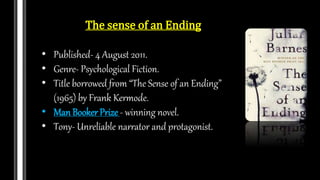
The sense of an Ending
• Published- 4 August 2011.
• Genre- Psychological Fiction.
• Title borrowed from “The Sense of an Ending”
(1965) by Frank Kermode.
• Man Booker Prize - winning novel.
• Tony- Unreliable narrator and protagonist.
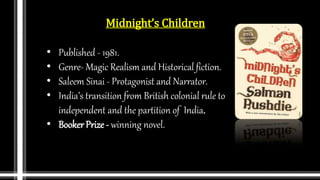
Midnight’s Children
• Published - 1981.
• Genre- Magic Realism and Historical fiction.
• Saleem Sinai - Protagonist and Narrator.
• India’s transition from British colonial rule to
independent and the partition of India.
• Booker Prize - winning novel.
• David Gallo defines memory in his article on “Associations and Errors
throughHistory” that
“Memory is not simply recording of the past, but is
a deliberate “piecing-together” of retrieved information and other relevant
information in an effort to make
sense of the past”(13).
• Efforts to recollect memories can turn out to be fatal if the recollected
memories prove fallible.
• Narrator is reliable when he speaks for or acts in accordance with the
norms of the work, unreliable when he does not.
Narrator of both the Book
• Turn alters and deforms the authenticity of narration and history.
• Try to recollect, record their individual history but experience lapse
in memory.
• Aware of the shortcomings in their narration and often remind
the readers about the distortion of certain memories.
• The novels are narrated from the first person point of view.
• The main protagonists - narrate sequences from their life or rather
they narrate their individual history.
• His narrative moving gradually school day - college life - life before and
after marriage - finally the present retirement life.
• Discussion of History - “imperfections” of both memory and history
which in turn transforms the narrative - erratic one.
• Tony’s friend quotes Patrick Lagrange that
“History is the certainty produced at the point where the imperfections of
memory meet the inadequacies of documentation”
Narrator of the Midnight’s Children
• Saleem Sinai who is thirty one, description of the time and day on which
he was born.
• Lots of errors in his narration which he openly acknowledges:
“I amracing ahead at breakneck speed; errors are possible, and
overstatements, and jarringalterations in tone; I’mracing the cracks, but I
remain conscious that errors have already been made, and that, as my decay
accelerates […] the risk of unreliabilitygrows” (Rushdie 1995, 270).
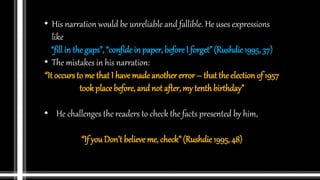
• His narration would be unreliable and fallible. He uses expressions
like
“fill in the gaps”, “confide in paper, before I forget” (Rushdie 1995, 37)
• The mistakes in his narration:
“It occurs to me that I have made another error – that the election of 1957
took place before, and not after, my tenthbirthday”
• He challenges the readers to check the facts presented by him,
“If you Don’t believe me, check” (Rushdie 1995, 48)
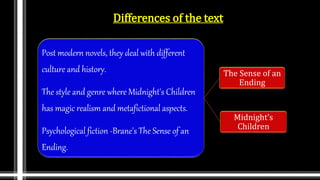
Differences of the text
Post modern novels, they deal with different
culture and history.
The style and genre where Midnight's Children
has magic realism and metafictional aspects.
Psychological fiction -Brane's The Sense of an
Ending.
The Sense of an
Ending
Midnight’s
Children
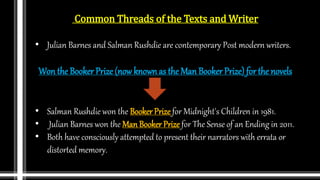
Common Threads of the Texts and Writer
• Julian Barnes and Salman Rushdie are contemporary Post modern writers.
Won the Booker Prize (now known as the Man Booker Prize) for the novels
• Salman Rushdie won the Booker Prize for Midnight's Children in 1981.
• Julian Barnes won the Man Booker Prize for The Sense of an Ending in 2011.
• Both have consciously attempted to present their narrators with errata or
distorted memory.
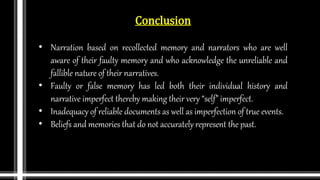
Conclusion
• Narration based on recollected memory and narrators who are well
aware of their faulty memory and who acknowledge the unreliable and
fallible nature of their narratives.
• Faulty or false memory has led both their individual history and
narrative imperfect thereby making their very “self” imperfect.
• Inadequacy of reliable documents as well as imperfection of true events.
• Beliefs and memories that do not accurately represent the past.
Citations
• Barnes, Julian. The Sense of an Ending. London: Vintage Books. 2012.
• Booth, Wayne C. The Rhetoric of Fiction. Chicago: The University of Chicago
Press,1983. 2nd ed.158 – 60. Print.
• Gallo, David. “Associations and Errors through History.” Associative Illusions of
Memory: False Memory Research in DRM and Related Tasks. Psychology Press: New
York, 2006. 13.
• Holman, Clarence Hugh, and William Harmon. A Handbook to Literature. 6th ed.
Macmillan, 1992. Oakes, Mark A., and Ira E. Hyman, Jr. “The Changing Face of
Memory and Self: False Memories, False Self.” False-memory Creation in Children
and Adults: Theory, Research, and Implications. Ed. David F.
• Rushdie, Salman. Midnight's Children. London: Vintage, 1995.
The New Literature

The New Literature

  • 2.
    Name: Dharti Makwana RollNo.: 5 Std.: M.A sem-4 Subject: The New Literature Email: Dharteemakwana789@gmail.com Submitted to: SMT. S.B. Gardi Department of English, MKBU
  • 3.
    Aim of thepresentation • To create new modes of narrating stories, experiences and also to open up possibilities for different levels of reading and interpreting a work. • To destruct and denunciate the very narrative of the stories. • However the modern and post modern writers have given reader a variety of different forms of unreliable narration. • To highlight the presentation of memory distortion in Julian Barnes‟ The Sense of an Ending and Salman Rushdie’s Midnight’s Children. • How the memory has the ability to transform an account of an individual’s narration into unreliable one.
  • 4.
    The sense ofan Ending • Published- 4 August 2011. • Genre- Psychological Fiction. • Title borrowed from “The Sense of an Ending” (1965) by Frank Kermode. • Man Booker Prize - winning novel. • Tony- Unreliable narrator and protagonist.
  • 5.
    Midnight’s Children • Published- 1981. • Genre- Magic Realism and Historical fiction. • Saleem Sinai - Protagonist and Narrator. • India’s transition from British colonial rule to independent and the partition of India. • Booker Prize - winning novel.
  • 6.
    • David Gallodefines memory in his article on “Associations and Errors throughHistory” that “Memory is not simply recording of the past, but is a deliberate “piecing-together” of retrieved information and other relevant information in an effort to make sense of the past”(13). • Efforts to recollect memories can turn out to be fatal if the recollected memories prove fallible. • Narrator is reliable when he speaks for or acts in accordance with the norms of the work, unreliable when he does not.
  • 7.
    Narrator of boththe Book • Turn alters and deforms the authenticity of narration and history. • Try to recollect, record their individual history but experience lapse in memory. • Aware of the shortcomings in their narration and often remind the readers about the distortion of certain memories. • The novels are narrated from the first person point of view. • The main protagonists - narrate sequences from their life or rather they narrate their individual history.
  • 9.
    • His narrativemoving gradually school day - college life - life before and after marriage - finally the present retirement life. • Discussion of History - “imperfections” of both memory and history which in turn transforms the narrative - erratic one. • Tony’s friend quotes Patrick Lagrange that “History is the certainty produced at the point where the imperfections of memory meet the inadequacies of documentation”
  • 10.
    Narrator of theMidnight’s Children • Saleem Sinai who is thirty one, description of the time and day on which he was born. • Lots of errors in his narration which he openly acknowledges: “I amracing ahead at breakneck speed; errors are possible, and overstatements, and jarringalterations in tone; I’mracing the cracks, but I remain conscious that errors have already been made, and that, as my decay accelerates […] the risk of unreliabilitygrows” (Rushdie 1995, 270).
  • 11.
    • His narrationwould be unreliable and fallible. He uses expressions like “fill in the gaps”, “confide in paper, before I forget” (Rushdie 1995, 37) • The mistakes in his narration: “It occurs to me that I have made another error – that the election of 1957 took place before, and not after, my tenthbirthday” • He challenges the readers to check the facts presented by him, “If you Don’t believe me, check” (Rushdie 1995, 48)
  • 12.
    Differences of thetext Post modern novels, they deal with different culture and history. The style and genre where Midnight's Children has magic realism and metafictional aspects. Psychological fiction -Brane's The Sense of an Ending. The Sense of an Ending Midnight’s Children
  • 13.
    Common Threads ofthe Texts and Writer • Julian Barnes and Salman Rushdie are contemporary Post modern writers. Won the Booker Prize (now known as the Man Booker Prize) for the novels • Salman Rushdie won the Booker Prize for Midnight's Children in 1981. • Julian Barnes won the Man Booker Prize for The Sense of an Ending in 2011. • Both have consciously attempted to present their narrators with errata or distorted memory.
  • 14.
    Conclusion • Narration basedon recollected memory and narrators who are well aware of their faulty memory and who acknowledge the unreliable and fallible nature of their narratives. • Faulty or false memory has led both their individual history and narrative imperfect thereby making their very “self” imperfect. • Inadequacy of reliable documents as well as imperfection of true events. • Beliefs and memories that do not accurately represent the past.
  • 15.
    Citations • Barnes, Julian.The Sense of an Ending. London: Vintage Books. 2012. • Booth, Wayne C. The Rhetoric of Fiction. Chicago: The University of Chicago Press,1983. 2nd ed.158 – 60. Print. • Gallo, David. “Associations and Errors through History.” Associative Illusions of Memory: False Memory Research in DRM and Related Tasks. Psychology Press: New York, 2006. 13. • Holman, Clarence Hugh, and William Harmon. A Handbook to Literature. 6th ed. Macmillan, 1992. Oakes, Mark A., and Ira E. Hyman, Jr. “The Changing Face of Memory and Self: False Memories, False Self.” False-memory Creation in Children and Adults: Theory, Research, and Implications. Ed. David F. • Rushdie, Salman. Midnight's Children. London: Vintage, 1995.