Point of view on New Lean Themes in Banking /
Financial Institutes
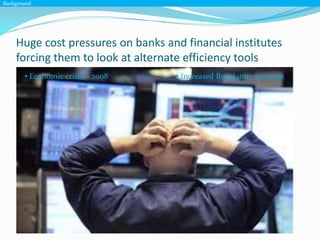
Huge cost pressures on banks and financial institutes
forcing them to look at alternate efficiency tools
Background
• Economic crises - 2008 • Increased Regulatory pressure
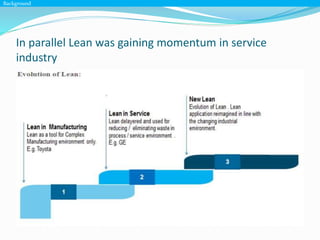
In parallel Lean was gaining momentum in service
industry
Background
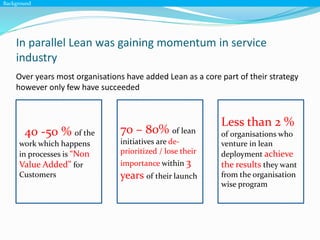
Over years most organisations have added Lean as a core part of their strategy
however only few have succeeded
Background
40 -50 % of the
work which happens
in processes is “Non
Value Added” for
Customers
70 – 80% of lean
initiatives are de-
prioritized / lose their
importance within 3
years of their launch
Less than 2 %
of organisations who
venture in lean
deployment achieve
the results they want
from the organisation
wise program
In parallel Lean was gaining momentum in service
industry
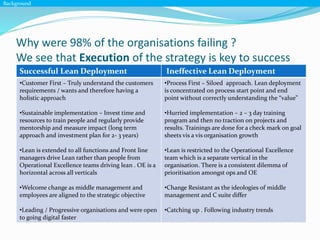
Why were 98% of the organisations failing ?
We see that Execution of the strategy is key to success
Background
Successful Lean Deployment Ineffective Lean Deployment
•Customer First – Truly understand the customers
requirements / wants and therefore having a
holistic approach
•Sustainable implementation – Invest time and
resources to train people and regularly provide
mentorship and measure impact (long term
approach and investment plan for 2- 3 years)
•Lean is extended to all functions and Front line
managers drive Lean rather than people from
Operational Excellence teams driving lean . OE is a
horizontal across all verticals
•Welcome change as middle management and
employees are aligned to the strategic objective
•Leading / Progressive organisations and were open
to going digital faster
•Process First – Siloed approach. Lean deployment
is concentrated on process start point and end
point without correctly understanding the “value”
•Hurried implementation – 2 – 3 day training
program and then no traction on projects and
results. Trainings are done for a check mark on goal
sheets vis a vis organisation growth
•Lean is restricted to the Operational Excellence
team which is a separate vertical in the
organisation. There is a consistent dilemma of
prioritisation amongst ops and OE
•Change Resistant as the ideologies of middle
management and C suite differ
•Catching up . Following industry trends
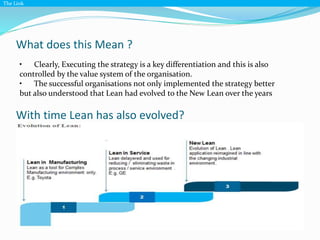
What does this Mean ?
The Link
• Clearly, Executing the strategy is a key differentiation and this is also
controlled by the value system of the organisation.
• The successful organisations not only implemented the strategy better
but also understood that Lean had evolved to the New Lean over the years
With time Lean has also evolved?
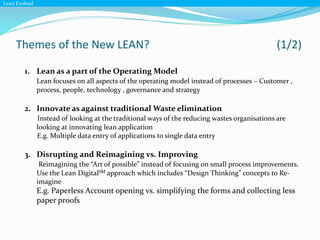
Themes of the New LEAN? (1/2)
Lean Evolved
1. Lean as a part of the Operating Model
Lean focuses on all aspects of the operating model instead of processes – Customer ,
process, people, technology , governance and strategy
2. Innovate as against traditional Waste elimination
Instead of looking at the traditional ways of the reducing wastes organisations are
looking at innovating lean application
E.g. Multiple data entry of applications to single data entry
3. Disrupting and Reimagining vs. Improving
Reimagining the “Art of possible” instead of focusing on small process improvements.
Use the Lean DigitalSM approach which includes “Design Thinking” concepts to Re-
imagine
E.g. Paperless Account opening vs. simplifying the forms and collecting less
paper proofs
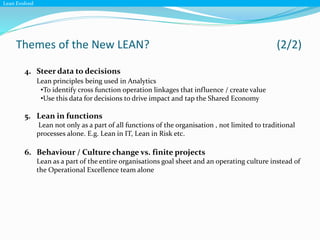
Themes of the New LEAN? (2/2)
Lean Evolved
4. Steer data to decisions
Lean principles being used in Analytics
•To identify cross function operation linkages that influence / create value
•Use this data for decisions to drive impact and tap the Shared Economy
5. Lean in functions
Lean not only as a part of all functions of the organisation , not limited to traditional
processes alone. E.g. Lean in IT, Lean in Risk etc.
6. Behaviour / Culture change vs. finite projects
Lean as a part of the entire organisations goal sheet and an operating culture instead of
the Operational Excellence team alone
References
References and Credits
https://www.google.co.in/url?sa=t&rct=j&q=&esrc=s&source=web&cd=4&cad=rja&uact=8&ved=0a
hUKEwjzpKSH3ofTAhXEuo8KHULzD0kQFggrMAM&url=http%3A%2F%2Fwww.mckinsey.com%2F
~%2Fmedia%2Fmckinsey%2Fdotcom%2Fclient_service%2Ffinancial%2520services%2Flatest%2520t
hinking%2Freports%2Flean_management_new_frontiers_for_financial_institutions.ashx&usg=AFQ
jCNHYdjPElUCxHel0Qi3aIDsvYMbmoQ&sig2=WoWwZHSpHDfj2CTj05h7mw&bvm=bv.151325232,d.
c2I
www.genpact.com
www.google.com
Photo Credits
Scmp.com
google.com
https://www.linkedin.com/in/hahimanshuanand/

The new lean

  • 1.
    Point of viewon New Lean Themes in Banking / Financial Institutes
  • 2.
    Huge cost pressureson banks and financial institutes forcing them to look at alternate efficiency tools Background • Economic crises - 2008 • Increased Regulatory pressure
  • 3.
    In parallel Leanwas gaining momentum in service industry Background
  • 4.
    Over years mostorganisations have added Lean as a core part of their strategy however only few have succeeded Background 40 -50 % of the work which happens in processes is “Non Value Added” for Customers 70 – 80% of lean initiatives are de- prioritized / lose their importance within 3 years of their launch Less than 2 % of organisations who venture in lean deployment achieve the results they want from the organisation wise program In parallel Lean was gaining momentum in service industry
  • 5.
    Why were 98%of the organisations failing ? We see that Execution of the strategy is key to success Background Successful Lean Deployment Ineffective Lean Deployment •Customer First – Truly understand the customers requirements / wants and therefore having a holistic approach •Sustainable implementation – Invest time and resources to train people and regularly provide mentorship and measure impact (long term approach and investment plan for 2- 3 years) •Lean is extended to all functions and Front line managers drive Lean rather than people from Operational Excellence teams driving lean . OE is a horizontal across all verticals •Welcome change as middle management and employees are aligned to the strategic objective •Leading / Progressive organisations and were open to going digital faster •Process First – Siloed approach. Lean deployment is concentrated on process start point and end point without correctly understanding the “value” •Hurried implementation – 2 – 3 day training program and then no traction on projects and results. Trainings are done for a check mark on goal sheets vis a vis organisation growth •Lean is restricted to the Operational Excellence team which is a separate vertical in the organisation. There is a consistent dilemma of prioritisation amongst ops and OE •Change Resistant as the ideologies of middle management and C suite differ •Catching up . Following industry trends
  • 6.
    What does thisMean ? The Link • Clearly, Executing the strategy is a key differentiation and this is also controlled by the value system of the organisation. • The successful organisations not only implemented the strategy better but also understood that Lean had evolved to the New Lean over the years With time Lean has also evolved?
  • 7.
    Themes of theNew LEAN? (1/2) Lean Evolved 1. Lean as a part of the Operating Model Lean focuses on all aspects of the operating model instead of processes – Customer , process, people, technology , governance and strategy 2. Innovate as against traditional Waste elimination Instead of looking at the traditional ways of the reducing wastes organisations are looking at innovating lean application E.g. Multiple data entry of applications to single data entry 3. Disrupting and Reimagining vs. Improving Reimagining the “Art of possible” instead of focusing on small process improvements. Use the Lean DigitalSM approach which includes “Design Thinking” concepts to Re- imagine E.g. Paperless Account opening vs. simplifying the forms and collecting less paper proofs
  • 8.
    Themes of theNew LEAN? (2/2) Lean Evolved 4. Steer data to decisions Lean principles being used in Analytics •To identify cross function operation linkages that influence / create value •Use this data for decisions to drive impact and tap the Shared Economy 5. Lean in functions Lean not only as a part of all functions of the organisation , not limited to traditional processes alone. E.g. Lean in IT, Lean in Risk etc. 6. Behaviour / Culture change vs. finite projects Lean as a part of the entire organisations goal sheet and an operating culture instead of the Operational Excellence team alone
  • 9.
  • 10.