Patrick Müller, Christina Rode-Schubert, Uwe Fischer
The method
trend2ability
|2 © Patrick Müller, Uwe Fischer, Christina Rode-Schubert- 2018
What is a trend?
 A trend is an instrument to describe changes
and trends in all areas: in society, in the
economy or in the technological field.
 The description and the boundary conditions
allow a statement about the future
development.
 Source: Wikipedia
CC0/3dman_eu/Pixabay
|3 © Patrick Müller, Uwe Fischer, Christina Rode-Schubert- 2018
Types of trends
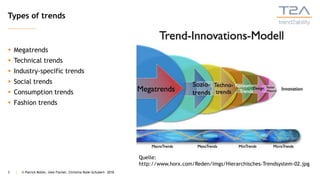
 Megatrends
 Technical trends
 Industry-specific trends
 Social trends
 Consumption trends
 Fashion trends
Quelle:
http://www.horx.com/Reden/Imgs/Hierarchisches-Trendsystem-02.jpg
|4 © Patrick Müller, Uwe Fischer, Christina Rode-Schubert- 2018
The 12 megatrends
Globalization Urbanization Connectivity
Mobility New Work Knowledge Culture
Silver Society Gender Shift Healthness
Safety &
Security
Neo Ecology Individualization
CC0 Gemeinfrei CC0
CC0 CC0 CC0
CC0 CC0 CC0
CC0
CC0
CC0
|5 © Patrick Müller, Uwe Fischer, Christina Rode-Schubert- 2018
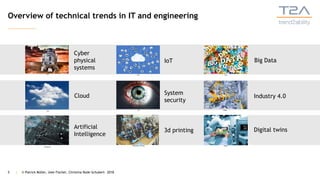
Overview of technical trends in IT and engineering
Cyber
physical
systems
IoT
System
security
Big Data
Cloud
CC0
CC0 CC0
CC0
CC0
Artificial
Intelligence
3d printing
Industry 4.0
Digital twins
Storyblocks
Adobe
Kaboompics/Pixabay Adobe
|6 © Patrick Müller, Uwe Fischer, Christina Rode-Schubert- 2018
Important sources for trends | excerpt
 Zukunftsinstitut
 University Sankt-Gallen
 Fraunhofer-Institutes
 Gartner Group
 VDI Technologiezentrum
 Gapminder
|7 © Patrick Müller, Uwe Fischer, Christina Rode-Schubert- 2018
Overview trend2ability
Priorisation of
trends
Mapping of
trends Deriving
the required
capabilities
Identification of
relevant trends
5Creation of
Roadmap
4
2
3
1
Quelle: stock.adobe.com/ SceneNature
|8 © Patrick Müller, Uwe Fischer, Christina Rode-Schubert- 2018
Step 1: Identification of relevant trends
 Types of trends
 Megatrends
 Technical trends
 Business models trends
 Industry-specific trends
 Sources:
 Own records
 Workshop with customers for business trends
 External sources
 Zukunftsinstitut
 Gartner Hype Cycle ...
Step 1a: Sources of trends
|9 © Patrick Müller, Uwe Fischer, Christina Rode-Schubert- 2018
Step 1: Identification of relevant trends
 Where does a trend/subtrend influence the company?
 On the business model
 On processes (broken down to those named by the company)
 On the company's technologies (within the product, within production,
within IT)
 Where is the trend a threat, where is it a chance?
Step 1b: Determination of trends relevant to the company
|10 © Patrick Müller, Uwe Fischer, Christina Rode-Schubert- 2018
Step 2: Priorization of trends
 How mature is the company at the respective point?
 Is/Are
 the respective influence is high enough,
 the processes involved are important enough,
 the discrepancy between companies and state of the art high enough?
 Only if the combination of factors is high enough the trend will be
considered further.
|11 © Patrick Müller, Uwe Fischer, Christina Rode-Schubert- 2018
Step 2: Priorization of trends
 Consolidation of trends
 Formation of trend lines
 Determination of intersection points
 Creation of the trend map
Derive the company-specific trend map
Quelle: Patrick Müller
|12 © Patrick Müller, Uwe Fischer, Christina Rode-Schubert- 2018
Quelle: stock.adobe.com/PikePicture
Step 3: Mapping trends on design levels
 Starting point:
 Company specific trend map
 Mapping trends on design levels (processes, business models and
IT, from Step1)
 group work
 Mapping sub-trends to sub-processes, business models and IT
clusters
 Crossing points are created
 Voting regarding the importance of the points
 Where is there a need for action?
 Consolidation of results in Excel
|13 © Patrick Müller, Uwe Fischer, Christina Rode-Schubert- 2018
Step 4: Deriving the required skills: Formulation of desired skills as
user stories
 Starting points: Intersections of trends and
processes at level 1 and level 2
 Formulation of desired skills as user stories
Example:
Mega Trend Individualization | Mass Customization
The company wants to offer a product with
different variants in order to be able to offer a
differentiated range on the market
|14 © Patrick Müller, Uwe Fischer, Christina Rode-Schubert- 2018
Step 4: Beaking down of capabilities
The IT manager wants to use the required
BOT/KI technologies in the cloud
The service manager wants
to control the use of the AI
to prevent customer
satisfaction.
The person responsible
for the service wants to
integrate the required
FAQ's into the AI.
The company wants to use AI and chat bots for customer
communication
The IT manager wants to
integrate the bot software into
his own homepage
Quelle: stock.adobe.com/Dragan Grkic
|15 © Patrick Müller, Uwe Fischer, Christina Rode-Schubert- 2018
Step 5: Creation of a roadmap
 Prioritization, e.g. with the commonly
used 50-30-20 rule
 When should the capabilities be available?
 The capabilities are put into a meaningful
order, dependencies are taken into
account?
 Classification of activities into new
projects, current projects, line tasks
 Formation of the roadmap
Quelle: stock.adobe.com/PikePicture
|16 © Patrick Müller, Uwe Fischer, Christina Rode-Schubert- 2018
Procedure in a customer project
Preparation Workshop Follow Up
 Target Architecture
 Transformation-Roadmap
Business
Trends
Business Trends
Map
Hype Cycle
Emerging Technologies
Consolidation
Mega-Trends
Capabilities Workshops
Hypothesis-based derivation
of Business Capabilities
|17 © Patrick Müller, Uwe Fischer, Christina Rode-Schubert- 2018
The TCI Enterprise Transformation Cycle
ENVISION ENGAGE TRANSFORM OPTIMIZE
Strategy
Processes
Organization
BUSINESS TRANSFORMATION
Systems
& Tools
Governance
Change Management
Program/Project Management
Values &
Principles
People
Source: TCI Transformation Consulting International
Uwe Fischer Uwe.Fischer@trend2ability.com
Patrick Müller Patrick.Mueller@trend2ability.com
Christina Rode-Schubert Christina.Rode-Schubert@trend2ability.com
|19 © Patrick Müller, Uwe Fischer, Christina Rode-Schubert- 2018
Sources for Images
 Trend innovation model: Mathias Horx
 Avatars: Paperwork
 Street: stock.adobe.com/ SceneNature
 Trend map: Patrick Müller
 Flip chart: stock.adobe.com/PikePicture
 Group picture of cobsultants: Patrick Müller / TCI
 Cube: stock.adobe.com/Dragan Grkic
 Enterprise Transformation Cycle: Wolfgang Hellriegel / TCI
 Town: Storyblocks

The method trend2ability

  • 1.
    Patrick Müller, ChristinaRode-Schubert, Uwe Fischer The method trend2ability
  • 2.
    |2 © PatrickMüller, Uwe Fischer, Christina Rode-Schubert- 2018 What is a trend?  A trend is an instrument to describe changes and trends in all areas: in society, in the economy or in the technological field.  The description and the boundary conditions allow a statement about the future development.  Source: Wikipedia CC0/3dman_eu/Pixabay
  • 3.
    |3 © PatrickMüller, Uwe Fischer, Christina Rode-Schubert- 2018 Types of trends  Megatrends  Technical trends  Industry-specific trends  Social trends  Consumption trends  Fashion trends Quelle: http://www.horx.com/Reden/Imgs/Hierarchisches-Trendsystem-02.jpg
  • 4.
    |4 © PatrickMüller, Uwe Fischer, Christina Rode-Schubert- 2018 The 12 megatrends Globalization Urbanization Connectivity Mobility New Work Knowledge Culture Silver Society Gender Shift Healthness Safety & Security Neo Ecology Individualization CC0 Gemeinfrei CC0 CC0 CC0 CC0 CC0 CC0 CC0 CC0 CC0 CC0
  • 5.
    |5 © PatrickMüller, Uwe Fischer, Christina Rode-Schubert- 2018 Overview of technical trends in IT and engineering Cyber physical systems IoT System security Big Data Cloud CC0 CC0 CC0 CC0 CC0 Artificial Intelligence 3d printing Industry 4.0 Digital twins Storyblocks Adobe Kaboompics/Pixabay Adobe
  • 6.
    |6 © PatrickMüller, Uwe Fischer, Christina Rode-Schubert- 2018 Important sources for trends | excerpt  Zukunftsinstitut  University Sankt-Gallen  Fraunhofer-Institutes  Gartner Group  VDI Technologiezentrum  Gapminder
  • 7.
    |7 © PatrickMüller, Uwe Fischer, Christina Rode-Schubert- 2018 Overview trend2ability Priorisation of trends Mapping of trends Deriving the required capabilities Identification of relevant trends 5Creation of Roadmap 4 2 3 1 Quelle: stock.adobe.com/ SceneNature
  • 8.
    |8 © PatrickMüller, Uwe Fischer, Christina Rode-Schubert- 2018 Step 1: Identification of relevant trends  Types of trends  Megatrends  Technical trends  Business models trends  Industry-specific trends  Sources:  Own records  Workshop with customers for business trends  External sources  Zukunftsinstitut  Gartner Hype Cycle ... Step 1a: Sources of trends
  • 9.
    |9 © PatrickMüller, Uwe Fischer, Christina Rode-Schubert- 2018 Step 1: Identification of relevant trends  Where does a trend/subtrend influence the company?  On the business model  On processes (broken down to those named by the company)  On the company's technologies (within the product, within production, within IT)  Where is the trend a threat, where is it a chance? Step 1b: Determination of trends relevant to the company
  • 10.
    |10 © PatrickMüller, Uwe Fischer, Christina Rode-Schubert- 2018 Step 2: Priorization of trends  How mature is the company at the respective point?  Is/Are  the respective influence is high enough,  the processes involved are important enough,  the discrepancy between companies and state of the art high enough?  Only if the combination of factors is high enough the trend will be considered further.
  • 11.
    |11 © PatrickMüller, Uwe Fischer, Christina Rode-Schubert- 2018 Step 2: Priorization of trends  Consolidation of trends  Formation of trend lines  Determination of intersection points  Creation of the trend map Derive the company-specific trend map Quelle: Patrick Müller
  • 12.
    |12 © PatrickMüller, Uwe Fischer, Christina Rode-Schubert- 2018 Quelle: stock.adobe.com/PikePicture Step 3: Mapping trends on design levels  Starting point:  Company specific trend map  Mapping trends on design levels (processes, business models and IT, from Step1)  group work  Mapping sub-trends to sub-processes, business models and IT clusters  Crossing points are created  Voting regarding the importance of the points  Where is there a need for action?  Consolidation of results in Excel
  • 13.
    |13 © PatrickMüller, Uwe Fischer, Christina Rode-Schubert- 2018 Step 4: Deriving the required skills: Formulation of desired skills as user stories  Starting points: Intersections of trends and processes at level 1 and level 2  Formulation of desired skills as user stories Example: Mega Trend Individualization | Mass Customization The company wants to offer a product with different variants in order to be able to offer a differentiated range on the market
  • 14.
    |14 © PatrickMüller, Uwe Fischer, Christina Rode-Schubert- 2018 Step 4: Beaking down of capabilities The IT manager wants to use the required BOT/KI technologies in the cloud The service manager wants to control the use of the AI to prevent customer satisfaction. The person responsible for the service wants to integrate the required FAQ's into the AI. The company wants to use AI and chat bots for customer communication The IT manager wants to integrate the bot software into his own homepage Quelle: stock.adobe.com/Dragan Grkic
  • 15.
    |15 © PatrickMüller, Uwe Fischer, Christina Rode-Schubert- 2018 Step 5: Creation of a roadmap  Prioritization, e.g. with the commonly used 50-30-20 rule  When should the capabilities be available?  The capabilities are put into a meaningful order, dependencies are taken into account?  Classification of activities into new projects, current projects, line tasks  Formation of the roadmap Quelle: stock.adobe.com/PikePicture
  • 16.
    |16 © PatrickMüller, Uwe Fischer, Christina Rode-Schubert- 2018 Procedure in a customer project Preparation Workshop Follow Up  Target Architecture  Transformation-Roadmap Business Trends Business Trends Map Hype Cycle Emerging Technologies Consolidation Mega-Trends Capabilities Workshops Hypothesis-based derivation of Business Capabilities
  • 17.
    |17 © PatrickMüller, Uwe Fischer, Christina Rode-Schubert- 2018 The TCI Enterprise Transformation Cycle ENVISION ENGAGE TRANSFORM OPTIMIZE Strategy Processes Organization BUSINESS TRANSFORMATION Systems & Tools Governance Change Management Program/Project Management Values & Principles People Source: TCI Transformation Consulting International
  • 18.
    Uwe Fischer Uwe.Fischer@trend2ability.com PatrickMüller Patrick.Mueller@trend2ability.com Christina Rode-Schubert Christina.Rode-Schubert@trend2ability.com
  • 19.
    |19 © PatrickMüller, Uwe Fischer, Christina Rode-Schubert- 2018 Sources for Images  Trend innovation model: Mathias Horx  Avatars: Paperwork  Street: stock.adobe.com/ SceneNature  Trend map: Patrick Müller  Flip chart: stock.adobe.com/PikePicture  Group picture of cobsultants: Patrick Müller / TCI  Cube: stock.adobe.com/Dragan Grkic  Enterprise Transformation Cycle: Wolfgang Hellriegel / TCI  Town: Storyblocks