The document discusses human resource management for a new food delivery company. It covers developing job descriptions and analyzing positions, recruiting through various sources, screening applicants, and ensuring compliance with regulations. It also discusses developing workforce and strategic plans, managing employee payroll and benefits, and creating an inclusive workplace.

![ Ensure that human resources practices conformto various regulations.
Push the employee’s motivation.
Job Design and Analysis
Jobcharacteristictheory
In situations where multiple new jobs are created and recruited forthe first time, or the nature of a
job has substantially changed, or the nature of a job has substantially changed, a job analysis might
be undertaken to document the knowledge, skills, abilities and other characteristics
(KSAOs) required or sought forthe job. From these, the relevant information is captured in such
documents as job descriptions and job specifications. Often,a company already has job descriptions
for existing positions. Where already drawn up, these documents may require review and update to
reflectcurrent requirements. Prior to the recruitment stage, a person specificationshould be
finalized to provide recruiters with the project's requirements and objectives.[5]
Sourcing
Sourcing is the use of one or more strategies to attract or identify candidates to fill job vacancies.It
may involveinternal and/or external recruitment advertising, using appropriate media, such as job
portals,local or national newspapers, specialist recruitment media, professional publications,
window advertisements, job centers, or in a variety of ways viathe internet.
An employee referral program is a system where existing employees recommend prospective
candidates for the job offered,and in some organizations if the suggested candidate is hired, the
employee receives a cash bonus.[13]
Alternatively, employers may use recruitment consultancies or agencies to find otherwise scarce
candidates—who, in many cases, may be content in their current positions and are not actively
looking to move. This initial research forcandidates—also called namegeneration—produces
contactinformation for potential candidates, whomthe recruiter can then discreetly contactand
screen.[5]
Screening and selection
Various psychologicaltests can assess a variety of KSAOs, including literacy. Assessments are also
available to measure physical ability. Recruiters and agencies may use applicant tracking systems to
filter candidates, along withsoftware tools forpsychometric testing and performance-based
assessment.[6] In many countries, employers are legally mandated to ensure their screening and
selection processes meet equal opportunity and ethical standards.[5]
In order to significantly improve the candidate evaluation and selection process, Buettner proposed
a recruitment frameworkfor searching online social networks.[2]
Employers are likely to recognize the value of candidates whoencompass soft skills such as
interpersonal or team leadership.[7] Many companies, including multinational organizations and
those that recruit from a range of nationalities, are also often concerned about whether a candidate
fits the prevailing company culture.[8]
Disabledcandidates
The word disability carries few positive connotations for most employers. Research has shown that
employer biases tend to improve through first-hand experience and exposure with proper supports
for the employee[9] and the employer making the hiring decisions. As formost companies, money
and job stability are twoof the contributing factors to the productivity of a disabled employee,](https://image.slidesharecdn.com/8a21ca77-8ddf-4d38-b291-29cce018dfc5-161107034141/85/The-lion-s-den-Project-HR-Management-2-320.jpg)
![whichin return equates to the growth and success of a business. Hiring disabled workersproduce
more advantages than disadvantages.[10] There is no differencein the daily production of a disabled
worker.[1] Given their situation, they are more likely to adapt to their environmental surroundings
and acquaint themselves with equipment, enabling them to solve problems and overcomeadversity
as withother employees. The U.S. IRS grants companies Disabled Access Credit when they meet
eligibility criteria.[11]
Workplace Planning:
Environment Scanning is a form of business intelligence. In the context of WorkforcePlanning, it is
used to identify the set of facts or circumstances that surround a workforcesituation or event.
CurrentWorkforceProfile
Current State is a profile of the demand and supply factorsboth internally and externally of the
workforcethe organization has today.
TransitionWorkforceProfile
demand and supply factors forthe transition fromcurrent to the future workforce.
Future WorkforceView
Future View is determining the organization’s needs considering the emerging trends and issues
identified during the Environment Scanning.
AnalysisandTargetedFuture
Once criticalelements are identified through quantitative and qualitative analysis, the future
targets that are the best fit in terms of business strategy and is achievable given the surrounding
factors(internal/external, supply/demand) are determined.
RiskAssessmentandRiskMitigation
The process is about determining appropriate actions to manage risk assessment and identify risk
mitigation strategies to deliver the targeted future.
Recruitment and Selection
An applicanttrackingsystem(ATS)isa softwareapplication that enables the electronic handling
of recruitment needs. An ATS can be implemented or accessed online on an enterprise or small
business level, depending on the needs of the company, and there is also free and open source
ATS software available. An ATS is very similar to customer relationship management (CRM)
systems,[verification needed] but are designed forrecruitment tracking purposes. In many cases they filter
applications automatically based on given criteria such as keywords,skills, former employers, years
of experience and schools attended.[1] This has caused many to adapt resume
optimization techniques similar to those used in search engine optimization when creating and
formatting their résumé.[2]
Almost all recruitment agencies and most major corporations with an in-house recruitment
functionuse some form of applicant tracking system to handle job postings, applicants, resumes,
interviews.[3] A dedicated ATS is not uncommon for recruitment specific needs. On the enterprise
level it may be offeredas a module or functionaladdition to a human resources suite or Human
Resource Information System (HRIS).The ATS is expanding into small and medium
enterprises through open source orsoftwareas a serviceofferings (SaaS). The principal function of
an ATS is to provide a central location and database fora company'srecruitment efforts.ATSs are
built to better assist management of resumes and applicant information. Data is either collected
from internal applications viathe ATS front-end, located on the company website or is extracted
from applicants on job boards. The majority of job and resume boards
(Monster.com, Hotjobs, CareerBuilder, Indeed.com) have partnerships with ATS software providers
to provide parsing support and ease of data migration from one system to another.[4][verification needed]](https://image.slidesharecdn.com/8a21ca77-8ddf-4d38-b291-29cce018dfc5-161107034141/85/The-lion-s-den-Project-HR-Management-3-320.jpg)
![Functionality of an ATS is not limited todata mining and collection;ATS applications in the
recruitment industry include the ability to automate the recruitment process via a
defined workflow.
Another benefit of an applicant tracking system is analyzing and coordinating recruitment efforts-
managing the conceptual structure known as human capital. A corporate career site or company
specific job board module may be offered,allowing companies to provide opportunities to internal
candidates prior to external recruitment efforts.Candidates may be identified via pre-existing data
or through information garnered through other means. This data is typically stored forsearch and
retrieval processes. Some systems have expanded offerings that include off-siteencrypted resume
and data storage, which are often legally required by equal opportunity employment laws.
Applicant tracking systems may also be referred to as talent acquisition and management
products (TAMP)and are often provided via an application service provider orsoftwareas a
service (SaaS) model.[6] The levelof service and costcan vary greatly across providers. In the UK and
Ireland, Applicant Tracking Systems whichare specifically forAgency Recruiters are oftenreferred
to as Recruitment Software and this is a term used mainly in the recruitment agency industry
(representative bodies include the REC in the UK and the NRF in Ireland). Although proprietary
systems dominate the ATS space, there are open-source alternatives.
As the data held within recruitment software is predominantly personal data, it is often[vague] tightly
controlled by data protection legislation, preventing the data from being held offshore, which
frequently places a legal restriction on the use of SaaS offerings.
Social recruiting isthe use of social media forrecruiting including sites like Facebookand Twitter
or career-oriented social networking sites such as LinkedIn and XING.[3][16][17] It is a rapidly
growing sourcing technique, especially with middle-aged people. On Google+, the fastest-growing
age group is 45–54. On Twitter, the expanding generation is people from ages 55–64.[18]
Mobile recruiting is a recruitment strategy that uses mobile technology to attract, engage and
convertcandidates. Mobile recruiting is often cited as a growing opportunity forrecruiters to
connectwith candidates more efficiently with"over89% of job seekers saying their mobile device
will be an important tool and resource for their job search."
Some recruiters workby accepting payments from job seekers, and in return help them to find a
job. This is illegal in some countries, such as in the United Kingdom, in whichrecruiters must not
charge candidates for their services (although websites such as LinkedIn may charge for ancillary
job-search-related services).Such recruiters often refer to themselves as "personal marketers" and
"job application services" rather than as recruiters.
The people whowe have has staff must have the followingskills
Social skills are any skill facilitating interaction and communication withothers. Social rules and
relations are created, communicated, and changed in verbal and nonverbal ways.The process of
learning these skills is called socialization.
Interpersonal skills are sometimes also referred to as people skills or communication skills.[1]
Interpersonal skills are the skills a person uses to communicate and interact with others. They
include persuasion, activelistening,[2] delegation, and leadership.](https://image.slidesharecdn.com/8a21ca77-8ddf-4d38-b291-29cce018dfc5-161107034141/85/The-lion-s-den-Project-HR-Management-4-320.jpg)
![Training and development
Training and development is a function of human resource management concerned with
organizational activity aimed at bettering the performance of individuals and groups
in organizational settings. Training and development can also be described as ‘an educational
process which involvesthe sharpening of skills, concepts,changing of attitude and gaining more
knowledge to enhance the performance of employees[1] It has been known by several names,
including "Human Resource Development", "Human Capital Development" and "Learning and
Development".
Practice
Made out of the followingareas:
Training:Thisactivity is both focusedupon, and evaluated against, the job that an
individual currently holds.
Education:This activity focusesupon the jobs that an individual may potentially hold in the
future, and is evaluated against those jobs.
Development:Thisactivity focuses upon the activities that the organization employing the
individual, or that the individual is part of, may partake in the future, and is almost
impossible to evaluate.
Benefits of Training & Development
Training is crucialfor organizational development and its success whichis indeed fruitfulto both
employers and employees of an organization. Here are some important benefits of training and
development
Increased productivity
Less supervision
Job satisfaction]
Skills Development
In all of the following areas very important to training and future Development.
A training simulation is a virtual medium through which various types of skills can be
acquired.[1] Training simulations can be used in a wide variety of genres; however they are most
commonly[2]
used in corporate situations to improve business awareness and management skills.
They are also common in academic environments as an integrated part of a business or
management course.
Coaching isa formof development in whicha person called a coach supports a learner or client in
achieving a specific personal or professional goal. The learner is sometimes called a coachee.
Occasionally,coaching may mean an informal relationship between two people, of whom one has
more experience and expertise than the other and offersadvice and guidance as the latter learns;
but coaching differs from mentoring in focusing on specific tasks or objectives,as opposed to
general goals or overall development.[1][2] Addressemployeeweaknesses: Mostof the employees
have certain weaknesses in their workplace, whichhinder them fromgiving the best outputs.
Training assists in eliminating these weaknesses, by strengthening workers skills and dissolving
inner barriers. A well-organized development program helps employees gain analogous skills and
knowledge, thus bringing them all to an advanced uniform level. This simply means that the whole](https://image.slidesharecdn.com/8a21ca77-8ddf-4d38-b291-29cce018dfc5-161107034141/85/The-lion-s-den-Project-HR-Management-5-320.jpg)
![workforceis reliable, so the company or organization doesn’t have to rely only on specific
employees.
Increasedconsistency:Awell-organized training and development program gives employees
constant knowledge and experience. Access to regular training ensures that all employees have a
consistent experience and consistent knowledge of tasks and procedures, something whichis
particularly important when it comes to basic company policies and procedures. Ensuring that all
employees have consistent knowledge also helps to ensure that tasks are completed on time and
without issues, and there are no questions to be asked about how things should be done. Safety,
discrimination and administrative chores should be crucial tasks which require training. This
mostly includes administrative procedures and ethics during execution of duty.
Reductioninlearningtime:Systematic training through trained instructors is essential to reduce
the training period. If the employees learn through trial and error, they willtake a longer time and
even may not be able to learn right methods of doing work.Here training takes care of all these
things in a compactmanner and reduces the time frame of self-learning significantly.
Teamspirit: Training and Development helps in instilling the sense of team work,team spirit, and
inter-team collaborations. It helps in inculcating the zeal to learn within the employees.
SkillsDevelopment:Trainingand development helps in increasing the job knowledge and skills of
employees at each level. It helps to expand the horizons of human intellect and an overall
personality of the employees.
Optimum resourceutilization:Trainingand Development significantly helps to provide an
opportunity and broad structure for the development of human resources' technicaland behavioral
skills in an organization which ultimately results in optimum resource utilization, moreover it also
helps the employees in attaining personal growth.
Development[
The concept of training employees to have a wider perspective on their position within the workplace
has been around for hundreds of years,[14]
but it is only relatively recently that the idea of creating a
simulated environment for trainees to test their abilities and skills has been developed. The first
commercially available training simulation was in 1956, and was called The Top Management
Decision Game, and was created by the American Management Association.[15]
Since then, the
market has expanded hugely, with thousands of simulations available based upon hundreds of
different industries. Initially very simple with just a few choices to make, some simulations have
become extremely complex with many different interlinking decisions. When training simulations
were first used, they involved paper forms that were filled in by the participants and then compared
by the organizer of the exercise. Nowadays, nearly all simulations are computer based,[16] and involve
multi-stage algorithms that calculate performance based on the decisions entered.[17]
Most simulations
are based around a real industry, and hence they use real data to be as accurate as possible and to
provide a realistic experience. However, some remain generic and do not model a particular
industry, although these tend to be more useful for younger players or those with absolutely no
business knowledge.
Integrated training simulations](https://image.slidesharecdn.com/8a21ca77-8ddf-4d38-b291-29cce018dfc5-161107034141/85/The-lion-s-den-Project-HR-Management-6-320.jpg)
![Most corporations and academic courses that contain a training simulation integrate it into an
existing or completely new training programme.[18]
This allows the participants to get the maximum
value from the experience, as well as review the sessions in order to improve them for future use.
The structure of a training session would normally be as follows:
Introduction: the organizer of the program (plus sometimes a specialist in the training
simulation) will meet the participants and give them a brief explanation of the purposes behind
the training and what they should hope to achieve.
Lectures: sometimes the trainees will also receive one or more lectures around the topics that
the simulation will be based on, in order to give them an idea of the type of skills they will need.
This is especially important within academia, when the students will often be examined on this
section after the event.
The simulation: the simulation will then be played, allowing newly acquired knowledge to be
tested and skills practiced. A positive atmosphere is vital here to maintain enthusiasm.
Evaluation: once the simulation has been completed, it is very important to summarize what
has been learnt and the effectiveness of the training. Presenting results to others may provide a
means of internal assessment, as well as showcasing the players’ achievements.
This integrated training will allow everyone taking part in the simulation to get the maximum
experience possible, as well as being entertaining, exciting and giving them a new perspective on
the business world. Many companies that specialize in training simulations also offer to create a
special integrated plan unique to the client,[19]
to make the process as streamlined and efficient as
possible.
Benefits
Since training simulations are available based on such a wide range of different industries, and with
thousands of different aims and objectives, it is difficult to outline a specific skill-set that will be
improved by taking part in a training simulation. However, skills that every good training simulation
should build on include:
Business awareness – before participating in the training programme, many players will have
little idea of how to run a business or what it involves. Simulations allow them to temporarily
have control over a virtual company, to see whether their decisions lead them to success or
failure![20]
Time management and organization – most simulations contain timed sessions, which will test
the candidates’ skill in submitting decisions within the allotted time slot.[21]
This is an excellent skill
for any employee or graduate.
Team coordination – the majority of training simulations involve working in groups or teams of
people;[22]
improving the abilities to communicate effectively, delegate tasks and diplomatically
resolve any situations.
Problem solving – simulations will often present tricky circumstances that must be thought
through logically to be solved.[23]
Successful resolution of these shows good management skills.
If every participant improves in these four key skill areas, the training programme will be a success,
and any business should notice an improvement in efficiency and motivation, and students will be
inspired and animated.[24]
Web-basedsimulation](https://image.slidesharecdn.com/8a21ca77-8ddf-4d38-b291-29cce018dfc5-161107034141/85/The-lion-s-den-Project-HR-Management-7-320.jpg)
![Web-basedsimulation (WBS) is the invocation of computer simulation services over the World Wide
Web, specifically through a web browser.[1][2][3][4]
Increasingly, the web is being looked upon as an
environment for providing modeling and simulation applications, and as such, is an emerging area of
investigation within the simulation community.[4][5][6]
Web-based simulation is used in several contexts:
In e-learning, various principles can quickly be illustrated to students by means of
interactive computer animations, for example during lecture demonstrations and computer
exercises.
In distance learning, web-based simulation may provide an alternative to installing expensive
simulation software on the student computer, or an alternative to expensive laborative
equipment.
In software engineering, web-based emulation allows application development and testing on
one platform for other target platforms, for example for various mobile operating
systems[7]
or mobile web browsers, without the need of target hardware or locally installed
emulation software.
In online computer games, 3D environments can be simulated, and old home
computers and video game consoles can be emulated, allowing the user to play old computer
games in the web browser.
In medical education, nurse education and allied health education (like sonographer training),
web-based simulations can be used for learning and practicing clinical healthcare procedures.
Web-based procedural simulations emphasize the cognitive elements such as the steps of the
procedure, the decisions, the tools/devices to be used, and the correct anatomical location.
Existing tools
AgentSheets – graphically programmed tool for creating web-based The Sims-like simulation
games, and for teaching beginner students programming.
AnyLogic – a graphically programmed tool that generates Java code for discrete event
simulation, system dynamics and agent-based models
Easy Java Simulations – a tool for modelling and visualization of physical phenomenons, that
automatically generates Java code from mathematical expressions.
ExploreLearning Gizmos – a large library of interactive online simulations for math and science
education in grades 3–12.
GNU Octave web interfaces – MATLAB compatible open-source software
Google Chart API – for the generation of embedded charts in web pages
Lanner Group Ltd L-SIM Server – Java-based discrete event simulation engine which supports
model standards such as BPMN 2.0
Nanohub – web 2.0 in-browser interactive simulation of nanotechnology](https://image.slidesharecdn.com/8a21ca77-8ddf-4d38-b291-29cce018dfc5-161107034141/85/The-lion-s-den-Project-HR-Management-8-320.jpg)
![ NetLogo – a multi-agent programming language and integrated modeling environment that runs
on the Java Virtual Machine
OpenPlaG – PHP-based function graph plotter for the use on websites
OpenEpi – web-based packet of tools for biostatistics
Recursive Porous Agent Simulation Toolkit (Repast) – agent-based modeling and simulation
toolkit implemented in Java and many other languages
SAGE – open source numerical analysis software with web-interface, based on the Python
programming language
Simulation123 – a tool supporting web-based simulation documentation, a category of web-
based simulation[1]
SimScale – web-based simulation platform supporting computational fluid dynamics, solid
mechanics, and thermodynamics
Social simulation – review of computational sociology and agent based systems.
StarLogo – agent-based simulation language written in Java.
VisSim viewer – graphically programmed data flow diagrams for simulation of dynamical
systems
webMathematica and Mathematica Player – a computer algebra system and programming
language.
VisualSim Explorer – enables system level models to be embedded in documents for viewing,
simulation and analysis from within a Web Browser without any local software installation.
Performance management (PM)
Performance management (PM) includes activities which ensure that goals are consistently
being met in an effective and efficient manner. Performance management can focus on the
performance of an organization, a department, employee, or even the processes to build a
product or service, as well as many[quantify]
other areas.
PM is also known[by whom?] as a process by which organizations align their resources, systems and
employees to strategic objectives and priorities.
Application
This is used most often in the workplace, can apply wherever people interact — schools, churches,
community meetings, sports teams, health setting, governmental agencies, social events, and even
political settings - anywhere in the world people interact with their environments to produce desired
effects. Armstrong and Baron (1998) defined it as a “strategic and integrated approach to increase
the effectiveness of companies by improving the performance of the people who work in them and
by developing the capabilities of teams and individual contributors.”
First, acommitmentanalysismustbe donewherea job mission statement is drawnup for each job.
Thejobmissionstatementisa jobdefinition in terms of purpose,customers,productandscope.The](https://image.slidesharecdn.com/8a21ca77-8ddf-4d38-b291-29cce018dfc5-161107034141/85/The-lion-s-den-Project-HR-Management-9-320.jpg)
![aim withthis analysisisto determinethecontinuouskey objectives andperformancestandards for
each jobposition
Benefits
Managing employee or system performance and aligning their objectives facilitates the effective
delivery of strategic and operational goals. Some proponents argue that there is a clear and
immediate correlation between using performance management programs or software and improved
business and organizational results.[citation needed]
In the public sector, the effects of performance
management systems have differed from positive to negative, suggesting that differences in the
characteristics of performance management systems and the contexts into which they are
implemented play an important role to the success or failure of performance management.[3][4]
For employee performance management, using integrated software, rather than a spreadsheet
based recording system, may deliver a significant return on investment through a range of direct and
indirect sales benefits, operational efficiency benefits and by unlocking the latent potential in every
employees work day (i.e. the time they spend not actually doing their job). Benefits may include:
Direct financial gain
Grow sales
Reduce costs in the organization
Stop project overruns
Aligns the organization directly behind the CEO's goals
Decreases the time it takes to create strategic or operational changes by communicating the
changes through a new set of goals
Motivated workforce
Optimizes incentive plans to specific goals for over achievement, not just business as usual
Improves employee engagement because everyone understands howthey are directly
contributing to the organizations high level goals
Create transparency in achievement of goals
High confidence in bonus payment process
Professional development programs are better aligned directly to achieving business level goals
Improved management control
Flexible, responsive to management needs
Displays data relationships
Helps audit / comply with legislative requirement
Simplifies communication of strategic goals scenario planning
Provides well documented and communicated process documentation
Organizational development](https://image.slidesharecdn.com/8a21ca77-8ddf-4d38-b291-29cce018dfc5-161107034141/85/The-lion-s-den-Project-HR-Management-10-320.jpg)
![In organizational development (OD), performance can be thought of as Actual Results vs Desired
Results. Any discrepancy, where Actual is less than Desired, could constitute the performance
improvement zone. Performance management and improvement can be thought of as a cycle:
1. Performance planning where goals and objectives are established
2. Performance coaching where a manager intervenes to give feedback and adjust
performance
3. Performance appraisal where individual performance is formally documented and feedback
delivered
A performance problem is any gap between Desired Results and Actual Results. Performance
improvement is any effort targeted at closing the gap between Actual Results and Desired Results.
Other organizational development definitions are slightly different. The U.S. Office of Personnel
Management (OPM) indicates that Performance Management consists of a system or process
whereby:
1. Work is planned and expectations are set
2. Performance of work is monitored
3. Staff ability to perform is developed and enhanced
4. Performance is rated or measured and the ratings summarized
5. Top performance is rewarded[5]
Performance management in the company
Many people equate performance management with performance appraisal. This is a common
misconception. Performance management is the term used to refer to activities, tools, processes,
and programs that companies create or apply to manage the performance of individual employees,
teams, departments, and other organizational units within their organizational influence. In contrast,
performance appraisal refers to the act of appraising or evaluating performance during a given
performance period to determine how well an employee, a vendor or an organizational unit has
performed relative to agreed objectives or goals, and this is only one of many important activities
within the overall concept of performance management.
At the workplace, performance management is implemented by employees with supervisory roles.
Normally, the goal of managing performance is to allow individual employees to find out how well
they had performed relative to performance targets or key performance indicators during a specific
performance period from their supervisors and managers.
Organizations and companies typically manage employee performance over a formal 12-month
period (otherwise known as the formal company performance period).
The results of performance management exercises are used:
in employee development planning to select the most appropriate and suitable development
intervention to improve employees' knowledge, skills and behavior
as factual basis for compensation and rewards (pay raise & bonuses being the most common)](https://image.slidesharecdn.com/8a21ca77-8ddf-4d38-b291-29cce018dfc5-161107034141/85/The-lion-s-den-Project-HR-Management-11-320.jpg)
![ as factual basis in consideration with other factors for mobility (Example: transfers and
promotions)
The Balanced Scorecard
The Balanced Scorecard "translatesanorganization'smissionandstrategyintoacomprehensivesetof
performance measuresthatprovidethe frameworkforastrategic measurementandmanagement
system".Itwasoriginallymade forthe private sectorto"overcome deficienciesinthe financial
accountingmodel".
Social Return on Investment (SROI)
While it is difficult to assign a financial value to social benefits many nonprofit work to produce,
nonprofits feel the need to measure their performance. Social Return on Investment (SROI) is a form
of measurement that can be used by nonprofits. SROI assigns a financial value to charitable
activities so that nonprofits can measure their social benefits. For example, the nonprofit Crises
employs the SROI method to measure the value of their activities by trying to show how helping the
homeless population access education and training has benefits such as creating tax revenue and
reducing the cost of welfare.
Evaluation vs. Performance Measurement
Evaluating programs can help figure out what works for the organization and what does not.
However, evaluation takes time and is costly. Performance Measurement on the other hand is less
time-consuming and can provide information in time for day to day decisions. While both evaluation
and performance measurements are necessary they each have their own advantages and
disadvantages. A con of performance measurement is that the validity of the results can be
questioned and it is not clear as to whether or not positive outcomes were due to a specific
program. [14]
A performance metric is that which determines an organization's behavior and performance.
Performance metrics measure an organization's activities and performance. It should support a
range of stakeholder needs from customers, shareholders to employees.[1]
While traditionally many
metrics are finance based, inwardly focusing on the performance of the organization, metrics may
also focus on the performance against customer requirements and value.[2]
In project management,
performance metrics are used to assess the health of the project and consist of the measuring of
seven criteria: safety, time, cost, resources, scope, quality, and actions.[3]
In call centres, performance
metrics help capture internal performance and can include productivity measurements and the
quality of service provided by the customer service advisor. These metrics can include: Calls
Answered, Calls Abandoned, Average Handle Time and Average Wait Time. [4]
Developing performance metrics usually follows a process of:
1. Establishing critical processes/customer requirements
2. Identifying specific, quantifiable outputs of work
3. Establishing targets against which results can be scored
Remuneration
Remuneration 1. is the compensation that one receives in exchange for the work or services
performed.; 2. Not to be confused with giving (away), or donating, or the act of providing to. 3.
Example: Remuneration is to Paycheck; as Retirement is to Compensate [1]
A number of
complementary benefits, however, are increasingly popular remuneration mechanisms.
Remuneration is one component of reward management.](https://image.slidesharecdn.com/8a21ca77-8ddf-4d38-b291-29cce018dfc5-161107034141/85/The-lion-s-den-Project-HR-Management-12-320.jpg)
![One of the most common means of attempting to align principal and agent interests is to design a
contract with incentives that track agent performance. The principal–agent theory provides an
explanation for the dissimilarities across the marketing firms in the types of compensation plans
used by them, such as fixed salary, straight commission or a combination of both fixed salary and
straight commissions.[2]
Although many types of commission systems exist, a common form is known as on-target
earnings in which commission rates are based on the achievement of specific targets that have been
agreed upon between management and the salesperson. Commissions are intended to create a
strong incentive for employees to invest maximum effort into their work.
Often, a firm embracing a commission structure may not involve employees, but may solely establish
themselves using independent contractors. An example in the US could be a real estate agent.
Compensation methods (Remuneration), Pricing models and business models used for the
different types of internet marketing, including affiliate marketing,contextual advertising, search
engine marketing (including vertical comparison shopping search engines and local search engines)
and display advertising.
Predominant compensation methods in affiliate marketing
The following models are also referred to as performance based pricing/compensation model,
because they only pay if a visitor performs an action that is desired by the advertisers or completes a
purchase. Advertisers and publishers share the risk of a visitor that does not convert.
Pay-per-sale (PPS) - (revenue share)
Cost-per-sale (CPS). Advertiser pays the publisher a percentage of the order amount (sale) that was
created by a customer who was referred by the publisher. revenue sharing.
Pay-per-lead (PPL)/pay-per-action (PPA)
Cost-per-action or cost-per-acquisition (CPA), cost per lead (CPL). Advertiser pays publisher a
commission for every visitor referred by the publisher to the advertiser (web site) and performs a
desired action, such as filling out a form, creating an account or signing up for a newsletter. This
compensation model is very popular with online services from internet service providers, cell phone
providers, banks (loans, mortgages, credit cards) and subscription services.
Special CPA compensation models
Pay-per-call[
Similar to pay per click, pay per call is a business model for ad listings in search engines and
directories that allows publishers to charge local advertisers on a per-call basis for each lead (call)
they generate (CPA). Advertiser pays publisher a commission for phone calls received from potential
prospects as response to a specific publisher ad.
The term "pay per call" is sometimes confused with click-to-call, the technology that enables the
"pay-per-call" business model. Call-tracking technology allows to create a bridge between online and
offline advertising. Click-to-call is a service which lets users click a button or link and immediately
speak with a customer service representative. The call can either be carried over VoIP, or the
customer may request an immediate call back by entering their phone number. One significant
benefit to click-to-call providers is that it allows companies to monitor when online visitors change
from the website to a phone sales channel.
Pay-per-call is not just restricted to local advertisers. Many of the pay-per-call search engines allows
advertisers with a national presence to create ads with local telephone numbers. Pay-per-call](https://image.slidesharecdn.com/8a21ca77-8ddf-4d38-b291-29cce018dfc5-161107034141/85/The-lion-s-den-Project-HR-Management-13-320.jpg)
![advertising is still new and in its infancy, but according to the Kelsey Group, the pay-per-phone-call
market is expected to reach US$3.7 billion by 2010.[citation needed]
Pay-per-install (PPI)
Advertiser pays publisher a commission for every install by a user of usually free applications
bundled with adware applications. Users are prompted first if they really want to download and install
this software. Pay per install is included in the definition for pay per action (like cost-per-acquisition),
but its relationship to how adware is distributed made the use of this term versus pay per action
more popular to distinguish it from other CPA offers that pay for software downloads. The term pay
per install is being used beyond the download of adware.[1]
Some botnets are known to operate PPI scams to generate money for their operators. Essentially,
the compromised computer with the bot agent is instructed to install the software package from a
registered PPI source via the bot's command and control system. The bot operator then receives
payment from the PPI agency and, after a short period of time, uninstalls the software package and
installs a new one.[2]
Pricing models in search engine marketing
Pay-per-click (PPC)
Cost-per-click (CPC). Advertiser pays publisher a commission every time a visitor clicks on the
advertiser's ad. It is irrelevant (for the compensation) how often an ad is displayed. commission is
only due when the ad is clicked. See also click fraud.
Pay per action (PPA)
Cost-per-action (CPA). Search engines started to experiment with this compensation method in
spring 2007.
Pricing models in display advertising
Pay-per-impression (PPI)
Cost-per-mil (mil/mille/M = Latin/Roman numeral for thousand) impressions. Publisher earns a
commission for every 1,000 impressions (page views/displays) of text, banner image or rich
media ads.
Pay per action (PPA) or cost per action (CPA)
Cost-per-action (CPA). Used by display advertising as pricing mode as early as 1998.[3]
By mid-2007
the CPA/Performance pricing mode (50%) superseded the CPM pricing mode (45%) and became
the dominant pricing mode for display advertising.[4]
Shared CPM
Shared Cost-per-mil (CPM) is a pricing model in which two or more advertisers share the same ad
space for the duration of a single impression (or page view) in order to save CPM costs. Publishers
offering a shared CPM pricing model generally offer a discount to compensate for the reduced
exposure received by the advertisers that opt to share online ad space in this way. Inspired by the
rotating billboards of outdoor advertising, the shared CPM pricing model can be implemented with
either refresh scripts (client-side JavaScript) or specialized rich media ad units. Publishers that opt to
offer a shared CPM pricing model with their existing ad management platforms must employ
additional tracking methods to ensure accurate impression counting and separate click-through
tracking for each advertiser that opts to share a particular ad space with one or more other
advertisers.](https://image.slidesharecdn.com/8a21ca77-8ddf-4d38-b291-29cce018dfc5-161107034141/85/The-lion-s-den-Project-HR-Management-14-320.jpg)
![Pay per thousand
(PPT)
An employee stock option (ESO) is commonly viewed as a complex call option on the
common stock of a company, granted by the company to an employee as part of the
employee's remuneration package.[1]
Regulators and economists have since specified that "employee
stock options" is a label that refers to compensation contracts between an employer and an
employee that carries some characteristics of financial options but are not in and of themselves
options (that is they are "compensation contracts"). Web-based simulation is used in several
contexts:
In e-learning, various principles can quickly be illustrated to students by means of
interactive computer animations, for example during lecture demonstrations and computer
exercises.
In distance learning, web-based simulation may provide an alternative to installing expensive
simulation software on the student computer, or an alternative to expensive laborative
equipment.
In software engineering, web-based emulation allows application development and testing on
one platform for other target platforms, for example for various mobile operating
systems[7]
or mobile web browsers, without the need of target hardware or locally installed
emulation software.
In online computer games, 3D environments can be simulated, and old home
computers and video game consoles can be emulated, allowing the user to play old computer
games in the web browser.
In medical education, nurse education and allied health education (like sonographer training),
web-based simulations can be used for learning and practicing clinical healthcare procedures.
Web-based procedural simulations emphasize the cognitive elements such as the steps of the
procedure, the decisions, the tools/devices to be used, and the correct anatomical location.
Existing tools
AnyLogic – a graphically programmed tool that generates Java code for discrete event
simulation, system dynamics and agent-based models
AgentSheets – graphically programmed tool for creating web-based The Sims-like simulation
games, and for teaching beginner students programming.
Easy Java Simulations – a tool for modelling and visualization of physical phenomenons, that
automatically generates Java code from mathematical expressions.
ExploreLearning Gizmos – a large library of interactive online simulations for math and science
education in grades 3–12.
GNU Octave web interfaces – MATLAB compatible open-source software
Google Chart API – for the generation of embedded charts in web pages
Lanner Group Ltd L-SIM Server – Java-based discrete event simulation engine which supports
model standards such as BPMN 2.0
Nanohub – web 2.0 in-browser interactive simulation of nanotechnology
NetLogo – a multi-agent programming language and integrated modeling environment that runs
on the Java Virtual Machine](https://image.slidesharecdn.com/8a21ca77-8ddf-4d38-b291-29cce018dfc5-161107034141/85/The-lion-s-den-Project-HR-Management-17-320.jpg)
![ OpenPlaG – PHP-based function graph plotter for the use on websites
OpenEpi – web-based packet of tools for biostatistics
Recursive Porous Agent Simulation Toolkit (Repast) – agent-based modeling and simulation
toolkit implemented in Java and many other languages
SAGE – open source numerical analysis software with web-interface, based on the Python
programming language
Simulation123 – a tool supporting web-based simulation documentation, a category of web-
based simulation[1]
SimScale – web-based simulation platform supporting computational fluid dynamics, solid
mechanics, and thermodynamics
Social simulation – review of computational sociology and agent based systems.
StarLogo – agent-based simulation language written in Java.
VisSim viewer – graphically programmed data flow diagrams for simulation of dynamical
systems
webMathematica and Mathematica Player – a computer algebra system and programming
language.
VisualSim Explorer – enables system level models to be embedded in documents for viewing,
simulation and analysis from within a Web Browser without any local software installation.
Performance management (PM) includes activities which ensure that goals are consistently
being met in an effective and efficient manner. Performance management can focus on the
performance of an organization, a department, employee, or even the processes to build a
product or service, as well as many[quantify]
other areas.
PM is also known[by whom?]
as a process by which organizations align their resources, systems and
employees to strategic objectives and priorities.
Application
This is used most often in the workplace, can apply wherever people interact — schools, churches,
community meetings, sports teams, health setting, governmental agencies, social events, and even
political settings - anywhere in the world people interact with their environments to produce desired
effects. Armstrong and Baron (1998) defined it as a “strategic and integrated approach to increase
the effectiveness of companies by improving the performance of the people who work in them and
by developing the capabilities of teams and individual contributors.”
First, a commitment analysis must be done where a job mission statement is drawn up for each job.
The job mission statement is a job definition in terms of purpose, customers, product and scope. The
aim with this analysis is to determine the continuous key objectives and performance standards for
each job position.
Benefits
Managing employee or system performance and aligning their objectives facilitates the effective
delivery of strategic and operational goals. Some proponents argue that there is a clear and
immediate correlation between using performance management programs or software and improved
business and organizational results. In the public sector, the effects of performance management
systems have differed from positive to negative, suggesting that differences in the characteristics of
performance management systems and the contexts into which they are implemented play an
important role to the success or failure of performance management.](https://image.slidesharecdn.com/8a21ca77-8ddf-4d38-b291-29cce018dfc5-161107034141/85/The-lion-s-den-Project-HR-Management-18-320.jpg)
![For employee performance management, using integrated software, rather than a spreadsheet
based recording system, may deliver a significant return on investment through a range of direct and
indirect sales benefits, operational efficiency benefits and by unlocking the latent potential in every
employees work day (i.e. the time they spend not actually doing their job). Benefits may include:
Direct financial gain
Grow sales
Reduce costs in the organization
Stop project overruns
Aligns the organization directly behind the CEO's goals
Decreases the time it takes to create strategic or operational changes by communicating the
changes through a new set of goals
Motivated workforce
Optimizes incentive plans to specific goals for over achievement, not just business as usual
Improves employee engagement because everyone understands howthey are directly
contributing to the organizations high level goals
Create transparency in achievement of goals
High confidence in bonus payment process
Professional development programs are better aligned directly to achieving business level goals
Improved management control
Flexible, responsive to management needs
Displays data relationships
Helps audit / comply with legislative requirement
Simplifies communication of strategic goals scenario planning
Provides well documented and communicated process documentation
Organizational development[edit]
In organizational development (OD), performance can be thought of as Actual Results vs Desired
Results. Any discrepancy, where Actual is less than Desired, could constitute the performance
improvement zone. Performance management and improvement can be thought of as a cycle:
1. Performance planning where goals and objectives are established
2. Performance coaching where a manager intervenes to give feedback and adjust
performance
3. Performance appraisal where individual performance is formally documented and feedback
delivered
A performance problem is any gap between Desired Results and Actual Results. Performance
improvement is any effort targeted at closing the gap between Actual Results and Desired Results.
Other organizational development definitions are slightly different. The U.S. Office of Personnel
Management (OPM) indicates that Performance Management consists of a system or process
whereby:
1. Work is planned and expectations are set
2. Performance of work is monitored
3. Staff ability to perform is developed and enhanced](https://image.slidesharecdn.com/8a21ca77-8ddf-4d38-b291-29cce018dfc5-161107034141/85/The-lion-s-den-Project-HR-Management-19-320.jpg)
![4. Performance is rated or measured and the ratings summarized
5. Top performance is rewarded[5]
Performance management in companies[edit]
Many people equate performance management with performance appraisal. This is a common
misconception. Performance management is the term used to refer to activities, tools, processes,
and programs that companies create or apply to manage the performance of individual employees,
teams, departments, and other organizational units within their organizational influence. In contrast,
performance appraisal refers to the act of appraising or evaluating performance during a given
performance period to determine how well an employee, a vendor or an organizational unit has
performed relative to agreed objectives or goals, and this is only one of many important activities
within the overall concept of performance management.
At the workplace, performance management is implemented by employees with supervisory roles.
Normally, the goal of managing performance is to allow individual employees to find out how well
they had performed relative to performance targets or key performance indicators during a specific
performance period from their supervisors and managers.
Organizations and companies typically manage employee performance over a formal 12-month
period (otherwise known as the formal company performance period).
The results of performance management exercises are used:
in employee development planning to select the most appropriate and suitable development
intervention to improve employees' knowledge, skills and behavior
as factual basis for compensation and rewards (pay raise & bonuses being the most common)
as factual basis in consideration with other factors for mobility (Example: transfers and
promotions)
Performance management (PM) Performance measurement[1]
is the process of collecting,
analyzing and/or reporting information regarding the performance of an individual, group,
organization, system or component. It can involve studying processes/strategies within
organizations, or studying engineering processes/parameters/phenomena, to see whether output are
in line with what was intended or should have been achieved. he Balanced
Scorecard[edit]
The Balanced Scorecard "translates an organization's mission and strategy into a comprehensive
set of performance measures that provide the framework for a strategic measurement and
management system".[11]
It was originally made for the private sector to "overcome deficiencies in the
financial accounting model". [12]
Social Return on Investment (SROI)[edit]
While it is difficult to assign a financial value to social benefits many nonprofit work to produce,
nonprofits feel the need to measure their performance. Social Return on Investment (SROI) is a form
of measurement that can be used by nonprofits. SROI assigns a financial value to charitable
activities so that nonprofits can measure their social benefits. For example, the nonprofit Crises
employs the SROI method to measure the value of their activities by trying to show how helping the
homeless population access education and training has benefits such as creating tax revenue and
reducing the cost of welfare. [13]
Evaluation vs. Performance Measurement[edit]
Evaluating programs can help figure out what works for the organization and what does not.
However, evaluation takes time and is costly. Performance Measurement on the other hand is less](https://image.slidesharecdn.com/8a21ca77-8ddf-4d38-b291-29cce018dfc5-161107034141/85/The-lion-s-den-Project-HR-Management-20-320.jpg)
![time-consuming and can provide information in time for day to day decisions. While both evaluation
and performance measurement are necessary they each have their own advantages and
disadvantages. A con of performance measurement is that the validity of the results can be
questioned and it is not clear as to whether or not positive outcomes were due to a specific
program. [14]
A performance metric is that which determines an organization's behavior and performance.
Performance metrics measure an organization's activities and performance. It should support a
range of stakeholder needs from customers, shareholders to employees.[1]
While traditionally many
metrics are finance based, inwardly focusing on the performance of the organization, metrics may
also focus on the performance against customer requirements and value.[2]
In project management,
performance metrics are used to assess the health of the project and consist of the measuring of
seven criteria: safety, time, cost, resources, scope, quality, and actions.[3]
In call centres, performance
metrics help capture internal performance and can include productivity measurements and the
quality of service provided by thecustomer service advisor. These metrics can include: Calls
Answered, Calls Abandoned, Average Handle Time and Average Wait Time. [4]
Developing performance metrics usually follows a process of:
1. Establishing critical processes/customer requirements
2. Identifying specific, quantifiable outputs of work
3. Establishing targets against which results can be scored
Remuneration 1. is the compensation that one receives in exchange for the work or services
performed.; 2. Not to be confused with giving (away), or donating, or the act of providing to. 3.
Example: Remuneration is to Paycheck; as Retirement is to Compensate [1]
A number of
complementary benefits, however, are increasingly popular remuneration mechanisms.
Remuneration is one component of reward management. he payment
of commission as remuneration for services rendered or products sold is a common way to
reward sales people. Payments often are calculated on the basis of a percentage of the goods sold,
a way for firms to solve the principal–agent problem by attempting to realign employees' interests
with those of the firm. One of the most common means of attempting to align principal and agent
interests is to design a contract with incentives that track agent performance. The principal–agent
theory provides an explanation for the dissimilarities across the marketing firms in the types of
compensation plans used by them, such as fixed salary, straight commission or a combination of
both fixed salary and straight commissions.[2]
Although many types of commission systems exist, a common form is known as on-target
earnings in which commission rates are based on the achievement of specific targets that have been
agreed upon between management and the salesperson. Commissions are intended to create a
strong incentive for employees to invest maximum effort into their work.
Often, a firm embracing a commission structure may not involve employees, but may solely establish
themselves using independent contractors. An example in the US could be a real estate agent.
Compensation methods (Remuneration), Pricing models and business models used for the
different types of internet marketing, including affiliate marketing,contextual advertising, search
engine marketing (including vertical comparison shopping search engines and local search engines)
and display advertising. Predominant compensation methods in affiliate
marketing[edit]
The following models are also referred to as performance based pricing/compensation model,
because they only pay if a visitor performs an action that is desired by the advertisers or completes a
purchase. Advertisers and publishers share the risk of a visitor that does not convert.
Pay-per-sale (PPS) - (revenue share)[edit]](https://image.slidesharecdn.com/8a21ca77-8ddf-4d38-b291-29cce018dfc5-161107034141/85/The-lion-s-den-Project-HR-Management-21-320.jpg)
![Cost-per-sale (CPS). Advertiser pays the publisher a percentage of the order amount (sale) that was
created by a customer who was referred by the publisher. revenue sharing.
Pay-per-lead (PPL)/pay-per-action (PPA)[edit]
Cost-per-action or cost-per-acquisition (CPA), cost per lead (CPL). Advertiser pays publisher a
commission for every visitor referred by the publisher to the advertiser (web site) and performs a
desired action, such as filling out a form, creating an account or signing up for a newsletter. This
compensation model is very popular with online services from internet service providers, cell phone
providers, banks (loans, mortgages, credit cards) and subscription services.
Special CPA compensation models[edit]
Pay-per-call[edit]
Similar to pay per click, pay per call is a business model for ad listings in search engines and
directories that allows publishers to charge local advertisers on a per-call basis for each lead (call)
they generate (CPA). Advertiser pays publisher a commission for phone calls received from potential
prospects as response to a specific publisher ad.
The term "pay per call" is sometimes confused with click-to-call, the technology that enables the
"pay-per-call" business model. Call-tracking technology allows to create a bridge between online and
offline advertising. Click-to-call is a service which lets users click a button or link and immediately
speak with a customer service representative. The call can either be carried over VoIP, or the
customer may request an immediate call back by entering their phone number. One significant
benefit to click-to-call providers is that it allows companies to monitor when online visitors change
from the website to a phone sales channel.
Pay-per-call is not just restricted to local advertisers. Many of the pay-per-call search engines allows
advertisers with a national presence to create ads with local telephone numbers. Pay-per-call
advertising is still new and in its infancy, but according to the Kelsey Group, the pay-per-phone-call
market is expected to reach US$3.7 billion by 2010.[citation needed]
Pay-per-install (PPI)[edit]
Advertiser pays publisher a commission for every install by a user of usually free applications
bundled with adware applications. Users are prompted first if they really want to download and install
this software. Pay per install is included in the definition for pay per action (like cost-per-acquisition),
but its relationship to how adware is distributed made the use of this term versus pay per action
more popular to distinguish it from other CPA offers that pay for software downloads. The term pay
per install is being used beyond the download of adware.[1]
Some botnets are known to operate PPI scams to generate money for their operators. Essentially,
the compromised computer with the bot agent is instructed to install the software package from a
registered PPI source via the bot's command and control system. The bot operator then receives
payment from the PPI agency and, after a short period of time, uninstalls the software package and
installs a new one.[2]
Pricing models in search engine marketing[edit]
Pay-per-click (PPC)[edit]
Cost-per-click (CPC). Advertiser pays publisher a commission every time a visitor clicks on the
advertiser's ad. It is irrelevant (for the compensation) how often an ad is displayed. commission is
only due when the ad is clicked. See also click fraud.
Pay per action (PPA)[edit]](https://image.slidesharecdn.com/8a21ca77-8ddf-4d38-b291-29cce018dfc5-161107034141/85/The-lion-s-den-Project-HR-Management-22-320.jpg)
![Cost-per-action (CPA). Search engines started to experiment with this compensation method in
spring 2007.
Pricing models in display advertising[edit]
Pay-per-impression (PPI)[edit]
Cost-per-mil (mil/mille/M = Latin/Roman numeral for thousand) impressions. Publisher earns a
commission for every 1,000 impressions (page views/displays) of text, banner image or rich
media ads.
Pay per action (PPA) or cost per action (CPA)[edit]
Cost-per-action (CPA). Used by display advertising as pricing mode as early as 1998.[3]
By mid-2007
the CPA/Performance pricing mode (50%) superseded the CPM pricing mode (45%) and became
the dominant pricing mode for display advertising.[4]
Shared CPM[edit]
Shared Cost-per-mil (CPM) is a pricing model in which two or more advertisers share the same ad
space for the duration of a single impression (or page view) in order to save CPM costs. Publishers
offering a shared CPM pricing model generally offer a discount to compensate for the reduced
exposure received by the advertisers that opt to share online ad space in this way. Inspired by the
rotating billboards of outdoor advertising, the shared CPM pricing model can be implemented with
either refresh scripts (client-side JavaScript) or specialized rich media ad units. Publishers that opt to
offer a shared CPM pricing model with their existing ad management platforms must employ
additional tracking methods to ensure accurate impression counting and separate click-through
tracking for each advertiser that opts to share a particular ad space with one or more other
advertisers.
Compensation methods in contextual advertising[edit]
Pay-per-click (PPC)[edit]
See PPC/CPC in Search engine marketing.
Pay-per-impression (PPI)[edit]
see PPI/CPM in Display Advertising
Google AdSense offers this compensation method for its "Advertise on this site" feature that allows
advertisers to target specific publisher sites within the Google content network.
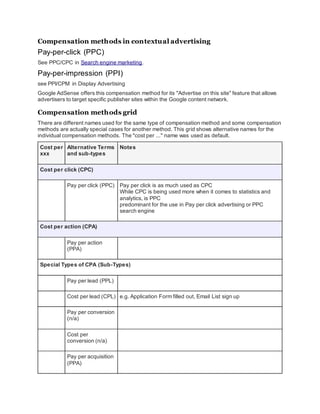
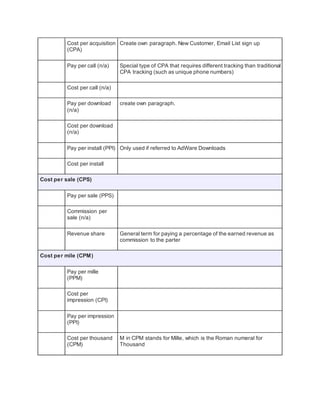
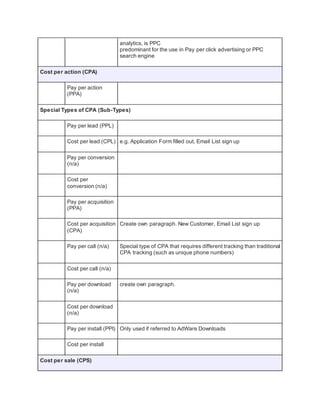
Compensation methods grid[edit]
There are different names used for the same type of compensation method and some compensation
methods are actually special cases for another method. This grid shows alternative names for the
individual compensation methods. The "cost per ..." name was used as default.
Cost per
xxx
Alternative Terms
and sub-types
Notes
Cost per click (CPC)
Pay per click (PPC) Pay per click is as much used as CPC
While CPC is being used more when it comes to statistics and](https://image.slidesharecdn.com/8a21ca77-8ddf-4d38-b291-29cce018dfc5-161107034141/85/The-lion-s-den-Project-HR-Management-23-320.jpg)
![Pay per sale (PPS)
Commission per
sale (n/a)
Revenue share General term for paying a percentage of the earned revenue as
commission to the parter
Cost per mille (CPM)
Pay per mille
(PPM)
Cost per
impression (CPI)
Pay per impression
(PPI)
Cost per thousand
(CPM)
M in CPM stands for Mille, which is the Roman numeral for
Thousand
Pay per thousand
(PPT)
An employee stock option (ESO) is commonly viewed as a complex call option on the
common stock of a company, granted by the company to an employee as part of the
employee's remuneration package.[1]
Regulators and economists have since specified that "employee
stock options" is a label that refers to compensation contracts between an employer and an
employee that carries some characteristics of financial options but are not in and of themselves
options (that is they are "compensation contracts"). Stock option expensing was a controversy well
before the most recent set of controversies in the early 2000s. The earliest attempts by accounting
regulators to expense stock options in the early 1990s were unsuccessful and resulted in the
promulgation of FAS123 by the Financial Accounting Standards Board which required disclosure of
stock option positions but no income statement expensing, per se. The controversy continued and in
2005, at the insistence of the SEC, the FASB modified the FAS123 rule to provide a rule that the
options should be expensed as of the grant date. One misunderstanding is that the expense is at the
fair value of the options. This is not true. The expense is indeed based on the fair value of the
options but that fair value measure does not follow the fair value rules for other items which are
governed by a separate set of rules under ASC Topic 820. In addition the fair value measure must
be modified for forfeiture estimates and may be modified for other factors such as liquidity before
expensing can occur. Finally the expense of the resulting number is rarely made on the grant date
but in some cases must be deferred and in other cases may be deferred over time as set forth in the
revised accounting rules for these contracts known as FAS123(revised).[2]
Employee Stock Options
are non standard contracts with the employer whereby the employer has the liability of delivering a
certain number of shares of the employer stock, when and if the employee stock options are
exercised by the employee. Traditional employee stock options have structural problems, in that
when exercised followed by an immediate sale of stock, the alignment between](https://image.slidesharecdn.com/8a21ca77-8ddf-4d38-b291-29cce018dfc5-161107034141/85/The-lion-s-den-Project-HR-Management-25-320.jpg)
![employee/shareholders is eliminated. Early exercises also have substantial penalties to the
exercising employee. Those penalties are a) part of the "fair value" of the options, called "time value"
is forfeited back to the company and b) an early tax liability occurs. These two penalties overcome
the merits of "diversifying" in most cases. Contract differences[edit]
Employee stock options have the following differences from standardized, exchange-traded options:
Exercise price: The exercise price is non-standardized and is usually the current price of the
company stock at the time of issue. Alternatively, a formula may be used, such as sampling the
lowest closing price over a 30-day window on either side of the grant date. On the other hand,
choosing an exercise at grant date equal to the average price for the next sixty days after the
grant would eliminate the chance of back dating and spring loading. Often, an employee may
have ESOs exercisable at different times and different exercise prices.
Quantity: Standardized stock options typically have 100 shares per contract. ESOs usually have
some non-standardized amount.
Vesting: Initially if X number of shares are granted to employee, then all X may not be in his
account.
some or all of the options may require that the employee continue to be employed by the
company for a specified term of years before "vesting", i.e. selling or transferring the stock or
options. Vesting may be granted all at once ("cliff vesting") or over a period time ("graded
vesting"), in which case it may be "uniform" (e.g. 20% of the options vest each year for 5
years) or "non-uniform" (e.g. 20%, 30% and 50% of the options vest each year for the next
three years).
some or all of the options may require a certain event to occur, such as an initial public
offering of the stock, or a change of control of the company.
Or the options may require the employee or the company meet certain performance goals or
profits (e.g., a 10% increase in sales)[4]
Duration (Expiration): ESOs often have a maximum maturity that far exceeds the maturity of
standardized options. It is not unusual for ESOs to have a maximum maturity of 10 years from
date of issue, while standardized options usually have a maximum maturity of about 30 months.
Non-transferable: With fewexceptions, ESOs are generally not transferable and must either be
exercised or allowed to expire worthless on expiration day. There is a substantial risk that when
the ESOs are granted (perhaps 50%[5]) that the options will be worthless at expiration.[6] This
should encourage the holders to reduce risk by selling exchange traded call options. In fact it is
the only efficient way to manage those speculative ESOs and SARs. Wealth Managers generally
advise early exercise of ESOs and SARs, then sell and diversify.
Over the counter: Unlike exchange traded options, ESOs are considered a private contract
between the employer and employee. As such, those two parties are responsible for arranging
the clearing and settlement of any transactions that result from the contract. In addition, the
employee is subjected to the credit risk of the company. If for any reason the company is unable
to deliver the stock against the option contract upon exercise, the employee may have limited
recourse. For exchange-trade options, the fulfillment of the option contract is guaranteed by the
Options Clearing Corp.
Tax issues: There are a variety of differences in the tax treatment of ESOs having to do with
their use as compensation. These vary by country of issue but in general, ESOs are tax-
advantaged with respect to standardized options. See below.
In the U.S., stock options granted to employees are of two forms that differ primarily in their
tax treatment. They may be either:
Incentive stock options (ISOs)](https://image.slidesharecdn.com/8a21ca77-8ddf-4d38-b291-29cce018dfc5-161107034141/85/The-lion-s-den-Project-HR-Management-26-320.jpg)
![ Non-qualified stock options (NQSOs or NSOs)
In the UK, there are various approved tax and employee share schemes,[7]
including
Enterprise Management Incentives (EMIs).[8]
(Employee share schemes that aren’t approved
by the UK government don’t have the same tax advantages.)
Valuation[edit]
As of 2006, the International Accounting Standards Board (IASB) and the Financial Accounting
Standards Board (FASB) agree that the fair value at the grant date should be estimated using
an option pricing model. Via requisite modifications, the valuation should incorporate the features
described above. Note that, having incorporated these, the value of the ESO will typically "be much
less than Black–Scholes prices for corresponding market-traded options...." [9]
Here, in discussing the
valuation, FAS 123 Revised (A15) - which does not prescribe a specific valuation model - states that:
a lattice model can be designed to accommodate dynamic assumptions of expected volatility and
dividends over the option’s contractual term, and estimates of expected option exercise
patterns during the option’s contractual term, including the effect of blackout periods. Therefore, the
design of a lattice model more fully reflects the substantive characteristics of a particular employee
share option or similar instrument. Nevertheless, both a lattice model and theBlack–Scholes–Merton
formula, as well as other valuation techniques that meet the requirements … can provide a fair value
estimate that is consistent with the measurement objective and fair-value-based method….
The reference to “contractual term” requires that the model incorporates the effect of vesting on the
valuation. As above, option holders may not exercise their option prior to their vesting date, and
during this time the option is effectively European in style. “Blackout periods”, similarly, requires that
the model recognizes that the option may not be exercised during the quarter (or other period)
preceding the release of financial results (or other corporate event), when employees would be
precluded from trade in company securities; see Insider trading. During other times, exercise would
be allowed, and the option is effectively American there. Given this pattern, the ESO, in total, is
therefore a Bermudan option. Note that employees leaving the company prior to vesting will forfeit
unvested options, which results in a decrease in the company's liability here, and this too must be
incorporated into the valuation.
The reference to “expected exercise patterns” is to what is called “suboptimal early exercise
behavior”.[10]
Here, regardless of other considerations − see Rational pricing#Options — employees
are assumed to exercise when they are sufficiently “in the money”. This is usually proxied as the
share price exceeding a specified multiple of the strike price; this multiple, in turn, is often an
empirically determined average for the company or industry in question.
The preference for lattice models is that these break the problem into discrete sub-problems, and
hence different rules and behaviors may be applied at the various time/price combinations as
appropriate. (The binomial model is the simplest and most common lattice model.) The "dynamic
assumptions of expected volatility and dividends" (e.g. expected changes to dividend policy), as well
as of forecast changes in interest rates (as consistent with today's term structure),[10]
may also be
incorporated in a lattice model, although a Finite difference model would be more correctly (if less
easily) applied in these cases.[11]
Black-Scholes may be applied to ESO valuation, but with an
important consideration: option maturity is substituted with an "effective time to exercise", reflecting
the impact on value of vesting, employee exits and suboptimal exercise.[12]
For modelling purposes,
where Black-Scholes is used, this number is (often) estimated using SEC Filings of comparable
companies. For reporting purposes, it can be found by calculating the ESO's Fugit - "the (risk-
neutral) expected life of the option" - directly from the lattice,[13]
or back-solved such that Black-
Scholes returns a given lattice-based result.
The work of Carpenter (1998) is acknowledged as the first attempt at a thorough treatment of the
problem in light of these features,[14]
and, more recently the Hull-Whitemodel (2004) is widely
used;[15]
see also Rubinstein (1995). These approaches are essentially modifications of the standard](https://image.slidesharecdn.com/8a21ca77-8ddf-4d38-b291-29cce018dfc5-161107034141/85/The-lion-s-den-Project-HR-Management-27-320.jpg)
![binomial model (although may sometimes implemented as a Trinomial tree). See below for further
discussion, as well as calculation resources. Although the Black–Scholes model is still applied by the
majority of public and private companies,[citation needed]
through September 2006, over 350 companies have
publicly disclosed the use of a (modified) binomial model in SEC filings.[citation needed]
Often, the inputs to the
pricing model may be difficult to determine[12]
— usually stock volatility, expected time to expiration,
and relevant exercise multiples — and a variety of commercial services are now offered here.
Accounting and taxation treatment
GAAP
Main article: Stock option expensing
The US GAAP accounting model for employee stock options and similar share-based compensation
contracts changed substantially in 2005 as FAS123 (revised) began to take effect. According to US
generally accepted accounting principles in effect before June 2005, principally FAS123 and its
predecessor APB 25, stock options granted to employees did not need to be recognized as an
expense on the income statement when granted if certain conditions were met, although the cost
(expressed under FAS123 as a form of the fair value of the stock option contracts) was disclosed in
the notes to the financial statements.
This allows a potentially large form of employee compensation to not show up as an expense in the
current year, and therefore, currently overstate income. Many assert that over-reporting of income by
methods such as this by American corporations was one contributing factor in the Stock Market
Downturn of 2002.
Employee stock options have to be expensed under US GAAP in the US. Each company must begin
expensing stock options no later than the first reporting period of a fiscal beginning after June 15,
2005. As most companies have fiscal years that are calendars, for most companies this means
beginning with the first quarter of 2006. As a result, companies that have not voluntarily started
expensing options will only see an income statement effect in fiscal year 2006. Companies will be
allowed, but not required, to restate prior-period results after the effective date. This will be quite a
change versus before, since options did not have to be expensed in case the exercise price was at
or above the stock price (intrinsic value based method APB 25). Only a disclosure in the footnotes
was required. Intentions from the international accounting body IASB indicate that similar treatment
will follow internationally.
As above, "Method of option expensing: SAB 107", issued by the SEC, does not specify a preferred
valuation model, but 3 criteria must be met when selecting a valuation model: The model is applied
in a manner consistent with the fair value measurement objective and other requirements of
FAS123R; is based on established financial economic theory and generally applied in the field; and
reflects all substantive characteristics of the instrument (i.e. assumptions on volatility, interest rate,
dividend yield, etc.) need to be specified.
Taxation
Because most employee stock options in the US are non-transferable,they are not immediately
exercisable although they can be readily hedged to reduce risk. The Canada Revenue Agency, and
Revenue Quebec considers that their "fair market value" cannot be "readily determined", and
therefore "no taxable event" occurs when an employee receives an option grant. Depending on the
type of option granted, the employee may or may not be taxed upon exercise. Non-qualified stock
options (those most often granted to employees) are taxed upon exercise. Incentive stock
options (ISO) are not, assuming that the employee complies with certain additional tax code
requirements. Most importantly, shares acquired upon exercise of ISOs must be held for at least one
year after the date of exercise if the favorable capital gains taxes are to be achieved.](https://image.slidesharecdn.com/8a21ca77-8ddf-4d38-b291-29cce018dfc5-161107034141/85/The-lion-s-den-Project-HR-Management-28-320.jpg)
![However, taxes can be delayed or reduced by avoiding premature exercises and holding them until
near expiration day and hedging along the way. The taxes applied when hedging are friendly to the
employee/optioned.
Excess tax benefits from stock-based compensation
This item of the profit-and-loss (P&L) statement of companies' earnings reports is due to the different
timing of option expense recognition between the GAAP P&L and how the IRS deals with it, and the
resulting difference between estimated and actual tax deductions.
At the time the options are awarded, GAAP requires an estimate of their value to be run through the
P&L as an expense. This lowers operating income and GAAP taxes. However, the IRS treats option
expense differently, and only allows their tax deductibility at the time the options are exercised/expire
and the true cost is known.
This means that cash taxes in the period the options are expensed are higher than GAAP taxes. The
delta goes into a deferred income tax asset on the balance sheet. When the options are
exercised/expire, their actual cost becomes known and the precise tax deduction allowed by the IRS
can then be determined. There is then a balancing up event. If the original estimate of the options'
cost was too low, there will be more tax deduction allowed than was at first estimated. This 'excess'
is run through the P&L in the period when it becomes known (i.e. the quarter in which the options are
exercised). It raises net income (by lowering taxes) and is subsequently deducted out in the
calculation of operating cash flow because it relates to expenses/earnings from a prior period.
Employee benefits and (especially in British English) benefits in kind (also called fringe
benefits, perquisites, or perks) include various types of non-wage compensation provided
to employees in addition to their normal wages or salaries.[1]
In instances where an employee
exchanges (cash) wages for some other form of benefit is generally referred to as a 'salary
packaging' or 'salary exchange' arrangement. In most countries, most kinds of employee benefits are
taxable to at least some degree.
Examples of these benefits include: housing (employer-provided or employer-paid), group insurance
(health, dental, life, etc.), disability income protection, retirement
benefits, daycare, tuition reimbursement, sick leave, vacation (paid and non-paid), social
security, profit sharing, employer student loan contributions, and other specialized benefits.
The purpose of employee benefits is to increase the economic security of staff members, and in
doing so, improve worker retention across the organization. As such, it is one component of reward
management.
The term perks is often used colloquially to refer to those benefits of a more discretionary nature.
Often, perks are given to employees who are doing notably well and/or have seniority. Common
perks are take-home vehicles, hotel stays, free refreshments, leisure activities on work time (golf,
etc.), stationery, allowances for lunch, and—when multiple choices exist—first choice of such things
as job assignments and vacation scheduling. They may also be given first chance at job promotions
when vacancies exist.
In Canada
Employee benefits in Canada usually refer to employer sponsored life, disability, health, and dental
plans. Such group insurance plans are a top-up to existing provincial coverage. An employer
provided group insurance plan is coordinated with the provincial plan in the respective province or
territory, therefore an employee covered by such a plan must be covered by the provincial plan first.
The life, accidental death and dismemberment and disability insurance component is an employee
benefit only. Some plans provide a minimal dependent life insurance benefit as well. The healthcare
plan may include any of the following: hospital room upgrades (Semi-Private or Private), medical
services/supplies and equipment, travel medical (60 or 90 days per trip), registered therapists and](https://image.slidesharecdn.com/8a21ca77-8ddf-4d38-b291-29cce018dfc5-161107034141/85/The-lion-s-den-Project-HR-Management-29-320.jpg)
![practitioners (i.e. physiotherapists, acupuncturists, chiropractors, etc.), prescription requiring drugs,
vision (eye exams, contacts/lenses), and Employee Assistance Programs. The dental plan usually
includes Basic Dental (cleanings, fillings, root canals), Major Dental (crowns, bridges, dentures)
and/or Orthodontics (braces).
Other than the employer sponsored health benefits described above, the next most common
employee benefits are group savings plans (Group RRSPs and Group Profit Sharing Plans) which
have tax and growth advantages to individual saving plans.
Profit sharing refers to various incentive plans introduced by businesses that provide direct or
indirect payments to employees that depend on company's profitability in addition to employees'
regular salary and bonuses. In publicly traded companies these plans typically amount to allocation
of shares to employees.
The profit sharing plans are based on predetermined economic sharing rules that define the split of
gains between the company as a principal and the employee as an agent.[1]
For example, suppose
the profits are x, which might be a random variable. Before knowing the profits, the principal and
agent might agree on a sharing rule s(x). Here, the agent will receive s(x) and the principal will
receive the residual gain x-s(x)]
Gainsharing
Gainsharing is a program that returns cost savings to the employees, usually as a lump-sum bonus.
It is a productivity measure, as opposed to profit-sharing which is a profitability measure. There are
three major types of gainsharing:
Scanlon plan: This program dates back to the 1930s and relies on committees to create cost-
sharing ideas. Designed to lower labor costs without lowering the level of a firm's activity. The
incentives are derived as a function of the ratio between labor costs and sales value of
production (SVOP).
Rucker plan: This plan also uses committees, but although the committee structure is simpler
the cost-saving calculations are more complex. A ratio is calculated that expresses the value of
production required for each dollar of total wage bill.
Improshare: Improshare stands for "Improved productivity through sharing" and is a more recent
plan. With this plan, a standard is developed that identifies the expected number of hours to
produce something, and any savings between this standard and actual production are shared
between the company and the workers.
Salary
A salary is a form of periodic payment from an employer to an employee, which may be specified in
an employment contract. It is contrasted with piece wages, where each job, hour or other unit is paid
separately, rather than on a periodic basis. From the point of view of running a business, salary can
also be viewed as the cost of acquiring and retaining human resources for running operations, and is
then termed personnel expense or salary expense. In accounting, salaries are recorded in payroll
accounts.[1]
Salary is a fixed amount of money or compensation paid to an employee by an employer in
return for work performed. Salary is commonly paid in fixed intervals, for example, monthly
payments of one-twelfth of the annual salary.
Salary is typically determined by comparing market pay rates for people performing similar
work in similar industries in the same region. Salary is also determined by leveling the pay
rates and salary ranges established by an individual employer. Salary is also affected by the
number of people available to perform the specific job in the employer's employment locale](https://image.slidesharecdn.com/8a21ca77-8ddf-4d38-b291-29cce018dfc5-161107034141/85/The-lion-s-den-Project-HR-Management-30-320.jpg)
![Wage
A wage is monetary compensation (or remuneration, personnel expenses, labor) paid by
an employer to an employee in exchange for work done. Payment may be calculated as a fixed
amount for each task completed (a task wage or piece rate), or at an hourly or daily rate, or based
on an easily measured quantity of work done.
Wages are an example of expenses that are involved in running a business.
Payment by wage contrasts with salaried work, in which the employer pays an arranged amount at
steady intervals (such as a week or month) regardless of hours worked, with commission which
conditions pay on individual performance, and with compensation based on the performance of the
company as a whole. Waged employees may also receive tips or gratuitypaid directly by clients
and employee benefits which are non-monetary forms of compensation. Since wage labour is the
predominant form of work, the term "wage" sometimes refers to all forms (or all monetary forms) of
employee compensation.
Origins and necessary components
Wage labour involves the exchange of money for time spent at work (the latter quantity is
termed labor power by Marx and subsequent economists). As Moses I. Finley lays out the issue
in The Ancient Economy:
The very idea of wage-labour requires two difficult conceptual steps. First it requires the
abstraction of a man's labour from both his person and the product of his work. When one
purchases an object from an independent craftsman … one has not bought his labour but the
object, which he had produced in his own time and under his own conditions of work. But
when one hires labour, one purchases an abstraction, labour-power, which the purchaser
then uses at a time and under conditions which he, the purchaser, not the "owner" of the
labour-power, determines (and for which he normally pays after he has consumed it).
Second, the wage labour system requires the establishment of a method of measuring the
labour one has purchased, for purposes of payment, commonly by introducing a second
abstraction, namely labour-time.[1]
The wage is the monetary measure corresponding to the standard units of working time (or to a
standard amount of accomplished work, defined as a piece rate). The earliest such unit of time,
still frequently used, is the day of work. The invention of clocks coincided with the elaborating of
subdivisions of time for work, of which the hour became the most common, underlying the
concept of an hourly wage.[2][3]
Wage Differences
Even in countries where market forces primarily set wage rates, studies show that there are still
differences in remuneration for work based on sex and race. For example, according to the U.S.
Bureau of Labor Statistics, in 2007 women of all races made approximately 80% of the median wage
of their male counterparts. This is likely due to the supply and demand for women in the market
because of family obligations.[7] Similarly, white men made about 84% the wage of Asian men, and
black men 64%.[8]
These are overall averages and are not adjusted for the type, amount, and quality
of work done.
Labour law
Labour law (also labor law or employment law, see spelling differences) mediates the relationship
between workers (employees), employers, trade unions and the government. Collective labour law
relates to the tripartite relationship between employee, employer and union. Individual labour law
concerns employees' rights at work and through the contract for work. Employment standards are
social norms (in some cases also technical standards) for the minimum socially acceptable](https://image.slidesharecdn.com/8a21ca77-8ddf-4d38-b291-29cce018dfc5-161107034141/85/The-lion-s-den-Project-HR-Management-31-320.jpg)
![conditions under which employees or contractors are allowed to work. Government agencies (such
as the former US Employment Standards Administration) enforce labour law (legislative, regulatory,
or judicial). Canadian labour law is that body of law which regulates the rights, restrictions
obligations of trade unions, workers and employers in Canada. Canadian employment law is that
body of law which regulates the rights, restrictions obligations of non-unioned workers and
employers in Canada.
Framework
Both the federal and provincial (or territorial) governments have authority over labour and
employment law in Canada. The constitution[1]
gives exclusive federal jurisdiction over employment in
specific industries, such as banking, radio and TV broadcasting, inland and maritime navigation and
shipping, inland fishing, as well as any form of transportation that crosses provincial boundaries.
Employment that is not subject to federal jurisdiction is governed by the laws of the province or
territory where the employment takes place.
In areas of unrestricted provincial jurisdiction, each province (and increasingly each territory) is in
charge. So, for example, education (except education on First Nation reserves) and municipal
government are both subject to provincial legislation (the territories excepted).
While Quebec's statutory environment is considerably different in many respects, most provinces
and the federal Code all follow the standard of enterprise-based bargaining structures. They also
share a certification process (the details of which differ somewhat from province to province) through
which unions are recognized by the state as having the support of a majority of workers in a narrowly
defined workplace. In Quebec, the Civil Code governs labor relations in the province.
One feature common to all provincial and federal labor laws is the "Rand Formula". This legal
concept allows employees in unionized workplaces to decline union membership but requires them
to pay the equivalent of basic union dues even if they decide not to be union members.
We followthe OntarioGovernmentEmploymentStandardsAct.](https://image.slidesharecdn.com/8a21ca77-8ddf-4d38-b291-29cce018dfc5-161107034141/85/The-lion-s-den-Project-HR-Management-32-320.jpg)


![Human Resource Information System [HRIS] MBA defence](https://cdn.slidesharecdn.com/ss_thumbnails/hrisresearchppt21-131125023046-phpapp02-thumbnail.jpg?width=640&height=640&fit=bounds)


![Chap001[1]](https://cdn.slidesharecdn.com/ss_thumbnails/chap0011-140422074736-phpapp02-thumbnail.jpg?width=640&height=640&fit=bounds)


