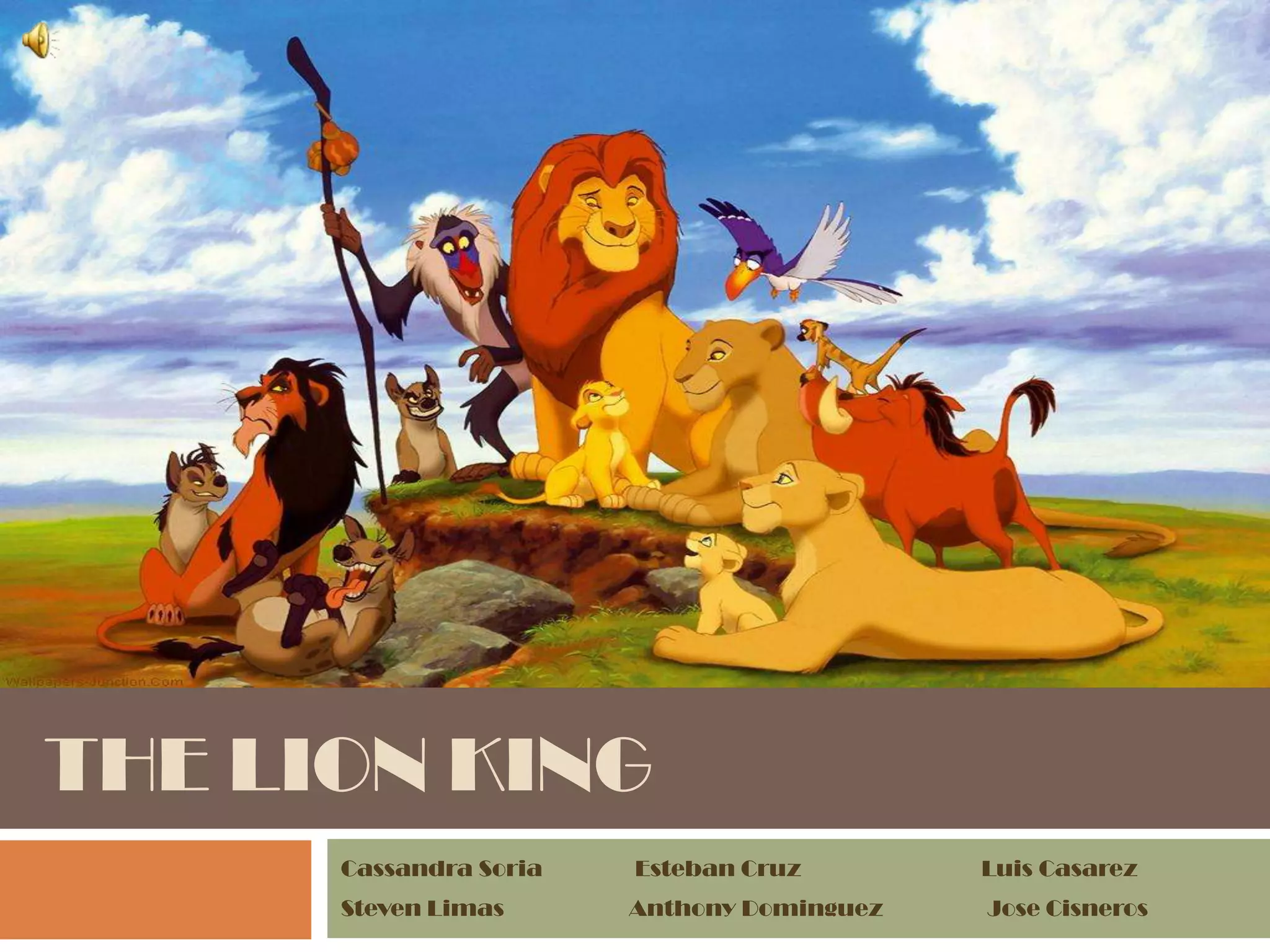
THE LION KING
Cassandra Soria Esteban Cruz Luis Casarez
Steven Limas Anthony Dominguez Jose Cisneros
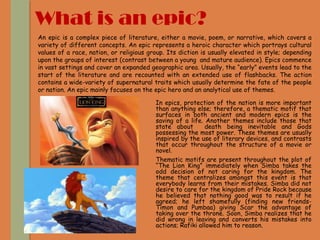
What is an epic?
In epics, protection of the nation is more important
than anything else; therefore, a thematic motif that
surfaces in both ancient and modern epics is the
saving of a life. Another themes include those that
state about death being inevitable and Gods
possessing the most power. These themes are usually
inspired by the use of literary devices, and contrasts
that occur throughout the structure of a movie or
novel.
Thematic motifs are present throughout the plot of
“The Lion King” immediately when Simba takes the
odd decision of not caring for the kingdom. The
theme that centralizes amongst this event is that
everybody learns from their mistakes. Simba did not
desire to care for the kingdom of Pride Rock because
he believed that nothing good was to result if he
agreed; he left shamefully (finding new friends-
Timon and Pumbaa) giving Scar the advantage of
taking over the throne. Soon, Simba realizes that he
did wrong in leaving and converts his mistakes into
actions; Rafiki allowed him to reason.
An epic is a complex piece of literature, either a movie, poem, or narrative, which covers a
variety of different concepts. An epic represents a heroic character which portrays cultural
values of a race, nation, or religious group. Its diction is usually elevated in style; depending
upon the groups of interest (contrast between a young and mature audience). Epics commence
in vast settings and cover an expanded geographic area. Usually, the “early” events lead to the
start of the literature and are recounted with an extended use of flashbacks. The action
contains a wide-variety of supernatural traits which usually determine the fate of the people
or nation. An epic mainly focuses on the epic hero and an analytical use of themes.
What are the traits of an epic
hero?
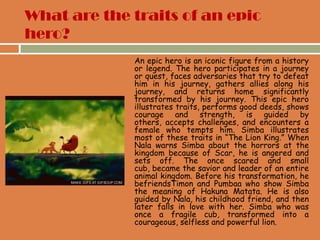
 An epic hero is an iconic figure from a history
or legend. The hero participates in a journey
or quest, faces adversaries that try to defeat
him in his journey, gathers allies along his
journey, and returns home significantly
transformed by his journey. This epic hero
illustrates traits, performs good deeds, shows
courage and strength, is guided by
others, accepts challenges, and encounters a
female who tempts him. Simba illustrates
most of these traits in “The Lion King.” When
Nala warns Simba about the horrors at the
kingdom because of Scar, he is angered and
sets off. The once scared and small
cub, became the savior and leader of an entire
animal kingdom. Before his transformation, he
befriendsTimon and Pumbaa who show Simba
the meaning of Hakuna Matata. He is also
guided by Nala, his childhood friend, and then
later falls in love with her. Simba who was
once a fragile cub, transformed into a
courageous, selfless and powerful lion.
In “The Lion King”, Mufasa reigned when Simba left
Pride Rock. As soon as Scar took throne, everything
overturned from a radiant setting into a dull
surrounding completely covered in darkness. This
dramatic change within the movie symbolizes the
suffering of the life-less environment Scar brought to
the kingdom.
During the climatic section of the movie, Scar is no
longer veiling his demonic nature from Simba. Perhaps in
tandem, to its symbolic representation of Hell, fire is
often used as a symbol of cleansing; since it removes
impurities. After the fight in which Simba and Scar are
involved, it rains, which not only revivifies the land, it
also serves as a dual baptism (with fire and water) re-
consecrating of the land for good.
The fight not only symbolizes that he‟s fighting for his
father, but for the whole kingdom. The event signifies a
rejuvenation with Simba at throne.
Quotes
 “Long live the king.” – Scar
 Scar was sarcastic when he spoke these
words, but little did he know that the king would
live on. Scar may have killed Mufasa, but Simba
followed in his father‟s footsteps and became a
powerful and righteous king.
 “I’m only brave when I have to. Being brave
doesn’t mean looking for trouble.” – Mufasa
 Mufasa spoke these wise words to his young
son, Simba, and these words later helped Simba
through his life journey. Simba ran off in
fear, but with the help of his father‟s
advice, Simba was able to build courage without
the fear of getting into trouble, and return to
rebuild the kingdom. Simba was able to take the
responsibilities as King with the help of his
father‟s advice, and others too.
Quotes
“Bad things happen, and you can’t do
anything
about them.” –Timon
This quote highlights the meaning of
“Hakuna Matata.” Through his
words, Timon explains that dwelling on
the past is not an option to live a good
life. In order to live life free of worries
you must forget the bad, and move on.
“Oh yes, the past can hurt, but the
way I see it you can either run from
it, or learn from it.” – Rafiki
This quote also supports the meaning of
“Hakuna Matata.” Rafiki is a wise
character who offers great advice, and
through these words he is saying that it
is in fact the circle of life, and that life
continues.
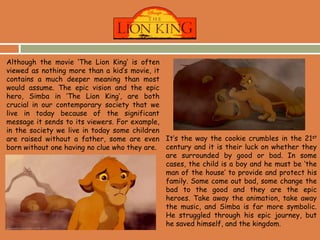
Although the movie „The Lion King‟ is often
viewed as nothing more than a kid‟s movie, it
contains a much deeper meaning than most
would assume. The epic vision and the epic
hero, Simba in „The Lion King‟, are both
crucial in our contemporary society that we
live in today because of the significant
message it sends to its viewers. For example,
in the society we live in today some children
are raised without a father, some are even
born without one having no clue who they are.
It‟s the way the cookie crumbles in the 21st
century and it is their luck on whether they
are surrounded by good or bad. In some
cases, the child is a boy and he must be „the
man of the house‟ to provide and protect his
family. Some come out bad, some change the
bad to the good and they are the epic
heroes. Take away the animation, take away
the music, and Simba is far more symbolic.
He struggled through his epic journey, but
he saved himself, and the kingdom.
Questions
1. What concept is used in the movie “The Lion
King”?
a. Be respectful to your elders
b. The circle of life
c. Fathers need to take more care of their
children
d. The love cycle
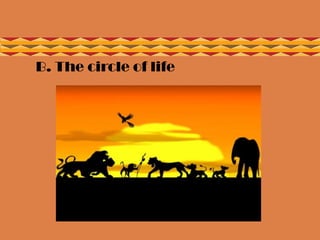
 B. The circle of life
Questions
2. Who is the epic hero in “The Lion King”?
a. Timon
b. Pumba
c. Simba
d. Scar
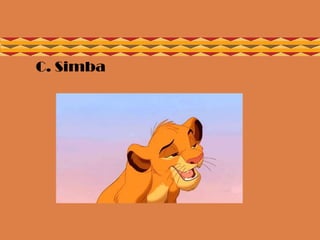
 C. Simba
Questions
3. Timon and Pumbaa exclaim, ”Sometimes you
have to put the past behind.” What is their main
focus towards the audience?
a. The past changes everything and there isn‟t
anything we can do about the situation
b. Nobody should care much about the past; what is
done is done
c. The present will definitely become as planned
without moving a finger
d. The past cannot be undone, but we can make the
best out of the future with bright decisions
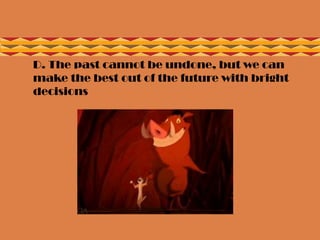
 D. The past cannot be undone, but we can
make the best out of the future with bright
decisions

4. What is the hero’s purpose in the movie?
a. To reunite with his friends and family
b. To change the present society and put down
his role as king
c. To take back the kingdom and return it to
“normal”, whereas it is his destiny
d. All of the above
Questions
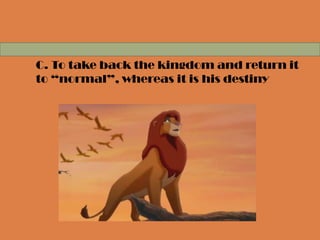
 C. To take back the kingdom and return it
to “normal”, whereas it is his destiny
Questions
5.What is the difference between both, Simba
and Scar?
a. Both characters go through equal dramatic
changes over time
b. Simba changes throughout the plot of the
movie, while Scar does not
c. Simba does not change throughout the
movie, while Scar does
d. It is impossible to distinguish between both
characters
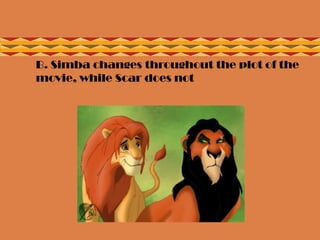
 B. Simba changes throughout the plot of the
movie, while Scar does not
Questions
6. What is the best turning point that
triggers the hero’s actions in the movie?
a. Simba realizes that Scar was falsifying being
his friend
b. Scar destroyed everything
c. The hyenas took full control of the land
d. Scar accuses him of killing his father
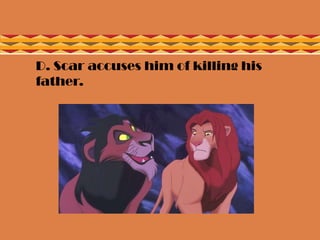
 D. Scar accuses him of killing his
father.
Questions
7. Who exposes Simba’s capacity to take full
control of the kingdom for the reason that
his father is “within” him?
a. Scar
b. Pumba
c. Rafiki
d. Timon
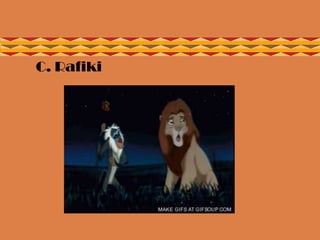
 C. Rafiki
Questions
8. When Simba leaves the paradise to head
for Pride Rock, what does he realize?
a. That he does not have a map to leave the
paradise
b. That he forgot Timon and Pumba behind
c. That he is leaving his childhood behind and
taking responsibility
d. Only a and b
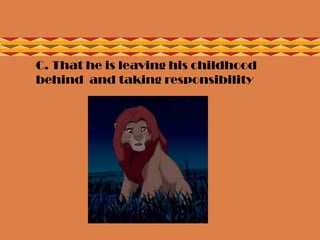
 C. That he is leaving his childhood
behind and taking responsibility
Questions
9.What types of conflicts does the epic hero
encounter throughout the plot of the movie?
a. Character vs. Self
b. Character vs. Character
c. Both a and b
d. None of the above
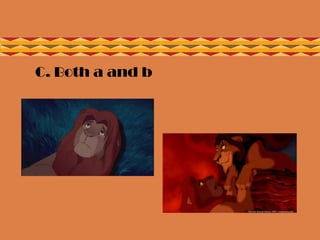
C. Both a and b
Questions
10.What is the final action Simba takes as
the epic hero in “The Lion King”?
a. He rebuilds Pride Rock after Scar nearly
destroyed it
b. He buries his father Mufasa
c. He decides to go on a journey to uncover his
inner personality
d. He leaves Pride Rock forever
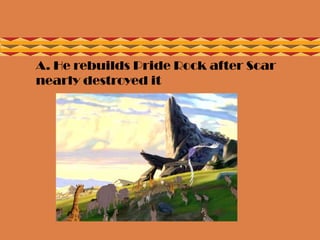
 A. He rebuilds Pride Rock after Scar
nearly destroyed it
The End
 Thank you for watching, and listening
to our presentation.

The lion king ppt

  • 1.
    THE LION KING CassandraSoria Esteban Cruz Luis Casarez Steven Limas Anthony Dominguez Jose Cisneros
  • 2.
    What is anepic? In epics, protection of the nation is more important than anything else; therefore, a thematic motif that surfaces in both ancient and modern epics is the saving of a life. Another themes include those that state about death being inevitable and Gods possessing the most power. These themes are usually inspired by the use of literary devices, and contrasts that occur throughout the structure of a movie or novel. Thematic motifs are present throughout the plot of “The Lion King” immediately when Simba takes the odd decision of not caring for the kingdom. The theme that centralizes amongst this event is that everybody learns from their mistakes. Simba did not desire to care for the kingdom of Pride Rock because he believed that nothing good was to result if he agreed; he left shamefully (finding new friends- Timon and Pumbaa) giving Scar the advantage of taking over the throne. Soon, Simba realizes that he did wrong in leaving and converts his mistakes into actions; Rafiki allowed him to reason. An epic is a complex piece of literature, either a movie, poem, or narrative, which covers a variety of different concepts. An epic represents a heroic character which portrays cultural values of a race, nation, or religious group. Its diction is usually elevated in style; depending upon the groups of interest (contrast between a young and mature audience). Epics commence in vast settings and cover an expanded geographic area. Usually, the “early” events lead to the start of the literature and are recounted with an extended use of flashbacks. The action contains a wide-variety of supernatural traits which usually determine the fate of the people or nation. An epic mainly focuses on the epic hero and an analytical use of themes.
  • 3.
    What are thetraits of an epic hero?  An epic hero is an iconic figure from a history or legend. The hero participates in a journey or quest, faces adversaries that try to defeat him in his journey, gathers allies along his journey, and returns home significantly transformed by his journey. This epic hero illustrates traits, performs good deeds, shows courage and strength, is guided by others, accepts challenges, and encounters a female who tempts him. Simba illustrates most of these traits in “The Lion King.” When Nala warns Simba about the horrors at the kingdom because of Scar, he is angered and sets off. The once scared and small cub, became the savior and leader of an entire animal kingdom. Before his transformation, he befriendsTimon and Pumbaa who show Simba the meaning of Hakuna Matata. He is also guided by Nala, his childhood friend, and then later falls in love with her. Simba who was once a fragile cub, transformed into a courageous, selfless and powerful lion.
  • 5.
    In “The LionKing”, Mufasa reigned when Simba left Pride Rock. As soon as Scar took throne, everything overturned from a radiant setting into a dull surrounding completely covered in darkness. This dramatic change within the movie symbolizes the suffering of the life-less environment Scar brought to the kingdom. During the climatic section of the movie, Scar is no longer veiling his demonic nature from Simba. Perhaps in tandem, to its symbolic representation of Hell, fire is often used as a symbol of cleansing; since it removes impurities. After the fight in which Simba and Scar are involved, it rains, which not only revivifies the land, it also serves as a dual baptism (with fire and water) re- consecrating of the land for good. The fight not only symbolizes that he‟s fighting for his father, but for the whole kingdom. The event signifies a rejuvenation with Simba at throne.
  • 6.
    Quotes  “Long livethe king.” – Scar  Scar was sarcastic when he spoke these words, but little did he know that the king would live on. Scar may have killed Mufasa, but Simba followed in his father‟s footsteps and became a powerful and righteous king.  “I’m only brave when I have to. Being brave doesn’t mean looking for trouble.” – Mufasa  Mufasa spoke these wise words to his young son, Simba, and these words later helped Simba through his life journey. Simba ran off in fear, but with the help of his father‟s advice, Simba was able to build courage without the fear of getting into trouble, and return to rebuild the kingdom. Simba was able to take the responsibilities as King with the help of his father‟s advice, and others too.
  • 7.
    Quotes “Bad things happen,and you can’t do anything about them.” –Timon This quote highlights the meaning of “Hakuna Matata.” Through his words, Timon explains that dwelling on the past is not an option to live a good life. In order to live life free of worries you must forget the bad, and move on. “Oh yes, the past can hurt, but the way I see it you can either run from it, or learn from it.” – Rafiki This quote also supports the meaning of “Hakuna Matata.” Rafiki is a wise character who offers great advice, and through these words he is saying that it is in fact the circle of life, and that life continues.
  • 8.
    Although the movie„The Lion King‟ is often viewed as nothing more than a kid‟s movie, it contains a much deeper meaning than most would assume. The epic vision and the epic hero, Simba in „The Lion King‟, are both crucial in our contemporary society that we live in today because of the significant message it sends to its viewers. For example, in the society we live in today some children are raised without a father, some are even born without one having no clue who they are. It‟s the way the cookie crumbles in the 21st century and it is their luck on whether they are surrounded by good or bad. In some cases, the child is a boy and he must be „the man of the house‟ to provide and protect his family. Some come out bad, some change the bad to the good and they are the epic heroes. Take away the animation, take away the music, and Simba is far more symbolic. He struggled through his epic journey, but he saved himself, and the kingdom.
  • 9.
    Questions 1. What conceptis used in the movie “The Lion King”? a. Be respectful to your elders b. The circle of life c. Fathers need to take more care of their children d. The love cycle
  • 10.
     B. Thecircle of life
  • 11.
    Questions 2. Who isthe epic hero in “The Lion King”? a. Timon b. Pumba c. Simba d. Scar
  • 12.
  • 13.
    Questions 3. Timon andPumbaa exclaim, ”Sometimes you have to put the past behind.” What is their main focus towards the audience? a. The past changes everything and there isn‟t anything we can do about the situation b. Nobody should care much about the past; what is done is done c. The present will definitely become as planned without moving a finger d. The past cannot be undone, but we can make the best out of the future with bright decisions
  • 14.
     D. Thepast cannot be undone, but we can make the best out of the future with bright decisions 
  • 15.
    4. What isthe hero’s purpose in the movie? a. To reunite with his friends and family b. To change the present society and put down his role as king c. To take back the kingdom and return it to “normal”, whereas it is his destiny d. All of the above Questions
  • 16.
     C. Totake back the kingdom and return it to “normal”, whereas it is his destiny
  • 17.
    Questions 5.What is thedifference between both, Simba and Scar? a. Both characters go through equal dramatic changes over time b. Simba changes throughout the plot of the movie, while Scar does not c. Simba does not change throughout the movie, while Scar does d. It is impossible to distinguish between both characters
  • 18.
     B. Simbachanges throughout the plot of the movie, while Scar does not
  • 19.
    Questions 6. What isthe best turning point that triggers the hero’s actions in the movie? a. Simba realizes that Scar was falsifying being his friend b. Scar destroyed everything c. The hyenas took full control of the land d. Scar accuses him of killing his father
  • 20.
     D. Scaraccuses him of killing his father.
  • 21.
    Questions 7. Who exposesSimba’s capacity to take full control of the kingdom for the reason that his father is “within” him? a. Scar b. Pumba c. Rafiki d. Timon
  • 22.
  • 23.
    Questions 8. When Simbaleaves the paradise to head for Pride Rock, what does he realize? a. That he does not have a map to leave the paradise b. That he forgot Timon and Pumba behind c. That he is leaving his childhood behind and taking responsibility d. Only a and b
  • 24.
     C. Thathe is leaving his childhood behind and taking responsibility
  • 25.
    Questions 9.What types ofconflicts does the epic hero encounter throughout the plot of the movie? a. Character vs. Self b. Character vs. Character c. Both a and b d. None of the above
  • 26.
    C. Both aand b
  • 27.
    Questions 10.What is thefinal action Simba takes as the epic hero in “The Lion King”? a. He rebuilds Pride Rock after Scar nearly destroyed it b. He buries his father Mufasa c. He decides to go on a journey to uncover his inner personality d. He leaves Pride Rock forever
  • 28.
     A. Herebuilds Pride Rock after Scar nearly destroyed it
  • 29.
    The End  Thankyou for watching, and listening to our presentation.