Text as a
Connected
Discourse
Learning Targets:
1. describe a
written text
as connected
discourse
2. distinguish
between and
among patterns
of development
in writing across
disciplines
3. identify
properties of
a well-written
text
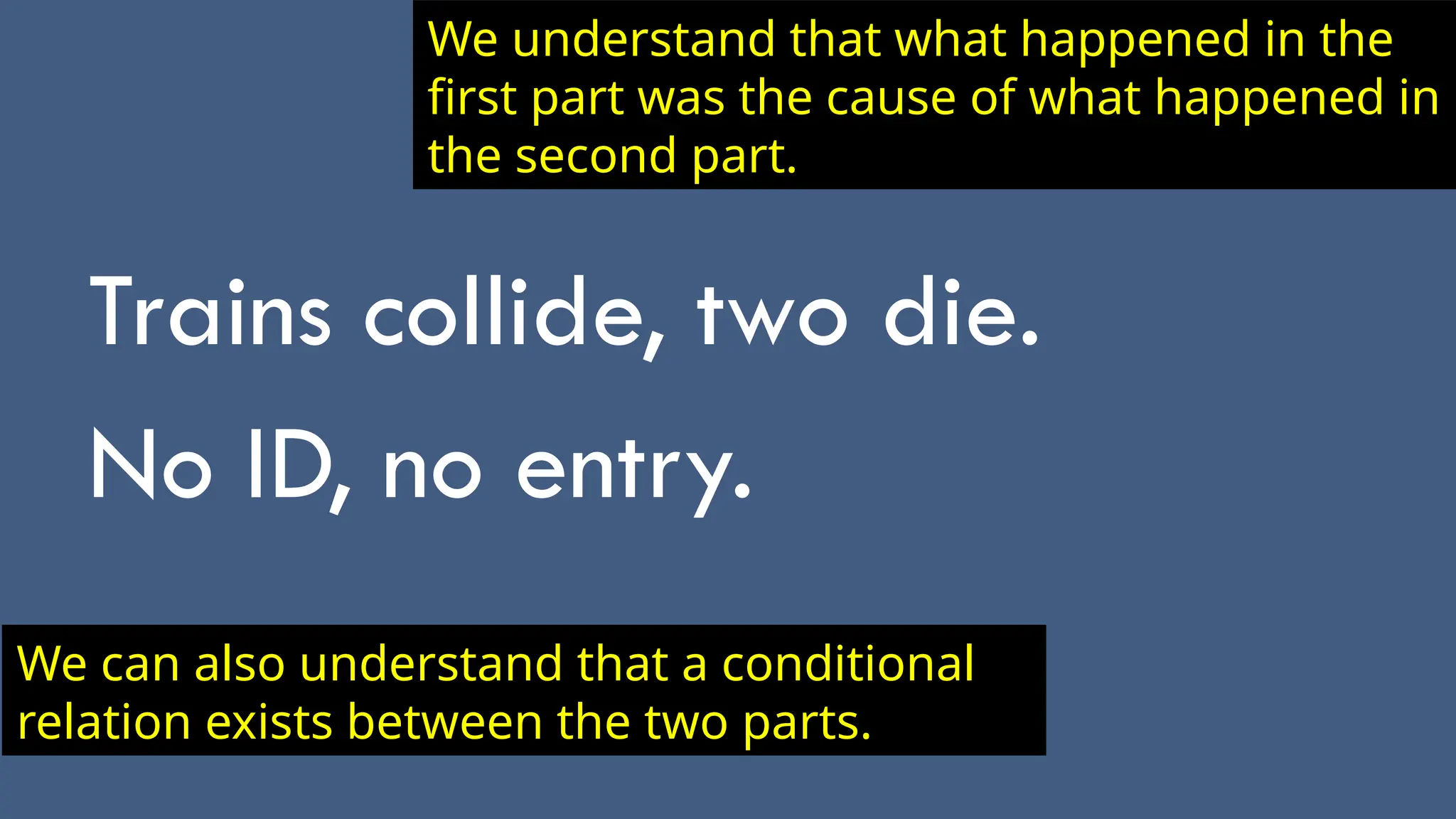
Trains collide, two die.
No ID, no entry.
We understand that what happened in the
first part was the cause of what happened in
the second part.
We can also understand that a conditional
relation exists between the two parts.
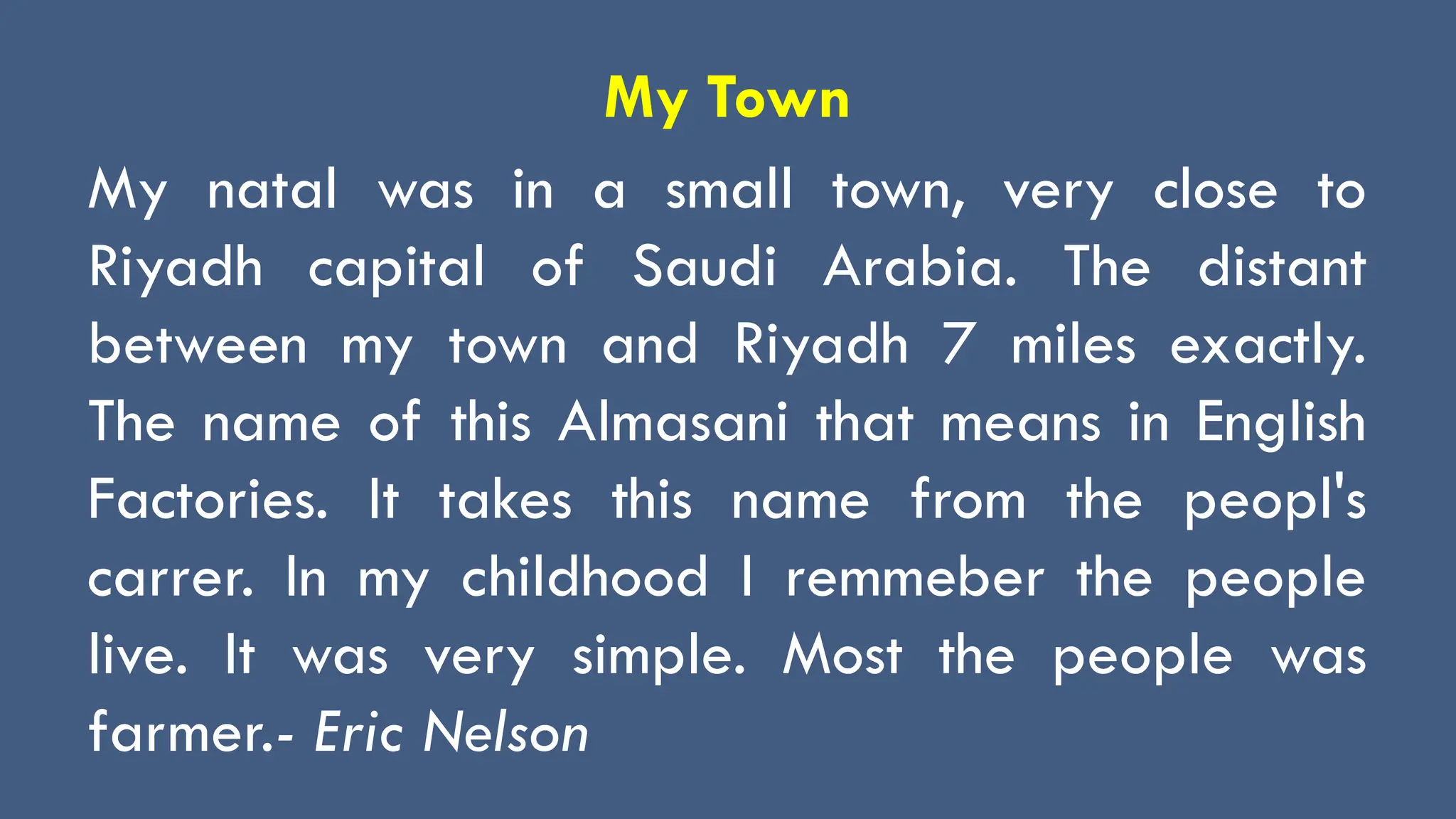
My Town
My natal was in a small town, very close to
Riyadh capital of Saudi Arabia. The distant
between my town and Riyadh 7 miles exactly.
The name of this Almasani that means in English
Factories. It takes this name from the peopl's
carrer. In my childhood I remmeber the people
live. It was very simple. Most the people was
farmer.- Eric Nelson
• How do we make sense of what we read?
• How can we recognize well-constructed texts as
opposed to those that are jumbled or
incoherent?
• How do we understand speakers who
communicate more than what they say?
DISCOURSE ANALYSIS
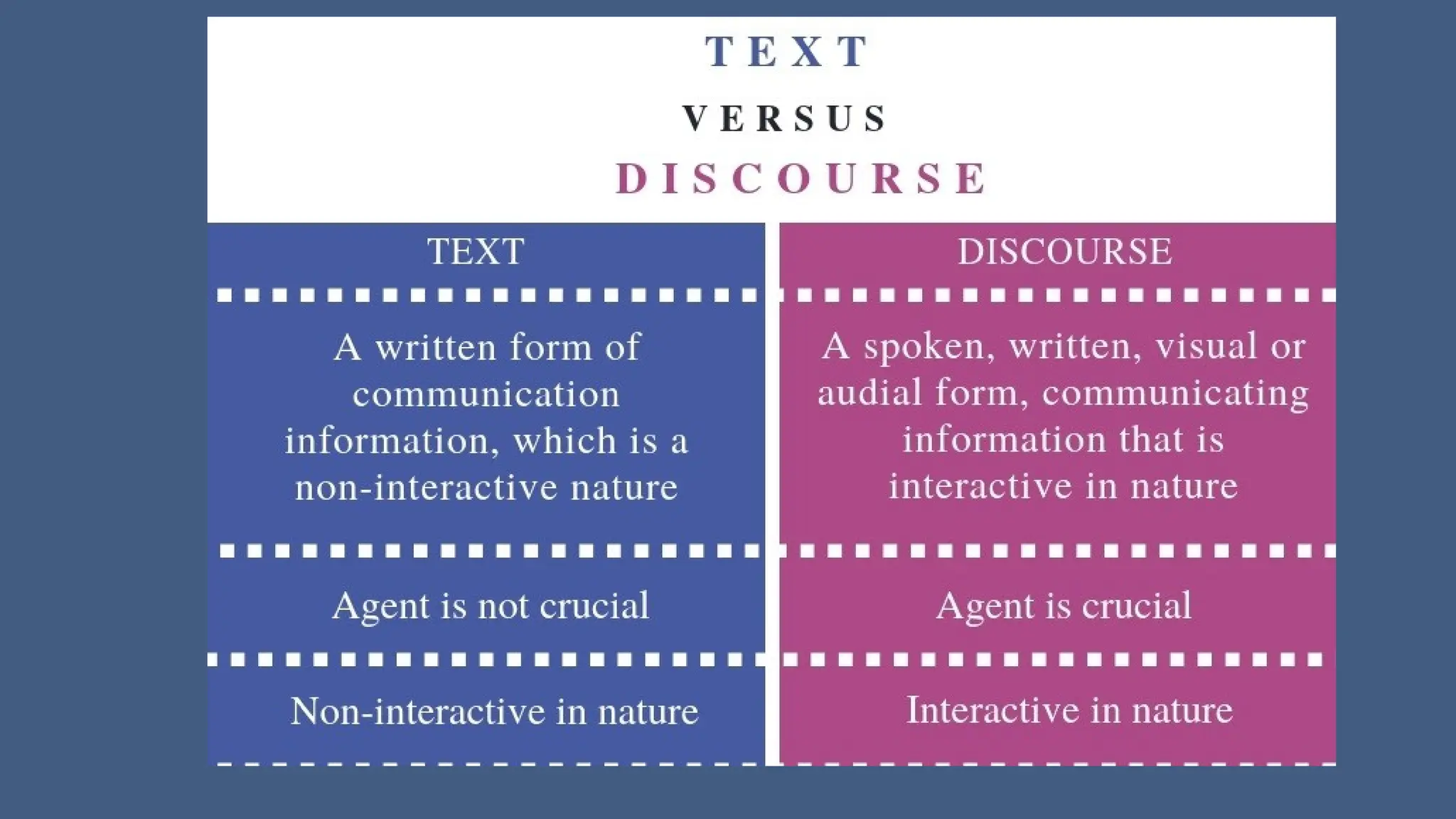
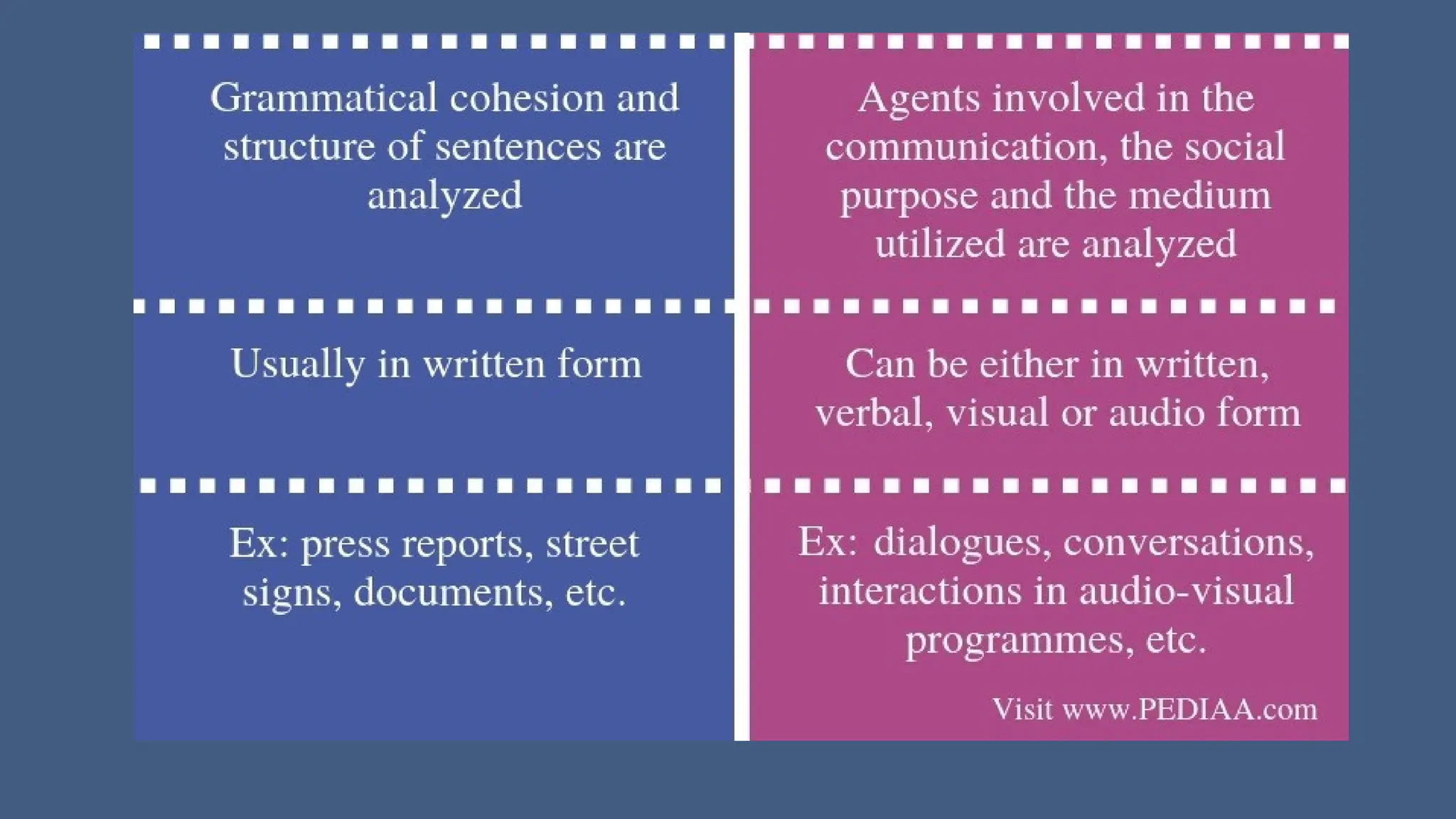
Text vs. Discourse
• While text is defined as the sequence of
paragraphs that represents an extended unit
of speech, discourse is the language beyond
these sentences. It is language use relative to
social, political and cultural formations
(Jaworski & Coupland, 1993)
Analyzing a discourse is usually contextual.
The reader tries to consider several factors
that may have influenced the writer to make
certain claims. Those factors explain the
author’s biases, philosophy, and educational
and professional backgrounds, among
others. Below are three of those factors.
1. Culture – The beliefs, customs, attitudes, language, and other things that
define culture may influence the author’s perspective on several issues. Knowing
about the culture the author belongs to, the reader may understand his or her
biases.
2. Social environment – The author’s physical surroundings and social
relationships, as well as the culture of the time may have influenced his or her
writing. For instance, during the early decades of the 20th century, most writers
produced works that were classified as “modern” because of its distinct
feature: stream of consciousness.
3. Experiences – Personal accounts or first-hand experience of events, though
subjective, establish credibility and reliability of information presented in any
discourse.
DISCOURSE may…
 persuade/argue
 describe
 inform
 narrate
TYPES OF DISCOURSES
• Argumentation – In this type of discourse, the writer
aims to persuade the audience or readers. He or she
presents valid claims or counterclaims, each
supported by evidence, to prove a point. In proving
claims, the writer presents studies, experts’ opinions,
and statistical data, among others. Moreover, an
argumentative discourse should appeal to logic or
reason instead of emotion.
Example:
A recent study confirmed that playing video games may cause
children to become violent. However, this is only true for some
children. Dr. Charlotte Cooper and Dr. Markey Vitasa of ABC
University explained that children who manifest a combination of
three personality traits high neuroticism, disagreeableness, and low
―
levels of conscientiousness are more likely to be aggressive toward
―
others after playing video games.
In order to convince the readers, the author of the passage mentioned a study to
support his or her claim about video games. The author did not simply state that
video games may cause children to become violent; he or she proved it by citing
two experts.
TYPES OF DISCOURSES
• Description – This type of discourse is based
on the main impression of the author about the
topic or subject. His or her impression is
influenced by prior knowledge, culture,
environment, and experiences, among others.
As the writer describes his or her
observations, it triggers sensory images
among readers.
Example:
When I first saw my childhood friend Margarette,
she was about my younger sister Viv’s height. Her
hair was curly and dark, and her skin was pale. But
what really struck me when I first saw her was her
big round blue eyes.
Through the author’s description, the reader can infer what the
person Margarette looks like.
TYPES OF DISCOURSES
• Exposition – This aims to inform, clarify, and
explain a phenomenon. It defines what
something is and provides an in-depth
discussion about topics that are usually less
explored. Moreover, it gives reader
instructions on how something is done.
Example:
How to set up an email account
1. Choose the web host.
2. Look for the sign up button. Click it.
3. Provide the required information.
4. Think of a unique username and a password. (Tip: For
the password, type in uppercase or add characters.)
5. Start using the newly setup email account.
The passage gives instructions on how to set up an email account. Some
examples of an exposition may be found in some magazine articles or
editorials, which usually include life hacks.
TYPES OF DISCOURSES
• Narration – This type of discourse is like storytelling.
It recalls events chronologically. It is told in the first,
second, or third person point of view. Moreover, its
structure may be linear or nonlinear. A linear structure
follows a typical format: beginning, middle, end; while
a nonlinear structure may start from the end or in the
middle.
Example:
I remember the time when I learned how to swim. I was only eight
years old and afraid to bathe in a pool. I envied the kids who played
with inflatable balls and animals. Whenever my family would visit the
clubhouse, I would sit beside the pool and never really jump in to join
them. A summer camp opened in our neighborhood, and my mom
thought of enrolling my brother and me in a swimming class. Two
days before the class started, my mom gave me a pep talk; that
made me realize that I did not want to miss out the fun just because I
was afraid.
The passage conveys a person’s experience about learning how to swim. The
events are told chronologically, and the story is told in the first person point
of view.
How do we ensure the connection
between text and discourse?
COHESION
• My father once bought a
Lincoln convertible. He did it by
saving every penny he could.
That car would be worth a
fortune nowadays. However, he
sold it to help pay for my
college education. Sometimes, I
think I'd rather have the
convertible.
Analysis of cohesive ties
within a text gives us some
insight into how writers
structure what they want to
say, and they may be crucial
factors in our judgments on
whether something is well-
written or not.
• ties and connections that exist
within the text
COHESION, ITSELF, IS NOT SUFFICIENT TO ENABLE US
TO MAKE SENSE OF WHAT WE READ.
• My father once bought a
Lincoln convertible. The car
driven by the police was
red. That color doesn't suit
her. She consists of three
letters. However, a letter
isn't as fast as a telephone
call.
The “connectedness” we
experience in our
interpretation of normal texts
in not simply based on
connections between the
words.
COHERENCE
*Telephone rings*
HER: That's the telephone.
HIM: I'm in the bath.
HER: O.K.
(Widdowson, 1978)
• She makes a request
to perform action.
• He states reason why
can't comply with
request.
• She undertakes to
perform action.
everything fitting together well.
TOP 5 COHERENCE AND COHESION MISTAKES
• No clear topic sentences – be sure that the main idea in your paragraph
will be in the first sentence
• Poor use of transition signals – don’t use them between every sentence in
a paragraph
• No progression – every sentence in your essay should add something more
to your argument
• Poor referencing – it is great to reference, but it should always be clear
what a pronoun refers to
• Parts of the essay cannot be understood – don’t let bad paraphrasing
destroy the content of your essay.
REVIEW
1. What is the purpose of informative
text?
A) To persuade you to buy something.
B) To describe how a scene might look in
a novel.
C) To provide clear facts about
something.
D) To tell you how to do something.
2. The following passage is an example
of informative text: true or false?
A) True
B) False
New Sydmouth Public
Library: What can I borrow
or hire?
There is a large
collection of books
including paperbacks, non-
fiction books, ‘talking
books’, books in large print
and books in languages
apart from English. Up to 6
items can
be borrowed for 3 weeks.
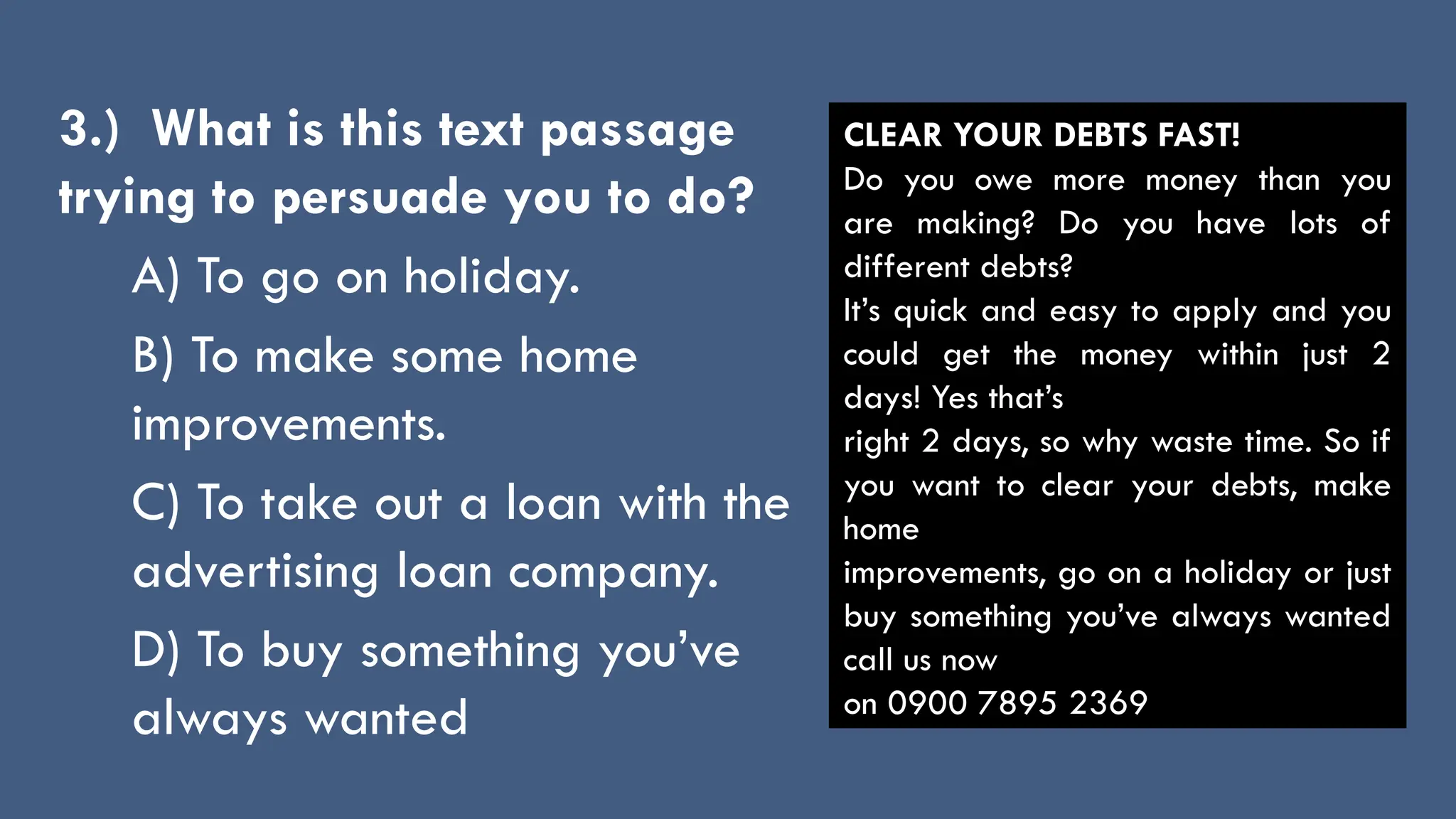
3.) What is this text passage
trying to persuade you to do?
A) To go on holiday.
B) To make some home
improvements.
C) To take out a loan with the
advertising loan company.
D) To buy something you’ve
always wanted
CLEAR YOUR DEBTS FAST!
Do you owe more money than you
are making? Do you have lots of
different debts?
It’s quick and easy to apply and you
could get the money within just 2
days! Yes that’s
right 2 days, so why waste time. So if
you want to clear your debts, make
home
improvements, go on a holiday or just
buy something you’ve always wanted
call us now
on 0900 7895 2369
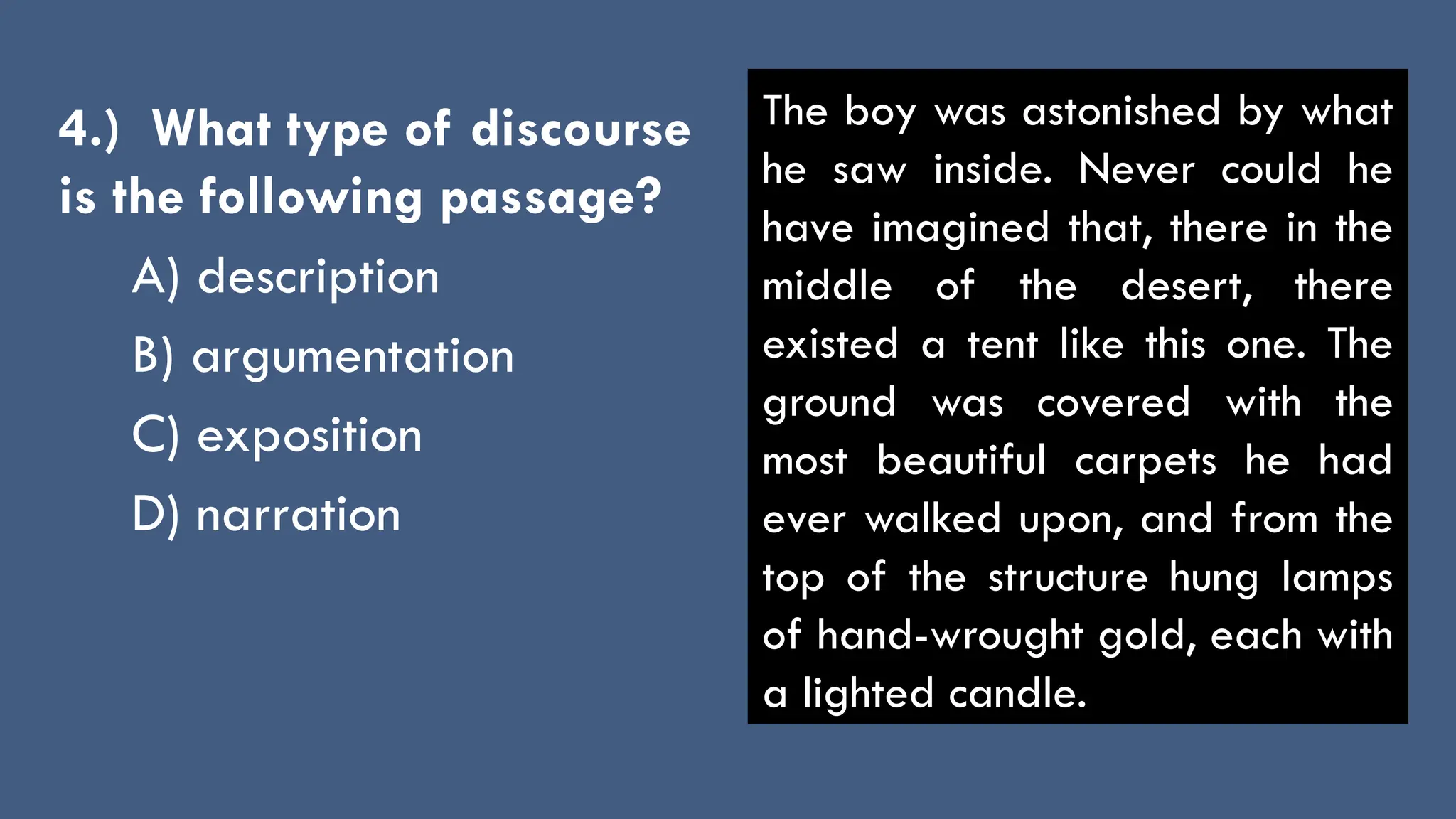
4.) What type of discourse
is the following passage?
A) description
B) argumentation
C) exposition
D) narration
The boy was astonished by what
he saw inside. Never could he
have imagined that, there in the
middle of the desert, there
existed a tent like this one. The
ground was covered with the
most beautiful carpets he had
ever walked upon, and from the
top of the structure hung lamps
of hand-wrought gold, each with
a lighted candle.
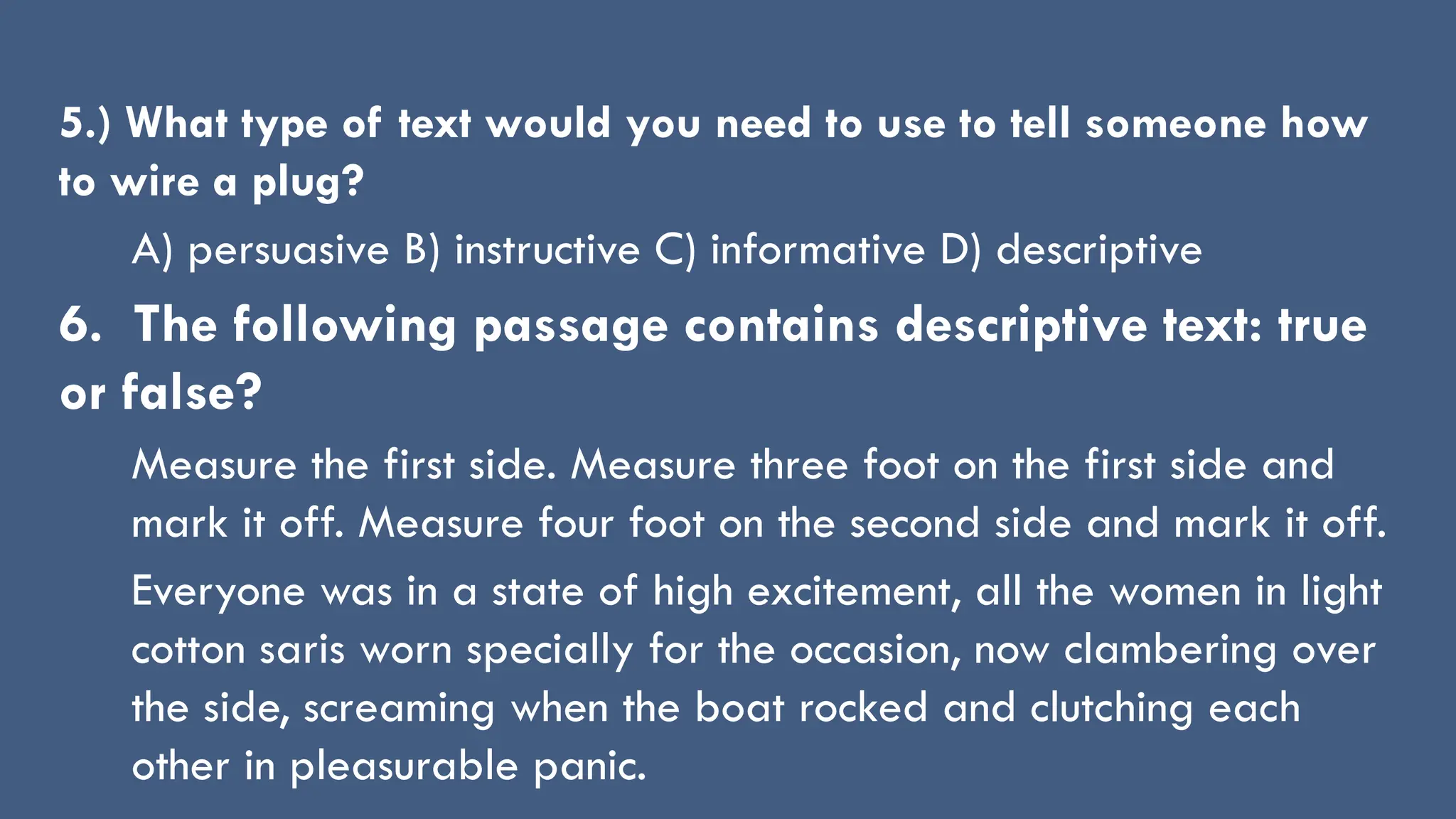
5.) What type of text would you need to use to tell someone how
to wire a plug?
A) persuasive B) instructive C) informative D) descriptive
6. The following passage contains descriptive text: true
or false?
Measure the first side. Measure three foot on the first side and
mark it off. Measure four foot on the second side and mark it off.
Everyone was in a state of high excitement, all the women in light
cotton saris worn specially for the occasion, now clambering over
the side, screaming when the boat rocked and clutching each
other in pleasurable panic.
Group Activity
INFORML DEBATE
Topics:
1.Same Sex Union
2. Legalizing Marijuana
3. Legalizing Abortion
1.You just heard that your favorite band is playing at
the school’s covered court on Friday. Unfortunately, you
are scheduled to work at your part-time job. Through
writing a letter to your boss, explain why you need time
off on Friday.
2.Your friend plans to meet you at the school canteen
before seeing the concert. However, this friend needs
directions since he does not know the campus. In a note
to your friend, explain how to walk or drive to the school
and where to meet.
3.You have just seen a fantastic concert at the university
gymnasium. You want to capture the experience in your
diary. In a journal entry for yourself, describe the show
and your feelings.
4.You saw the concert last Friday. Your English teacher
wants you to write a creative story about the
experience. It could take the form of a brief story,
dialogue, or poem. In a short paper for your class, write
your creative response to the experience.
General Rubric for grading paper requirements
a. Content - 8pts
b. Organization (Coherence and Cohesion) - 4pts
c. Correctness and format- 4pts
d. Presentation- 4pts
TOTAL: 20 pts
The learner realizes  that information in  a written text may  be selected and  organized to  achieve a particular  purpose.

The learner realizes that information in a written text may be selected and organized to achieve a particular purpose.

  • 1.
  • 2.
    Learning Targets: 1. describea written text as connected discourse 2. distinguish between and among patterns of development in writing across disciplines 3. identify properties of a well-written text
  • 3.
    Trains collide, twodie. No ID, no entry. We understand that what happened in the first part was the cause of what happened in the second part. We can also understand that a conditional relation exists between the two parts.
  • 4.
    My Town My natalwas in a small town, very close to Riyadh capital of Saudi Arabia. The distant between my town and Riyadh 7 miles exactly. The name of this Almasani that means in English Factories. It takes this name from the peopl's carrer. In my childhood I remmeber the people live. It was very simple. Most the people was farmer.- Eric Nelson
  • 5.
    • How dowe make sense of what we read? • How can we recognize well-constructed texts as opposed to those that are jumbled or incoherent? • How do we understand speakers who communicate more than what they say? DISCOURSE ANALYSIS
  • 6.
    Text vs. Discourse •While text is defined as the sequence of paragraphs that represents an extended unit of speech, discourse is the language beyond these sentences. It is language use relative to social, political and cultural formations (Jaworski & Coupland, 1993)
  • 9.
    Analyzing a discourseis usually contextual. The reader tries to consider several factors that may have influenced the writer to make certain claims. Those factors explain the author’s biases, philosophy, and educational and professional backgrounds, among others. Below are three of those factors.
  • 10.
    1. Culture –The beliefs, customs, attitudes, language, and other things that define culture may influence the author’s perspective on several issues. Knowing about the culture the author belongs to, the reader may understand his or her biases. 2. Social environment – The author’s physical surroundings and social relationships, as well as the culture of the time may have influenced his or her writing. For instance, during the early decades of the 20th century, most writers produced works that were classified as “modern” because of its distinct feature: stream of consciousness. 3. Experiences – Personal accounts or first-hand experience of events, though subjective, establish credibility and reliability of information presented in any discourse.
  • 11.
    DISCOURSE may…  persuade/argue describe  inform  narrate
  • 12.
    TYPES OF DISCOURSES •Argumentation – In this type of discourse, the writer aims to persuade the audience or readers. He or she presents valid claims or counterclaims, each supported by evidence, to prove a point. In proving claims, the writer presents studies, experts’ opinions, and statistical data, among others. Moreover, an argumentative discourse should appeal to logic or reason instead of emotion.
  • 13.
    Example: A recent studyconfirmed that playing video games may cause children to become violent. However, this is only true for some children. Dr. Charlotte Cooper and Dr. Markey Vitasa of ABC University explained that children who manifest a combination of three personality traits high neuroticism, disagreeableness, and low ― levels of conscientiousness are more likely to be aggressive toward ― others after playing video games. In order to convince the readers, the author of the passage mentioned a study to support his or her claim about video games. The author did not simply state that video games may cause children to become violent; he or she proved it by citing two experts.
  • 14.
    TYPES OF DISCOURSES •Description – This type of discourse is based on the main impression of the author about the topic or subject. His or her impression is influenced by prior knowledge, culture, environment, and experiences, among others. As the writer describes his or her observations, it triggers sensory images among readers.
  • 15.
    Example: When I firstsaw my childhood friend Margarette, she was about my younger sister Viv’s height. Her hair was curly and dark, and her skin was pale. But what really struck me when I first saw her was her big round blue eyes. Through the author’s description, the reader can infer what the person Margarette looks like.
  • 16.
    TYPES OF DISCOURSES •Exposition – This aims to inform, clarify, and explain a phenomenon. It defines what something is and provides an in-depth discussion about topics that are usually less explored. Moreover, it gives reader instructions on how something is done.
  • 17.
    Example: How to setup an email account 1. Choose the web host. 2. Look for the sign up button. Click it. 3. Provide the required information. 4. Think of a unique username and a password. (Tip: For the password, type in uppercase or add characters.) 5. Start using the newly setup email account. The passage gives instructions on how to set up an email account. Some examples of an exposition may be found in some magazine articles or editorials, which usually include life hacks.
  • 18.
    TYPES OF DISCOURSES •Narration – This type of discourse is like storytelling. It recalls events chronologically. It is told in the first, second, or third person point of view. Moreover, its structure may be linear or nonlinear. A linear structure follows a typical format: beginning, middle, end; while a nonlinear structure may start from the end or in the middle.
  • 19.
    Example: I remember thetime when I learned how to swim. I was only eight years old and afraid to bathe in a pool. I envied the kids who played with inflatable balls and animals. Whenever my family would visit the clubhouse, I would sit beside the pool and never really jump in to join them. A summer camp opened in our neighborhood, and my mom thought of enrolling my brother and me in a swimming class. Two days before the class started, my mom gave me a pep talk; that made me realize that I did not want to miss out the fun just because I was afraid. The passage conveys a person’s experience about learning how to swim. The events are told chronologically, and the story is told in the first person point of view.
  • 20.
    How do weensure the connection between text and discourse?
  • 21.
    COHESION • My fatheronce bought a Lincoln convertible. He did it by saving every penny he could. That car would be worth a fortune nowadays. However, he sold it to help pay for my college education. Sometimes, I think I'd rather have the convertible. Analysis of cohesive ties within a text gives us some insight into how writers structure what they want to say, and they may be crucial factors in our judgments on whether something is well- written or not. • ties and connections that exist within the text
  • 22.
    COHESION, ITSELF, ISNOT SUFFICIENT TO ENABLE US TO MAKE SENSE OF WHAT WE READ. • My father once bought a Lincoln convertible. The car driven by the police was red. That color doesn't suit her. She consists of three letters. However, a letter isn't as fast as a telephone call. The “connectedness” we experience in our interpretation of normal texts in not simply based on connections between the words.
  • 23.
    COHERENCE *Telephone rings* HER: That'sthe telephone. HIM: I'm in the bath. HER: O.K. (Widdowson, 1978) • She makes a request to perform action. • He states reason why can't comply with request. • She undertakes to perform action. everything fitting together well.
  • 24.
    TOP 5 COHERENCEAND COHESION MISTAKES • No clear topic sentences – be sure that the main idea in your paragraph will be in the first sentence • Poor use of transition signals – don’t use them between every sentence in a paragraph • No progression – every sentence in your essay should add something more to your argument • Poor referencing – it is great to reference, but it should always be clear what a pronoun refers to • Parts of the essay cannot be understood – don’t let bad paraphrasing destroy the content of your essay.
  • 25.
  • 26.
    1. What isthe purpose of informative text? A) To persuade you to buy something. B) To describe how a scene might look in a novel. C) To provide clear facts about something. D) To tell you how to do something. 2. The following passage is an example of informative text: true or false? A) True B) False New Sydmouth Public Library: What can I borrow or hire? There is a large collection of books including paperbacks, non- fiction books, ‘talking books’, books in large print and books in languages apart from English. Up to 6 items can be borrowed for 3 weeks.
  • 27.
    3.) What isthis text passage trying to persuade you to do? A) To go on holiday. B) To make some home improvements. C) To take out a loan with the advertising loan company. D) To buy something you’ve always wanted CLEAR YOUR DEBTS FAST! Do you owe more money than you are making? Do you have lots of different debts? It’s quick and easy to apply and you could get the money within just 2 days! Yes that’s right 2 days, so why waste time. So if you want to clear your debts, make home improvements, go on a holiday or just buy something you’ve always wanted call us now on 0900 7895 2369
  • 28.
    4.) What typeof discourse is the following passage? A) description B) argumentation C) exposition D) narration The boy was astonished by what he saw inside. Never could he have imagined that, there in the middle of the desert, there existed a tent like this one. The ground was covered with the most beautiful carpets he had ever walked upon, and from the top of the structure hung lamps of hand-wrought gold, each with a lighted candle.
  • 29.
    5.) What typeof text would you need to use to tell someone how to wire a plug? A) persuasive B) instructive C) informative D) descriptive 6. The following passage contains descriptive text: true or false? Measure the first side. Measure three foot on the first side and mark it off. Measure four foot on the second side and mark it off. Everyone was in a state of high excitement, all the women in light cotton saris worn specially for the occasion, now clambering over the side, screaming when the boat rocked and clutching each other in pleasurable panic.
  • 30.
    Group Activity INFORML DEBATE Topics: 1.SameSex Union 2. Legalizing Marijuana 3. Legalizing Abortion
  • 31.
    1.You just heardthat your favorite band is playing at the school’s covered court on Friday. Unfortunately, you are scheduled to work at your part-time job. Through writing a letter to your boss, explain why you need time off on Friday. 2.Your friend plans to meet you at the school canteen before seeing the concert. However, this friend needs directions since he does not know the campus. In a note to your friend, explain how to walk or drive to the school and where to meet.
  • 32.
    3.You have justseen a fantastic concert at the university gymnasium. You want to capture the experience in your diary. In a journal entry for yourself, describe the show and your feelings. 4.You saw the concert last Friday. Your English teacher wants you to write a creative story about the experience. It could take the form of a brief story, dialogue, or poem. In a short paper for your class, write your creative response to the experience.
  • 33.
    General Rubric forgrading paper requirements a. Content - 8pts b. Organization (Coherence and Cohesion) - 4pts c. Correctness and format- 4pts d. Presentation- 4pts TOTAL: 20 pts