Laura Mulvey and The Male Gaze Theory 
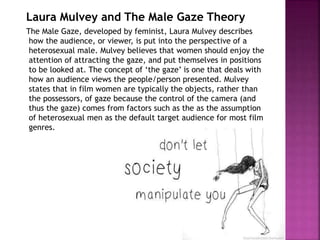
The Male Gaze, developed by feminist, Laura Mulvey describes 
how the audience, or viewer, is put into the perspective of a 
heterosexual male. Mulvey believes that women should enjoy the 
attention of attracting the gaze, and put themselves in positions 
to be looked at. The concept of ‘the gaze’ is one that deals with 
how an audience views the people/person presented. Mulvey 
states that in film women are typically the objects, rather than 
the possessors, of gaze because the control of the camera (and 
thus the gaze) comes from factors such as the as the assumption 
of heterosexual men as the default target audience for most film 
genres.
The male gaze occurs when the camera puts the audience into 
the perspective of a heterosexual man. It may, for instance linger 
over the curves of a woman's body. 
The woman is usually displayed on two different levels: 
- as an erotic object for both the characters within the film 
- the spectator who is watching the film 
The man emerges as the dominant power within the created film 
fantasy. The woman is passive to the active gaze from the man. 
This adds an element of 'patriarchal' order and it is often seen in 
"illusionistic narrative film". 
Mulvey argues that, in mainstream cinema, the male gaze 
typically takes precedence over the female gaze, reflecting an 
underlying power asymmetry. 
Mulvey' also states that the female gaze is the same as the male 
gaze because women look at themselves through the eyes of 
men. A feminist may see the male gaze as either a manifestation 
of unequal power between gazer and gazed, or as a conscious or 
subconscious attempt to develop that inequality. From this 
perspective, a woman who welcomes an objectifying gaze may 
be simply seeking to benefit men, welcoming such objectification 
may be viewed as akin to exhibitionism.
The Male Gaze typically focuses on: 
- Emphasizing curves of the female body 
- Referring to women as objects rather than people 
- The display of women is how men think they should be 
perceived 
- Female viewers, view the content through the eyes of 
a man
There are some flaws and disagreements with the theory 
however: 
- Some of the women may enjoy the attention and like 
people to look at them 
- There are videos and media 
products which use men in the same light, for instance in 
Kelly Rowland’s Motivation the men have less clothes on than 
she does and she treats them as though they are objects.
Source: Different Blogs on feminism

The laura mulvey theory

  • 2.
    Laura Mulvey andThe Male Gaze Theory The Male Gaze, developed by feminist, Laura Mulvey describes how the audience, or viewer, is put into the perspective of a heterosexual male. Mulvey believes that women should enjoy the attention of attracting the gaze, and put themselves in positions to be looked at. The concept of ‘the gaze’ is one that deals with how an audience views the people/person presented. Mulvey states that in film women are typically the objects, rather than the possessors, of gaze because the control of the camera (and thus the gaze) comes from factors such as the as the assumption of heterosexual men as the default target audience for most film genres.
  • 3.
    The male gazeoccurs when the camera puts the audience into the perspective of a heterosexual man. It may, for instance linger over the curves of a woman's body. The woman is usually displayed on two different levels: - as an erotic object for both the characters within the film - the spectator who is watching the film The man emerges as the dominant power within the created film fantasy. The woman is passive to the active gaze from the man. This adds an element of 'patriarchal' order and it is often seen in "illusionistic narrative film". Mulvey argues that, in mainstream cinema, the male gaze typically takes precedence over the female gaze, reflecting an underlying power asymmetry. Mulvey' also states that the female gaze is the same as the male gaze because women look at themselves through the eyes of men. A feminist may see the male gaze as either a manifestation of unequal power between gazer and gazed, or as a conscious or subconscious attempt to develop that inequality. From this perspective, a woman who welcomes an objectifying gaze may be simply seeking to benefit men, welcoming such objectification may be viewed as akin to exhibitionism.
  • 4.
    The Male Gazetypically focuses on: - Emphasizing curves of the female body - Referring to women as objects rather than people - The display of women is how men think they should be perceived - Female viewers, view the content through the eyes of a man
  • 5.
    There are someflaws and disagreements with the theory however: - Some of the women may enjoy the attention and like people to look at them - There are videos and media products which use men in the same light, for instance in Kelly Rowland’s Motivation the men have less clothes on than she does and she treats them as though they are objects.
  • 7.