Constitutional,
Human and Moral Values,
IPR
(M24-CHM-201)
Unit 1st
: Constitutional Values
Unit 2nd
: Humanistic Values
Unit 3rd
: Moral Values and Professional
Conduct
Unit 4th
: Intellectual Properties Rights
3
What Is Constitution?
A constitution is a set of fundamental principles or established laws according to which
a state or other organization is governed. These rules together make up, i.e. constitute,
what the entity is. When these principles are written down into a single collection or set
of legal documents, those documents may be said to comprise a written constitution.
or
The document containing laws and rules which determine and describe the form of the
government, the relationship between the citizens and the government, is called a
Constitution.
4
What Is Constitution?
I) In General-
The Constitution is the supreme law of the Country. All other laws have to conform
to the Constitution. The constitution contains laws concerning the government and
its relations with the people.
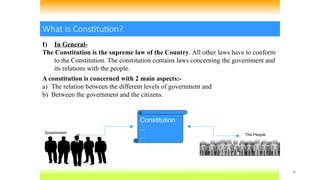
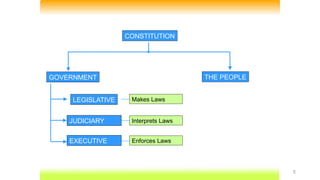
A constitution is concerned with 2 main aspects:-
a) The relation between the different levels of government and
b) Between the government and the citizens.
Constitution
...
…
Government The People
5
GOVERNMENT
EXECUTIVE
JUDICIARY
LEGISLATIVE
CONSTITUTION
THE PEOPLE
Makes Laws
Interprets Laws
Enforces Laws
6
Why Do We Need Constitution?
In General-
I. We need a constitution to govern a country properly.
II. The constitution defines the nature of political system of a country.
III. Sometimes we feel strongly about an issue that might go against our larger
interests and the constitution helps us guard against this.
IV. All the 3 organs of government (executive, legislature and judiciary) functions
within the constitution. All the 3 organs of government, including ordinary
citizens, derive their power and authority (i.e. Fundamental Right) from the
constitution. If they act against it, it is unconstitutional and unlawful.
So, constitution is required to have authoritative allocation of power and function,
and also to restrict them within its limit.
7
Why Do We Need Constitution?
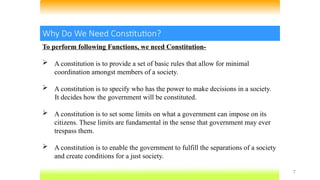
To perform following Functions, we need Constitution-
 A constitution is to provide a set of basic rules that allow for minimal
coordination amongst members of a society.
 A constitution is to specify who has the power to make decisions in a society.
It decides how the government will be constituted.
 A constitution is to set some limits on what a government can impose on its
citizens. These limits are fundamental in the sense that government may ever
trespass them.
 A constitution is to enable the government to fulfill the separations of a society
and create conditions for a just society.
8
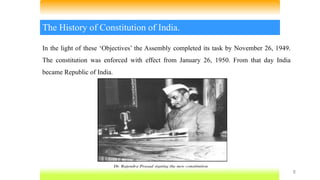
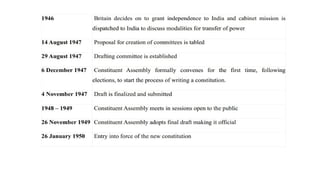
The History of Constitution of India.
In the light of these ‘Objectives’ the Assembly completed its task by November 26, 1949.
The constitution was enforced with effect from January 26, 1950. From that day India
became Republic of India.
9
The Framing of Constitution of India.
The Constituent Assembly of India was elected to write the Constitution of India.
Following India's independence from Great Britain, its members served as the
nation's first Parliament.
This body was formed in 1946 for the purpose of making independent India's
constitution. The assembly passed a resolution in 1947 January defining the
objectives of the constitution:-
1) To set up a Union of India comprising British India and the princely states.
2) To set up a federal form of government with separate state and central governments.
3) To set up a democracy in which all power is derived from the people:
I) where all people are guaranteed justice, equality and freedom;
II) where minorities, depressed classes and the tribal's rights are protected;
4) To protect the integrity of India and her sovereign rights over land, sea and air.
5) To help India attain its rightful place in the world - and work for peace and welfare of all mankind.
10
The Framing of Constitution of India.
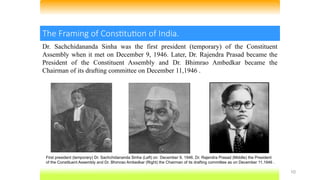
Dr. Sachchidananda Sinha was the first president (temporary) of the Constituent
Assembly when it met on December 9, 1946. Later, Dr. Rajendra Prasad became the
President of the Constituent Assembly and Dr. Bhimrao Ambedkar became the
Chairman of its drafting committee on December 11,1946 .
First president (temporary) Dr. Sachchidananda Sinha (Left) on December 9, 1946. Dr. Rajendra Prasad (Middle) the President
of the Constituent Assembly and Dr. Bhimrao Ambedkar (Right) the Chairman of its drafting committee as on December 11,1946 .
11
The Framing of Constitution of India.
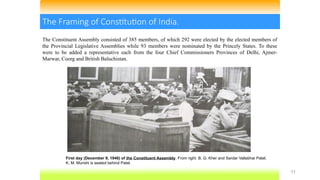
First day (December 9, 1946) of the Constituent Assembly. From right: B. G. Kher and Sardar Vallabhai Patel;
K. M. Munshi is seated behind Patel.
The Constituent Assembly consisted of 385 members, of which 292 were elected by the elected members of
the Provincial Legislative Assemblies while 93 members were nominated by the Princely States. To these
were to be added a representative each from the four Chief Commissioners Provinces of Delhi, Ajmer-
Marwar, Coorg and British Baluchistan.
12
The Framing of Constitution of India.
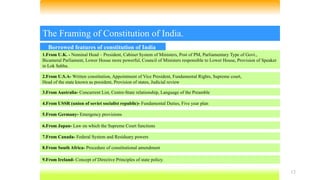
1.From U.K. - Nominal Head – President, Cabinet System of Ministers, Post of PM, Parliamentary Type of Govt.,
Bicameral Parliament, Lower House more powerful, Council of Ministers responsible to Lower House, Provision of Speaker
in Lok Sabha.
Borrowed features of constitution of India
2.From U.S.A- Written constitution, Appointment of Vice President, Fundamental Rights, Supreme court,
Head of the state known as president, Provision of states, Judicial review
7.From Canada- Federal System and Residuary powers
4.From USSR (union of soviet socialist republic)- Fundamental Duties, Five year plan
3.From Australia- Concurrent List, Centre-State relationship, Language of the Preamble
5.From Germany- Emergency provisions
6.From Japan- Law on which the Supreme Court functions
8.From South Africa- Procedure of constitutional amendment
9.From Ireland- Concept of Directive Principles of state policy.
13
4.The Framing of Constitution of India.
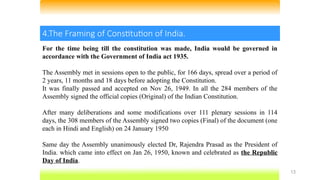
For the time being till the constitution was made, India would be governed in
accordance with the Government of India act 1935.
The Assembly met in sessions open to the public, for 166 days, spread over a period of
2 years, 11 months and 18 days before adopting the Constitution.
It was finally passed and accepted on Nov 26, 1949. In all the 284 members of the
Assembly signed the official copies (Original) of the Indian Constitution.
After many deliberations and some modifications over 111 plenary sessions in 114
days, the 308 members of the Assembly signed two copies (Final) of the document (one
each in Hindi and English) on 24 January 1950
Same day the Assembly unanimously elected Dr, Rajendra Prasad as the President of
India. which came into effect on Jan 26, 1950, known and celebrated as the Republic
Day of India.
14
4.The Framing of Constitution of India.
15
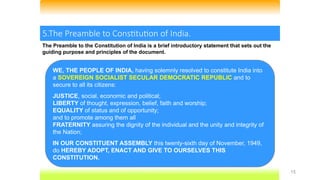
5.The Preamble to Constitution of India.
The Preamble to the Constitution of India is a brief introductory statement that sets out the
guiding purpose and principles of the document.
WE, THE PEOPLE OF INDIA, having solemnly resolved to constitute India into
a SOVEREIGN SOCIALIST SECULAR DEMOCRATIC REPUBLIC and to
secure to all its citizens:
JUSTICE, social, economic and political;
LIBERTY of thought, expression, belief, faith and worship;
EQUALITY of status and of opportunity;
and to promote among them all
FRATERNITY assuring the dignity of the individual and the unity and integrity of
the Nation;
IN OUR CONSTITUENT ASSEMBLY this twenty-sixth day of November, 1949,
do HEREBY ADOPT, ENACT AND GIVE TO OURSELVES THIS
CONSTITUTION.
16
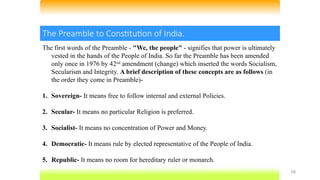
The Preamble to Constitution of India.
The first words of the Preamble - "We, the people" - signifies that power is ultimately
vested in the hands of the People of India. So far the Preamble has been amended
only once in 1976 by 42nd
amendment (change) which inserted the words Socialism,
Secularism and Integrity. A brief description of these concepts are as follows (in
the order they come in Preamble)-
1. Sovereign- It means free to follow internal and external Policies.
2. Secular- It means no particular Religion is preferred.
3. Socialist- It means no concentration of Power and Money.
4. Democratic- It means rule by elected representative of the People of India.
5. Republic- It means no room for hereditary ruler or monarch.
17
The Preamble to Constitution of India.
The preamble-page, along with other pages of the First and original Book of Constitution of India,
was designed (Art) and decorated (Frames) solely by renowned painter Beohar shakha.
Hindi (Left) and English (Middle) versions of Preamble as available in the First book of Constitution of India (Right).
18
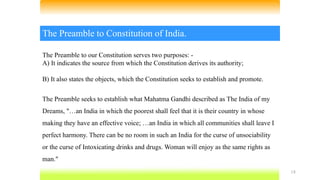
The Preamble to Constitution of India.
The Preamble to our Constitution serves two purposes: -
A) It indicates the source from which the Constitution derives its authority;
B) It also states the objects, which the Constitution seeks to establish and promote.
The Preamble seeks to establish what Mahatma Gandhi described as The India of my
Dreams, "…an India in which the poorest shall feel that it is their country in whose
making they have an effective voice; …an India in which all communities shall leave I
perfect harmony. There can be no room in such an India for the curse of unsociability
or the curse of Intoxicating drinks and drugs. Woman will enjoy as the same rights as
man."
Unit 1st
Constitutional Values
Historical Perspective of Indian Constitution
You may have come across the term constitution quite often. It is used in various contexts such as
Constitution of a State or a Nation, Constitution of an Association or Union, Constitution of a Sports
Club, Constitution of a non-governmental organization (NGO), Constitution of a company and so
on. Does this term mean the same in all these contexts? No, it is not so.
As used commonly, constitution is a set of rules, generally written, which defines and regulate the
structure and functioning of an organization, institution or a company. But when it is used in the
context of a State or a Nation, Constitution means a set of fundamental principles, basic rules and
established precedents (means standards/instances).
It identifies, defines and regulates various aspects of the State and the structure,
powers and functions of the major institutions under the three organs of the
Government – the executive, the legislature and the judiciary. It also provides
for rights and freedoms of citizens and spells out the relationships between
individual citizen and the State and government. It is the supreme and ultimate
authority.
Moreover, it is not a static but a living document, because it needs to be amended
as and when required to keep it updated. Its flexibility enables it to change
according to changing aspirations of the people, the needs of the time and the
changes taking place in society.
The process of constitution-making was greatly influenced by the following factors:
(a) aspirations generated during the long drawn freedom struggle,
(b) the constitutional and political changes that took place during the British rule,
(c) the ideas and thoughts of Mahatma Gandhi,
(d) the socio-cultural ethos of the country and
(e) the experiences of the functioning of Constitutions in other democratic countries of the
world.
The Constitution came into effect on 26 January, 1950 and since then we celebrate this
day as the Republic Day every year.
The Constitution of India defines all aspects of the Indian political system
including its basic objectives. It has provisions regarding :
(a) the territories that India will comprise,
(b) citizenship,
(c) fundamental rights,
(d) directive principles of state policy and fundamental duties,
(e) the structure and functioning of governments at union, state and local levels, and
(f) it defines India as a democratic, socialist and secular republic. It has provisions
for bringing about social change and defining the relationship between individual
citizen and the state.
The Constituent Assembly began to prepare the Constitution on 9
December, 1946. Dr. Rajendra Prasad was elected as its President on
11 December, 1946. Dr. Baba Saheb Bhimrao Ambedkar was the
Chairman of the Drafting Committee.
The Constituent Assembly met for 166 days, spread over a period of 2
years, 11 months and 18 days. The making of the Constitution was
completed on 26 November, 1949 when the Constituent Assembly
adopted the Draft, Constitution of India.
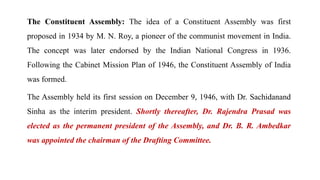
The Constituent Assembly: The idea of a Constituent Assembly was first
proposed in 1934 by M. N. Roy, a pioneer of the communist movement in India.
The concept was later endorsed by the Indian National Congress in 1936.
Following the Cabinet Mission Plan of 1946, the Constituent Assembly of India
was formed.
The Assembly held its first session on December 9, 1946, with Dr. Sachidanand
Sinha as the interim president. Shortly thereafter, Dr. Rajendra Prasad was
elected as the permanent president of the Assembly, and Dr. B. R. Ambedkar
was appointed the chairman of the Drafting Committee.
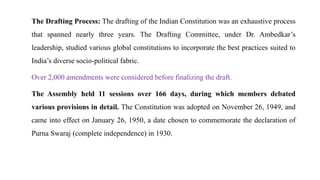
The Drafting Process: The drafting of the Indian Constitution was an exhaustive process
that spanned nearly three years. The Drafting Committee, under Dr. Ambedkar’s
leadership, studied various global constitutions to incorporate the best practices suited to
India’s diverse socio-political fabric.
Over 2,000 amendments were considered before finalizing the draft.
The Assembly held 11 sessions over 166 days, during which members debated
various provisions in detail. The Constitution was adopted on November 26, 1949, and
came into effect on January 26, 1950, a date chosen to commemorate the declaration of
Purna Swaraj (complete independence) in 1930.
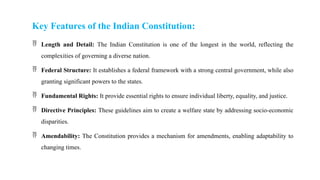
Key Features of the Indian Constitution:
 Length and Detail: The Indian Constitution is one of the longest in the world, reflecting the
complexities of governing a diverse nation.
 Federal Structure: It establishes a federal framework with a strong central government, while also
granting significant powers to the states.
 Fundamental Rights: It provide essential rights to ensure individual liberty, equality, and justice.
 Directive Principles: These guidelines aim to create a welfare state by addressing socio-economic
disparities.
 Amendability: The Constitution provides a mechanism for amendments, enabling adaptability to
changing times.
The Salient Features of the Constitution:
1. Written Constitution:
As has been stated earlier, the Constitution of India is the longest written
constitution. It contains a Preamble, 470 Articles in 25 Parts, 12 Schedules, 5
Appendices and 145000 words. It is a document of fundamental laws that define
the nature of the political system and the structure and functioning of organs of
the government. It expresses the vision of India as a democratic nation. It also
identifies the fundamental rights and fundamental duties of citizens.
2. A Unique Blend of Rigidity and Flexibility:
As regards Constitutions, generally written constitutions are rigid. It is not easy to bring
about changes in them frequently. The Constitution lays down special procedure for
constitutional amendments. In the unwritten constitution like the British Constitution,
amendments are made through ordinary law-making procedure.
It reflects the value of continuity and change. There are three ways of amending the
Constitution of India. Some of its provisions can be amended by the simple majority in
the Parliament, and some by special majority, while some amendments require special
majority in the parliament and approval of States as well.
3. Fundamental Rights and Duties:
The Constitution of India includes rights in a separate Chapter which has often
been referred to as the ‘conscience’ of the Constitution. Fundamental Rights
protect citizens against the arbitrary and absolute exercise of power by the State.
The Constitution guarantees the rights to individuals against the State as well
as against other individuals. The Constitution also guarantees the rights of
minorities against the majority.
4. Directive Principles of State Policy:
In addition to Fundamental Rights, the Constitution also has a section called
Directive Principles of State Policy (DSPS), a unique feature of the our
Constitution. It is aimed at ensuring greater social and economic reforms and
serving as a guide to the State to institute laws and policies that help reduce the
poverty of the masses and eliminate social discrimination.
5. Integrated Judicial System:
Unlike the judicial systems of federal countries like the United States of America,
the Indian Constitution has established an integrated judicial system. Although the
Supreme Court is at the national level, High Courts at the state level and
Subordinate Courts at the district and lower level, there is a single hierarchy of
Courts. At the top of the hierarchy is the Supreme Court. This unified judicial
system is aimed at promoting and ensuring justice to all the citizens in uniform
manner. Moreover, the constitutional provisions ensure the independence of
Indian judiciary which is free from the influence of the executive and the
legislature.
6. Single Citizenship:
Indian Constitution has provision for single citizenship. It means that every
Indian is a citizen of India, irrespective of the place of his/her residence or
birth in the country. This is unlike the United States of America where there is
the system of double citizenship. A person is a citizen of a State where he/she
lives as well as he/she is a citizen of U.S.A. This provision in the Indian
Constitution definitely reinforces the values of equality, unity and integrity.
7. Universal Adult Franchise (सार्वभौमिक वयस्क मताधिकार):
The values of equality and justice are reflected in yet another salient
feature of the Constitution. Every Indian after attaining certain
age (at present 18 years) has a right to vote. No discrimination can
be made on the basis of religion, race, caste, sex, descent, and place
of birth or residence. This right is known as universal adult
franchise.
8. Federal System and Parliamentary Form of Government:
Another salient feature of the Indian Constitution is that it provides for a federal
system of state and parliamentary form of government. It it is necessary to note
here that the federal system reflects the constitutional value of unity and
integrity of the nation, and more importantly the value of decentralization of
power. The parliamentary form of government reflects the values of responsibility
and sovereignty vested in the people.
Basic Values enshrined in the Preamble of Indian Constitution:
The Preamble to any Constitution is a brief introductory statement that conveys
the guiding principles of the document. The Preamble to the Indian Constitution
also does so. The values expressed in the Preamble are expressed as objectives of the
Constitution. These are: sovereignty (संप्रभुता), socialism (समाजवाद), secularism
(धर्मनिरपेक्षतावाद), democracy (लोकतंत्र), republican (गणतंत्र) character of Indian State,
justice (न्याय), liberty (आजादी), equality (समानता), fraternity (बंधुत्व), human dignity
(मानवीय गरिमा) and the unity and integrity of the Nation (राष्ट्र की एकता और अखंडता).
Let us discuss these constitutional values:
1. Sovereignty (संप्रभुता):
Being sovereign means having complete political freedom and being the supreme
authority.
It implies that India is free to determine for itself without any external interference
(either by any country or individual) and nobody is there within to challenge its
authority. This feature of sovereignty gives us the dignity of existence as a nation in the
international community. Though the Constitution does not specify where the sovereign
authority lies but a mention of ‘We the People of India’ in the Preamble clearly indicates
that sovereignty rests with the people of India. This means that the constitutional
authorities and organs of government derive their power only from the people.
2. Socialism (समाजवाद):
You may be aware that social and economic inequalities have been inherent in the
Indian traditional society. Which is why, socialism has been made a constitutional
value aimed at promoting social change and transformation to end all forms of
inequalities.
Our Constitution directs the governments and the people to ensure a planned
and coordinated social development in all fields. It directs to prevent
concentration of wealth and power in a few hands. The Constitution has specific
provisions that deal with inequalities in the Chapters on Fundamental Rights
and Directive Principles of State Policy.
3. Secularism (धर्मनिरपेक्षतावाद):
We all are pleased when anyone says that India is a home to almost
all major religions in the world. In the context of this plurality (means more
than one or two; many), secularism is seen as a great constitutional value.
Secularism implies that our country is not guided by any one religion or
any religious considerations. However, the Indian state is not against
religions. It allows all its citizens to follow and practise any religion they like.
At the same time, it ensures that the state does not have any religion of its own.
Constitution strictly prohibits any discrimination on the ground of
religion.
4. Democracy (लोकतंत्र):
The Preamble reflects democracy as a value. The people elect the rulers of the country and the
elected representatives remain accountable to the people. The people of India elect them to be
part of the government at different levels by a system of universal adult franchise.
Democracy contributes to stability, continuous progress in the society and it secures
peaceful political change. More importantly, it is based on the principles of rule of law,
inalienable (अनिवार्य) rights of citizens, independence of judiciary, free and fair elections and
freedom of the press.
5. Republic (गणतंत्र):
India is not only a democratic nation but it is also a republic. The most
important symbol of being a republic is the office of the Head of the State,
i.e. the President who is elected and who is not selected on the basis of
heredity, as is found in a system with monarchy. This value strengthens and
substantiates democracy where every citizen of India is equally eligible to be
elected as the Head of the State. Political equality is the chief message of this
provision.
6. Justice (न्याय):
Even now we find a number of cases where not only the social and
economic justice but also the political justice is denied. Which is why,
the constitution-makers have included social, economic and political
justice as constitutional values. By doing so, they have stressed that the
political freedom granted to Indian citizens has to be instrumental in
the creation of a new social order, based on socio-economic justice.
Equal justice must be availed to every citizen.
7. Liberty (आजादी):
The Preamble prescribes liberty of thought, expression, belief, faith and worship as
one of the core values. These have to be assured to every member of all the
communities. It has been done so, because the ideals of democracy cannot be attained
without the presence of certain minimal rights which are essential for a free and
civilized existence of individuals.
8. Equality (समानता):
Equality is as significant constitutional value as any other. The Constitution ensures
equality of status and opportunity to every citizen for the development of the best in
him/her. As a human being everybody has a dignified self and to ensure its full
enjoyment, inequality in any form present in our country and society has been
prohibited. Equality reflected specifically in the Preamble is therefore held as an
important value.
9. Fraternity (बंधुत्व):
There is also a commitment made in the Preamble to promote the value of
fraternity that stands for the spirit of common brotherhood among all the
people of India. In the absence of fraternity, a plural society like India stands
divided.
Therefore, to give meaning to all the ideals like justice, liberty and equality,
the Preamble lays great emphasis on fraternity.
10. Dignity of the individual (व्यक्ति की गरिमा):
It is essential to secure the dignity of every individual without which
democracy can not function. It ensures equal participation of every
individual in all the processes of democratic governance.
11. International peace:
The value of international peace is not included in the Preamble, but it is reflected in
other provisions of the Constitution. The Indian Constitution directs the state
(a) to promote international peace and security,
(b) maintain just (न्यायसंगत) and honourable (सम्मानजनक) relations between nations,
(c) foster respect for international law and treaty obligations, and
(d) encourage settlement of international disputes by arbitration (मध्यस्थता).
12. Fundamental Duties:
Our Constitution prescribes some duties to be performed by the citizens. It is true
that these duties are not enforceable in the court of law like the fundamental rights
are, but these duties are to be performed by citizens. Fundamental duties have still
greater importance because these reflect certain basic values like patriotism,
nationalism, humanism, environmentalism, harmonious living, gender equality,
scientific temper and inquiry, and individual and collective excellence.
Concept of Constitutional Morality (संवैधानिक नैतिकता)
Constitutional morality means that while every citizens would respect the Constitution and will obey the
Constitutional authorities, they would also have the freedom to criticize those Constitutional authorities,
and Constitutional authorities would have to act within the limits imposed by the law.
In Indian context, the word Constitutional Morality was first propounded by Dr. B.R Ambedkar. He described
Constitutional Morality as adherence (लगाव) to the constitutional principles and the spirit of the document,
even in the face of societal and political pressures. Constitutional morality requires individuals, institutions,
and governments to act within the framework of the Constitution while upholding its core values.
Examples:
 Upholding the rules of law, even when it is inconvenient or unpopular.
 Respecting the rights of others, even if you don’t like them.
 Being willing to compromise and work with people who have different
views.
 Being willing to stand up for what you believe in, even when it is
difficult.
The term ‘Constitutional Morality’ is not found in Indian Constitution.
Nevertheless, we find mention of the word “morality” in conjunction with
“public order” in the constitution at various places.
“Constitutional Molarity essentially implied a “co-existence of freedom and
self-imposed restraint”. It means that while citizens would respect the
Constitution and obey Constitutional authorities, they would also have the
freedom to criticize those Constitutional authorities, and Constitutional
authorities would have to act within the limits imposed by the law.”
Components of Constitutional Morality:
1. Adherence (लगाव) to Rule of Law: Constitutional morality demands strict adherence to the rule of law,
ensuring that all individuals and institutions operate within the legal framework.
2. Protection of Fundamental Rights: It upholds the sanctity (पवित्रता) of fundamental rights, ensuring that every
individual enjoys equality, freedom, and dignity.
3. Respect for Diversity: Constitutional morality emphasizes inclusivity and tolerance (सहिष्णुता), recognizing
India's pluralistic (बहुलवादी) society.
4. Accountability and Transparency: It requires public officials and institutions to act responsibly and
transparently, reflecting the democratic ethos (मूल्य) of the Constitution.
5. Balancing Power: Constitutional morality ensures the separation of powers among the legislature, executive,
and judiciary, maintaining a system of checks and balances.
Patriotic Values and Ingredients of National Building (देशभक्ति के
मूल्य और राष्ट्रीय निर्माण के तत्व):
Patriotism (देशभक्ति), the unwavering love and devotion for one’s country,
forms the backbone of national identity and unity. It is a force that inspires
individuals to work for the collective good, fostering a spirit of collaboration
and flexibility. In the broader context of nation-building, patriotic values are
not just ideals but essential components that drive progress, stability, and
prosperity (समृद्धि).
Patriotic Values: The Foundation of National Unity
Patriotic values encourage citizens to prioritize national interests over personal gains, ensuring
a cohesive and harmonious society (एकजुट और सामंजस्यपूर्ण समाज).
Key patriotic values include:
1. Respect for Diversity: Embracing the cultural, linguistic, and religious diversity of a nation fosters mutual
understanding and acceptance.
2. Commitment to Justice: Upholding fairness and equality strengthens trust in national institutions and
reinforces social cohesion.
3. Responsibility and Accountability: Active participation in civic duties and adherence to laws demonstrate a
commitment to the nation’s well-being.
4. Pride in National Heritage: Celebrating a nation’s history, achievements, and symbols nurtures a collective
identity and inspires future generations.
Ingredients of Nation-Building: Following ingredients are crucial for effective
nation-building:
1. Strong Leadership: Visionary leaders guide the nation toward growth, unity, and
sustainability.
2. Effective Governance: Transparent and inclusive governance ensures political
stability, economic growth, and social justice.
3. Education: A strong education system equips citizens with knowledge, skills, and
values necessary for personal and national development.
4. Economic Development: A thriving (संपन्न) economy provides opportunities,
reduces inequalities, and fosters innovation.
5. Social Cohesion (सामाजिक एकता): Promoting inclusivity and addressing
grievances prevent societal divisions and conflicts.
6. Rule of Law: A fair and impartial legal system safeguards citizens’ rights and
maintains order.
7. Infrastructure Development: Investments in transportation, communication,
and energy systems lay the groundwork for economic and social progress.
“Fundamentals Rights and Duties”
As members of a democratic country, we may speak of such rights as the right to vote, the
right to form political parties, the right to contest elections and so on. But apart from the
generally accepted political and civil rights, people today are also making new demands for
rights such as the right to information, right to clean air or the right to safe drinking water.
Rights are claimed not only in relation to our political and public lives but also in
relation to our social and personal relationships.
Moreover, rights may be claimed not only for adult human beings but also for children,
unborn foetuses, and even animals.
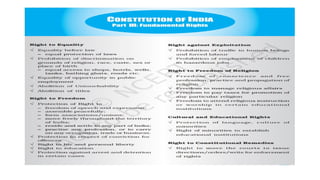
Fundamental rights of the Indian constitution are the basic rights provided by the constitution of India to
its citizens. These rights are essential for the development of the personality of every individual. There are
six fundamental rights guaranteed by the Indian Constitution. They are as follows:
1. Right to Equality
2. Right to freedom
3. Right against exploitation
4. Right to freedom of Religion
5. Cultural and Educational Rights
6. Right to constitutional Remedies
1. Right to Equality:
The right to equality is given in the articles 14 –18 of the Indian constitution. The articles under the right to
equality include the following:
Article 14: Equality before law
Article 15: Prohibition of discrimination on grounds of religion, race, caste or place of birth.
Article 16: Equality of opportunity in matters of public employment.
Article 17: Abolition (उन्मूलन) of Untouchability.
Article 18: Abolition of titles: This article aims to abolish titles such as Rai Bahadur, Raj Bahadur,
Maharaja, Taluqdar, Zamindar, etc., because using such titles does not give equal status for all.
2. Right to freedom
Freedoms are defined in such a manner that every person will enjoy her freedom without threatening freedom
of others and without endangering the law and order situation.
The right to freedom is given in the articles 19–22 of the Indian constitution.
Article 19: Protection of certain rights regarding freedom of speech, communication, etc.
Article 20: Protection in respect of conviction for offences (अपराधों के लिए सजा).
Article 21: Protection of life and personal liberty (स्वतंत्रता).
Article 21-A: Right to Education
Article 22: Protection Against Arrest and Detention in certain cases.
3. Right against Exploitation (शोषण)
In our country there are millions of people who are deprived. They may be subjected to exploitation by
their fellow human beings. One such form of exploitation in our country has been beggar or forced
labour without payment. Another closely related form of exploitation is buying and selling of human
beings and using them as slaves. Both of these are prohibited under the Constitution. The right to
exploitation is given in the articles 23 and 24 of the Indian constitution. They are:
Article 23: Prohibition of traffic in human beings and forced labour.
Article 24: Prohibition of employment of children in factories, etc.
4. Right to freedom of Religion
According to our Constitution, everyone enjoys the right to follow the religion of his or her choice. This freedom is
considered as a hallmark of democracy. Democracy has always incorporated the freedom to follow the religion of
one’s choice as one of its basic principles. The right to freedom of religion is given in the articles 25 – 28 of the
Indian constitution.
Article 25: Freedom of conscience and free profession, practice and propagation of religion.
Article 26: Freedom to manage religious affairs
Article 27: Freedom as to the payment of taxes for promotion of any particular religion
Article 28: Freedom as to attendance at religious instruction or religious worship in certain educational institutions.
5. Cultural and Educational Rights:
One of the fundamental rights is the right of the minorities to maintain their culture.
Such communities have a culture, language and a script of their own, and have the right
to conserve and develop these. All minorities, religious or linguistic, can set up their
own educational institutions. The cultural and educational rights are given in the
articles 29 and 30 of the Indian constitution.
Article 29: Protection of interests of minorities.
Article 30: Right of minorities to establish and administer educational institutions.
6. Right to constitutional Remedies (उपचार):
The right to Constitutional Remedies gives the citizens the right to approach the Supreme Court or
the High Court to implement the fundamental rights. The Courts can issue orders to the government
to implement the rights. The right to constitutional remedies is given by articles 32-35 of the
constitution.
Article 32: According to this article, the Courts can grant 5 types of writs namely, Habeas Corpus,
Mandamus, Quo Warranto, Prohibition and Certiorari.
The Supreme Court and the High Courts can issue orders and give directives to the government
for the enforcement of rights. The courts can issue various special orders known as writs (प्रादेश).
1. Habeas Corpus (बंदी प्रत्यक्षीकरण): A writ of habeas corpus means that the court orders
that the arrested person should be presented before it. It can also order to set free an
arrested person if the manner or grounds of arrest are not lawful or satisfactory
2. Mandamus (परमादेश): This writ is issued when the court finds that a particular office
holder is not doing legal duty and thereby is infringing on the right of an individual.
3. Quo Warranto (अधिकार पृच्छा/): If the court finds that a person is holding office but
is not entitled to hold that office, it issues the writ of quo warranto and restricts that
person from acting as an office holder.
4. Prohibition (निषेध): This writ is issued by a higher court (High Court
or Supreme Court) when a lower court has considered a case going
beyond its jurisdiction.
5. Certiorari: Under this writ, the court orders a lower court or another
authority to transfer a matter pending before it to the higher authority
or court.
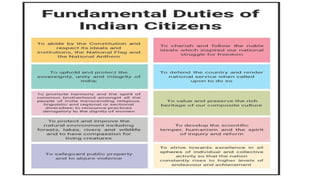
Fundamental Duties
 Fundamental Duties are the moral responsibilities of the citizens of India to help promote a
patriotic spirit and to uphold the unity of our country. Article 51(A) of the constitution
describes 11 fundamental duties. It states that it shall be the duty of every Indian citizen:
1. to abide (पालन करना) the Constitution and to respect its ideals and institutions, the
National Anthem and the National Flag;
2. to cherish the noble ideals which inspired our national freedom struggle and follow them;
3. to uphold and to protect the unity, sovereignty, and integrity of the Indian nation;
4. to defend the country and render national service whenever called upon to do so;
5. to promote harmony and the spirit of common brotherhood amongst all the
people of India transcending religious, linguistic and regional or sectional
diversities; to renounce practices derogatory to the dignity of women;
6. to value and preserve the rich heritage of our composite culture;
7. to protect and improve the natural environment including forests, lakes,
rivers and wildlife, and to have compassion for living creatures;
8. to develop the scientific temper, humanism and the spirit of inquiry and
reform;
9. to safeguard public property and to abjure (त्यागना) violence;
10. to strive towards excellence in all spheres of individual as well as
collective activity so that the nation constantly rises to higher levels of
endeavour and achievement;
11. who is a parent or guardian to provide opportunities for education to his
child or, as the case may be, ward between the age of six and fourteen
years.
Directive Principle of State Policy (DPSP):
Mentioned in article 36 – 51 in Part IV
Directive Principles are the certain ideas particularly aiming at socio-economic justice,
which according to the framers of the Indian Constitution.
Dr. B. R. Ambedkar described Directive Principles as a “Novel Feature” of the Constitution.
They are in the nature of general directions, instructions or guidelines to the State.
Directive Principles embody the aspirations of the people, objectives and ideals which Union
and the State governments must bear in mind while making laws and formulating policies.
They lay down a code of conduct for the legislatures, executives and administrators of
India to performe their responsibilities in tune with these ideals.
Philosophical base of the Directive Principle:
Directive Principles in the Indian Constitution are taken from the Constitution of
Ireland.
Article-37 of the Constitution, states about the application of the Directive
Principles, which says that the provisions contained in this part (Part-IV) shall not
be enforceable by any Court but principles there in laid down, are nevertheless
fundamental in the governance of the country and it shall be the duty of the State to
apply these principles while making the laws.
Classification of the Directive Principles: Principle of State Policy:
The Directive Principles are classified on the basis of their ideological source and
objectives. For the sake of making their study convenient, we can broadly place them
in four categories, these are
1. Economic and Social Principles;
2. Directives Based on Gandhian Principles;
3. Directive Principles relating io International Peace;
4. Miscellaneous.
1.The Economic and Social Principles:
A large number of Directive Principles are socialistic in nature and dedicated to
achieve social and economic welfare of the people with the objective to establish
India as a Welfare State. Some of these principles are as follows:
A. The State shall strive to promote the welfare of the people by securing and
protecting a social order in which justice, social, economic and political, shall
inform all institutions of national life (Article 38).
B. Articles 39 says that State shall in particular, direct its policies towards securing:
 right to an adequate means of livelihood to all the citizens;
 the ownership and control of material resources shall be organised in a manner to serve the
common good;
 the operation of the economic system does not result in the concentration of the wealth to the
common detriment. In other words state shall avoid concentration of wealth in few hands;
 equal pay for equal work for both men and women;
 the protection of the strength and health of the workers; and
 that the childhood and youth are not exploited;
C. Article-42 declares that, the State shall make provisions for securing just
(न्यायपूर्ण) and humane (मानवतावादी) conditions of work and for maternity relief.
D. According to Article-43, the State shall endeavour to secure to all workers a
living wage and a decent standard of life, while article 43A says that the State
shall take steps to secure the participation of workers in the management of
industries.
2. Directives Based on Gandhian Principles:
There are certain directives principles as aiming at implementing Gandhian Principles. These are as follows;
 State shall take steps to organise village panchayats as units of Self Government (Article-40)
 The State shall endeavour to promote cottage industries on an individual or cooperative basis in
rural areas, (Article-43)
 Article-45 provides for free and compulsory education to all children till the age of 14 years.
This original provision was amended by 86th
Constitutional Amendment Act 2002, it now
declares that, “the State shall endeavour to provide early childhood care and education for all
children until they complete the age of 14 years.” (Article 21-A).
 Article-46 lays down that the State shall promote educational and economic
interests of the weaker sections of the people particularly that of the
Scheduled Castes (SCs) and Scheduled Tribes (STs) and other weaker
sections.
 Article-47 states that State shall take steps to improve public health and
prohibit consumption of intoxicating drinks and drugs that are injurious to
health.
 Article-48 says that, State shall take steps to prohibit slaughter of cows,
calves and other milch and draught cattle (related to animal husbandry and
dairy milk product).
3. Directive Principles Relating to International Peace and Security:
Through Directive Principles of State Policy, the members of our constituent assembly
tried to ensure that Government of free India should render active cooperation for
world peace and security. Article 51 declares that to establish international peace and
security the State shall endeavour to –
 promote international peace and security;
 maintain just and honourable relations with the nations;
 foster respect for international law and treaty obligations; and
 encourage settlement of international disputes by arbitration.
4. Miscellaneous Directive Principles:
The fourth category of Directive Principles Contains some general subjects which are sometimes
termed as liberal principles. These are as follows;
i. Article-44: The State shall endeavour to secure for the citizen a uniform civil code through the
territory of India.
ii. Article-48A: Directs the State to protect and improve the environment and to safeguard the
forests and wildlife of the country
iii. Article-49: State should protect every monument or place of artistic or historic interest.
iv. Article-50: The State shall take steps to separate judiciary from the executive in the public
services of the State.
What do the Directive Principles contain?
1. the goals and objectives that we as a society should adopt;
2. certain rights that individuals should enjoy apart from the Fundamental Rights; and
3. certain policies that the government should adopt.
You may get some idea of the vision of makers of our Constitution by looking at
some of the Directive Principles.
The governments from time to time tried to give effect to some Directive Principles of
State Policy.
Relationship between fundamental rights and directive principles:
It is possible to see both Fundamental Rights and Directive Principles as
complementary to each other.
 Fundamental Rights restrain the government from doing certain things while
Directive Principles exhort the government to do certain things.
 Fundamental Rights mainly protect the rights of individuals while directive
principles ensure the well-being of the entire society.

To gain hand on hand experience on tech and data

  • 1.
    Constitutional, Human and MoralValues, IPR (M24-CHM-201)
  • 2.
    Unit 1st : ConstitutionalValues Unit 2nd : Humanistic Values Unit 3rd : Moral Values and Professional Conduct Unit 4th : Intellectual Properties Rights
  • 3.
    3 What Is Constitution? Aconstitution is a set of fundamental principles or established laws according to which a state or other organization is governed. These rules together make up, i.e. constitute, what the entity is. When these principles are written down into a single collection or set of legal documents, those documents may be said to comprise a written constitution. or The document containing laws and rules which determine and describe the form of the government, the relationship between the citizens and the government, is called a Constitution.
  • 4.
    4 What Is Constitution? I)In General- The Constitution is the supreme law of the Country. All other laws have to conform to the Constitution. The constitution contains laws concerning the government and its relations with the people. A constitution is concerned with 2 main aspects:- a) The relation between the different levels of government and b) Between the government and the citizens. Constitution ... … Government The People
  • 5.
  • 6.
    6 Why Do WeNeed Constitution? In General- I. We need a constitution to govern a country properly. II. The constitution defines the nature of political system of a country. III. Sometimes we feel strongly about an issue that might go against our larger interests and the constitution helps us guard against this. IV. All the 3 organs of government (executive, legislature and judiciary) functions within the constitution. All the 3 organs of government, including ordinary citizens, derive their power and authority (i.e. Fundamental Right) from the constitution. If they act against it, it is unconstitutional and unlawful. So, constitution is required to have authoritative allocation of power and function, and also to restrict them within its limit.
  • 7.
    7 Why Do WeNeed Constitution? To perform following Functions, we need Constitution-  A constitution is to provide a set of basic rules that allow for minimal coordination amongst members of a society.  A constitution is to specify who has the power to make decisions in a society. It decides how the government will be constituted.  A constitution is to set some limits on what a government can impose on its citizens. These limits are fundamental in the sense that government may ever trespass them.  A constitution is to enable the government to fulfill the separations of a society and create conditions for a just society.
  • 8.
    8 The History ofConstitution of India. In the light of these ‘Objectives’ the Assembly completed its task by November 26, 1949. The constitution was enforced with effect from January 26, 1950. From that day India became Republic of India.
  • 9.
    9 The Framing ofConstitution of India. The Constituent Assembly of India was elected to write the Constitution of India. Following India's independence from Great Britain, its members served as the nation's first Parliament. This body was formed in 1946 for the purpose of making independent India's constitution. The assembly passed a resolution in 1947 January defining the objectives of the constitution:- 1) To set up a Union of India comprising British India and the princely states. 2) To set up a federal form of government with separate state and central governments. 3) To set up a democracy in which all power is derived from the people: I) where all people are guaranteed justice, equality and freedom; II) where minorities, depressed classes and the tribal's rights are protected; 4) To protect the integrity of India and her sovereign rights over land, sea and air. 5) To help India attain its rightful place in the world - and work for peace and welfare of all mankind.
  • 10.
    10 The Framing ofConstitution of India. Dr. Sachchidananda Sinha was the first president (temporary) of the Constituent Assembly when it met on December 9, 1946. Later, Dr. Rajendra Prasad became the President of the Constituent Assembly and Dr. Bhimrao Ambedkar became the Chairman of its drafting committee on December 11,1946 . First president (temporary) Dr. Sachchidananda Sinha (Left) on December 9, 1946. Dr. Rajendra Prasad (Middle) the President of the Constituent Assembly and Dr. Bhimrao Ambedkar (Right) the Chairman of its drafting committee as on December 11,1946 .
  • 11.
    11 The Framing ofConstitution of India. First day (December 9, 1946) of the Constituent Assembly. From right: B. G. Kher and Sardar Vallabhai Patel; K. M. Munshi is seated behind Patel. The Constituent Assembly consisted of 385 members, of which 292 were elected by the elected members of the Provincial Legislative Assemblies while 93 members were nominated by the Princely States. To these were to be added a representative each from the four Chief Commissioners Provinces of Delhi, Ajmer- Marwar, Coorg and British Baluchistan.
  • 12.
    12 The Framing ofConstitution of India. 1.From U.K. - Nominal Head – President, Cabinet System of Ministers, Post of PM, Parliamentary Type of Govt., Bicameral Parliament, Lower House more powerful, Council of Ministers responsible to Lower House, Provision of Speaker in Lok Sabha. Borrowed features of constitution of India 2.From U.S.A- Written constitution, Appointment of Vice President, Fundamental Rights, Supreme court, Head of the state known as president, Provision of states, Judicial review 7.From Canada- Federal System and Residuary powers 4.From USSR (union of soviet socialist republic)- Fundamental Duties, Five year plan 3.From Australia- Concurrent List, Centre-State relationship, Language of the Preamble 5.From Germany- Emergency provisions 6.From Japan- Law on which the Supreme Court functions 8.From South Africa- Procedure of constitutional amendment 9.From Ireland- Concept of Directive Principles of state policy.
  • 13.
    13 4.The Framing ofConstitution of India. For the time being till the constitution was made, India would be governed in accordance with the Government of India act 1935. The Assembly met in sessions open to the public, for 166 days, spread over a period of 2 years, 11 months and 18 days before adopting the Constitution. It was finally passed and accepted on Nov 26, 1949. In all the 284 members of the Assembly signed the official copies (Original) of the Indian Constitution. After many deliberations and some modifications over 111 plenary sessions in 114 days, the 308 members of the Assembly signed two copies (Final) of the document (one each in Hindi and English) on 24 January 1950 Same day the Assembly unanimously elected Dr, Rajendra Prasad as the President of India. which came into effect on Jan 26, 1950, known and celebrated as the Republic Day of India.
  • 14.
    14 4.The Framing ofConstitution of India.
  • 15.
    15 5.The Preamble toConstitution of India. The Preamble to the Constitution of India is a brief introductory statement that sets out the guiding purpose and principles of the document. WE, THE PEOPLE OF INDIA, having solemnly resolved to constitute India into a SOVEREIGN SOCIALIST SECULAR DEMOCRATIC REPUBLIC and to secure to all its citizens: JUSTICE, social, economic and political; LIBERTY of thought, expression, belief, faith and worship; EQUALITY of status and of opportunity; and to promote among them all FRATERNITY assuring the dignity of the individual and the unity and integrity of the Nation; IN OUR CONSTITUENT ASSEMBLY this twenty-sixth day of November, 1949, do HEREBY ADOPT, ENACT AND GIVE TO OURSELVES THIS CONSTITUTION.
  • 16.
    16 The Preamble toConstitution of India. The first words of the Preamble - "We, the people" - signifies that power is ultimately vested in the hands of the People of India. So far the Preamble has been amended only once in 1976 by 42nd amendment (change) which inserted the words Socialism, Secularism and Integrity. A brief description of these concepts are as follows (in the order they come in Preamble)- 1. Sovereign- It means free to follow internal and external Policies. 2. Secular- It means no particular Religion is preferred. 3. Socialist- It means no concentration of Power and Money. 4. Democratic- It means rule by elected representative of the People of India. 5. Republic- It means no room for hereditary ruler or monarch.
  • 17.
    17 The Preamble toConstitution of India. The preamble-page, along with other pages of the First and original Book of Constitution of India, was designed (Art) and decorated (Frames) solely by renowned painter Beohar shakha. Hindi (Left) and English (Middle) versions of Preamble as available in the First book of Constitution of India (Right).
  • 18.
    18 The Preamble toConstitution of India. The Preamble to our Constitution serves two purposes: - A) It indicates the source from which the Constitution derives its authority; B) It also states the objects, which the Constitution seeks to establish and promote. The Preamble seeks to establish what Mahatma Gandhi described as The India of my Dreams, "…an India in which the poorest shall feel that it is their country in whose making they have an effective voice; …an India in which all communities shall leave I perfect harmony. There can be no room in such an India for the curse of unsociability or the curse of Intoxicating drinks and drugs. Woman will enjoy as the same rights as man."
  • 19.
  • 20.
    Historical Perspective ofIndian Constitution You may have come across the term constitution quite often. It is used in various contexts such as Constitution of a State or a Nation, Constitution of an Association or Union, Constitution of a Sports Club, Constitution of a non-governmental organization (NGO), Constitution of a company and so on. Does this term mean the same in all these contexts? No, it is not so. As used commonly, constitution is a set of rules, generally written, which defines and regulate the structure and functioning of an organization, institution or a company. But when it is used in the context of a State or a Nation, Constitution means a set of fundamental principles, basic rules and established precedents (means standards/instances).
  • 21.
    It identifies, definesand regulates various aspects of the State and the structure, powers and functions of the major institutions under the three organs of the Government – the executive, the legislature and the judiciary. It also provides for rights and freedoms of citizens and spells out the relationships between individual citizen and the State and government. It is the supreme and ultimate authority. Moreover, it is not a static but a living document, because it needs to be amended as and when required to keep it updated. Its flexibility enables it to change according to changing aspirations of the people, the needs of the time and the changes taking place in society.
  • 22.
    The process ofconstitution-making was greatly influenced by the following factors: (a) aspirations generated during the long drawn freedom struggle, (b) the constitutional and political changes that took place during the British rule, (c) the ideas and thoughts of Mahatma Gandhi, (d) the socio-cultural ethos of the country and (e) the experiences of the functioning of Constitutions in other democratic countries of the world. The Constitution came into effect on 26 January, 1950 and since then we celebrate this day as the Republic Day every year.
  • 23.
    The Constitution ofIndia defines all aspects of the Indian political system including its basic objectives. It has provisions regarding : (a) the territories that India will comprise, (b) citizenship, (c) fundamental rights, (d) directive principles of state policy and fundamental duties, (e) the structure and functioning of governments at union, state and local levels, and (f) it defines India as a democratic, socialist and secular republic. It has provisions for bringing about social change and defining the relationship between individual citizen and the state.
  • 24.
    The Constituent Assemblybegan to prepare the Constitution on 9 December, 1946. Dr. Rajendra Prasad was elected as its President on 11 December, 1946. Dr. Baba Saheb Bhimrao Ambedkar was the Chairman of the Drafting Committee. The Constituent Assembly met for 166 days, spread over a period of 2 years, 11 months and 18 days. The making of the Constitution was completed on 26 November, 1949 when the Constituent Assembly adopted the Draft, Constitution of India.
  • 26.
    The Constituent Assembly:The idea of a Constituent Assembly was first proposed in 1934 by M. N. Roy, a pioneer of the communist movement in India. The concept was later endorsed by the Indian National Congress in 1936. Following the Cabinet Mission Plan of 1946, the Constituent Assembly of India was formed. The Assembly held its first session on December 9, 1946, with Dr. Sachidanand Sinha as the interim president. Shortly thereafter, Dr. Rajendra Prasad was elected as the permanent president of the Assembly, and Dr. B. R. Ambedkar was appointed the chairman of the Drafting Committee.
  • 27.
    The Drafting Process:The drafting of the Indian Constitution was an exhaustive process that spanned nearly three years. The Drafting Committee, under Dr. Ambedkar’s leadership, studied various global constitutions to incorporate the best practices suited to India’s diverse socio-political fabric. Over 2,000 amendments were considered before finalizing the draft. The Assembly held 11 sessions over 166 days, during which members debated various provisions in detail. The Constitution was adopted on November 26, 1949, and came into effect on January 26, 1950, a date chosen to commemorate the declaration of Purna Swaraj (complete independence) in 1930.
  • 28.
    Key Features ofthe Indian Constitution:  Length and Detail: The Indian Constitution is one of the longest in the world, reflecting the complexities of governing a diverse nation.  Federal Structure: It establishes a federal framework with a strong central government, while also granting significant powers to the states.  Fundamental Rights: It provide essential rights to ensure individual liberty, equality, and justice.  Directive Principles: These guidelines aim to create a welfare state by addressing socio-economic disparities.  Amendability: The Constitution provides a mechanism for amendments, enabling adaptability to changing times.
  • 29.
    The Salient Featuresof the Constitution: 1. Written Constitution: As has been stated earlier, the Constitution of India is the longest written constitution. It contains a Preamble, 470 Articles in 25 Parts, 12 Schedules, 5 Appendices and 145000 words. It is a document of fundamental laws that define the nature of the political system and the structure and functioning of organs of the government. It expresses the vision of India as a democratic nation. It also identifies the fundamental rights and fundamental duties of citizens.
  • 30.
    2. A UniqueBlend of Rigidity and Flexibility: As regards Constitutions, generally written constitutions are rigid. It is not easy to bring about changes in them frequently. The Constitution lays down special procedure for constitutional amendments. In the unwritten constitution like the British Constitution, amendments are made through ordinary law-making procedure. It reflects the value of continuity and change. There are three ways of amending the Constitution of India. Some of its provisions can be amended by the simple majority in the Parliament, and some by special majority, while some amendments require special majority in the parliament and approval of States as well.
  • 31.
    3. Fundamental Rightsand Duties: The Constitution of India includes rights in a separate Chapter which has often been referred to as the ‘conscience’ of the Constitution. Fundamental Rights protect citizens against the arbitrary and absolute exercise of power by the State. The Constitution guarantees the rights to individuals against the State as well as against other individuals. The Constitution also guarantees the rights of minorities against the majority.
  • 32.
    4. Directive Principlesof State Policy: In addition to Fundamental Rights, the Constitution also has a section called Directive Principles of State Policy (DSPS), a unique feature of the our Constitution. It is aimed at ensuring greater social and economic reforms and serving as a guide to the State to institute laws and policies that help reduce the poverty of the masses and eliminate social discrimination.
  • 33.
    5. Integrated JudicialSystem: Unlike the judicial systems of federal countries like the United States of America, the Indian Constitution has established an integrated judicial system. Although the Supreme Court is at the national level, High Courts at the state level and Subordinate Courts at the district and lower level, there is a single hierarchy of Courts. At the top of the hierarchy is the Supreme Court. This unified judicial system is aimed at promoting and ensuring justice to all the citizens in uniform manner. Moreover, the constitutional provisions ensure the independence of Indian judiciary which is free from the influence of the executive and the legislature.
  • 34.
    6. Single Citizenship: IndianConstitution has provision for single citizenship. It means that every Indian is a citizen of India, irrespective of the place of his/her residence or birth in the country. This is unlike the United States of America where there is the system of double citizenship. A person is a citizen of a State where he/she lives as well as he/she is a citizen of U.S.A. This provision in the Indian Constitution definitely reinforces the values of equality, unity and integrity.
  • 35.
    7. Universal AdultFranchise (सार्वभौमिक वयस्क मताधिकार): The values of equality and justice are reflected in yet another salient feature of the Constitution. Every Indian after attaining certain age (at present 18 years) has a right to vote. No discrimination can be made on the basis of religion, race, caste, sex, descent, and place of birth or residence. This right is known as universal adult franchise.
  • 36.
    8. Federal Systemand Parliamentary Form of Government: Another salient feature of the Indian Constitution is that it provides for a federal system of state and parliamentary form of government. It it is necessary to note here that the federal system reflects the constitutional value of unity and integrity of the nation, and more importantly the value of decentralization of power. The parliamentary form of government reflects the values of responsibility and sovereignty vested in the people.
  • 37.
    Basic Values enshrinedin the Preamble of Indian Constitution: The Preamble to any Constitution is a brief introductory statement that conveys the guiding principles of the document. The Preamble to the Indian Constitution also does so. The values expressed in the Preamble are expressed as objectives of the Constitution. These are: sovereignty (संप्रभुता), socialism (समाजवाद), secularism (धर्मनिरपेक्षतावाद), democracy (लोकतंत्र), republican (गणतंत्र) character of Indian State, justice (न्याय), liberty (आजादी), equality (समानता), fraternity (बंधुत्व), human dignity (मानवीय गरिमा) and the unity and integrity of the Nation (राष्ट्र की एकता और अखंडता). Let us discuss these constitutional values:
  • 38.
    1. Sovereignty (संप्रभुता): Beingsovereign means having complete political freedom and being the supreme authority. It implies that India is free to determine for itself without any external interference (either by any country or individual) and nobody is there within to challenge its authority. This feature of sovereignty gives us the dignity of existence as a nation in the international community. Though the Constitution does not specify where the sovereign authority lies but a mention of ‘We the People of India’ in the Preamble clearly indicates that sovereignty rests with the people of India. This means that the constitutional authorities and organs of government derive their power only from the people.
  • 39.
    2. Socialism (समाजवाद): Youmay be aware that social and economic inequalities have been inherent in the Indian traditional society. Which is why, socialism has been made a constitutional value aimed at promoting social change and transformation to end all forms of inequalities. Our Constitution directs the governments and the people to ensure a planned and coordinated social development in all fields. It directs to prevent concentration of wealth and power in a few hands. The Constitution has specific provisions that deal with inequalities in the Chapters on Fundamental Rights and Directive Principles of State Policy.
  • 40.
    3. Secularism (धर्मनिरपेक्षतावाद): Weall are pleased when anyone says that India is a home to almost all major religions in the world. In the context of this plurality (means more than one or two; many), secularism is seen as a great constitutional value. Secularism implies that our country is not guided by any one religion or any religious considerations. However, the Indian state is not against religions. It allows all its citizens to follow and practise any religion they like. At the same time, it ensures that the state does not have any religion of its own. Constitution strictly prohibits any discrimination on the ground of religion.
  • 41.
    4. Democracy (लोकतंत्र): ThePreamble reflects democracy as a value. The people elect the rulers of the country and the elected representatives remain accountable to the people. The people of India elect them to be part of the government at different levels by a system of universal adult franchise. Democracy contributes to stability, continuous progress in the society and it secures peaceful political change. More importantly, it is based on the principles of rule of law, inalienable (अनिवार्य) rights of citizens, independence of judiciary, free and fair elections and freedom of the press.
  • 42.
    5. Republic (गणतंत्र): Indiais not only a democratic nation but it is also a republic. The most important symbol of being a republic is the office of the Head of the State, i.e. the President who is elected and who is not selected on the basis of heredity, as is found in a system with monarchy. This value strengthens and substantiates democracy where every citizen of India is equally eligible to be elected as the Head of the State. Political equality is the chief message of this provision.
  • 43.
    6. Justice (न्याय): Evennow we find a number of cases where not only the social and economic justice but also the political justice is denied. Which is why, the constitution-makers have included social, economic and political justice as constitutional values. By doing so, they have stressed that the political freedom granted to Indian citizens has to be instrumental in the creation of a new social order, based on socio-economic justice. Equal justice must be availed to every citizen.
  • 44.
    7. Liberty (आजादी): ThePreamble prescribes liberty of thought, expression, belief, faith and worship as one of the core values. These have to be assured to every member of all the communities. It has been done so, because the ideals of democracy cannot be attained without the presence of certain minimal rights which are essential for a free and civilized existence of individuals.
  • 45.
    8. Equality (समानता): Equalityis as significant constitutional value as any other. The Constitution ensures equality of status and opportunity to every citizen for the development of the best in him/her. As a human being everybody has a dignified self and to ensure its full enjoyment, inequality in any form present in our country and society has been prohibited. Equality reflected specifically in the Preamble is therefore held as an important value.
  • 46.
    9. Fraternity (बंधुत्व): Thereis also a commitment made in the Preamble to promote the value of fraternity that stands for the spirit of common brotherhood among all the people of India. In the absence of fraternity, a plural society like India stands divided. Therefore, to give meaning to all the ideals like justice, liberty and equality, the Preamble lays great emphasis on fraternity.
  • 47.
    10. Dignity ofthe individual (व्यक्ति की गरिमा): It is essential to secure the dignity of every individual without which democracy can not function. It ensures equal participation of every individual in all the processes of democratic governance.
  • 48.
    11. International peace: Thevalue of international peace is not included in the Preamble, but it is reflected in other provisions of the Constitution. The Indian Constitution directs the state (a) to promote international peace and security, (b) maintain just (न्यायसंगत) and honourable (सम्मानजनक) relations between nations, (c) foster respect for international law and treaty obligations, and (d) encourage settlement of international disputes by arbitration (मध्यस्थता).
  • 49.
    12. Fundamental Duties: OurConstitution prescribes some duties to be performed by the citizens. It is true that these duties are not enforceable in the court of law like the fundamental rights are, but these duties are to be performed by citizens. Fundamental duties have still greater importance because these reflect certain basic values like patriotism, nationalism, humanism, environmentalism, harmonious living, gender equality, scientific temper and inquiry, and individual and collective excellence.
  • 50.
    Concept of ConstitutionalMorality (संवैधानिक नैतिकता) Constitutional morality means that while every citizens would respect the Constitution and will obey the Constitutional authorities, they would also have the freedom to criticize those Constitutional authorities, and Constitutional authorities would have to act within the limits imposed by the law. In Indian context, the word Constitutional Morality was first propounded by Dr. B.R Ambedkar. He described Constitutional Morality as adherence (लगाव) to the constitutional principles and the spirit of the document, even in the face of societal and political pressures. Constitutional morality requires individuals, institutions, and governments to act within the framework of the Constitution while upholding its core values.
  • 51.
    Examples:  Upholding therules of law, even when it is inconvenient or unpopular.  Respecting the rights of others, even if you don’t like them.  Being willing to compromise and work with people who have different views.  Being willing to stand up for what you believe in, even when it is difficult.
  • 52.
    The term ‘ConstitutionalMorality’ is not found in Indian Constitution. Nevertheless, we find mention of the word “morality” in conjunction with “public order” in the constitution at various places. “Constitutional Molarity essentially implied a “co-existence of freedom and self-imposed restraint”. It means that while citizens would respect the Constitution and obey Constitutional authorities, they would also have the freedom to criticize those Constitutional authorities, and Constitutional authorities would have to act within the limits imposed by the law.”
  • 53.
    Components of ConstitutionalMorality: 1. Adherence (लगाव) to Rule of Law: Constitutional morality demands strict adherence to the rule of law, ensuring that all individuals and institutions operate within the legal framework. 2. Protection of Fundamental Rights: It upholds the sanctity (पवित्रता) of fundamental rights, ensuring that every individual enjoys equality, freedom, and dignity. 3. Respect for Diversity: Constitutional morality emphasizes inclusivity and tolerance (सहिष्णुता), recognizing India's pluralistic (बहुलवादी) society. 4. Accountability and Transparency: It requires public officials and institutions to act responsibly and transparently, reflecting the democratic ethos (मूल्य) of the Constitution. 5. Balancing Power: Constitutional morality ensures the separation of powers among the legislature, executive, and judiciary, maintaining a system of checks and balances.
  • 54.
    Patriotic Values andIngredients of National Building (देशभक्ति के मूल्य और राष्ट्रीय निर्माण के तत्व): Patriotism (देशभक्ति), the unwavering love and devotion for one’s country, forms the backbone of national identity and unity. It is a force that inspires individuals to work for the collective good, fostering a spirit of collaboration and flexibility. In the broader context of nation-building, patriotic values are not just ideals but essential components that drive progress, stability, and prosperity (समृद्धि). Patriotic Values: The Foundation of National Unity
  • 55.
    Patriotic values encouragecitizens to prioritize national interests over personal gains, ensuring a cohesive and harmonious society (एकजुट और सामंजस्यपूर्ण समाज). Key patriotic values include: 1. Respect for Diversity: Embracing the cultural, linguistic, and religious diversity of a nation fosters mutual understanding and acceptance. 2. Commitment to Justice: Upholding fairness and equality strengthens trust in national institutions and reinforces social cohesion. 3. Responsibility and Accountability: Active participation in civic duties and adherence to laws demonstrate a commitment to the nation’s well-being. 4. Pride in National Heritage: Celebrating a nation’s history, achievements, and symbols nurtures a collective identity and inspires future generations.
  • 56.
    Ingredients of Nation-Building:Following ingredients are crucial for effective nation-building: 1. Strong Leadership: Visionary leaders guide the nation toward growth, unity, and sustainability. 2. Effective Governance: Transparent and inclusive governance ensures political stability, economic growth, and social justice. 3. Education: A strong education system equips citizens with knowledge, skills, and values necessary for personal and national development.
  • 57.
    4. Economic Development:A thriving (संपन्न) economy provides opportunities, reduces inequalities, and fosters innovation. 5. Social Cohesion (सामाजिक एकता): Promoting inclusivity and addressing grievances prevent societal divisions and conflicts. 6. Rule of Law: A fair and impartial legal system safeguards citizens’ rights and maintains order. 7. Infrastructure Development: Investments in transportation, communication, and energy systems lay the groundwork for economic and social progress.
  • 58.
    “Fundamentals Rights andDuties” As members of a democratic country, we may speak of such rights as the right to vote, the right to form political parties, the right to contest elections and so on. But apart from the generally accepted political and civil rights, people today are also making new demands for rights such as the right to information, right to clean air or the right to safe drinking water. Rights are claimed not only in relation to our political and public lives but also in relation to our social and personal relationships. Moreover, rights may be claimed not only for adult human beings but also for children, unborn foetuses, and even animals.
  • 59.
    Fundamental rights ofthe Indian constitution are the basic rights provided by the constitution of India to its citizens. These rights are essential for the development of the personality of every individual. There are six fundamental rights guaranteed by the Indian Constitution. They are as follows: 1. Right to Equality 2. Right to freedom 3. Right against exploitation 4. Right to freedom of Religion 5. Cultural and Educational Rights 6. Right to constitutional Remedies
  • 61.
    1. Right toEquality: The right to equality is given in the articles 14 –18 of the Indian constitution. The articles under the right to equality include the following: Article 14: Equality before law Article 15: Prohibition of discrimination on grounds of religion, race, caste or place of birth. Article 16: Equality of opportunity in matters of public employment. Article 17: Abolition (उन्मूलन) of Untouchability. Article 18: Abolition of titles: This article aims to abolish titles such as Rai Bahadur, Raj Bahadur, Maharaja, Taluqdar, Zamindar, etc., because using such titles does not give equal status for all.
  • 62.
    2. Right tofreedom Freedoms are defined in such a manner that every person will enjoy her freedom without threatening freedom of others and without endangering the law and order situation. The right to freedom is given in the articles 19–22 of the Indian constitution. Article 19: Protection of certain rights regarding freedom of speech, communication, etc. Article 20: Protection in respect of conviction for offences (अपराधों के लिए सजा). Article 21: Protection of life and personal liberty (स्वतंत्रता). Article 21-A: Right to Education Article 22: Protection Against Arrest and Detention in certain cases.
  • 63.
    3. Right againstExploitation (शोषण) In our country there are millions of people who are deprived. They may be subjected to exploitation by their fellow human beings. One such form of exploitation in our country has been beggar or forced labour without payment. Another closely related form of exploitation is buying and selling of human beings and using them as slaves. Both of these are prohibited under the Constitution. The right to exploitation is given in the articles 23 and 24 of the Indian constitution. They are: Article 23: Prohibition of traffic in human beings and forced labour. Article 24: Prohibition of employment of children in factories, etc.
  • 64.
    4. Right tofreedom of Religion According to our Constitution, everyone enjoys the right to follow the religion of his or her choice. This freedom is considered as a hallmark of democracy. Democracy has always incorporated the freedom to follow the religion of one’s choice as one of its basic principles. The right to freedom of religion is given in the articles 25 – 28 of the Indian constitution. Article 25: Freedom of conscience and free profession, practice and propagation of religion. Article 26: Freedom to manage religious affairs Article 27: Freedom as to the payment of taxes for promotion of any particular religion Article 28: Freedom as to attendance at religious instruction or religious worship in certain educational institutions.
  • 65.
    5. Cultural andEducational Rights: One of the fundamental rights is the right of the minorities to maintain their culture. Such communities have a culture, language and a script of their own, and have the right to conserve and develop these. All minorities, religious or linguistic, can set up their own educational institutions. The cultural and educational rights are given in the articles 29 and 30 of the Indian constitution. Article 29: Protection of interests of minorities. Article 30: Right of minorities to establish and administer educational institutions.
  • 66.
    6. Right toconstitutional Remedies (उपचार): The right to Constitutional Remedies gives the citizens the right to approach the Supreme Court or the High Court to implement the fundamental rights. The Courts can issue orders to the government to implement the rights. The right to constitutional remedies is given by articles 32-35 of the constitution. Article 32: According to this article, the Courts can grant 5 types of writs namely, Habeas Corpus, Mandamus, Quo Warranto, Prohibition and Certiorari. The Supreme Court and the High Courts can issue orders and give directives to the government for the enforcement of rights. The courts can issue various special orders known as writs (प्रादेश).
  • 67.
    1. Habeas Corpus(बंदी प्रत्यक्षीकरण): A writ of habeas corpus means that the court orders that the arrested person should be presented before it. It can also order to set free an arrested person if the manner or grounds of arrest are not lawful or satisfactory 2. Mandamus (परमादेश): This writ is issued when the court finds that a particular office holder is not doing legal duty and thereby is infringing on the right of an individual. 3. Quo Warranto (अधिकार पृच्छा/): If the court finds that a person is holding office but is not entitled to hold that office, it issues the writ of quo warranto and restricts that person from acting as an office holder.
  • 68.
    4. Prohibition (निषेध):This writ is issued by a higher court (High Court or Supreme Court) when a lower court has considered a case going beyond its jurisdiction. 5. Certiorari: Under this writ, the court orders a lower court or another authority to transfer a matter pending before it to the higher authority or court.
  • 69.
    Fundamental Duties  FundamentalDuties are the moral responsibilities of the citizens of India to help promote a patriotic spirit and to uphold the unity of our country. Article 51(A) of the constitution describes 11 fundamental duties. It states that it shall be the duty of every Indian citizen: 1. to abide (पालन करना) the Constitution and to respect its ideals and institutions, the National Anthem and the National Flag; 2. to cherish the noble ideals which inspired our national freedom struggle and follow them; 3. to uphold and to protect the unity, sovereignty, and integrity of the Indian nation; 4. to defend the country and render national service whenever called upon to do so;
  • 70.
    5. to promoteharmony and the spirit of common brotherhood amongst all the people of India transcending religious, linguistic and regional or sectional diversities; to renounce practices derogatory to the dignity of women; 6. to value and preserve the rich heritage of our composite culture; 7. to protect and improve the natural environment including forests, lakes, rivers and wildlife, and to have compassion for living creatures; 8. to develop the scientific temper, humanism and the spirit of inquiry and reform;
  • 71.
    9. to safeguardpublic property and to abjure (त्यागना) violence; 10. to strive towards excellence in all spheres of individual as well as collective activity so that the nation constantly rises to higher levels of endeavour and achievement; 11. who is a parent or guardian to provide opportunities for education to his child or, as the case may be, ward between the age of six and fourteen years.
  • 73.
    Directive Principle ofState Policy (DPSP): Mentioned in article 36 – 51 in Part IV Directive Principles are the certain ideas particularly aiming at socio-economic justice, which according to the framers of the Indian Constitution. Dr. B. R. Ambedkar described Directive Principles as a “Novel Feature” of the Constitution. They are in the nature of general directions, instructions or guidelines to the State. Directive Principles embody the aspirations of the people, objectives and ideals which Union and the State governments must bear in mind while making laws and formulating policies. They lay down a code of conduct for the legislatures, executives and administrators of India to performe their responsibilities in tune with these ideals.
  • 74.
    Philosophical base ofthe Directive Principle: Directive Principles in the Indian Constitution are taken from the Constitution of Ireland. Article-37 of the Constitution, states about the application of the Directive Principles, which says that the provisions contained in this part (Part-IV) shall not be enforceable by any Court but principles there in laid down, are nevertheless fundamental in the governance of the country and it shall be the duty of the State to apply these principles while making the laws.
  • 75.
    Classification of theDirective Principles: Principle of State Policy: The Directive Principles are classified on the basis of their ideological source and objectives. For the sake of making their study convenient, we can broadly place them in four categories, these are 1. Economic and Social Principles; 2. Directives Based on Gandhian Principles; 3. Directive Principles relating io International Peace; 4. Miscellaneous.
  • 76.
    1.The Economic andSocial Principles: A large number of Directive Principles are socialistic in nature and dedicated to achieve social and economic welfare of the people with the objective to establish India as a Welfare State. Some of these principles are as follows: A. The State shall strive to promote the welfare of the people by securing and protecting a social order in which justice, social, economic and political, shall inform all institutions of national life (Article 38).
  • 77.
    B. Articles 39says that State shall in particular, direct its policies towards securing:  right to an adequate means of livelihood to all the citizens;  the ownership and control of material resources shall be organised in a manner to serve the common good;  the operation of the economic system does not result in the concentration of the wealth to the common detriment. In other words state shall avoid concentration of wealth in few hands;  equal pay for equal work for both men and women;  the protection of the strength and health of the workers; and  that the childhood and youth are not exploited;
  • 78.
    C. Article-42 declaresthat, the State shall make provisions for securing just (न्यायपूर्ण) and humane (मानवतावादी) conditions of work and for maternity relief. D. According to Article-43, the State shall endeavour to secure to all workers a living wage and a decent standard of life, while article 43A says that the State shall take steps to secure the participation of workers in the management of industries.
  • 79.
    2. Directives Basedon Gandhian Principles: There are certain directives principles as aiming at implementing Gandhian Principles. These are as follows;  State shall take steps to organise village panchayats as units of Self Government (Article-40)  The State shall endeavour to promote cottage industries on an individual or cooperative basis in rural areas, (Article-43)  Article-45 provides for free and compulsory education to all children till the age of 14 years. This original provision was amended by 86th Constitutional Amendment Act 2002, it now declares that, “the State shall endeavour to provide early childhood care and education for all children until they complete the age of 14 years.” (Article 21-A).
  • 80.
     Article-46 laysdown that the State shall promote educational and economic interests of the weaker sections of the people particularly that of the Scheduled Castes (SCs) and Scheduled Tribes (STs) and other weaker sections.  Article-47 states that State shall take steps to improve public health and prohibit consumption of intoxicating drinks and drugs that are injurious to health.  Article-48 says that, State shall take steps to prohibit slaughter of cows, calves and other milch and draught cattle (related to animal husbandry and dairy milk product).
  • 81.
    3. Directive PrinciplesRelating to International Peace and Security: Through Directive Principles of State Policy, the members of our constituent assembly tried to ensure that Government of free India should render active cooperation for world peace and security. Article 51 declares that to establish international peace and security the State shall endeavour to –  promote international peace and security;  maintain just and honourable relations with the nations;  foster respect for international law and treaty obligations; and  encourage settlement of international disputes by arbitration.
  • 82.
    4. Miscellaneous DirectivePrinciples: The fourth category of Directive Principles Contains some general subjects which are sometimes termed as liberal principles. These are as follows; i. Article-44: The State shall endeavour to secure for the citizen a uniform civil code through the territory of India. ii. Article-48A: Directs the State to protect and improve the environment and to safeguard the forests and wildlife of the country iii. Article-49: State should protect every monument or place of artistic or historic interest. iv. Article-50: The State shall take steps to separate judiciary from the executive in the public services of the State.
  • 83.
    What do theDirective Principles contain? 1. the goals and objectives that we as a society should adopt; 2. certain rights that individuals should enjoy apart from the Fundamental Rights; and 3. certain policies that the government should adopt. You may get some idea of the vision of makers of our Constitution by looking at some of the Directive Principles. The governments from time to time tried to give effect to some Directive Principles of State Policy.
  • 84.
    Relationship between fundamentalrights and directive principles: It is possible to see both Fundamental Rights and Directive Principles as complementary to each other.  Fundamental Rights restrain the government from doing certain things while Directive Principles exhort the government to do certain things.  Fundamental Rights mainly protect the rights of individuals while directive principles ensure the well-being of the entire society.