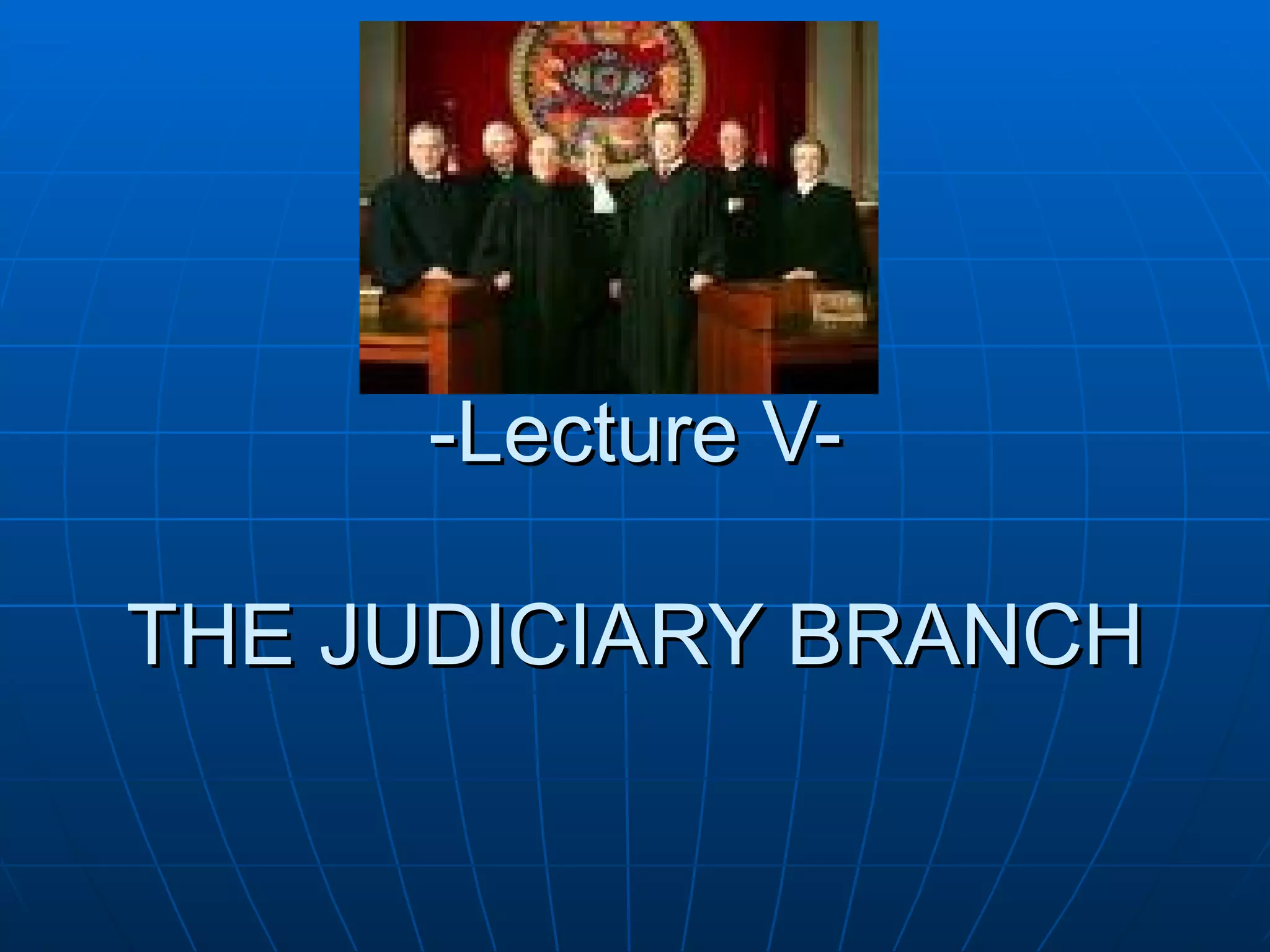
-Lecture V- THE JUDICIARY BRANCH
What is the judiciary branch? Constitutions serve as the expression of the basic laws and legal framework of the regime The judiciary branch stems from the need to interpret these laws Function of legal systems in political processes, importance of legal culture, and role of judges and courts
Within cross-national studies in Comparative Politics, the judiciary branch has deserved little attention:  Legal systems and courts are the most system specific: more difficult to make generalizations While the executive and the legislative branches are generally part of the political process, this is often not the case for the judiciary branch (insulation from the political process for reasons of impartiality)
THE IDEA OF LAW Basic rules of conduct that reflect to some extent the concept of justice “ Justice”: the government should be a government of laws and not of men (ideal concept) A legal system that treats everyone equally and that is not subject to change through the arbitrary acts of a dictator and of changing majorities
Typology of Laws Scientific Law:  observations and measurements that have been empirically determined upon physical, biological, and chemical evidence Moral Law:  Precepts or guidelines that are based upon subjective values, beliefs, and attitudes. Moral laws focus on behavior.  Divine Law:  the source of authority derives from God Natural Law:  laws governing human behavior are more basic than man-made-laws and intrinsic to each individual. Everyone longs for, and has basic principles of justice Positive Law  (most important for governments):  Man-made Designed to govern human behavior Enforceable by governmental action
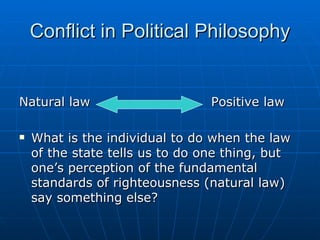
Conflict in Political Philosophy Natural law Positive law What is the individual to do when the law of the state tells us to do one thing, but one’s perception of the fundamental standards of righteousness (natural law) say something else?
LEGAL CULTURES “ the beliefs, attitudes, and values of society relative to the laws and politics” Has to deal with the nature and process of justice in the political system, the concept of equality, and the nature of law in the regime itself The nation’s legal culture shapes the role that the laws and institutions play in the legal realm Is the regime’s behavior limited by law (constitutional regime), or do the laws of a country exist to control individuals and allow the government to do as it pleases (unconstitutional regime)?
National contexts and political cultures affect people’s attitude towards law: Ex.: the U.S. as the most litigious system in the world/emphasis first on informal means of settlement in Japan
Variance upon groups of legal culture Romano-Germanic law Common law Socialist law Non-Western legal families
Romano-Germanic law “ Code” law developed a the time of Justinian (A.D. 533) Written law comprehensively codified/written in documents Code Napoleon (early 19 th  century): the laws of the French empire had to be codified in one single document Ex.: served as a basis for many systems around the world. Quebec? Louisiana (both Code Napoleon and Common Law)
Common Law Created in England and influenced the Anglo-Saxon world (U.S.) Judge-made laws When the science of law was invented in 12 th  century England, it was made by judges Question of judicial precedents/incremental evolution of law A judge may base his decision on previously adjudicated cases, or decide that they are new characteristics implying derivation from previous cases
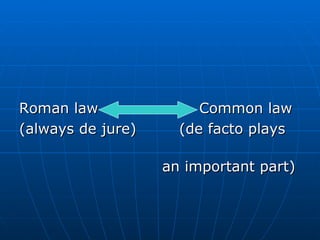
Roman law   Common law (always de jure) (de facto plays    an important part)
Code law  (ex.: France): more emphasis on preventing a guilty person to escape from punishment Common law  (U.S.): guarantees and safeguards to minimize the likelihood of innocents to be jailed + IMPORTANCE OF JUDGES
Socialist law Philosophical roots of Marx Law is an instrument tool of capitalism In a society in which economic problems have been taken care of (through the revolution), there should be no need for law Reality? Soviet Union?  How do we interpret this paradox? Redirection for Soviet Marxists: law exists to further the interests of the people, yet the state knows what people want and need better than them
Non-Western legal systems Importance of local customs and traditions Legal culture of the former colonizing power (if applicable) The degree to which the colonizing power permitted development and autonomy Islamic laws (religion), tribal laws elsewhere Israel’s law mixed of Turkish, British law, and religious law… Asian countries place a greater emphasis on the group over the individual (/Western countries that place more importance on individualism)
SOURCES OF LAW In the Middle-Ages, came from the monarch/ruler and/or the Church/religion In proto-societies, came from moral/religious values. Ex.: Moses and the Ten Commandments; the Koran Absolutist monarchies such as 17 th  century England or France, came from Divine Right (King by Godly virtue) Another source: custom or tradition (de facto) which does not need to be written in the constitution. Ex.: the President must step down after a second mandate in the U.S. (G. Washington started; FDR’s fourth mandate led to the adoption of the 22 nd  Amendment)
Constitutions Judiciary branches (judge-made laws) Legislative branches (create laws) Executive branch (growing source of law) Administrations (administrations are often being delegated authorities to make laws) Ex.: National Food and Drugs Agency
LEGAL STRUCTURE: THE COURT Individual/group of individuals with power to make decisions in disputes Before the court, parties and advocate present the evidence and principles regarding a case Those principles are used by the individuals/groups to impartially make decision independently from any other bodies
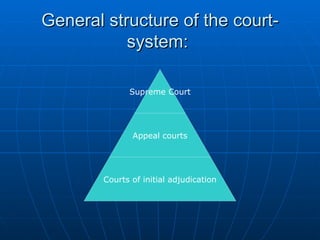
General structure of the court-system:  Supreme Court Appeal courts Courts of initial adjudication
Sometimes, complexity of the question whether what issue falls within which jurisdiction (especially true for federal systems) Ex. By robbing a bank/federal bank, you may face two trials
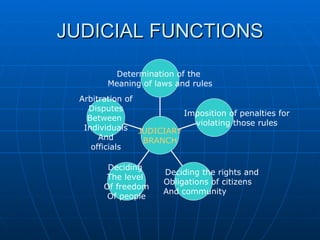
JUDICIAL FUNCTIONS Arbitration of Disputes Between  Individuals And officials Deciding  The level  Of freedom Of people Deciding the rights and Obligations of citizens  And community Imposition of penalties for violating those rules Determination of the  Meaning of laws and rules JUDICIARY BRANCH
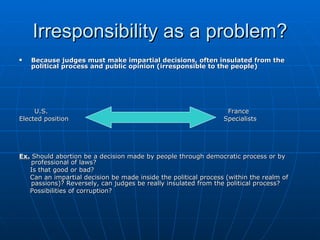
Irresponsibility as a problem? Because judges must make impartial decisions, often insulated from the political process and public opinion (irresponsible to the people) U.S.    France Elected position   Specialists Ex.  Should abortion be a decision made by people through democratic process or by professional of laws?  Is that good or bad? Can an impartial decision be made inside the political process (within the realm of passions)? Reversely, can judges be really insulated from the political process? Possibilities of corruption?
JUDICIARIES IN THE POLITICAL ARENA Courts try to insulate themselves from the political process  (even in the U.S. where the Supreme Court is one of (if not) the most politicized court in the world) Interaction with the political environment can exist through the judicial review process:  “ process by which courts are in the position to rule upon the propriety or legality of action of the legislative and executive branches” Exists only in a clear minority of nations
Austria, Canada, Denmark, Ireland, Norway, Argentina, Brazil, Colombia, Mexico, Australia, India, Pakistan, Philippines, Ghana, Israel, Nigeria… In the U.K.,  parliamentary supremacy  (yet, recently evolved into an embryonic move towards judicial activism)
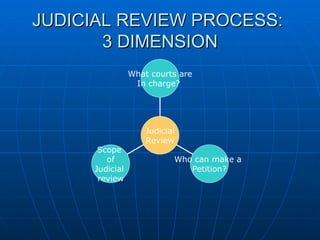
JUDICIAL REVIEW PROCESS:  3 DIMENSION Scope  of Judicial  review Who can make a  Petition? What courts are In charge?  Judicial Review
1) What courts are in charge of judicial review? The American model: uses regular courts. Judicial review is one of their tasks The European model (France): a special constitutional court performs this tasks
2) Who can initiate suit?  In the U.S.:  only an “injured” person can  In Canada:  everyone can make a petition
3) Scope of Judicial Review?  Extensive (U.S.) Limited:  in Israel, judicial review does not have jurisdiction over the laws passed by the Knesset. In Italy, courts have only a symbolic function of judicial review Non-existing (currently in Russia)
Judicial review as undemocratic? Process aims at reversing a decision that has been made through a democratic process (through the legislature/executive) Task often granted to non-elected individuals
Judicial Review: the Gavel and the Robe Growing importance of judicial review granted to non-elected individuals in Europe In the U.S.:  process that fit well with the notion of checks and balances, and especially balancing the potential disastrous consequences of popular vote. Marbury v Madison (1803) as the first precedent In Europe instead, emphasis on the sanctity of popular vote WWII and the experience of fascism have created a need for supervising the decisions of the other branches and avoid the unintended consequences of popular decisions
Judgment Power Appointments FUNCTIONS
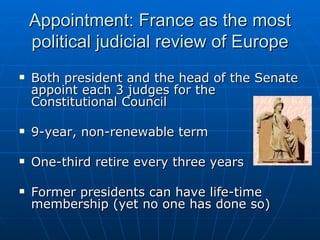
Appointment: France as the most political judicial review of Europe Both president and the head of the Senate appoint each 3 judges for the Constitutional Council 9-year, non-renewable term One-third retire every three years Former presidents can have life-time membership (yet no one has done so)
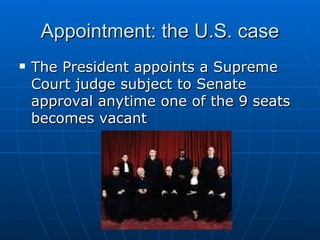
Appointment: the U.S. case The President appoints a Supreme Court judge subject to Senate approval anytime one of the 9 seats becomes vacant
Who has the power to nullify laws? French 5 th  Republic Constitution permitted 4 types of individual to make petition: The President The Prime Minister The heads of the 2 houses of parliament In 1974, an Amendment permitted 60 deputies (representatives) to seat in the Council as well As a result, the Council has become more active
Judgments Made more or less openly to the public Evolution towards supranational judicial review through the European union with the growing roles of the European Court of Justice in Luxembourg (ECJ) or the European Court of Human Rights in Strasburg (ECHR):  The ECJ can interpret the treaties upon which the EU was founded The European Court of Human Rights is the final court of appeal on Human Rights issues for most Europe
Power and legitimacy of these judges? Unaccountability? Not necessarily… Judges can be overruled by constitutional amendments Role of media, lawyers (judges as public individuals) Judges as not that independent, still the result of a political process, and therefore can be changed

The judiciary branch

  • 1.
    -Lecture V- THEJUDICIARY BRANCH
  • 2.
    What is thejudiciary branch? Constitutions serve as the expression of the basic laws and legal framework of the regime The judiciary branch stems from the need to interpret these laws Function of legal systems in political processes, importance of legal culture, and role of judges and courts
  • 3.
    Within cross-national studiesin Comparative Politics, the judiciary branch has deserved little attention: Legal systems and courts are the most system specific: more difficult to make generalizations While the executive and the legislative branches are generally part of the political process, this is often not the case for the judiciary branch (insulation from the political process for reasons of impartiality)
  • 4.
    THE IDEA OFLAW Basic rules of conduct that reflect to some extent the concept of justice “ Justice”: the government should be a government of laws and not of men (ideal concept) A legal system that treats everyone equally and that is not subject to change through the arbitrary acts of a dictator and of changing majorities
  • 5.
    Typology of LawsScientific Law: observations and measurements that have been empirically determined upon physical, biological, and chemical evidence Moral Law: Precepts or guidelines that are based upon subjective values, beliefs, and attitudes. Moral laws focus on behavior. Divine Law: the source of authority derives from God Natural Law: laws governing human behavior are more basic than man-made-laws and intrinsic to each individual. Everyone longs for, and has basic principles of justice Positive Law (most important for governments): Man-made Designed to govern human behavior Enforceable by governmental action
  • 6.
    Conflict in PoliticalPhilosophy Natural law Positive law What is the individual to do when the law of the state tells us to do one thing, but one’s perception of the fundamental standards of righteousness (natural law) say something else?
  • 7.
    LEGAL CULTURES “the beliefs, attitudes, and values of society relative to the laws and politics” Has to deal with the nature and process of justice in the political system, the concept of equality, and the nature of law in the regime itself The nation’s legal culture shapes the role that the laws and institutions play in the legal realm Is the regime’s behavior limited by law (constitutional regime), or do the laws of a country exist to control individuals and allow the government to do as it pleases (unconstitutional regime)?
  • 8.
    National contexts andpolitical cultures affect people’s attitude towards law: Ex.: the U.S. as the most litigious system in the world/emphasis first on informal means of settlement in Japan
  • 9.
    Variance upon groupsof legal culture Romano-Germanic law Common law Socialist law Non-Western legal families
  • 10.
    Romano-Germanic law “Code” law developed a the time of Justinian (A.D. 533) Written law comprehensively codified/written in documents Code Napoleon (early 19 th century): the laws of the French empire had to be codified in one single document Ex.: served as a basis for many systems around the world. Quebec? Louisiana (both Code Napoleon and Common Law)
  • 11.
    Common Law Createdin England and influenced the Anglo-Saxon world (U.S.) Judge-made laws When the science of law was invented in 12 th century England, it was made by judges Question of judicial precedents/incremental evolution of law A judge may base his decision on previously adjudicated cases, or decide that they are new characteristics implying derivation from previous cases
  • 12.
    Roman law Common law (always de jure) (de facto plays an important part)
  • 13.
    Code law (ex.: France): more emphasis on preventing a guilty person to escape from punishment Common law (U.S.): guarantees and safeguards to minimize the likelihood of innocents to be jailed + IMPORTANCE OF JUDGES
  • 14.
    Socialist law Philosophicalroots of Marx Law is an instrument tool of capitalism In a society in which economic problems have been taken care of (through the revolution), there should be no need for law Reality? Soviet Union? How do we interpret this paradox? Redirection for Soviet Marxists: law exists to further the interests of the people, yet the state knows what people want and need better than them
  • 15.
    Non-Western legal systemsImportance of local customs and traditions Legal culture of the former colonizing power (if applicable) The degree to which the colonizing power permitted development and autonomy Islamic laws (religion), tribal laws elsewhere Israel’s law mixed of Turkish, British law, and religious law… Asian countries place a greater emphasis on the group over the individual (/Western countries that place more importance on individualism)
  • 16.
    SOURCES OF LAWIn the Middle-Ages, came from the monarch/ruler and/or the Church/religion In proto-societies, came from moral/religious values. Ex.: Moses and the Ten Commandments; the Koran Absolutist monarchies such as 17 th century England or France, came from Divine Right (King by Godly virtue) Another source: custom or tradition (de facto) which does not need to be written in the constitution. Ex.: the President must step down after a second mandate in the U.S. (G. Washington started; FDR’s fourth mandate led to the adoption of the 22 nd Amendment)
  • 17.
    Constitutions Judiciary branches(judge-made laws) Legislative branches (create laws) Executive branch (growing source of law) Administrations (administrations are often being delegated authorities to make laws) Ex.: National Food and Drugs Agency
  • 18.
    LEGAL STRUCTURE: THECOURT Individual/group of individuals with power to make decisions in disputes Before the court, parties and advocate present the evidence and principles regarding a case Those principles are used by the individuals/groups to impartially make decision independently from any other bodies
  • 19.
    General structure ofthe court-system: Supreme Court Appeal courts Courts of initial adjudication
  • 20.
    Sometimes, complexity ofthe question whether what issue falls within which jurisdiction (especially true for federal systems) Ex. By robbing a bank/federal bank, you may face two trials
  • 21.
    JUDICIAL FUNCTIONS Arbitrationof Disputes Between Individuals And officials Deciding The level Of freedom Of people Deciding the rights and Obligations of citizens And community Imposition of penalties for violating those rules Determination of the Meaning of laws and rules JUDICIARY BRANCH
  • 22.
    Irresponsibility as aproblem? Because judges must make impartial decisions, often insulated from the political process and public opinion (irresponsible to the people) U.S. France Elected position Specialists Ex. Should abortion be a decision made by people through democratic process or by professional of laws? Is that good or bad? Can an impartial decision be made inside the political process (within the realm of passions)? Reversely, can judges be really insulated from the political process? Possibilities of corruption?
  • 23.
    JUDICIARIES IN THEPOLITICAL ARENA Courts try to insulate themselves from the political process (even in the U.S. where the Supreme Court is one of (if not) the most politicized court in the world) Interaction with the political environment can exist through the judicial review process: “ process by which courts are in the position to rule upon the propriety or legality of action of the legislative and executive branches” Exists only in a clear minority of nations
  • 24.
    Austria, Canada, Denmark,Ireland, Norway, Argentina, Brazil, Colombia, Mexico, Australia, India, Pakistan, Philippines, Ghana, Israel, Nigeria… In the U.K., parliamentary supremacy (yet, recently evolved into an embryonic move towards judicial activism)
  • 25.
    JUDICIAL REVIEW PROCESS: 3 DIMENSION Scope of Judicial review Who can make a Petition? What courts are In charge? Judicial Review
  • 26.
    1) What courtsare in charge of judicial review? The American model: uses regular courts. Judicial review is one of their tasks The European model (France): a special constitutional court performs this tasks
  • 27.
    2) Who caninitiate suit? In the U.S.: only an “injured” person can In Canada: everyone can make a petition
  • 28.
    3) Scope ofJudicial Review? Extensive (U.S.) Limited: in Israel, judicial review does not have jurisdiction over the laws passed by the Knesset. In Italy, courts have only a symbolic function of judicial review Non-existing (currently in Russia)
  • 29.
    Judicial review asundemocratic? Process aims at reversing a decision that has been made through a democratic process (through the legislature/executive) Task often granted to non-elected individuals
  • 30.
    Judicial Review: theGavel and the Robe Growing importance of judicial review granted to non-elected individuals in Europe In the U.S.: process that fit well with the notion of checks and balances, and especially balancing the potential disastrous consequences of popular vote. Marbury v Madison (1803) as the first precedent In Europe instead, emphasis on the sanctity of popular vote WWII and the experience of fascism have created a need for supervising the decisions of the other branches and avoid the unintended consequences of popular decisions
  • 31.
  • 32.
    Appointment: France asthe most political judicial review of Europe Both president and the head of the Senate appoint each 3 judges for the Constitutional Council 9-year, non-renewable term One-third retire every three years Former presidents can have life-time membership (yet no one has done so)
  • 33.
    Appointment: the U.S.case The President appoints a Supreme Court judge subject to Senate approval anytime one of the 9 seats becomes vacant
  • 34.
    Who has thepower to nullify laws? French 5 th Republic Constitution permitted 4 types of individual to make petition: The President The Prime Minister The heads of the 2 houses of parliament In 1974, an Amendment permitted 60 deputies (representatives) to seat in the Council as well As a result, the Council has become more active
  • 35.
    Judgments Made moreor less openly to the public Evolution towards supranational judicial review through the European union with the growing roles of the European Court of Justice in Luxembourg (ECJ) or the European Court of Human Rights in Strasburg (ECHR): The ECJ can interpret the treaties upon which the EU was founded The European Court of Human Rights is the final court of appeal on Human Rights issues for most Europe
  • 36.
    Power and legitimacyof these judges? Unaccountability? Not necessarily… Judges can be overruled by constitutional amendments Role of media, lawyers (judges as public individuals) Judges as not that independent, still the result of a political process, and therefore can be changed