The Indian Perspectives on ICT Policy
INDIA: SOME BASIC FACTS
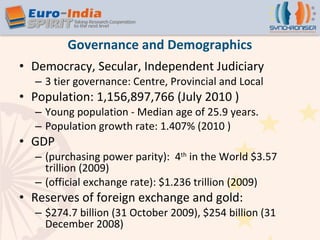
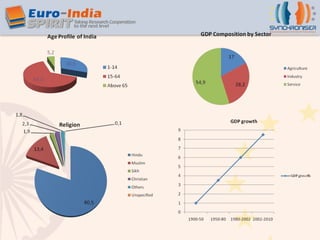
Governance and Demographics Democracy, Secular, Independent Judiciary 3 tier governance: Centre, Provincial and Local Population: 1,156,897,766 (July 2010 ) Young population - Median age of 25.9 years. Population growth rate: 1.407% (2010 ) GDP  (purchasing power parity):  4 th  in the World $3.57 trillion (2009) (official exchange rate): $1.236 trillion (2009) Reserves of foreign exchange and gold:  $274.7 billion (31 October 2009), $254 billion (31 December 2008)
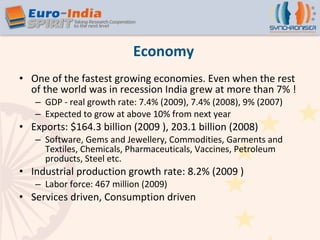
Economy One of the fastest growing economies. Even when the rest of the world was in recession India grew at more than 7% ! GDP - real growth rate: 7.4% (2009), 7.4% (2008), 9% (2007) Expected to grow at above 10% from next year Exports: $164.3 billion (2009 ), 203.1 billion (2008) Software, Gems and Jewellery, Commodities, Garments and Textiles, Chemicals, Pharmaceuticals, Vaccines, Petroleum products, Steel etc. Industrial production growth rate: 8.2% (2009 ) Labor force: 467 million (2009)  Services driven, Consumption driven
 
100 Indian Companies have market cap of US$ 3bn  1,000 Indian Companies have received foreign  institutional investment The market capitalization of top 10 Indian Companies is more than 450 billion USD 125 Fortune 500 companies have R&D bases in India 390 Fortune 500 companies have outsourced software development to India Only 2% loans are bad in Indian banks
Telecom One of the fastest growing telecom markets in the world total telephone subscribership base is approaching 600 million an overall teledensity of 50%, and subscribership is currently growing nearly 20 million per month; urban teledensity has reached 100% and rural teledensity is about 20% and steadily growing Good infrastructure  One of the world's largest domestic satellite systems, the Indian National Satellite system (INSAT), with 6 satellites supporting 33,000 very small aperture terminals (VSAT) Some major international submarine cable systems, including Sea-Me-We-3 , Sea-Me-We-4, Fiber-Optic Link Around the Globe (FLAG), South Africa - Far East (SAFE), the i2i cable network , and Tata Indicom link provide bandwidth available for both voice and data traffic Satellite earth stations - 8 Intelsat (Indian Ocean) and 1 Inmarsat (Indian Ocean region) and 9 gateway exchanges Telephones - main lines in use: 36.76 million (2010), Telephones - mobile cellular: 545 million (2010) Internet country code: .in, Internet hosts: 3.611 million (2009), Internet users: 81 million (2008)
POLICY PERSPECTIVES ON ICT IN INDIA
Telecom Policy Perspective Telecom is deregulated TRAI Large number of private operators Government owned land based and mobile operator exists but operates under TRAI guidelines Mobile telephony GSM and CDMA  2 G  services successfully running for several years 3 G  Spectrum auction successfully conducted and released. Operators will start services soon WiMax Spectrum has been auctioned successfully Security Blackberry Controversy – considered a security threat – given 2 months to address government concerns Government has the right to snoop provided it is authorized by competent authority VoIP  Security concerns Intra country restrictions
Open Source Encouragement to open source by government  ICT in Government  National Electronic Governance Plan – 6 billion USD Mission Mode Projects of both central and provincial governments Security National infrastructure exists and taken seriously IT Act facilitates prosecution efforts PC penetration is low at 3% Internet Penetration is low Government is trying to improve the situation by policy interventions especially in broadband. Information Technology
New Areas of Policy Intervention Privacy of Data Local Language Applications Low Cost Computing Devices Convergence Faster Internet Redundancy of Internet connection Computerization of Government in a big way – NeGP Leveraging mobile devices for citizen services Security Anti Piracy Drives Linking Industry with Educational Institutes Bridging the Digital Divide
Thank You

The Indian Perspectives on ICT Policy

  • 1.
  • 2.
  • 3.
    Governance and DemographicsDemocracy, Secular, Independent Judiciary 3 tier governance: Centre, Provincial and Local Population: 1,156,897,766 (July 2010 ) Young population - Median age of 25.9 years. Population growth rate: 1.407% (2010 ) GDP (purchasing power parity): 4 th in the World $3.57 trillion (2009) (official exchange rate): $1.236 trillion (2009) Reserves of foreign exchange and gold: $274.7 billion (31 October 2009), $254 billion (31 December 2008)
  • 4.
    Economy One ofthe fastest growing economies. Even when the rest of the world was in recession India grew at more than 7% ! GDP - real growth rate: 7.4% (2009), 7.4% (2008), 9% (2007) Expected to grow at above 10% from next year Exports: $164.3 billion (2009 ), 203.1 billion (2008) Software, Gems and Jewellery, Commodities, Garments and Textiles, Chemicals, Pharmaceuticals, Vaccines, Petroleum products, Steel etc. Industrial production growth rate: 8.2% (2009 ) Labor force: 467 million (2009) Services driven, Consumption driven
  • 5.
  • 6.
    100 Indian Companieshave market cap of US$ 3bn 1,000 Indian Companies have received foreign institutional investment The market capitalization of top 10 Indian Companies is more than 450 billion USD 125 Fortune 500 companies have R&D bases in India 390 Fortune 500 companies have outsourced software development to India Only 2% loans are bad in Indian banks
  • 7.
    Telecom One ofthe fastest growing telecom markets in the world total telephone subscribership base is approaching 600 million an overall teledensity of 50%, and subscribership is currently growing nearly 20 million per month; urban teledensity has reached 100% and rural teledensity is about 20% and steadily growing Good infrastructure One of the world's largest domestic satellite systems, the Indian National Satellite system (INSAT), with 6 satellites supporting 33,000 very small aperture terminals (VSAT) Some major international submarine cable systems, including Sea-Me-We-3 , Sea-Me-We-4, Fiber-Optic Link Around the Globe (FLAG), South Africa - Far East (SAFE), the i2i cable network , and Tata Indicom link provide bandwidth available for both voice and data traffic Satellite earth stations - 8 Intelsat (Indian Ocean) and 1 Inmarsat (Indian Ocean region) and 9 gateway exchanges Telephones - main lines in use: 36.76 million (2010), Telephones - mobile cellular: 545 million (2010) Internet country code: .in, Internet hosts: 3.611 million (2009), Internet users: 81 million (2008)
  • 8.
  • 9.
    Telecom Policy PerspectiveTelecom is deregulated TRAI Large number of private operators Government owned land based and mobile operator exists but operates under TRAI guidelines Mobile telephony GSM and CDMA 2 G services successfully running for several years 3 G Spectrum auction successfully conducted and released. Operators will start services soon WiMax Spectrum has been auctioned successfully Security Blackberry Controversy – considered a security threat – given 2 months to address government concerns Government has the right to snoop provided it is authorized by competent authority VoIP Security concerns Intra country restrictions
  • 10.
    Open Source Encouragementto open source by government ICT in Government National Electronic Governance Plan – 6 billion USD Mission Mode Projects of both central and provincial governments Security National infrastructure exists and taken seriously IT Act facilitates prosecution efforts PC penetration is low at 3% Internet Penetration is low Government is trying to improve the situation by policy interventions especially in broadband. Information Technology
  • 11.
    New Areas ofPolicy Intervention Privacy of Data Local Language Applications Low Cost Computing Devices Convergence Faster Internet Redundancy of Internet connection Computerization of Government in a big way – NeGP Leveraging mobile devices for citizen services Security Anti Piracy Drives Linking Industry with Educational Institutes Bridging the Digital Divide
  • 12.