India’s Information Technology Sector   What Contribution to Broader Economic Development?   Nirvikar Singh University of California, Santa Cruz OECD – GOI - GOTN International Conference on  “ The IT/Software Industries in Indian and Asian Development” November 11-12, 2002
Outline Introduction Is IT Special in Theory and Practice? Opportunities and Constraints Policy Thoughts Conclusion
1. Introduction Success of IT well known Can it be more than an enclave for software exports? What can be achieved and how? Can we “ensure that the Indian IT sector remains a dominant player in the global market,   and that we emerge as one of the leading countries of the new millennium ”?
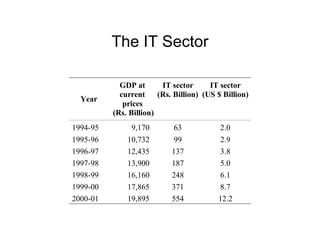
The IT Sector
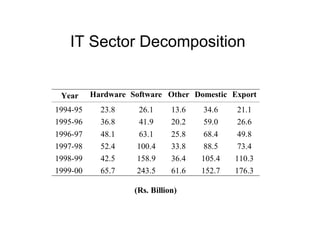
IT Sector Decomposition
 
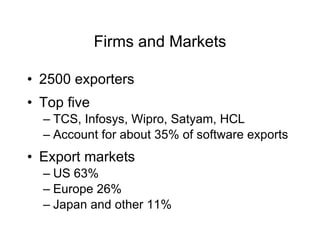
Firms and Markets 2500 exporters Top five  TCS, Infosys, Wipro, Satyam, HCL Account for about 35% of software exports   Export markets US 63% Europe 26% Japan and other 11%
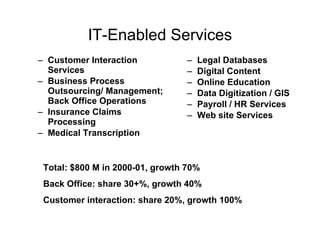
IT-Enabled Services Customer Interaction Services Business Process Outsourcing/ Management; Back Office Operations Insurance Claims Processing Medical Transcription Legal Databases Digital Content Online Education Data Digitization / GIS Payroll / HR Services Web site Services Total: $800 M in 2000-01, growth 70% Back Office: share 30+%, growth 40% Customer interaction: share 20%, growth 100%
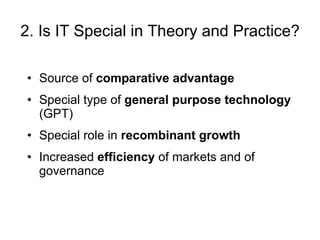
2. Is IT Special in Theory and Practice? Source of  comparative advantage Special type of  general purpose technology  (GPT)  Special role in  recombinant growth Increased  efficiency  of markets and of governance
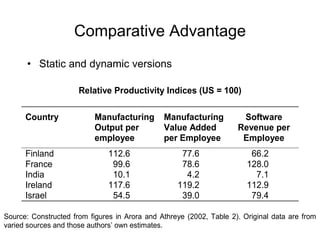
Comparative Advantage Static and dynamic versions
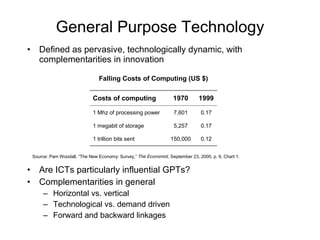
Defined as pervasive, technologically dynamic, with complementarities in innovation Are ICTs particularly influential GPTs? Complementarities in general Horizontal vs. vertical Technological vs. demand driven Forward and backward linkages General Purpose Technology
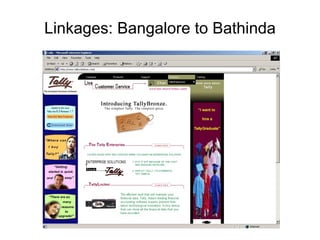
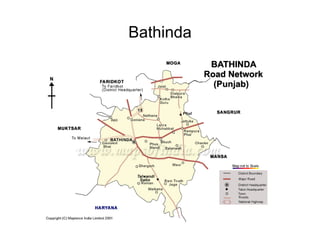
Linkages: Bangalore to Bathinda
Recombinant Growth Central idea is that new ideas are formed through combinations of old ideas The state of IT knowledge affects the success rate of turning potential new ideas into practical ones Writing and telephones, not just Internet and computers This makes IT special Indian policy neglected modern communications, for example
Market and Government Efficiency Economize on resource use Increase quantity and quality of buyer-seller matches Internal resource use within organizations (public or private) More efficient information exchange throughout value chain (public or private) Greater transparency and accountability
3. Opportunities and Constraints ITES Hardware  Broad-Based Growth Skills Infrastructure  Finance
ITES Diverse categories Range of skill sets Management and infrastructure The ‘O-ring’ model may matter (complementarities within the firm)
Hardware Design with outsourced manufacturing Low-cost versions targeted to developing countries (e.g., Simputer) Management and infrastructure again
Broad-Based Growth Complementarities, leap-frogging, operational efficiencies Jobs: automation vs. new IT-enabled services Examples Handhelds, smart cards and micro-finance Milk collection in dairy cooperatives Market information Education content and delivery
Bathinda
Business in Bathinda TARAhaat:  Subsidiary of Development Alternatives, a large NGO A commercial enterprise, but 51% ownership by a nonprofit foundation Social mission: “the creation of sustainable rural livelihoods through improved information flows and education that can be enabled by IT” Implementation through a business model that involves franchising information kiosk owners TARAgyan is developing educational content and software for use in TARAhaat’s information kiosks  Includes teaching courses in Tally accounting software
Domestic Market for IT Smaller size Different requirements Managerial attention Internal Internet access and use Domestic infrastructure in general State of Indian industry
Skills Stock of technical professionals: > 500K Adding over 100K a year Real growth is in customer interaction services  Different skill-set, easier to ramp up Engineers may not be so scarce today – what complementary inputs do they need?
Infrastructure Electric power – matters for everything  Water, roads, ports – hardware  Telecommunications – everything, especially software Technological change has made everything possible in telecoms – if policies are right
Finance Problems of directed credit, financial repression and fiscal deficits Some progress in securities markets, corporate governance, corporate law and tax policy Nascent venture capital industry – US $ 1 B in 2000-01 Pending issues of changes in tax and accounting regulations
4. Policy Thoughts Where does targeting make sense? What kinds of tax-subsidy policies? Software exports Telecoms Venture capital Education Broad reform areas: labor, infrastructure, finance, small scale reservations
Governance Enhance domestic demand for IT Operational efficiency Access and transparency Empowerment and accountability Examples Andhra Pradesh: agricultural land records Urban service delivery: forms, bills, etc.  Gyandoot / Drishtee: complaints, forms
5. Conclusion IT is a fast-growing, export-oriented sector Also definite potential for contributing to broad-based growth – much more than software exports IT’s success exposes key bottlenecks and areas where reform is needed Policy initiatives have to be general, not sector-specific, or narrowly targeted – IT as “the thin end of the wedge” IT can also contribute to broader economic development – governance,education, operational efficiency, market efficiency

2399797

  • 1.
    India’s Information TechnologySector What Contribution to Broader Economic Development? Nirvikar Singh University of California, Santa Cruz OECD – GOI - GOTN International Conference on “ The IT/Software Industries in Indian and Asian Development” November 11-12, 2002
  • 2.
    Outline Introduction IsIT Special in Theory and Practice? Opportunities and Constraints Policy Thoughts Conclusion
  • 3.
    1. Introduction Successof IT well known Can it be more than an enclave for software exports? What can be achieved and how? Can we “ensure that the Indian IT sector remains a dominant player in the global market, and that we emerge as one of the leading countries of the new millennium ”?
  • 4.
  • 5.
  • 6.
  • 7.
    Firms and Markets2500 exporters Top five TCS, Infosys, Wipro, Satyam, HCL Account for about 35% of software exports Export markets US 63% Europe 26% Japan and other 11%
  • 8.
    IT-Enabled Services CustomerInteraction Services Business Process Outsourcing/ Management; Back Office Operations Insurance Claims Processing Medical Transcription Legal Databases Digital Content Online Education Data Digitization / GIS Payroll / HR Services Web site Services Total: $800 M in 2000-01, growth 70% Back Office: share 30+%, growth 40% Customer interaction: share 20%, growth 100%
  • 9.
    2. Is ITSpecial in Theory and Practice? Source of comparative advantage Special type of general purpose technology (GPT) Special role in recombinant growth Increased efficiency of markets and of governance
  • 10.
    Comparative Advantage Staticand dynamic versions
  • 11.
    Defined as pervasive,technologically dynamic, with complementarities in innovation Are ICTs particularly influential GPTs? Complementarities in general Horizontal vs. vertical Technological vs. demand driven Forward and backward linkages General Purpose Technology
  • 12.
  • 13.
    Recombinant Growth Centralidea is that new ideas are formed through combinations of old ideas The state of IT knowledge affects the success rate of turning potential new ideas into practical ones Writing and telephones, not just Internet and computers This makes IT special Indian policy neglected modern communications, for example
  • 14.
    Market and GovernmentEfficiency Economize on resource use Increase quantity and quality of buyer-seller matches Internal resource use within organizations (public or private) More efficient information exchange throughout value chain (public or private) Greater transparency and accountability
  • 15.
    3. Opportunities andConstraints ITES Hardware Broad-Based Growth Skills Infrastructure Finance
  • 16.
    ITES Diverse categoriesRange of skill sets Management and infrastructure The ‘O-ring’ model may matter (complementarities within the firm)
  • 17.
    Hardware Design withoutsourced manufacturing Low-cost versions targeted to developing countries (e.g., Simputer) Management and infrastructure again
  • 18.
    Broad-Based Growth Complementarities,leap-frogging, operational efficiencies Jobs: automation vs. new IT-enabled services Examples Handhelds, smart cards and micro-finance Milk collection in dairy cooperatives Market information Education content and delivery
  • 19.
  • 20.
    Business in BathindaTARAhaat: Subsidiary of Development Alternatives, a large NGO A commercial enterprise, but 51% ownership by a nonprofit foundation Social mission: “the creation of sustainable rural livelihoods through improved information flows and education that can be enabled by IT” Implementation through a business model that involves franchising information kiosk owners TARAgyan is developing educational content and software for use in TARAhaat’s information kiosks Includes teaching courses in Tally accounting software
  • 21.
    Domestic Market forIT Smaller size Different requirements Managerial attention Internal Internet access and use Domestic infrastructure in general State of Indian industry
  • 22.
    Skills Stock oftechnical professionals: > 500K Adding over 100K a year Real growth is in customer interaction services Different skill-set, easier to ramp up Engineers may not be so scarce today – what complementary inputs do they need?
  • 23.
    Infrastructure Electric power– matters for everything Water, roads, ports – hardware Telecommunications – everything, especially software Technological change has made everything possible in telecoms – if policies are right
  • 24.
    Finance Problems ofdirected credit, financial repression and fiscal deficits Some progress in securities markets, corporate governance, corporate law and tax policy Nascent venture capital industry – US $ 1 B in 2000-01 Pending issues of changes in tax and accounting regulations
  • 25.
    4. Policy ThoughtsWhere does targeting make sense? What kinds of tax-subsidy policies? Software exports Telecoms Venture capital Education Broad reform areas: labor, infrastructure, finance, small scale reservations
  • 26.
    Governance Enhance domesticdemand for IT Operational efficiency Access and transparency Empowerment and accountability Examples Andhra Pradesh: agricultural land records Urban service delivery: forms, bills, etc. Gyandoot / Drishtee: complaints, forms
  • 27.
    5. Conclusion ITis a fast-growing, export-oriented sector Also definite potential for contributing to broad-based growth – much more than software exports IT’s success exposes key bottlenecks and areas where reform is needed Policy initiatives have to be general, not sector-specific, or narrowly targeted – IT as “the thin end of the wedge” IT can also contribute to broader economic development – governance,education, operational efficiency, market efficiency