A G R O U N D B U I L D I N G O P P O R T U N I T Y
M I C R O A N D
C O M M U N I T Y C O M P O S T I N G
A v i t a l p a r t o f s u s t a i n a b l e f u t u r e
U S C C A n n u a l C o n f e r e n c e & T r a d e S h o w
J a n u a r y 2 3 r d , 2 0 1 8 , A t l a n t a
Brenda Platt, @PlattBrenda
Institute for Local Self-Reliance, @ilsr
Composting for Community Project
Our Mission:
To provide innovative strategies, working models and timely information to support
environmentally sound and equitable community development.
Programs:
Waste to Wealth
Composting for Community
Community Banking
Community Owned Broadband
Energy Democracy
Community Scaled Economy
The Public Good Blog
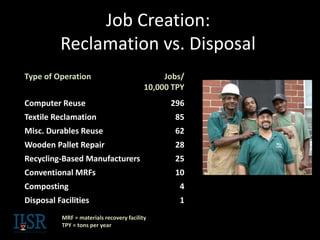
Job Creation:
Reclamation vs. Disposal
Type of Operation Jobs/
10,000 TPY
Computer Reuse 296
Textile Reclamation 85
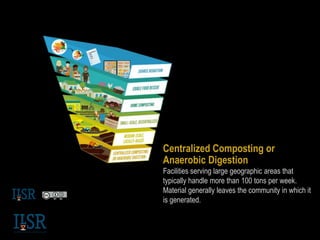
Misc. Durables Reuse 62
Wooden Pallet Repair 28
Recycling-Based Manufacturers 25
Conventional MRFs 10
Composting 4
Disposal Facilities 1
MRF = materials recovery facility
TPY = tons per year
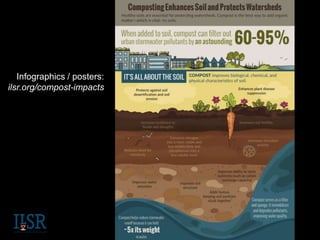
Infographics / posters:
ilsr.org/compost-impacts
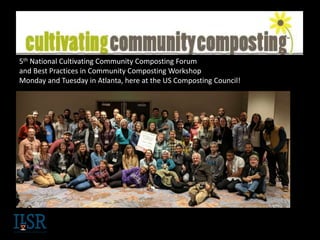
5th National Cultivating Community Composting Forum
and Best Practices in Community Composting Workshop
Monday and Tuesday in Atlanta, here at the US Composting Council!
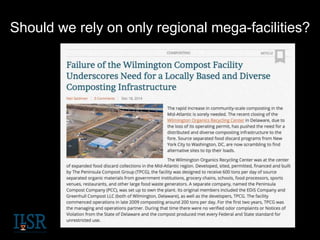
Should we rely on only regional mega-facilities?
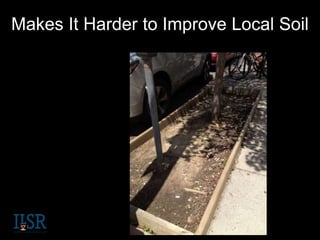
Makes It Harder to Improve Local Soil
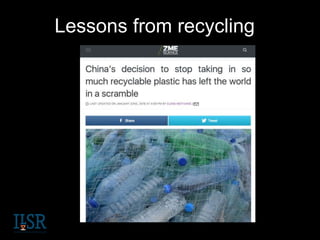
Lessons from recycling
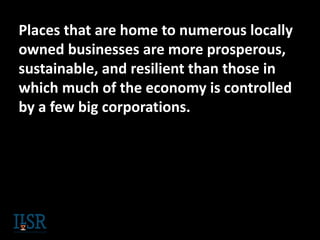
Places that are home to numerous locally
owned businesses are more prosperous,
sustainable, and resilient than those in
which much of the economy is controlled
by a few big corporations.
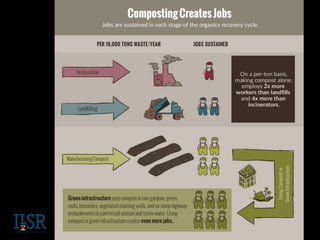
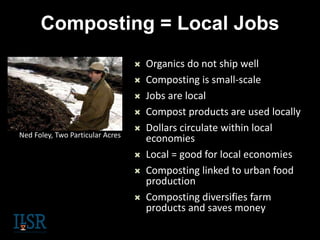
Composting = Local Jobs
 Organics do not ship well
 Composting is small-scale
 Jobs are local
 Compost products are used locally
 Dollars circulate within local
economies
 Local = good for local economies
 Composting linked to urban food
production
 Composting diversifies farm
products and saves money
Ned Foley, Two Particular Acres
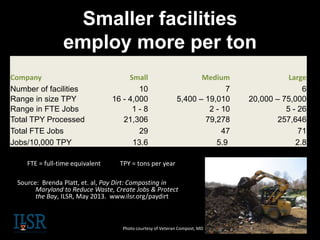
Smaller facilities
employ more per ton
Company Small Medium Large
Number of facilities 10 7 6
Range in size TPY 16 - 4,000 5,400 – 19,010 20,000 – 75,000
Range in FTE Jobs 1 - 8 2 - 10 5 - 26
Total TPY Processed 21,306 79,278 257,646
Total FTE Jobs 29 47 71
Jobs/10,000 TPY 13.6 5.9 2.8
Source: Brenda Platt, et. al, Pay Dirt: Composting in
Maryland to Reduce Waste, Create Jobs & Protect
the Bay, ILSR, May 2013. www.ilsr.org/paydirt
FTE = full-time equivalent TPY = tons per year
Photo courtesy of Veteran Compost, MD
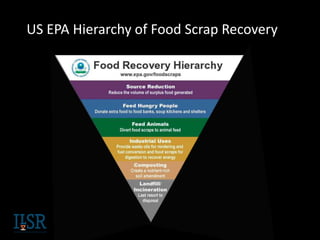
US EPA Hierarchy of Food Scrap Recovery
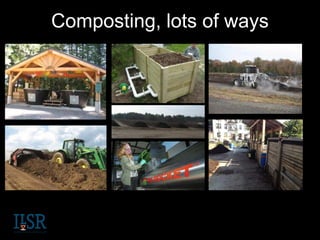
Composting, lots of ways
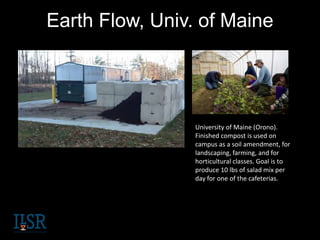
Earth Flow, Univ. of Maine
University of Maine (Orono).
Finished compost is used on
campus as a soil amendment, for
landscaping, farming, and for
horticultural classes. Goal is to
produce 10 lbs of salad mix per
day for one of the cafeterias.
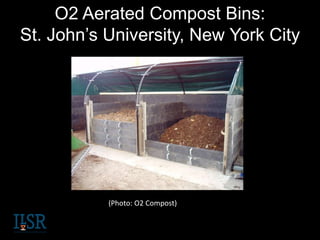
O2 Aerated Compost Bins:
St. John’s University, New York City
(Photo: O2 Compost)
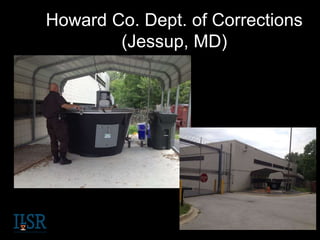
Howard Co. Dept. of Corrections
(Jessup, MD)
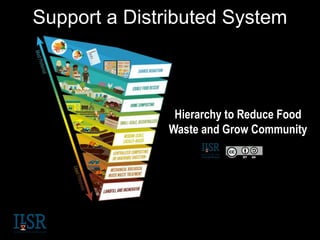
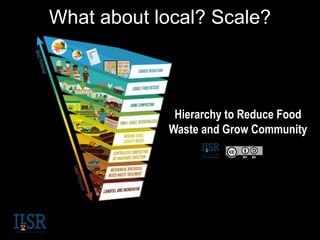
Hierarchy to Reduce Food
Waste and Grow Community
What about local? Scale?
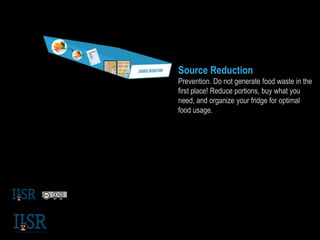
Source Reduction
Prevention. Do not generate food waste in the
first place! Reduce portions, buy what you
need, and organize your fridge for optimal
food usage.
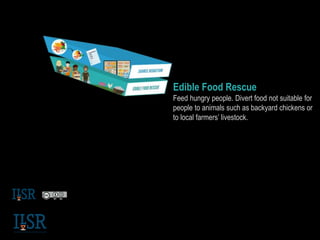
Edible Food Rescue
Feed hungry people. Divert food not suitable for
people to animals such as backyard chickens or
to local farmers’ livestock.
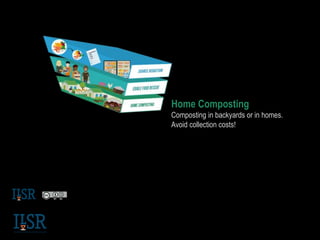
Home Composting
Composting in backyards or in homes.
Avoid collection costs!
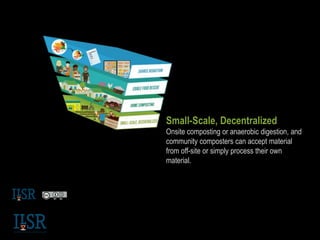
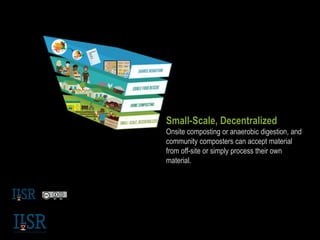
Small-Scale, Decentralized
Onsite composting or anaerobic digestion, and
community composters can accept material
from off-site or simply process their own
material.
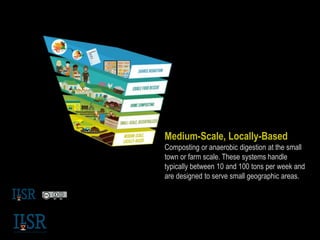
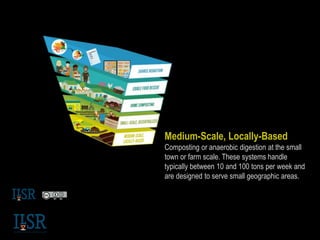
Medium-Scale, Locally-Based
Composting or anaerobic digestion at the small
town or farm scale. These systems handle
typically between 10 and 100 tons per week and
are designed to serve small geographic areas.
Centralized Composting or
Anaerobic Digestion
Facilities serving large geographic areas that
typically handle more than 100 tons per week.
Material generally leaves the community in which it
is generated.
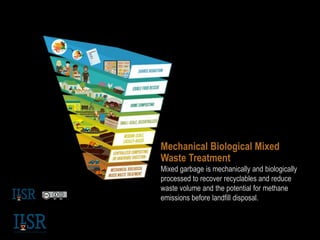
Mechanical Biological Mixed
Waste Treatment
Mixed garbage is mechanically and biologically
processed to recover recyclables and reduce
waste volume and the potential for methane
emissions before landfill disposal.
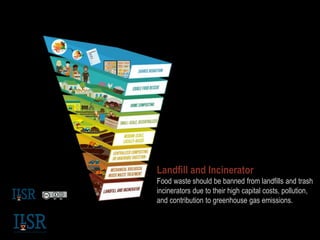
Landfill and Incinerator
Food waste should be banned from landfills and trash
incinerators due to their high capital costs, pollution,
and contribution to greenhouse gas emissions.
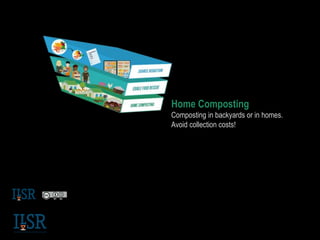
Home Composting
Composting in backyards or in homes.
Avoid collection costs!
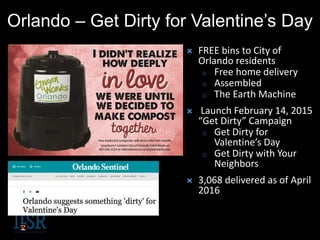
Orlando – Get Dirty for Valentine’s Day
 FREE bins to City of
Orlando residents
o Free home delivery
o Assembled
o The Earth Machine
 Launch February 14, 2015
“Get Dirty” Campaign
o Get Dirty for
Valentine’s Day
o Get Dirty with Your
Neighbors
 3,068 delivered as of April
2016
Small-Scale, Decentralized
Onsite composting or anaerobic digestion, and
community composters can accept material
from off-site or simply process their own
material.
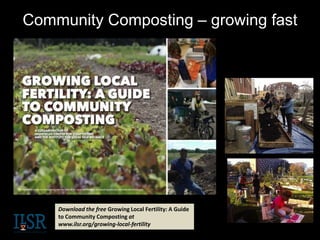
Community Composting – growing fast
Compost builds community!
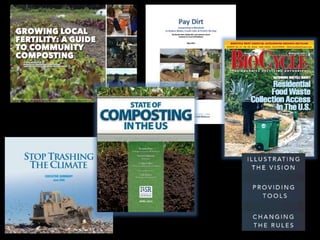
Download the free Growing Local Fertility: A Guide
to Community Composting at
www.ilsr.org/growing-local-fertility
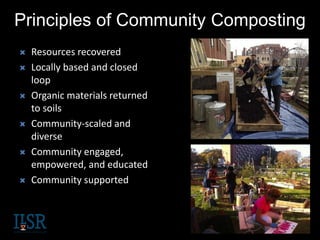
Principles of Community Composting
 Resources recovered
 Locally based and closed
loop
 Organic materials returned
to soils
 Community-scaled and
diverse
 Community engaged,
empowered, and educated
 Community supported
Compost builds community!
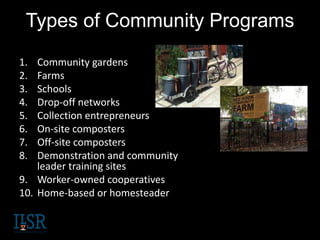
Types of Community Programs
1. Community gardens
2. Farms
3. Schools
4. Drop-off networks
5. Collection entrepreneurs
6. On-site composters
7. Off-site composters
8. Demonstration and community
leader training sites
9. Worker-owned cooperatives
10. Home-based or homesteader hubs
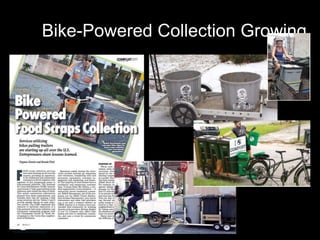
Philly Compost offers pedal-powered
collection service to neighboring restaurants
within a 2-mile radius (Philadelphia)
Bike-Powered Collection Growing
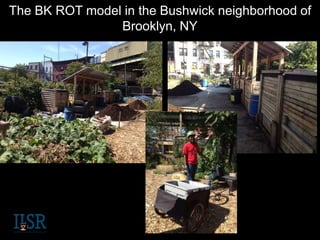
The BK ROT model in the Bushwick neighborhood of
Brooklyn, NY
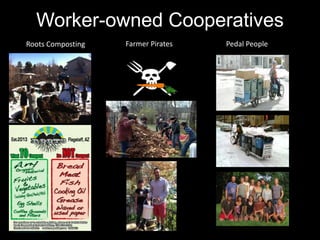
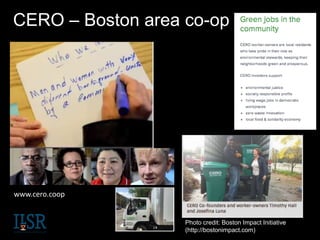
Worker-owned Cooperatives
Roots Composting Farmer Pirates Pedal People
CERO – Boston area co-op
Photo credit: Boston Impact Initiative
(http://bostonimpact.com)
www.cero.coop
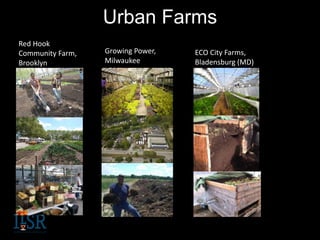
Urban Farms
Red Hook
Community Farm,
Brooklyn
Growing Power,
Milwaukee
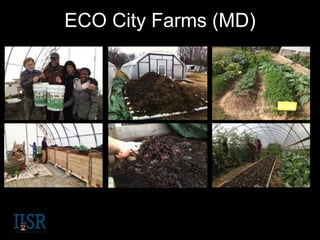
ECO City Farms,
Bladensburg (MD)
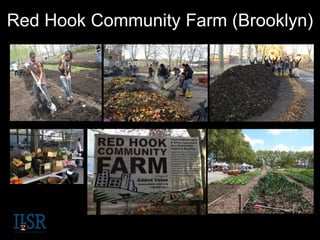
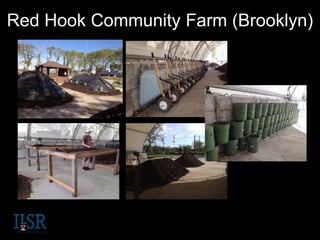
Red Hook Community Farm (Brooklyn)
ECO City Farms (MD)
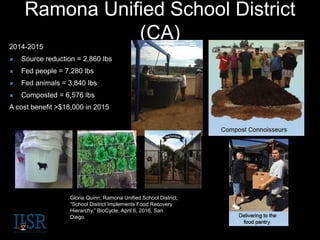
Ramona Unified School District
(CA)
Gloria Quinn, Ramona Unified School District,
“School District Implements Food Recovery
Hierarchy,” BioCycle, April 6, 2016, San
Diego.
2014-2015
 Source reduction = 2,860 lbs
 Fed people = 7,280 lbs
 Fed animals = 3,840 lbs
 Composted = 6,576 lbs
A cost benefit >$18,000 in 2015
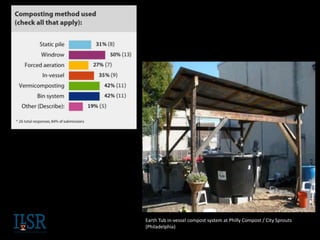
Earth Tub in-vessel compost system at Philly Compost / City Sprouts
(Philadelphia)
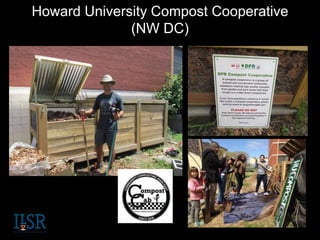
Howard University Compost Cooperative
(NW DC)
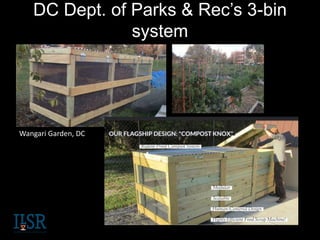
DC Dept. of Parks & Rec’s 3-bin
system
“Knox” design by Urban Farm Plans (www.urbanfarmplans.com)
Wangari Garden, DC
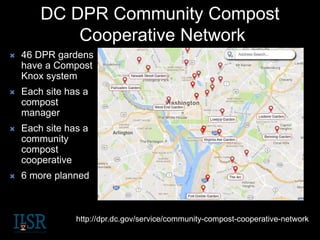
DC DPR Community Compost
Cooperative Network
http://dpr.dc.gov/service/community-compost-cooperative-network
 46 DPR gardens
have a Compost
Knox system
 Each site has a
compost
manager
 Each site has a
community
compost
cooperative
 6 more planned
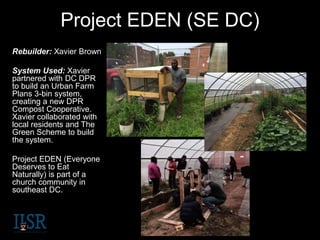
Project EDEN (SE DC)
Rebuilder: Xavier Brown
System Used: Xavier
partnered with DC DPR
to build an Urban Farm
Plans 3-bin system,
creating a new DPR
Compost Cooperative.
Xavier collaborated with
local residents and The
Green Scheme to build
the system.
Project EDEN (Everyone
Deserves to Eat
Naturally) is part of a
church community in
southeast DC.
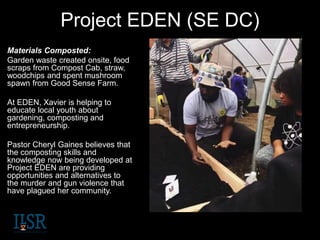
Project EDEN (SE DC)
Materials Composted:
Garden waste created onsite, food
scraps from Compost Cab, straw,
woodchips and spent mushroom
spawn from Good Sense Farm.
At EDEN, Xavier is helping to
educate local youth about
gardening, composting and
entrepreneurship.
Pastor Cheryl Gaines believes that
the composting skills and
knowledge now being developed at
Project EDEN are providing
opportunities and alternatives to
the murder and gun violence that
have plagued her community.
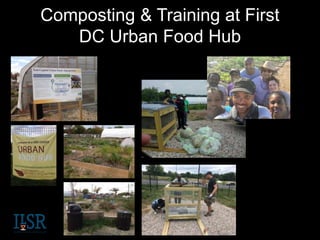
Composting & Training at First
DC Urban Food Hub
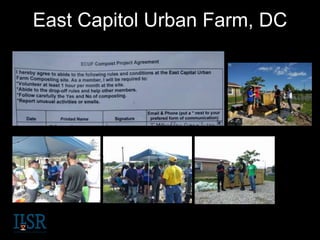
East Capitol Urban Farm, DC
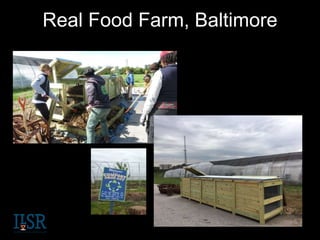
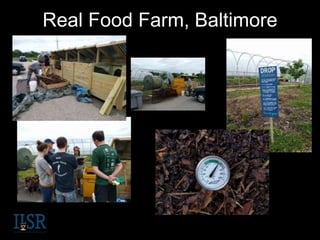
Real Food Farm, Baltimore
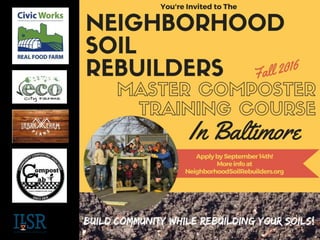
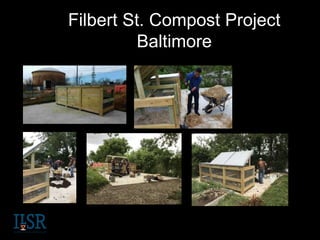
Filbert St. Compost Project
Baltimore
Medium-Scale, Locally-Based
Composting or anaerobic digestion at the small
town or farm scale. These systems handle
typically between 10 and 100 tons per week and
are designed to serve small geographic areas.
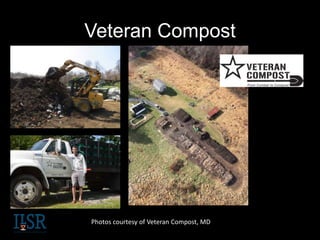
Veteran Compost
Photos courtesy of Veteran Compost, MD
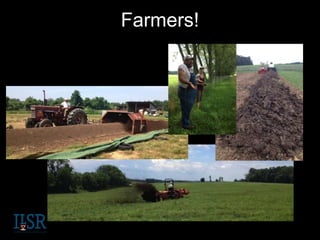
Farmers!
Ag Choice, NJ example
“Small to midsize facilities, like Ag Choice, cannot survive under the current Class
C permit structure [in New Jersey]...
We now are permitted to process 38,000 cubic yards per year and currently
employ 16 full time staff members, and five individuals from our local ARC
program. What we have found is that bigger is not always better. We have
designed and operate a midsize facility that is controllable and profitable...
Quite frankly, we do not want to become a monster Class C facility. We firmly
believe we can be successful and impactful by keeping things smaller and more
manageable.”
– Jay Fischer, Founder & CEO
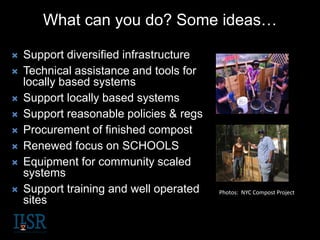
What can you do? Some ideas…
 Support diversified infrastructure
 Technical assistance and tools for
locally based systems
 Support locally based systems
 Support reasonable policies & regs
 Procurement of finished compost
 Renewed focus on SCHOOLS
 Equipment for community scaled
systems
 Support training and well operated
sites
Photos: NYC Compost Project
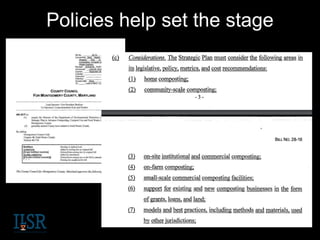
Policies help set the stage
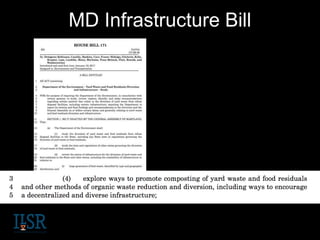
MD Infrastructure Bill
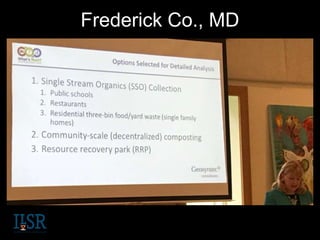
Frederick Co., MD
Hierarchy to Reduce Food
Waste and Grow Community
Support a Distributed System
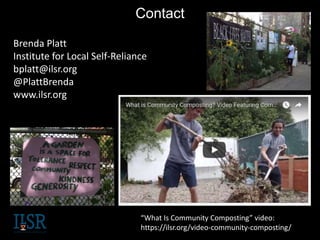
Contact
Brenda Platt
Institute for Local Self-Reliance
bplatt@ilsr.org
@PlattBrenda
www.ilsr.org
“What Is Community Composting” video:
https://ilsr.org/video-community-composting/

The Important Role for Micro and Community Composting

  • 1.
    A G RO U N D B U I L D I N G O P P O R T U N I T Y M I C R O A N D C O M M U N I T Y C O M P O S T I N G A v i t a l p a r t o f s u s t a i n a b l e f u t u r e U S C C A n n u a l C o n f e r e n c e & T r a d e S h o w J a n u a r y 2 3 r d , 2 0 1 8 , A t l a n t a Brenda Platt, @PlattBrenda Institute for Local Self-Reliance, @ilsr Composting for Community Project
  • 2.
    Our Mission: To provideinnovative strategies, working models and timely information to support environmentally sound and equitable community development. Programs: Waste to Wealth Composting for Community Community Banking Community Owned Broadband Energy Democracy Community Scaled Economy The Public Good Blog
  • 4.
    Job Creation: Reclamation vs.Disposal Type of Operation Jobs/ 10,000 TPY Computer Reuse 296 Textile Reclamation 85 Misc. Durables Reuse 62 Wooden Pallet Repair 28 Recycling-Based Manufacturers 25 Conventional MRFs 10 Composting 4 Disposal Facilities 1 MRF = materials recovery facility TPY = tons per year
  • 6.
  • 8.
    5th National CultivatingCommunity Composting Forum and Best Practices in Community Composting Workshop Monday and Tuesday in Atlanta, here at the US Composting Council!
  • 9.
    Should we relyon only regional mega-facilities?
  • 10.
    Makes It Harderto Improve Local Soil
  • 11.
  • 12.
    Places that arehome to numerous locally owned businesses are more prosperous, sustainable, and resilient than those in which much of the economy is controlled by a few big corporations.
  • 13.
    Composting = LocalJobs  Organics do not ship well  Composting is small-scale  Jobs are local  Compost products are used locally  Dollars circulate within local economies  Local = good for local economies  Composting linked to urban food production  Composting diversifies farm products and saves money Ned Foley, Two Particular Acres
  • 14.
    Smaller facilities employ moreper ton Company Small Medium Large Number of facilities 10 7 6 Range in size TPY 16 - 4,000 5,400 – 19,010 20,000 – 75,000 Range in FTE Jobs 1 - 8 2 - 10 5 - 26 Total TPY Processed 21,306 79,278 257,646 Total FTE Jobs 29 47 71 Jobs/10,000 TPY 13.6 5.9 2.8 Source: Brenda Platt, et. al, Pay Dirt: Composting in Maryland to Reduce Waste, Create Jobs & Protect the Bay, ILSR, May 2013. www.ilsr.org/paydirt FTE = full-time equivalent TPY = tons per year Photo courtesy of Veteran Compost, MD
  • 15.
    US EPA Hierarchyof Food Scrap Recovery
  • 16.
  • 17.
    Earth Flow, Univ.of Maine University of Maine (Orono). Finished compost is used on campus as a soil amendment, for landscaping, farming, and for horticultural classes. Goal is to produce 10 lbs of salad mix per day for one of the cafeterias.
  • 18.
    O2 Aerated CompostBins: St. John’s University, New York City (Photo: O2 Compost)
  • 19.
    Howard Co. Dept.of Corrections (Jessup, MD)
  • 20.
    Hierarchy to ReduceFood Waste and Grow Community What about local? Scale?
  • 21.
    Source Reduction Prevention. Donot generate food waste in the first place! Reduce portions, buy what you need, and organize your fridge for optimal food usage.
  • 22.
    Edible Food Rescue Feedhungry people. Divert food not suitable for people to animals such as backyard chickens or to local farmers’ livestock.
  • 23.
    Home Composting Composting inbackyards or in homes. Avoid collection costs!
  • 24.
    Small-Scale, Decentralized Onsite compostingor anaerobic digestion, and community composters can accept material from off-site or simply process their own material.
  • 25.
    Medium-Scale, Locally-Based Composting oranaerobic digestion at the small town or farm scale. These systems handle typically between 10 and 100 tons per week and are designed to serve small geographic areas.
  • 26.
    Centralized Composting or AnaerobicDigestion Facilities serving large geographic areas that typically handle more than 100 tons per week. Material generally leaves the community in which it is generated.
  • 27.
    Mechanical Biological Mixed WasteTreatment Mixed garbage is mechanically and biologically processed to recover recyclables and reduce waste volume and the potential for methane emissions before landfill disposal.
  • 28.
    Landfill and Incinerator Foodwaste should be banned from landfills and trash incinerators due to their high capital costs, pollution, and contribution to greenhouse gas emissions.
  • 29.
    Home Composting Composting inbackyards or in homes. Avoid collection costs!
  • 30.
    Orlando – GetDirty for Valentine’s Day  FREE bins to City of Orlando residents o Free home delivery o Assembled o The Earth Machine  Launch February 14, 2015 “Get Dirty” Campaign o Get Dirty for Valentine’s Day o Get Dirty with Your Neighbors  3,068 delivered as of April 2016
  • 31.
    Small-Scale, Decentralized Onsite compostingor anaerobic digestion, and community composters can accept material from off-site or simply process their own material.
  • 32.
    Community Composting –growing fast Compost builds community! Download the free Growing Local Fertility: A Guide to Community Composting at www.ilsr.org/growing-local-fertility
  • 33.
    Principles of CommunityComposting  Resources recovered  Locally based and closed loop  Organic materials returned to soils  Community-scaled and diverse  Community engaged, empowered, and educated  Community supported Compost builds community!
  • 34.
    Types of CommunityPrograms 1. Community gardens 2. Farms 3. Schools 4. Drop-off networks 5. Collection entrepreneurs 6. On-site composters 7. Off-site composters 8. Demonstration and community leader training sites 9. Worker-owned cooperatives 10. Home-based or homesteader hubs Philly Compost offers pedal-powered collection service to neighboring restaurants within a 2-mile radius (Philadelphia)
  • 35.
  • 36.
    The BK ROTmodel in the Bushwick neighborhood of Brooklyn, NY
  • 37.
    Worker-owned Cooperatives Roots CompostingFarmer Pirates Pedal People
  • 38.
    CERO – Bostonarea co-op Photo credit: Boston Impact Initiative (http://bostonimpact.com) www.cero.coop
  • 39.
    Urban Farms Red Hook CommunityFarm, Brooklyn Growing Power, Milwaukee ECO City Farms, Bladensburg (MD)
  • 40.
    Red Hook CommunityFarm (Brooklyn)
  • 41.
    Red Hook CommunityFarm (Brooklyn)
  • 42.
  • 43.
    Ramona Unified SchoolDistrict (CA) Gloria Quinn, Ramona Unified School District, “School District Implements Food Recovery Hierarchy,” BioCycle, April 6, 2016, San Diego. 2014-2015  Source reduction = 2,860 lbs  Fed people = 7,280 lbs  Fed animals = 3,840 lbs  Composted = 6,576 lbs A cost benefit >$18,000 in 2015
  • 44.
    Earth Tub in-vesselcompost system at Philly Compost / City Sprouts (Philadelphia)
  • 45.
    Howard University CompostCooperative (NW DC)
  • 46.
    DC Dept. ofParks & Rec’s 3-bin system “Knox” design by Urban Farm Plans (www.urbanfarmplans.com) Wangari Garden, DC
  • 47.
    DC DPR CommunityCompost Cooperative Network http://dpr.dc.gov/service/community-compost-cooperative-network  46 DPR gardens have a Compost Knox system  Each site has a compost manager  Each site has a community compost cooperative  6 more planned
  • 48.
    Project EDEN (SEDC) Rebuilder: Xavier Brown System Used: Xavier partnered with DC DPR to build an Urban Farm Plans 3-bin system, creating a new DPR Compost Cooperative. Xavier collaborated with local residents and The Green Scheme to build the system. Project EDEN (Everyone Deserves to Eat Naturally) is part of a church community in southeast DC.
  • 49.
    Project EDEN (SEDC) Materials Composted: Garden waste created onsite, food scraps from Compost Cab, straw, woodchips and spent mushroom spawn from Good Sense Farm. At EDEN, Xavier is helping to educate local youth about gardening, composting and entrepreneurship. Pastor Cheryl Gaines believes that the composting skills and knowledge now being developed at Project EDEN are providing opportunities and alternatives to the murder and gun violence that have plagued her community.
  • 50.
    Composting & Trainingat First DC Urban Food Hub
  • 51.
  • 53.
    Real Food Farm,Baltimore
  • 54.
    Real Food Farm,Baltimore
  • 55.
    Filbert St. CompostProject Baltimore
  • 56.
    Medium-Scale, Locally-Based Composting oranaerobic digestion at the small town or farm scale. These systems handle typically between 10 and 100 tons per week and are designed to serve small geographic areas.
  • 57.
    Veteran Compost Photos courtesyof Veteran Compost, MD
  • 58.
  • 59.
    Ag Choice, NJexample “Small to midsize facilities, like Ag Choice, cannot survive under the current Class C permit structure [in New Jersey]... We now are permitted to process 38,000 cubic yards per year and currently employ 16 full time staff members, and five individuals from our local ARC program. What we have found is that bigger is not always better. We have designed and operate a midsize facility that is controllable and profitable... Quite frankly, we do not want to become a monster Class C facility. We firmly believe we can be successful and impactful by keeping things smaller and more manageable.” – Jay Fischer, Founder & CEO
  • 60.
    What can youdo? Some ideas…  Support diversified infrastructure  Technical assistance and tools for locally based systems  Support locally based systems  Support reasonable policies & regs  Procurement of finished compost  Renewed focus on SCHOOLS  Equipment for community scaled systems  Support training and well operated sites Photos: NYC Compost Project
  • 61.
  • 62.
  • 63.
  • 64.
    Hierarchy to ReduceFood Waste and Grow Community Support a Distributed System
  • 65.
    Contact Brenda Platt Institute forLocal Self-Reliance bplatt@ilsr.org @PlattBrenda www.ilsr.org “What Is Community Composting” video: https://ilsr.org/video-community-composting/