“The Implementation of One-Way Road Policy
At Barangay District 01, Benito Soliven Isabela:
An Assessment”
In Partial Fulfilment of the Researcher
For the Subject
Practical Research 1
Benito Soliven National HighSchool
Division of Isabela
Municipality of Benito Soliven
Submitted by:
Lovely Mae Bueno Gracel
Parangan
Roselle Durwin Sherile Basa
Angelica Hamtig Jan Ulysses
Bulanadi
Princess Joy Lintao Joey Corpuz
Sharina Obien Romar
Salaguinto
Submitted to:
Mr. Arvee Butac
CHAPTER 1
Introduction
 Historically, Carabao served as the primary transportation source in the
early age which assist or support them to attain their needs and help them in
their works. But when things are being modernized, transportation has been
improved and developed a lot. At the same time, there is a vehicular mass
that invented every year that people should have their own for their services.
The most popular vehicular mass in the Philippines is the jeepney that
symbolize as Philippine culture and this is the start were a variety of
attractive vehicles exist. This is the reason why there is such a traffic along the
roads and highways that should have to take an action and make some
solution.
 In a long period of time, population continue to increase and the areas
are filled with the renovated houses and Business. When the generation
continues to grow and community develop, there are problems encountered
by the people just like congestion in the areas, the roads are not enough to
accommodate the increasing number of vehicles in a year because the people
used to have their own vehicles for comfort and this is some of the reason for
having accidents. In many years passed, as Mayor Roberto T. Lungan sited
as Mayor of Benito Soliven, Isabela, in order to solve this problem, he
implemented the one-way road policy for the reason that number of
casualties in the road accidents decreased, the vehicles should have to
organize and same as the drivers to manage them in knowing their limitation
and less for the tendency of doing violation.
 One-way road policy comes from the one-way street
system that first to introduce at London near the river
Thames that is ordered by their King to regulate traffic
within the area that was made in 1617. This system started
to develop and adapt to the other country and became a
one-way road in the Philippines that started to establish in
the different areas around it especially to the narrow way
place.
 Nowadays, there is an uncontrollable increase of motor
vehicles, it will not be very easy for the government to create
policies in order to fully eliminate the unending traffic
problems. One-way road is said to be effective on streets
that it is not enough to accommodate two-way path for the
vehicles. The said policy can help the traffic to move freely, it
also helps the community to have a well-organized way and
to help the pedestrian being alert or responsive to their
surroundings.
The current situation of our community leads us to be
aware and make us realize on what we must do. Leaders
must help each other in obtaining a well-organized public
ways and highways. So, it is important to study the
research topic for the reason that we must consider one’s
opinion or people’s opinion.
 The researchers conducted the study at District 1, Benito
Soliven, Isabela to accumulate ideas and concerns from the
citizen in identifying the improvements made after one-way
road policy has been implemented.
Statement of the Problem
Generally, this study aims to assess the feedback of each respondent on the
implementation of “One-Way Road Policy”. Specifically, it sought to answer the following
questions formulated by the researcher:
1. What are the problems encountered by the residents prior to the implementation of
One-way road policy?
2. How did the One-way road policy improve the transportation at Barangay District 01?
3. What are the reactions of the residents to the implementation of One-way road
policy?
Conceptual Framework
 As stated in REPUBLIC ACT No. 4136, this is an act to compile the laws
relative to land transportation and traffic rules, to create a land
transportation commission and for other purposes. Then, it is suggested that
the local government should implement a policy related to traffics on roads
and highways. The possible outcome has a greater impact on the people who
are affected by it. This may help everyone to unite them improving their
community.
 There is also stated in REPUBLIC ACT NO. 10752 SECTION 3. NATIONAL
GOVERNMENT PROJECTS. As used in this Act, the term “National
Government Projects” shall refer to all national government infrastructure
projects and its public service facilities, Engineering works and service,
contract, including projects undertaken by a government-owned and
controlled corporation all projects. This meant to say that one of the
responsible people in making a policy is the Local Government Unit. So, they
have the ability to manage the community same as to the people.
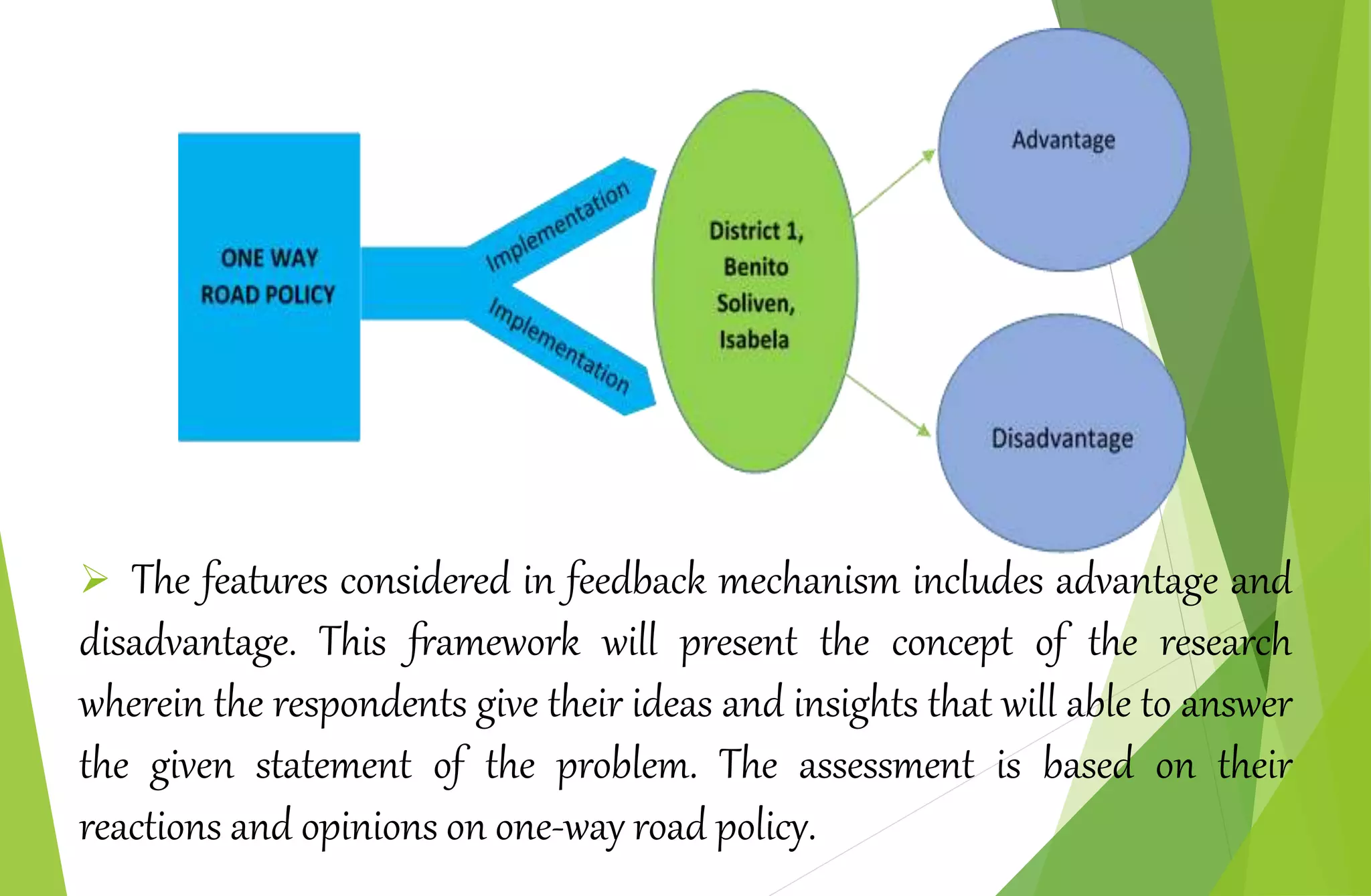
 The features considered in feedback mechanism includes advantage and
disadvantage. This framework will present the concept of the research
wherein the respondents give their ideas and insights that will able to answer
the given statement of the problem. The assessment is based on their
reactions and opinions on one-way road policy.
Significance of the Study
 The result of the study will surely help the Local
Government of Benito Soliven as their basis in improving
the one-way road policy to evade road accidents, congestion
and traffic problems.
 The result will also provide essential information on the
issues and concern of the society.
 The result of the study will also help the other researchers
or next researchers related to the study. This will help them
to have a basis, additional knowledge or can put it in their
related studies.
Scope and Delimitation
 This study focused on assessing the one-way road policy
which implemented by Local Government of Benito Soliven
for the residents of District 1, Benito Soliven, Isabela.
 This study is limited in assessing the implementation of
one-way road policy by the Local Government of Benito
Soliven, Isabela.
Definition of Terms
To ensure accurate and consistent understanding of a study, the
following terms are hereby operationally defined.
 Advantage – A condition or circumstance that puts one in a favourable or
superior position.
 Congestion – (Traffic) A condition on transport networks that occurs as
use increases, and is characterized by slower speeds, longer trip times, and
increased vehicular queue. (In Areas) A result of overcrowding that makes
the area to have a lack of space.
 Disadvantage – A favourable circumstance or condition that reduces the
chances of success or effectiveness.
 Local Government – The administration of a particular town, country, or
district with representatives elected by those who live there.
 One-Way Street – It is a street either facilitating only one-way traffic, or
designed to direct vehicles to move in one direction.
 Pedestrian – A person walking along or in a developed area.
 Transportation – It is an action of transporting someone or something. It
is a process of being transported.
CHAPTER 2
Review of Related Literature and Studies
This chapter presents and discusses the wealth of literature
and studies related to the present research topic being studied.
This chapter will begin with an examination. The part of this
chapter will explore literature and studies related to:
TRAFFICCONTROL
This review explains that the purpose of a traffic
control system is too maintaining safety, to
decrease the congestion between vehicles and
pedestrians and to solve the problems on the roads
or highways.
The highways and roads progress has been declining
because of the modernization wherein there are a lot
of fashionable cars or vehicles today. But because of
traffic control, they are able to maintain the space in
traffic, it is not expensive for the government just like
the one-way street. But then, it also requires money
but not as much as expensive for the signage needed.
This can help everyone to maintain the safety on the
roads or streets, to limit those vehicles who attempt
to overtake other vehicles. Whoever violates it there
is a punishment as stated in the JOINT
ADMINISTRATIVE ORDER NO. 2014-01 by the
Department of Transportation and Communication
(DOTC). In traffic control, they establish coding
with the use of plate numbers to limit those vehicles
traveling along the road to lessen the traffic. In
addition, with the use of “coding”, they could easily
determine the persons who violated the rule.
Transportation
Policy is a planned line of conduct in the light of which individual
decisions are made and coordination achieved, (GROLIER
ENCYCLOPEDIA OF KNOWLEDGE, 2004). So, it should be in the
process of planning not just creating, making and constructing without
any preparation. This can led to ineffective and not sufficient enough to
help the individuals. Effective policy should be: a well-planned and
organize; for community development; for the safeties, securities, or
protection of the citizen and should approved by the officials and same
as the society. A policy should be related to the objective that it is capable.
In addition, it should not only be for personal feelings but should be based
on the facts that we need this policy. So, a policy should supported or
compatible with the public interest and being suggested by others and it
must be necessary for the community. The policy must be easy to understand
that people must know what must be to do. A policy is not just a deal that
people must go with the flow but people should know how it was. The
manager or management should examine, inspect and analyse on the
changes within the policy because a successful implementation can only see
in the initiative of the management, (Giacchino and Kakabadse, 2003).
According to O’Toole (2003, p266) establishing a policy is a part of the
government to make some effort and to do something.
The value of Traffic Management
Generally, we all know that the goal of traffic management is to
reduce traffics, to prevent accidents and to lessen the number of road
casualties.
There are also traffic management in London because they have also
to control the intersection in the parking areas in the street. This mean to
say that mostly on the street should have to organize and manage roads.
There are factors affecting the capacity according to J.M Thomson.
1. Changes in the network itself.
2.Parking restrictions.
3.A higher standard of parking.
4.Efficiency of the vehicles.
As a whole, there are lack of improvements on the roads that need to
be aware by the management so that the people will not be affected by it.
Advantage and Disadvantage of One-Way Street
One way street is one of the issue today because narrow places are
hard to manage especially to the congested areas. This can be more
efficient if all of the people are have to be going on with this policy.
Because this policy can help them to achieve the goal of their community
and to maintain safety around the area. On the other side, this can be
balanced with the objective such as Business Retention, pedestrian
convenience, and community revitalization, (Thomson, 2004). So, it has
an objective to prioritize some of the reasons why they need to implement
one-way road policy.
Why one-way
In one way street, there is a capacity that motorist would not encounter
traffic problems because of the tendency that it controls every vehicle who
passed in the area by signalizing them. The purpose of signalizing is for the
people to be aware of the turning movements and intersections to reduce
conflicts. There are some benefits in One-way street:
 It improved Traffic Flow.
 It Lower Cost.
 It Reduced Conflicts.
This is considered as advantages on a one-way street and it is good to
know that this system is effective.
Why not one-way
In traffic operation, it must consider the system of roadway wherein it
should be in a single direction only but then there are some drivers don’t
know where is the right path that this can cause an increasing number of the
turning movements. For example, the drivers are not aware of the no entry
signs and he entered to it, then, in the end, he is on the wrong way. Thus,
there is a tendency for traffics and accidents or otherwise, this can lead him
to go back to the right way. Another, it is considered that it can use a lot of
time and efforts, much expenditure and need to be organized always. It
means that there should be a security to inform drivers in the right path and
manage them.
One-way system generally yields 120 to 160% more turning movements
when compared to a two‐way system, and travel distances from a downtown
entry point to destination is usually 20 to 50% greater in a one way system
when compared to a two‐way system, (Walker, Kulash and McHugh, 2001).
This means that there are also disadvantages that are to be considered in the
study. Hence, we should always consider it because sometimes we
misinterpret the suggestions of the people.
On the other side, there are people much like the two-way street for
unfamiliar drivers especially to the visitors who are not aware in the
conduction. In addition, a two-way street system will allow the drivers to
stop in opposite direction then this means that it can eliminate confusing
situation.
There are problems that we can encounter on a one-way street:
 The increase in Motorist Inattentiveness.
 Increased Imbalance in Traffic Volumes.
 Increased Environmental Injustice.
 Difficulty in Entering or Exiting the Street.
 The increase in Pedestrian Discomfort.
 Increase in Inconvenience.
 Increased Inducement to Sprawl.
 The increase in Moving Violations.
 Increased “Barrier Effect.
 The increase in Motorist Impatience.
 Reduced Safety
So, it means that there are many advantages one-way street system and
this can be proven based on the result of this research.
Assessment of a One-Way Policy in a major road: the case of
Quezon Avenue in Vigan City, Ilocos Sur
This is a thesis study assessing a one-way policy that is related to this
research.
The objective of the study is:
1. To characterize the major road under study.
2. To gather parking data.
3. To determine the average speed of vehicles that travel along Quezon
Avenue.
4. To determine the volume of pedestrians crossing Quezon Avenue.
5. To determine the level of service of the intersections.
6. To characterize the respondents’ attributes and analyse the perceptions of
respondents on the necessity, acceptability, and impact of a one-way scheme.
7. To test the relationship between the level of necessity and the
characteristics of respondents, and to compare the level of necessity and level
of acceptability towards the one-way scheme policy.
In this study, it considered also the following as basis in assessing the
one-way policy, (Franklyn T. Amistad, 2012).
 Vehicle on Street-Parking
 Speed of Vehicles
 Pedestrian
 Level of Service (LOS)
 Respondents’ Attribute
 Level of Necessity of the One-way Scheme
 Level of Attainment of the Objectives of Establishing the One-way Scheme.
 Level of Driving Attitudes of Bigueños on the One-way Scheme along
Quezon Avenue.
 Establishing the Relationship between the Level of Necessity of a One-way
Scheme along Quezon Avenue and the Profile of Residents in Vigan City.
 Comparison Between the of Level of Attitudes towards Walking and the
Level of Driving Attitudes of Bigueños Towards the One-way Scheme Along
Quezon Avenue.
This means that in assessing one-way road policy should consider it as
based on the objectives given to accumulate findings and data. The result of
the study are able to know the accessibility and capability of one-way policy
in Vigan City. Both advantage and disadvantage also exist in the study.
Meaning to say that there is a tendency that in this research it will exist.
Example of disadvantage is that the avenue is unsignalize. Example of
advantage is a good sight-passing distance because of signalize between
intersection they regulate drivers and pedestrian to be aware on the
intersections on the road.

The implementation of one way road policy

  • 1.
    “The Implementation ofOne-Way Road Policy At Barangay District 01, Benito Soliven Isabela: An Assessment” In Partial Fulfilment of the Researcher For the Subject Practical Research 1 Benito Soliven National HighSchool Division of Isabela Municipality of Benito Soliven
  • 2.
    Submitted by: Lovely MaeBueno Gracel Parangan Roselle Durwin Sherile Basa Angelica Hamtig Jan Ulysses Bulanadi Princess Joy Lintao Joey Corpuz Sharina Obien Romar Salaguinto Submitted to: Mr. Arvee Butac
  • 3.
    CHAPTER 1 Introduction  Historically,Carabao served as the primary transportation source in the early age which assist or support them to attain their needs and help them in their works. But when things are being modernized, transportation has been improved and developed a lot. At the same time, there is a vehicular mass that invented every year that people should have their own for their services. The most popular vehicular mass in the Philippines is the jeepney that symbolize as Philippine culture and this is the start were a variety of attractive vehicles exist. This is the reason why there is such a traffic along the roads and highways that should have to take an action and make some solution.
  • 4.
     In along period of time, population continue to increase and the areas are filled with the renovated houses and Business. When the generation continues to grow and community develop, there are problems encountered by the people just like congestion in the areas, the roads are not enough to accommodate the increasing number of vehicles in a year because the people used to have their own vehicles for comfort and this is some of the reason for having accidents. In many years passed, as Mayor Roberto T. Lungan sited as Mayor of Benito Soliven, Isabela, in order to solve this problem, he implemented the one-way road policy for the reason that number of casualties in the road accidents decreased, the vehicles should have to organize and same as the drivers to manage them in knowing their limitation and less for the tendency of doing violation.
  • 5.
     One-way roadpolicy comes from the one-way street system that first to introduce at London near the river Thames that is ordered by their King to regulate traffic within the area that was made in 1617. This system started to develop and adapt to the other country and became a one-way road in the Philippines that started to establish in the different areas around it especially to the narrow way place.
  • 6.
     Nowadays, thereis an uncontrollable increase of motor vehicles, it will not be very easy for the government to create policies in order to fully eliminate the unending traffic problems. One-way road is said to be effective on streets that it is not enough to accommodate two-way path for the vehicles. The said policy can help the traffic to move freely, it also helps the community to have a well-organized way and to help the pedestrian being alert or responsive to their surroundings.
  • 7.
    The current situationof our community leads us to be aware and make us realize on what we must do. Leaders must help each other in obtaining a well-organized public ways and highways. So, it is important to study the research topic for the reason that we must consider one’s opinion or people’s opinion.
  • 8.
     The researchersconducted the study at District 1, Benito Soliven, Isabela to accumulate ideas and concerns from the citizen in identifying the improvements made after one-way road policy has been implemented.
  • 9.
    Statement of theProblem Generally, this study aims to assess the feedback of each respondent on the implementation of “One-Way Road Policy”. Specifically, it sought to answer the following questions formulated by the researcher: 1. What are the problems encountered by the residents prior to the implementation of One-way road policy? 2. How did the One-way road policy improve the transportation at Barangay District 01? 3. What are the reactions of the residents to the implementation of One-way road policy?
  • 10.
    Conceptual Framework  Asstated in REPUBLIC ACT No. 4136, this is an act to compile the laws relative to land transportation and traffic rules, to create a land transportation commission and for other purposes. Then, it is suggested that the local government should implement a policy related to traffics on roads and highways. The possible outcome has a greater impact on the people who are affected by it. This may help everyone to unite them improving their community.
  • 11.
     There isalso stated in REPUBLIC ACT NO. 10752 SECTION 3. NATIONAL GOVERNMENT PROJECTS. As used in this Act, the term “National Government Projects” shall refer to all national government infrastructure projects and its public service facilities, Engineering works and service, contract, including projects undertaken by a government-owned and controlled corporation all projects. This meant to say that one of the responsible people in making a policy is the Local Government Unit. So, they have the ability to manage the community same as to the people.
  • 12.
     The featuresconsidered in feedback mechanism includes advantage and disadvantage. This framework will present the concept of the research wherein the respondents give their ideas and insights that will able to answer the given statement of the problem. The assessment is based on their reactions and opinions on one-way road policy.
  • 13.
    Significance of theStudy  The result of the study will surely help the Local Government of Benito Soliven as their basis in improving the one-way road policy to evade road accidents, congestion and traffic problems.  The result will also provide essential information on the issues and concern of the society.
  • 14.
     The resultof the study will also help the other researchers or next researchers related to the study. This will help them to have a basis, additional knowledge or can put it in their related studies.
  • 15.
    Scope and Delimitation This study focused on assessing the one-way road policy which implemented by Local Government of Benito Soliven for the residents of District 1, Benito Soliven, Isabela.  This study is limited in assessing the implementation of one-way road policy by the Local Government of Benito Soliven, Isabela.
  • 16.
    Definition of Terms Toensure accurate and consistent understanding of a study, the following terms are hereby operationally defined.  Advantage – A condition or circumstance that puts one in a favourable or superior position.  Congestion – (Traffic) A condition on transport networks that occurs as use increases, and is characterized by slower speeds, longer trip times, and increased vehicular queue. (In Areas) A result of overcrowding that makes the area to have a lack of space.  Disadvantage – A favourable circumstance or condition that reduces the chances of success or effectiveness.
  • 17.
     Local Government– The administration of a particular town, country, or district with representatives elected by those who live there.  One-Way Street – It is a street either facilitating only one-way traffic, or designed to direct vehicles to move in one direction.  Pedestrian – A person walking along or in a developed area.  Transportation – It is an action of transporting someone or something. It is a process of being transported.
  • 18.
    CHAPTER 2 Review ofRelated Literature and Studies This chapter presents and discusses the wealth of literature and studies related to the present research topic being studied. This chapter will begin with an examination. The part of this chapter will explore literature and studies related to:
  • 19.
    TRAFFICCONTROL This review explainsthat the purpose of a traffic control system is too maintaining safety, to decrease the congestion between vehicles and pedestrians and to solve the problems on the roads or highways.
  • 20.
    The highways androads progress has been declining because of the modernization wherein there are a lot of fashionable cars or vehicles today. But because of traffic control, they are able to maintain the space in traffic, it is not expensive for the government just like the one-way street. But then, it also requires money but not as much as expensive for the signage needed.
  • 21.
    This can helpeveryone to maintain the safety on the roads or streets, to limit those vehicles who attempt to overtake other vehicles. Whoever violates it there is a punishment as stated in the JOINT ADMINISTRATIVE ORDER NO. 2014-01 by the Department of Transportation and Communication (DOTC). In traffic control, they establish coding with the use of plate numbers to limit those vehicles traveling along the road to lessen the traffic. In addition, with the use of “coding”, they could easily determine the persons who violated the rule.
  • 22.
    Transportation Policy is aplanned line of conduct in the light of which individual decisions are made and coordination achieved, (GROLIER ENCYCLOPEDIA OF KNOWLEDGE, 2004). So, it should be in the process of planning not just creating, making and constructing without any preparation. This can led to ineffective and not sufficient enough to help the individuals. Effective policy should be: a well-planned and organize; for community development; for the safeties, securities, or protection of the citizen and should approved by the officials and same as the society. A policy should be related to the objective that it is capable.
  • 23.
    In addition, itshould not only be for personal feelings but should be based on the facts that we need this policy. So, a policy should supported or compatible with the public interest and being suggested by others and it must be necessary for the community. The policy must be easy to understand that people must know what must be to do. A policy is not just a deal that people must go with the flow but people should know how it was. The manager or management should examine, inspect and analyse on the changes within the policy because a successful implementation can only see in the initiative of the management, (Giacchino and Kakabadse, 2003). According to O’Toole (2003, p266) establishing a policy is a part of the government to make some effort and to do something.
  • 24.
    The value ofTraffic Management Generally, we all know that the goal of traffic management is to reduce traffics, to prevent accidents and to lessen the number of road casualties. There are also traffic management in London because they have also to control the intersection in the parking areas in the street. This mean to say that mostly on the street should have to organize and manage roads.
  • 25.
    There are factorsaffecting the capacity according to J.M Thomson. 1. Changes in the network itself. 2.Parking restrictions. 3.A higher standard of parking. 4.Efficiency of the vehicles. As a whole, there are lack of improvements on the roads that need to be aware by the management so that the people will not be affected by it.
  • 26.
    Advantage and Disadvantageof One-Way Street One way street is one of the issue today because narrow places are hard to manage especially to the congested areas. This can be more efficient if all of the people are have to be going on with this policy. Because this policy can help them to achieve the goal of their community and to maintain safety around the area. On the other side, this can be balanced with the objective such as Business Retention, pedestrian convenience, and community revitalization, (Thomson, 2004). So, it has an objective to prioritize some of the reasons why they need to implement one-way road policy.
  • 27.
    Why one-way In oneway street, there is a capacity that motorist would not encounter traffic problems because of the tendency that it controls every vehicle who passed in the area by signalizing them. The purpose of signalizing is for the people to be aware of the turning movements and intersections to reduce conflicts. There are some benefits in One-way street:  It improved Traffic Flow.  It Lower Cost.  It Reduced Conflicts. This is considered as advantages on a one-way street and it is good to know that this system is effective.
  • 28.
    Why not one-way Intraffic operation, it must consider the system of roadway wherein it should be in a single direction only but then there are some drivers don’t know where is the right path that this can cause an increasing number of the turning movements. For example, the drivers are not aware of the no entry signs and he entered to it, then, in the end, he is on the wrong way. Thus, there is a tendency for traffics and accidents or otherwise, this can lead him to go back to the right way. Another, it is considered that it can use a lot of time and efforts, much expenditure and need to be organized always. It means that there should be a security to inform drivers in the right path and manage them.
  • 29.
    One-way system generallyyields 120 to 160% more turning movements when compared to a two‐way system, and travel distances from a downtown entry point to destination is usually 20 to 50% greater in a one way system when compared to a two‐way system, (Walker, Kulash and McHugh, 2001). This means that there are also disadvantages that are to be considered in the study. Hence, we should always consider it because sometimes we misinterpret the suggestions of the people. On the other side, there are people much like the two-way street for unfamiliar drivers especially to the visitors who are not aware in the conduction. In addition, a two-way street system will allow the drivers to stop in opposite direction then this means that it can eliminate confusing situation.
  • 30.
    There are problemsthat we can encounter on a one-way street:  The increase in Motorist Inattentiveness.  Increased Imbalance in Traffic Volumes.  Increased Environmental Injustice.  Difficulty in Entering or Exiting the Street.  The increase in Pedestrian Discomfort.  Increase in Inconvenience.  Increased Inducement to Sprawl.  The increase in Moving Violations.  Increased “Barrier Effect.
  • 31.
     The increasein Motorist Impatience.  Reduced Safety So, it means that there are many advantages one-way street system and this can be proven based on the result of this research.
  • 32.
    Assessment of aOne-Way Policy in a major road: the case of Quezon Avenue in Vigan City, Ilocos Sur This is a thesis study assessing a one-way policy that is related to this research. The objective of the study is: 1. To characterize the major road under study. 2. To gather parking data. 3. To determine the average speed of vehicles that travel along Quezon Avenue.
  • 33.
    4. To determinethe volume of pedestrians crossing Quezon Avenue. 5. To determine the level of service of the intersections. 6. To characterize the respondents’ attributes and analyse the perceptions of respondents on the necessity, acceptability, and impact of a one-way scheme. 7. To test the relationship between the level of necessity and the characteristics of respondents, and to compare the level of necessity and level of acceptability towards the one-way scheme policy.
  • 34.
    In this study,it considered also the following as basis in assessing the one-way policy, (Franklyn T. Amistad, 2012).  Vehicle on Street-Parking  Speed of Vehicles  Pedestrian  Level of Service (LOS)  Respondents’ Attribute  Level of Necessity of the One-way Scheme  Level of Attainment of the Objectives of Establishing the One-way Scheme.
  • 35.
     Level ofDriving Attitudes of Bigueños on the One-way Scheme along Quezon Avenue.  Establishing the Relationship between the Level of Necessity of a One-way Scheme along Quezon Avenue and the Profile of Residents in Vigan City.  Comparison Between the of Level of Attitudes towards Walking and the Level of Driving Attitudes of Bigueños Towards the One-way Scheme Along Quezon Avenue.
  • 36.
    This means thatin assessing one-way road policy should consider it as based on the objectives given to accumulate findings and data. The result of the study are able to know the accessibility and capability of one-way policy in Vigan City. Both advantage and disadvantage also exist in the study. Meaning to say that there is a tendency that in this research it will exist. Example of disadvantage is that the avenue is unsignalize. Example of advantage is a good sight-passing distance because of signalize between intersection they regulate drivers and pedestrian to be aware on the intersections on the road.