Introduced to: Dr. Alaa
Done by: Haitham ALSheyadi 85753
         Yousuf ALKaabi    86471
Comparison    Comparative study               Non-Comparative
Item                                          study
Study Title   A Comparison       of Student
              Outcomes & Satisfaction Between         Post-Secondary
              Traditional & Web Based Course Students’ Purposes for
              Offerings                       Blogging

Author        Julio C. Rivera &              Paul Leslie
              Margaret         L.       Rice Elizabeth Murphy

Type          Learners’ perception      and Non-Comparative
              performance
Comparison      Comparative study                      Non-Comparative
Item                                                   study
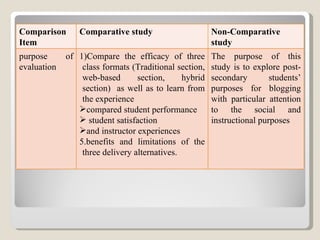
purpose      of 1)Compare the efficacy of three        The purpose of this
evaluation       class formats (Traditional section,   study is to explore post-
                 web-based       section,     hybrid   secondary        students’
                 section) as well as to learn from     purposes for blogging
                 the experience                        with particular attention
                compared student performance          to the social and
                 student satisfaction                 instructional purposes
                and instructor experiences
                5.benefits and limitations of the
                 three delivery alternatives.
Comparison    Comparative study                     Non-Comparative
Item                                                study
Participant   The number of students were:          •9 students of the
               41 in the traditional course        2005-2006 group of
               section                              Foundation           year
              53 in the web based course           students.
               section                              •all of whom created a
               40 in the hybrid course section     blog to which they made
              (Note: all the three sections         at least one posting. All
               studied      Introduction       to   students are:
               Information Systems course)           Emirati citizens
                                                    Females
                                                    and between 17 and 20
                                                    years old
                                                    (Note: The sample of
                                                    blogs came from an all-
                                                    women’s college in the
                                                    United Arab Emirates. )
Comparison    Comparative study        Non-Comparative study
Item
Instruments   multiple-choice          Rourke et al. (2001) test to
              exams using questions      analyze content and assessing
              selected by the            social presence.
              instructors from the      Gunawardena et al. (1997)
              publisher’s test bank      model (“explain the process by
              ( to evaluate students     which       construction     of
              performance)               knowledge occurred )
              a researcher-            interviews
              developed                  .(Look some examples of the interview
              questionnaire (To
              evaluate students
              satisfaction)
              Chi square test of
              independence
Comparison   Comparative study                     Non-Comparative
Item                                               study
Results                                            the primary use of
             tudent Performance:                   blogging was for social
                                                   purposes.
             here was no significant difference    Self-disclosure was the
             in student performance, regardless    most notable purpose for
             of the class format                   blogging ,in addition to
                                                   sharing        emotional
                                                   responses to learning.
             tudent Satisfaction:                  The lack of teaching
                                                   nature     may      have
             tudents were not completely           influenced students’ use
             satisfied with the web based          of blogging for social
             course offering (less technological   rather than instructional
             mastery ,The student instructional    purposes.
             experience)
Comparison Item   Comparative study                      Non-Comparative study


advantages                                               •Need more focus and use for the
                  tudents    should     be  informed     blogs for instructional purposes
                  regarding       course     delivery    •Encourage teachers to use blog
                  methodology and the requirements       in instructional process
                  for student participation

                  upport for web delivered classes
                  needs    to be expanded.    Both
                  students and instructors require
                  support.


limitations                                              •It is unclear how having
                  here is no guarantee that a            mixed-gender classes might
                                                         have   affected   the  social
                  homogenous cross-section enrolled
                                                         presence    and    knowledge
                  in each course section                 construction    in     which
                                                         students engaged.
                  wo different instructors taught the
                  three sections. Obviously each
                  instructor would place emphasis on
                  different topics and conduct the
                  class in a slightly different manner
Course Section            Exam Score Average


Traditional Class                      74.85


Hybrid Class                           73.35


Web based Class                        73.97


               Table 1: Exam Score Average


                                                     Back
Question                     Traditiona Hybrid     Web        based
                             l Class    Class      Class

Method of Presentation 3.632            3.235      2.419
Easy to Follow

Improved Understanding 3.421            3.059      2.545
of      Concepts       and
Principles
Explained          Difficult 3.632      3.059      2.484
Material Clearly

     (Table 2: Student Course Section Selection (# Students

                                                               Back
Section          Yes        No

Traditional Class 35        3

Hybrid Class     30         4

Web based Class 33          17


   Table 3: Student Satisfaction by Class )#
                  )Students
                                               Back
Why    did you select the pictures and images or
 fonts colours?
 What motivated you to post?
  What motivated you to comment on others’ blogs?
 How useful or not useful were others comments to
 you?


Some of the interview questions:
                                             Back
   C. , Julio & L. Margaret, “A Comparison of Student Outcomes &
    Satisfaction Between Traditional & Web Based Course Offerings”, Fall
    2002 [Online] Journal of Distance Learning Administration,
    http://www.westga.edu/~distance/ojdla/fall53/rivera53.html (Accessed:
    April 30/2008)

   Leslie, Paul; Murphy, Elizabeth, “Post-Secondary Students’ Purposes for
    Blogging”, October 2008. [online] Journal of Distance Learning
    Administration. Available:
    http://www.irrodl.org/index.php/irrodl/article/view/560/1099 [Accessed:
    April 30/2008]


References:
Comparative and non comparative evaluation studies

Comparative and non comparative evaluation studies

  • 1.
    Introduced to: Dr.Alaa Done by: Haitham ALSheyadi 85753 Yousuf ALKaabi 86471
  • 2.
    Comparison Comparative study Non-Comparative Item study Study Title A Comparison of Student Outcomes & Satisfaction Between Post-Secondary Traditional & Web Based Course Students’ Purposes for Offerings Blogging Author Julio C. Rivera & Paul Leslie Margaret L. Rice Elizabeth Murphy Type Learners’ perception and Non-Comparative performance
  • 3.
    Comparison Comparative study Non-Comparative Item study purpose of 1)Compare the efficacy of three The purpose of this evaluation class formats (Traditional section, study is to explore post- web-based section, hybrid secondary students’ section) as well as to learn from purposes for blogging the experience with particular attention compared student performance to the social and  student satisfaction instructional purposes and instructor experiences 5.benefits and limitations of the three delivery alternatives.
  • 4.
    Comparison Comparative study Non-Comparative Item study Participant The number of students were: •9 students of the  41 in the traditional course 2005-2006 group of section Foundation year 53 in the web based course students. section •all of whom created a  40 in the hybrid course section blog to which they made (Note: all the three sections at least one posting. All studied Introduction to students are: Information Systems course)  Emirati citizens Females and between 17 and 20 years old (Note: The sample of blogs came from an all- women’s college in the United Arab Emirates. )
  • 5.
    Comparison Comparative study Non-Comparative study Item Instruments multiple-choice  Rourke et al. (2001) test to exams using questions analyze content and assessing selected by the social presence. instructors from the  Gunawardena et al. (1997) publisher’s test bank model (“explain the process by ( to evaluate students which construction of performance) knowledge occurred ) a researcher-  interviews developed .(Look some examples of the interview questionnaire (To evaluate students satisfaction) Chi square test of independence
  • 6.
    Comparison Comparative study Non-Comparative Item study Results the primary use of tudent Performance: blogging was for social purposes. here was no significant difference Self-disclosure was the in student performance, regardless most notable purpose for of the class format blogging ,in addition to sharing emotional responses to learning. tudent Satisfaction: The lack of teaching nature may have tudents were not completely influenced students’ use satisfied with the web based of blogging for social course offering (less technological rather than instructional mastery ,The student instructional purposes. experience)
  • 7.
    Comparison Item Comparative study Non-Comparative study advantages •Need more focus and use for the tudents should be informed blogs for instructional purposes regarding course delivery •Encourage teachers to use blog methodology and the requirements in instructional process for student participation upport for web delivered classes needs to be expanded. Both students and instructors require support. limitations •It is unclear how having here is no guarantee that a mixed-gender classes might have affected the social homogenous cross-section enrolled presence and knowledge in each course section construction in which students engaged. wo different instructors taught the three sections. Obviously each instructor would place emphasis on different topics and conduct the class in a slightly different manner
  • 8.
    Course Section Exam Score Average Traditional Class 74.85 Hybrid Class 73.35 Web based Class 73.97 Table 1: Exam Score Average Back
  • 9.
    Question Traditiona Hybrid Web based l Class Class Class Method of Presentation 3.632 3.235 2.419 Easy to Follow Improved Understanding 3.421 3.059 2.545 of Concepts and Principles Explained Difficult 3.632 3.059 2.484 Material Clearly (Table 2: Student Course Section Selection (# Students Back
  • 10.
    Section Yes No Traditional Class 35 3 Hybrid Class 30 4 Web based Class 33 17 Table 3: Student Satisfaction by Class )# )Students Back
  • 11.
    Why did you select the pictures and images or fonts colours? What motivated you to post?  What motivated you to comment on others’ blogs? How useful or not useful were others comments to you? Some of the interview questions: Back
  • 12.
    C. , Julio & L. Margaret, “A Comparison of Student Outcomes & Satisfaction Between Traditional & Web Based Course Offerings”, Fall 2002 [Online] Journal of Distance Learning Administration, http://www.westga.edu/~distance/ojdla/fall53/rivera53.html (Accessed: April 30/2008)  Leslie, Paul; Murphy, Elizabeth, “Post-Secondary Students’ Purposes for Blogging”, October 2008. [online] Journal of Distance Learning Administration. Available: http://www.irrodl.org/index.php/irrodl/article/view/560/1099 [Accessed: April 30/2008] References: