Govt P U College High School section Hithala
Shikaripur Tq|| Shivamogga Dt||
10th Standard
PHYSICS
Subject Teacher: GADDIGAPPA K S
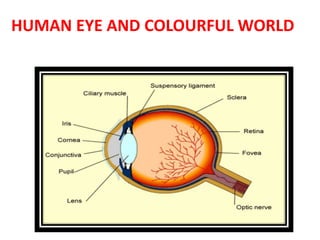
HUMAN EYE AND COLOURFUL WORLD
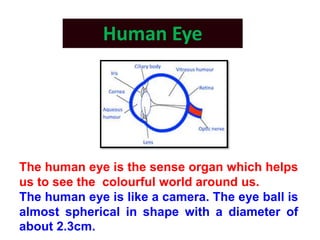
Human Eye
The human eye is the sense organ which helps
us to see the colourful world around us.
The human eye is like a camera. The eye ball is
almost spherical in shape with a diameter of
about 2.3cm.
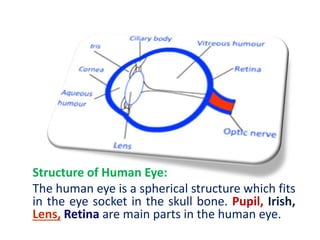
Structure of Human Eye:
The human eye is a spherical structure which fits
in the eye socket in the skull bone. Pupil, Irish,
Lens, Retina are main parts in the human eye.
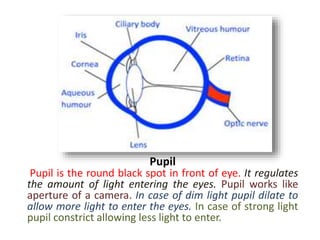
Pupil
Pupil is the round black spot in front of eye. It regulates
the amount of light entering the eyes. Pupil works like
aperture of a camera. In case of dim light pupil dilate to
allow more light to enter the eyes. In case of strong light
pupil constrict allowing less light to enter.
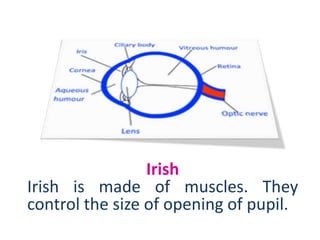
Irish
Irish is made of muscles. They
control the size of opening of pupil.
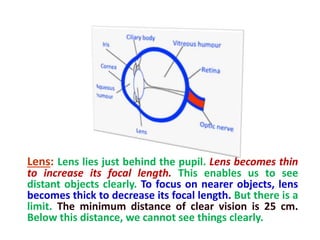
Lens: Lens lies just behind the pupil. Lens becomes thin
to increase its focal length. This enables us to see
distant objects clearly. To focus on nearer objects, lens
becomes thick to decrease its focal length. But there is a
limit. The minimum distance of clear vision is 25 cm.
Below this distance, we cannot see things clearly.
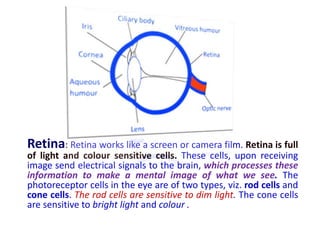
Retina: Retina works like a screen or camera film. Retina is full
of light and colour sensitive cells. These cells, upon receiving
image send electrical signals to the brain, which processes these
information to make a mental image of what we see. The
photoreceptor cells in the eye are of two types, viz. rod cells and
cone cells. The rod cells are sensitive to dim light. The cone cells
are sensitive to bright light and colour .
Light enters the eye through a transparent membrane
called cornea.
The ciliary muscles helps to change the curvature
of the lens and to change its focal length
Working of the eye :-
The eye lens forms a real inverted image of the object
on the retina. The light sensitive cells in the retina then
produce electrical signals which are carried by the optic
nerves to the brain. The brain processes the information
and sends the message to the eye and then we see the
object.
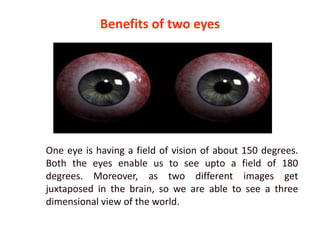
One eye is having a field of vision of about 150 degrees.
Both the eyes enable us to see upto a field of 180
degrees. Moreover, as two different images get
juxtaposed in the brain, so we are able to see a three
dimensional view of the world.
Benefits of two eyes
The human eye can clearly see a nearby object as
well as an object on infinity. This ability of the
human eye is called the power of accommodation
of human eye.
Power of Accommodation of Human Eye
Malfunctions of Eyes
 Cataract
 Myopia
 Hypermetropia
 Presbyopia
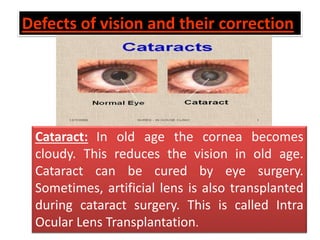
Cataract: In old age the cornea becomes
cloudy. This reduces the vision in old age.
Cataract can be cured by eye surgery.
Sometimes, artificial lens is also transplanted
during cataract surgery. This is called Intra
Ocular Lens Transplantation.
Defects of vision and their correction
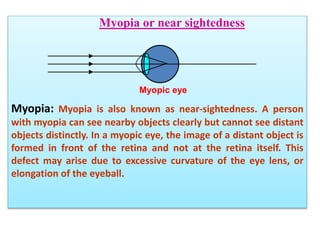
Myopia or near sightedness
Myopia: Myopia is also known as near-sightedness. A person
with myopia can see nearby objects clearly but cannot see distant
objects distinctly. In a myopic eye, the image of a distant object is
formed in front of the retina and not at the retina itself. This
defect may arise due to excessive curvature of the eye lens, or
elongation of the eyeball.
Myopic eye
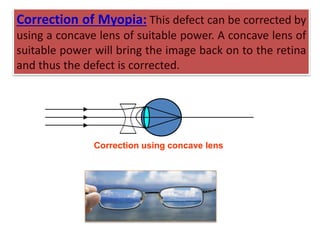
Correction using concave lens
Correction of Myopia: This defect can be corrected by
using a concave lens of suitable power. A concave lens of
suitable power will bring the image back on to the retina
and thus the defect is corrected.
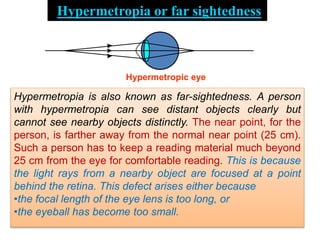
Hypermetropia or far sightedness
Hypermetropic eye
Hypermetropia is also known as far-sightedness. A person
with hypermetropia can see distant objects clearly but
cannot see nearby objects distinctly. The near point, for the
person, is farther away from the normal near point (25 cm).
Such a person has to keep a reading material much beyond
25 cm from the eye for comfortable reading. This is because
the light rays from a nearby object are focused at a point
behind the retina. This defect arises either because
•the focal length of the eye lens is too long, or
•the eyeball has become too small.
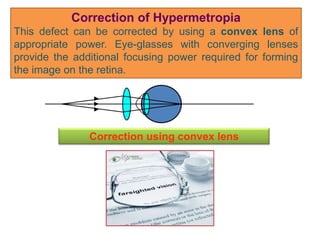
Correction using convex lens
Correction of Hypermetropia
This defect can be corrected by using a convex lens of
appropriate power. Eye-glasses with converging lenses
provide the additional focusing power required for forming
the image on the retina.
Presbyopia
The power of accommodation of the eye usually decreases
with ageing. For most people, the near point gradually recedes
away. They find it difficult to see nearby objects comfortably
and distinctly without corrective eye-glasses. This defect is
called Presbyopia.
It arises due to the gradual weakening of the ciliary muscles
and diminishing flexibility of the eye lens. Sometimes, a
person may suffer from both myopia and hypermetropia. Such
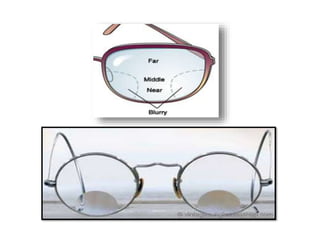
people often require bifocal lenses.
A common type of bi-focal lenses consists of both concave and
convex lenses. The upper portion consists of a concave lens. It
facilitates distant vision. The lower part is a convex lens. It
facilitates near vision.
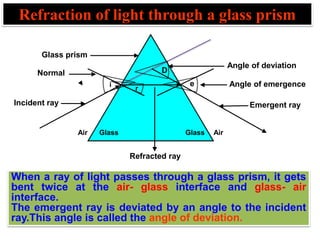
Refraction of light through a glass prism
When a ray of light passes through a glass prism, it gets
bent twice at the air- glass interface and glass- air
interface.
The emergent ray is deviated by an angle to the incident
ray.This angle is called the angle of deviation.
Incident ray
Refracted ray
Emergent ray
D
i
r
Air Glass Glass Air
Glass prism
e Angle of emergence
Angle of deviation
Normal
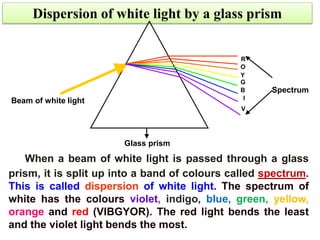
Dispersion of white light by a glass prism
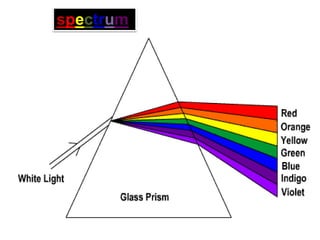
When a beam of white light is passed through a glass
prism, it is split up into a band of colours called spectrum.
This is called dispersion of white light. The spectrum of
white has the colours violet, indigo, blue, green, yellow,
orange and red (VIBGYOR). The red light bends the least
and the violet light bends the most.
Beam of white light
Spectrum
R
O
Y
G
I
B
V
Glass prism
spectrum
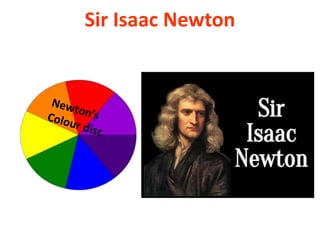
Sir Isaac Newton
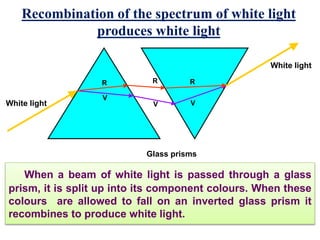
Recombination of the spectrum of white light
produces white light
R
V
V
R R
When a beam of white light is passed through a glass
prism, it is split up into its component colours. When these
colours are allowed to fall on an inverted glass prism it
recombines to produce white light.
VWhite light
White light
Glass prisms
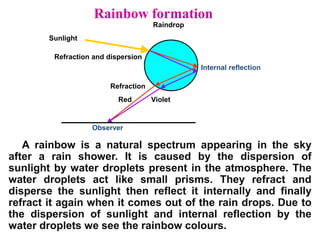
Rainbow formation
A rainbow is a natural spectrum appearing in the sky
after a rain shower. It is caused by the dispersion of
sunlight by water droplets present in the atmosphere. The
water droplets act like small prisms. They refract and
disperse the sunlight then reflect it internally and finally
refract it again when it comes out of the rain drops. Due to
the dispersion of sunlight and internal reflection by the
water droplets we see the rainbow colours.
Sunlight
Raindrop
Red Violet
Refraction and dispersion
Internal reflection
Observer
Refraction
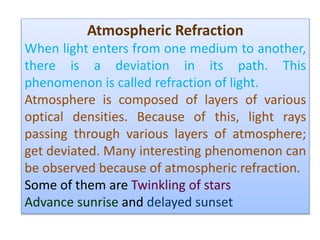
Atmospheric Refraction
When light enters from one medium to another,
there is a deviation in its path. This
phenomenon is called refraction of light.
Atmosphere is composed of layers of various
optical densities. Because of this, light rays
passing through various layers of atmosphere;
get deviated. Many interesting phenomenon can
be observed because of atmospheric refraction.
Some of them are Twinkling of stars
Advance sunrise and delayed sunset
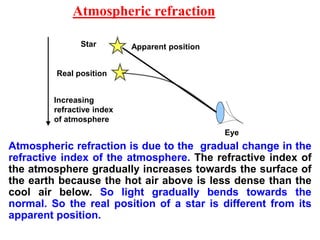
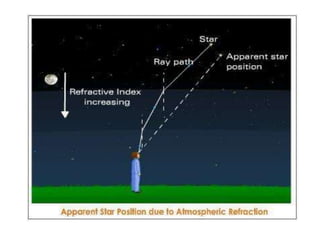
Atmospheric refraction
Atmospheric refraction is due to the gradual change in the
refractive index of the atmosphere. The refractive index of
the atmosphere gradually increases towards the surface of
the earth because the hot air above is less dense than the
cool air below. So light gradually bends towards the
normal. So the real position of a star is different from its
apparent position.
Apparent position
Real position
Eye
Star
Increasing
refractive index
of atmosphere
Twinkling of stars
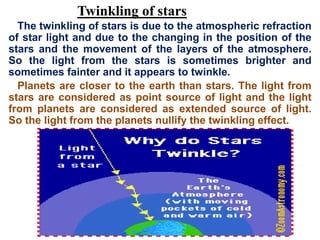
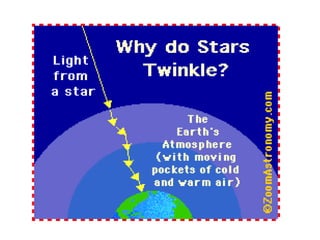
The twinkling of stars is due to the atmospheric refraction
of star light and due to the changing in the position of the
stars and the movement of the layers of the atmosphere.
So the light from the stars is sometimes brighter and
sometimes fainter and it appears to twinkle.
Planets are closer to the earth than stars. The light from
stars are considered as point source of light and the light
from planets are considered as extended source of light.
So the light from the planets nullify the twinkling effect.
Earth
Observer
SunriseSunset
Apparent positionApparent position
Atmosphere
Advance sunrise and delayed sunset
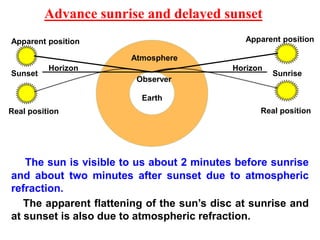
The sun is visible to us about 2 minutes before sunrise
and about two minutes after sunset due to atmospheric
refraction.
The apparent flattening of the sun’s disc at sunrise and
at sunset is also due to atmospheric refraction.
Horizon Horizon
Real position Real position
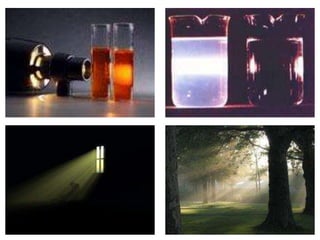
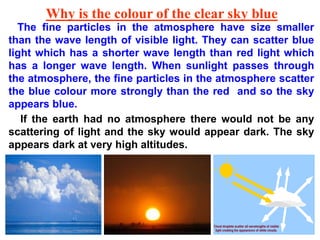
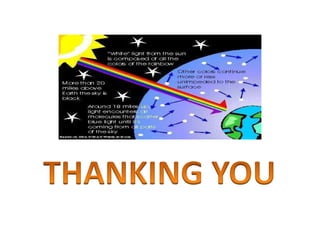
Why is the colour of the clear sky blue
The fine particles in the atmosphere have size smaller
than the wave length of visible light. They can scatter blue
light which has a shorter wave length than red light which
has a longer wave length. When sunlight passes through
the atmosphere, the fine particles in the atmosphere scatter
the blue colour more strongly than the red and so the sky
appears blue.
If the earth had no atmosphere there would not be any
scattering of light and the sky would appear dark. The sky
appears dark at very high altitudes.
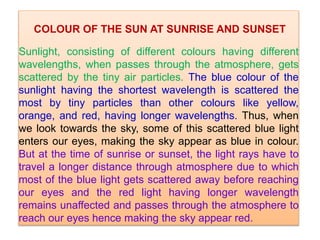
COLOUR OF THE SUN AT SUNRISE AND SUNSET
Sunlight, consisting of different colours having different
wavelengths, when passes through the atmosphere, gets
scattered by the tiny air particles. The blue colour of the
sunlight having the shortest wavelength is scattered the
most by tiny particles than other colours like yellow,
orange, and red, having longer wavelengths. Thus, when
we look towards the sky, some of this scattered blue light
enters our eyes, making the sky appear as blue in colour.
But at the time of sunrise or sunset, the light rays have to
travel a longer distance through atmosphere due to which
most of the blue light gets scattered away before reaching
our eyes and the red light having longer wavelength
remains unaffected and passes through the atmosphere to
reach our eyes hence making the sky appear red.
The human eye presentation

The human eye presentation

  • 1.
    Govt P UCollege High School section Hithala Shikaripur Tq|| Shivamogga Dt|| 10th Standard PHYSICS Subject Teacher: GADDIGAPPA K S
  • 3.
    HUMAN EYE ANDCOLOURFUL WORLD
  • 4.
    Human Eye The humaneye is the sense organ which helps us to see the colourful world around us. The human eye is like a camera. The eye ball is almost spherical in shape with a diameter of about 2.3cm.
  • 5.
    Structure of HumanEye: The human eye is a spherical structure which fits in the eye socket in the skull bone. Pupil, Irish, Lens, Retina are main parts in the human eye.
  • 6.
    Pupil Pupil is theround black spot in front of eye. It regulates the amount of light entering the eyes. Pupil works like aperture of a camera. In case of dim light pupil dilate to allow more light to enter the eyes. In case of strong light pupil constrict allowing less light to enter.
  • 7.
    Irish Irish is madeof muscles. They control the size of opening of pupil.
  • 8.
    Lens: Lens liesjust behind the pupil. Lens becomes thin to increase its focal length. This enables us to see distant objects clearly. To focus on nearer objects, lens becomes thick to decrease its focal length. But there is a limit. The minimum distance of clear vision is 25 cm. Below this distance, we cannot see things clearly.
  • 9.
    Retina: Retina workslike a screen or camera film. Retina is full of light and colour sensitive cells. These cells, upon receiving image send electrical signals to the brain, which processes these information to make a mental image of what we see. The photoreceptor cells in the eye are of two types, viz. rod cells and cone cells. The rod cells are sensitive to dim light. The cone cells are sensitive to bright light and colour .
  • 10.
    Light enters theeye through a transparent membrane called cornea. The ciliary muscles helps to change the curvature of the lens and to change its focal length Working of the eye :- The eye lens forms a real inverted image of the object on the retina. The light sensitive cells in the retina then produce electrical signals which are carried by the optic nerves to the brain. The brain processes the information and sends the message to the eye and then we see the object.
  • 11.
    One eye ishaving a field of vision of about 150 degrees. Both the eyes enable us to see upto a field of 180 degrees. Moreover, as two different images get juxtaposed in the brain, so we are able to see a three dimensional view of the world. Benefits of two eyes
  • 12.
    The human eyecan clearly see a nearby object as well as an object on infinity. This ability of the human eye is called the power of accommodation of human eye. Power of Accommodation of Human Eye
  • 13.
    Malfunctions of Eyes Cataract  Myopia  Hypermetropia  Presbyopia
  • 14.
    Cataract: In oldage the cornea becomes cloudy. This reduces the vision in old age. Cataract can be cured by eye surgery. Sometimes, artificial lens is also transplanted during cataract surgery. This is called Intra Ocular Lens Transplantation. Defects of vision and their correction
  • 15.
    Myopia or nearsightedness Myopia: Myopia is also known as near-sightedness. A person with myopia can see nearby objects clearly but cannot see distant objects distinctly. In a myopic eye, the image of a distant object is formed in front of the retina and not at the retina itself. This defect may arise due to excessive curvature of the eye lens, or elongation of the eyeball. Myopic eye
  • 16.
    Correction using concavelens Correction of Myopia: This defect can be corrected by using a concave lens of suitable power. A concave lens of suitable power will bring the image back on to the retina and thus the defect is corrected.
  • 17.
    Hypermetropia or farsightedness Hypermetropic eye Hypermetropia is also known as far-sightedness. A person with hypermetropia can see distant objects clearly but cannot see nearby objects distinctly. The near point, for the person, is farther away from the normal near point (25 cm). Such a person has to keep a reading material much beyond 25 cm from the eye for comfortable reading. This is because the light rays from a nearby object are focused at a point behind the retina. This defect arises either because •the focal length of the eye lens is too long, or •the eyeball has become too small.
  • 18.
    Correction using convexlens Correction of Hypermetropia This defect can be corrected by using a convex lens of appropriate power. Eye-glasses with converging lenses provide the additional focusing power required for forming the image on the retina.
  • 19.
    Presbyopia The power ofaccommodation of the eye usually decreases with ageing. For most people, the near point gradually recedes away. They find it difficult to see nearby objects comfortably and distinctly without corrective eye-glasses. This defect is called Presbyopia. It arises due to the gradual weakening of the ciliary muscles and diminishing flexibility of the eye lens. Sometimes, a person may suffer from both myopia and hypermetropia. Such people often require bifocal lenses. A common type of bi-focal lenses consists of both concave and convex lenses. The upper portion consists of a concave lens. It facilitates distant vision. The lower part is a convex lens. It facilitates near vision.
  • 21.
    Refraction of lightthrough a glass prism When a ray of light passes through a glass prism, it gets bent twice at the air- glass interface and glass- air interface. The emergent ray is deviated by an angle to the incident ray.This angle is called the angle of deviation. Incident ray Refracted ray Emergent ray D i r Air Glass Glass Air Glass prism e Angle of emergence Angle of deviation Normal
  • 22.
    Dispersion of whitelight by a glass prism When a beam of white light is passed through a glass prism, it is split up into a band of colours called spectrum. This is called dispersion of white light. The spectrum of white has the colours violet, indigo, blue, green, yellow, orange and red (VIBGYOR). The red light bends the least and the violet light bends the most. Beam of white light Spectrum R O Y G I B V Glass prism
  • 23.
  • 24.
  • 25.
    Recombination of thespectrum of white light produces white light R V V R R When a beam of white light is passed through a glass prism, it is split up into its component colours. When these colours are allowed to fall on an inverted glass prism it recombines to produce white light. VWhite light White light Glass prisms
  • 26.
    Rainbow formation A rainbowis a natural spectrum appearing in the sky after a rain shower. It is caused by the dispersion of sunlight by water droplets present in the atmosphere. The water droplets act like small prisms. They refract and disperse the sunlight then reflect it internally and finally refract it again when it comes out of the rain drops. Due to the dispersion of sunlight and internal reflection by the water droplets we see the rainbow colours. Sunlight Raindrop Red Violet Refraction and dispersion Internal reflection Observer Refraction
  • 27.
    Atmospheric Refraction When lightenters from one medium to another, there is a deviation in its path. This phenomenon is called refraction of light. Atmosphere is composed of layers of various optical densities. Because of this, light rays passing through various layers of atmosphere; get deviated. Many interesting phenomenon can be observed because of atmospheric refraction. Some of them are Twinkling of stars Advance sunrise and delayed sunset
  • 28.
    Atmospheric refraction Atmospheric refractionis due to the gradual change in the refractive index of the atmosphere. The refractive index of the atmosphere gradually increases towards the surface of the earth because the hot air above is less dense than the cool air below. So light gradually bends towards the normal. So the real position of a star is different from its apparent position. Apparent position Real position Eye Star Increasing refractive index of atmosphere
  • 30.
    Twinkling of stars Thetwinkling of stars is due to the atmospheric refraction of star light and due to the changing in the position of the stars and the movement of the layers of the atmosphere. So the light from the stars is sometimes brighter and sometimes fainter and it appears to twinkle. Planets are closer to the earth than stars. The light from stars are considered as point source of light and the light from planets are considered as extended source of light. So the light from the planets nullify the twinkling effect.
  • 32.
    Earth Observer SunriseSunset Apparent positionApparent position Atmosphere Advancesunrise and delayed sunset The sun is visible to us about 2 minutes before sunrise and about two minutes after sunset due to atmospheric refraction. The apparent flattening of the sun’s disc at sunrise and at sunset is also due to atmospheric refraction. Horizon Horizon Real position Real position
  • 35.
    Why is thecolour of the clear sky blue The fine particles in the atmosphere have size smaller than the wave length of visible light. They can scatter blue light which has a shorter wave length than red light which has a longer wave length. When sunlight passes through the atmosphere, the fine particles in the atmosphere scatter the blue colour more strongly than the red and so the sky appears blue. If the earth had no atmosphere there would not be any scattering of light and the sky would appear dark. The sky appears dark at very high altitudes.
  • 36.
    COLOUR OF THESUN AT SUNRISE AND SUNSET Sunlight, consisting of different colours having different wavelengths, when passes through the atmosphere, gets scattered by the tiny air particles. The blue colour of the sunlight having the shortest wavelength is scattered the most by tiny particles than other colours like yellow, orange, and red, having longer wavelengths. Thus, when we look towards the sky, some of this scattered blue light enters our eyes, making the sky appear as blue in colour. But at the time of sunrise or sunset, the light rays have to travel a longer distance through atmosphere due to which most of the blue light gets scattered away before reaching our eyes and the red light having longer wavelength remains unaffected and passes through the atmosphere to reach our eyes hence making the sky appear red.