The Horror Genre
Horror Genre Definition
Horror films are described as unsettling films
designed to frighten and panic, cause dread and
alarm, and to invoke our hidden worst fears,
often in a terrifying, shocking finale, while
captivating and entertaining us at the same time
in a cathartic experience.
Horror films effectively centre on the dark side
of life, the forbidden, and strange and alarming
events. They deal with our most primal nature
and its fears: our nightmares, our vulnerability,
our alienation, our revulsions, our terror of the
unknown, our fear of death and dismemberment,
loss of identity, of fear of sexuality.
Changes in society in the history
of the horror genre
First Ever Horror Movie: Begin with the works of George Mellies.
Mellies created what is widely believed the first ever ‘horror’
movie The Haunted Castle in 1898, featuring an incarnation of the
devil.
The Literary Years: 1900-1920 an influx of supernatural-themed
films. Many filmmakers turned to literature classics as source
material. The first adaptation of Frankenstein was released by
Edison Studios in these early days, as well as Dr. Jekyll and Mr.
Hyde and The Werewolf.
The Golden Age of Horror: Widely considered to be the finest era
of the genre, the two decades between the 1920s and 30s saw
many classics being produced. Films such as The Mummy (1932)
and the first colour adaptation of Dr. Jekyll and Mr. Hyde (1931).
The 30s also marked the first time in the industry that the
word ‘horror’ was used to describe the genre. Horror films
started to worry the general public at this point with heavy
censoring and public outcry becoming common with each
release.
Changes in society in the history
of the horror genre
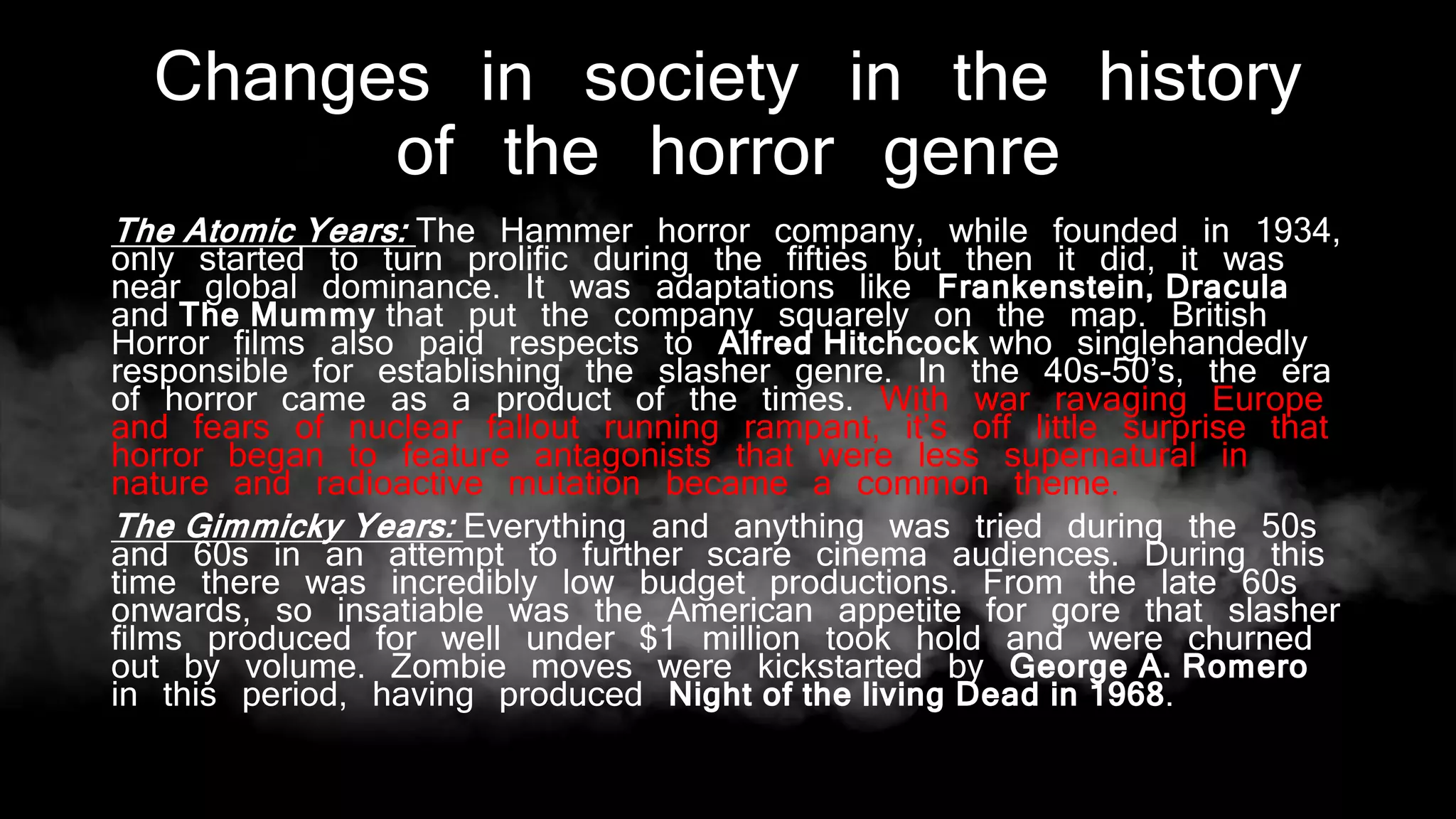
The Atomic Years: The Hammer horror company, while founded in 1934,
only started to turn prolific during the fifties but then it did, it was
near global dominance. It was adaptations like Frankenstein, Dracula
and The Mummy that put the company squarely on the map. British
Horror films also paid respects to Alfred Hitchcock who singlehandedly
responsible for establishing the slasher genre. In the 40s-50’s, the era
of horror came as a product of the times. With war ravaging Europe
and fears of nuclear fallout running rampant, it’s off little surprise that
horror began to feature antagonists that were less supernatural in
nature and radioactive mutation became a common theme.
The Gimmicky Years: Everything and anything was tried during the 50s
and 60s in an attempt to further scare cinema audiences. During this
time there was incredibly low budget productions. From the late 60s
onwards, so insatiable was the American appetite for gore that slasher
films produced for well under $1 million took hold and were churned
out by volume. Zombie moves were kickstarted by George A. Romero
in this period, having produced Night of the living Dead in 1968.
Changes in society in the history
of the horror genre
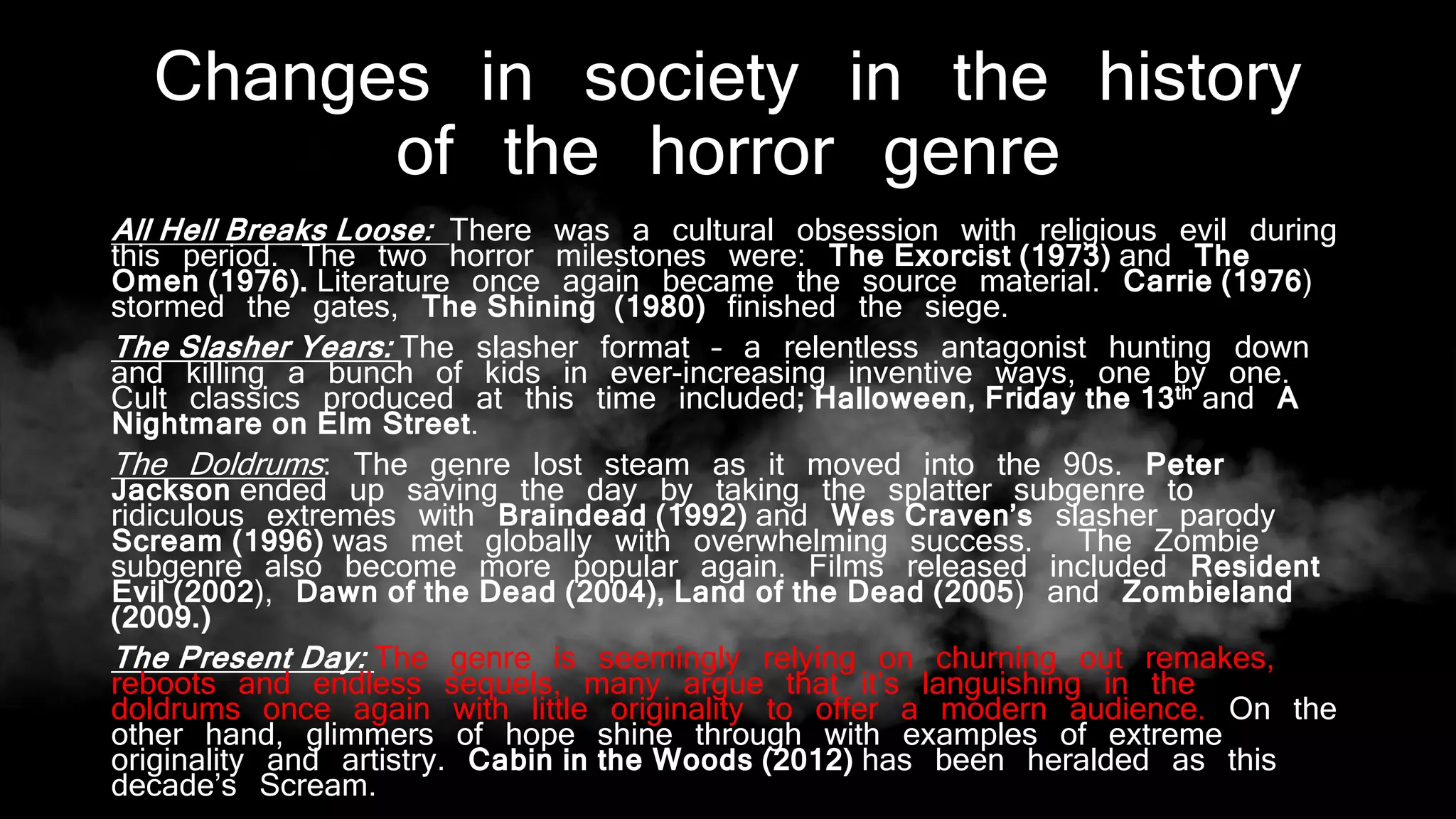
All Hell Breaks Loose: There was a cultural obsession with religious evil during
this period. The two horror milestones were: The Exorcist (1973) and The
Omen (1976). Literature once again became the source material. Carrie (1976)
stormed the gates, The Shining (1980) finished the siege.
The Slasher Years: The slasher format – a relentless antagonist hunting down
and killing a bunch of kids in ever-increasing inventive ways, one by one.
Cult classics produced at this time included; Halloween, Friday the 13th and A
Nightmare on Elm Street.
The Doldrums: The genre lost steam as it moved into the 90s. Peter
Jackson ended up saving the day by taking the splatter subgenre to
ridiculous extremes with Braindead (1992) and Wes Craven’s slasher parody
Scream (1996) was met globally with overwhelming success. The Zombie
subgenre also become more popular again. Films released included Resident
Evil (2002), Dawn of the Dead (2004), Land of the Dead (2005) and Zombieland
(2009.)
The Present Day: The genre is seemingly relying on churning out remakes,
reboots and endless sequels, many argue that it’s languishing in the
doldrums once again with little originality to offer a modern audience. On the
other hand, glimmers of hope shine through with examples of extreme
originality and artistry. Cabin in the Woods (2012) has been heralded as this
decade’s Scream.
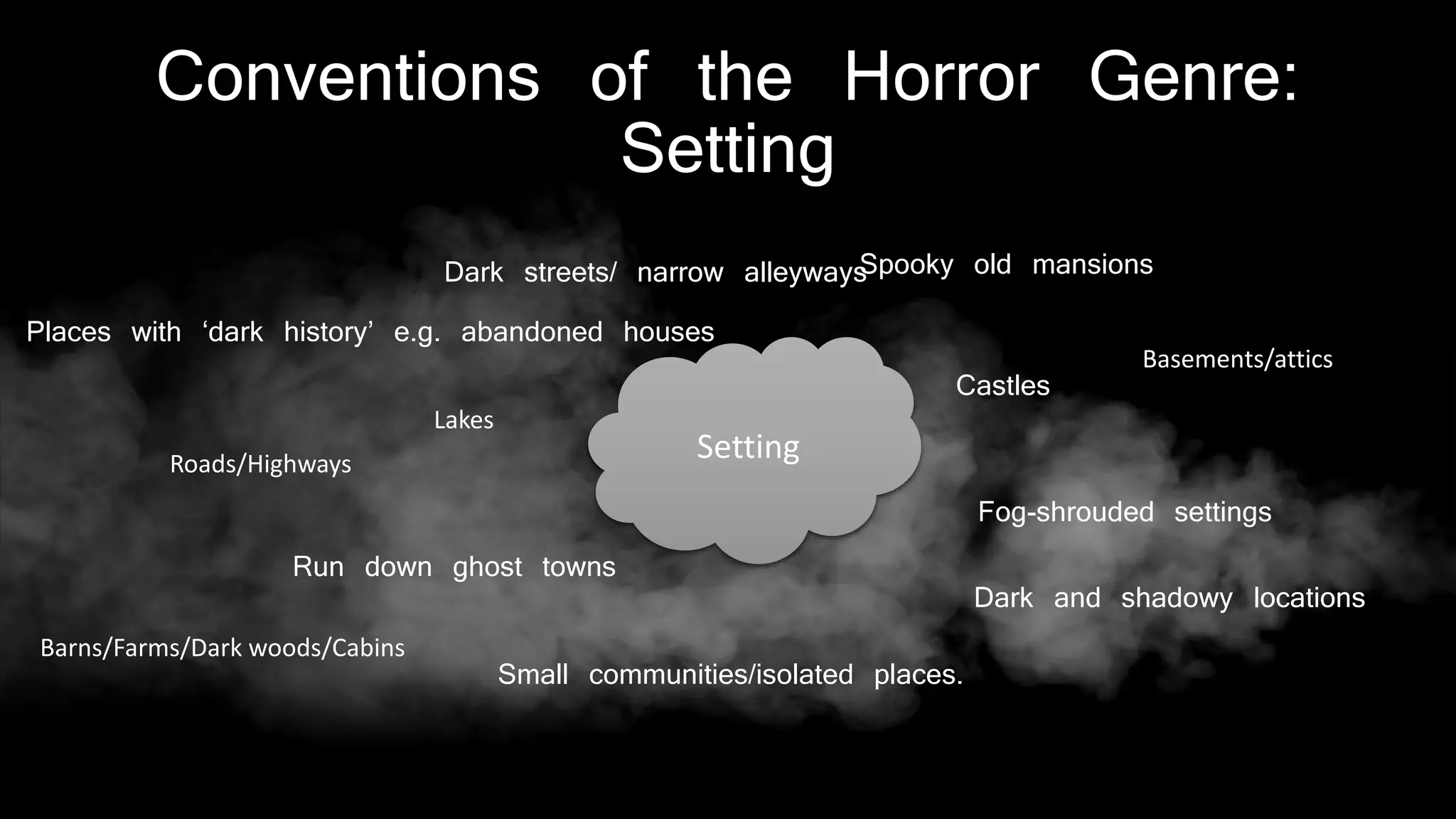
Conventions of the Horror Genre:
Setting
Setting
Spooky old mansions
Castles
Fog-shrouded settings
Dark and shadowy locations
Small communities/isolated places.
Dark streets/ narrow alleyways
Run down ghost towns
Places with ‘dark history’ e.g. abandoned houses
Lakes
Roads/Highways
Barns/Farms/Dark woods/Cabins
Basements/attics
Conventions of the Horror Genre:
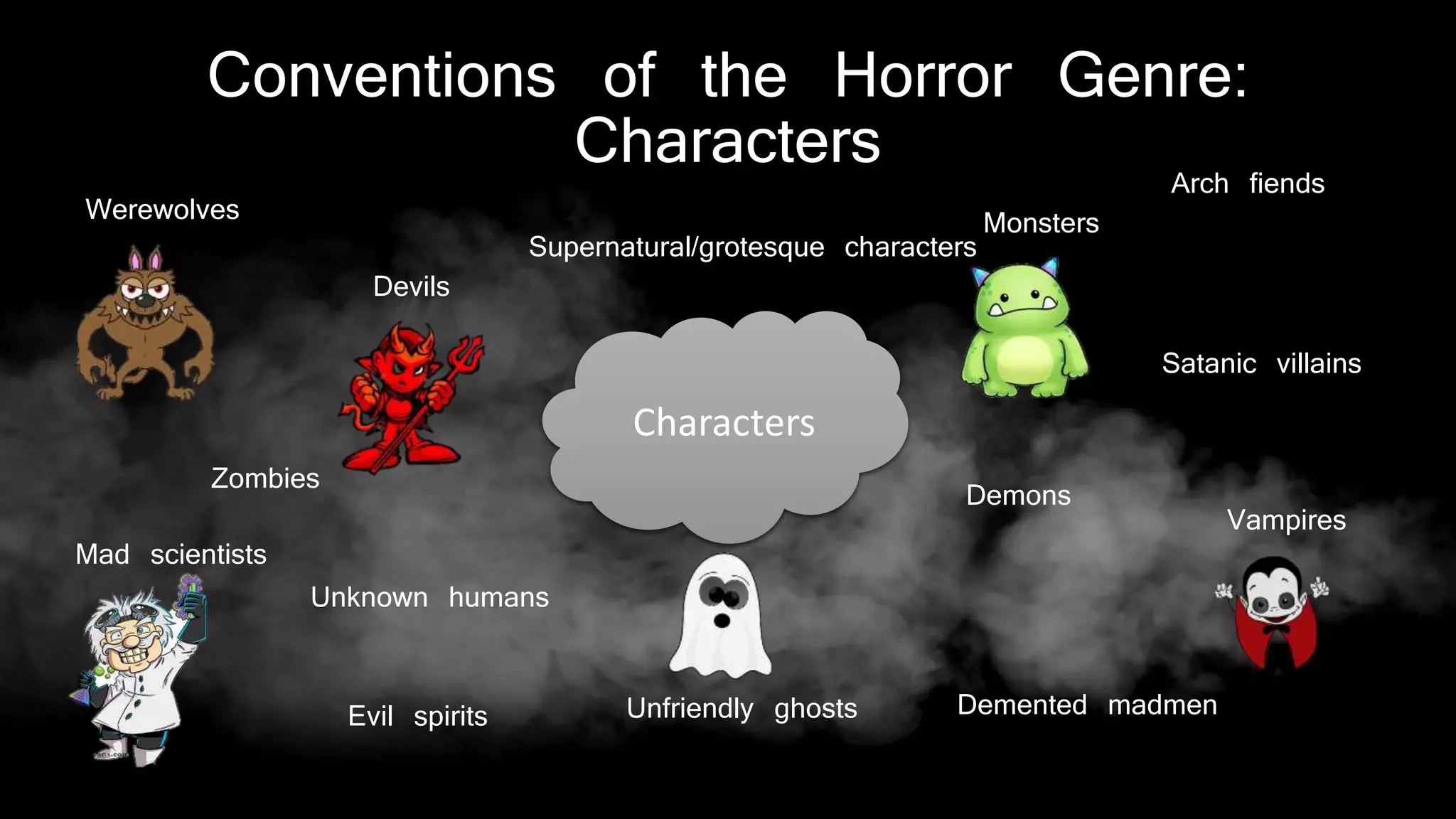
Characters
Werewolves
Characters
Unknown humans
Supernatural/grotesque characters
Vampires
Demented madmen
Devils
Monsters
Mad scientists
Demons
Zombies
Evil spirits
Arch fiends
Unfriendly ghosts
Satanic villains
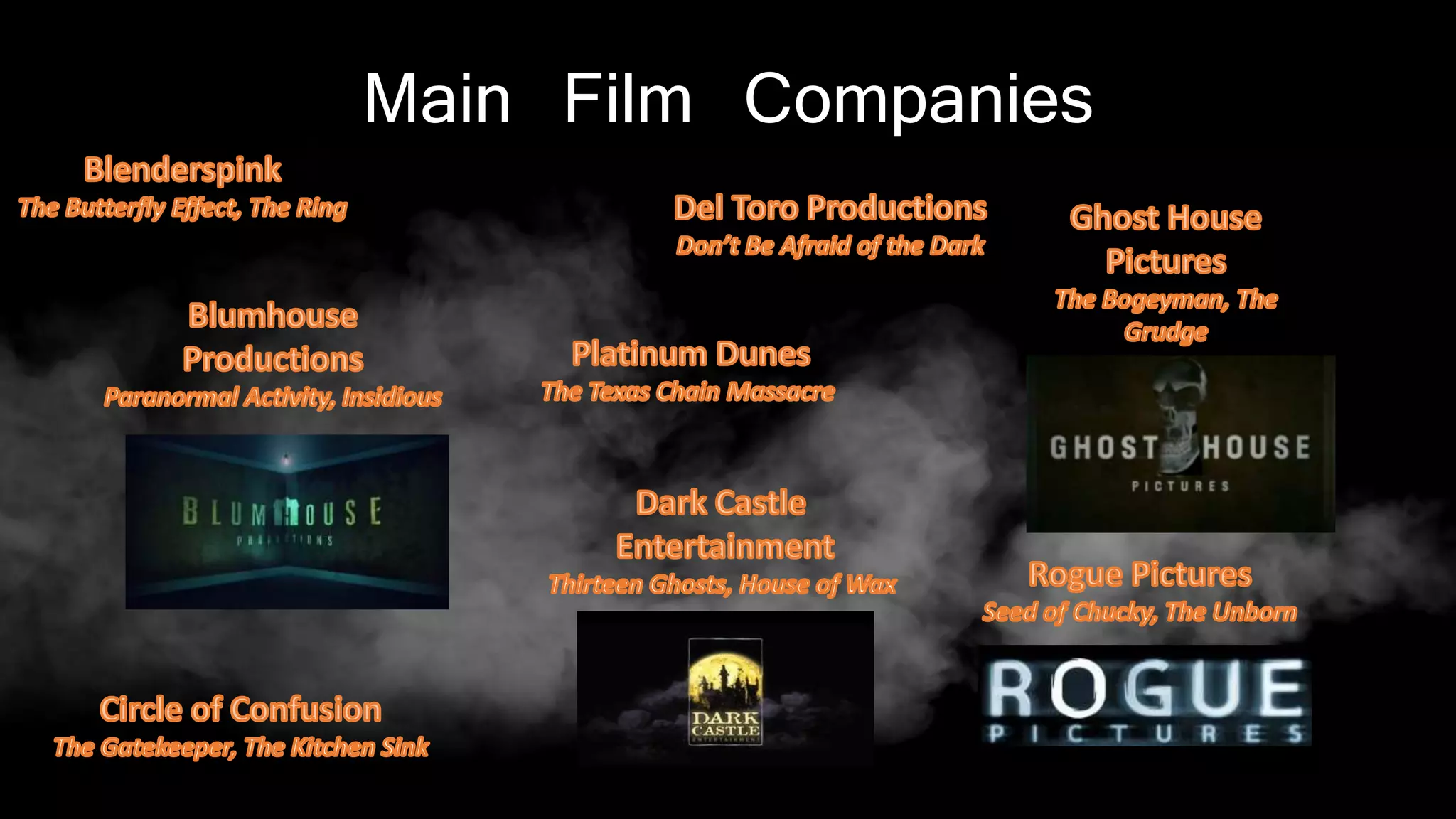
Main Film Companies
Robert Englund (Freddy vs. Jason)
Vincent Price (The Fall of the House of Usher)
Bill Moseley (The Devil’s Rejects)
Zelda Rubinstein (Poltergeist)
Bruce Campbell (Army of Darkness)
Best Horror-Film Actors
Horror Box Office
Top Grossing Movies 1995 - 2016
Rank Movie Total Gross
1 I am Legend $256,393,010
2 Hannibal $165,092,266
3 The Blair Witch
Project
$140,539,099
4 Scream $103,046,663
5 The Ring $129,094,024
6 Scream 2 $101,363,301
7 Sleepy Hollow $101,068,340
It is evident that the
horror genre is well
received and popular to
see in cinemas as the
total gross of the top 7
movies all received more
than $1 million. Horror
movies are common to
see in the cinemas as
thrill seekers like to take
part in the whole
experience. From the table,
it’s clear that although
Scream isn’t the top
grossing horror movie of
all time, it’s a successful
horror franchise as the
original film and it’s sequel
appear in the top 7.
Target Audience
The usual age
group is 15 –
25.
Horror movies give a thrill
that can excite the young
audience easier than an
older one.
The young audiences are less susceptible to being put off the film
by violence or unnatural images which may make older audience feel negative
towards the film.
Males are more likely to be a fan of horror
movies than girls, this is due to the
stereotypical thrill seeker which is portrayed
with a boy and the thrill boys seek to contest
with there young adult hormones.
Violence is also a convention
of horror movies which is
often loved by males.
Overall horror films are aimed at
the working class.
Generally the
target interests of
horror film are
blood, intense
violence,
supernatural, the
unexplained,
mystery and
illusion.

The Horror Genre

  • 1.
  • 2.
    Horror Genre Definition Horrorfilms are described as unsettling films designed to frighten and panic, cause dread and alarm, and to invoke our hidden worst fears, often in a terrifying, shocking finale, while captivating and entertaining us at the same time in a cathartic experience. Horror films effectively centre on the dark side of life, the forbidden, and strange and alarming events. They deal with our most primal nature and its fears: our nightmares, our vulnerability, our alienation, our revulsions, our terror of the unknown, our fear of death and dismemberment, loss of identity, of fear of sexuality.
  • 3.
    Changes in societyin the history of the horror genre First Ever Horror Movie: Begin with the works of George Mellies. Mellies created what is widely believed the first ever ‘horror’ movie The Haunted Castle in 1898, featuring an incarnation of the devil. The Literary Years: 1900-1920 an influx of supernatural-themed films. Many filmmakers turned to literature classics as source material. The first adaptation of Frankenstein was released by Edison Studios in these early days, as well as Dr. Jekyll and Mr. Hyde and The Werewolf. The Golden Age of Horror: Widely considered to be the finest era of the genre, the two decades between the 1920s and 30s saw many classics being produced. Films such as The Mummy (1932) and the first colour adaptation of Dr. Jekyll and Mr. Hyde (1931). The 30s also marked the first time in the industry that the word ‘horror’ was used to describe the genre. Horror films started to worry the general public at this point with heavy censoring and public outcry becoming common with each release.
  • 4.
    Changes in societyin the history of the horror genre The Atomic Years: The Hammer horror company, while founded in 1934, only started to turn prolific during the fifties but then it did, it was near global dominance. It was adaptations like Frankenstein, Dracula and The Mummy that put the company squarely on the map. British Horror films also paid respects to Alfred Hitchcock who singlehandedly responsible for establishing the slasher genre. In the 40s-50’s, the era of horror came as a product of the times. With war ravaging Europe and fears of nuclear fallout running rampant, it’s off little surprise that horror began to feature antagonists that were less supernatural in nature and radioactive mutation became a common theme. The Gimmicky Years: Everything and anything was tried during the 50s and 60s in an attempt to further scare cinema audiences. During this time there was incredibly low budget productions. From the late 60s onwards, so insatiable was the American appetite for gore that slasher films produced for well under $1 million took hold and were churned out by volume. Zombie moves were kickstarted by George A. Romero in this period, having produced Night of the living Dead in 1968.
  • 5.
    Changes in societyin the history of the horror genre All Hell Breaks Loose: There was a cultural obsession with religious evil during this period. The two horror milestones were: The Exorcist (1973) and The Omen (1976). Literature once again became the source material. Carrie (1976) stormed the gates, The Shining (1980) finished the siege. The Slasher Years: The slasher format – a relentless antagonist hunting down and killing a bunch of kids in ever-increasing inventive ways, one by one. Cult classics produced at this time included; Halloween, Friday the 13th and A Nightmare on Elm Street. The Doldrums: The genre lost steam as it moved into the 90s. Peter Jackson ended up saving the day by taking the splatter subgenre to ridiculous extremes with Braindead (1992) and Wes Craven’s slasher parody Scream (1996) was met globally with overwhelming success. The Zombie subgenre also become more popular again. Films released included Resident Evil (2002), Dawn of the Dead (2004), Land of the Dead (2005) and Zombieland (2009.) The Present Day: The genre is seemingly relying on churning out remakes, reboots and endless sequels, many argue that it’s languishing in the doldrums once again with little originality to offer a modern audience. On the other hand, glimmers of hope shine through with examples of extreme originality and artistry. Cabin in the Woods (2012) has been heralded as this decade’s Scream.
  • 6.
    Conventions of theHorror Genre: Setting Setting Spooky old mansions Castles Fog-shrouded settings Dark and shadowy locations Small communities/isolated places. Dark streets/ narrow alleyways Run down ghost towns Places with ‘dark history’ e.g. abandoned houses Lakes Roads/Highways Barns/Farms/Dark woods/Cabins Basements/attics
  • 7.
    Conventions of theHorror Genre: Characters Werewolves Characters Unknown humans Supernatural/grotesque characters Vampires Demented madmen Devils Monsters Mad scientists Demons Zombies Evil spirits Arch fiends Unfriendly ghosts Satanic villains
  • 8.
  • 9.
    Robert Englund (Freddyvs. Jason) Vincent Price (The Fall of the House of Usher) Bill Moseley (The Devil’s Rejects) Zelda Rubinstein (Poltergeist) Bruce Campbell (Army of Darkness) Best Horror-Film Actors
  • 10.
    Horror Box Office TopGrossing Movies 1995 - 2016 Rank Movie Total Gross 1 I am Legend $256,393,010 2 Hannibal $165,092,266 3 The Blair Witch Project $140,539,099 4 Scream $103,046,663 5 The Ring $129,094,024 6 Scream 2 $101,363,301 7 Sleepy Hollow $101,068,340 It is evident that the horror genre is well received and popular to see in cinemas as the total gross of the top 7 movies all received more than $1 million. Horror movies are common to see in the cinemas as thrill seekers like to take part in the whole experience. From the table, it’s clear that although Scream isn’t the top grossing horror movie of all time, it’s a successful horror franchise as the original film and it’s sequel appear in the top 7.
  • 11.
    Target Audience The usualage group is 15 – 25. Horror movies give a thrill that can excite the young audience easier than an older one. The young audiences are less susceptible to being put off the film by violence or unnatural images which may make older audience feel negative towards the film. Males are more likely to be a fan of horror movies than girls, this is due to the stereotypical thrill seeker which is portrayed with a boy and the thrill boys seek to contest with there young adult hormones. Violence is also a convention of horror movies which is often loved by males. Overall horror films are aimed at the working class. Generally the target interests of horror film are blood, intense violence, supernatural, the unexplained, mystery and illusion.