Timeline of Horror Films:
Horror Sub Genres:
• Body Horror
• Comedy
• Gothic
• Psychological
• Sci-Fi
• Slasher
• Supernatural
• Zombie
• Action
Definition Of Horror Films:
• Horror films are unsettling films designed to frighten panic,
cause dread and alarm, and to invoke our hidden worst
fears, often in a terrifying, shocking finale, while captivating
and entertaining us at the same time in a cathartic
experience. Horror films effectively center on the dark side
of life, the forbidden, strange and alarming events. They
deal with our most primal nature and its fears; our
nightmares, our vulnerability, our alienation, our revulsions,
our terror of the unknown, our fear of death and
dismemberment, loss of identity, or fear of sexuality.
• The following timeline shows how the horror genre in film
has excelled over the years from the ‘first ever’ silent
horror movie in 1896 to the modern day movies that thrill
todays society.
1896: The House of the Devil
• Le Château hanté, released in the
United States as The Devil's
Castle and in Britain as The
Haunted Castle, is an 1897 French
short silent film directed by
Georges Melies. The film is about
a man who enters a haunted
castle and is constantly taunted
by spirits inside the castle.
• 1896 was a time when horror and
the gothic genre amongst
literature were excelling. It was
extremely popular in theatres
and books and although it need
not specifically come into
practice until the 30s – it can be
argued that Georges Melies was
the first horror in the industry.
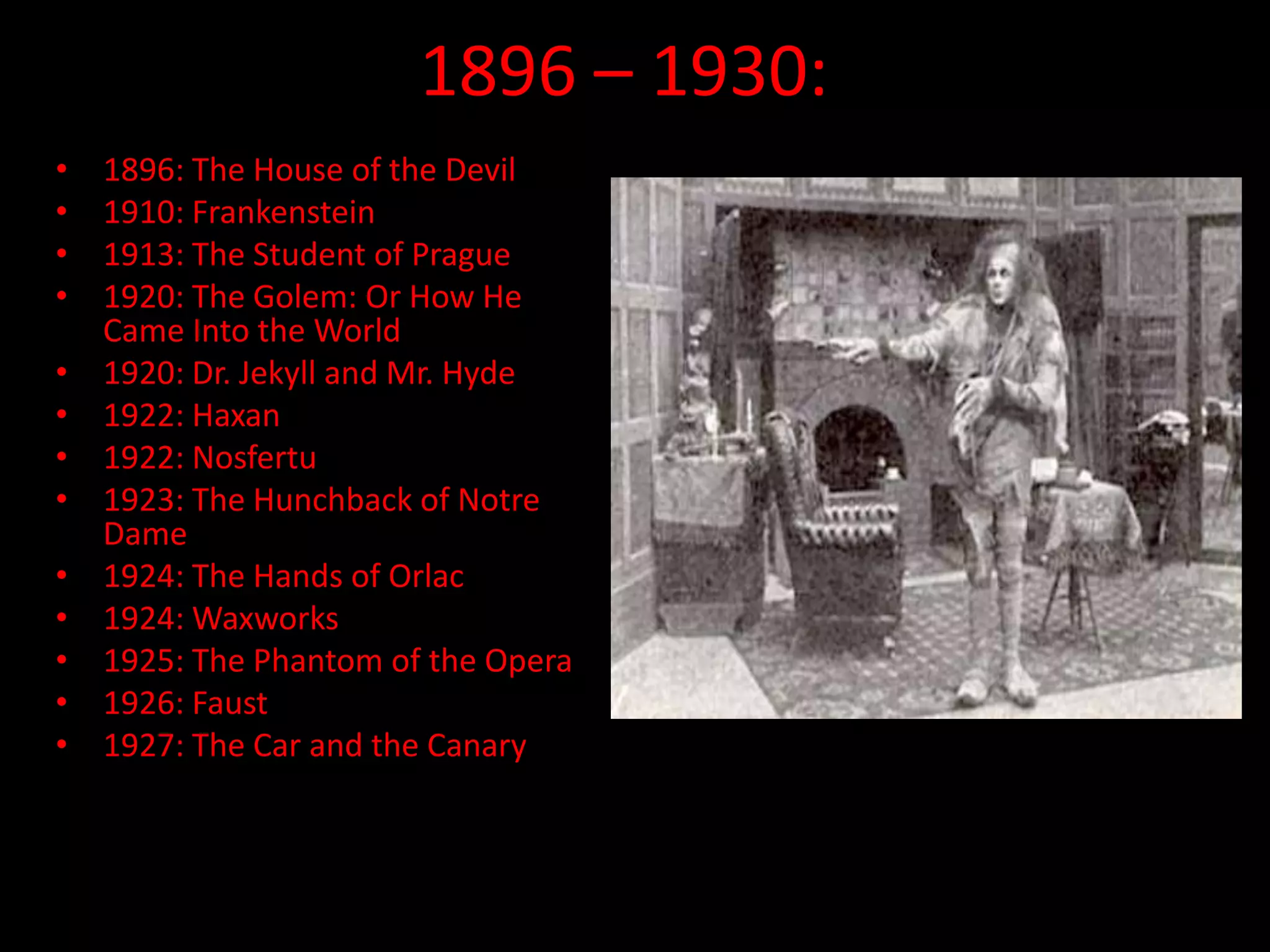
1896 – 1930:
• 1896: The House of the Devil
• 1910: Frankenstein
• 1913: The Student of Prague
• 1920: The Golem: Or How He
Came Into the World
• 1920: Dr. Jekyll and Mr. Hyde
• 1922: Haxan
• 1922: Nosfertu
• 1923: The Hunchback of Notre
Dame
• 1924: The Hands of Orlac
• 1924: Waxworks
• 1925: The Phantom of the Opera
• 1926: Faust
• 1927: The Car and the Canary
1930s Horror:
• During the silent era, Universal was
responsible for the few achievements in
American horror most notable The Phantom
of the Opera and The Hunchback of Notre
Dame both starring Lon Chaney. But in the
30s, Universal really sunk their teeth into
horror, kicking off the Universal Gothic horror
cycle.
• Dracula 1930:
• This was a huge hit among the audience in
which sound was first established. It brought a
whole new experience to the people who
wanted to be thrilled. There were numerous
sequels created by Universal who were said to
be the new horror distributor.
• However, with sequels of the same storyline
becoming more and more common among
Universal, people began getting bored and
eventually gave up with the horror genre. It
began to loose steam and eventually the first
sting of characters retired from the industry.
1950s Horror:• During the 1950s, graphics
became more technologically
advanced meaning many
subgenres were explored.
• Fears of invasion from previous
cultural times meant that many
films such as ‘The Blob’ and
‘Godzilla’ widened the target
audience while still highlighting
the horror genre.
• Some examples of 50s horror:
1960s horror:
• Pyscho was the breakthrough in modern day
horror films. Arguable Hitchock’s most famous,
it was a turning point in the style of horror. With
blood, gore and the slasher subgenre explored,
the social revolution of the era featuring at the
time, controversial levels of violence.
• Directions that were key in breaking through the
genre with films that changed the genre for
decades:
• Alfred Hitchcock (Psycho and The Birds)
• Vincent Price (Witchfinder General and House
of Usher)
• Mario Bava (Black Sunday and Black Sabbath)
• Many people saw the films at the time as too
graphic and over the top, however they were so
popular due to being the first of their kind.
1970s Horror:
• The 70s enhanced what we saw in 60s
horror, however, as the audience were
aware, we see that the world began
preparing itself and enjoyed what
they saw.
• The themes of sex, war, religion and
violence were shown in the
conventions of the horror movies.
• Zombie and Cannibal movies were
also explored in the era of horror
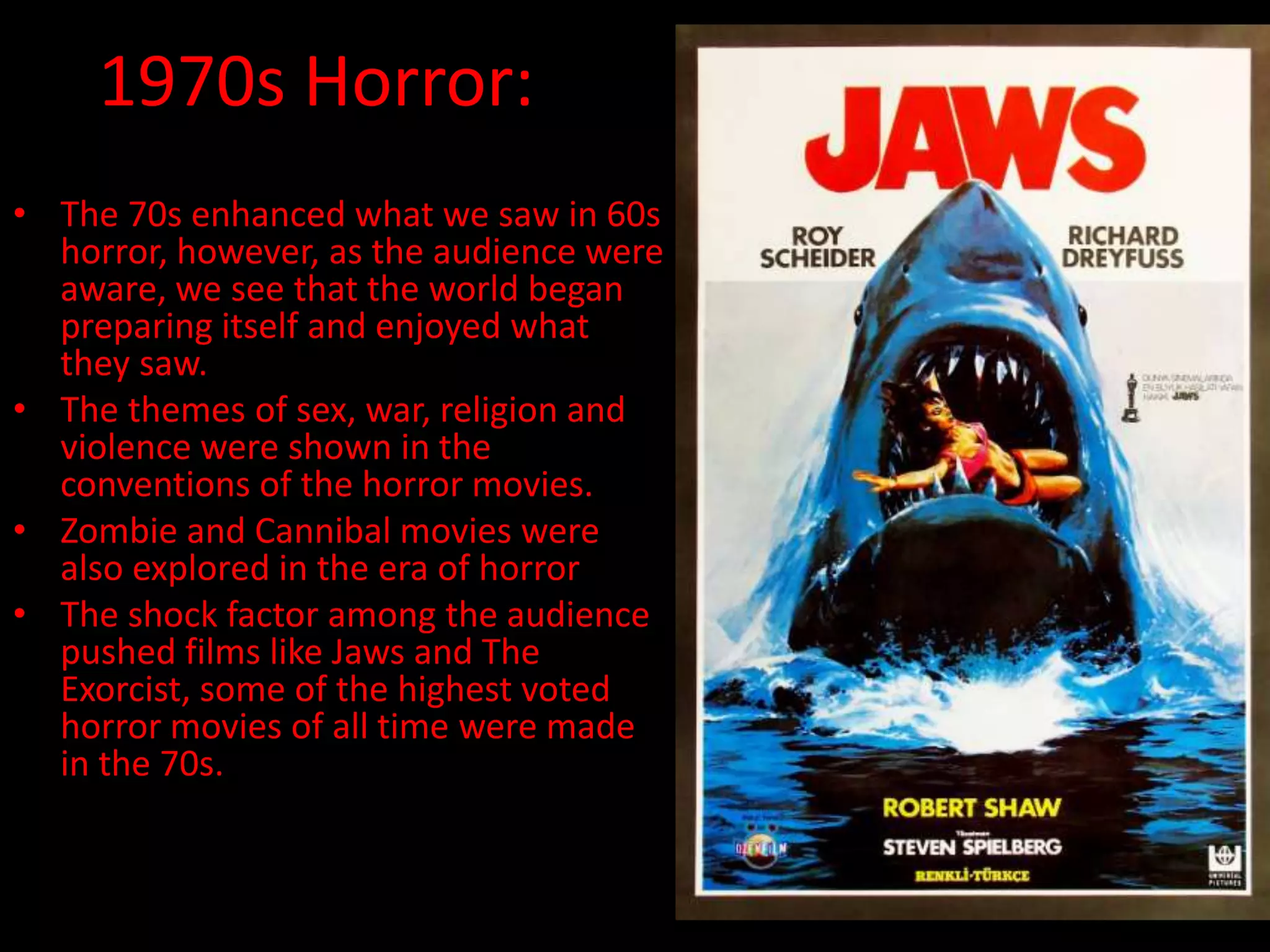
• The shock factor among the audience
pushed films like Jaws and The
Exorcist, some of the highest voted
horror movies of all time were made
in the 70s.
1980s Horror:
• Horror in the beginning of
the 80s was enhanced by
slasher films such as Prom
Night, A Nightmare on
Elm Street and Friday the
13th
• Towards the end of the
80s, we were introduced
into the comic subgenre
and a lighthearted take on
horror (i.e Ghostbusters)
• Stalker Thrillers were also
shown great in the 80s.
1990s Horror:
• The early 90s brought masses of
success for the horror genre
with it becoming blockbuster
successes
• The Silence of the Lambs swept
the major academy awards in
1992, which spurred studios into
funding large-scale horror-
themed projects. In 1996,
Scream’s success ignited the
slasher genre and spawned
similar films.
• Overall, big blockbuster hits
meant popularity and a wider
target audience and more
money for the distributors.
Modern Day Horror:
• The US horror blockbusters were remakes
of previous films with a modern twist, in
order to ruse storylines and incorporate
new target audiences as well as previous.
These were films such as Halloween, Dawn
of the Dead and Friday the 13th. They also
incorporated foreign films like The Ring.
• Innovations in the genre were made with
most notable one of the most popular
horror films of all time with 7 sequels,
‘torture porn was a huge success – films
such as Saw.
• Supernatural films were also enhanced
with new technologies, creating realistic
settings for films like Paranormal Activity.
• Horror films of today are the most popular
genre itself as they attribute the highest
grossing’s and a mass for the growing
target audience.

Megan Byrne time line of horror

  • 1.
  • 3.
    Horror Sub Genres: •Body Horror • Comedy • Gothic • Psychological • Sci-Fi • Slasher • Supernatural • Zombie • Action
  • 4.
    Definition Of HorrorFilms: • Horror films are unsettling films designed to frighten panic, cause dread and alarm, and to invoke our hidden worst fears, often in a terrifying, shocking finale, while captivating and entertaining us at the same time in a cathartic experience. Horror films effectively center on the dark side of life, the forbidden, strange and alarming events. They deal with our most primal nature and its fears; our nightmares, our vulnerability, our alienation, our revulsions, our terror of the unknown, our fear of death and dismemberment, loss of identity, or fear of sexuality. • The following timeline shows how the horror genre in film has excelled over the years from the ‘first ever’ silent horror movie in 1896 to the modern day movies that thrill todays society.
  • 5.
    1896: The Houseof the Devil • Le Château hanté, released in the United States as The Devil's Castle and in Britain as The Haunted Castle, is an 1897 French short silent film directed by Georges Melies. The film is about a man who enters a haunted castle and is constantly taunted by spirits inside the castle. • 1896 was a time when horror and the gothic genre amongst literature were excelling. It was extremely popular in theatres and books and although it need not specifically come into practice until the 30s – it can be argued that Georges Melies was the first horror in the industry.
  • 6.
    1896 – 1930: •1896: The House of the Devil • 1910: Frankenstein • 1913: The Student of Prague • 1920: The Golem: Or How He Came Into the World • 1920: Dr. Jekyll and Mr. Hyde • 1922: Haxan • 1922: Nosfertu • 1923: The Hunchback of Notre Dame • 1924: The Hands of Orlac • 1924: Waxworks • 1925: The Phantom of the Opera • 1926: Faust • 1927: The Car and the Canary
  • 7.
    1930s Horror: • Duringthe silent era, Universal was responsible for the few achievements in American horror most notable The Phantom of the Opera and The Hunchback of Notre Dame both starring Lon Chaney. But in the 30s, Universal really sunk their teeth into horror, kicking off the Universal Gothic horror cycle. • Dracula 1930: • This was a huge hit among the audience in which sound was first established. It brought a whole new experience to the people who wanted to be thrilled. There were numerous sequels created by Universal who were said to be the new horror distributor. • However, with sequels of the same storyline becoming more and more common among Universal, people began getting bored and eventually gave up with the horror genre. It began to loose steam and eventually the first sting of characters retired from the industry.
  • 8.
    1950s Horror:• Duringthe 1950s, graphics became more technologically advanced meaning many subgenres were explored. • Fears of invasion from previous cultural times meant that many films such as ‘The Blob’ and ‘Godzilla’ widened the target audience while still highlighting the horror genre. • Some examples of 50s horror:
  • 9.
    1960s horror: • Pyschowas the breakthrough in modern day horror films. Arguable Hitchock’s most famous, it was a turning point in the style of horror. With blood, gore and the slasher subgenre explored, the social revolution of the era featuring at the time, controversial levels of violence. • Directions that were key in breaking through the genre with films that changed the genre for decades: • Alfred Hitchcock (Psycho and The Birds) • Vincent Price (Witchfinder General and House of Usher) • Mario Bava (Black Sunday and Black Sabbath) • Many people saw the films at the time as too graphic and over the top, however they were so popular due to being the first of their kind.
  • 10.
    1970s Horror: • The70s enhanced what we saw in 60s horror, however, as the audience were aware, we see that the world began preparing itself and enjoyed what they saw. • The themes of sex, war, religion and violence were shown in the conventions of the horror movies. • Zombie and Cannibal movies were also explored in the era of horror • The shock factor among the audience pushed films like Jaws and The Exorcist, some of the highest voted horror movies of all time were made in the 70s.
  • 11.
    1980s Horror: • Horrorin the beginning of the 80s was enhanced by slasher films such as Prom Night, A Nightmare on Elm Street and Friday the 13th • Towards the end of the 80s, we were introduced into the comic subgenre and a lighthearted take on horror (i.e Ghostbusters) • Stalker Thrillers were also shown great in the 80s.
  • 12.
    1990s Horror: • Theearly 90s brought masses of success for the horror genre with it becoming blockbuster successes • The Silence of the Lambs swept the major academy awards in 1992, which spurred studios into funding large-scale horror- themed projects. In 1996, Scream’s success ignited the slasher genre and spawned similar films. • Overall, big blockbuster hits meant popularity and a wider target audience and more money for the distributors.
  • 13.
    Modern Day Horror: •The US horror blockbusters were remakes of previous films with a modern twist, in order to ruse storylines and incorporate new target audiences as well as previous. These were films such as Halloween, Dawn of the Dead and Friday the 13th. They also incorporated foreign films like The Ring. • Innovations in the genre were made with most notable one of the most popular horror films of all time with 7 sequels, ‘torture porn was a huge success – films such as Saw. • Supernatural films were also enhanced with new technologies, creating realistic settings for films like Paranormal Activity. • Horror films of today are the most popular genre itself as they attribute the highest grossing’s and a mass for the growing target audience.