THE
HOLOCAUST
HITLER, PROPAGANDA, AND U.S. INTERVENTION
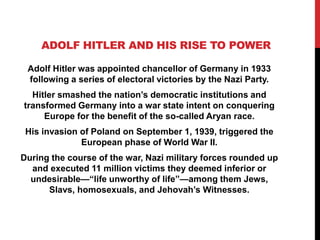
ADOLF HITLER AND HIS RISE TO POWER
Adolf Hitler was appointed chancellor of Germany in 1933
following a series of electoral victories by the Nazi Party.
Hitler smashed the nation’s democratic institutions and
transformed Germany into a war state intent on conquering
Europe for the benefit of the so-called Aryan race.
His invasion of Poland on September 1, 1939, triggered the
European phase of World War II.
During the course of the war, Nazi military forces rounded up
and executed 11 million victims they deemed inferior or
undesirable—“life unworthy of life”—among them Jews,
Slavs, homosexuals, and Jehovah’s Witnesses.
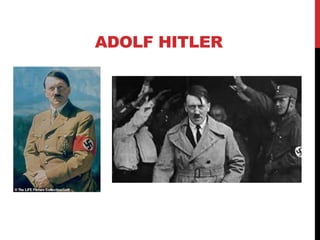
ADOLF HITLER
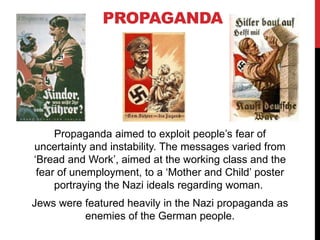
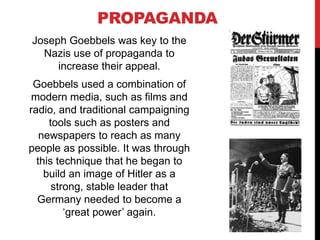
PROPAGANDA
Propaganda aimed to exploit people’s fear of
uncertainty and instability. The messages varied from
‘Bread and Work’, aimed at the working class and the
fear of unemployment, to a ‘Mother and Child’ poster
portraying the Nazi ideals regarding woman.
Jews were featured heavily in the Nazi propaganda as
enemies of the German people.
PROPAGANDA
Joseph Goebbels was key to the
Nazis use of propaganda to
increase their appeal.
Goebbels used a combination of
modern media, such as films and
radio, and traditional campaigning
tools such as posters and
newspapers to reach as many
people as possible. It was through
this technique that he began to
build an image of Hitler as a
strong, stable leader that
Germany needed to become a
‘great power’ again.
THE U.S.
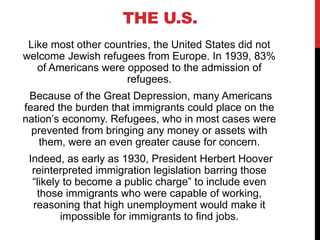
Like most other countries, the United States did not
welcome Jewish refugees from Europe. In 1939, 83%
of Americans were opposed to the admission of
refugees.
Because of the Great Depression, many Americans
feared the burden that immigrants could place on the
nation’s economy. Refugees, who in most cases were
prevented from bringing any money or assets with
them, were an even greater cause for concern.
Indeed, as early as 1930, President Herbert Hoover
reinterpreted immigration legislation barring those
“likely to become a public charge” to include even
those immigrants who were capable of working,
reasoning that high unemployment would make it
impossible for immigrants to find jobs.
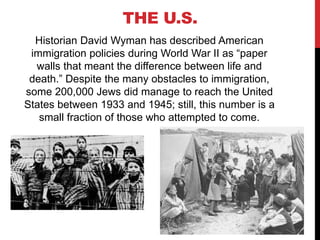
Historian David Wyman has described American
immigration policies during World War II as “paper
walls that meant the difference between life and
death.” Despite the many obstacles to immigration,
some 200,000 Jews did manage to reach the United
States between 1933 and 1945; still, this number is a
small fraction of those who attempted to come.
THE U.S.
CONCENTRATION CAMPS
Nazi concentration camps served three main purposes:
• To incarcerate people whom the Nazi regime perceived
to be a security threat. These people were incarcerated
for indefinite amounts of time.
• To eliminate individuals and small, targeted groups of
individuals by murder, away from the public and judicial
review.
• To exploit forced labor of the prisoner population. This
purpose grew out of a labor shortage.
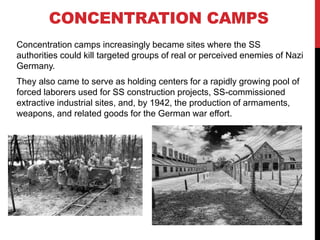
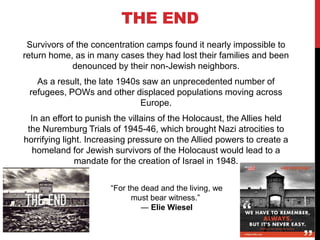
Concentration camps increasingly became sites where the SS
authorities could kill targeted groups of real or perceived enemies of Nazi
Germany.
They also came to serve as holding centers for a rapidly growing pool of
forced laborers used for SS construction projects, SS-commissioned
extractive industrial sites, and, by 1942, the production of armaments,
weapons, and related goods for the German war effort.
CONCENTRATION CAMPS
THE END
Survivors of the concentration camps found it nearly impossible to
return home, as in many cases they had lost their families and been
denounced by their non-Jewish neighbors.
As a result, the late 1940s saw an unprecedented number of
refugees, POWs and other displaced populations moving across
Europe.
In an effort to punish the villains of the Holocaust, the Allies held
the Nuremburg Trials of 1945-46, which brought Nazi atrocities to
horrifying light. Increasing pressure on the Allied powers to create a
homeland for Jewish survivors of the Holocaust would lead to a
mandate for the creation of Israel in 1948.
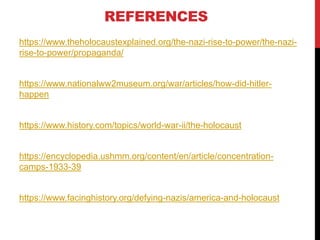
“For the dead and the living, we
must bear witness.”
― Elie Wiesel
REFERENCES
https://www.theholocaustexplained.org/the-nazi-rise-to-power/the-nazi-
rise-to-power/propaganda/
https://www.nationalww2museum.org/war/articles/how-did-hitler-
happen
https://www.history.com/topics/world-war-ii/the-holocaust
https://encyclopedia.ushmm.org/content/en/article/concentration-
camps-1933-39
https://www.facinghistory.org/defying-nazis/america-and-holocaust

The Holocaust

  • 1.
  • 2.
    ADOLF HITLER ANDHIS RISE TO POWER Adolf Hitler was appointed chancellor of Germany in 1933 following a series of electoral victories by the Nazi Party. Hitler smashed the nation’s democratic institutions and transformed Germany into a war state intent on conquering Europe for the benefit of the so-called Aryan race. His invasion of Poland on September 1, 1939, triggered the European phase of World War II. During the course of the war, Nazi military forces rounded up and executed 11 million victims they deemed inferior or undesirable—“life unworthy of life”—among them Jews, Slavs, homosexuals, and Jehovah’s Witnesses.
  • 3.
  • 4.
    PROPAGANDA Propaganda aimed toexploit people’s fear of uncertainty and instability. The messages varied from ‘Bread and Work’, aimed at the working class and the fear of unemployment, to a ‘Mother and Child’ poster portraying the Nazi ideals regarding woman. Jews were featured heavily in the Nazi propaganda as enemies of the German people.
  • 5.
    PROPAGANDA Joseph Goebbels waskey to the Nazis use of propaganda to increase their appeal. Goebbels used a combination of modern media, such as films and radio, and traditional campaigning tools such as posters and newspapers to reach as many people as possible. It was through this technique that he began to build an image of Hitler as a strong, stable leader that Germany needed to become a ‘great power’ again.
  • 6.
    THE U.S. Like mostother countries, the United States did not welcome Jewish refugees from Europe. In 1939, 83% of Americans were opposed to the admission of refugees. Because of the Great Depression, many Americans feared the burden that immigrants could place on the nation’s economy. Refugees, who in most cases were prevented from bringing any money or assets with them, were an even greater cause for concern. Indeed, as early as 1930, President Herbert Hoover reinterpreted immigration legislation barring those “likely to become a public charge” to include even those immigrants who were capable of working, reasoning that high unemployment would make it impossible for immigrants to find jobs.
  • 7.
    Historian David Wymanhas described American immigration policies during World War II as “paper walls that meant the difference between life and death.” Despite the many obstacles to immigration, some 200,000 Jews did manage to reach the United States between 1933 and 1945; still, this number is a small fraction of those who attempted to come. THE U.S.
  • 8.
    CONCENTRATION CAMPS Nazi concentrationcamps served three main purposes: • To incarcerate people whom the Nazi regime perceived to be a security threat. These people were incarcerated for indefinite amounts of time. • To eliminate individuals and small, targeted groups of individuals by murder, away from the public and judicial review. • To exploit forced labor of the prisoner population. This purpose grew out of a labor shortage.
  • 9.
    Concentration camps increasinglybecame sites where the SS authorities could kill targeted groups of real or perceived enemies of Nazi Germany. They also came to serve as holding centers for a rapidly growing pool of forced laborers used for SS construction projects, SS-commissioned extractive industrial sites, and, by 1942, the production of armaments, weapons, and related goods for the German war effort. CONCENTRATION CAMPS
  • 10.
    THE END Survivors ofthe concentration camps found it nearly impossible to return home, as in many cases they had lost their families and been denounced by their non-Jewish neighbors. As a result, the late 1940s saw an unprecedented number of refugees, POWs and other displaced populations moving across Europe. In an effort to punish the villains of the Holocaust, the Allies held the Nuremburg Trials of 1945-46, which brought Nazi atrocities to horrifying light. Increasing pressure on the Allied powers to create a homeland for Jewish survivors of the Holocaust would lead to a mandate for the creation of Israel in 1948. “For the dead and the living, we must bear witness.” ― Elie Wiesel
  • 11.