Ancient Greek Sports
   The ancient Olympics were rather different from the
 modern Games. There were fewer events, and only free
men who spoke Greek could compete, instead of athletes
  from any country. Also, the games were always held at
Olympia instead of moving around to different sites every
 time. Like our Olympics, though, winning athletes were
heroes who put their home towns on the map. One young
 Athenian nobleman defended his political reputation by
mentioning how he entered seven chariots in the Olympic
 chariot-race. This high number of entries made both the
  aristocrat and Athens look very wealthy and powerful.
Marathon
• The marathon is a long-distance running event with an
  official distance of 42.195 kilometres (26 miles and 385
  yards), that is usually run as a road race. The event was
  instituted in commemoration of the fabled run of
  the Greek soldier Pheidippidis, a messenger from the Battle
  of Marathon (the namesake of the race) to Athens.
• The marathon was one of the original
  modern Olympic events in 1896, though the distance did not
  become standardized until 1921. More than 500 marathons
  are held throughout the world each year, with the vast
  majority of competitors being recreational athletes. Smaller
  marathons, such as the Stanley Marathon, can have just
  dozens of participants, while larger marathons can have tens
  of thousands of participants.
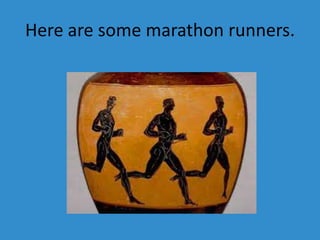
Here are some marathon runners.
Pankration
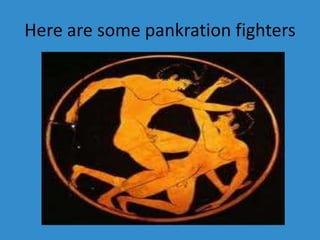
• This event was a grueling combination of
  boxing and wrestling. Punches were
  allowed, although the fighters did not wrap
  their hands with the boxing himantes.
• Rules outlawed only biting and gouging an
  opponent's eyes, nose, or mouth with
  fingernails. Attacks such as kicking an
  opponent in the belly, which are against the
  rules in modern sports, were perfectly legal.
Here are some pankration fighters
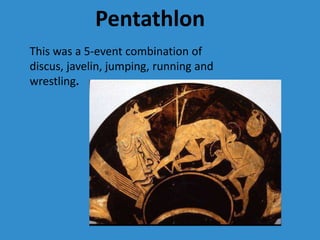
Pentathlon
This was a 5-event combination of
discus, javelin, jumping, running and
wrestling.
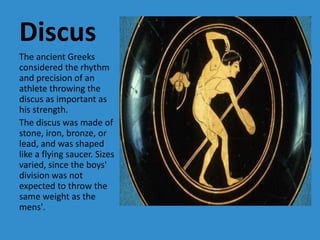
Discus
The ancient Greeks
considered the rhythm
and precision of an
athlete throwing the
discus as important as
his strength.
The discus was made of
stone, iron, bronze, or
lead, and was shaped
like a flying saucer. Sizes
varied, since the boys'
division was not
expected to throw the
same weight as the
mens'.
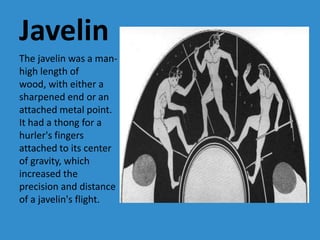
Javelin
The javelin was a man-
high length of
wood, with either a
sharpened end or an
attached metal point.
It had a thong for a
hurler's fingers
attached to its center
of gravity, which
increased the
precision and distance
of a javelin's flight.
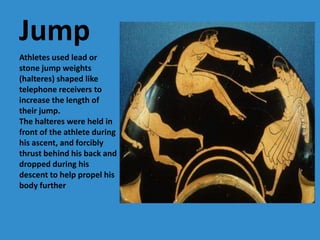
Jump
Athletes used lead or
stone jump weights
(halteres) shaped like
telephone receivers to
increase the length of
their jump.
The halteres were held in
front of the athlete during
his ascent, and forcibly
thrust behind his back and
dropped during his
descent to help propel his
body further
Running
There were 4 types of
races at Olympia.
The stadion was the oldest
event of the Games.
Runners sprinted for
1 stade(192 m.), or the
length of the stadium. The
other races were a 2-
stade race (384 m.), and a
long-distance run which
ranged from 7 to
24 stades (1,344 m. to
4,608 m.).
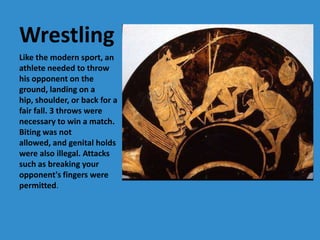
Wrestling
Like the modern sport, an
athlete needed to throw
his opponent on the
ground, landing on a
hip, shoulder, or back for a
fair fall. 3 throws were
necessary to win a match.
Biting was not
allowed, and genital holds
were also illegal. Attacks
such as breaking your
opponent's fingers were
permitted.
Thanks for watching
This presentasion was made by
 Christos Mermigas and Giannis
 Tsiakiris


             

Comeniuscomic, ancient greek sports

  • 1.
    Ancient Greek Sports The ancient Olympics were rather different from the modern Games. There were fewer events, and only free men who spoke Greek could compete, instead of athletes from any country. Also, the games were always held at Olympia instead of moving around to different sites every time. Like our Olympics, though, winning athletes were heroes who put their home towns on the map. One young Athenian nobleman defended his political reputation by mentioning how he entered seven chariots in the Olympic chariot-race. This high number of entries made both the aristocrat and Athens look very wealthy and powerful.
  • 2.
    Marathon • The marathonis a long-distance running event with an official distance of 42.195 kilometres (26 miles and 385 yards), that is usually run as a road race. The event was instituted in commemoration of the fabled run of the Greek soldier Pheidippidis, a messenger from the Battle of Marathon (the namesake of the race) to Athens. • The marathon was one of the original modern Olympic events in 1896, though the distance did not become standardized until 1921. More than 500 marathons are held throughout the world each year, with the vast majority of competitors being recreational athletes. Smaller marathons, such as the Stanley Marathon, can have just dozens of participants, while larger marathons can have tens of thousands of participants.
  • 3.
    Here are somemarathon runners.
  • 4.
    Pankration • This eventwas a grueling combination of boxing and wrestling. Punches were allowed, although the fighters did not wrap their hands with the boxing himantes. • Rules outlawed only biting and gouging an opponent's eyes, nose, or mouth with fingernails. Attacks such as kicking an opponent in the belly, which are against the rules in modern sports, were perfectly legal.
  • 5.
    Here are somepankration fighters
  • 6.
    Pentathlon This was a5-event combination of discus, javelin, jumping, running and wrestling.
  • 7.
    Discus The ancient Greeks consideredthe rhythm and precision of an athlete throwing the discus as important as his strength. The discus was made of stone, iron, bronze, or lead, and was shaped like a flying saucer. Sizes varied, since the boys' division was not expected to throw the same weight as the mens'.
  • 8.
    Javelin The javelin wasa man- high length of wood, with either a sharpened end or an attached metal point. It had a thong for a hurler's fingers attached to its center of gravity, which increased the precision and distance of a javelin's flight.
  • 9.
    Jump Athletes used leador stone jump weights (halteres) shaped like telephone receivers to increase the length of their jump. The halteres were held in front of the athlete during his ascent, and forcibly thrust behind his back and dropped during his descent to help propel his body further
  • 10.
    Running There were 4types of races at Olympia. The stadion was the oldest event of the Games. Runners sprinted for 1 stade(192 m.), or the length of the stadium. The other races were a 2- stade race (384 m.), and a long-distance run which ranged from 7 to 24 stades (1,344 m. to 4,608 m.).
  • 11.
    Wrestling Like the modernsport, an athlete needed to throw his opponent on the ground, landing on a hip, shoulder, or back for a fair fall. 3 throws were necessary to win a match. Biting was not allowed, and genital holds were also illegal. Attacks such as breaking your opponent's fingers were permitted.
  • 12.
    Thanks for watching Thispresentasion was made by Christos Mermigas and Giannis Tsiakiris 