Where anything can happen...
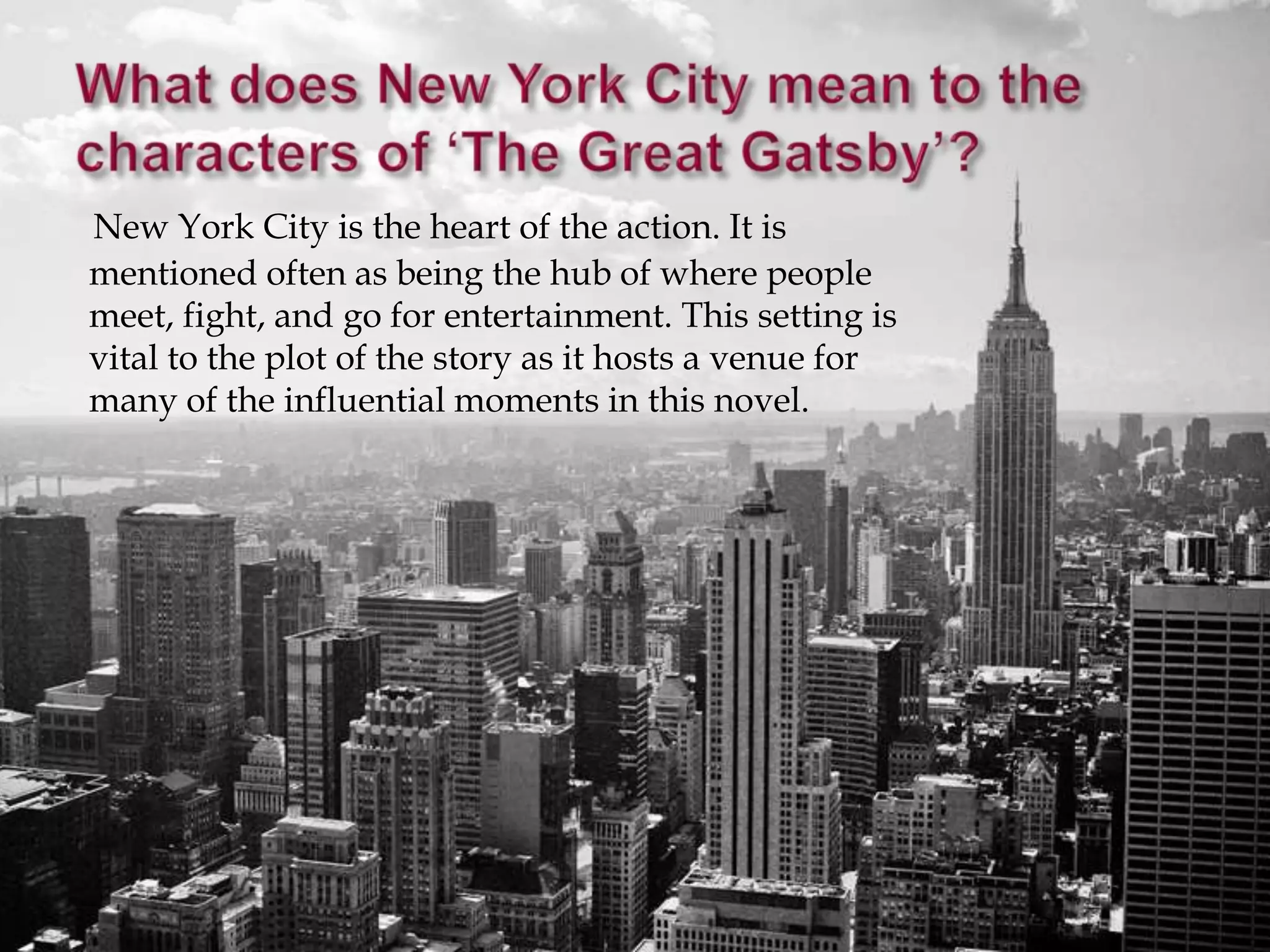
New York City is the heart of the action. It is
mentioned often as being the hub of where people
meet, fight, and go for entertainment. This setting is
vital to the plot of the story as it hosts a venue for
many of the influential moments in this novel.
New York City undoubtedly plays a big
role in this story, and its significance is
huge. Many important things happen in
this city. Listed in chronological order,
they include:
•Gatsby meets Meyer Wolfshiem in New York
City
•Nick, Tom, Myrtle, Catherine, and the Mckee
couple have a small party in a NYC apartment.
This is where Tom slaps Myrtle.
•Gatsby drives Nick to New York City for lunch
and reveals much of his past.
•Meyer Wolfsheim, a con-artist, is introduced as
Gatsby‟s partner, which leads one to suspect
Gatsby‟s finances are derived by illegal means.
•Jordan Baker reveals the romantic history of Daisy
and Gatsby to Nick. This is where Gatsby asks Nick
indirectly through Jordan to arrange a meeting for
himself and Daisy. Nick agrees.
•Tom, Daisy, Gatsby, Nick and Jordan go to NYC for
the afternoon. They rent a suite at the Plaza Hotel
which is where Tom confronts Gatsby about his
knowledge of his affair with Daisy.
•Nick and Jordan break up over the phone. Nick is in
his work office in NYC.
•Nick tries to find Gatsby‟s friends for his funeral,
specifically he visits Wolfshiem. He denies the funeral
invitation.
Through the chapters, it
has been demonstrated
that in New York,
anything can happen,
dreams can come true,
and you can always beat
any social norms that are
stacked against you. The
characters in „The Great
Gatsby‟ have realized
this, so they make use of
NYC, visiting it often for
any important matters
that need to be dealt
with.
•On pg 19, we find out that Tom met his mistress, Myrtle, on a train to
New York City. He also smacks her in the face at a party in NYC on pg
41. On top of this, When Myrtle leaves her husband to visit Tom, NYC
acts as her alibi, although we all know she isn‟t actually going to visit
her sister.
•On pg 80 we learn more about Daisys past. “There were wild
rumours circulating about her-how her mother had found her packing
her bag one winter night to go to New York and say goodbye to a
soldier who was going overseas.” At this time Jordan and Nick are at
the Plaza Hotel, conveniently located in NYC.
•On the hottest day of summer, Jordan, Nick, Gatsby, Daisy and Tom
decide to go into the city as a means of something to do. This
eventually leads to an intense dispute between Tom and Jay,
ultimately ending all the fantasies Gatsby had about reliving the past
with Daisy.
Which encourages this theme statement...
Those who understand the basic lifestyle of New York City are
therefore able to comprehend that in this metropole, you are capable
of accomplishing everything you could ever dream of while also
defeating any social norms, even if the odds are stacked against you.
Basically, the people that are able to embrace the eccentricities and uniqueness
of the city also understand that the dreams and challenges of many others are
what creates that sense of being unordinary. For example, on pg 73, Gatsby and
Nick drive by a limousine that is part of a funeral procession. Inside this
limousine is a white chauffeur driving around three black people. Seeing such
a thing is bizarre and very out of the ordinary, but Nick laughs aloud and
thinks to himself “Anything can happen now that we‟ve slid over this bridge,
anything at all...” Nick understands that perhaps, at some point in time, the
black people had all sorts of odds stacked against their favour, but
nonetheless they are now sitting inside a limousine being chauffeured around
by a white man, likely the same race that stacked those odds into a sky-high
tower. Perhaps all the towers of the very famous skyline of New York City are
reminders of situations where someone has defeated the social norms stacked
against them.
This idea is further supported by much of the imagery awarded to the City of New York:
•pg 32 “We drove over Fifth avenue, so warm and soft, almost pastoral, on the summer
Sunday afternoon that I wouldn‟t have been surprised to see a great flock of white sheep
turn the corner.”
pg 38 “The late afternoon sky bloomed in the window for a moment like the blue honey of
the Mediterranean.”
•pg 40 “I wanted to get out and walk eastward toward the park through the soft twilight.”
•pg 61 “I began to like New York, the racy, adventurous feel of it at night.” “I liked to pick
out romantic women from the enchanted crowd”
pg 73 “Over the great bridge, with the sunlight through the girders making a constant
flicker upon the moving cars, with the city rising up across the river in white heaps and
sugar lumps all built with a wish out of a non-olfactory money. The city seen from the
Queensboro Bridge is always the city seen for the first time, in its first wild promise of all
the mystery and the beauty in the world.”
The mood of this novel
is heavily influenced
by numerous counts
of imagery.
Depending on the
intended mood, the
imagery that was used
took on a slightly
gloomier feel, as
demonstrated in certain
passages:
•pg 40 “Yet high over the city our line of yellow windows must have
contributed to their share of human secrecy to the casual watcher in the
darkening streets.”
pg 61 “I lunched with them in dark crowded restaurants.” “For some
reason it was the gloomiest event of my day.” “In the metropolitan
twilight I felt a haunting loneliness sometimes.”
pg 62 “When the dark lanes of the Forties were five deep with
throbbing taxi cabs, I felt a sinking in my heart.”
pg 72 “We passed Port Roosevelt, where there was a glimpse of res-
belted ocean-going ships, and sped along a cobbled slum lined with
the dark, undeserted saloons of the faded gilt ninteen hundreds.”
pg 143 “His voice was as remote from Jordan and me as the
foreign clamour on the sidewalk or the tumult of the
elevated overhead. Human sympathy has its limits and we
were content to let all their tragic arguments fade with the
city lights behind.” “We passed over the dark bridge,
driving on towards death through the cooling twilight.”
Motifs are used in ‘The Great Gatsby’ in regards to New
York City in order to highlight certain characteristics
that would further enhance the way Scott Fitzgerald
wanted the reader to think about the extravagant city.
The idea of carelessness is another
recurring motif in New York City.
Examples of such include:
•On pg 63 Jordan is driving with Nick
through the city when she almost
collides with a pedestrian. She is to
blame, as she was being careless, but she
then goes on to state that she hates
careless people.
•On pg 75, Meyer Wolfshiem explains
how his friend Rosys carelessness ended
up leading to his ultimate demise, being
shot on the streets of New York.
Alcohol is a motif that we see a lot of
throughout this novel, specifically:
•At the small party in NYC in chapter
2.
• When Tom confronts Jay about his
cheating with Daisy in chapter 7, there
is a bottle of whiskey that he had
brought along for the trip.
Ultimately, motifs are used in this story to draw your attention to
specific characteristics of the individuals in ‘The Great Gatsby’.
The constant displays of carelessness also tells
us that some of the characters think they are
better than most people, thanks to their social
standing. They feel that they should be able to
do whatever they please, whenever they please.
The use of motifs in this novel are constantly employed
to add an array of elements to the characters that
Fitzgerald has created.
The references to alcohol demonstrate
that the characters don‟t follow rules
because they think they are above the
law (alcohol was banned due to
prohibition at this time)and are
ultimately careless.
Scott Fitzgerald uses a delicately balanced combination of significance, imagery
and motif to sculpt his masterpiece of a novel „The Great Gatsby‟. New York
City plays a large part, I believe, done purposely in order to add equal parts of
glamour, mystery and excitement to this timeless novel about the ultimate
perils and successes of an elite group of New York‟s finest.

The great gatsby nyc

  • 1.
  • 2.
    New York Cityis the heart of the action. It is mentioned often as being the hub of where people meet, fight, and go for entertainment. This setting is vital to the plot of the story as it hosts a venue for many of the influential moments in this novel.
  • 3.
    New York Cityundoubtedly plays a big role in this story, and its significance is huge. Many important things happen in this city. Listed in chronological order, they include: •Gatsby meets Meyer Wolfshiem in New York City •Nick, Tom, Myrtle, Catherine, and the Mckee couple have a small party in a NYC apartment. This is where Tom slaps Myrtle. •Gatsby drives Nick to New York City for lunch and reveals much of his past. •Meyer Wolfsheim, a con-artist, is introduced as Gatsby‟s partner, which leads one to suspect Gatsby‟s finances are derived by illegal means. •Jordan Baker reveals the romantic history of Daisy and Gatsby to Nick. This is where Gatsby asks Nick indirectly through Jordan to arrange a meeting for himself and Daisy. Nick agrees. •Tom, Daisy, Gatsby, Nick and Jordan go to NYC for the afternoon. They rent a suite at the Plaza Hotel which is where Tom confronts Gatsby about his knowledge of his affair with Daisy. •Nick and Jordan break up over the phone. Nick is in his work office in NYC. •Nick tries to find Gatsby‟s friends for his funeral, specifically he visits Wolfshiem. He denies the funeral invitation.
  • 4.
    Through the chapters,it has been demonstrated that in New York, anything can happen, dreams can come true, and you can always beat any social norms that are stacked against you. The characters in „The Great Gatsby‟ have realized this, so they make use of NYC, visiting it often for any important matters that need to be dealt with. •On pg 19, we find out that Tom met his mistress, Myrtle, on a train to New York City. He also smacks her in the face at a party in NYC on pg 41. On top of this, When Myrtle leaves her husband to visit Tom, NYC acts as her alibi, although we all know she isn‟t actually going to visit her sister. •On pg 80 we learn more about Daisys past. “There were wild rumours circulating about her-how her mother had found her packing her bag one winter night to go to New York and say goodbye to a soldier who was going overseas.” At this time Jordan and Nick are at the Plaza Hotel, conveniently located in NYC. •On the hottest day of summer, Jordan, Nick, Gatsby, Daisy and Tom decide to go into the city as a means of something to do. This eventually leads to an intense dispute between Tom and Jay, ultimately ending all the fantasies Gatsby had about reliving the past with Daisy. Which encourages this theme statement...
  • 5.
    Those who understandthe basic lifestyle of New York City are therefore able to comprehend that in this metropole, you are capable of accomplishing everything you could ever dream of while also defeating any social norms, even if the odds are stacked against you. Basically, the people that are able to embrace the eccentricities and uniqueness of the city also understand that the dreams and challenges of many others are what creates that sense of being unordinary. For example, on pg 73, Gatsby and Nick drive by a limousine that is part of a funeral procession. Inside this limousine is a white chauffeur driving around three black people. Seeing such a thing is bizarre and very out of the ordinary, but Nick laughs aloud and thinks to himself “Anything can happen now that we‟ve slid over this bridge, anything at all...” Nick understands that perhaps, at some point in time, the black people had all sorts of odds stacked against their favour, but nonetheless they are now sitting inside a limousine being chauffeured around by a white man, likely the same race that stacked those odds into a sky-high tower. Perhaps all the towers of the very famous skyline of New York City are reminders of situations where someone has defeated the social norms stacked against them.
  • 6.
    This idea isfurther supported by much of the imagery awarded to the City of New York: •pg 32 “We drove over Fifth avenue, so warm and soft, almost pastoral, on the summer Sunday afternoon that I wouldn‟t have been surprised to see a great flock of white sheep turn the corner.” pg 38 “The late afternoon sky bloomed in the window for a moment like the blue honey of the Mediterranean.” •pg 40 “I wanted to get out and walk eastward toward the park through the soft twilight.” •pg 61 “I began to like New York, the racy, adventurous feel of it at night.” “I liked to pick out romantic women from the enchanted crowd” pg 73 “Over the great bridge, with the sunlight through the girders making a constant flicker upon the moving cars, with the city rising up across the river in white heaps and sugar lumps all built with a wish out of a non-olfactory money. The city seen from the Queensboro Bridge is always the city seen for the first time, in its first wild promise of all the mystery and the beauty in the world.” The mood of this novel is heavily influenced by numerous counts of imagery.
  • 7.
    Depending on the intendedmood, the imagery that was used took on a slightly gloomier feel, as demonstrated in certain passages: •pg 40 “Yet high over the city our line of yellow windows must have contributed to their share of human secrecy to the casual watcher in the darkening streets.” pg 61 “I lunched with them in dark crowded restaurants.” “For some reason it was the gloomiest event of my day.” “In the metropolitan twilight I felt a haunting loneliness sometimes.” pg 62 “When the dark lanes of the Forties were five deep with throbbing taxi cabs, I felt a sinking in my heart.” pg 72 “We passed Port Roosevelt, where there was a glimpse of res- belted ocean-going ships, and sped along a cobbled slum lined with the dark, undeserted saloons of the faded gilt ninteen hundreds.” pg 143 “His voice was as remote from Jordan and me as the foreign clamour on the sidewalk or the tumult of the elevated overhead. Human sympathy has its limits and we were content to let all their tragic arguments fade with the city lights behind.” “We passed over the dark bridge, driving on towards death through the cooling twilight.”
  • 8.
    Motifs are usedin ‘The Great Gatsby’ in regards to New York City in order to highlight certain characteristics that would further enhance the way Scott Fitzgerald wanted the reader to think about the extravagant city. The idea of carelessness is another recurring motif in New York City. Examples of such include: •On pg 63 Jordan is driving with Nick through the city when she almost collides with a pedestrian. She is to blame, as she was being careless, but she then goes on to state that she hates careless people. •On pg 75, Meyer Wolfshiem explains how his friend Rosys carelessness ended up leading to his ultimate demise, being shot on the streets of New York. Alcohol is a motif that we see a lot of throughout this novel, specifically: •At the small party in NYC in chapter 2. • When Tom confronts Jay about his cheating with Daisy in chapter 7, there is a bottle of whiskey that he had brought along for the trip.
  • 9.
    Ultimately, motifs areused in this story to draw your attention to specific characteristics of the individuals in ‘The Great Gatsby’. The constant displays of carelessness also tells us that some of the characters think they are better than most people, thanks to their social standing. They feel that they should be able to do whatever they please, whenever they please. The use of motifs in this novel are constantly employed to add an array of elements to the characters that Fitzgerald has created. The references to alcohol demonstrate that the characters don‟t follow rules because they think they are above the law (alcohol was banned due to prohibition at this time)and are ultimately careless.
  • 10.
    Scott Fitzgerald usesa delicately balanced combination of significance, imagery and motif to sculpt his masterpiece of a novel „The Great Gatsby‟. New York City plays a large part, I believe, done purposely in order to add equal parts of glamour, mystery and excitement to this timeless novel about the ultimate perils and successes of an elite group of New York‟s finest.