The Grandmother
David Lynch
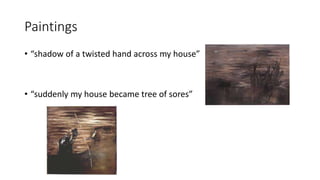
Paintings
• “shadow of a twisted hand across my house”
• “suddenly my house became tree of sores”
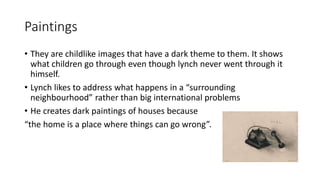
Paintings
• They are childlike images that have a dark theme to them. It shows
what children go through even though lynch never went through it
himself.
• Lynch likes to address what happens in a “surrounding
neighbourhood” rather than big international problems
• He creates dark paintings of houses because
“the home is a place where things can go wrong”.
Extra information:
• To portray a dysfunctional society lynch uses:
• Surreal
• Non-traditional narratives
• Symbolism
These are all used to portray different communities.
David Lynch life
• He moved around a lot as a child, however this never effected his
education and he didn’t feel unhappy.
• He then studied art at Pennsylvania Academy of fine art.
One of the projects he had to complete was a visual arts with cinema.
He looped an animation project into one of his sculptures.
David Lynch filmmaking:
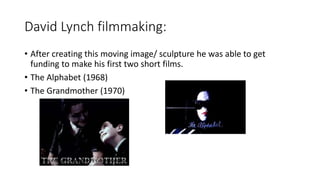
• After creating this moving image/ sculpture he was able to get
funding to make his first two short films.
• The Alphabet (1968)
• The Grandmother (1970)
What the film represents
• The grandmother represents Lynch’s first major films in terms of:
• Length
• Style
• Choice of material
The grandmother: story
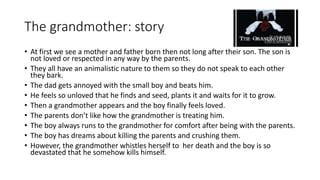
• At first we see a mother and father born then not long after their son. The son is
not loved or respected in any way by the parents.
• They all have an animalistic nature to them so they do not speak to each other
they bark.
• The dad gets annoyed with the small boy and beats him.
• He feels so unloved that he finds and seed, plants it and waits for it to grow.
• Then a grandmother appears and the boy finally feels loved.
• The parents don’t like how the grandmother is treating him.
• The boy always runs to the grandmother for comfort after being with the parents.
• The boy has dreams about killing the parents and crushing them.
• However, the grandmother whistles herself to her death and the boy is so
devastated that he somehow kills himself.
About the film
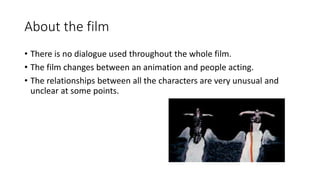
• There is no dialogue used throughout the whole film.
• The film changes between an animation and people acting.
• The relationships between all the characters are very unusual and
unclear at some points.
About the film
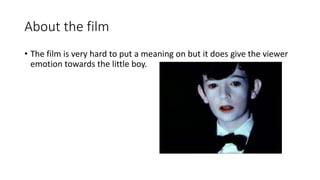
• The film is very hard to put a meaning on but it does give the viewer
emotion towards the little boy.
The film and paintings
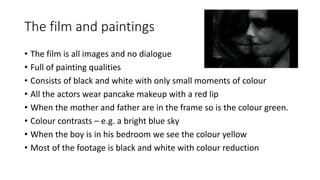
• The film is all images and no dialogue
• Full of painting qualities
• Consists of black and white with only small moments of colour
• All the actors wear pancake makeup with a red lip
• When the mother and father are in the frame so is the colour green.
• Colour contrasts – e.g. a bright blue sky
• When the boy is in his bedroom we see the colour yellow
• Most of the footage is black and white with colour reduction
Influences
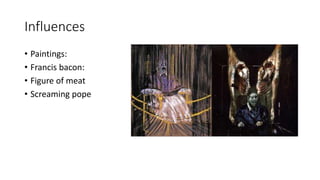
• Paintings:
• Francis bacon:
• Figure of meat
• Screaming pope
Influences
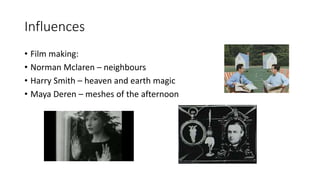
• Film making:
• Norman Mclaren – neighbours
• Harry Smith – heaven and earth magic
• Maya Deren – meshes of the afternoon
Extra information
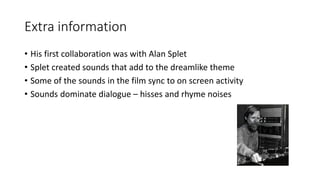
• His first collaboration was with Alan Splet
• Splet created sounds that add to the dreamlike theme
• Some of the sounds in the film sync to on screen activity
• Sounds dominate dialogue – hisses and rhyme noises

The grandmother

  • 1.
  • 2.
    Paintings • “shadow ofa twisted hand across my house” • “suddenly my house became tree of sores”
  • 3.
    Paintings • They arechildlike images that have a dark theme to them. It shows what children go through even though lynch never went through it himself. • Lynch likes to address what happens in a “surrounding neighbourhood” rather than big international problems • He creates dark paintings of houses because “the home is a place where things can go wrong”.
  • 4.
    Extra information: • Toportray a dysfunctional society lynch uses: • Surreal • Non-traditional narratives • Symbolism These are all used to portray different communities.
  • 5.
    David Lynch life •He moved around a lot as a child, however this never effected his education and he didn’t feel unhappy. • He then studied art at Pennsylvania Academy of fine art. One of the projects he had to complete was a visual arts with cinema. He looped an animation project into one of his sculptures.
  • 6.
    David Lynch filmmaking: •After creating this moving image/ sculpture he was able to get funding to make his first two short films. • The Alphabet (1968) • The Grandmother (1970)
  • 7.
    What the filmrepresents • The grandmother represents Lynch’s first major films in terms of: • Length • Style • Choice of material
  • 8.
    The grandmother: story •At first we see a mother and father born then not long after their son. The son is not loved or respected in any way by the parents. • They all have an animalistic nature to them so they do not speak to each other they bark. • The dad gets annoyed with the small boy and beats him. • He feels so unloved that he finds and seed, plants it and waits for it to grow. • Then a grandmother appears and the boy finally feels loved. • The parents don’t like how the grandmother is treating him. • The boy always runs to the grandmother for comfort after being with the parents. • The boy has dreams about killing the parents and crushing them. • However, the grandmother whistles herself to her death and the boy is so devastated that he somehow kills himself.
  • 9.
    About the film •There is no dialogue used throughout the whole film. • The film changes between an animation and people acting. • The relationships between all the characters are very unusual and unclear at some points.
  • 10.
    About the film •The film is very hard to put a meaning on but it does give the viewer emotion towards the little boy.
  • 11.
    The film andpaintings • The film is all images and no dialogue • Full of painting qualities • Consists of black and white with only small moments of colour • All the actors wear pancake makeup with a red lip • When the mother and father are in the frame so is the colour green. • Colour contrasts – e.g. a bright blue sky • When the boy is in his bedroom we see the colour yellow • Most of the footage is black and white with colour reduction
  • 12.
    Influences • Paintings: • Francisbacon: • Figure of meat • Screaming pope
  • 13.
    Influences • Film making: •Norman Mclaren – neighbours • Harry Smith – heaven and earth magic • Maya Deren – meshes of the afternoon
  • 14.
    Extra information • Hisfirst collaboration was with Alan Splet • Splet created sounds that add to the dreamlike theme • Some of the sounds in the film sync to on screen activity • Sounds dominate dialogue – hisses and rhyme noises