On this SlideShare page, you will find several Power Point presentations, one for each of the
most popular essays to read aloud from A Sand County Almanac at Aldo Leopold Weekend
events. Each presentation has the essay text right on the slides, paired with beautiful images that
help add a visual element to public readings. Dave Winefske (Aldo Leopold Weekend event
planner from Argyle, Wisconsin) gets credit for putting these together. Thanks Dave!

A note on images within the presentations: we have only received permission to use these
images within these presentations, as part of this event. You will see a photo credit slide as the
last image in every presentation. Please be sure to show that slide to your audience at least
once, and if you don't mind leaving it up to show at the end of each essay, that is best. Also please
note that we do not have permission to use these images outside of Aldo Leopold Weekend
reading event presentations. For example, the images that come from the Aldo Leopold
Foundation archive are not “public domain,” yet we see unauthorized uses of them all the time on
the internet. So, hopefully that’s enough said on this topic—if you have any questions, just let us
know. mail@aldoleopold.org

If you download these presentations to use in your event, feel free to delete this intro slide before
showing to your audience.
The Good
Oak
There are two spiritual dangers in
not owning a farm. One is the danger
of supposing that breakfast comes
from the grocery, and the other that
heat comes from the furnace.
To avoid the first danger, one should plant a garden, preferably where
there is no grocer to confuse the issue.
To avoid the second, he should lay a split of good oak on the
andirons, preferably where there is no furnace, and let it warm his shins
while a February blizzard tosses the trees outside.
If one has cut, split, hauled, and piled his own good oak, and let his mind
work the while, he will remember much about where the heat comes from,
and with a wealth of detail denied to those who
spend the week-end in town astride a radiator.
The particular oak now aglow on
my andirons grew on the bank
of the old emigrant road where it
climbs the sandhill.
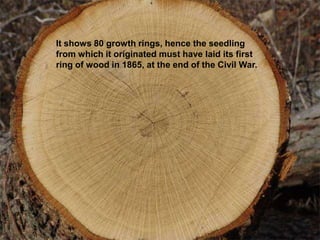
The stump, which I measured upon felling the
tree, has a diameter of 30 inches.
It shows 80 growth rings, hence the seedling
from which it originated must have laid its first
ring of wood in 1865, at the end of the Civil War.
But I know from the history of present seedlings that no oak grows above
the reach of rabbits without a decade or more of getting girdled each
winter, and re-sprouting during the following summer. Indeed, it is all too
clear that every surviving oak is the product either of rabbit negligence or
of rabbit scarcity.
Some day some patient botanist will draw a frequency curve of oak birth-
years, and show that the curve humps every ten years, each hump
originating from a low in the ten-year rabbit cycle. (A fauna and flora, by
this very process of perpetual battle within and among species, achieve
collective immortality.)
It is likely, then, that a low in rabbits occurred in the middle 'sixties, when
my oak began to lay on annual rings, but that the acorn that produced it
fell during the preceding decade, when the covered wagons were still
passing over my road into the Great Northwest.
It may have been the wash and wear
of the emigrant traffic that bared this
roadbank, and thus enabled this
particular acorn to spread its first
leaves to the sun.
Only one acorn in a thousand ever grew large enough to fight rabbits;
the rest were drowned at birth in the prairie sea
It is a warming thought that this one wasn't, and thus lived to garner
eighty years of June sun. It is this sunlight that is now being
released, through the intervention of my axe and saw, to warm my shack
and my spirit through eighty gusts of blizzard.
And with each gust a wisp of smoke from my
chimney bears witness, to whomsoever it may
concern that the sun did not shine in vain.
My dog does not care where heat comes from, but he cares ardently
that it come, and soon.
Indeed he considers my ability to make it come as
something magical, for when I rise in the cold black
pre-dawn and kneel shivering by the hearth making a
fire, he pushes himself blandly between me and the
kindling splits I have laid on the ashes, and I must
touch a match to them by poking it between his legs.
Such faith, I suppose, is the kind that moves
mountains.
It was a bolt of lightning that put an
end to wood-making by this
particular oak. We were all
awakened, one night in July, by the
thunderous crash; we realized that
the bolt must have hit near
by, but, since it had not hit us, we
all went back to sleep. Man brings
all things to the test of himself, and
this is notably true of lightning.
Next morning, as we strolled over
the sandhill rejoicing with the
cone-flowers and the prairie
clovers over their fresh accession
of rain, we came upon a great slab
of bark freshly torn from the trunk
of the roadside oak.
The trunk showed a long
spiral scar of barkless
sapwood, a foot wide and not
yet yellowed by the sun. By
the next day the leaves had
wilted, and we knew that the
lightning had bequeathed to
us three cords of prospective
fuel wood.
We mourned the
loss of the old
tree, but knew that a
dozen of its progeny
standing straight
and stalwart on the
sands had already
taken over its job of
wood-making.
We let the dead veteran season for a year in the sun it could no
longer use, and then on a crisp winter’s day we laid a newly filed saw
to its bastioned base. Fragrant little chips of history spewed from the
saw cut, and accumulated on the snow before each kneeling sawyer.
We sensed that these two piles of sawdust were something more
than wood: that they were the integrated transect of a century; that
our saw was biting its way, stroke by stroke, decade by decade, into
the chronology of a lifetime, written in concentric annual rings of
good oak.
It took only a dozen pulls of the saw to transect the few years of our
ownership, during which we had learned to love and cherish this farm.
Abruptly we began to cut the years of our predecessor the bootlegger,
who hated this farm, skinned it of
residual fertility, burned its
farmhouse, threw it back into the lap
of the County (with delinquent taxes
to boot), and then disappeared
among the landless anonymities of
the Great Depression.
Yet the oak had laid down good wood for him;
his sawdust was as fragrant, as sound, and as
pink as our own. An oak is no respecter of
persons.
The reign of the bootlegger ended
sometime during the dust-bowl
drouths of 1936, 1934, 1933, and
1930.
Oak smoke from his still and peat from burning marshlands must have
clouded the sun in those years, and alphabetical conservation was
abroad in the land, but the sawdust shows no change.
Rest! cries the
chief
sawyer, and we
pause for
breath.
Now our saw bites into the 1920's, the Babbittian decade when everything
grew bigger and better in heedlessness and arrogance-until 1929, when
stock markets crumpled.
If the oak heard them fall, its wood gives no sign. Nor did it heed the
Legislature's several protestations of love for trees: a National Forest & a
forest-crop law in 1927, a great refuge on the Upper Mississippi
bottomlands in 1924, and a new forest policy in 1921.
Neither did it notice the demise of the state's last marten in 1925, nor the
arrival of its first starling in 1923.
In March 1922, the ‘Big Sleet’ tore the neighboring elms limb from
limb, but there is no sign of damage to our tree. What is a ton of
ice, more or less, to a good oak?
Rest! cries the
chief sawyer, and
we pause for
breath.
Now the saw bites into 1910-20,
the decade of the drainage dream,
when steam shovels sucked dry
the marshes of central Wisconsin
to make farms, and made ash-
heaps instead.
Our marsh escaped, not because of any caution or forbearance among
engineers, but because the river floods it each April, and did so with a
vengeance-perhaps a defensive vengeance-in the years 1913-16.
The oak laid on wood just the same, even in 1915, when the
Supreme Court abolished the state forests and Governor
Phillip pontificated that ‘state forestry is not a good business
proposition.'
(It did not occur to the Governor that there might be more than one
definition of what is good, and even of what is business. It did not occur
to him that while the courts were writing one definition of goodness in
the law books, fires were writing quite another one on the face of the
land. Perhaps, to be a governor, one must be free from doubt on such
matters.
While forestry receded during this decade, game conservation advanced.
In 1916 pheasants became successfully established in Waukesha County;
in 1915 a federal law prohibited spring shooting; in 1913 a state game
farm was started;
in 1912 a 'buck law’ protected female deer; in 1911 an
epidemic of refuges spread over the state. ‘Refuge'
became a holy word, but the oak took no heed.
Rest! cries the
chief sawyer, and
we pause for
breath.
Now we cut 1910, when a great university president published a book on
conservation, a great sawfly epidemic killed millions of tamaracks, a great
drouth burned the pineries, and a great dredge drained Horicon Marsh.
We cut 1909, when smelt were first planted in the
GreatLakes, and when a wet summer induced the Legislature
to cut the forest-fire appropriations.
We cut 1908, a dry year when the forests burned fiercely, and Wisconsin
parted with its last cougar. We cut 1907, when a wandering lynx, looking
in the wrong direction for the promised land, ended his career among the
farms of Dane County.
We cut 1906, when the first state forester took office, and fires burned
17,000 acres in these sand counties; we cut 1905 when a great flight of
goshawks came out of the North and ate up the local grouse (they no
doubt perched in this tree to eat some of mine).
We cut 1902-3, a winter of
bitter cold; 1901, which
brought the most intense
drouth of record (rainfall only
17 inches); 1900, a centennial
year of hope, of prayer, and
the usual annual ring of oak.
Rest! cries the chief
sawyer, and we pause for
breath
Now our saw bites into the 1890's,
called gay by those whose eyes turn
cityward rather than landward. We cut
1899, when the last passenger pigeon
collided with a charge of shot near
Babcock, two counties to the north;
we cut 1898 when a dry fall, followed
by a snowless winter, froze the soil
seven feet deep and killed the apple
trees; 1897, another drouth year, when
another forestry commission came into
being; 1896, when 25,000 prairie
chickens were shipped to market from
the village of Spooner alone;
1895, another year of fires; 1894, another
drouth year; and 1893, the year of ‘The
Bluebird Storm,' when a March blizzard
reduced the migrating bluebirds to near-
zero. (The first bluebirds always alighted
in this oak, but in the middle 'nineties it
must have gone without.)
We cut 1892, another year of fires; 1891, a low in the grouse cycle;
and 1890, the year of the Babcock Milk Tester, which enabled
Governor Heil to boast, half a century later, that Wisconsin is
America's Dairyland. The motor licenses which now parade that
boast were then not foreseen, even by Professor Babcock.
It was likewise in 1890 that the largest
pine rafts in history slipped down the
Wisconsin River in full view of my oak,
to build an empire of red barns for the
cows of the prairie states.
Thus it is that good pine now stands between the cow and the
blizzard, just as good oak stands between the blizzard and me.
Rest! cries the
chief sawyer, and
we pause for
breath.
Now our saw bites into the 1880's; into 1889, a drouth year in which Arbor
Day was first proclaimed; into 1887, when Wisconsin appointed its first
game wardens; into 1886, when the College of Agriculture held its first
short course for farmers;
into 1885,preceded by a winter 'of unprecedented length and
severity'; into 1883, when Dean W. H. Henry reported that the
spring flowers at Madison bloomed 13 days later than
average; into 1882, the year Lake Mendota opened a month
late following the historic 'Big Snow' and bitter cold of 1881-2
It was likewise in 1881 that the Wisconsin Agricultural Society debated the
question, 'How do you. account for the second growth of black oak timber
that has sprung up all over the country in the last thirty years?' My oak
was one of these.
One debater claimed
spontaneous generation,
another claimed regurgitation of
acorns by southbound pigeons.
Rest! cries the chief sawyer, and
we pause for breath.
Now our saw bites the 1870's, the decade of Wisconsin's carousal in
wheat. Monday morning came in 1879, when chinch
bugs, grubs, rust, and soil exhaustion finally convinced Wisconsin
farmers that they could not compete with the virgin prairies further west
in the game of wheating land to death.
I suspect that this farm played its share in the game, and that the sand
blow just north of my oak had its origin in over-wheating.
This same year of 1879 saw the first planting
of carp in Wisconsin, and also the first arrival
of quack-grass as a stowaway from Europe.
On 27 October 1879, six
migrating prairie chickens
perched on the rooftree of
the German Methodist
Church in Madison, and took
a look at the growing city.
On 8 November the markets
at Madison were reported to
be glutted with ducks at 10
cents each.
In 1878 a deer hunter from Sauk Rapids
remarked prophetically, ‘The hunters
promise to outnumber the deer.'
On 10 September 1877, two
brothers, shooting Muskego
Lake, bagged 210 blue-winged teal in
one day.
In 1876 came the wettest year of record; the rainfall piled up 50 inches.
Prairie chickens declined, perhaps owing to hard rains:
In 1875 four hunters killed 153 prairie
chickens at York Prairie, one county to
the eastward.
In the same year the U.S. Fish Commission planted Atlantic salmon in
Devil's Lake, 10 miles south of my oak.
In 1874 the first
factory-made barbed
wire was stapled to
oak trees; I hope no
such artifacts are
buried in the oak now
under saw!
In 1873 one Chicago firm received and
marketed 25,000 prairie chickens. The
Chicago trade collectively bought 600,000
at $3.25 per dozen.
In 1872 the last wild Wisconsin
turkey was killed, two counties
to the southwest.
It is appropriate that the decade ending the pioneer carousal in wheat
should likewise have ended the pioneer carousal in pigeon blood. In 1871,
within a 50-mile triangle spreading northwestward from my oak, 136
million pigeons are estimated to have nested, and some may have nested
in it, for it was then a thrifty sapling 20 feet tall.
Pigeon hunters by scores plied their trade with net and gun, club and salt
lick, and trainloads of prospective pigeon pie moved southward and
eastward toward the cities. It was the last big nesting in Wisconsin, and
nearly the last in any state.
This same year 1871 brought
other evidence of the march of
empire: the Peshtigo Fire, which
cleared a couple of counties of
trees and soil, and the Chicago
Fire, said to have started from the
protesting kick of a cow.
In 1870 the meadow mice had already
staged their march of empire; they ate up
the young orchards of the young
state, and then died. They did not eat my
oak, whose bark was already too tough
and thick for mice.
It was likewise in 1870 that a
market gunner boasted in
the American Sportsman of
killing 6000 ducks in one
season near Chicago.
Rest! 'cries the
chief sawyer, and
we pause for
breath.
Our saw now cuts the 1860's, when thousands died to settle the question:
Is the man-man community lightly to be dismembered? They settled
it, but they did not see, nor do we yet see, that the same question applies
to the man-land community.
This decade was not without its gropings toward the larger issue. In 1867
Increase A. Lapham induced the State Horticultural Society to offer prizes
for forest plantations.
In 1866 the last native Wisconsin elk was killed.
The saw now severs
1865, the pith-year of
our oak. In that year
John Muir offered to
buy from his
brother, who then
owned the home farm
thirty miles east of my
oak, a sanctuary for
the wildflowers that
had gladdened his
youth.
His brother declined to part with the land, but he could not suppress the
idea: 1865 still stands in Wisconsin history as the birth year of mercy for
things natural, wild, and free.
We have cut the core. Our saw now reverses its orientation in history; we
cut backward across the years, and outward toward the far side of the
stump. At last there is a tremor in the great trunk; the saw-kerf suddenly
widens; the saw is quickly pulled as the sawyers spring backward to
safety; all hands cry Timber!'; my oak leans, groans, and crashes with
earth-shaking thunder, to lie prostrate across the emigrant road that gave
it birth.
Now comes the job of making wood. The maul rings on steel wedges as
the sections of trunk are up-ended one by one, only to fall apart in
fragrant slabs to be corded by the roadside.
There is an allegory for historians in the diverse functions of saw,
wedge, and axe.
The saw works only across the
years, which it must deal with one
by one, in sequence. From each
year the raker teeth pull little
chips of fact, which accumulate
in little piles, called sawdust by
woodsmen and archives by
historians; both judge the
character of what lies within by
the character of the samples thus
made visible without.
It is not until the transect is completed that the tree falls, and the
stump yields a collective view of a century. By its fall the tree attests
the unity of the hodge-podge called history.
The wedge, on the
other hand, works only
in radial splits; such a
split yields a collective
view of all the years at
once, or no view at all,
depending on the skill
with which the plane of
the split is chosen.
(If in doubt, let the section season for a year until
a crack develops. Many a hastily driven wedge
lies rusting in the woods, embedded in
unsplittable cross-grain. )
The axe functions only at an
angle diagonal to the years, and
this only for the peripheral rings
of the recent past.
Its special function is to lop limbs, for which both saw and wedge are
useless. The three tools are requisite to good oak, and to good history.
These things I ponder as the kettle sings, and the
good oak burns to red coals on white ashes. Those
ashes, come spring,
I will return to the orchard at the foot of the sand-hill. They will come back
to me again, perhaps as red apples, or perhaps as a spirit of enterprise in
some fat October squirrel, who, for reasons unknown to himself, is bent
on planting acorns.
Photo Credits
•Historic photographs: Aldo Leopold Foundation archives
•A Sand County Almanac photographs by Michael Sewell
•David Wisnefske, Sugar River Valley Pheasants Forever, Wisconsin Environmental Education Board, Wisconsin
Environmental Education Foundation, Argyle Land Ethic Academy (ALEA)
•UW Stevens Point Freckmann Herbarium, R. Freckmann, V.Kline, E. Judziewicz, K. Kohout, D. Lee, K Sytma, R.
Kowal, P. Drobot, D. Woodland, A. Meeks, R. Bierman
•Curt Meine, (Aldo Leopold Biographer)
•Wisconsin Department of Natural Resources, Environmental Education for Kids (EEK)
•Hays Cummins, Miami of Ohio University
•Leopold Education Project, Ed Pembleton
•Bird Pictures by Bill Schmoker
•Pheasants Forever, Roger Hill
•Ruffed Grouse Society
•US Fish and Wildlife Service and US Forest Service
•Eric Engbretson
•James Kurz
•Owen Gromme Collection
•John White & Douglas Cooper
•National Oceanic and Atmospheric Administration (NOAA)
•Ohio State University Extension, Buckeye Yard and Garden Online
•New Jersey University, John Muir Society, Artchive.com, and Labor Law Talk

The Good Oak

  • 1.
    On this SlideSharepage, you will find several Power Point presentations, one for each of the most popular essays to read aloud from A Sand County Almanac at Aldo Leopold Weekend events. Each presentation has the essay text right on the slides, paired with beautiful images that help add a visual element to public readings. Dave Winefske (Aldo Leopold Weekend event planner from Argyle, Wisconsin) gets credit for putting these together. Thanks Dave! A note on images within the presentations: we have only received permission to use these images within these presentations, as part of this event. You will see a photo credit slide as the last image in every presentation. Please be sure to show that slide to your audience at least once, and if you don't mind leaving it up to show at the end of each essay, that is best. Also please note that we do not have permission to use these images outside of Aldo Leopold Weekend reading event presentations. For example, the images that come from the Aldo Leopold Foundation archive are not “public domain,” yet we see unauthorized uses of them all the time on the internet. So, hopefully that’s enough said on this topic—if you have any questions, just let us know. mail@aldoleopold.org If you download these presentations to use in your event, feel free to delete this intro slide before showing to your audience.
  • 3.
  • 4.
    There are twospiritual dangers in not owning a farm. One is the danger of supposing that breakfast comes from the grocery, and the other that heat comes from the furnace.
  • 5.
    To avoid thefirst danger, one should plant a garden, preferably where there is no grocer to confuse the issue.
  • 6.
    To avoid thesecond, he should lay a split of good oak on the andirons, preferably where there is no furnace, and let it warm his shins while a February blizzard tosses the trees outside.
  • 7.
    If one hascut, split, hauled, and piled his own good oak, and let his mind work the while, he will remember much about where the heat comes from,
  • 8.
    and with awealth of detail denied to those who spend the week-end in town astride a radiator.
  • 9.
    The particular oaknow aglow on my andirons grew on the bank of the old emigrant road where it climbs the sandhill.
  • 10.
    The stump, whichI measured upon felling the tree, has a diameter of 30 inches.
  • 11.
    It shows 80growth rings, hence the seedling from which it originated must have laid its first ring of wood in 1865, at the end of the Civil War.
  • 12.
    But I knowfrom the history of present seedlings that no oak grows above the reach of rabbits without a decade or more of getting girdled each winter, and re-sprouting during the following summer. Indeed, it is all too clear that every surviving oak is the product either of rabbit negligence or of rabbit scarcity.
  • 13.
    Some day somepatient botanist will draw a frequency curve of oak birth- years, and show that the curve humps every ten years, each hump originating from a low in the ten-year rabbit cycle. (A fauna and flora, by this very process of perpetual battle within and among species, achieve collective immortality.)
  • 14.
    It is likely,then, that a low in rabbits occurred in the middle 'sixties, when my oak began to lay on annual rings, but that the acorn that produced it fell during the preceding decade, when the covered wagons were still passing over my road into the Great Northwest.
  • 15.
    It may havebeen the wash and wear of the emigrant traffic that bared this roadbank, and thus enabled this particular acorn to spread its first leaves to the sun.
  • 16.
    Only one acornin a thousand ever grew large enough to fight rabbits; the rest were drowned at birth in the prairie sea
  • 17.
    It is awarming thought that this one wasn't, and thus lived to garner eighty years of June sun. It is this sunlight that is now being released, through the intervention of my axe and saw, to warm my shack and my spirit through eighty gusts of blizzard.
  • 18.
    And with eachgust a wisp of smoke from my chimney bears witness, to whomsoever it may concern that the sun did not shine in vain.
  • 19.
    My dog doesnot care where heat comes from, but he cares ardently that it come, and soon.
  • 20.
    Indeed he considersmy ability to make it come as something magical, for when I rise in the cold black pre-dawn and kneel shivering by the hearth making a fire, he pushes himself blandly between me and the kindling splits I have laid on the ashes, and I must touch a match to them by poking it between his legs. Such faith, I suppose, is the kind that moves mountains.
  • 21.
    It was abolt of lightning that put an end to wood-making by this particular oak. We were all awakened, one night in July, by the thunderous crash; we realized that the bolt must have hit near by, but, since it had not hit us, we all went back to sleep. Man brings all things to the test of himself, and this is notably true of lightning.
  • 22.
    Next morning, aswe strolled over the sandhill rejoicing with the cone-flowers and the prairie clovers over their fresh accession of rain, we came upon a great slab of bark freshly torn from the trunk of the roadside oak.
  • 23.
    The trunk showeda long spiral scar of barkless sapwood, a foot wide and not yet yellowed by the sun. By the next day the leaves had wilted, and we knew that the lightning had bequeathed to us three cords of prospective fuel wood.
  • 24.
    We mourned the lossof the old tree, but knew that a dozen of its progeny standing straight and stalwart on the sands had already taken over its job of wood-making.
  • 25.
    We let thedead veteran season for a year in the sun it could no longer use, and then on a crisp winter’s day we laid a newly filed saw to its bastioned base. Fragrant little chips of history spewed from the saw cut, and accumulated on the snow before each kneeling sawyer. We sensed that these two piles of sawdust were something more than wood: that they were the integrated transect of a century; that our saw was biting its way, stroke by stroke, decade by decade, into the chronology of a lifetime, written in concentric annual rings of good oak.
  • 26.
    It took onlya dozen pulls of the saw to transect the few years of our ownership, during which we had learned to love and cherish this farm.
  • 27.
    Abruptly we beganto cut the years of our predecessor the bootlegger,
  • 28.
    who hated thisfarm, skinned it of residual fertility, burned its farmhouse, threw it back into the lap of the County (with delinquent taxes to boot), and then disappeared among the landless anonymities of the Great Depression.
  • 29.
    Yet the oakhad laid down good wood for him; his sawdust was as fragrant, as sound, and as pink as our own. An oak is no respecter of persons.
  • 30.
    The reign ofthe bootlegger ended sometime during the dust-bowl drouths of 1936, 1934, 1933, and 1930.
  • 31.
    Oak smoke fromhis still and peat from burning marshlands must have clouded the sun in those years, and alphabetical conservation was abroad in the land, but the sawdust shows no change.
  • 32.
    Rest! cries the chief sawyer,and we pause for breath.
  • 33.
    Now our sawbites into the 1920's, the Babbittian decade when everything grew bigger and better in heedlessness and arrogance-until 1929, when stock markets crumpled.
  • 34.
    If the oakheard them fall, its wood gives no sign. Nor did it heed the Legislature's several protestations of love for trees: a National Forest & a forest-crop law in 1927, a great refuge on the Upper Mississippi bottomlands in 1924, and a new forest policy in 1921.
  • 35.
    Neither did itnotice the demise of the state's last marten in 1925, nor the arrival of its first starling in 1923.
  • 36.
    In March 1922,the ‘Big Sleet’ tore the neighboring elms limb from limb, but there is no sign of damage to our tree. What is a ton of ice, more or less, to a good oak?
  • 37.
    Rest! cries the chiefsawyer, and we pause for breath.
  • 38.
    Now the sawbites into 1910-20, the decade of the drainage dream, when steam shovels sucked dry the marshes of central Wisconsin to make farms, and made ash- heaps instead.
  • 39.
    Our marsh escaped,not because of any caution or forbearance among engineers, but because the river floods it each April, and did so with a vengeance-perhaps a defensive vengeance-in the years 1913-16.
  • 40.
    The oak laidon wood just the same, even in 1915, when the Supreme Court abolished the state forests and Governor Phillip pontificated that ‘state forestry is not a good business proposition.'
  • 41.
    (It did notoccur to the Governor that there might be more than one definition of what is good, and even of what is business. It did not occur to him that while the courts were writing one definition of goodness in the law books, fires were writing quite another one on the face of the land. Perhaps, to be a governor, one must be free from doubt on such matters.
  • 42.
    While forestry recededduring this decade, game conservation advanced. In 1916 pheasants became successfully established in Waukesha County; in 1915 a federal law prohibited spring shooting; in 1913 a state game farm was started;
  • 43.
    in 1912 a'buck law’ protected female deer; in 1911 an epidemic of refuges spread over the state. ‘Refuge' became a holy word, but the oak took no heed.
  • 44.
    Rest! cries the chiefsawyer, and we pause for breath.
  • 45.
    Now we cut1910, when a great university president published a book on conservation, a great sawfly epidemic killed millions of tamaracks, a great drouth burned the pineries, and a great dredge drained Horicon Marsh.
  • 46.
    We cut 1909,when smelt were first planted in the GreatLakes, and when a wet summer induced the Legislature to cut the forest-fire appropriations.
  • 47.
    We cut 1908,a dry year when the forests burned fiercely, and Wisconsin parted with its last cougar. We cut 1907, when a wandering lynx, looking in the wrong direction for the promised land, ended his career among the farms of Dane County.
  • 48.
    We cut 1906,when the first state forester took office, and fires burned 17,000 acres in these sand counties; we cut 1905 when a great flight of goshawks came out of the North and ate up the local grouse (they no doubt perched in this tree to eat some of mine).
  • 49.
    We cut 1902-3,a winter of bitter cold; 1901, which brought the most intense drouth of record (rainfall only 17 inches); 1900, a centennial year of hope, of prayer, and the usual annual ring of oak. Rest! cries the chief sawyer, and we pause for breath
  • 50.
    Now our sawbites into the 1890's, called gay by those whose eyes turn cityward rather than landward. We cut 1899, when the last passenger pigeon collided with a charge of shot near Babcock, two counties to the north;
  • 51.
    we cut 1898when a dry fall, followed by a snowless winter, froze the soil seven feet deep and killed the apple trees; 1897, another drouth year, when another forestry commission came into being; 1896, when 25,000 prairie chickens were shipped to market from the village of Spooner alone;
  • 52.
    1895, another yearof fires; 1894, another drouth year; and 1893, the year of ‘The Bluebird Storm,' when a March blizzard reduced the migrating bluebirds to near- zero. (The first bluebirds always alighted in this oak, but in the middle 'nineties it must have gone without.)
  • 53.
    We cut 1892,another year of fires; 1891, a low in the grouse cycle; and 1890, the year of the Babcock Milk Tester, which enabled Governor Heil to boast, half a century later, that Wisconsin is America's Dairyland. The motor licenses which now parade that boast were then not foreseen, even by Professor Babcock.
  • 54.
    It was likewisein 1890 that the largest pine rafts in history slipped down the Wisconsin River in full view of my oak, to build an empire of red barns for the cows of the prairie states.
  • 55.
    Thus it isthat good pine now stands between the cow and the blizzard, just as good oak stands between the blizzard and me.
  • 56.
    Rest! cries the chiefsawyer, and we pause for breath.
  • 57.
    Now our sawbites into the 1880's; into 1889, a drouth year in which Arbor Day was first proclaimed; into 1887, when Wisconsin appointed its first game wardens; into 1886, when the College of Agriculture held its first short course for farmers;
  • 58.
    into 1885,preceded bya winter 'of unprecedented length and severity'; into 1883, when Dean W. H. Henry reported that the spring flowers at Madison bloomed 13 days later than average; into 1882, the year Lake Mendota opened a month late following the historic 'Big Snow' and bitter cold of 1881-2
  • 59.
    It was likewisein 1881 that the Wisconsin Agricultural Society debated the question, 'How do you. account for the second growth of black oak timber that has sprung up all over the country in the last thirty years?' My oak was one of these.
  • 60.
    One debater claimed spontaneousgeneration, another claimed regurgitation of acorns by southbound pigeons. Rest! cries the chief sawyer, and we pause for breath.
  • 61.
    Now our sawbites the 1870's, the decade of Wisconsin's carousal in wheat. Monday morning came in 1879, when chinch bugs, grubs, rust, and soil exhaustion finally convinced Wisconsin farmers that they could not compete with the virgin prairies further west in the game of wheating land to death.
  • 62.
    I suspect thatthis farm played its share in the game, and that the sand blow just north of my oak had its origin in over-wheating.
  • 63.
    This same yearof 1879 saw the first planting of carp in Wisconsin, and also the first arrival of quack-grass as a stowaway from Europe.
  • 64.
    On 27 October1879, six migrating prairie chickens perched on the rooftree of the German Methodist Church in Madison, and took a look at the growing city.
  • 65.
    On 8 Novemberthe markets at Madison were reported to be glutted with ducks at 10 cents each.
  • 66.
    In 1878 adeer hunter from Sauk Rapids remarked prophetically, ‘The hunters promise to outnumber the deer.'
  • 67.
    On 10 September1877, two brothers, shooting Muskego Lake, bagged 210 blue-winged teal in one day.
  • 68.
    In 1876 camethe wettest year of record; the rainfall piled up 50 inches. Prairie chickens declined, perhaps owing to hard rains:
  • 69.
    In 1875 fourhunters killed 153 prairie chickens at York Prairie, one county to the eastward.
  • 70.
    In the sameyear the U.S. Fish Commission planted Atlantic salmon in Devil's Lake, 10 miles south of my oak.
  • 71.
    In 1874 thefirst factory-made barbed wire was stapled to oak trees; I hope no such artifacts are buried in the oak now under saw!
  • 72.
    In 1873 oneChicago firm received and marketed 25,000 prairie chickens. The Chicago trade collectively bought 600,000 at $3.25 per dozen.
  • 73.
    In 1872 thelast wild Wisconsin turkey was killed, two counties to the southwest.
  • 74.
    It is appropriatethat the decade ending the pioneer carousal in wheat should likewise have ended the pioneer carousal in pigeon blood. In 1871, within a 50-mile triangle spreading northwestward from my oak, 136 million pigeons are estimated to have nested, and some may have nested in it, for it was then a thrifty sapling 20 feet tall.
  • 75.
    Pigeon hunters byscores plied their trade with net and gun, club and salt lick, and trainloads of prospective pigeon pie moved southward and eastward toward the cities. It was the last big nesting in Wisconsin, and nearly the last in any state.
  • 76.
    This same year1871 brought other evidence of the march of empire: the Peshtigo Fire, which cleared a couple of counties of trees and soil, and the Chicago Fire, said to have started from the protesting kick of a cow.
  • 77.
    In 1870 themeadow mice had already staged their march of empire; they ate up the young orchards of the young state, and then died. They did not eat my oak, whose bark was already too tough and thick for mice.
  • 78.
    It was likewisein 1870 that a market gunner boasted in the American Sportsman of killing 6000 ducks in one season near Chicago.
  • 79.
    Rest! 'cries the chiefsawyer, and we pause for breath.
  • 80.
    Our saw nowcuts the 1860's, when thousands died to settle the question: Is the man-man community lightly to be dismembered? They settled it, but they did not see, nor do we yet see, that the same question applies to the man-land community.
  • 81.
    This decade wasnot without its gropings toward the larger issue. In 1867 Increase A. Lapham induced the State Horticultural Society to offer prizes for forest plantations.
  • 82.
    In 1866 thelast native Wisconsin elk was killed.
  • 83.
    The saw nowsevers 1865, the pith-year of our oak. In that year John Muir offered to buy from his brother, who then owned the home farm thirty miles east of my oak, a sanctuary for the wildflowers that had gladdened his youth.
  • 84.
    His brother declinedto part with the land, but he could not suppress the idea: 1865 still stands in Wisconsin history as the birth year of mercy for things natural, wild, and free.
  • 85.
    We have cutthe core. Our saw now reverses its orientation in history; we cut backward across the years, and outward toward the far side of the stump. At last there is a tremor in the great trunk; the saw-kerf suddenly widens; the saw is quickly pulled as the sawyers spring backward to safety; all hands cry Timber!'; my oak leans, groans, and crashes with earth-shaking thunder, to lie prostrate across the emigrant road that gave it birth.
  • 86.
    Now comes thejob of making wood. The maul rings on steel wedges as the sections of trunk are up-ended one by one, only to fall apart in fragrant slabs to be corded by the roadside.
  • 87.
    There is anallegory for historians in the diverse functions of saw, wedge, and axe.
  • 88.
    The saw worksonly across the years, which it must deal with one by one, in sequence. From each year the raker teeth pull little chips of fact, which accumulate in little piles, called sawdust by woodsmen and archives by historians; both judge the character of what lies within by the character of the samples thus made visible without.
  • 89.
    It is notuntil the transect is completed that the tree falls, and the stump yields a collective view of a century. By its fall the tree attests the unity of the hodge-podge called history.
  • 90.
    The wedge, onthe other hand, works only in radial splits; such a split yields a collective view of all the years at once, or no view at all, depending on the skill with which the plane of the split is chosen.
  • 91.
    (If in doubt,let the section season for a year until a crack develops. Many a hastily driven wedge lies rusting in the woods, embedded in unsplittable cross-grain. )
  • 92.
    The axe functionsonly at an angle diagonal to the years, and this only for the peripheral rings of the recent past.
  • 93.
    Its special functionis to lop limbs, for which both saw and wedge are useless. The three tools are requisite to good oak, and to good history.
  • 94.
    These things Iponder as the kettle sings, and the good oak burns to red coals on white ashes. Those ashes, come spring,
  • 95.
    I will returnto the orchard at the foot of the sand-hill. They will come back to me again, perhaps as red apples, or perhaps as a spirit of enterprise in some fat October squirrel, who, for reasons unknown to himself, is bent on planting acorns.
  • 96.
    Photo Credits •Historic photographs:Aldo Leopold Foundation archives •A Sand County Almanac photographs by Michael Sewell •David Wisnefske, Sugar River Valley Pheasants Forever, Wisconsin Environmental Education Board, Wisconsin Environmental Education Foundation, Argyle Land Ethic Academy (ALEA) •UW Stevens Point Freckmann Herbarium, R. Freckmann, V.Kline, E. Judziewicz, K. Kohout, D. Lee, K Sytma, R. Kowal, P. Drobot, D. Woodland, A. Meeks, R. Bierman •Curt Meine, (Aldo Leopold Biographer) •Wisconsin Department of Natural Resources, Environmental Education for Kids (EEK) •Hays Cummins, Miami of Ohio University •Leopold Education Project, Ed Pembleton •Bird Pictures by Bill Schmoker •Pheasants Forever, Roger Hill •Ruffed Grouse Society •US Fish and Wildlife Service and US Forest Service •Eric Engbretson •James Kurz •Owen Gromme Collection •John White & Douglas Cooper •National Oceanic and Atmospheric Administration (NOAA) •Ohio State University Extension, Buckeye Yard and Garden Online •New Jersey University, John Muir Society, Artchive.com, and Labor Law Talk