Northern Ireland (Ulster)
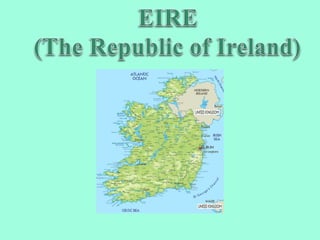
Eire(The Republic of Ireland)
Ireland
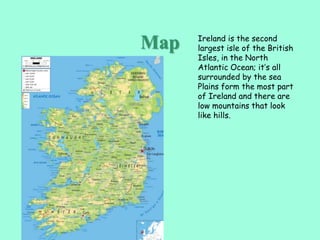
Ireland is the second
largest isle of the British
Isles, in the North
Atlantic Ocean; it’s all
surrounded by the sea
Plains form the most part
of Ireland and there are
low mountains that look
like hills.
Map
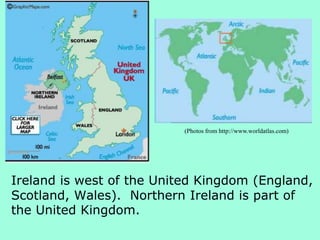
Ireland is west of the United Kingdom (England,
Scotland, Wales). Northern Ireland is part of
the United Kingdom.
(Photos from http://www.worldatlas.com)
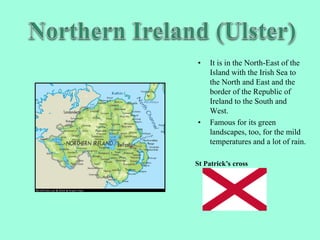
• It is in the North-East of the
Island with the Irish Sea to
the North and East and the
border of the Republic of
Ireland to the South and
West.
• Famous for its green
landscapes, too, for the mild
temperatures and a lot of rain.
St Patrick’s cross
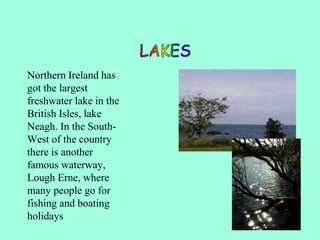
Northern Ireland has
got the largest
freshwater lake in the
British Isles, lake
Neagh. In the South-
West of the country
there is another
famous waterway,
Lough Erne, where
many people go for
fishing and boating
holidays
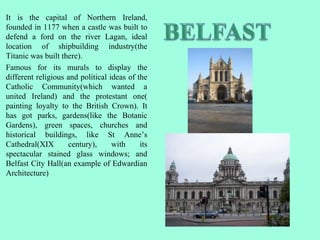
It is the capital of Northern Ireland,
founded in 1177 when a castle was built to
defend a ford on the river Lagan, ideal
location of shipbuilding industry(the
Titanic was built there).
Famous for its murals to display the
different religious and political ideas of the
Catholic Community(which wanted a
united Ireland) and the protestant one(
painting loyalty to the British Crown). It
has got parks, gardens(like the Botanic
Gardens), green spaces, churches and
historical buildings, like St Anne’s
Cathedral(XIX century), with its
spectacular stained glass windows; and
Belfast City Hall(an example of Edwardian
Architecture)
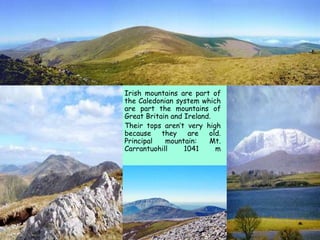
Irish mountains are part of
the Caledonian system which
are part the mountains of
Great Britain and Ireland.
Their tops aren’t very high
because they are old.
Principal mountain: Mt.
Carrantuohill 1041 m
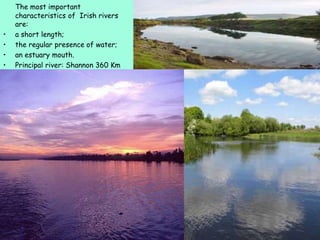
The most important
characteristics of Irish rivers
are:
• a short length;
• the regular presence of water;
• an estuary mouth.
• Principal river: Shannon 360 Km
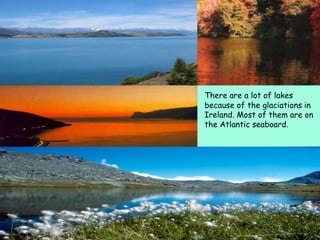
There are a lot of lakes
because of the glaciations in
Ireland. Most of them are on
the Atlantic seaboard.
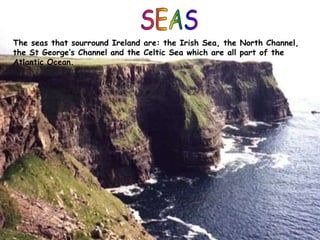
The seas that sourround Ireland are: the Irish Sea, the North Channel,
the St George’s Channel and the Celtic Sea which are all part of the
Atlantic Ocean.
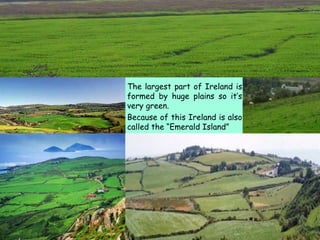
The largest part of Ireland is
formed by huge plains so it’s
very green.
Because of this Ireland is also
called the “Emerald Island”
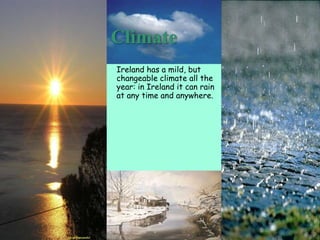
Ireland has a mild, but
changeable climate all the
year: in Ireland it can rain
at any time and anywhere.
Climate
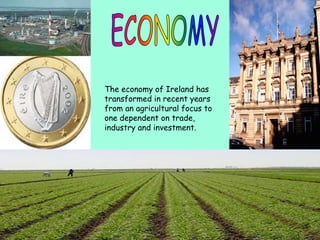
The economy of Ireland has
transformed in recent years
from an agricultural focus to
one dependent on trade,
industry and investment.
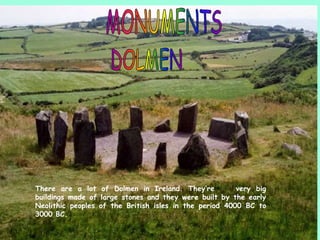
There are a lot of Dolmen in Ireland. They’re very big
buildings made of large stones and they were built by the early
Neolithic peoples of the British isles in the period 4000 BC to
3000 BC.
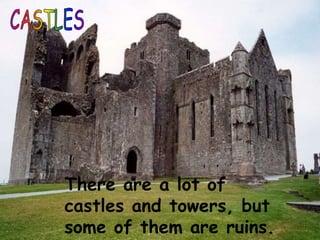
There are a lot of
castles and towers, but
some of them are ruins.
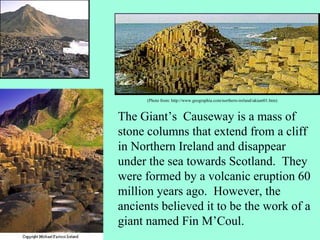
The Giant’s Causeway is a mass of
stone columns that extend from a cliff
in Northern Ireland and disappear
under the sea towards Scotland. They
were formed by a volcanic eruption 60
million years ago. However, the
ancients believed it to be the work of a
giant named Fin M’Coul.
(Photo from: http://www.geographia.com/northern-ireland/ukiant01.htm)
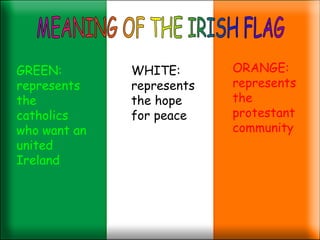
GREEN:
represents
the
catholics
who want an
united
Ireland
WHITE:
represents
the hope
for peace
ORANGE:
represents
the
protestant
community
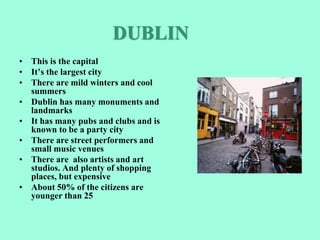
• This is the capital
• It’s the largest city
• There are mild winters and cool
summers
• Dublin has many monuments and
landmarks
• It has many pubs and clubs and is
known to be a party city
• There are street performers and
small music venues
• There are also artists and art
studios. And plenty of shopping
places, but expensive
• About 50% of the citizens are
younger than 25
DUBLIN
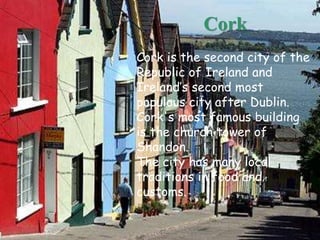
Cork is the second city of the
Republic of Ireland and
Ireland’s second most
populous city after Dublin.
Cork's most famous building
is the church tower of
Shandon.
The city has many local
traditions in food and
customs.
Cork
Most people in Ireland speak
English, but a few still speak
Gaelic. You might hear
someone say “Erin go bragh”
on St. Patrick’s Day, which is
Gaelic for “Ireland forever.”
(Sound file from: http://www.irish-sayings.com/)
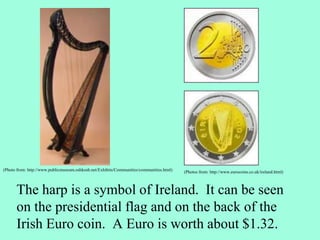
The harp is a symbol of Ireland. It can be seen
on the presidential flag and on the back of the
Irish Euro coin. A Euro is worth about $1.32.
(Photos from: http://www.eurocoins.co.uk/ireland.html)
(Photo from: http://www.publicmuseum.oshkosh.net/Exhibits/Communities/communities.html)
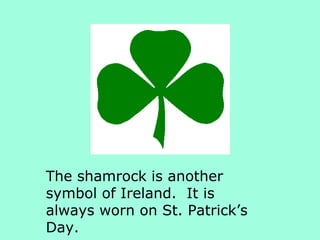
The shamrock is another
symbol of Ireland. It is
always worn on St. Patrick’s
Day.
The Celts, warriors from
western Europe, controlled
Ireland for 1000 years. Today
the term “celtic” is often used to
refer to anything traditionally
Irish, such as celtic music and
celtic dance. Dance, music,
holidays, and traditions are all
part of a people’s culture.
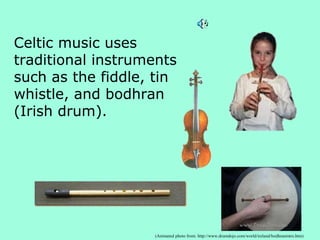
Celtic music uses
traditional instruments
such as the fiddle, tin
whistle, and bodhran
(Irish drum).
(Animated photo from: http://www.drumdojo.com/world/ireland/bodhranintro.htm)
Why do we celebrate St.
Patrick’s Day in America?
•Many Americans have Irish ancestors,
meaning their parents, grandparents or great-
grandparents came from Ireland.
•It’s fun to celebrate holidays from around
the world. Even if you’re not Irish, you can
enjoy celebrating the holiday by wearing
green, which is also a sign of spring.

Ireland

  • 1.
    Northern Ireland (Ulster) Eire(TheRepublic of Ireland) Ireland
  • 2.
    Ireland is thesecond largest isle of the British Isles, in the North Atlantic Ocean; it’s all surrounded by the sea Plains form the most part of Ireland and there are low mountains that look like hills. Map
  • 3.
    Ireland is westof the United Kingdom (England, Scotland, Wales). Northern Ireland is part of the United Kingdom. (Photos from http://www.worldatlas.com)
  • 4.
    • It isin the North-East of the Island with the Irish Sea to the North and East and the border of the Republic of Ireland to the South and West. • Famous for its green landscapes, too, for the mild temperatures and a lot of rain. St Patrick’s cross
  • 5.
    Northern Ireland has gotthe largest freshwater lake in the British Isles, lake Neagh. In the South- West of the country there is another famous waterway, Lough Erne, where many people go for fishing and boating holidays
  • 6.
    It is thecapital of Northern Ireland, founded in 1177 when a castle was built to defend a ford on the river Lagan, ideal location of shipbuilding industry(the Titanic was built there). Famous for its murals to display the different religious and political ideas of the Catholic Community(which wanted a united Ireland) and the protestant one( painting loyalty to the British Crown). It has got parks, gardens(like the Botanic Gardens), green spaces, churches and historical buildings, like St Anne’s Cathedral(XIX century), with its spectacular stained glass windows; and Belfast City Hall(an example of Edwardian Architecture)
  • 8.
    Irish mountains arepart of the Caledonian system which are part the mountains of Great Britain and Ireland. Their tops aren’t very high because they are old. Principal mountain: Mt. Carrantuohill 1041 m
  • 9.
    The most important characteristicsof Irish rivers are: • a short length; • the regular presence of water; • an estuary mouth. • Principal river: Shannon 360 Km
  • 10.
    There are alot of lakes because of the glaciations in Ireland. Most of them are on the Atlantic seaboard.
  • 11.
    The seas thatsourround Ireland are: the Irish Sea, the North Channel, the St George’s Channel and the Celtic Sea which are all part of the Atlantic Ocean.
  • 12.
    The largest partof Ireland is formed by huge plains so it’s very green. Because of this Ireland is also called the “Emerald Island”
  • 13.
    Ireland has amild, but changeable climate all the year: in Ireland it can rain at any time and anywhere. Climate
  • 14.
    The economy ofIreland has transformed in recent years from an agricultural focus to one dependent on trade, industry and investment.
  • 15.
    There are alot of Dolmen in Ireland. They’re very big buildings made of large stones and they were built by the early Neolithic peoples of the British isles in the period 4000 BC to 3000 BC.
  • 16.
    There are alot of castles and towers, but some of them are ruins.
  • 17.
    The Giant’s Causewayis a mass of stone columns that extend from a cliff in Northern Ireland and disappear under the sea towards Scotland. They were formed by a volcanic eruption 60 million years ago. However, the ancients believed it to be the work of a giant named Fin M’Coul. (Photo from: http://www.geographia.com/northern-ireland/ukiant01.htm)
  • 18.
    GREEN: represents the catholics who want an united Ireland WHITE: represents thehope for peace ORANGE: represents the protestant community
  • 19.
    • This isthe capital • It’s the largest city • There are mild winters and cool summers • Dublin has many monuments and landmarks • It has many pubs and clubs and is known to be a party city • There are street performers and small music venues • There are also artists and art studios. And plenty of shopping places, but expensive • About 50% of the citizens are younger than 25 DUBLIN
  • 20.
    Cork is thesecond city of the Republic of Ireland and Ireland’s second most populous city after Dublin. Cork's most famous building is the church tower of Shandon. The city has many local traditions in food and customs. Cork
  • 21.
    Most people inIreland speak English, but a few still speak Gaelic. You might hear someone say “Erin go bragh” on St. Patrick’s Day, which is Gaelic for “Ireland forever.” (Sound file from: http://www.irish-sayings.com/)
  • 22.
    The harp isa symbol of Ireland. It can be seen on the presidential flag and on the back of the Irish Euro coin. A Euro is worth about $1.32. (Photos from: http://www.eurocoins.co.uk/ireland.html) (Photo from: http://www.publicmuseum.oshkosh.net/Exhibits/Communities/communities.html)
  • 23.
    The shamrock isanother symbol of Ireland. It is always worn on St. Patrick’s Day.
  • 24.
    The Celts, warriorsfrom western Europe, controlled Ireland for 1000 years. Today the term “celtic” is often used to refer to anything traditionally Irish, such as celtic music and celtic dance. Dance, music, holidays, and traditions are all part of a people’s culture.
  • 25.
    Celtic music uses traditionalinstruments such as the fiddle, tin whistle, and bodhran (Irish drum). (Animated photo from: http://www.drumdojo.com/world/ireland/bodhranintro.htm)
  • 26.
    Why do wecelebrate St. Patrick’s Day in America? •Many Americans have Irish ancestors, meaning their parents, grandparents or great- grandparents came from Ireland. •It’s fun to celebrate holidays from around the world. Even if you’re not Irish, you can enjoy celebrating the holiday by wearing green, which is also a sign of spring.