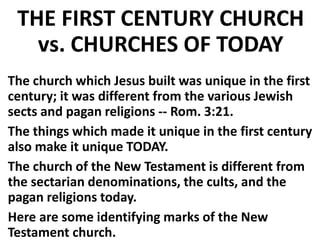
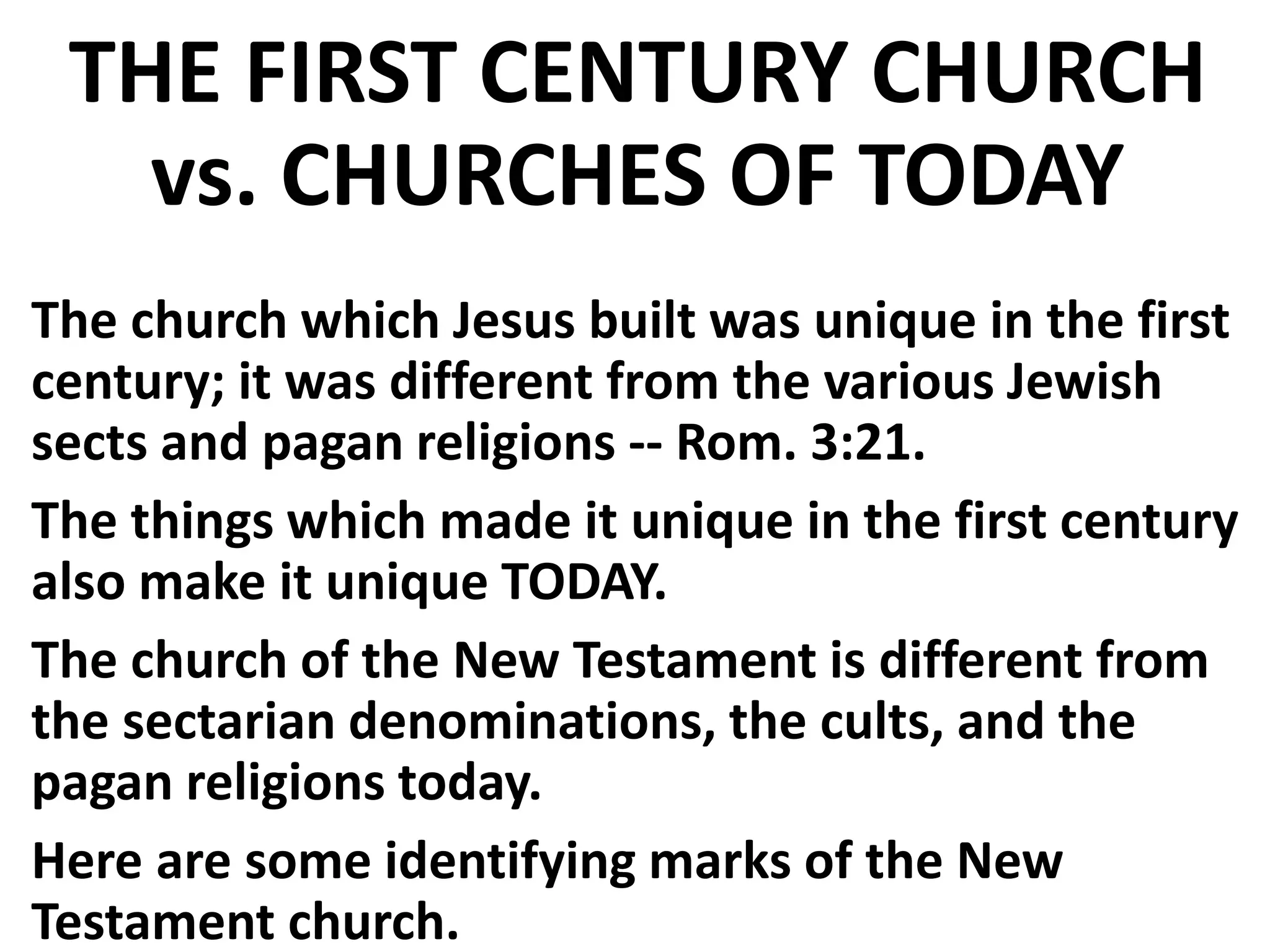
THE FIRST CENTURY CHURCH
vs. CHURCHES OF TODAY
The church which Jesus built was unique in the first
century; it was different from the various Jewish
sects and pagan religions -- Rom. 3:21.
The things which made it unique in the first century
also make it unique TODAY.
The church of the New Testament is different from
the sectarian denominations, the cults, and the
pagan religions today.
Here are some identifying marks of the New
Testament church.
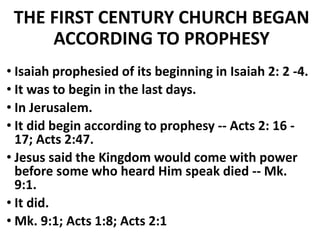
THE FIRST CENTURY CHURCH BEGAN
ACCORDING TO PROPHESY
• Isaiah prophesied of its beginning in Isaiah 2: 2 -4.
• It was to begin in the last days.
• In Jerusalem.
• It did begin according to prophesy -- Acts 2: 16 -
17; Acts 2:47.
• Jesus said the Kingdom would come with power
before some who heard Him speak died -- Mk.
9:1.
• It did.
• Mk. 9:1; Acts 1:8; Acts 2:1
THE FIRST CENTURY CHURCH
FOLLOWED APOSTOLIC DOCTRINE
• Luke recorded that "they continued steadfastly in the apostle's
doctrine" -- Acts 2:42
• Doctrine of Christ -- 2 John 9
• Doctrine of God -- Tit. 2: 10
• The first century church recognized that Jesus had selected the
Apostles through whom to reveal His will to mankind -- Matt.
16:19; 18:18
• He gave them the Holy Spirit to guide them "into all truth"--
John 16:13.
• The Holy Spirit taught them "all things" and brought all things
to their remembrance that Jesus said unto them -- John 14: 26.
• The early church recognized the special role of the Apostles in
revealing the will of God, and it abided in the apostle's doctrine
-- Acts 2:42; 2 John 9 - 11
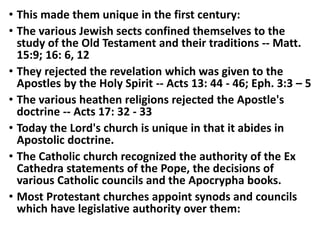
• This made them unique in the first century:
• The various Jewish sects confined themselves to the
study of the Old Testament and their traditions -- Matt.
15:9; 16: 6, 12
• They rejected the revelation which was given to the
Apostles by the Holy Spirit -- Acts 13: 44 - 46; Eph. 3:3 – 5
• The various heathen religions rejected the Apostle's
doctrine -- Acts 17: 32 - 33
• Today the Lord's church is unique in that it abides in
Apostolic doctrine.
• The Catholic church recognized the authority of the Ex
Cathedra statements of the Pope, the decisions of
various Catholic councils and the Apocrypha books.
• Most Protestant churches appoint synods and councils
which have legislative authority over them:
• They decide whether or not homosexuals should be allowed
to serve as preachers -- I Cor. 6: 9 - 10
• They decide whether or not a woman can preach -- I Tim.
2:8, 11 - 12, 14
• They don't go to the word of God to settle issues and
problems. (2 Tim 3:16-17)
• The apostle's doctrine is not their standard of authority.
• Religious groups who have these synods or councils, feel at
liberty to introduce all kinds of innovations in the worship
and work of the church -- they have introduced Choirs,
special singing groups, instruments of music, church
supported institutions, and all kinds of recreational
activities.
• The church of the New Testament today, and in the first
century, abides in the Apostle's doctrine; it does not go
beyond the Word of God -- 2 John 9 - 11; I Cor. 4:6; Rev. 22:
18 - 19; John 12:48; Heb. 1: 1 - 2
THE DAY OF WORSHIP WAS UNIQUE
TO THE EARLY CHURCH
• The early church assembled on the first day of every week:
• To eat the Lord's Supper -- Acts 20:7; 2:42
• To give -- I Cor. 16:1 - 2.
• To teach and pray -- Acts 2:42; 20:7.
• To Sing -- Col. 3:16; Eph. 5:19.
• This day of worship was known as the "LORD'S DAY" -- Rev. 1:
10
• This day distinguished the first century church from Judaism
which "remembered the Sabbath"-- Ex. 20:8; Col. 2: 14 – 17
• The pagans had no distinctive day of worship.
• The first day of the week worship was distinctive to the early
church.
• The first day of the week is still one of the DISTINCTIVE
MARKS of the New Testament church.
THE WORSHIP OF THE EARLY CHURCH
WAS UNIQUE
• Apostolic preaching -- Acts 20:7
• The Lord's Supper -- Acts 2:42
• Prayer -- Acts 2:42
• Congregational singing -- Col. 3:16
• Contribution -- I Cor. 16:1 – 2
• This worship is DISTINCTIVE
• The Jewish people worshipped God with an altar where
animal sacrifices were offered to God
• They studied the Law of Moses.
• They had a separate priesthood.
• Their worship differed from that of the New Testament church.
• The worship of the New Testament church still differs from that of
denominationalism and makes the New Testament church unique.
• DENOMINATIONS:
• Forsake Apostolic Doctrine to hear a preacher tell some
heartwarming stories and preach from creeds.
• They have rejected the weekly observance of the Lord's Supper
for yearly, quarterly, or monthly observance.
• They have rejected congregational singing for singing by choirs
and special groups -- Col. 3:16; Eph. 5:19
• They have supplemented singing with instrumental music -- I Cor.
4:6
• They have replaced free-will offering with tithes -- I Cor. 16:2; II
Cor. 8:12
• The church which worships in keeping with the Divine pattern is
distinctive and unique.
• This worship does not attract the worldly who expect to be
entertained.
• This worship only attracts the spiritually-minded -- Rom. 6:6
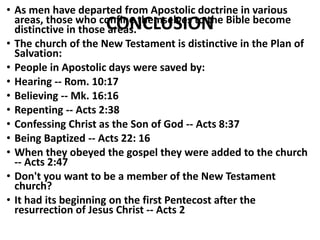
CONCLUSION
• As men have departed from Apostolic doctrine in various
areas, those who confine themselves to the Bible become
distinctive in those areas.
• The church of the New Testament is distinctive in the Plan of
Salvation:
• People in Apostolic days were saved by:
• Hearing -- Rom. 10:17
• Believing -- Mk. 16:16
• Repenting -- Acts 2:38
• Confessing Christ as the Son of God -- Acts 8:37
• Being Baptized -- Acts 22: 16
• When they obeyed the gospel they were added to the church
-- Acts 2:47
• Don't you want to be a member of the New Testament
church?
• It had its beginning on the first Pentecost after the
resurrection of Jesus Christ -- Acts 2

The first century church vs

  • 1.
    THE FIRST CENTURYCHURCH vs. CHURCHES OF TODAY The church which Jesus built was unique in the first century; it was different from the various Jewish sects and pagan religions -- Rom. 3:21. The things which made it unique in the first century also make it unique TODAY. The church of the New Testament is different from the sectarian denominations, the cults, and the pagan religions today. Here are some identifying marks of the New Testament church.
  • 2.
    THE FIRST CENTURYCHURCH BEGAN ACCORDING TO PROPHESY • Isaiah prophesied of its beginning in Isaiah 2: 2 -4. • It was to begin in the last days. • In Jerusalem. • It did begin according to prophesy -- Acts 2: 16 - 17; Acts 2:47. • Jesus said the Kingdom would come with power before some who heard Him speak died -- Mk. 9:1. • It did. • Mk. 9:1; Acts 1:8; Acts 2:1
  • 3.
    THE FIRST CENTURYCHURCH FOLLOWED APOSTOLIC DOCTRINE • Luke recorded that "they continued steadfastly in the apostle's doctrine" -- Acts 2:42 • Doctrine of Christ -- 2 John 9 • Doctrine of God -- Tit. 2: 10 • The first century church recognized that Jesus had selected the Apostles through whom to reveal His will to mankind -- Matt. 16:19; 18:18 • He gave them the Holy Spirit to guide them "into all truth"-- John 16:13. • The Holy Spirit taught them "all things" and brought all things to their remembrance that Jesus said unto them -- John 14: 26. • The early church recognized the special role of the Apostles in revealing the will of God, and it abided in the apostle's doctrine -- Acts 2:42; 2 John 9 - 11
  • 4.
    • This madethem unique in the first century: • The various Jewish sects confined themselves to the study of the Old Testament and their traditions -- Matt. 15:9; 16: 6, 12 • They rejected the revelation which was given to the Apostles by the Holy Spirit -- Acts 13: 44 - 46; Eph. 3:3 – 5 • The various heathen religions rejected the Apostle's doctrine -- Acts 17: 32 - 33 • Today the Lord's church is unique in that it abides in Apostolic doctrine. • The Catholic church recognized the authority of the Ex Cathedra statements of the Pope, the decisions of various Catholic councils and the Apocrypha books. • Most Protestant churches appoint synods and councils which have legislative authority over them:
  • 5.
    • They decidewhether or not homosexuals should be allowed to serve as preachers -- I Cor. 6: 9 - 10 • They decide whether or not a woman can preach -- I Tim. 2:8, 11 - 12, 14 • They don't go to the word of God to settle issues and problems. (2 Tim 3:16-17) • The apostle's doctrine is not their standard of authority. • Religious groups who have these synods or councils, feel at liberty to introduce all kinds of innovations in the worship and work of the church -- they have introduced Choirs, special singing groups, instruments of music, church supported institutions, and all kinds of recreational activities. • The church of the New Testament today, and in the first century, abides in the Apostle's doctrine; it does not go beyond the Word of God -- 2 John 9 - 11; I Cor. 4:6; Rev. 22: 18 - 19; John 12:48; Heb. 1: 1 - 2
  • 6.
    THE DAY OFWORSHIP WAS UNIQUE TO THE EARLY CHURCH • The early church assembled on the first day of every week: • To eat the Lord's Supper -- Acts 20:7; 2:42 • To give -- I Cor. 16:1 - 2. • To teach and pray -- Acts 2:42; 20:7. • To Sing -- Col. 3:16; Eph. 5:19. • This day of worship was known as the "LORD'S DAY" -- Rev. 1: 10 • This day distinguished the first century church from Judaism which "remembered the Sabbath"-- Ex. 20:8; Col. 2: 14 – 17 • The pagans had no distinctive day of worship. • The first day of the week worship was distinctive to the early church. • The first day of the week is still one of the DISTINCTIVE MARKS of the New Testament church.
  • 7.
    THE WORSHIP OFTHE EARLY CHURCH WAS UNIQUE • Apostolic preaching -- Acts 20:7 • The Lord's Supper -- Acts 2:42 • Prayer -- Acts 2:42 • Congregational singing -- Col. 3:16 • Contribution -- I Cor. 16:1 – 2 • This worship is DISTINCTIVE • The Jewish people worshipped God with an altar where animal sacrifices were offered to God • They studied the Law of Moses. • They had a separate priesthood.
  • 8.
    • Their worshipdiffered from that of the New Testament church. • The worship of the New Testament church still differs from that of denominationalism and makes the New Testament church unique. • DENOMINATIONS: • Forsake Apostolic Doctrine to hear a preacher tell some heartwarming stories and preach from creeds. • They have rejected the weekly observance of the Lord's Supper for yearly, quarterly, or monthly observance. • They have rejected congregational singing for singing by choirs and special groups -- Col. 3:16; Eph. 5:19 • They have supplemented singing with instrumental music -- I Cor. 4:6 • They have replaced free-will offering with tithes -- I Cor. 16:2; II Cor. 8:12 • The church which worships in keeping with the Divine pattern is distinctive and unique. • This worship does not attract the worldly who expect to be entertained. • This worship only attracts the spiritually-minded -- Rom. 6:6
  • 9.
    CONCLUSION • As menhave departed from Apostolic doctrine in various areas, those who confine themselves to the Bible become distinctive in those areas. • The church of the New Testament is distinctive in the Plan of Salvation: • People in Apostolic days were saved by: • Hearing -- Rom. 10:17 • Believing -- Mk. 16:16 • Repenting -- Acts 2:38 • Confessing Christ as the Son of God -- Acts 8:37 • Being Baptized -- Acts 22: 16 • When they obeyed the gospel they were added to the church -- Acts 2:47 • Don't you want to be a member of the New Testament church? • It had its beginning on the first Pentecost after the resurrection of Jesus Christ -- Acts 2