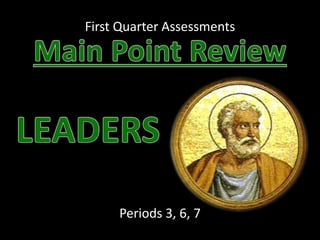
First Quarter Assessments
Periods 3, 6, 7
First Quarter Assessments
Periods 3, 6, 7
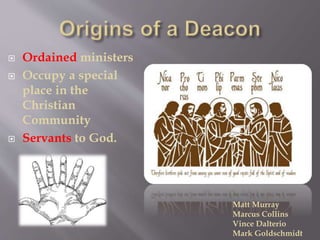
 Ordained ministers
 Occupy a special
place in the
Christian
Community
 Servants to God.
Matt Murray
Marcus Collins
Vince Dalterio
Mark Goldschmidt
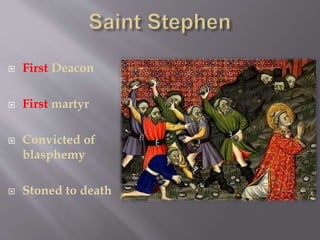
 First Deacon
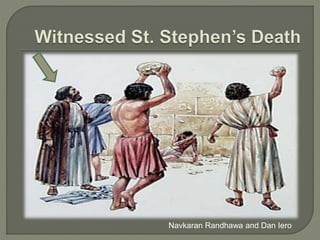
 First martyr
 Convicted of
blasphemy
 Stoned to death
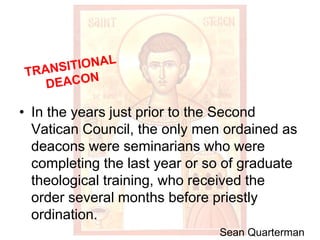
• In the years just prior to the Second
Vatican Council, the only men ordained as
deacons were seminarians who were
completing the last year or so of graduate
theological training, who received the
order several months before priestly
ordination.
Sean Quarterman
• In 1967 Pope Paul VI issued the motu
proprio, restoring the ancient practice of
ordaining to the diaconate men who were
not candidates for priestly ordination.
These men are known as PERMANENT
DEACONS in contrast to those completing
their training, who were then called
transitional deacons.
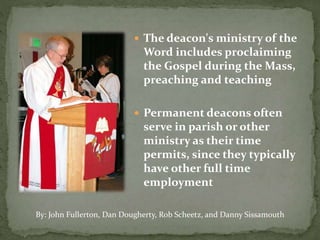
 The deacon's ministry of the
Word includes proclaiming
the Gospel during the Mass,
preaching and teaching
 Permanent deacons often
serve in parish or other
ministry as their time
permits, since they typically
have other full time
employment
By: John Fullerton, Dan Dougherty, Rob Scheetz, and Danny Sissamouth
First Quarter Assessments
Periods 3, 6, 7
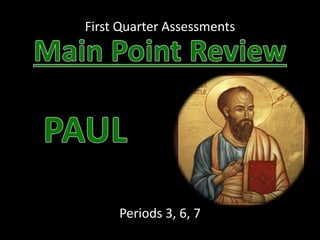
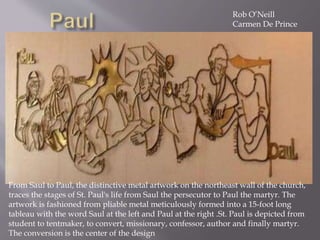
From Saul to Paul, the distinctive metal artwork on the northeast wall of the church,
traces the stages of St. Paul's life from Saul the persecutor to Paul the martyr. The
artwork is fashioned from pliable metal meticulously formed into a 15-foot long
tableau with the word Saul at the left and Paul at the right .St. Paul is depicted from
student to tentmaker, to convert, missionary, confessor, author and finally martyr.
The conversion is the center of the design
Rob O’Neill
Carmen De Prince
Navkaran Randhawa and Dan Iero
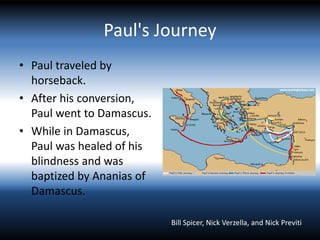
Paul's Journey
• Paul traveled by
horseback.
• After his conversion,
Paul went to Damascus.
• While in Damascus,
Paul was healed of his
blindness and was
baptized by Ananias of
Damascus.
Bill Spicer, Nick Verzella, and Nick Previti
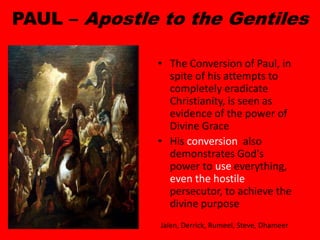
PAUL – Apostle to the Gentiles
• The Conversion of Paul, in
spite of his attempts to
completely eradicate
Christianity, is seen as
evidence of the power of
Divine Grace
• His conversion also
demonstrates God's
power to use everything,
even the hostile
persecutor, to achieve the
divine purpose
Jalen, Derrick, Rumeel, Steve, Dhameer
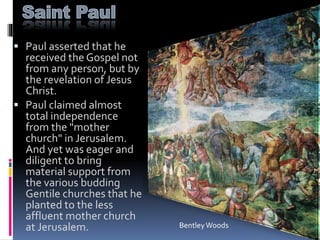
 Paul asserted that he
received the Gospel not
from any person, but by
the revelation of Jesus
Christ.
 Paul claimed almost
total independence
from the "mother
church" in Jerusalem.
And yet was eager and
diligent to bring
material support from
the various budding
Gentile churches that he
planted to the less
affluent mother church
at Jerusalem. BentleyWoods
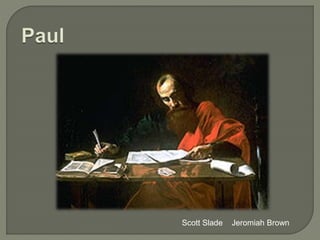
Scott Slade Jeromiah Brown
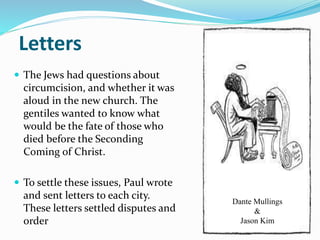
Letters
 The Jews had questions about
circumcision, and whether it was
aloud in the new church. The
gentiles wanted to know what
would be the fate of those who
died before the Seconding
Coming of Christ.
 To settle these issues, Paul wrote
and sent letters to each city.
These letters settled disputes and
order
Dante Mullings
&
Jason Kim
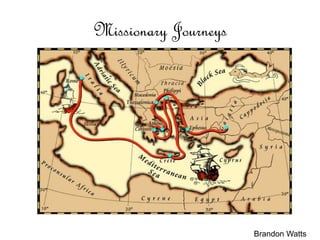
Missionary Journeys
Brandon Watts
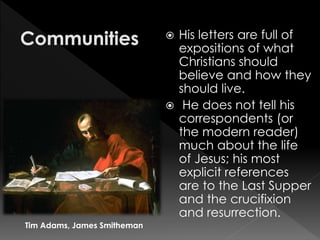
 His letters are full of
expositions of what
Christians should
believe and how they
should live.
 He does not tell his
correspondents (or
the modern reader)
much about the life
of Jesus; his most
explicit references
are to the Last Supper
and the crucifixion
and resurrection.
Tim Adams, James Smitheman
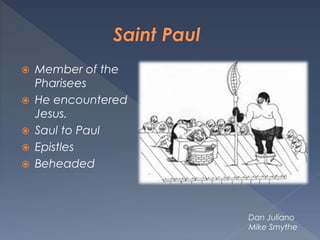
 Member of the
Pharisees
 He encountered
Jesus.
 Saul to Paul
 Epistles
 Beheaded
Dan Juliano
Mike Smythe
First Quarter Assessments
Periods 3, 6, 7
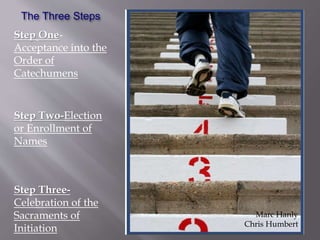
The Three Steps
Step One-
Acceptance into the
Order of
Catechumens
Step Two-Election
or Enrollment of
Names
Step Three-
Celebration of the
Sacraments of
Initiation
Marc Hanly
Chris Humbert
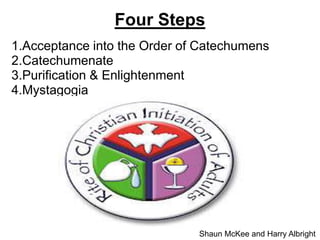
Four Steps
1.Acceptance into the Order of Catechumens
2.Catechumenate
3.Purification & Enlightenment
4.Mystagogia
Shaun McKee and Harry Albright
The Process
The RCIA involves the community of Catholics and includes
many stages that are preformed by liturigcal rites to help the
convert in his or her journey to the final result.
This is usually completed at the Easter Vigil at which time they
will become a full member of the Roman Catholic Church
Lloyd White TJ Mack
Sacraments of Initiation
 This final and very important stage takes place
after the Easter Vigil.
 They receive baptism, confirmation and
eucharist.
 For the first year the new Catholics are called
Neophytes, and they need help and guidance
integrating themselves into this new life.
 During Mystagogy the Neophytes are given
catechesis and other help in integrating
themselves into their new Faith and their new
parish.
Branden Loomis, Ryan Valentino and Mike Regan
Mystagogia
• Time period after Easter inwhich all the new members learn
the aspects of belonging to a parish and how to express their
faith.
First Quarter Assessments
Periods 3, 6, 7
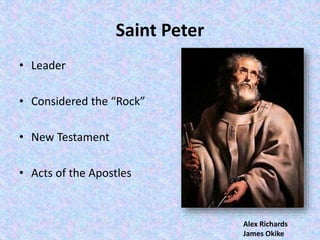
Saint Peter
• Leader
• Considered the “Rock”
• New Testament
• Acts of the Apostles
Alex Richards
James Okike
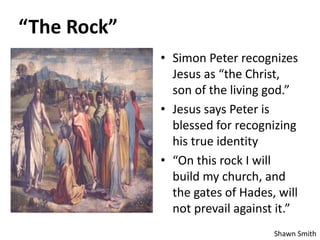
“The Rock”
• Simon Peter recognizes
Jesus as “the Christ,
son of the living god.”
• Jesus says Peter is
blessed for recognizing
his true identity
• “On this rock I will
build my church, and
the gates of Hades, will
not prevail against it.”
Shawn Smith
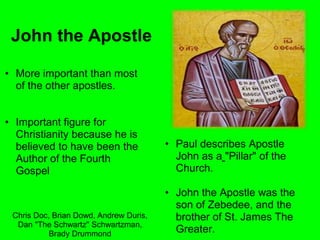
John the Apostle
• More important than most
of the other apostles.
• Important figure for
Christianity because he is
believed to have been the
Author of the Fourth
Gospel
• Paul describes Apostle
John as a "Pillar" of the
Church.
• John the Apostle was the
son of Zebedee, and the
brother of St. James The
Greater.
Chris Doc, Brian Dowd, Andrew Duris,
Dan "The Schwartz" Schwartzman,
Brady Drummond
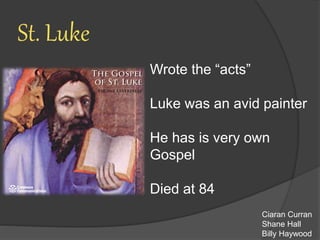
St. Luke
Wrote the “acts”
Luke was an avid painter
He has is very own
Gospel
Died at 84
Ciaran Curran
Shane Hall
Billy Haywood
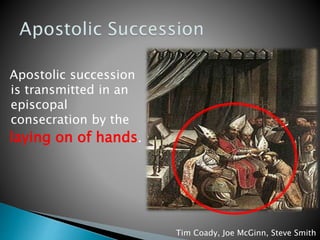
Apostolic succession
is transmitted in an
episcopal
consecration by the
laying on of hands.
Tim Coady, Joe McGinn, Steve Smith
Dan Stone
James Cleary
Thomas Mucho
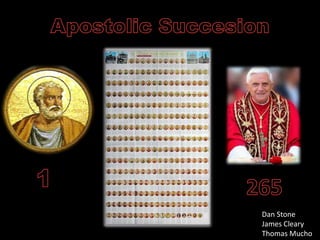
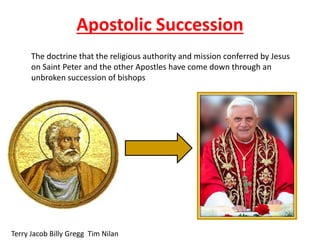
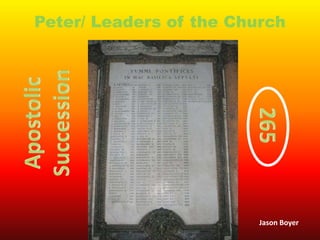
Apostolic Succession
The doctrine that the religious authority and mission conferred by Jesus
on Saint Peter and the other Apostles have come down through an
unbroken succession of bishops
Terry Jacob Billy Gregg Tim Nilan
Peter/ Leaders of the Church
Jason Boyer
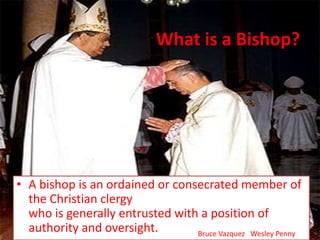
What is a Bishop?
• A bishop is an ordained or consecrated member of
the Christian clergy
who is generally entrusted with a position of
authority and oversight. Bruce Vazquez Wesley Penny
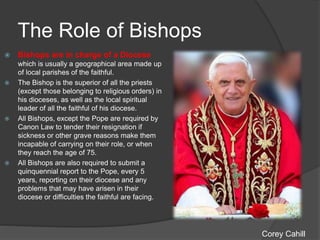
The Role of Bishops
 Bishops are in charge of a Diocese
which is usually a geographical area made up
of local parishes of the faithful.
 The Bishop is the superior of all the priests
(except those belonging to religious orders) in
his dioceses, as well as the local spiritual
leader of all the faithful of his diocese.
 All Bishops, except the Pope are required by
Canon Law to tender their resignation if
sickness or other grave reasons make them
incapable of carrying on their role, or when
they reach the age of 75.
 All Bishops are also required to submit a
quinquennial report to the Pope, every 5
years, reporting on their diocese and any
problems that may have arisen in their
diocese or difficulties the faithful are facing.
Corey Cahill
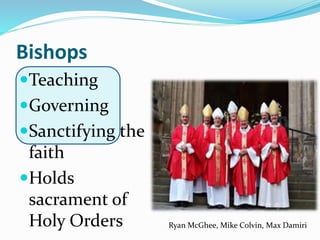
Bishops
Teaching
Governing
Sanctifying the
faith
Holds
sacrament of
Holy Orders Ryan McGhee, Mike Colvin, Max Damiri
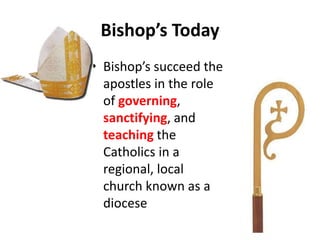
Bishop’s Today
• Bishop’s succeed the
apostles in the role
of governing,
sanctifying, and
teaching the
Catholics in a
regional, local
church known as a
diocese
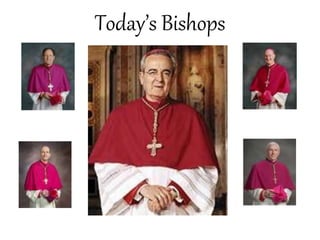
Today’s Bishops
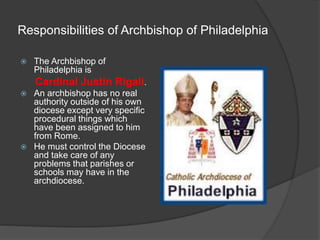
Responsibilities of Archbishop of Philadelphia
 The Archbishop of
Philadelphia is
Cardinal Justin Rigali.
 An archbishop has no real
authority outside of his own
diocese except very specific
procedural things which
have been assigned to him
from Rome.
 He must control the Diocese
and take care of any
problems that parishes or
schools may have in the
archdiocese.
Have A Nice Day !
Bill Spicer, Nick Verzella,
and Nick Previti

Project summary 1Q MB

  • 1.
  • 2.
  • 3.
     Ordained ministers Occupy a special place in the Christian Community  Servants to God. Matt Murray Marcus Collins Vince Dalterio Mark Goldschmidt
  • 4.
     First Deacon First martyr  Convicted of blasphemy  Stoned to death
  • 5.
    • In theyears just prior to the Second Vatican Council, the only men ordained as deacons were seminarians who were completing the last year or so of graduate theological training, who received the order several months before priestly ordination. Sean Quarterman
  • 6.
    • In 1967Pope Paul VI issued the motu proprio, restoring the ancient practice of ordaining to the diaconate men who were not candidates for priestly ordination. These men are known as PERMANENT DEACONS in contrast to those completing their training, who were then called transitional deacons.
  • 7.
     The deacon'sministry of the Word includes proclaiming the Gospel during the Mass, preaching and teaching  Permanent deacons often serve in parish or other ministry as their time permits, since they typically have other full time employment By: John Fullerton, Dan Dougherty, Rob Scheetz, and Danny Sissamouth
  • 8.
  • 9.
    From Saul toPaul, the distinctive metal artwork on the northeast wall of the church, traces the stages of St. Paul's life from Saul the persecutor to Paul the martyr. The artwork is fashioned from pliable metal meticulously formed into a 15-foot long tableau with the word Saul at the left and Paul at the right .St. Paul is depicted from student to tentmaker, to convert, missionary, confessor, author and finally martyr. The conversion is the center of the design Rob O’Neill Carmen De Prince
  • 10.
  • 11.
    Paul's Journey • Paultraveled by horseback. • After his conversion, Paul went to Damascus. • While in Damascus, Paul was healed of his blindness and was baptized by Ananias of Damascus. Bill Spicer, Nick Verzella, and Nick Previti
  • 12.
    PAUL – Apostleto the Gentiles • The Conversion of Paul, in spite of his attempts to completely eradicate Christianity, is seen as evidence of the power of Divine Grace • His conversion also demonstrates God's power to use everything, even the hostile persecutor, to achieve the divine purpose Jalen, Derrick, Rumeel, Steve, Dhameer
  • 13.
     Paul assertedthat he received the Gospel not from any person, but by the revelation of Jesus Christ.  Paul claimed almost total independence from the "mother church" in Jerusalem. And yet was eager and diligent to bring material support from the various budding Gentile churches that he planted to the less affluent mother church at Jerusalem. BentleyWoods
  • 14.
  • 15.
    Letters  The Jewshad questions about circumcision, and whether it was aloud in the new church. The gentiles wanted to know what would be the fate of those who died before the Seconding Coming of Christ.  To settle these issues, Paul wrote and sent letters to each city. These letters settled disputes and order Dante Mullings & Jason Kim
  • 16.
  • 17.
     His lettersare full of expositions of what Christians should believe and how they should live.  He does not tell his correspondents (or the modern reader) much about the life of Jesus; his most explicit references are to the Last Supper and the crucifixion and resurrection. Tim Adams, James Smitheman
  • 18.
     Member ofthe Pharisees  He encountered Jesus.  Saul to Paul  Epistles  Beheaded Dan Juliano Mike Smythe
  • 19.
  • 20.
    The Three Steps StepOne- Acceptance into the Order of Catechumens Step Two-Election or Enrollment of Names Step Three- Celebration of the Sacraments of Initiation Marc Hanly Chris Humbert
  • 21.
    Four Steps 1.Acceptance intothe Order of Catechumens 2.Catechumenate 3.Purification & Enlightenment 4.Mystagogia Shaun McKee and Harry Albright
  • 22.
    The Process The RCIAinvolves the community of Catholics and includes many stages that are preformed by liturigcal rites to help the convert in his or her journey to the final result. This is usually completed at the Easter Vigil at which time they will become a full member of the Roman Catholic Church Lloyd White TJ Mack
  • 23.
    Sacraments of Initiation This final and very important stage takes place after the Easter Vigil.  They receive baptism, confirmation and eucharist.  For the first year the new Catholics are called Neophytes, and they need help and guidance integrating themselves into this new life.  During Mystagogy the Neophytes are given catechesis and other help in integrating themselves into their new Faith and their new parish. Branden Loomis, Ryan Valentino and Mike Regan
  • 24.
    Mystagogia • Time periodafter Easter inwhich all the new members learn the aspects of belonging to a parish and how to express their faith.
  • 25.
  • 26.
    Saint Peter • Leader •Considered the “Rock” • New Testament • Acts of the Apostles Alex Richards James Okike
  • 27.
    “The Rock” • SimonPeter recognizes Jesus as “the Christ, son of the living god.” • Jesus says Peter is blessed for recognizing his true identity • “On this rock I will build my church, and the gates of Hades, will not prevail against it.” Shawn Smith
  • 28.
    John the Apostle •More important than most of the other apostles. • Important figure for Christianity because he is believed to have been the Author of the Fourth Gospel • Paul describes Apostle John as a "Pillar" of the Church. • John the Apostle was the son of Zebedee, and the brother of St. James The Greater. Chris Doc, Brian Dowd, Andrew Duris, Dan "The Schwartz" Schwartzman, Brady Drummond
  • 29.
    St. Luke Wrote the“acts” Luke was an avid painter He has is very own Gospel Died at 84 Ciaran Curran Shane Hall Billy Haywood
  • 30.
    Apostolic succession is transmittedin an episcopal consecration by the laying on of hands. Tim Coady, Joe McGinn, Steve Smith
  • 31.
  • 32.
    Apostolic Succession The doctrinethat the religious authority and mission conferred by Jesus on Saint Peter and the other Apostles have come down through an unbroken succession of bishops Terry Jacob Billy Gregg Tim Nilan
  • 33.
    Peter/ Leaders ofthe Church Jason Boyer
  • 34.
    What is aBishop? • A bishop is an ordained or consecrated member of the Christian clergy who is generally entrusted with a position of authority and oversight. Bruce Vazquez Wesley Penny
  • 35.
    The Role ofBishops  Bishops are in charge of a Diocese which is usually a geographical area made up of local parishes of the faithful.  The Bishop is the superior of all the priests (except those belonging to religious orders) in his dioceses, as well as the local spiritual leader of all the faithful of his diocese.  All Bishops, except the Pope are required by Canon Law to tender their resignation if sickness or other grave reasons make them incapable of carrying on their role, or when they reach the age of 75.  All Bishops are also required to submit a quinquennial report to the Pope, every 5 years, reporting on their diocese and any problems that may have arisen in their diocese or difficulties the faithful are facing. Corey Cahill
  • 36.
  • 37.
    Bishop’s Today • Bishop’ssucceed the apostles in the role of governing, sanctifying, and teaching the Catholics in a regional, local church known as a diocese
  • 38.
  • 39.
    Responsibilities of Archbishopof Philadelphia  The Archbishop of Philadelphia is Cardinal Justin Rigali.  An archbishop has no real authority outside of his own diocese except very specific procedural things which have been assigned to him from Rome.  He must control the Diocese and take care of any problems that parishes or schools may have in the archdiocese.
  • 40.
    Have A NiceDay ! Bill Spicer, Nick Verzella, and Nick Previti