HISTORY 15
MWF 8:30-9:30 AM
THE FILIPINO –
AMERICAN WAR
Friendship & Forgetting
1899-1902
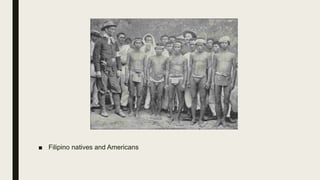
■ Filipino natives and Americans
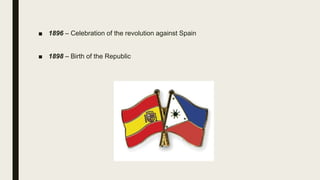
■ 1896 – Celebration of the revolution against Spain
■ 1898 – Birth of the Republic
The main objective of the Americans:
■ Filipinizing bereaucracy
■ Independence
■ Through “BENEVOLENT ASSIMILATION”
The Filipino-American War
■ Began on February 1899
■ Filipino Republican Army – poorly trained and equipped – was defeated
■ By late 1900 they shifted to guerilla warfare
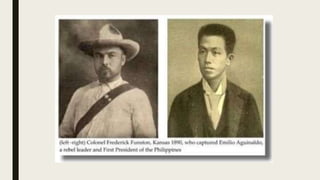
■ By May 1901 – Aguinaldo was captured and swore allegiance to the United
States
■ By May 1902 – the rest of the generals and army followed
■ Officially ended 4 July 1902
■ Rejected a girl of further enlightenment
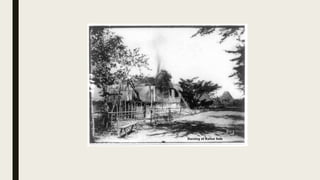
■ “Insurrection” – Filipino resistance
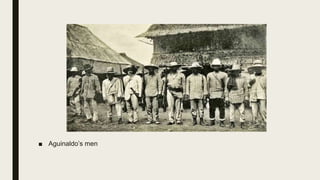
■ Aguinaldo’s men
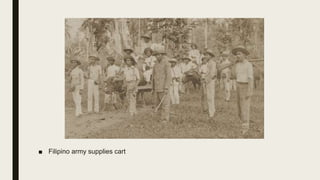
■ Filipino army supplies cart
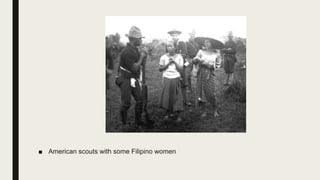
■ American scouts with some Filipino women
AMIGO WARFARE
■ 1900 – 1902 - the focus was on the fate of the republican government and army
■ 1899 Antonio Luna had been assassinated by filipiono soldiers allegedly under
orders from General Aguinaldo.
■ 1901 Aguinaldo retreated to the north and was captured and took the oath of
allegiance to the United States
■ The Amigo Warfare was what the Americans called the filipino style of
resistance
■ Filipinos live uneasily alongside the Americans
■ Filipinos (guerillas) used posed as friendly villagers by day, some donned
American uniforms and were guerillas by night – change of identity
■ “Benevolent Assimilation” – The Orphans of the Pacific
DESCRIBING
LEADERSHIP: THE
ILLUSTRADOS AND
CACIQUES
■ Famous leaders in the Filipino American war:
■ Antonio Luna
■ Gregorio del Pilar
■ Manuel Tinio
“Unsung Heroes” – war heroes that are
not-so-known
■ Norberto Mayo – rural ilustrado
■ Based at the barrios of Tiaong
■ Other ilustrados: Pedro Paterno, Felipe Buencamino, Manuel Arguelles
■ Ladislao Magsangcay – a cacique, a local chief
■ Main initiator of the revolution in their towns
■ Attracting lone soldiers
■ “man of powers” – respected leader
■ Was then called “colonel”, “Captail Islao”
WAR AND
FRIENDSHIP IN
PACIFIED TOWNS
■ Mid 1900 – town centers/poblacions in the Philippines were under the United
States civil or military control
■ After 1902 – U.S pacification and education programs managed to transform
the resistance into a condition of heredity
■ 1900 – only a fraction of the Tiaong evacuees returned to their homes – The rest
are in the guerilla/war zones
■ 1901 – the populace returned en masse; as one group to the town as a result of
crisis: malaria, cholera, sickness, death, declining health, hunger, etc.
■ Pacified town – under a dual government – “companion strategy or amigo
warfare”
■ Mid 1901 – American government allowed local elections
■ Revolutionaries took this opportunity for their own ends. They nominated Pedro
Cantos
■ Dual government – straddling the divide between the colonial and revolutionary
orders.
■ “Duality”
■ Pedro Cantos - President of Tiaong
■ Rural ilustrado. No military or revolutionary background
■ Secret weapon of the guerilla chiefs
■ Ultimate goal : keep lines of communication open between the town and the
country side.
COUNTER-AMIGO
WARFARE AND THE
NEW COLONIALISM
■ “Benevolent Assimilation” had not worked
■ We were seen as semi-civilized and treacherous
■ In US textbooks, this was called the “Spanish-American War”
■ Gen. Bell pacified the provinces
■ No neutrality was allowed – it was only for or against, not just in words but in
deeds
■ The Filipinos had to live near the town centers – where the Americans are
■ Guerillas are outside – their families are inside
■ Prompted surrender
A “HOLWING
WILDNERNESS”
■ "Balangiga massacre" , September 28,1901.
■ "kill and burn" operation to punish the people
■ Balangiga was not the only area ravaged by the Americans
■ Gov. Gardner complained to Manila authorities about the harsh atrocities and
torture
■ In Candelaria as well, majority of Quezon area now
■ Women, children were molested
■ Threatened with imprisonment, deportation, and death
■ No more farmland, food, crops, animals, houses
SURRENDER,
REDEMPTION,
FORGETTING
■ Miguel Malvar – last general to surrender
■ Considered he positive outcomes of their surrender: sanitation, health,
education and political tutelage
■ Still were not able to eradicate negative elements such as banditry, religious
fanaticism, ignorance, caciquism, and so on and so forth
■ Reasons of surrender: imprisonment of their supporters or their relatives,
mass destruction, cholera epidemic, people were barred from
agriculture/farming, looming famine
They did not want to accept that they had
to surrender. However, important factors
prompted them to do so
■ In surrendering, they may acquire the benefits of tutelage and partnership with
the United States
■ A former soldier of Magsangcay begged him to surrender for the sake of the
people, seeing as they were already in drastic conditions – no money, no food,
no clothes, suffered in jails
■ Magsangcay said he would rather die in the field than be captured, but
eventually his soldiers deserted him and surrendered
■ Magsangcay
■ Norberto Mayo
■ Bernardo Marques; said that they were tired of staying in the field, they
were scared, lost hope, health declined, and their families prompted them
to surrender
The surrender of leaders:
Other factors that contributed to their
surrender:
■ No rice crops; no food, no crops, and cant farm because their farms were
already a wasteland
■ An epidemic of cholera, spread from Manila to the provinces
■ Crisis – pleaded assistances from higher authorities
The US; who was largely responsible
for the destruction and suffering,
turned the drastic situation into a
redemptive situation
■ Imported food for them, since the natives had to rely on imported food
because they had no more lands
■ Used their military posts as local distribution centers (here the natives lined
up day & night)
■ Provided what they needed most – rice and medicine
■ Tutelage (“foster child”)
Candelaria women were told to file
formal charges of violation against
the scouts and their officers, but no
one came forward
Because the Americans helped the
Filipinos, forgiving and forgetting was
quick to take form. They wished to
erase a tragic and shameful event
from public memory. This established
hierarchy and indebtedness (utang na
loob) with the Americans
CONCLUSION
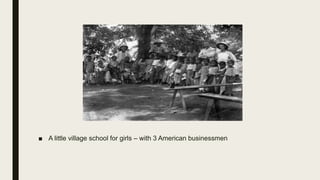
■ A little village school for girls – with 3 American businessmen
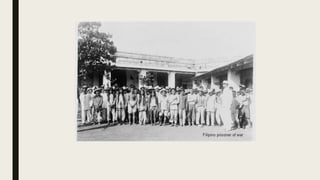
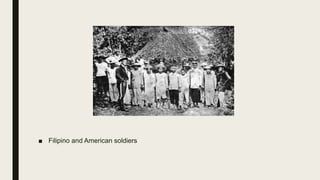
■ Filipino and American soldiers
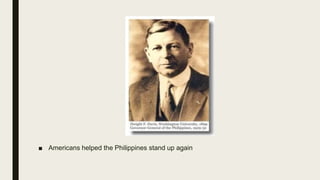
■ Americans helped the Philippines stand up again
“LET THE DEAD PAST
BURY ITS DEAD”
- Captain Boughton
THE END
GROUP 3
Maldo, Ignacio, Fua, Ang, Recto, Salazar

The Filipino-American War

  • 1.
  • 2.
    THE FILIPINO – AMERICANWAR Friendship & Forgetting
  • 3.
  • 6.
    ■ Filipino nativesand Americans
  • 7.
    ■ 1896 –Celebration of the revolution against Spain ■ 1898 – Birth of the Republic
  • 8.
    The main objectiveof the Americans: ■ Filipinizing bereaucracy ■ Independence ■ Through “BENEVOLENT ASSIMILATION”
  • 9.
    The Filipino-American War ■Began on February 1899 ■ Filipino Republican Army – poorly trained and equipped – was defeated ■ By late 1900 they shifted to guerilla warfare ■ By May 1901 – Aguinaldo was captured and swore allegiance to the United States ■ By May 1902 – the rest of the generals and army followed
  • 10.
    ■ Officially ended4 July 1902 ■ Rejected a girl of further enlightenment ■ “Insurrection” – Filipino resistance
  • 12.
  • 13.
    ■ Filipino armysupplies cart
  • 14.
    ■ American scoutswith some Filipino women
  • 15.
  • 16.
    ■ 1900 –1902 - the focus was on the fate of the republican government and army ■ 1899 Antonio Luna had been assassinated by filipiono soldiers allegedly under orders from General Aguinaldo. ■ 1901 Aguinaldo retreated to the north and was captured and took the oath of allegiance to the United States ■ The Amigo Warfare was what the Americans called the filipino style of resistance
  • 17.
    ■ Filipinos liveuneasily alongside the Americans ■ Filipinos (guerillas) used posed as friendly villagers by day, some donned American uniforms and were guerillas by night – change of identity ■ “Benevolent Assimilation” – The Orphans of the Pacific
  • 18.
  • 19.
    ■ Famous leadersin the Filipino American war: ■ Antonio Luna ■ Gregorio del Pilar ■ Manuel Tinio
  • 20.
    “Unsung Heroes” –war heroes that are not-so-known ■ Norberto Mayo – rural ilustrado ■ Based at the barrios of Tiaong ■ Other ilustrados: Pedro Paterno, Felipe Buencamino, Manuel Arguelles
  • 21.
    ■ Ladislao Magsangcay– a cacique, a local chief ■ Main initiator of the revolution in their towns ■ Attracting lone soldiers ■ “man of powers” – respected leader ■ Was then called “colonel”, “Captail Islao”
  • 22.
  • 23.
    ■ Mid 1900– town centers/poblacions in the Philippines were under the United States civil or military control ■ After 1902 – U.S pacification and education programs managed to transform the resistance into a condition of heredity ■ 1900 – only a fraction of the Tiaong evacuees returned to their homes – The rest are in the guerilla/war zones ■ 1901 – the populace returned en masse; as one group to the town as a result of crisis: malaria, cholera, sickness, death, declining health, hunger, etc.
  • 24.
    ■ Pacified town– under a dual government – “companion strategy or amigo warfare” ■ Mid 1901 – American government allowed local elections ■ Revolutionaries took this opportunity for their own ends. They nominated Pedro Cantos ■ Dual government – straddling the divide between the colonial and revolutionary orders. ■ “Duality”
  • 25.
    ■ Pedro Cantos- President of Tiaong ■ Rural ilustrado. No military or revolutionary background ■ Secret weapon of the guerilla chiefs ■ Ultimate goal : keep lines of communication open between the town and the country side.
  • 26.
  • 27.
    ■ “Benevolent Assimilation”had not worked ■ We were seen as semi-civilized and treacherous ■ In US textbooks, this was called the “Spanish-American War” ■ Gen. Bell pacified the provinces
  • 28.
    ■ No neutralitywas allowed – it was only for or against, not just in words but in deeds ■ The Filipinos had to live near the town centers – where the Americans are ■ Guerillas are outside – their families are inside ■ Prompted surrender
  • 29.
  • 30.
    ■ "Balangiga massacre", September 28,1901. ■ "kill and burn" operation to punish the people ■ Balangiga was not the only area ravaged by the Americans ■ Gov. Gardner complained to Manila authorities about the harsh atrocities and torture
  • 31.
    ■ In Candelariaas well, majority of Quezon area now ■ Women, children were molested ■ Threatened with imprisonment, deportation, and death ■ No more farmland, food, crops, animals, houses
  • 32.
  • 33.
    ■ Miguel Malvar– last general to surrender ■ Considered he positive outcomes of their surrender: sanitation, health, education and political tutelage ■ Still were not able to eradicate negative elements such as banditry, religious fanaticism, ignorance, caciquism, and so on and so forth ■ Reasons of surrender: imprisonment of their supporters or their relatives, mass destruction, cholera epidemic, people were barred from agriculture/farming, looming famine
  • 34.
    They did notwant to accept that they had to surrender. However, important factors prompted them to do so ■ In surrendering, they may acquire the benefits of tutelage and partnership with the United States ■ A former soldier of Magsangcay begged him to surrender for the sake of the people, seeing as they were already in drastic conditions – no money, no food, no clothes, suffered in jails ■ Magsangcay said he would rather die in the field than be captured, but eventually his soldiers deserted him and surrendered
  • 35.
    ■ Magsangcay ■ NorbertoMayo ■ Bernardo Marques; said that they were tired of staying in the field, they were scared, lost hope, health declined, and their families prompted them to surrender The surrender of leaders:
  • 36.
    Other factors thatcontributed to their surrender: ■ No rice crops; no food, no crops, and cant farm because their farms were already a wasteland ■ An epidemic of cholera, spread from Manila to the provinces ■ Crisis – pleaded assistances from higher authorities
  • 37.
    The US; whowas largely responsible for the destruction and suffering, turned the drastic situation into a redemptive situation
  • 38.
    ■ Imported foodfor them, since the natives had to rely on imported food because they had no more lands ■ Used their military posts as local distribution centers (here the natives lined up day & night) ■ Provided what they needed most – rice and medicine ■ Tutelage (“foster child”)
  • 39.
    Candelaria women weretold to file formal charges of violation against the scouts and their officers, but no one came forward
  • 40.
    Because the Americanshelped the Filipinos, forgiving and forgetting was quick to take form. They wished to erase a tragic and shameful event from public memory. This established hierarchy and indebtedness (utang na loob) with the Americans
  • 41.
  • 42.
    ■ A littlevillage school for girls – with 3 American businessmen
  • 43.
    ■ Filipino andAmerican soldiers
  • 44.
    ■ Americans helpedthe Philippines stand up again
  • 45.
    “LET THE DEADPAST BURY ITS DEAD” - Captain Boughton
  • 46.
  • 47.
    GROUP 3 Maldo, Ignacio,Fua, Ang, Recto, Salazar