Cover Page 


       Why We Don’t 
     Understand Complex 
          Systems 
 

Author: Jeffrey G. Long (jefflong@aol.com) 

Date: May 21, 2000 

Forum: Poster session presented at the International Conference on Complex 
Systems, sponsored by the New England Complex Systems Institute. 


                                 Contents 
Page 1: Abstract 

Pages 2‐22: Slides (but no text) for presentation 


                                  License 
This work is licensed under the Creative Commons Attribution‐NonCommercial 
3.0 Unported License. To view a copy of this license, visit 
http://creativecommons.org/licenses/by‐nc/3.0/ or send a letter to Creative 
Commons, 444 Castro Street, Suite 900, Mountain View, California, 94041, USA. 


                                Uploaded June 27, 2011 
Abstract Title: Why We Don’t Understand Complex Systems
Author: Jeffrey G. Long


Physics has sought to understand physical systems that once were considered baffling in their
behavior, and by the discovery of new abstractions – initially the creation of a new descriptive
language, the infinitesimal calculus – was able to help provide theoretical explanations that have
led to one revolution after another in the past 300 years. But as is usually the case, prior to the
development of any real understanding of (say) thermodynamics, humanity was able to
successfully harness the power of steam to launch the industrial revolution. This is characteristic
of the successes we have had with many complex systems: humanity’s successes in dealing with
these systems, great as they have been in some cases, have occurred more by trial and error
exploration than by the application of any fundamental organizing principles. Extending this
classic model of progress to other kinds of complex system, this paper presents two fundamental
theses.

The first principal thesis is that complexity is in the eye of the beholder, and is a euphemism for
perplexity. Seeming complexity can be dissolved with appropriate new ways of looking at
complex phenomena, leading to the corollary that in order to understand complex systems, we
will need to develop wholly new abstractions. Humanity has typically come across these by
accident rather than systematically, so the hunt for new abstractions could be greatly facilitated
by the systematic study of the history and evolution of a variety of types of notational systems
(not just mathematics). I call this proposed subject “notational engineering”. I believe we need
new abstractions in many areas, including (e.g.) new ways of representing value besides money,
and new ways of representing large systems of complex rules besides the current tools of
mathematics, logic and natural language.

The second principal thesis of this talk is that seemingly-complex systems differ from simpler,
more understandable systems only in having more rules governing their behavior. In traditional
science, scientists look at the complex behavior of a system and try to develop a few simple rules
that account for that behavior. With seemingly-complex systems, there will be many rules that
must be defined. I call the complex behavior of a system its “surface structure”, and the
thousands of rules that govern it “middle structure”. These rules in turn can be grouped by their
form, and these the “deep structure” of the system. Families of systems share the same deep
structure. This process-oriented metaphysics permits a very practical, highly abstract and formal
way of organizing and representing rules. I call this approach “Ultra-Structure”, and have applied
it to a number of types of systems. It permits the creation of “spreadsheets” (called “Competency
Rule Engines) for families of systems, where one needs only to enter the rules of a system as
data into the spreadsheet to make the system accurately model the behavior of a complex
system. I think this may be a serious candidate for a new general approach to representing any
kind of complex, or seemingly-complex, system.
Why We Don’t Understand
   Complex S t
   C    l Systems

           Jeffrey G. Long
     ICCS Conference, May 2000
          jefflong@aol.com
Complexity is a
      Euphemism for Perplexity
We may have competence in using complex systems
but we still don’t “understand” complex systems

This is not because of the nature of the systems, but
rather because our notational systems – our
abstractions -- are inadequate


These problems cannot be solved by working harder
or using faster computers
Complexity is not a property of systems; rather, perplexity
is a property of the observer

Many if not most problems today are fundamentally
representational in character

We don’t go sailing in automobiles; we shouldn’t (e.g.)
         g        g               ;              ( g)
use mathematics for complex conditional rules

Using the wrong, or too-limited, a notational system is
inescapably self-defeating
We Have Never Really Studied
       Notational Systems
There are four kinds of sign system:
   Formal: syntax only, e.g. formal logic and language, pure
   mathematics
   Informal: semantics only, e.g. art, advertising, politics,
   religious symbols
   Notational: have both syntax and semantics, e.g. natural
                                      semantics e g
   language, musical notation, money, cartography
   Subsymbolic: neither syntax nor semantics, e.g. natural
   systems

Of these, notational systems are probably the least-explored
Each primary notational system maps a different
“abstraction space”
   Abstraction spaces are incommensurable
   Perceiving these is a unique human ability


Abstraction spaces are discoveries, not inventions
   Abstraction spaces are real


Acquiring literacy in a notation is learning how to see
a new abstraction space
All higher forms of thinking are dependent upon the
use of one or more notational systems

The notational systems one habitually uses influences
the manner in which one perceives his environment:
the picture of the universe shifts from notation to
notation

Notational systems have been central to the
evolution of civilization
Every notational system has limitations: a
    y             y
“complexity barrier”

The problems we face now as a civilization are, in
many cases, notational

We need a more systematic way to develop and
settle abstraction spaces
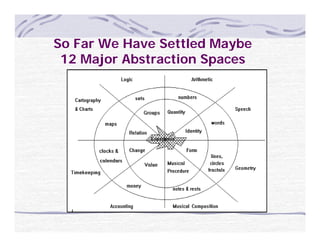
So Far We Have Settled Maybe
 12 Major Abstraction Spaces
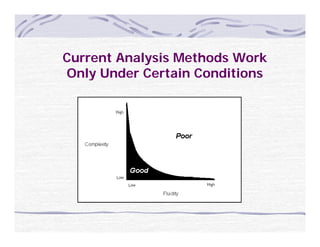
Current Analysis Methods Work
Only Under Certain Conditions
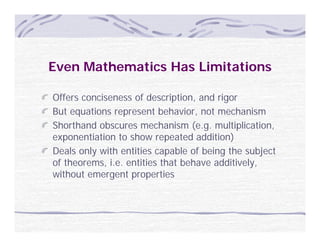
Even Mathematics Has Limitations

Offers conciseness of description, and rigor
But
B t equations represent b h i
         ti              t behavior, not mechanism
                                       t    h i
Shorthand obscures mechanism (e.g. multiplication,
exponentiation to show repeated addition)
Deals only with entities capable of being the subject
of theorems, i.e. entities that behave additively,
without emergent properties
   h
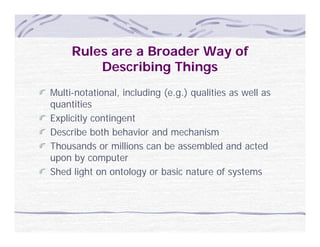
Rules are a Broader Way of
         Describing Things
Multi-notational, including (e.g.) qualities as well as
q
quantities
Explicitly contingent
Describe both behavior and mechanism
Thousands or millions can be assembled and acted
upon by computer
Shed light on ontology or basic nature of systems
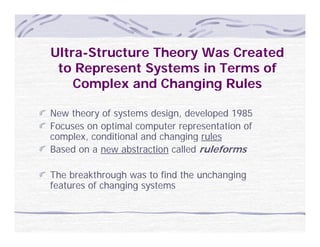
Ultra-Structure Theory Was Created
 to Represent Systems in Terms of
    Complex and Changing Rules

New theory of systems design, developed 1985
Focuses on optimal computer representation of
complex, conditional and changing rules
Based on a new abstraction called ruleforms

The breakthrough was to find the unchanging
features of changing systems
The Theory Offers a Different Way to
Look at Complex Syste s and Processes
 oo     Co p e Systems a d ocesses

  observable
   behaviors                  surface structure
                      generates
        rules                 middle structure
                      constrains
form of rules
f     f l                      deep structure
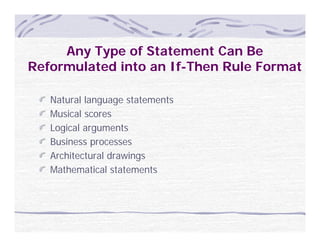
Any Type of Statement Can Be
                f
Reformulated into an If-Then Rule Format

   Natural language statements
   Musical scores
   Logical arguments
   Business processes
   B i
   Architectural drawings
   Mathematical statements
Rules Can be Represented in
    Place-Value (Tabular) Form

Place value assigns meaning based on content and
location
  In Hindu-Arabic numerals, this is column position
  In ruleforms, this is column position
Thousands of rules can fit in same ruleform
There are multiple basic ruleforms, not just one
  But the t t l
  B t th total number i still small (<100?)
                  b is till      ll ( 100?)
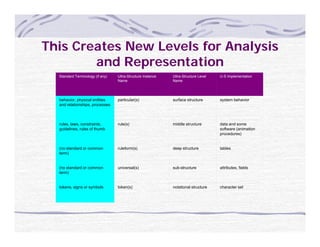
This Creates New Levels for Analysis
        and Representation
  Standard Terminology (if any)   Ultra-Structure Instance   Ultra-Structure Level   U-S Implementation
                                  Name                       Name


  behavior, physical entities     particular(s)              surface structure       system behavior
  and relationships, processes


  rules, laws, constraints,       rule(s)                    middle structure        data and some
  guidelines, rules of thumb                                                         software (animation
                                                                                     procedures)


  (no standard or common          ruleform(s)                deep structure          tables
  term)


  (no standard or common          universal(s)               sub-structure           attributes, fields
  term)


  tokens, signs or symbols        token(s)                   notational structure    character set
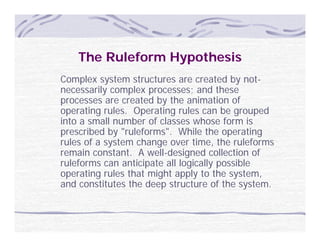
The Ruleform Hypothesis
Complex system structures are created b not-
C     l      t     t t                t d by t
necessarily complex processes; and these
processes are created by the animation of
operating rules. Operating rules can be grouped
      ti     l    O    ti      l        b       d
into a small number of classes whose form is
prescribed by "ruleforms". While the operating
rules of a system change over time, th ruleforms
  l     f      t    h             ti   the l f
remain constant. A well-designed collection of
ruleforms can anticipate all logically possible
operating rules that might apply to the system,
      ti     l th t i ht         l t th      t
and constitutes the deep structure of the system.
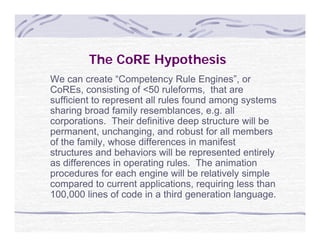
The CoRE Hypothesis
We
W can create “Competency Rule E i
               t “C      t       R l Engines”, or
                                              ”
CoREs, consisting of <50 ruleforms, that are
sufficient to represent all rules found among systems
sharing b d f il resemblances, e.g. all
 h i broad family             bl             ll
corporations. Their definitive deep structure will be
permanent, unchanging, and robust for all members
of the family, whose diff
 f th f il        h   differences in manifest
                                     i    if t
structures and behaviors will be represented entirely
as differences in operating rules. The animation
procedures f each engine will b relatively simple
       d      for   h      i     ill be l ti l i l
compared to current applications, requiring less than
100,000 lines of code in a third generation language.
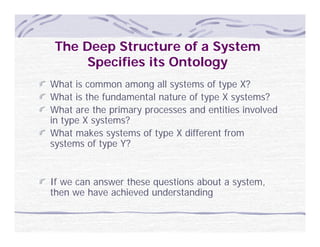
The Deep Structure of a System
      Specifies its Ontology
What is common among all systems of type X?
What is the fundamental nature of type X systems?
What are the primary processes and entities involved
in type X systems?
What makes systems of type X different from
systems of type Y?


If we can answer these questions about a system,
then we have achieved understanding
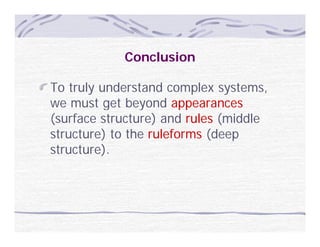
Conclusion

To truly understand complex systems,
we must get beyond appearances
          g     y       pp
(surface structure) and rules (middle
structure) to the ruleforms (deep
         )                  (   p
structure).
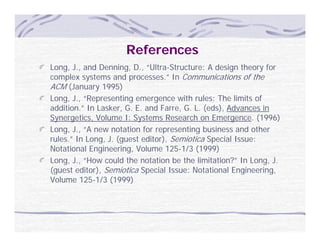
R f
                     References
Long, J., and Denning, D., “Ultra-Structure: A design theory for
complex systems and processes.” In Communications of the
                       processes
ACM (January 1995)
Long, J., “Representing emergence with rules: The limits of
addition.
addition ” In Lasker, G E. and Farre G L (eds) Advances in
              Lasker G. E        Farre, G. L. (eds),
Synergetics, Volume I: Systems Research on Emergence. (1996)
Long, J., “A new notation for representing business and other
rules ” In Long, J. (guest editor) Semiotica Special Issue:
rules.     Long J          editor),
Notational Engineering, Volume 125-1/3 (1999)
Long, J., “How could the notation be the limitation?” In Long, J.
(guest editor) Semiotica Special Issue: Notational Engineering
        editor),                                     Engineering,
Volume 125-1/3 (1999)

Why we dont understand complex systems

  • 1.
    Cover Page    Why We Don’t  Understand Complex  Systems    Author: Jeffrey G. Long (jefflong@aol.com)  Date: May 21, 2000  Forum: Poster session presented at the International Conference on Complex  Systems, sponsored by the New England Complex Systems Institute.    Contents  Page 1: Abstract  Pages 2‐22: Slides (but no text) for presentation  License  This work is licensed under the Creative Commons Attribution‐NonCommercial  3.0 Unported License. To view a copy of this license, visit  http://creativecommons.org/licenses/by‐nc/3.0/ or send a letter to Creative  Commons, 444 Castro Street, Suite 900, Mountain View, California, 94041, USA.  Uploaded June 27, 2011 
  • 2.
    Abstract Title: WhyWe Don’t Understand Complex Systems Author: Jeffrey G. Long Physics has sought to understand physical systems that once were considered baffling in their behavior, and by the discovery of new abstractions – initially the creation of a new descriptive language, the infinitesimal calculus – was able to help provide theoretical explanations that have led to one revolution after another in the past 300 years. But as is usually the case, prior to the development of any real understanding of (say) thermodynamics, humanity was able to successfully harness the power of steam to launch the industrial revolution. This is characteristic of the successes we have had with many complex systems: humanity’s successes in dealing with these systems, great as they have been in some cases, have occurred more by trial and error exploration than by the application of any fundamental organizing principles. Extending this classic model of progress to other kinds of complex system, this paper presents two fundamental theses. The first principal thesis is that complexity is in the eye of the beholder, and is a euphemism for perplexity. Seeming complexity can be dissolved with appropriate new ways of looking at complex phenomena, leading to the corollary that in order to understand complex systems, we will need to develop wholly new abstractions. Humanity has typically come across these by accident rather than systematically, so the hunt for new abstractions could be greatly facilitated by the systematic study of the history and evolution of a variety of types of notational systems (not just mathematics). I call this proposed subject “notational engineering”. I believe we need new abstractions in many areas, including (e.g.) new ways of representing value besides money, and new ways of representing large systems of complex rules besides the current tools of mathematics, logic and natural language. The second principal thesis of this talk is that seemingly-complex systems differ from simpler, more understandable systems only in having more rules governing their behavior. In traditional science, scientists look at the complex behavior of a system and try to develop a few simple rules that account for that behavior. With seemingly-complex systems, there will be many rules that must be defined. I call the complex behavior of a system its “surface structure”, and the thousands of rules that govern it “middle structure”. These rules in turn can be grouped by their form, and these the “deep structure” of the system. Families of systems share the same deep structure. This process-oriented metaphysics permits a very practical, highly abstract and formal way of organizing and representing rules. I call this approach “Ultra-Structure”, and have applied it to a number of types of systems. It permits the creation of “spreadsheets” (called “Competency Rule Engines) for families of systems, where one needs only to enter the rules of a system as data into the spreadsheet to make the system accurately model the behavior of a complex system. I think this may be a serious candidate for a new general approach to representing any kind of complex, or seemingly-complex, system.
  • 3.
    Why We Don’tUnderstand Complex S t C l Systems Jeffrey G. Long ICCS Conference, May 2000 jefflong@aol.com
  • 4.
    Complexity is a Euphemism for Perplexity We may have competence in using complex systems but we still don’t “understand” complex systems This is not because of the nature of the systems, but rather because our notational systems – our abstractions -- are inadequate These problems cannot be solved by working harder or using faster computers
  • 5.
    Complexity is nota property of systems; rather, perplexity is a property of the observer Many if not most problems today are fundamentally representational in character We don’t go sailing in automobiles; we shouldn’t (e.g.) g g ; ( g) use mathematics for complex conditional rules Using the wrong, or too-limited, a notational system is inescapably self-defeating
  • 6.
    We Have NeverReally Studied Notational Systems There are four kinds of sign system: Formal: syntax only, e.g. formal logic and language, pure mathematics Informal: semantics only, e.g. art, advertising, politics, religious symbols Notational: have both syntax and semantics, e.g. natural semantics e g language, musical notation, money, cartography Subsymbolic: neither syntax nor semantics, e.g. natural systems Of these, notational systems are probably the least-explored
  • 7.
    Each primary notationalsystem maps a different “abstraction space” Abstraction spaces are incommensurable Perceiving these is a unique human ability Abstraction spaces are discoveries, not inventions Abstraction spaces are real Acquiring literacy in a notation is learning how to see a new abstraction space
  • 8.
    All higher formsof thinking are dependent upon the use of one or more notational systems The notational systems one habitually uses influences the manner in which one perceives his environment: the picture of the universe shifts from notation to notation Notational systems have been central to the evolution of civilization
  • 9.
    Every notational systemhas limitations: a y y “complexity barrier” The problems we face now as a civilization are, in many cases, notational We need a more systematic way to develop and settle abstraction spaces
  • 10.
    So Far WeHave Settled Maybe 12 Major Abstraction Spaces
  • 11.
    Current Analysis MethodsWork Only Under Certain Conditions
  • 12.
    Even Mathematics HasLimitations Offers conciseness of description, and rigor But B t equations represent b h i ti t behavior, not mechanism t h i Shorthand obscures mechanism (e.g. multiplication, exponentiation to show repeated addition) Deals only with entities capable of being the subject of theorems, i.e. entities that behave additively, without emergent properties h
  • 13.
    Rules are aBroader Way of Describing Things Multi-notational, including (e.g.) qualities as well as q quantities Explicitly contingent Describe both behavior and mechanism Thousands or millions can be assembled and acted upon by computer Shed light on ontology or basic nature of systems
  • 14.
    Ultra-Structure Theory WasCreated to Represent Systems in Terms of Complex and Changing Rules New theory of systems design, developed 1985 Focuses on optimal computer representation of complex, conditional and changing rules Based on a new abstraction called ruleforms The breakthrough was to find the unchanging features of changing systems
  • 15.
    The Theory Offersa Different Way to Look at Complex Syste s and Processes oo Co p e Systems a d ocesses observable behaviors surface structure generates rules middle structure constrains form of rules f f l deep structure
  • 16.
    Any Type ofStatement Can Be f Reformulated into an If-Then Rule Format Natural language statements Musical scores Logical arguments Business processes B i Architectural drawings Mathematical statements
  • 17.
    Rules Can beRepresented in Place-Value (Tabular) Form Place value assigns meaning based on content and location In Hindu-Arabic numerals, this is column position In ruleforms, this is column position Thousands of rules can fit in same ruleform There are multiple basic ruleforms, not just one But the t t l B t th total number i still small (<100?) b is till ll ( 100?)
  • 18.
    This Creates NewLevels for Analysis and Representation Standard Terminology (if any) Ultra-Structure Instance Ultra-Structure Level U-S Implementation Name Name behavior, physical entities particular(s) surface structure system behavior and relationships, processes rules, laws, constraints, rule(s) middle structure data and some guidelines, rules of thumb software (animation procedures) (no standard or common ruleform(s) deep structure tables term) (no standard or common universal(s) sub-structure attributes, fields term) tokens, signs or symbols token(s) notational structure character set
  • 19.
    The Ruleform Hypothesis Complexsystem structures are created b not- C l t t t t d by t necessarily complex processes; and these processes are created by the animation of operating rules. Operating rules can be grouped ti l O ti l b d into a small number of classes whose form is prescribed by "ruleforms". While the operating rules of a system change over time, th ruleforms l f t h ti the l f remain constant. A well-designed collection of ruleforms can anticipate all logically possible operating rules that might apply to the system, ti l th t i ht l t th t and constitutes the deep structure of the system.
  • 20.
    The CoRE Hypothesis We Wcan create “Competency Rule E i t “C t R l Engines”, or ” CoREs, consisting of <50 ruleforms, that are sufficient to represent all rules found among systems sharing b d f il resemblances, e.g. all h i broad family bl ll corporations. Their definitive deep structure will be permanent, unchanging, and robust for all members of the family, whose diff f th f il h differences in manifest i if t structures and behaviors will be represented entirely as differences in operating rules. The animation procedures f each engine will b relatively simple d for h i ill be l ti l i l compared to current applications, requiring less than 100,000 lines of code in a third generation language.
  • 21.
    The Deep Structureof a System Specifies its Ontology What is common among all systems of type X? What is the fundamental nature of type X systems? What are the primary processes and entities involved in type X systems? What makes systems of type X different from systems of type Y? If we can answer these questions about a system, then we have achieved understanding
  • 22.
    Conclusion To truly understandcomplex systems, we must get beyond appearances g y pp (surface structure) and rules (middle structure) to the ruleforms (deep ) ( p structure).
  • 23.
    R f References Long, J., and Denning, D., “Ultra-Structure: A design theory for complex systems and processes.” In Communications of the processes ACM (January 1995) Long, J., “Representing emergence with rules: The limits of addition. addition ” In Lasker, G E. and Farre G L (eds) Advances in Lasker G. E Farre, G. L. (eds), Synergetics, Volume I: Systems Research on Emergence. (1996) Long, J., “A new notation for representing business and other rules ” In Long, J. (guest editor) Semiotica Special Issue: rules. Long J editor), Notational Engineering, Volume 125-1/3 (1999) Long, J., “How could the notation be the limitation?” In Long, J. (guest editor) Semiotica Special Issue: Notational Engineering editor), Engineering, Volume 125-1/3 (1999)