Cover Page 


    Notation Engineering: 
      A Proposed New Discipline 
                          in Semiotics 
Author: Jeffrey G. Long (jefflong@aol.com) 

Date: October 25, 1997 

Forum: Talk presented at the at the 22nd Annual Meeting of the Semiotic Society 
of America. 


                                 Contents 
Pages 1‐15: Slides (but no text) for presentation 


                                  License 
This work is licensed under the Creative Commons Attribution‐NonCommercial 
3.0 Unported License. To view a copy of this license, visit 
http://creativecommons.org/licenses/by‐nc/3.0/ or send a letter to Creative 
Commons, 444 Castro Street, Suite 900, Mountain View, California, 94041, USA. 


                                Uploaded June 22, 2011 
Notational Engineering:
A Proposed New Discipline in Semiotics

              Jeffrey G. Long
       GWU Notational Engineering Laboratory


             Copyright 1997 © Jeffrey G. Long
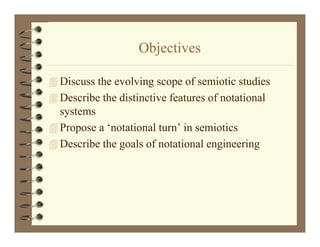
Objectives
                    Obj ti

 Discuss the evolving scope of semiotic studies
 Describe the distinctive features of notational
  systems
 Propose a ‘notational turn’ in semiotics
 Describe the goals of notational engineering
The E l i S
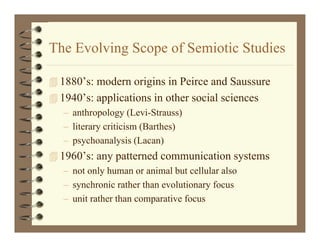
Th Evolving Scope of Semiotic Studies
                   f S i ti St di

 1880’s: modern origins in Peirce and Saussure
 1940’s: applications in other social sciences
   – anthropology (Levi-Strauss)
   – literary criticism (Barthes)
   – psychoanalysis (Lacan)
           h     l i (L      )
 1960’s: any patterned communication systems
   – not only human or animal but cellular also
   – synchronic rather than evolutionary focus
   – unit rather than comparative focus
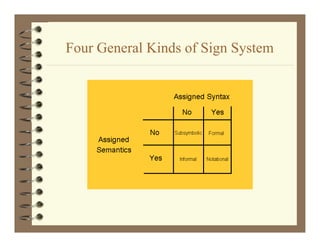
Four G
F    General Ki d of Si S t
           l Kinds f Sign System
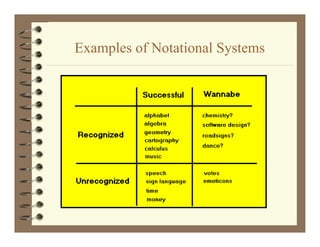
Examples of Notational Systems
E    l    f N t ti l S t
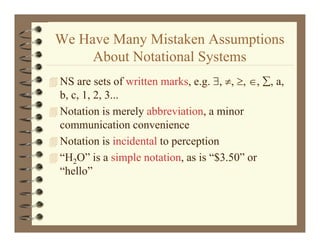
We Have Many Mistaken Assumptions
             y                 p
      About Notational Systems
 NS are sets of written marks, e.g. , , , ,  a,
                                                 ,
  b, c, 1, 2, 3...
NNotation is merely abbreviation, a minor
         i i       l bb i i            i
  communication convenience
 N t ti is i id t l t perception
  Notation i incidental to        ti
 “H2O” is a simple notation, as is “$3.50” or
  “hello”
   hello
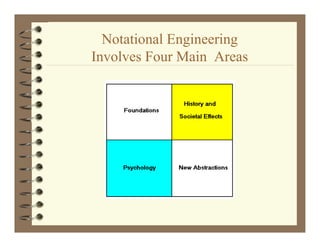
Notational Engineering
               g       g
Involves Four Main Areas
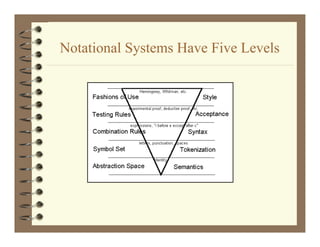
Notational S t
N t ti l Systems Have Five Levels
                 H    Fi L l
Notational S t
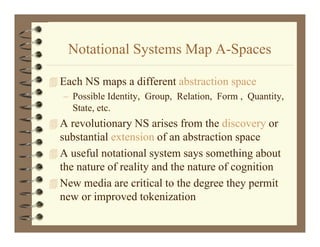
    N t ti l Systems Map A-Spaces
                     M AS

 Each NS maps a different abstraction space
   – Possible Identity, Group, Relation, Form , Quantity,
     State, etc
     State etc.
 A revolutionary NS arises from the discovery or
  substantial extension of an abstraction space
 A useful notational system says something about
  the nature of reality and the nature of cognition
 New media are critical to the degree they permit
  new or improved tokenization
            p
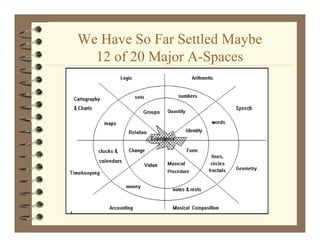
We Have So Far Settled Maybe
                         y
  12 of 20 Major A-Spaces
Like Any Tool, Every Notation Has
          y      ,    y
     Both Strengths and Limitations
 We don’t go sailing in automobiles; we shouldn’t
  (e.g.) use English for complex rules
 U i the wrong, or too-limited, a NS is
  Using h                  li i d        i
  inescapably self-defeating
CComplexity is a euphemism for perplexity
         l it i        h i f           l it
   – Many if not most problems today are fundamentally
     representational in character
   – They cannot be solved by working harder or using
     faster computers
   – We need fundamentally new abstractions (e.g. for rules)
But There is No Systematic Approach
                   y          pp
       to Notational Development
 We take what we have for granted; it is the cognitive
  sea we swim in
NNew NS are hihistorically treated with derision
                     i ll          d ihd i i
 NS are ad hoc, often developed over hundreds of
  years
 There is no underlying theory of NS-as-maps
 Th
  There is no test bed, approval process, or standards
        i          b d           l                d d
  body for abstractions
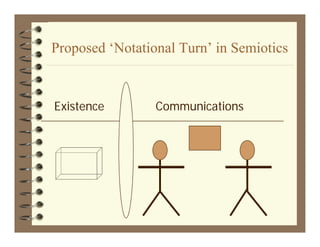
Proposed ‘N t ti l Turn’ in Semiotics
P      d ‘Notational T ’ i S i ti


Existence       Communications
We Need A New Discipline of
                           p
         Notational Engineering
 Cross-notational
 Cross-cultural
 Longitudinal, i.e. “historically” based
 Seeking explanatory hypotheses subject to
  experimental verification
 Philosophically well-grounded and defensible


 Revolutionary new NS could be better
  constructed, tested and utilized
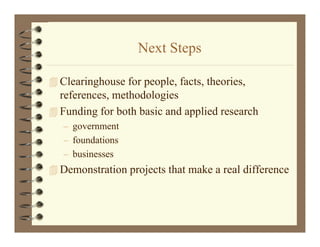
Next Steps
                   N t St

 Clearinghouse for people, facts, theories,
  references, methodologies
 F di for both basic and applied research
  Funding f b h b i       d  li d        h
   – government
   – foundations
   – businesses
 Demonstration projects that make a real difference

Notational engineering

  • 1.
    Cover Page    Notation Engineering:  A Proposed New Discipline  in Semiotics  Author: Jeffrey G. Long (jefflong@aol.com)  Date: October 25, 1997  Forum: Talk presented at the at the 22nd Annual Meeting of the Semiotic Society  of America.    Contents  Pages 1‐15: Slides (but no text) for presentation    License  This work is licensed under the Creative Commons Attribution‐NonCommercial  3.0 Unported License. To view a copy of this license, visit  http://creativecommons.org/licenses/by‐nc/3.0/ or send a letter to Creative  Commons, 444 Castro Street, Suite 900, Mountain View, California, 94041, USA.  Uploaded June 22, 2011 
  • 2.
    Notational Engineering: A ProposedNew Discipline in Semiotics Jeffrey G. Long GWU Notational Engineering Laboratory Copyright 1997 © Jeffrey G. Long
  • 3.
    Objectives Obj ti  Discuss the evolving scope of semiotic studies  Describe the distinctive features of notational systems  Propose a ‘notational turn’ in semiotics  Describe the goals of notational engineering
  • 4.
    The E li S Th Evolving Scope of Semiotic Studies f S i ti St di  1880’s: modern origins in Peirce and Saussure  1940’s: applications in other social sciences – anthropology (Levi-Strauss) – literary criticism (Barthes) – psychoanalysis (Lacan) h l i (L )  1960’s: any patterned communication systems – not only human or animal but cellular also – synchronic rather than evolutionary focus – unit rather than comparative focus
  • 5.
    Four G F General Ki d of Si S t l Kinds f Sign System
  • 6.
    Examples of NotationalSystems E l f N t ti l S t
  • 7.
    We Have ManyMistaken Assumptions y p About Notational Systems  NS are sets of written marks, e.g. , , , ,  a, , b, c, 1, 2, 3... NNotation is merely abbreviation, a minor i i l bb i i i communication convenience  N t ti is i id t l t perception Notation i incidental to ti  “H2O” is a simple notation, as is “$3.50” or “hello” hello
  • 8.
    Notational Engineering g g Involves Four Main Areas
  • 9.
    Notational S t Nt ti l Systems Have Five Levels H Fi L l
  • 10.
    Notational S t N t ti l Systems Map A-Spaces M AS  Each NS maps a different abstraction space – Possible Identity, Group, Relation, Form , Quantity, State, etc State etc.  A revolutionary NS arises from the discovery or substantial extension of an abstraction space  A useful notational system says something about the nature of reality and the nature of cognition  New media are critical to the degree they permit new or improved tokenization p
  • 11.
    We Have SoFar Settled Maybe y 12 of 20 Major A-Spaces
  • 12.
    Like Any Tool,Every Notation Has y , y Both Strengths and Limitations  We don’t go sailing in automobiles; we shouldn’t (e.g.) use English for complex rules  U i the wrong, or too-limited, a NS is Using h li i d i inescapably self-defeating CComplexity is a euphemism for perplexity l it i h i f l it – Many if not most problems today are fundamentally representational in character – They cannot be solved by working harder or using faster computers – We need fundamentally new abstractions (e.g. for rules)
  • 13.
    But There isNo Systematic Approach y pp to Notational Development  We take what we have for granted; it is the cognitive sea we swim in NNew NS are hihistorically treated with derision i ll d ihd i i  NS are ad hoc, often developed over hundreds of years  There is no underlying theory of NS-as-maps  Th There is no test bed, approval process, or standards i b d l d d body for abstractions
  • 14.
    Proposed ‘N tti l Turn’ in Semiotics P d ‘Notational T ’ i S i ti Existence Communications
  • 15.
    We Need ANew Discipline of p Notational Engineering  Cross-notational  Cross-cultural  Longitudinal, i.e. “historically” based  Seeking explanatory hypotheses subject to experimental verification  Philosophically well-grounded and defensible  Revolutionary new NS could be better constructed, tested and utilized
  • 16.
    Next Steps N t St  Clearinghouse for people, facts, theories, references, methodologies  F di for both basic and applied research Funding f b h b i d li d h – government – foundations – businesses  Demonstration projects that make a real difference