TeLLNet


                          Reflection Support for
                         Communities on the Web


                                 Ralf Klamma
                            RWTH Aachen University
                            TU Delft, February 19, 2010
Lehrstuhl Informatik 5
(Informationssysteme)
   Prof. Dr. M. Jarke
   I5-RK-0210-1
I5-RK-0210-2
              Prof. Dr. M. Jarke
                                                                    TeLLNet


           Lehrstuhl Informatik 5
           (Informationssysteme)
                                           RWTH Aachen


                                    Community Information Systems


                                    Data Management: Mediabases


                                              PALADIN


                                            Case Studies
                                                                              Agenda


                                       Conclusions and Outlook
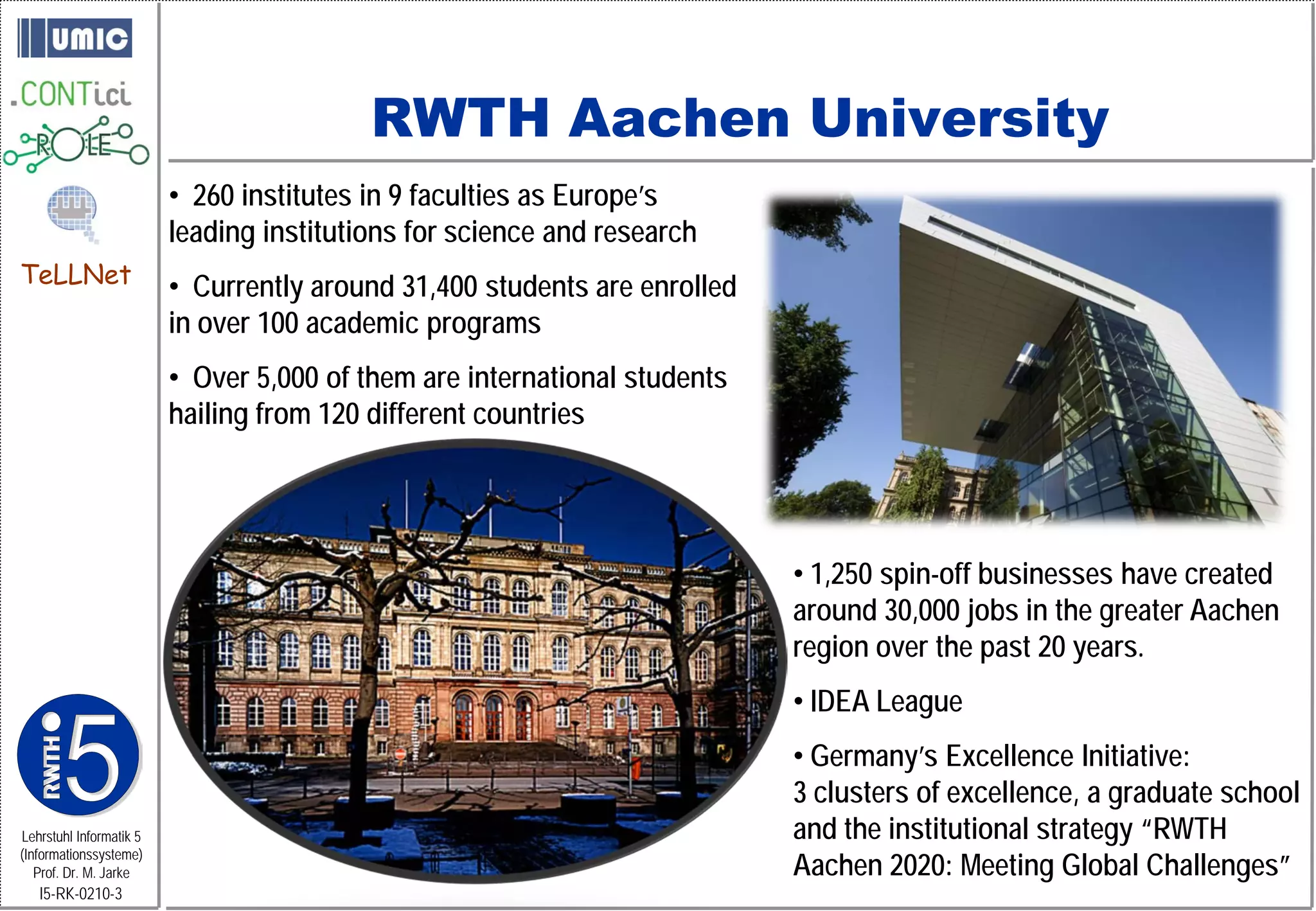
RWTH Aachen University
                         • 260 institutes in 9 faculties as Europe’s
                         leading institutions for science and research
TeLLNet                  • Currently around 31,400 students are enrolled
                         in over 100 academic programs
                         • Over 5,000 of them are international students
                         hailing from 120 different countries


                                                                           • 1,250 spin-off businesses have created
                                                                           around 30,000 jobs in the greater Aachen
                                                                           region over the past 20 years.
                                                                           • IDEA League
                                                                           • Germany’s Excellence Initiative:
                                                                           3 clusters of excellence, a graduate school
Lehrstuhl Informatik 5                                                     and the institutional strategy “RWTH
                                                                           Aachen 2020: Meeting Global Challenges”
(Informationssysteme)
   Prof. Dr. M. Jarke
   I5-RK-0210-3
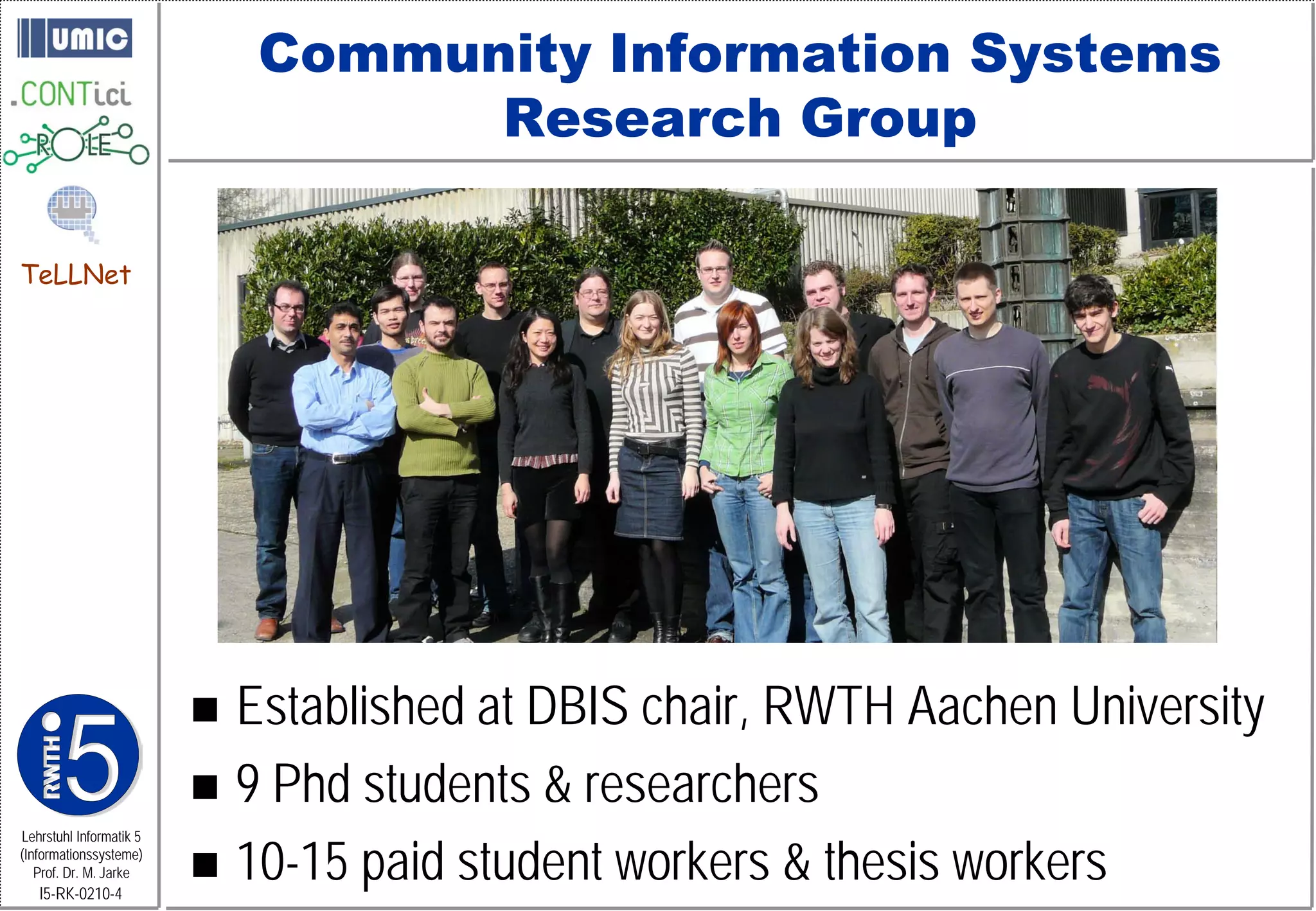
Community Information Systems
                                   Research Group

TeLLNet


                          Established at DBIS chair, RWTH Aachen University
                          9 Phd students & researchers
                          10-15 paid student workers & thesis workers
Lehrstuhl Informatik 5
(Informationssysteme)
   Prof. Dr. M. Jarke
   I5-RK-0210-4
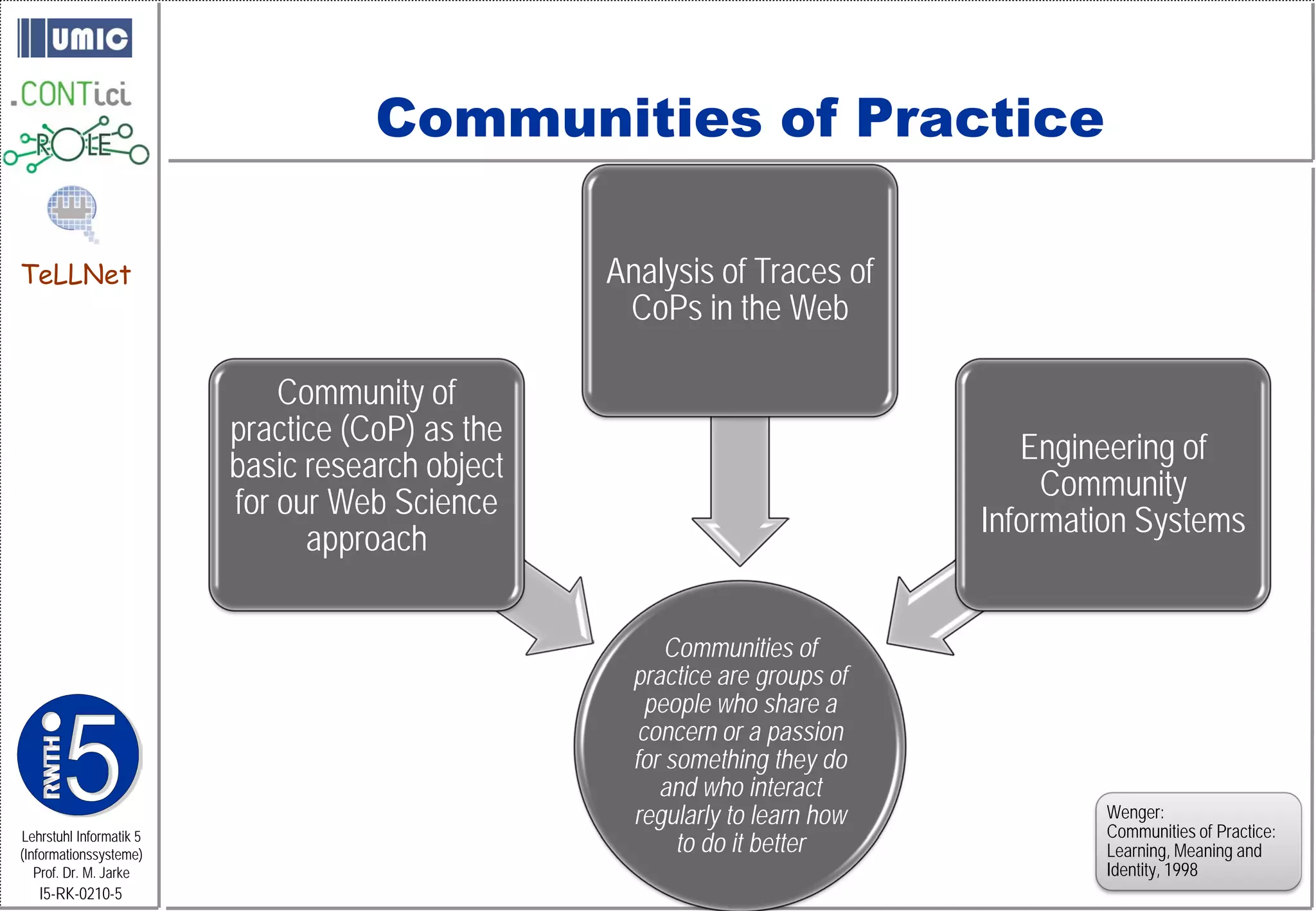
Communities of Practice

TeLLNet                                          Analysis of Traces of
                                                  CoPs in the Web

                             Community of
                         practice (CoP) as the
                                                                               Engineering of
                         basic research object
                                                                                 Community
                         for our Web Science
                                                                            Information Systems
                               approach


                                                       Communities of
                                                   practice are groups of
                                                     people who share a
                                                    concern or a passion
                                                   for something they do
                                                      and who interact
                                                   regularly to learn how            Wenger:
                                                                                     Communities of Practice:
Lehrstuhl Informatik 5
(Informationssysteme)
                                                        to do it better              Learning, Meaning and
   Prof. Dr. M. Jarke                                                                Identity, 1998
   I5-RK-0210-5
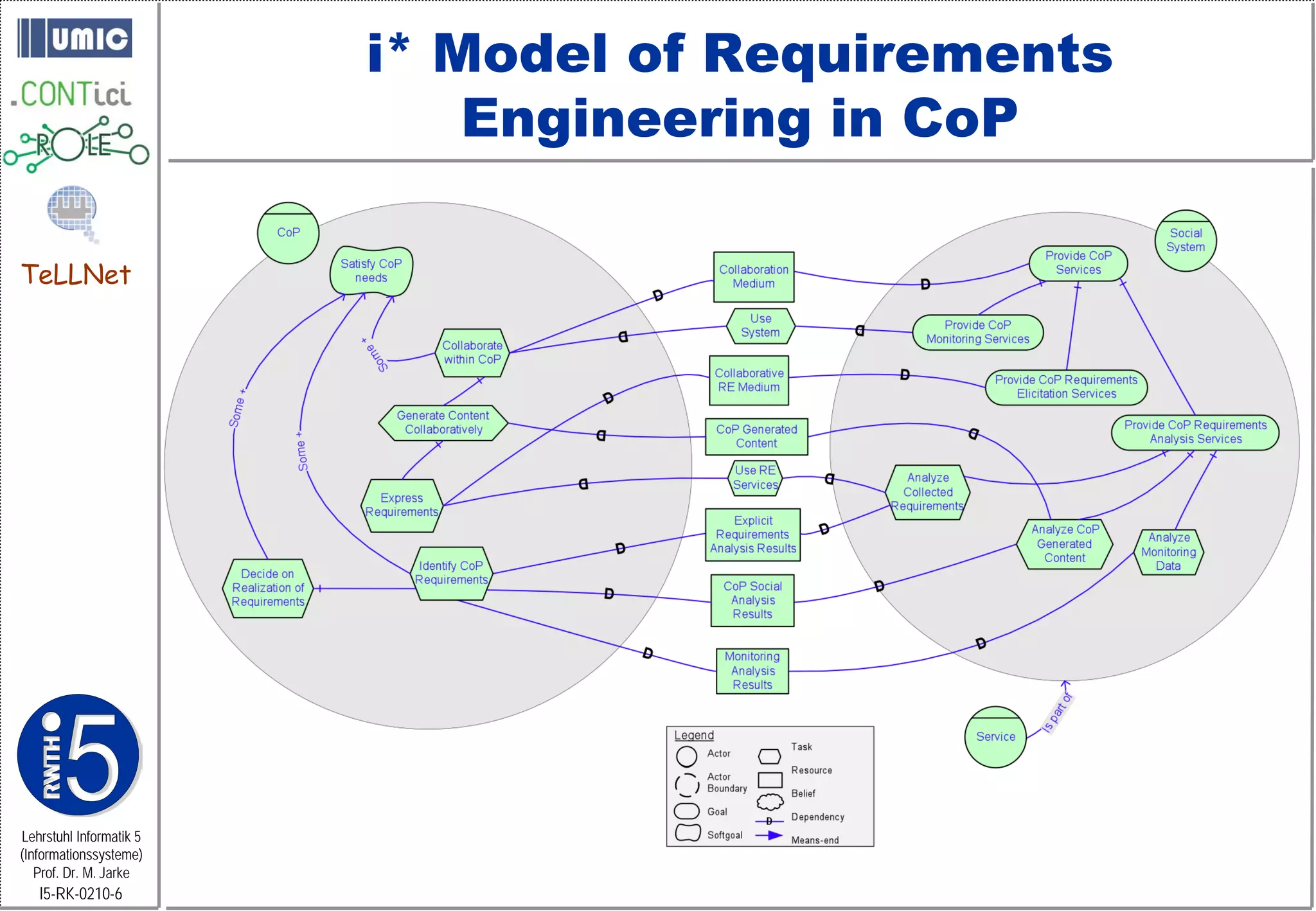
i* Model of Requirements
                             Engineering in CoP

TeLLNet


Lehrstuhl Informatik 5
(Informationssysteme)
   Prof. Dr. M. Jarke
   I5-RK-0210-6
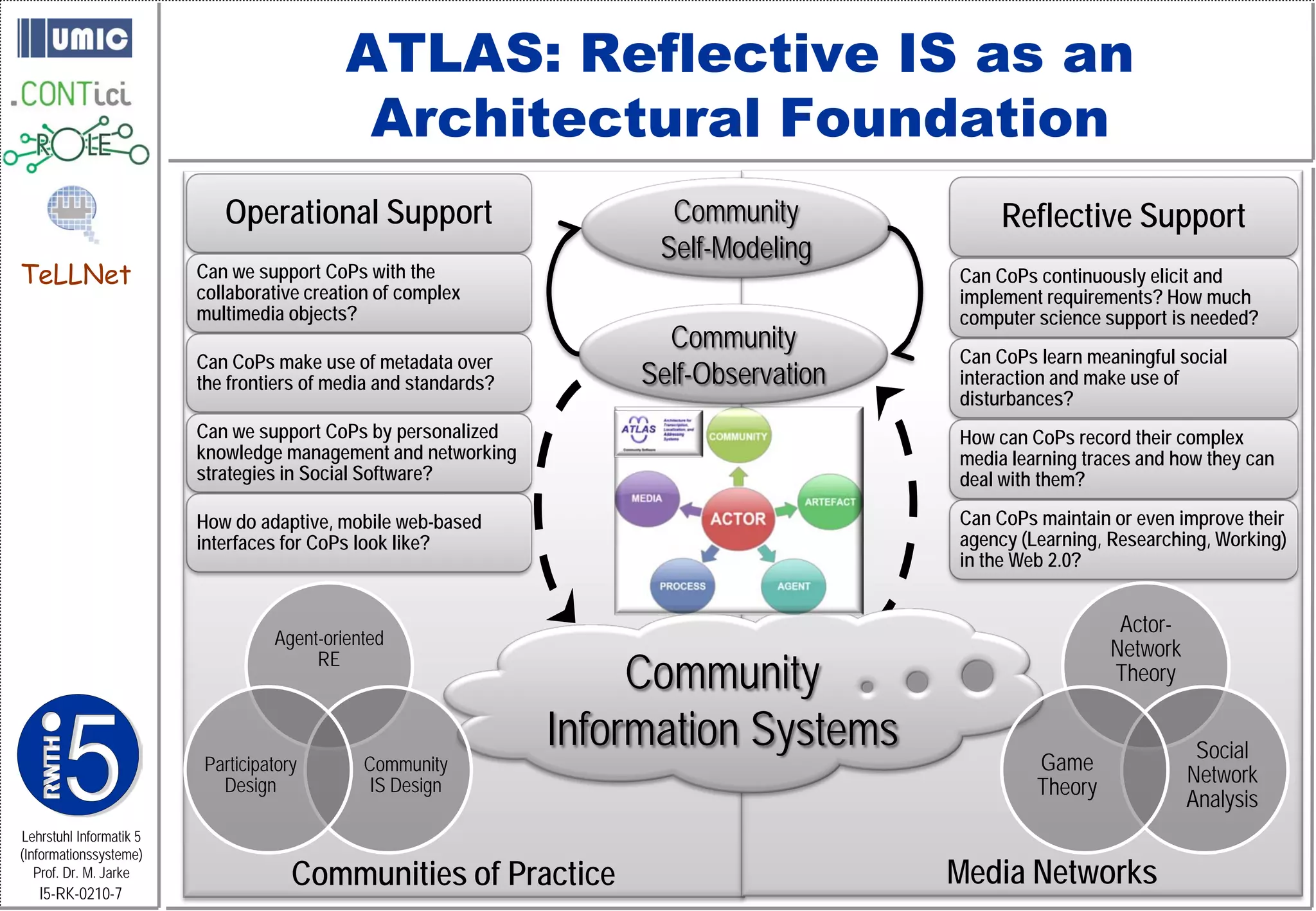
ATLAS: Reflective IS as an
                                            Architectural Foundation
                            Operational Support                         Community             Reflective Support
                                                                       Self-Modeling
TeLLNet                  Can we support CoPs with the                                    Can CoPs continuously elicit and
                         collaborative creation of complex                               implement requirements? How much
                         multimedia objects?                                             computer science support is needed?
                                                                        Community
                         Can CoPs make use of metadata over                              Can CoPs learn meaningful social
                         the frontiers of media and standards?        Self-Observation   interaction and make use of
                                                                                         disturbances?
                         Can we support CoPs by personalized                             How can CoPs record their complex
                         knowledge management and networking                             media learning traces and how they can
                         strategies in Social Software?                                  deal with them?

                         How do adaptive, mobile web-based                               Can CoPs maintain or even improve their
                         interfaces for CoPs look like?                                  agency (Learning, Researching, Working)
                                                                                         in the Web 2.0?


                                                                                                            Actor-
                                  Agent-oriented
                                                                                                           Network
                                       RE
                                                                      Community                            Theory

                                                                 Information Systems                                  Social
                         Participatory       Community                                            Game
                                                                                                                     Network
                           Design             IS Design                                           Theory
                                                                                                                     Analysis
Lehrstuhl Informatik 5
(Informationssysteme)
   Prof. Dr. M. Jarke
   I5-RK-0210-7
                                     Communities of Practice                             Media Networks
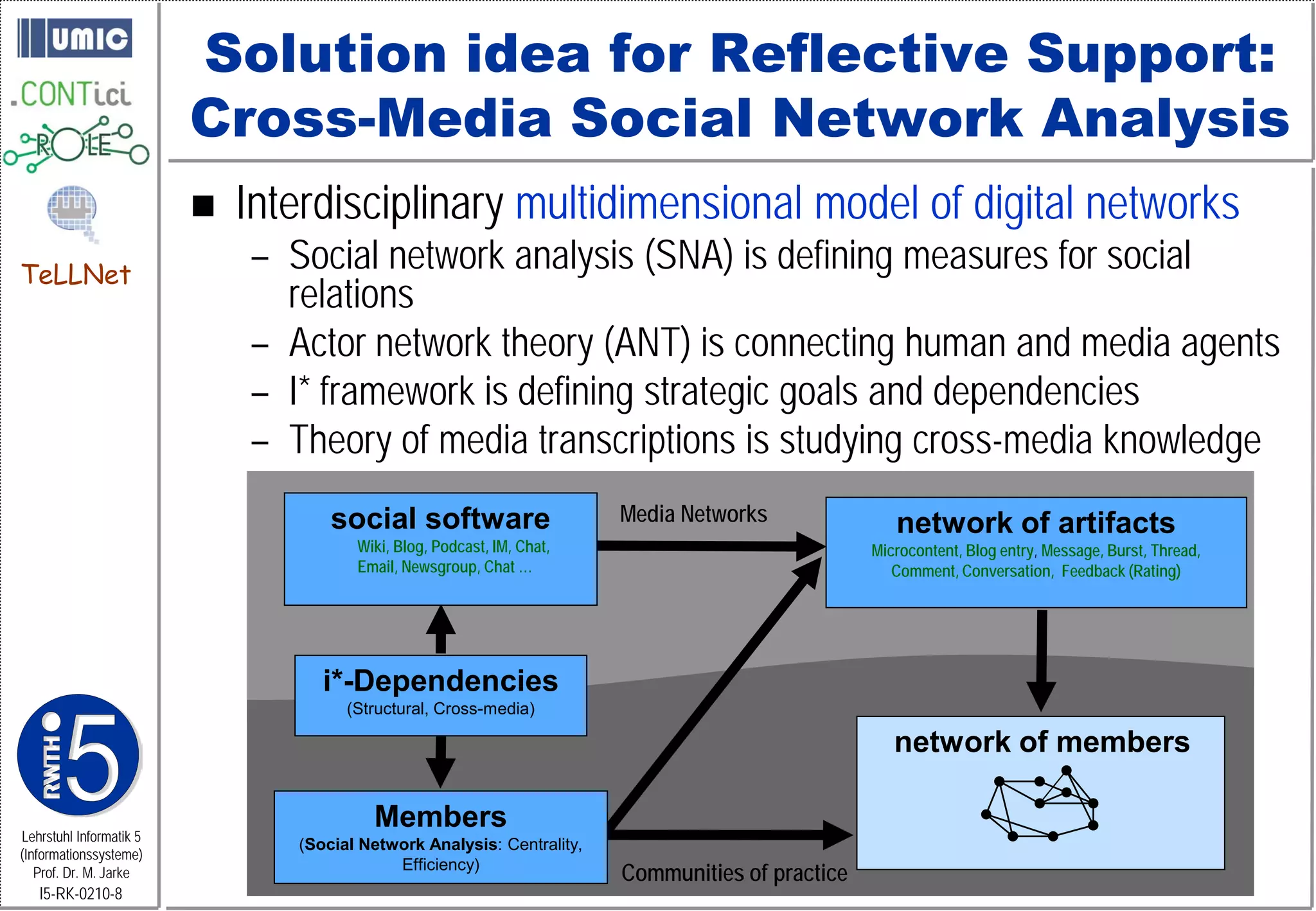
Solution idea for Reflective Support:
                         Cross-Media Social Network Analysis
                            Interdisciplinary multidimensional model of digital networks
TeLLNet
                             – Social network analysis (SNA) is defining measures for social
                               relations
                             – Actor network theory (ANT) is connecting human and media agents
                             – I* framework is defining strategic goals and dependencies
                             – Theory of media transcriptions is studying cross-media knowledge
                                    social software                     Media Networks               network of artifacts
                                       Wiki, Blog, Podcast, IM, Chat,                             Microcontent, Blog entry, Message, Burst, Thread,
                                       Email, Newsgroup, Chat …                                      Comment, Conversation, Feedback (Rating)


                                   i*-Dependencies
                                      (Structural, Cross-media)

                                                                                                     network of members

Lehrstuhl Informatik 5
                                         Members
                                (Social Network Analysis: Centrality,
(Informationssysteme)
   Prof. Dr. M. Jarke
                                            Efficiency)
                                                                        Communities of practice
   I5-RK-0210-8
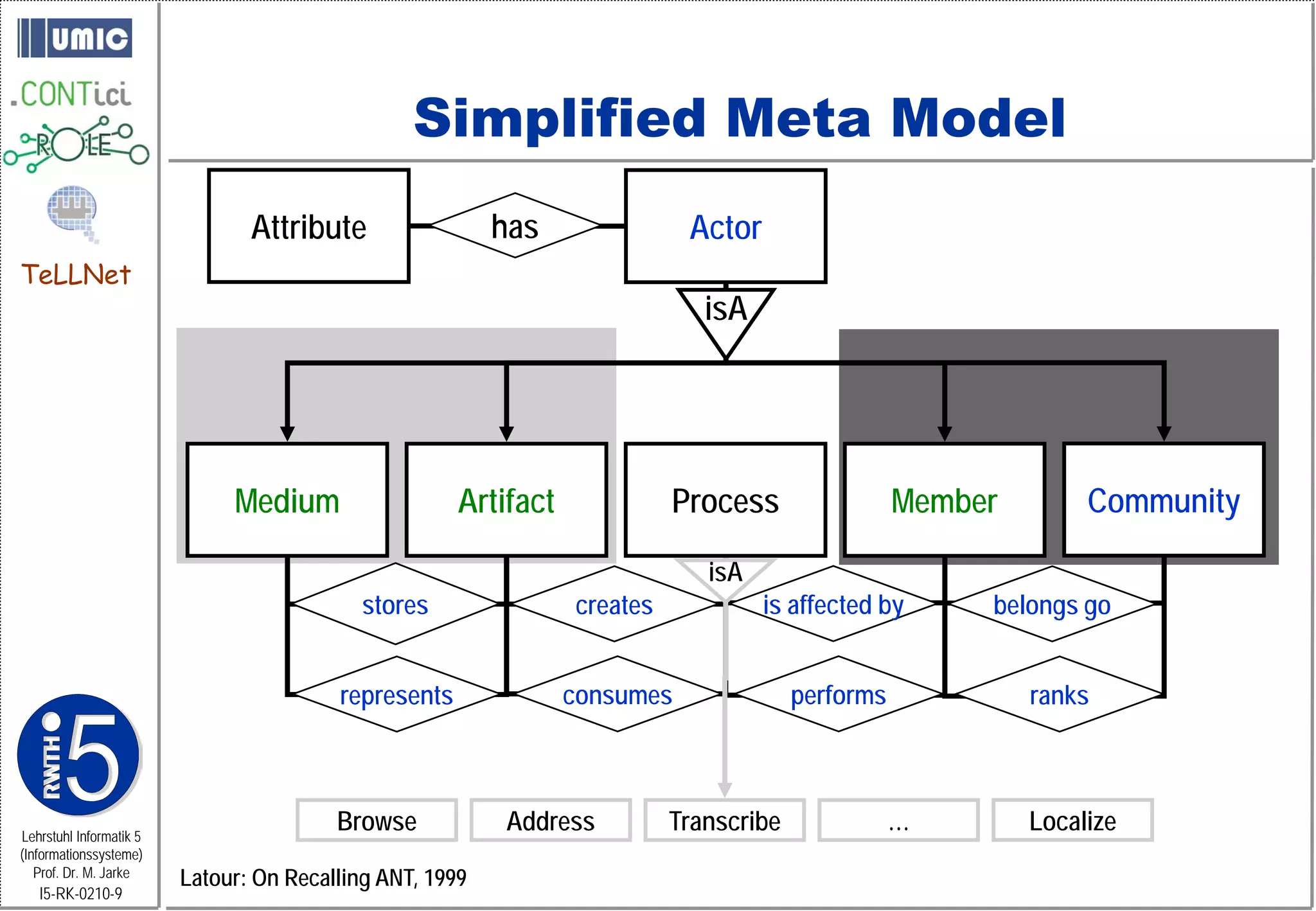
Simplified Meta Model
                                Attribute                 has               Actor
TeLLNet
                                                                              isA


                              Medium                  Artifact             Process                 Member        Community

                                                                              isA
                                            stores               creates            is affected by      belongs go


                                         represents              consumes               performs            ranks


Lehrstuhl Informatik 5
                                         Browse           Address          Transcribe              …        Localize
(Informationssysteme)
   Prof. Dr. M. Jarke
                         Latour: On Recalling ANT, 1999
   I5-RK-0210-9
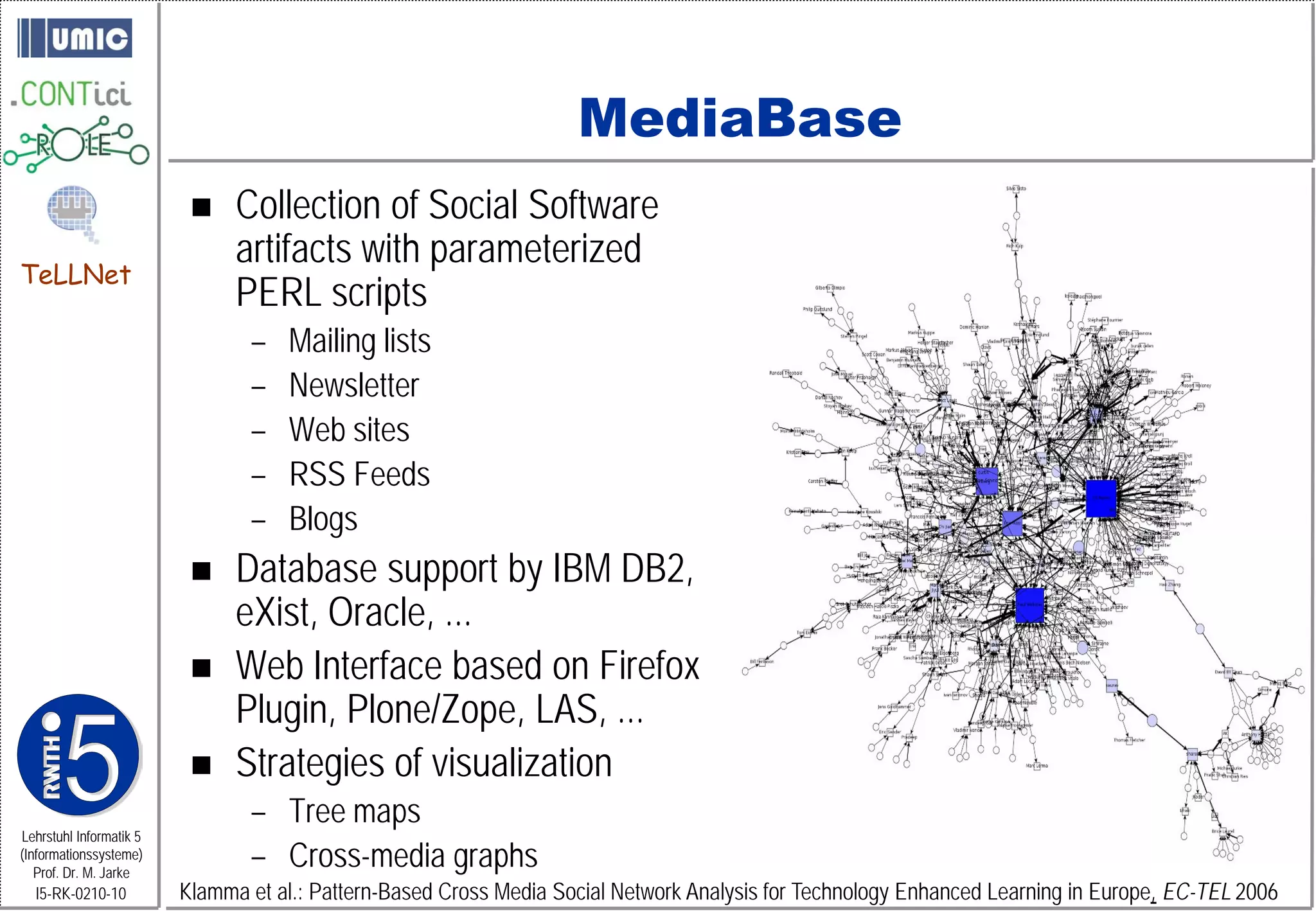
MediaBase
                              Collection of Social Software
                               artifacts with parameterized
TeLLNet
                               PERL scripts
                                –   Mailing lists
                                –   Newsletter
                                –   Web sites
                                –   RSS Feeds
                                –   Blogs
                              Database support by IBM DB2,
                               eXist, Oracle, ...
                              Web Interface based on Firefox
                               Plugin, Plone/Zope, LAS, ...
                              Strategies of visualization
                                – Tree maps
Lehrstuhl Informatik 5
(Informationssysteme)
   Prof. Dr. M. Jarke
                                – Cross-media graphs
  I5-RK-0210-10          Klamma et al.: Pattern-Based Cross Media Social Network Analysis for Technology Enhanced Learning in Europe, EC-TEL 2006
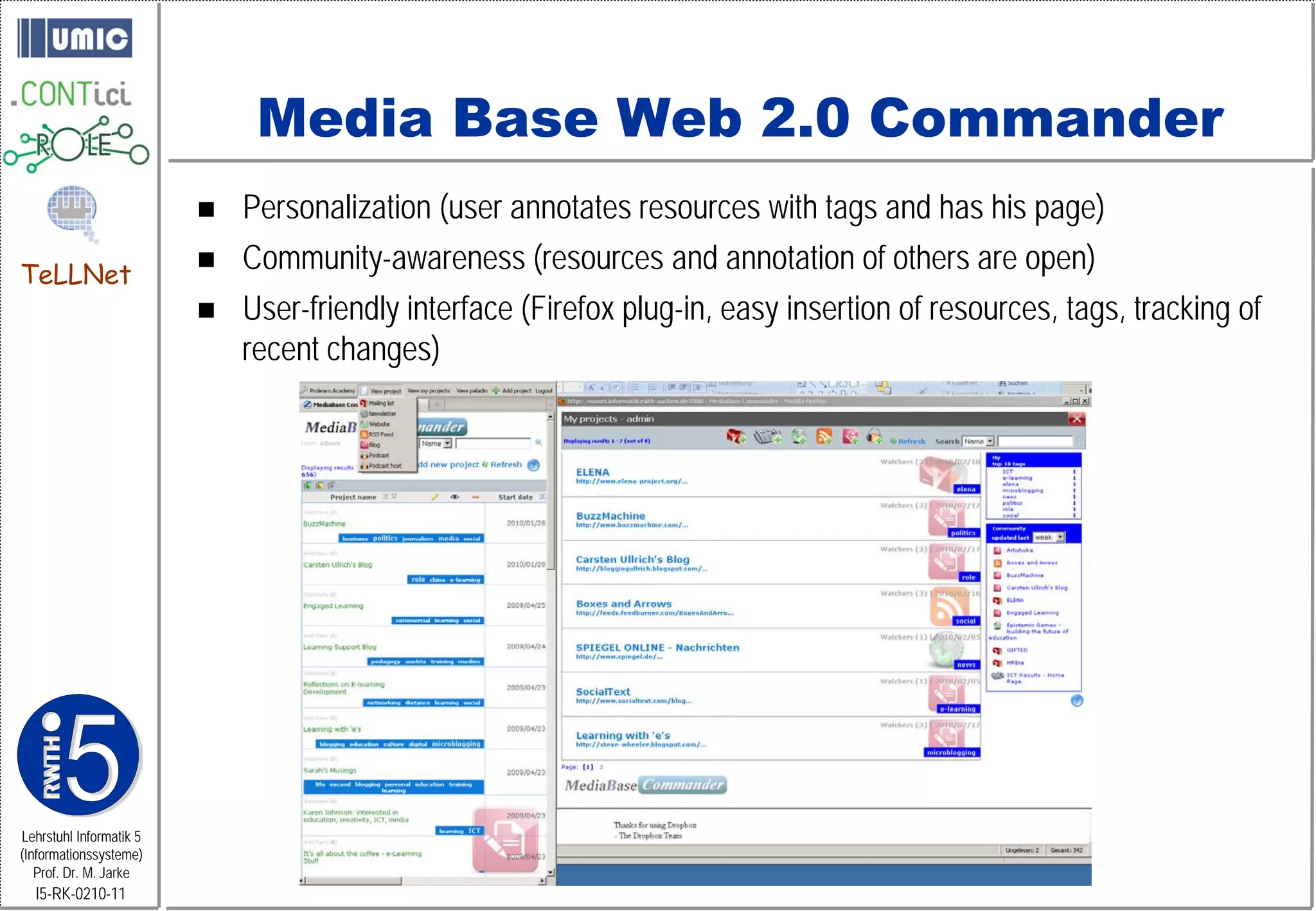
Media Base Web 2.0 Commander
                            Personalization (user annotates resources with tags and has his page)
TeLLNet
                            Community-awareness (resources and annotation of others are open)
                            User-friendly interface (Firefox plug-in, easy insertion of resources, tags, tracking of
                             recent changes)


Lehrstuhl Informatik 5
(Informationssysteme)
   Prof. Dr. M. Jarke
  I5-RK-0210-11
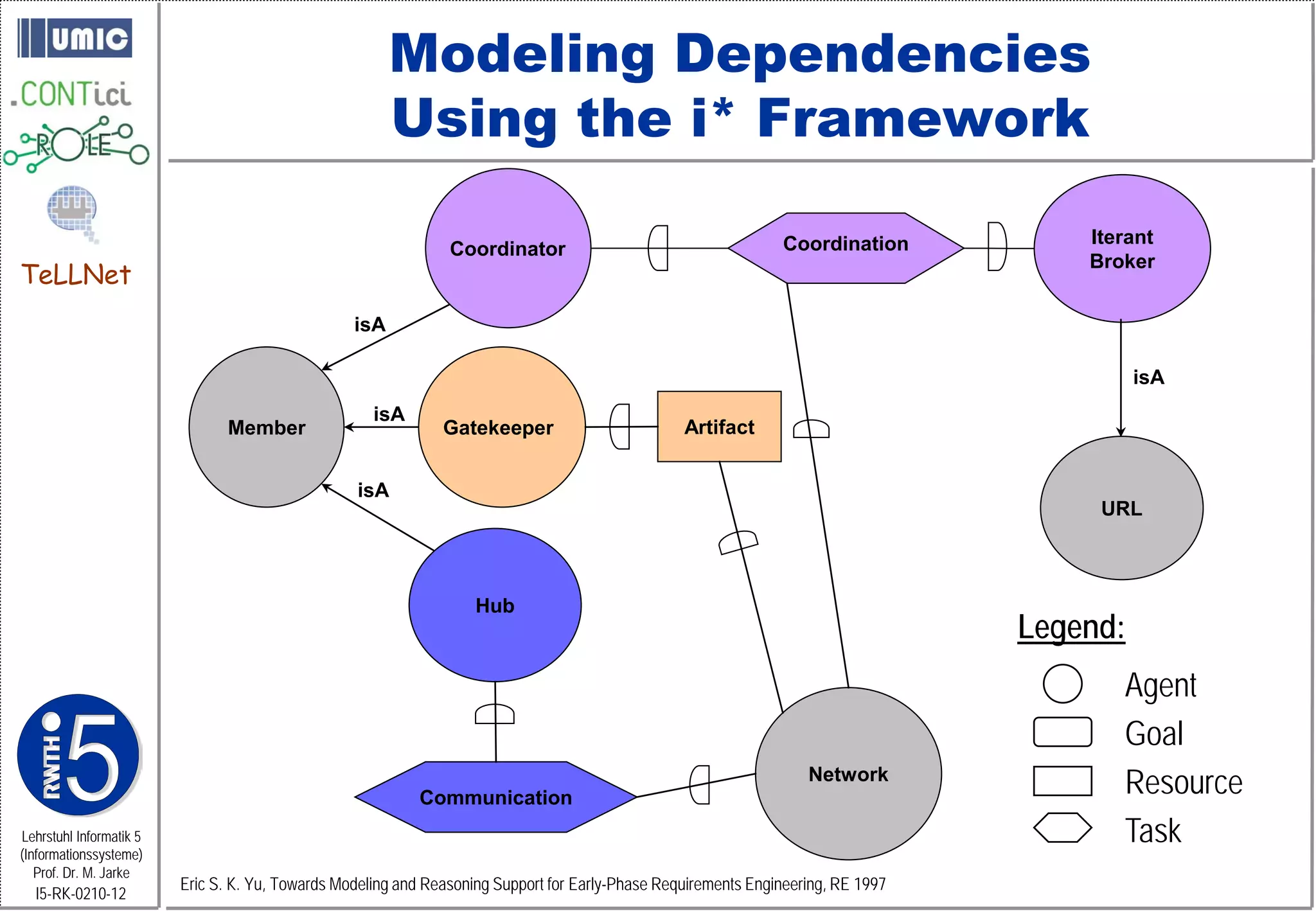
Modeling Dependencies
                                                        Using the i* Framework

                                                                                                                Coordination           Iterant
                                                                Coordinator
                                                                                                                                       Broker
TeLLNet
                                                  isA

                                                                                                                                             isA
                                                     isA
                               Member                          Gatekeeper                         Artifact


                                                  isA
                                                                                                                                        URL


                                                                    Hub
                                                                                                                                   Legend:
                                                                                                                                          Agent
                                                                                                                                          Goal
                                                           Communication
                                                                                                                    Network
                                                                                                                                          Resource
Lehrstuhl Informatik 5                                                                                                                    Task
(Informationssysteme)
   Prof. Dr. M. Jarke
                         Eric S. K. Yu, Towards Modeling and Reasoning Support for Early-Phase Requirements Engineering, RE 1997
  I5-RK-0210-12
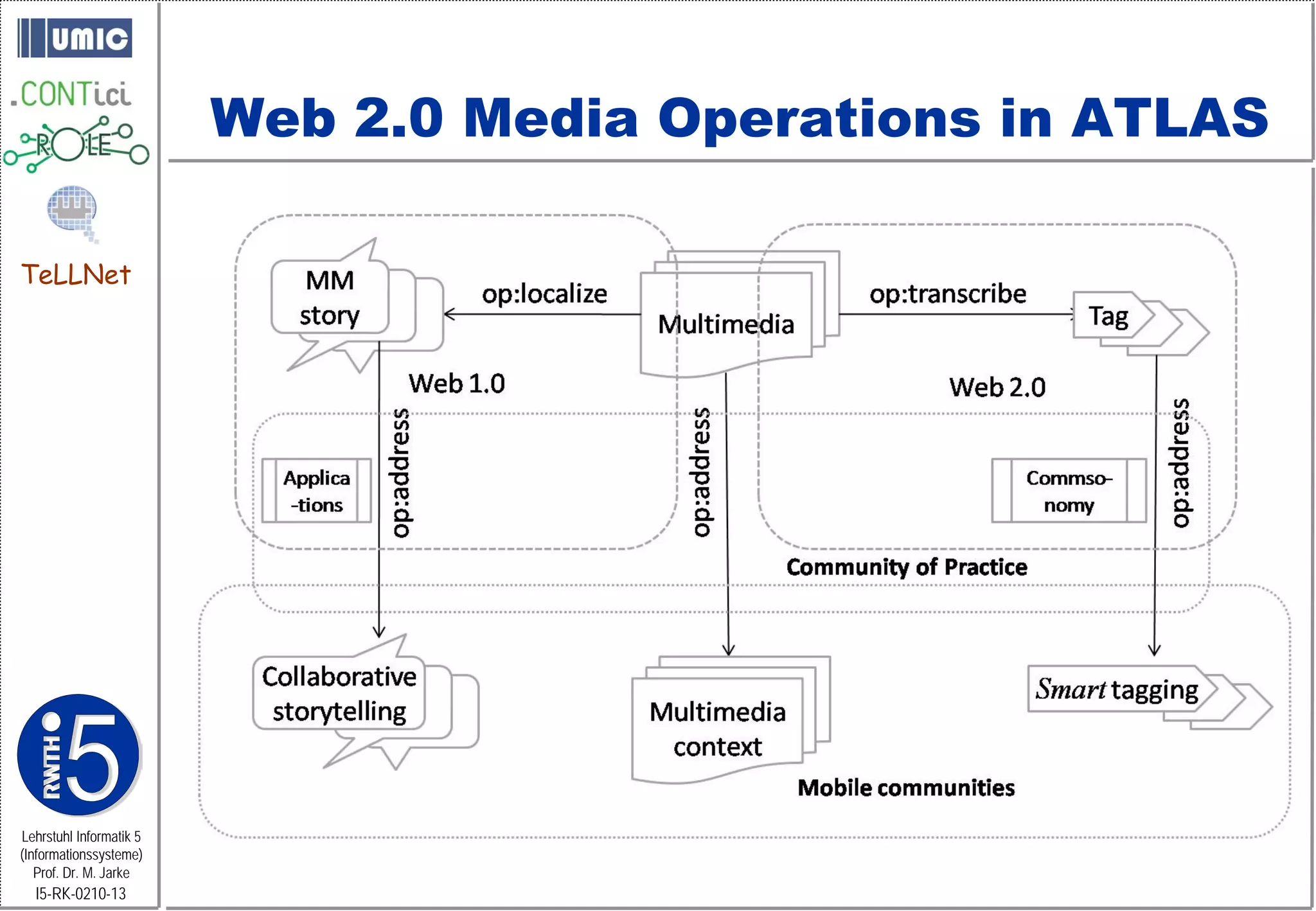
Web 2.0 Media Operations in ATLAS

TeLLNet


Lehrstuhl Informatik 5
(Informationssysteme)
   Prof. Dr. M. Jarke
  I5-RK-0210-13
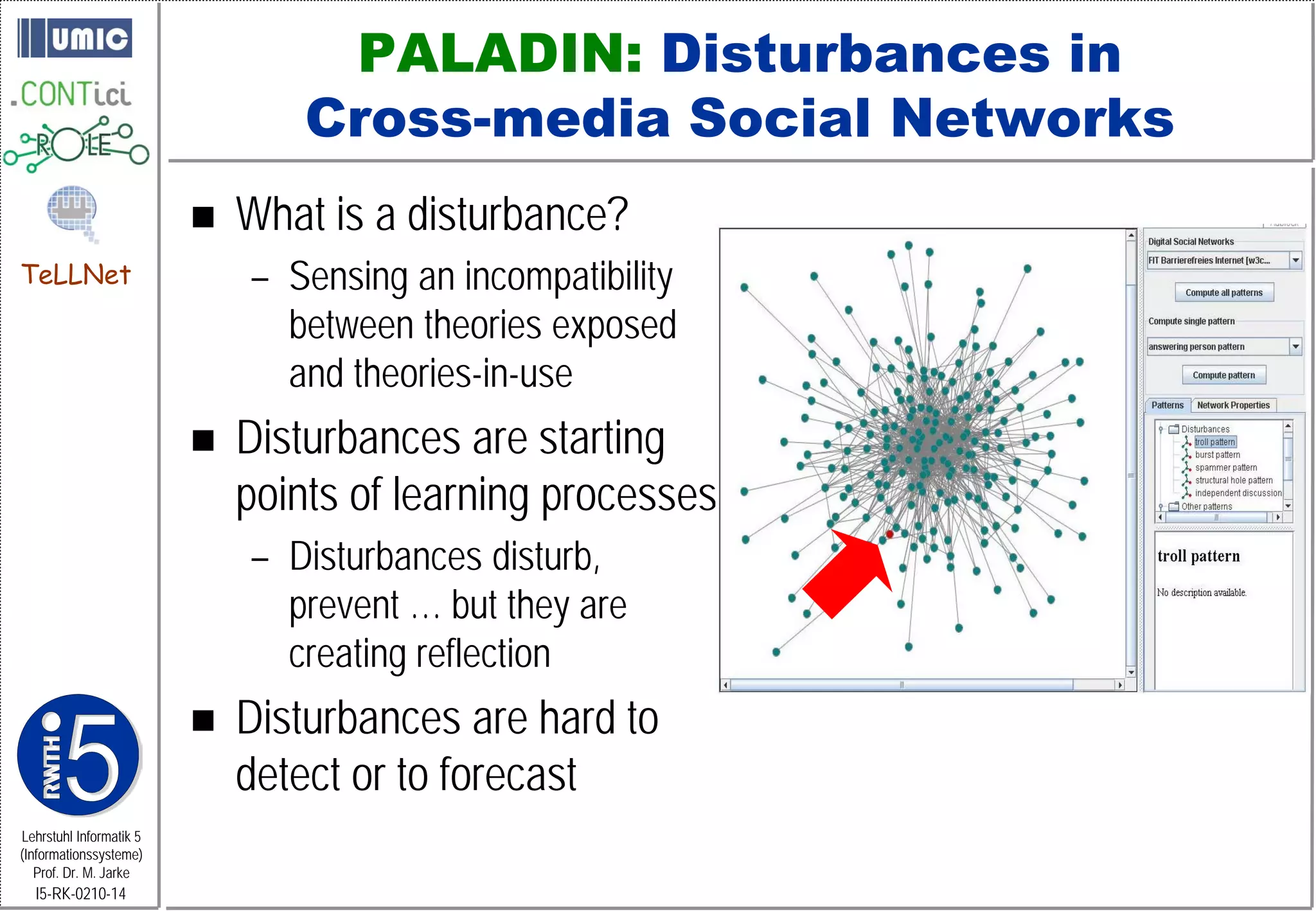
PALADIN: Disturbances in
                                 Cross-media Social Networks
                            What is a disturbance?
TeLLNet                      – Sensing an incompatibility
                               between theories exposed
                               and theories-in-use
                            Disturbances are starting
                             points of learning processes
                             – Disturbances disturb,
                               prevent … but they are
                               creating reflection
                            Disturbances are hard to
                             detect or to forecast
Lehrstuhl Informatik 5
(Informationssysteme)
   Prof. Dr. M. Jarke
  I5-RK-0210-14
Pattern Language for PALADIN:
                                         Example Troll
                         Troll Pattern: This pattern tries to discover the cases when a troll exists in a digital social
                           network. A troll in the network is considered a disturbance.
TeLLNet
                         Disturbance:
                         (EXISTS [medium | medium.affordance = threadArtefact]) &
                           (EXISTS [troll |(EXISTS [thread | (thread.author = troll) &
                               (COUNT [message | (message.author = troll) &
                               (message.posted = thread)]) > minPosts]) &
                               (~EXISTS[ thread1, message1| (thread1.author1 != troll) &
                               (message1.author = troll & message1.posted = thread1 ]))])])
                         Forces: medium; troll; network; member; thread; message; url
                         Force Relations: neighbour(troll, member); own thread(troll, thread)
                         Solution: No attention must be paid to the discussions started by the troll.
                         Rationale: The troll needs attention to continue its activities. If no attention is paid, he/she
Lehrstuhl Informatik 5
                           will stop participating in the discussions.
                         Pattern Relations: Associates Spammer pattern.
(Informationssysteme)
   Prof. Dr. M. Jarke
  I5-RK-0210-15
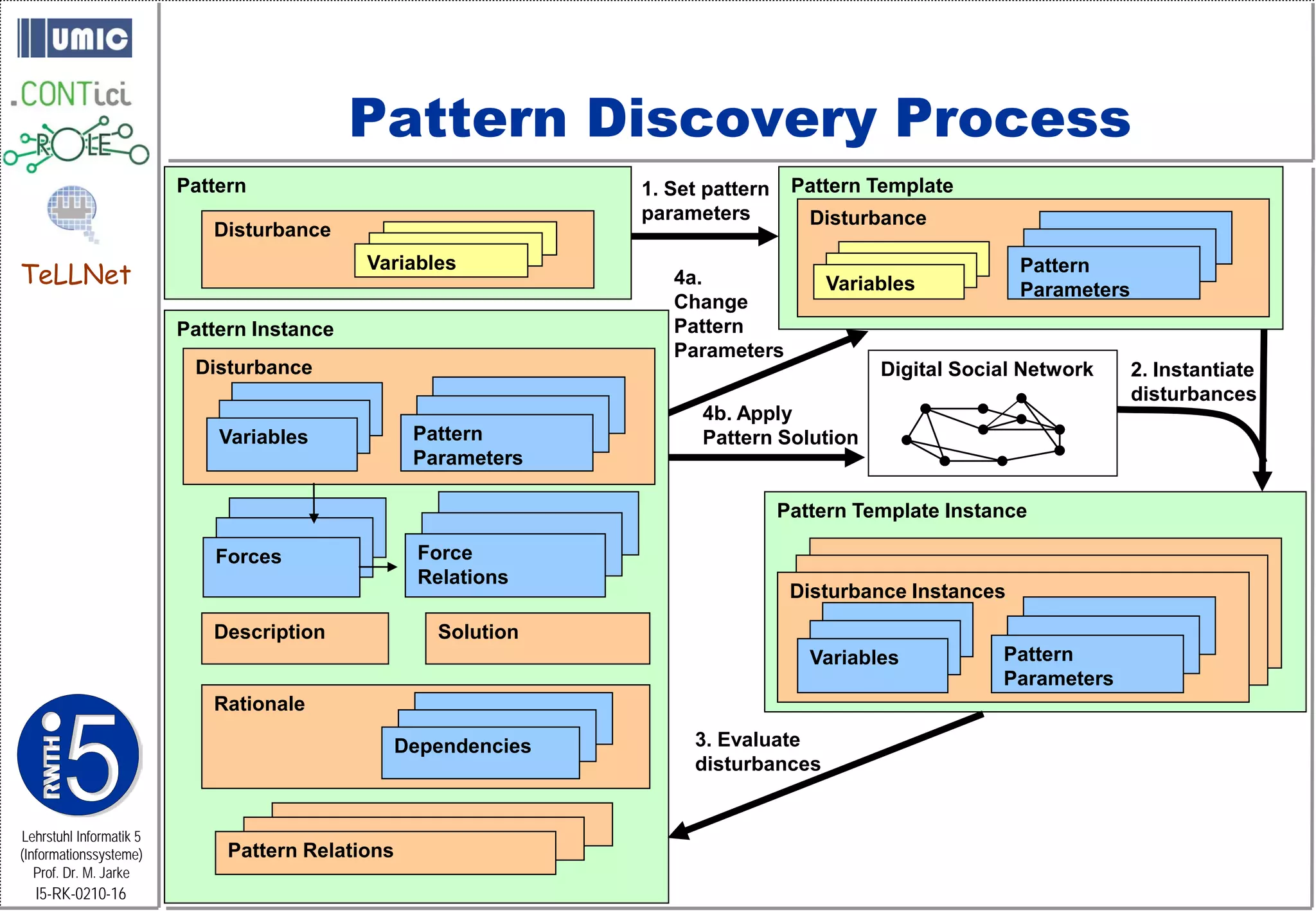
Pattern Discovery Process
                         Pattern                                 1. Set pattern    Pattern Template
                                                                 parameters          Disturbance
                            Disturbance

TeLLNet
                                            Variables                                                      Pattern
                                                                    4a.               Variables            Parameters
                                                                    Change
                         Pattern Instance                           Pattern
                                                                    Parameters
                          Disturbance                                                       Digital Social Network      2. Instantiate
                                                                                                                        disturbances
                                                                       4b. Apply
                             Variables             Pattern             Pattern Solution
                                                   Parameters

                                                                                  Pattern Template Instance

                            Forces                  Force
                                                    Relations
                                                                                   Disturbance Instances

                            Description               Solution
                                                                                     Variables          Pattern
                                                                                                        Parameters
                            Rationale

                                                  Dependencies        3. Evaluate
                                                                      disturbances


Lehrstuhl Informatik 5
(Informationssysteme)         Pattern Relations
   Prof. Dr. M. Jarke
  I5-RK-0210-16
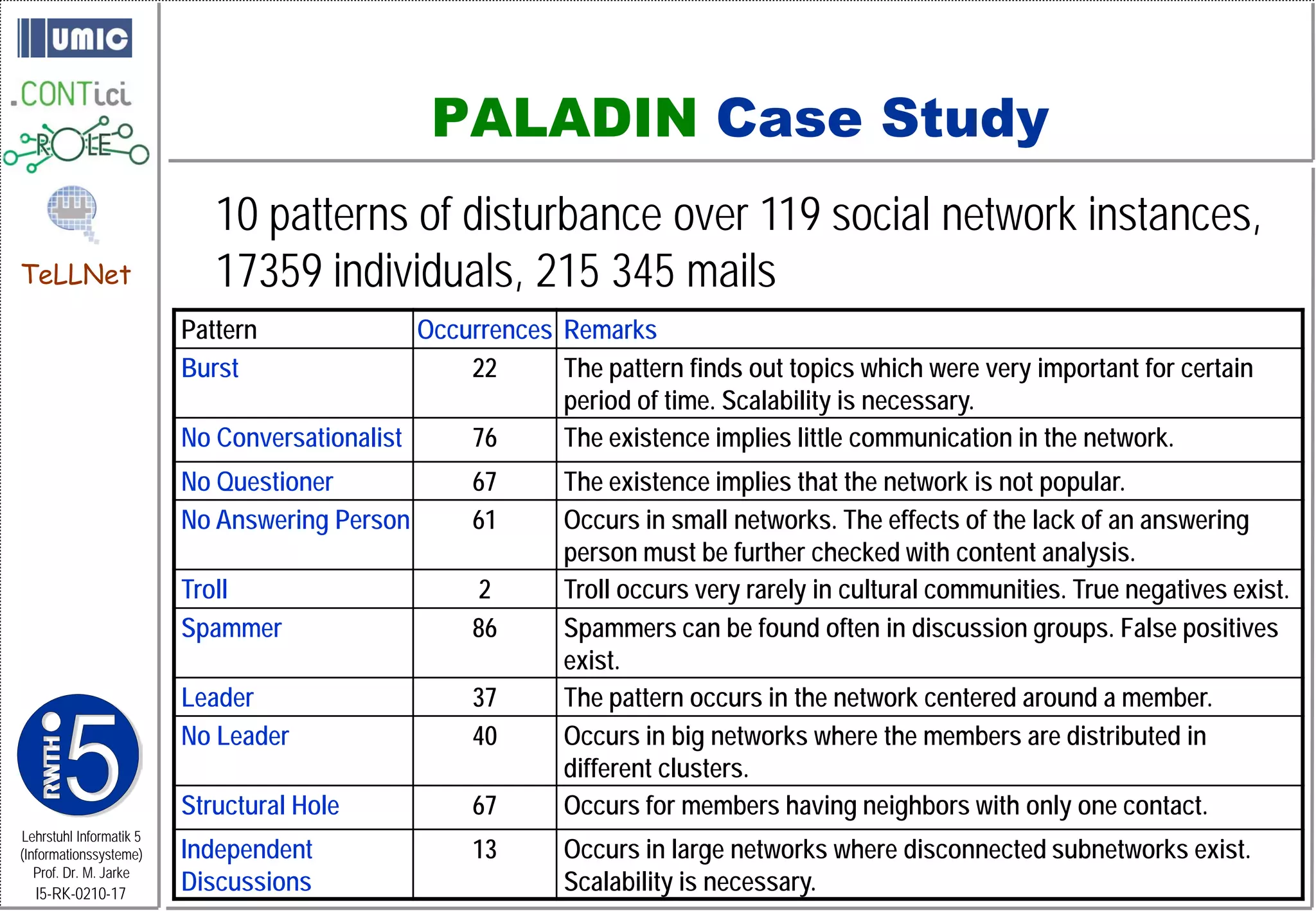
PALADIN Case Study
                            10 patterns of disturbance over 119 social network instances,
TeLLNet                     17359 individuals, 215 345 mails
                         Pattern              Occurrences Remarks
                         Burst                    22      The pattern finds out topics which were very important for certain
                                                          period of time. Scalability is necessary.
                         No Conversationalist     76      The existence implies little communication in the network.
                         No Questioner             67       The existence implies that the network is not popular.
                         No Answering Person       61       Occurs in small networks. The effects of the lack of an answering
                                                            person must be further checked with content analysis.
                         Troll                      2       Troll occurs very rarely in cultural communities. True negatives exist.
                         Spammer                   86       Spammers can be found often in discussion groups. False positives
                                                            exist.
                         Leader                    37       The pattern occurs in the network centered around a member.
                         No Leader                 40       Occurs in big networks where the members are distributed in
                                                            different clusters.
                         Structural Hole           67       Occurs for members having neighbors with only one contact.
Lehrstuhl Informatik 5
(Informationssysteme)    Independent               13       Occurs in large networks where disconnected subnetworks exist.
   Prof. Dr. M. Jarke
  I5-RK-0210-17
                         Discussions                        Scalability is necessary.
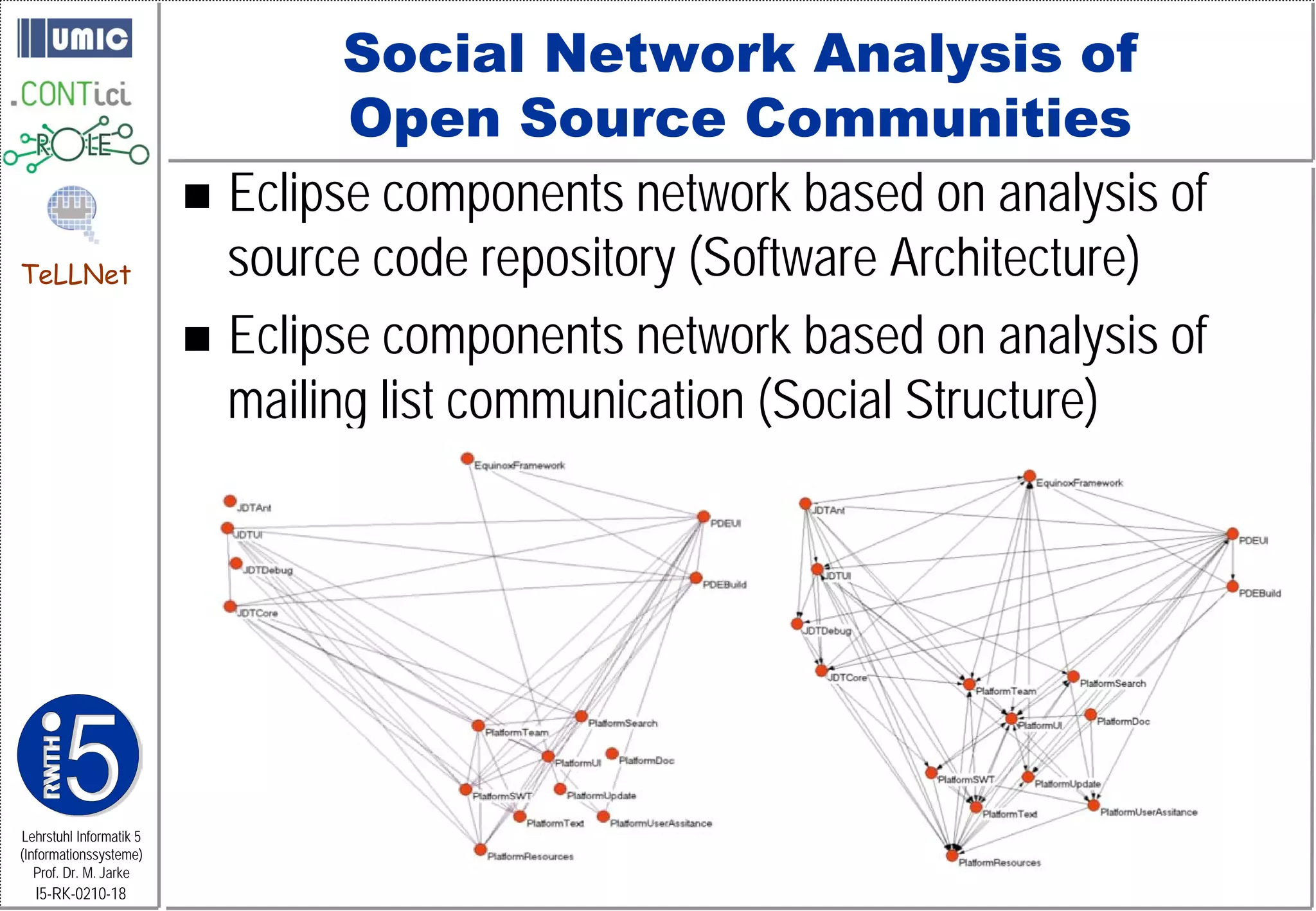
Social Network Analysis of
                                 Open Source Communities
                          Eclipse components network based on analysis of
TeLLNet                    source code repository (Software Architecture)
                          Eclipse components network based on analysis of
                           mailing list communication (Social Structure)


Lehrstuhl Informatik 5
(Informationssysteme)
   Prof. Dr. M. Jarke
  I5-RK-0210-18
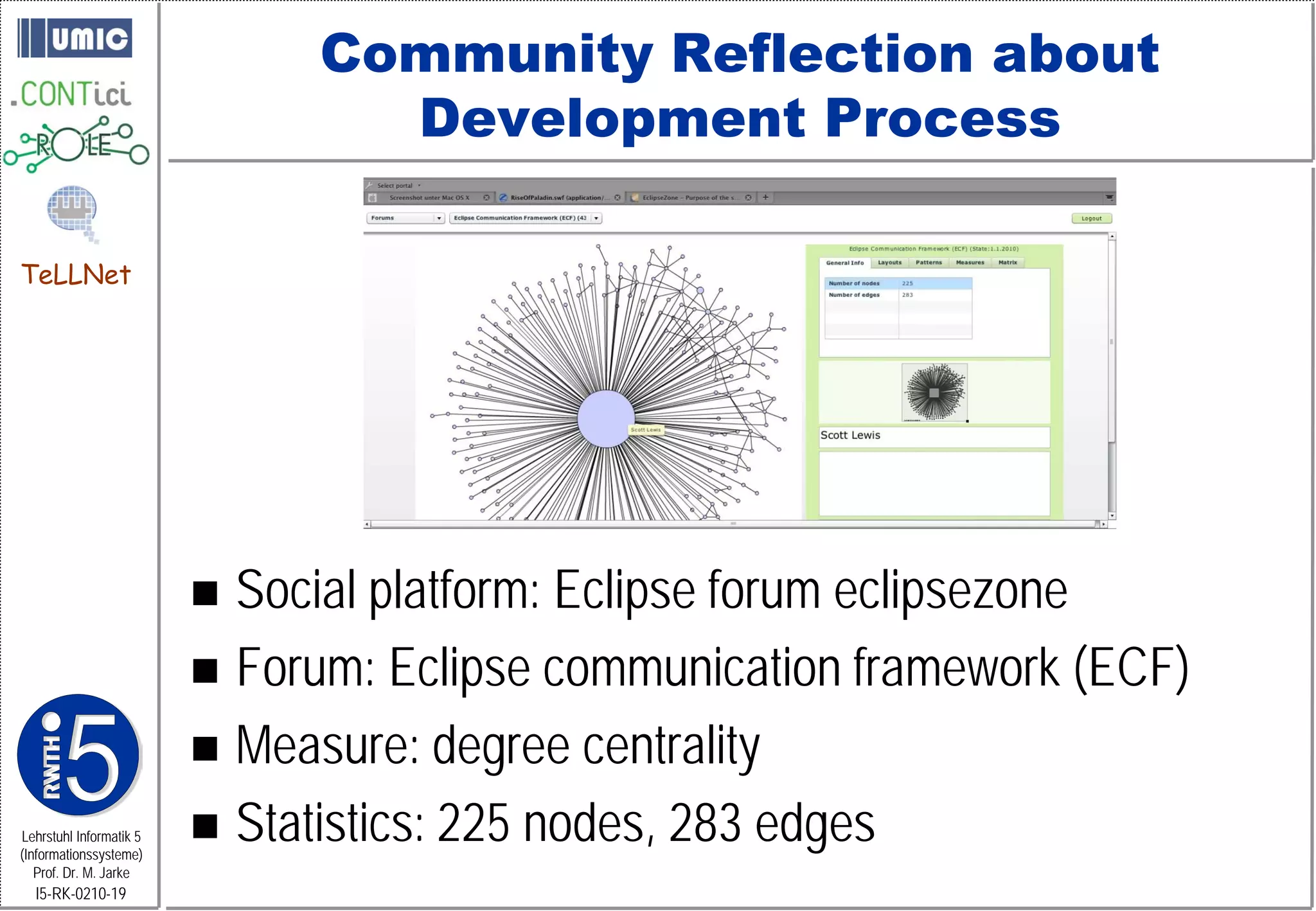
Community Reflection about
                                Development Process

TeLLNet


                          Social platform: Eclipse forum eclipsezone
                          Forum: Eclipse communication framework (ECF)
                          Measure: degree centrality
Lehrstuhl Informatik 5
(Informationssysteme)
                          Statistics: 225 nodes, 283 edges
   Prof. Dr. M. Jarke
  I5-RK-0210-19
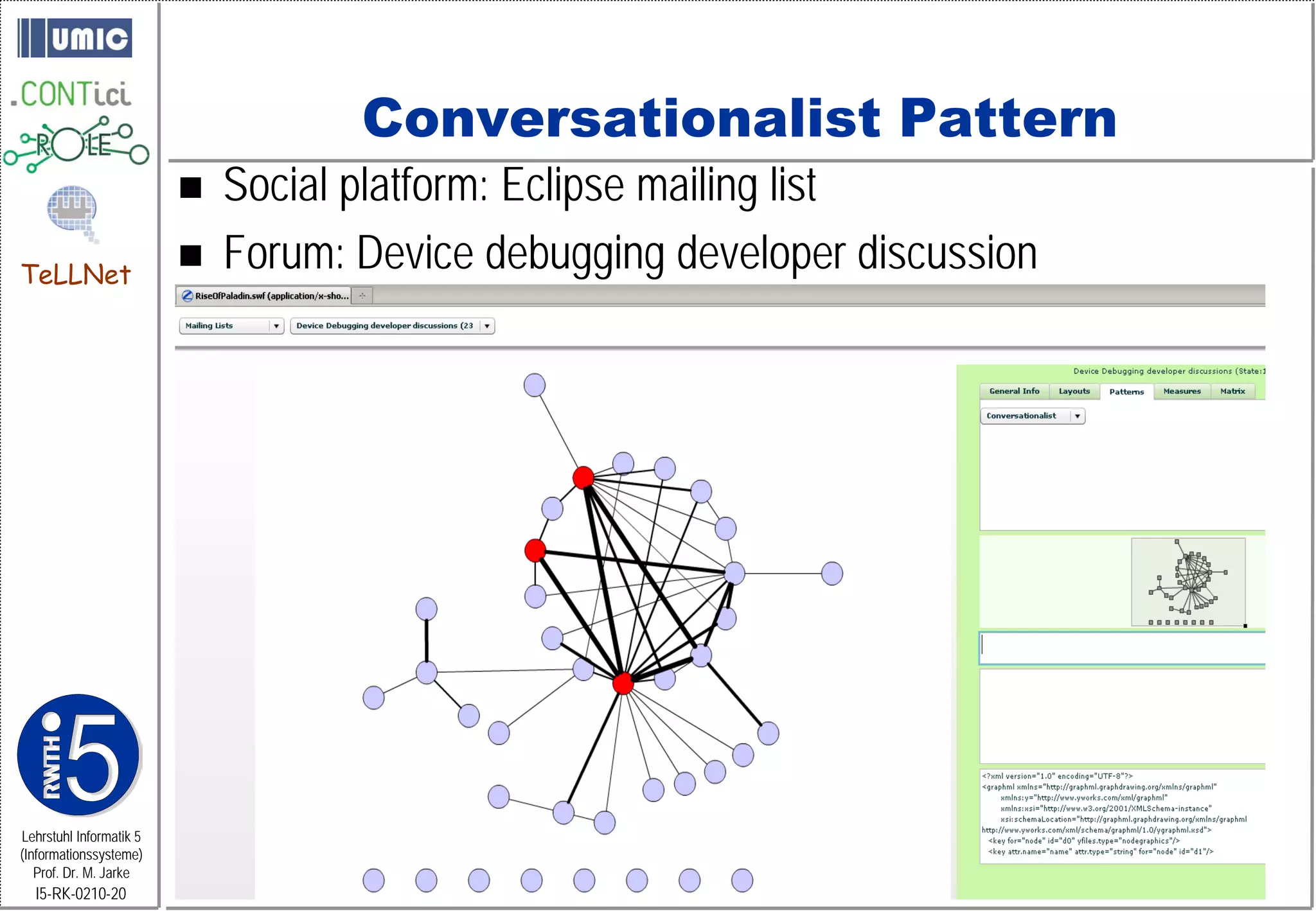
Conversationalist Pattern
                            Social platform: Eclipse mailing list
TeLLNet
                            Forum: Device debugging developer discussion


Lehrstuhl Informatik 5
(Informationssysteme)
   Prof. Dr. M. Jarke
  I5-RK-0210-20
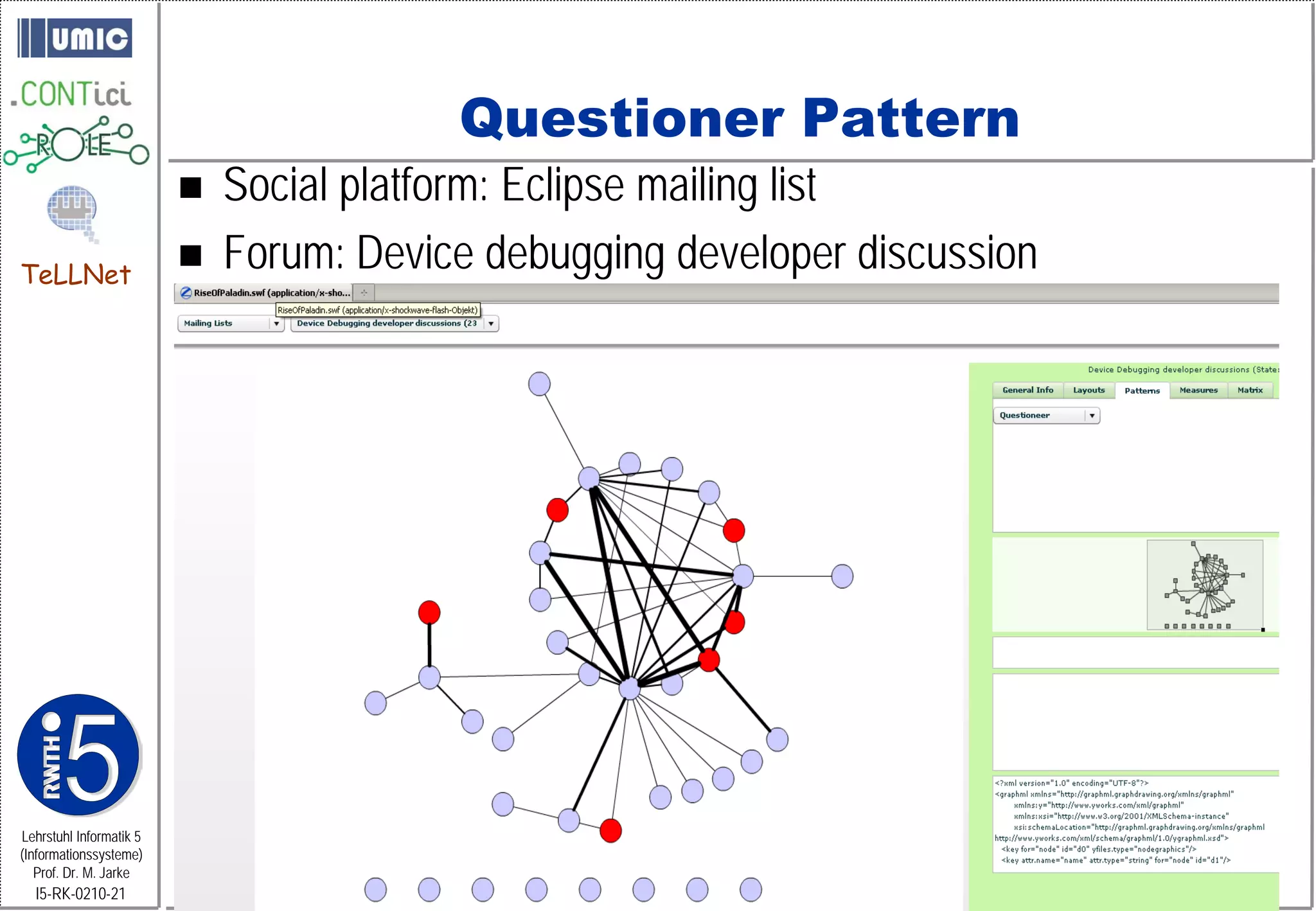
Questioner Pattern
                            Social platform: Eclipse mailing list
TeLLNet
                            Forum: Device debugging developer discussion


Lehrstuhl Informatik 5
(Informationssysteme)
   Prof. Dr. M. Jarke
  I5-RK-0210-21
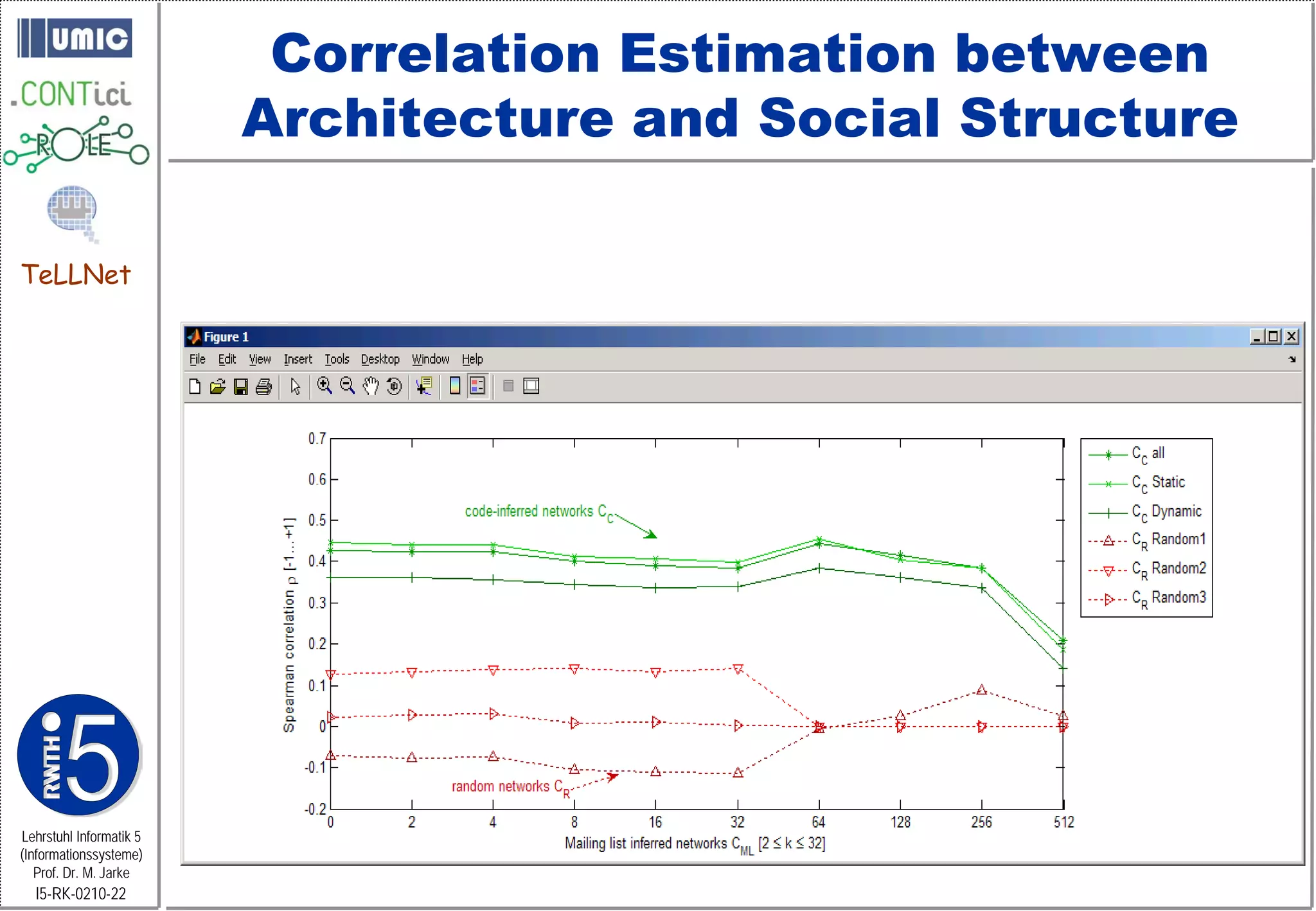
Correlation Estimation between
                         Architecture and Social Structure

TeLLNet


Lehrstuhl Informatik 5
(Informationssysteme)
   Prof. Dr. M. Jarke
  I5-RK-0210-22
Requirements Reflection Compared
                                to Community Performance
                            With increasing number of boundary spanners it becomes
TeLLNet
                             easier to induce / implement requirements, which can be
                             evidenced by increased release rates and vice-versa


                            As most bugs are due to insufficient understanding [NOHI99]
                             and knowledge creation as well as sharing is supported by
                             boundary spanners [BDBu07], then increased number of
                             boundary spanners should be evidenced by decreased bug
                             rate and vice-versa
Lehrstuhl Informatik 5
(Informationssysteme)
   Prof. Dr. M. Jarke
  I5-RK-0210-23
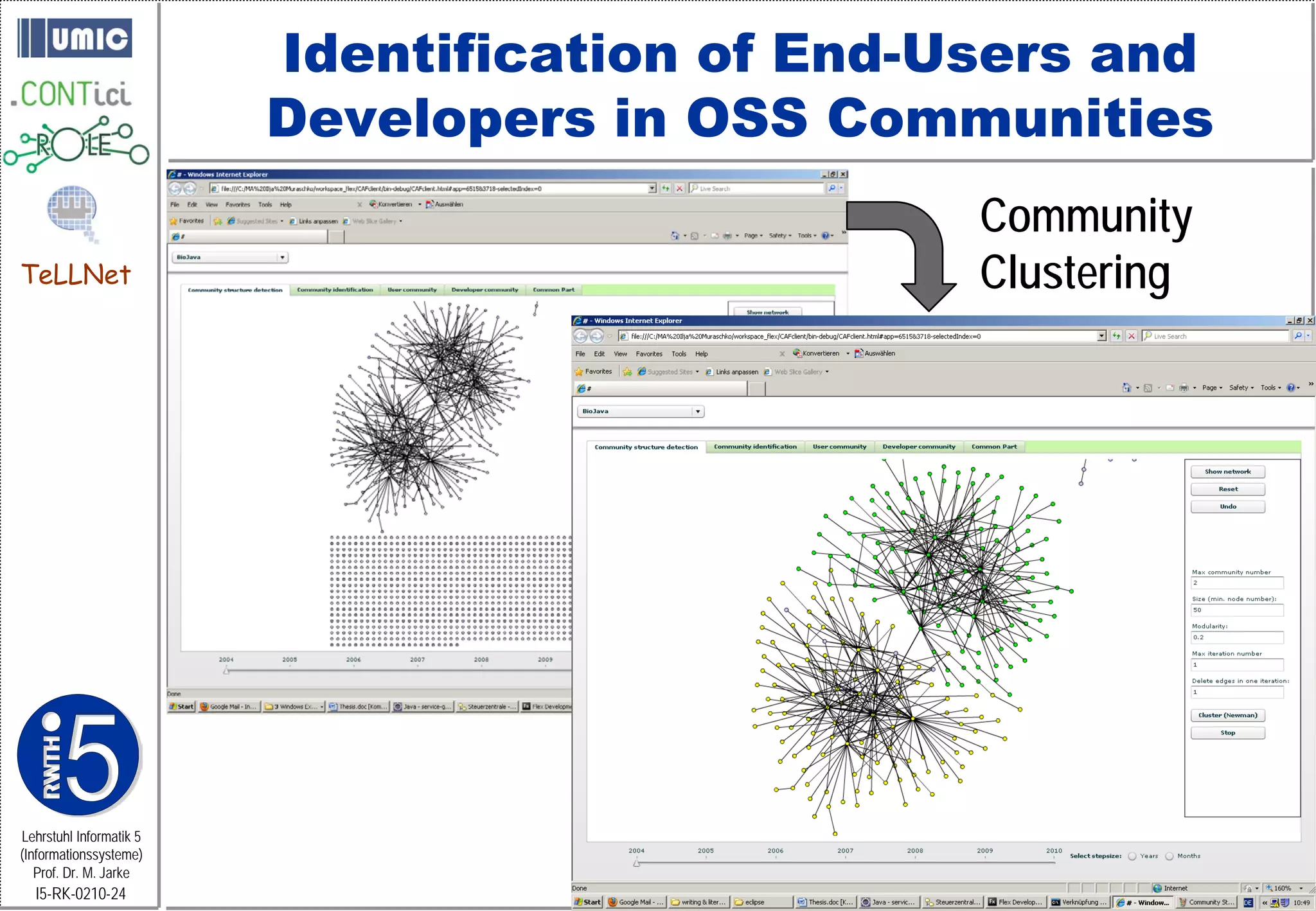
Identification of End-Users and
                         Developers in OSS Communities
                                                Community
TeLLNet                                         Clustering


Lehrstuhl Informatik 5
(Informationssysteme)
   Prof. Dr. M. Jarke
  I5-RK-0210-24
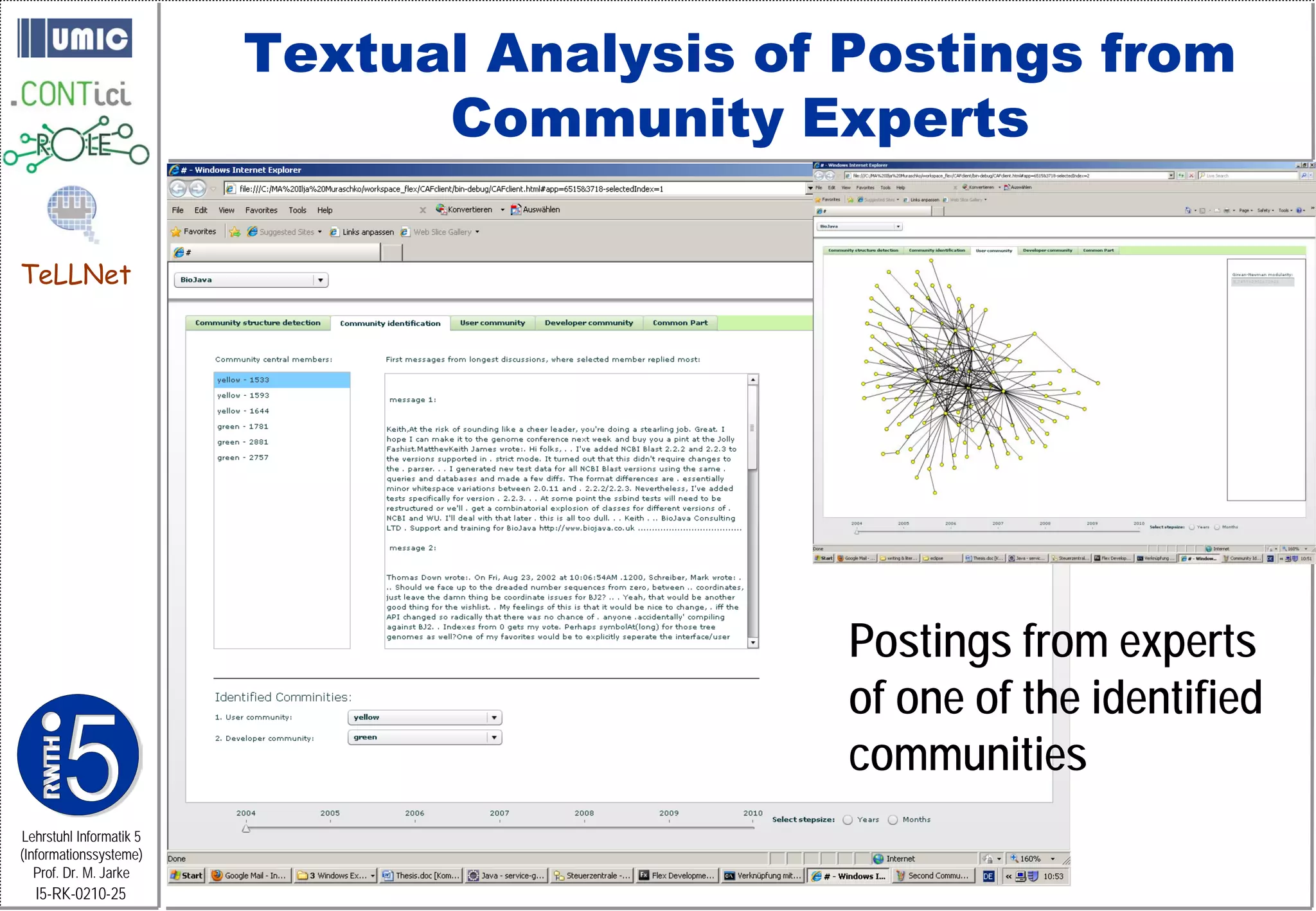
Textual Analysis of Postings from
                               Community Experts

TeLLNet


                                             Postings from experts
                                             of one of the identified
                                             communities
Lehrstuhl Informatik 5
(Informationssysteme)
   Prof. Dr. M. Jarke
  I5-RK-0210-25
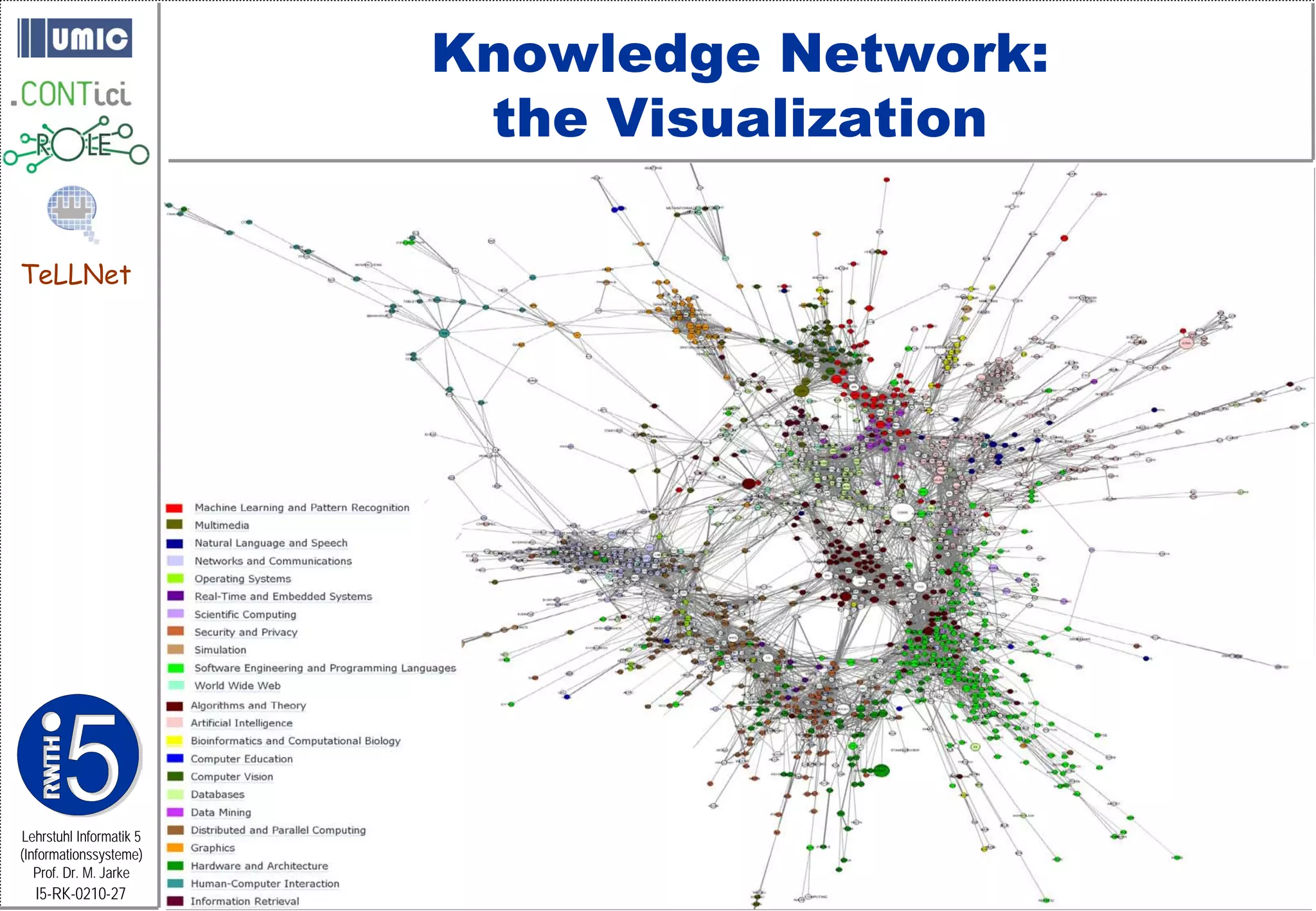
Knowledge Network of Computer
                                  Science with AERCS
                            Knowledge network to understand major research areas and how they
TeLLNet                      are interconnected
                            Dataset: combination of DBLP and CiteSeerX
                              - DBLP: 788,259 author’s names, 1,226,412 publications, 3,490 series.
                              - CiteSeerX: 7,385,652 publications; 22,735,140 references and over 4 million
                                author’s names
                              - Matching: 70% publications in DBLP using canopy clustering technique
                            Method:
                              - Citation analysis: bibliographic coupling
                              - Relatedness measure: cosine similarity
                              - Series cluster analysis
                            Visualization:
Lehrstuhl Informatik 5        - yFiles organic layout (forced-directed paradigm)
(Informationssysteme)
   Prof. Dr. M. Jarke
  I5-RK-0210-26
Knowledge Network:
                          the Visualization

TeLLNet


Lehrstuhl Informatik 5
(Informationssysteme)
   Prof. Dr. M. Jarke
  I5-RK-0210-27
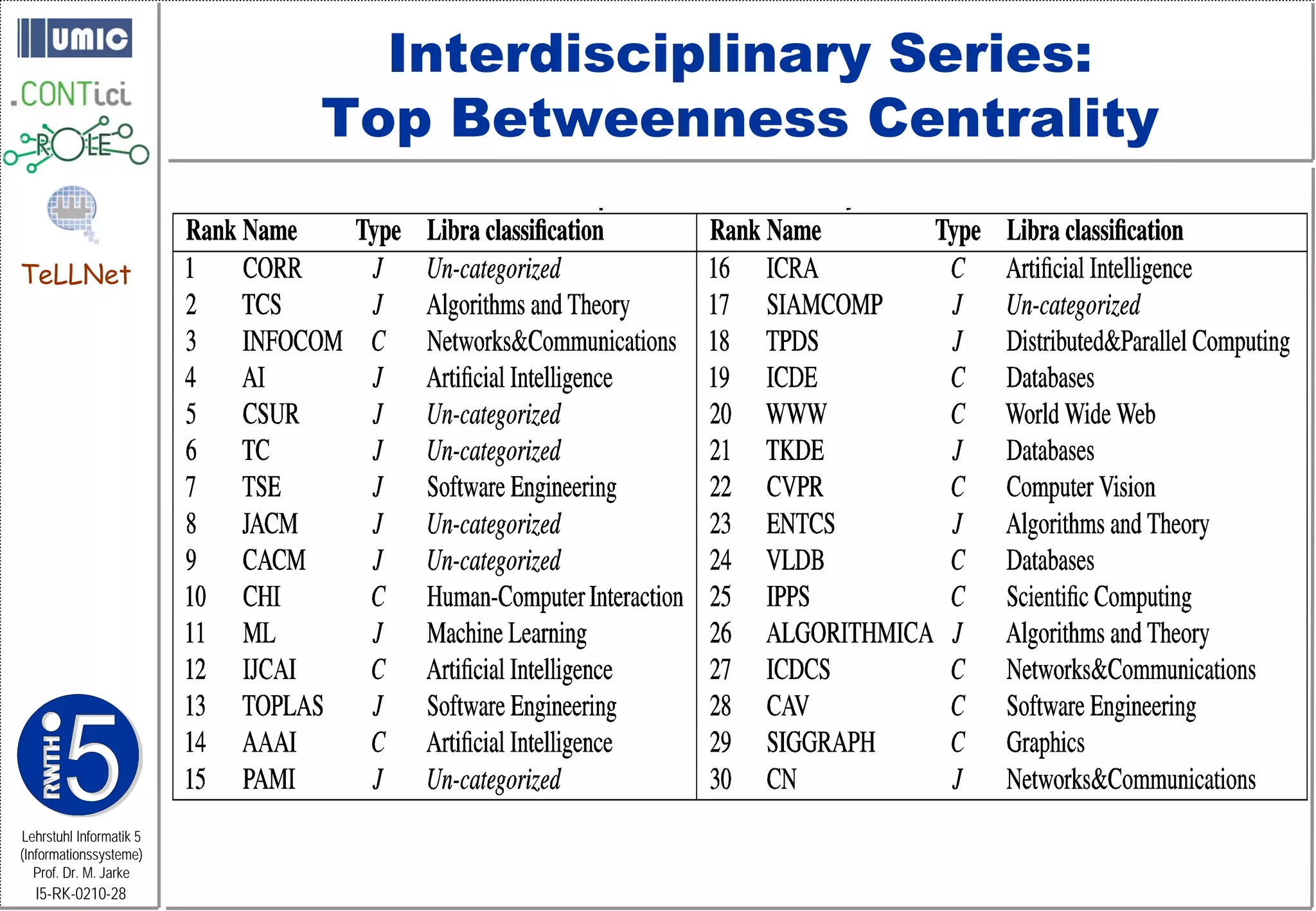
Interdisciplinary Series:
                         Top Betweenness Centrality

TeLLNet


Lehrstuhl Informatik 5
(Informationssysteme)
   Prof. Dr. M. Jarke
  I5-RK-0210-28
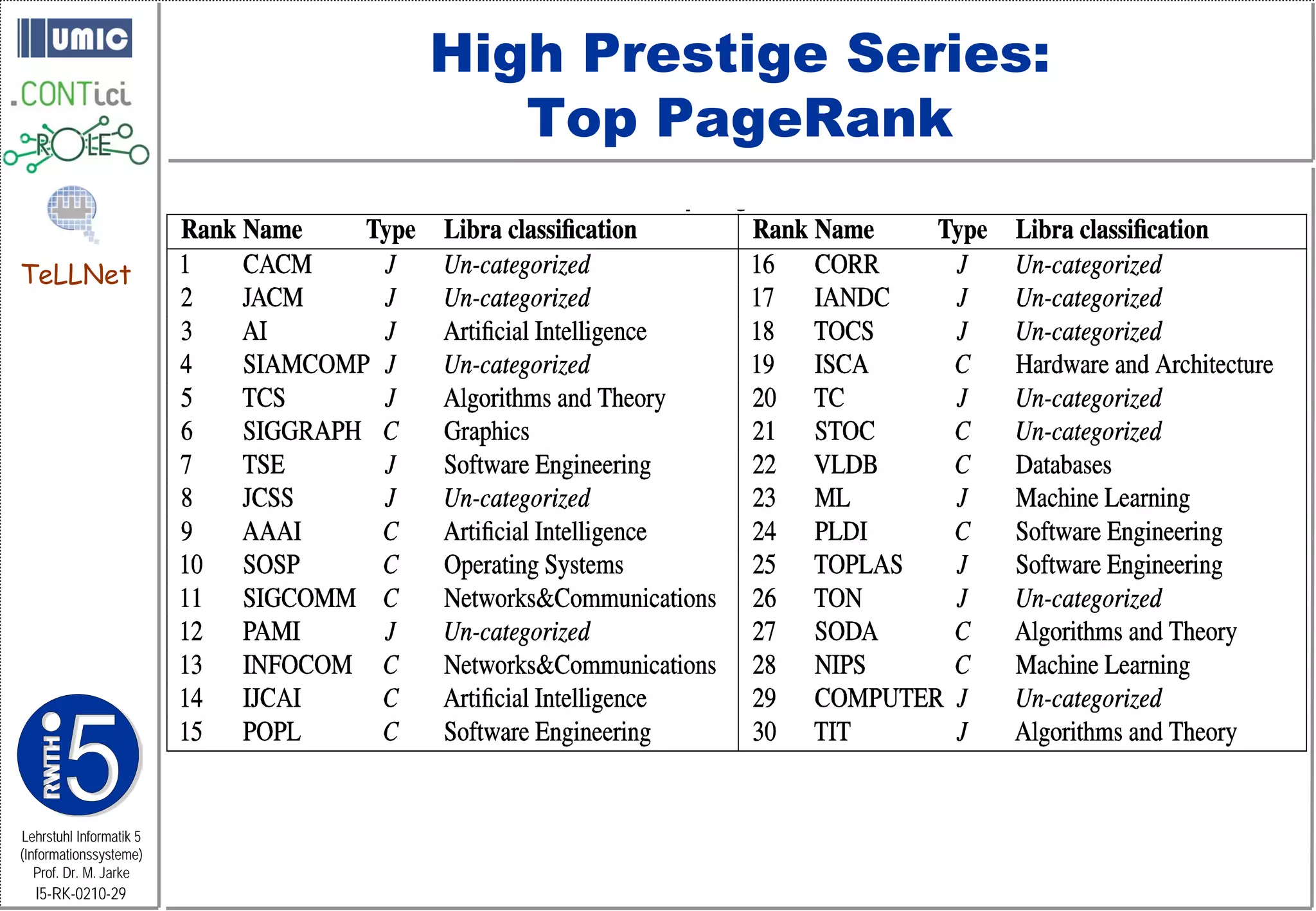
High Prestige Series:
                            Top PageRank

TeLLNet


Lehrstuhl Informatik 5
(Informationssysteme)
   Prof. Dr. M. Jarke
  I5-RK-0210-29
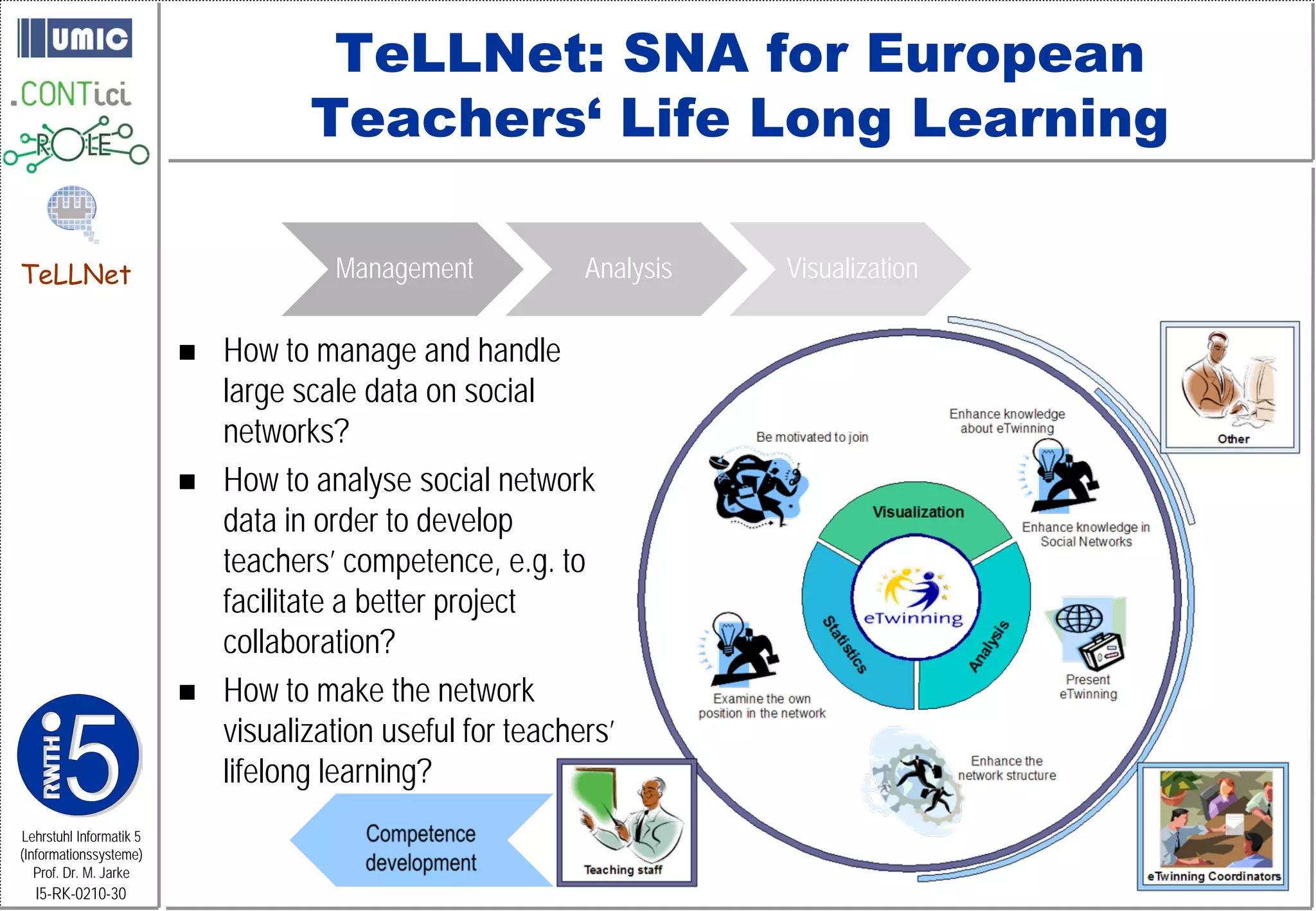
TeLLNet: SNA for European
                                    Teachers‘ Life Long Learning

TeLLNet                               Management            Analysis   Visualization

                            How to manage and handle
                             large scale data on social
                             networks?
                            How to analyse social network
                             data in order to develop
                             teachers’ competence, e.g. to
                             facilitate a better project
                             collaboration?
                            How to make the network
                             visualization useful for teachers’
                             lifelong learning?
Lehrstuhl Informatik 5
(Informationssysteme)
   Prof. Dr. M. Jarke
  I5-RK-0210-30
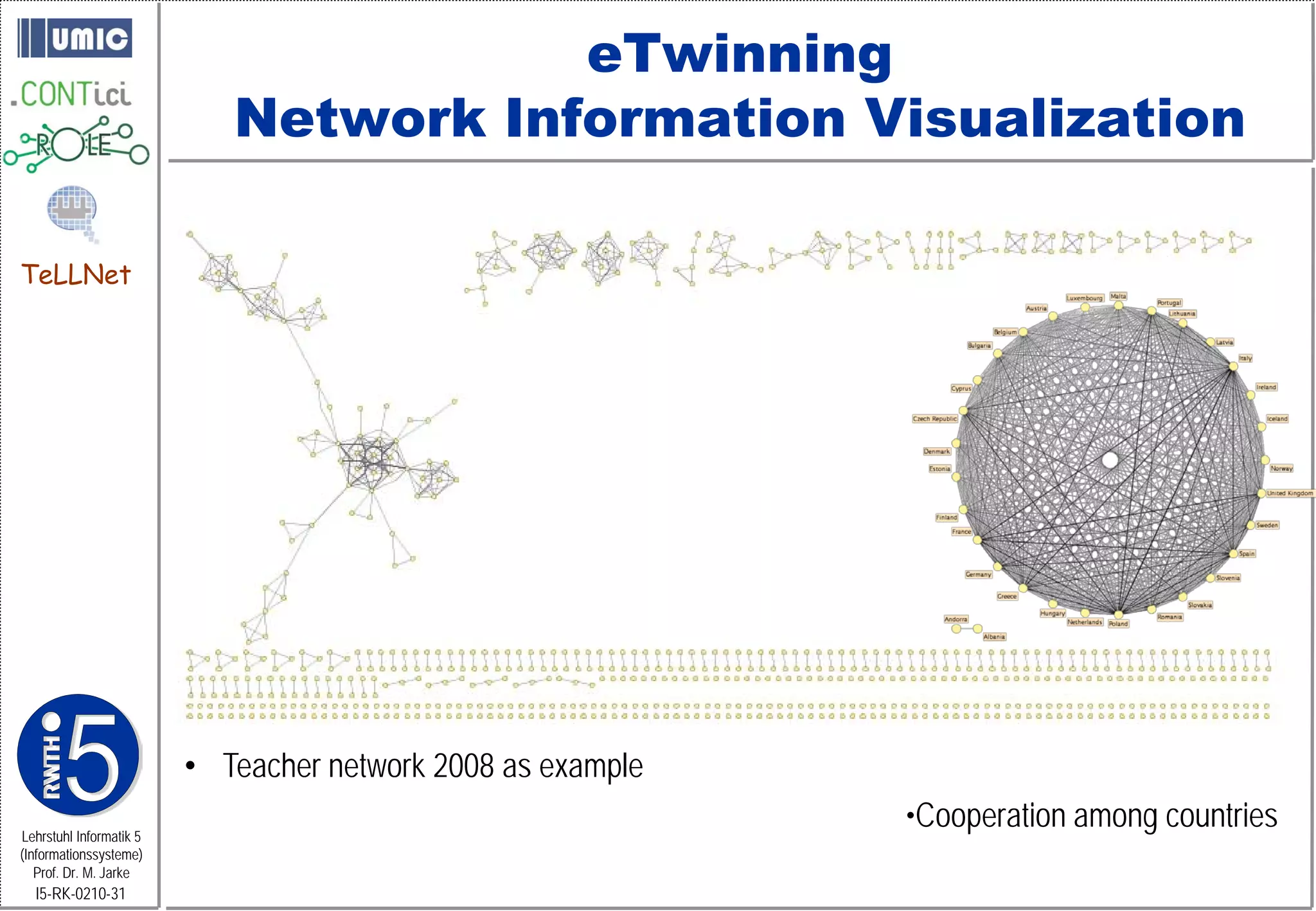
eTwinning
                            Network Information Visualization

TeLLNet


                         • Teacher network 2008 as example
Lehrstuhl Informatik 5
                                                             •Cooperation among countries
(Informationssysteme)
   Prof. Dr. M. Jarke
  I5-RK-0210-31
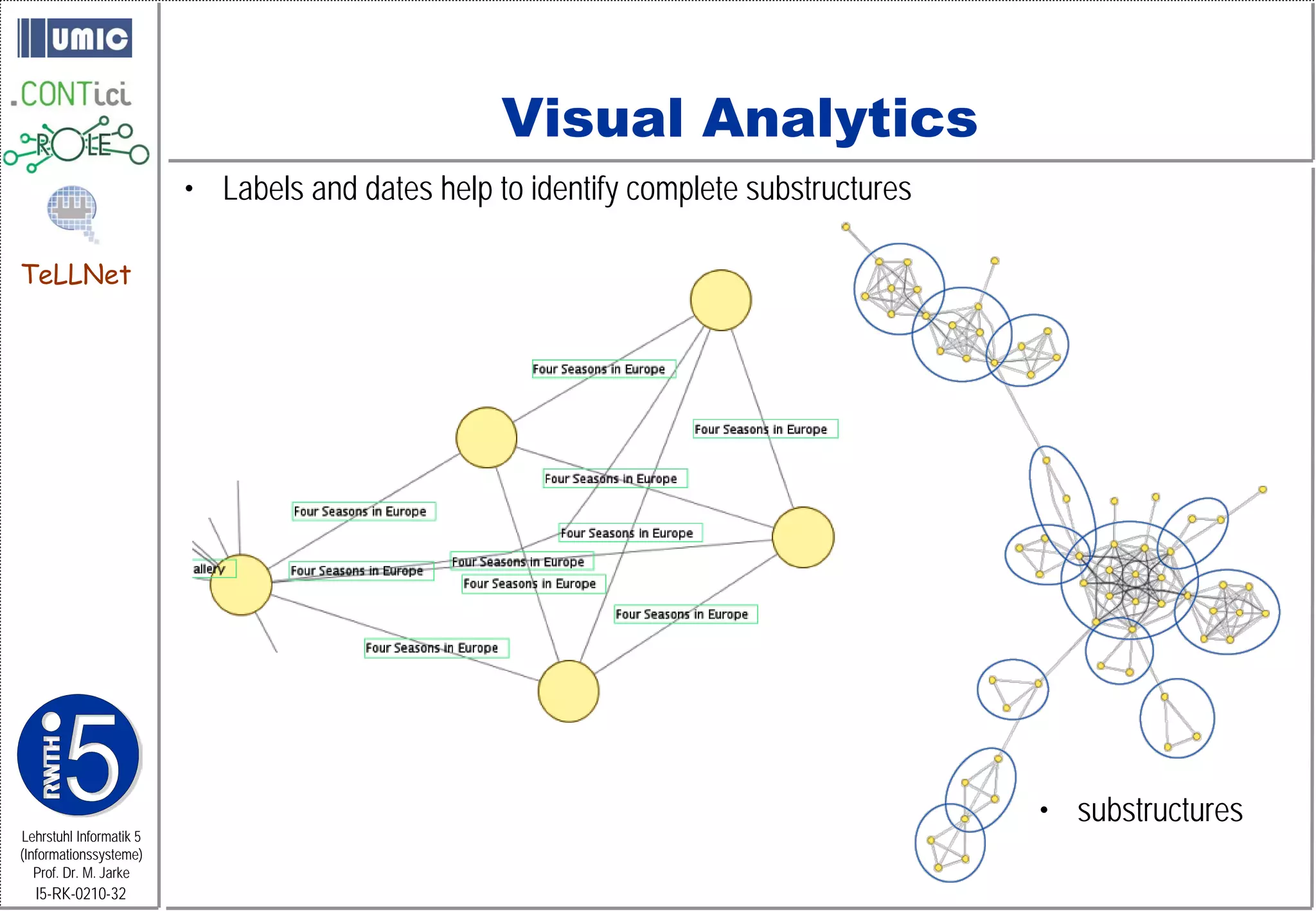
Visual Analytics
                         • Labels and dates help to identify complete substructures

TeLLNet


                                                                                      • substructures
Lehrstuhl Informatik 5
(Informationssysteme)
   Prof. Dr. M. Jarke
  I5-RK-0210-32
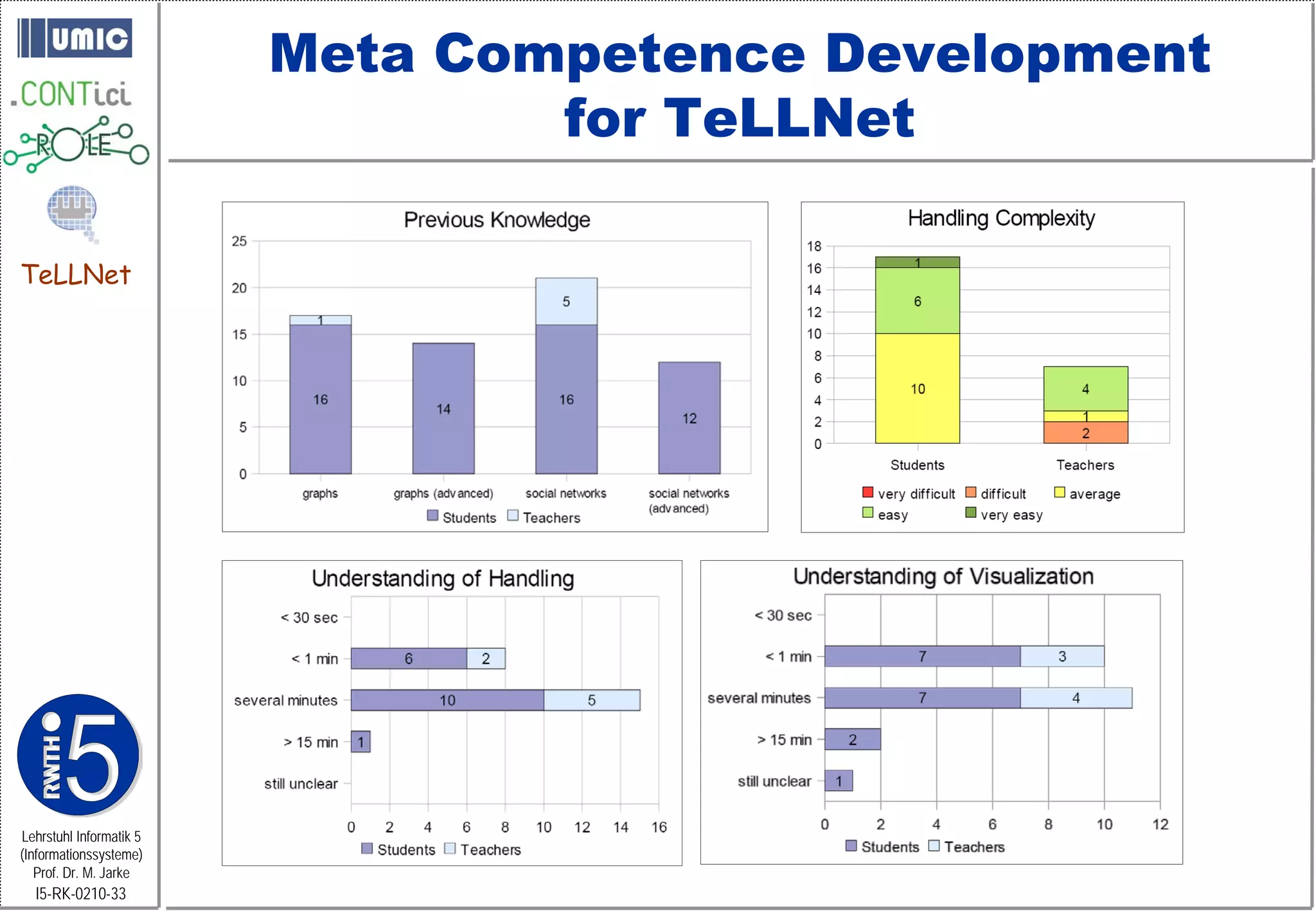
Meta Competence Development
                                 for TeLLNet

TeLLNet


Lehrstuhl Informatik 5
(Informationssysteme)
   Prof. Dr. M. Jarke
  I5-RK-0210-33
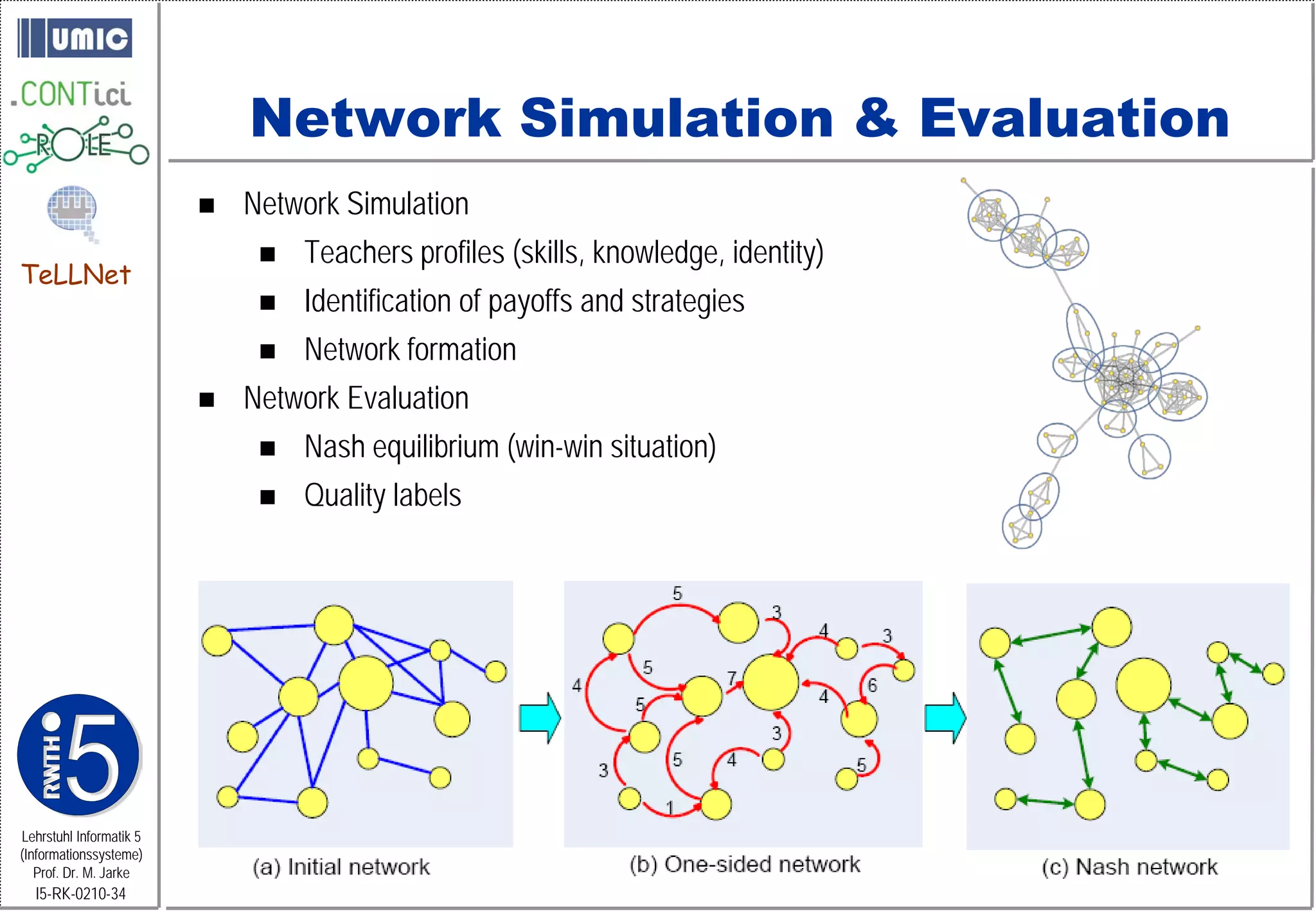
Network Simulation & Evaluation
                            Network Simulation
                                 Teachers profiles (skills, knowledge, identity)
TeLLNet
                                 Identification of payoffs and strategies
                                 Network formation
                            Network Evaluation
                                 Nash equilibrium (win-win situation)
                                 Quality labels


Lehrstuhl Informatik 5
(Informationssysteme)
   Prof. Dr. M. Jarke
  I5-RK-0210-34
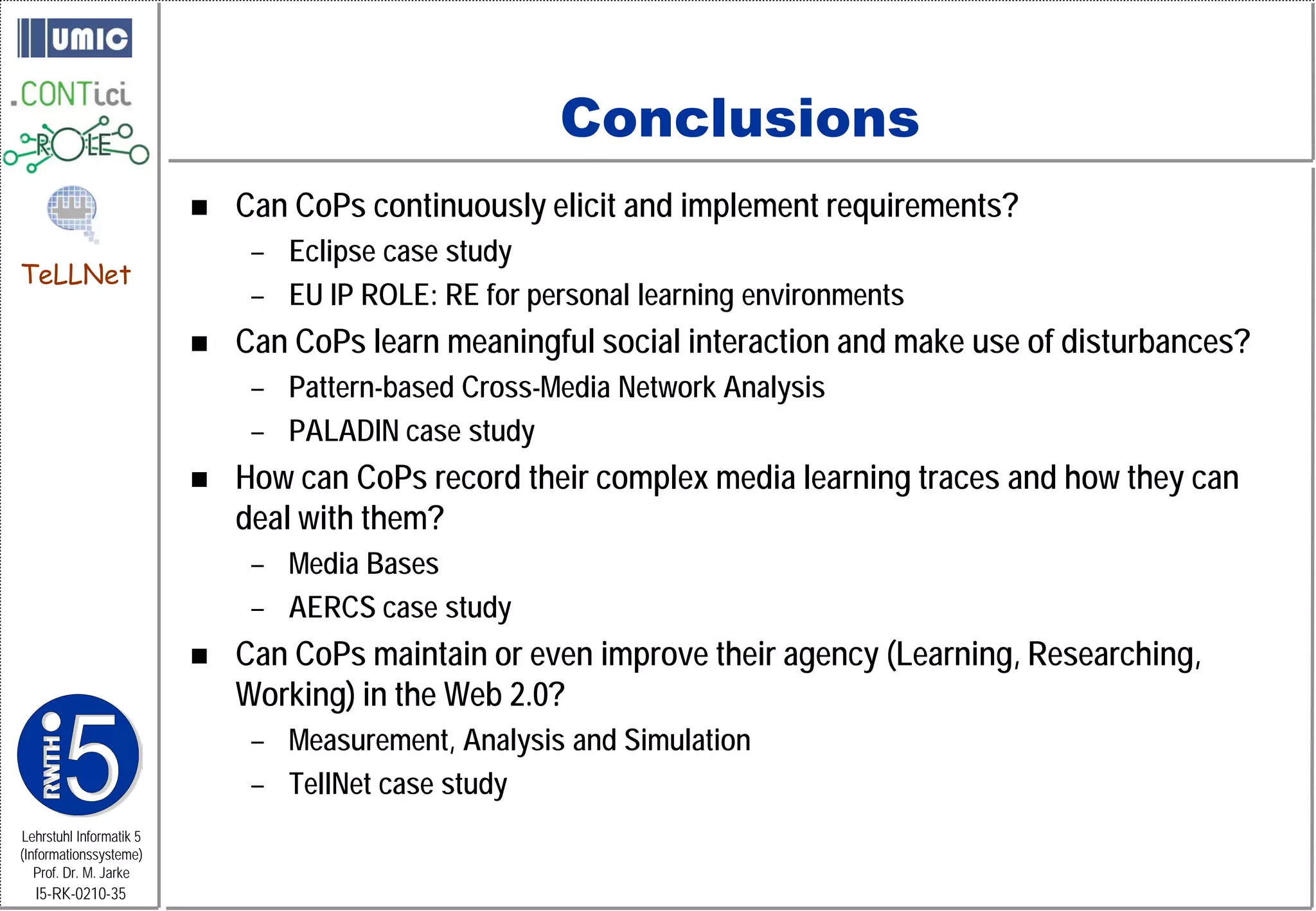
Conclusions
                            Can CoPs continuously elicit and implement requirements?
                              – Eclipse case study
TeLLNet
                              – EU IP ROLE: RE for personal learning environments
                            Can CoPs learn meaningful social interaction and make use of disturbances?
                              – Pattern-based Cross-Media Network Analysis
                              – PALADIN case study
                            How can CoPs record their complex media learning traces and how they can
                             deal with them?
                              – Media Bases
                              – AERCS case study
                            Can CoPs maintain or even improve their agency (Learning, Researching,
                             Working) in the Web 2.0?
                              – Measurement, Analysis and Simulation
                              – TellNet case study
Lehrstuhl Informatik 5
(Informationssysteme)
   Prof. Dr. M. Jarke
  I5-RK-0210-35
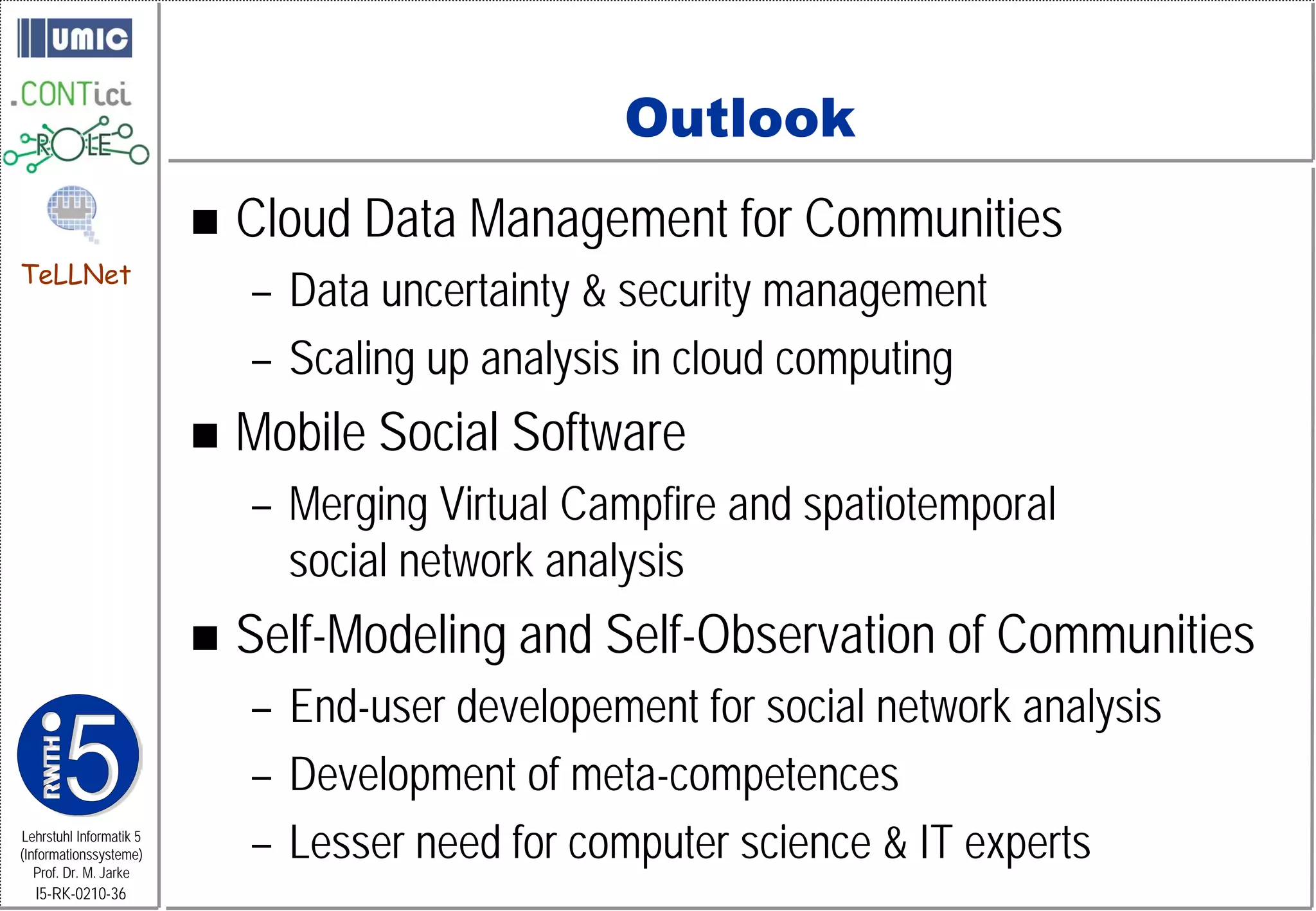
Outlook
                            Cloud Data Management for Communities
TeLLNet
                             – Data uncertainty & security management
                             – Scaling up analysis in cloud computing
                            Mobile Social Software
                             – Merging Virtual Campfire and spatiotemporal
                               social network analysis
                            Self-Modeling and Self-Observation of Communities
                             – End-user developement for social network analysis
                             – Development of meta-competences
Lehrstuhl Informatik 5
(Informationssysteme)
   Prof. Dr. M. Jarke
                             – Lesser need for computer science & IT experts
  I5-RK-0210-36

Reflection Support for Communities on the Web

  • 1.
    TeLLNet Reflection Support for Communities on the Web Ralf Klamma RWTH Aachen University TU Delft, February 19, 2010 Lehrstuhl Informatik 5 (Informationssysteme) Prof. Dr. M. Jarke I5-RK-0210-1
  • 2.
    I5-RK-0210-2 Prof. Dr. M. Jarke TeLLNet Lehrstuhl Informatik 5 (Informationssysteme) RWTH Aachen Community Information Systems Data Management: Mediabases PALADIN Case Studies Agenda Conclusions and Outlook
  • 3.
    RWTH Aachen University • 260 institutes in 9 faculties as Europe’s leading institutions for science and research TeLLNet • Currently around 31,400 students are enrolled in over 100 academic programs • Over 5,000 of them are international students hailing from 120 different countries • 1,250 spin-off businesses have created around 30,000 jobs in the greater Aachen region over the past 20 years. • IDEA League • Germany’s Excellence Initiative: 3 clusters of excellence, a graduate school Lehrstuhl Informatik 5 and the institutional strategy “RWTH Aachen 2020: Meeting Global Challenges” (Informationssysteme) Prof. Dr. M. Jarke I5-RK-0210-3
  • 4.
    Community Information Systems Research Group TeLLNet  Established at DBIS chair, RWTH Aachen University  9 Phd students & researchers  10-15 paid student workers & thesis workers Lehrstuhl Informatik 5 (Informationssysteme) Prof. Dr. M. Jarke I5-RK-0210-4
  • 5.
    Communities of Practice TeLLNet Analysis of Traces of CoPs in the Web Community of practice (CoP) as the Engineering of basic research object Community for our Web Science Information Systems approach Communities of practice are groups of people who share a concern or a passion for something they do and who interact regularly to learn how Wenger: Communities of Practice: Lehrstuhl Informatik 5 (Informationssysteme) to do it better Learning, Meaning and Prof. Dr. M. Jarke Identity, 1998 I5-RK-0210-5
  • 6.
    i* Model ofRequirements Engineering in CoP TeLLNet Lehrstuhl Informatik 5 (Informationssysteme) Prof. Dr. M. Jarke I5-RK-0210-6
  • 7.
    ATLAS: Reflective ISas an Architectural Foundation Operational Support Community Reflective Support Self-Modeling TeLLNet Can we support CoPs with the Can CoPs continuously elicit and collaborative creation of complex implement requirements? How much multimedia objects? computer science support is needed? Community Can CoPs make use of metadata over Can CoPs learn meaningful social the frontiers of media and standards? Self-Observation interaction and make use of disturbances? Can we support CoPs by personalized How can CoPs record their complex knowledge management and networking media learning traces and how they can strategies in Social Software? deal with them? How do adaptive, mobile web-based Can CoPs maintain or even improve their interfaces for CoPs look like? agency (Learning, Researching, Working) in the Web 2.0? Actor- Agent-oriented Network RE Community Theory Information Systems Social Participatory Community Game Network Design IS Design Theory Analysis Lehrstuhl Informatik 5 (Informationssysteme) Prof. Dr. M. Jarke I5-RK-0210-7 Communities of Practice Media Networks
  • 8.
    Solution idea forReflective Support: Cross-Media Social Network Analysis  Interdisciplinary multidimensional model of digital networks TeLLNet – Social network analysis (SNA) is defining measures for social relations – Actor network theory (ANT) is connecting human and media agents – I* framework is defining strategic goals and dependencies – Theory of media transcriptions is studying cross-media knowledge social software Media Networks network of artifacts Wiki, Blog, Podcast, IM, Chat, Microcontent, Blog entry, Message, Burst, Thread, Email, Newsgroup, Chat … Comment, Conversation, Feedback (Rating) i*-Dependencies (Structural, Cross-media) network of members Lehrstuhl Informatik 5 Members (Social Network Analysis: Centrality, (Informationssysteme) Prof. Dr. M. Jarke Efficiency) Communities of practice I5-RK-0210-8
  • 9.
    Simplified Meta Model Attribute has Actor TeLLNet isA Medium Artifact Process Member Community isA stores creates is affected by belongs go represents consumes performs ranks Lehrstuhl Informatik 5 Browse Address Transcribe … Localize (Informationssysteme) Prof. Dr. M. Jarke Latour: On Recalling ANT, 1999 I5-RK-0210-9
  • 10.
    MediaBase  Collection of Social Software artifacts with parameterized TeLLNet PERL scripts – Mailing lists – Newsletter – Web sites – RSS Feeds – Blogs  Database support by IBM DB2, eXist, Oracle, ...  Web Interface based on Firefox Plugin, Plone/Zope, LAS, ...  Strategies of visualization – Tree maps Lehrstuhl Informatik 5 (Informationssysteme) Prof. Dr. M. Jarke – Cross-media graphs I5-RK-0210-10 Klamma et al.: Pattern-Based Cross Media Social Network Analysis for Technology Enhanced Learning in Europe, EC-TEL 2006
  • 11.
    Media Base Web2.0 Commander  Personalization (user annotates resources with tags and has his page) TeLLNet  Community-awareness (resources and annotation of others are open)  User-friendly interface (Firefox plug-in, easy insertion of resources, tags, tracking of recent changes) Lehrstuhl Informatik 5 (Informationssysteme) Prof. Dr. M. Jarke I5-RK-0210-11
  • 12.
    Modeling Dependencies Using the i* Framework Coordination Iterant Coordinator Broker TeLLNet isA isA isA Member Gatekeeper Artifact isA URL Hub Legend: Agent Goal Communication Network Resource Lehrstuhl Informatik 5 Task (Informationssysteme) Prof. Dr. M. Jarke Eric S. K. Yu, Towards Modeling and Reasoning Support for Early-Phase Requirements Engineering, RE 1997 I5-RK-0210-12
  • 13.
    Web 2.0 MediaOperations in ATLAS TeLLNet Lehrstuhl Informatik 5 (Informationssysteme) Prof. Dr. M. Jarke I5-RK-0210-13
  • 14.
    PALADIN: Disturbances in Cross-media Social Networks  What is a disturbance? TeLLNet – Sensing an incompatibility between theories exposed and theories-in-use  Disturbances are starting points of learning processes – Disturbances disturb, prevent … but they are creating reflection  Disturbances are hard to detect or to forecast Lehrstuhl Informatik 5 (Informationssysteme) Prof. Dr. M. Jarke I5-RK-0210-14
  • 15.
    Pattern Language forPALADIN: Example Troll Troll Pattern: This pattern tries to discover the cases when a troll exists in a digital social network. A troll in the network is considered a disturbance. TeLLNet Disturbance: (EXISTS [medium | medium.affordance = threadArtefact]) & (EXISTS [troll |(EXISTS [thread | (thread.author = troll) & (COUNT [message | (message.author = troll) & (message.posted = thread)]) > minPosts]) & (~EXISTS[ thread1, message1| (thread1.author1 != troll) & (message1.author = troll & message1.posted = thread1 ]))])]) Forces: medium; troll; network; member; thread; message; url Force Relations: neighbour(troll, member); own thread(troll, thread) Solution: No attention must be paid to the discussions started by the troll. Rationale: The troll needs attention to continue its activities. If no attention is paid, he/she Lehrstuhl Informatik 5 will stop participating in the discussions. Pattern Relations: Associates Spammer pattern. (Informationssysteme) Prof. Dr. M. Jarke I5-RK-0210-15
  • 16.
    Pattern Discovery Process Pattern 1. Set pattern Pattern Template parameters Disturbance Disturbance TeLLNet Variables Pattern 4a. Variables Parameters Change Pattern Instance Pattern Parameters Disturbance Digital Social Network 2. Instantiate disturbances 4b. Apply Variables Pattern Pattern Solution Parameters Pattern Template Instance Forces Force Relations Disturbance Instances Description Solution Variables Pattern Parameters Rationale Dependencies 3. Evaluate disturbances Lehrstuhl Informatik 5 (Informationssysteme) Pattern Relations Prof. Dr. M. Jarke I5-RK-0210-16
  • 17.
    PALADIN Case Study 10 patterns of disturbance over 119 social network instances, TeLLNet 17359 individuals, 215 345 mails Pattern Occurrences Remarks Burst 22 The pattern finds out topics which were very important for certain period of time. Scalability is necessary. No Conversationalist 76 The existence implies little communication in the network. No Questioner 67 The existence implies that the network is not popular. No Answering Person 61 Occurs in small networks. The effects of the lack of an answering person must be further checked with content analysis. Troll 2 Troll occurs very rarely in cultural communities. True negatives exist. Spammer 86 Spammers can be found often in discussion groups. False positives exist. Leader 37 The pattern occurs in the network centered around a member. No Leader 40 Occurs in big networks where the members are distributed in different clusters. Structural Hole 67 Occurs for members having neighbors with only one contact. Lehrstuhl Informatik 5 (Informationssysteme) Independent 13 Occurs in large networks where disconnected subnetworks exist. Prof. Dr. M. Jarke I5-RK-0210-17 Discussions Scalability is necessary.
  • 18.
    Social Network Analysisof Open Source Communities  Eclipse components network based on analysis of TeLLNet source code repository (Software Architecture)  Eclipse components network based on analysis of mailing list communication (Social Structure) Lehrstuhl Informatik 5 (Informationssysteme) Prof. Dr. M. Jarke I5-RK-0210-18
  • 19.
    Community Reflection about Development Process TeLLNet  Social platform: Eclipse forum eclipsezone  Forum: Eclipse communication framework (ECF)  Measure: degree centrality Lehrstuhl Informatik 5 (Informationssysteme)  Statistics: 225 nodes, 283 edges Prof. Dr. M. Jarke I5-RK-0210-19
  • 20.
    Conversationalist Pattern  Social platform: Eclipse mailing list TeLLNet  Forum: Device debugging developer discussion Lehrstuhl Informatik 5 (Informationssysteme) Prof. Dr. M. Jarke I5-RK-0210-20
  • 21.
    Questioner Pattern  Social platform: Eclipse mailing list TeLLNet  Forum: Device debugging developer discussion Lehrstuhl Informatik 5 (Informationssysteme) Prof. Dr. M. Jarke I5-RK-0210-21
  • 22.
    Correlation Estimation between Architecture and Social Structure TeLLNet Lehrstuhl Informatik 5 (Informationssysteme) Prof. Dr. M. Jarke I5-RK-0210-22
  • 23.
    Requirements Reflection Compared to Community Performance  With increasing number of boundary spanners it becomes TeLLNet easier to induce / implement requirements, which can be evidenced by increased release rates and vice-versa  As most bugs are due to insufficient understanding [NOHI99] and knowledge creation as well as sharing is supported by boundary spanners [BDBu07], then increased number of boundary spanners should be evidenced by decreased bug rate and vice-versa Lehrstuhl Informatik 5 (Informationssysteme) Prof. Dr. M. Jarke I5-RK-0210-23
  • 24.
    Identification of End-Usersand Developers in OSS Communities Community TeLLNet Clustering Lehrstuhl Informatik 5 (Informationssysteme) Prof. Dr. M. Jarke I5-RK-0210-24
  • 25.
    Textual Analysis ofPostings from Community Experts TeLLNet Postings from experts of one of the identified communities Lehrstuhl Informatik 5 (Informationssysteme) Prof. Dr. M. Jarke I5-RK-0210-25
  • 26.
    Knowledge Network ofComputer Science with AERCS  Knowledge network to understand major research areas and how they TeLLNet are interconnected  Dataset: combination of DBLP and CiteSeerX - DBLP: 788,259 author’s names, 1,226,412 publications, 3,490 series. - CiteSeerX: 7,385,652 publications; 22,735,140 references and over 4 million author’s names - Matching: 70% publications in DBLP using canopy clustering technique  Method: - Citation analysis: bibliographic coupling - Relatedness measure: cosine similarity - Series cluster analysis  Visualization: Lehrstuhl Informatik 5 - yFiles organic layout (forced-directed paradigm) (Informationssysteme) Prof. Dr. M. Jarke I5-RK-0210-26
  • 27.
    Knowledge Network: the Visualization TeLLNet Lehrstuhl Informatik 5 (Informationssysteme) Prof. Dr. M. Jarke I5-RK-0210-27
  • 28.
    Interdisciplinary Series: Top Betweenness Centrality TeLLNet Lehrstuhl Informatik 5 (Informationssysteme) Prof. Dr. M. Jarke I5-RK-0210-28
  • 29.
    High Prestige Series: Top PageRank TeLLNet Lehrstuhl Informatik 5 (Informationssysteme) Prof. Dr. M. Jarke I5-RK-0210-29
  • 30.
    TeLLNet: SNA forEuropean Teachers‘ Life Long Learning TeLLNet Management Analysis Visualization  How to manage and handle large scale data on social networks?  How to analyse social network data in order to develop teachers’ competence, e.g. to facilitate a better project collaboration?  How to make the network visualization useful for teachers’ lifelong learning? Lehrstuhl Informatik 5 (Informationssysteme) Prof. Dr. M. Jarke I5-RK-0210-30
  • 31.
    eTwinning Network Information Visualization TeLLNet • Teacher network 2008 as example Lehrstuhl Informatik 5 •Cooperation among countries (Informationssysteme) Prof. Dr. M. Jarke I5-RK-0210-31
  • 32.
    Visual Analytics • Labels and dates help to identify complete substructures TeLLNet • substructures Lehrstuhl Informatik 5 (Informationssysteme) Prof. Dr. M. Jarke I5-RK-0210-32
  • 33.
    Meta Competence Development for TeLLNet TeLLNet Lehrstuhl Informatik 5 (Informationssysteme) Prof. Dr. M. Jarke I5-RK-0210-33
  • 34.
    Network Simulation &Evaluation  Network Simulation  Teachers profiles (skills, knowledge, identity) TeLLNet  Identification of payoffs and strategies  Network formation  Network Evaluation  Nash equilibrium (win-win situation)  Quality labels Lehrstuhl Informatik 5 (Informationssysteme) Prof. Dr. M. Jarke I5-RK-0210-34
  • 35.
    Conclusions  Can CoPs continuously elicit and implement requirements? – Eclipse case study TeLLNet – EU IP ROLE: RE for personal learning environments  Can CoPs learn meaningful social interaction and make use of disturbances? – Pattern-based Cross-Media Network Analysis – PALADIN case study  How can CoPs record their complex media learning traces and how they can deal with them? – Media Bases – AERCS case study  Can CoPs maintain or even improve their agency (Learning, Researching, Working) in the Web 2.0? – Measurement, Analysis and Simulation – TellNet case study Lehrstuhl Informatik 5 (Informationssysteme) Prof. Dr. M. Jarke I5-RK-0210-35
  • 36.
    Outlook  Cloud Data Management for Communities TeLLNet – Data uncertainty & security management – Scaling up analysis in cloud computing  Mobile Social Software – Merging Virtual Campfire and spatiotemporal social network analysis  Self-Modeling and Self-Observation of Communities – End-user developement for social network analysis – Development of meta-competences Lehrstuhl Informatik 5 (Informationssysteme) Prof. Dr. M. Jarke – Lesser need for computer science & IT experts I5-RK-0210-36