Adaptive and Intelligent Collaborative
  Learning Support systems (AICLS)


          Magnisalis Ioannis


          Aristotle University of Thessaloniki, Greece 2011
Presentation flow
  – Background & Work up to now
  – Research Directions & Future Roadmap
  – Publications


                Aristotle University of Thessaloniki, Greece 2011
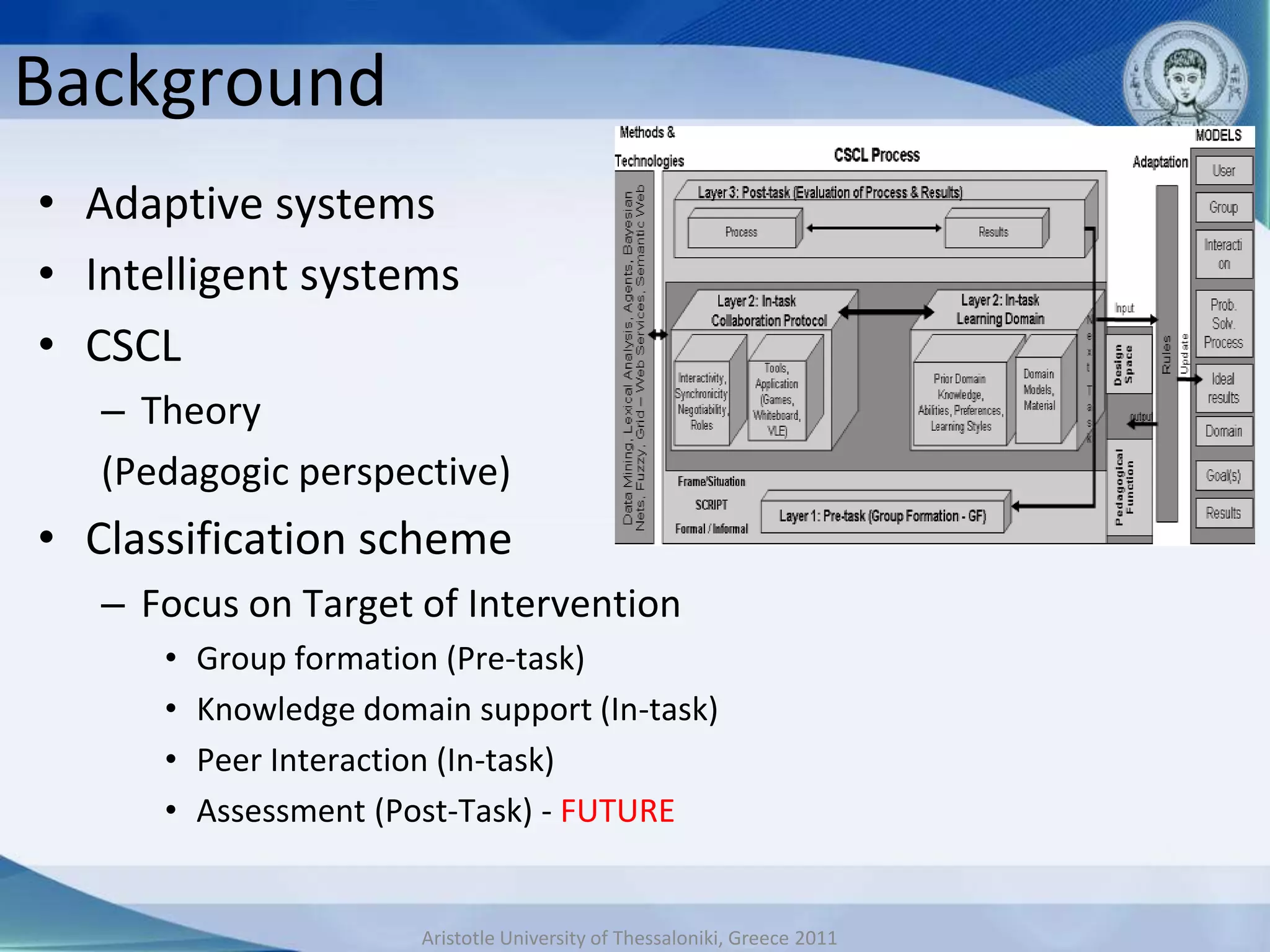
Background
• Adaptive systems
• Intelligent systems
• CSCL
   – Theory
   (Pedagogic perspective)
• Classification scheme
   – Focus on Target of Intervention
      •   Group formation (Pre-task)
      •   Knowledge domain support (In-task)
      •   Peer Interaction (In-task)
      •   Assessment (Post-Task) - FUTURE


                        Aristotle University of Thessaloniki, Greece 2011
Work up to now 1/8
•   Standards and widespread technologies
    – IMS-LD, QTI, Moodle, LAMS, Webconference
      tools,BPEL, Semantic Web & Ontologies …
•   Adaptation patterns modeling (IRMO design
    specification)
•   Architecture for AICLS systems (MAPIS)
•   Case studies
    – Pre-task (group formation)
    – In-task (Moodle forum): Mirroring & Meta-
      cognitive level

                  Aristotle University of Thessaloniki, Greece 2011
Work up to now 2/8
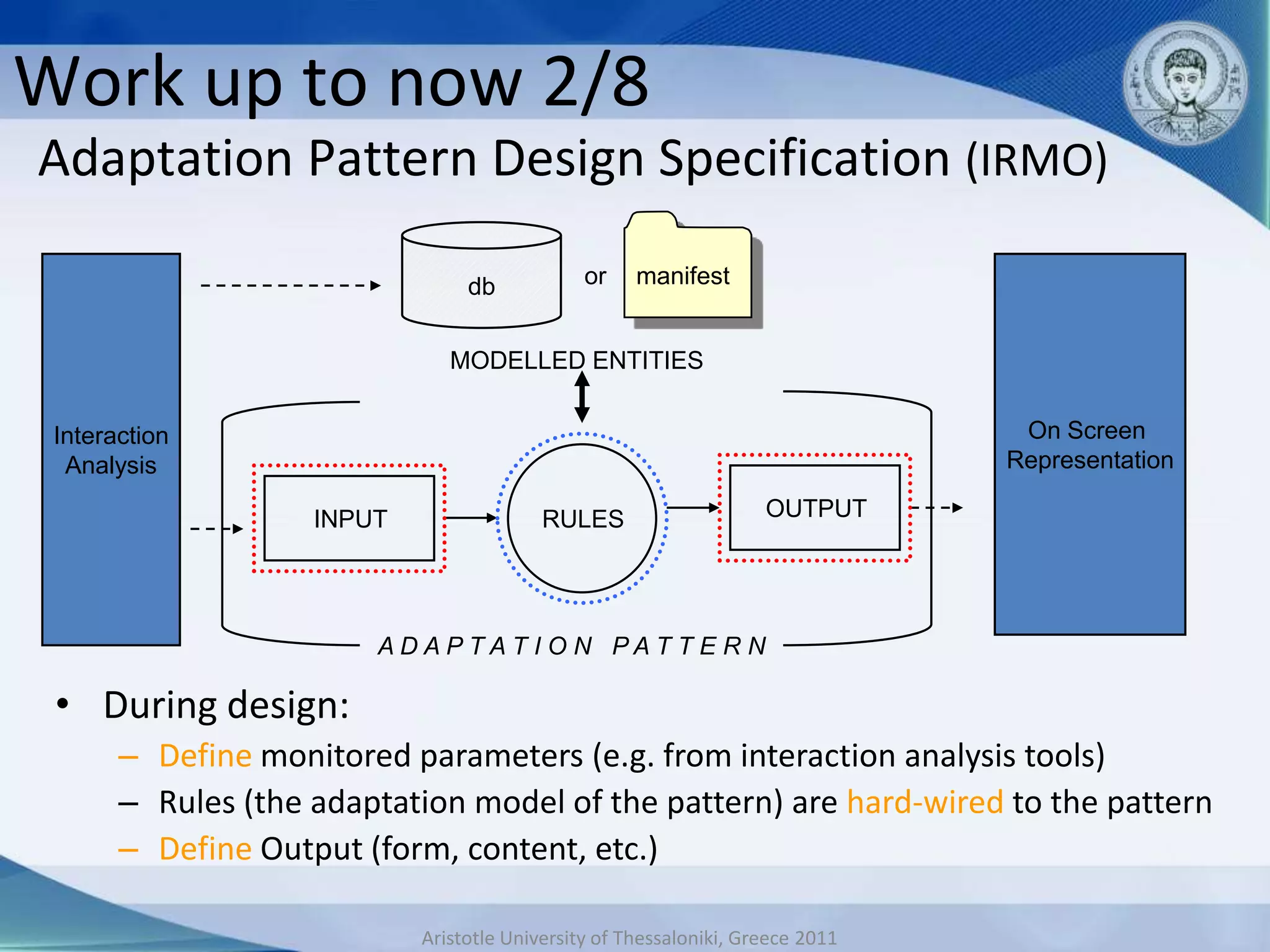
Adaptation Pattern Design Specification (IRMO)

                                 db            or    manifest


                               MODELLED ENTITIES


 Interaction                                                                     On Screen
  Analysis                                                                      Representation

                    INPUT                 RULES                     OUTPUT


                        ADAPTAT I O N PAT T E R N

 • During design:
       – Define monitored parameters (e.g. from interaction analysis tools)
       – Rules (the adaptation model of the pattern) are hard-wired to the pattern
       – Define Output (form, content, etc.)

                            Aristotle University of Thessaloniki, Greece 2011
Work up to now 3/8
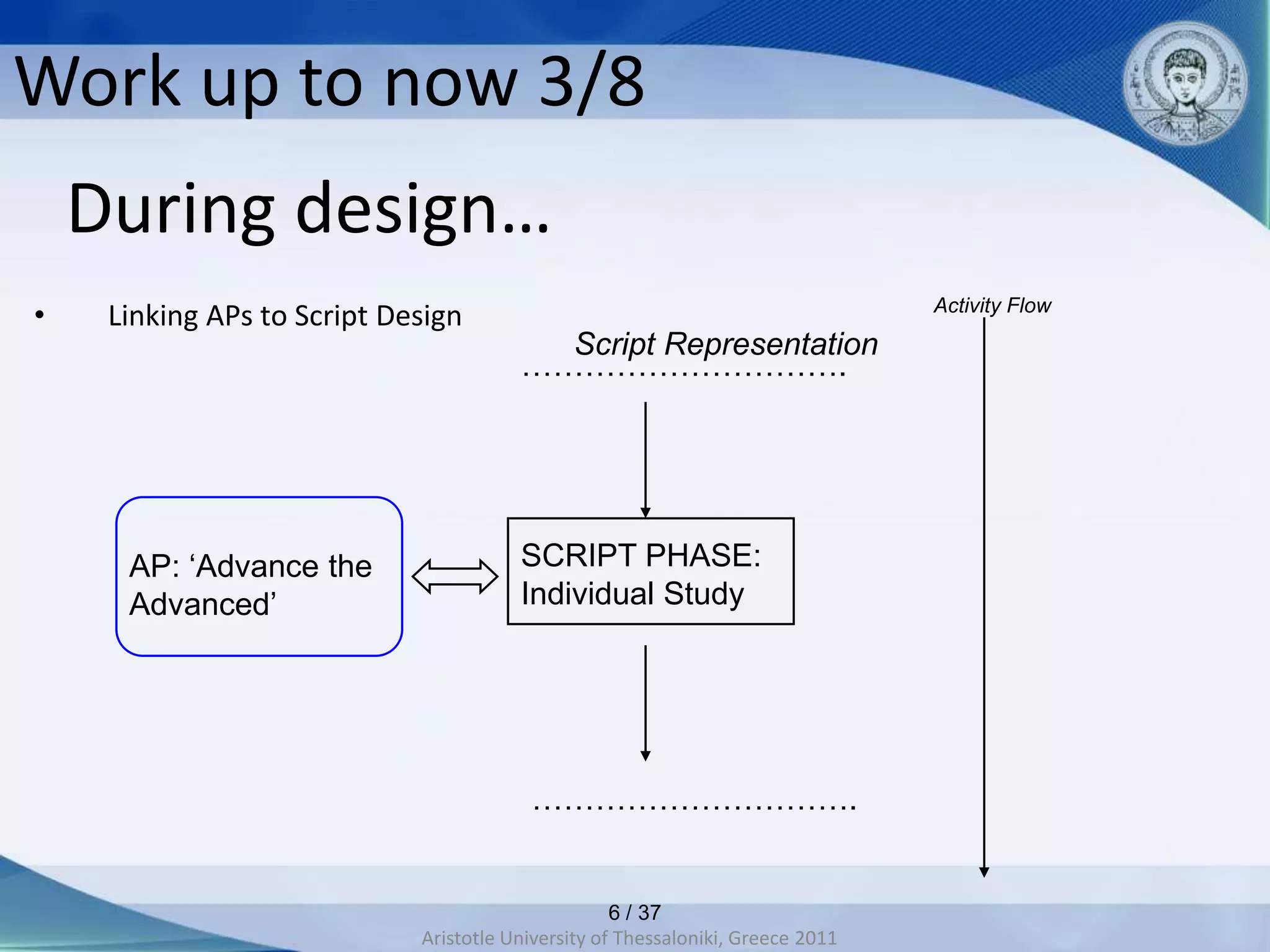
    During design…
•    Linking APs to Script Design                                                Activity Flow
                                          Script Representation
                                        ………………………….


      AP: ‘Advance the                  SCRIPT PHASE:
      Advanced’                         Individual Study


                                         ………………………….


                                                    6 / 37
                             Aristotle University of Thessaloniki, Greece 2011
Work up to now 4/8
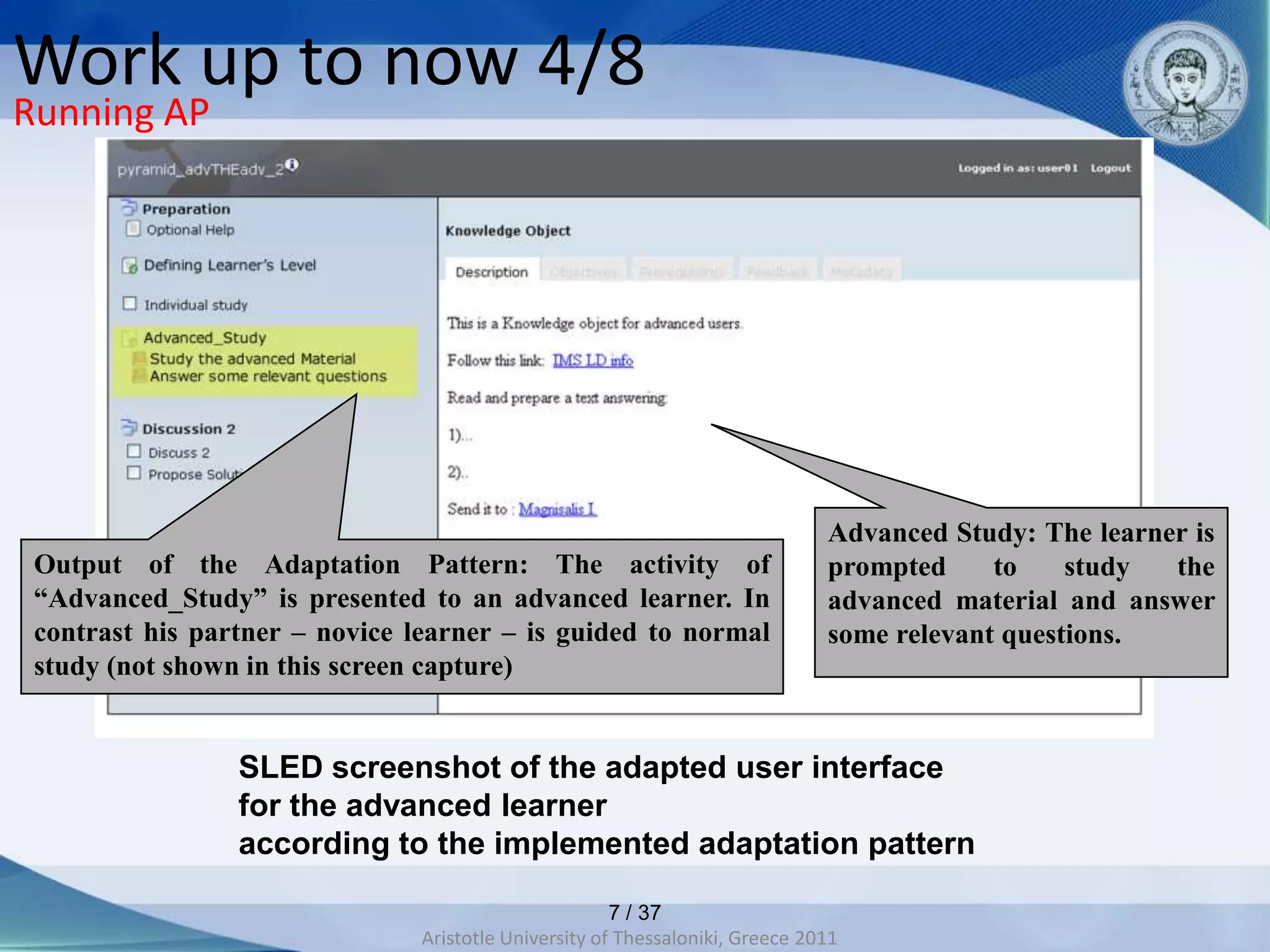
Running AP


                                                                               Advanced Study: The learner is
 Output of the Adaptation Pattern: The activity of                             prompted     to    study  the
 “Advanced_Study” is presented to an advanced learner. In                      advanced material and answer
 contrast his partner – novice learner – is guided to normal                   some relevant questions.
 study (not shown in this screen capture)


                 SLED screenshot of the adapted user interface
                 for the advanced learner
                 according to the implemented adaptation pattern

                                                       7 / 37
                                Aristotle University of Thessaloniki, Greece 2011
Work up to now 5/8
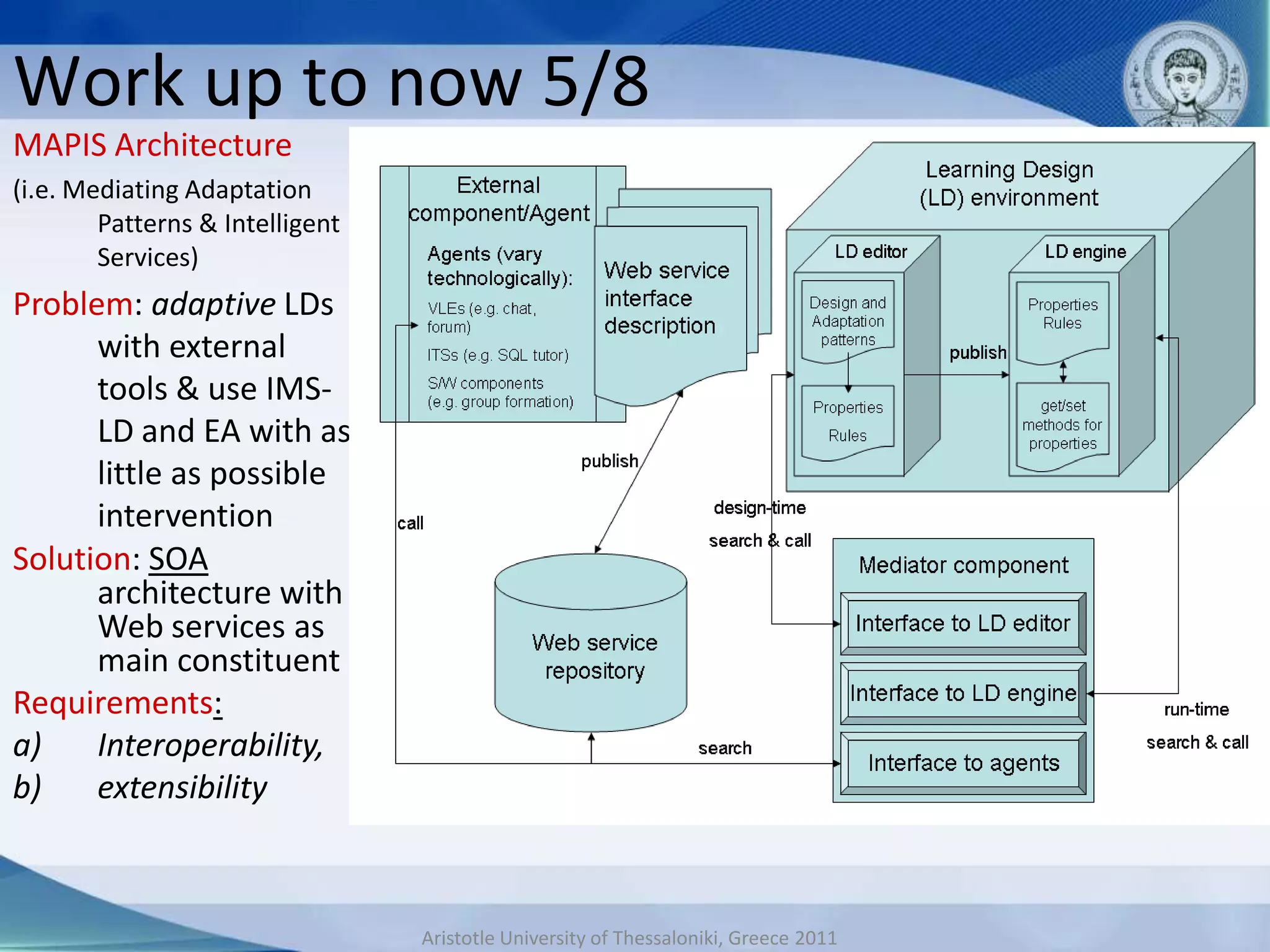
MAPIS Architecture
(i.e. Mediating Adaptation
        Patterns & Intelligent
        Services)
Problem: adaptive LDs
      with external
      tools & use IMS-
      LD and EA with as
      little as possible
      intervention
Solution: SOA
      architecture with
      Web services as
      main constituent
Requirements:
a)    Interoperability,
b)    extensibility


                                 Aristotle University of Thessaloniki, Greece 2011
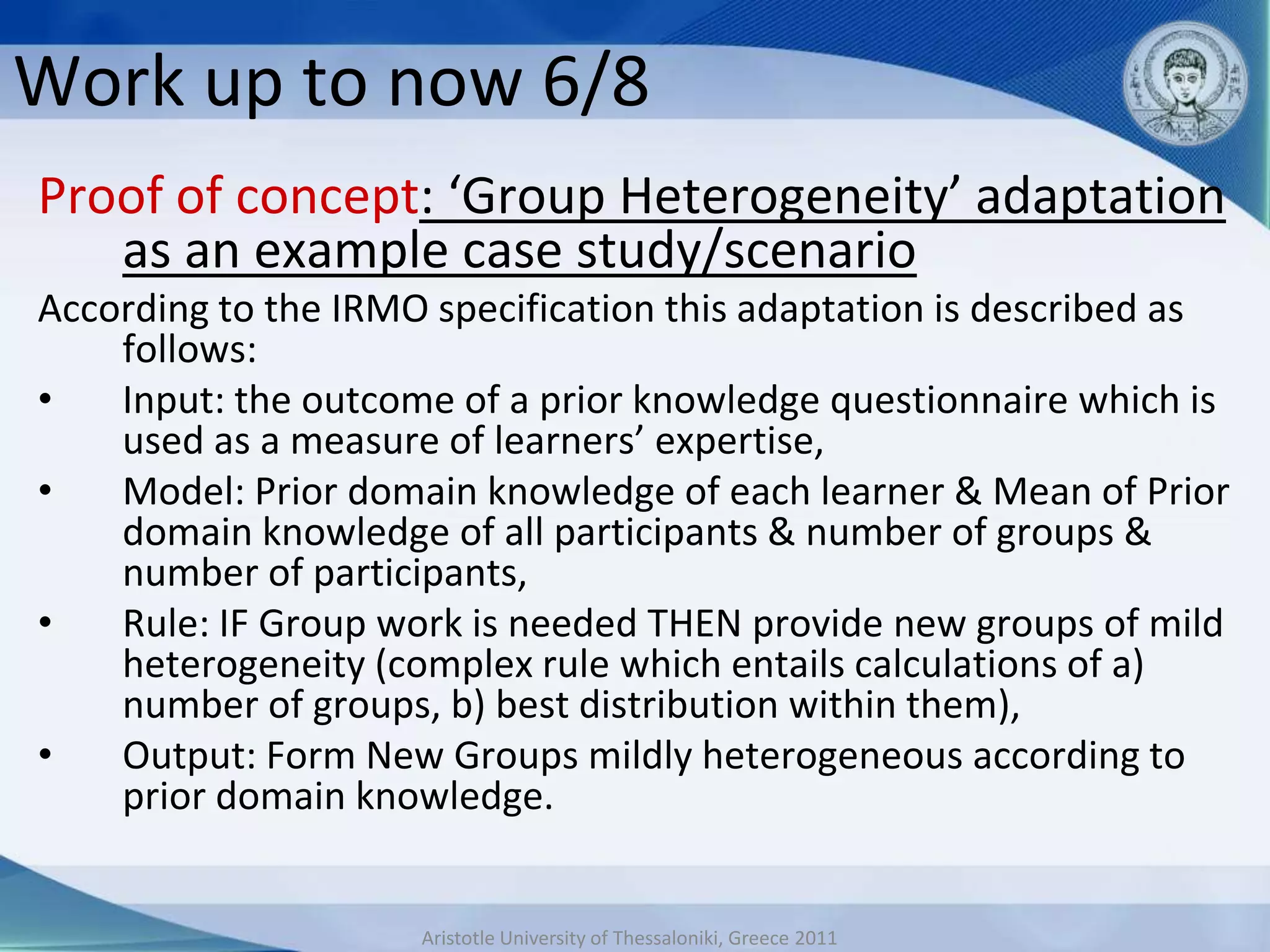
Work up to now 6/8
Proof of concept: ‘Group Heterogeneity’ adaptation
   as an example case study/scenario
According to the IRMO specification this adaptation is described as
    follows:
•   Input: the outcome of a prior knowledge questionnaire which is
    used as a measure of learners’ expertise,
•   Model: Prior domain knowledge of each learner & Mean of Prior
    domain knowledge of all participants & number of groups &
    number of participants,
•   Rule: IF Group work is needed THEN provide new groups of mild
    heterogeneity (complex rule which entails calculations of a)
    number of groups, b) best distribution within them),
•   Output: Form New Groups mildly heterogeneous according to
    prior domain knowledge.


                     Aristotle University of Thessaloniki, Greece 2011
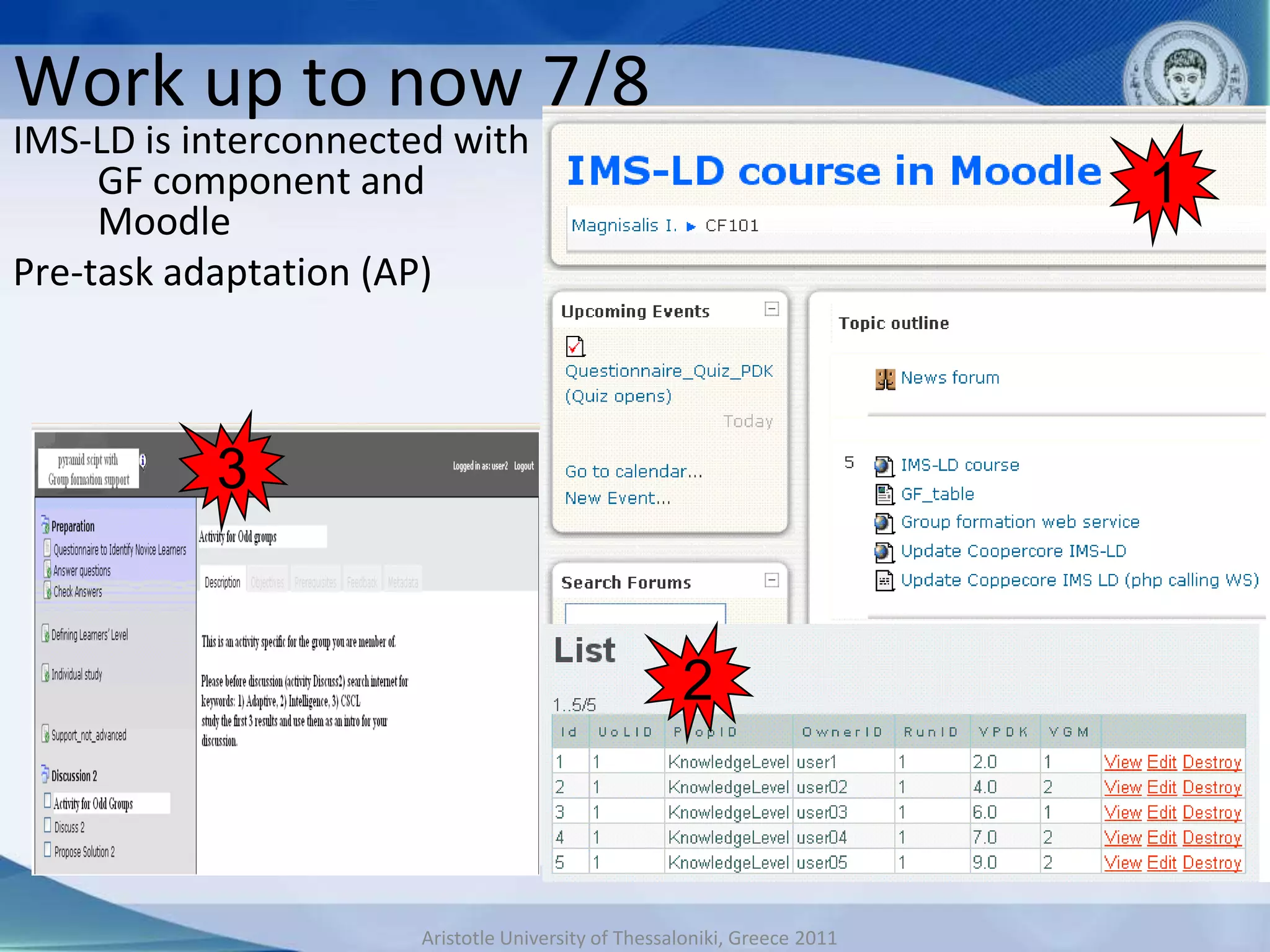
Work up to now 7/8
IMS-LD is interconnected with
     GF component and                                                     1
     Moodle
Pre-task adaptation (AP)


           3


                                                    2


                      Aristotle University of Thessaloniki, Greece 2011
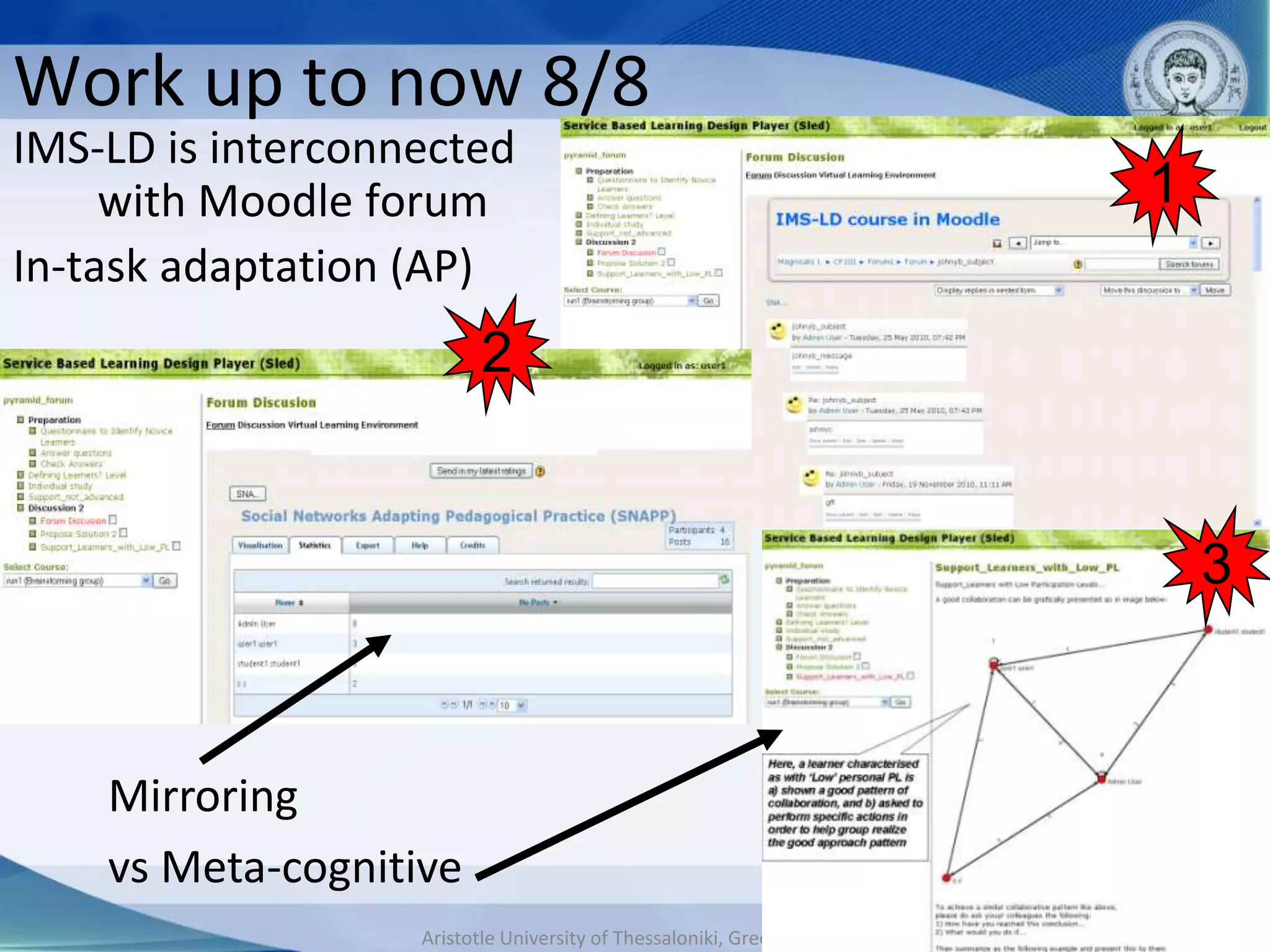
Work up to now 8/8
IMS-LD is interconnected
     with Moodle forum                                                 1
In-task adaptation (AP)
                          2


                                                                           3


    Mirroring
    vs Meta-cognitive
                   Aristotle University of Thessaloniki, Greece 2011
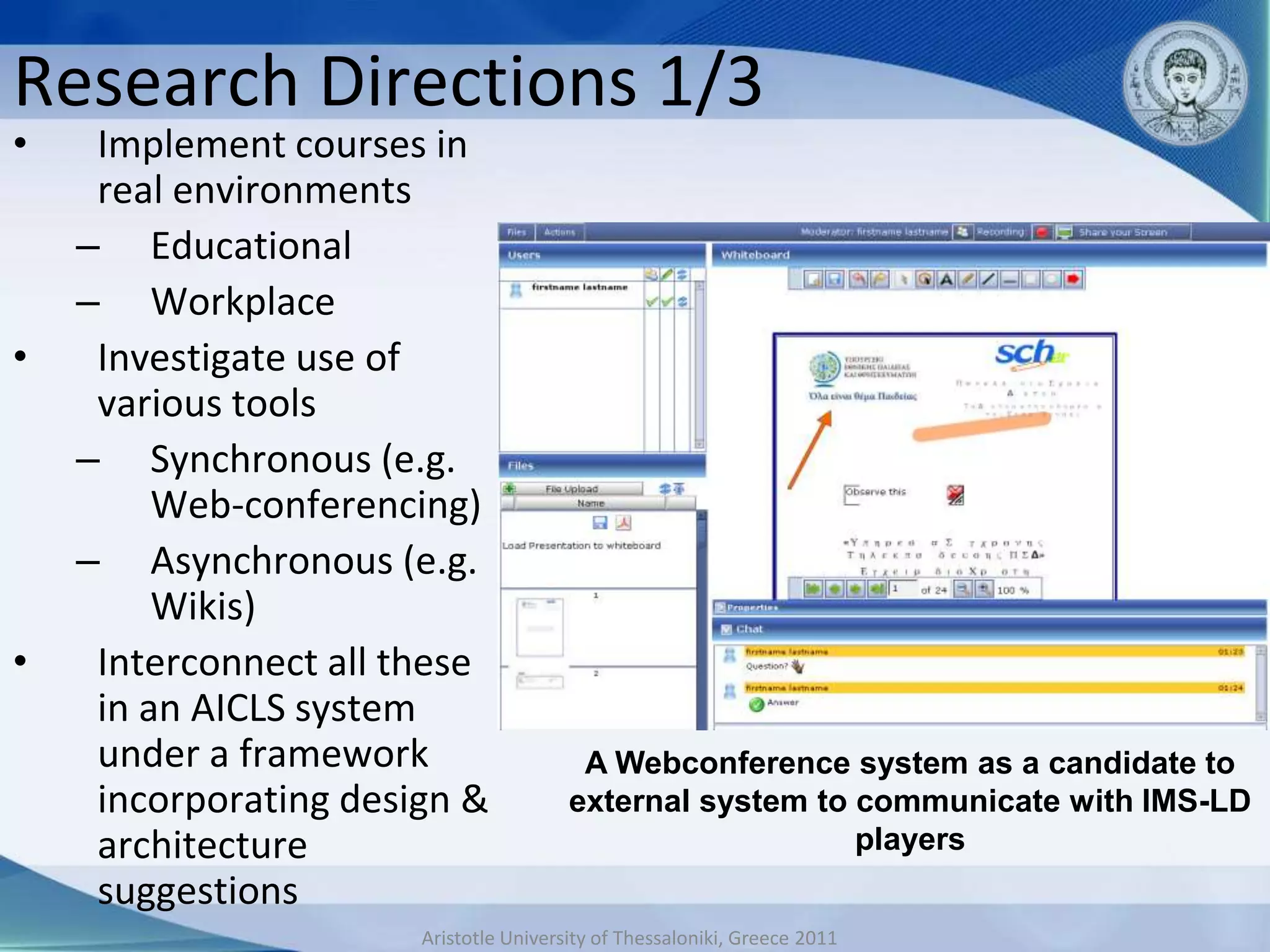
Research Directions 1/3
•    Implement courses in
     real environments
    – Educational
    – Workplace
•    Investigate use of
     various tools
    – Synchronous (e.g.
         Web-conferencing)
    – Asynchronous (e.g.
         Wikis)
•    Interconnect all these
     in an AICLS system
     under a framework                   A Webconference system as a candidate to
     incorporating design &             external system to communicate with IMS-LD
     architecture                                          players
     suggestions
                       Aristotle University of Thessaloniki, Greece 2011
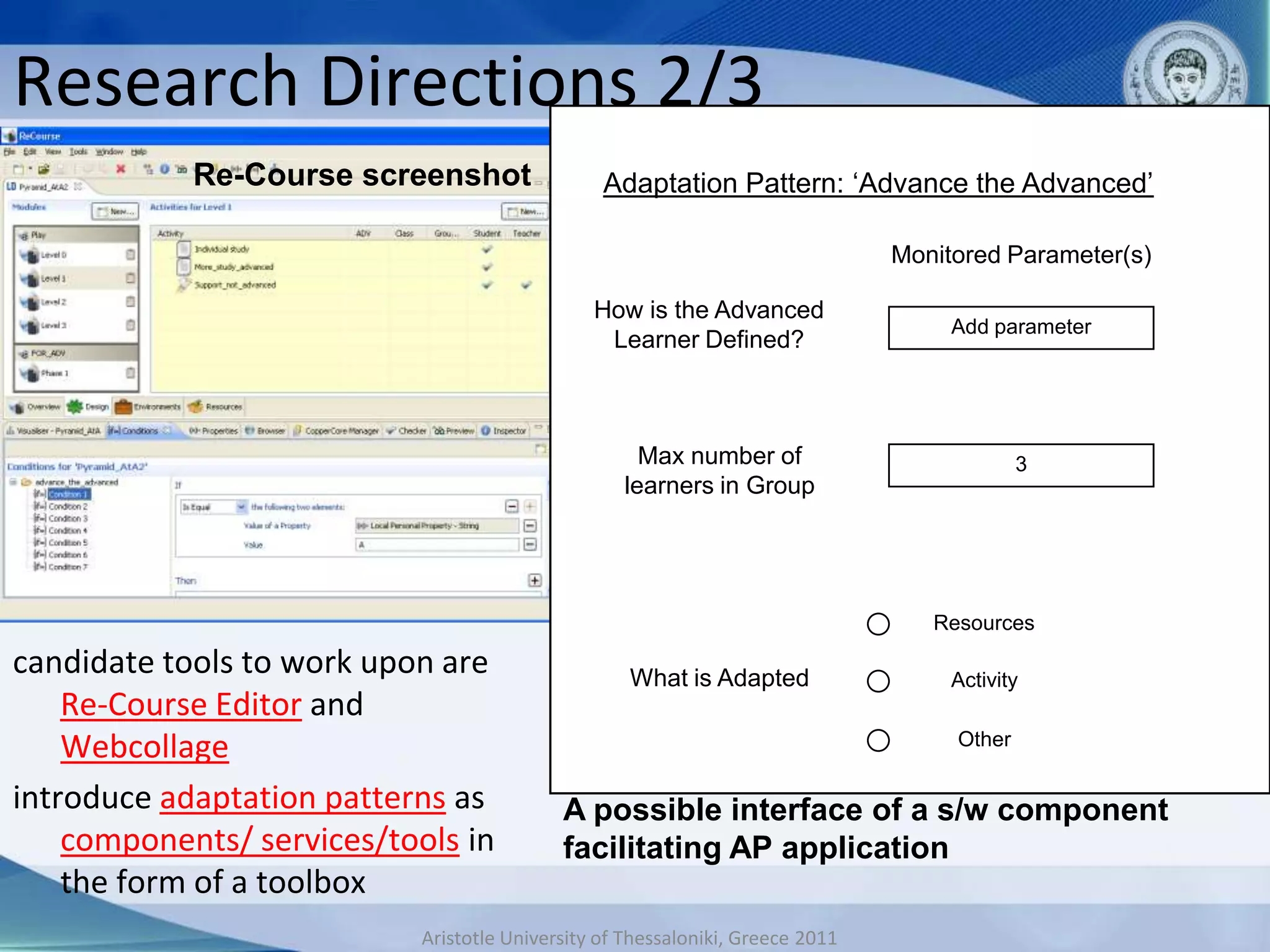
Research Directions 2/3
            Re-Course screenshot                Adaptation Pattern: ‘Advance the Advanced’
                                                    ………………………….
                                                               Monitored Parameter(s)

                                               How is the Advanced
                                                                                Add parameter
                                                Learner Defined?


                                                       SCRIPT PHASE:
                                                    MaxIndividualof
                                                        number Study                     3
                                                  learners in Group


                                                                               Resources

candidate tools to work upon are                    ………………………….
                                                   What is Adapted              Activity
    Re-Course Editor and
    Webcollage                                                                   Other

introduce adaptation patterns as           A possible interface of a s/w component
    components/ services/tools in          facilitating AP application
    the form of a toolbox
                           Aristotle University of Thessaloniki, Greece 2011
Research Directions 3/3
As a next step we are already working in designing a complete course
     in IMS-LD and Moodle providing adaptive support at three
     distinct levels in a pyramid script:
•    Pre-task adaptation: for example a questionnaire in Moodle to
     activate specific learning activities
•    In-task adaptation: providing hints and careful interventions in
     discussion within a Moodle forum according to participation
     levels monitored in Moodle and set into IMS-LD.
•    Post-task adaptation: Assessment of the CSCL process from the
     students can provide ratings for the hints introduced during in-
     task adaptation. The system should not use hints rated as not
     helpful in a next run.
   –   Target is a system that evolves by its use (LEGO system)
   –   Assessment that is adaptive itself
   –   Built of folksonomies instead of Ontologies


                        Aristotle University of Thessaloniki, Greece 2011
Publications
•   S. Demetriadis, I. Magnisalis and A. Karakostas, “Adaptation Patterns in Systems for
    Collaborative Learning and the Role of the Learning Design Specification”, Scripted vs.
    Free CS collaboration: Alternatives and paths for adaptable and flexible CS scripted
    collaboration Workshop in CSCL2009, Rhodes, 2009, pp. 43-47.
•   I. Magnisalis, S. Demetriadis, “Modeling adaptation patterns with IMS-LD specification: a
    case study as a proof of concept implementation", International Conference
    on Intelligent Networking and Collaborative Systems (INCoS 2009), Barcelona, 2009.
•   Ioannis D. Magnisalis, Stavros N. Demetriadis, Andreas S. Pomportsis, “Implementing
    Adaptive Techniques in Systems for Collaborative Learning by extending IMS-LD
    capabilities", International Conference on Intelligent Networking and Collaborative
    Systems (INCoS 2010), Thessaloniki, 2010 (accepted).
•   I. Magnisalis, S. Demetriadis, “Modeling adaptation patterns in the context of
    collaborative learning: case studies of IMS-LD based implementation", Technology-
    Enhanced Systems and Adaptation Methods for Collaborative Learning Support, (under
    revision).
•   Magnisalis, Ioannis; Demetriadis, Stavros; Karakostas, Anastasios; , "Adaptive and
    Intelligent Systems for Collaborative Learning Support: A Review of the Field," Learning
    Technologies, IEEE Transactions on , vol.4, no.1, pp.5-20, Jan. 2011
    doi: 10.1109/TLT.2011.2
•   D. Meimaridou, I. Magnisalis, S. Demetriadis, A. Pomportsis, “Web conferencing to
    support blended learning in the school context: a case study in a Second Chance School ”,
    ICICTE 2011, (under review).


                            Aristotle University of Thessaloniki, Greece 2011
Technological background extensions and interests

 •   Java, Javascript, PHP, MySQL
 •   Web services, BPEL, Semantic Web
 •   Ontologies, Rule-based systems
 •   Annotation, Rating systems
 •   Wikis, Forum, Chat, web-conferencing
     tools


                 Aristotle University of Thessaloniki, Greece 2011
Thank you for your attention!
        Questions?
                                                                          Contact:
                                                            E-mail: imagnisa@csd.auth.gr

              Department of Informatics, AUTH: http://www.csd.auth.gr
                               Multimedia lab: http://mlab.csd.auth.gr/


        Aristotle University of Thessaloniki, Greece 2011
Common
•   SOFCLES project
•   LEADFLOW4LD
•   GSI
•   CLFPs and APs
Scenario
• GF
• IA
• Weights of hinttype
• Adaptive behavior updated every time is run
• Two types of implementation: Client (php/java)
  or BPEL based data of complex scenario e.g. IA &
  GF: role reallocation or IA from various tools in an
  activity (e.g. drawing & forum & chat)
• Linked data org
Terms
• Ubiquitous (Pros – Cons)
• Collective Intelligence (Educational aspect) –
  (folksonomy vs ontology, modest computing)
• Pedagogy
• Adaptation - Meta-adaptation
• Orchestration (choreography) – Design vs Run-
  time
            http://www.kinecteducation.com/
• Kinect http://projects.ict.usc.edu/mxr/faast/
           http://www.rit.edu/innovationcenter/kinectatrit/ag
           gregator/categories/1
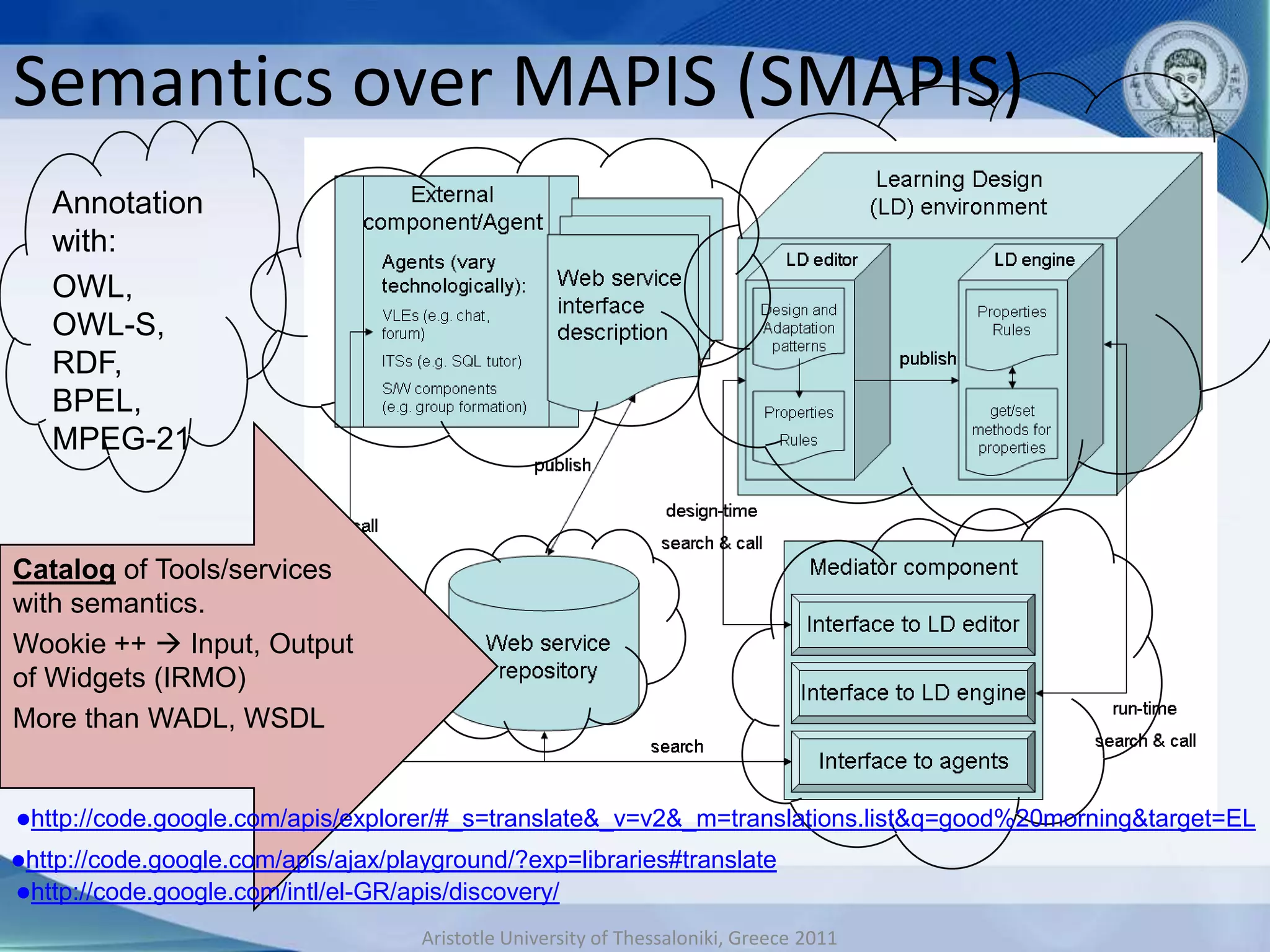
Semantics over MAPIS (SMAPIS)
   Annotation
   with:
   OWL,
   OWL-S,
   RDF,
   BPEL,
   MPEG-21


Catalog of Tools/services
with semantics.
Wookie ++  Input, Output
of Widgets (IRMO)
More than WADL, WSDL


http://code.google.com/apis/explorer/#_s=translate&_v=v2&_m=translations.list&q=good%20morning&target=EL

http://code.google.com/apis/ajax/playground/?exp=libraries#translate
http://code.google.com/intl/el-GR/apis/discovery/

                                     Aristotle University of Thessaloniki, Greece 2011
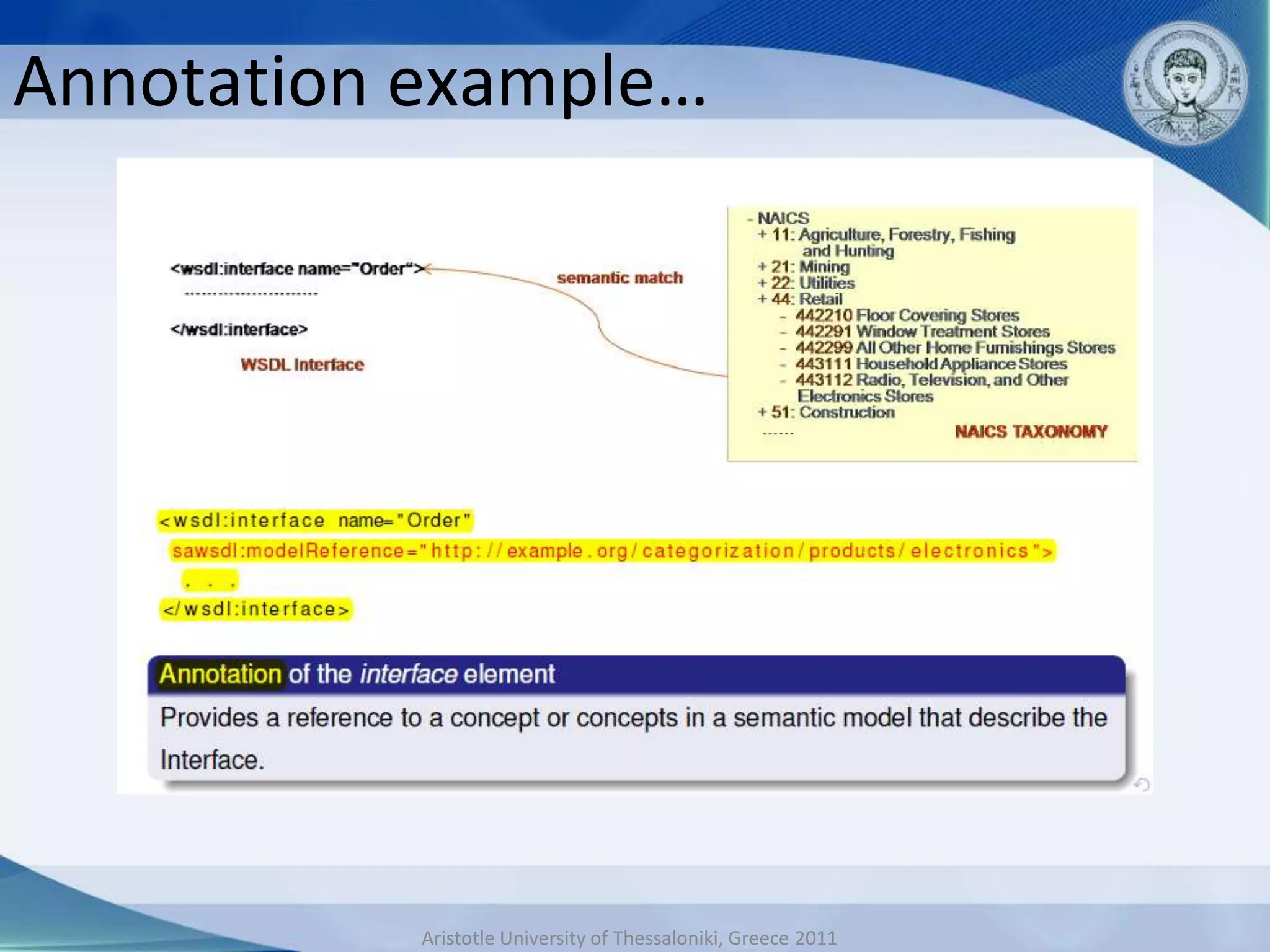
Annotation example…


           Aristotle University of Thessaloniki, Greece 2011
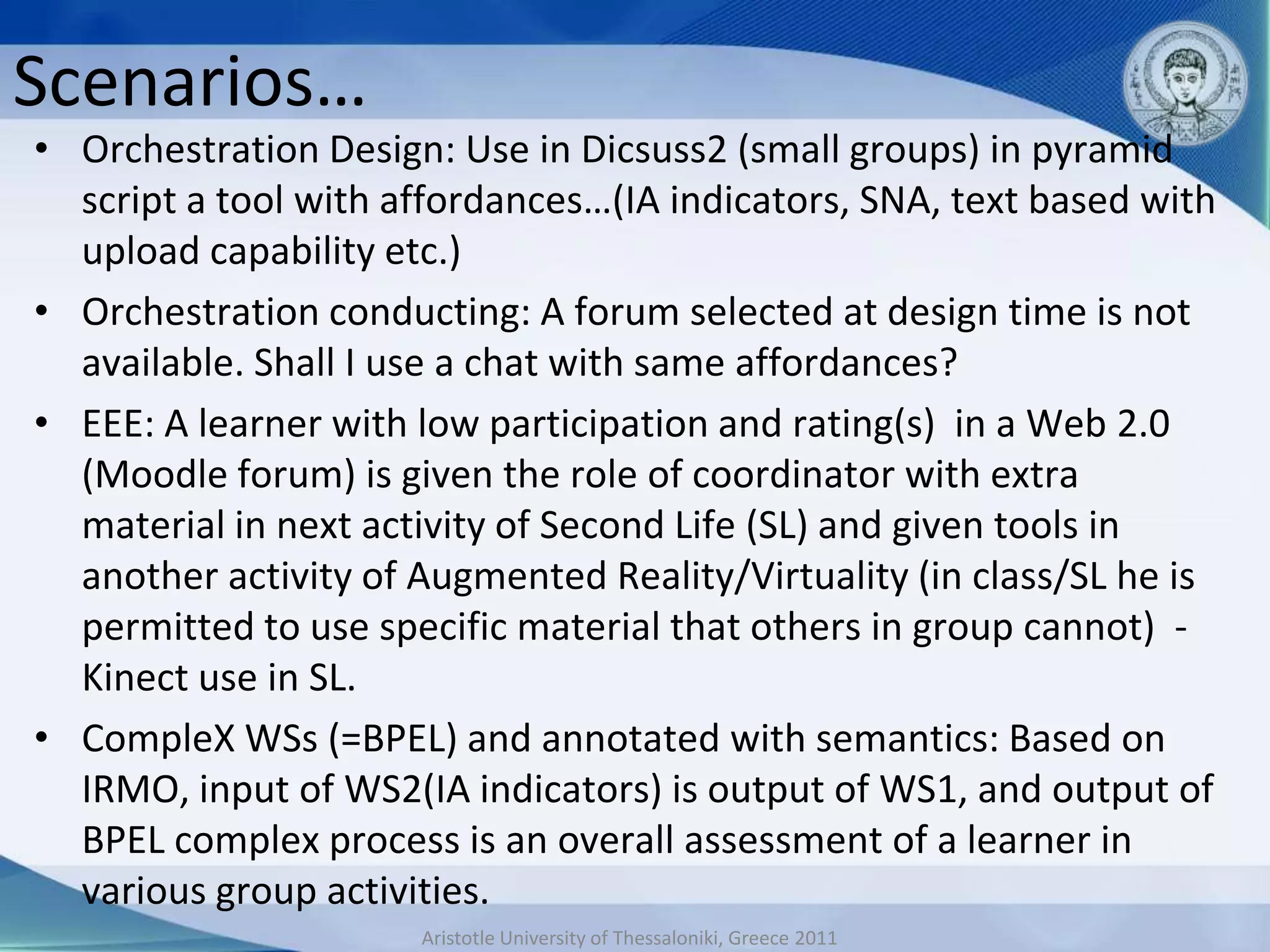
Scenarios…
• Orchestration Design: Use in Dicsuss2 (small groups) in pyramid
  script a tool with affordances…(IA indicators, SNA, text based with
  upload capability etc.)
• Orchestration conducting: A forum selected at design time is not
  available. Shall I use a chat with same affordances?
• EEE: A learner with low participation and rating(s) in a Web 2.0
  (Moodle forum) is given the role of coordinator with extra
  material in next activity of Second Life (SL) and given tools in
  another activity of Augmented Reality/Virtuality (in class/SL he is
  permitted to use specific material that others in group cannot) -
  Kinect use in SL.
• CompleX WSs (=BPEL) and annotated with semantics: Based on
  IRMO, input of WS2(IA indicators) is output of WS1, and output of
  BPEL complex process is an overall assessment of a learner in
  various group activities.
                      Aristotle University of Thessaloniki, Greece 2011
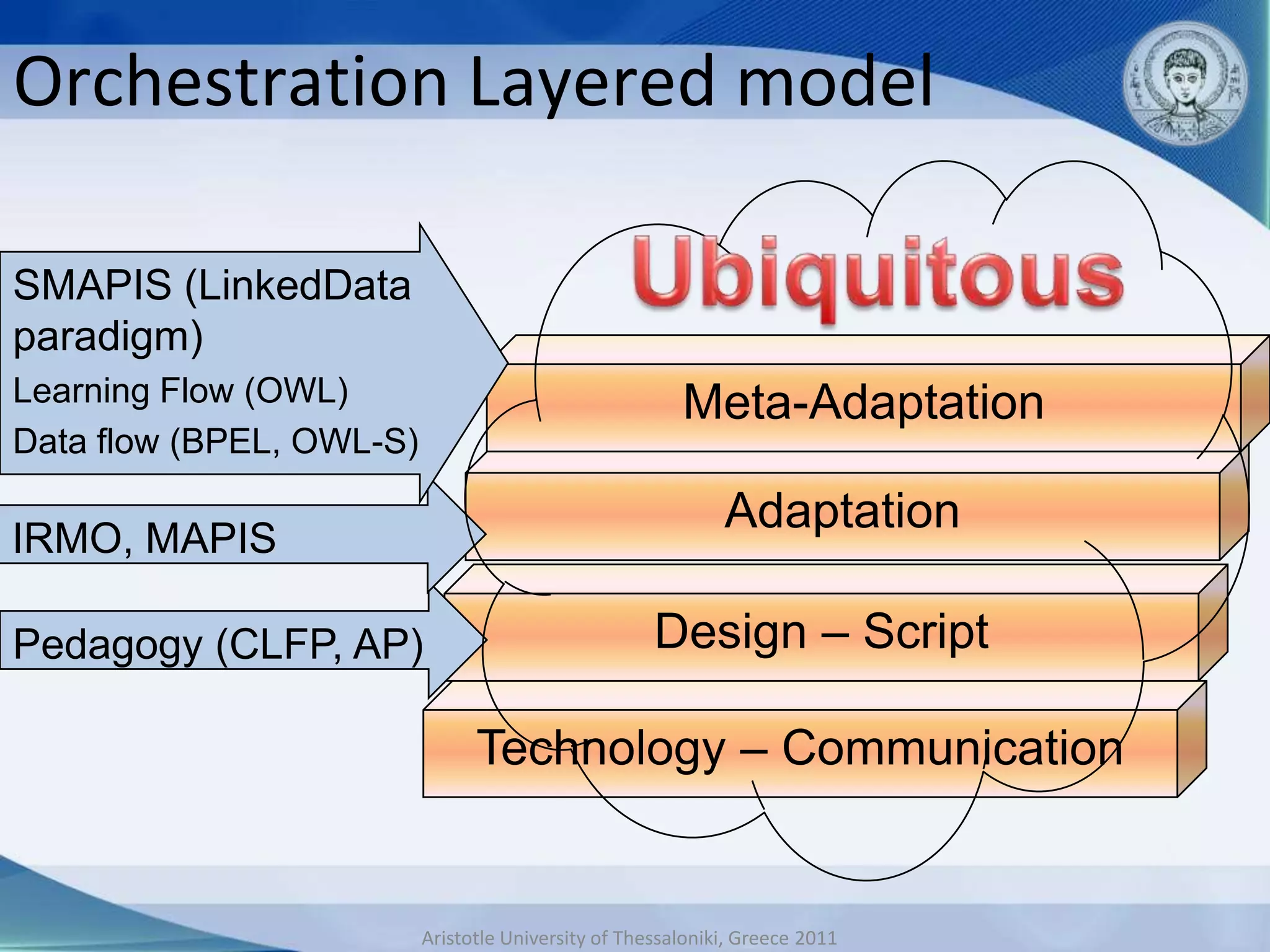
Orchestration Layered model

SMAPIS (LinkedData
paradigm)
Learning Flow (OWL)                                     Meta-Adaptation
Data flow (BPEL, OWL-S)

                                                             Adaptation
IRMO, MAPIS

Pedagogy (CLFP, AP)                                  Design – Script

                                Technology – Communication


                          Aristotle University of Thessaloniki, Greece 2011
Challenges of Ubiquitous…
•   1. The “Accidentally” Smart Environment
•   2. Impromptu (i.e. NO) Interoperability
•   3. No Systems Administrator
•   4. Social Implications of Aware Technologies
•   5. Reliability

    – Example: No 3G/wifi connectivity – No problem, use
      your phone to take a photo, use Lights to attract
      attention

                   Aristotle University of Thessaloniki, Greece 2011
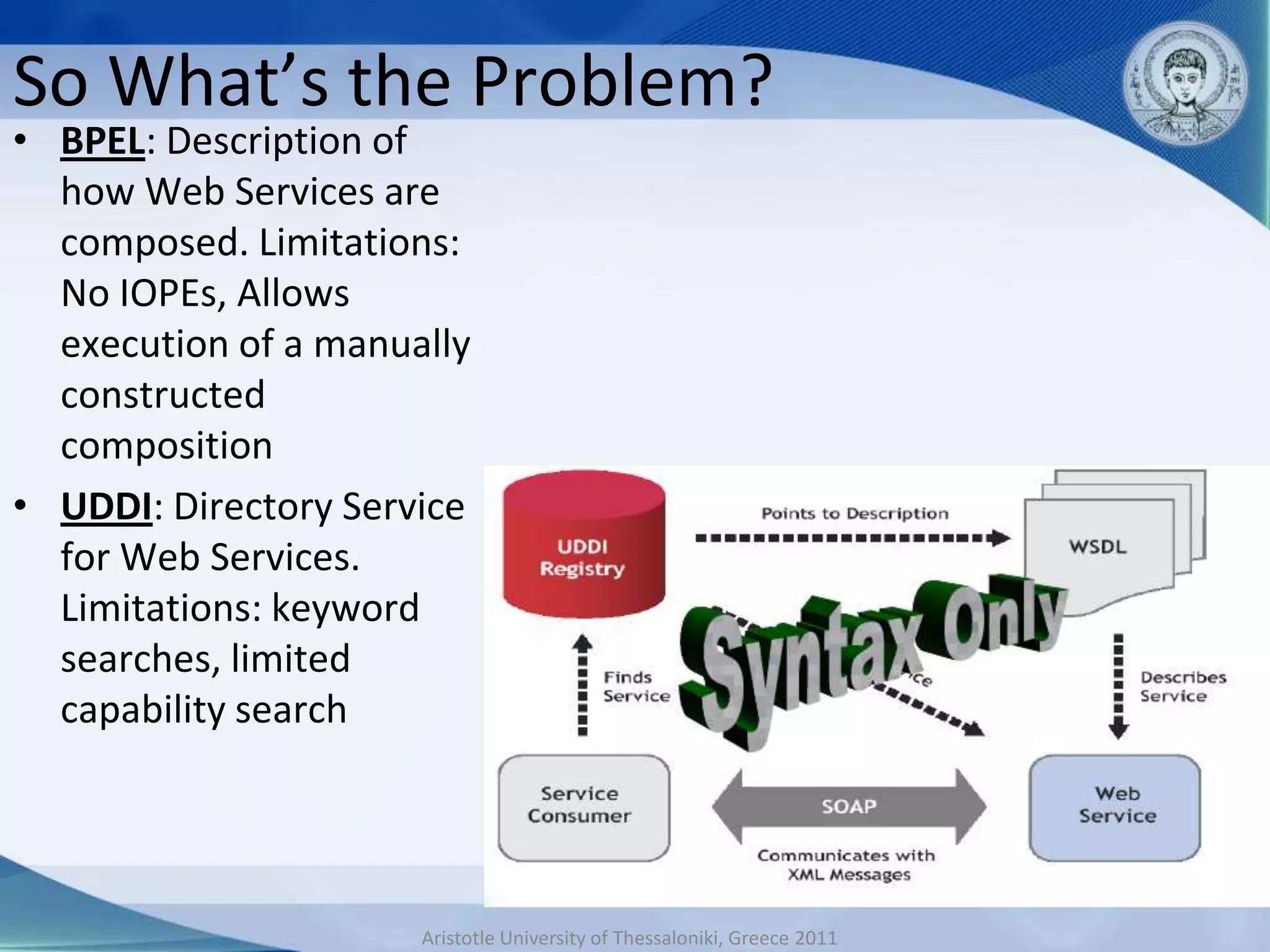
So What’s the Problem?
• BPEL: Description of
  how Web Services are
  composed. Limitations:
  No IOPEs, Allows
  execution of a manually
  constructed
  composition
• UDDI: Directory Service
  for Web Services.
  Limitations: keyword
  searches, limited
  capability search


                      Aristotle University of Thessaloniki, Greece 2011
Process Model in OWL-S
• Process
   – Potentially interpretable description of service provider’s
     behavior
   – Specifies service interaction protocol
       • Tells service user how and when to interact (read/write messages)
   – Specifies abstract messages: ontological type of information
      transmitted
• Used for: Service invocation, planning/composition,
  interoperation, monitoring
• All processes have: Inputs, outputs, preconditions and effects
• Composite processes deal with:
   – Control flow
   – Data flow

                        Aristotle University of Thessaloniki, Greece 2011
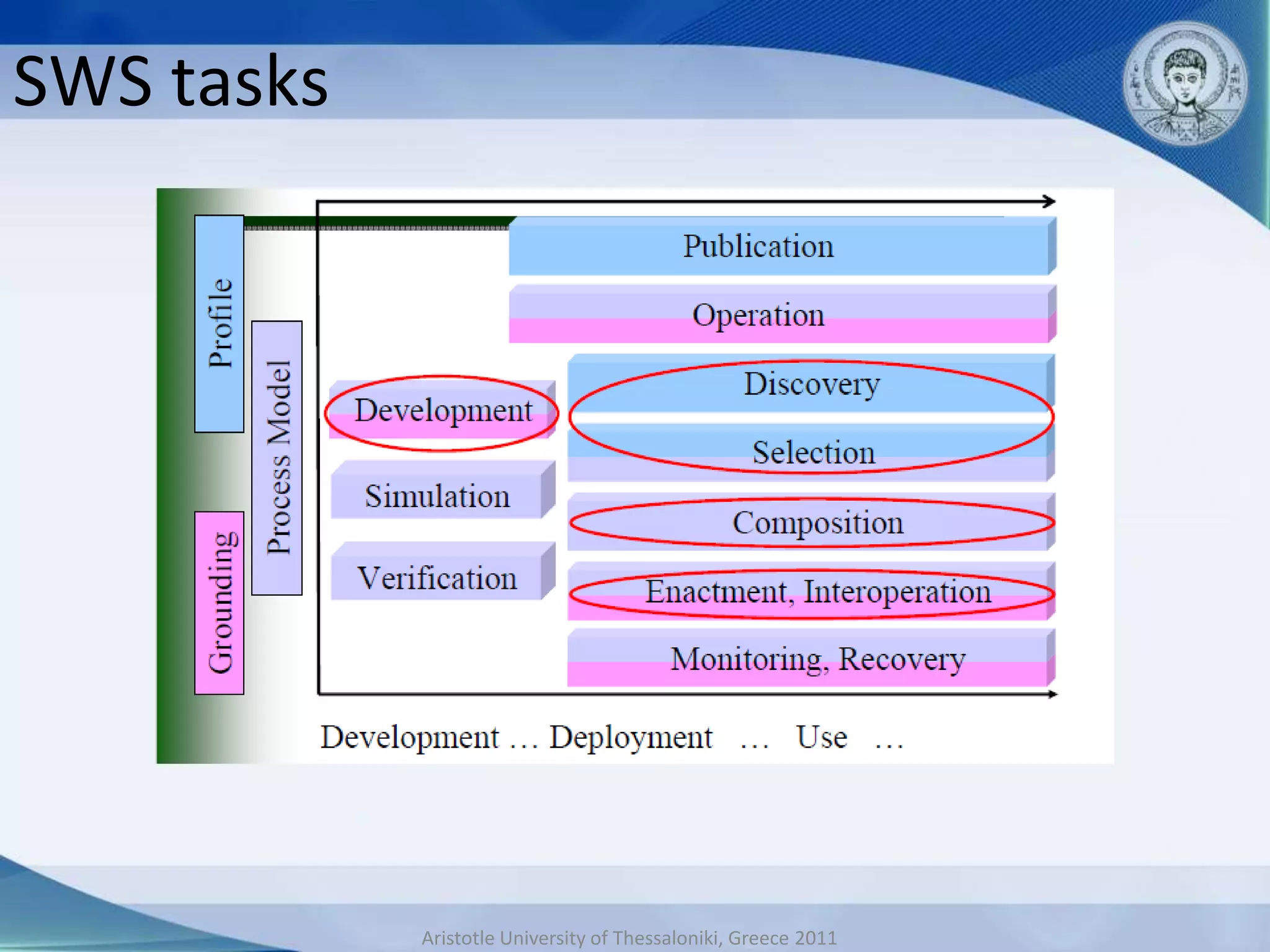
SWS tasks


            Aristotle University of Thessaloniki, Greece 2011
Tackling Semantic Interoperability…
Lack of Semantic Interoperability is a major hurdle for
• Discovery: Different terms used for advertisements and requests
• Invocation: Different specs for messages and WS interface
• Understanding: Interpreting the results returned by the Web
   service
• Composing Services: Reconciling LD goals with goals of the WS
• Negotiating contracts & communications: Different terminology
   and protocols used


                     Aristotle University of Thessaloniki, Greece 2011

Valldolid Magnisalis Ioannis

  • 1.
    Adaptive and IntelligentCollaborative Learning Support systems (AICLS) Magnisalis Ioannis Aristotle University of Thessaloniki, Greece 2011
  • 2.
    Presentation flow – Background & Work up to now – Research Directions & Future Roadmap – Publications Aristotle University of Thessaloniki, Greece 2011
  • 3.
    Background • Adaptive systems •Intelligent systems • CSCL – Theory (Pedagogic perspective) • Classification scheme – Focus on Target of Intervention • Group formation (Pre-task) • Knowledge domain support (In-task) • Peer Interaction (In-task) • Assessment (Post-Task) - FUTURE Aristotle University of Thessaloniki, Greece 2011
  • 4.
    Work up tonow 1/8 • Standards and widespread technologies – IMS-LD, QTI, Moodle, LAMS, Webconference tools,BPEL, Semantic Web & Ontologies … • Adaptation patterns modeling (IRMO design specification) • Architecture for AICLS systems (MAPIS) • Case studies – Pre-task (group formation) – In-task (Moodle forum): Mirroring & Meta- cognitive level Aristotle University of Thessaloniki, Greece 2011
  • 5.
    Work up tonow 2/8 Adaptation Pattern Design Specification (IRMO) db or manifest MODELLED ENTITIES Interaction On Screen Analysis Representation INPUT RULES OUTPUT ADAPTAT I O N PAT T E R N • During design: – Define monitored parameters (e.g. from interaction analysis tools) – Rules (the adaptation model of the pattern) are hard-wired to the pattern – Define Output (form, content, etc.) Aristotle University of Thessaloniki, Greece 2011
  • 6.
    Work up tonow 3/8 During design… • Linking APs to Script Design Activity Flow Script Representation …………………………. AP: ‘Advance the SCRIPT PHASE: Advanced’ Individual Study …………………………. 6 / 37 Aristotle University of Thessaloniki, Greece 2011
  • 7.
    Work up tonow 4/8 Running AP Advanced Study: The learner is Output of the Adaptation Pattern: The activity of prompted to study the “Advanced_Study” is presented to an advanced learner. In advanced material and answer contrast his partner – novice learner – is guided to normal some relevant questions. study (not shown in this screen capture) SLED screenshot of the adapted user interface for the advanced learner according to the implemented adaptation pattern 7 / 37 Aristotle University of Thessaloniki, Greece 2011
  • 8.
    Work up tonow 5/8 MAPIS Architecture (i.e. Mediating Adaptation Patterns & Intelligent Services) Problem: adaptive LDs with external tools & use IMS- LD and EA with as little as possible intervention Solution: SOA architecture with Web services as main constituent Requirements: a) Interoperability, b) extensibility Aristotle University of Thessaloniki, Greece 2011
  • 9.
    Work up tonow 6/8 Proof of concept: ‘Group Heterogeneity’ adaptation as an example case study/scenario According to the IRMO specification this adaptation is described as follows: • Input: the outcome of a prior knowledge questionnaire which is used as a measure of learners’ expertise, • Model: Prior domain knowledge of each learner & Mean of Prior domain knowledge of all participants & number of groups & number of participants, • Rule: IF Group work is needed THEN provide new groups of mild heterogeneity (complex rule which entails calculations of a) number of groups, b) best distribution within them), • Output: Form New Groups mildly heterogeneous according to prior domain knowledge. Aristotle University of Thessaloniki, Greece 2011
  • 10.
    Work up tonow 7/8 IMS-LD is interconnected with GF component and 1 Moodle Pre-task adaptation (AP) 3 2 Aristotle University of Thessaloniki, Greece 2011
  • 11.
    Work up tonow 8/8 IMS-LD is interconnected with Moodle forum 1 In-task adaptation (AP) 2 3 Mirroring vs Meta-cognitive Aristotle University of Thessaloniki, Greece 2011
  • 12.
    Research Directions 1/3 • Implement courses in real environments – Educational – Workplace • Investigate use of various tools – Synchronous (e.g. Web-conferencing) – Asynchronous (e.g. Wikis) • Interconnect all these in an AICLS system under a framework A Webconference system as a candidate to incorporating design & external system to communicate with IMS-LD architecture players suggestions Aristotle University of Thessaloniki, Greece 2011
  • 13.
    Research Directions 2/3 Re-Course screenshot Adaptation Pattern: ‘Advance the Advanced’ …………………………. Monitored Parameter(s) How is the Advanced Add parameter Learner Defined? SCRIPT PHASE: MaxIndividualof number Study 3 learners in Group Resources candidate tools to work upon are …………………………. What is Adapted Activity Re-Course Editor and Webcollage Other introduce adaptation patterns as A possible interface of a s/w component components/ services/tools in facilitating AP application the form of a toolbox Aristotle University of Thessaloniki, Greece 2011
  • 14.
    Research Directions 3/3 Asa next step we are already working in designing a complete course in IMS-LD and Moodle providing adaptive support at three distinct levels in a pyramid script: • Pre-task adaptation: for example a questionnaire in Moodle to activate specific learning activities • In-task adaptation: providing hints and careful interventions in discussion within a Moodle forum according to participation levels monitored in Moodle and set into IMS-LD. • Post-task adaptation: Assessment of the CSCL process from the students can provide ratings for the hints introduced during in- task adaptation. The system should not use hints rated as not helpful in a next run. – Target is a system that evolves by its use (LEGO system) – Assessment that is adaptive itself – Built of folksonomies instead of Ontologies Aristotle University of Thessaloniki, Greece 2011
  • 15.
    Publications • S. Demetriadis, I. Magnisalis and A. Karakostas, “Adaptation Patterns in Systems for Collaborative Learning and the Role of the Learning Design Specification”, Scripted vs. Free CS collaboration: Alternatives and paths for adaptable and flexible CS scripted collaboration Workshop in CSCL2009, Rhodes, 2009, pp. 43-47. • I. Magnisalis, S. Demetriadis, “Modeling adaptation patterns with IMS-LD specification: a case study as a proof of concept implementation", International Conference on Intelligent Networking and Collaborative Systems (INCoS 2009), Barcelona, 2009. • Ioannis D. Magnisalis, Stavros N. Demetriadis, Andreas S. Pomportsis, “Implementing Adaptive Techniques in Systems for Collaborative Learning by extending IMS-LD capabilities", International Conference on Intelligent Networking and Collaborative Systems (INCoS 2010), Thessaloniki, 2010 (accepted). • I. Magnisalis, S. Demetriadis, “Modeling adaptation patterns in the context of collaborative learning: case studies of IMS-LD based implementation", Technology- Enhanced Systems and Adaptation Methods for Collaborative Learning Support, (under revision). • Magnisalis, Ioannis; Demetriadis, Stavros; Karakostas, Anastasios; , "Adaptive and Intelligent Systems for Collaborative Learning Support: A Review of the Field," Learning Technologies, IEEE Transactions on , vol.4, no.1, pp.5-20, Jan. 2011 doi: 10.1109/TLT.2011.2 • D. Meimaridou, I. Magnisalis, S. Demetriadis, A. Pomportsis, “Web conferencing to support blended learning in the school context: a case study in a Second Chance School ”, ICICTE 2011, (under review). Aristotle University of Thessaloniki, Greece 2011
  • 16.
    Technological background extensionsand interests • Java, Javascript, PHP, MySQL • Web services, BPEL, Semantic Web • Ontologies, Rule-based systems • Annotation, Rating systems • Wikis, Forum, Chat, web-conferencing tools Aristotle University of Thessaloniki, Greece 2011
  • 17.
    Thank you foryour attention! Questions? Contact: E-mail: imagnisa@csd.auth.gr Department of Informatics, AUTH: http://www.csd.auth.gr Multimedia lab: http://mlab.csd.auth.gr/ Aristotle University of Thessaloniki, Greece 2011
  • 18.
    Common • SOFCLES project • LEADFLOW4LD • GSI • CLFPs and APs
  • 19.
    Scenario • GF • IA •Weights of hinttype • Adaptive behavior updated every time is run • Two types of implementation: Client (php/java) or BPEL based data of complex scenario e.g. IA & GF: role reallocation or IA from various tools in an activity (e.g. drawing & forum & chat) • Linked data org
  • 20.
    Terms • Ubiquitous (Pros– Cons) • Collective Intelligence (Educational aspect) – (folksonomy vs ontology, modest computing) • Pedagogy • Adaptation - Meta-adaptation • Orchestration (choreography) – Design vs Run- time http://www.kinecteducation.com/ • Kinect http://projects.ict.usc.edu/mxr/faast/ http://www.rit.edu/innovationcenter/kinectatrit/ag gregator/categories/1
  • 21.
    Semantics over MAPIS(SMAPIS) Annotation with: OWL, OWL-S, RDF, BPEL, MPEG-21 Catalog of Tools/services with semantics. Wookie ++  Input, Output of Widgets (IRMO) More than WADL, WSDL http://code.google.com/apis/explorer/#_s=translate&_v=v2&_m=translations.list&q=good%20morning&target=EL http://code.google.com/apis/ajax/playground/?exp=libraries#translate http://code.google.com/intl/el-GR/apis/discovery/ Aristotle University of Thessaloniki, Greece 2011
  • 22.
    Annotation example… Aristotle University of Thessaloniki, Greece 2011
  • 23.
    Scenarios… • Orchestration Design:Use in Dicsuss2 (small groups) in pyramid script a tool with affordances…(IA indicators, SNA, text based with upload capability etc.) • Orchestration conducting: A forum selected at design time is not available. Shall I use a chat with same affordances? • EEE: A learner with low participation and rating(s) in a Web 2.0 (Moodle forum) is given the role of coordinator with extra material in next activity of Second Life (SL) and given tools in another activity of Augmented Reality/Virtuality (in class/SL he is permitted to use specific material that others in group cannot) - Kinect use in SL. • CompleX WSs (=BPEL) and annotated with semantics: Based on IRMO, input of WS2(IA indicators) is output of WS1, and output of BPEL complex process is an overall assessment of a learner in various group activities. Aristotle University of Thessaloniki, Greece 2011
  • 24.
    Orchestration Layered model SMAPIS(LinkedData paradigm) Learning Flow (OWL) Meta-Adaptation Data flow (BPEL, OWL-S) Adaptation IRMO, MAPIS Pedagogy (CLFP, AP) Design – Script Technology – Communication Aristotle University of Thessaloniki, Greece 2011
  • 25.
    Challenges of Ubiquitous… • 1. The “Accidentally” Smart Environment • 2. Impromptu (i.e. NO) Interoperability • 3. No Systems Administrator • 4. Social Implications of Aware Technologies • 5. Reliability – Example: No 3G/wifi connectivity – No problem, use your phone to take a photo, use Lights to attract attention Aristotle University of Thessaloniki, Greece 2011
  • 26.
    So What’s theProblem? • BPEL: Description of how Web Services are composed. Limitations: No IOPEs, Allows execution of a manually constructed composition • UDDI: Directory Service for Web Services. Limitations: keyword searches, limited capability search Aristotle University of Thessaloniki, Greece 2011
  • 27.
    Process Model inOWL-S • Process – Potentially interpretable description of service provider’s behavior – Specifies service interaction protocol • Tells service user how and when to interact (read/write messages) – Specifies abstract messages: ontological type of information transmitted • Used for: Service invocation, planning/composition, interoperation, monitoring • All processes have: Inputs, outputs, preconditions and effects • Composite processes deal with: – Control flow – Data flow Aristotle University of Thessaloniki, Greece 2011
  • 28.
    SWS tasks Aristotle University of Thessaloniki, Greece 2011
  • 29.
    Tackling Semantic Interoperability… Lackof Semantic Interoperability is a major hurdle for • Discovery: Different terms used for advertisements and requests • Invocation: Different specs for messages and WS interface • Understanding: Interpreting the results returned by the Web service • Composing Services: Reconciling LD goals with goals of the WS • Negotiating contracts & communications: Different terminology and protocols used Aristotle University of Thessaloniki, Greece 2011