



Keyword Research  and Selection The Definitive Guide to Gathering, Sorting and Organizing Your Keywords into a High-Performance SEO Campaign
From this To this
Introduction   Why is it so darn important? Helps you know  where  your audience is How do they search? What words do they use? What’s their intent? Helps you know  who  your audience is Right keyword, wrong audience Right audience, different keyword searches Helps you target your audience properly SEARCH
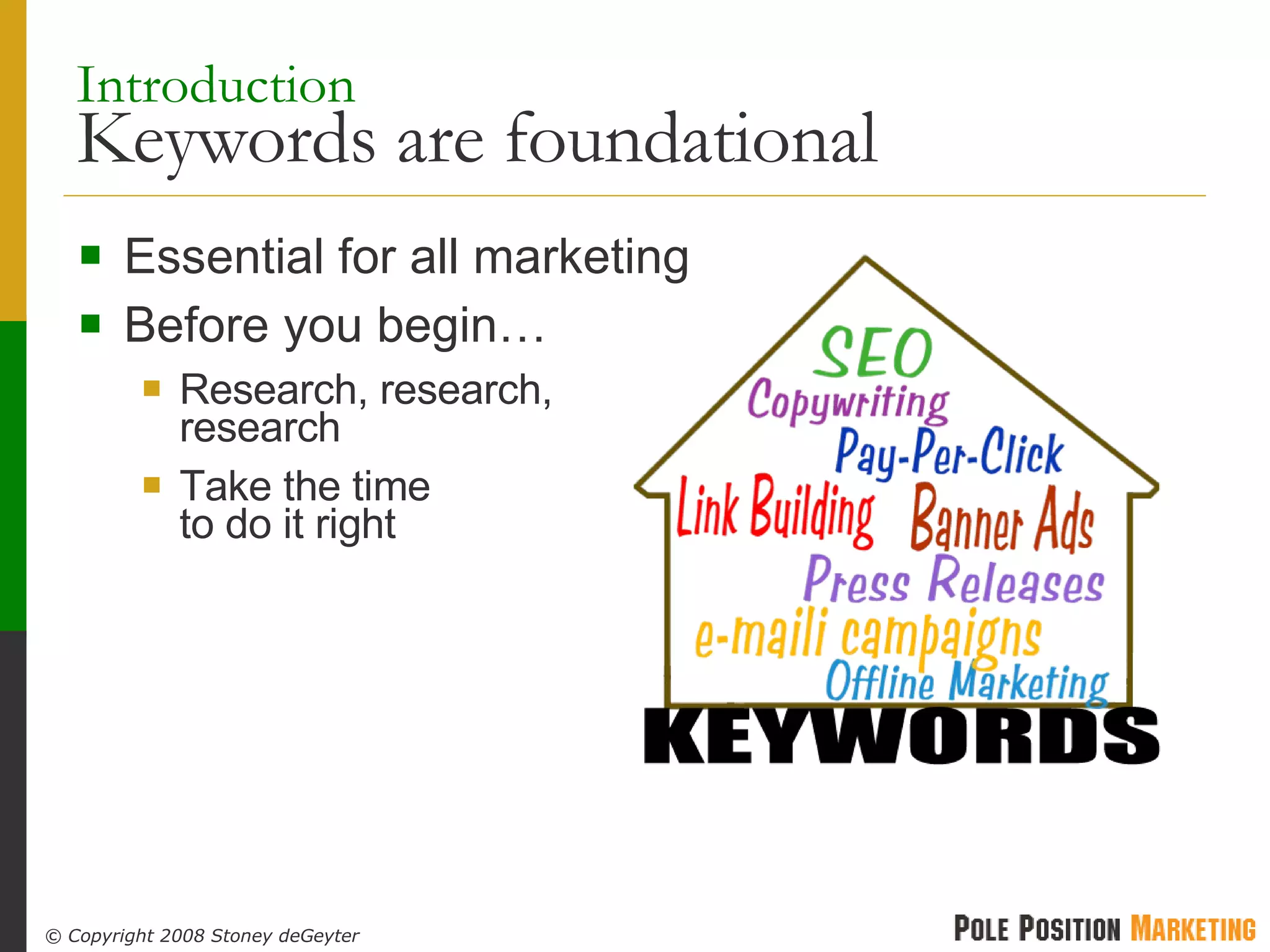
Introduction   Keywords are foundational Essential for all marketing  Before you begin… Research, research, research Take the time to do it right
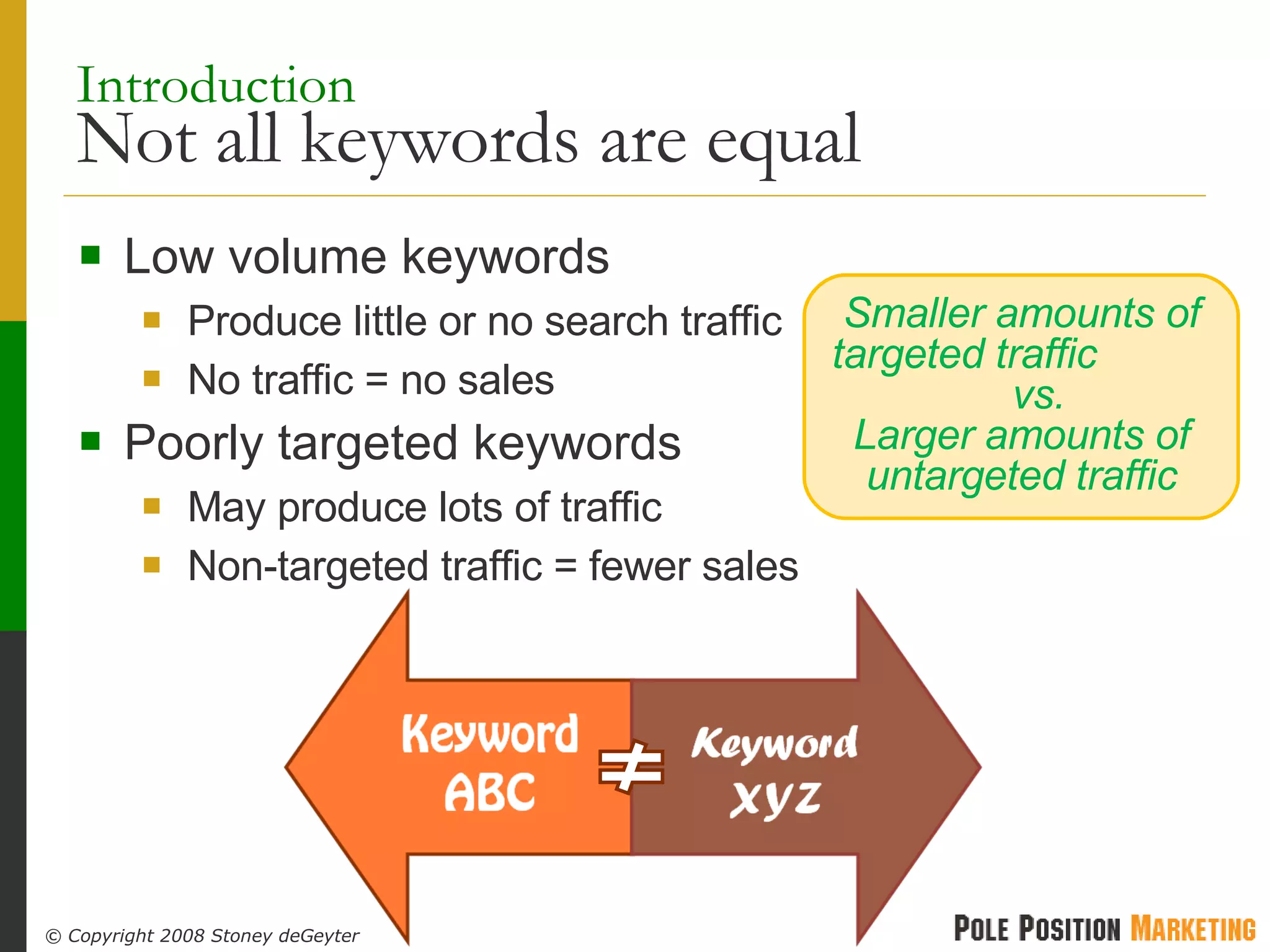
Introduction   Not all keywords are equal Low volume keywords Produce little or no search traffic No traffic = no sales Poorly targeted keywords May produce lots of traffic Non-targeted traffic = fewer sales Smaller amounts of targeted traffic  vs. Larger amounts of untargeted traffic
Introduction   It ain’t easy doing it right Quality keyword research is: Sometimes difficult Usually time-consuming Always important Stay focused Research thoroughly Analyze carefully Target thoughtfully
Phase I Finding Core Terms
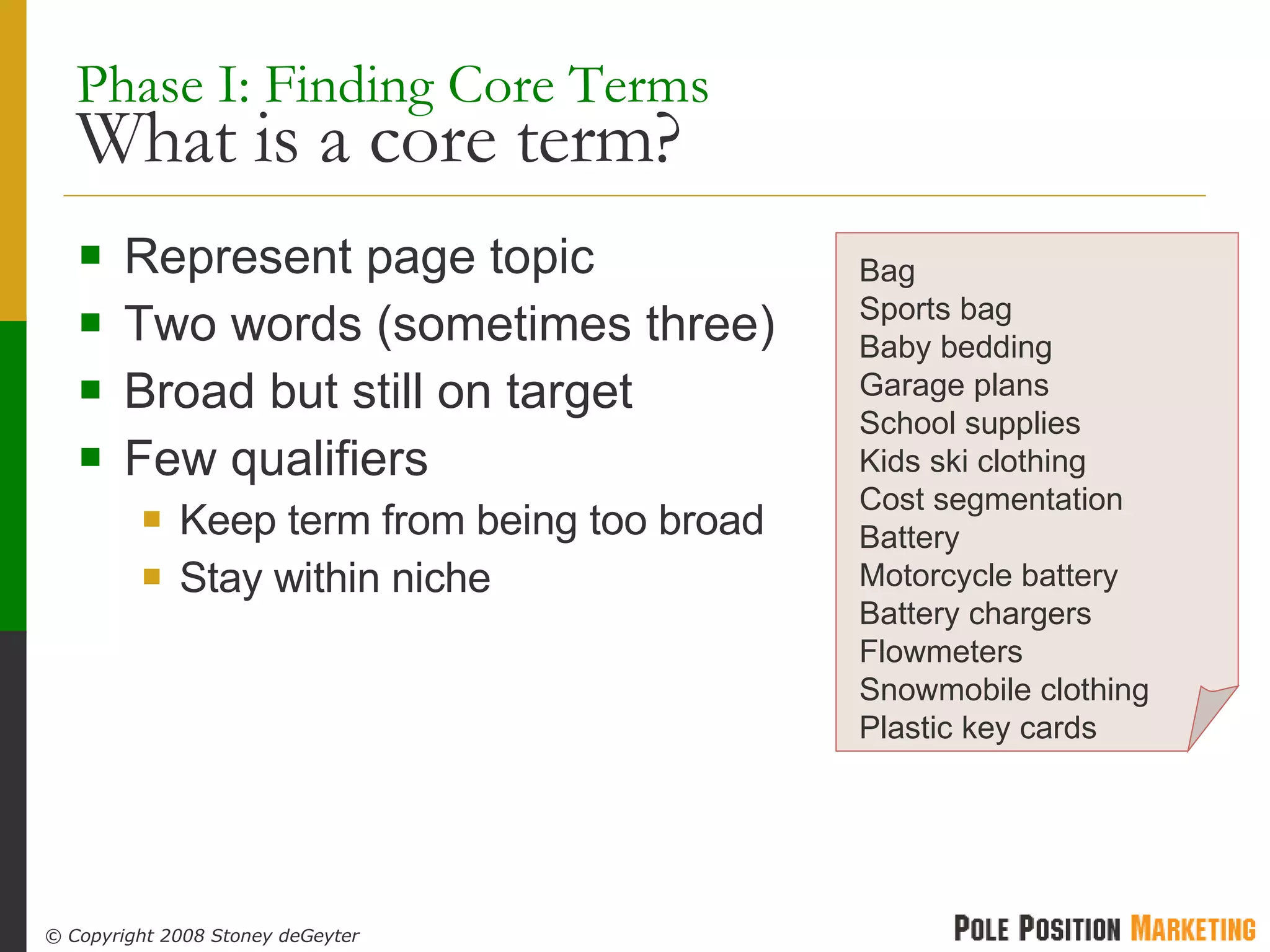
Phase I: Finding Core Terms What is a core term? Represent page topic Two words (sometimes three) Broad but still on target Few qualifiers Keep term from being too broad Stay within niche Bag Sports bag Baby bedding Garage plans School supplies Kids ski clothing Cost segmentation Battery Motorcycle battery Battery chargers Flowmeters Snowmobile clothing Plastic key cards
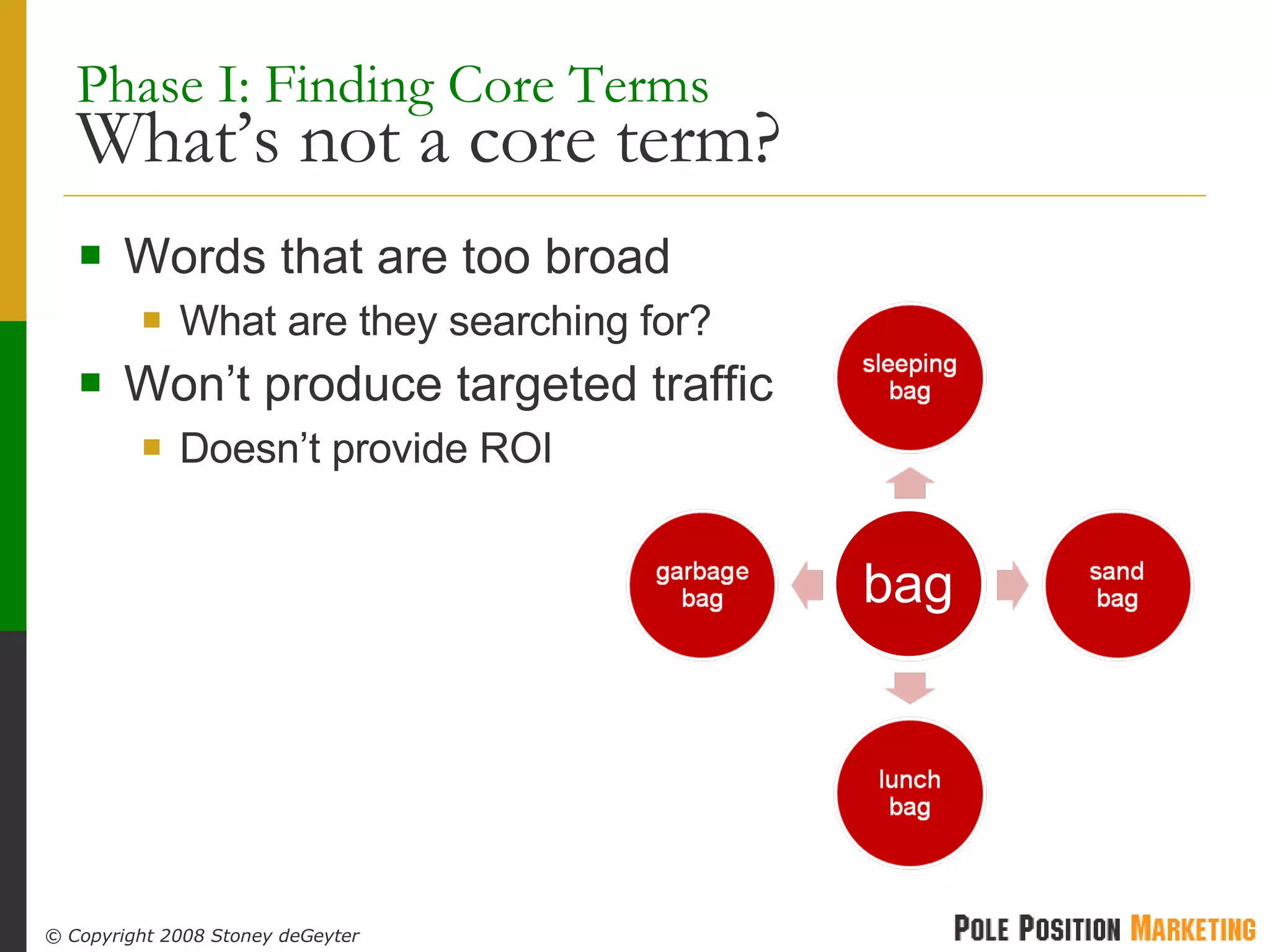
Words that are too broad What are they searching for? Won’t produce targeted traffic Doesn’t provide ROI Phase I: Finding Core Terms  What’s not a core term? bag
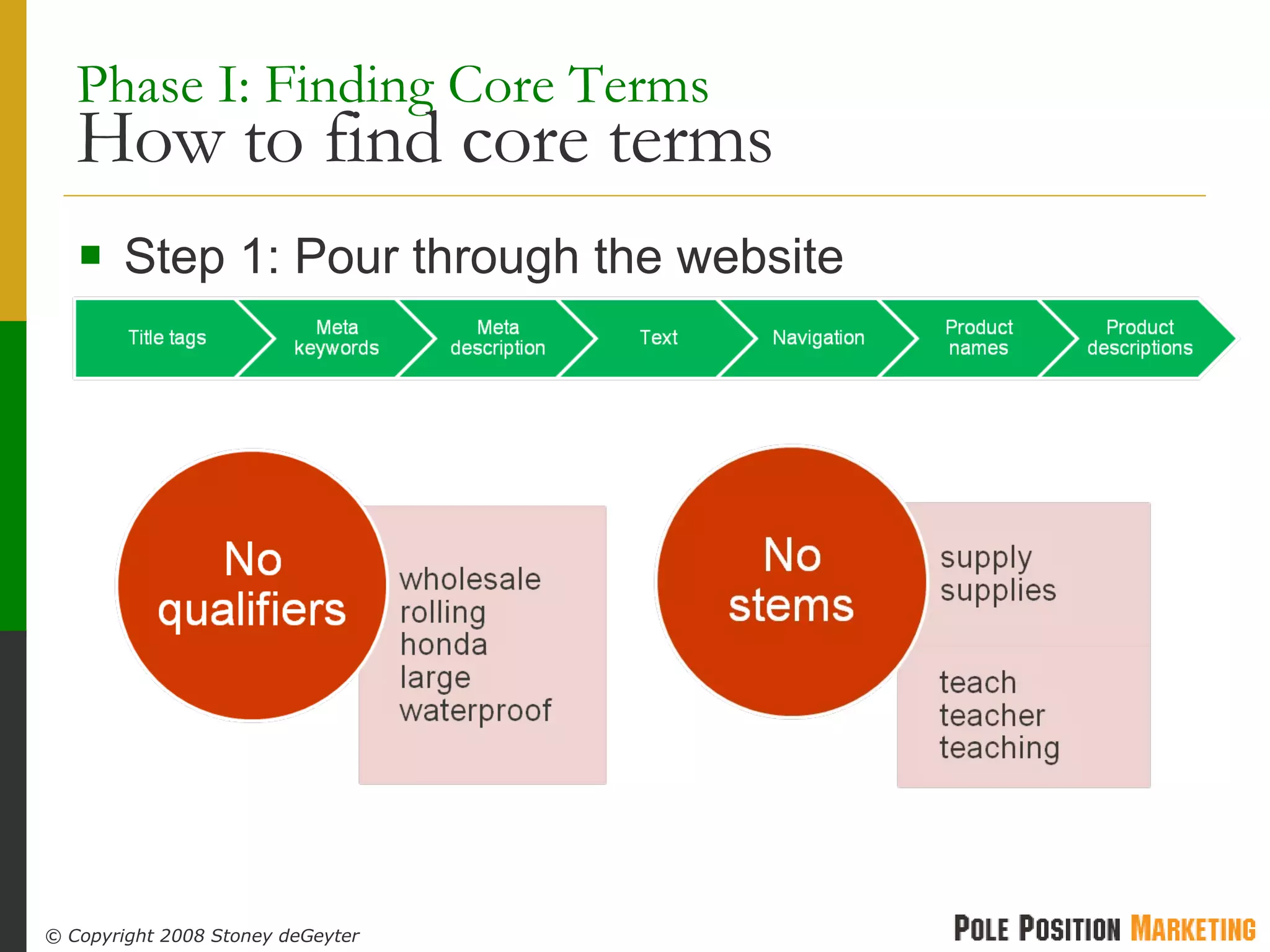
Phase I: Finding Core Terms  How to find core terms Step 1: Pour through the website
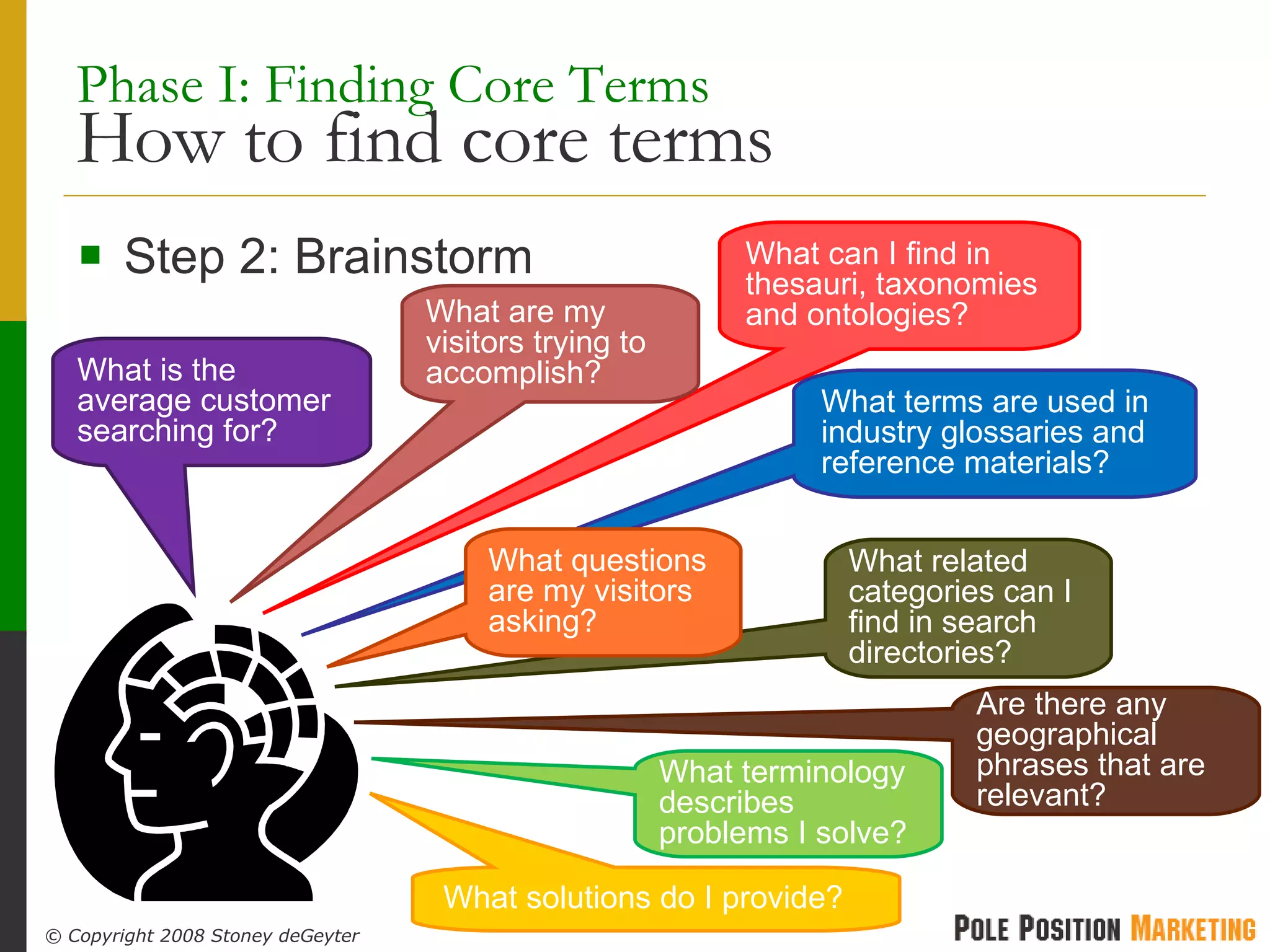
Step 2: Brainstorm Phase I: Finding Core Terms  How to find core terms What can I find in thesauri, taxonomies and ontologies? What is the average customer searching for? What are my visitors trying to accomplish? What terms are used in industry glossaries and reference materials? What solutions do I provide?  Are there any geographical phrases that are relevant? What terminology describes problems I solve? What related categories can I find in search directories? What questions are my visitors asking?
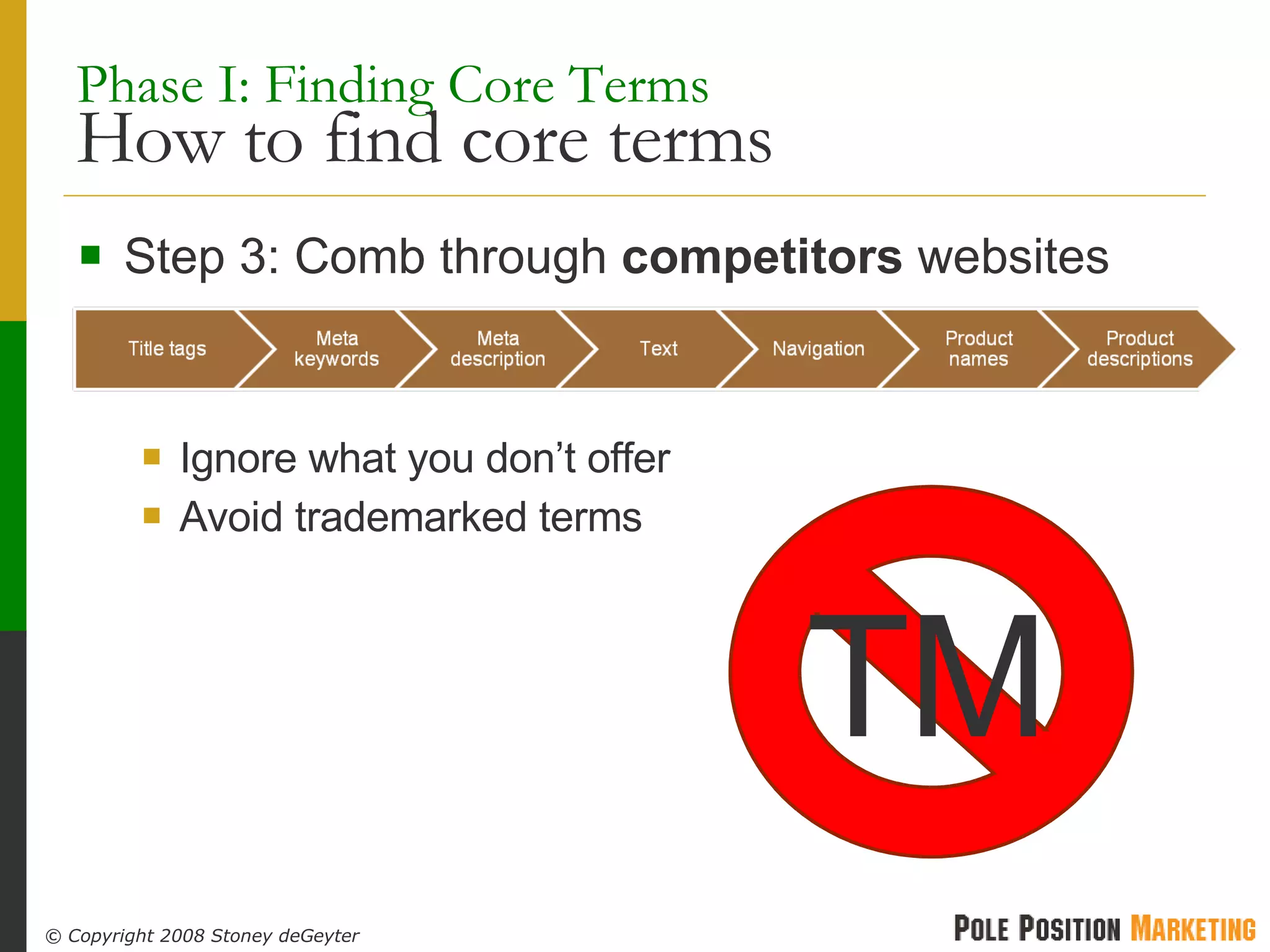
Phase I: Finding Core Terms  How to find core terms Step 3: Comb through  competitors  websites Ignore what you don’t offer Avoid trademarked terms TM
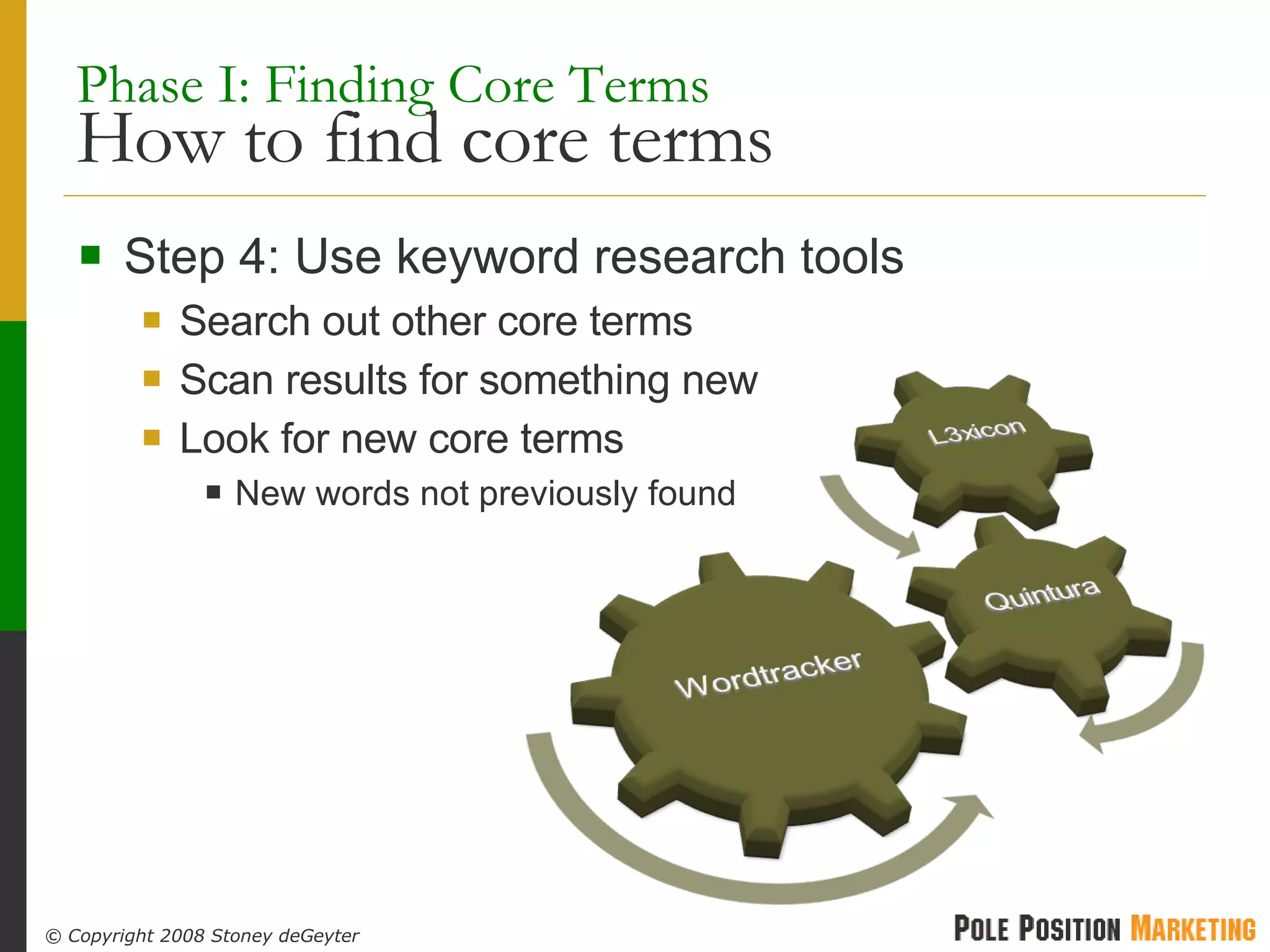
Step 4: Use keyword research tools Search out other core terms Scan results for something new Look for new core terms New words not previously found Phase I: Finding Core Terms  How to find core terms
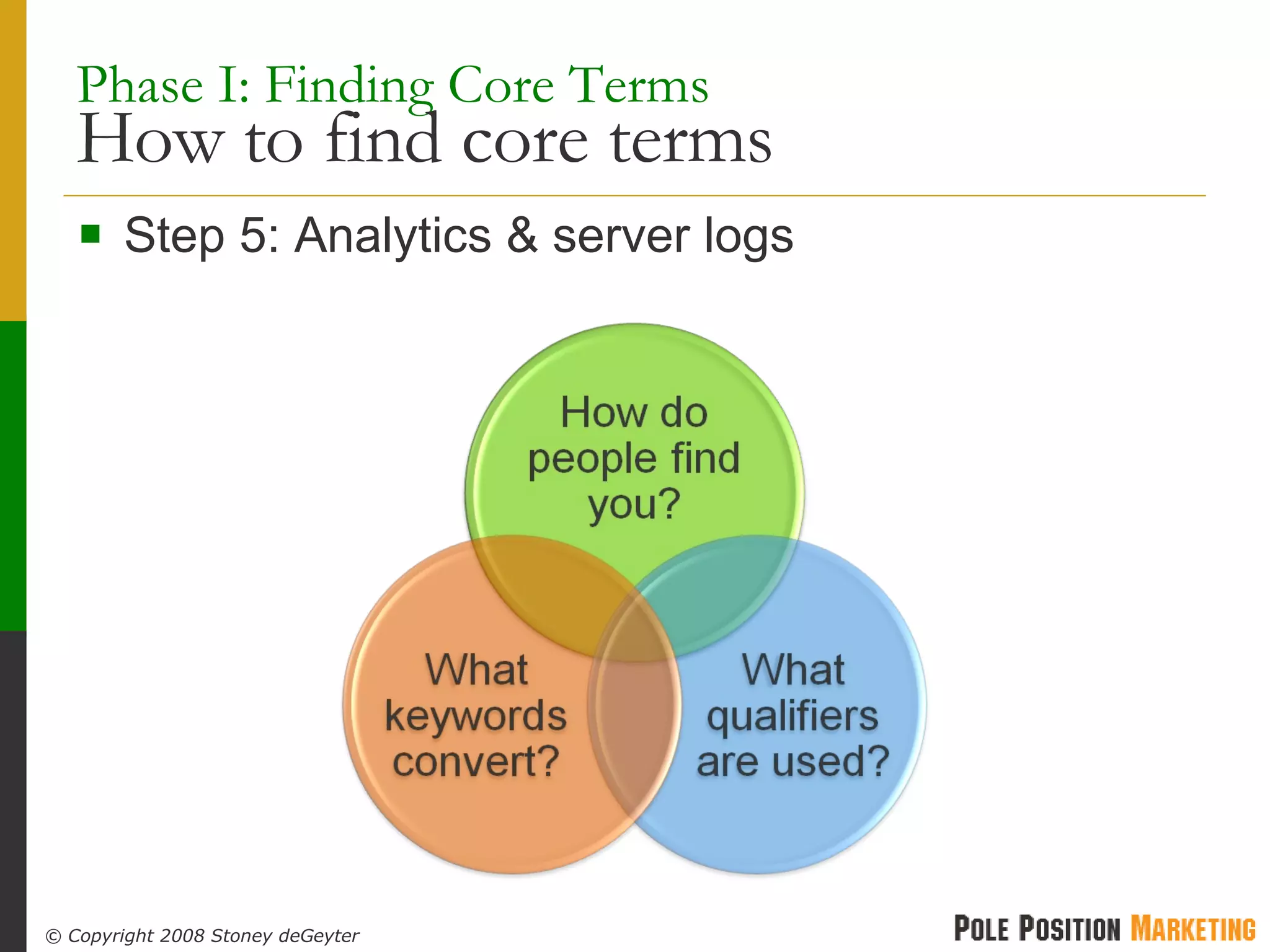
Phase I: Finding Core Terms  How to find core terms Step 5: Analytics & server logs
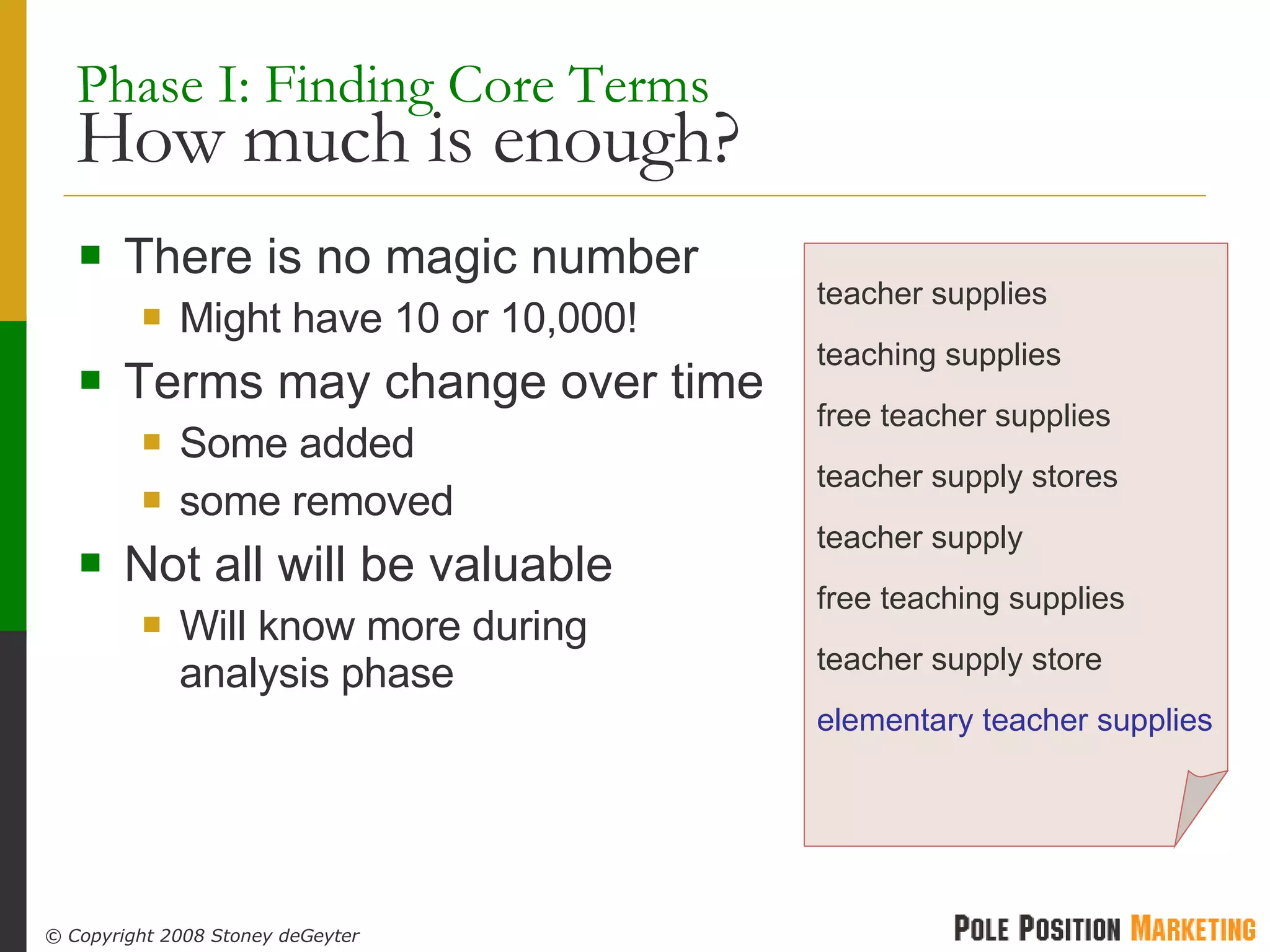
Phase I: Finding Core Terms  How much is enough? There is no magic number Might have 10 or 10,000! Terms may change over time Some added some removed Not all will be valuable Will know more during analysis phase teacher supplies teaching supplies free teacher supplies teacher supply stores teacher supply free teaching supplies teacher supply store elementary teacher supplies
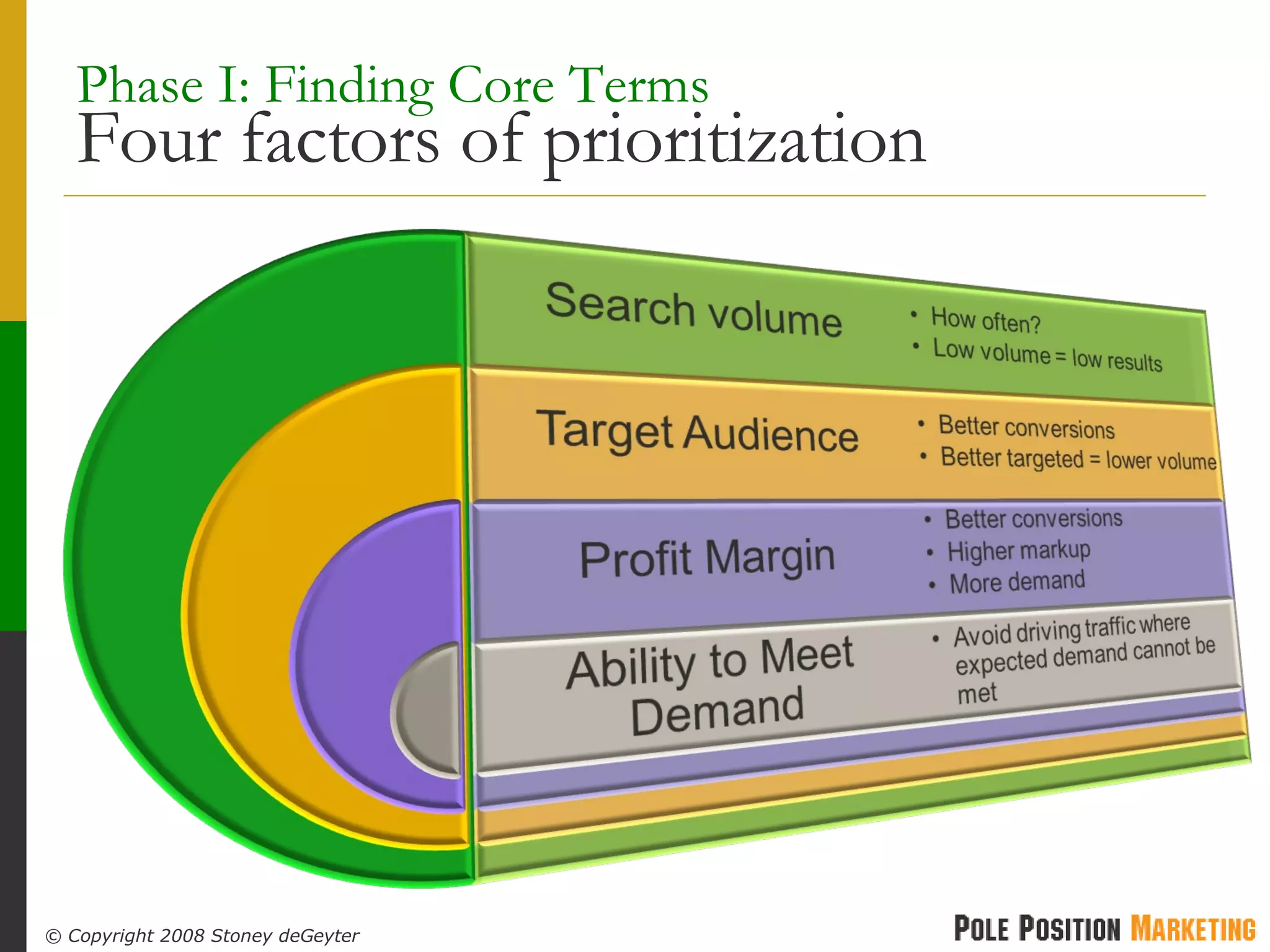
Phase I: Finding Core Terms  Four factors of prioritization
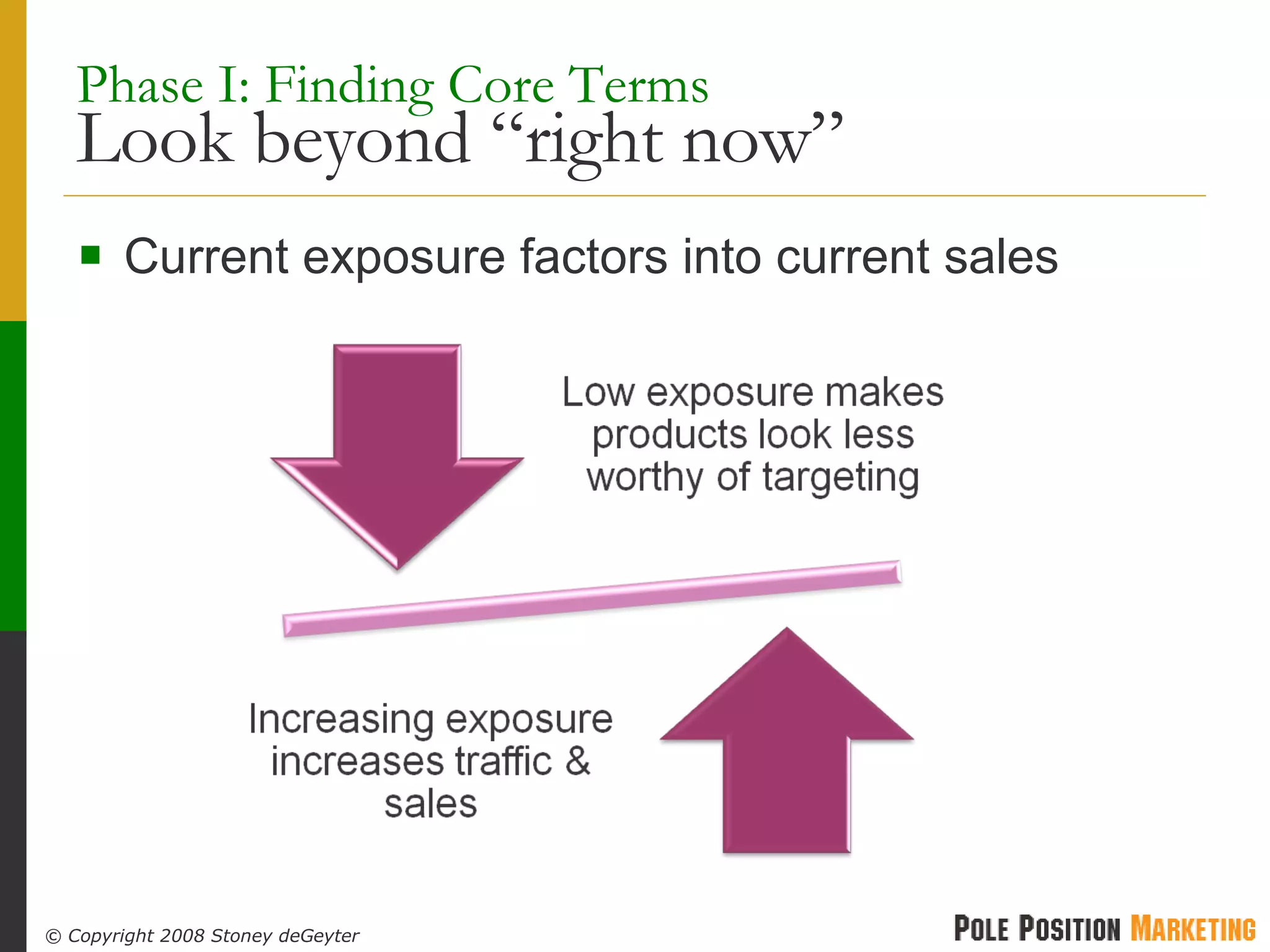
Phase I: Finding Core Terms  Look beyond “right now” Current exposure factors into current sales
 
Phase II Researching Search Phrases
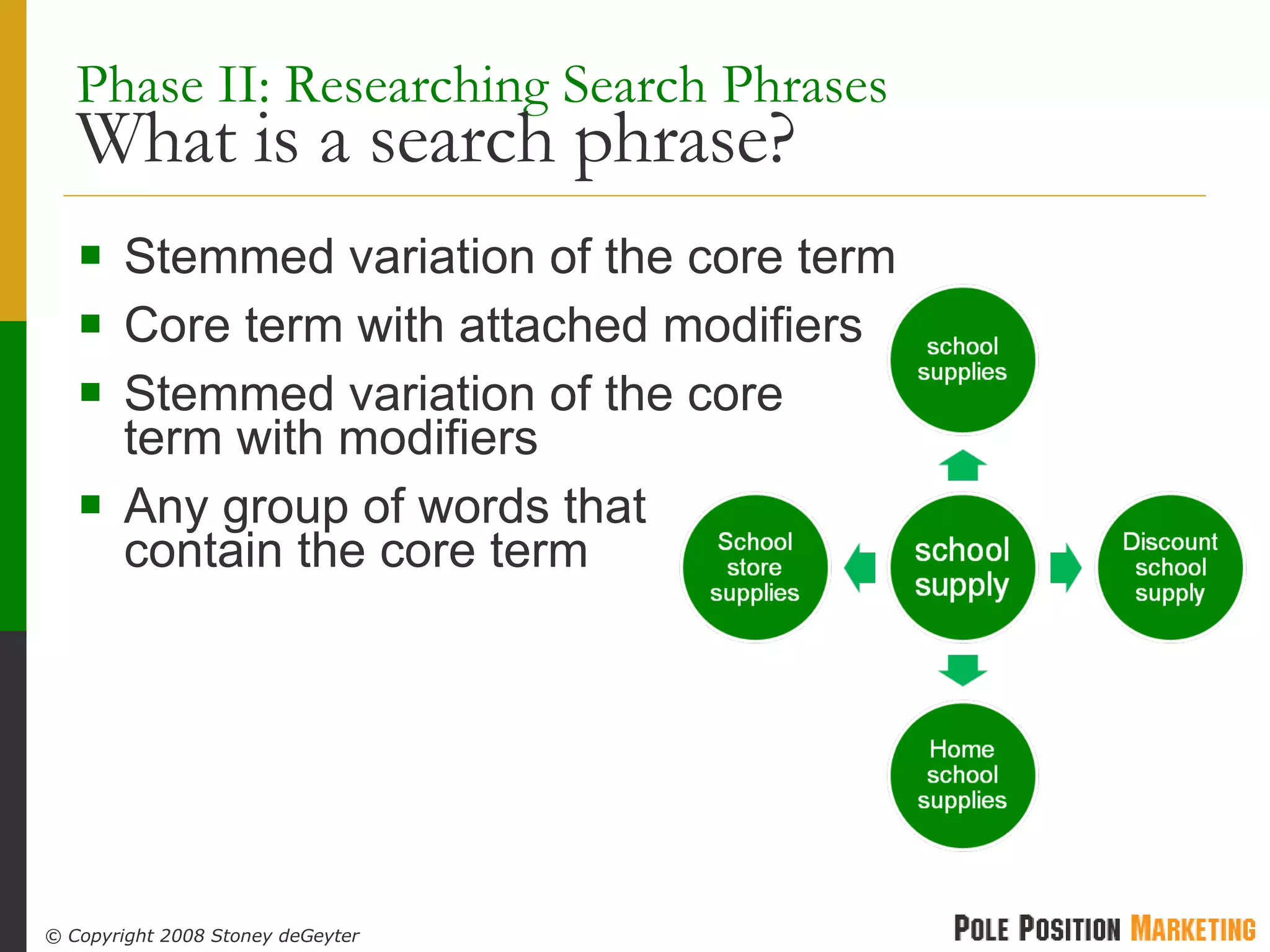
Phase II: Researching Search Phrases   What is a search phrase? Stemmed variation of the core term Core term with attached modifiers Stemmed variation of the core term with modifiers Any group of words that contain the core term
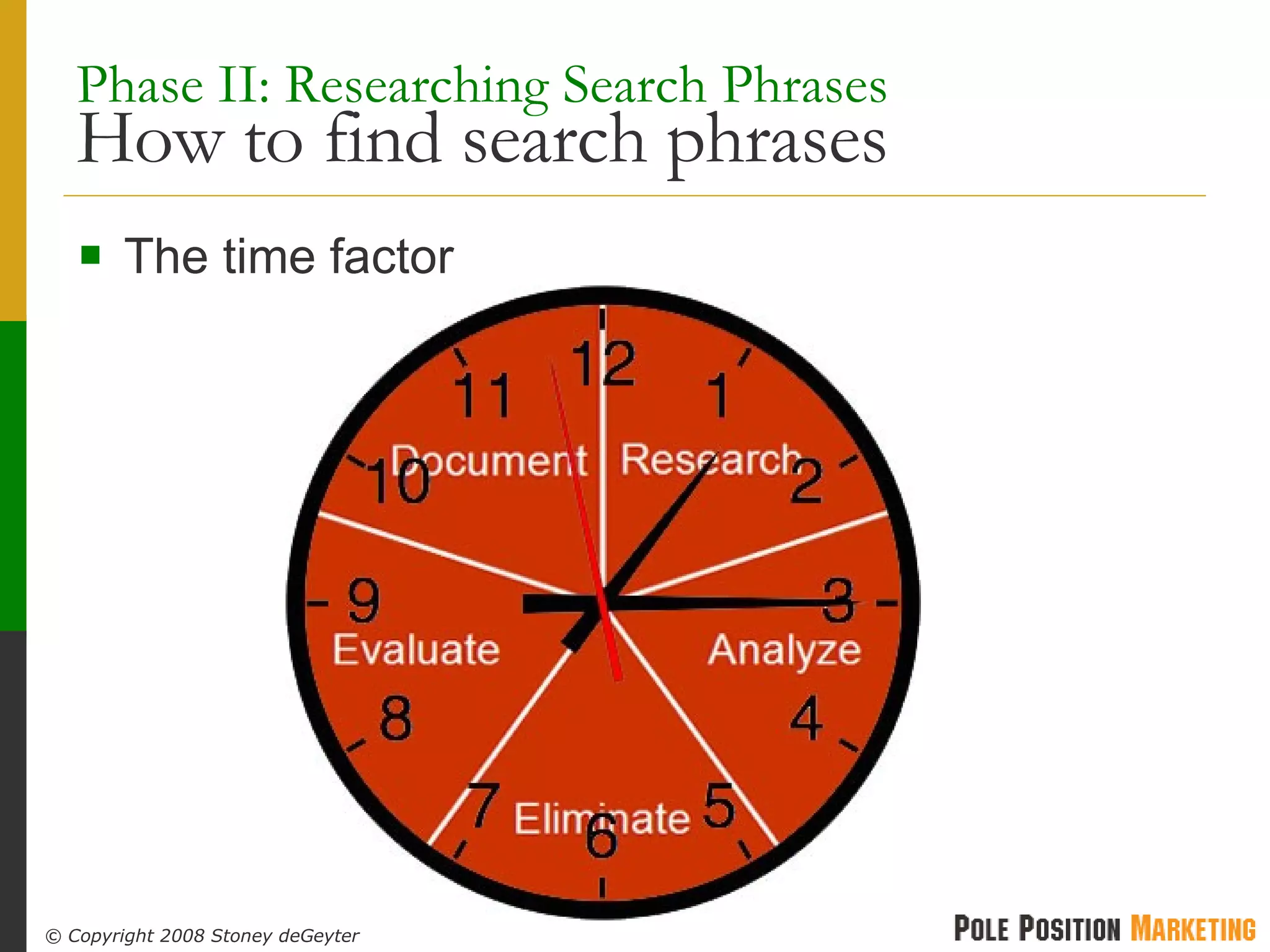
Phase II: Researching Search Phrases   How to find search phrases The time factor
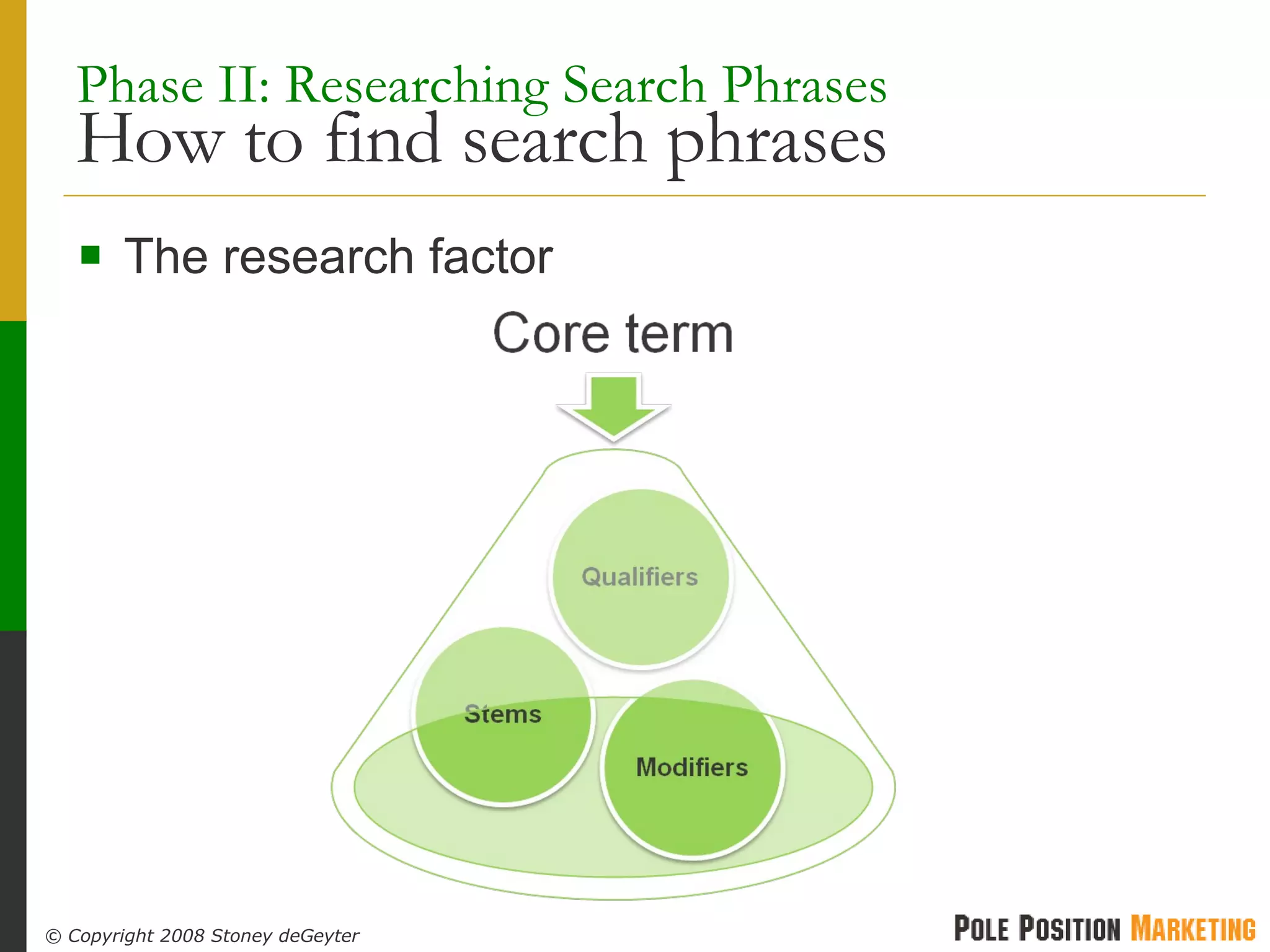
Phase II: Researching Search Phrases   How to find search phrases The research factor
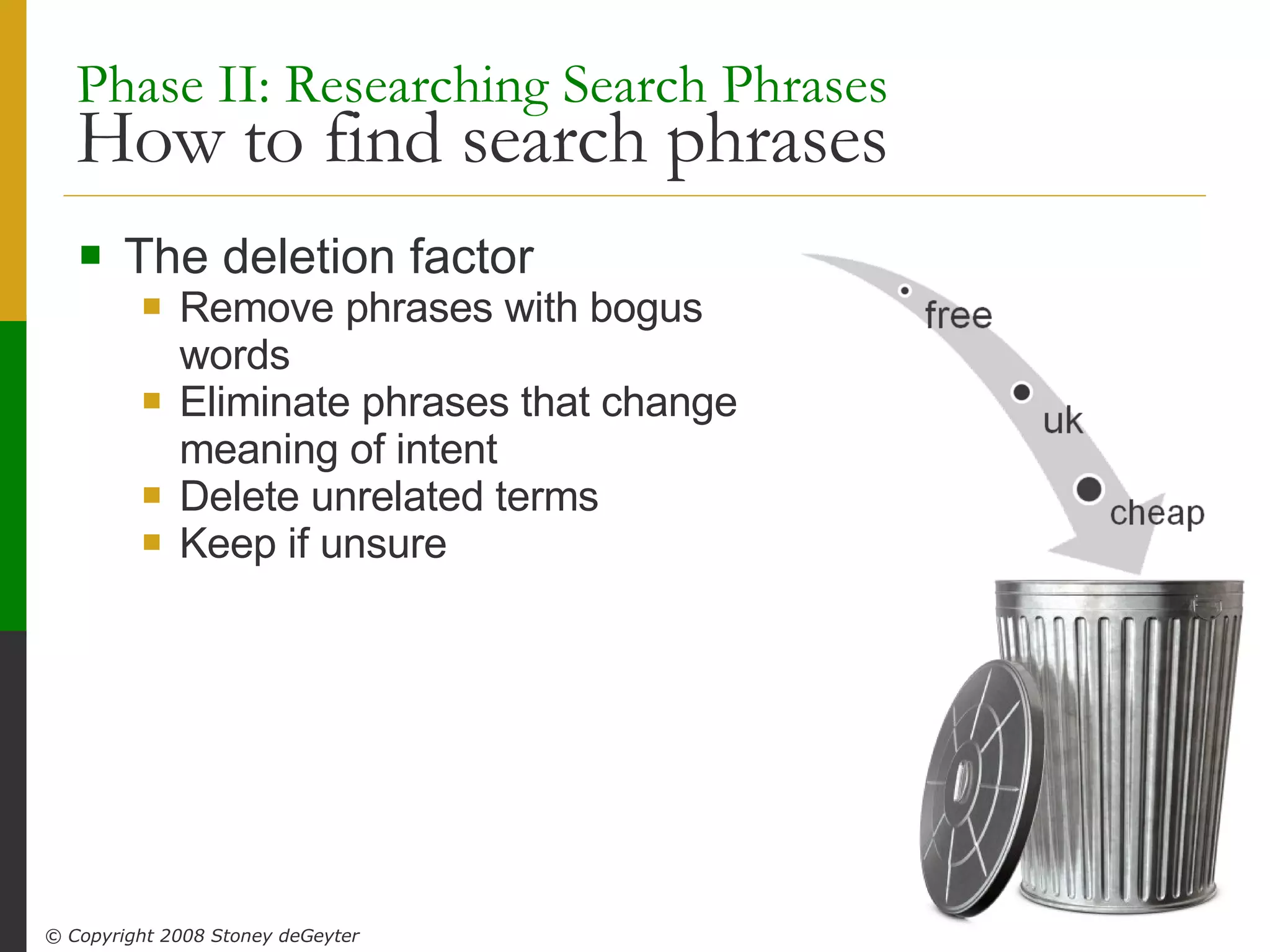
Phase II: Researching Search Phrases   How to find search phrases The deletion factor Remove phrases with bogus words Eliminate phrases that change meaning of intent Delete unrelated terms Keep if unsure
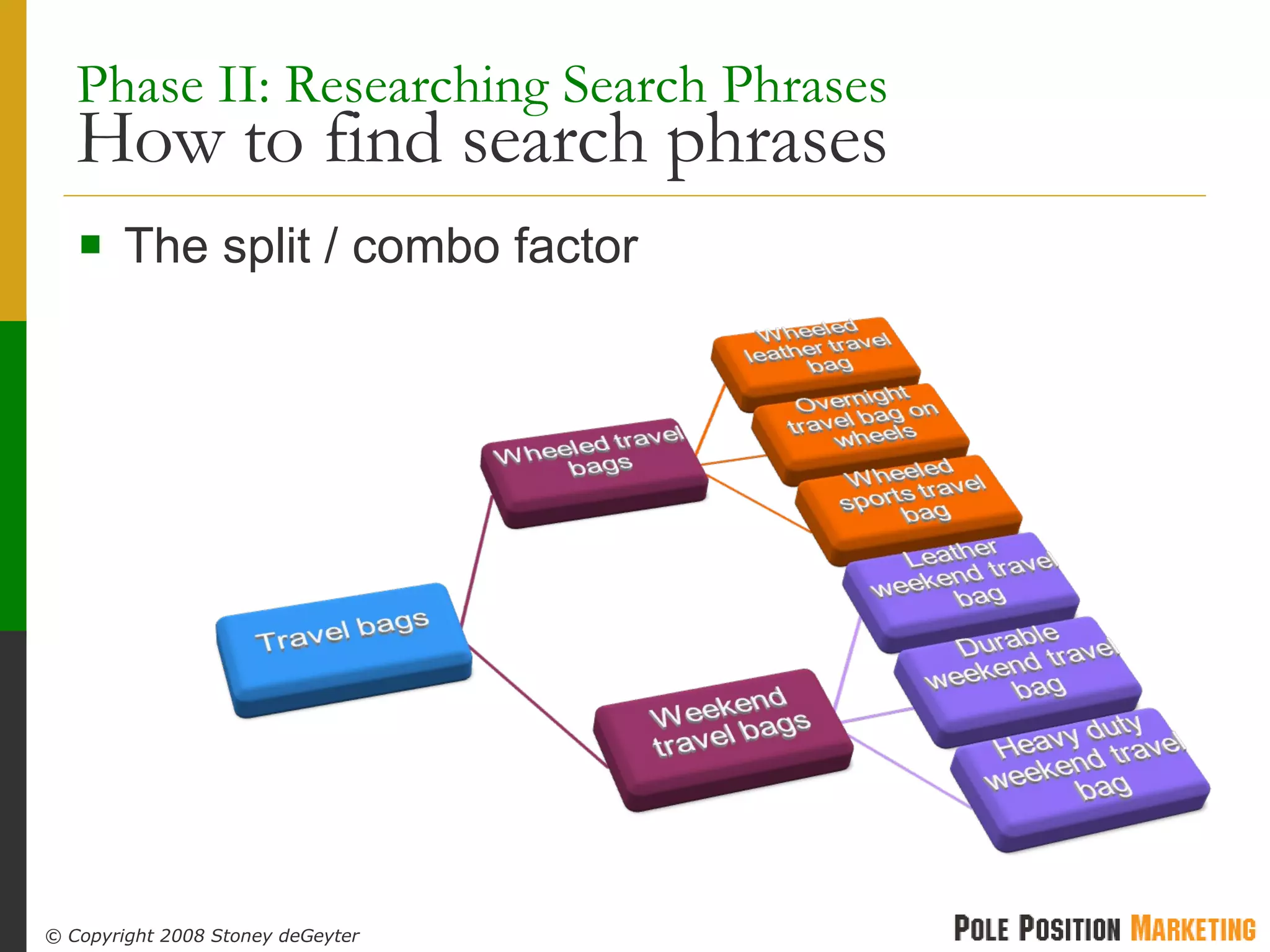
Phase II: Researching Search Phrases   How to find search phrases The split / combo factor
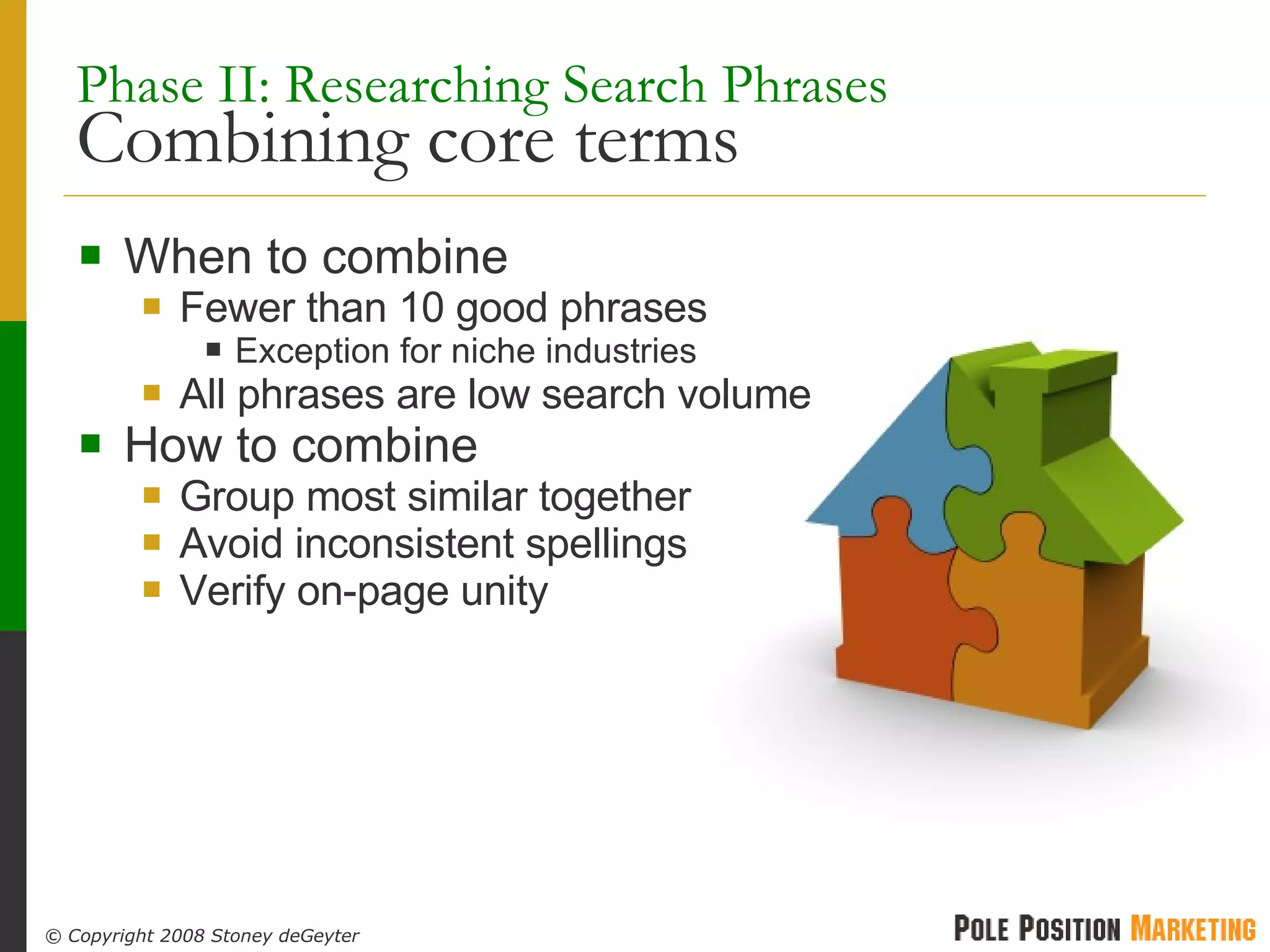
Phase II: Researching Search Phrases   Combining core terms When to combine Fewer than 10 good phrases Exception for niche industries All phrases are low search volume How to combine Group most similar together Avoid inconsistent spellings Verify on-page unity
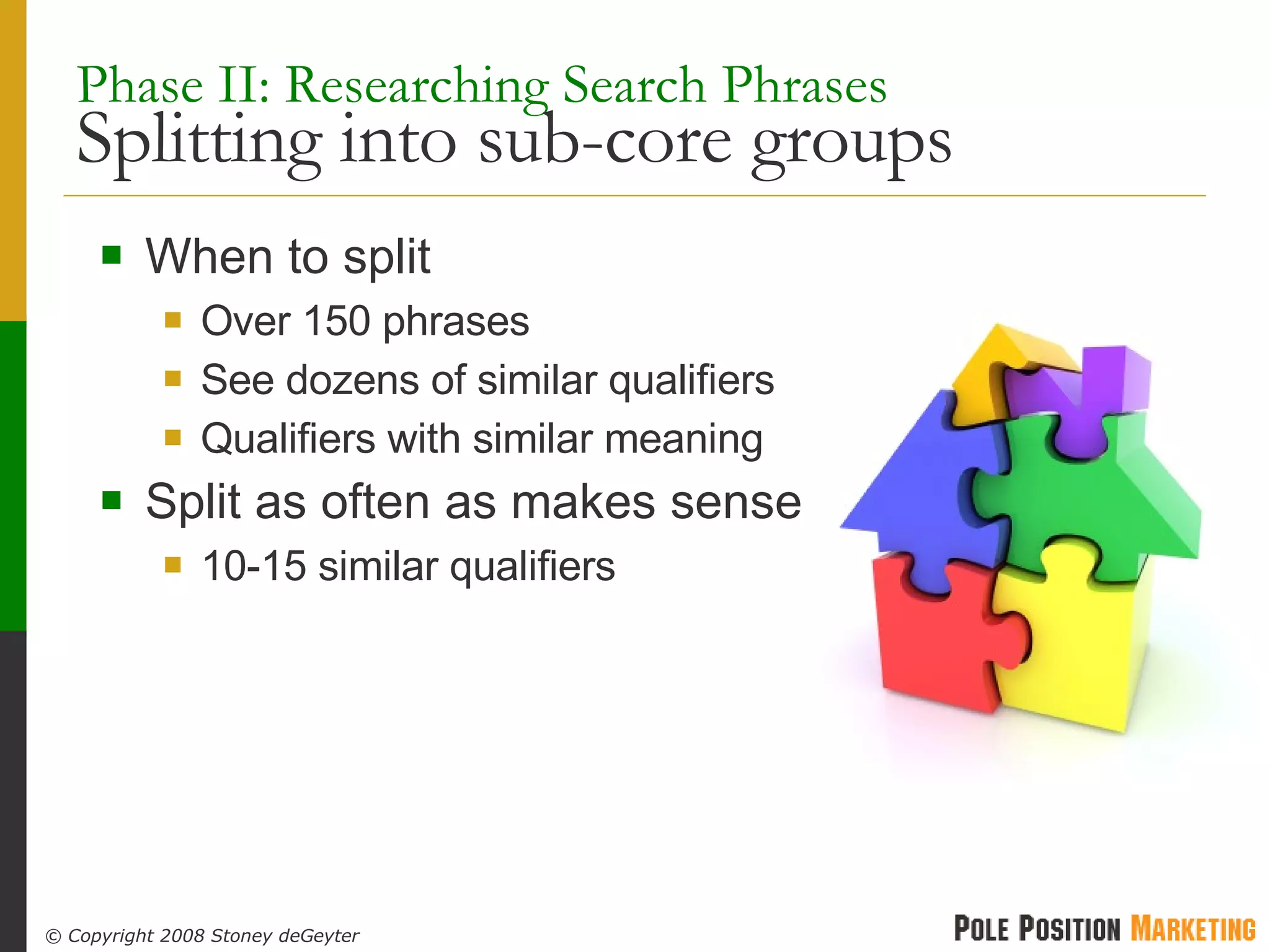
Phase II: Researching Search Phrases   Splitting into sub-core groups When to split Over 150 phrases See dozens of similar qualifiers Qualifiers with similar meaning Split as often as makes sense 10-15 similar qualifiers
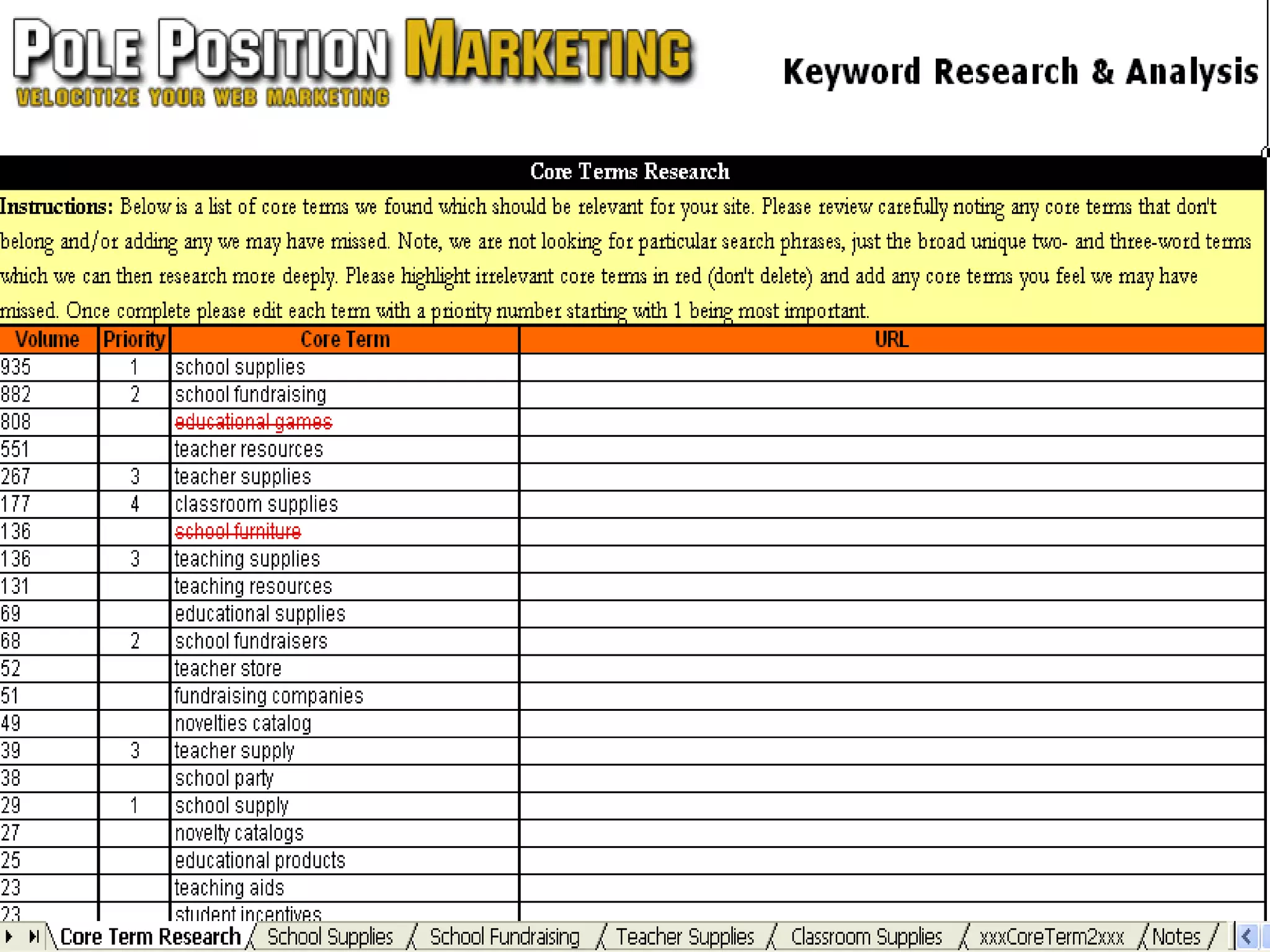
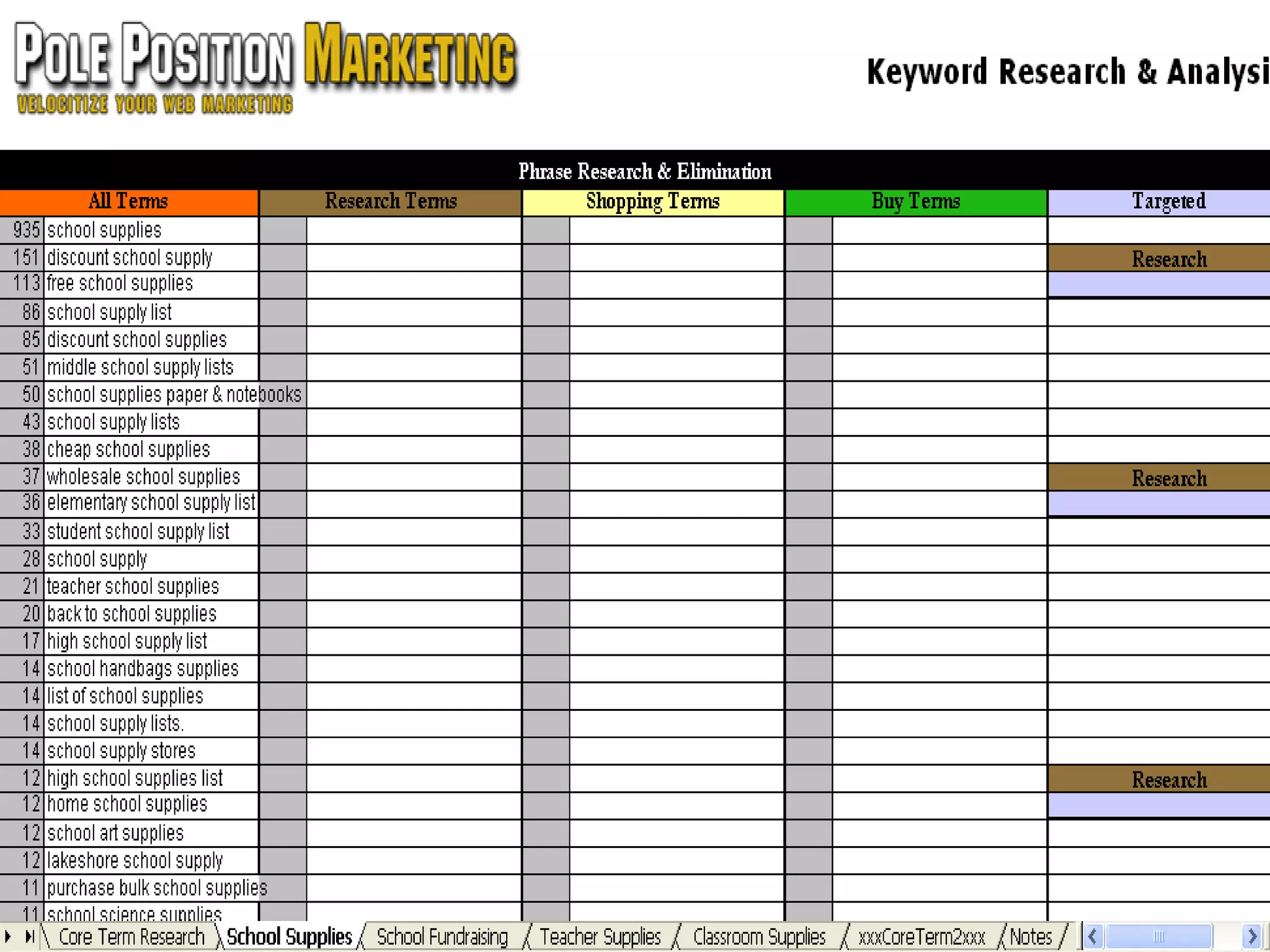
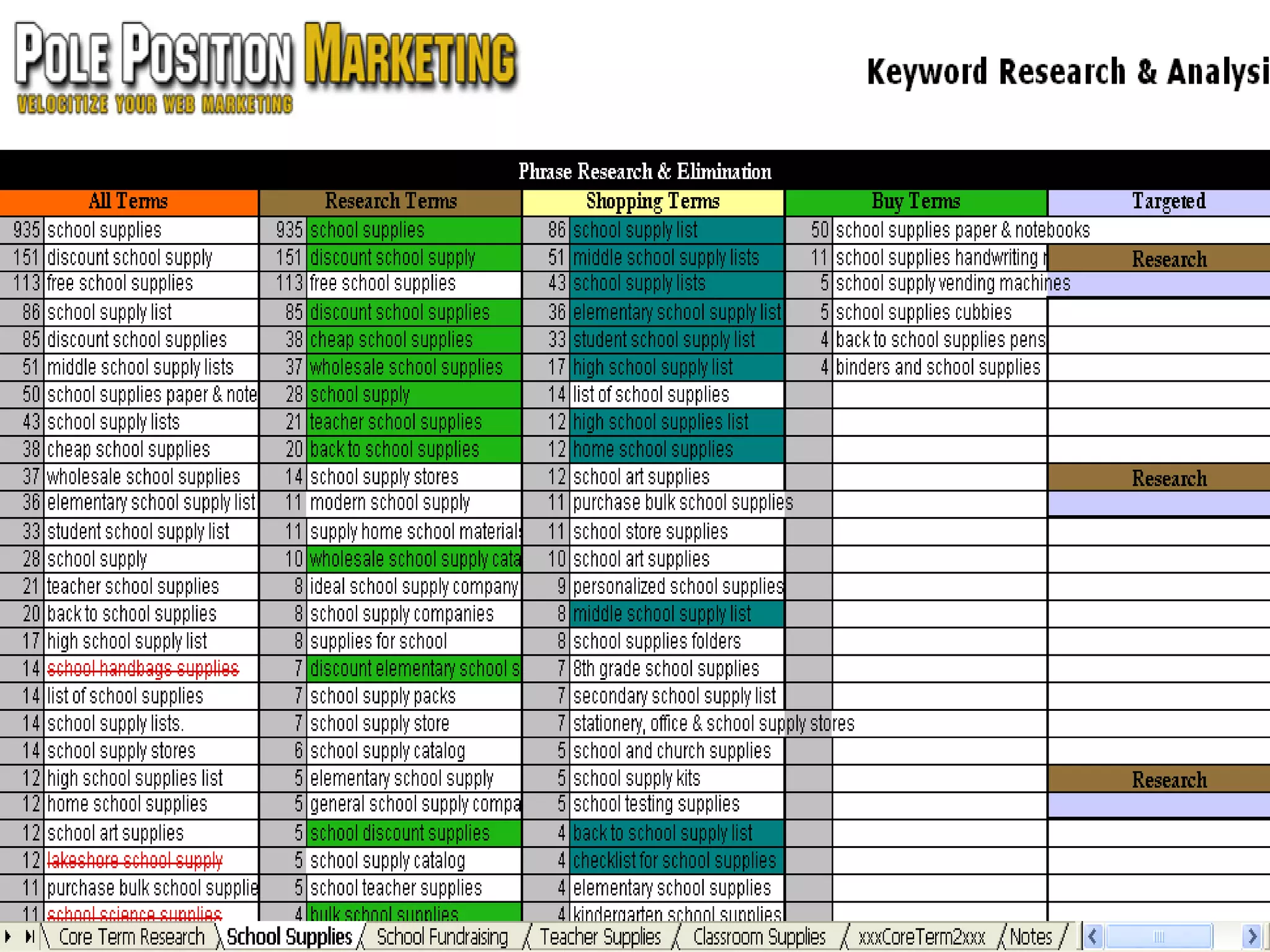
Researching Search Phrases   Search phrase spreadsheet
Phase III Analyzing and Eliminating Keywords
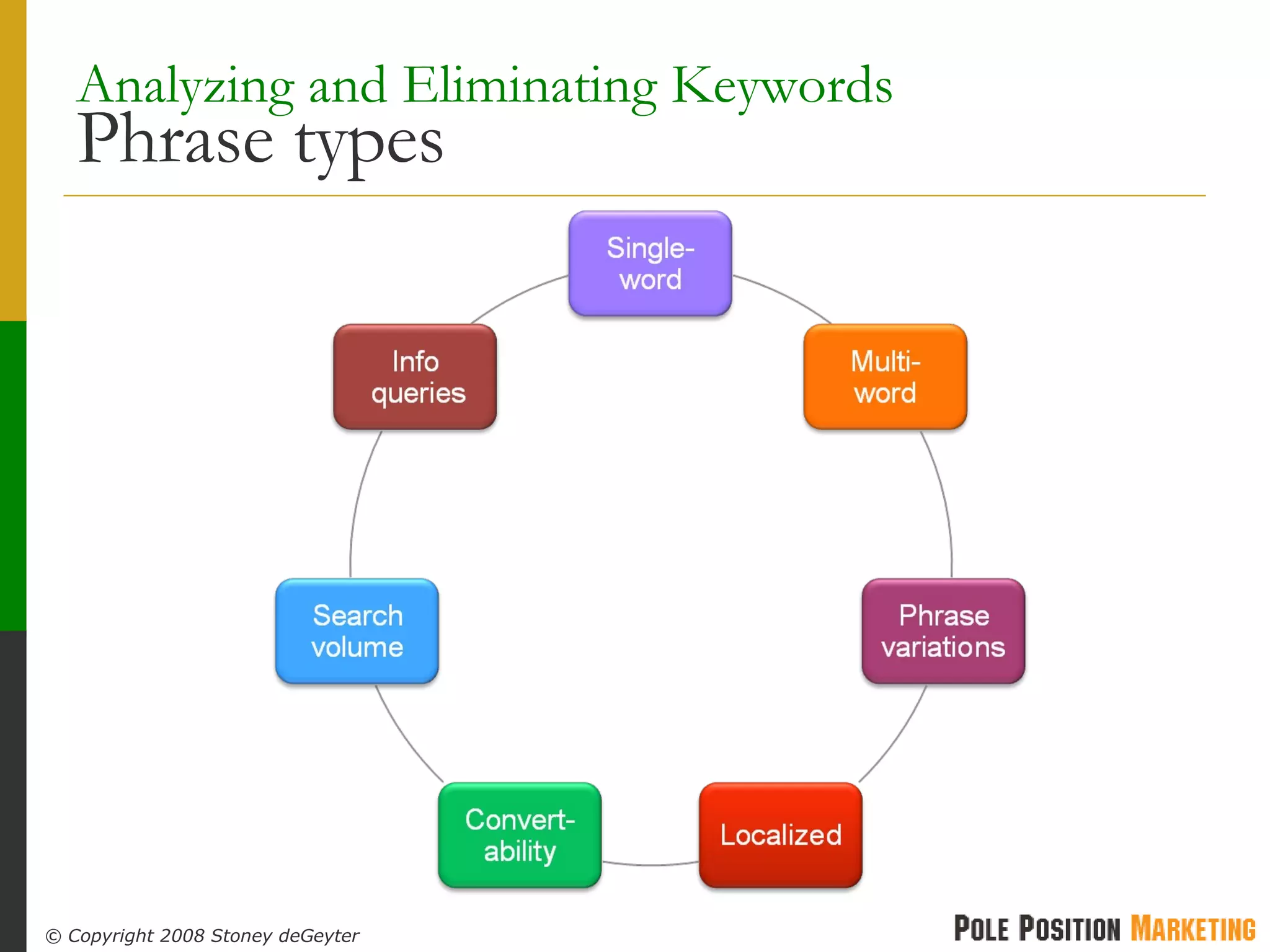
Analyzing and Eliminating Keywords   Phrase types
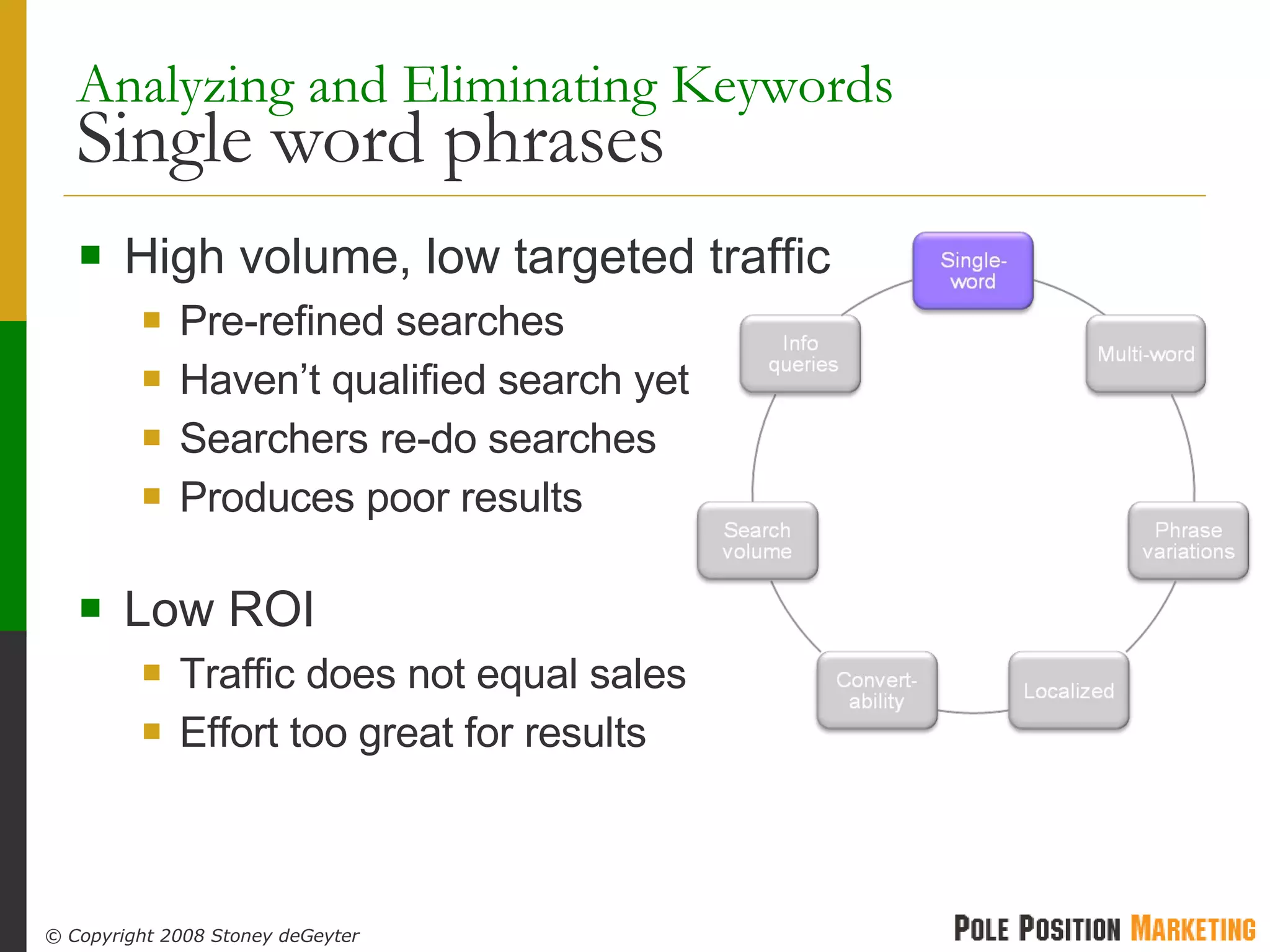
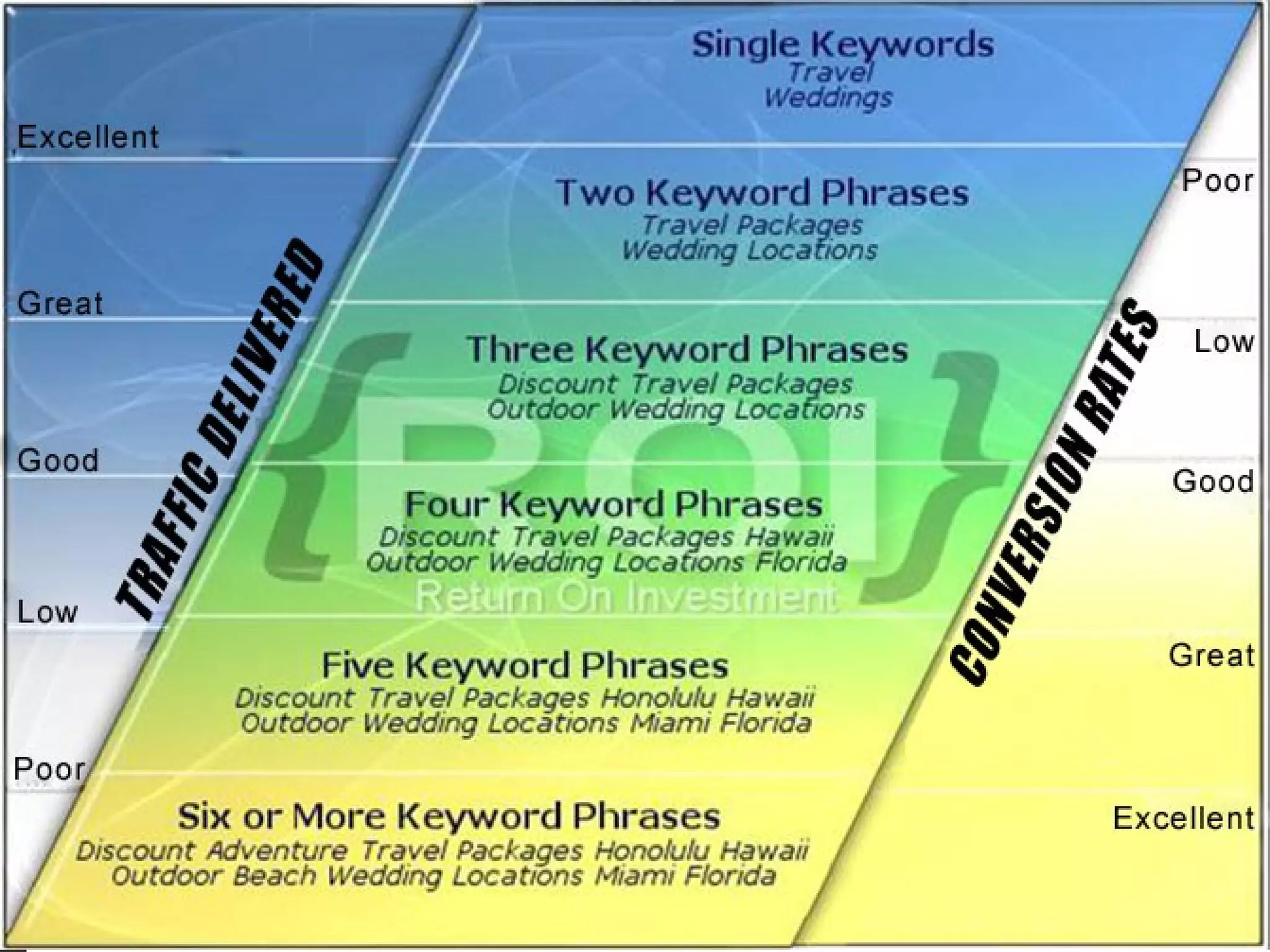
Analyzing and Eliminating Keywords   Single word phrases High volume, low targeted traffic Pre-refined searches Haven’t qualified search yet Searchers re-do searches Produces poor results Low ROI Traffic does not equal sales Effort too great for results
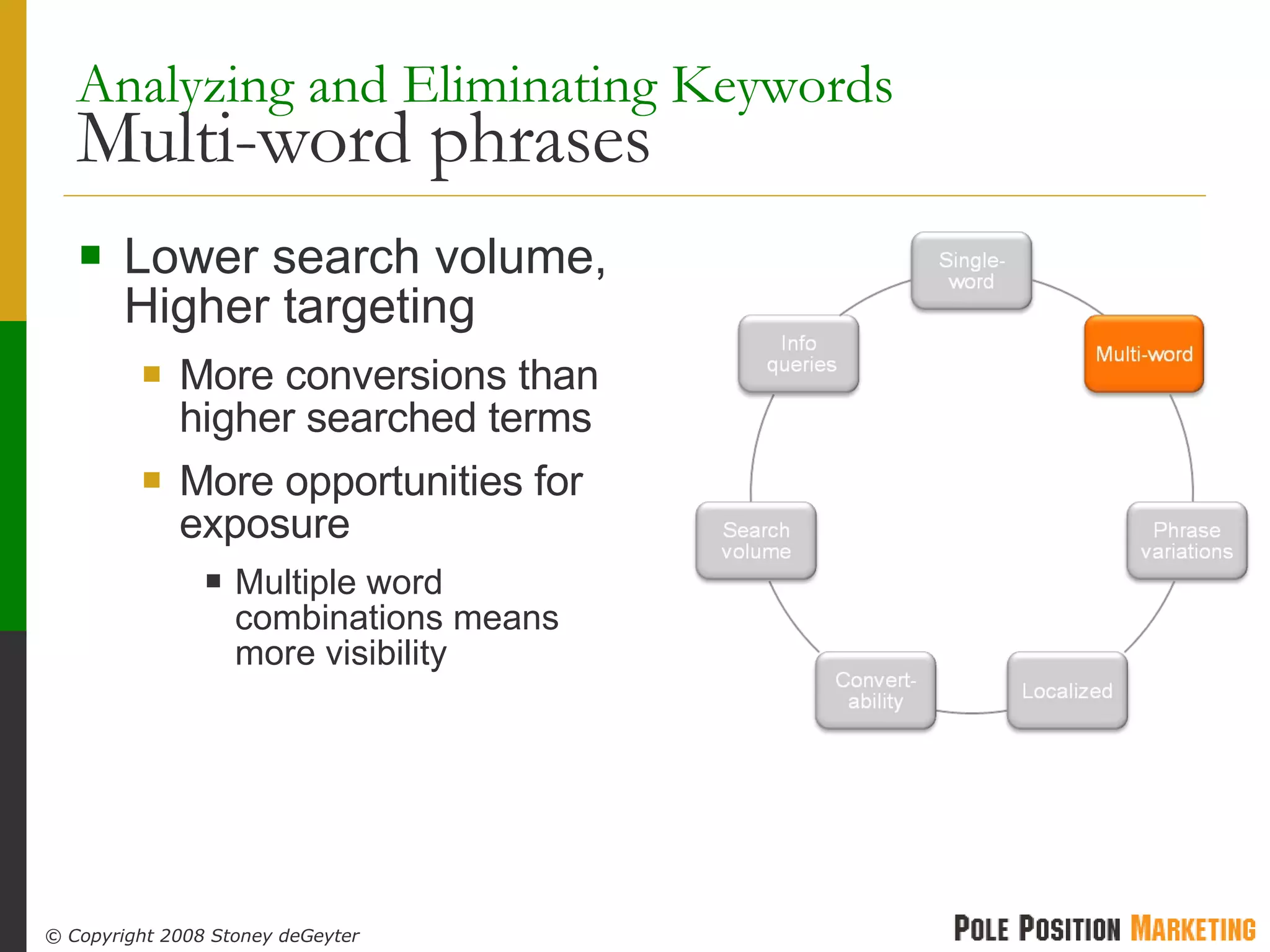
Analyzing and Eliminating Keywords   Multi-word phrases Lower search volume, Higher targeting More conversions than higher searched terms More opportunities for exposure Multiple word combinations means more visibility
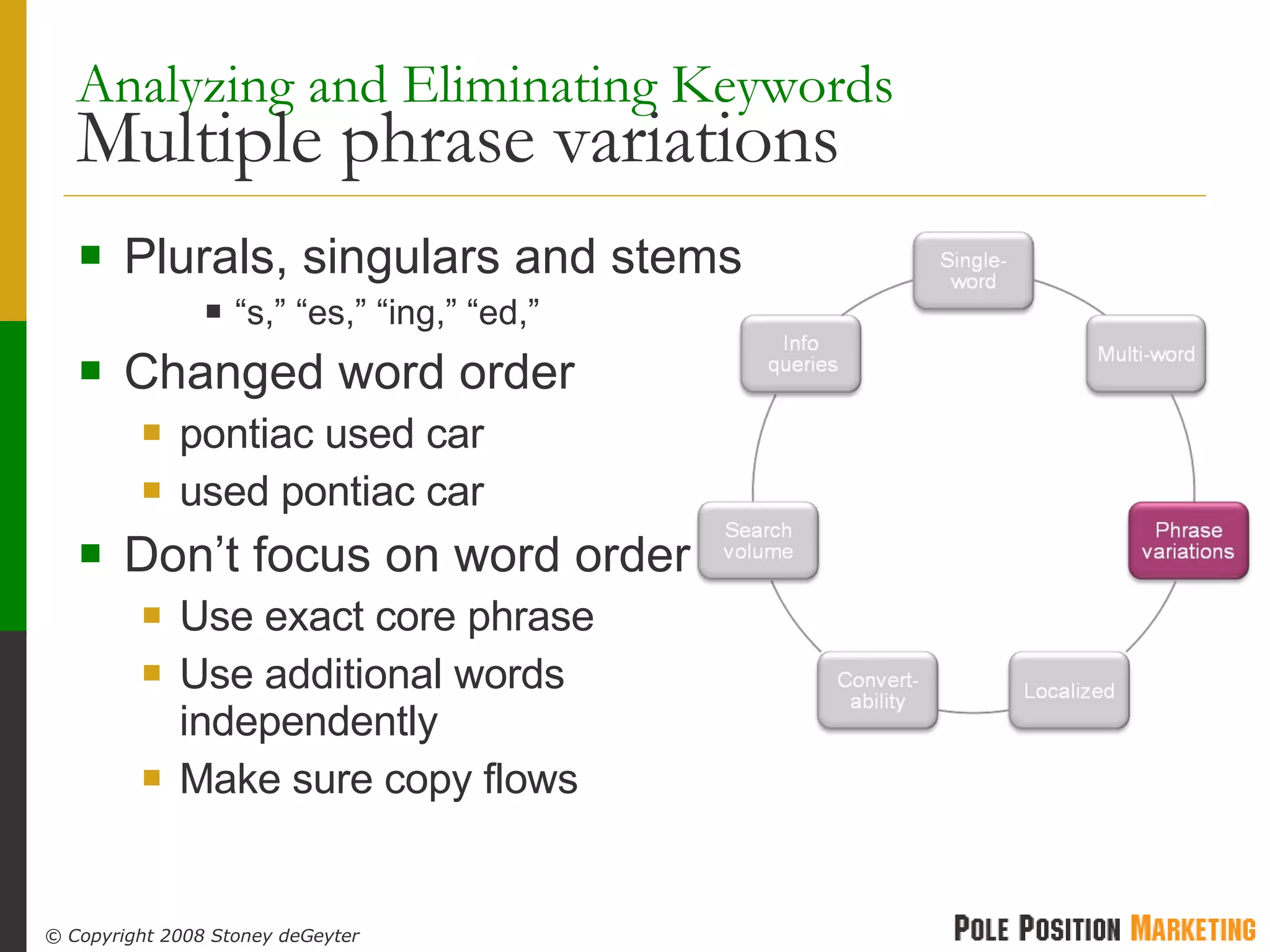
Analyzing and Eliminating Keywords   Multiple phrase variations Plurals, singulars and stems “ s,” “es,” “ing,” “ed,” Changed word order pontiac used car  used pontiac car Don’t focus on word order Use exact core phrase Use additional words independently  Make sure copy flows
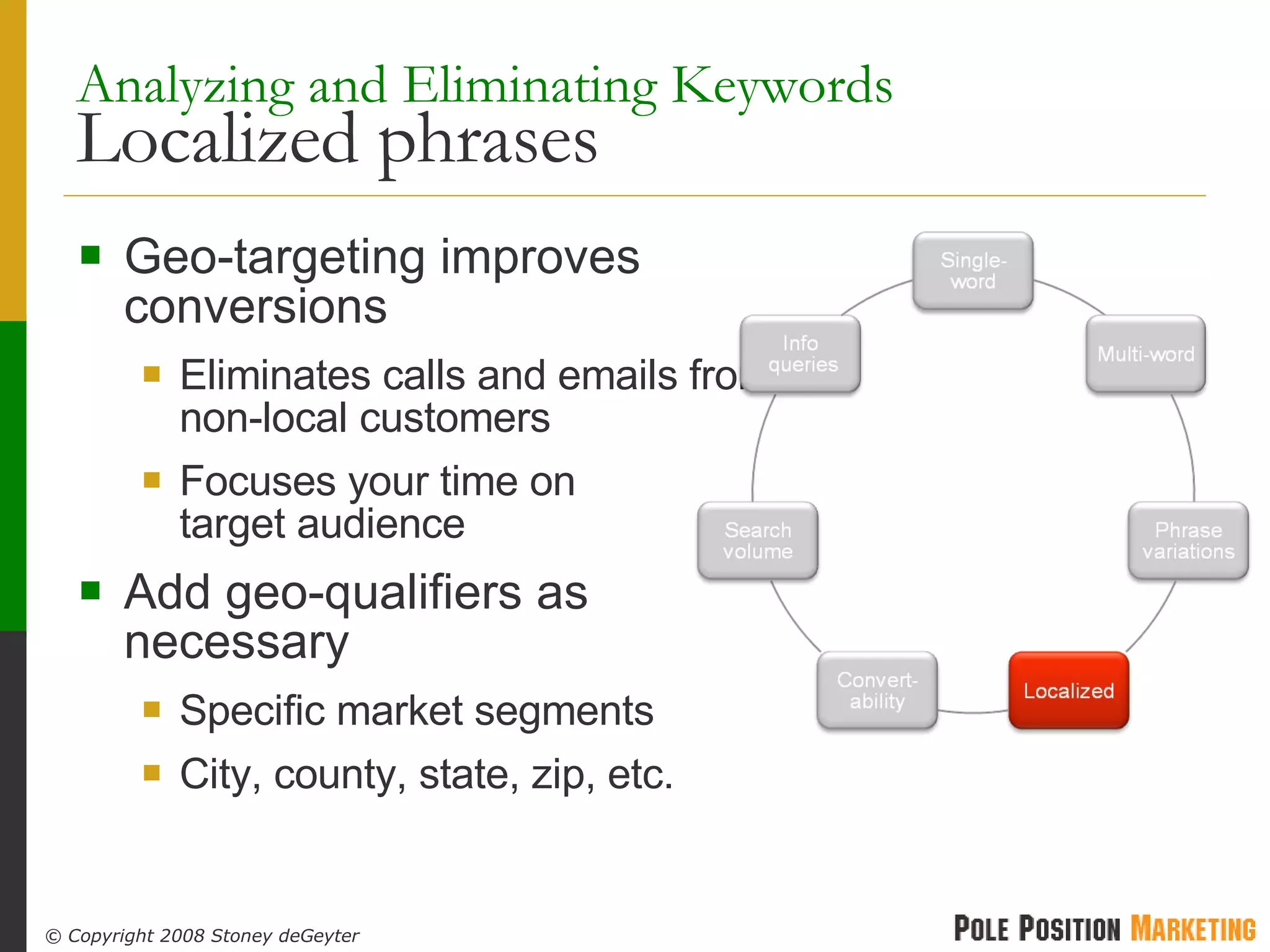
Analyzing and Eliminating Keywords   Localized phrases Geo-targeting improves conversions Eliminates calls and emails from non-local customers Focuses your time on target audience Add geo-qualifiers as necessary Specific market segments City, county, state, zip, etc.
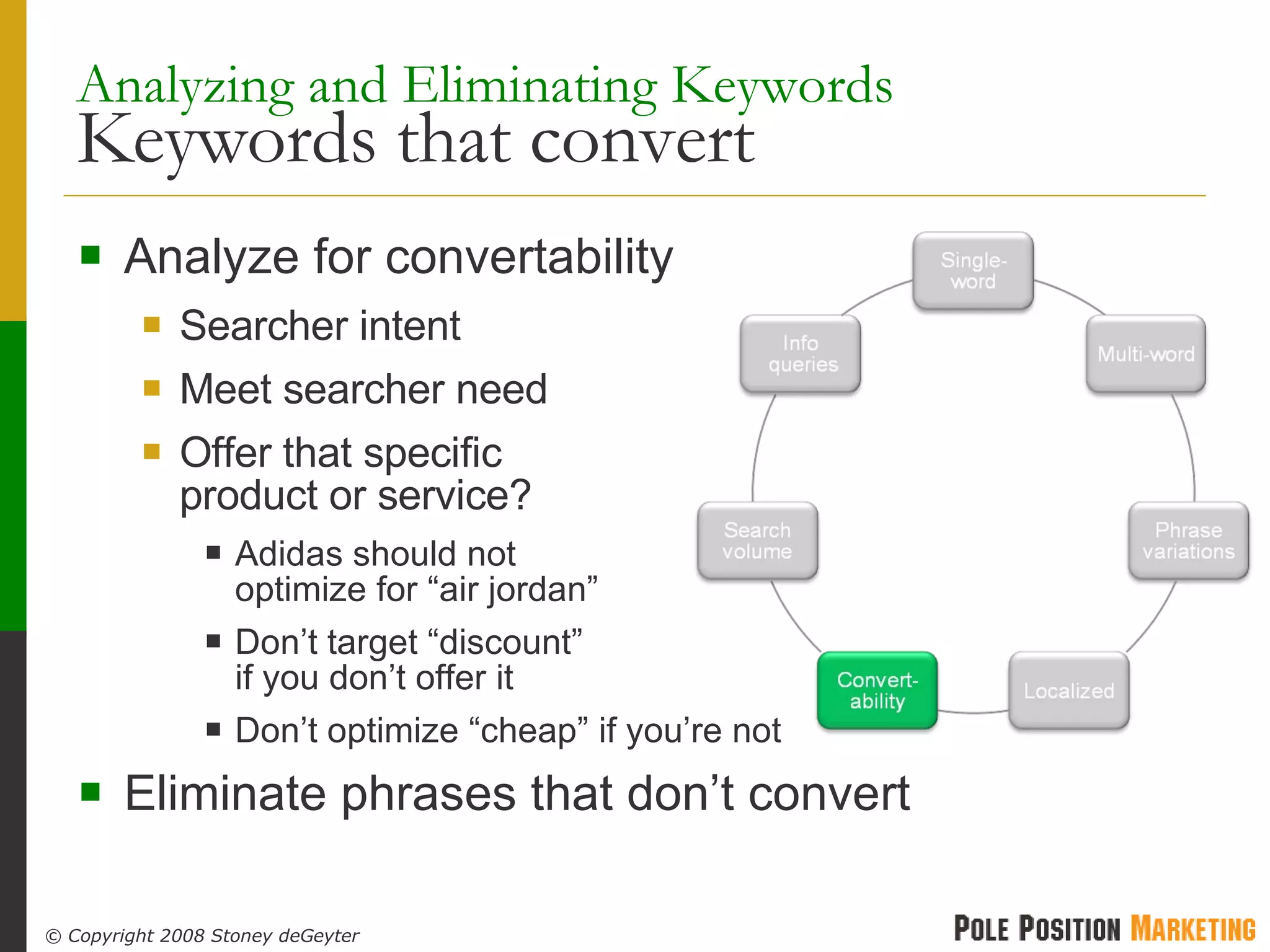
Analyzing and Eliminating Keywords   Keywords that convert Analyze for convertability Searcher intent Meet searcher need Offer that specific product or service? Adidas should not  optimize for “air jordan” Don’t target “discount”  if you don’t offer it Don’t optimize “cheap” if you’re not Eliminate phrases that don’t convert
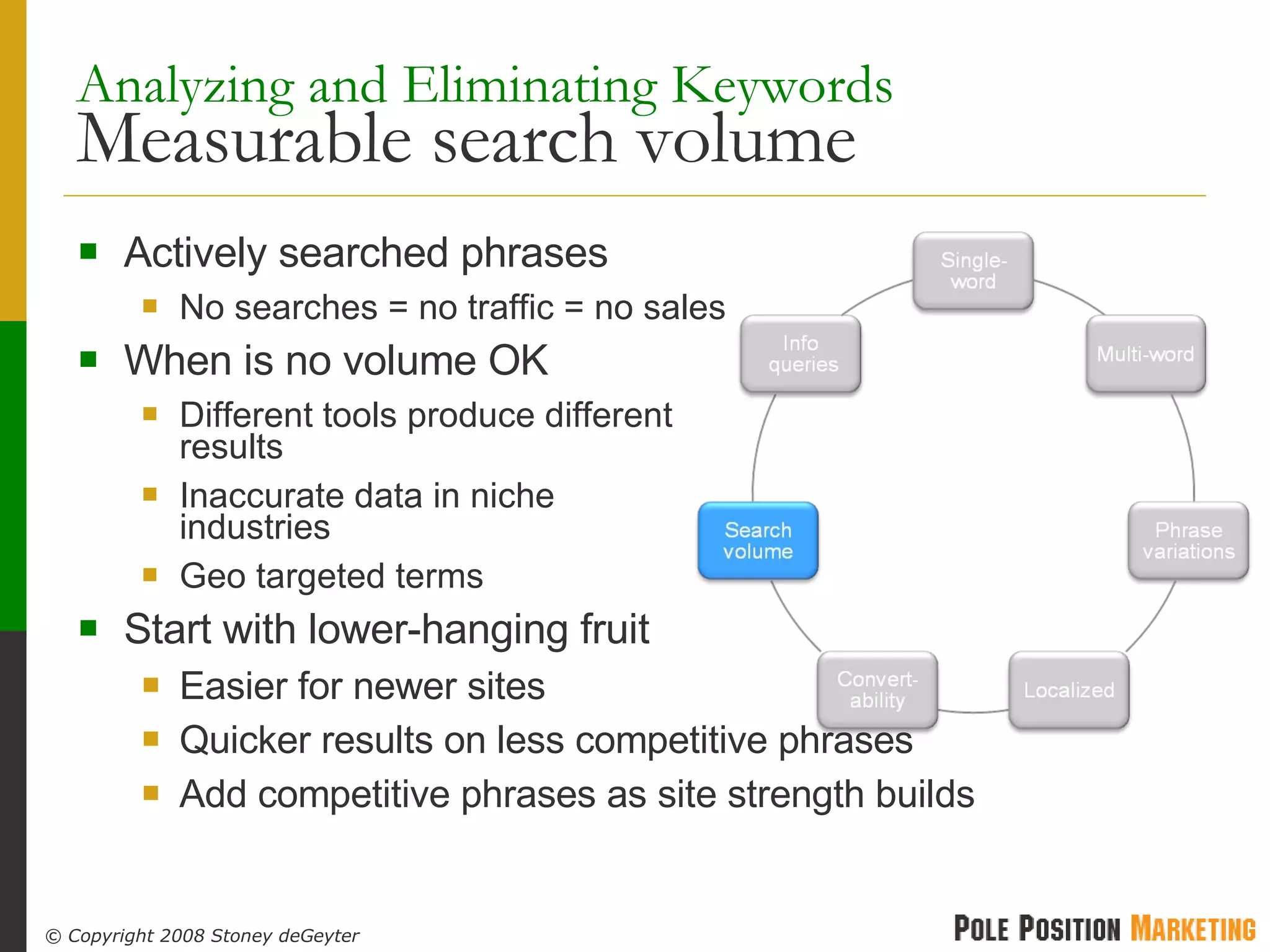
Analyzing and Eliminating Keywords   Measurable search volume Actively searched phrases No searches = no traffic = no sales When is no volume OK Different tools produce different results Inaccurate data in niche  industries Geo targeted terms Start with lower-hanging fruit Easier for newer sites Quicker results on less competitive phrases Add competitive phrases as site strength builds
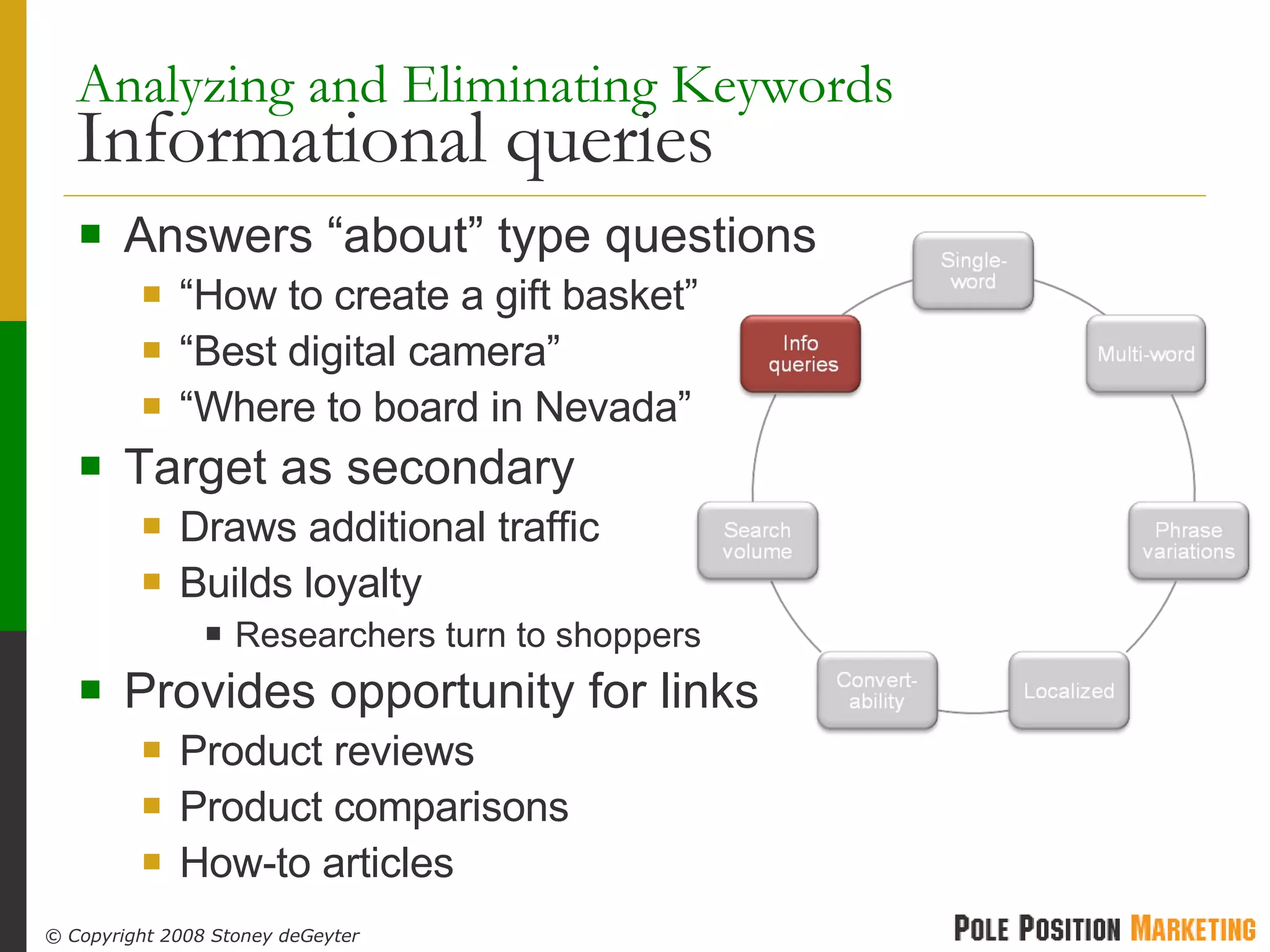
Analyzing and Eliminating Keywords   Informational queries Answers “about” type questions “ How to create a gift basket” “ Best digital camera” “ Where to board in Nevada” Target as secondary Draws additional traffic Builds loyalty Researchers turn to shoppers Provides opportunity for links Product reviews Product comparisons How-to articles
Analyzing and Eliminating Keywords   Analyzing phrases for quality What is the customer looking for? Is the query clear? Future / seasonal trends? What’s missing in SERPs? Where’s the ROI?
 
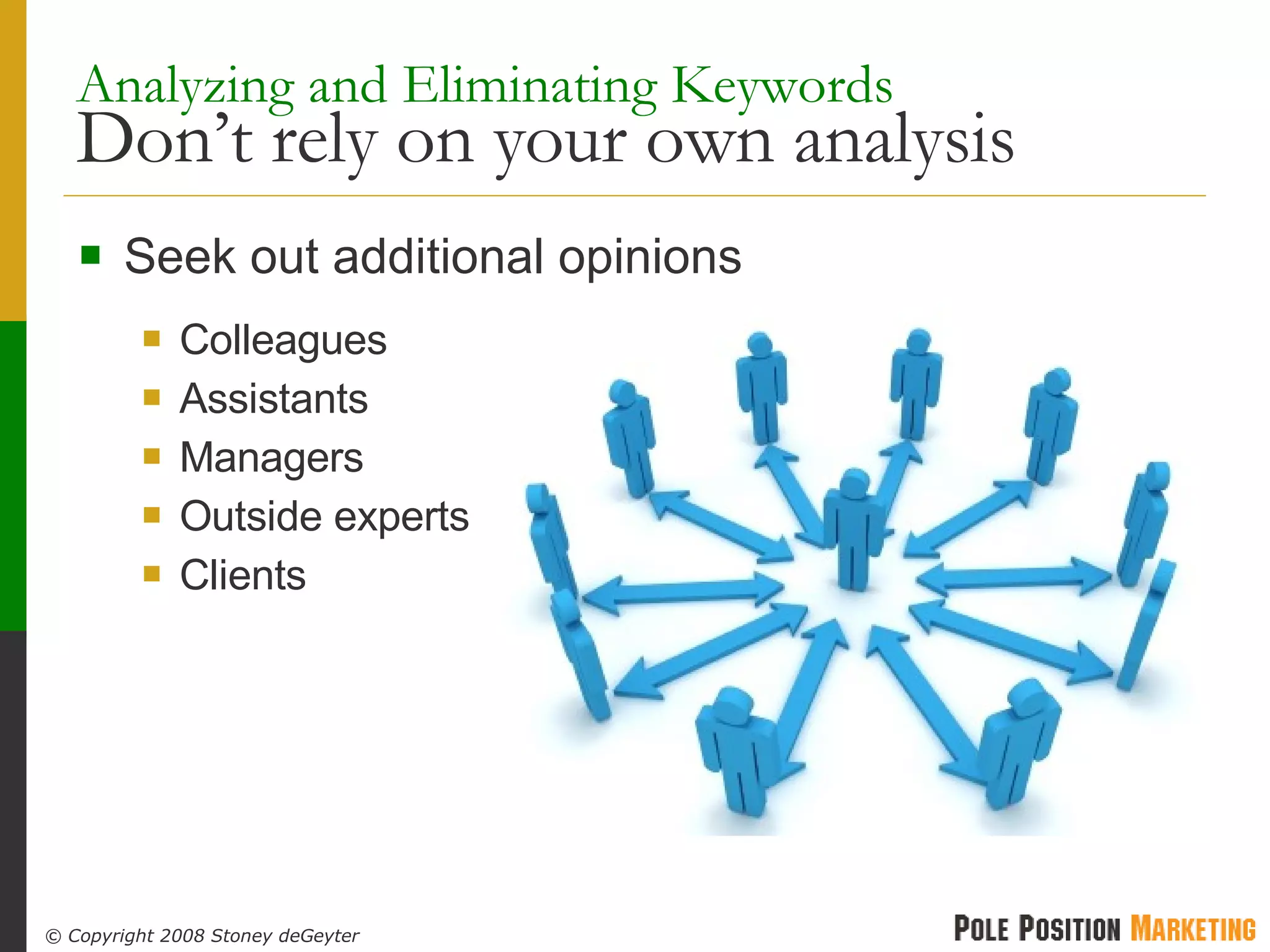
Analyzing and Eliminating Keywords Don’t rely on your own analysis Seek out additional opinions  Colleagues Assistants Managers Outside experts Clients
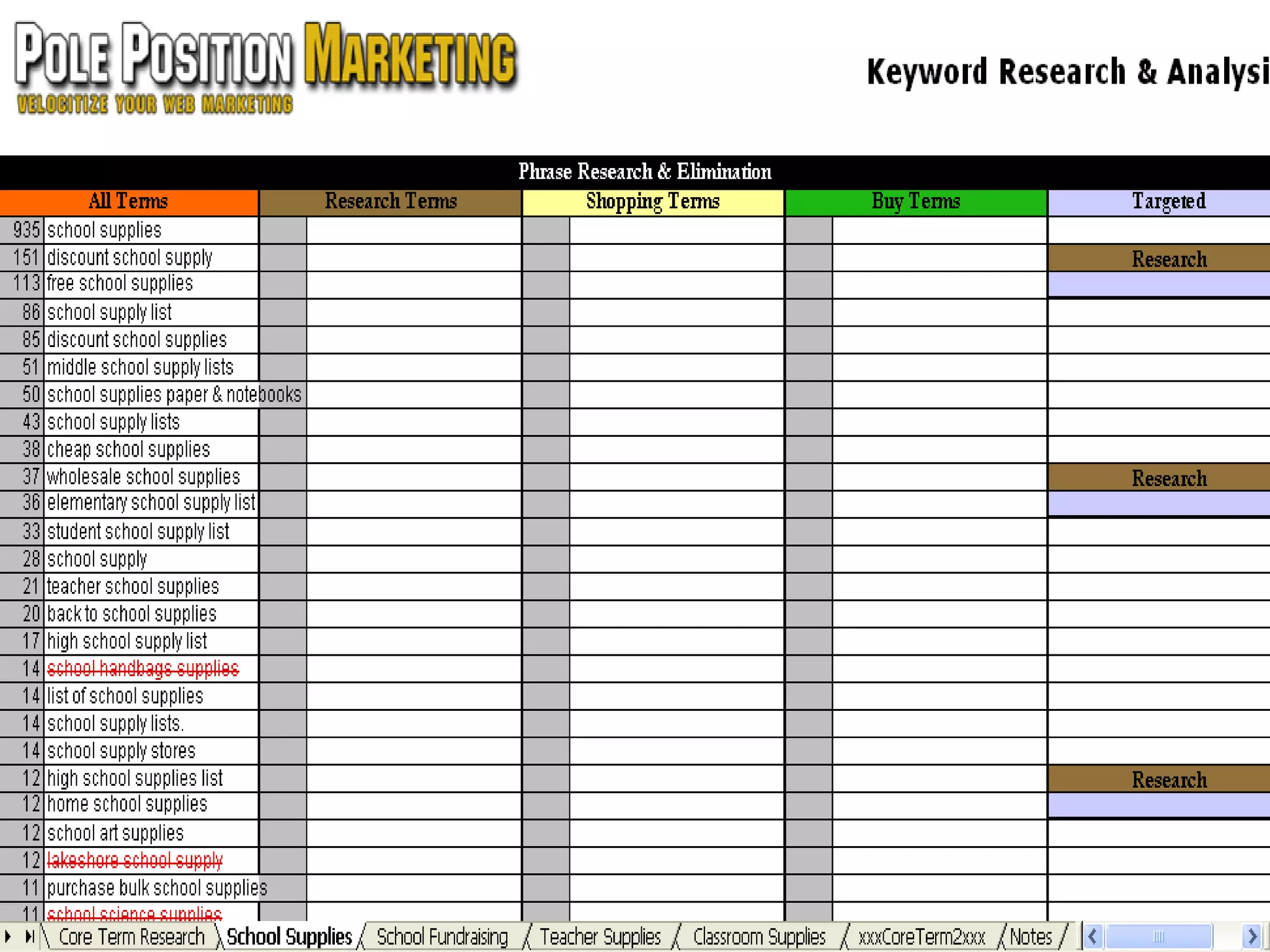
Researching Search Phrases   Search phrase spreadsheet
Phase IV  Organizing Keywords for Success
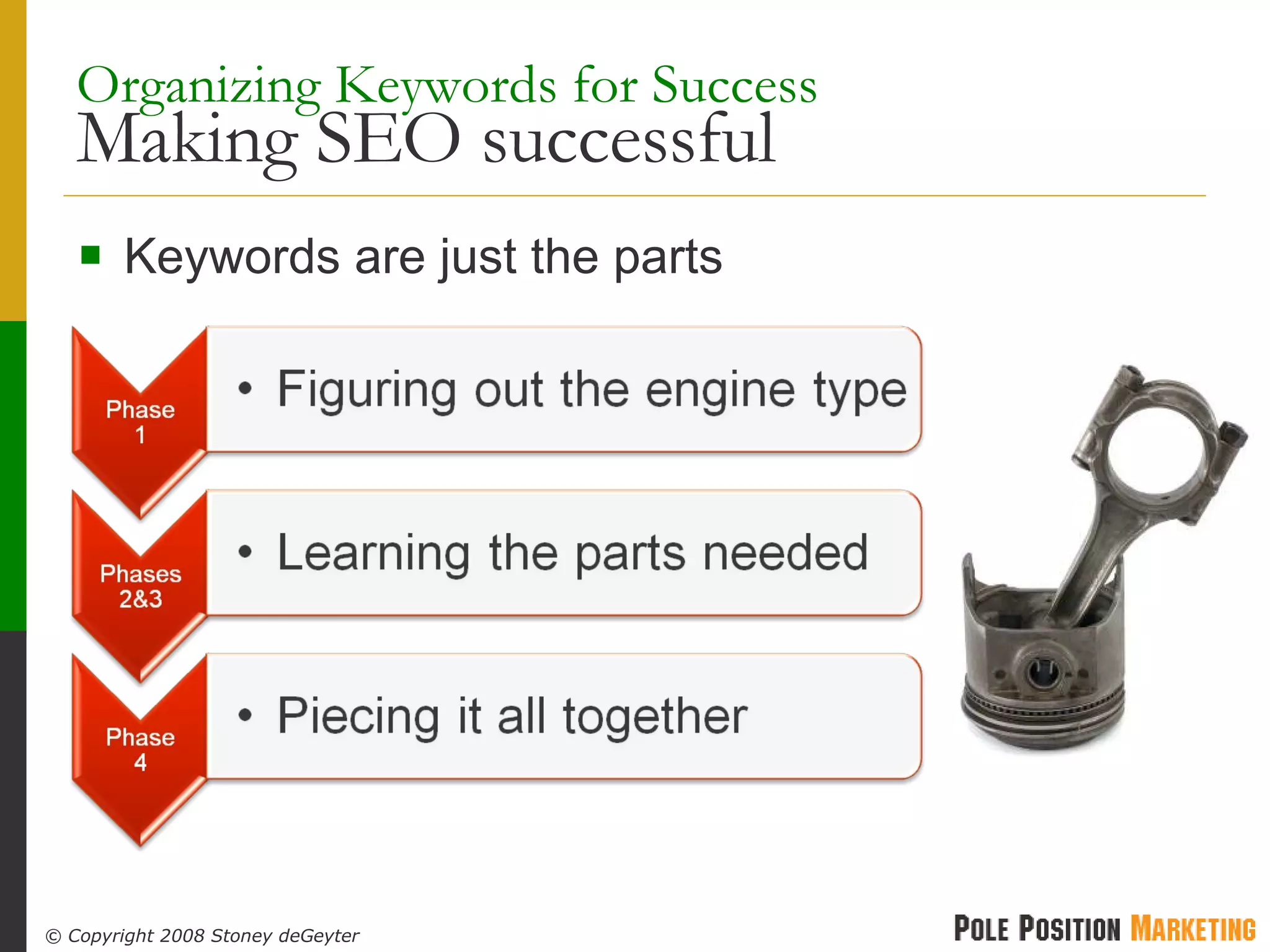
Keywords are just the parts Organizing Keywords for Success Making SEO successful
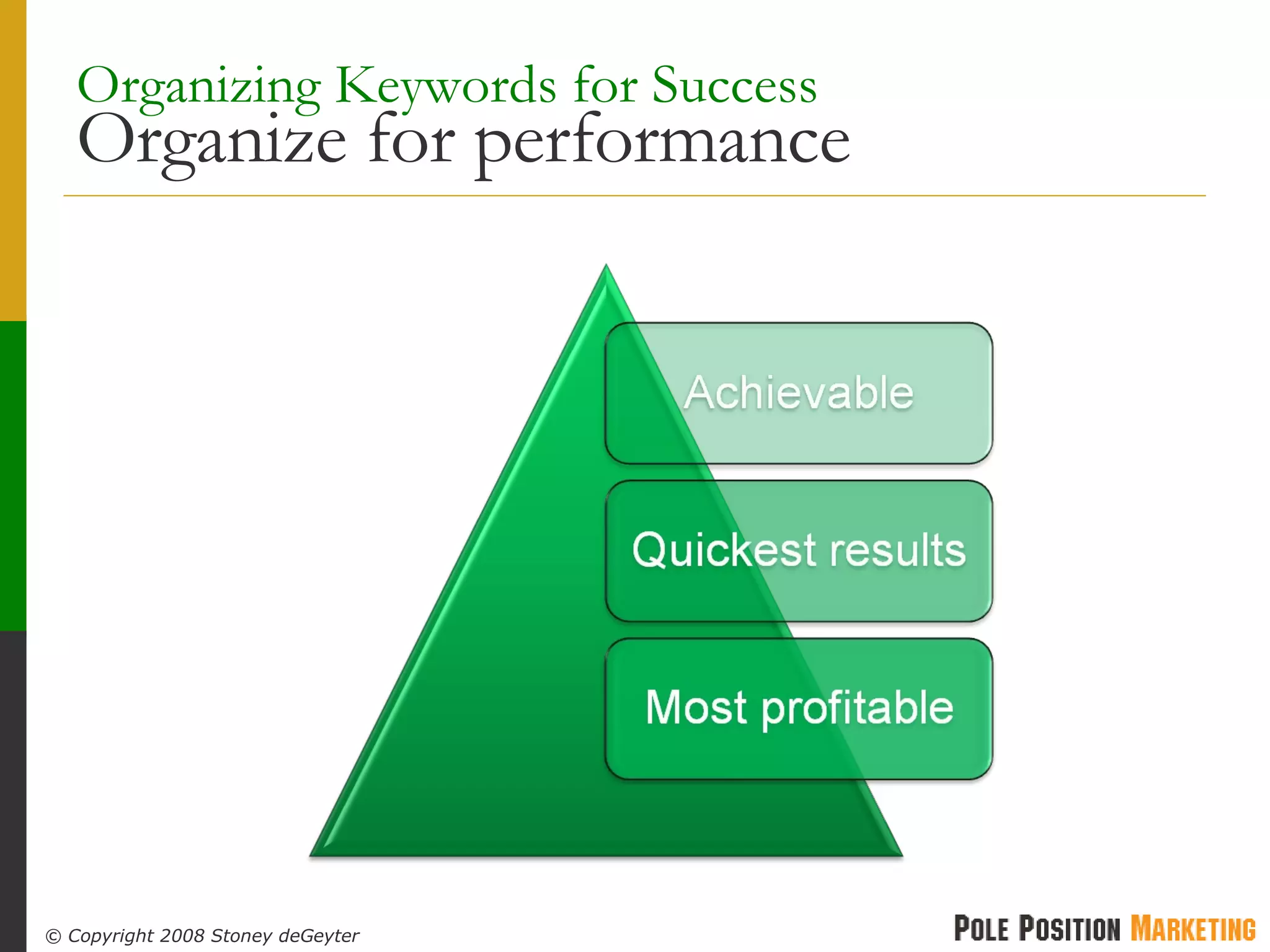
Organizing Keywords for Success Organize for performance
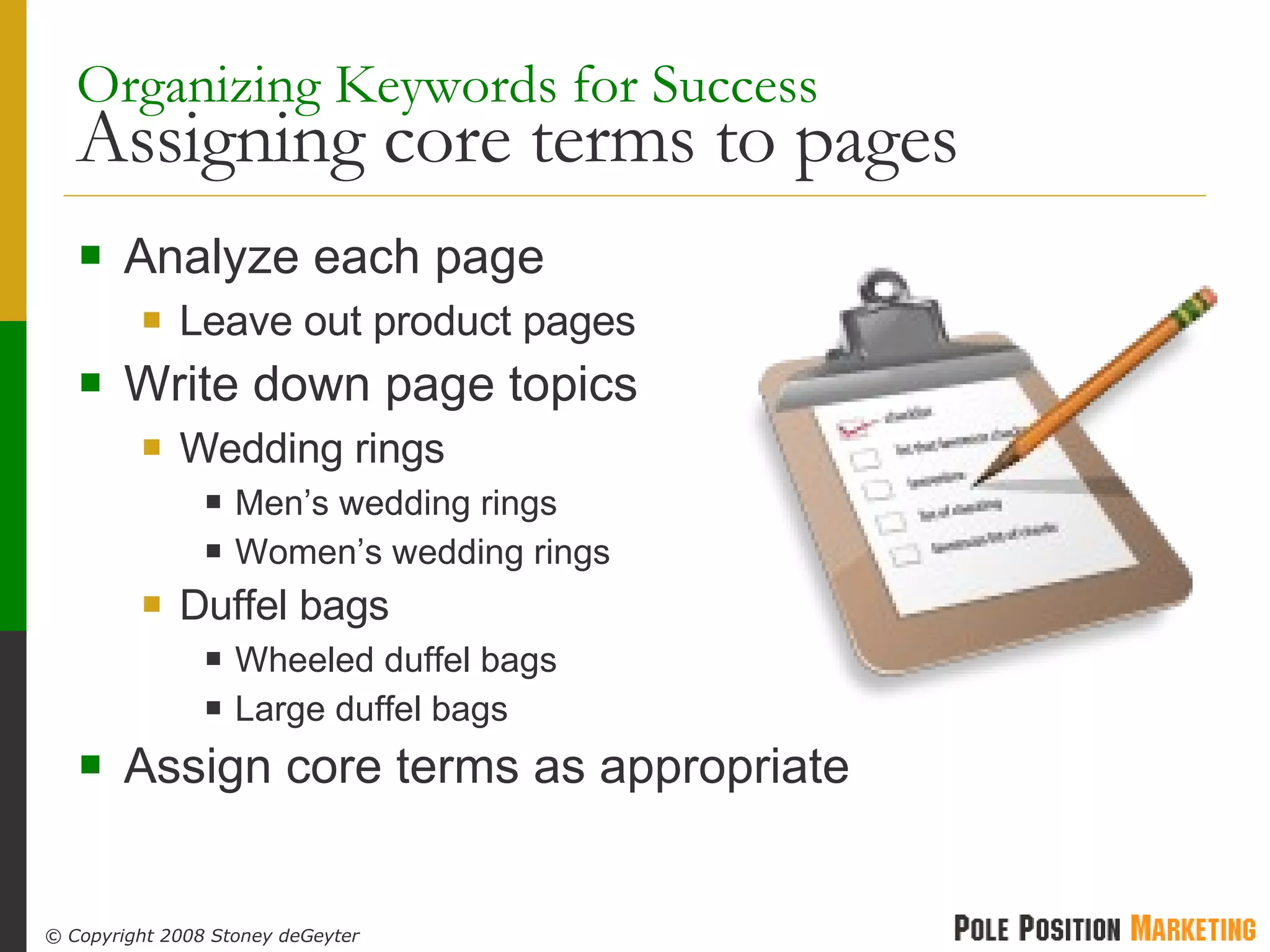
Organizing Keywords for Success  Assigning core terms to pages Analyze each page Leave out product pages Write down page topics Wedding rings Men’s wedding rings Women’s wedding rings Duffel bags Wheeled duffel bags Large duffel bags Assign core terms as appropriate
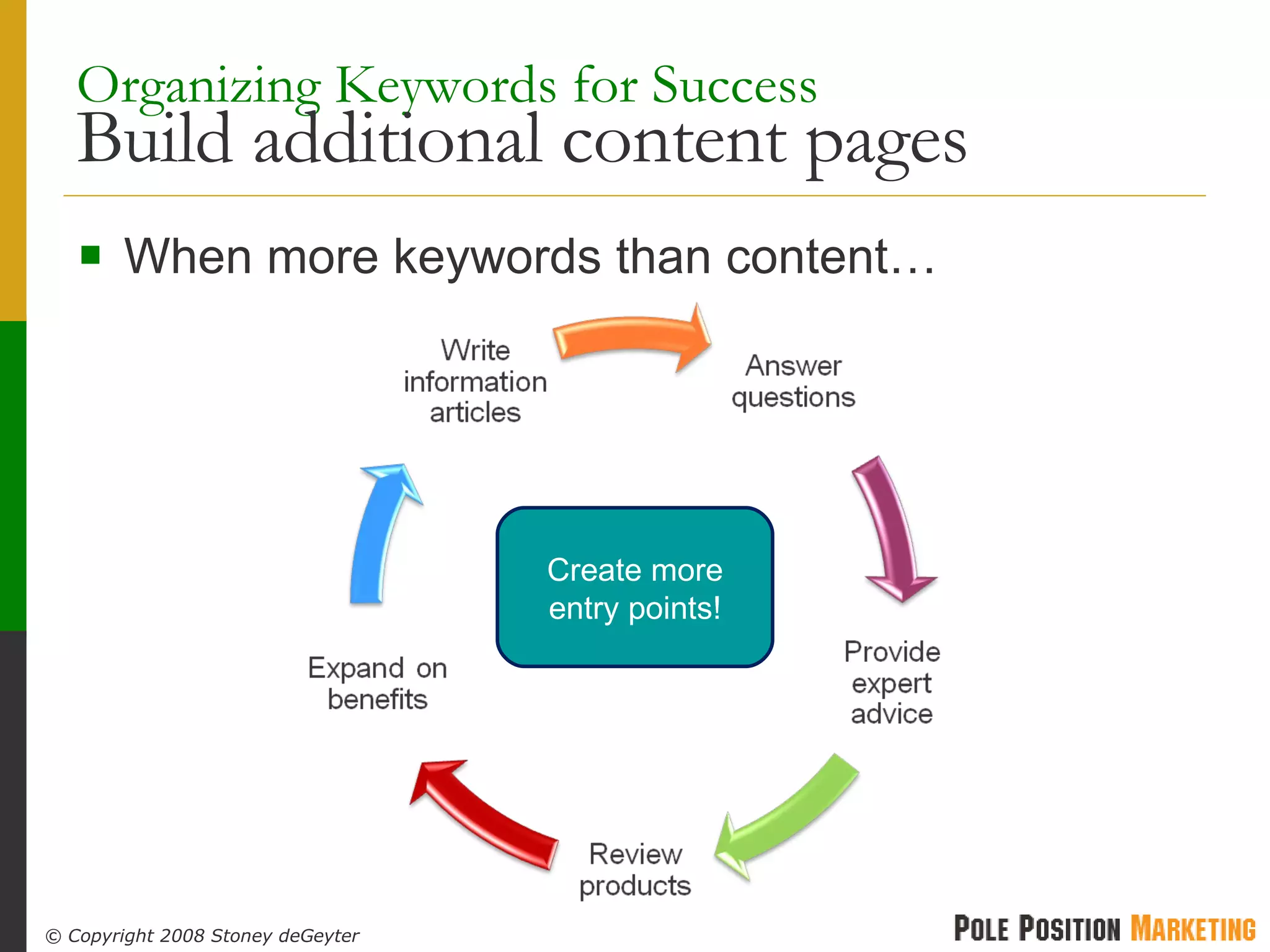
Organizing Keywords for Success  Build additional content pages When more keywords than content… Create more entry points!
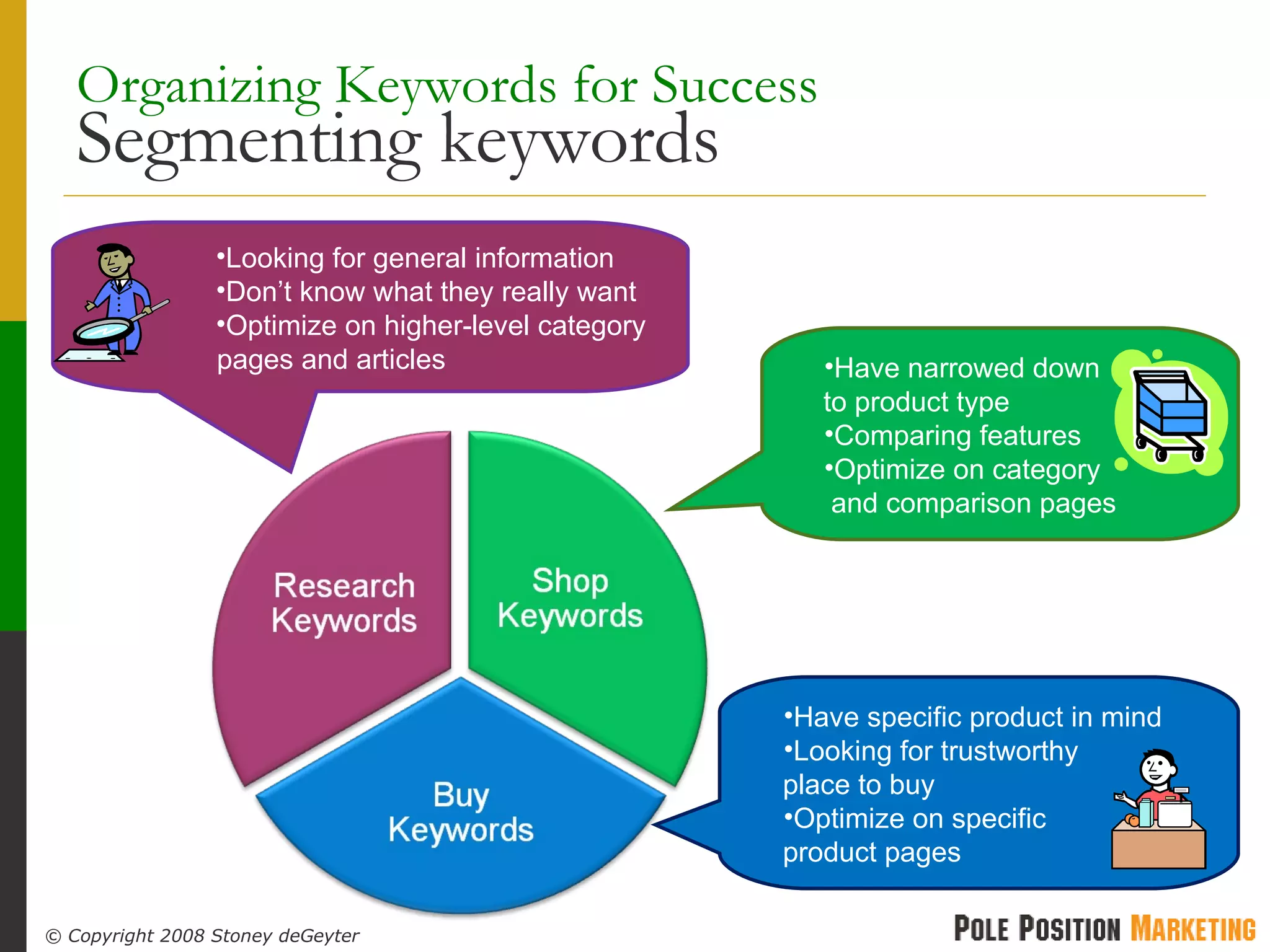
Organizing Keywords for Success  Segmenting keywords Looking for general information Don’t know what they really want Optimize on higher-level category   pages and articles Have narrowed down    to product type Comparing features Optimize on category    and comparison pages Have specific product in mind Looking for trustworthy   place to buy Optimize on specific   product pages
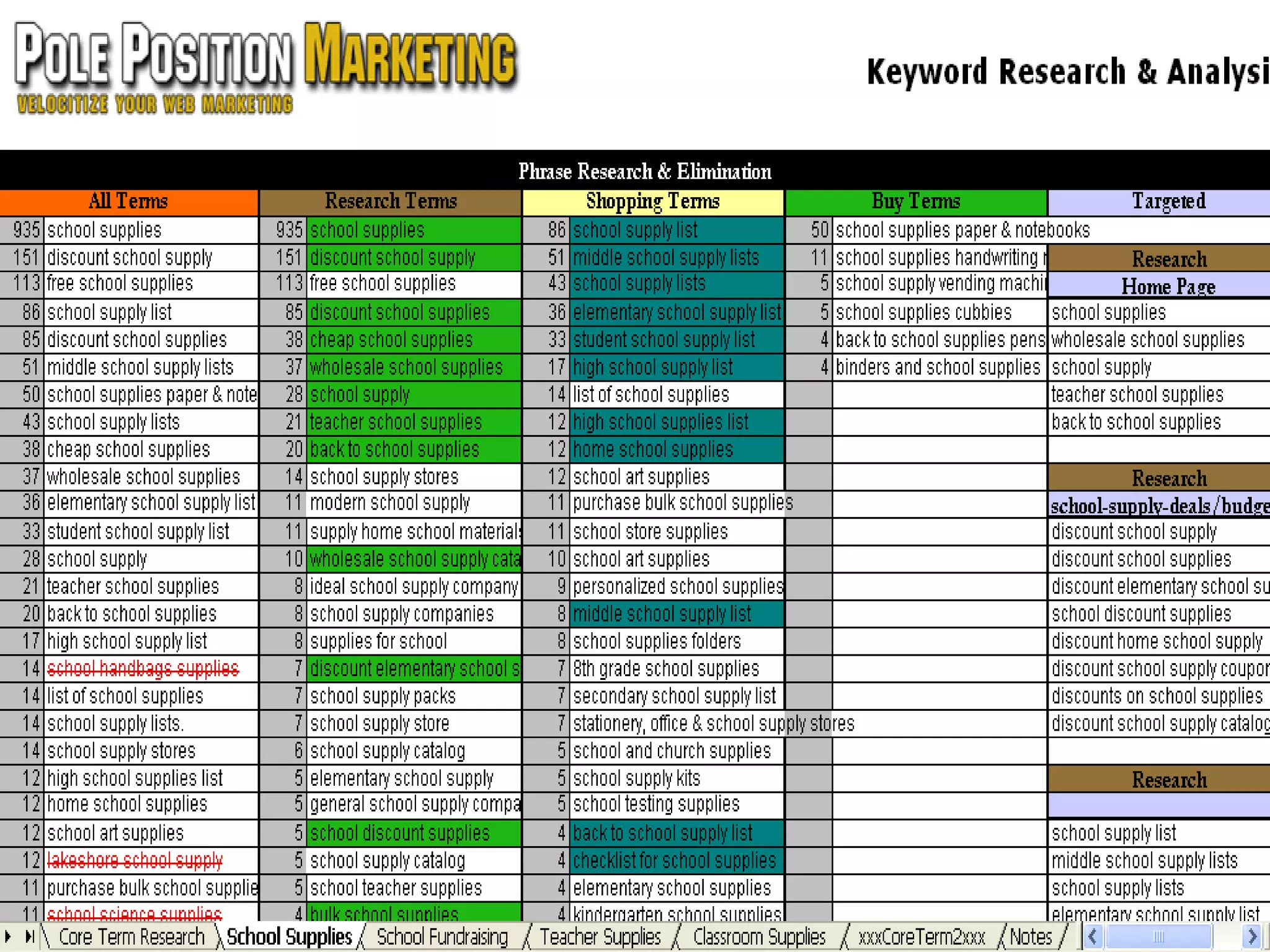
Organizing Keywords for Success  Search phrase spreadsheet
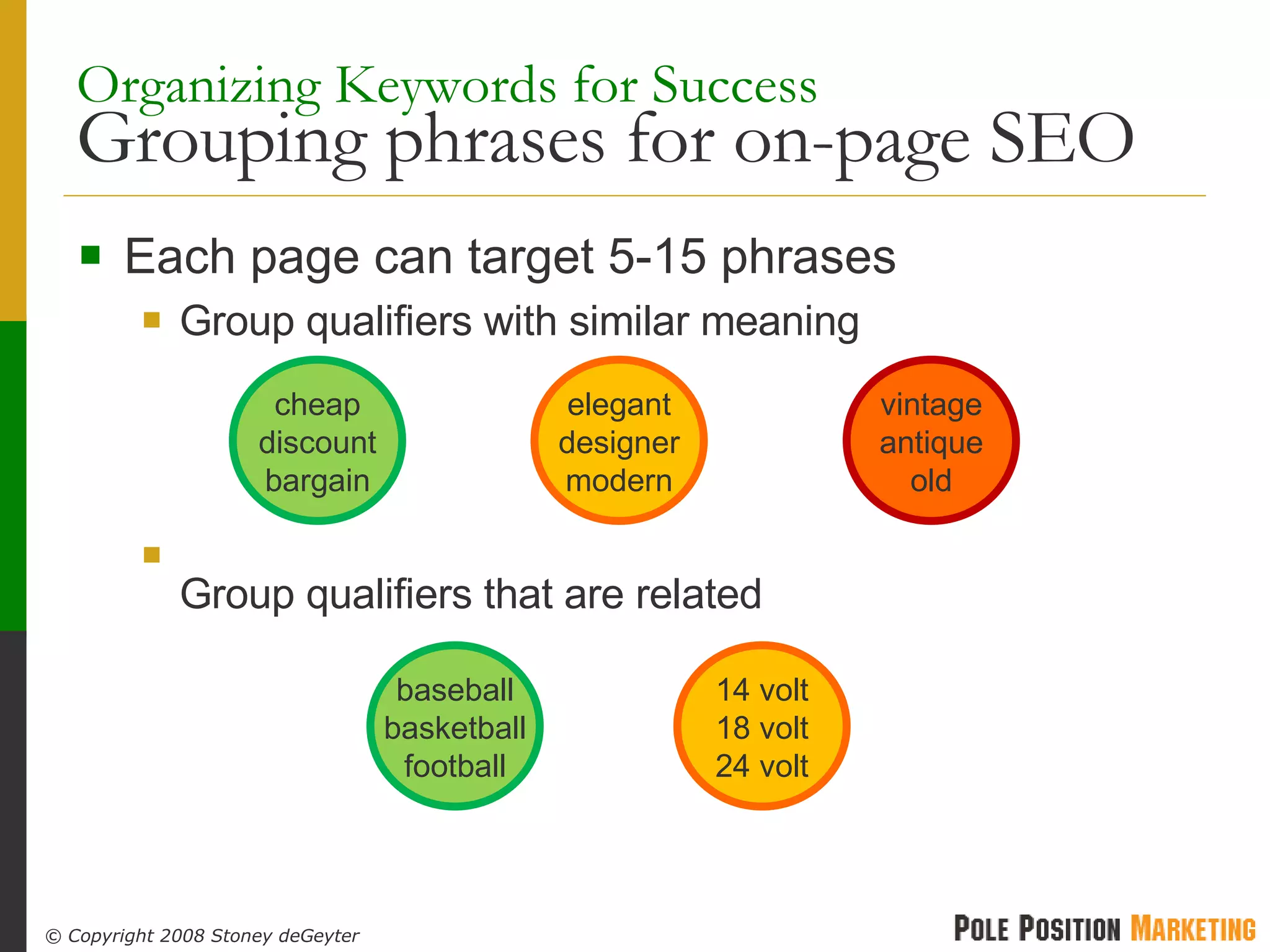
Organizing Keywords for Success  Grouping phrases for on-page SEO Each page can target 5-15 phrases Group qualifiers with similar meaning Group qualifiers that are related cheap discount bargain elegant designer modern vintage antique old baseball basketball football 14 volt 18 volt 24 volt
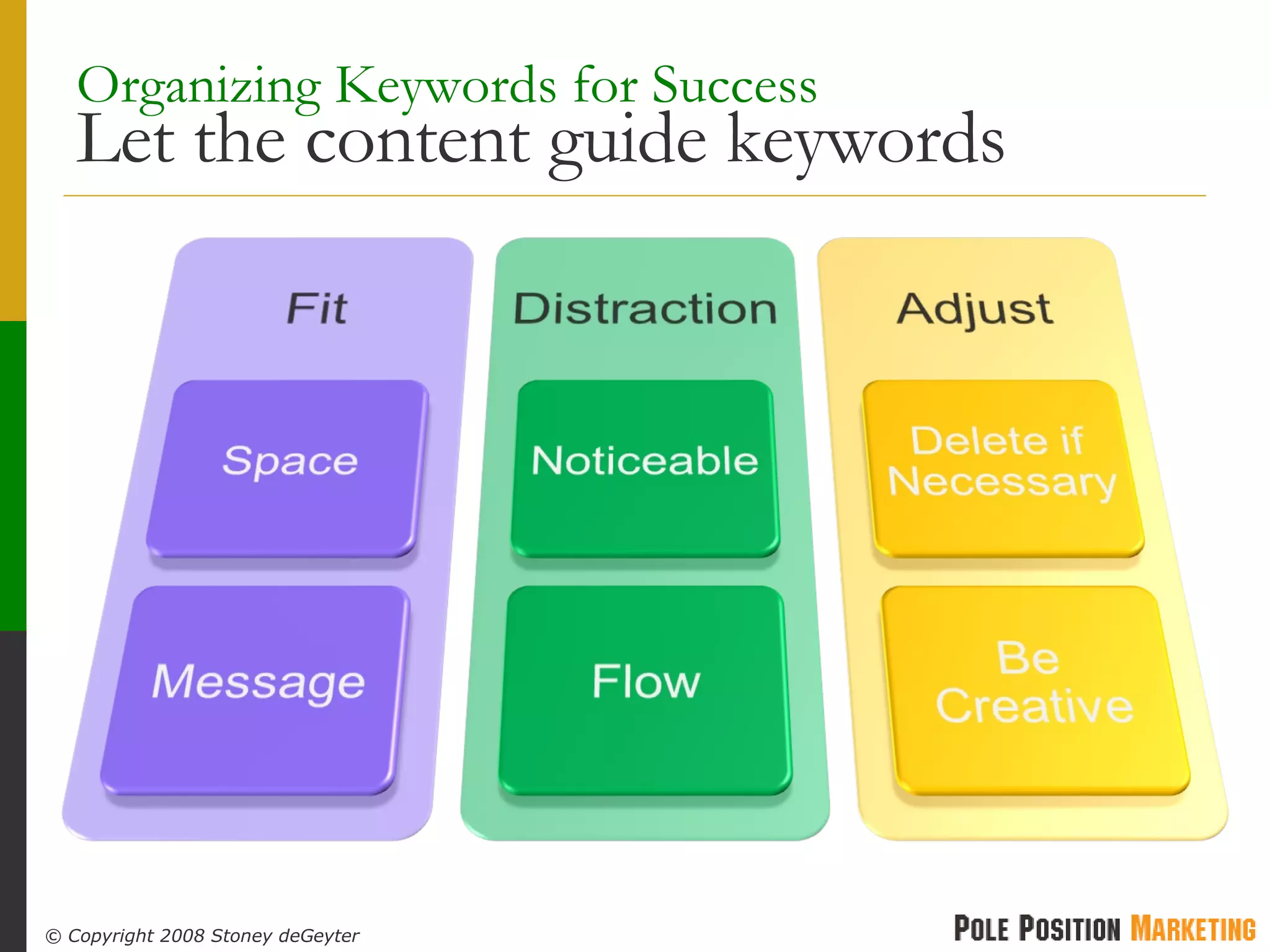
Organizing Keywords for Success  Let the content guide keywords
Organizing Keywords for Success  Search phrase spreadsheet
Conclusion
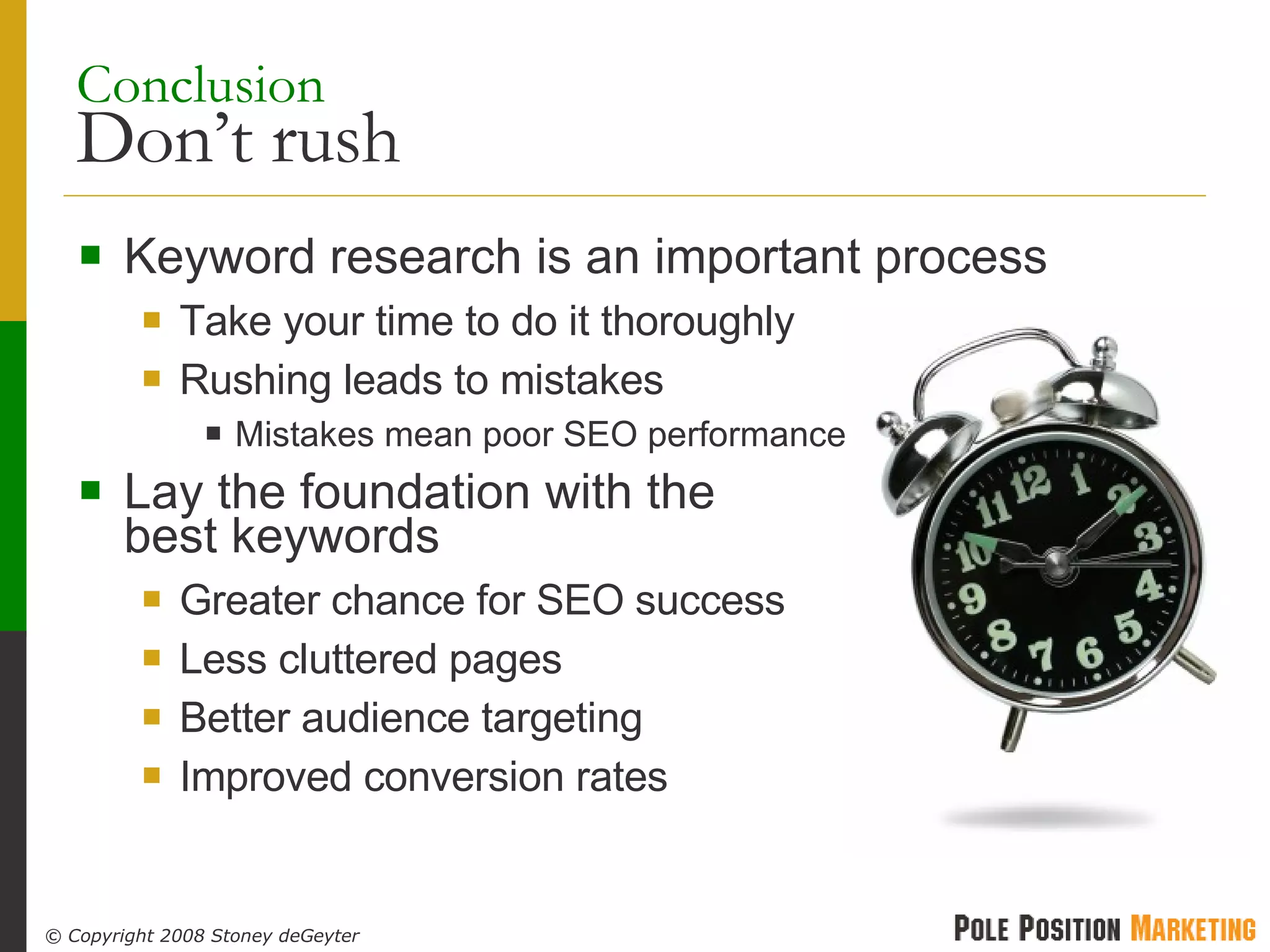
Conclusion   Don’t rush Keyword research is an important process Take your time to do it thoroughly Rushing leads to mistakes Mistakes mean poor SEO performance Lay the foundation with the  best keywords Greater chance for SEO success Less cluttered pages Better audience targeting Improved conversion rates
All good? Or…?
Thank You!  www.PolePositionMarketing.com

The Definitive Guide To Keyword Research

  • 1.
    Keyword Research and Selection The Definitive Guide to Gathering, Sorting and Organizing Your Keywords into a High-Performance SEO Campaign
  • 2.
  • 3.
    Introduction Why is it so darn important? Helps you know where your audience is How do they search? What words do they use? What’s their intent? Helps you know who your audience is Right keyword, wrong audience Right audience, different keyword searches Helps you target your audience properly SEARCH
  • 4.
    Introduction Keywords are foundational Essential for all marketing Before you begin… Research, research, research Take the time to do it right
  • 5.
    Introduction Not all keywords are equal Low volume keywords Produce little or no search traffic No traffic = no sales Poorly targeted keywords May produce lots of traffic Non-targeted traffic = fewer sales Smaller amounts of targeted traffic vs. Larger amounts of untargeted traffic
  • 6.
    Introduction It ain’t easy doing it right Quality keyword research is: Sometimes difficult Usually time-consuming Always important Stay focused Research thoroughly Analyze carefully Target thoughtfully
  • 7.
    Phase I FindingCore Terms
  • 8.
    Phase I: FindingCore Terms What is a core term? Represent page topic Two words (sometimes three) Broad but still on target Few qualifiers Keep term from being too broad Stay within niche Bag Sports bag Baby bedding Garage plans School supplies Kids ski clothing Cost segmentation Battery Motorcycle battery Battery chargers Flowmeters Snowmobile clothing Plastic key cards
  • 9.
    Words that aretoo broad What are they searching for? Won’t produce targeted traffic Doesn’t provide ROI Phase I: Finding Core Terms What’s not a core term? bag
  • 10.
    Phase I: FindingCore Terms How to find core terms Step 1: Pour through the website
  • 11.
    Step 2: BrainstormPhase I: Finding Core Terms How to find core terms What can I find in thesauri, taxonomies and ontologies? What is the average customer searching for? What are my visitors trying to accomplish? What terms are used in industry glossaries and reference materials? What solutions do I provide? Are there any geographical phrases that are relevant? What terminology describes problems I solve? What related categories can I find in search directories? What questions are my visitors asking?
  • 12.
    Phase I: FindingCore Terms How to find core terms Step 3: Comb through competitors websites Ignore what you don’t offer Avoid trademarked terms TM
  • 13.
    Step 4: Usekeyword research tools Search out other core terms Scan results for something new Look for new core terms New words not previously found Phase I: Finding Core Terms How to find core terms
  • 14.
    Phase I: FindingCore Terms How to find core terms Step 5: Analytics & server logs
  • 15.
    Phase I: FindingCore Terms How much is enough? There is no magic number Might have 10 or 10,000! Terms may change over time Some added some removed Not all will be valuable Will know more during analysis phase teacher supplies teaching supplies free teacher supplies teacher supply stores teacher supply free teaching supplies teacher supply store elementary teacher supplies
  • 16.
    Phase I: FindingCore Terms Four factors of prioritization
  • 17.
    Phase I: FindingCore Terms Look beyond “right now” Current exposure factors into current sales
  • 18.
  • 19.
    Phase II ResearchingSearch Phrases
  • 20.
    Phase II: ResearchingSearch Phrases What is a search phrase? Stemmed variation of the core term Core term with attached modifiers Stemmed variation of the core term with modifiers Any group of words that contain the core term
  • 21.
    Phase II: ResearchingSearch Phrases How to find search phrases The time factor
  • 22.
    Phase II: ResearchingSearch Phrases How to find search phrases The research factor
  • 23.
    Phase II: ResearchingSearch Phrases How to find search phrases The deletion factor Remove phrases with bogus words Eliminate phrases that change meaning of intent Delete unrelated terms Keep if unsure
  • 24.
    Phase II: ResearchingSearch Phrases How to find search phrases The split / combo factor
  • 25.
    Phase II: ResearchingSearch Phrases Combining core terms When to combine Fewer than 10 good phrases Exception for niche industries All phrases are low search volume How to combine Group most similar together Avoid inconsistent spellings Verify on-page unity
  • 26.
    Phase II: ResearchingSearch Phrases Splitting into sub-core groups When to split Over 150 phrases See dozens of similar qualifiers Qualifiers with similar meaning Split as often as makes sense 10-15 similar qualifiers
  • 27.
    Researching Search Phrases Search phrase spreadsheet
  • 28.
    Phase III Analyzingand Eliminating Keywords
  • 29.
    Analyzing and EliminatingKeywords Phrase types
  • 30.
    Analyzing and EliminatingKeywords Single word phrases High volume, low targeted traffic Pre-refined searches Haven’t qualified search yet Searchers re-do searches Produces poor results Low ROI Traffic does not equal sales Effort too great for results
  • 31.
    Analyzing and EliminatingKeywords Multi-word phrases Lower search volume, Higher targeting More conversions than higher searched terms More opportunities for exposure Multiple word combinations means more visibility
  • 32.
    Analyzing and EliminatingKeywords Multiple phrase variations Plurals, singulars and stems “ s,” “es,” “ing,” “ed,” Changed word order pontiac used car used pontiac car Don’t focus on word order Use exact core phrase Use additional words independently Make sure copy flows
  • 33.
    Analyzing and EliminatingKeywords Localized phrases Geo-targeting improves conversions Eliminates calls and emails from non-local customers Focuses your time on target audience Add geo-qualifiers as necessary Specific market segments City, county, state, zip, etc.
  • 34.
    Analyzing and EliminatingKeywords Keywords that convert Analyze for convertability Searcher intent Meet searcher need Offer that specific product or service? Adidas should not optimize for “air jordan” Don’t target “discount” if you don’t offer it Don’t optimize “cheap” if you’re not Eliminate phrases that don’t convert
  • 35.
    Analyzing and EliminatingKeywords Measurable search volume Actively searched phrases No searches = no traffic = no sales When is no volume OK Different tools produce different results Inaccurate data in niche industries Geo targeted terms Start with lower-hanging fruit Easier for newer sites Quicker results on less competitive phrases Add competitive phrases as site strength builds
  • 36.
    Analyzing and EliminatingKeywords Informational queries Answers “about” type questions “ How to create a gift basket” “ Best digital camera” “ Where to board in Nevada” Target as secondary Draws additional traffic Builds loyalty Researchers turn to shoppers Provides opportunity for links Product reviews Product comparisons How-to articles
  • 37.
    Analyzing and EliminatingKeywords Analyzing phrases for quality What is the customer looking for? Is the query clear? Future / seasonal trends? What’s missing in SERPs? Where’s the ROI?
  • 38.
  • 39.
    Analyzing and EliminatingKeywords Don’t rely on your own analysis Seek out additional opinions Colleagues Assistants Managers Outside experts Clients
  • 40.
    Researching Search Phrases Search phrase spreadsheet
  • 41.
    Phase IV Organizing Keywords for Success
  • 42.
    Keywords are justthe parts Organizing Keywords for Success Making SEO successful
  • 43.
    Organizing Keywords forSuccess Organize for performance
  • 44.
    Organizing Keywords forSuccess Assigning core terms to pages Analyze each page Leave out product pages Write down page topics Wedding rings Men’s wedding rings Women’s wedding rings Duffel bags Wheeled duffel bags Large duffel bags Assign core terms as appropriate
  • 45.
    Organizing Keywords forSuccess Build additional content pages When more keywords than content… Create more entry points!
  • 46.
    Organizing Keywords forSuccess Segmenting keywords Looking for general information Don’t know what they really want Optimize on higher-level category pages and articles Have narrowed down to product type Comparing features Optimize on category and comparison pages Have specific product in mind Looking for trustworthy place to buy Optimize on specific product pages
  • 47.
    Organizing Keywords forSuccess Search phrase spreadsheet
  • 48.
    Organizing Keywords forSuccess Grouping phrases for on-page SEO Each page can target 5-15 phrases Group qualifiers with similar meaning Group qualifiers that are related cheap discount bargain elegant designer modern vintage antique old baseball basketball football 14 volt 18 volt 24 volt
  • 49.
    Organizing Keywords forSuccess Let the content guide keywords
  • 50.
    Organizing Keywords forSuccess Search phrase spreadsheet
  • 51.
  • 52.
    Conclusion Don’t rush Keyword research is an important process Take your time to do it thoroughly Rushing leads to mistakes Mistakes mean poor SEO performance Lay the foundation with the best keywords Greater chance for SEO success Less cluttered pages Better audience targeting Improved conversion rates
  • 53.
  • 54.
    Thank You! www.PolePositionMarketing.com