Web Savvy Marketing & iThemes Media LLC Copyright © 2016, All Rights Reserved
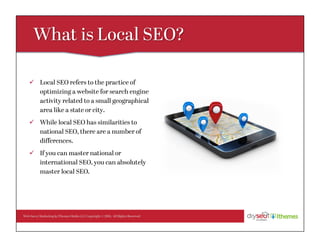
ü  Local SEO refers to the practice of
optimizing a website for search engine
activity related to a small geographical
area like a state or city.
ü  While local SEO has similarities to
national SEO, there are a number of
differences.
ü  If you can master national or
international SEO, you can absolutely
master local SEO.
Web Savvy Marketing & iThemes Media LLC Copyright © 2016, All Rights Reserved
ü  Keyword Only– Keywords without a city name rely more heavily on traditional organic
ranking factors, although in some cases they can still include local results. Examples of
this would be a website designer or divorce attorney.
ü  Keyword & Location – Keywords that include a city name rely more heavily on true local
ranking factors and will most likely pull from local listings like Google My Business or
Google+ pages. An example of this would be Michigan vacation spots or Detroit
plumber.
ü  Mobile Based Searches - Keyword searches performed on mobile devices can produce
very different results then that of desktop computers. A desktop and a mobile phone
search can have completely different results for the exact same phrase which confuses
and frustrates a lot of marketers. Such search inquiries and results can occur with or
without a geographical phrase added to the search term.
Web Savvy Marketing & iThemes Media LLC Copyright © 2016, All Rights Reserved
ü  Soda vs. Pop vs. Coke
ü  Football vs. Soccer
ü  Frying Pan vs. Skillet
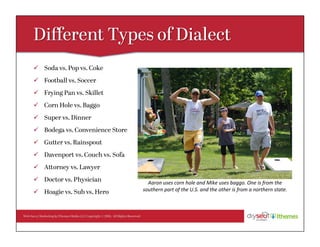
ü  Corn Hole vs. Baggo
ü  Super vs. Dinner
ü  Bodega vs. Convenience Store
ü  Gutter vs. Rainspout
ü  Davenport vs. Couch vs. Sofa
ü  Attorney vs. Lawyer
ü  Doctor vs. Physician
ü  Hoagie vs. Sub vs. Hero
Aaron	uses	corn	hole	and	Mike	uses	baggo.	One	is	from	the	
southern	part	of	the	U.S.	and	the	other	is	from	a	northern	state.
Web Savvy Marketing & iThemes Media LLC Copyright © 2016, All Rights Reserved
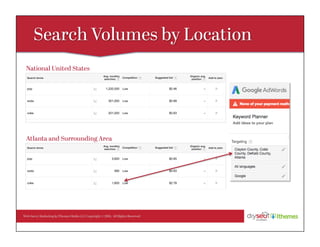
National United States
Atlanta and Surrounding Area
Web Savvy Marketing & iThemes Media LLC Copyright © 2016, All Rights Reserved
1.  Authority- Just like in national search, the authority of a
businesses’ domain (website address) matters a lot.
2.  Keyword Focus – Keyword usage and proper site
mapping is important.
3.  Presence of Key NAP Data – NAP means name, address,
and phone number. This is the heart of local SEO.
–  Contact information on the website becomes
critical, but it doesn’t mean throw your location (city
or state) in all your content text and H1 headers.
–  NAP should be placed in the header or footer so it
displays on all content pages and posts.
–  Phone number should include an actual area code
and not just an 800 number.
–  Multiple locations requires multiple location pages.
Web Savvy Marketing & iThemes Media LLC Copyright © 2016, All Rights Reserved
4.  Inbound Links - Just as with national SEO, local SEO
relies on both quantity and quality of inbound links to
local businesses’ websites from external sites.
5.  Google My Business & Google+ - These social media
profiles should have accurate and optimized categories
and relevant keywords in business descriptions.
6.  External Directory References - The availability and
consistency of NAP (name, address, phone number) on
other third-party local business directories is important.
Examples include Yelp, Angie’s List, Manta, Foursquare,
Merchant Circle, TripAdvisor, and Internet Yellow Pages.
Web Savvy Marketing & iThemes Media LLC Copyright © 2016, All Rights Reserved
7.  User Behavioral & Mobile Usage - User behavior and
mobile usage are both considerations. Examples of such
factors include user click through rates from search,
check-ins, and user calls to a business.
8.  Search Personalization - Search personalization includes
results provided to users based on what is most relevant
to their interests or located closest to their physical
location.
9.  Reviews - The quantity and diversity of online reviews
and rankings will also influence local search
optimization efforts. These user reviews would be
positive reviews from real users on legitimate websites.
10.  Social Media Signals - Google+ authority, Facebook likes,
and Twitter followers provide additional influence in
determining local search performance.
Web Savvy Marketing & iThemes Media LLC Copyright © 2016, All Rights Reserved
ü  Relevance - Relevance is how well a local listing
matches what someone is searching for. Adding
complete and detailed business information
can help Google better understand your
business and match you to relevant search
results.
ü  Distance - Just like it sounds — how far is each potential search result from the
location term used in a search? If you don’t specify a location in your search, Google
will calculate distance based on what it knows about your location.
ü  Prominence - This describes how well-known or prominent a business can be. This is
based on information Google has about a business from across the web (like links,
articles, and directories). Some places are more prominent in the offline world, and
Google will try to reflect this online as well.
Web Savvy Marketing & iThemes Media LLC Copyright © 2016, All Rights Reserved
ü  Website name
ü  URLs – main and cornerstone content
ü  Contact information
ü  Phone number – local area code for small geographical
focused sites
ü  Top search terms – your top five search terms
ü  Short description that uses these search terms (25-50
words)
ü  Long description that uses these search terms
ü  Logo files – various sizes and file types
ü  Images used in main website branding or for products
and services
Web Savvy Marketing & iThemes Media LLC Copyright © 2016, All Rights Reserved
ü  Add your address and phone number in the footer or
header of your website. Use your local area code and not
just an 800.
ü  Sign up for a Google My Business or Google+ page.
ü  Use other social media where applicable. Facebook is
always good for local SEO.
ü  Encourage customers to check in and leave reviews.
ü  Use a consistent format for your address and information.
ü  Use keywords within your business descriptions.
ü  Check your local listings to see if they are accurate.
ü  Add your business to new local directories or use a service
like Yext’s PowerListings or GoDaddy’s Get Found.
Web Savvy Marketing & iThemes Media LLC Copyright © 2016, All Rights Reserved
ü  Usage of 800 numbers, but no local area
code.
ü  Phone numbers as images and not text.
ü  Digital business listing is different than
the actual physical address of the
business.
ü  Duplicate listings in local search
directories.
ü  Inconsistency with business name,
address, or phone number in online
directories.
ü  Incorrect categories used in local
directories such as Google My Business.
ü  Unverified listings in local directories.
Web Savvy Marketing & iThemes Media LLC Copyright © 2016, All Rights Reserved
Rebecca Gill
Founder of Web Savvy Marketing
Instructor at DIYSEOcourses.com
@rebeccagill on Twitter
Download this presentation at:
Slideshare.net/rebeccagill

Mastering Local SEO

  • 1.
    Web Savvy Marketing& iThemes Media LLC Copyright © 2016, All Rights Reserved
  • 2.
    Web Savvy Marketing& iThemes Media LLC Copyright © 2016, All Rights Reserved
  • 3.
    Web Savvy Marketing& iThemes Media LLC Copyright © 2016, All Rights Reserved
  • 4.
    Web Savvy Marketing& iThemes Media LLC Copyright © 2016, All Rights Reserved ü  Local SEO refers to the practice of optimizing a website for search engine activity related to a small geographical area like a state or city. ü  While local SEO has similarities to national SEO, there are a number of differences. ü  If you can master national or international SEO, you can absolutely master local SEO.
  • 5.
    Web Savvy Marketing& iThemes Media LLC Copyright © 2016, All Rights Reserved ü  Keyword Only– Keywords without a city name rely more heavily on traditional organic ranking factors, although in some cases they can still include local results. Examples of this would be a website designer or divorce attorney. ü  Keyword & Location – Keywords that include a city name rely more heavily on true local ranking factors and will most likely pull from local listings like Google My Business or Google+ pages. An example of this would be Michigan vacation spots or Detroit plumber. ü  Mobile Based Searches - Keyword searches performed on mobile devices can produce very different results then that of desktop computers. A desktop and a mobile phone search can have completely different results for the exact same phrase which confuses and frustrates a lot of marketers. Such search inquiries and results can occur with or without a geographical phrase added to the search term.
  • 6.
    Web Savvy Marketing& iThemes Media LLC Copyright © 2016, All Rights Reserved ü  Soda vs. Pop vs. Coke ü  Football vs. Soccer ü  Frying Pan vs. Skillet ü  Corn Hole vs. Baggo ü  Super vs. Dinner ü  Bodega vs. Convenience Store ü  Gutter vs. Rainspout ü  Davenport vs. Couch vs. Sofa ü  Attorney vs. Lawyer ü  Doctor vs. Physician ü  Hoagie vs. Sub vs. Hero Aaron uses corn hole and Mike uses baggo. One is from the southern part of the U.S. and the other is from a northern state.
  • 7.
    Web Savvy Marketing& iThemes Media LLC Copyright © 2016, All Rights Reserved National United States Atlanta and Surrounding Area
  • 8.
    Web Savvy Marketing& iThemes Media LLC Copyright © 2016, All Rights Reserved 1.  Authority- Just like in national search, the authority of a businesses’ domain (website address) matters a lot. 2.  Keyword Focus – Keyword usage and proper site mapping is important. 3.  Presence of Key NAP Data – NAP means name, address, and phone number. This is the heart of local SEO. –  Contact information on the website becomes critical, but it doesn’t mean throw your location (city or state) in all your content text and H1 headers. –  NAP should be placed in the header or footer so it displays on all content pages and posts. –  Phone number should include an actual area code and not just an 800 number. –  Multiple locations requires multiple location pages.
  • 9.
    Web Savvy Marketing& iThemes Media LLC Copyright © 2016, All Rights Reserved 4.  Inbound Links - Just as with national SEO, local SEO relies on both quantity and quality of inbound links to local businesses’ websites from external sites. 5.  Google My Business & Google+ - These social media profiles should have accurate and optimized categories and relevant keywords in business descriptions. 6.  External Directory References - The availability and consistency of NAP (name, address, phone number) on other third-party local business directories is important. Examples include Yelp, Angie’s List, Manta, Foursquare, Merchant Circle, TripAdvisor, and Internet Yellow Pages.
  • 10.
    Web Savvy Marketing& iThemes Media LLC Copyright © 2016, All Rights Reserved 7.  User Behavioral & Mobile Usage - User behavior and mobile usage are both considerations. Examples of such factors include user click through rates from search, check-ins, and user calls to a business. 8.  Search Personalization - Search personalization includes results provided to users based on what is most relevant to their interests or located closest to their physical location. 9.  Reviews - The quantity and diversity of online reviews and rankings will also influence local search optimization efforts. These user reviews would be positive reviews from real users on legitimate websites. 10.  Social Media Signals - Google+ authority, Facebook likes, and Twitter followers provide additional influence in determining local search performance.
  • 11.
    Web Savvy Marketing& iThemes Media LLC Copyright © 2016, All Rights Reserved ü  Relevance - Relevance is how well a local listing matches what someone is searching for. Adding complete and detailed business information can help Google better understand your business and match you to relevant search results. ü  Distance - Just like it sounds — how far is each potential search result from the location term used in a search? If you don’t specify a location in your search, Google will calculate distance based on what it knows about your location. ü  Prominence - This describes how well-known or prominent a business can be. This is based on information Google has about a business from across the web (like links, articles, and directories). Some places are more prominent in the offline world, and Google will try to reflect this online as well.
  • 12.
    Web Savvy Marketing& iThemes Media LLC Copyright © 2016, All Rights Reserved ü  Website name ü  URLs – main and cornerstone content ü  Contact information ü  Phone number – local area code for small geographical focused sites ü  Top search terms – your top five search terms ü  Short description that uses these search terms (25-50 words) ü  Long description that uses these search terms ü  Logo files – various sizes and file types ü  Images used in main website branding or for products and services
  • 13.
    Web Savvy Marketing& iThemes Media LLC Copyright © 2016, All Rights Reserved ü  Add your address and phone number in the footer or header of your website. Use your local area code and not just an 800. ü  Sign up for a Google My Business or Google+ page. ü  Use other social media where applicable. Facebook is always good for local SEO. ü  Encourage customers to check in and leave reviews. ü  Use a consistent format for your address and information. ü  Use keywords within your business descriptions. ü  Check your local listings to see if they are accurate. ü  Add your business to new local directories or use a service like Yext’s PowerListings or GoDaddy’s Get Found.
  • 14.
    Web Savvy Marketing& iThemes Media LLC Copyright © 2016, All Rights Reserved
  • 15.
    Web Savvy Marketing& iThemes Media LLC Copyright © 2016, All Rights Reserved ü  Usage of 800 numbers, but no local area code. ü  Phone numbers as images and not text. ü  Digital business listing is different than the actual physical address of the business. ü  Duplicate listings in local search directories. ü  Inconsistency with business name, address, or phone number in online directories. ü  Incorrect categories used in local directories such as Google My Business. ü  Unverified listings in local directories.
  • 16.
    Web Savvy Marketing& iThemes Media LLC Copyright © 2016, All Rights Reserved Rebecca Gill Founder of Web Savvy Marketing Instructor at DIYSEOcourses.com @rebeccagill on Twitter Download this presentation at: Slideshare.net/rebeccagill