The Data Analysis Workflow
Professor Vernon Gayle
vernon.gayle@ed.ac.uk
@Profbigvern
https://github.com/vernongayle
The Data Analysis
Workflow
1. Have you ever lost a file?
2. Have you ever wondered if you have
deleted a file?
3. Have you and a colleague ever been
working on different versions of a file?
A Thought Experiment (be honest…)
4. Have you ever struggled to identify data files?
chapter1_2019.dat
chap1_2019.dat
Be honest…A Thought Experiment (be honest…)
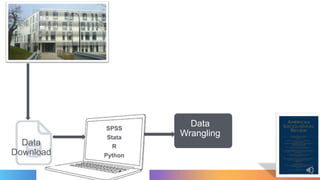
Data
Download
Data
Wrangling
SPSS
Stata
R
Python
Data
Download
Data
Wrangling
Exploratory
Data
Analysis
Statistical
Modelling
Write-Up
Results
SPSS
Stata
R
Python
Analysing data without a
planned and organised
workflow can be compared to
drinking and driving. In both
situations it doesn’t matter how
careful you are, it is still highly
likely to end in a wreck!
(Philip Stark UC Berkeley)
Therefore just like drinking and
driving, we strongly warn
against not having a
systematic workflow
The Workflow
Workflow should be planned and carefully
orchestrated
Workflow MUST NOT be adhoc
(e.g. piece-meal, developed as a reaction to mistakes etc.)
The Workflow
The Workflow Cycle
Data
Download
Data
Wrangling
SPSS
Stata
R
Python
GUIs will leave you in a sticky mess!
Drop down menus = no audit trail
Data Wrangling
• Selecting variables (surveys have large k)
• Operationalising measures (e.g. income; social class; education)
• Re-coding variables
• Selection cases (sub-samples in large surveys)
• Missing data
Data Wrangling
• Selecting variables (surveys have large k)
• Operationalising measures (e.g. income; social class;
education)
• Re-coding variables
• Selection cases (sub-samples in large surveys)
• Missing data
Minor actions in the
Data Wrangling Phase
can have major consequences!
Exploratory
Data
Analysis
Statistical
Modelling
Write-Up
Results
SPSS
Stata
R
Python
Data Analysis
• Which cases
• Which variables (format)
• Missing data
• Estimation method (mle; gls)
• Weights and survey structure (svy)
• Setting a seed
• Number of quadrature points
• Which version or library
Data Analysis
• Which cases
• Which variables (format)
• Missing data
• Estimation method (mle; gls)
• Weights and survey structure (svy)
• Setting a seed
• Number of quadrature points
• Which version or library
Better supporting YOU and what YOU DO
Not changing you into something YOU ARE NOT
Improving the Workflow
ALL SERIOUS WORK MUST
BE REPRODUCIBLE!
There MUST be an audit trail
Transparency
Progamming
Efficiency
Accuracy
Reproducibility
A Planned Workflow Has Benefits
• Accuracy
• minimising information loss and errors in analyses and output
• Programming Efficiency
• automation, maximising features in software
• Transparency
• showing what you did, why, when, how
• Reproducibility
• same results every time whoever or wherever
• editing, rewriting reports or re-submission of papers
26
Four Pillars of Wisdom
It is always easier to document today than it is tomorrow!
Corollary 1:
Nobody likes to write documentation
Corollary 2:
Nobody ever regrets having written documentation
Long’s Law
Has anyone in the history of data analysis ever said
“these files are too well documented”
Long’s Law
Good News
•Improving the workflow with a modest amount of
effort
•The less experience you have the better
(start from the very beginning)
Some Practical
Strategies and Tactics
Standard Directory Structure
File Naming Protocols
File Name = name_date_depositor's initials_version_type
Therefore bhpsaindresp_20140506_vg_v1.dta
Would be a
a. The British Household Panel Survey File “aindresp”
b. Deposited on 6th May 2014
c. Deposited by vg (Vernon Gayle)
d. Version v1
e. File type (e.g. a Stata .dta file)
File Naming Protocols
Analysis File Structure
and Information
Variable Naming Protocols
• Good data providers will tend to stick to clearly defined variable
naming conventions
• Wave 1 of UKHLS a_sex is the gender variable, and in wave 2
of the study b_sex is the gender variable (UK Data Archive
Study Number 6614)
• Youth Cohort Time Series for England, Wales and Scotland,
1984-2002 the variable t0schtyp is the type of school that the
pupil attended in Year 11 (at time point t0 in the study) (UK Data
Archive Study Number 5765)
By contrast in the less well curated Youth Cohort Study
of England and Wales Cohort 4 (UK Data Archive
Study Number 3107) this is the opaque variable
dx11_a
Variable Naming Protocols
Estimating Work Time…
Benefits of a Good Workflow
• Limits duplication of effort
• Systematic work minimises errors
• Helps to detect errors
• Editing work, resubmitting papers etc.
• Aids collaboration
• Supports additional (e.g. future) work
What To Do…
• Audit trail
• Don’t use drop menus ( a gui = a sticky mess)
• Systematic directory structure, file names, versions,
variable names etc.
• Plan! don’t do ad hoc work or work on the fly
• Write comments
J. Scott Long has posted a really good pdf version of a talk on the
workflow http://www.ihrp.uic.edu/files/Workflow%20Slides%20JSLong%20110410.pdf
http://eprints.ncrm.ac.uk/4000/
ALL SERIOUS WORK MUST
BE REPRODUCIBLE!
There MUST be an audit trail
How to cite this video
Gayle, V. (2020) The Data Analysis Workflow. Available at: https://www.ncrm.ac.uk
(Accessed: day month year)
The Data Analysis Workflow
Professor Vernon Gayle
vernon.gayle@ed.ac.uk
@Profbigvern
https://github.com/vernongayle

The Data Analysis Workflow

  • 1.
    The Data AnalysisWorkflow Professor Vernon Gayle vernon.gayle@ed.ac.uk @Profbigvern https://github.com/vernongayle
  • 3.
  • 4.
    1. Have youever lost a file? 2. Have you ever wondered if you have deleted a file? 3. Have you and a colleague ever been working on different versions of a file? A Thought Experiment (be honest…)
  • 5.
    4. Have youever struggled to identify data files? chapter1_2019.dat chap1_2019.dat Be honest…A Thought Experiment (be honest…)
  • 10.
  • 11.
  • 12.
    Analysing data withouta planned and organised workflow can be compared to drinking and driving. In both situations it doesn’t matter how careful you are, it is still highly likely to end in a wreck! (Philip Stark UC Berkeley) Therefore just like drinking and driving, we strongly warn against not having a systematic workflow The Workflow
  • 13.
    Workflow should beplanned and carefully orchestrated Workflow MUST NOT be adhoc (e.g. piece-meal, developed as a reaction to mistakes etc.) The Workflow
  • 14.
  • 15.
  • 16.
    GUIs will leaveyou in a sticky mess! Drop down menus = no audit trail
  • 17.
    Data Wrangling • Selectingvariables (surveys have large k) • Operationalising measures (e.g. income; social class; education) • Re-coding variables • Selection cases (sub-samples in large surveys) • Missing data
  • 18.
    Data Wrangling • Selectingvariables (surveys have large k) • Operationalising measures (e.g. income; social class; education) • Re-coding variables • Selection cases (sub-samples in large surveys) • Missing data
  • 19.
    Minor actions inthe Data Wrangling Phase can have major consequences!
  • 20.
  • 21.
    Data Analysis • Whichcases • Which variables (format) • Missing data • Estimation method (mle; gls) • Weights and survey structure (svy) • Setting a seed • Number of quadrature points • Which version or library
  • 22.
    Data Analysis • Whichcases • Which variables (format) • Missing data • Estimation method (mle; gls) • Weights and survey structure (svy) • Setting a seed • Number of quadrature points • Which version or library
  • 23.
    Better supporting YOUand what YOU DO Not changing you into something YOU ARE NOT Improving the Workflow
  • 24.
    ALL SERIOUS WORKMUST BE REPRODUCIBLE! There MUST be an audit trail
  • 25.
  • 26.
    • Accuracy • minimisinginformation loss and errors in analyses and output • Programming Efficiency • automation, maximising features in software • Transparency • showing what you did, why, when, how • Reproducibility • same results every time whoever or wherever • editing, rewriting reports or re-submission of papers 26 Four Pillars of Wisdom
  • 27.
    It is alwayseasier to document today than it is tomorrow! Corollary 1: Nobody likes to write documentation Corollary 2: Nobody ever regrets having written documentation Long’s Law
  • 28.
    Has anyone inthe history of data analysis ever said “these files are too well documented” Long’s Law
  • 29.
    Good News •Improving theworkflow with a modest amount of effort •The less experience you have the better (start from the very beginning)
  • 30.
  • 31.
  • 32.
    File Naming Protocols FileName = name_date_depositor's initials_version_type Therefore bhpsaindresp_20140506_vg_v1.dta Would be a a. The British Household Panel Survey File “aindresp” b. Deposited on 6th May 2014 c. Deposited by vg (Vernon Gayle) d. Version v1 e. File type (e.g. a Stata .dta file) File Naming Protocols
  • 33.
  • 34.
    Variable Naming Protocols •Good data providers will tend to stick to clearly defined variable naming conventions • Wave 1 of UKHLS a_sex is the gender variable, and in wave 2 of the study b_sex is the gender variable (UK Data Archive Study Number 6614) • Youth Cohort Time Series for England, Wales and Scotland, 1984-2002 the variable t0schtyp is the type of school that the pupil attended in Year 11 (at time point t0 in the study) (UK Data Archive Study Number 5765)
  • 35.
    By contrast inthe less well curated Youth Cohort Study of England and Wales Cohort 4 (UK Data Archive Study Number 3107) this is the opaque variable dx11_a Variable Naming Protocols
  • 36.
  • 37.
    Benefits of aGood Workflow • Limits duplication of effort • Systematic work minimises errors • Helps to detect errors • Editing work, resubmitting papers etc. • Aids collaboration • Supports additional (e.g. future) work
  • 39.
    What To Do… •Audit trail • Don’t use drop menus ( a gui = a sticky mess) • Systematic directory structure, file names, versions, variable names etc. • Plan! don’t do ad hoc work or work on the fly • Write comments
  • 40.
    J. Scott Longhas posted a really good pdf version of a talk on the workflow http://www.ihrp.uic.edu/files/Workflow%20Slides%20JSLong%20110410.pdf http://eprints.ncrm.ac.uk/4000/
  • 41.
    ALL SERIOUS WORKMUST BE REPRODUCIBLE! There MUST be an audit trail
  • 42.
    How to citethis video Gayle, V. (2020) The Data Analysis Workflow. Available at: https://www.ncrm.ac.uk (Accessed: day month year)
  • 43.
    The Data AnalysisWorkflow Professor Vernon Gayle vernon.gayle@ed.ac.uk @Profbigvern https://github.com/vernongayle