Tricia Postle – Artistic Director, Majlis Art Garden { majlisarts.com }
Leif Bloomquist – Programmer & Composer { schemafactor.com }
New Adventures In Sound Art
TransX Transmission Art Symposium – Toronto, ON, Canada
May 19th, 2013
The Dancer From The Dance:
Mapping Motion With Sound
Via Radio Transmission
The Dancer From The Dance
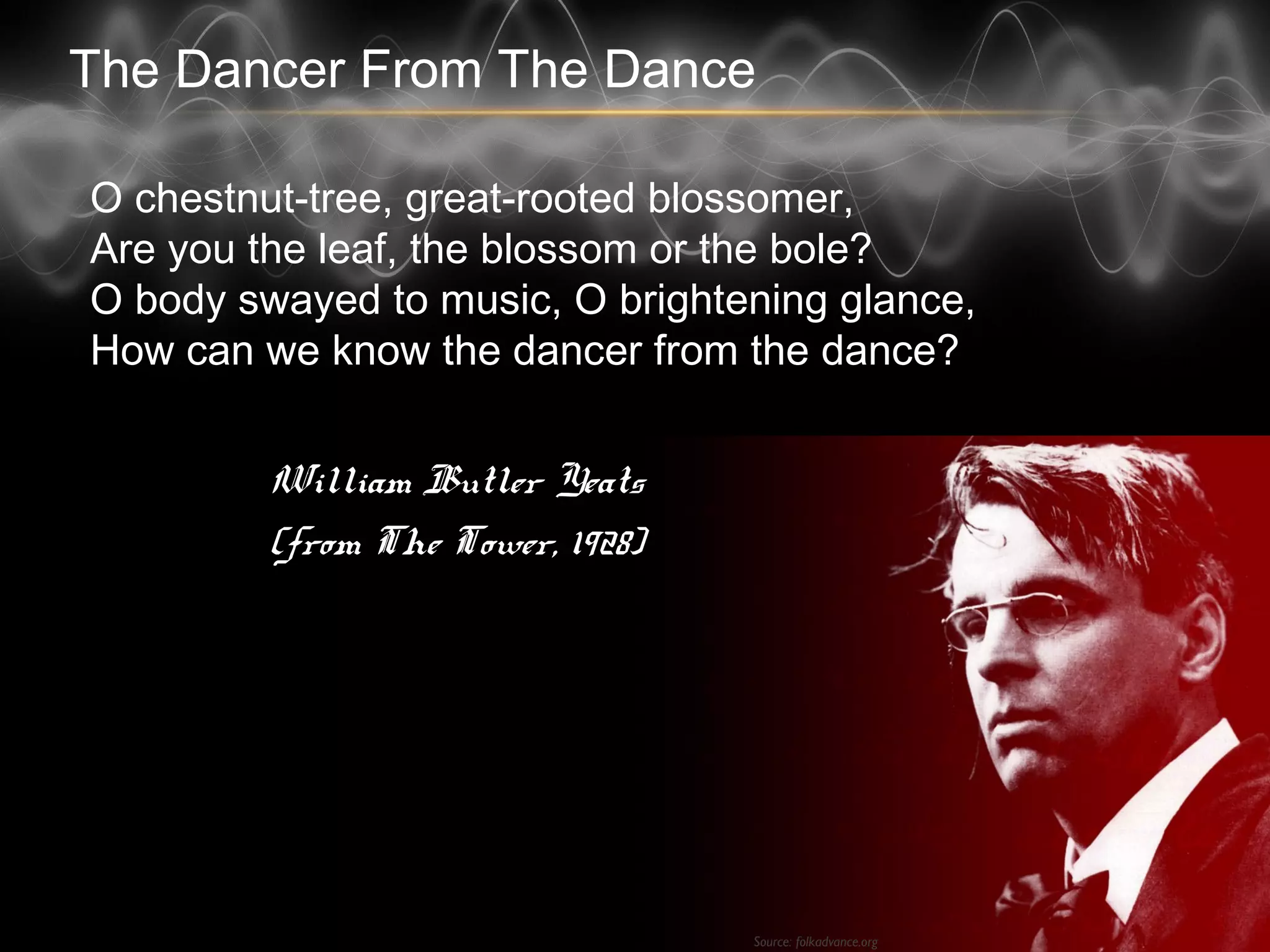
O chestnut-tree, great-rooted blossomer,
Are you the leaf, the blossom or the bole?
O body swayed to music, O brightening glance,
How can we know the dancer from the dance?
William Butler Yeats
(from The Tower, 1928)
Source: folkadvance.org
The Dancer From The Dance
1. Introduction
2. The Past: Movement Mapping and Dance Notation
3. The Present: Arduinos, XBees and the MotionMIDI device
4. The Future: What’s next?
5. Other work in this area
6. Vignettes
7. Performance
Introduction
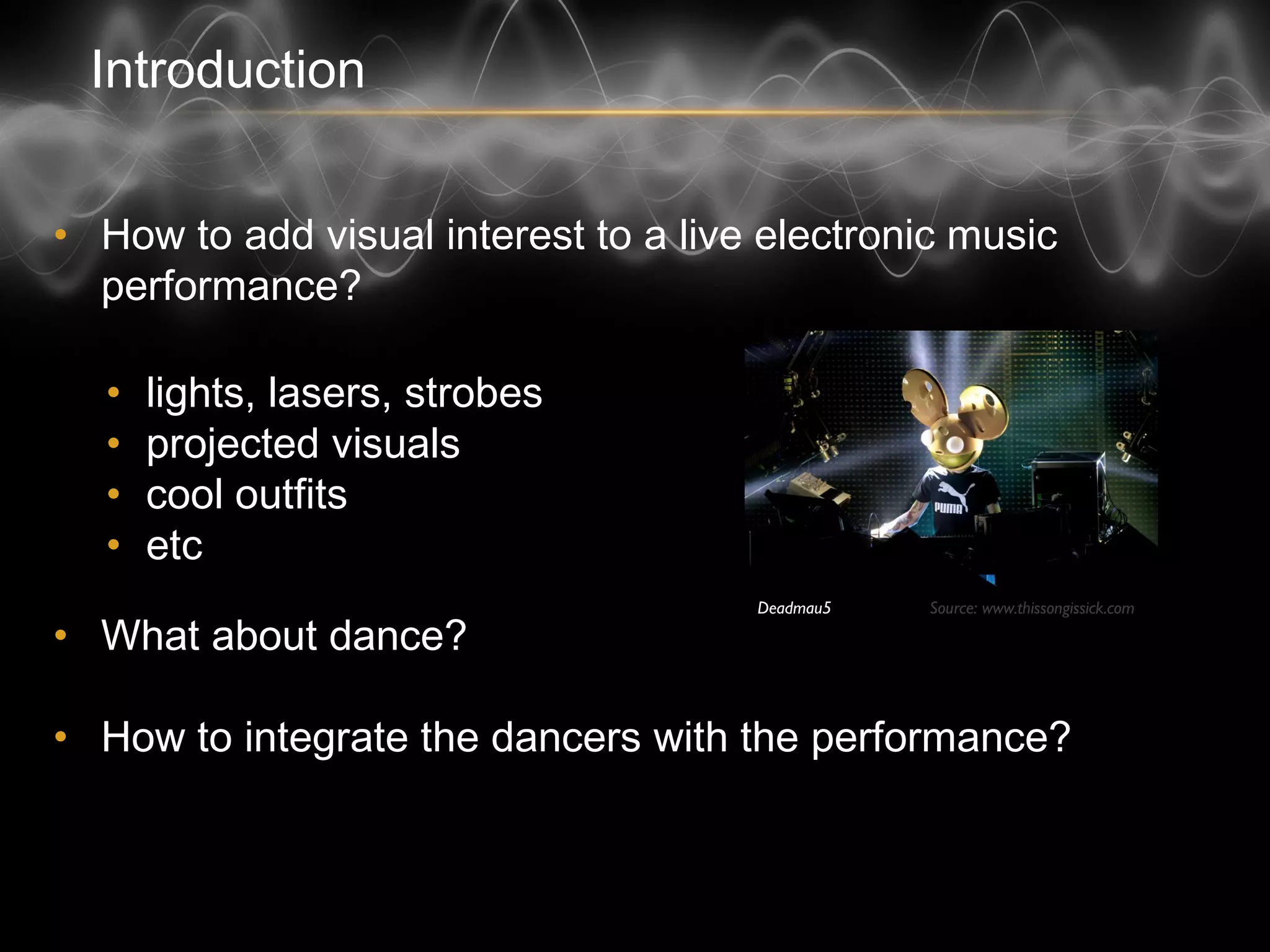
• How to add visual interest to a live electronic music
performance?
• lights, lasers, strobes
• projected visuals
• cool outfits
• etc
• What about dance?
• How to integrate the dancers with the performance?
Source: www.thissongissick.comDeadmau5
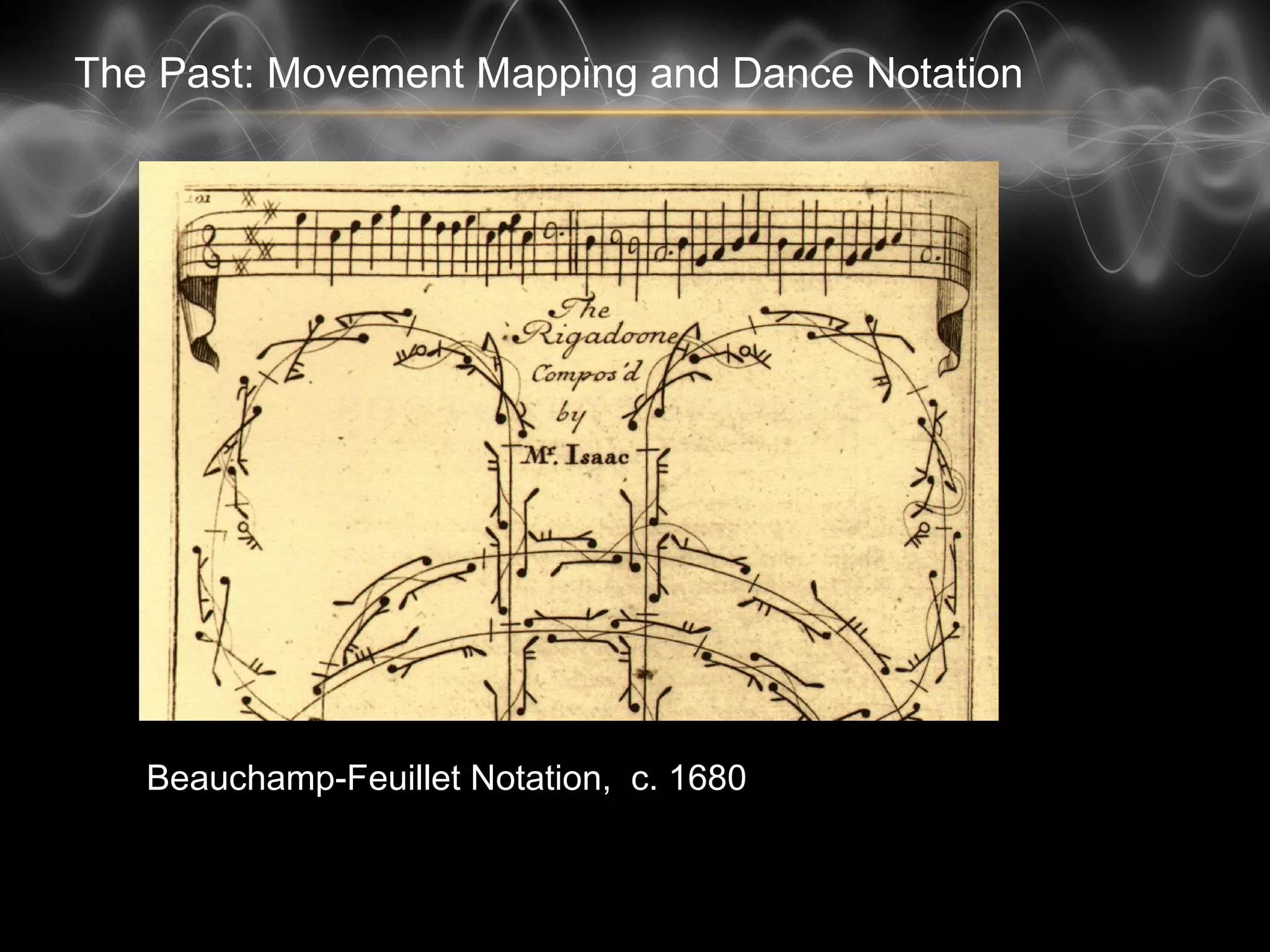
The Past: Movement Mapping and Dance Notation
Beauchamp-Feuillet Notation, c. 1680
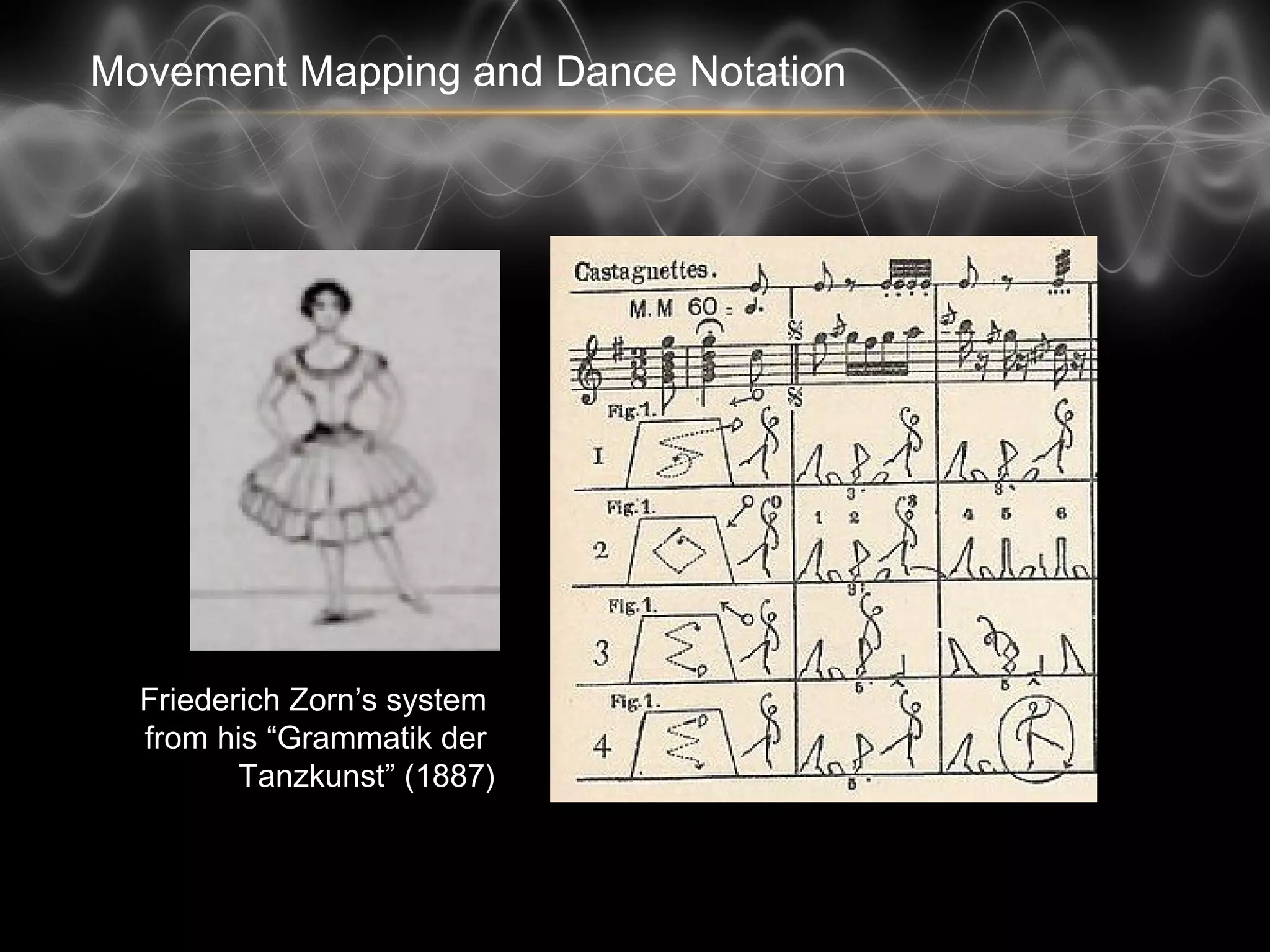
Movement Mapping and Dance Notation
Friederich Zorn’s system
from his “Grammatik der
Tanzkunst” (1887)
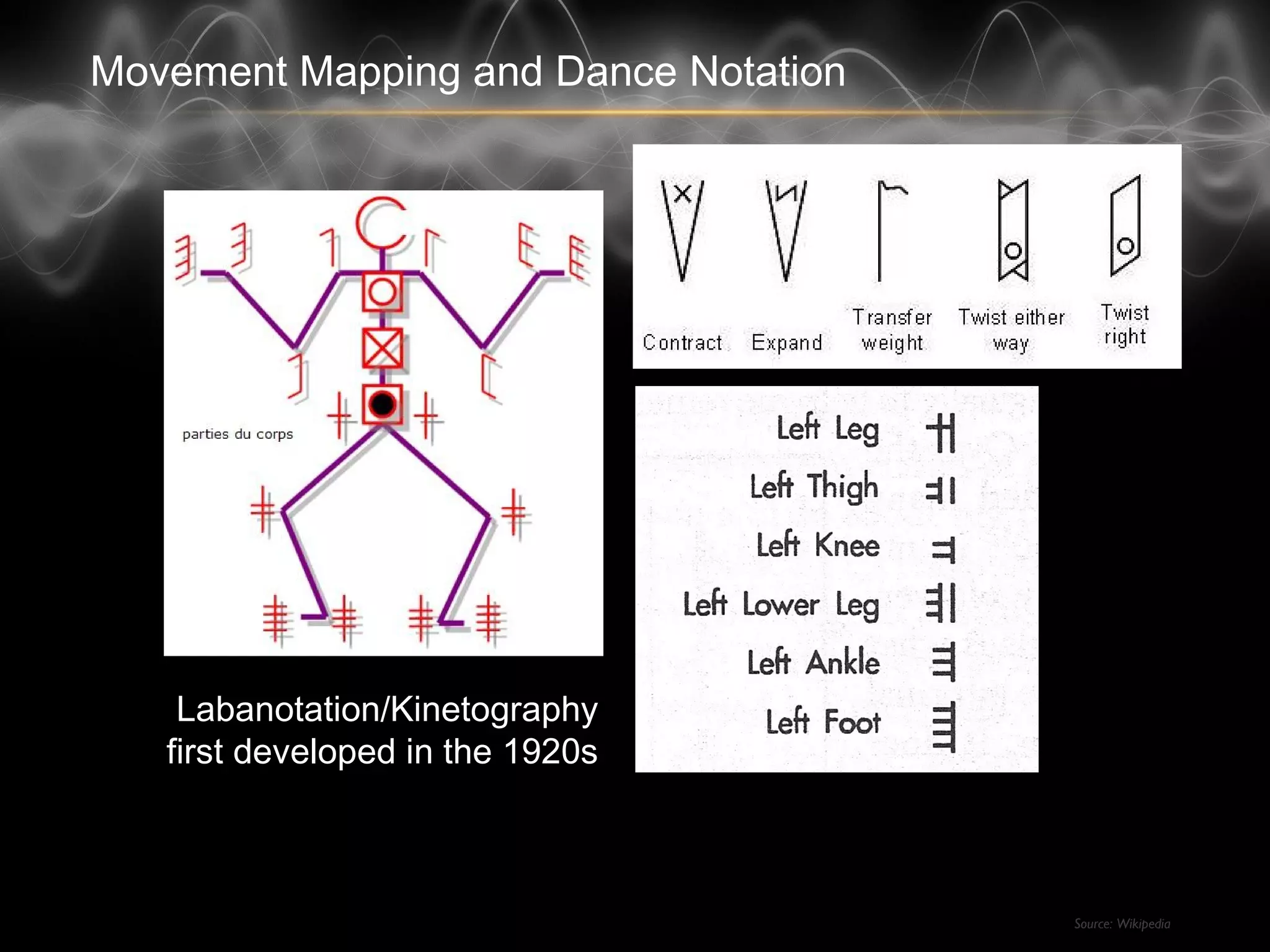
Movement Mapping and Dance Notation
Labanotation/Kinetography
first developed in the 1920s
Source: Wikipedia
8
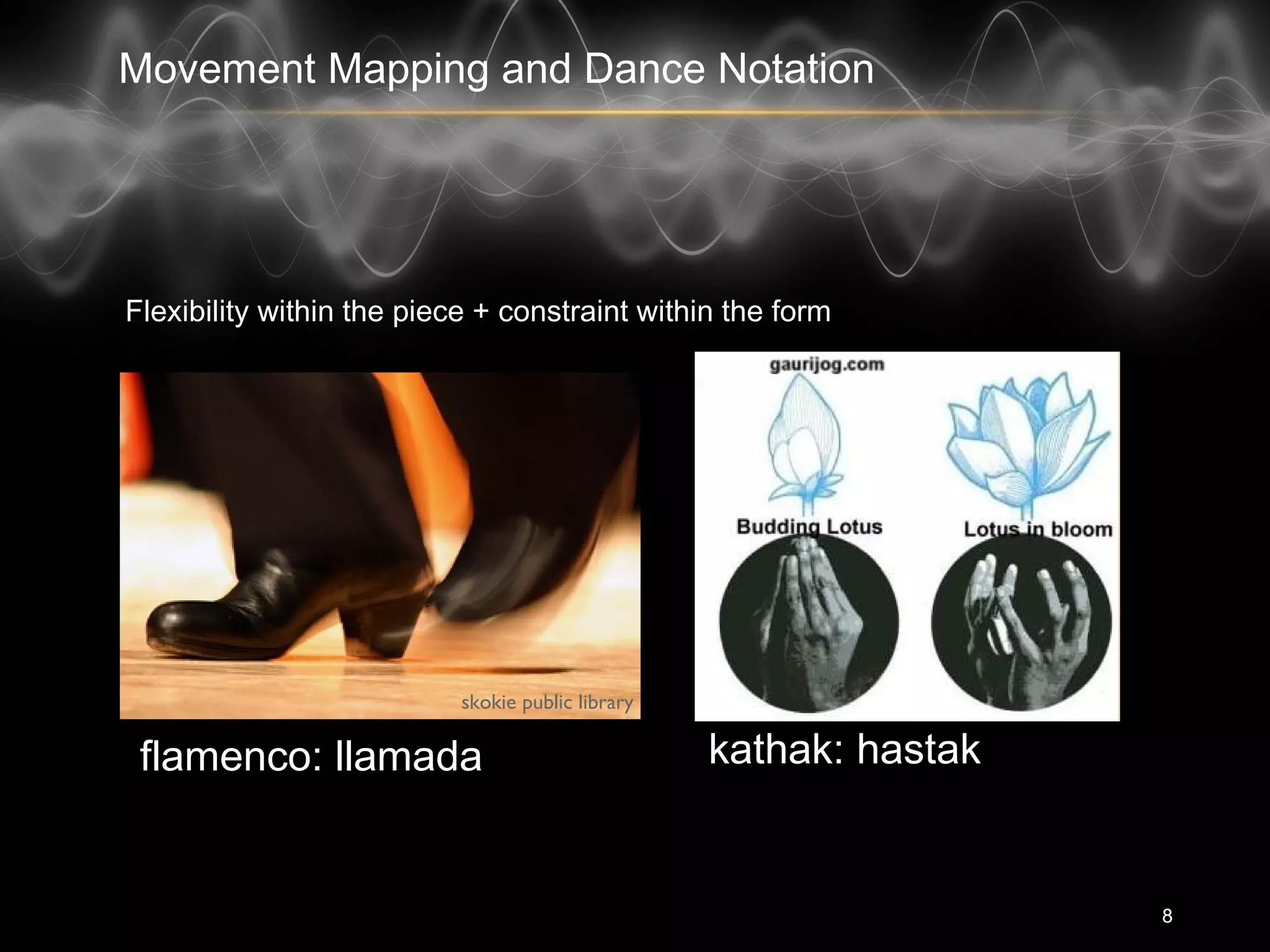
Flexibility within the piece + constraint within the form
8
flamenco: llamada kathak: hastak
skokie public library
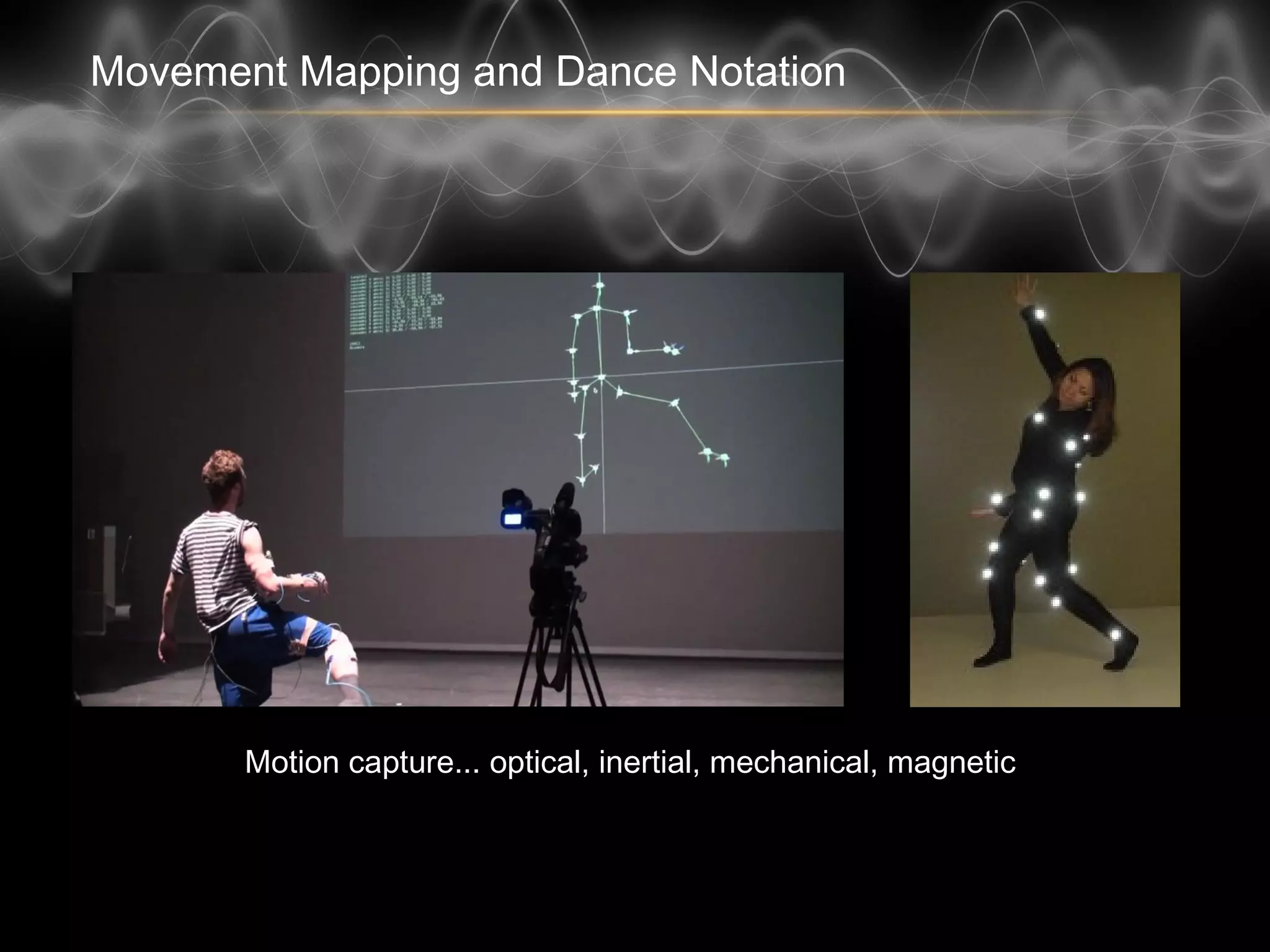
Movement Mapping and Dance Notation
Motion capture... optical, inertial, mechanical, magnetic
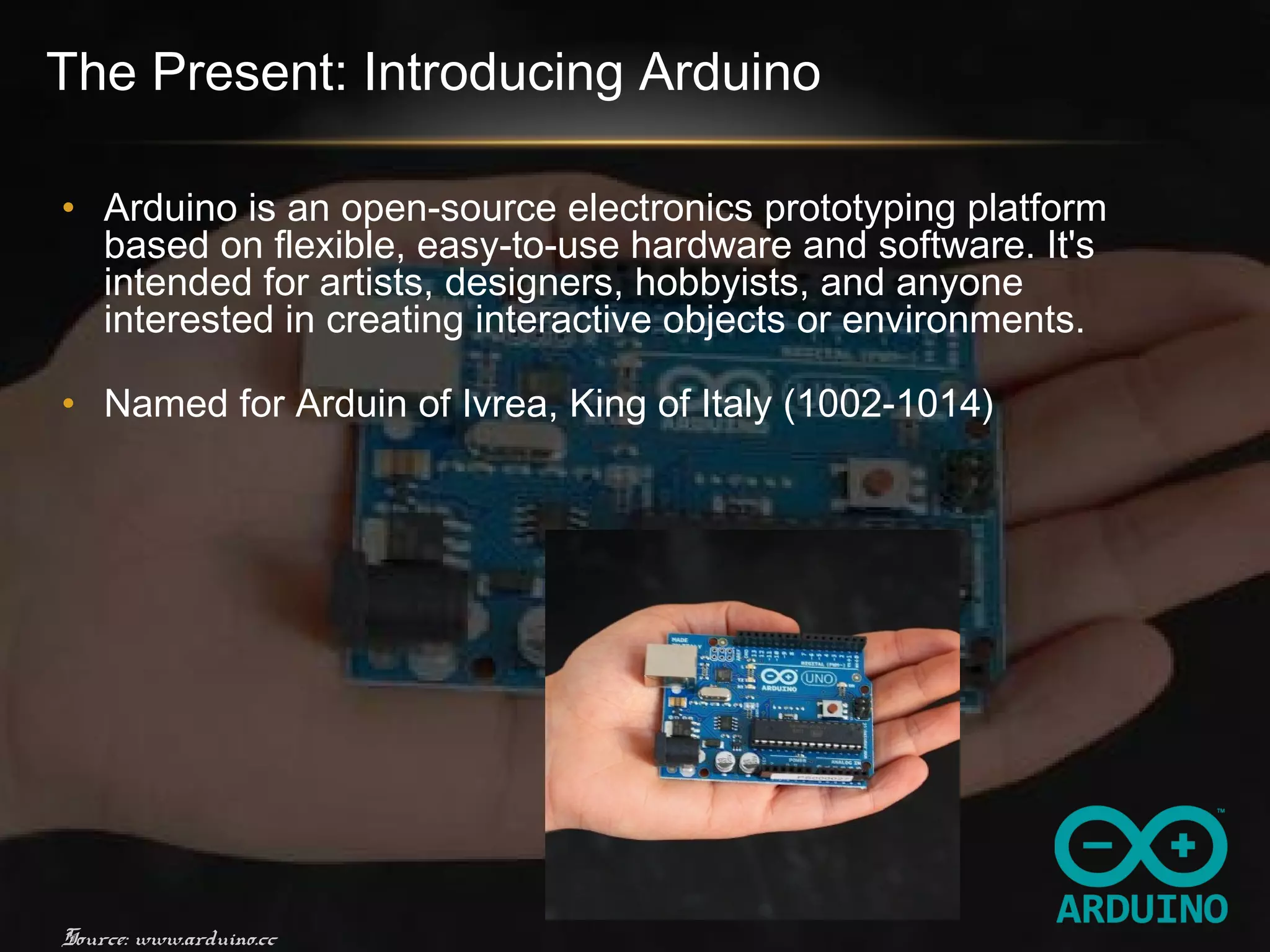
The Present: Introducing Arduino
• Arduino is an open-source electronics prototyping platform
based on flexible, easy-to-use hardware and software. It's
intended for artists, designers, hobbyists, and anyone
interested in creating interactive objects or environments.
• Named for Arduin of Ivrea, King of Italy (1002-1014)
Source: www.arduino.cc
Arduino Continued
• Based on Atmel Microprocessors and the Processing language
(a simplified version of C++)
• Designs are “Open” – free to use, modify, and create derivatives (hardware
and software)
• Strong community focus
• Countless variations and sizes
• Some (i.e. Arduino Lilypad) can be sewn into clothing!
• Countless add-ons, “shields”, kits, sensors, actuators, other
devices…like radios! – ZigBee (XBee), 802.11 (Wifi), Bluetooth…
• SparkFun Electronics { www.sparkfun.com }
• AdaFruit Industries { www.adafruit.com }
• Creatron (right here in Toronto!) { www.creatroninc.com }
• Many many more
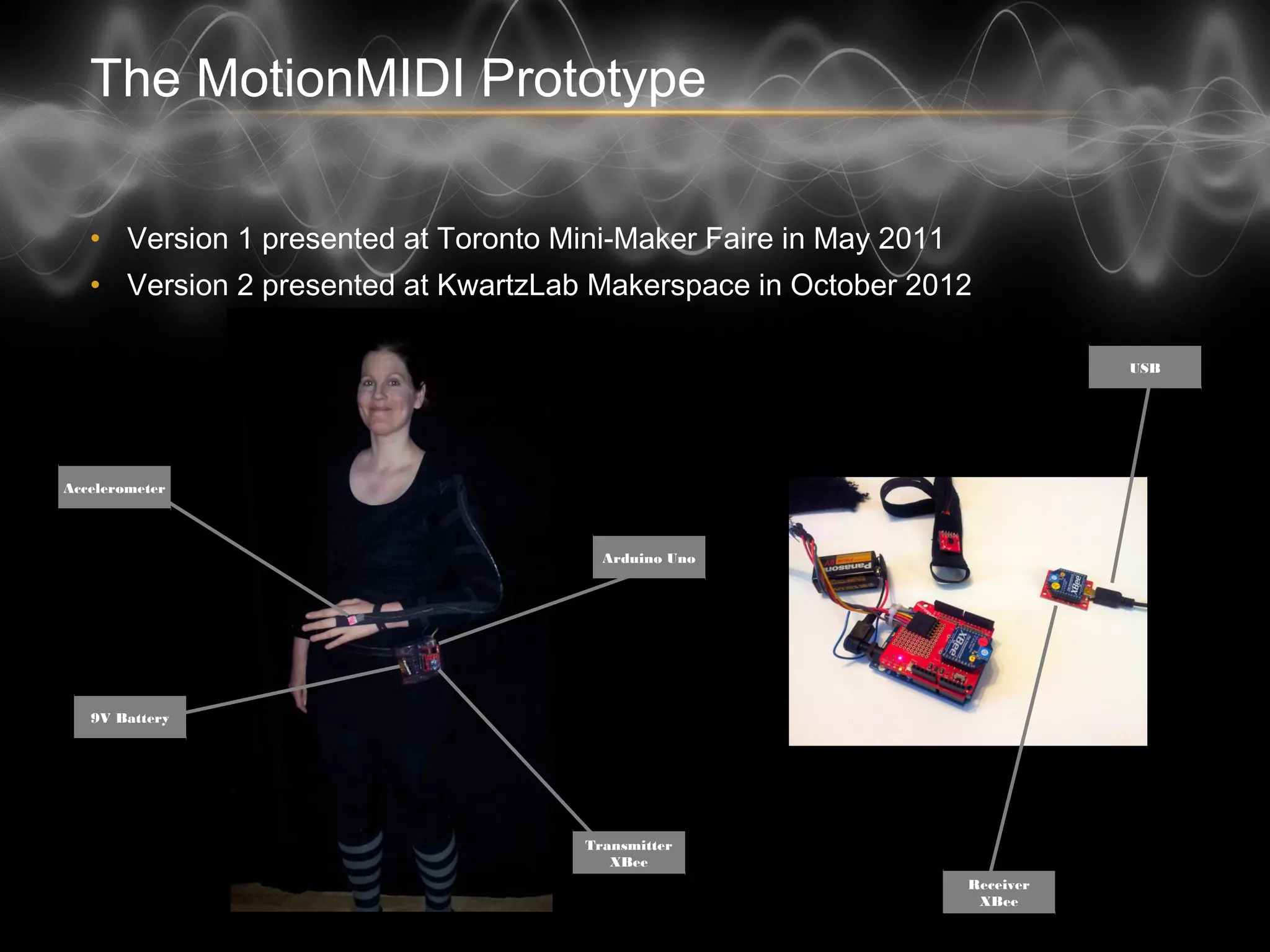
The MotionMIDI Prototype
• Version 1 presented at Toronto Mini-Maker Faire in May 2011
• Version 2 presented at KwartzLab Makerspace in October 2012
Accelerometer
Arduino Uno
Transmitter
XBee
Receiver
XBee
USB
9V Battery
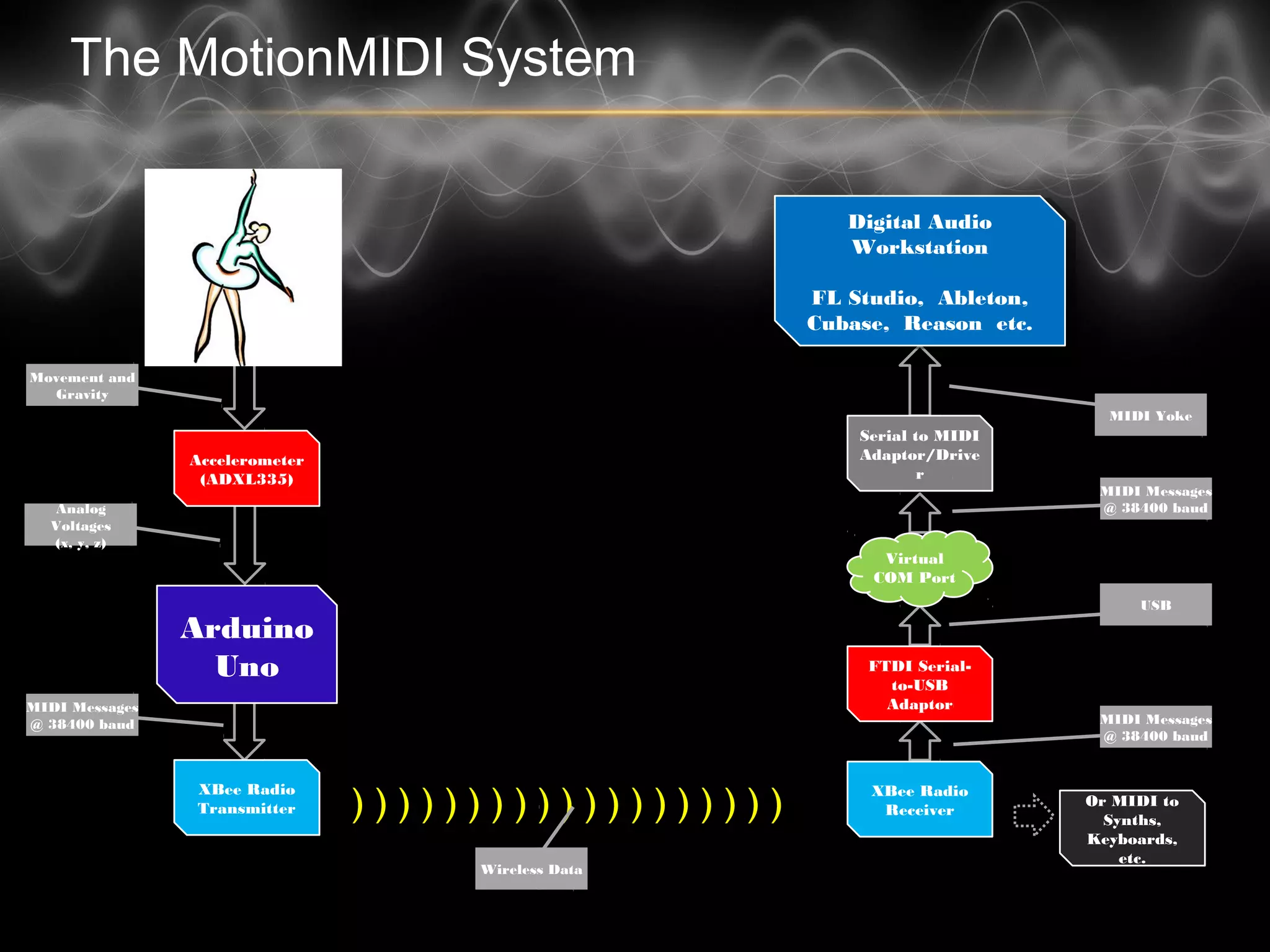
The MotionMIDI System
XBee Radio
Receiver
FTDI Serial-to-
USB Adaptor
Digital Audio
Workstation
FL
Studio, Ableton, Cubase
, Reason etc.
Virtual
COM Port
Serial to MIDI
Adaptor/Driver
) ) ) ) ) ) ) ) ) ) ) ) ) ) ) ) ) ) )
Accelerometer
(ADXL335)
Arduino
Uno
XBee Radio
Transmitter
Analog Voltages
(x, y, z)
MIDI Messages
@ 38400 baud
Wireless Data
MIDI Messages
@ 38400 baud
USB
MIDI Yoke
MIDI Messages
@ 38400 baud
Movement and
Gravity
Or MIDI to
Synths,
Keyboards, etc.
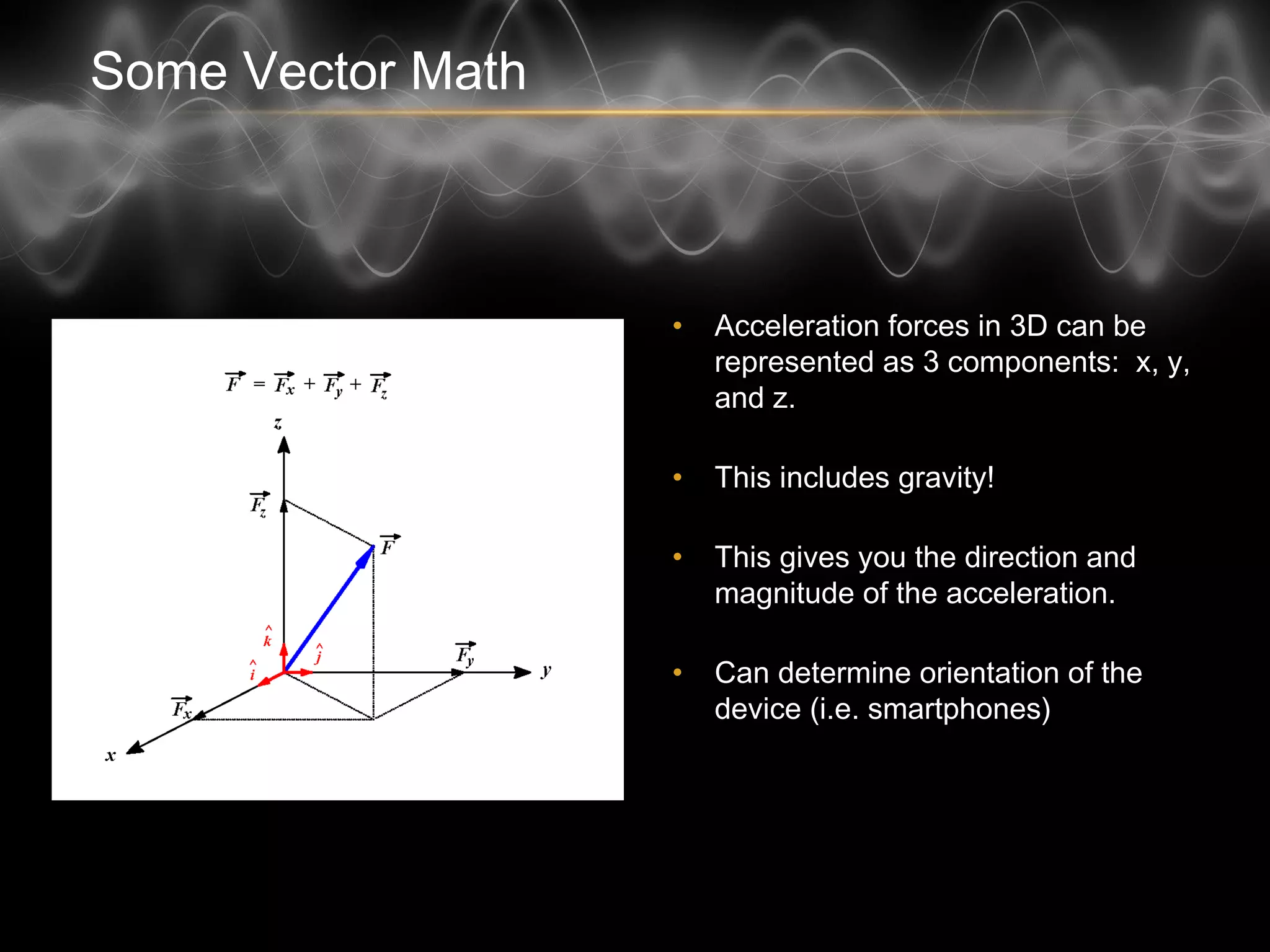
Some Vector Math
• Acceleration forces in 3D can be
represented as 3 components:
x, y, and z.
• This includes gravity!
• This gives you the direction and
magnitude of the acceleration.
• Can determine orientation of the
device (i.e. smartphones)
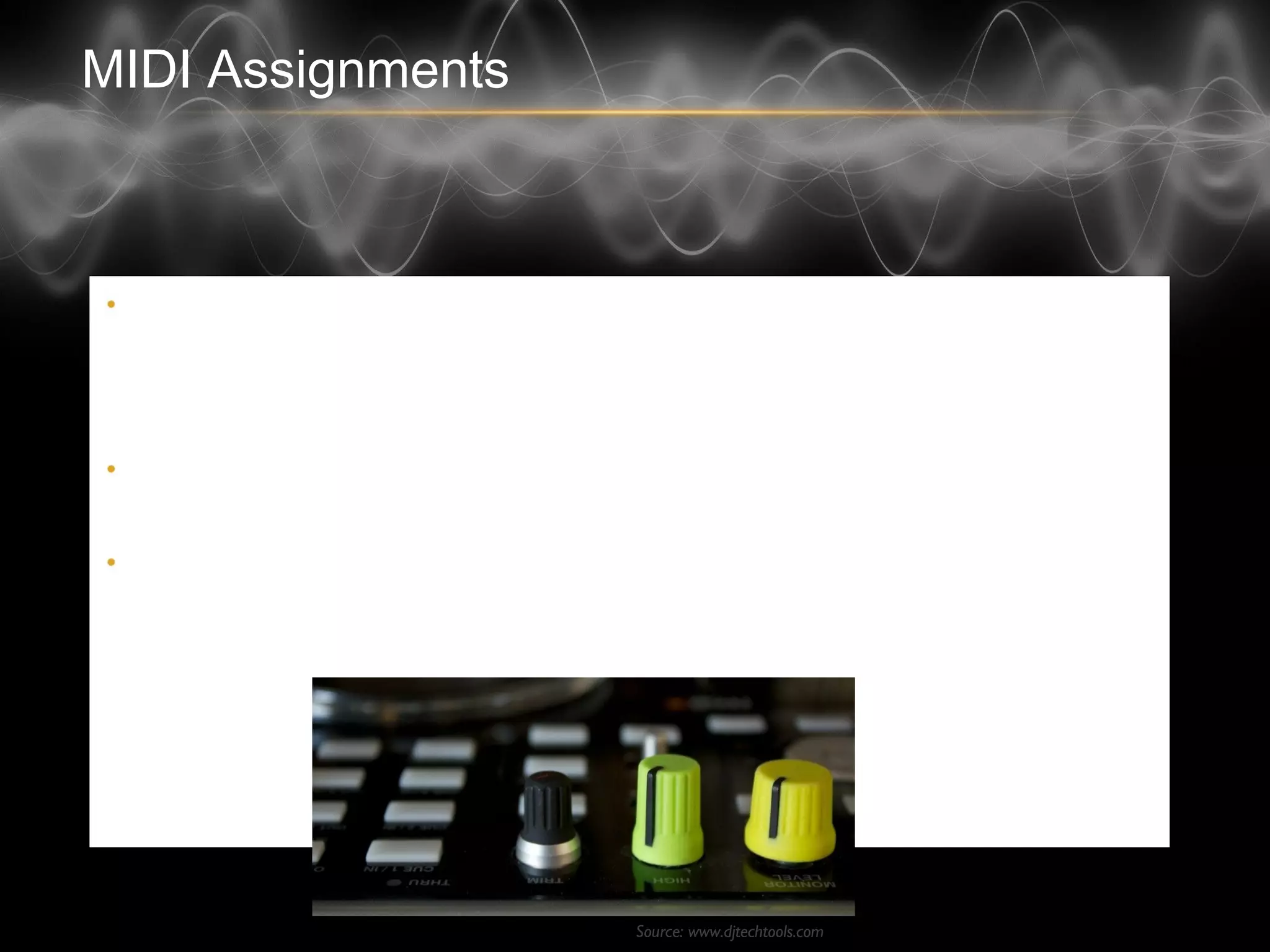
MIDI Assignments
Source: www.djtechtools.com
•
This is the *entire* sketch (program)!
#define CENTER 371 // Same for x, y, and z
#define RANGE 100
#define MAX (CENTER+RANGE)
#define MIN (CENTER-RANGE)
#define LED 13
void setup()
{
// Direct connect or XBee. Use 31250 for Raw MIDI
Serial.begin(38400);
pinMode(LED, OUTPUT);
}
void loop()
{
int x, y, z;
byte x1, y1, z1;
digitalWrite(LED, HIGH); // set the LED on
x = analogRead(0); // read analog input pin 0
y = analogRead(1); // read analog input pin 1
z = analogRead(2); // read analog input pin 2
x1 = AccelToCC(x);
y1 = AccelToCC(y);
z1 = AccelToCC(z);
sendMIDI(0xB0,20,x1); // Channel 1, CC#20
sendMIDI(0xB0,21,y1); // Channel 1, CC#21
sendMIDI(0xB0,22,z1); // Channel 1, CC#22
digitalWrite(LED, LOW); // set the LED off
delay(100); // wait 100ms for next reading
}
// Send a MIDI message
void sendMIDI(byte cmd, byte data1, byte data2)
{
Serial.write(cmd);
Serial.write(data1);
Serial.write(data2);
}
// Map an input between MIN and MAX to 0 to 127
byte AccelToCC(int in)
{
// Bound
if (in > MAX) in=MAX;
if (in < MIN) in=MIN;
// Change zero-offset
in = in-MIN;
// Scale between 0.0 and 1.0
float temp = (float)in/((float)MAX-(float)MIN);
return temp*127;
}
{ https://github.com/LeifBloomquist/MotionMIDI }
[MIT License]
Future Plans
• Look into commercial and hobbyist sensors that could be employed (magnetic,
inertial).
• Use the sensor inputs to generate notes, directly or as seeds to a fractal
generation algorithm.
• Work on more pieces, involve and get feedback from the dance community
(i.e. Coexisdance)
• Small production run?
• Explore and have fun!
Acknowledgements
Special thanks to:
• Seth Hardy (Site3 coLaboratory) for XBee radio programming help.
• Gauri Vanarase for previous dance history input.
Related work
• Imogen Heap and “The Gloves”
{ www.imogenheap.com, theglovesproject.com }
• Loretta Faveri and SonicWear { www.sonicwear.ca }
Commercialization of OCADU project similar to ours – in discussions about
collaboration.
• Kinectar { www.kinectar.org } Microsoft XBOX Kinect with MIDI devices.
• The LEAP Motion { www.leapmotion.com } Handsfree 3D input device
• Many music-related apps in development (coming July 2013)
• Many more!
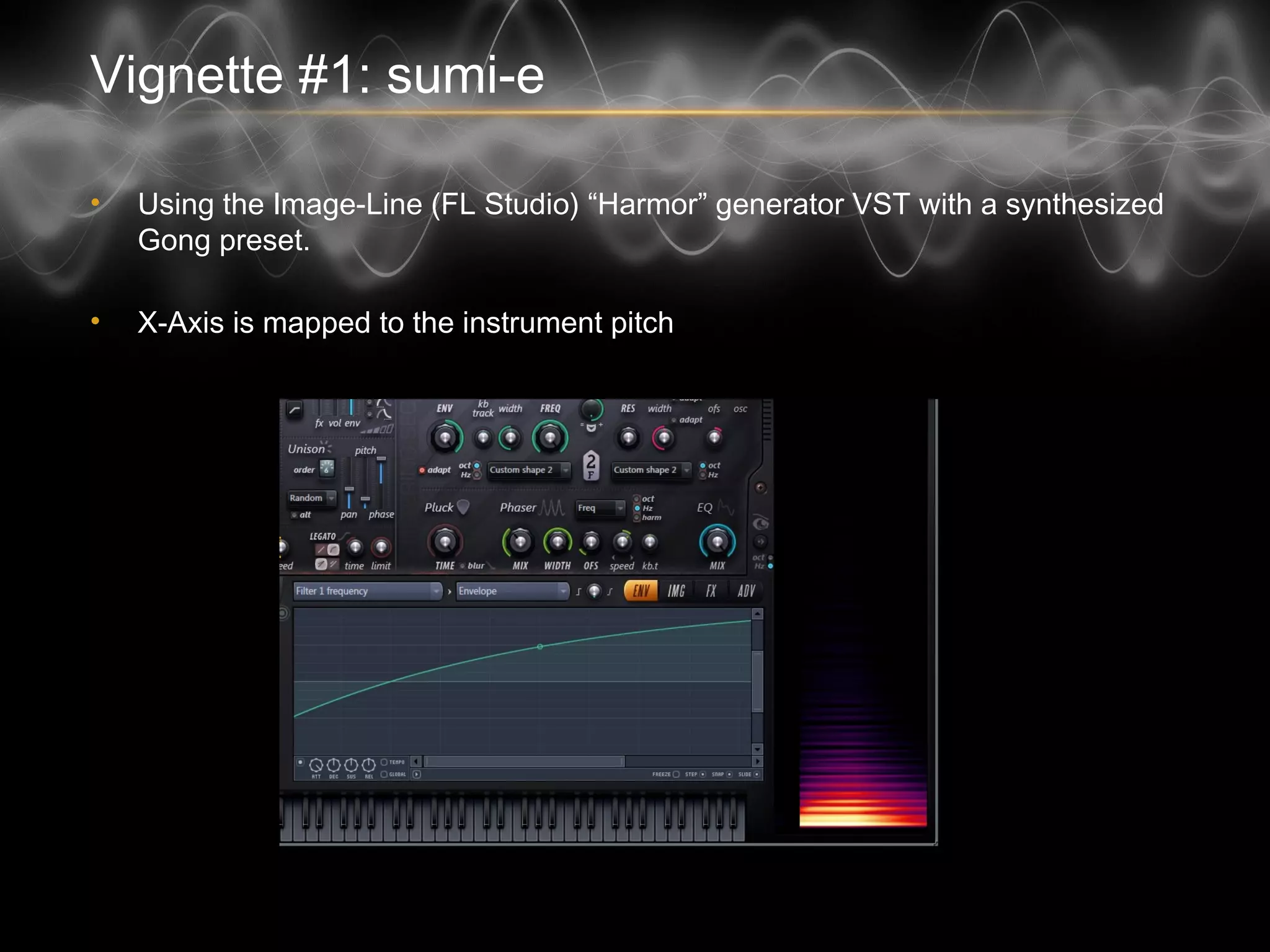
Vignette #1: sumi-e
• Using the Image-Line (FL Studio) “Harmor” generator VST with a synthesized
Gong preset.
• X-Axis is mapped to the instrument pitch
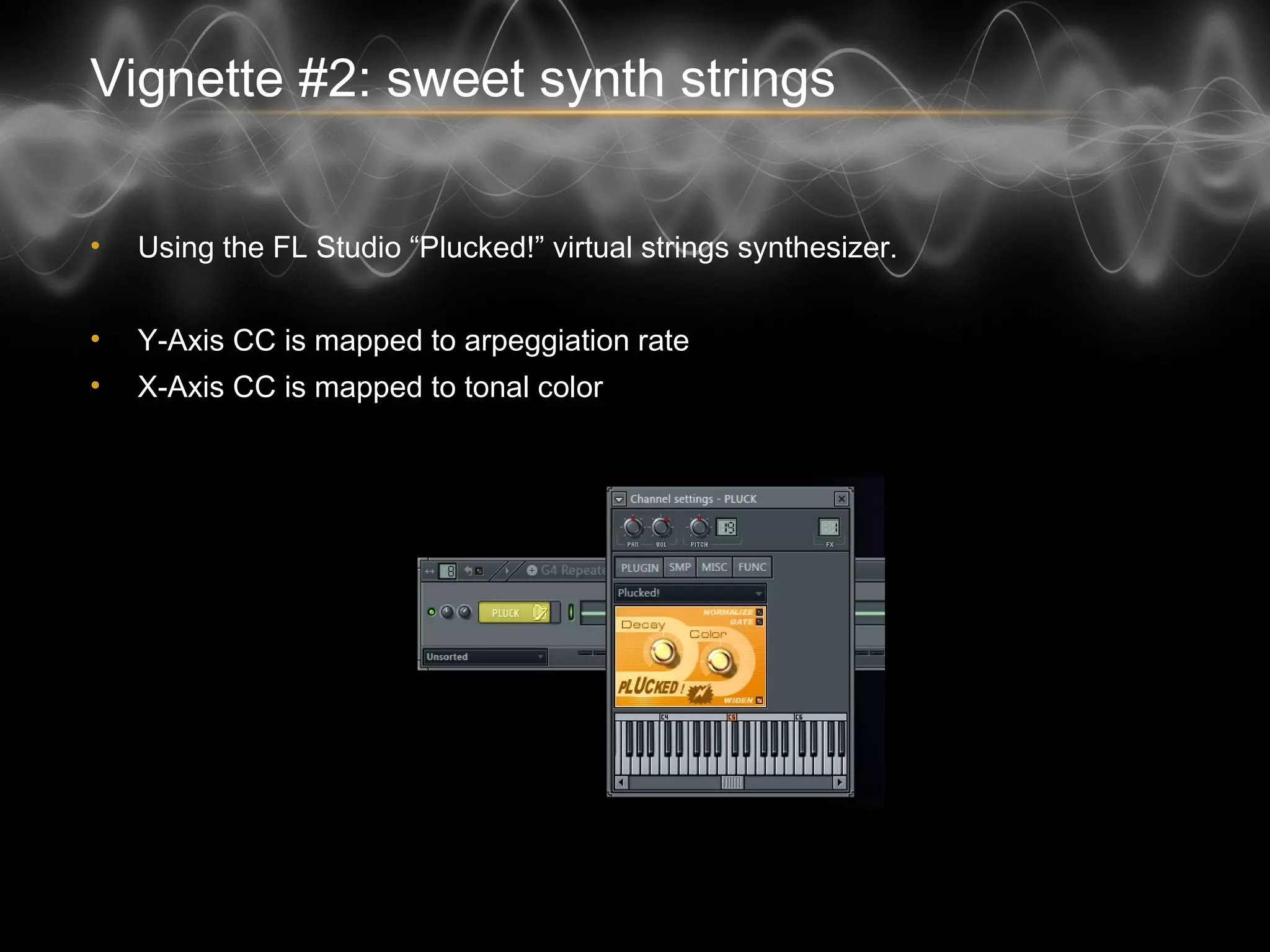
Vignette #2: sweet synth strings
• Using the FL Studio “Plucked!” virtual strings synthesizer.
• Y-Axis CC is mapped to arpeggiation rate
• X-Axis CC is mapped to tonal color
Vignette #3: oontz
(The world’s shortest electronic body music [EBM] piece)
• Force magnitude CC is mapped to the cutoff frequency for the low-pass filter
on the main synth line
Source: glamslamentertainments.com
Any questions?
Performance
Biography – Tricia Postle
Tricia Postle is the artistic director of Majlis Art Garden, a
multidisciplinary seasonal space in Queen West presenting
poetry, music, dance and storytelling.
This summer Majlis will host a salon-style evening on the
intersection of music and technology. For further
information please visit majlisarts.com .
Tricia is a lyric mezzo and poet, and has been known to
play the hurdy-gurdy, psaltry, and qanun. She has recently
started setting contemporary poetry as art song. She
holds a BA in Medieval Studies and Music from the
University of Toronto.
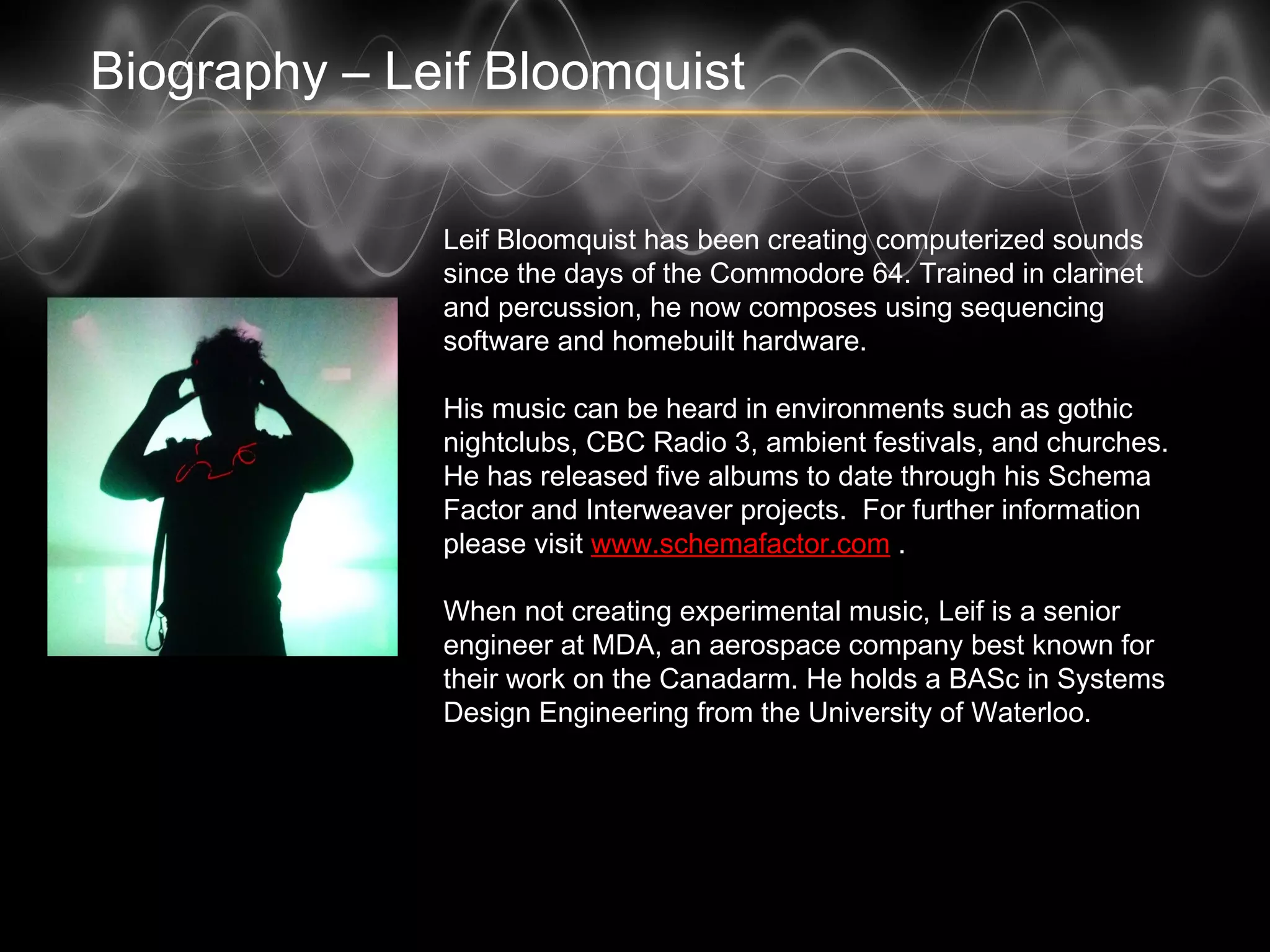
Biography – Leif Bloomquist
Leif Bloomquist has been creating computerized sounds
since the days of the Commodore 64. Trained in clarinet
and percussion, he now composes using sequencing
software and homebuilt hardware.
His music can be heard in environments such as gothic
nightclubs, CBC Radio 3, ambient festivals, and churches.
He has released five albums to date through his Schema
Factor and Interweaver projects. For further information
please visit www.schemafactor.com .
When not creating experimental music, Leif is a senior
engineer at MDA, an aerospace company best known for
their work on the Canadarm. He holds a BASc in Systems
Design Engineering from the University of Waterloo.

The Dancer From The Dance: Mapping Motion With Sound Via Radio Transmission

  • 1.
    Tricia Postle –Artistic Director, Majlis Art Garden { majlisarts.com } Leif Bloomquist – Programmer & Composer { schemafactor.com } New Adventures In Sound Art TransX Transmission Art Symposium – Toronto, ON, Canada May 19th, 2013 The Dancer From The Dance: Mapping Motion With Sound Via Radio Transmission
  • 2.
    The Dancer FromThe Dance O chestnut-tree, great-rooted blossomer, Are you the leaf, the blossom or the bole? O body swayed to music, O brightening glance, How can we know the dancer from the dance? William Butler Yeats (from The Tower, 1928) Source: folkadvance.org
  • 3.
    The Dancer FromThe Dance 1. Introduction 2. The Past: Movement Mapping and Dance Notation 3. The Present: Arduinos, XBees and the MotionMIDI device 4. The Future: What’s next? 5. Other work in this area 6. Vignettes 7. Performance
  • 4.
    Introduction • How toadd visual interest to a live electronic music performance? • lights, lasers, strobes • projected visuals • cool outfits • etc • What about dance? • How to integrate the dancers with the performance? Source: www.thissongissick.comDeadmau5
  • 5.
    The Past: MovementMapping and Dance Notation Beauchamp-Feuillet Notation, c. 1680
  • 6.
    Movement Mapping andDance Notation Friederich Zorn’s system from his “Grammatik der Tanzkunst” (1887)
  • 7.
    Movement Mapping andDance Notation Labanotation/Kinetography first developed in the 1920s Source: Wikipedia
  • 8.
    8 Flexibility within thepiece + constraint within the form 8 flamenco: llamada kathak: hastak skokie public library Movement Mapping and Dance Notation
  • 9.
    Movement Mapping andDance Notation Motion capture... optical, inertial, mechanical, magnetic
  • 10.
    The Present: IntroducingArduino • Arduino is an open-source electronics prototyping platform based on flexible, easy-to-use hardware and software. It's intended for artists, designers, hobbyists, and anyone interested in creating interactive objects or environments. • Named for Arduin of Ivrea, King of Italy (1002-1014) Source: www.arduino.cc
  • 11.
    Arduino Continued • Basedon Atmel Microprocessors and the Processing language (a simplified version of C++) • Designs are “Open” – free to use, modify, and create derivatives (hardware and software) • Strong community focus • Countless variations and sizes • Some (i.e. Arduino Lilypad) can be sewn into clothing! • Countless add-ons, “shields”, kits, sensors, actuators, other devices…like radios! – ZigBee (XBee), 802.11 (Wifi), Bluetooth… • SparkFun Electronics { www.sparkfun.com } • AdaFruit Industries { www.adafruit.com } • Creatron (right here in Toronto!) { www.creatroninc.com } • Many many more
  • 12.
    The MotionMIDI Prototype •Version 1 presented at Toronto Mini-Maker Faire in May 2011 • Version 2 presented at KwartzLab Makerspace in October 2012 Accelerometer Arduino Uno Transmitter XBee Receiver XBee USB 9V Battery
  • 13.
    The MotionMIDI System XBeeRadio Receiver FTDI Serial-to- USB Adaptor Digital Audio Workstation FL Studio, Ableton, Cubase , Reason etc. Virtual COM Port Serial to MIDI Adaptor/Driver ) ) ) ) ) ) ) ) ) ) ) ) ) ) ) ) ) ) ) Accelerometer (ADXL335) Arduino Uno XBee Radio Transmitter Analog Voltages (x, y, z) MIDI Messages @ 38400 baud Wireless Data MIDI Messages @ 38400 baud USB MIDI Yoke MIDI Messages @ 38400 baud Movement and Gravity Or MIDI to Synths, Keyboards, etc.
  • 14.
    Some Vector Math •Acceleration forces in 3D can be represented as 3 components: x, y, and z. • This includes gravity! • This gives you the direction and magnitude of the acceleration. • Can determine orientation of the device (i.e. smartphones)
  • 15.
  • 16.
    This is the*entire* sketch (program)! #define CENTER 371 // Same for x, y, and z #define RANGE 100 #define MAX (CENTER+RANGE) #define MIN (CENTER-RANGE) #define LED 13 void setup() { // Direct connect or XBee. Use 31250 for Raw MIDI Serial.begin(38400); pinMode(LED, OUTPUT); } void loop() { int x, y, z; byte x1, y1, z1; digitalWrite(LED, HIGH); // set the LED on x = analogRead(0); // read analog input pin 0 y = analogRead(1); // read analog input pin 1 z = analogRead(2); // read analog input pin 2 x1 = AccelToCC(x); y1 = AccelToCC(y); z1 = AccelToCC(z); sendMIDI(0xB0,20,x1); // Channel 1, CC#20 sendMIDI(0xB0,21,y1); // Channel 1, CC#21 sendMIDI(0xB0,22,z1); // Channel 1, CC#22 digitalWrite(LED, LOW); // set the LED off delay(100); // wait 100ms for next reading } // Send a MIDI message void sendMIDI(byte cmd, byte data1, byte data2) { Serial.write(cmd); Serial.write(data1); Serial.write(data2); } // Map an input between MIN and MAX to 0 to 127 byte AccelToCC(int in) { // Bound if (in > MAX) in=MAX; if (in < MIN) in=MIN; // Change zero-offset in = in-MIN; // Scale between 0.0 and 1.0 float temp = (float)in/((float)MAX-(float)MIN); return temp*127; } { https://github.com/LeifBloomquist/MotionMIDI } [MIT License]
  • 17.
    Future Plans • Lookinto commercial and hobbyist sensors that could be employed (magnetic, inertial). • Use the sensor inputs to generate notes, directly or as seeds to a fractal generation algorithm. • Work on more pieces, involve and get feedback from the dance community (i.e. Coexisdance) • Small production run? • Explore and have fun!
  • 18.
    Acknowledgements Special thanks to: •Seth Hardy (Site3 coLaboratory) for XBee radio programming help. • Gauri Vanarase for previous dance history input.
  • 19.
    Related work • ImogenHeap and “The Gloves” { www.imogenheap.com, theglovesproject.com } • Loretta Faveri and SonicWear { www.sonicwear.ca } Commercialization of OCADU project similar to ours – in discussions about collaboration. • Kinectar { www.kinectar.org } Microsoft XBOX Kinect with MIDI devices. • The LEAP Motion { www.leapmotion.com } Handsfree 3D input device • Many music-related apps in development (coming July 2013) • Many more!
  • 20.
    Vignette #1: sumi-e •Using the Image-Line (FL Studio) “Harmor” generator VST with a synthesized Gong preset. • X-Axis is mapped to the instrument pitch
  • 21.
    Vignette #2: sweetsynth strings • Using the FL Studio “Plucked!” virtual strings synthesizer. • Y-Axis CC is mapped to arpeggiation rate • X-Axis CC is mapped to tonal color
  • 22.
    Vignette #3: oontz (Theworld’s shortest electronic body music [EBM] piece) • Force magnitude CC is mapped to the cutoff frequency for the low-pass filter on the main synth line Source: glamslamentertainments.com
  • 23.
  • 24.
  • 25.
    Biography – TriciaPostle Tricia Postle is the artistic director of Majlis Art Garden, a multidisciplinary seasonal space in Queen West presenting poetry, music, dance and storytelling. This summer Majlis will host a salon-style evening on the intersection of music and technology. For further information please visit majlisarts.com . Tricia is a lyric mezzo and poet, and has been known to play the hurdy-gurdy, psaltry, and qanun. She has recently started setting contemporary poetry as art song. She holds a BA in Medieval Studies and Music from the University of Toronto.
  • 26.
    Biography – LeifBloomquist Leif Bloomquist has been creating computerized sounds since the days of the Commodore 64. Trained in clarinet and percussion, he now composes using sequencing software and homebuilt hardware. His music can be heard in environments such as gothic nightclubs, CBC Radio 3, ambient festivals, and churches. He has released five albums to date through his Schema Factor and Interweaver projects. For further information please visit www.schemafactor.com . When not creating experimental music, Leif is a senior engineer at MDA, an aerospace company best known for their work on the Canadarm. He holds a BASc in Systems Design Engineering from the University of Waterloo.