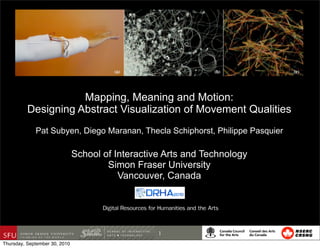

Mapping, Meaning and Motion:
          Designing Abstract Visualization of Movement Qualities
             Pat Subyen, Diego Maranan, Thecla Schiphorst, Philippe Pasquier

                               School of Interactive Arts and Technology
                                       Simon Fraser University
                                          Vancouver, Canada


                                      Digital Resources for Humanities and the Arts


                                                           1
Thursday, September 30, 2010
Presentation Outline
  • What are we doing?

  • Overview of Laban Effort: significance

  • Laban Effort visualization: rationale, challenges, and
    approaches

  • Machine-based recognition, eight Basic Efforts

  • LabanEffortDetect: a system for generating real-time Laban
    Effort profile stream from a moving subject

  • Two visualization systems: description, results, initial results

  • Future work

                                   2
Thursday, September 30, 2010
What are we doing?
  • We created a visualization of movement qualities (Laban Effort
    qualities).
  • Visualization: (Pat Subyen)
    A prototype of real-time interactive visualization system.
  • LabanEffortDetect: (Diego Maranan, Thecla Schiphorst, Philippe Pasquier)
    A prototype machine-learning based system which was created
    by the Institute for Advanced Computing Applications and
      Technologies at the University of Illinois and the University of Illinois
      Dance Department in collaboration with Thecla Schiphorst.

  • This Project is funded by the Canada Council for the Arts -
    NSERC New Media Initiative Grant, for the research project
    entitled "Meaning from Motion for Interaction and Visualization”.


                                         3
Thursday, September 30, 2010
Human movement

                                   Human movement is an
                                    outer manifestation of
                                    an inner state. It is that
                                    part of our self that
                                    extends to and
                                    interacts with the
                                    physical world (Moore
                                    & Yamamoto,1998).


                               4
Thursday, September 30, 2010
Laban-based analysis of movement qualities

    • Laban Effort: part of Laban
      Movement Analysis
    • Laban Effort analysis looks
      at
       o Weight
       o Time
       o Space
       o Flow
    • Weight: Strong - Light
    • Time: Sudden - Sustained
    • Space: Direct - Indirect
    • Flow: Bound - Free


                                    5
Thursday, September 30, 2010
Laban Effort: a few applications

  • Enhancing factory worker efficiency
    and experience (Laban &
    Laurence, 1974; Bradley 2009)
  • Enhancing movement-based
    practices (e.g., dance, theatre,
    sports)
  • Designing interactive interfaces
    (e.g., Schiphorst, 2007; Pietrowicz
    et al, 2010)
  • Animating robots (Nakata et al,
    2002; Matsumaru 2009) and virtual
    characters (Chi et al, 2000)


                                6
Thursday, September 30, 2010
Narrowing our focus: The Eight "Basic Efforts"
      •Laban’s Eight Basic Efforts use three parameters, Space, Weight
      and Time. (Flow is absent in the Action Drive).
      •The Action Drive is immediately recognizable in everyday actions.


                                                         Basic Effort


                               The Eight Basic Efforts

                                          7
Thursday, September 30, 2010
Laban Effort Visualization: Rationale and
   challenges

   • How can the visualization communicate a “feeling” of
     movement across modalities?

   • How can Laban Effort Qualities be designed and
     transformed into a visualization that make sense?

   • How can the visualization be interactive, real-time and
     computationally efficient?

   • How can it complement performance/dance?


                               8
Thursday, September 30, 2010
LabanEffortDetect: A system for recognize of
  Laban Effort qualities
  • Part of a larger research project (Thecla Schiphorst, UIUC
    NCSA+Department of Dance, Diego Maranan)
  • The prototype, machine learning-based system we use for
    obtaining a real-time, continuous Laban Effort profile
    stream
  • Expands on previous research in machine-based Laban
    Effort recognition (e.g., Santos et al, 2009; Zhao & Badler,
    2005; Zhao, 2001; Swaminathan et al, 2009)


                                  9
Thursday, September 30, 2010
Laban Effort Recognition + Visualization

  We are designing a real-time interactive system that visualizes
  the eight Basic Efforts


                                                  ?
                                         We exploring what are the
                                         criteria expressing Laban
                                              Effort Qualities?


                                 10
Thursday, September 30, 2010
Laban Effort Recognition + Visualization

  We are designing a real-time interactive system that visualizes
  the eight Basic Efforts


                                                  ?
                                         We exploring what are the
                                         criteria expressing Laban
                                              Effort Qualities?


                                 10
Thursday, September 30, 2010
Visualization System+ LabanEffortDetect:
                       System Diagram


                               11
Thursday, September 30, 2010
Visualization: Experimental Methods
   • I use metaphor framework (Cox 2008) to create a mapping
     from one domain of information (the source) into another
     domain (the target).

   • Each domain constitutes a system of beliefs, also called a
     concept network (Indurkhya 1992).


                                 12
Thursday, September 30, 2010
I use a model of information aesthetics (Lau and Moere 2004) to analyze
    from a visualization art perspective, in terms of artistic influence
    and meaningfulness.


                               Domain model for information aesthetics (Lau and Moere 2004)

                                                             13
Thursday, September 30, 2010
The creation of “art” is often synonymous with a focus on
         extrinsic data meaning(Boehner. et al 2005).


                           Categories within the model of information aesthetics(Lau and Moere 2004)

                                                              14
Thursday, September 30, 2010
Design Process for Visualization
   •     used exploratory methods to create a series of prototypes.

   •     experimented with two different designs (to date).

   • compared
               1. mapping strategy
               2. visual communicative properties
               3. aesthetic of visualization
               4. computational efficiency

   •    Design1 uses an artificial life technique, L-Systems to generate
       visualization.

   •    Design2 uses metaphors within communication design to generate
       visualization.

                                       15
Thursday, September 30, 2010
Design1: L-VIZ System


     • L-VIZ uses an L-system as a generative process to create
       visualization.

     • L-system is a formal process to simulate the growth of
       plants; it was first described by Aristid Lindenmayer in
       1968.

     • an L-system is a grammar composed of a set of
       procedural drawing rules. Different rules produce different
       results


                                   16
Thursday, September 30, 2010
The Mapping
      • created a visual interpretation for each of Effort value of Space,
      Weight and Time.


      •translated the visual interpretation to an L-system Drawing Rule
      •combinations of effort parameters create an L-system drawing rule.
      For example, Punch is composed of Direct, Sudden and Strong.


                                        17
Thursday, September 30, 2010
Kandinsky Color Theory and Laban Effort qualities Color Mapping


                                                              18
Thursday, September 30, 2010
Result: Output from the L-VIZ System


                          Still images from real-time visualization interactive system; L-VIZ System


                                                                19
Thursday, September 30, 2010
Result: Output from the L-VIZ System


                               Visualization of Float Effort


                                        20
Thursday, September 30, 2010
Result: Output from the L-VIZ System


                               Visualization of Slash Effort


                                            21
Thursday, September 30, 2010
Output from L-VIZ: Punch Basic Effort (Video)

                                                   22
Thursday, September 30, 2010
Output from L-VIZ: Punch Basic Effort (Video)

                                                   22
Thursday, September 30, 2010
Design2: Motion Sketch


         •uses visual communication design metaphors (two-
         dimensional design theory) to explore the expression of
         Laban Basic Efforts.

         •explore visualization that expresses the “feeling” of
         movement quality.


                                     23
Thursday, September 30, 2010
• Motion Sketch uses sketching, based on composition
       design, and then translates it to motion.


                                24
Thursday, September 30, 2010
• translating the motion sketches into computationally
      defined motion graphics.


                                 25
Thursday, September 30, 2010
Result: Output from Motion Sketch: eight Basic Effort


                         Still images from real-time visualization interactive system; Motion Sketch


                                                               26
Thursday, September 30, 2010
Result: Output from Motion Sketch: eight Basic Effort (Video)


                                  27
Thursday, September 30, 2010
Result: Output from Motion Sketch: eight Basic Effort (Video)


                                  27
Thursday, September 30, 2010
28
Thursday, September 30, 2010
28
Thursday, September 30, 2010
29
Thursday, September 30, 2010
29
Thursday, September 30, 2010
30
Thursday, September 30, 2010
30
Thursday, September 30, 2010
Initial Results

       • L-VIZ (L-systems) has some computational aspect specific
         issues. For instance,
            • the visualization tend towards dense layering
            • the visualization did not accurately represent Time, Space
              Efforts (Sustained or Indirect).
            • etc.


       • Motion Sketch is successful for communicates Eight Basic
         Efforts from performer and audience perspectives in initial pilot
         study user feedback tests. (mention by Laban certified specialist).


                                        31
Thursday, September 30, 2010
Laban Effort Recognition + Visualization:
   Possible Future Applications
   • Teaching tool for movement classes (mention by Laban certified specialist)
   • Integrated into live performance
   • Visual/installation art


                                          32
Thursday, September 30, 2010
Future Work
    • Visualization: develop prototypes with four main criteria

    •   Visual aesthetic
    •   Visual communication
    •   Mapping strategy
    •   Interactivity (real-time and computational efficiency)

    • We are interested in visualizing
        • human movement
        • movement textures (from a ‘still’ scene)
      mapped to moving elements that exhibit Laban Effort
      qualities.


                                     33
Thursday, September 30, 2010
Acknowledgments
       This research is funded in part by the Canada Council for
           the Arts and the Natural Sciences and Engineering
                      Research Council of Canada.


                                  Pat Subyen(psubyen@sfu.ca)
                                Diego Maranan (diegom@sfu.ca)
                                Thecla Schiphorst (thecla@sfu.ca)
                               Philippe Pasquier (pasquier@sfu.ca)

                  School of Interactive Arts + Technology (SIAT)
                             Simon Fraser University
                                        Vancouver, Canada


                                                                     34


Thursday, September 30, 2010

DRHA presentation pdf

  • 1.
    Mapping, Meaning andMotion: Designing Abstract Visualization of Movement Qualities Pat Subyen, Diego Maranan, Thecla Schiphorst, Philippe Pasquier School of Interactive Arts and Technology Simon Fraser University Vancouver, Canada Digital Resources for Humanities and the Arts 1 Thursday, September 30, 2010
  • 2.
    Presentation Outline • What are we doing? • Overview of Laban Effort: significance • Laban Effort visualization: rationale, challenges, and approaches • Machine-based recognition, eight Basic Efforts • LabanEffortDetect: a system for generating real-time Laban Effort profile stream from a moving subject • Two visualization systems: description, results, initial results • Future work 2 Thursday, September 30, 2010
  • 3.
    What are wedoing? • We created a visualization of movement qualities (Laban Effort qualities). • Visualization: (Pat Subyen) A prototype of real-time interactive visualization system. • LabanEffortDetect: (Diego Maranan, Thecla Schiphorst, Philippe Pasquier) A prototype machine-learning based system which was created by the Institute for Advanced Computing Applications and Technologies at the University of Illinois and the University of Illinois Dance Department in collaboration with Thecla Schiphorst. • This Project is funded by the Canada Council for the Arts - NSERC New Media Initiative Grant, for the research project entitled "Meaning from Motion for Interaction and Visualization”. 3 Thursday, September 30, 2010
  • 4.
    Human movement Human movement is an outer manifestation of an inner state. It is that part of our self that extends to and interacts with the physical world (Moore & Yamamoto,1998). 4 Thursday, September 30, 2010
  • 5.
    Laban-based analysis ofmovement qualities • Laban Effort: part of Laban Movement Analysis • Laban Effort analysis looks at o Weight o Time o Space o Flow • Weight: Strong - Light • Time: Sudden - Sustained • Space: Direct - Indirect • Flow: Bound - Free 5 Thursday, September 30, 2010
  • 6.
    Laban Effort: afew applications • Enhancing factory worker efficiency and experience (Laban & Laurence, 1974; Bradley 2009) • Enhancing movement-based practices (e.g., dance, theatre, sports) • Designing interactive interfaces (e.g., Schiphorst, 2007; Pietrowicz et al, 2010) • Animating robots (Nakata et al, 2002; Matsumaru 2009) and virtual characters (Chi et al, 2000) 6 Thursday, September 30, 2010
  • 7.
    Narrowing our focus:The Eight "Basic Efforts" •Laban’s Eight Basic Efforts use three parameters, Space, Weight and Time. (Flow is absent in the Action Drive). •The Action Drive is immediately recognizable in everyday actions. Basic Effort The Eight Basic Efforts 7 Thursday, September 30, 2010
  • 8.
    Laban Effort Visualization:Rationale and challenges • How can the visualization communicate a “feeling” of movement across modalities? • How can Laban Effort Qualities be designed and transformed into a visualization that make sense? • How can the visualization be interactive, real-time and computationally efficient? • How can it complement performance/dance? 8 Thursday, September 30, 2010
  • 9.
    LabanEffortDetect: A systemfor recognize of Laban Effort qualities • Part of a larger research project (Thecla Schiphorst, UIUC NCSA+Department of Dance, Diego Maranan) • The prototype, machine learning-based system we use for obtaining a real-time, continuous Laban Effort profile stream • Expands on previous research in machine-based Laban Effort recognition (e.g., Santos et al, 2009; Zhao & Badler, 2005; Zhao, 2001; Swaminathan et al, 2009) 9 Thursday, September 30, 2010
  • 10.
    Laban Effort Recognition+ Visualization We are designing a real-time interactive system that visualizes the eight Basic Efforts ? We exploring what are the criteria expressing Laban Effort Qualities? 10 Thursday, September 30, 2010
  • 11.
    Laban Effort Recognition+ Visualization We are designing a real-time interactive system that visualizes the eight Basic Efforts ? We exploring what are the criteria expressing Laban Effort Qualities? 10 Thursday, September 30, 2010
  • 12.
    Visualization System+ LabanEffortDetect: System Diagram 11 Thursday, September 30, 2010
  • 13.
    Visualization: Experimental Methods • I use metaphor framework (Cox 2008) to create a mapping from one domain of information (the source) into another domain (the target). • Each domain constitutes a system of beliefs, also called a concept network (Indurkhya 1992). 12 Thursday, September 30, 2010
  • 14.
    I use amodel of information aesthetics (Lau and Moere 2004) to analyze from a visualization art perspective, in terms of artistic influence and meaningfulness. Domain model for information aesthetics (Lau and Moere 2004) 13 Thursday, September 30, 2010
  • 15.
    The creation of“art” is often synonymous with a focus on extrinsic data meaning(Boehner. et al 2005). Categories within the model of information aesthetics(Lau and Moere 2004) 14 Thursday, September 30, 2010
  • 16.
    Design Process forVisualization • used exploratory methods to create a series of prototypes. • experimented with two different designs (to date). • compared 1. mapping strategy 2. visual communicative properties 3. aesthetic of visualization 4. computational efficiency • Design1 uses an artificial life technique, L-Systems to generate visualization. • Design2 uses metaphors within communication design to generate visualization. 15 Thursday, September 30, 2010
  • 17.
    Design1: L-VIZ System • L-VIZ uses an L-system as a generative process to create visualization. • L-system is a formal process to simulate the growth of plants; it was first described by Aristid Lindenmayer in 1968. • an L-system is a grammar composed of a set of procedural drawing rules. Different rules produce different results 16 Thursday, September 30, 2010
  • 18.
    The Mapping • created a visual interpretation for each of Effort value of Space, Weight and Time. •translated the visual interpretation to an L-system Drawing Rule •combinations of effort parameters create an L-system drawing rule. For example, Punch is composed of Direct, Sudden and Strong. 17 Thursday, September 30, 2010
  • 19.
    Kandinsky Color Theoryand Laban Effort qualities Color Mapping 18 Thursday, September 30, 2010
  • 20.
    Result: Output fromthe L-VIZ System Still images from real-time visualization interactive system; L-VIZ System 19 Thursday, September 30, 2010
  • 21.
    Result: Output fromthe L-VIZ System Visualization of Float Effort 20 Thursday, September 30, 2010
  • 22.
    Result: Output fromthe L-VIZ System Visualization of Slash Effort 21 Thursday, September 30, 2010
  • 23.
    Output from L-VIZ:Punch Basic Effort (Video) 22 Thursday, September 30, 2010
  • 24.
    Output from L-VIZ:Punch Basic Effort (Video) 22 Thursday, September 30, 2010
  • 25.
    Design2: Motion Sketch •uses visual communication design metaphors (two- dimensional design theory) to explore the expression of Laban Basic Efforts. •explore visualization that expresses the “feeling” of movement quality. 23 Thursday, September 30, 2010
  • 26.
    • Motion Sketchuses sketching, based on composition design, and then translates it to motion. 24 Thursday, September 30, 2010
  • 27.
    • translating themotion sketches into computationally defined motion graphics. 25 Thursday, September 30, 2010
  • 28.
    Result: Output fromMotion Sketch: eight Basic Effort Still images from real-time visualization interactive system; Motion Sketch 26 Thursday, September 30, 2010
  • 29.
    Result: Output fromMotion Sketch: eight Basic Effort (Video) 27 Thursday, September 30, 2010
  • 30.
    Result: Output fromMotion Sketch: eight Basic Effort (Video) 27 Thursday, September 30, 2010
  • 31.
  • 32.
  • 33.
  • 34.
  • 35.
  • 36.
  • 37.
    Initial Results • L-VIZ (L-systems) has some computational aspect specific issues. For instance, • the visualization tend towards dense layering • the visualization did not accurately represent Time, Space Efforts (Sustained or Indirect). • etc. • Motion Sketch is successful for communicates Eight Basic Efforts from performer and audience perspectives in initial pilot study user feedback tests. (mention by Laban certified specialist). 31 Thursday, September 30, 2010
  • 38.
    Laban Effort Recognition+ Visualization: Possible Future Applications • Teaching tool for movement classes (mention by Laban certified specialist) • Integrated into live performance • Visual/installation art 32 Thursday, September 30, 2010
  • 39.
    Future Work • Visualization: develop prototypes with four main criteria • Visual aesthetic • Visual communication • Mapping strategy • Interactivity (real-time and computational efficiency) • We are interested in visualizing • human movement • movement textures (from a ‘still’ scene) mapped to moving elements that exhibit Laban Effort qualities. 33 Thursday, September 30, 2010
  • 40.
    Acknowledgments This research is funded in part by the Canada Council for the Arts and the Natural Sciences and Engineering Research Council of Canada. Pat Subyen(psubyen@sfu.ca) Diego Maranan (diegom@sfu.ca) Thecla Schiphorst (thecla@sfu.ca) Philippe Pasquier (pasquier@sfu.ca) School of Interactive Arts + Technology (SIAT) Simon Fraser University Vancouver, Canada 34 Thursday, September 30, 2010