The Content Creator's
Guide to Digital Copyright
And Fair Use Doctrine
Adam Ray
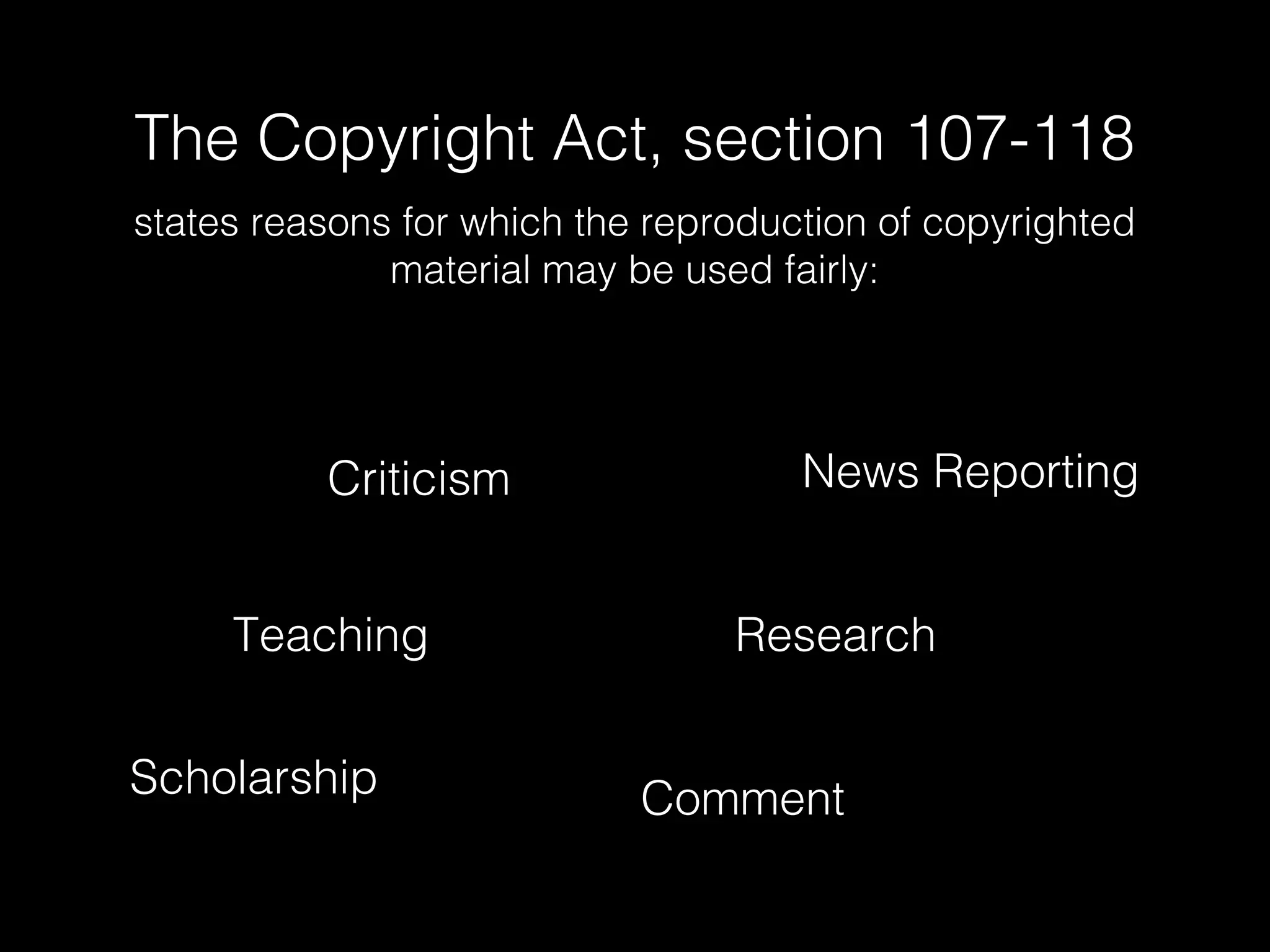
The Copyright Act, section 107-118
states reasons for which the reproduction of copyrighted
material may be used fairly:
Criticism
Comment
News Reporting
Teaching Research
Scholarship
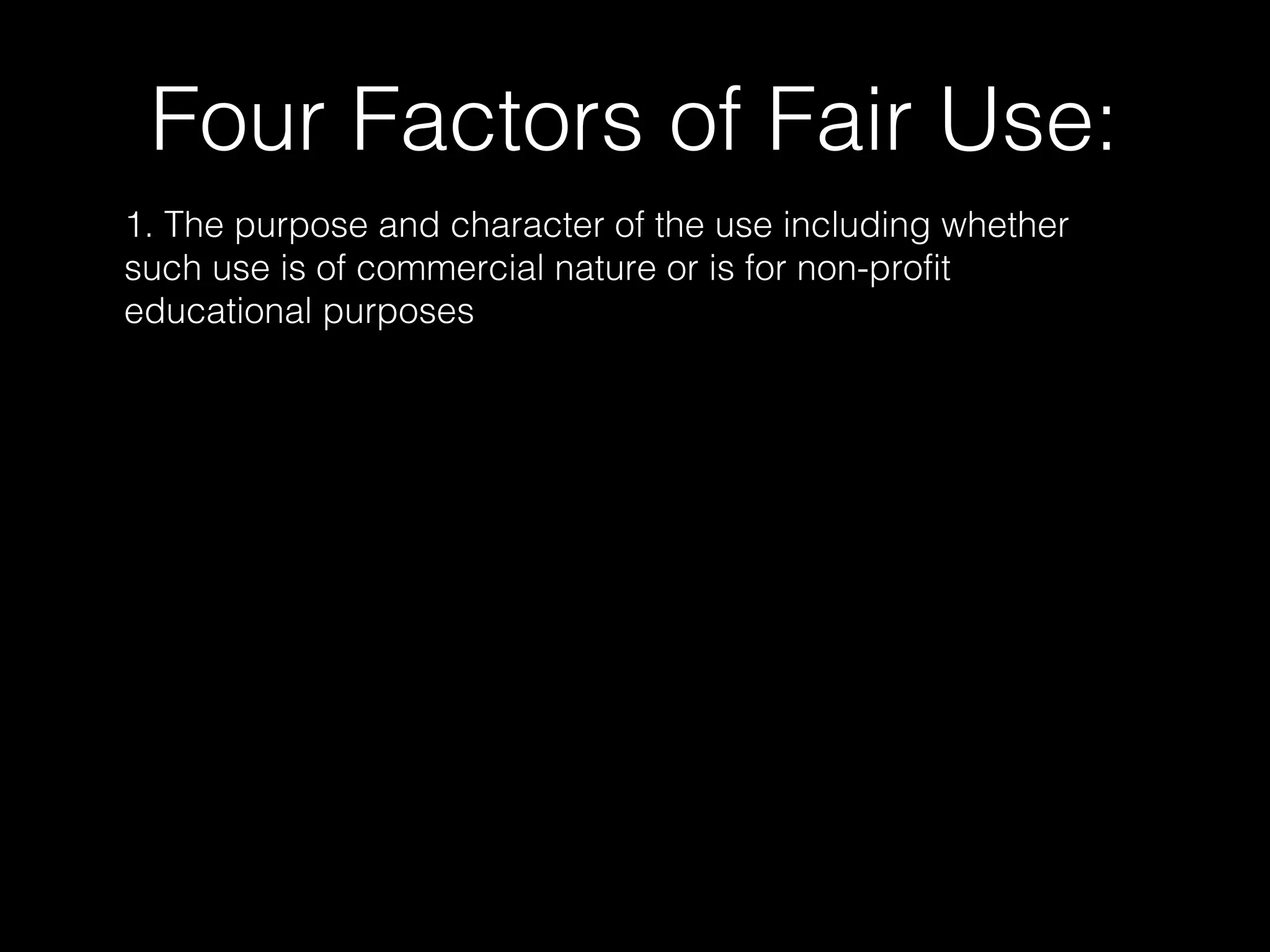
Four Factors of Fair Use:
1. The purpose and character of the use including whether
such use is of commercial nature or is for non-profit
educational purposes
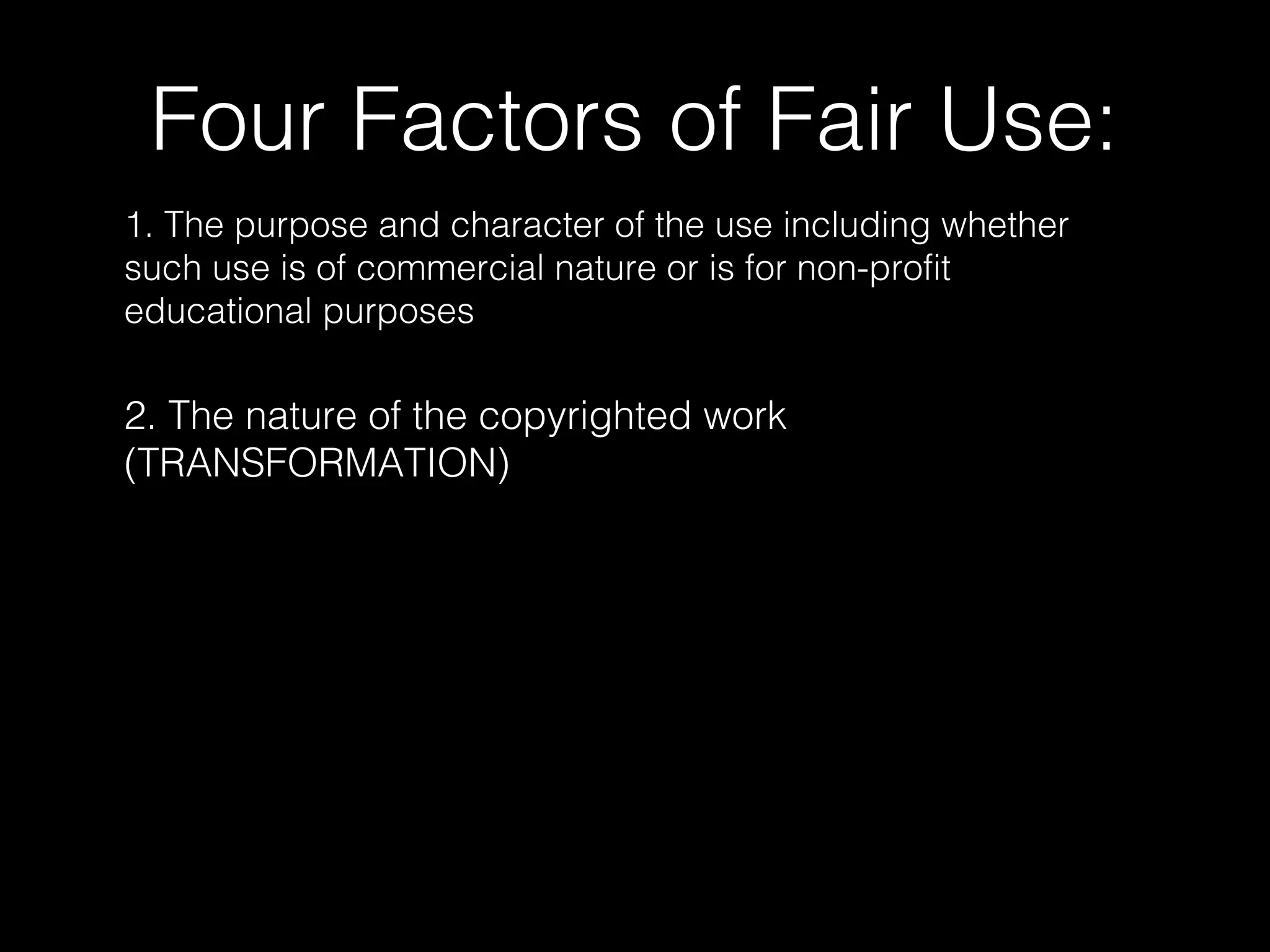
Four Factors of Fair Use:
1. The purpose and character of the use including whether
such use is of commercial nature or is for non-profit
educational purposes
2. The nature of the copyrighted work
(TRANSFORMATION)
Four Factors of Fair Use:
1. The purpose and character of the use including whether
such use is of commercial nature or is for non-profit
educational purposes
3. The amount and substantiality of the portion used in
relation to the copyrighted work as a whole
2. The nature of the copyrighted work
(TRANSFORMATION)
Four Factors of Fair Use:
1. The purpose and character of the use including whether
such use is of commercial nature or is for non-profit
educational purposes
3. The amount and substantiality of the portion used in
relation to the copyrighted work as a whole
2. The nature of the copyrighted work
(TRANSFORMATION)
4. The effect of the use upon the potential market for, or
value of, the copyrighted work
Tranformation is the Key
Transformation has been at the heart of most copyright
cases in the last 20 years, and hinges on these factors:
Tranformation is the Key
Transformation has been at the heart of most copyright
cases in the last 20 years, and hinges on these factors:
Does your use of the copyright material convey:
New Expression?
New Meaning?
New Message?
Tranformation is the Key
Transformation has been at the heart of most copyright
cases in the last 20 years, and hinges on these factors:
Does your use of the copyright material convey:
New Expression?
New Meaning?
New Message?
Or does it supersede or supplant the object of
the original creation?
If your use is doing the same thing as the original was
doing, you may not have Fair Use.
Ask yourself before your begin a project:
Do I have a transformative process , and can I
articulate it?
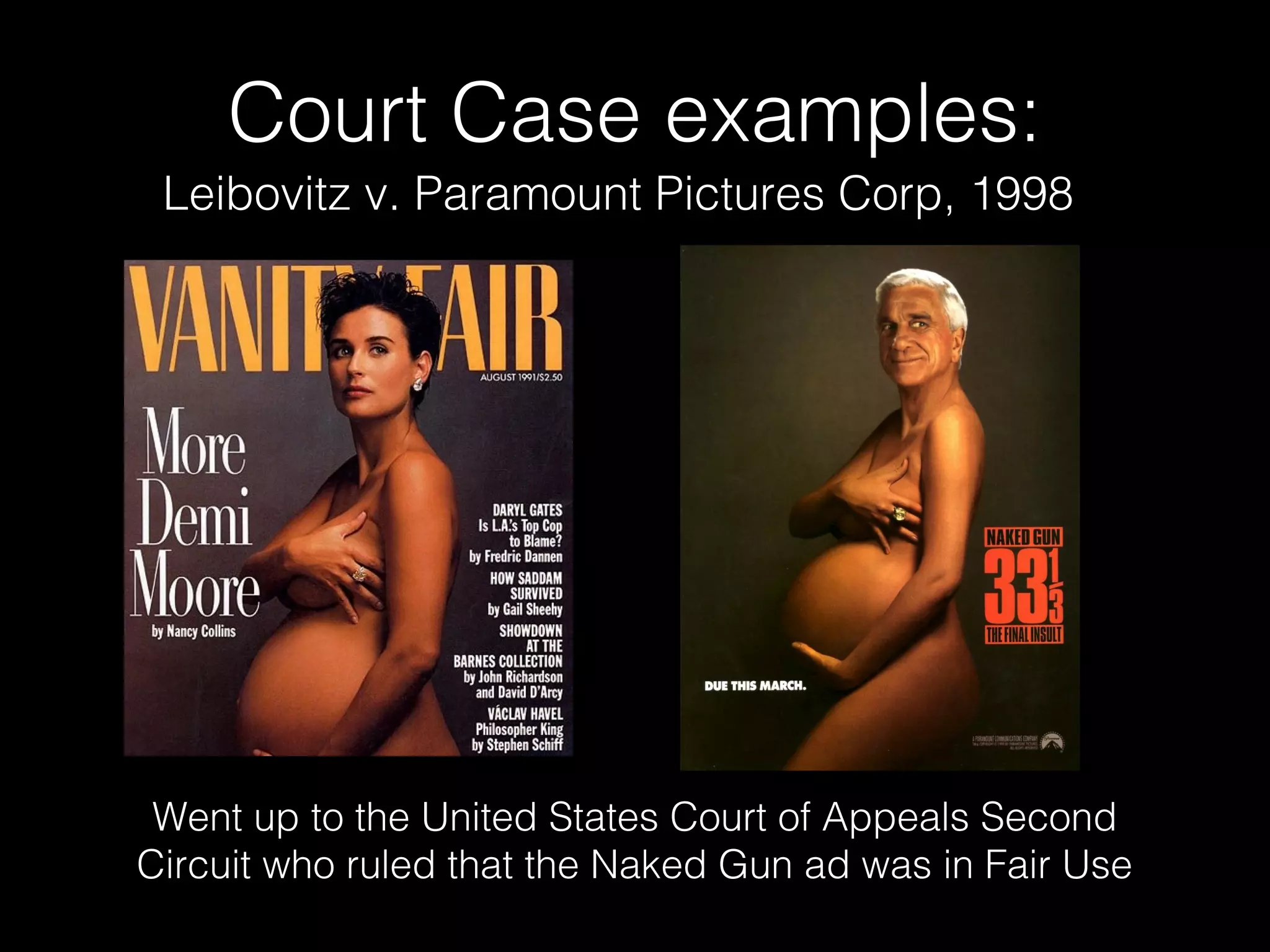
Court Case examples:
Went up to the United States Court of Appeals Second
Circuit who ruled that the Naked Gun ad was in Fair Use
Leibovitz v. Paramount Pictures Corp, 1998
Copyright Myths
1. If you credit the author with a link, then there is no
copyright infringement.
FALSE: The act of obtaining permission
has no effect on the legitimacy of fair use.
2. If content does not have proof of
copyright, it's not copyright protected.
FALSE: In 1978 the law changed and abolished
the need for a copyright symbol. From then on,
every published work on paper or digital media
is automatically copyright protected.
Best Practices:
1. Use Public Domain material.
Best Practices:
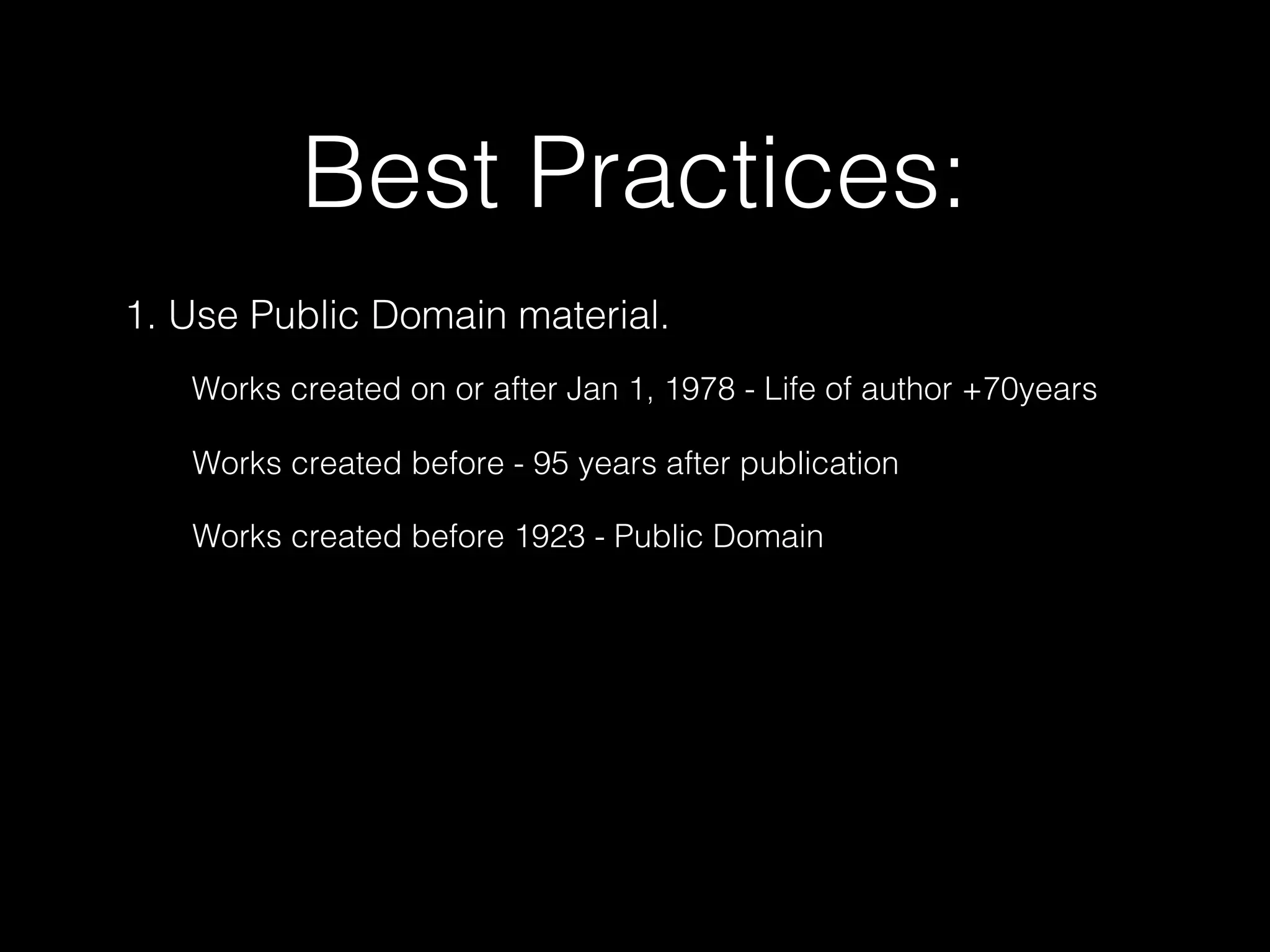
1. Use Public Domain material.
Works created on or after Jan 1, 1978 - Life of author +70years
Works created before - 95 years after publication
Works created before 1923 - Public Domain
Best Practices:
1. Use Public Domain material.
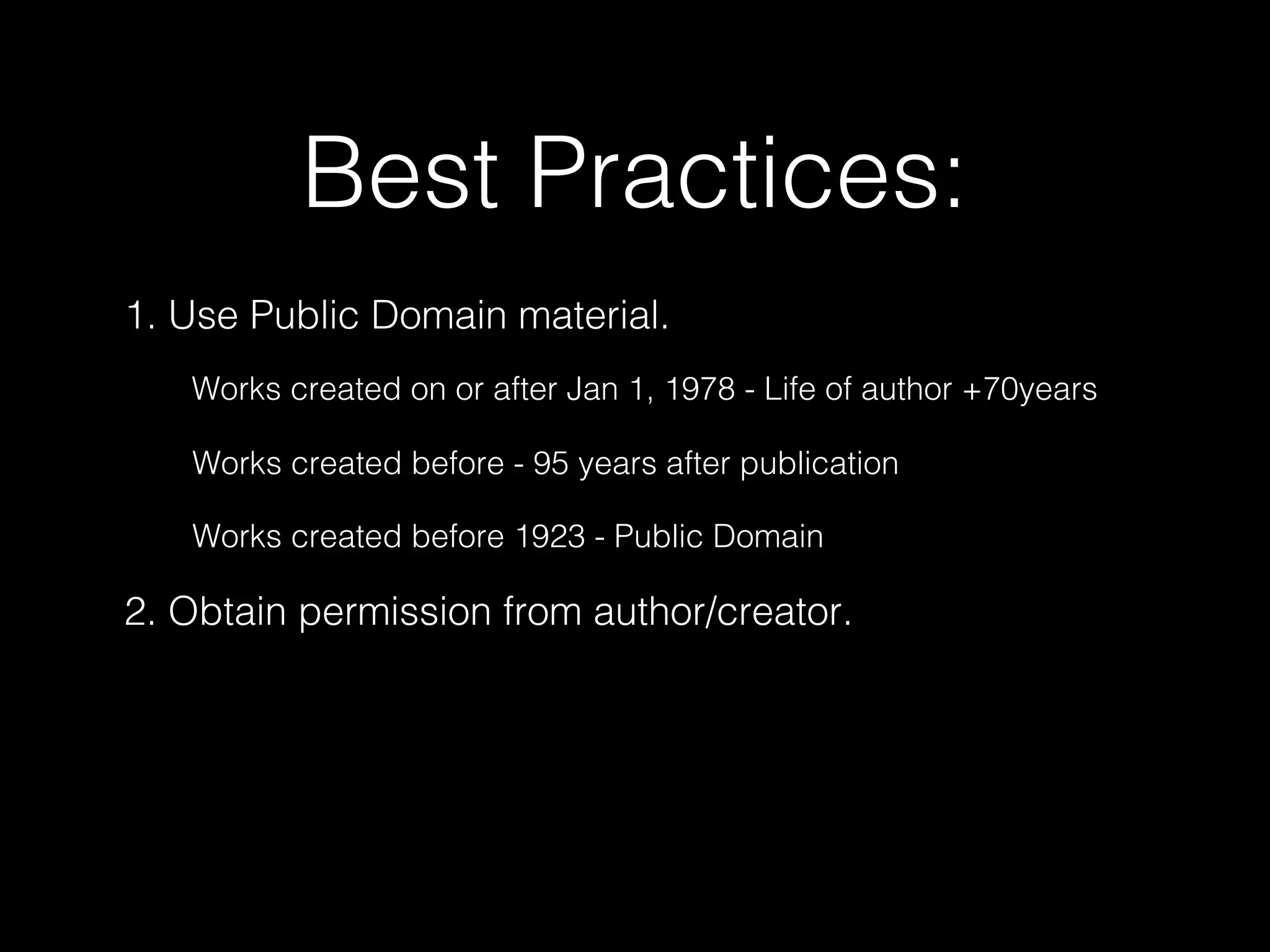
2. Obtain permission from author/creator.
Works created on or after Jan 1, 1978 - Life of author +70years
Works created before - 95 years after publication
Works created before 1923 - Public Domain
Best Practices:
1. Use Public Domain material.
2. Obtain permission from author/creator.
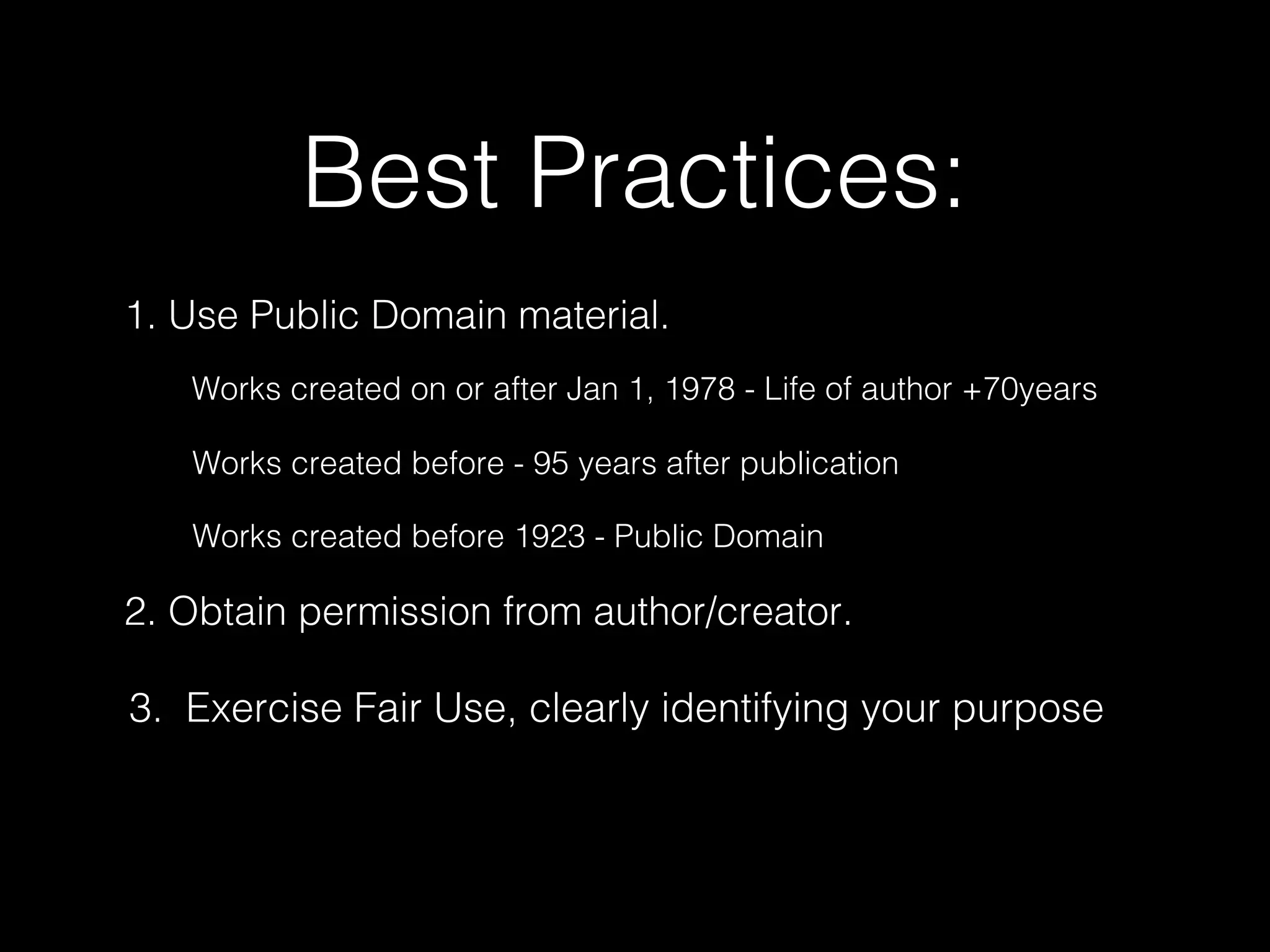
3. Exercise Fair Use, clearly identifying your purpose
Works created on or after Jan 1, 1978 - Life of author +70years
Works created before - 95 years after publication
Works created before 1923 - Public Domain
QUIZ: Is This Fair Use?
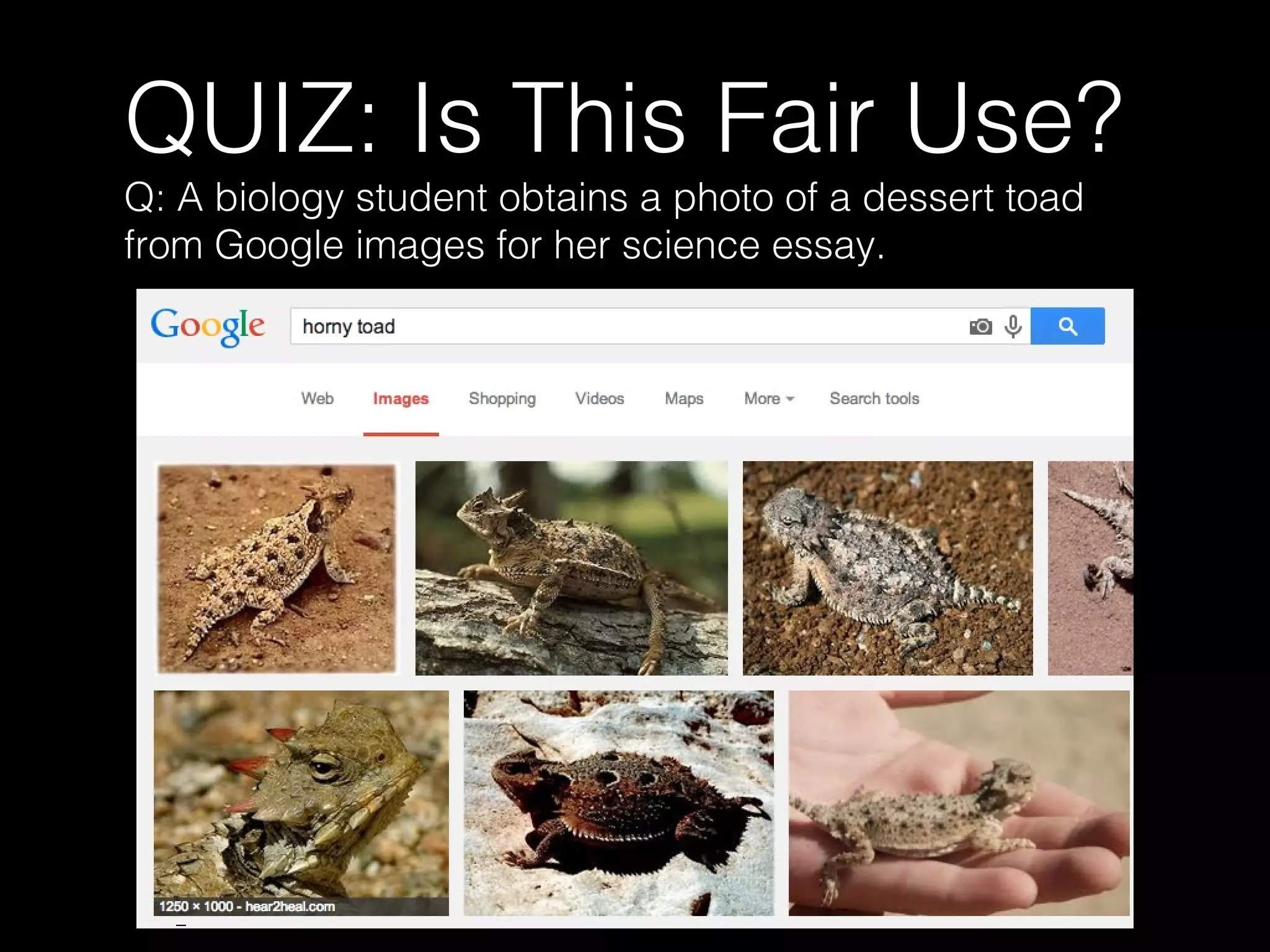
Q: A biology student obtains a photo of a dessert toad
from Google images for her science essay.
QUIZ: Is This Fair Use?
Q: A biology student obtains a photo of a dessert toad
from Google images for her science essay.
YES!
QUIZ: Is This Fair Use?
Q: A biology student obtains a photo of a dessert toad
from Google images for her science essay.
YES!
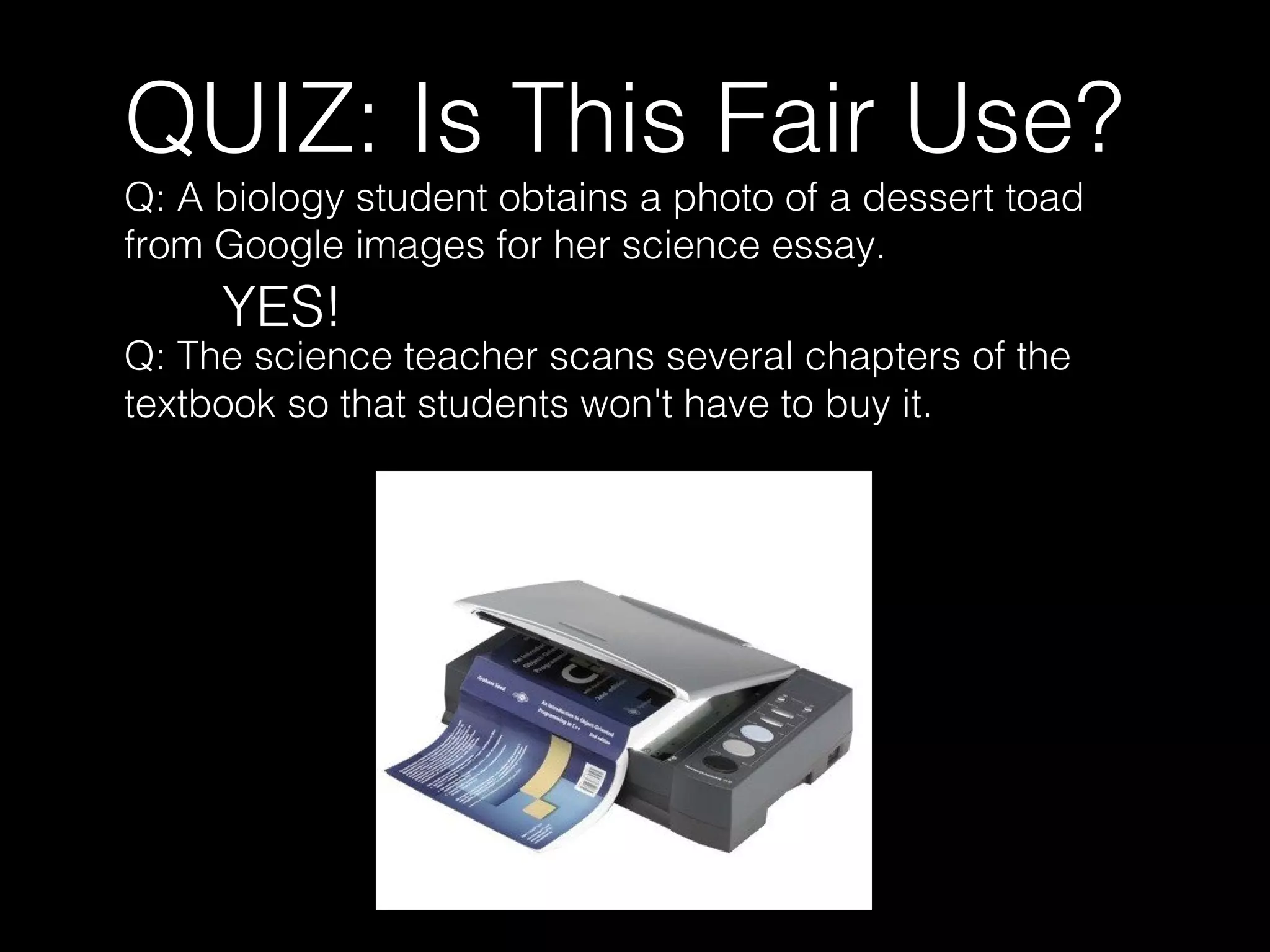
Q: The science teacher scans several chapters of the
textbook so that students won't have to buy it.
QUIZ: Is This Fair Use?
Q: A biology student obtains a photo of a dessert toad
from Google images for her science essay.
YES!
Q: The science teacher scans several chapters of the
textbook so that students won't have to buy it.
NO!
QUIZ: Is This Fair Use?
Q: A biology student obtains a photo of a dessert toad
from Google images for her science essay.
YES!
Q: The science teacher scans several chapters of the
book so that students won't have to buy it.
NO!
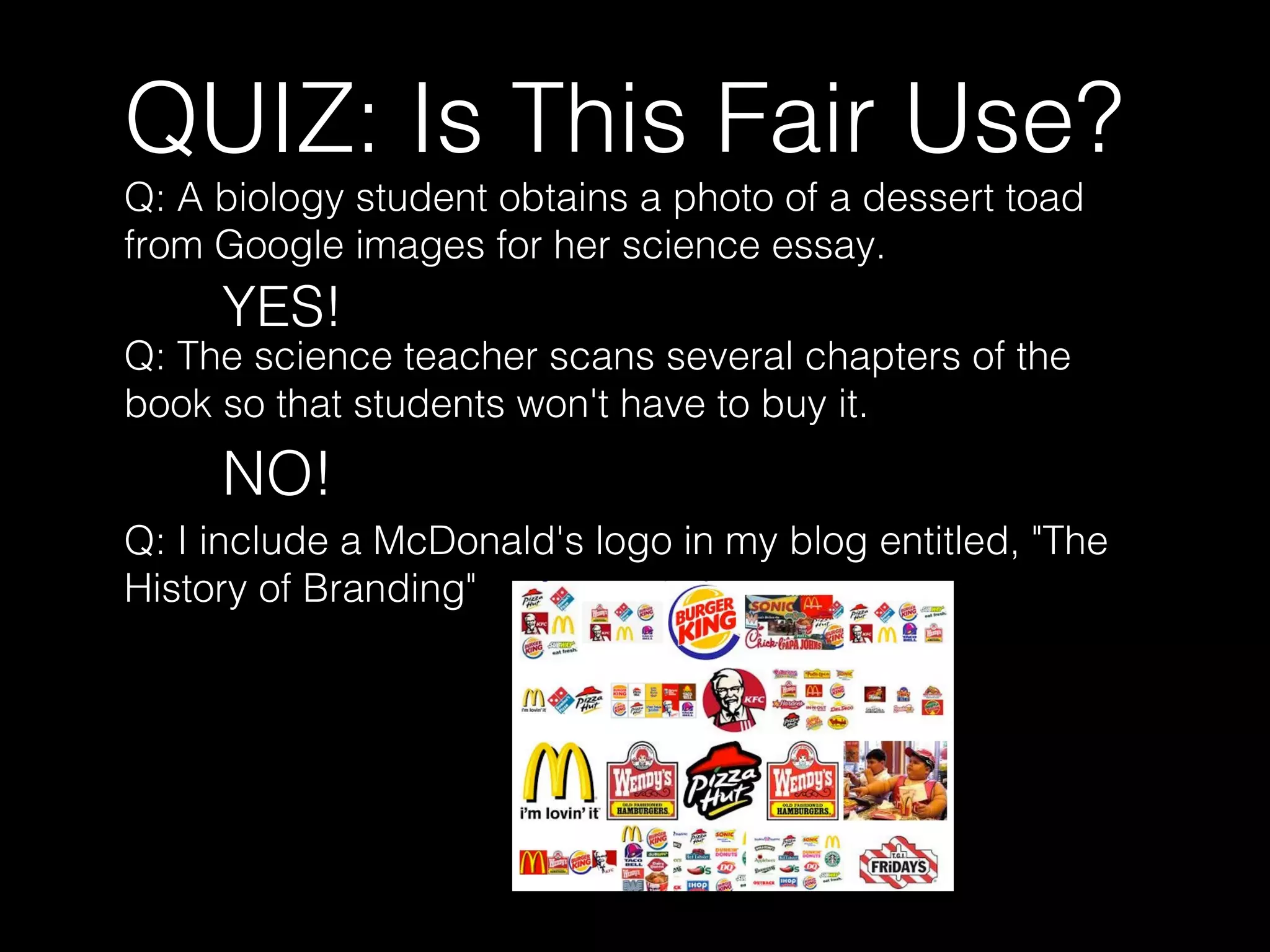
Q: I include a McDonald's logo in my blog entitled, "The
History of Branding"
QUIZ: Is This Fair Use?
Q: A biology student obtains a photo of a dessert toad
from Google images for her science essay.
YES!
Q: The science teacher scans several chapters of the
book so that students won't have to buy it.
NO!
Q: I include a McDonald's logo in my blog entitled, "The
History of Branding"
YES!
QUIZ: Is This Fair Use?
Q: A biology student obtains a photo of a dessert toad
from Google images for her science essay.
YES!
Q: The science teacher scans several chapters of the
book so that students won't have to buy it.
NO!
Q: I include a McDonald's logo in my blog entitled, "The
History of Branding"
YES!
Q: I create a website containing a company's name such
as "www.MicrosoftSucks.com
QUIZ: Is This Fair Use?
Q: A biology student obtains a photo of a dessert toad
from Google images for her science essay.
YES!
Q: The science teacher scans several chapters of the
book so that students won't have to buy it.
NO!
Q: I include a McDonald's logo in my blog entitled, "The
History of Branding"
YES!
Q: I create a website containing a company's name such
as "www.MicrosoftSucks.com
YES!
QUIZ: Is This Fair Use?
http://youtu.be/u1kqqMXWEFs
Sources: (although I don't legally
need to do this for this presentation)
Julie Ahrens - Stanford Center for Internet and Society
Copyright and Fair Use Issues in the Visual Motion Arts.
United State Copyright Office www.copyright.gov
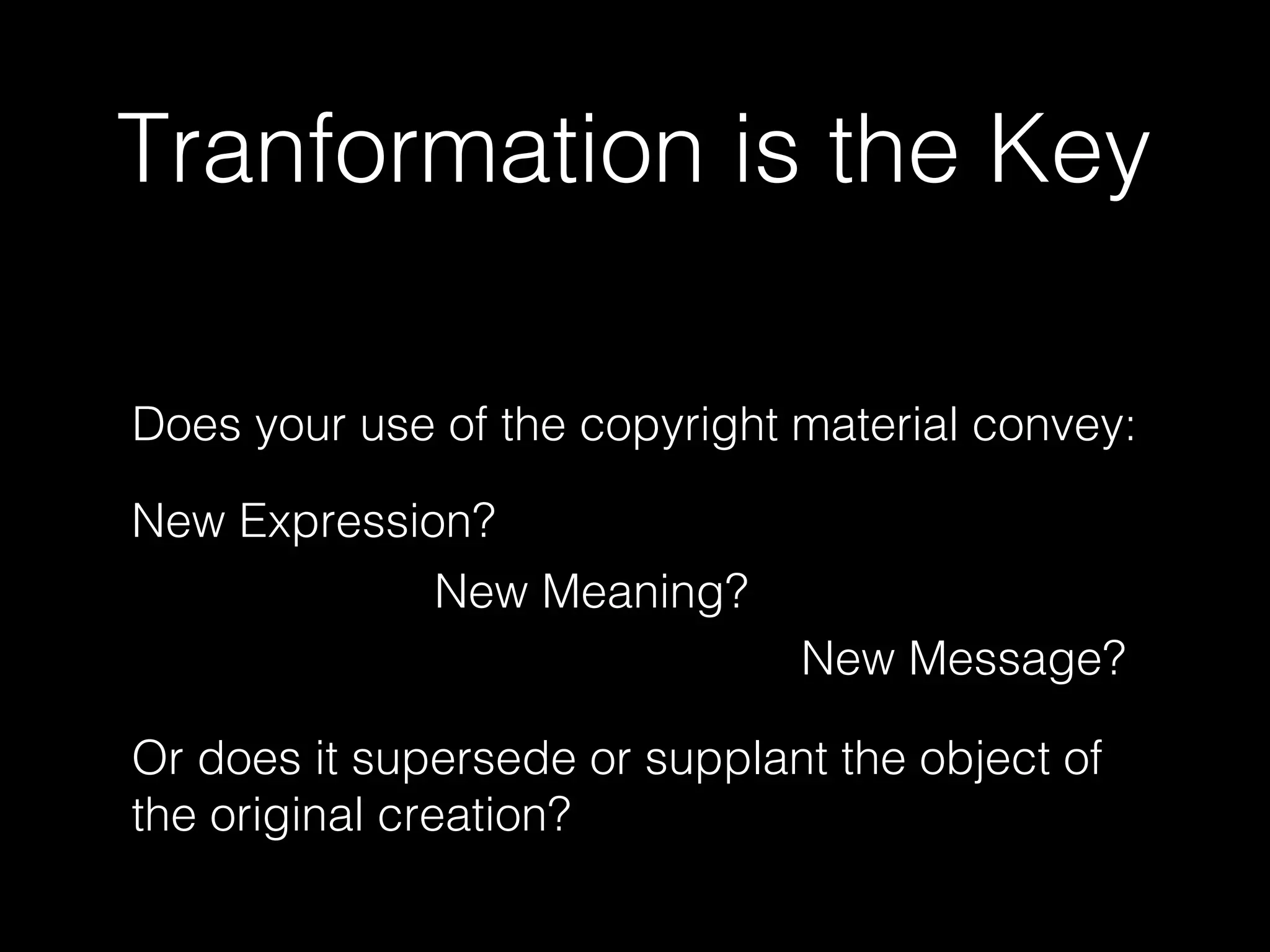
Tranformation is the Key
Does your use of the copyright material convey:
New Expression?
New Meaning?
Or does it supersede or supplant the object of
the original creation?
New Message?
The Content Creator's
Guide to Digital Copyright
And Fair Use Doctrine
Adam Ray

The content creator's guide to digital copyright and fair use doctrine

  • 1.
    The Content Creator's Guideto Digital Copyright And Fair Use Doctrine Adam Ray
  • 2.
    The Copyright Act,section 107-118 states reasons for which the reproduction of copyrighted material may be used fairly: Criticism Comment News Reporting Teaching Research Scholarship
  • 3.
    Four Factors ofFair Use: 1. The purpose and character of the use including whether such use is of commercial nature or is for non-profit educational purposes
  • 4.
    Four Factors ofFair Use: 1. The purpose and character of the use including whether such use is of commercial nature or is for non-profit educational purposes 2. The nature of the copyrighted work (TRANSFORMATION)
  • 5.
    Four Factors ofFair Use: 1. The purpose and character of the use including whether such use is of commercial nature or is for non-profit educational purposes 3. The amount and substantiality of the portion used in relation to the copyrighted work as a whole 2. The nature of the copyrighted work (TRANSFORMATION)
  • 6.
    Four Factors ofFair Use: 1. The purpose and character of the use including whether such use is of commercial nature or is for non-profit educational purposes 3. The amount and substantiality of the portion used in relation to the copyrighted work as a whole 2. The nature of the copyrighted work (TRANSFORMATION) 4. The effect of the use upon the potential market for, or value of, the copyrighted work
  • 7.
    Tranformation is theKey Transformation has been at the heart of most copyright cases in the last 20 years, and hinges on these factors:
  • 8.
    Tranformation is theKey Transformation has been at the heart of most copyright cases in the last 20 years, and hinges on these factors: Does your use of the copyright material convey: New Expression? New Meaning? New Message?
  • 9.
    Tranformation is theKey Transformation has been at the heart of most copyright cases in the last 20 years, and hinges on these factors: Does your use of the copyright material convey: New Expression? New Meaning? New Message? Or does it supersede or supplant the object of the original creation?
  • 10.
    If your useis doing the same thing as the original was doing, you may not have Fair Use. Ask yourself before your begin a project: Do I have a transformative process , and can I articulate it?
  • 11.
    Court Case examples: Wentup to the United States Court of Appeals Second Circuit who ruled that the Naked Gun ad was in Fair Use Leibovitz v. Paramount Pictures Corp, 1998
  • 12.
    Copyright Myths 1. Ifyou credit the author with a link, then there is no copyright infringement. FALSE: The act of obtaining permission has no effect on the legitimacy of fair use. 2. If content does not have proof of copyright, it's not copyright protected. FALSE: In 1978 the law changed and abolished the need for a copyright symbol. From then on, every published work on paper or digital media is automatically copyright protected.
  • 13.
    Best Practices: 1. UsePublic Domain material.
  • 14.
    Best Practices: 1. UsePublic Domain material. Works created on or after Jan 1, 1978 - Life of author +70years Works created before - 95 years after publication Works created before 1923 - Public Domain
  • 15.
    Best Practices: 1. UsePublic Domain material. 2. Obtain permission from author/creator. Works created on or after Jan 1, 1978 - Life of author +70years Works created before - 95 years after publication Works created before 1923 - Public Domain
  • 16.
    Best Practices: 1. UsePublic Domain material. 2. Obtain permission from author/creator. 3. Exercise Fair Use, clearly identifying your purpose Works created on or after Jan 1, 1978 - Life of author +70years Works created before - 95 years after publication Works created before 1923 - Public Domain
  • 17.
    QUIZ: Is ThisFair Use? Q: A biology student obtains a photo of a dessert toad from Google images for her science essay.
  • 18.
    QUIZ: Is ThisFair Use? Q: A biology student obtains a photo of a dessert toad from Google images for her science essay. YES!
  • 19.
    QUIZ: Is ThisFair Use? Q: A biology student obtains a photo of a dessert toad from Google images for her science essay. YES! Q: The science teacher scans several chapters of the textbook so that students won't have to buy it.
  • 20.
    QUIZ: Is ThisFair Use? Q: A biology student obtains a photo of a dessert toad from Google images for her science essay. YES! Q: The science teacher scans several chapters of the textbook so that students won't have to buy it. NO!
  • 21.
    QUIZ: Is ThisFair Use? Q: A biology student obtains a photo of a dessert toad from Google images for her science essay. YES! Q: The science teacher scans several chapters of the book so that students won't have to buy it. NO! Q: I include a McDonald's logo in my blog entitled, "The History of Branding"
  • 22.
    QUIZ: Is ThisFair Use? Q: A biology student obtains a photo of a dessert toad from Google images for her science essay. YES! Q: The science teacher scans several chapters of the book so that students won't have to buy it. NO! Q: I include a McDonald's logo in my blog entitled, "The History of Branding" YES!
  • 23.
    QUIZ: Is ThisFair Use? Q: A biology student obtains a photo of a dessert toad from Google images for her science essay. YES! Q: The science teacher scans several chapters of the book so that students won't have to buy it. NO! Q: I include a McDonald's logo in my blog entitled, "The History of Branding" YES! Q: I create a website containing a company's name such as "www.MicrosoftSucks.com
  • 24.
    QUIZ: Is ThisFair Use? Q: A biology student obtains a photo of a dessert toad from Google images for her science essay. YES! Q: The science teacher scans several chapters of the book so that students won't have to buy it. NO! Q: I include a McDonald's logo in my blog entitled, "The History of Branding" YES! Q: I create a website containing a company's name such as "www.MicrosoftSucks.com YES!
  • 25.
    QUIZ: Is ThisFair Use? http://youtu.be/u1kqqMXWEFs
  • 26.
    Sources: (although Idon't legally need to do this for this presentation) Julie Ahrens - Stanford Center for Internet and Society Copyright and Fair Use Issues in the Visual Motion Arts. United State Copyright Office www.copyright.gov
  • 27.
    Tranformation is theKey Does your use of the copyright material convey: New Expression? New Meaning? Or does it supersede or supplant the object of the original creation? New Message?
  • 28.
    The Content Creator's Guideto Digital Copyright And Fair Use Doctrine Adam Ray