The Conditional
 Z E R O , F I R S T, S E C O N D , A N D T H I R D C O N D I T I O N A L
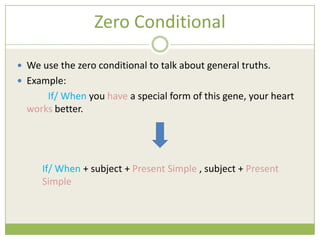
Zero Conditional

 We use the zero conditional to talk about general truths.
 Example:
      If/ When you have a special form of this gene, your heart
  works better.


     If/ When + subject + Present Simple , subject + Present
     Simple
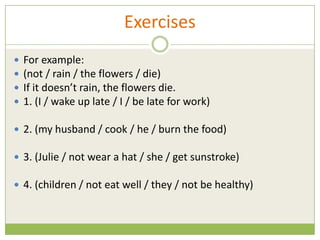
Exercises
   For example:
   (not / rain / the flowers / die)
   If it doesn’t rain, the flowers die.
   1. (I / wake up late / I / be late for work)

 2. (my husband / cook / he / burn the food)

 3. (Julie / not wear a hat / she / get sunstroke)

 4. (children / not eat well / they / not be healthy)
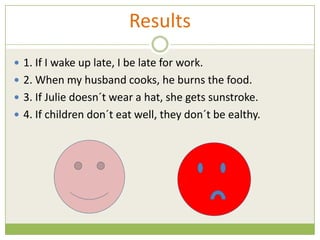
Results
 1. If I wake up late, I be late for work.
 2. When my husband cooks, he burns the food.
 3. If Julie doesn´t wear a hat, she gets sunstroke.
 4. If children don´t eat well, they don´t be ealthy.
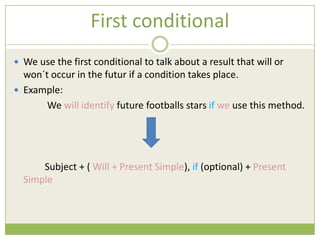
First conditional
 We use the first conditional to talk about a result that will or
  won´t occur in the futur if a condition takes place.
 Example:
       We will identify future footballs stars if we use this method.


      Subject + ( Will + Present Simple), if (optional) + Present
  Simple
Show Answer
 Check


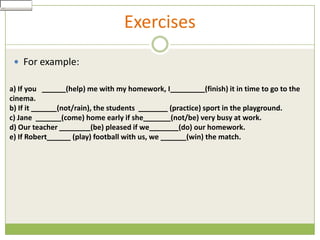
                                     Exercises
     For example:

  a) If you        (help) me with my homework, I             (finish) it in time to go to the
  cinema.
  b) If it      (not/rain), the students         (practice) sport in the playground.
  c) Jane        (come) home early if she        (not/be) very busy at work.
  d) Our teacher           (be) pleased if we       (do) our homework.
  e) If Robert       (play) football with us, we      (win) the match.
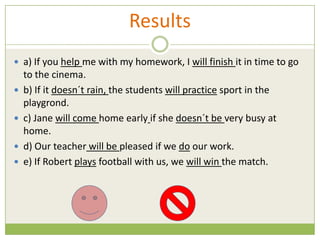
Results
 a) If you help me with my homework, I will finish it in time to go
    to the cinema.
   b) If it doesn´t rain, the students will practice sport in the
    playgrond.
   c) Jane will come home early if she doesn´t be very busy at
    home.
   d) Our teacher will be pleased if we do our work.
   e) If Robert plays football with us, we will win the match.
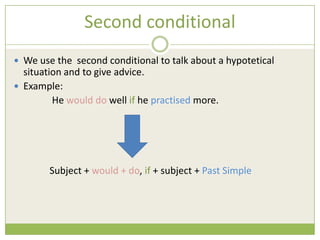
Second conditional
 We use the second conditional to talk about a hypotetical
  situation and to give advice.
 Example:
         He would do well if he practised more.


        Subject + would + do, if + subject + Past Simple
Exercises

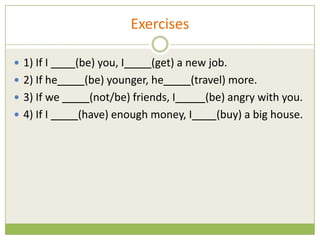
 1) If I    (be) you, I     (get) a new job.
 2) If he     (be) younger, he       (travel) more.
 3) If we      (not/be) friends, I       (be) angry with you.
 4) If I     (have) enough money, I        (buy) a big house.
Results

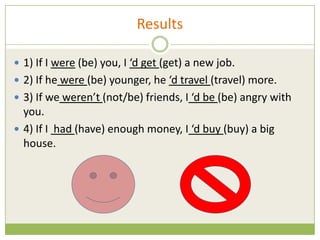
 1) If I were (be) you, I ‘d get (get) a new job.
 2) If he were (be) younger, he ‘d travel (travel) more.
 3) If we weren’t (not/be) friends, I ‘d be (be) angry with
  you.
 4) If I had (have) enough money, I ‘d buy (buy) a big
  house.
Third Conditional

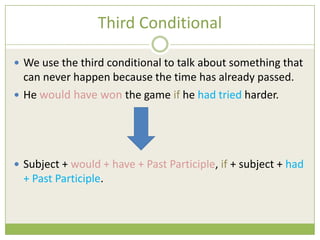
 We use the third conditional to talk about something that
  can never happen because the time has already passed.
 He would have won the game if he had tried harder.


 Subject + would + have + Past Participle, if + subject + had
  + Past Participle.
Exercises

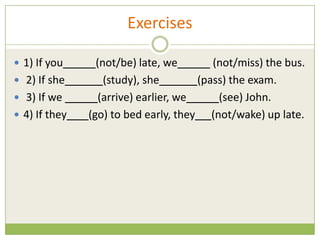
 1) If you      (not/be) late, we        (not/miss) the bus.
 2) If she        (study), she        (pass) the exam.
 3) If we        (arrive) earlier, we     (see) John.
 4) If they   (go) to bed early, they (not/wake) up late.
Results
 1) If you hadn´t been late, we wouldn´t have missed the
  bus.
 2) If she had studied, she would have passed the exam.
 3) If we had arrived earlier, we would have seen Jhon.
 4) If they had gone to bed early, they wouldn´t have
  woken up late.

The conditional

  • 1.
    The Conditional ZE R O , F I R S T, S E C O N D , A N D T H I R D C O N D I T I O N A L
  • 2.
    Zero Conditional  Weuse the zero conditional to talk about general truths.  Example: If/ When you have a special form of this gene, your heart works better. If/ When + subject + Present Simple , subject + Present Simple
  • 3.
    Exercises  For example:  (not / rain / the flowers / die)  If it doesn’t rain, the flowers die.  1. (I / wake up late / I / be late for work)  2. (my husband / cook / he / burn the food)  3. (Julie / not wear a hat / she / get sunstroke)  4. (children / not eat well / they / not be healthy)
  • 4.
    Results  1. IfI wake up late, I be late for work.  2. When my husband cooks, he burns the food.  3. If Julie doesn´t wear a hat, she gets sunstroke.  4. If children don´t eat well, they don´t be ealthy.
  • 5.
    First conditional  Weuse the first conditional to talk about a result that will or won´t occur in the futur if a condition takes place.  Example: We will identify future footballs stars if we use this method. Subject + ( Will + Present Simple), if (optional) + Present Simple
  • 6.
    Show Answer Check Exercises  For example: a) If you (help) me with my homework, I (finish) it in time to go to the cinema. b) If it (not/rain), the students (practice) sport in the playground. c) Jane (come) home early if she (not/be) very busy at work. d) Our teacher (be) pleased if we (do) our homework. e) If Robert (play) football with us, we (win) the match.
  • 7.
    Results  a) Ifyou help me with my homework, I will finish it in time to go to the cinema.  b) If it doesn´t rain, the students will practice sport in the playgrond.  c) Jane will come home early if she doesn´t be very busy at home.  d) Our teacher will be pleased if we do our work.  e) If Robert plays football with us, we will win the match.
  • 8.
    Second conditional  Weuse the second conditional to talk about a hypotetical situation and to give advice.  Example: He would do well if he practised more. Subject + would + do, if + subject + Past Simple
  • 9.
    Exercises  1) IfI (be) you, I (get) a new job.  2) If he (be) younger, he (travel) more.  3) If we (not/be) friends, I (be) angry with you.  4) If I (have) enough money, I (buy) a big house.
  • 10.
    Results  1) IfI were (be) you, I ‘d get (get) a new job.  2) If he were (be) younger, he ‘d travel (travel) more.  3) If we weren’t (not/be) friends, I ‘d be (be) angry with you.  4) If I had (have) enough money, I ‘d buy (buy) a big house.
  • 11.
    Third Conditional  Weuse the third conditional to talk about something that can never happen because the time has already passed.  He would have won the game if he had tried harder.  Subject + would + have + Past Participle, if + subject + had + Past Participle.
  • 12.
    Exercises  1) Ifyou (not/be) late, we (not/miss) the bus.  2) If she (study), she (pass) the exam.  3) If we (arrive) earlier, we (see) John.  4) If they (go) to bed early, they (not/wake) up late.
  • 13.
    Results  1) Ifyou hadn´t been late, we wouldn´t have missed the bus.  2) If she had studied, she would have passed the exam.  3) If we had arrived earlier, we would have seen Jhon.  4) If they had gone to bed early, they wouldn´t have woken up late.