The Comparison of Two
Populations

Slide 1

Shakeel Nouman
M.Phil Statistics

The Comparison of Two Populations By Shakeel Nouman M.Phil Statistics Govt. College University Lahore, Statistical Officer
8

Slide 2

The Comparison of Two Populations

• Using Statistics
• Paired-Observation Comparisons
• A Test for the Difference between Two
•
•

•

Population Means Using Independent
Random Samples
A Large-Sample Test for the Difference
between Two Population Proportions
The F Distribution and a Test for the
Equality of Two Population Variances
Summary and Review of Terms

The Comparison of Two Populations By Shakeel Nouman M.Phil Statistics Govt. College University Lahore, Statistical Officer
8-1 Using Statistics
•

Slide 3

Inferences about differences between parameters
of two populations
 Paired-Observations
 Observe the same group of persons or things
• At two different times: “before” and “after”
• Under two different sets of circumstances or “treatments”

 Independent Samples
» Observe different groups of persons or things
• At different times or under different sets of circumstances

The Comparison of Two Populations By Shakeel Nouman M.Phil Statistics Govt. College University Lahore, Statistical Officer
8-2 Paired-Observation
Comparisons
•

•

Slide 4

Population parameters may differ at two different
times or under two different sets of
circumstances or treatments because:
The circumstances differ between times or
treatments
The people or things in the different groups are
themselves different
By looking at paired-observations, we are able to
minimize the “between group” , extraneous
variation.

The Comparison of Two Populations By Shakeel Nouman M.Phil Statistics Govt. College University Lahore, Statistical Officer
Paired-Observation ComparisonsSlide 5
of Means
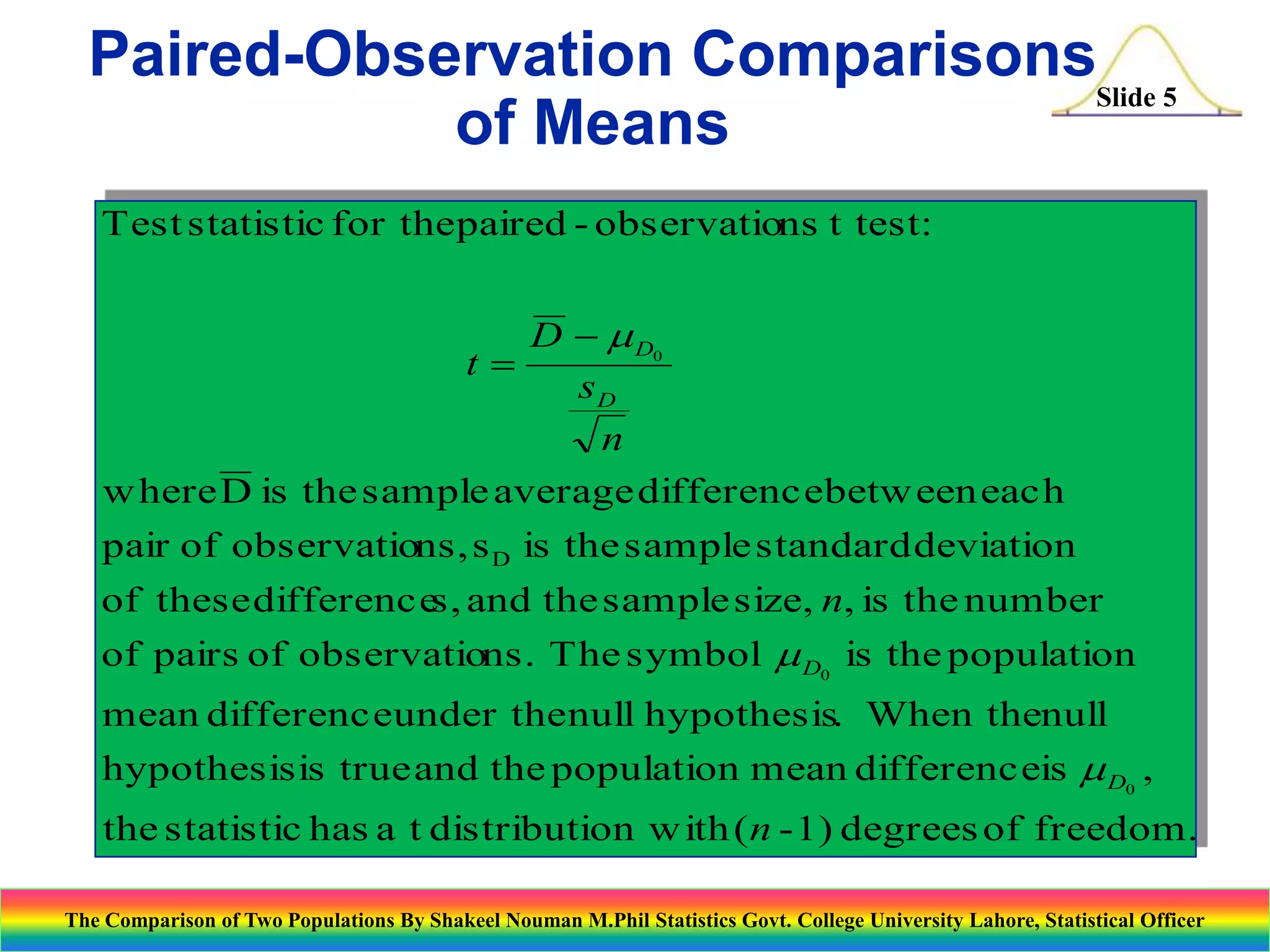
Test statistic for the paired - observations t test:
D -  D0
t
sD
n
w here D is the sample average differencebetw een each
pair of observations, s D is the sample standard deviation
of these difference and the sample size, n, is the number
s,
of pairs of observations. The symbol  D0 is the population
mean differenceunder the null hypothesis. When thenull
hypothesis is true and the population mean differenceis  D0 ,
the statistic has a t distribution w ith (n - 1) degrees of freedom.
The Comparison of Two Populations By Shakeel Nouman M.Phil Statistics Govt. College University Lahore, Statistical Officer
Example 8-1

Slide 6

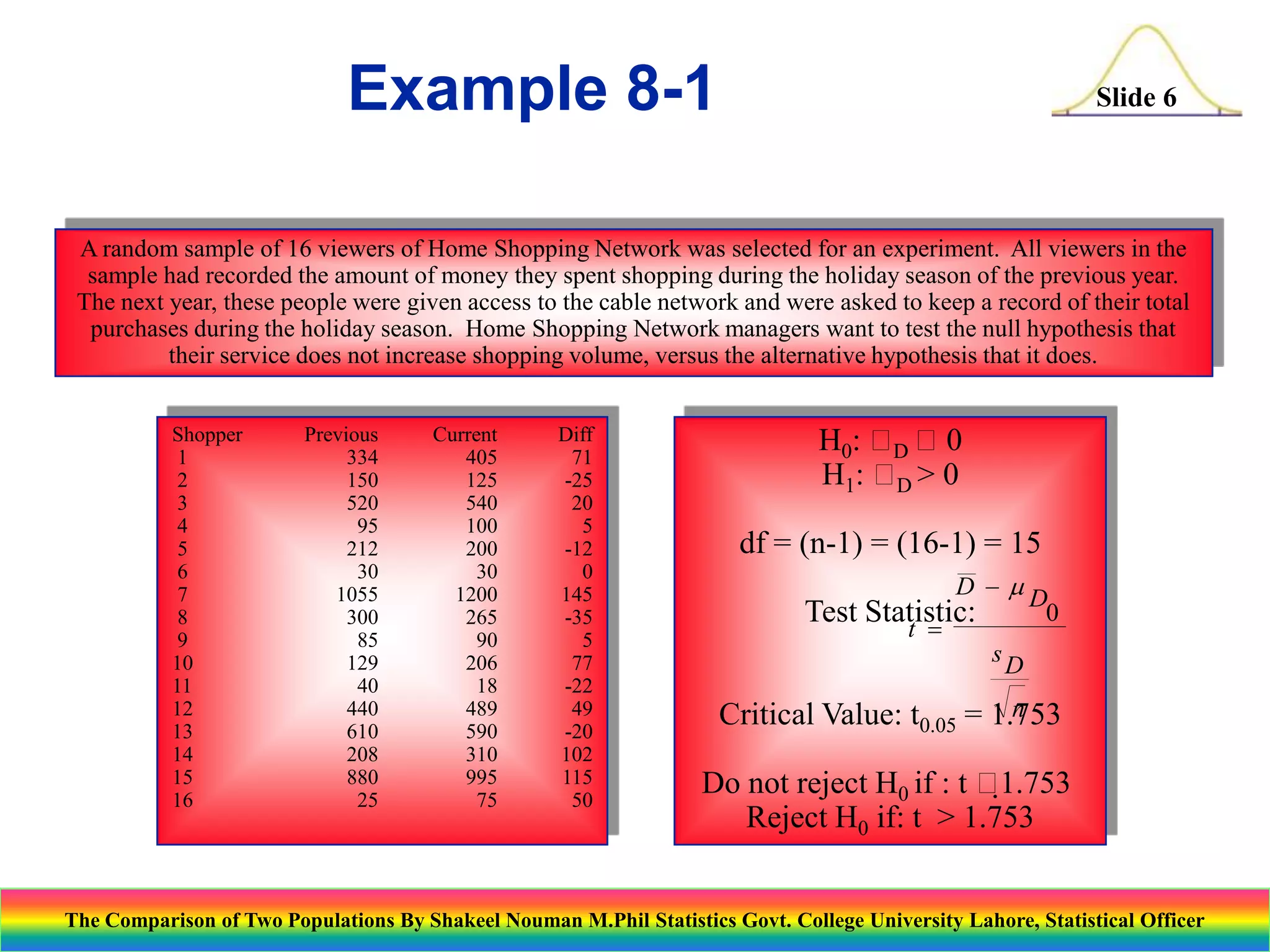
A random sample of 16 viewers of Home Shopping Network was selected for an experiment. All viewers in the
sample had recorded the amount of money they spent shopping during the holiday season of the previous year.
The next year, these people were given access to the cable network and were asked to keep a record of their total
purchases during the holiday season. Home Shopping Network managers want to test the null hypothesis that
their service does not increase shopping volume, versus the alternative hypothesis that it does.
Shopper
1
2
3
4
5
6
7
8
9
10
11
12
13
14
15
16

Previous
334
150
520
95
212
30
1055
300
85
129
40
440
610
208
880
25

Current
405
125
540
100
200
30
1200
265
90
206
18
489
590
310
995
75

Diff
71
-25
20
5
-12
0
145
-35
5
77
-22
49
-20
102
115
50

H0:  0
D
H1:  > 0
D

df = (n-1) = (16-1) = 15
D - D
0
Test Statistic:
t 
sD
n
Critical Value: t0.05 = 1.753

Do not reject H0 if : t 
1.753
Reject H0 if: t > 1.753

The Comparison of Two Populations By Shakeel Nouman M.Phil Statistics Govt. College University Lahore, Statistical Officer
Example 8-1: Solution
D - D
32.81 - 0
0
t

 2.354
sD
55.75

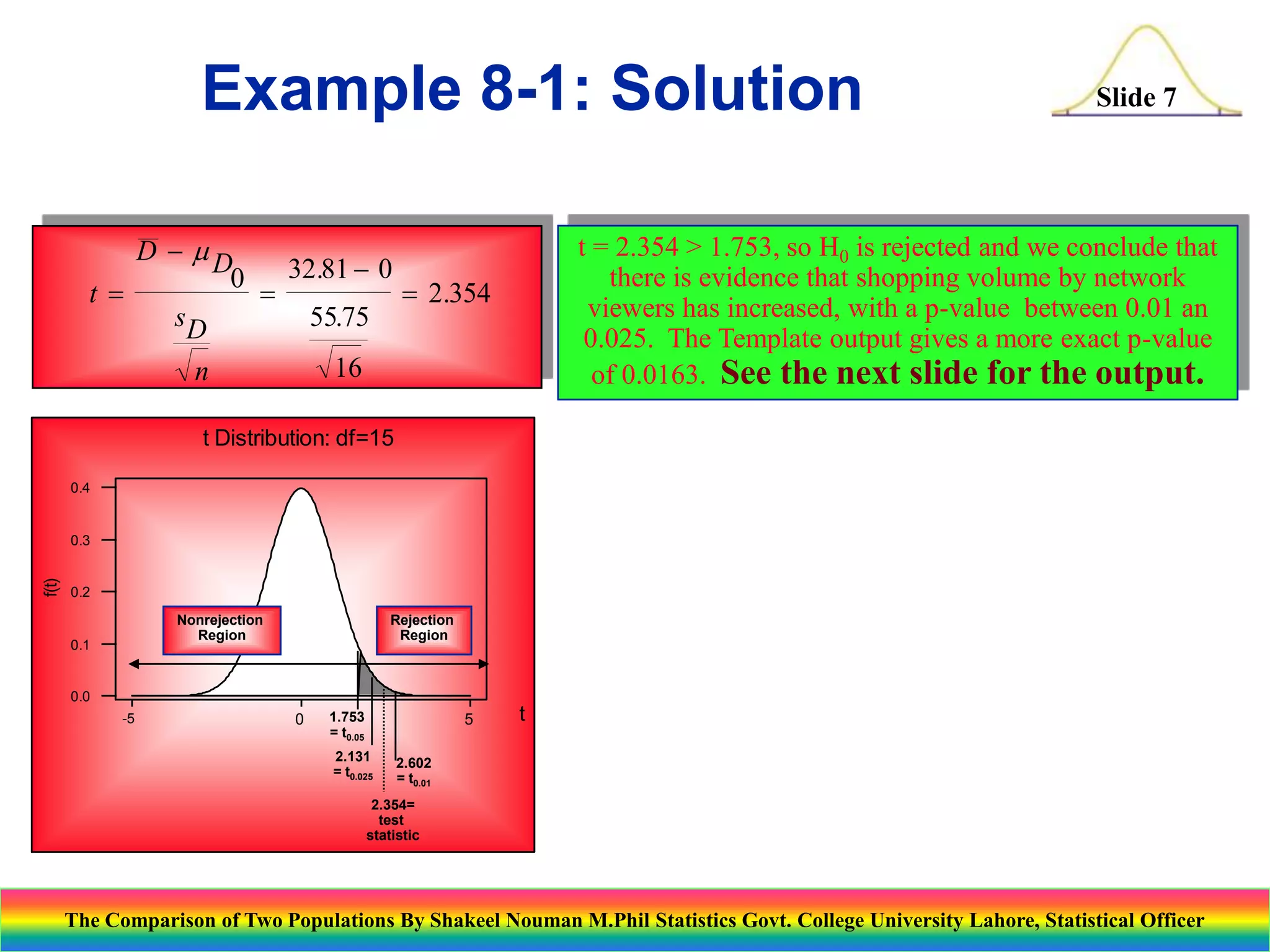
t = 2.354 > 1.753, so H0 is rejected and we conclude that
there is evidence that shopping volume by network
viewers has increased, with a p-value between 0.01 an
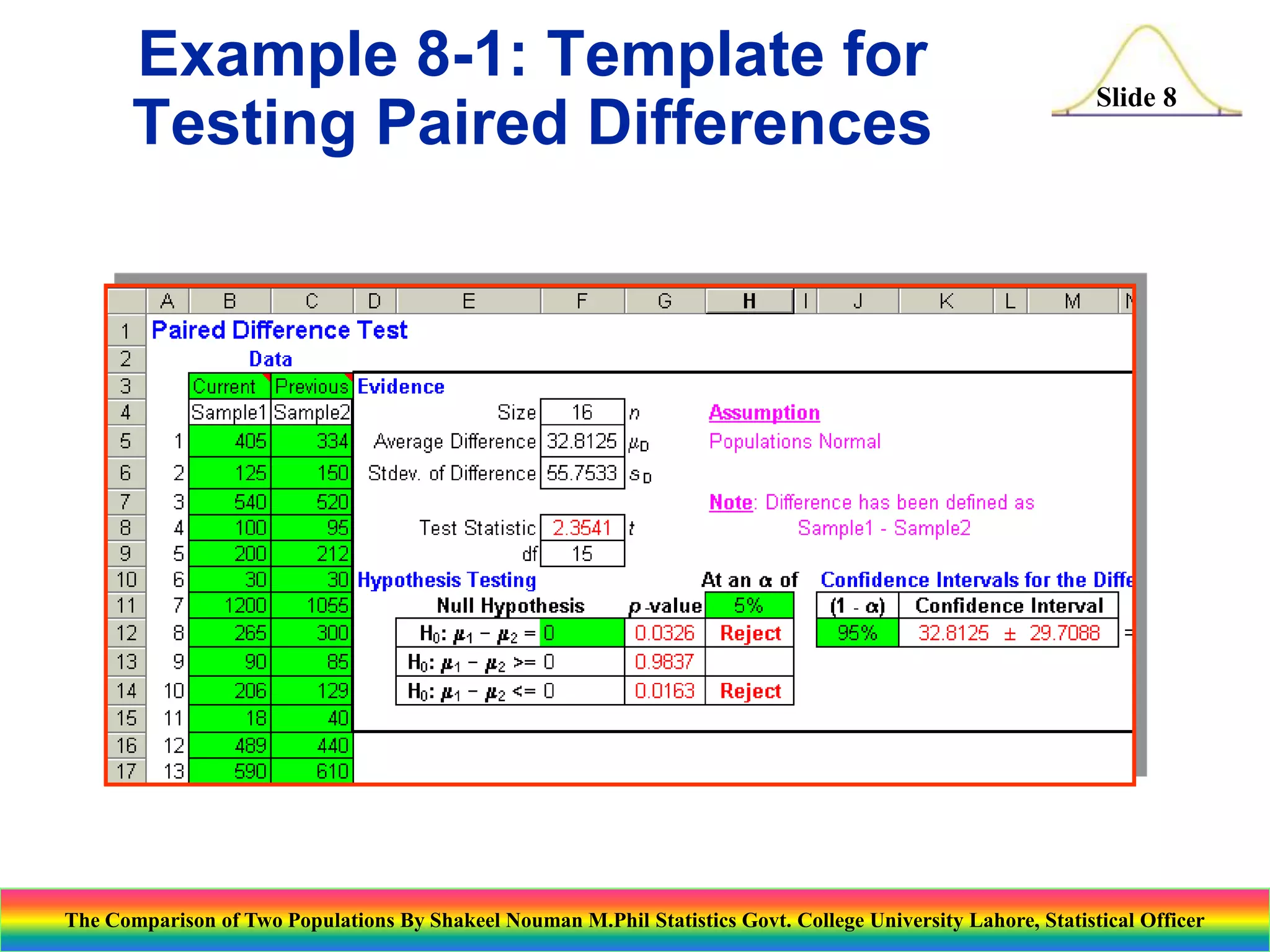
0.025. The Template output gives a more exact p-value
of 0.0163. See the next slide for the output.

16

n

Slide 7

t Distribution: df=15
0.4

f(t)

0.3

0.2
Nonrejection
Region

0.1

Rejection
Region

0.0
-5

0

1.753
= t0.05

5

2.131
= t0.025

t

2.602
= t0.01

2.354=
test
statistic

The Comparison of Two Populations By Shakeel Nouman M.Phil Statistics Govt. College University Lahore, Statistical Officer
Example 8-1: Template for
Testing Paired Differences

Slide 8

The Comparison of Two Populations By Shakeel Nouman M.Phil Statistics Govt. College University Lahore, Statistical Officer
Example 8-2

Slide 9

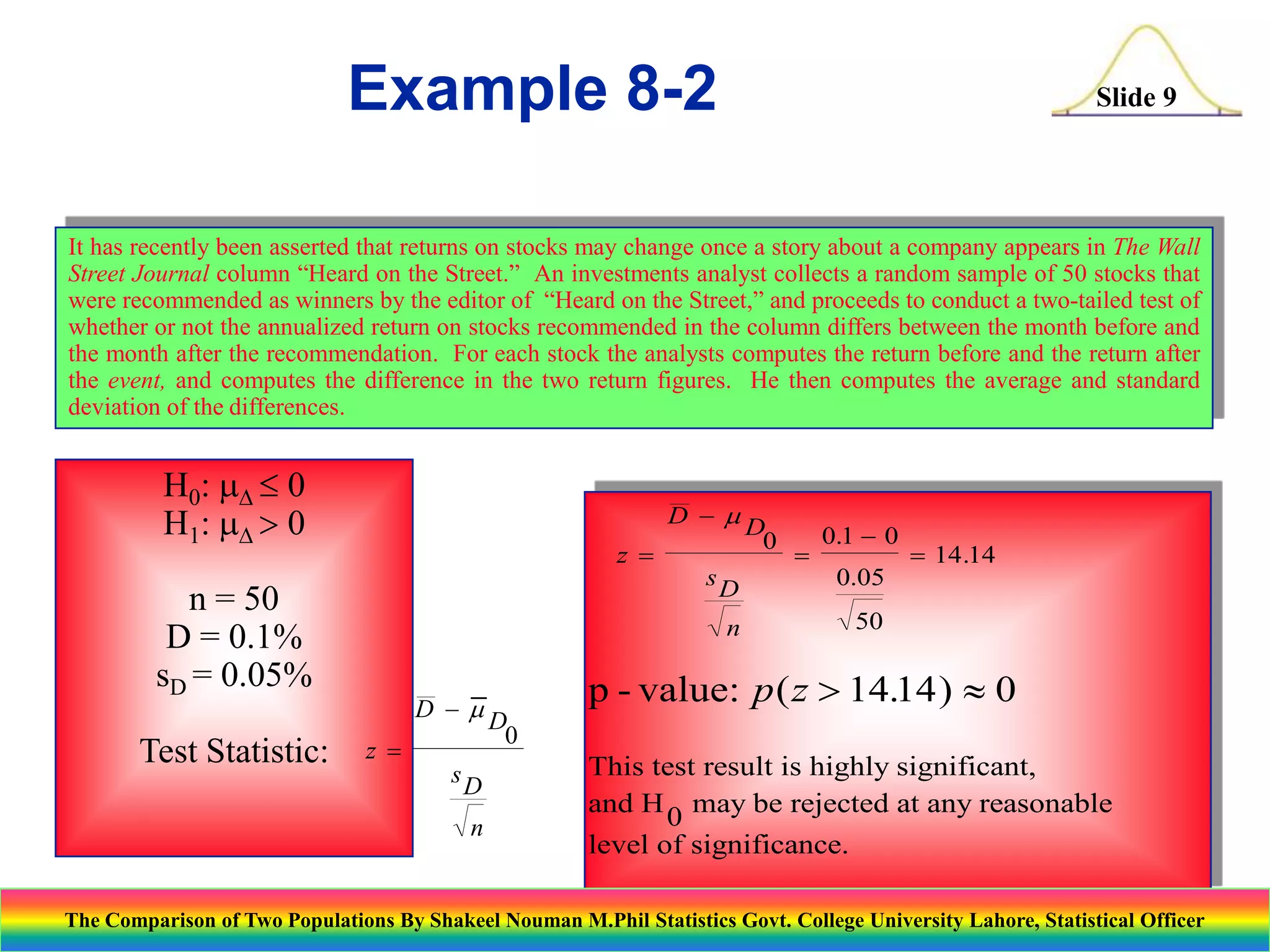
It has recently been asserted that returns on stocks may change once a story about a company appears in The Wall
Street Journal column “Heard on the Street.” An investments analyst collects a random sample of 50 stocks that
were recommended as winners by the editor of “Heard on the Street,” and proceeds to conduct a two-tailed test of
whether or not the annualized return on stocks recommended in the column differs between the month before and
the month after the recommendation. For each stock the analysts computes the return before and the return after
the event, and computes the difference in the two return figures. He then computes the average and standard
deviation of the differences.

H0: D  0
H1: D > 0

D - D
0.1 - 0
0
z 

 14 .14
sD
0.05

n = 50
D = 0.1%
sD = 0.05%
Test Statistic:

n

z 

D - D
0
sD
n

50

p - value: p ( z > 14.14 )  0
This test result is highly significant,
and H 0 may be rejected at any reasonable
level of significance.

The Comparison of Two Populations By Shakeel Nouman M.Phil Statistics Govt. College University Lahore, Statistical Officer
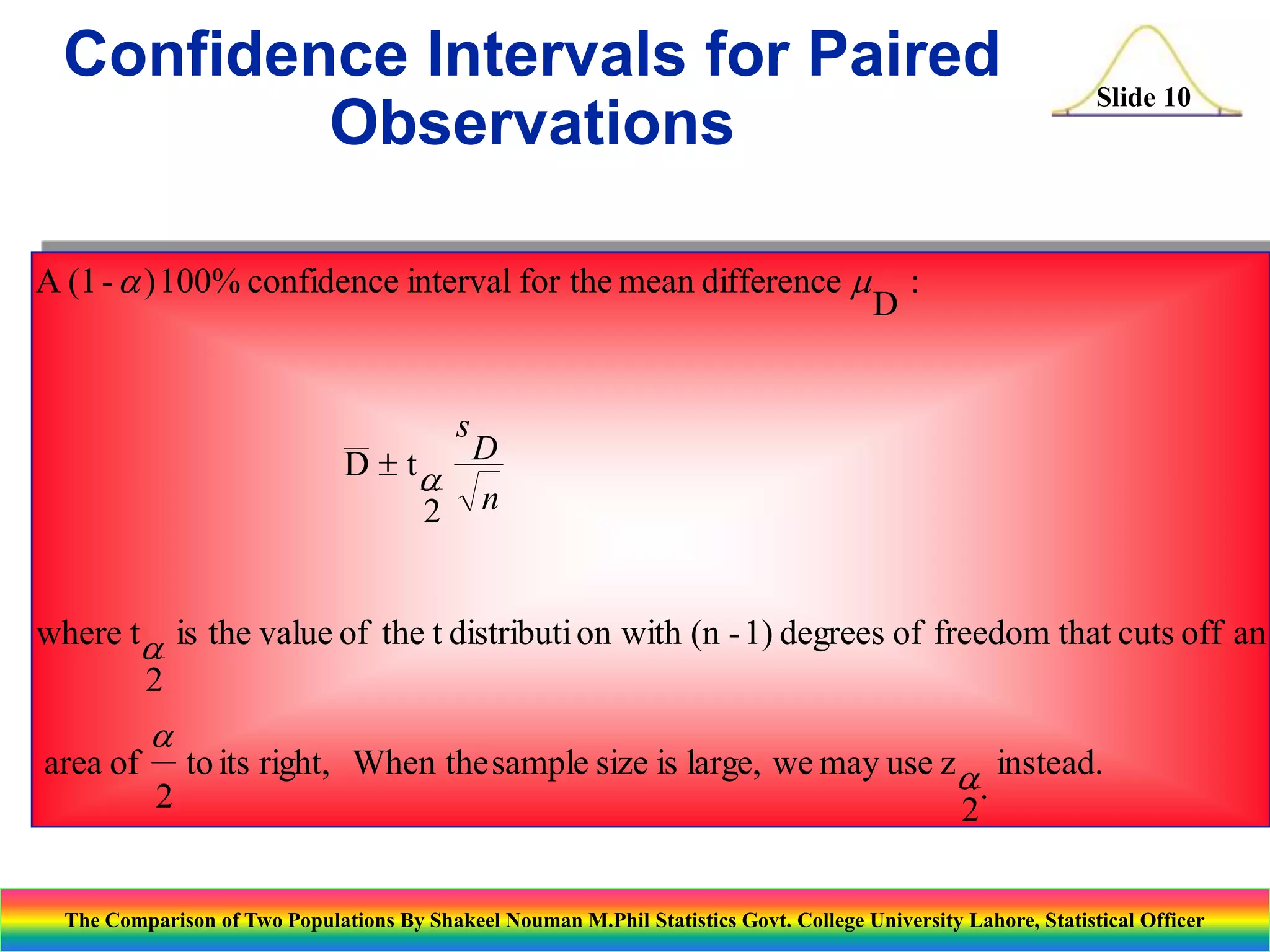
Confidence Intervals for Paired
Observations
A (1 -  ) 100% confidence interval for the mean difference 

D

Slide 10

:

s

D  t D
2 n

where t is the value of the t distributi on with (n - 1) degrees of freedom that cuts off an
2
area of



to its right, When the sample size is large, we may use z instead.
.
2
2

The Comparison of Two Populations By Shakeel Nouman M.Phil Statistics Govt. College University Lahore, Statistical Officer
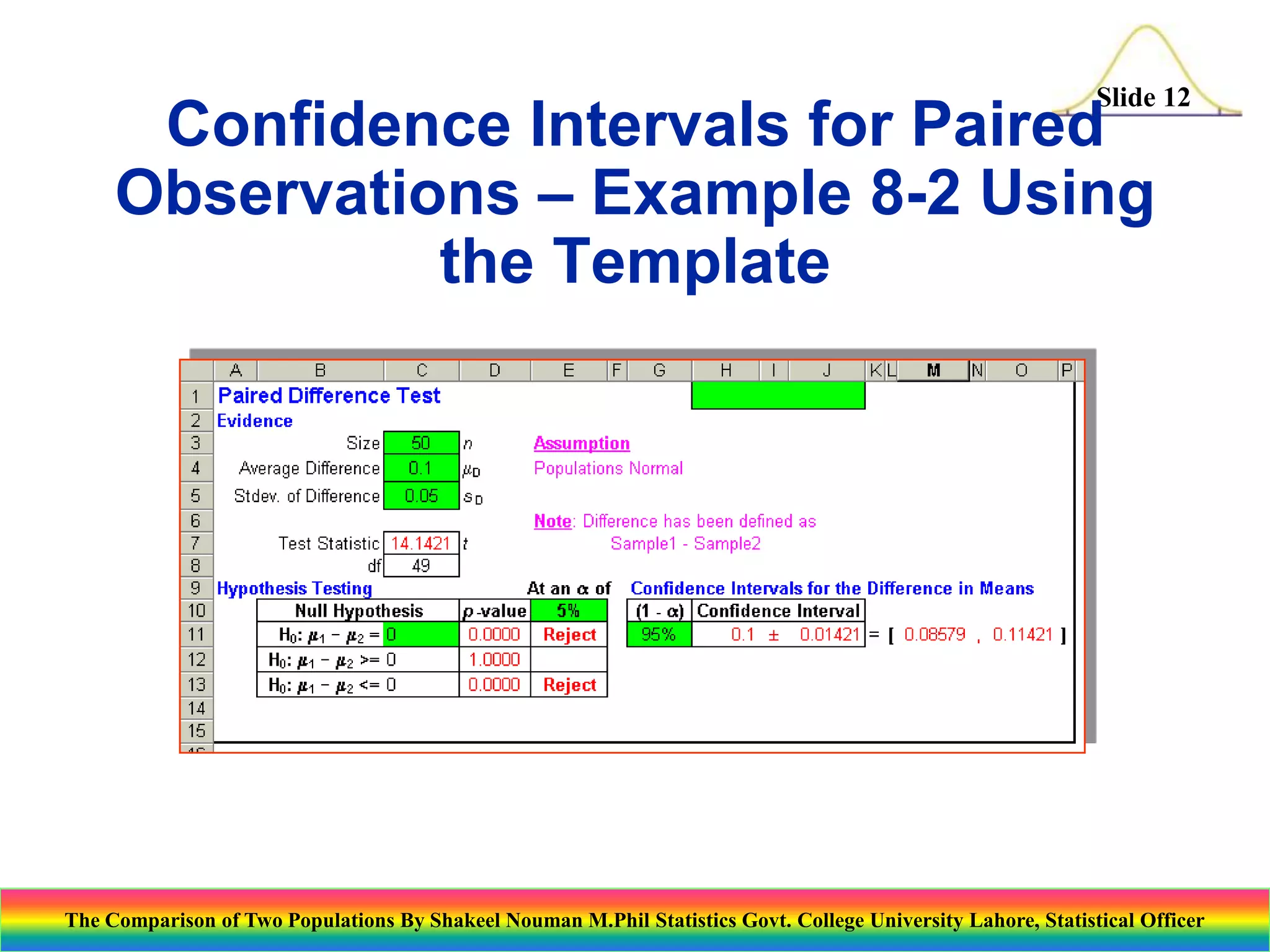
Confidence Intervals for Paired
Observations – Example 8-2

Slide 11

95% confidence interval for the data in Example 8 - 2 :
s
D  z D  0.11.96 0.05  0.1 (1.96)(.0071)
n
50
2
 0.1 0.014  [0.086,0.114]
Note that this confidence interval does not include the value 0.

The Comparison of Two Populations By Shakeel Nouman M.Phil Statistics Govt. College University Lahore, Statistical Officer
Slide 12

Confidence Intervals for Paired
Observations – Example 8-2 Using
the Template

The Comparison of Two Populations By Shakeel Nouman M.Phil Statistics Govt. College University Lahore, Statistical Officer
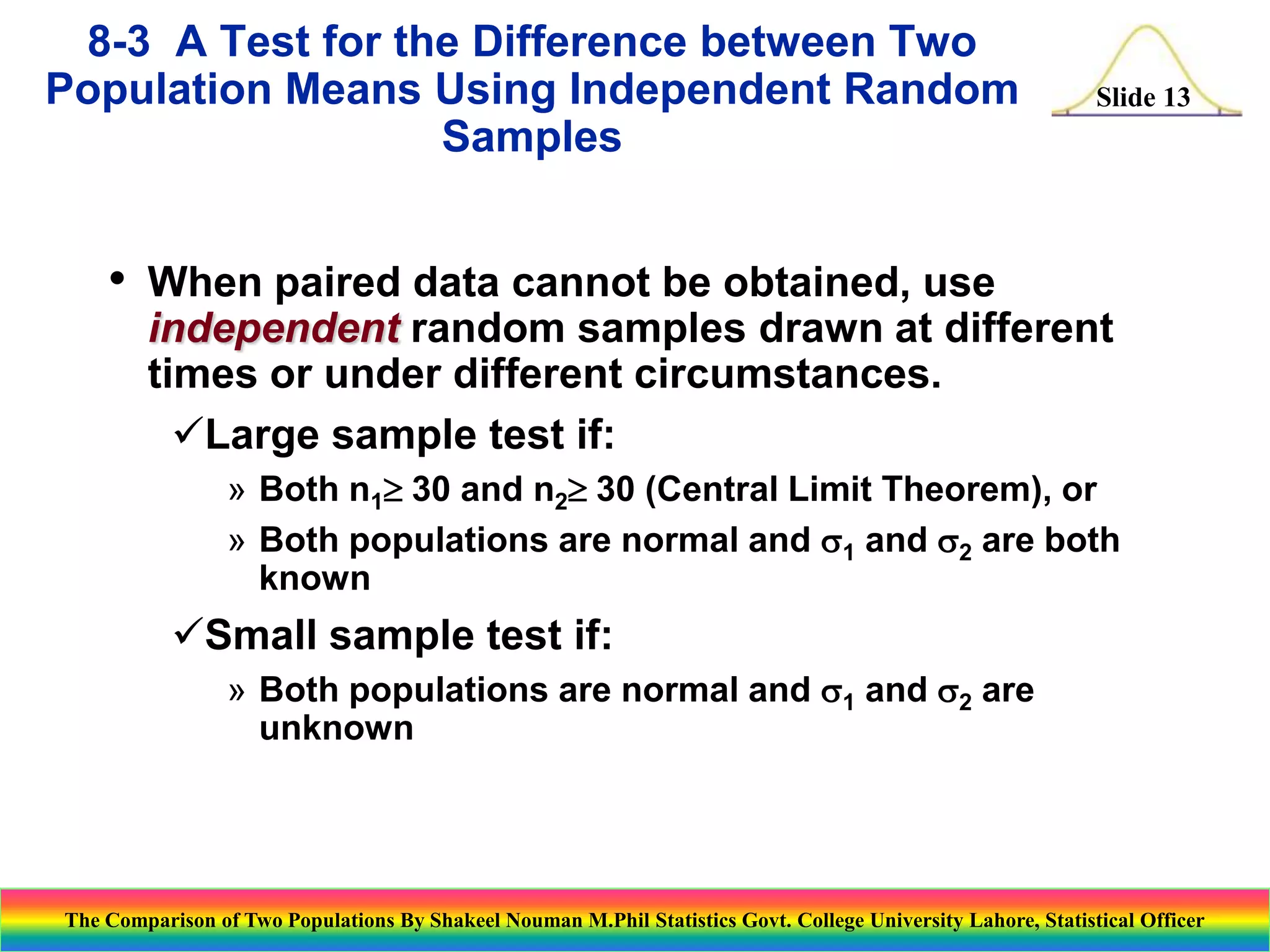
8-3 A Test for the Difference between Two
Population Means Using Independent Random
Samples

•

Slide 13

When paired data cannot be obtained, use
independent random samples drawn at different
times or under different circumstances.
Large sample test if:
» Both n1 30 and n2 30 (Central Limit Theorem), or
» Both populations are normal and s1 and s2 are both
known

Small sample test if:
» Both populations are normal and s1 and s2 are
unknown

The Comparison of Two Populations By Shakeel Nouman M.Phil Statistics Govt. College University Lahore, Statistical Officer
Comparisons of Two Population
Means: Testing Situations
•

•

•

Slide 14

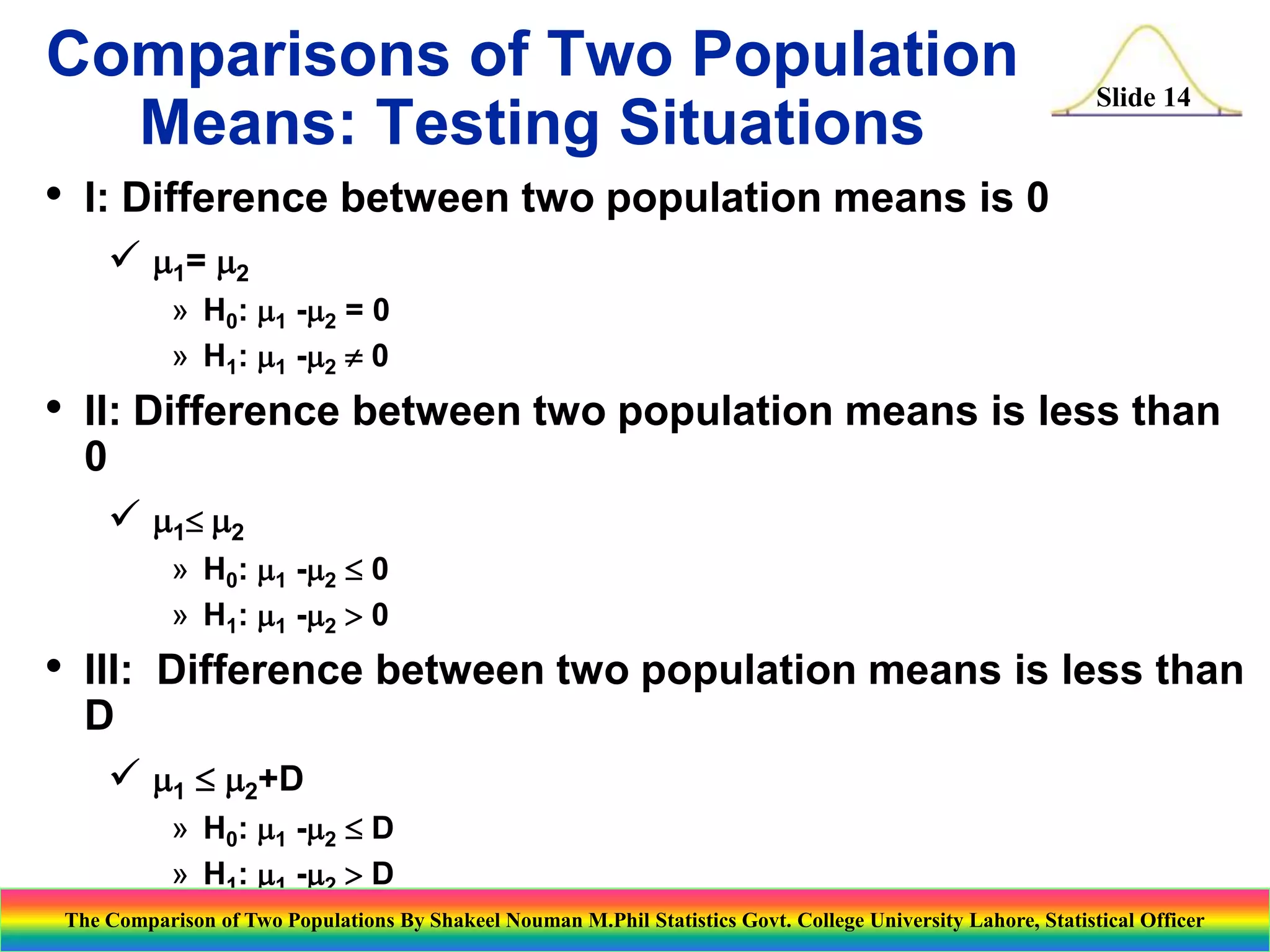
I: Difference between two population means is 0
 1= 2
» H0: 1 -2 = 0
» H1: 1 -2  0

II: Difference between two population means is less than
0
 1 2
» H0: 1 -2  0
» H1: 1 -2 > 0

III: Difference between two population means is less than
D
 1  2+D
» H0: 1 -2  D
» H1: 1 -2 > D
The Comparison of Two Populations By Shakeel Nouman M.Phil Statistics Govt. College University Lahore, Statistical Officer
Comparisons of Two Population
Means: Test Statistic

Slide 15

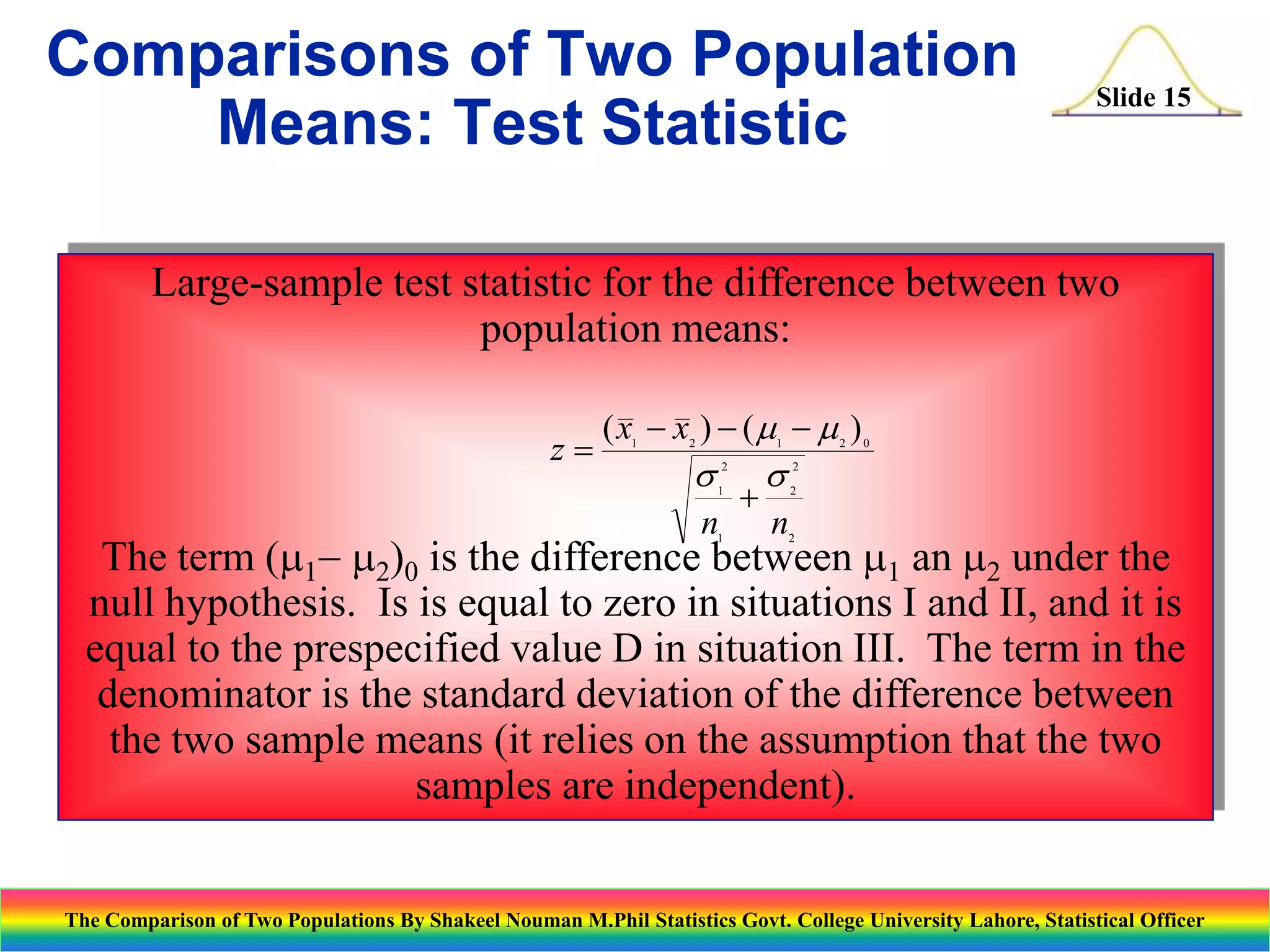
Large-sample test statistic for the difference between two
population means:
z

( x - x ) - ( -  )
1

2

s

1

2
1

n

+

2

s

0

2
2

n

The term (1- 2)0 is the difference between 1 an 2 under the
null hypothesis. Is is equal to zero in situations I and II, and it is
equal to the prespecified value D in situation III. The term in the
denominator is the standard deviation of the difference between
the two sample means (it relies on the assumption that the two
samples are independent).
1

2

The Comparison of Two Populations By Shakeel Nouman M.Phil Statistics Govt. College University Lahore, Statistical Officer
Two-Tailed Test for Equality of
Two Population Means: Example
8-3

Slide 16

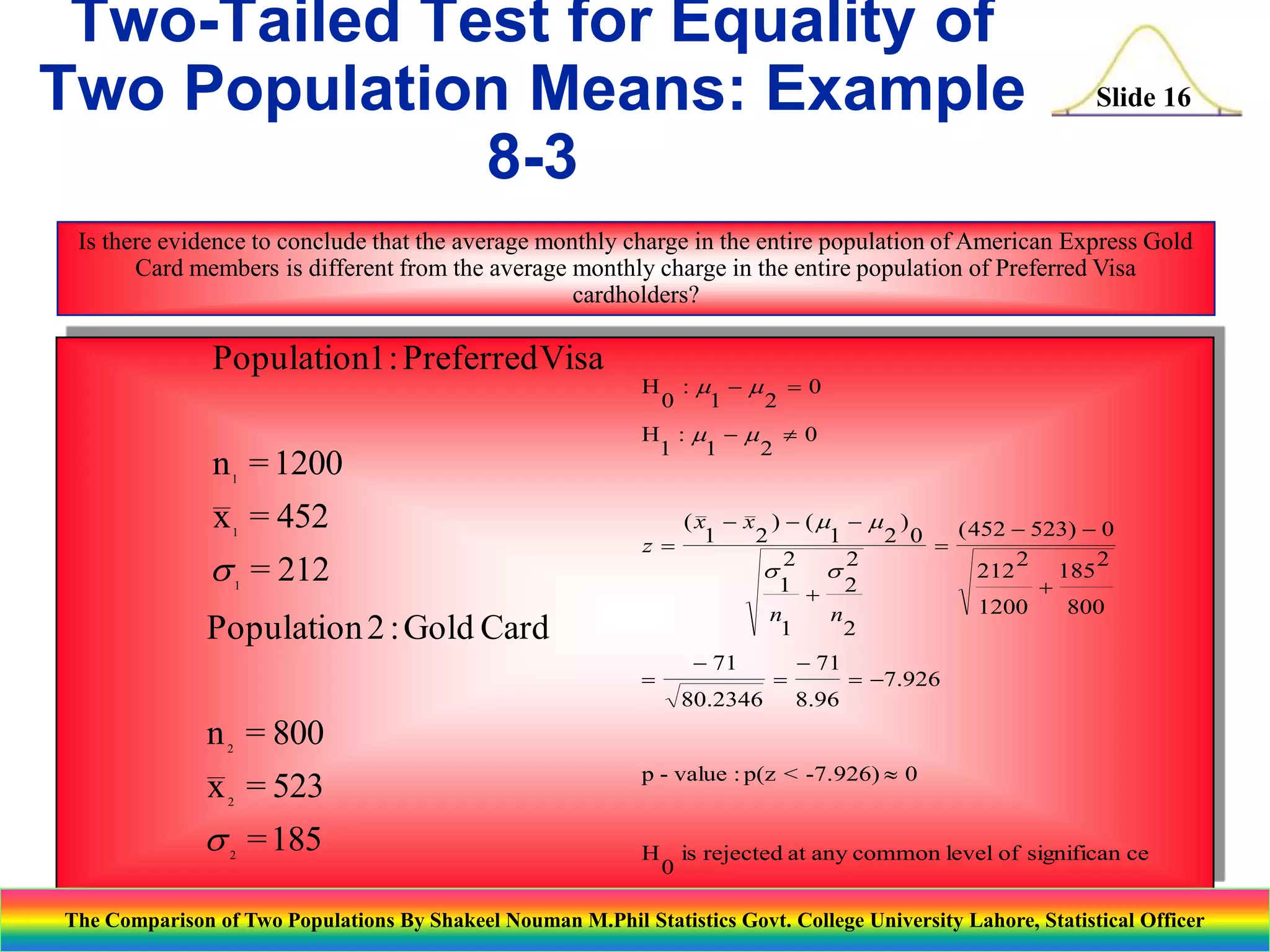
Is there evidence to conclude that the average monthly charge in the entire population of American Express Gold
Card members is different from the average monthly charge in the entire population of Preferred Visa
cardholders?

Population1 : Preferred Visa
H

n = 1200

0

: - 0
1
2

H : - 0
1
1
2

1

x = 452
1

s = 212
1

Population 2 : Gold Card

( x - x ) - ( -  )
2
1
2 0  ( 452 - 523) - 0
z  1
2
2
2
2
s
s
212
185
1 + 2
+
1200
800
n
n
1
2
- 71



80.2346



- 71

 -7.926

8.96

n = 800
2

x = 523

p - value : p(z < -7.926)  0

2

s = 185
2

H

0

is rejected at any common level of significan ce

The Comparison of Two Populations By Shakeel Nouman M.Phil Statistics Govt. College University Lahore, Statistical Officer
Example 8-3: Carrying Out the
Test
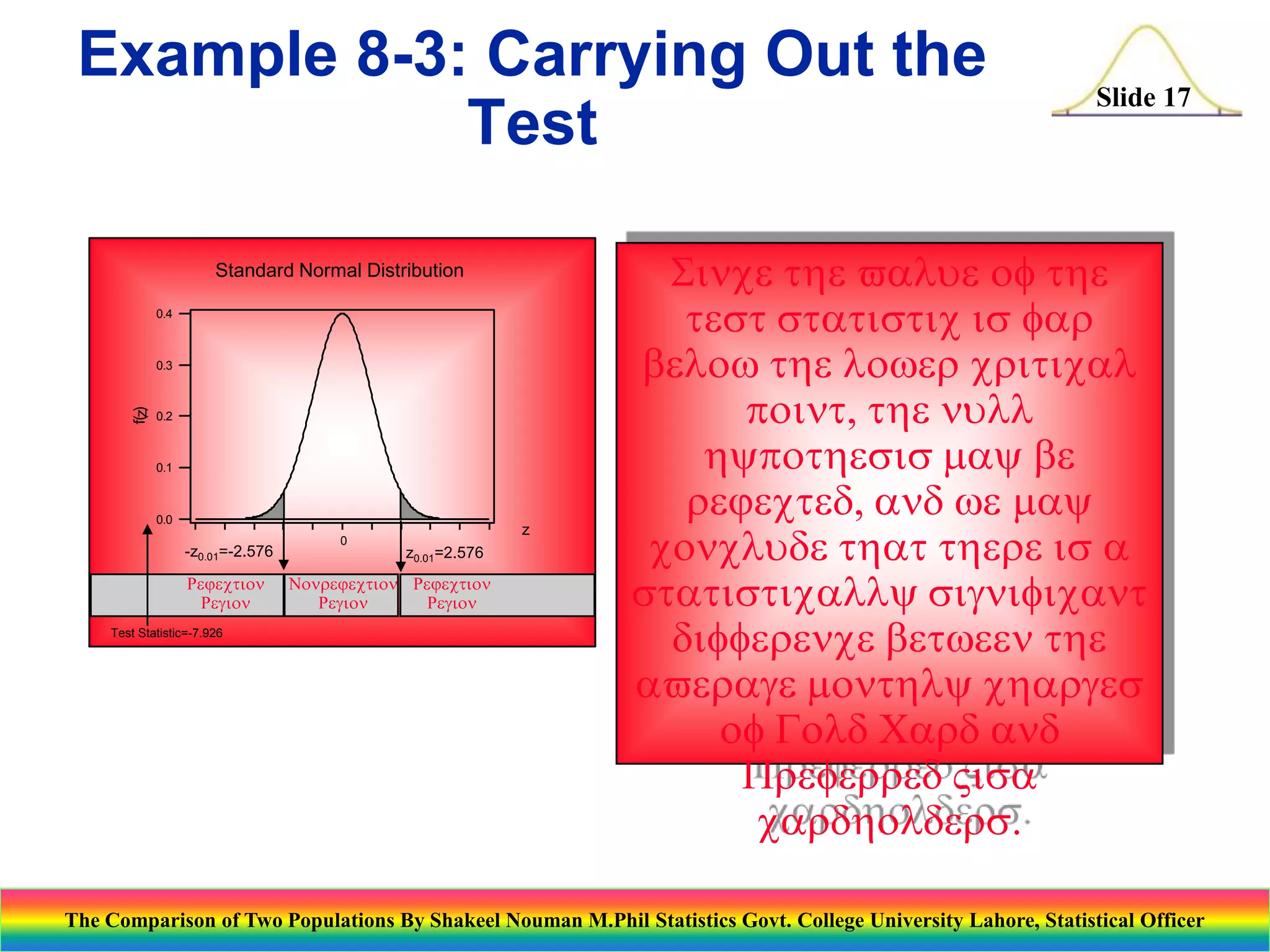
Standard Normal Distribution
0.4

f(z)

0.3

0.2

0.1

0.0

-z0.01=-2.576

Rejection
Region
Test Statistic=-7.926

0

z
z0.01=2.576

Nonrejection Rejection
Region
Region

Slide 17

Since the vlue of the
test sttistic is fr
below the lower criticl
point, the null
hypothesis y be
rejected, nd we y
conclude tht there is 
sttisticlly significnt
difference between the
verge onthly chrges
of Gold Crd nd
Preferred Vis
crdholders.

The Comparison of Two Populations By Shakeel Nouman M.Phil Statistics Govt. College University Lahore, Statistical Officer
Example 8-3: Using the
Template

Slide 18

The Comparison of Two Populations By Shakeel Nouman M.Phil Statistics Govt. College University Lahore, Statistical Officer
Two-Tailed Test for Difference
Between Two Population Means:
Example 8-4

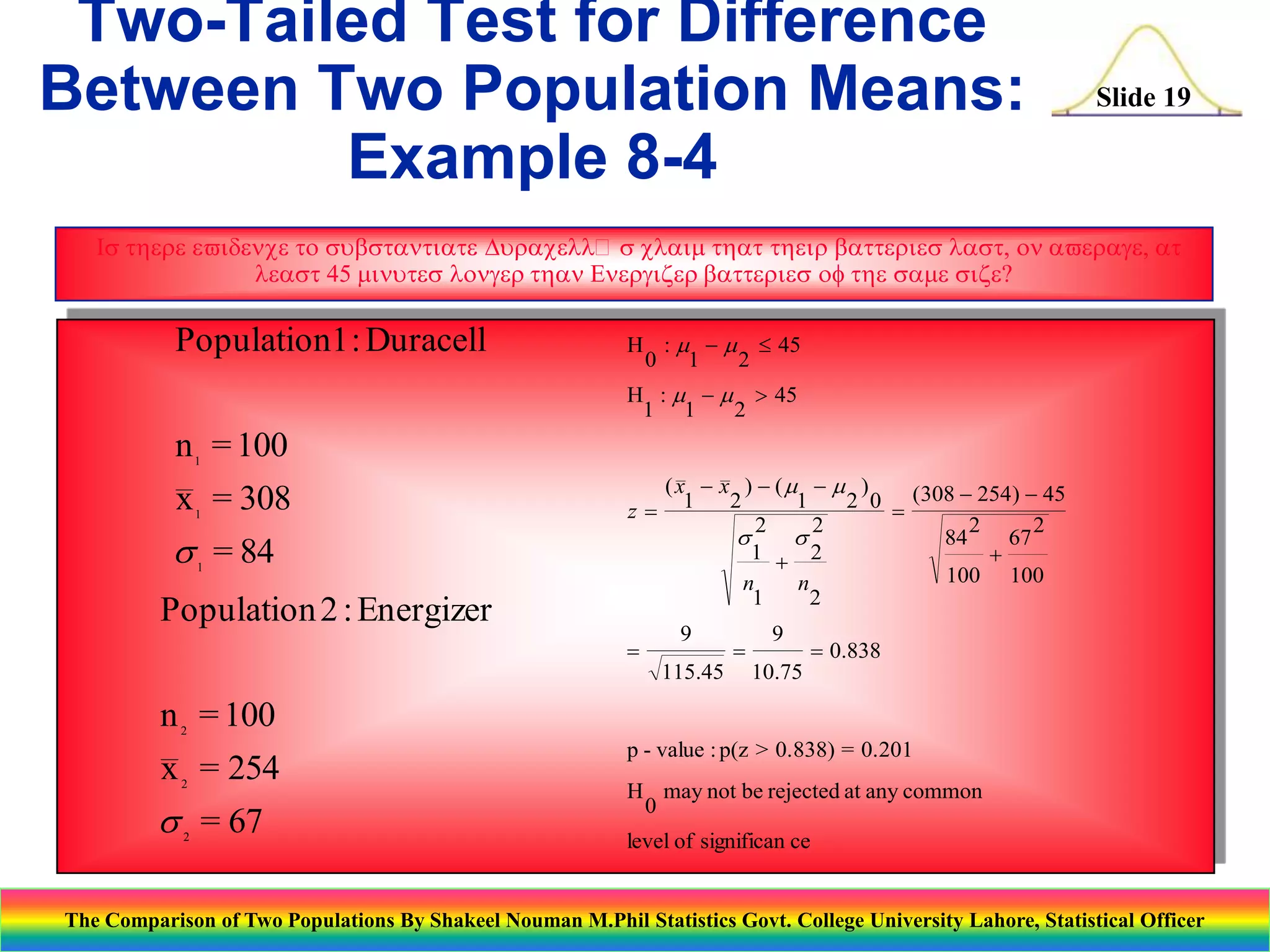
Slide 19

Is there evidence to substntite Durcells cli tht their btteries lst, on verge, t
lest 45 inutes longer thn Energizer btteries of the se size?

Population1 : Duracell

H :  -   45
0 1
2
H :  -  > 45
1 1
2

n = 100
1

x = 308
1

s = 84
1

Population 2 : Energizer

( x - x ) - ( -  )
2
1
2 0  (308 - 254) - 45
z 1
2
2
2
2
s
s
84
67
1 + 2
+
100 100
n
n
1
2


9
115.45



9

 0.838

10.75

n = 100
2

x = 254
2

s = 67
2

p - value : p(z > 0.838) = 0.201
H may not be rejected at any common
0
level of significan ce

The Comparison of Two Populations By Shakeel Nouman M.Phil Statistics Govt. College University Lahore, Statistical Officer
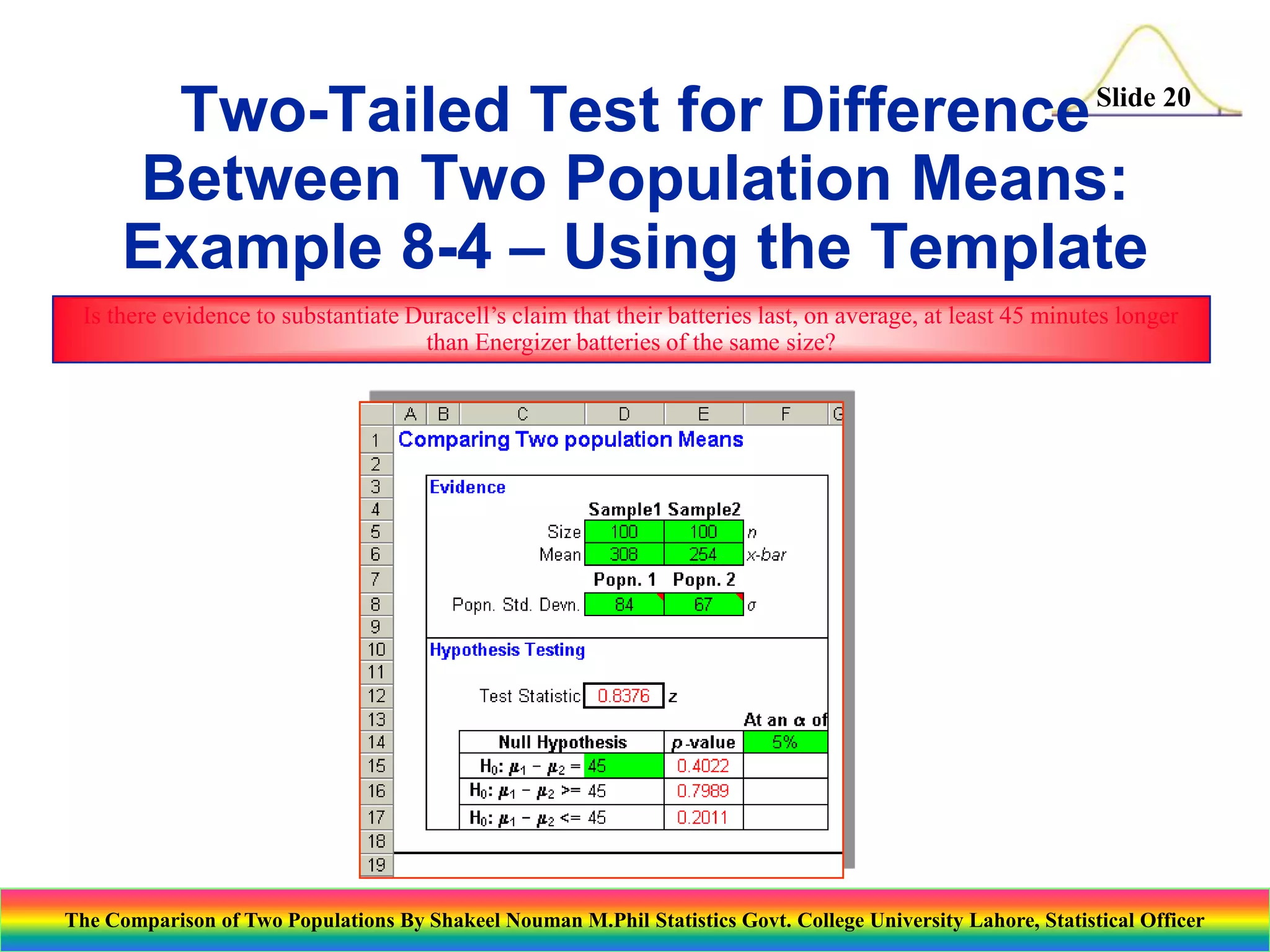
Two-Tailed Test for Difference Slide 20
Between Two Population Means:
Example 8-4 – Using the Template
Is there evidence to substantiate Duracell’s claim that their batteries last, on average, at least 45 minutes longer
than Energizer batteries of the same size?

The Comparison of Two Populations By Shakeel Nouman M.Phil Statistics Govt. College University Lahore, Statistical Officer
Confidence Intervals for the
Difference between Two
Population Means

Slide 21

A large-sample (1-)100% confidence interval for the difference
between two population means, 1- 2 , using independent
random samples:
(x - x )  z
1
2

2

2
2
s
1 + 2
n
n
1
2

s

A 95% confidence interval using the data in example 8-3:
(x - x )  z
1
2

2

2
2
s
2122 1852
1 + 2  (523 - 452)  1.96
+
 [53.44,88.56]
1200 800
n
n
1
2

s

The Comparison of Two Populations By Shakeel Nouman M.Phil Statistics Govt. College University Lahore, Statistical Officer
8-4 A Test for the Difference between Two
Population Means: Assuming Equal Population
Variances

Slide 22

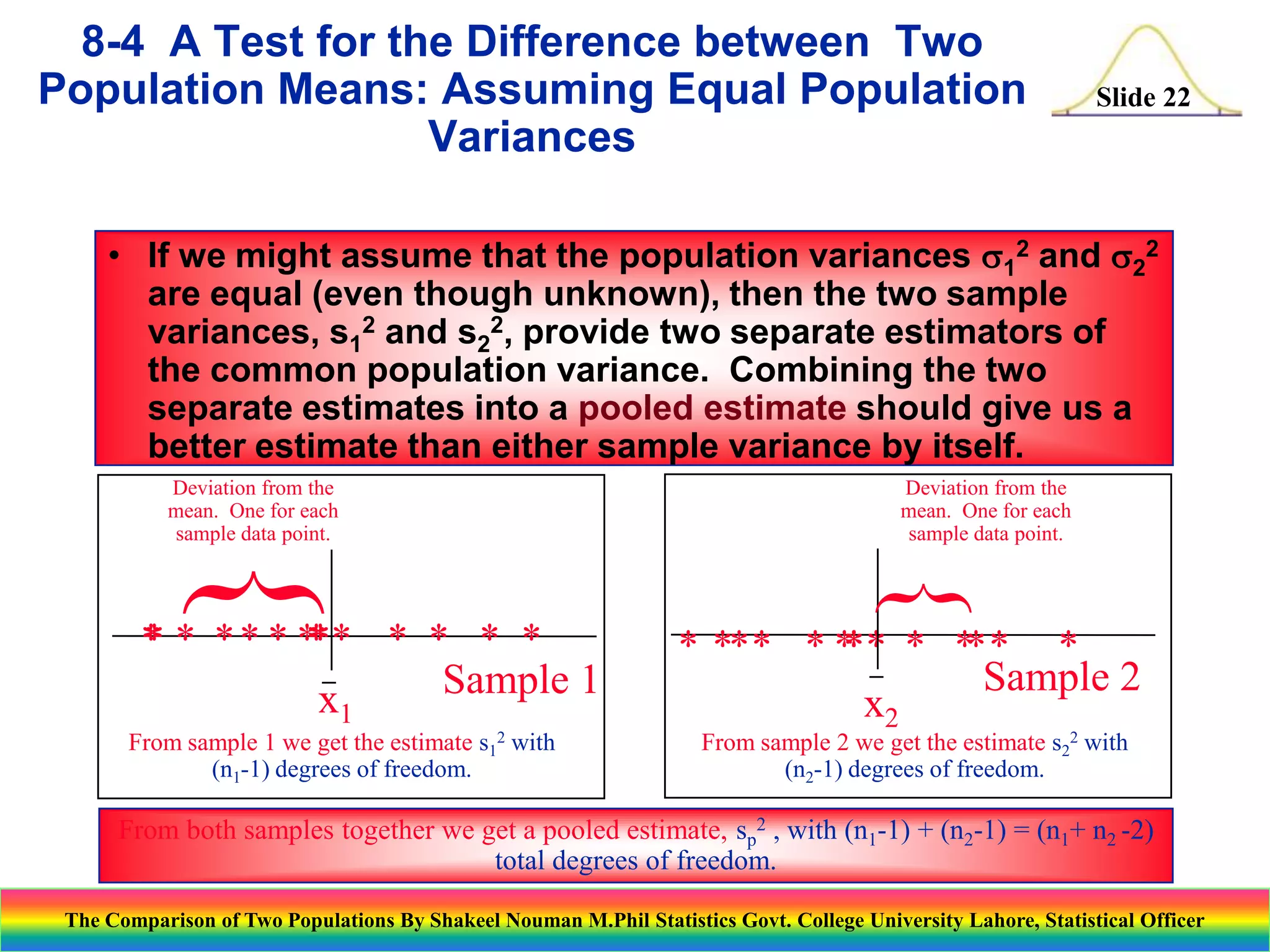
• If we might assume that the population variances s12 and s22
are equal (even though unknown), then the two sample
variances, s12 and s22, provide two separate estimators of
the common population variance. Combining the two
separate estimates into a pooled estimate should give us a
better estimate than either sample variance by itself.

* * ** * *** * * * *
*
Sample 1
x1
From sample 1 we get the estimate s12 with
(n1-1) degrees of freedom.

Deviation from the
mean. One for each
sample data point.

}

}

Deviation from the
mean. One for each
sample data point.

* ** * * * * * *
*
** *
Sample 2
x2
From sample 2 we get the estimate s22 with
(n2-1) degrees of freedom.

From both samples together we get a pooled estimate, sp2 , with (n1-1) + (n2-1) = (n1+ n2 -2)
total degrees of freedom.
The Comparison of Two Populations By Shakeel Nouman M.Phil Statistics Govt. College University Lahore, Statistical Officer
Pooled Estimate of the
Population Variance

Slide 23

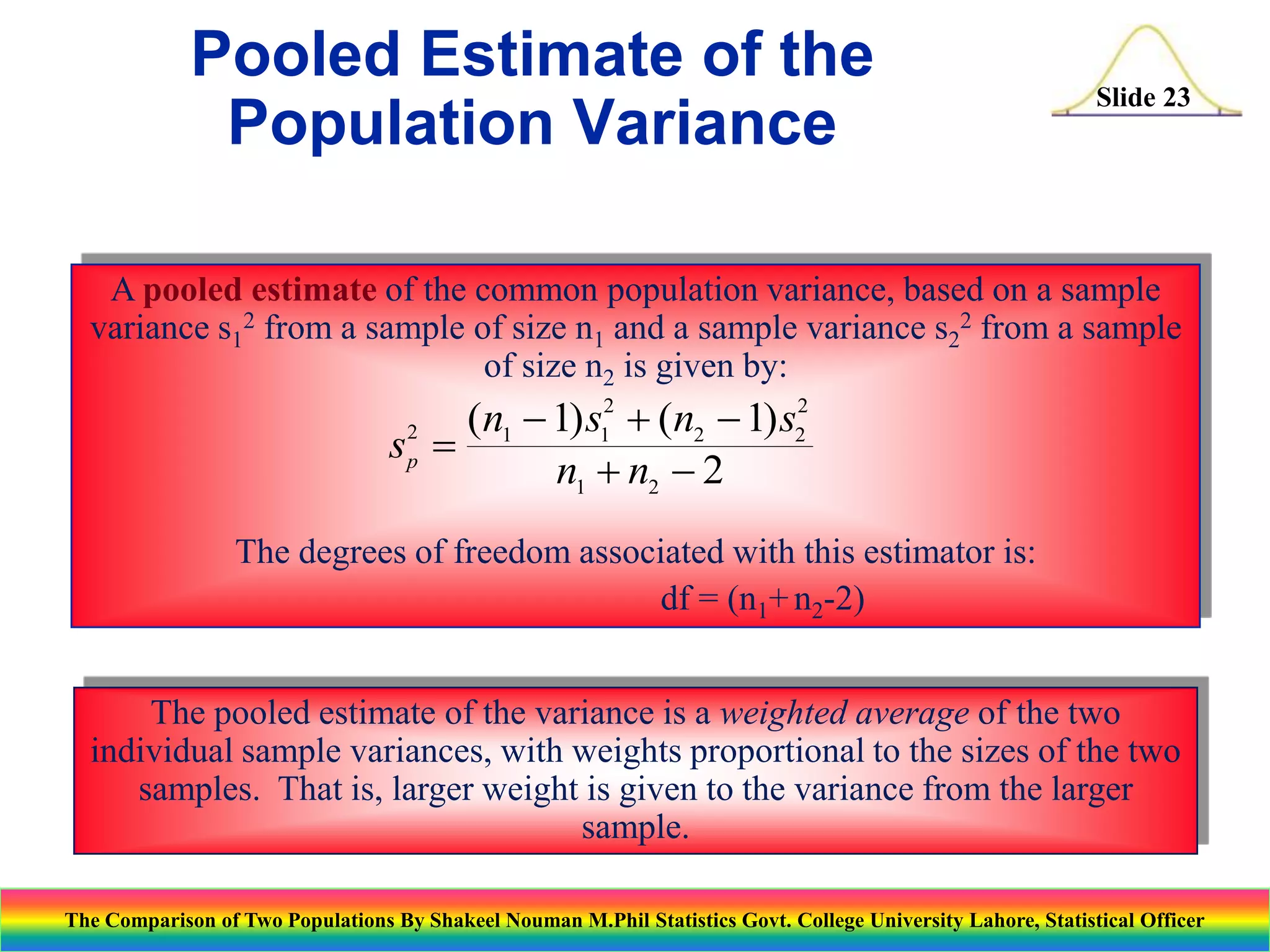
A pooled estimate of the common population variance, based on a sample
variance s12 from a sample of size n1 and a sample variance s22 from a sample
of size n2 is given by:

(n1 - 1) s12 + (n2 - 1) s22
s2 
p
n1 + n2 - 2

The degrees of freedom associated with this estimator is:
df = (n1+ n2-2)
The pooled estimate of the variance is a weighted average of the two
individual sample variances, with weights proportional to the sizes of the two
samples. That is, larger weight is given to the variance from the larger
sample.
The Comparison of Two Populations By Shakeel Nouman M.Phil Statistics Govt. College University Lahore, Statistical Officer
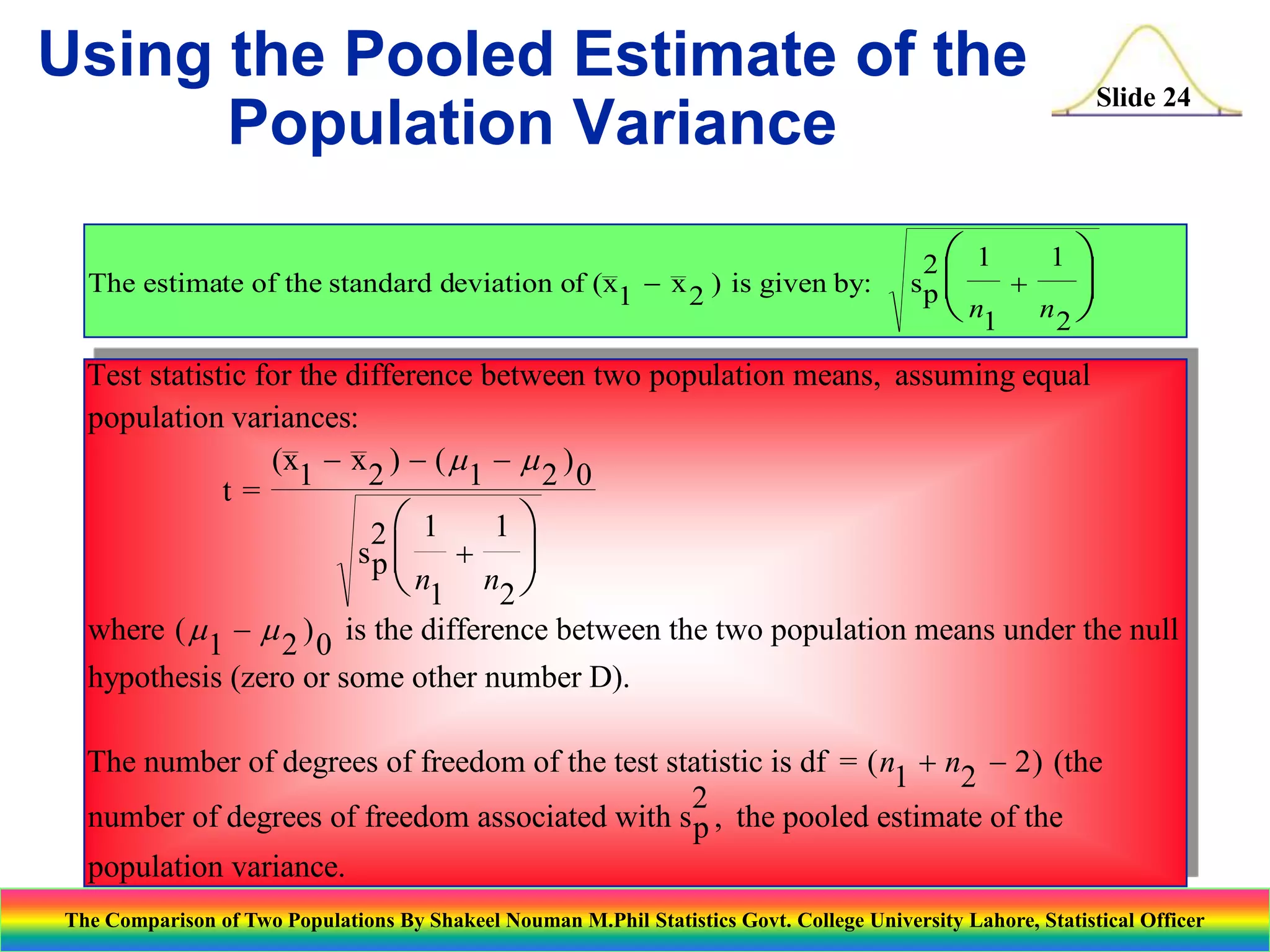
Using the Pooled Estimate of the
Population Variance
The estimate of the standard deviation of (x1 - x 2 ) is given by:

Slide 24

1 
2 1
sp 
+

n1
n2 


Test statistic for the difference between two population means, assuming equal
population variances:
(x1 - x 2 ) - (  1 -  2 ) 0
t=
1
2 1
sp  +

n1 n2 


where (  1 -  2 ) 0 is the difference between the two population means under the null
hypothesis (zero or some other number D).

The number of degrees of freedom of the test statistic is df = ( n1 + n2 - 2 ) (the
2
number of degrees of freedom associated with s p , the pooled estimate of the
population variance.
The Comparison of Two Populations By Shakeel Nouman M.Phil Statistics Govt. College University Lahore, Statistical Officer
Example 8-5

Slide 25

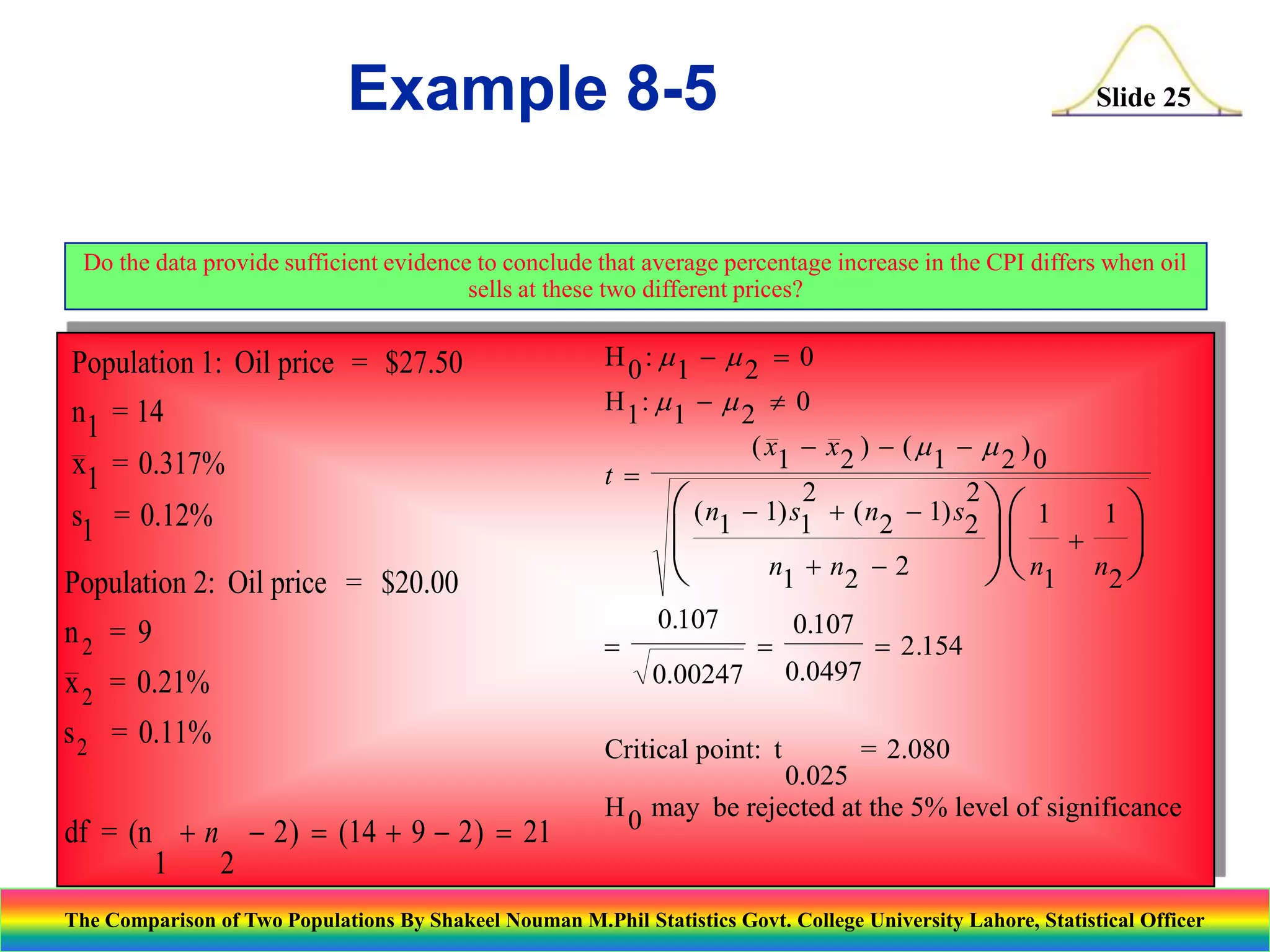
Do the data provide sufficient evidence to conclude that average percentage increase in the CPI differs when oil
sells at these two different prices?

Population 1: Oil price = $27.50
n1 = 14
x1 = 0.317%
s1 = 0.12%

Population 2: Oil price = $20.00
n2 = 9
x 2 = 0.21%
s 2 = 0.11%
df = (n + n - 2 )  (14 + 9 - 2 )  21
1
2

H 0 : 1 -  2  0
H1:  1 -  2  0

( x1 - x 2 ) - (  1 -  2 ) 0
t 
2
2
 ( n1 - 1) s1 + ( n2 - 1) s2   1 1 

 + 
n1 + n2 - 2

  n1 n2 
0.107
0.107


 2.154
0.00247 0.0497
Critical point: t

= 2.080

0.025
H 0 may be rejected at the 5% level of significance

The Comparison of Two Populations By Shakeel Nouman M.Phil Statistics Govt. College University Lahore, Statistical Officer
Example 8-5: Using the
Template

Slide 26

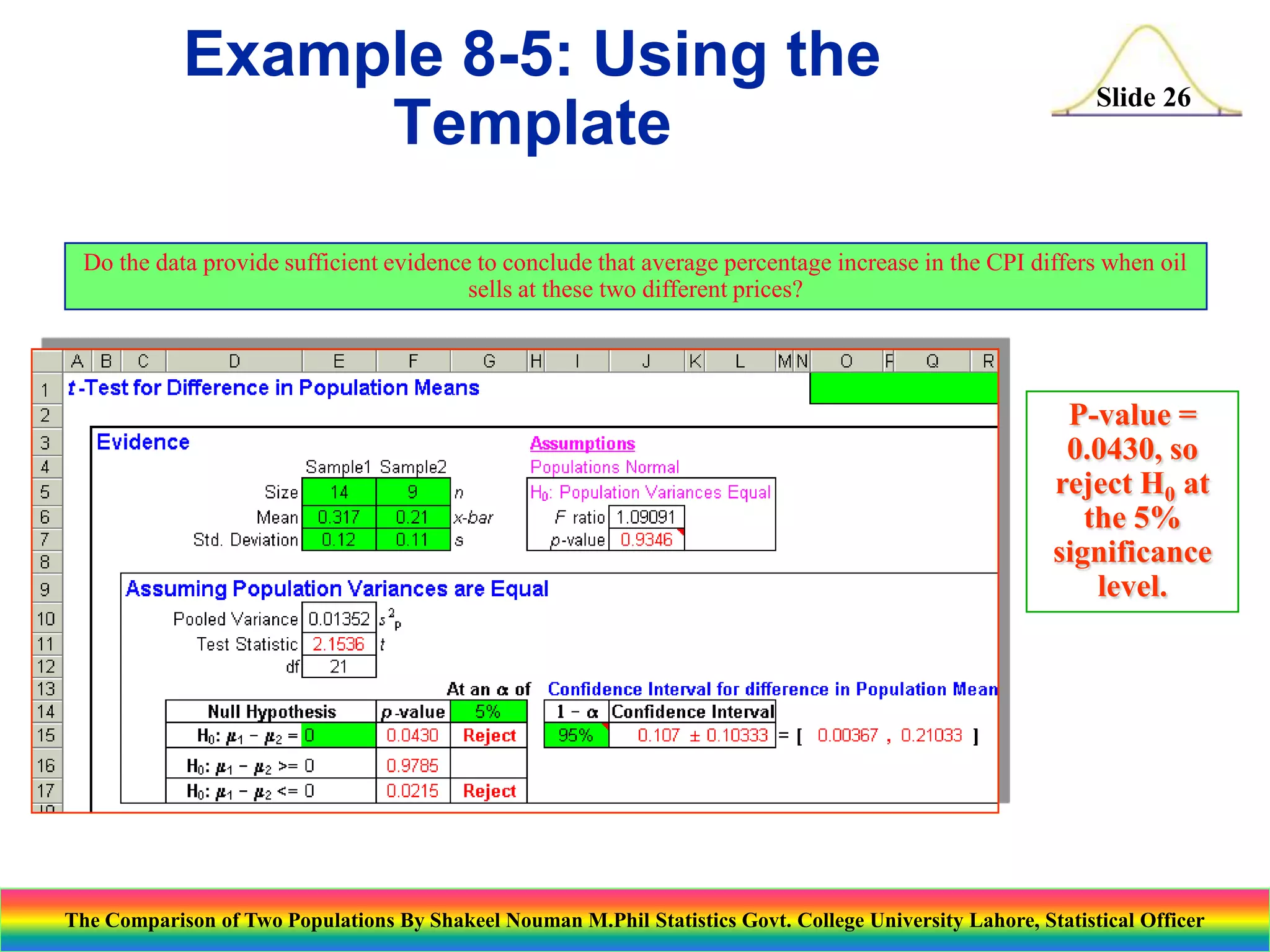
Do the data provide sufficient evidence to conclude that average percentage increase in the CPI differs when oil
sells at these two different prices?

P-value =
0.0430, so
reject H0 at
the 5%
significance
level.

The Comparison of Two Populations By Shakeel Nouman M.Phil Statistics Govt. College University Lahore, Statistical Officer
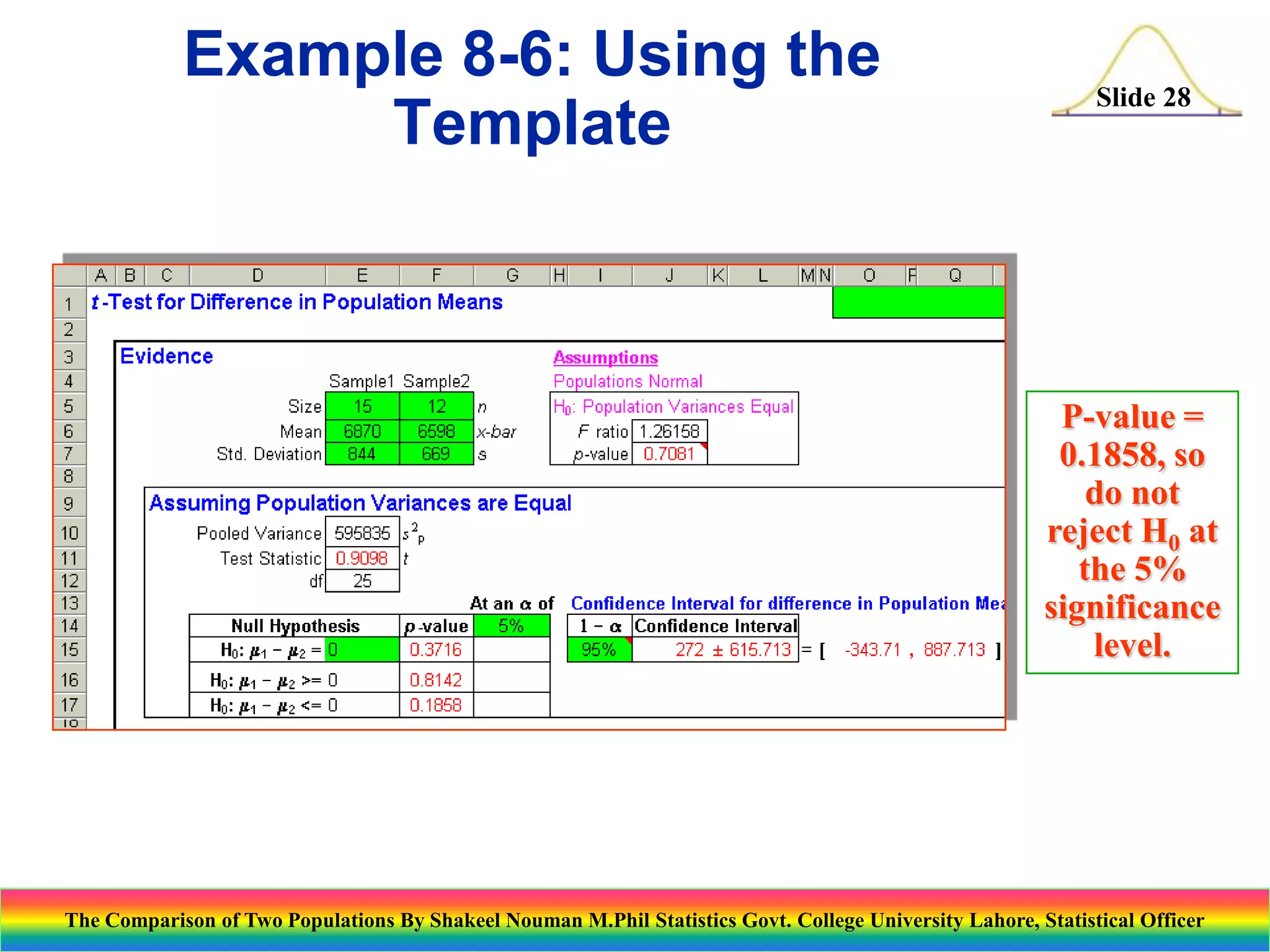
Example 8-6
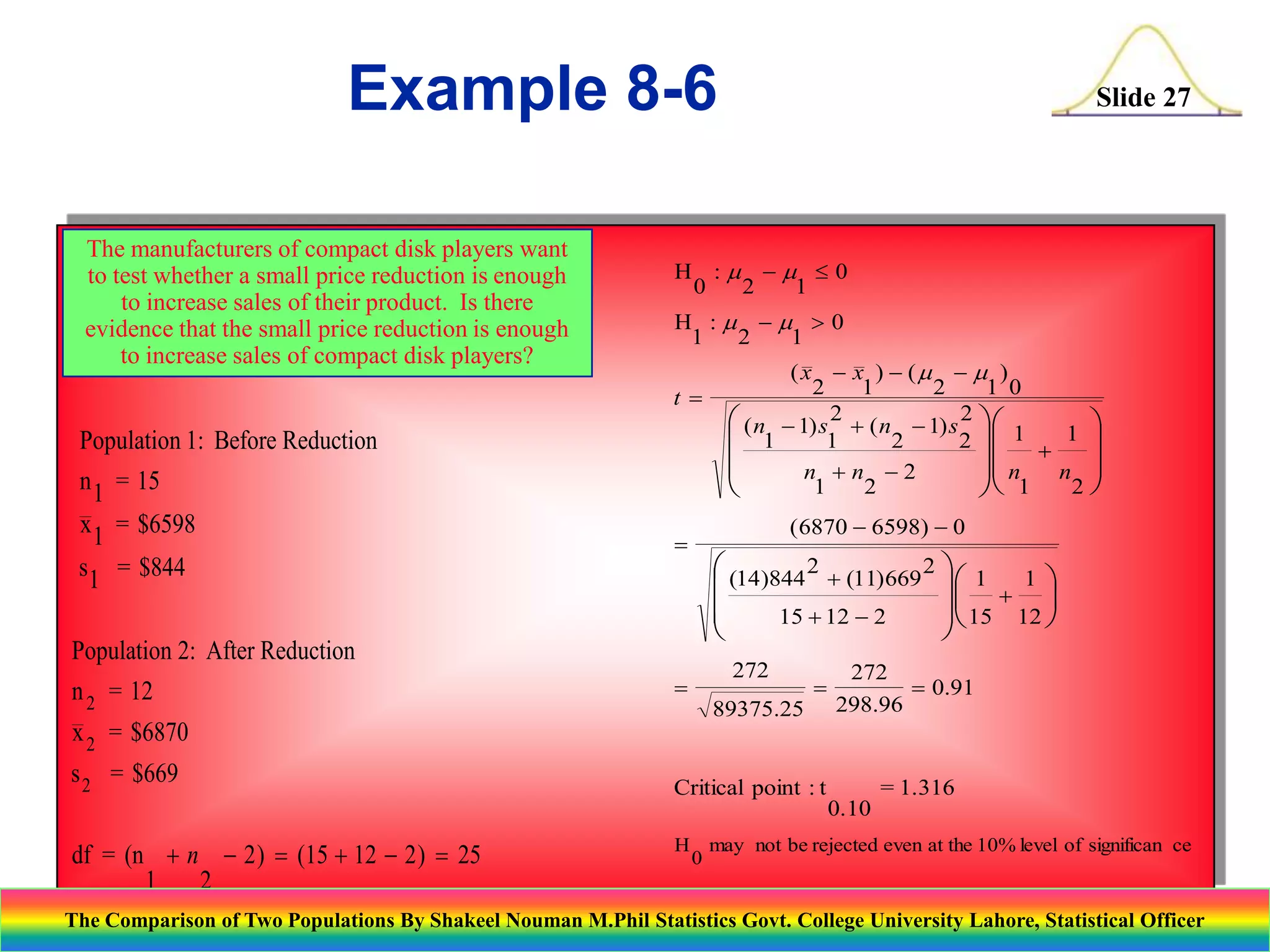
The manufacturers of compact disk players want
to test whether a small price reduction is enough
to increase sales of their product. Is there
evidence that the small price reduction is enough
to increase sales of compact disk players?

H : - 0
0
2
1
H : - >0
1
2
1
t

Population 1: Before Reduction
n 1 = 15
x 1 = $6598



s1 = $844

Population 2: After Reduction
n 2 = 12

Slide 27



( x - x ) - ( -  )
2
1
2
1 0
 ( n - 1) s 2 + ( n - 1) s 2  1 1
 1
1
2
2 
+

 n n
n +n -2
1
2

 1 2






( 6870 - 6598) - 0

 (14)844 2 + (11)669 2  1 1 

 + 

 15 12 
15 + 12 - 2


272



89375.25

272
 0.91
298.96

x 2 = $6870
s 2 = $669

Critical point : t

= 1.316
0.10

df = (n + n - 2 )  (15 + 12 - 2 )  25
1
2

H may not be rejected even at the 10% level of significan ce
0

The Comparison of Two Populations By Shakeel Nouman M.Phil Statistics Govt. College University Lahore, Statistical Officer
Example 8-6: Using the
Template

Slide 28

P-value =
0.1858, so
do not
reject H0 at
the 5%
significance
level.

The Comparison of Two Populations By Shakeel Nouman M.Phil Statistics Govt. College University Lahore, Statistical Officer
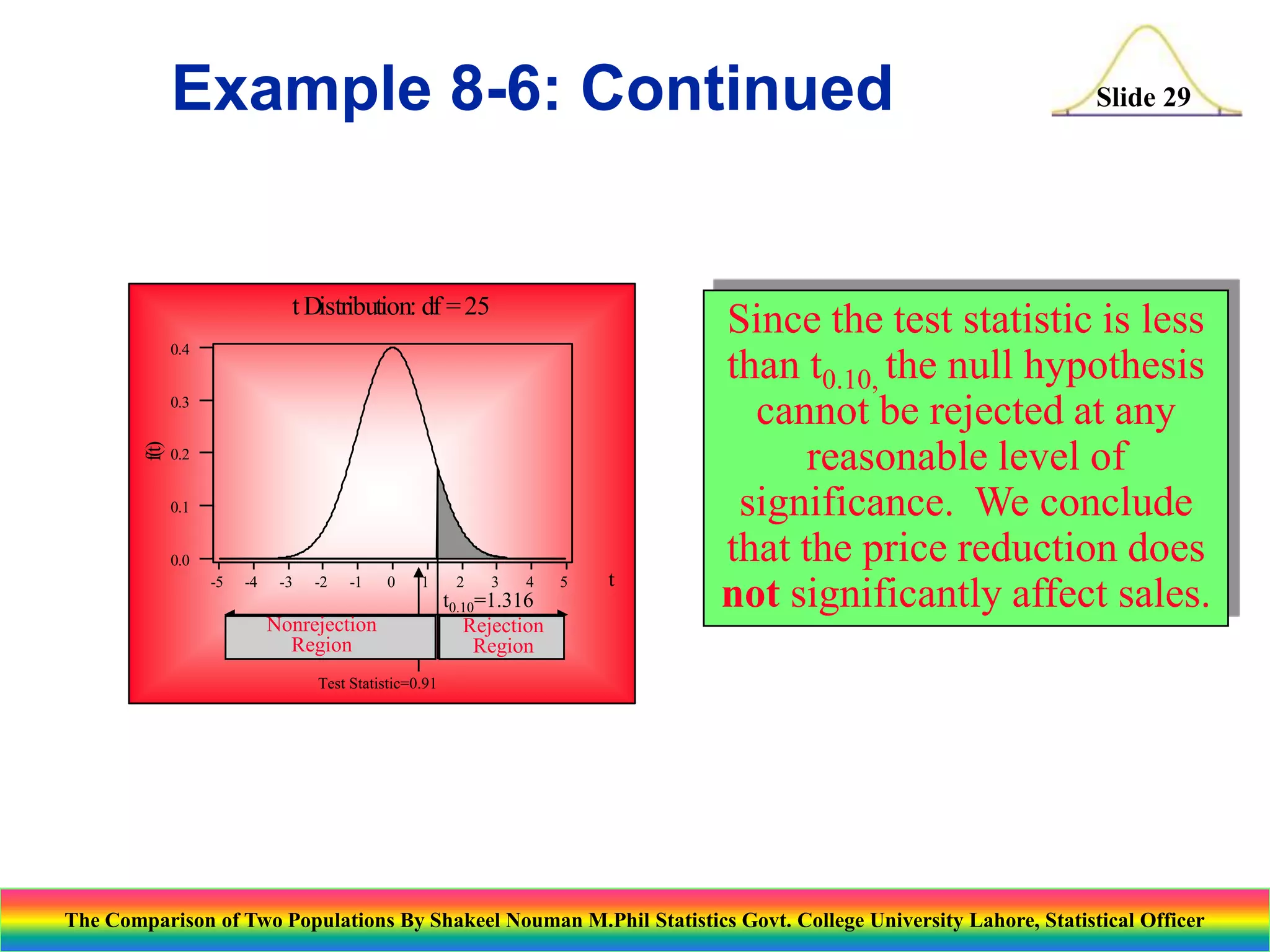
Example 8-6: Continued

t Distribution: df = 25
0.4

f(t)

0.3
0.2
0.1

0.0
-5

-4

-3

-2

-1

0

1

Nonrejection
Region

2

3

4

t0.10=1.316
Rejection
Region

5

t

Slide 29

Since the test statistic is less
than t0.10, the null hypothesis
cannot be rejected at any
reasonable level of
significance. We conclude
that the price reduction does
not significantly affect sales.

Test Statistic=0.91

The Comparison of Two Populations By Shakeel Nouman M.Phil Statistics Govt. College University Lahore, Statistical Officer
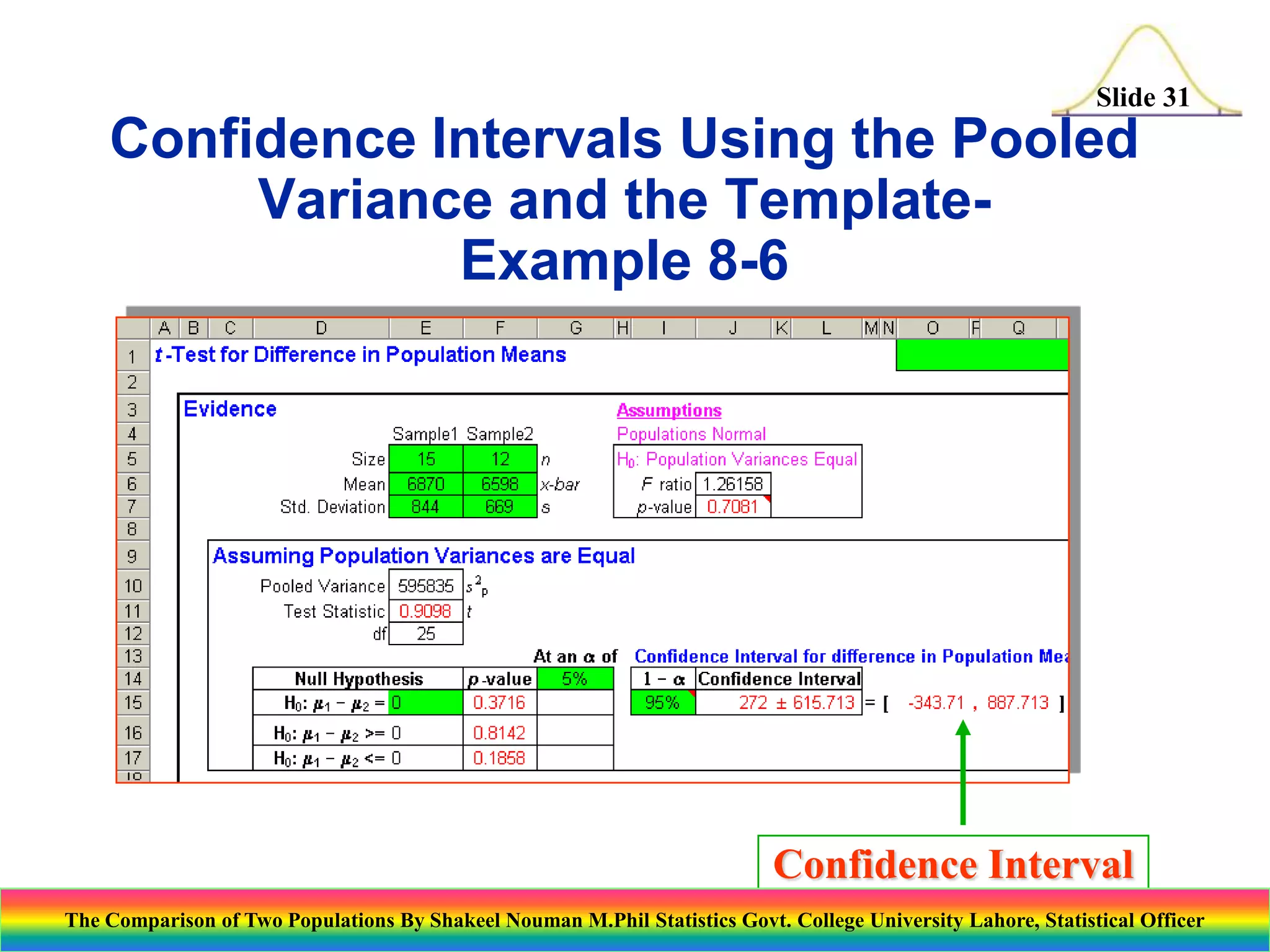
Confidence Intervals Using the
Pooled Variance

Slide 30

A (1-) 100% confidence interval for the difference between two
population means, 1- 2 , using independent random samples and
assuming equal population variances:
( x1 - x2 )  t


2 1

sp 

 n1

+



n2 
1

2

A 95% confidence interval using the data in Example 8-6:
( x1 - x 2 )  t



2
sp

 1 + 1


 n1 n2 

 ( 6870 - 6598 )  2 .06 ( 595835)( 0.15)  [ -343.85,887 .85]

2
The Comparison of Two Populations By Shakeel Nouman M.Phil Statistics Govt. College University Lahore, Statistical Officer
Slide 31

Confidence Intervals Using the Pooled
Variance and the TemplateExample 8-6

Confidence Interval
The Comparison of Two Populations By Shakeel Nouman M.Phil Statistics Govt. College University Lahore, Statistical Officer
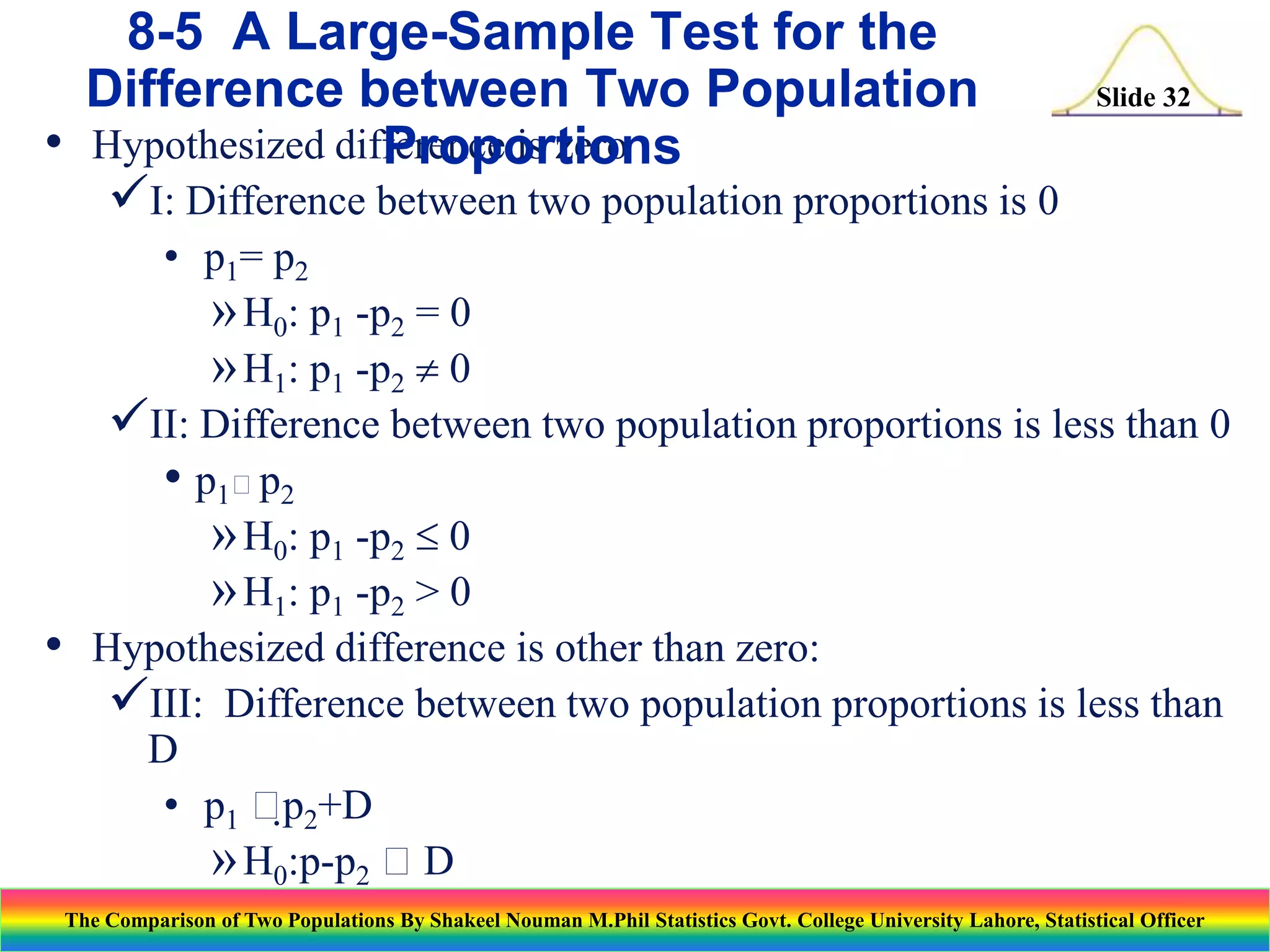
8-5 A Large-Sample Test for the
Difference between Two Population
• Hypothesized difference is zero
Proportions
I: Difference between two population proportions is 0

Slide 32

• p1= p2
» H0: p1 -p2 = 0
» H1: p1 -p2  0
II: Difference between two population proportions is less than 0
• p1p2
» H0: p1 -p2  0
» H1: p1 -p2 > 0
• Hypothesized difference is other than zero:
III: Difference between two population proportions is less than
D
• p1  2+D
p
» H0:p-p2 D
The Comparison of H : p -p By Shakeel Nouman M.Phil Statistics Govt. College University Lahore, Statistical Officer
» Two1Populations2 > D
1
Comparisons of Two Population
Proportions When the Hypothesized
Difference Is Zero: Test Statistic

Slide 33

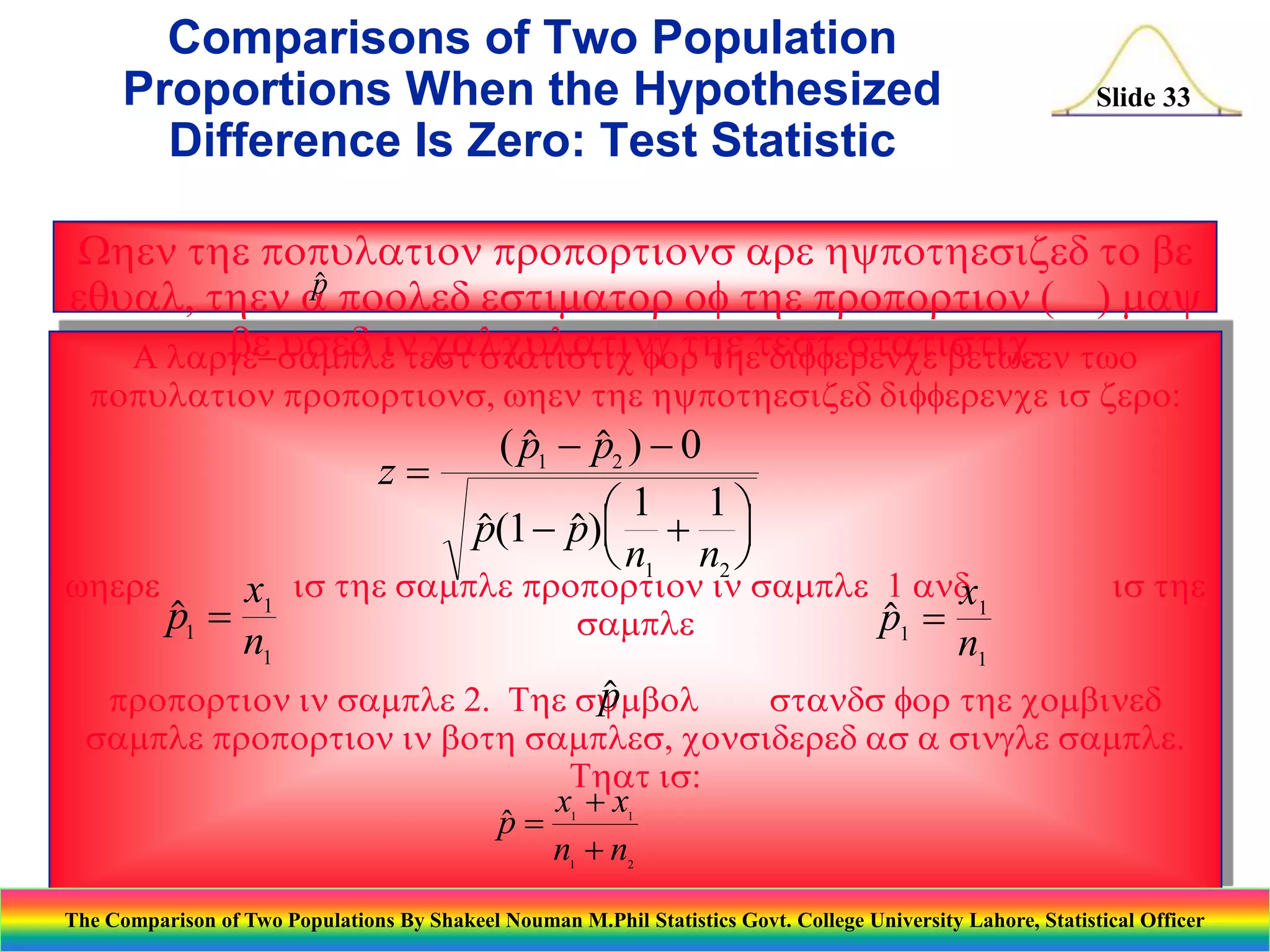
When the popultion proportions re hypothesized to be
p

equl, then  pooled estitor of the proportion ( ) y
be used in clculting the difference between
A lrge-sple test sttistic for thetest sttistic. two
popultion proportions, when the hypothesized difference is zero:

z
where

( p1 - p2 ) - 0
 
1 1
p 1- p  + 
( )

 n1 n2 

is the
x1 is the sple proportion in sple 1 nd 1
x
p1 

p1 

sple
n1
n1
p

proportion in sple 2. The sybol
stnds for the cobined

sple proportion in both sples, considered s  single sple.
Tht is:
x +x
p
ˆ
n +n
1

1

1

2

The Comparison of Two Populations By Shakeel Nouman M.Phil Statistics Govt. College University Lahore, Statistical Officer
Comparisons of Two Population
Proportions When the Hypothesized
Difference Is Zero: Example 8-8

Slide 34

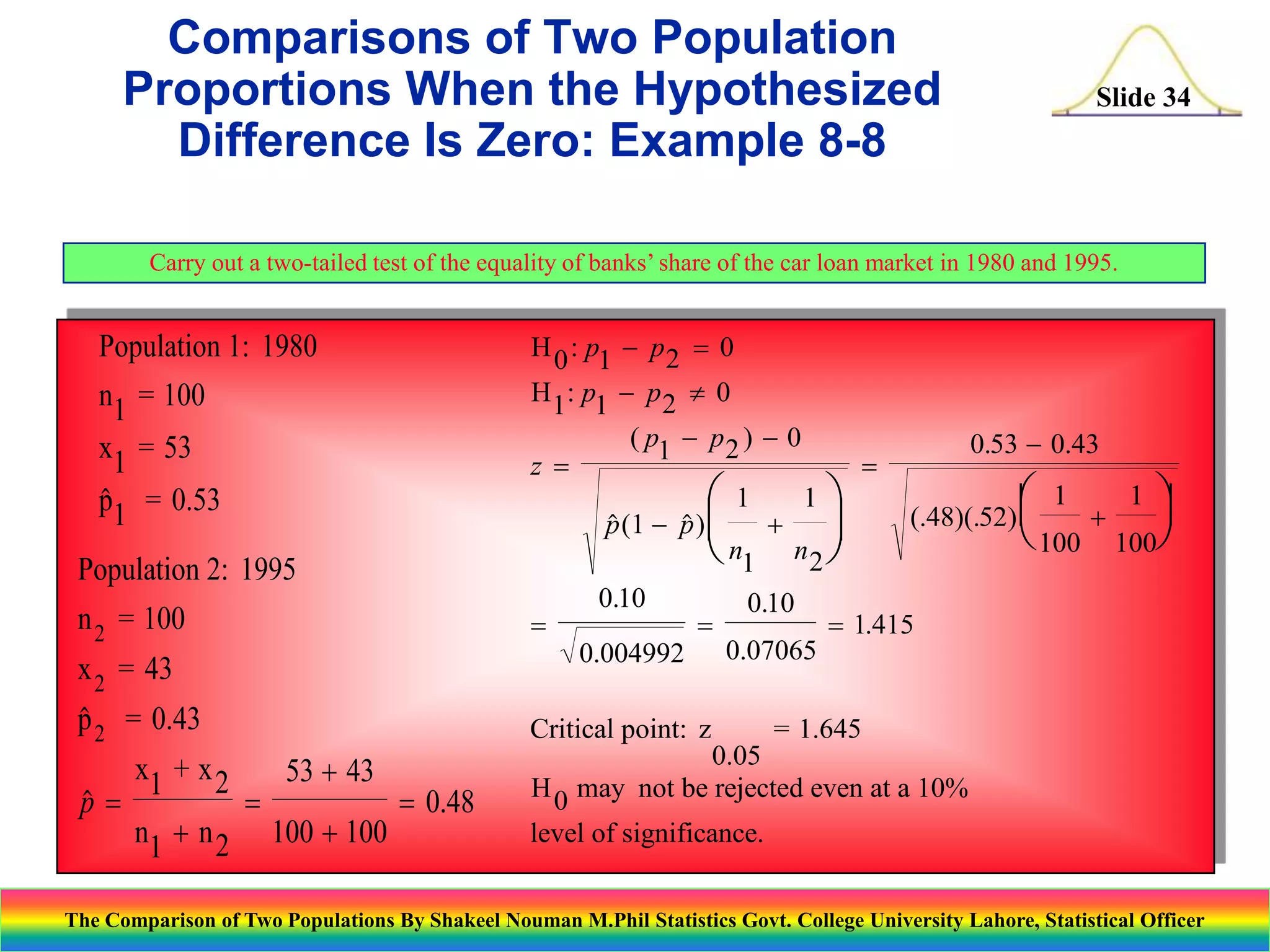
Carry out a two-tailed test of the equality of banks’ share of the car loan market in 1980 and 1995.

n1 = 100

H 0 : p1 - p 2  0
H1: p1 - p 2  0

x1 = 53

z 

Population 1: 1980

p1 = 0.53


Population 2: 1995
n 2 = 100
x 2 = 43
p 2 = 0.43

x1 + x 2
53 + 43
p


 0.48
n1 + n 2 100 + 100

( p1 - p 2 ) - 0

p (1 


 1 1
p )

+

 n1 n2 

0.10



0.004992
Critical point: z

0.10



0.53 - 0.43

 1 + 1

 100 100

(.48)(.52) 

 1.415

0.07065
= 1.645

0.05
H 0 may not be rejected even at a 10%
level of significance.

The Comparison of Two Populations By Shakeel Nouman M.Phil Statistics Govt. College University Lahore, Statistical Officer
Example 8-8: Carrying Out the
Test

Slide 35

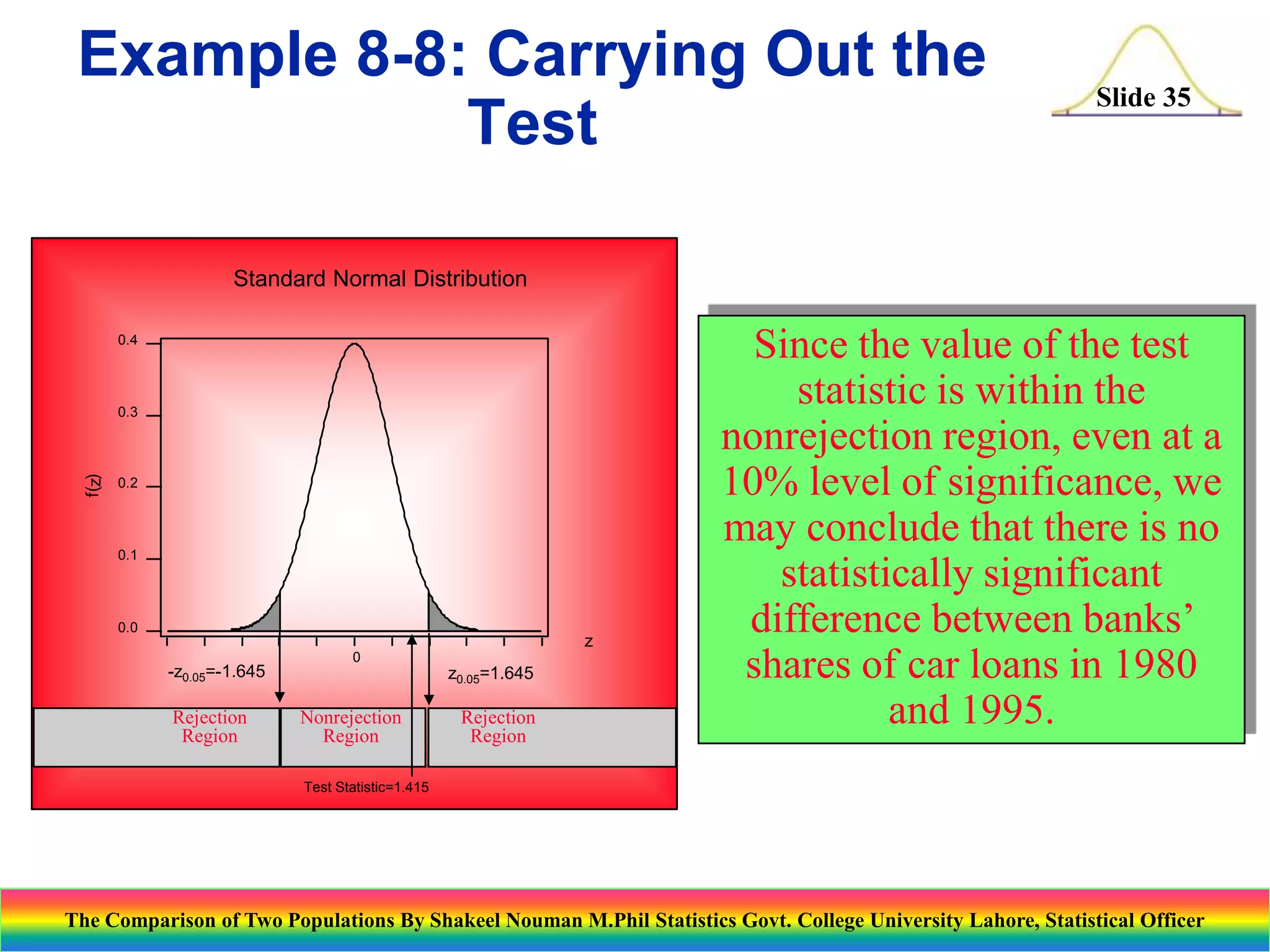
Standard Normal Distribution
0.4

f(z)

0.3

0.2

0.1

0.0

z
-z0.05=-1.645

Rejection
Region

0

z0.05=1.645

Nonrejection
Region

Rejection
Region

Since the value of the test
statistic is within the
nonrejection region, even at a
10% level of significance, we
may conclude that there is no
statistically significant
difference between banks’
shares of car loans in 1980
and 1995.

Test Statistic=1.415

The Comparison of Two Populations By Shakeel Nouman M.Phil Statistics Govt. College University Lahore, Statistical Officer
Example 8-8: Using the
Template

Slide 36

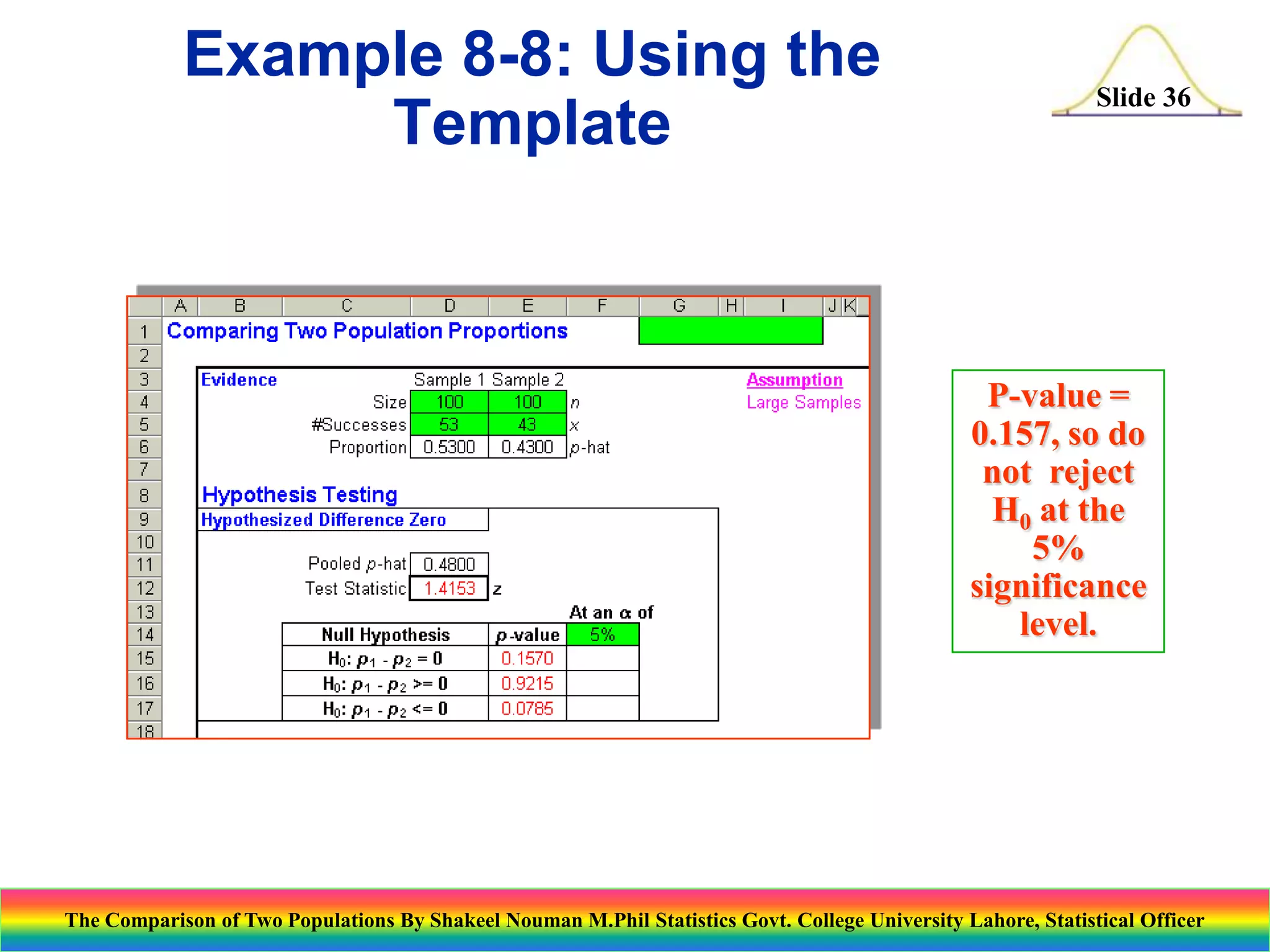
P-value =
0.157, so do
not reject
H0 at the
5%
significance
level.

The Comparison of Two Populations By Shakeel Nouman M.Phil Statistics Govt. College University Lahore, Statistical Officer
Comparisons of Two Population Proportions
When the Hypothesized Difference Is Not Zero:
Example 8-9

Slide 37

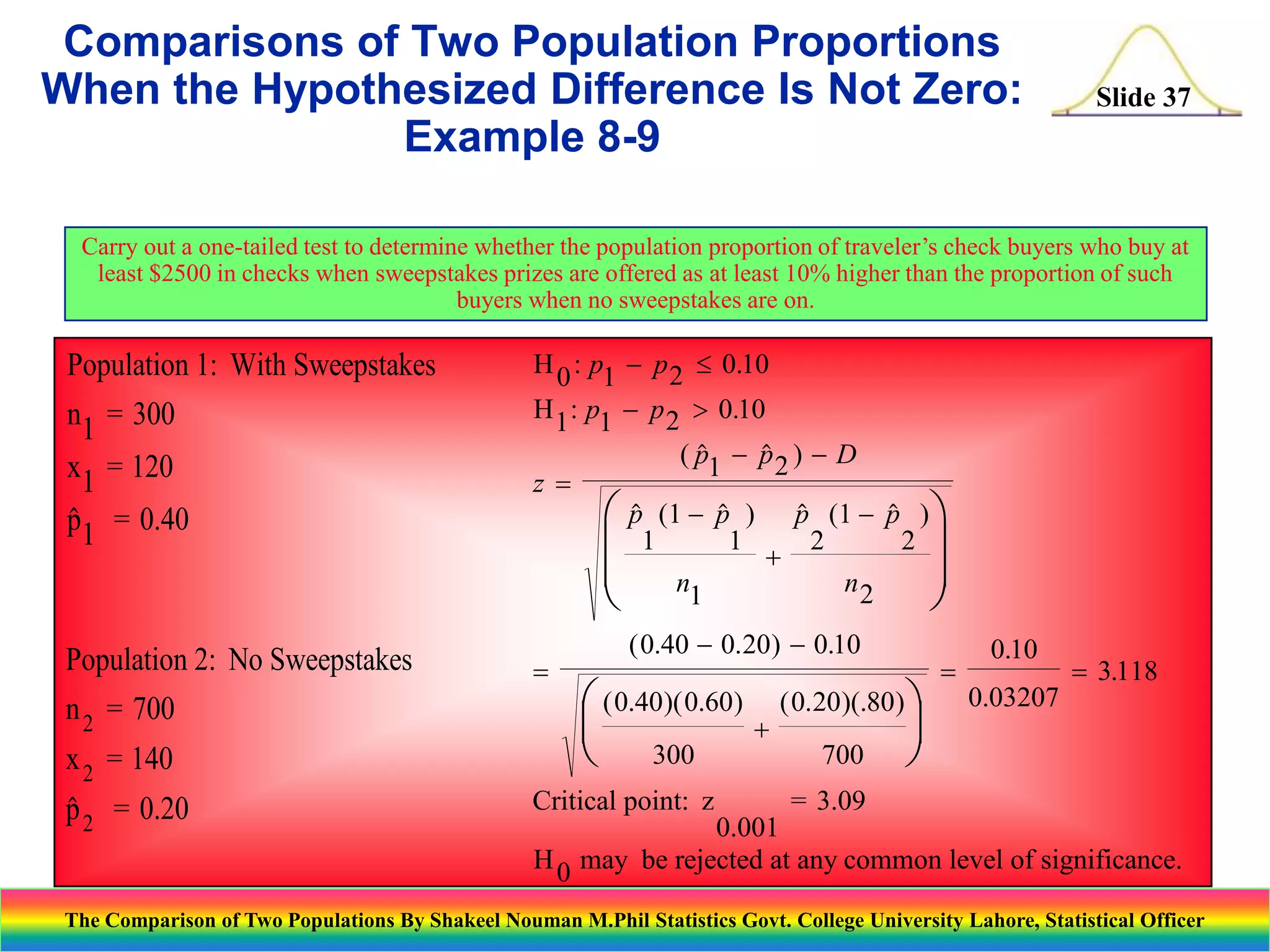
Carry out a one-tailed test to determine whether the population proportion of traveler’s check buyers who buy at
least $2500 in checks when sweepstakes prizes are offered as at least 10% higher than the proportion of such
buyers when no sweepstakes are on.

n1 = 300

H 0 : p1 - p 2  0.10
H 1 : p1 - p 2 > 0.10

x1 = 120

z

Population 1: With Sweepstakes

p1 = 0.40


Population 2: No Sweepstakes
n 2 = 700
x 2 = 140
p 2 = 0.20




( p1 - p 2 ) - D





 p (1 - p )
1
1

 n1 +


p (1 - p ) 


2
2 

n2



( 0.40 - 0.20) - 0.10

 ( 0.40)( 0.60) ( 0.20)(.80) 
+


700
 300


Critical point: z



0.10

 3.118

0.03207

= 3.09

0.001
H 0 may be rejected at any common level of significance.

The Comparison of Two Populations By Shakeel Nouman M.Phil Statistics Govt. College University Lahore, Statistical Officer
Example 8-9: Carrying Out the
Test
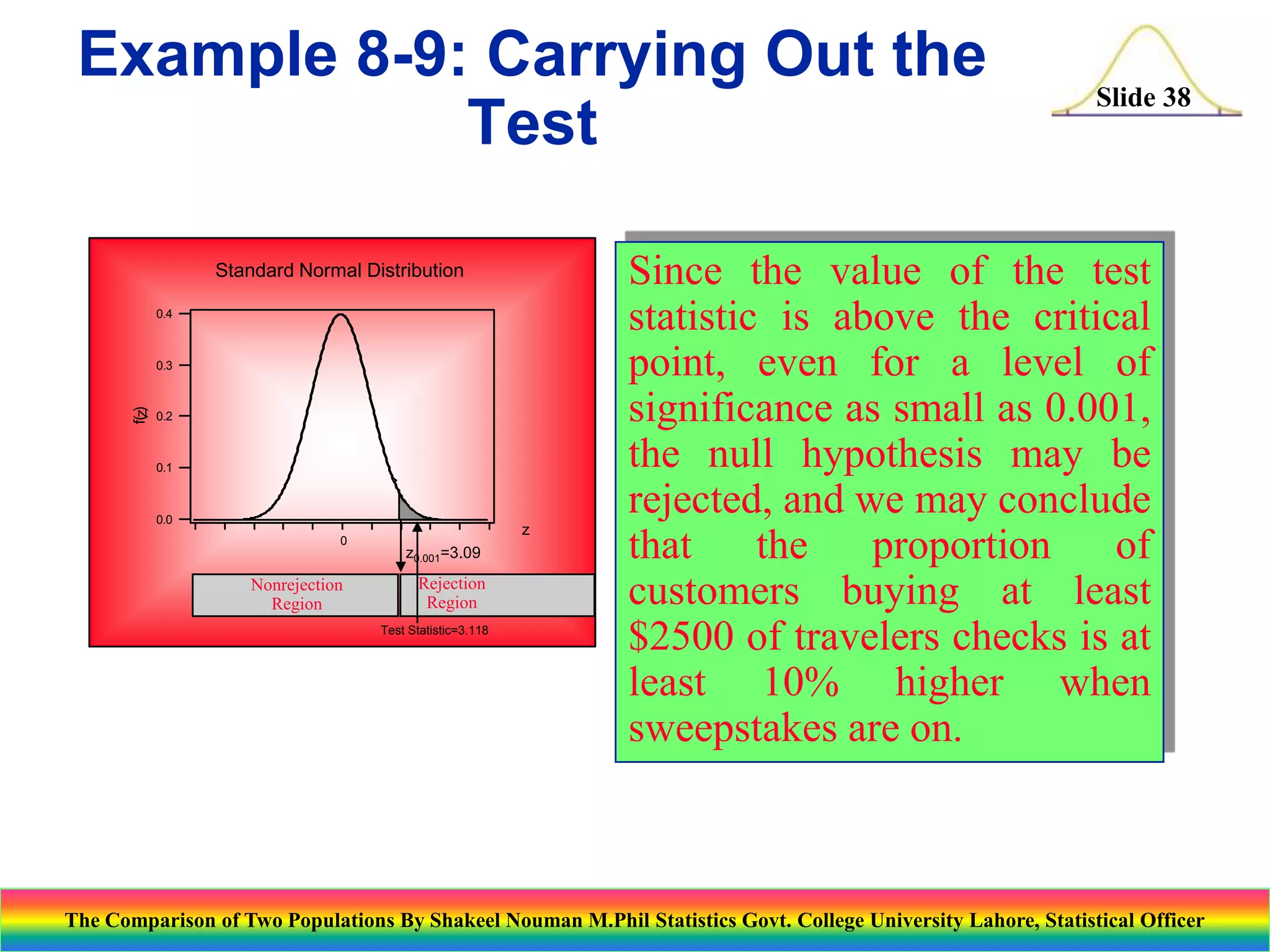
Standard Normal Distribution
0.4

f(z)

0.3

0.2

0.1

0.0
0

Nonrejection
Region

z
z0.001=3.09

Rejection
Region
Test Statistic=3.118

Slide 38

Since the value of the test
statistic is above the critical
point, even for a level of
significance as small as 0.001,
the null hypothesis may be
rejected, and we may conclude
that
the
proportion
of
customers buying at least
$2500 of travelers checks is at
least 10% higher when
sweepstakes are on.

The Comparison of Two Populations By Shakeel Nouman M.Phil Statistics Govt. College University Lahore, Statistical Officer
Example 8-9: Using the
Template

Slide 39

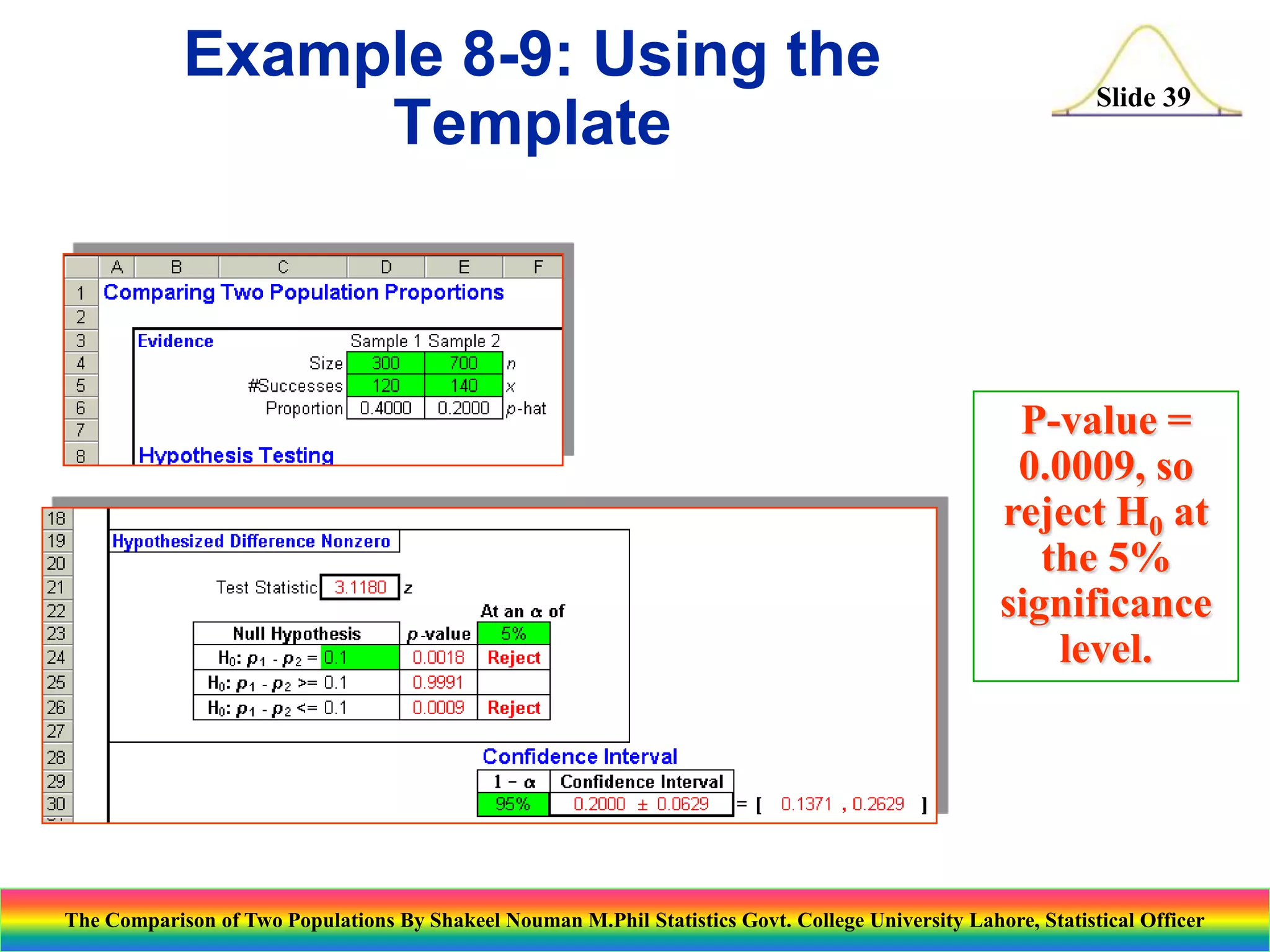
P-value =
0.0009, so
reject H0 at
the 5%
significance
level.

The Comparison of Two Populations By Shakeel Nouman M.Phil Statistics Govt. College University Lahore, Statistical Officer
Confidence Intervals for the
Difference between Two
Population Proportions

Slide 40

A (1- 100% large-sample confidence interval for the difference
)
between two population proportions:
( p1 - p 2 )  z







 p (1 - p )
1
 1
 n1 +


p (1 - p ) 


2
2 

n2



2

A 95% confidence interval using the data in example 8-9:




 p1 (1 - p1 ) p 2 (1 - p 2 ) 

  ( 0.4 - 0.2)  1.96 ( 0.4 )( 0.6) + ( 0.2)( 0.8)
( p1 - p 2 )  z


+

n2
300
700
 
 n1

2
 0.2  (1.96)( 0.0321)  0.2  0.063  [ 0.137 ,0.263]
The Comparison of Two Populations By Shakeel Nouman M.Phil Statistics Govt. College University Lahore, Statistical Officer
Slide 41

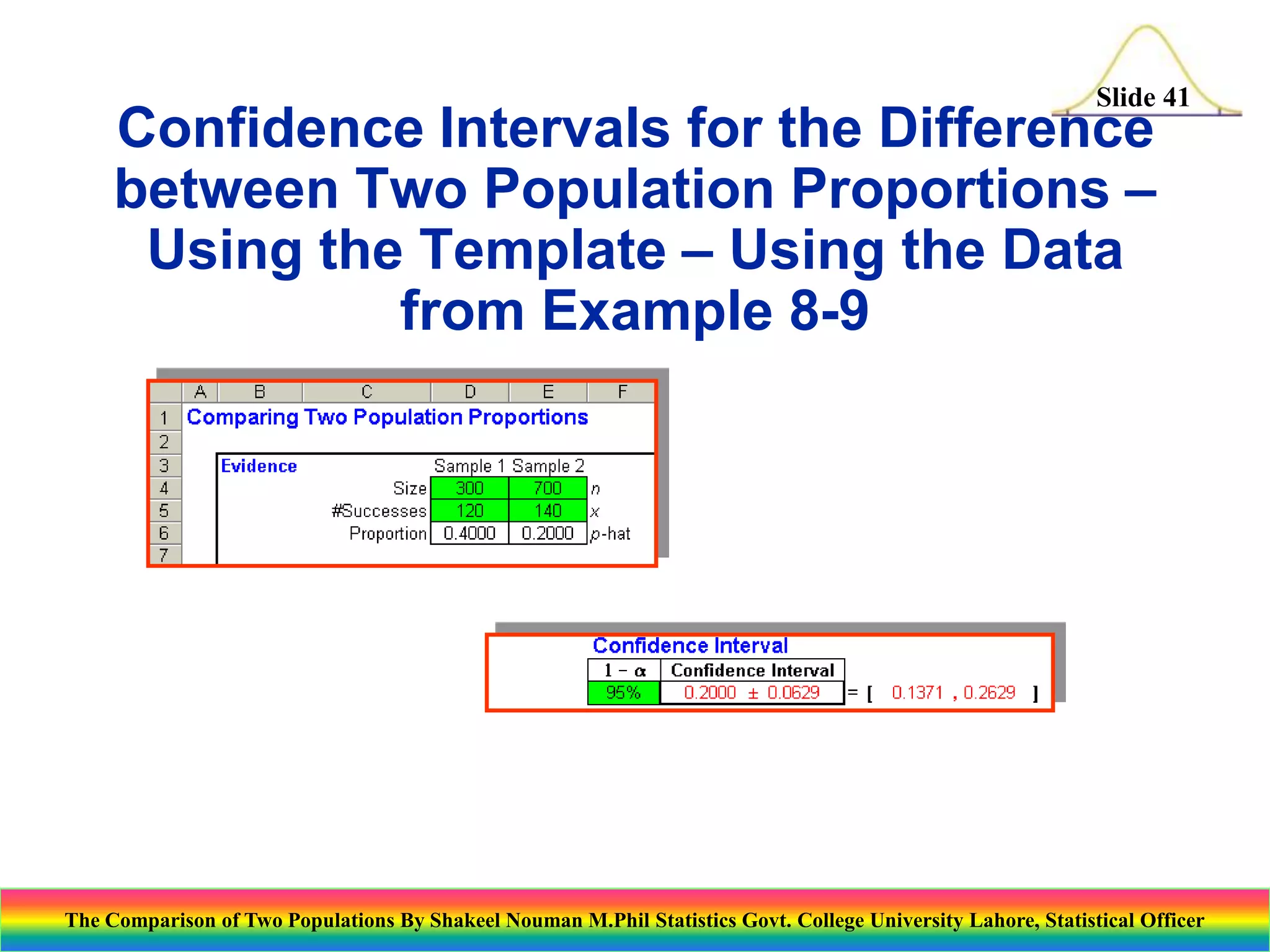
Confidence Intervals for the Difference
between Two Population Proportions –
Using the Template – Using the Data
from Example 8-9

The Comparison of Two Populations By Shakeel Nouman M.Phil Statistics Govt. College University Lahore, Statistical Officer
8-6 The F Distribution and a Test for
Equality of Two Population
Variances

Slide 42

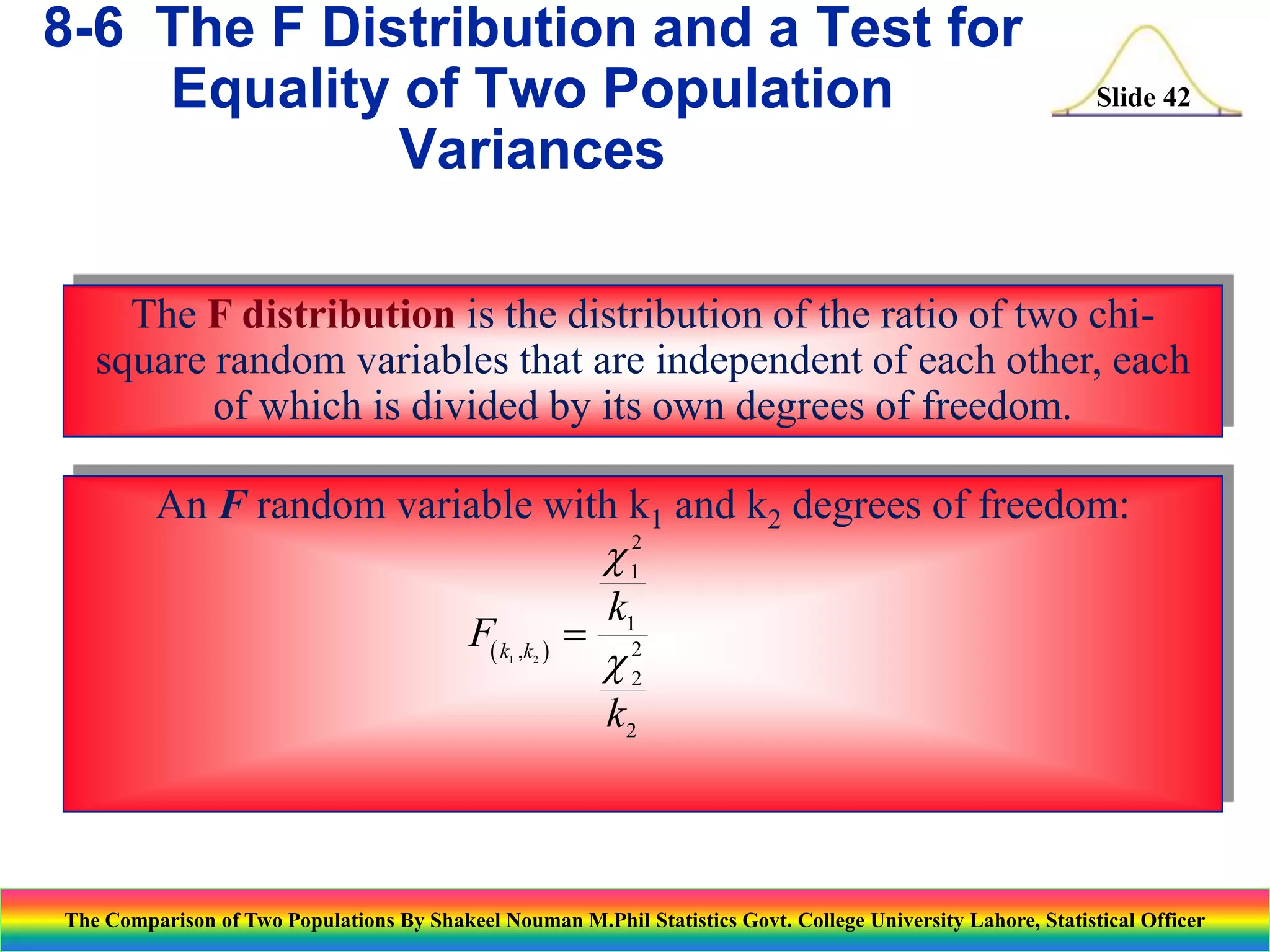
The F distribution is the distribution of the ratio of two chisquare random variables that are independent of each other, each
of which is divided by its own degrees of freedom.
An F random variable with k1 and k2 degrees of freedom:
c 12
k1
F( k ,k )  2
c2
k2
1

2

The Comparison of Two Populations By Shakeel Nouman M.Phil Statistics Govt. College University Lahore, Statistical Officer
The F Distribution

F Distributions with different Degrees of Freedom

f(F)

• The F random variable cannot
be negative, so it is bound by
zero on the left.
• The F distribution is skewed to
the right.
• The F distribution is identified
the number of degrees of
freedom in the numerator, k1,
and the number of degrees of
freedom in the denominator,
k2 .

Slide 43

F(25,30)

1.0

F(10,15)
0.5

F(5,6)

0.0
0

1

2

3

4

5

F

The Comparison of Two Populations By Shakeel Nouman M.Phil Statistics Govt. College University Lahore, Statistical Officer
Using the Table of the F
Distribution
Critical Points of the F Distribution Cutting Off a
Right-Tail Area of 0.05
k1

1

2

3

4

5

6

Slide 44

F Distribution with 7 and 11 De gre e s of Fre ed om
7

8

9
0.7

k2
161.4
18.51
10.13
7.71
6.61
5.99
5.59
5.32
5.12
4.96
4.84
4.75
4.67
4.60
4.54

199.5
19.00
9.55
6.94
5.79
5.14
4.74
4.46
4.26
4.10
3.98
3.89
3.81
3.74
3.68

215.7
19.16
9.28
6.59
5.41
4.76
4.35
4.07
3.86
3.71
3.59
3.49
3.41
3.34
3.29

224.6
19.25
9.12
6.39
5.19
4.53
4.12
3.84
3.63
3.48
3.36
3.26
3.18
3.11
3.06

230.2
19.30
9.01
6.26
5.05
4.39
3.97
3.69
3.48
3.33
3.20
3.11
3.03
2.96
2.90

234.0
19.33
8.94
6.16
4.95
4.28
3.87
3.58
3.37
3.22
3.09
3.00
2.92
2.85
2.79

236.8
19.35
8.89
6.09
4.88
4.21
3.79
3.50
3.29
3.14
3.01
2.91
2.83
2.76
3.01
2.71

238.9
19.37
8.85
6.04
4.82
4.15
3.73
3.44
3.23
3.07
2.95
2.85
2.77
2.70
2.64

240.5
19.38
8.81
6.00
4.77
4.10
3.68
3.39
3.18
3.02
2.90
2.80
2.71
2.65
2.59

0.6
0.5

f(F)

1
2
3
4
5
6
7
8
9
10
11
12
13
14
15

0.4
0.3
0.2
0.1

F

0.0
0

1

2

3

4

5

F0.05=3.01

The left-hand critical point to go along with F(k1,k2) is given by:

1
F( k 2 ,k 1)

Where F(k1,k2) is the right-hand critical point for an F random variable with the
reverse number of degrees of freedom.
The Comparison of Two Populations By Shakeel Nouman M.Phil Statistics Govt. College University Lahore, Statistical Officer
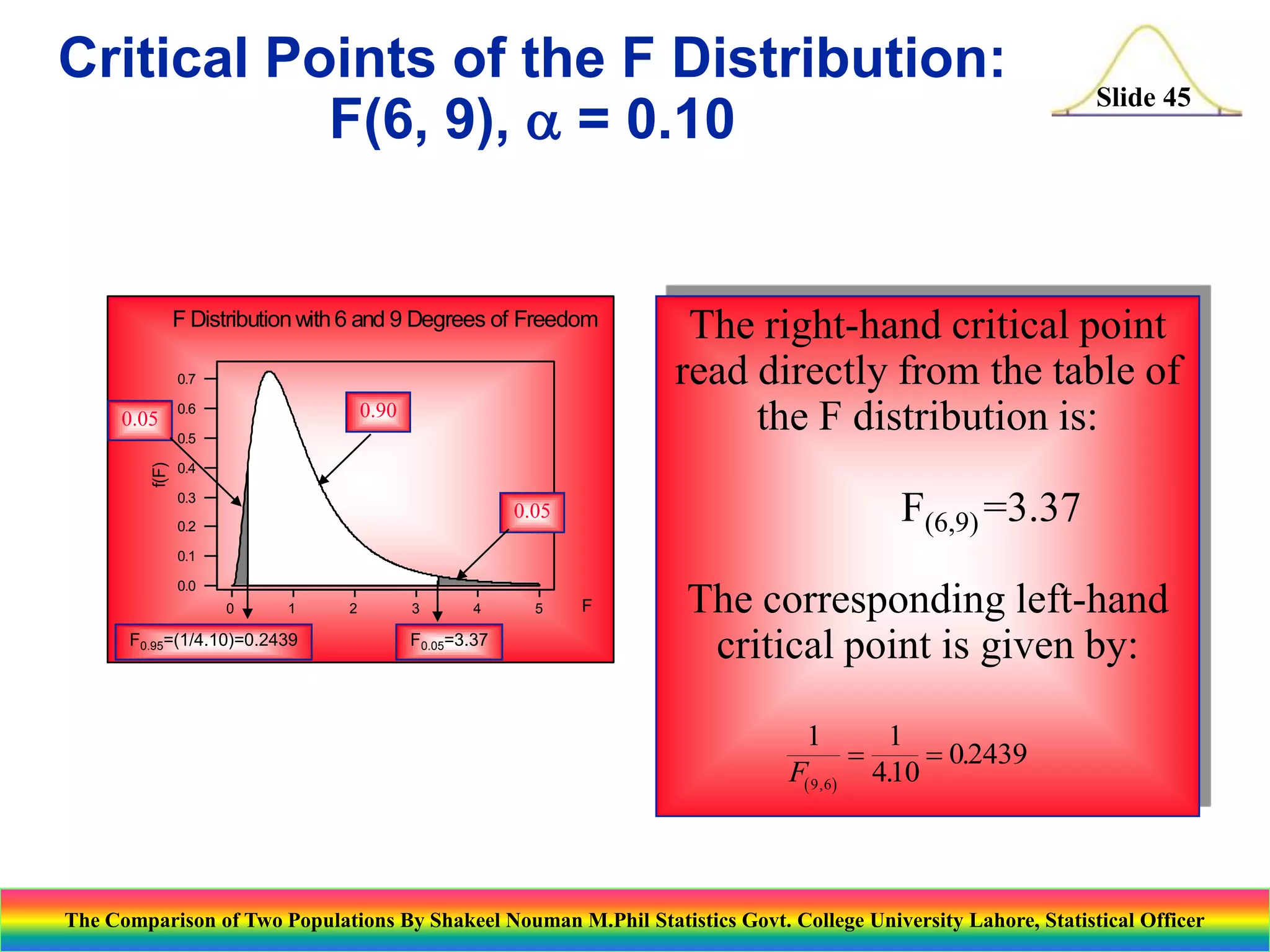
Critical Points of the F Distribution:
F(6, 9),  = 0.10

F Distribution with 6 and 9 Degrees of Freedom
0.7

0.05

0.90

0.6

f(F)

0.5

Slide 45

The right-hand critical point
read directly from the table of
the F distribution is:

0.4
0.3

F(6,9) =3.37

0.05

0.2
0.1
0.0
0

1

F0.95=(1/4.10)=0.2439

2

3

4

F0.05=3.37

5

F

The corresponding left-hand
critical point is given by:
1
1

 0.2439
F( 9 , 6) 410
.

The Comparison of Two Populations By Shakeel Nouman M.Phil Statistics Govt. College University Lahore, Statistical Officer
Test Statistic for the Equality of
Two Population Variances

Slide 46

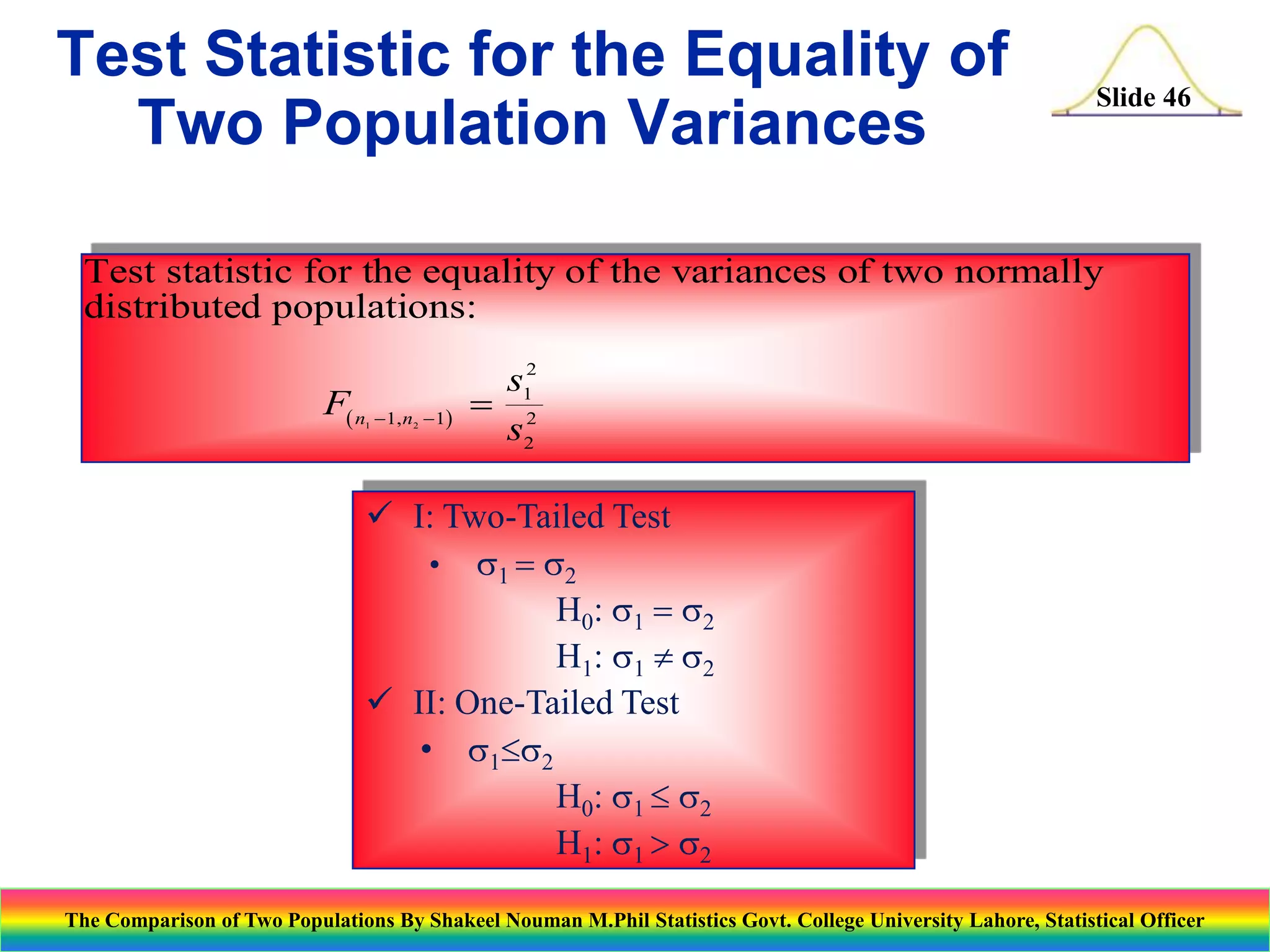
Test statistic for the equality of the variances of two normally
distributed populations:
F( n -1,n -1)
1

2

s12
 2
s2

 I: Two-Tailed Test
• s1  s2
H 0 : s1  s2
H 1 : s1  s2
 II: One-Tailed Test
• s1s2
H 0 : s1  s2
H 1 : s1 > s2
The Comparison of Two Populations By Shakeel Nouman M.Phil Statistics Govt. College University Lahore, Statistical Officer
Example 8-10

Slide 47

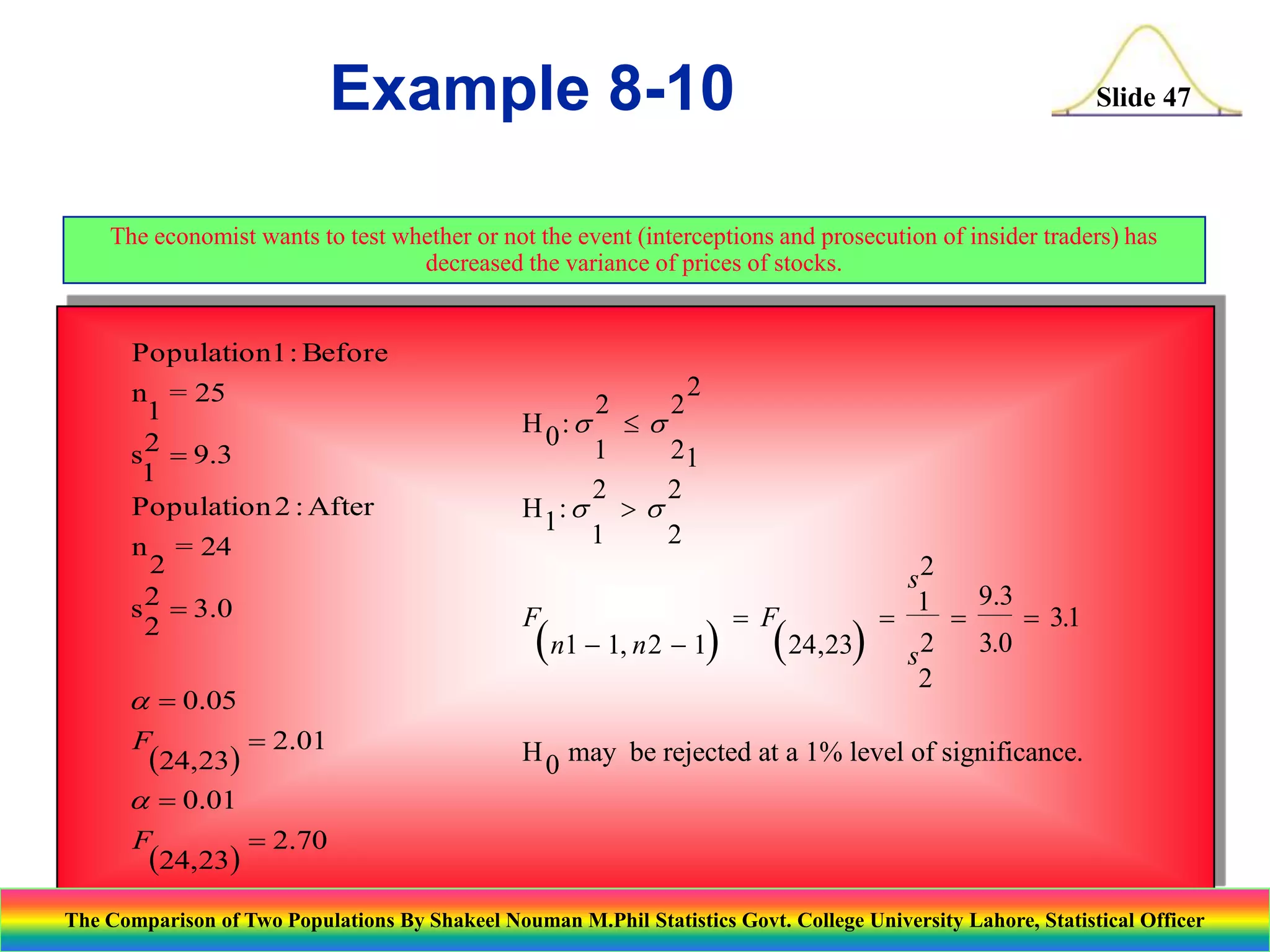
The economist wants to test whether or not the event (interceptions and prosecution of insider traders) has
decreased the variance of prices of stocks.

Population1 : Before
n = 25
1
s 2  9.3
1
Population 2 : After
n = 24
2
s 2  3.0
2

  0.05
F

(24,23)

 2.01

  0.01
F

(24,23)

H 0: s
H1: s

2
1
2
1

s
>s

2

2

21
2
2

s2
9.3
1
F
 F


 3.1
3.0
n1 - 1, n 2 - 1
24,23
s2
2

(

)

(

)

H 0 may be rejected at a 1% level of significance.

 2.70

The Comparison of Two Populations By Shakeel Nouman M.Phil Statistics Govt. College University Lahore, Statistical Officer
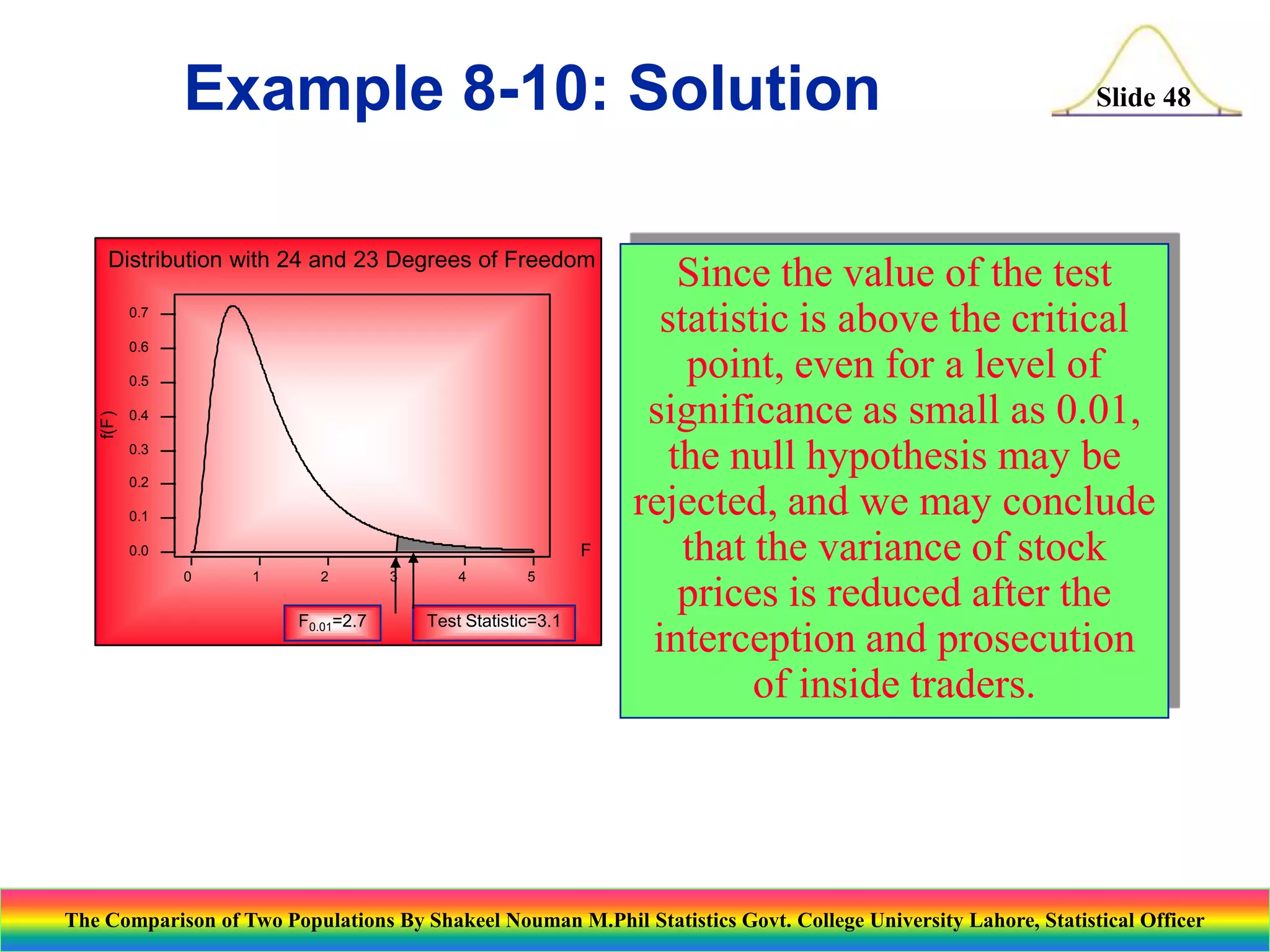
Example 8-10: Solution
Distribution with 24 and 23 Degrees of Freedom
0.7
0.6

f(F)

0.5
0.4
0.3
0.2
0.1

F

0.0
0

1

2

F0.01=2.7

3

4

5

Test Statistic=3.1

Slide 48

Since the value of the test
statistic is above the critical
point, even for a level of
significance as small as 0.01,
the null hypothesis may be
rejected, and we may conclude
that the variance of stock
prices is reduced after the
interception and prosecution
of inside traders.

The Comparison of Two Populations By Shakeel Nouman M.Phil Statistics Govt. College University Lahore, Statistical Officer
Example 8-10: Solution Using
the Template

Slide 49

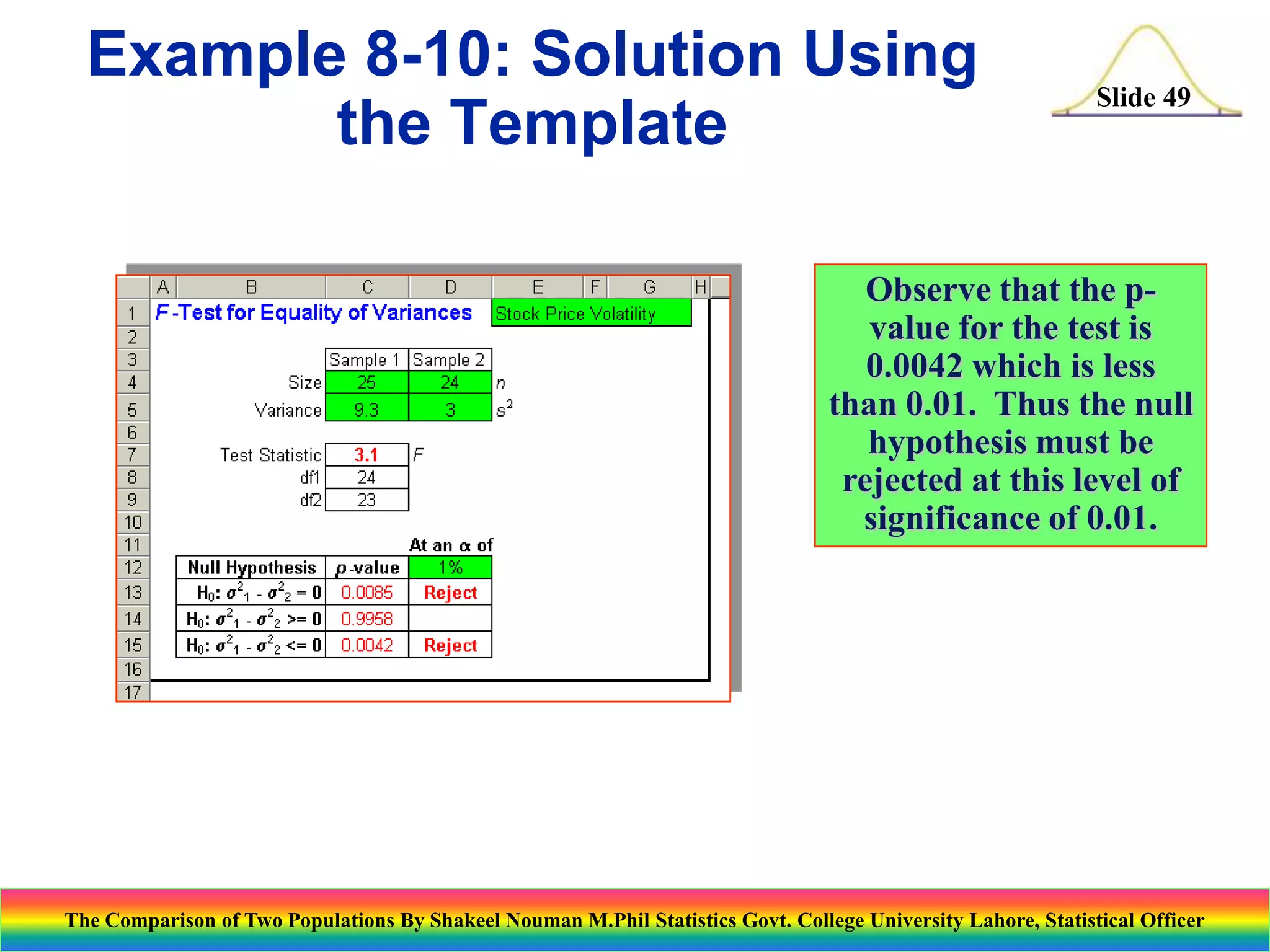
Observe that the pvalue for the test is
0.0042 which is less
than 0.01. Thus the null
hypothesis must be
rejected at this level of
significance of 0.01.

The Comparison of Two Populations By Shakeel Nouman M.Phil Statistics Govt. College University Lahore, Statistical Officer
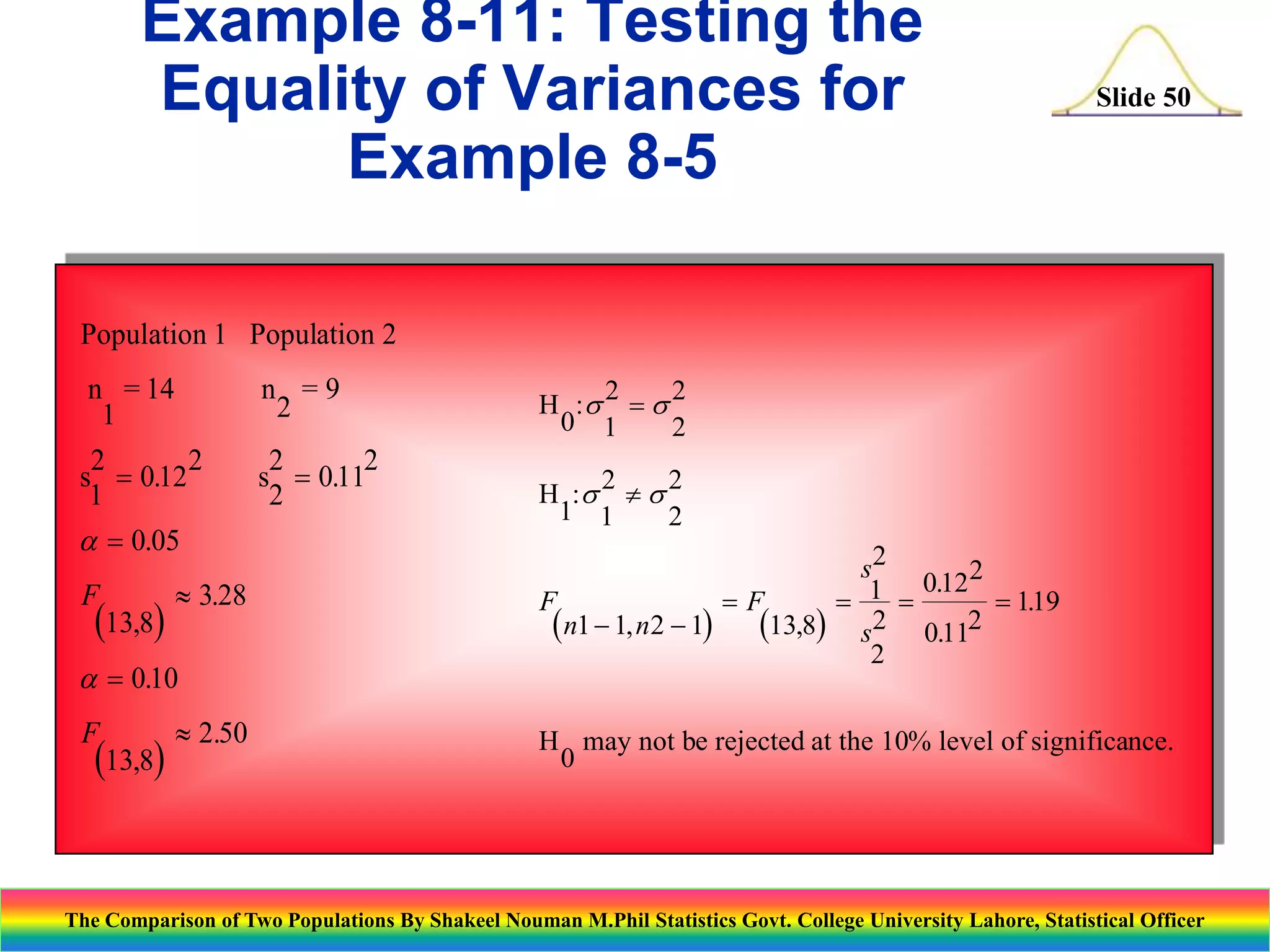
Example 8-11: Testing the
Equality of Variances for
Example 8-5

Slide 50

Population 1 Population 2
n = 14
1

n =9
2

2
2
s  0.12
1

2
2
s  0.11
2

  0.05
F

(13,8)

 3.28

  0.10
F

(13,8)

 2.50

2
2
H :s  s
0 1
2
2
2
H :s  s
1 1
2
s2
2
1  0.12  119
F
F

.
n1 - 1, n2 - 1)
13,8) s2 0.112
(
(
2
H may not be rejected at the 10% level of significance.
0

The Comparison of Two Populations By Shakeel Nouman M.Phil Statistics Govt. College University Lahore, Statistical Officer
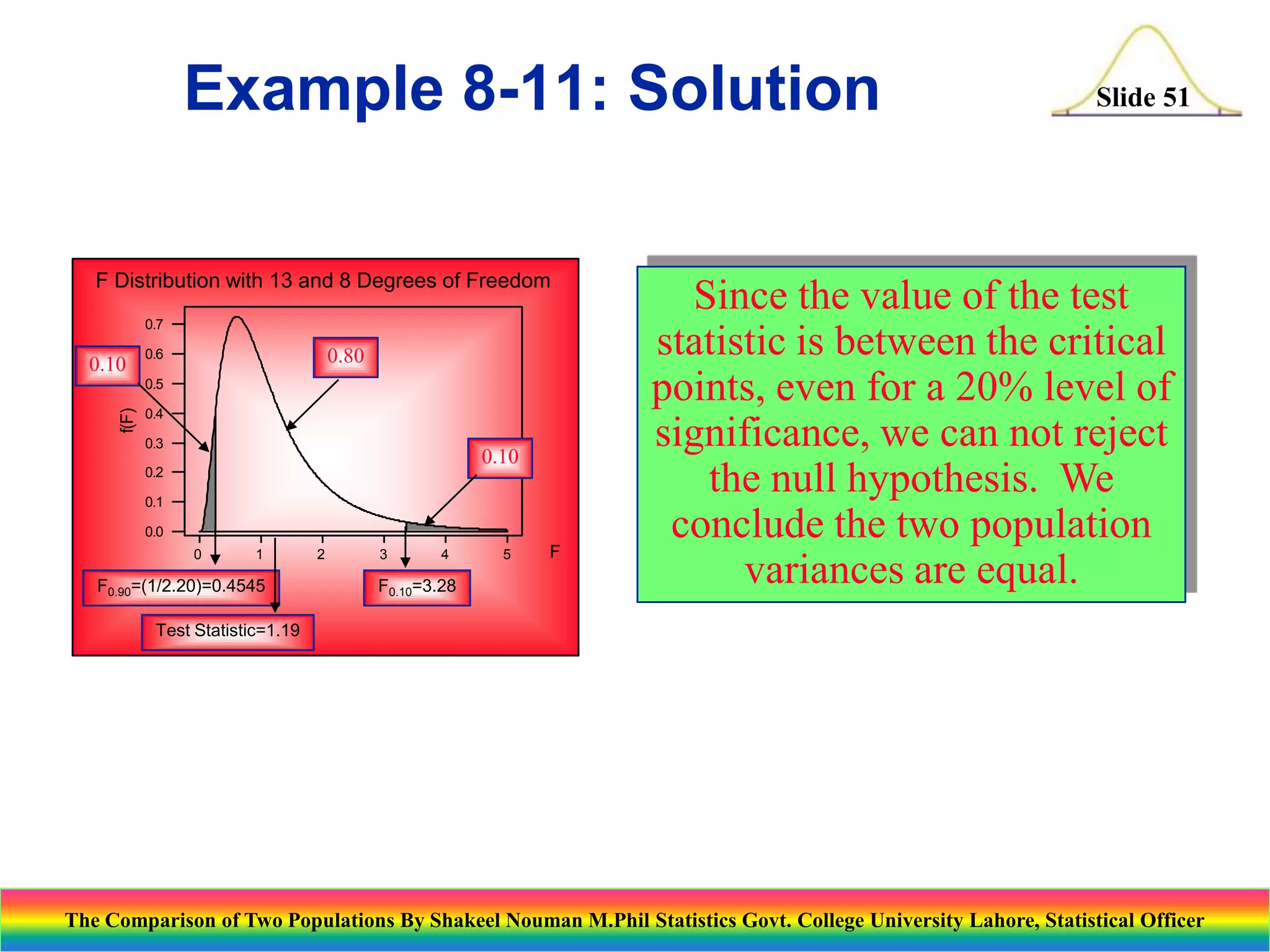
Example 8-11: Solution
F Distribution with 13 and 8 Degrees of Freedom
0.7

0.10

0.80

0.6

f(F)

0.5
0.4
0.3

0.10

0.2
0.1
0.0
0

1

F0.90=(1/2.20)=0.4545

2

3

4

F0.10=3.28

5

F

Slide 51

Since the value of the test
statistic is between the critical
points, even for a 20% level of
significance, we can not reject
the null hypothesis. We
conclude the two population
variances are equal.

Test Statistic=1.19

The Comparison of Two Populations By Shakeel Nouman M.Phil Statistics Govt. College University Lahore, Statistical Officer
Slide 52

Template to test for the Difference
between Two Population
Variances: Example 8-11
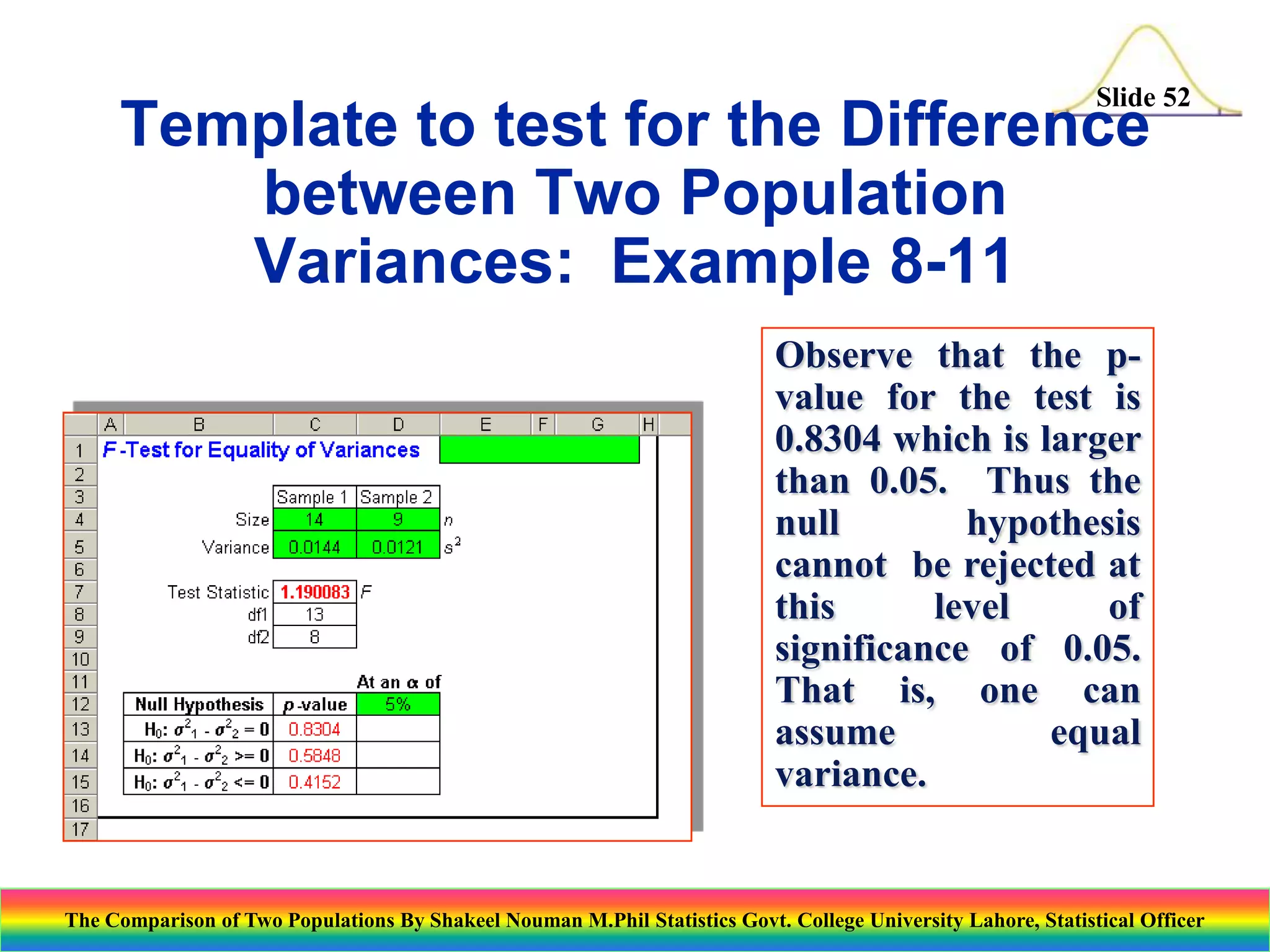
Observe that the pvalue for the test is
0.8304 which is larger
than 0.05. Thus the
null
hypothesis
cannot be rejected at
this
level
of
significance of 0.05.
That is, one can
assume
equal
variance.

The Comparison of Two Populations By Shakeel Nouman M.Phil Statistics Govt. College University Lahore, Statistical Officer
Slide 53

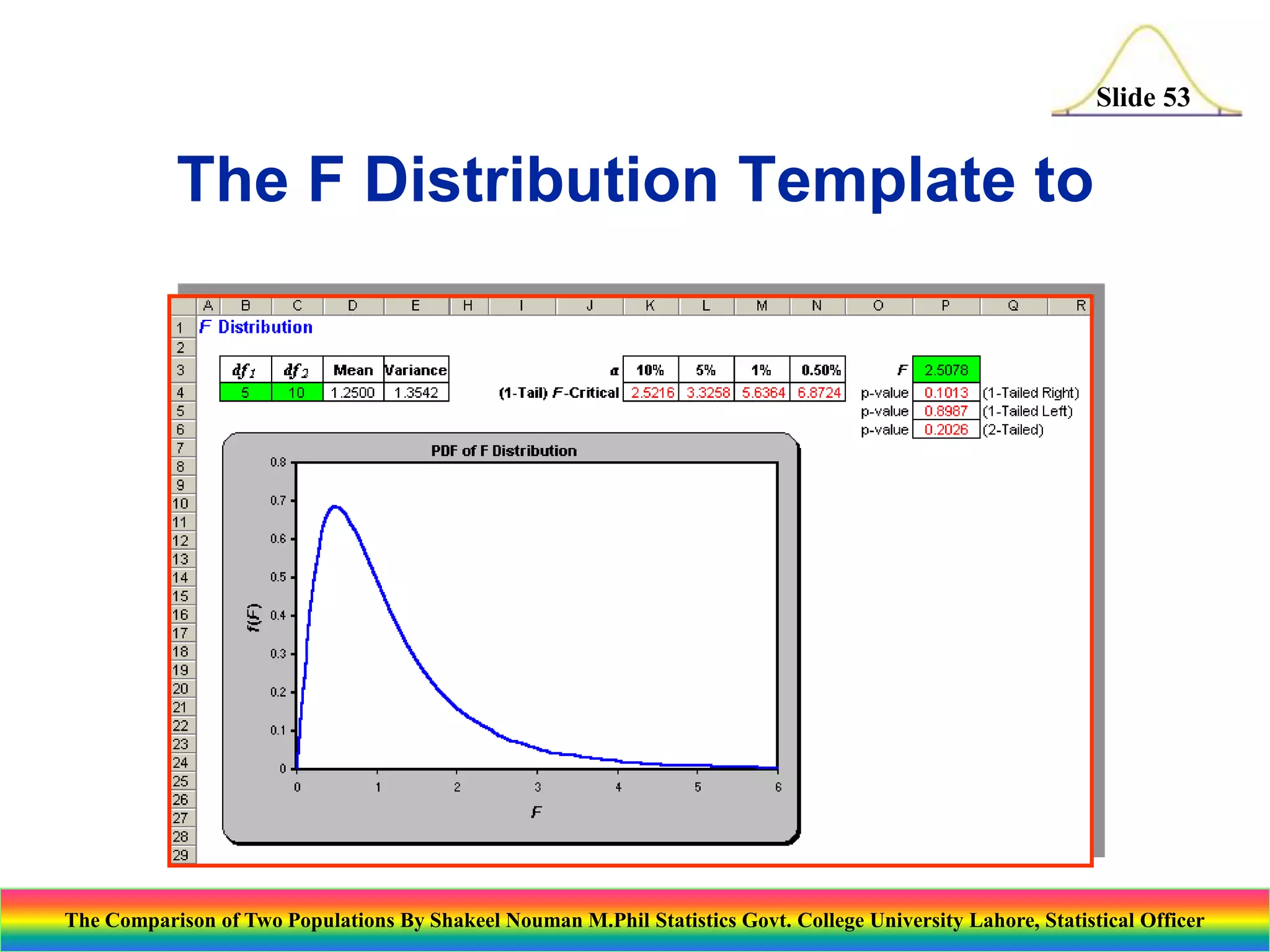
The F Distribution Template to

The Comparison of Two Populations By Shakeel Nouman M.Phil Statistics Govt. College University Lahore, Statistical Officer
Slide 54

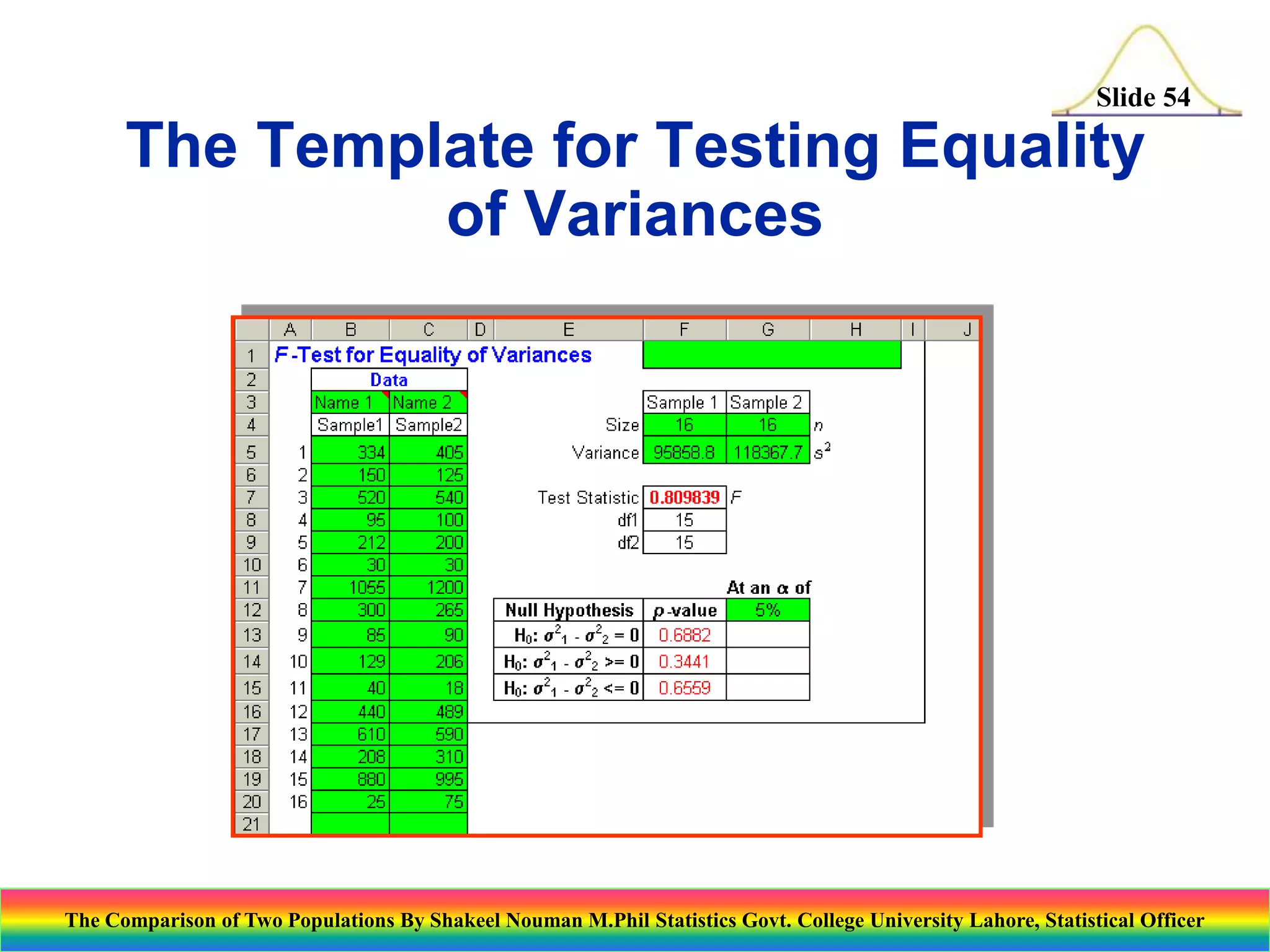
The Template for Testing Equality
of Variances

The Comparison of Two Populations By Shakeel Nouman M.Phil Statistics Govt. College University Lahore, Statistical Officer
Slide 55

Name
Religion
Domicile
Contact #
E.Mail
M.Phil (Statistics)

Shakeel Nouman
Christian
Punjab (Lahore)
0332-4462527. 0321-9898767
sn_gcu@yahoo.com
sn_gcu@hotmail.com
GC University, .
(Degree awarded by GC University)

M.Sc (Statistics)
Statitical Officer
(BS-17)
(Economics & Marketing
Division)

GC University, .
(Degree awarded by GC University)

Livestock Production Research Institute
Bahadurnagar (Okara), Livestock & Dairy Development
Department, Govt. of Punjab

The Comparison of Two Populations By Shakeel Nouman M.Phil Statistics Govt. College University Lahore, Statistical Officer

The comparison of two populations

  • 1.
    The Comparison ofTwo Populations Slide 1 Shakeel Nouman M.Phil Statistics The Comparison of Two Populations By Shakeel Nouman M.Phil Statistics Govt. College University Lahore, Statistical Officer
  • 2.
    8 Slide 2 The Comparisonof Two Populations • Using Statistics • Paired-Observation Comparisons • A Test for the Difference between Two • • • Population Means Using Independent Random Samples A Large-Sample Test for the Difference between Two Population Proportions The F Distribution and a Test for the Equality of Two Population Variances Summary and Review of Terms The Comparison of Two Populations By Shakeel Nouman M.Phil Statistics Govt. College University Lahore, Statistical Officer
  • 3.
    8-1 Using Statistics • Slide3 Inferences about differences between parameters of two populations  Paired-Observations  Observe the same group of persons or things • At two different times: “before” and “after” • Under two different sets of circumstances or “treatments”  Independent Samples » Observe different groups of persons or things • At different times or under different sets of circumstances The Comparison of Two Populations By Shakeel Nouman M.Phil Statistics Govt. College University Lahore, Statistical Officer
  • 4.
    8-2 Paired-Observation Comparisons • • Slide 4 Populationparameters may differ at two different times or under two different sets of circumstances or treatments because: The circumstances differ between times or treatments The people or things in the different groups are themselves different By looking at paired-observations, we are able to minimize the “between group” , extraneous variation. The Comparison of Two Populations By Shakeel Nouman M.Phil Statistics Govt. College University Lahore, Statistical Officer
  • 5.
    Paired-Observation ComparisonsSlide 5 ofMeans Test statistic for the paired - observations t test: D -  D0 t sD n w here D is the sample average differencebetw een each pair of observations, s D is the sample standard deviation of these difference and the sample size, n, is the number s, of pairs of observations. The symbol  D0 is the population mean differenceunder the null hypothesis. When thenull hypothesis is true and the population mean differenceis  D0 , the statistic has a t distribution w ith (n - 1) degrees of freedom. The Comparison of Two Populations By Shakeel Nouman M.Phil Statistics Govt. College University Lahore, Statistical Officer
  • 6.
    Example 8-1 Slide 6 Arandom sample of 16 viewers of Home Shopping Network was selected for an experiment. All viewers in the sample had recorded the amount of money they spent shopping during the holiday season of the previous year. The next year, these people were given access to the cable network and were asked to keep a record of their total purchases during the holiday season. Home Shopping Network managers want to test the null hypothesis that their service does not increase shopping volume, versus the alternative hypothesis that it does. Shopper 1 2 3 4 5 6 7 8 9 10 11 12 13 14 15 16 Previous 334 150 520 95 212 30 1055 300 85 129 40 440 610 208 880 25 Current 405 125 540 100 200 30 1200 265 90 206 18 489 590 310 995 75 Diff 71 -25 20 5 -12 0 145 -35 5 77 -22 49 -20 102 115 50 H0:  0 D H1:  > 0 D df = (n-1) = (16-1) = 15 D - D 0 Test Statistic: t  sD n Critical Value: t0.05 = 1.753 Do not reject H0 if : t  1.753 Reject H0 if: t > 1.753 The Comparison of Two Populations By Shakeel Nouman M.Phil Statistics Govt. College University Lahore, Statistical Officer
  • 7.
    Example 8-1: Solution D- D 32.81 - 0 0 t   2.354 sD 55.75 t = 2.354 > 1.753, so H0 is rejected and we conclude that there is evidence that shopping volume by network viewers has increased, with a p-value between 0.01 an 0.025. The Template output gives a more exact p-value of 0.0163. See the next slide for the output. 16 n Slide 7 t Distribution: df=15 0.4 f(t) 0.3 0.2 Nonrejection Region 0.1 Rejection Region 0.0 -5 0 1.753 = t0.05 5 2.131 = t0.025 t 2.602 = t0.01 2.354= test statistic The Comparison of Two Populations By Shakeel Nouman M.Phil Statistics Govt. College University Lahore, Statistical Officer
  • 8.
    Example 8-1: Templatefor Testing Paired Differences Slide 8 The Comparison of Two Populations By Shakeel Nouman M.Phil Statistics Govt. College University Lahore, Statistical Officer
  • 9.
    Example 8-2 Slide 9 Ithas recently been asserted that returns on stocks may change once a story about a company appears in The Wall Street Journal column “Heard on the Street.” An investments analyst collects a random sample of 50 stocks that were recommended as winners by the editor of “Heard on the Street,” and proceeds to conduct a two-tailed test of whether or not the annualized return on stocks recommended in the column differs between the month before and the month after the recommendation. For each stock the analysts computes the return before and the return after the event, and computes the difference in the two return figures. He then computes the average and standard deviation of the differences. H0: D  0 H1: D > 0 D - D 0.1 - 0 0 z    14 .14 sD 0.05 n = 50 D = 0.1% sD = 0.05% Test Statistic: n z  D - D 0 sD n 50 p - value: p ( z > 14.14 )  0 This test result is highly significant, and H 0 may be rejected at any reasonable level of significance. The Comparison of Two Populations By Shakeel Nouman M.Phil Statistics Govt. College University Lahore, Statistical Officer
  • 10.
    Confidence Intervals forPaired Observations A (1 -  ) 100% confidence interval for the mean difference  D Slide 10 : s D  t D 2 n where t is the value of the t distributi on with (n - 1) degrees of freedom that cuts off an 2 area of  to its right, When the sample size is large, we may use z instead. . 2 2 The Comparison of Two Populations By Shakeel Nouman M.Phil Statistics Govt. College University Lahore, Statistical Officer
  • 11.
    Confidence Intervals forPaired Observations – Example 8-2 Slide 11 95% confidence interval for the data in Example 8 - 2 : s D  z D  0.11.96 0.05  0.1 (1.96)(.0071) n 50 2  0.1 0.014  [0.086,0.114] Note that this confidence interval does not include the value 0. The Comparison of Two Populations By Shakeel Nouman M.Phil Statistics Govt. College University Lahore, Statistical Officer
  • 12.
    Slide 12 Confidence Intervalsfor Paired Observations – Example 8-2 Using the Template The Comparison of Two Populations By Shakeel Nouman M.Phil Statistics Govt. College University Lahore, Statistical Officer
  • 13.
    8-3 A Testfor the Difference between Two Population Means Using Independent Random Samples • Slide 13 When paired data cannot be obtained, use independent random samples drawn at different times or under different circumstances. Large sample test if: » Both n1 30 and n2 30 (Central Limit Theorem), or » Both populations are normal and s1 and s2 are both known Small sample test if: » Both populations are normal and s1 and s2 are unknown The Comparison of Two Populations By Shakeel Nouman M.Phil Statistics Govt. College University Lahore, Statistical Officer
  • 14.
    Comparisons of TwoPopulation Means: Testing Situations • • • Slide 14 I: Difference between two population means is 0  1= 2 » H0: 1 -2 = 0 » H1: 1 -2  0 II: Difference between two population means is less than 0  1 2 » H0: 1 -2  0 » H1: 1 -2 > 0 III: Difference between two population means is less than D  1  2+D » H0: 1 -2  D » H1: 1 -2 > D The Comparison of Two Populations By Shakeel Nouman M.Phil Statistics Govt. College University Lahore, Statistical Officer
  • 15.
    Comparisons of TwoPopulation Means: Test Statistic Slide 15 Large-sample test statistic for the difference between two population means: z ( x - x ) - ( -  ) 1 2 s 1 2 1 n + 2 s 0 2 2 n The term (1- 2)0 is the difference between 1 an 2 under the null hypothesis. Is is equal to zero in situations I and II, and it is equal to the prespecified value D in situation III. The term in the denominator is the standard deviation of the difference between the two sample means (it relies on the assumption that the two samples are independent). 1 2 The Comparison of Two Populations By Shakeel Nouman M.Phil Statistics Govt. College University Lahore, Statistical Officer
  • 16.
    Two-Tailed Test forEquality of Two Population Means: Example 8-3 Slide 16 Is there evidence to conclude that the average monthly charge in the entire population of American Express Gold Card members is different from the average monthly charge in the entire population of Preferred Visa cardholders? Population1 : Preferred Visa H n = 1200 0 : - 0 1 2 H : - 0 1 1 2 1 x = 452 1 s = 212 1 Population 2 : Gold Card ( x - x ) - ( -  ) 2 1 2 0  ( 452 - 523) - 0 z  1 2 2 2 2 s s 212 185 1 + 2 + 1200 800 n n 1 2 - 71  80.2346  - 71  -7.926 8.96 n = 800 2 x = 523 p - value : p(z < -7.926)  0 2 s = 185 2 H 0 is rejected at any common level of significan ce The Comparison of Two Populations By Shakeel Nouman M.Phil Statistics Govt. College University Lahore, Statistical Officer
  • 17.
    Example 8-3: CarryingOut the Test Standard Normal Distribution 0.4 f(z) 0.3 0.2 0.1 0.0 -z0.01=-2.576 Rejection Region Test Statistic=-7.926 0 z z0.01=2.576 Nonrejection Rejection Region Region Slide 17 Since the vlue of the test sttistic is fr below the lower criticl point, the null hypothesis y be rejected, nd we y conclude tht there is  sttisticlly significnt difference between the verge onthly chrges of Gold Crd nd Preferred Vis crdholders. The Comparison of Two Populations By Shakeel Nouman M.Phil Statistics Govt. College University Lahore, Statistical Officer
  • 18.
    Example 8-3: Usingthe Template Slide 18 The Comparison of Two Populations By Shakeel Nouman M.Phil Statistics Govt. College University Lahore, Statistical Officer
  • 19.
    Two-Tailed Test forDifference Between Two Population Means: Example 8-4 Slide 19 Is there evidence to substntite Durcells cli tht their btteries lst, on verge, t lest 45 inutes longer thn Energizer btteries of the se size? Population1 : Duracell H :  -   45 0 1 2 H :  -  > 45 1 1 2 n = 100 1 x = 308 1 s = 84 1 Population 2 : Energizer ( x - x ) - ( -  ) 2 1 2 0  (308 - 254) - 45 z 1 2 2 2 2 s s 84 67 1 + 2 + 100 100 n n 1 2  9 115.45  9  0.838 10.75 n = 100 2 x = 254 2 s = 67 2 p - value : p(z > 0.838) = 0.201 H may not be rejected at any common 0 level of significan ce The Comparison of Two Populations By Shakeel Nouman M.Phil Statistics Govt. College University Lahore, Statistical Officer
  • 20.
    Two-Tailed Test forDifference Slide 20 Between Two Population Means: Example 8-4 – Using the Template Is there evidence to substantiate Duracell’s claim that their batteries last, on average, at least 45 minutes longer than Energizer batteries of the same size? The Comparison of Two Populations By Shakeel Nouman M.Phil Statistics Govt. College University Lahore, Statistical Officer
  • 21.
    Confidence Intervals forthe Difference between Two Population Means Slide 21 A large-sample (1-)100% confidence interval for the difference between two population means, 1- 2 , using independent random samples: (x - x )  z 1 2  2 2 2 s 1 + 2 n n 1 2 s A 95% confidence interval using the data in example 8-3: (x - x )  z 1 2  2 2 2 s 2122 1852 1 + 2  (523 - 452)  1.96 +  [53.44,88.56] 1200 800 n n 1 2 s The Comparison of Two Populations By Shakeel Nouman M.Phil Statistics Govt. College University Lahore, Statistical Officer
  • 22.
    8-4 A Testfor the Difference between Two Population Means: Assuming Equal Population Variances Slide 22 • If we might assume that the population variances s12 and s22 are equal (even though unknown), then the two sample variances, s12 and s22, provide two separate estimators of the common population variance. Combining the two separate estimates into a pooled estimate should give us a better estimate than either sample variance by itself. * * ** * *** * * * * * Sample 1 x1 From sample 1 we get the estimate s12 with (n1-1) degrees of freedom. Deviation from the mean. One for each sample data point. } } Deviation from the mean. One for each sample data point. * ** * * * * * * * ** * Sample 2 x2 From sample 2 we get the estimate s22 with (n2-1) degrees of freedom. From both samples together we get a pooled estimate, sp2 , with (n1-1) + (n2-1) = (n1+ n2 -2) total degrees of freedom. The Comparison of Two Populations By Shakeel Nouman M.Phil Statistics Govt. College University Lahore, Statistical Officer
  • 23.
    Pooled Estimate ofthe Population Variance Slide 23 A pooled estimate of the common population variance, based on a sample variance s12 from a sample of size n1 and a sample variance s22 from a sample of size n2 is given by: (n1 - 1) s12 + (n2 - 1) s22 s2  p n1 + n2 - 2 The degrees of freedom associated with this estimator is: df = (n1+ n2-2) The pooled estimate of the variance is a weighted average of the two individual sample variances, with weights proportional to the sizes of the two samples. That is, larger weight is given to the variance from the larger sample. The Comparison of Two Populations By Shakeel Nouman M.Phil Statistics Govt. College University Lahore, Statistical Officer
  • 24.
    Using the PooledEstimate of the Population Variance The estimate of the standard deviation of (x1 - x 2 ) is given by: Slide 24 1  2 1 sp  +  n1 n2   Test statistic for the difference between two population means, assuming equal population variances: (x1 - x 2 ) - (  1 -  2 ) 0 t= 1 2 1 sp  +  n1 n2   where (  1 -  2 ) 0 is the difference between the two population means under the null hypothesis (zero or some other number D). The number of degrees of freedom of the test statistic is df = ( n1 + n2 - 2 ) (the 2 number of degrees of freedom associated with s p , the pooled estimate of the population variance. The Comparison of Two Populations By Shakeel Nouman M.Phil Statistics Govt. College University Lahore, Statistical Officer
  • 25.
    Example 8-5 Slide 25 Dothe data provide sufficient evidence to conclude that average percentage increase in the CPI differs when oil sells at these two different prices? Population 1: Oil price = $27.50 n1 = 14 x1 = 0.317% s1 = 0.12% Population 2: Oil price = $20.00 n2 = 9 x 2 = 0.21% s 2 = 0.11% df = (n + n - 2 )  (14 + 9 - 2 )  21 1 2 H 0 : 1 -  2  0 H1:  1 -  2  0 ( x1 - x 2 ) - (  1 -  2 ) 0 t  2 2  ( n1 - 1) s1 + ( n2 - 1) s2   1 1    +  n1 + n2 - 2    n1 n2  0.107 0.107    2.154 0.00247 0.0497 Critical point: t = 2.080 0.025 H 0 may be rejected at the 5% level of significance The Comparison of Two Populations By Shakeel Nouman M.Phil Statistics Govt. College University Lahore, Statistical Officer
  • 26.
    Example 8-5: Usingthe Template Slide 26 Do the data provide sufficient evidence to conclude that average percentage increase in the CPI differs when oil sells at these two different prices? P-value = 0.0430, so reject H0 at the 5% significance level. The Comparison of Two Populations By Shakeel Nouman M.Phil Statistics Govt. College University Lahore, Statistical Officer
  • 27.
    Example 8-6 The manufacturersof compact disk players want to test whether a small price reduction is enough to increase sales of their product. Is there evidence that the small price reduction is enough to increase sales of compact disk players? H : - 0 0 2 1 H : - >0 1 2 1 t Population 1: Before Reduction n 1 = 15 x 1 = $6598  s1 = $844 Population 2: After Reduction n 2 = 12 Slide 27  ( x - x ) - ( -  ) 2 1 2 1 0  ( n - 1) s 2 + ( n - 1) s 2  1 1  1 1 2 2  +   n n n +n -2 1 2   1 2     ( 6870 - 6598) - 0  (14)844 2 + (11)669 2  1 1    +    15 12  15 + 12 - 2   272  89375.25 272  0.91 298.96 x 2 = $6870 s 2 = $669 Critical point : t = 1.316 0.10 df = (n + n - 2 )  (15 + 12 - 2 )  25 1 2 H may not be rejected even at the 10% level of significan ce 0 The Comparison of Two Populations By Shakeel Nouman M.Phil Statistics Govt. College University Lahore, Statistical Officer
  • 28.
    Example 8-6: Usingthe Template Slide 28 P-value = 0.1858, so do not reject H0 at the 5% significance level. The Comparison of Two Populations By Shakeel Nouman M.Phil Statistics Govt. College University Lahore, Statistical Officer
  • 29.
    Example 8-6: Continued tDistribution: df = 25 0.4 f(t) 0.3 0.2 0.1 0.0 -5 -4 -3 -2 -1 0 1 Nonrejection Region 2 3 4 t0.10=1.316 Rejection Region 5 t Slide 29 Since the test statistic is less than t0.10, the null hypothesis cannot be rejected at any reasonable level of significance. We conclude that the price reduction does not significantly affect sales. Test Statistic=0.91 The Comparison of Two Populations By Shakeel Nouman M.Phil Statistics Govt. College University Lahore, Statistical Officer
  • 30.
    Confidence Intervals Usingthe Pooled Variance Slide 30 A (1-) 100% confidence interval for the difference between two population means, 1- 2 , using independent random samples and assuming equal population variances: ( x1 - x2 )  t  2 1 sp   n1 +   n2  1 2 A 95% confidence interval using the data in Example 8-6: ( x1 - x 2 )  t  2 sp  1 + 1    n1 n2   ( 6870 - 6598 )  2 .06 ( 595835)( 0.15)  [ -343.85,887 .85] 2 The Comparison of Two Populations By Shakeel Nouman M.Phil Statistics Govt. College University Lahore, Statistical Officer
  • 31.
    Slide 31 Confidence IntervalsUsing the Pooled Variance and the TemplateExample 8-6 Confidence Interval The Comparison of Two Populations By Shakeel Nouman M.Phil Statistics Govt. College University Lahore, Statistical Officer
  • 32.
    8-5 A Large-SampleTest for the Difference between Two Population • Hypothesized difference is zero Proportions I: Difference between two population proportions is 0 Slide 32 • p1= p2 » H0: p1 -p2 = 0 » H1: p1 -p2  0 II: Difference between two population proportions is less than 0 • p1p2 » H0: p1 -p2  0 » H1: p1 -p2 > 0 • Hypothesized difference is other than zero: III: Difference between two population proportions is less than D • p1  2+D p » H0:p-p2 D The Comparison of H : p -p By Shakeel Nouman M.Phil Statistics Govt. College University Lahore, Statistical Officer » Two1Populations2 > D 1
  • 33.
    Comparisons of TwoPopulation Proportions When the Hypothesized Difference Is Zero: Test Statistic Slide 33 When the popultion proportions re hypothesized to be p  equl, then  pooled estitor of the proportion ( ) y be used in clculting the difference between A lrge-sple test sttistic for thetest sttistic. two popultion proportions, when the hypothesized difference is zero: z where ( p1 - p2 ) - 0   1 1 p 1- p  +  ( )   n1 n2  is the x1 is the sple proportion in sple 1 nd 1 x p1   p1   sple n1 n1 p  proportion in sple 2. The sybol stnds for the cobined sple proportion in both sples, considered s  single sple. Tht is: x +x p ˆ n +n 1 1 1 2 The Comparison of Two Populations By Shakeel Nouman M.Phil Statistics Govt. College University Lahore, Statistical Officer
  • 34.
    Comparisons of TwoPopulation Proportions When the Hypothesized Difference Is Zero: Example 8-8 Slide 34 Carry out a two-tailed test of the equality of banks’ share of the car loan market in 1980 and 1995. n1 = 100 H 0 : p1 - p 2  0 H1: p1 - p 2  0 x1 = 53 z  Population 1: 1980 p1 = 0.53  Population 2: 1995 n 2 = 100 x 2 = 43 p 2 = 0.43  x1 + x 2 53 + 43 p    0.48 n1 + n 2 100 + 100 ( p1 - p 2 ) - 0 p (1    1 1 p )  +   n1 n2  0.10  0.004992 Critical point: z 0.10  0.53 - 0.43  1 + 1   100 100 (.48)(.52)   1.415 0.07065 = 1.645 0.05 H 0 may not be rejected even at a 10% level of significance. The Comparison of Two Populations By Shakeel Nouman M.Phil Statistics Govt. College University Lahore, Statistical Officer
  • 35.
    Example 8-8: CarryingOut the Test Slide 35 Standard Normal Distribution 0.4 f(z) 0.3 0.2 0.1 0.0 z -z0.05=-1.645 Rejection Region 0 z0.05=1.645 Nonrejection Region Rejection Region Since the value of the test statistic is within the nonrejection region, even at a 10% level of significance, we may conclude that there is no statistically significant difference between banks’ shares of car loans in 1980 and 1995. Test Statistic=1.415 The Comparison of Two Populations By Shakeel Nouman M.Phil Statistics Govt. College University Lahore, Statistical Officer
  • 36.
    Example 8-8: Usingthe Template Slide 36 P-value = 0.157, so do not reject H0 at the 5% significance level. The Comparison of Two Populations By Shakeel Nouman M.Phil Statistics Govt. College University Lahore, Statistical Officer
  • 37.
    Comparisons of TwoPopulation Proportions When the Hypothesized Difference Is Not Zero: Example 8-9 Slide 37 Carry out a one-tailed test to determine whether the population proportion of traveler’s check buyers who buy at least $2500 in checks when sweepstakes prizes are offered as at least 10% higher than the proportion of such buyers when no sweepstakes are on. n1 = 300 H 0 : p1 - p 2  0.10 H 1 : p1 - p 2 > 0.10 x1 = 120 z Population 1: With Sweepstakes p1 = 0.40  Population 2: No Sweepstakes n 2 = 700 x 2 = 140 p 2 = 0.20   ( p1 - p 2 ) - D      p (1 - p ) 1 1   n1 +  p (1 - p )    2 2   n2  ( 0.40 - 0.20) - 0.10  ( 0.40)( 0.60) ( 0.20)(.80)  +   700  300  Critical point: z  0.10  3.118 0.03207 = 3.09 0.001 H 0 may be rejected at any common level of significance. The Comparison of Two Populations By Shakeel Nouman M.Phil Statistics Govt. College University Lahore, Statistical Officer
  • 38.
    Example 8-9: CarryingOut the Test Standard Normal Distribution 0.4 f(z) 0.3 0.2 0.1 0.0 0 Nonrejection Region z z0.001=3.09 Rejection Region Test Statistic=3.118 Slide 38 Since the value of the test statistic is above the critical point, even for a level of significance as small as 0.001, the null hypothesis may be rejected, and we may conclude that the proportion of customers buying at least $2500 of travelers checks is at least 10% higher when sweepstakes are on. The Comparison of Two Populations By Shakeel Nouman M.Phil Statistics Govt. College University Lahore, Statistical Officer
  • 39.
    Example 8-9: Usingthe Template Slide 39 P-value = 0.0009, so reject H0 at the 5% significance level. The Comparison of Two Populations By Shakeel Nouman M.Phil Statistics Govt. College University Lahore, Statistical Officer
  • 40.
    Confidence Intervals forthe Difference between Two Population Proportions Slide 40 A (1- 100% large-sample confidence interval for the difference ) between two population proportions: ( p1 - p 2 )  z       p (1 - p ) 1  1  n1 +  p (1 - p )    2 2   n2  2 A 95% confidence interval using the data in example 8-9:      p1 (1 - p1 ) p 2 (1 - p 2 )     ( 0.4 - 0.2)  1.96 ( 0.4 )( 0.6) + ( 0.2)( 0.8) ( p1 - p 2 )  z   +  n2 300 700    n1  2  0.2  (1.96)( 0.0321)  0.2  0.063  [ 0.137 ,0.263] The Comparison of Two Populations By Shakeel Nouman M.Phil Statistics Govt. College University Lahore, Statistical Officer
  • 41.
    Slide 41 Confidence Intervalsfor the Difference between Two Population Proportions – Using the Template – Using the Data from Example 8-9 The Comparison of Two Populations By Shakeel Nouman M.Phil Statistics Govt. College University Lahore, Statistical Officer
  • 42.
    8-6 The FDistribution and a Test for Equality of Two Population Variances Slide 42 The F distribution is the distribution of the ratio of two chisquare random variables that are independent of each other, each of which is divided by its own degrees of freedom. An F random variable with k1 and k2 degrees of freedom: c 12 k1 F( k ,k )  2 c2 k2 1 2 The Comparison of Two Populations By Shakeel Nouman M.Phil Statistics Govt. College University Lahore, Statistical Officer
  • 43.
    The F Distribution FDistributions with different Degrees of Freedom f(F) • The F random variable cannot be negative, so it is bound by zero on the left. • The F distribution is skewed to the right. • The F distribution is identified the number of degrees of freedom in the numerator, k1, and the number of degrees of freedom in the denominator, k2 . Slide 43 F(25,30) 1.0 F(10,15) 0.5 F(5,6) 0.0 0 1 2 3 4 5 F The Comparison of Two Populations By Shakeel Nouman M.Phil Statistics Govt. College University Lahore, Statistical Officer
  • 44.
    Using the Tableof the F Distribution Critical Points of the F Distribution Cutting Off a Right-Tail Area of 0.05 k1 1 2 3 4 5 6 Slide 44 F Distribution with 7 and 11 De gre e s of Fre ed om 7 8 9 0.7 k2 161.4 18.51 10.13 7.71 6.61 5.99 5.59 5.32 5.12 4.96 4.84 4.75 4.67 4.60 4.54 199.5 19.00 9.55 6.94 5.79 5.14 4.74 4.46 4.26 4.10 3.98 3.89 3.81 3.74 3.68 215.7 19.16 9.28 6.59 5.41 4.76 4.35 4.07 3.86 3.71 3.59 3.49 3.41 3.34 3.29 224.6 19.25 9.12 6.39 5.19 4.53 4.12 3.84 3.63 3.48 3.36 3.26 3.18 3.11 3.06 230.2 19.30 9.01 6.26 5.05 4.39 3.97 3.69 3.48 3.33 3.20 3.11 3.03 2.96 2.90 234.0 19.33 8.94 6.16 4.95 4.28 3.87 3.58 3.37 3.22 3.09 3.00 2.92 2.85 2.79 236.8 19.35 8.89 6.09 4.88 4.21 3.79 3.50 3.29 3.14 3.01 2.91 2.83 2.76 3.01 2.71 238.9 19.37 8.85 6.04 4.82 4.15 3.73 3.44 3.23 3.07 2.95 2.85 2.77 2.70 2.64 240.5 19.38 8.81 6.00 4.77 4.10 3.68 3.39 3.18 3.02 2.90 2.80 2.71 2.65 2.59 0.6 0.5 f(F) 1 2 3 4 5 6 7 8 9 10 11 12 13 14 15 0.4 0.3 0.2 0.1 F 0.0 0 1 2 3 4 5 F0.05=3.01 The left-hand critical point to go along with F(k1,k2) is given by: 1 F( k 2 ,k 1) Where F(k1,k2) is the right-hand critical point for an F random variable with the reverse number of degrees of freedom. The Comparison of Two Populations By Shakeel Nouman M.Phil Statistics Govt. College University Lahore, Statistical Officer
  • 45.
    Critical Points ofthe F Distribution: F(6, 9),  = 0.10 F Distribution with 6 and 9 Degrees of Freedom 0.7 0.05 0.90 0.6 f(F) 0.5 Slide 45 The right-hand critical point read directly from the table of the F distribution is: 0.4 0.3 F(6,9) =3.37 0.05 0.2 0.1 0.0 0 1 F0.95=(1/4.10)=0.2439 2 3 4 F0.05=3.37 5 F The corresponding left-hand critical point is given by: 1 1   0.2439 F( 9 , 6) 410 . The Comparison of Two Populations By Shakeel Nouman M.Phil Statistics Govt. College University Lahore, Statistical Officer
  • 46.
    Test Statistic forthe Equality of Two Population Variances Slide 46 Test statistic for the equality of the variances of two normally distributed populations: F( n -1,n -1) 1 2 s12  2 s2  I: Two-Tailed Test • s1  s2 H 0 : s1  s2 H 1 : s1  s2  II: One-Tailed Test • s1s2 H 0 : s1  s2 H 1 : s1 > s2 The Comparison of Two Populations By Shakeel Nouman M.Phil Statistics Govt. College University Lahore, Statistical Officer
  • 47.
    Example 8-10 Slide 47 Theeconomist wants to test whether or not the event (interceptions and prosecution of insider traders) has decreased the variance of prices of stocks. Population1 : Before n = 25 1 s 2  9.3 1 Population 2 : After n = 24 2 s 2  3.0 2   0.05 F (24,23)  2.01   0.01 F (24,23) H 0: s H1: s 2 1 2 1 s >s 2 2 21 2 2 s2 9.3 1 F  F    3.1 3.0 n1 - 1, n 2 - 1 24,23 s2 2 ( ) ( ) H 0 may be rejected at a 1% level of significance.  2.70 The Comparison of Two Populations By Shakeel Nouman M.Phil Statistics Govt. College University Lahore, Statistical Officer
  • 48.
    Example 8-10: Solution Distributionwith 24 and 23 Degrees of Freedom 0.7 0.6 f(F) 0.5 0.4 0.3 0.2 0.1 F 0.0 0 1 2 F0.01=2.7 3 4 5 Test Statistic=3.1 Slide 48 Since the value of the test statistic is above the critical point, even for a level of significance as small as 0.01, the null hypothesis may be rejected, and we may conclude that the variance of stock prices is reduced after the interception and prosecution of inside traders. The Comparison of Two Populations By Shakeel Nouman M.Phil Statistics Govt. College University Lahore, Statistical Officer
  • 49.
    Example 8-10: SolutionUsing the Template Slide 49 Observe that the pvalue for the test is 0.0042 which is less than 0.01. Thus the null hypothesis must be rejected at this level of significance of 0.01. The Comparison of Two Populations By Shakeel Nouman M.Phil Statistics Govt. College University Lahore, Statistical Officer
  • 50.
    Example 8-11: Testingthe Equality of Variances for Example 8-5 Slide 50 Population 1 Population 2 n = 14 1 n =9 2 2 2 s  0.12 1 2 2 s  0.11 2   0.05 F (13,8)  3.28   0.10 F (13,8)  2.50 2 2 H :s  s 0 1 2 2 2 H :s  s 1 1 2 s2 2 1  0.12  119 F F  . n1 - 1, n2 - 1) 13,8) s2 0.112 ( ( 2 H may not be rejected at the 10% level of significance. 0 The Comparison of Two Populations By Shakeel Nouman M.Phil Statistics Govt. College University Lahore, Statistical Officer
  • 51.
    Example 8-11: Solution FDistribution with 13 and 8 Degrees of Freedom 0.7 0.10 0.80 0.6 f(F) 0.5 0.4 0.3 0.10 0.2 0.1 0.0 0 1 F0.90=(1/2.20)=0.4545 2 3 4 F0.10=3.28 5 F Slide 51 Since the value of the test statistic is between the critical points, even for a 20% level of significance, we can not reject the null hypothesis. We conclude the two population variances are equal. Test Statistic=1.19 The Comparison of Two Populations By Shakeel Nouman M.Phil Statistics Govt. College University Lahore, Statistical Officer
  • 52.
    Slide 52 Template totest for the Difference between Two Population Variances: Example 8-11 Observe that the pvalue for the test is 0.8304 which is larger than 0.05. Thus the null hypothesis cannot be rejected at this level of significance of 0.05. That is, one can assume equal variance. The Comparison of Two Populations By Shakeel Nouman M.Phil Statistics Govt. College University Lahore, Statistical Officer
  • 53.
    Slide 53 The FDistribution Template to The Comparison of Two Populations By Shakeel Nouman M.Phil Statistics Govt. College University Lahore, Statistical Officer
  • 54.
    Slide 54 The Templatefor Testing Equality of Variances The Comparison of Two Populations By Shakeel Nouman M.Phil Statistics Govt. College University Lahore, Statistical Officer
  • 55.
    Slide 55 Name Religion Domicile Contact # E.Mail M.Phil(Statistics) Shakeel Nouman Christian Punjab (Lahore) 0332-4462527. 0321-9898767 sn_gcu@yahoo.com sn_gcu@hotmail.com GC University, . (Degree awarded by GC University) M.Sc (Statistics) Statitical Officer (BS-17) (Economics & Marketing Division) GC University, . (Degree awarded by GC University) Livestock Production Research Institute Bahadurnagar (Okara), Livestock & Dairy Development Department, Govt. of Punjab The Comparison of Two Populations By Shakeel Nouman M.Phil Statistics Govt. College University Lahore, Statistical Officer