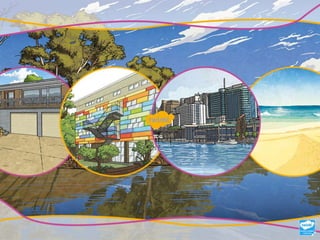
Learning Outcomes
Learning Objectives
• Investigate differences in the economic, demographic and social
characteristics of countries across the world (ACHASSK139).
• Explore the diversity of environments and types of settlement in the
Asia region (ACHASSK138).
• I can recognise differences in the economic, demographic and social
characteristics of countries across the world.
• I can recognise the diversity of settlement in the Asia region.
What is Liveability?
Liveability is a term that describes a community's quality of life.
Liveability is determined by a number of factors including:
the built and natural environments
economic wellbeing
social stability
educational opportunity
access to cultural, entertainment and recreation facilities
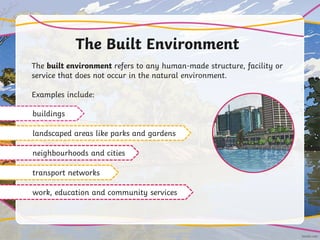
The Built Environment
The built environment refers to any human-made structure, facility or
service that does not occur in the natural environment.
Examples include:
buildings
landscaped areas like parks and gardens
neighbourhoods and cities
transport networks
work, education and community services
Liveability of the Built Environment
The liveability of the built environment refers to the quality of the
structures, facilities and services that are available.
There are five fundamental features that make a built environment
liveable. They are access to:
health and
community services
employment and
education opportunities
public transport, walking
and cycling infrastructure
affordable housing
public open spaces
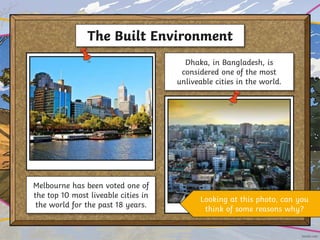
The Built Environment
Melbourne has been voted one of
the top 10 most liveable cities in
the world for the past 18 years.
Dhaka, in Bangladesh, is
considered one of the most
unliveable cities in the world.
Looking at this photo, can you
think of some reasons why?
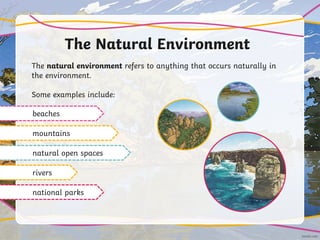
The Natural Environment
The natural environment refers to anything that occurs naturally in
the environment.
Some examples include:
beaches
mountains
natural open spaces
rivers
national parks
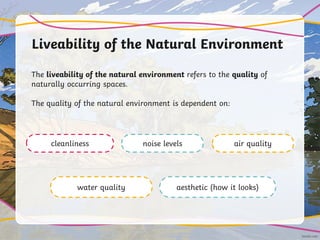
Liveability of the Natural Environment
The liveability of the natural environment refers to the quality of
naturally occurring spaces.
The quality of the natural environment is dependent on:
cleanliness
water quality aesthetic (how it looks)
air quality
noise levels
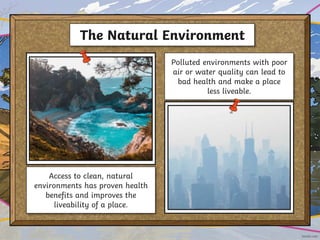
The Natural Environment
Access to clean, natural
environments has proven health
benefits and improves the
liveability of a place.
Polluted environments with poor
air or water quality can lead to
bad health and make a place
less liveable.
Economic Wellbeing
Economic wellbeing refers to financial stability.
Financial stability is dependent on:
income (how much you earn)
consumption (how much you spend)
wealth (how much you can save and own)
Liveability and Economic Wellbeing
The liveability of a place in relation to economic wellbeing is
determined by access to employment and wage levels.
You may live in an area with plenty of job opportunities, but if wages
are low, your economic wellbeing is also low.
Minimum wages vary across different countries, as does the cost of
living. The difference between the minimum wage and the cost of
living is a good indicator of economic wellbeing.
minimum wage vs cost of living = economic wellbeing indicator
Economic Wellbeing Indicator
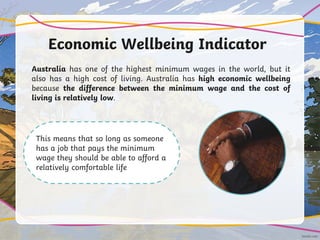
Australia has one of the highest minimum wages in the world, but it
also has a high cost of living. Australia has high economic wellbeing
because the difference between the minimum wage and the cost of
living is relatively low.
This means that so long as someone
has a job that pays the minimum
wage they should be able to afford a
relatively comfortable life
Economic Wellbeing Indicator
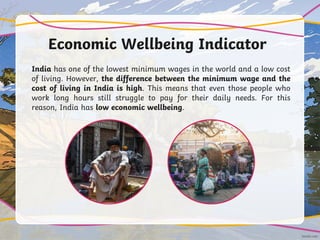
India has one of the lowest minimum wages in the world and a low cost
of living. However, the difference between the minimum wage and the
cost of living in India is high. This means that even those people who
work long hours still struggle to pay for their daily needs. For this
reason, India has low economic wellbeing.
Social Stability
Social stability refers to how safe and happy people feel
within their community.
It is dependent on:
connection with other people (e.g. a feeling of community)
the safety of an area (e.g. the rates of crime)
the gap between rich and poor (the difference between the
richest and poorest people in the community)
Liveability and Social Stability
A liveable community is one where people feel connected and safe, and
where the wealth is spread evenly throughout the community.
Many places in Australia have high liveability rates because there is
a strong sense of community, crime rates are low and the gap
between the rich and poor is relatively low.
In some countries around the world, like Indonesia, the gap between
the rich and poor is very high. This creates social instability.
Why do you think a gap between the rich and poor creates social instability?
Liveability and Social Stability
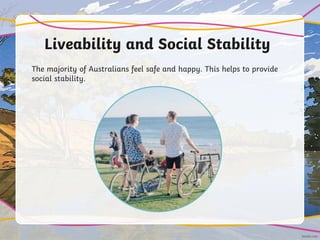
The majority of Australians feel safe and happy. This helps to provide
social stability.
Liveability and Social Stability
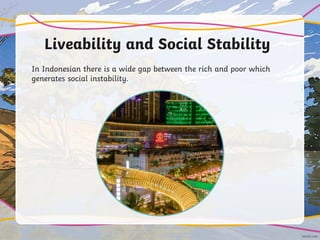
In Indonesian there is a wide gap between the rich and poor which
generates social instability.
Educational Opportunity
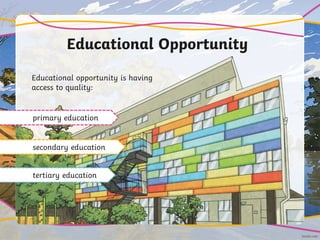
Educational opportunity is having
access to quality:
primary education
secondary education
tertiary education
Liveability and Educational Opportunity
The most liveable places in the world provide quality education to all
their citizens.
Finland is considered to have the best education system in the world.
Education, including university, in Finland is free and there are no
independent or private schools. This ensures that everyone receives a
good education regardless of their social or financial circumstances.
In Australia we have public, independent and private schools. This
can create an economic divide within the education system because
not all schools have the same access to funding.
Liveability and Educational Opportunity
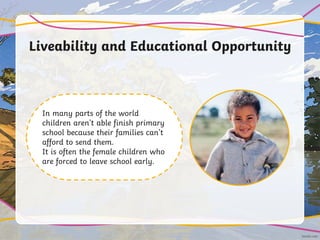
In many parts of the world
children aren’t able finish primary
school because their families can’t
afford to send them.
It is often the female children who
are forced to leave school early.
Culture, Entertainment and Recreation
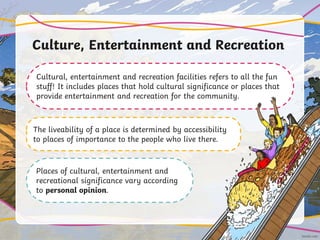
Cultural, entertainment and recreation facilities refers to all the fun
stuff! It includes places that hold cultural significance or places that
provide entertainment and recreation for the community.
The liveability of a place is determined by accessibility
to places of importance to the people who live there.
Places of cultural, entertainment and
recreational significance vary according
to personal opinion.
Liveability and Access to Cultural,
Entertainment and Recreation Facilities
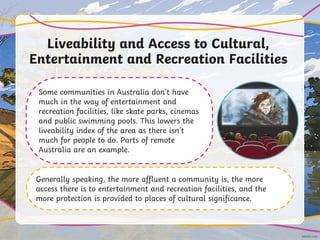
Some communities in Australia don’t have
much in the way of entertainment and
recreation facilities, like skate parks, cinemas
and public swimming pools. This lowers the
liveability index of the area as there isn’t
much for people to do. Parts of remote
Australia are an example.
Generally speaking, the more affluent a community is, the more
access there is to entertainment and recreation facilities, and the
more protection is provided to places of cultural significance.
Liveability and Access to Cultural,
Entertainment and Recreation Facilities
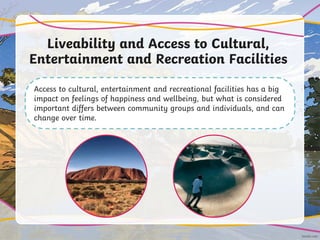
Access to cultural, entertainment and recreational facilities has a big
impact on feelings of happiness and wellbeing, but what is considered
important differs between community groups and individuals, and can
change over time.
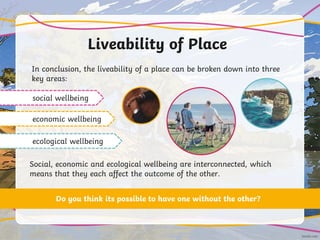
Liveability of Place
In conclusion, the liveability of a place can be broken down into three
key areas:
social wellbeing
economic wellbeing
ecological wellbeing
Social, economic and ecological wellbeing are interconnected, which
means that they each affect the outcome of the other.
Do you think its possible to have one without the other?
Class Discussion
What are the most important factors that make a place liveable for you?
You may like to consider the importance of things like:
the quality of the environment
a sense of community
access to recreational facilities
being close to school
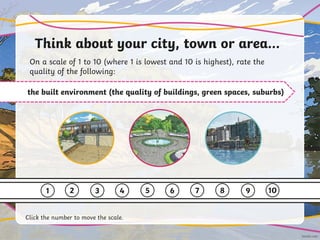
Think about your city, town or area…
On a scale of 1 to 10 (where 1 is lowest and 10 is highest), rate the
quality of the following:
the built environment (the quality of buildings, green spaces, suburbs)
1 2 3 4 5 6 7 8 9 10
Click the number to move the scale.
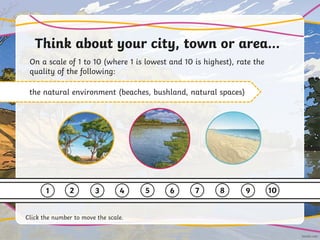
Think about your city, town or area…
On a scale of 1 to 10 (where 1 is lowest and 10 is highest), rate the
quality of the following:
the natural environment (beaches, bushland, natural spaces)
1 2 3 4 5 6 7 8 9 10
Click the number to move the scale.
Think about your city, town or area…
On a scale of 1 to 10 (where 1 is lowest and 10 is highest), rate the
quality of the following:
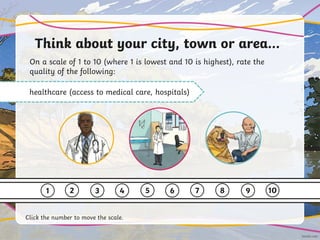
healthcare (access to medical care, hospitals)
1 2 3 4 5 6 7 8 9 10
Click the number to move the scale.
Think about your city, town or area…
On a scale of 1 to 10 (where 1 is lowest and 10 is highest), rate the
quality of the following:
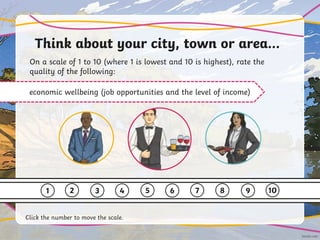
economic wellbeing (job opportunities and the level of income)
1 2 3 4 5 6 7 8 9 10
Click the number to move the scale.
Think about your city, town or area…
On a scale of 1 to 10 (where 1 is lowest and 10 is highest), rate the
quality of the following:
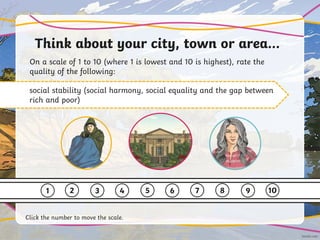
social stability (social harmony, social equality and the gap between
rich and poor)
1 2 3 4 5 6 7 8 9 10
Click the number to move the scale.
Think about your city, town or area…
On a scale of 1 to 10 (where 1 is lowest and 10 is highest), rate the
quality of the following:
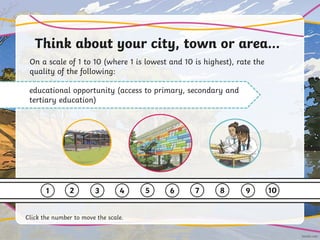
educational opportunity (access to primary, secondary and
tertiary education)
1 2 3 4 5 6 7 8 9 10
Click the number to move the scale.
Think about your city, town or area…
On a scale of 1 to 10 (where 1 is lowest and 10 is highest), rate the
quality of the following:
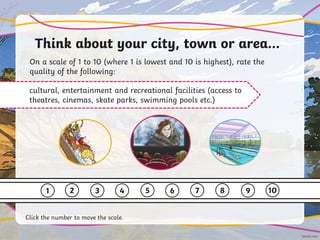
cultural, entertainment and recreational facilities (access to
theatres, cinemas, skate parks, swimming pools etc.)
1 2 3 4 5 6 7 8 9 10
Click the number to move the scale.
Think about your city, town or area…
On a scale of 1 to 10 (where 1 is lowest and 10 is highest), rate the
quality of the following:
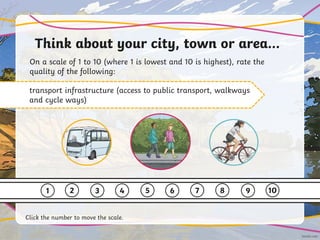
transport infrastructure (access to public transport, walkways
and cycle ways)
1 2 3 4 5 6 7 8 9 10
Click the number to move the scale.
Think about your city, town or area…
On a scale of 1 to 10 (where 1 is lowest and 10 is highest), rate the
quality of the following:
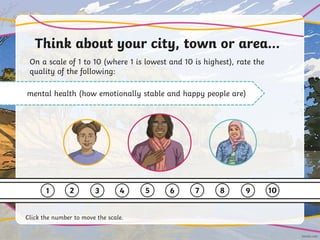
mental health (how emotionally stable and happy people are)
1 2 3 4 5 6 7 8 9 10
Click the number to move the scale.
Think about your city, town or area…
On a scale of 1 to 10 (where 1 is lowest and 10 is highest), rate the
quality of the following:
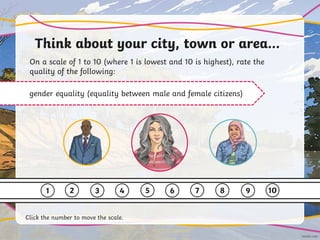
gender equality (equality between male and female citizens)
1 2 3 4 5 6 7 8 9 10
Click the number to move the scale.
How did the liveability of your local area
compare to that of Melbourne?
Melbourne 98.4/100
My area:
au-g-2548709-what-is-liveability-powerpoint_ver_3.pptx

au-g-2548709-what-is-liveability-powerpoint_ver_3.pptx

  • 2.
    Learning Outcomes Learning Objectives •Investigate differences in the economic, demographic and social characteristics of countries across the world (ACHASSK139). • Explore the diversity of environments and types of settlement in the Asia region (ACHASSK138). • I can recognise differences in the economic, demographic and social characteristics of countries across the world. • I can recognise the diversity of settlement in the Asia region.
  • 3.
    What is Liveability? Liveabilityis a term that describes a community's quality of life. Liveability is determined by a number of factors including: the built and natural environments economic wellbeing social stability educational opportunity access to cultural, entertainment and recreation facilities
  • 4.
    The Built Environment Thebuilt environment refers to any human-made structure, facility or service that does not occur in the natural environment. Examples include: buildings landscaped areas like parks and gardens neighbourhoods and cities transport networks work, education and community services
  • 5.
    Liveability of theBuilt Environment The liveability of the built environment refers to the quality of the structures, facilities and services that are available. There are five fundamental features that make a built environment liveable. They are access to: health and community services employment and education opportunities public transport, walking and cycling infrastructure affordable housing public open spaces
  • 6.
    The Built Environment Melbournehas been voted one of the top 10 most liveable cities in the world for the past 18 years. Dhaka, in Bangladesh, is considered one of the most unliveable cities in the world. Looking at this photo, can you think of some reasons why?
  • 7.
    The Natural Environment Thenatural environment refers to anything that occurs naturally in the environment. Some examples include: beaches mountains natural open spaces rivers national parks
  • 8.
    Liveability of theNatural Environment The liveability of the natural environment refers to the quality of naturally occurring spaces. The quality of the natural environment is dependent on: cleanliness water quality aesthetic (how it looks) air quality noise levels
  • 9.
    The Natural Environment Accessto clean, natural environments has proven health benefits and improves the liveability of a place. Polluted environments with poor air or water quality can lead to bad health and make a place less liveable.
  • 10.
    Economic Wellbeing Economic wellbeingrefers to financial stability. Financial stability is dependent on: income (how much you earn) consumption (how much you spend) wealth (how much you can save and own)
  • 11.
    Liveability and EconomicWellbeing The liveability of a place in relation to economic wellbeing is determined by access to employment and wage levels. You may live in an area with plenty of job opportunities, but if wages are low, your economic wellbeing is also low. Minimum wages vary across different countries, as does the cost of living. The difference between the minimum wage and the cost of living is a good indicator of economic wellbeing. minimum wage vs cost of living = economic wellbeing indicator
  • 12.
    Economic Wellbeing Indicator Australiahas one of the highest minimum wages in the world, but it also has a high cost of living. Australia has high economic wellbeing because the difference between the minimum wage and the cost of living is relatively low. This means that so long as someone has a job that pays the minimum wage they should be able to afford a relatively comfortable life
  • 13.
    Economic Wellbeing Indicator Indiahas one of the lowest minimum wages in the world and a low cost of living. However, the difference between the minimum wage and the cost of living in India is high. This means that even those people who work long hours still struggle to pay for their daily needs. For this reason, India has low economic wellbeing.
  • 14.
    Social Stability Social stabilityrefers to how safe and happy people feel within their community. It is dependent on: connection with other people (e.g. a feeling of community) the safety of an area (e.g. the rates of crime) the gap between rich and poor (the difference between the richest and poorest people in the community)
  • 15.
    Liveability and SocialStability A liveable community is one where people feel connected and safe, and where the wealth is spread evenly throughout the community. Many places in Australia have high liveability rates because there is a strong sense of community, crime rates are low and the gap between the rich and poor is relatively low. In some countries around the world, like Indonesia, the gap between the rich and poor is very high. This creates social instability. Why do you think a gap between the rich and poor creates social instability?
  • 16.
    Liveability and SocialStability The majority of Australians feel safe and happy. This helps to provide social stability.
  • 17.
    Liveability and SocialStability In Indonesian there is a wide gap between the rich and poor which generates social instability.
  • 18.
    Educational Opportunity Educational opportunityis having access to quality: primary education secondary education tertiary education
  • 19.
    Liveability and EducationalOpportunity The most liveable places in the world provide quality education to all their citizens. Finland is considered to have the best education system in the world. Education, including university, in Finland is free and there are no independent or private schools. This ensures that everyone receives a good education regardless of their social or financial circumstances. In Australia we have public, independent and private schools. This can create an economic divide within the education system because not all schools have the same access to funding.
  • 20.
    Liveability and EducationalOpportunity In many parts of the world children aren’t able finish primary school because their families can’t afford to send them. It is often the female children who are forced to leave school early.
  • 21.
    Culture, Entertainment andRecreation Cultural, entertainment and recreation facilities refers to all the fun stuff! It includes places that hold cultural significance or places that provide entertainment and recreation for the community. The liveability of a place is determined by accessibility to places of importance to the people who live there. Places of cultural, entertainment and recreational significance vary according to personal opinion.
  • 22.
    Liveability and Accessto Cultural, Entertainment and Recreation Facilities Some communities in Australia don’t have much in the way of entertainment and recreation facilities, like skate parks, cinemas and public swimming pools. This lowers the liveability index of the area as there isn’t much for people to do. Parts of remote Australia are an example. Generally speaking, the more affluent a community is, the more access there is to entertainment and recreation facilities, and the more protection is provided to places of cultural significance.
  • 23.
    Liveability and Accessto Cultural, Entertainment and Recreation Facilities Access to cultural, entertainment and recreational facilities has a big impact on feelings of happiness and wellbeing, but what is considered important differs between community groups and individuals, and can change over time.
  • 24.
    Liveability of Place Inconclusion, the liveability of a place can be broken down into three key areas: social wellbeing economic wellbeing ecological wellbeing Social, economic and ecological wellbeing are interconnected, which means that they each affect the outcome of the other. Do you think its possible to have one without the other?
  • 25.
    Class Discussion What arethe most important factors that make a place liveable for you? You may like to consider the importance of things like: the quality of the environment a sense of community access to recreational facilities being close to school
  • 26.
    Think about yourcity, town or area… On a scale of 1 to 10 (where 1 is lowest and 10 is highest), rate the quality of the following: the built environment (the quality of buildings, green spaces, suburbs) 1 2 3 4 5 6 7 8 9 10 Click the number to move the scale.
  • 27.
    Think about yourcity, town or area… On a scale of 1 to 10 (where 1 is lowest and 10 is highest), rate the quality of the following: the natural environment (beaches, bushland, natural spaces) 1 2 3 4 5 6 7 8 9 10 Click the number to move the scale.
  • 28.
    Think about yourcity, town or area… On a scale of 1 to 10 (where 1 is lowest and 10 is highest), rate the quality of the following: healthcare (access to medical care, hospitals) 1 2 3 4 5 6 7 8 9 10 Click the number to move the scale.
  • 29.
    Think about yourcity, town or area… On a scale of 1 to 10 (where 1 is lowest and 10 is highest), rate the quality of the following: economic wellbeing (job opportunities and the level of income) 1 2 3 4 5 6 7 8 9 10 Click the number to move the scale.
  • 30.
    Think about yourcity, town or area… On a scale of 1 to 10 (where 1 is lowest and 10 is highest), rate the quality of the following: social stability (social harmony, social equality and the gap between rich and poor) 1 2 3 4 5 6 7 8 9 10 Click the number to move the scale.
  • 31.
    Think about yourcity, town or area… On a scale of 1 to 10 (where 1 is lowest and 10 is highest), rate the quality of the following: educational opportunity (access to primary, secondary and tertiary education) 1 2 3 4 5 6 7 8 9 10 Click the number to move the scale.
  • 32.
    Think about yourcity, town or area… On a scale of 1 to 10 (where 1 is lowest and 10 is highest), rate the quality of the following: cultural, entertainment and recreational facilities (access to theatres, cinemas, skate parks, swimming pools etc.) 1 2 3 4 5 6 7 8 9 10 Click the number to move the scale.
  • 33.
    Think about yourcity, town or area… On a scale of 1 to 10 (where 1 is lowest and 10 is highest), rate the quality of the following: transport infrastructure (access to public transport, walkways and cycle ways) 1 2 3 4 5 6 7 8 9 10 Click the number to move the scale.
  • 34.
    Think about yourcity, town or area… On a scale of 1 to 10 (where 1 is lowest and 10 is highest), rate the quality of the following: mental health (how emotionally stable and happy people are) 1 2 3 4 5 6 7 8 9 10 Click the number to move the scale.
  • 35.
    Think about yourcity, town or area… On a scale of 1 to 10 (where 1 is lowest and 10 is highest), rate the quality of the following: gender equality (equality between male and female citizens) 1 2 3 4 5 6 7 8 9 10 Click the number to move the scale.
  • 36.
    How did theliveability of your local area compare to that of Melbourne? Melbourne 98.4/100 My area: