The Comedy Of Errors
by William Shakespeare
Alev Senem ÖZAKIN
İrem ÇATAKDERE
Yiğit KARAKAYA
Umut AYHAN
INTRODUCTION
• The Comedy Of Errors is one of
Shakespeare’s earliest plays.
• It is his shortest and one of his most farcial
comedies,with a major part of the humor
coming from slapstick and mistaken
identity in addition to puns and word play.
• The play was not published until it
appeared in the First Folio in 1623.
SUMMARY
• The cities of Syracuse and Ephesus are openly hostile toward one
another. Captured in Ephesus, Egeon has been condemned to
death by the Duke, who urges him to tell the sad story of how he has
come to this state. Thus, Shakespeare sets the background for the
play.
• Along with his wife Emilia, identical twin sons both named
Antipholus, and identical twin slaves both named Dromio, Egeon
some years ago suffered a shipwreck. One son and slave survived
with the father; the others, he hoped, survived with the mother.
Neither group knew of the other's survival, however, nor of their
whereabouts, but when Antipholus of Syracuse ("Egeon's twin" son)
turned eighteen, his father gave him permission to search for his
brother. The worried Egeon then set out after his second son, and
after five years of fruitless wandering, he came to Ephesus. Moved
by this tale of woe, the Duke of Ephesus gives his captive a day's
reprieve, within which time Egeon must raise a "thousand marks!'
ransom money:
• Try all the friends thou hast in Ephesus; Beg
thou, or borrow, to make up the sum,
And live; if no, then thou art doomed to die.
PLOT STRUCTURE
Initial Situation
Egeon is sentenced to death in Ephesus;
Egeon is seeking his two lost sons
Egeon is being a sad sack, and seems to
have a life story so miserable that he’d
rather die from it than deal with it. The
story of his separated family sets the
stage for the comic resolution; Egeon’s
plight seems to invite the conclusion of
all six people being happily reunited.
Conflict
Antipholus is in Ephesus seeking his lost family
Antipholus is conflicted about his lost family.
Not only has he left his father, but he seems
unable to locate his brother and mother. He is
convinced that in this process of searching for
them, he’s lost himself, too. S. Antipholus is
further confused by all the people who seem to
know him, though he doesn’t know them. This
increases his feeling that he doesn’t know
himself, and obscures the obvious fact that his
long-lost twin is running around in the same
city.
• Complication
Antipholus of Ephesus is also in
Ephesus, and is missing his dinner; S.
Antipholus is having E. Antipholus’s
dinner, and has declared his love for
Adriana’s sister; Adriana thinks her
husband is trying to betray her.
• Climax
The misunderstanding about the
necklace leads to E. Antipholus being
jailed; E. Antipholus and E. Dromio are
tied up and locked in Adriana’s house.
• Suspense
Antipholus of Syracuse and Dromio of
Syracuse escape into the priory after
almost getting into a duel with the
Merchant; the Abbess refuses to release
S. Antipholus to Adriana’s care
• Conclusion
Antipholus of Ephesus is committed to
his wife; S. Antipholus again declares his
love for Luciana; the whole family is
reunited; Egeon doesn’t get beheaded
THEMES
• First theme is Money. The play is about merchants and
Merchant class, in a por t city full of merchans and a
trade , and there are many refences to Money in the
play.From Egeon’s ransom,to the jailing of Antipholus ,to
the ‘loss’ of the 1000 ducats, and the retrieval of the ring
,the play is also about materialism.
• The nature of personal identity and its place in social
relationship is a central theme.It again relates to order.
When you know your truths , you can end your internal
conflicts.
• Marriage is in play a sub-theme of order alla re seeking a
happy union to be complete,and when each couple is
paired, when Reunion is affected ,then order is restored.
Narrator Point Of View
Though all works of literature present the
author’s point of view, they don’t all have a
narrator or a narrative voice that ties
together and presents the story.
Symbolism, Imagery & Allegory
• Water
Water imagery occurs all over the play,
starting with Egeon’s initial speech about
the storm. Water separates families, so we
can say that water is a symbol of
separation throughout the play. Twice we
hear characters describe their isolation like
they were drops of water: S. Antipholus
seeks for his family as though he were a
drop of water in the ocean.
• Money
The word money occurs 26 times in this play,
more than any of Shakespeare’s other plays,
though The Comedy of Errors is his shortest.
Ephesus is a city of merchants, and commerce
is central thing there. Usually, money is thought
of as a liberating object, but in this play, money
functions as an object and aim of bondage. By
the end of the play, both Egeon and his son, E.
Antipholus, are jailed for the sake of money.
Justice is less important than ransom, or at least
that’s how it seems until the miracle of the
separated twins comes out. The men win their
liberation not by money, but through truth.
• Geography and Travel
Though The Comedy of Errors takes
place in a single location, the characters
come from all corners of the earth. Though
they all happen to currently be in one spot,
they do a fantastic job of relating their
worldliness by using geography as a motif
in the play. Geography symbolizes not
only where you are, but where you’ve
been and where you intend to go.
QUIZ
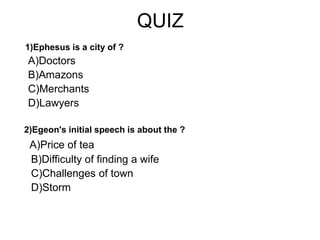
1)Ephesus is a city of ?
A)Doctors
B)Amazons
C)Merchants
D)Lawyers
2)Egeon's initial speech is about the ?
A)Price of tea
B)Difficulty of finding a wife
C)Challenges of town
D)Storm
3)Egeon will be executed because
A) He is a citizen of Corinth.
B) He is a citizen of Syracuse.
C) He has stolen a gold bracelet from the Duke.
D) He is a Christian.
4)Egeon lost his family in
A) A flood
B) A war between Syracuse and Ephesus
C) A plague
D) A shipwreck
5)Everyone goes to celebrate in:
A) The Duke's castle
B) Antipholus of Ephesus' home
C) The Porpentine
D) The Abbey
Answer Key
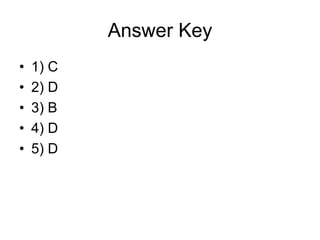
• 1) C
• 2) D
• 3) B
• 4) D
• 5) D
Bibliography
• http://www.sparknotes.com/shakespeare/e
rrors/
• http://www.shmoop.com/comedy-of-
errors/symbols-quiz.html
• http://www.youtube.com/watch?v=IaDptm
MgWQk
• http://en.wikipedia.org/wiki/The_Comedy_
of_Errors

The Comedy Of Errors

  • 1.
    The Comedy OfErrors by William Shakespeare Alev Senem ÖZAKIN İrem ÇATAKDERE Yiğit KARAKAYA Umut AYHAN
  • 2.
    INTRODUCTION • The ComedyOf Errors is one of Shakespeare’s earliest plays. • It is his shortest and one of his most farcial comedies,with a major part of the humor coming from slapstick and mistaken identity in addition to puns and word play. • The play was not published until it appeared in the First Folio in 1623.
  • 3.
    SUMMARY • The citiesof Syracuse and Ephesus are openly hostile toward one another. Captured in Ephesus, Egeon has been condemned to death by the Duke, who urges him to tell the sad story of how he has come to this state. Thus, Shakespeare sets the background for the play. • Along with his wife Emilia, identical twin sons both named Antipholus, and identical twin slaves both named Dromio, Egeon some years ago suffered a shipwreck. One son and slave survived with the father; the others, he hoped, survived with the mother. Neither group knew of the other's survival, however, nor of their whereabouts, but when Antipholus of Syracuse ("Egeon's twin" son) turned eighteen, his father gave him permission to search for his brother. The worried Egeon then set out after his second son, and after five years of fruitless wandering, he came to Ephesus. Moved by this tale of woe, the Duke of Ephesus gives his captive a day's reprieve, within which time Egeon must raise a "thousand marks!' ransom money: • Try all the friends thou hast in Ephesus; Beg thou, or borrow, to make up the sum, And live; if no, then thou art doomed to die.
  • 4.
    PLOT STRUCTURE Initial Situation Egeonis sentenced to death in Ephesus; Egeon is seeking his two lost sons Egeon is being a sad sack, and seems to have a life story so miserable that he’d rather die from it than deal with it. The story of his separated family sets the stage for the comic resolution; Egeon’s plight seems to invite the conclusion of all six people being happily reunited.
  • 5.
    Conflict Antipholus is inEphesus seeking his lost family Antipholus is conflicted about his lost family. Not only has he left his father, but he seems unable to locate his brother and mother. He is convinced that in this process of searching for them, he’s lost himself, too. S. Antipholus is further confused by all the people who seem to know him, though he doesn’t know them. This increases his feeling that he doesn’t know himself, and obscures the obvious fact that his long-lost twin is running around in the same city.
  • 6.
    • Complication Antipholus ofEphesus is also in Ephesus, and is missing his dinner; S. Antipholus is having E. Antipholus’s dinner, and has declared his love for Adriana’s sister; Adriana thinks her husband is trying to betray her. • Climax The misunderstanding about the necklace leads to E. Antipholus being jailed; E. Antipholus and E. Dromio are tied up and locked in Adriana’s house.
  • 7.
    • Suspense Antipholus ofSyracuse and Dromio of Syracuse escape into the priory after almost getting into a duel with the Merchant; the Abbess refuses to release S. Antipholus to Adriana’s care • Conclusion Antipholus of Ephesus is committed to his wife; S. Antipholus again declares his love for Luciana; the whole family is reunited; Egeon doesn’t get beheaded
  • 8.
    THEMES • First themeis Money. The play is about merchants and Merchant class, in a por t city full of merchans and a trade , and there are many refences to Money in the play.From Egeon’s ransom,to the jailing of Antipholus ,to the ‘loss’ of the 1000 ducats, and the retrieval of the ring ,the play is also about materialism. • The nature of personal identity and its place in social relationship is a central theme.It again relates to order. When you know your truths , you can end your internal conflicts. • Marriage is in play a sub-theme of order alla re seeking a happy union to be complete,and when each couple is paired, when Reunion is affected ,then order is restored.
  • 9.
    Narrator Point OfView Though all works of literature present the author’s point of view, they don’t all have a narrator or a narrative voice that ties together and presents the story.
  • 10.
    Symbolism, Imagery &Allegory • Water Water imagery occurs all over the play, starting with Egeon’s initial speech about the storm. Water separates families, so we can say that water is a symbol of separation throughout the play. Twice we hear characters describe their isolation like they were drops of water: S. Antipholus seeks for his family as though he were a drop of water in the ocean.
  • 11.
    • Money The wordmoney occurs 26 times in this play, more than any of Shakespeare’s other plays, though The Comedy of Errors is his shortest. Ephesus is a city of merchants, and commerce is central thing there. Usually, money is thought of as a liberating object, but in this play, money functions as an object and aim of bondage. By the end of the play, both Egeon and his son, E. Antipholus, are jailed for the sake of money. Justice is less important than ransom, or at least that’s how it seems until the miracle of the separated twins comes out. The men win their liberation not by money, but through truth.
  • 12.
    • Geography andTravel Though The Comedy of Errors takes place in a single location, the characters come from all corners of the earth. Though they all happen to currently be in one spot, they do a fantastic job of relating their worldliness by using geography as a motif in the play. Geography symbolizes not only where you are, but where you’ve been and where you intend to go.
  • 13.
    QUIZ 1)Ephesus is acity of ? A)Doctors B)Amazons C)Merchants D)Lawyers 2)Egeon's initial speech is about the ? A)Price of tea B)Difficulty of finding a wife C)Challenges of town D)Storm
  • 14.
    3)Egeon will beexecuted because A) He is a citizen of Corinth. B) He is a citizen of Syracuse. C) He has stolen a gold bracelet from the Duke. D) He is a Christian. 4)Egeon lost his family in A) A flood B) A war between Syracuse and Ephesus C) A plague D) A shipwreck 5)Everyone goes to celebrate in: A) The Duke's castle B) Antipholus of Ephesus' home C) The Porpentine D) The Abbey
  • 15.
    Answer Key • 1)C • 2) D • 3) B • 4) D • 5) D
  • 16.
    Bibliography • http://www.sparknotes.com/shakespeare/e rrors/ • http://www.shmoop.com/comedy-of- errors/symbols-quiz.html •http://www.youtube.com/watch?v=IaDptm MgWQk • http://en.wikipedia.org/wiki/The_Comedy_ of_Errors