+
ELIT 17 Class 3
+
AGENDA
 Lecture
 Shakespeare’s Language
 The Comedy of Errors
 Discussion Questions
 QHQs
 Introduction
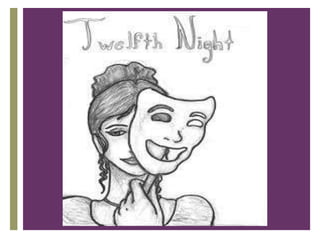
 Twelfth Night
+
https://www.youtube.com/watch?v=TsyLQaewQks&index=1&list=
PL1EA226F17885C8B1
Rhyme in
The Comedy of
Errors
+
Rhyme in The Comedy of Errors
Couplets: Two lines that rhyme and have the
same meter
Slant rhyme: sounds of the final of words of
the line are similar but not identical
Internal rhyme: rhyme that occurs within a
single line of verse, or between internal
phrases across multiple lines.
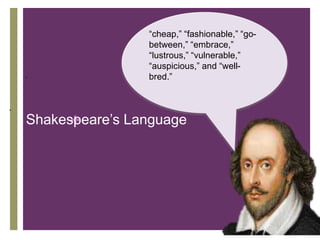
+Shakespeare’s Language
.
.
“cheap,” “fashionable,” “go-
between,” “embrace,”
“lustrous,” “vulnerable,”
“auspicious,” and “well-
bred.”
+
Words and Phrases
 The English language owes a great debt to
Shakespeare. Endlessly imaginative and not overly
concerned with grammatical convention, his scripts
contain thousands of never-before-seen words—a
diverse collection of loan-words from foreign
languages, compound words from existing English
terms, nouns turned into verbs, and creatively
applied prefixes—many of which have entered into
everyday language
http://www.shakespeare-online.com/biography/wordsinvented.html
http://mentalfloss.com/article/48657/20-words-we-owe-william-shakespeare
+
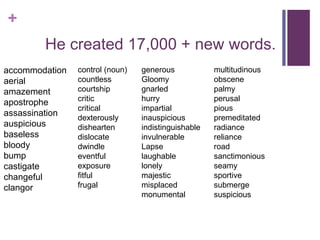
He created 17,000 + new words.
accommodation
aerial
amazement
apostrophe
assassination
auspicious
baseless
bloody
bump
castigate
changeful
clangor
control (noun)
countless
courtship
critic
critical
dexterously
dishearten
dislocate
dwindle
eventful
exposure
fitful
frugal
multitudinous
obscene
palmy
perusal
pious
premeditated
radiance
reliance
road
sanctimonious
seamy
sportive
submerge
suspicious
generous
Gloomy
gnarled
hurry
impartial
inauspicious
indistinguishable
invulnerable
Lapse
laughable
lonely
majestic
misplaced
monumental
+
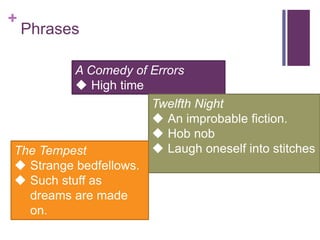
A Comedy of Errors
 High time
Twelfth Night
 An improbable fiction.
 Hob nob
 Laugh oneself into stitches
Phrases
The Tempest
 Strange bedfellows.
 Such stuff as
dreams are made
on.
 In a Pickle
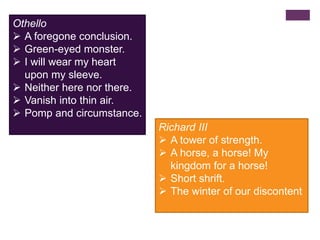
Othello
 A foregone conclusion.
 Green-eyed monster.
 I will wear my heart
upon my sleeve.
 Neither here nor there.
 Vanish into thin air.
 Pomp and circumstance.
Richard III
 A tower of strength.
 A horse, a horse! My
kingdom for a horse!
 Short shrift.
 The winter of our discontent
+
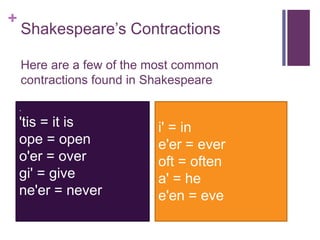
.
'tis = it is
ope = open
o'er = over
gi' = give
ne'er = never
Shakespeare’s Contractions
Here are a few of the most common
contractions found in Shakespeare
i' = in
e'er = ever
oft = often
a' = he
e'en = eve
+
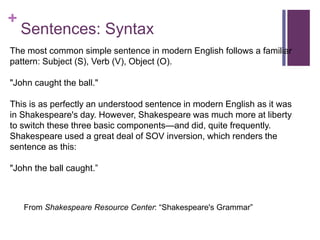
Sentences: Syntax
The most common simple sentence in modern English follows a familiar
pattern: Subject (S), Verb (V), Object (O).
"John caught the ball."
This is as perfectly an understood sentence in modern English as it was
in Shakespeare's day. However, Shakespeare was much more at liberty
to switch these three basic components—and did, quite frequently.
Shakespeare used a great deal of SOV inversion, which renders the
sentence as this:
"John the ball caught.”
From Shakespeare Resource Center: “Shakespeare's Grammar”
+
Sentences: Transitory Device
Shakespeare also throws in many examples of OSV construction:
"The ball John caught.”
Shakespeare seems to use this colloquially in many places as a
transitory device, bridging two sentences, to provide continuity.
Shakespeare (and many other writers) may also have used this as a
device to shift end emphasis to the verb of a clause. Also, another
prevalent usage of inversion was the VS order shift:
"caught John" instead of "John caught”
This order seems to be primarily a stylistic choice
From Shakespeare Resource Center: “Shakespeare's Grammar”
+
Sentences: Rhyming
Another reason for Shakespeare's utilization of this order
may be more practical. The romance languages of Italian
and French introduced rhymed verse; Anglo-Saxon poetry
was based on rhythm, metrical stresses, and alliteration
within lines rather than rhymed couplets. With the
introduction of rhymed poetic forms into English literature
(and, since the Norman invasion, an injection of French to
boot), there was a subsequent shift in English poetry.
Verbs in English are easy to rhyme because so many
English verbs are monosyllabic.
From Shakespeare Resource Center: “Shakespeare's Grammar”
+
Sentences: Blank Verse
Of course, Shakespeare wrote a great deal of work in blank
verse (unrhymed iambic pentameter: lines of five feet, each foot
being iambic, meaning two syllables long—one unstressed
followed by a stressed syllable). Frankly, Elizabethans allowed
for a lot more leeway in word order, and Shakespeare not only
realized that, he took advantage of it. By utilizing inverted word
orders, Shakespeare could effectively place the metrical stress
wherever he needed it most—and English is heavily dependent
on vocal inflection, which is not so easily translated into writing, to
suggest emphasis and meaning. In his usage of order inversion,
however, Shakespeare could compensate for this literary
shortcoming.
From Shakespeare Resource Center: “Shakespeare's Grammar”
+
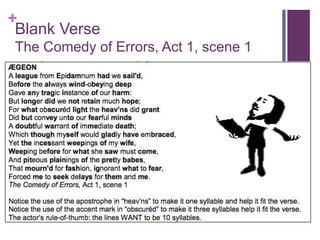
Blank Verse
The Comedy of Errors, Act 1, scene 1
+
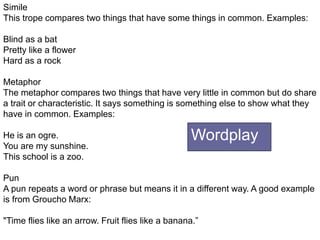
Simile
This trope compares two things that have some things in common. Examples:
Blind as a bat
Pretty like a flower
Hard as a rock
Metaphor
The metaphor compares two things that have very little in common but do share
a trait or characteristic. It says something is something else to show what they
have in common. Examples:
He is an ogre.
You are my sunshine.
This school is a zoo.
Pun
A pun repeats a word or phrase but means it in a different way. A good example
is from Groucho Marx:
"Time flies like an arrow. Fruit flies like a banana.”
Wordplay
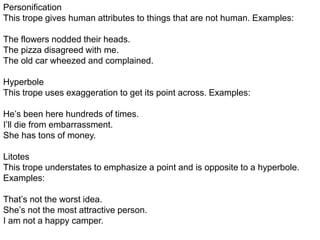
Personification
This trope gives human attributes to things that are not human. Examples:
The flowers nodded their heads.
The pizza disagreed with me.
The old car wheezed and complained.
Hyperbole
This trope uses exaggeration to get its point across. Examples:
He’s been here hundreds of times.
I’ll die from embarrassment.
She has tons of money.
Litotes
This trope understates to emphasize a point and is opposite to a hyperbole.
Examples:
That’s not the worst idea.
She’s not the most attractive person.
I am not a happy camper.
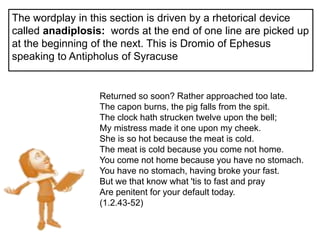
+The wordplay in this section is driven by a rhetorical device
called anadiplosis: words at the end of one line are picked up
at the beginning of the next. This is Dromio of Ephesus
speaking to Antipholus of Syracuse
Returned so soon? Rather approached too late.
The capon burns, the pig falls from the spit.
The clock hath strucken twelve upon the bell;
My mistress made it one upon my cheek.
She is so hot because the meat is cold.
The meat is cold because you come not home.
You come not home because you have no stomach.
You have no stomach, having broke your fast.
But we that know what 'tis to fast and pray
Are penitent for your default today.
(1.2.43-52)
+
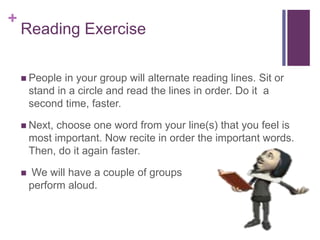
Reading Exercise
 People in your group will alternate reading lines. Sit or
stand in a circle and read the lines in order. Do it a
second time, faster.
 Next, choose one word from your line(s) that you feel is
most important. Now recite in order the important words.
Then, do it again faster.
 We will have a couple of groups
perform aloud.
+
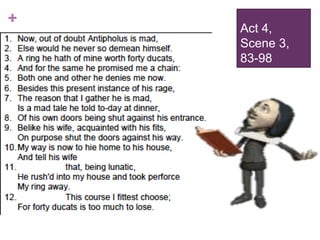
Act 4,
Scene 3,
83-98
+
Scene Evaluation
 The concept of word choice is central to
evaluating writing.
 Which words did you identify as the most
important in this scene?
 Why?
 How might you summarize this scene?
 Do the important words you chose help you
understand it better?
 How many different words for “crazy” does the
Courtesan know?
 Does her vocabulary affect the scene?
Let me
ask you!
+
The Play
A Summary?
The Ending?
+
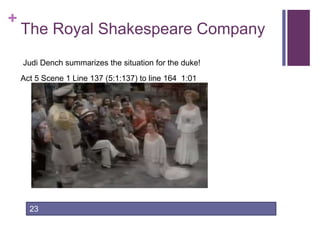
The Royal Shakespeare Company
Act 5 Scene 1 Line 137 (5:1:137) to line 164 1:01
23
Judi Dench summarizes the situation for the duke!
+
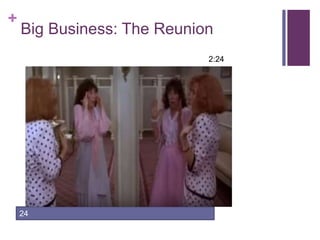
Big Business: The Reunion
24
2:24
+
In
Groups
Discuss
your
answers to
the
homework
questions
and your
QHQs.
+
Question
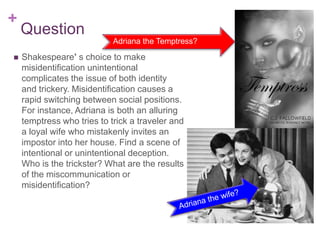
 Shakespeare’ s choice to make
misidentification unintentional
complicates the issue of both identity
and trickery. Misidentification causes a
rapid switching between social positions.
For instance, Adriana is both an alluring
temptress who tries to trick a traveler and
a loyal wife who mistakenly invites an
impostor into her house. Find a scene of
intentional or unintentional deception.
Who is the trickster? What are the results
of the miscommunication or
misidentification?
Adriana the Temptress?
+
Question
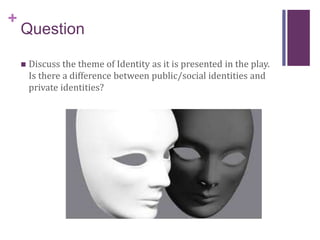
 Discuss the theme of Identity as it is presented in the play.
Is there a difference between public/social identities and
private identities?
+
Question
Are the Dromios servants or slaves?
Are their beatings meant to be farcical?
Are farce and social custom
interconnected? Can you think of a
contemporary example?
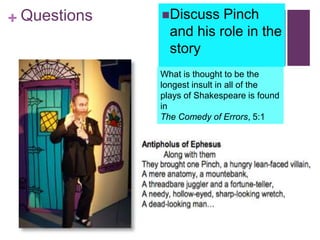
+ Questions Discuss Pinch
and his role in the
story
What is thought to be the
longest insult in all of the
plays of Shakespeare is found
in
The Comedy of Errors, 5:1
+
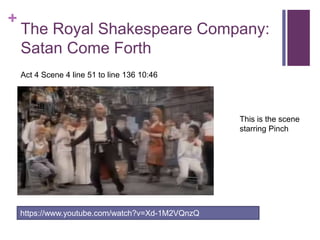
The Royal Shakespeare Company:
Satan Come Forth
https://www.youtube.com/watch?v=Xd-1M2VQnzQ
Act 4 Scene 4 line 51 to line 136 10:46
This is the scene
starring Pinch
+
QHQs
Q: What is the significance of
Shakespeare’s references to magic and
sorcery? Is sorcery/magic meant to be
seen as harmless, or does it have a
more sinister meaning?
Q: Why does Shakespeare end the play
with a scene of the two Dromios
reuniting at last?
+
+ Twelfth Night—an allusion to the night of
festivity preceding the Christian
celebration of the Epiphany—combines
love, confusion, mistaken identities, and
joyful discovery.
After the twins Sebastian and Viola
survive a shipwreck, neither knows that
the other is alive. Viola goes into service
with Count Orsino of Illyria, disguised as a
young man, “Cesario.”
*Synopsis from the Folger
Version of Twelfth Night
1:53
https://www.youtube.com/watch?v=R39jE4
SUEF4
Here is a trailer from a
contemporary version to get
you started.
+
Read: Twelfth Night: Acts 1 and 2
Post #3: Choose one
1. Compare and contrast the misidentification in Twelfth Night with
that from A Comedy of Errors.
2. Consider common practices of traditional wooing. In what way
would they be different from Cesario’s endeavors to woo Olivia for
Duke?
3. How does the clown prove that Olivia is a fool? Is he correct or
incorrect in his assessment? (Act 1 Scene 5) Explain your answer
with evidence from the text.
4. Analyze Maria’s speeches in Act 2 scene 3. Explain carefully her
motive to entrap Malvolio. Do you believe that she is justified in
doing it?
5. QHQ

Elit 17 class 3 comedy of errors

  • 1.
  • 2.
    + AGENDA  Lecture  Shakespeare’sLanguage  The Comedy of Errors  Discussion Questions  QHQs  Introduction  Twelfth Night
  • 3.
  • 4.
    + Rhyme in TheComedy of Errors Couplets: Two lines that rhyme and have the same meter Slant rhyme: sounds of the final of words of the line are similar but not identical Internal rhyme: rhyme that occurs within a single line of verse, or between internal phrases across multiple lines.
  • 5.
    +Shakespeare’s Language . . “cheap,” “fashionable,”“go- between,” “embrace,” “lustrous,” “vulnerable,” “auspicious,” and “well- bred.”
  • 6.
    + Words and Phrases The English language owes a great debt to Shakespeare. Endlessly imaginative and not overly concerned with grammatical convention, his scripts contain thousands of never-before-seen words—a diverse collection of loan-words from foreign languages, compound words from existing English terms, nouns turned into verbs, and creatively applied prefixes—many of which have entered into everyday language http://www.shakespeare-online.com/biography/wordsinvented.html http://mentalfloss.com/article/48657/20-words-we-owe-william-shakespeare
  • 7.
    + He created 17,000+ new words. accommodation aerial amazement apostrophe assassination auspicious baseless bloody bump castigate changeful clangor control (noun) countless courtship critic critical dexterously dishearten dislocate dwindle eventful exposure fitful frugal multitudinous obscene palmy perusal pious premeditated radiance reliance road sanctimonious seamy sportive submerge suspicious generous Gloomy gnarled hurry impartial inauspicious indistinguishable invulnerable Lapse laughable lonely majestic misplaced monumental
  • 8.
    + A Comedy ofErrors  High time Twelfth Night  An improbable fiction.  Hob nob  Laugh oneself into stitches Phrases The Tempest  Strange bedfellows.  Such stuff as dreams are made on.  In a Pickle
  • 9.
    Othello  A foregoneconclusion.  Green-eyed monster.  I will wear my heart upon my sleeve.  Neither here nor there.  Vanish into thin air.  Pomp and circumstance. Richard III  A tower of strength.  A horse, a horse! My kingdom for a horse!  Short shrift.  The winter of our discontent
  • 10.
    + . 'tis = itis ope = open o'er = over gi' = give ne'er = never Shakespeare’s Contractions Here are a few of the most common contractions found in Shakespeare i' = in e'er = ever oft = often a' = he e'en = eve
  • 11.
    + Sentences: Syntax The mostcommon simple sentence in modern English follows a familiar pattern: Subject (S), Verb (V), Object (O). "John caught the ball." This is as perfectly an understood sentence in modern English as it was in Shakespeare's day. However, Shakespeare was much more at liberty to switch these three basic components—and did, quite frequently. Shakespeare used a great deal of SOV inversion, which renders the sentence as this: "John the ball caught.” From Shakespeare Resource Center: “Shakespeare's Grammar”
  • 12.
    + Sentences: Transitory Device Shakespearealso throws in many examples of OSV construction: "The ball John caught.” Shakespeare seems to use this colloquially in many places as a transitory device, bridging two sentences, to provide continuity. Shakespeare (and many other writers) may also have used this as a device to shift end emphasis to the verb of a clause. Also, another prevalent usage of inversion was the VS order shift: "caught John" instead of "John caught” This order seems to be primarily a stylistic choice From Shakespeare Resource Center: “Shakespeare's Grammar”
  • 13.
    + Sentences: Rhyming Another reasonfor Shakespeare's utilization of this order may be more practical. The romance languages of Italian and French introduced rhymed verse; Anglo-Saxon poetry was based on rhythm, metrical stresses, and alliteration within lines rather than rhymed couplets. With the introduction of rhymed poetic forms into English literature (and, since the Norman invasion, an injection of French to boot), there was a subsequent shift in English poetry. Verbs in English are easy to rhyme because so many English verbs are monosyllabic. From Shakespeare Resource Center: “Shakespeare's Grammar”
  • 14.
    + Sentences: Blank Verse Ofcourse, Shakespeare wrote a great deal of work in blank verse (unrhymed iambic pentameter: lines of five feet, each foot being iambic, meaning two syllables long—one unstressed followed by a stressed syllable). Frankly, Elizabethans allowed for a lot more leeway in word order, and Shakespeare not only realized that, he took advantage of it. By utilizing inverted word orders, Shakespeare could effectively place the metrical stress wherever he needed it most—and English is heavily dependent on vocal inflection, which is not so easily translated into writing, to suggest emphasis and meaning. In his usage of order inversion, however, Shakespeare could compensate for this literary shortcoming. From Shakespeare Resource Center: “Shakespeare's Grammar”
  • 15.
    + Blank Verse The Comedyof Errors, Act 1, scene 1
  • 16.
    + Simile This trope comparestwo things that have some things in common. Examples: Blind as a bat Pretty like a flower Hard as a rock Metaphor The metaphor compares two things that have very little in common but do share a trait or characteristic. It says something is something else to show what they have in common. Examples: He is an ogre. You are my sunshine. This school is a zoo. Pun A pun repeats a word or phrase but means it in a different way. A good example is from Groucho Marx: "Time flies like an arrow. Fruit flies like a banana.” Wordplay
  • 17.
    Personification This trope giveshuman attributes to things that are not human. Examples: The flowers nodded their heads. The pizza disagreed with me. The old car wheezed and complained. Hyperbole This trope uses exaggeration to get its point across. Examples: He’s been here hundreds of times. I’ll die from embarrassment. She has tons of money. Litotes This trope understates to emphasize a point and is opposite to a hyperbole. Examples: That’s not the worst idea. She’s not the most attractive person. I am not a happy camper.
  • 18.
    +The wordplay inthis section is driven by a rhetorical device called anadiplosis: words at the end of one line are picked up at the beginning of the next. This is Dromio of Ephesus speaking to Antipholus of Syracuse Returned so soon? Rather approached too late. The capon burns, the pig falls from the spit. The clock hath strucken twelve upon the bell; My mistress made it one upon my cheek. She is so hot because the meat is cold. The meat is cold because you come not home. You come not home because you have no stomach. You have no stomach, having broke your fast. But we that know what 'tis to fast and pray Are penitent for your default today. (1.2.43-52)
  • 19.
    + Reading Exercise  Peoplein your group will alternate reading lines. Sit or stand in a circle and read the lines in order. Do it a second time, faster.  Next, choose one word from your line(s) that you feel is most important. Now recite in order the important words. Then, do it again faster.  We will have a couple of groups perform aloud.
  • 20.
  • 21.
    + Scene Evaluation  Theconcept of word choice is central to evaluating writing.  Which words did you identify as the most important in this scene?  Why?  How might you summarize this scene?  Do the important words you chose help you understand it better?  How many different words for “crazy” does the Courtesan know?  Does her vocabulary affect the scene? Let me ask you!
  • 22.
  • 23.
    + The Royal ShakespeareCompany Act 5 Scene 1 Line 137 (5:1:137) to line 164 1:01 23 Judi Dench summarizes the situation for the duke!
  • 24.
    + Big Business: TheReunion 24 2:24
  • 25.
  • 26.
    + Question  Shakespeare’ schoice to make misidentification unintentional complicates the issue of both identity and trickery. Misidentification causes a rapid switching between social positions. For instance, Adriana is both an alluring temptress who tries to trick a traveler and a loyal wife who mistakenly invites an impostor into her house. Find a scene of intentional or unintentional deception. Who is the trickster? What are the results of the miscommunication or misidentification? Adriana the Temptress?
  • 27.
    + Question  Discuss thetheme of Identity as it is presented in the play. Is there a difference between public/social identities and private identities?
  • 28.
    + Question Are the Dromiosservants or slaves? Are their beatings meant to be farcical? Are farce and social custom interconnected? Can you think of a contemporary example?
  • 29.
    + Questions DiscussPinch and his role in the story What is thought to be the longest insult in all of the plays of Shakespeare is found in The Comedy of Errors, 5:1
  • 30.
    + The Royal ShakespeareCompany: Satan Come Forth https://www.youtube.com/watch?v=Xd-1M2VQnzQ Act 4 Scene 4 line 51 to line 136 10:46 This is the scene starring Pinch
  • 31.
    + QHQs Q: What isthe significance of Shakespeare’s references to magic and sorcery? Is sorcery/magic meant to be seen as harmless, or does it have a more sinister meaning? Q: Why does Shakespeare end the play with a scene of the two Dromios reuniting at last?
  • 32.
  • 33.
    + Twelfth Night—anallusion to the night of festivity preceding the Christian celebration of the Epiphany—combines love, confusion, mistaken identities, and joyful discovery. After the twins Sebastian and Viola survive a shipwreck, neither knows that the other is alive. Viola goes into service with Count Orsino of Illyria, disguised as a young man, “Cesario.” *Synopsis from the Folger Version of Twelfth Night 1:53 https://www.youtube.com/watch?v=R39jE4 SUEF4 Here is a trailer from a contemporary version to get you started.
  • 34.
    + Read: Twelfth Night:Acts 1 and 2 Post #3: Choose one 1. Compare and contrast the misidentification in Twelfth Night with that from A Comedy of Errors. 2. Consider common practices of traditional wooing. In what way would they be different from Cesario’s endeavors to woo Olivia for Duke? 3. How does the clown prove that Olivia is a fool? Is he correct or incorrect in his assessment? (Act 1 Scene 5) Explain your answer with evidence from the text. 4. Analyze Maria’s speeches in Act 2 scene 3. Explain carefully her motive to entrap Malvolio. Do you believe that she is justified in doing it? 5. QHQ