Foundation of Catholic Education
*
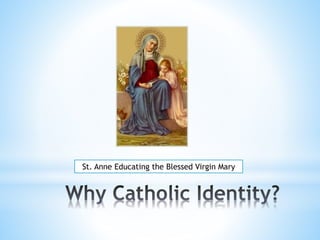
St. Anne Educating the Blessed Virgin Mary
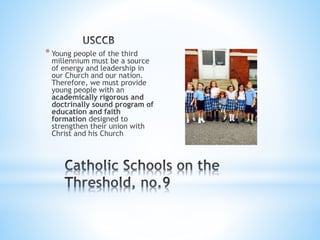
* Young people of the third
millennium must be a source
of energy and leadership in
our Church and our nation.
Therefore, we must provide
young people with an
academically rigorous and
doctrinally sound program of
education and faith
formation designed to
strengthen their union with
Christ and his Church
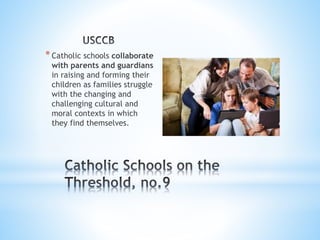
*Catholic schools collaborate
with parents and guardians
in raising and forming their
children as families struggle
with the changing and
challenging cultural and
moral contexts in which
they find themselves.
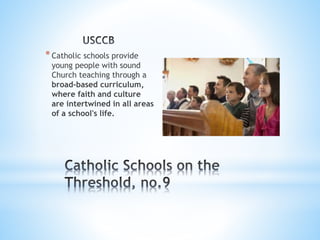
*Catholic schools provide
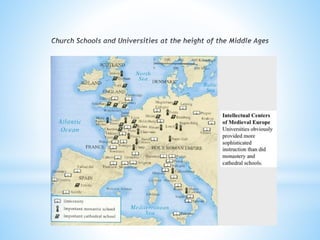
young people with sound
Church teaching through a
broad-based curriculum,
where faith and culture
are intertwined in all areas
of a school's life.
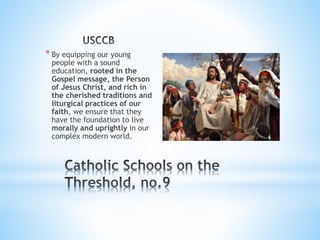
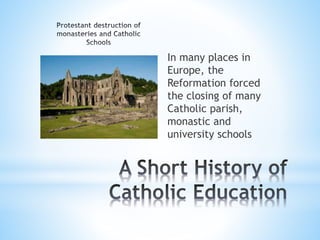
* By equipping our young
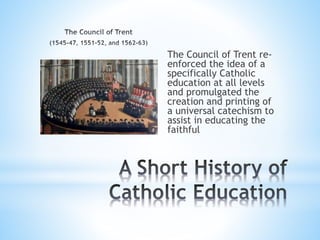
people with a sound
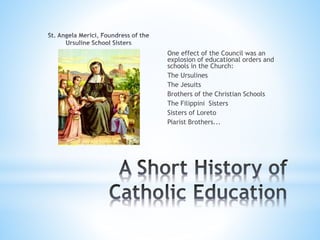
education, rooted in the
Gospel message, the Person
of Jesus Christ, and rich in
the cherished traditions and
liturgical practices of our
faith, we ensure that they
have the foundation to live
morally and uprightly in our
complex modern world.
*This unique Catholic
identity makes our Catholic
elementary and secondary
schools "Schools for the
human person" and allows
them to fill a critical role in
the future life of our
Church, our country, and
our world
*How conscious are we that
our school is an educational
ministry of the Church?
*Does SMA help
parents/guardians fulfill
their role as the primary
teachers of the Faith to
their children?
*Are we aware that parents,
teachers and administrators
have an important role in
assuring a Catholic
education at St. Mary
Academy?
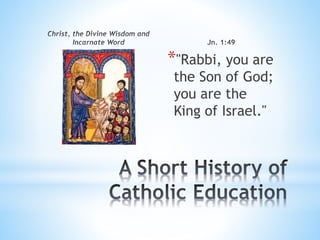
*"Rabbi, you are
the Son of God;
you are the
King of Israel."
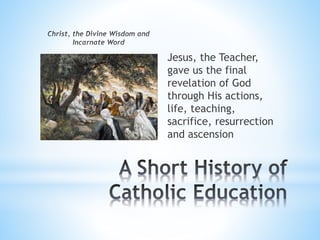
Jesus, the Teacher,
gave us the final
revelation of God
through His actions,
life, teaching,
sacrifice, resurrection
and ascension
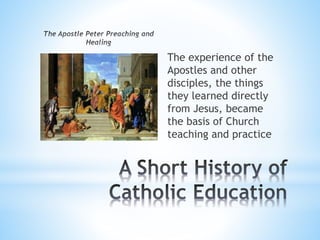
The experience of the
Apostles and other
disciples, the things
they learned directly
from Jesus, became
the basis of Church
teaching and practice
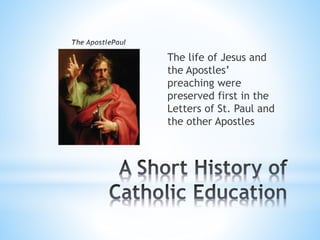
The life of Jesus and
the Apostles’
preaching were
preserved first in the
Letters of St. Paul and
the other Apostles
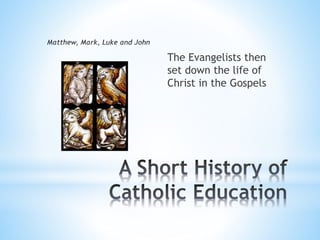
The Evangelists then
set down the life of
Christ in the Gospels
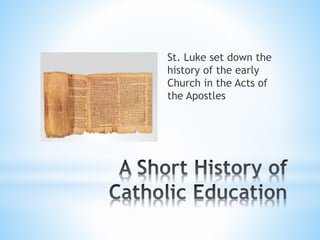
St. Luke set down the
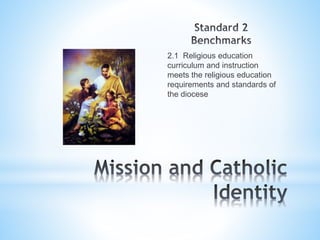
history of the early
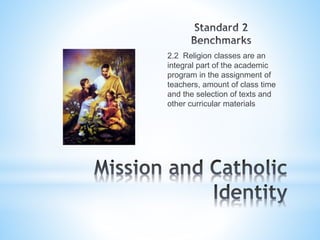
Church in the Acts of
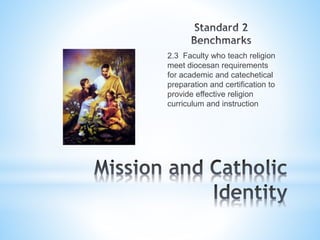
the Apostles
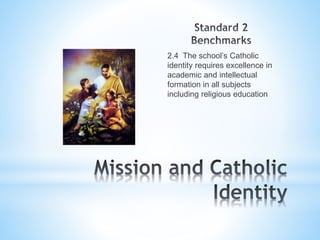
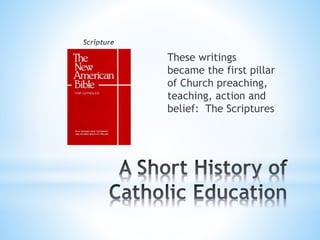
These writings
became the first pillar
of Church preaching,
teaching, action and
belief: The Scriptures
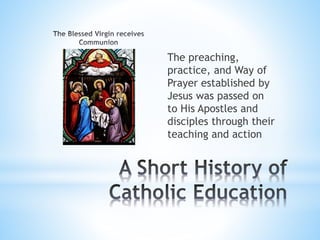
The preaching,
practice, and Way of
Prayer established by
Jesus was passed on
to His Apostles and
disciples through their
teaching and action
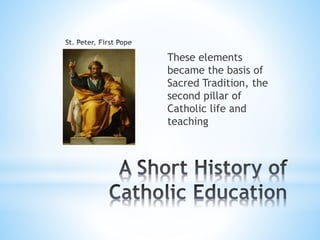
These elements
became the basis of
Sacred Tradition, the
second pillar of
Catholic life and
teaching
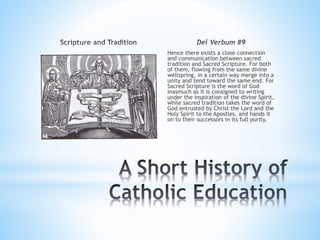
Hence there exists a close connection
and communication between sacred
tradition and Sacred Scripture. For both
of them, flowing from the same divine
wellspring, in a certain way merge into a
unity and tend toward the same end. For
Sacred Scripture is the word of God
inasmuch as it is consigned to writing
under the inspiration of the divine Spirit,
while sacred tradition takes the word of
God entrusted by Christ the Lord and the
Holy Spirit to the Apostles, and hands it
on to their successors in its full purity,
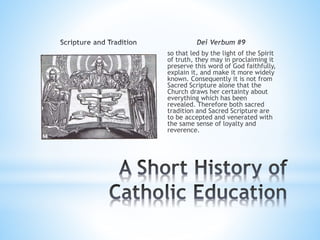
so that led by the light of the Spirit
of truth, they may in proclaiming it
preserve this word of God faithfully,
explain it, and make it more widely
known. Consequently it is not from
Sacred Scripture alone that the
Church draws her certainty about
everything which has been
revealed. Therefore both sacred
tradition and Sacred Scripture are
to be accepted and venerated with
the same sense of loyalty and
reverence.
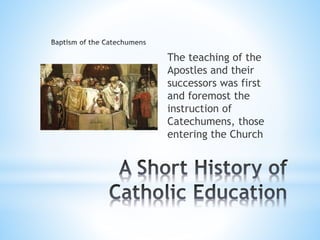
The teaching of the
Apostles and their
successors was first
and foremost the
instruction of
Catechumens, those
entering the Church
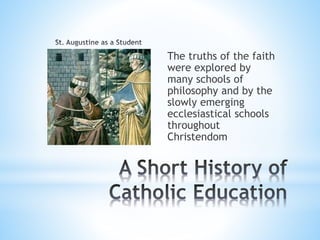
The truths of the faith
were explored by
many schools of
philosophy and by the
slowly emerging
ecclesiastical schools
throughout
Christendom
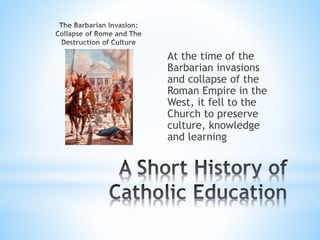
At the time of the
Barbarian invasions
and collapse of the
Roman Empire in the
West, it fell to the
Church to preserve
culture, knowledge
and learning
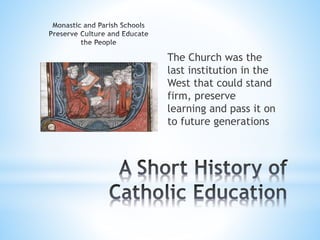
The Church was the
last institution in the
West that could stand
firm, preserve
learning and pass it on
to future generations
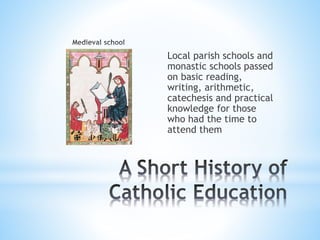
Local parish schools and
monastic schools passed
on basic reading,
writing, arithmetic,
catechesis and practical
knowledge for those
who had the time to
attend them
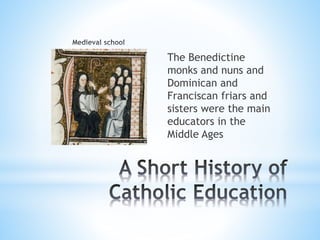
The Benedictine
monks and nuns and
Dominican and
Franciscan friars and
sisters were the main
educators in the
Middle Ages
In many places in
Europe, the
Reformation forced
the closing of many
Catholic parish,
monastic and
university schools
The Council of Trent re-
enforced the idea of a
specifically Catholic
education at all levels
and promulgated the
creation and printing of
a universal catechism to
assist in educating the
faithful
One effect of the Council was an
explosion of educational orders and
schools in the Church:
The Ursulines
The Jesuits
Brothers of the Christian Schools
The Filippini Sisters
Sisters of Loreto
Piarist Brothers...
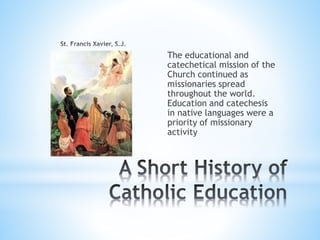
The educational and
catechetical mission of the
Church continued as
missionaries spread
throughout the world.
Education and catechesis
in native languages were a
priority of missionary
activity
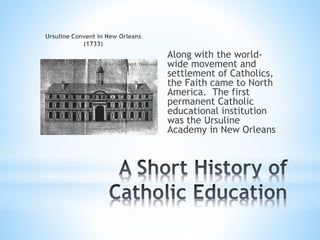
Along with the world-
wide movement and
settlement of Catholics,
the Faith came to North
America. The first
permanent Catholic
educational institution
was the Ursuline
Academy in New Orleans
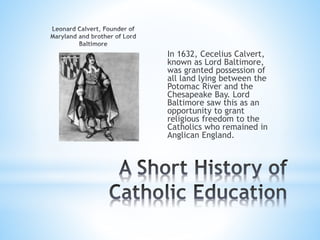
In 1632, Cecelius Calvert,
known as Lord Baltimore,
was granted possession of
all land lying between the
Potomac River and the
Chesapeake Bay. Lord
Baltimore saw this as an
opportunity to grant
religious freedom to the
Catholics who remained in
Anglican England.
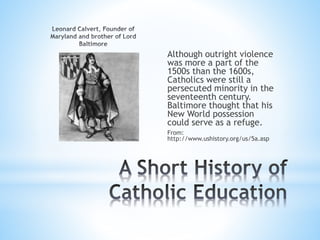
Although outright violence
was more a part of the
1500s than the 1600s,
Catholics were still a
persecuted minority in the
seventeenth century.
Baltimore thought that his
New World possession
could serve as a refuge.
From:
http://www.ushistory.org/us/5a.asp
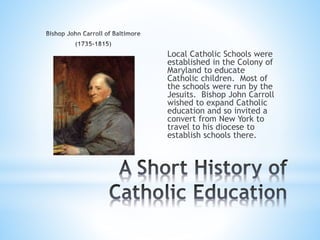
Local Catholic Schools were
established in the Colony of
Maryland to educate
Catholic children. Most of
the schools were run by the
Jesuits. Bishop John Carroll
wished to expand Catholic
education and so invited a
convert from New York to
travel to his diocese to
establish schools there.
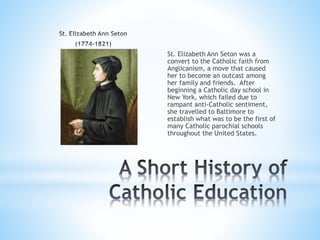
St. Elizabeth Ann Seton was a
convert to the Catholic faith from
Anglicanism, a move that caused
her to become an outcast among
her family and friends. After
beginning a Catholic day school in
New York, which failed due to
rampant anti-Catholic sentiment,
she travelled to Baltimore to
establish what was to be the first of
many Catholic parochial schools
throughout the United States.
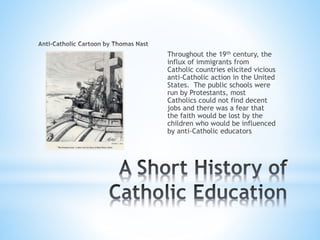
Throughout the 19th century, the
influx of immigrants from
Catholic countries elicited vicious
anti-Catholic action in the United
States. The public schools were
run by Protestants, most
Catholics could not find decent
jobs and there was a fear that
the faith would be lost by the
children who would be influenced
by anti-Catholic educators
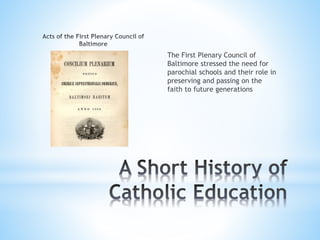
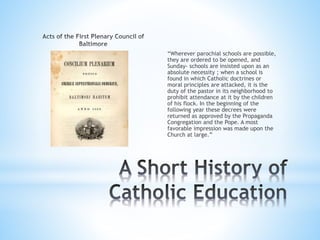
The First Plenary Council of
Baltimore stressed the need for
parochial schools and their role in
preserving and passing on the
faith to future generations
“Wherever parochial schools are possible,
they are ordered to be opened, and
Sunday- schools are insisted upon as an
absolute necessity ; when a school is
found in which Catholic doctrines or
moral principles are attacked, it is the
duty of the pastor in its neighborhood to
prohibit attendance at it by the children
of his flock. In the beginning of the
following year these decrees were
returned as approved by the Propaganda
Congregation and the Pope. A most
favorable impression was made upon the
Church at large.”
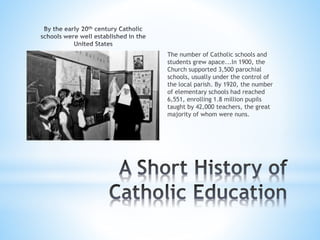
The number of Catholic schools and
students grew apace...In 1900, the
Church supported 3,500 parochial
schools, usually under the control of
the local parish. By 1920, the number
of elementary schools had reached
6,551, enrolling 1.8 million pupils
taught by 42,000 teachers, the great
majority of whom were nuns.
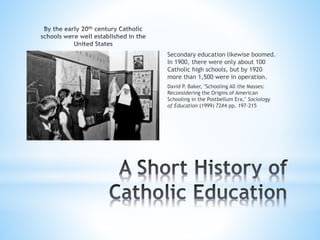
Secondary education likewise boomed.
In 1900, there were only about 100
Catholic high schools, but by 1920
more than 1,500 were in operation.
David P. Baker, "Schooling All the Masses:
Reconsidering the Origins of American
Schooling in the Postbellum Era," Sociology
of Education (1999) 72#4 pp. 197-215
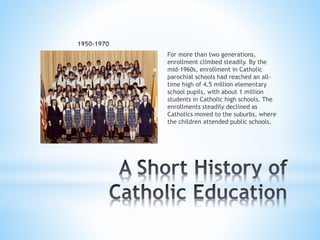
For more than two generations,
enrollment climbed steadily. By the
mid-1960s, enrollment in Catholic
parochial schools had reached an all-
time high of 4.5 million elementary
school pupils, with about 1 million
students in Catholic high schools. The
enrollments steadily declined as
Catholics moved to the suburbs, where
the children attended public schools.
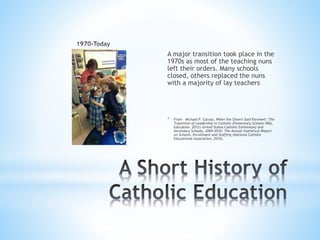
A major transition took place in the
1970s as most of the teaching nuns
left their orders. Many schools
closed, others replaced the nuns
with a majority of lay teachers
* From: Michael P. Caruso, When the Sisters Said Farewell: The
Transition of Leadership in Catholic Elementary Schools (R&L
Education, 2012) United States Catholic Elementary and
Secondary Schools, 2009-2010: The Annual Statistical Report
on Schools, Enrollment and Staffing (National Catholic
Educational Association, 2010).
* Jesus says, “But seek first the
kingdom (of God) and his
righteousness, and all these
things will be given you
besides.” (Matt. 6:33) Are we
giving the students of SMA the
chance to respond in faith and
intellect to the teaching of Jesus
and His Church?
* Have we lost the knowledge and
practice of our Catholic story?
* The Church has been at times
countercultural in society
throughout history: is the
counterculturalism of the
Gospel apparent at SMA?
* Is the community of SMA
aware of it’s role in carrying
on the great tradition of
Catholic education which we
have inherited and are called
upon to pass on?
*
"The Catholic school pursues cultural
goals and the natural development of
youth to the same degree as any other
school. What makes the Catholic school
distinctive is its attempt to generate a
community climate in the school that is
permeated by the Gospel spirit of
freedom and love. It tries to guide the
adolescents in such a way that
personality development goes hand in
hand with the development of the "new
creature" that each one has become
through baptism.
It tries to relate all of human
culture to the good news of
salvation so that the light of
faith will illumine everything
that the students will gradually
come to learn about the world,
about life, and about the human
person".
The Council…declared that what
makes the Catholic school
distinctive is its religious
dimension, and that this is to be
found in…
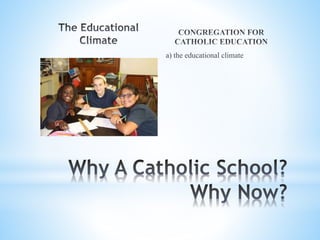
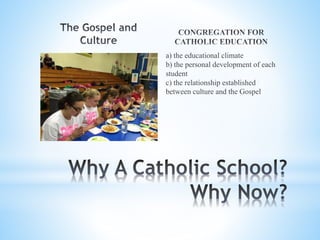
a) the educational climate
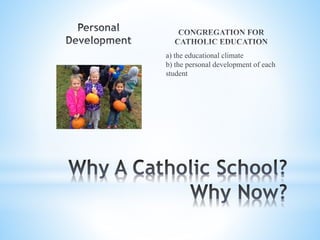
b) the personal development of each
student
a) the educational climate
b) the personal development of each
student
c) the relationship established
between culture and the Gospel
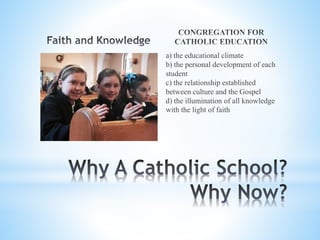
a) the educational climate
b) the personal development of each
student
c) the relationship established
between culture and the Gospel
d) the illumination of all knowledge
with the light of faith
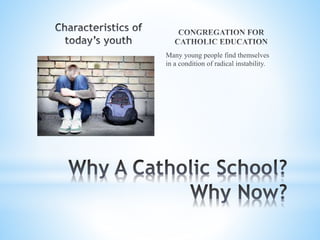
Many young people find themselves
in a condition of radical instability.
Many young people find themselves
in a condition of radical instability
Others live in an environment devoid
of truly human relationships; as a
result, they suffer from loneliness and
a lack of affection
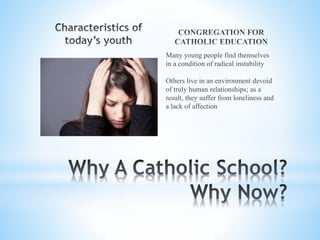
Many young people find themselves
in a condition of radical instability
Others live in an environment devoid
of truly human relationships; as a
result, they suffer from loneliness and
a lack of affection
Large numbers of today's youth are
very worried about an uncertain future
Not a few young people, unable to
find any meaning in life or trying to
find an escape from loneliness, turn to
alcohol, drugs, the erotic, the exotic
etc.
Not a few young people, unable to
find any meaning in life or trying to
find an escape from loneliness, turn to
alcohol drugs, the erotic, the exotic
etc.
The normal instability of youth is
accentuated by the times they are
living in. Their decisions are not
solidly based: today's "yes" easily
becomes tomorrow's "no"
Finally, a vague sort of generosity is
characteristic of many young people.
Filled with enthusiasm, they are eager
to join in popular causes. Too often,
however, these movements are
without any specific orientation or
inner coherence. It is important to
channel this potential for good and,
when possible, give it the orientation
that comes from the light of faith.
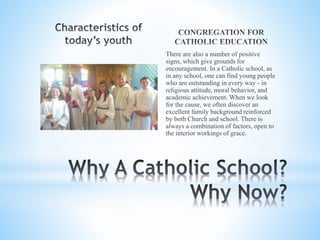
There are also a number of positive
signs, which give grounds for
encouragement. In a Catholic school, as
in any school, one can find young people
who are outstanding in every way - in
religious attitude, moral behavior, and
academic achievement. When we look
for the cause, we often discover an
excellent family background reinforced
by both Church and school. There is
always a combination of factors, open to
the interior workings of grace.
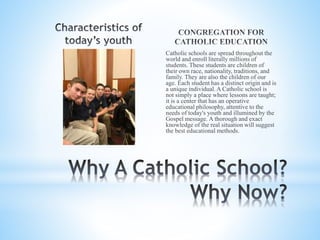
Catholic schools are spread throughout the
world and enroll literally millions of
students. These students are children of
their own race, nationality, traditions, and
family. They are also the children of our
age. Each student has a distinct origin and is
a unique individual. A Catholic school is
not simply a place where lessons are taught;
it is a center that has an operative
educational philosophy, attentive to the
needs of today's youth and illumined by the
Gospel message. A thorough and exact
knowledge of the real situation will suggest
the best educational methods.
* Do SMA students, faculty and
school communities reflect on the
values involved in the issues of
the day in the light of Jesus’
teaching and the teaching
authority of the Church?
* Does SMA provide a stable, safe
environment based on the
principles of the Gospel in order
to assist those students suffering
from the uncertainties of modern
life?
* The influence of social media
and the internet is pervasive
in our society. What are the
potentially good influences of
this situation on our students?
What are the bad?
* A foundation in the Faith is
necessary to our future: how
can we strengthen this
foundation?
*
Like the marks of the Church proclaimed in
the Creed – one, holy, catholic, and
apostolic – so, too, does the Holy See
identify the principal features of a school as
Catholic: a Catholic school should be
inspired by a supernatural vision,
founded on Christian anthropology,
animated by communion and community,
imbued with a Catholic worldview
throughout its curriculum, and sustained
by Gospel witness. These benchmarks help
to answer the critical question: Is this a
Catholic school according to the mind of
the Church?
It is precisely because of its Catholic
identity, which is anything but sectarian,
that a school derives the originality that
enables it to be a genuine instrument of
the Church's evangelizing mission.
Michael Guerra, former president of the
National Catholic Educational
Association put the challenge succinctly:
"The first and most important task for
Catholic schools is to maintain and
continually strengthen their Catholic
identity."
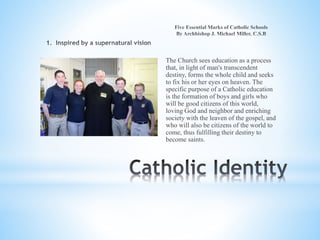
The Church sees education as a process
that, in light of man's transcendent
destiny, forms the whole child and seeks
to fix his or her eyes on heaven. The
specific purpose of a Catholic education
is the formation of boys and girls who
will be good citizens of this world,
loving God and neighbor and enriching
society with the leaven of the gospel, and
who will also be citizens of the world to
come, thus fulfilling their destiny to
become saints.
Emphasis on the supernatural destiny of
students brings with it a profound
appreciation of the need to perfect
children in all their dimensions as images
of God (cf. Gen. 1:26-27). Catholic
theology teaches that grace builds on
nature. Because of this complementarity
of the natural and the supernatural,
Catholic educators should have a sound
understanding of the human person that
addresses the requirements of both the
natural and the supernatural perfection of
the children entrusted to their care.
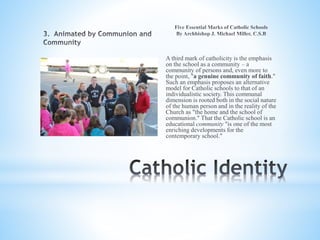
A third mark of catholicity is the emphasis
on the school as a community – a
community of persons and, even more to
the point, "a genuine community of faith."
Such an emphasis proposes an alternative
model for Catholic schools to that of an
individualistic society. This communal
dimension is rooted both in the social nature
of the human person and in the reality of the
Church as "the home and the school of
communion." That the Catholic school is an
educational community "is one of the most
enriching developments for the
contemporary school."
The integral formation of the human person, which
is the purpose of education, includes the
development of all the human faculties of the
students, together with preparation for professional
life, formation of ethical and social awareness,
becoming aware of the transcendental, and
religious education. Every school, and every
educator in the school, ought to be striving "to
form strong and responsible individuals, who are
capable of making free and correct choices," thus
preparing young people "to open themselves more
and more to reality, and to form in themselves a
clear idea of the meaning of life" [The Catholic
School, 31].
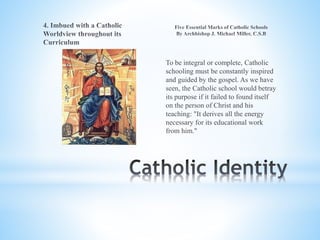
To be integral or complete, Catholic
schooling must be constantly inspired
and guided by the gospel. As we have
seen, the Catholic school would betray
its purpose if it failed to found itself
on the person of Christ and his
teaching: "It derives all the energy
necessary for its educational work
from him."
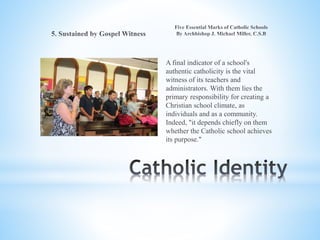
A final indicator of a school's
authentic catholicity is the vital
witness of its teachers and
administrators. With them lies the
primary responsibility for creating a
Christian school climate, as
individuals and as a community.
Indeed, "it depends chiefly on them
whether the Catholic school achieves
its purpose."
*Are the ties between home,
school and church made
stronger for students
through their attendance at
SMA?
*Are we assisting parents in
deepening their
understanding of Catholic
Identity at SMA?
*Is the curriculum at SMA
enhancing the formation of
the whole person,
intellectually, spiritually
and socially?
*Is the Gospel central to the
academic and social
experience of students at
SMA?
*
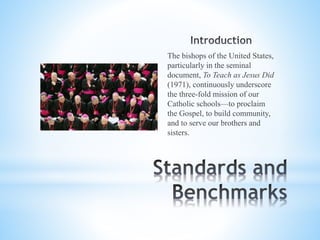
The bishops of the United States,
particularly in the seminal
document, To Teach as Jesus Did
(1971), continuously underscore
the three-fold mission of our
Catholic schools—to proclaim
the Gospel, to build community,
and to serve our brothers and
sisters.
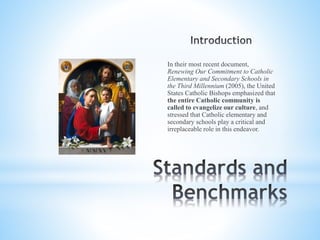
In their most recent document,
Renewing Our Commitment to Catholic
Elementary and Secondary Schools in
the Third Millennium (2005), the United
States Catholic Bishops emphasized that
the entire Catholic community is
called to evangelize our culture, and
stressed that Catholic elementary and
secondary schools play a critical and
irreplaceable role in this endeavor.
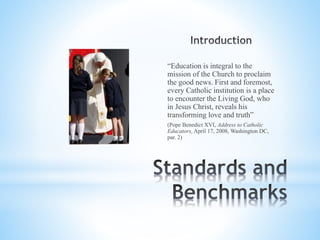
“Education is integral to the
mission of the Church to proclaim
the good news. First and foremost,
every Catholic institution is a place
to encounter the Living God, who
in Jesus Christ, reveals his
transforming love and truth”
(Pope Benedict XVI, Address to Catholic
Educators, April 17, 2008, Washington DC,
par. 2)
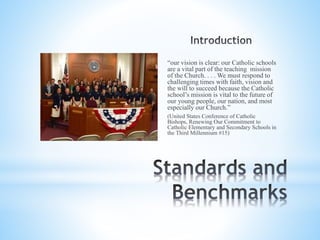
“our vision is clear: our Catholic schools
are a vital part of the teaching mission
of the Church. . . . We must respond to
challenging times with faith, vision and
the will to succeed because the Catholic
school’s mission is vital to the future of
our young people, our nation, and most
especially our Church.”
(United States Conference of Catholic
Bishops, Renewing Our Commitment to
Catholic Elementary and Secondary Schools in
the Third Millennium #15)
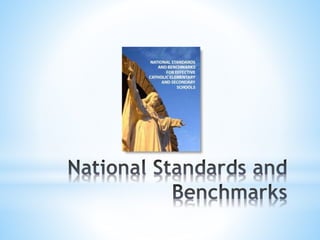
The National Standards and Benchmarks
for Effective Catholic Elementary and
Secondary Schools is intended to
describe how the most mission-driven,
program effective, well managed, and
responsibly governed Catholic schools
operate. They are offered as school
effectiveness standards rather than
curriculum content standards, although
they support curriculum development
consistent with national standards and
the Common Core State Standards.
This document contains three
types of statements grounded in
Church teachings, best practice,
and proven success of those
committed to the future of
Catholic elementary and
secondary education in the
United States.
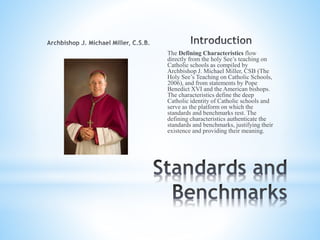
The Defining Characteristics flow
directly from the holy See’s teaching on
Catholic schools as compiled by
Archbishop J. Michael Miller, CSB (The
Holy See’s Teaching on Catholic Schools,
2006), and from statements by Pope
Benedict XVI and the American bishops.
The characteristics define the deep
Catholic identity of Catholic schools and
serve as the platform on which the
standards and benchmarks rest. The
defining characteristics authenticate the
standards and benchmarks, justifying their
existence and providing their meaning.
The Standards describe policies,
programs, structures, and processes
that should be present in mission-
driven, program effective, well-
managed, and responsibly governed
Catholic schools that operate in
concert with the defining
characteristics. The standards
address four domains: Mission and
Catholic Identity, Governance and
Leadership, Academic Excellence,
and Operational Vitality.
The Benchmarks provide
observable, measurable descriptors
for each standard. Benchmarks
provide a solid basis for future
development of more detailed self-
assessment and diagnostic
instruments, data collection and
reporting structures, and
accreditation tools, as appropriate
at the local, diocesan, regional, and
national levels.
National Standards and
Benchmarks for Effective
Catholic Elementary and
Secondary Schools was drafted
by a national task force of
Catholic school educators and
supporters, in communication
with the National Catholic
Educational Association (NCEA).
An excellent Catholic school is
guided and driven by a clearly
communicated mission that
embraces a Catholic identity
rooted in gospel values, centered
on the Eucharist, and committed
to faith formation, academic
excellence and service
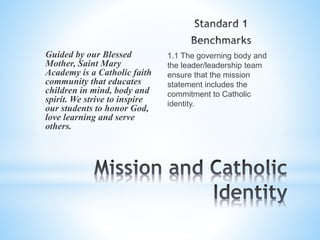
1.1 The governing body and
the leader/leadership team
ensure that the mission
statement includes the
commitment to Catholic
identity.
Guided by our Blessed
Mother, Saint Mary
Academy is a Catholic faith
community that educates
children in mind, body and
spirit. We strive to inspire
our students to honor God,
love learning and serve
others.
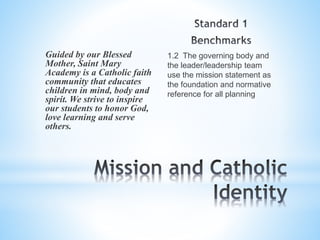
1.2 The governing body and
the leader/leadership team
use the mission statement as
the foundation and normative
reference for all planning
Guided by our Blessed
Mother, Saint Mary
Academy is a Catholic faith
community that educates
children in mind, body and
spirit. We strive to inspire
our students to honor God,
love learning and serve
others.
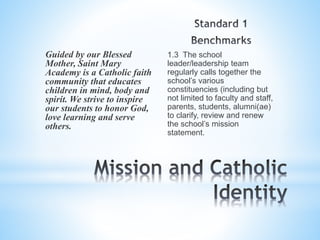
1.3 The school
leader/leadership team
regularly calls together the
school’s various
constituencies (including but
not limited to faculty and staff,
parents, students, alumni(ae)
to clarify, review and renew
the school’s mission
statement.
Guided by our Blessed
Mother, Saint Mary
Academy is a Catholic faith
community that educates
children in mind, body and
spirit. We strive to inspire
our students to honor God,
love learning and serve
others.
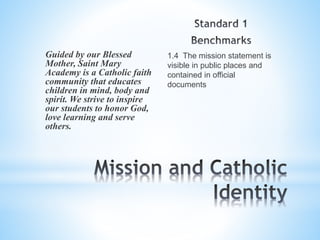
1.4 The mission statement is
visible in public places and
contained in official
documents
Guided by our Blessed
Mother, Saint Mary
Academy is a Catholic faith
community that educates
children in mind, body and
spirit. We strive to inspire
our students to honor God,
love learning and serve
others.
An excellent Catholic school
adhering to mission provides a
rigorous academic program for
religious studies and catechesis in
the Catholic faith, set within a
total academic curriculum that
integrates faith, culture, and life.
2.1 Religious education
curriculum and instruction
meets the religious education
requirements and standards of
the diocese
2.2 Religion classes are an
integral part of the academic
program in the assignment of
teachers, amount of class time
and the selection of texts and
other curricular materials
2.3 Faculty who teach religion
meet diocesan requirements
for academic and catechetical
preparation and certification to
provide effective religion
curriculum and instruction
2.4 The school’s Catholic
identity requires excellence in
academic and intellectual
formation in all subjects
including religious education
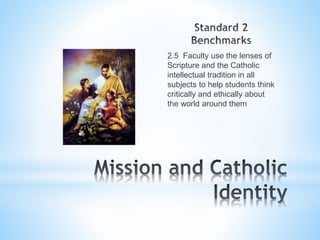
2.5 Faculty use the lenses of
Scripture and the Catholic
intellectual tradition in all
subjects to help students think
critically and ethically about
the world around them
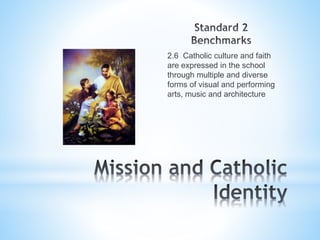
2.6 Catholic culture and faith
are expressed in the school
through multiple and diverse
forms of visual and performing
arts, music and architecture
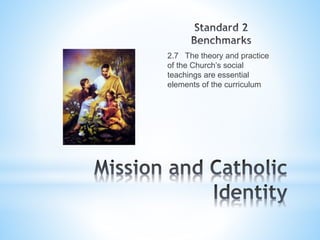
2.7 The theory and practice
of the Church’s social
teachings are essential
elements of the curriculum
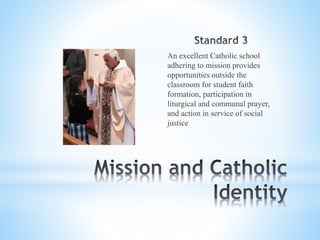
An excellent Catholic school
adhering to mission provides
opportunities outside the
classroom for student faith
formation, participation in
liturgical and communal prayer,
and action in service of social
justice
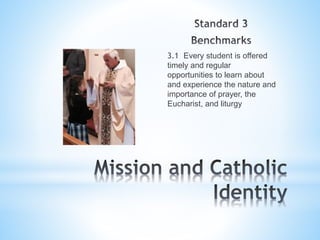
3.1 Every student is offered
timely and regular
opportunities to learn about
and experience the nature and
importance of prayer, the
Eucharist, and liturgy
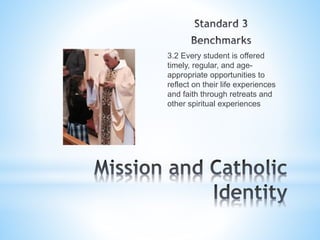
3.2 Every student is offered
timely, regular, and age-
appropriate opportunities to
reflect on their life experiences
and faith through retreats and
other spiritual experiences
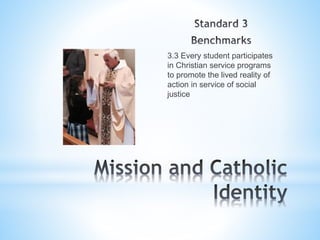
3.3 Every student participates
in Christian service programs
to promote the lived reality of
action in service of social
justice
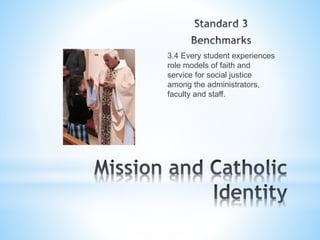
3.4 Every student experiences
role models of faith and
service for social justice
among the administrators,
faculty and staff.
An excellent Catholic school
adhering to mission provides
opportunities for adult faith
formation and action in service of
social justice.
4.1 The leader/leadership
team provides retreats and
other spiritual experiences for
the faculty and staff on a
regular and timely basis
4.2 The leader/leadership
team and faculty assist
parents/guardians in their role
as the primary educators of
their children in faith
4.3 The leader/leadership team
collaborates with other
institutions (for example,
Catholic Charities, Catholic
higher education, religious
congregation-sponsored
programs) to provide
opportunities for
parents/guardians to grow in the
knowledge and practice of the
faith
4.4 All adults in the school
community are invited to
participate in Christian service
programs to promote the lived
reality of action in service of
social justice
4.5 Every administrator,
faculty, and staff member
visibly supports the faith life of
the school community
*Are the contributions and
wisdom of all members of
the SMA community
considered respectfully as
we move forward to
improve SMA?
*What are the Standards for
Catholic Identity that SMA
excels in?
* What are the Standards of
Catholic Identity at SMA that
need to be implemented or
improved?
* How can all stakeholders at
SMA (Faculty, Staff, Parents,
Advisory Board) work
together in adopting and
implementing the benchmarks
for Catholic identity?
*
*To inform
*To inform
*To consult
*To inform
*To consult
*To assist St Mary
community in moving
forward with Catholic
identity
*

Catholic Identity

  • 3.
  • 4.
    St. Anne Educatingthe Blessed Virgin Mary
  • 5.
    * Young peopleof the third millennium must be a source of energy and leadership in our Church and our nation. Therefore, we must provide young people with an academically rigorous and doctrinally sound program of education and faith formation designed to strengthen their union with Christ and his Church
  • 6.
    *Catholic schools collaborate withparents and guardians in raising and forming their children as families struggle with the changing and challenging cultural and moral contexts in which they find themselves.
  • 7.
    *Catholic schools provide youngpeople with sound Church teaching through a broad-based curriculum, where faith and culture are intertwined in all areas of a school's life.
  • 8.
    * By equippingour young people with a sound education, rooted in the Gospel message, the Person of Jesus Christ, and rich in the cherished traditions and liturgical practices of our faith, we ensure that they have the foundation to live morally and uprightly in our complex modern world.
  • 9.
    *This unique Catholic identitymakes our Catholic elementary and secondary schools "Schools for the human person" and allows them to fill a critical role in the future life of our Church, our country, and our world
  • 10.
    *How conscious arewe that our school is an educational ministry of the Church? *Does SMA help parents/guardians fulfill their role as the primary teachers of the Faith to their children? *Are we aware that parents, teachers and administrators have an important role in assuring a Catholic education at St. Mary Academy?
  • 12.
    *"Rabbi, you are theSon of God; you are the King of Israel."
  • 13.
    Jesus, the Teacher, gaveus the final revelation of God through His actions, life, teaching, sacrifice, resurrection and ascension
  • 14.
    The experience ofthe Apostles and other disciples, the things they learned directly from Jesus, became the basis of Church teaching and practice
  • 15.
    The life ofJesus and the Apostles’ preaching were preserved first in the Letters of St. Paul and the other Apostles
  • 16.
    The Evangelists then setdown the life of Christ in the Gospels
  • 17.
    St. Luke setdown the history of the early Church in the Acts of the Apostles
  • 18.
    These writings became thefirst pillar of Church preaching, teaching, action and belief: The Scriptures
  • 19.
    The preaching, practice, andWay of Prayer established by Jesus was passed on to His Apostles and disciples through their teaching and action
  • 20.
    These elements became thebasis of Sacred Tradition, the second pillar of Catholic life and teaching
  • 21.
    Hence there existsa close connection and communication between sacred tradition and Sacred Scripture. For both of them, flowing from the same divine wellspring, in a certain way merge into a unity and tend toward the same end. For Sacred Scripture is the word of God inasmuch as it is consigned to writing under the inspiration of the divine Spirit, while sacred tradition takes the word of God entrusted by Christ the Lord and the Holy Spirit to the Apostles, and hands it on to their successors in its full purity,
  • 22.
    so that ledby the light of the Spirit of truth, they may in proclaiming it preserve this word of God faithfully, explain it, and make it more widely known. Consequently it is not from Sacred Scripture alone that the Church draws her certainty about everything which has been revealed. Therefore both sacred tradition and Sacred Scripture are to be accepted and venerated with the same sense of loyalty and reverence.
  • 23.
    The teaching ofthe Apostles and their successors was first and foremost the instruction of Catechumens, those entering the Church
  • 24.
    The truths ofthe faith were explored by many schools of philosophy and by the slowly emerging ecclesiastical schools throughout Christendom
  • 25.
    At the timeof the Barbarian invasions and collapse of the Roman Empire in the West, it fell to the Church to preserve culture, knowledge and learning
  • 26.
    The Church wasthe last institution in the West that could stand firm, preserve learning and pass it on to future generations
  • 27.
    Local parish schoolsand monastic schools passed on basic reading, writing, arithmetic, catechesis and practical knowledge for those who had the time to attend them
  • 28.
    The Benedictine monks andnuns and Dominican and Franciscan friars and sisters were the main educators in the Middle Ages
  • 30.
    In many placesin Europe, the Reformation forced the closing of many Catholic parish, monastic and university schools
  • 31.
    The Council ofTrent re- enforced the idea of a specifically Catholic education at all levels and promulgated the creation and printing of a universal catechism to assist in educating the faithful
  • 32.
    One effect ofthe Council was an explosion of educational orders and schools in the Church: The Ursulines The Jesuits Brothers of the Christian Schools The Filippini Sisters Sisters of Loreto Piarist Brothers...
  • 33.
    The educational and catecheticalmission of the Church continued as missionaries spread throughout the world. Education and catechesis in native languages were a priority of missionary activity
  • 34.
    Along with theworld- wide movement and settlement of Catholics, the Faith came to North America. The first permanent Catholic educational institution was the Ursuline Academy in New Orleans
  • 35.
    In 1632, CeceliusCalvert, known as Lord Baltimore, was granted possession of all land lying between the Potomac River and the Chesapeake Bay. Lord Baltimore saw this as an opportunity to grant religious freedom to the Catholics who remained in Anglican England.
  • 36.
    Although outright violence wasmore a part of the 1500s than the 1600s, Catholics were still a persecuted minority in the seventeenth century. Baltimore thought that his New World possession could serve as a refuge. From: http://www.ushistory.org/us/5a.asp
  • 37.
    Local Catholic Schoolswere established in the Colony of Maryland to educate Catholic children. Most of the schools were run by the Jesuits. Bishop John Carroll wished to expand Catholic education and so invited a convert from New York to travel to his diocese to establish schools there.
  • 38.
    St. Elizabeth AnnSeton was a convert to the Catholic faith from Anglicanism, a move that caused her to become an outcast among her family and friends. After beginning a Catholic day school in New York, which failed due to rampant anti-Catholic sentiment, she travelled to Baltimore to establish what was to be the first of many Catholic parochial schools throughout the United States.
  • 39.
    Throughout the 19thcentury, the influx of immigrants from Catholic countries elicited vicious anti-Catholic action in the United States. The public schools were run by Protestants, most Catholics could not find decent jobs and there was a fear that the faith would be lost by the children who would be influenced by anti-Catholic educators
  • 40.
    The First PlenaryCouncil of Baltimore stressed the need for parochial schools and their role in preserving and passing on the faith to future generations
  • 41.
    “Wherever parochial schoolsare possible, they are ordered to be opened, and Sunday- schools are insisted upon as an absolute necessity ; when a school is found in which Catholic doctrines or moral principles are attacked, it is the duty of the pastor in its neighborhood to prohibit attendance at it by the children of his flock. In the beginning of the following year these decrees were returned as approved by the Propaganda Congregation and the Pope. A most favorable impression was made upon the Church at large.”
  • 42.
    The number ofCatholic schools and students grew apace...In 1900, the Church supported 3,500 parochial schools, usually under the control of the local parish. By 1920, the number of elementary schools had reached 6,551, enrolling 1.8 million pupils taught by 42,000 teachers, the great majority of whom were nuns.
  • 43.
    Secondary education likewiseboomed. In 1900, there were only about 100 Catholic high schools, but by 1920 more than 1,500 were in operation. David P. Baker, "Schooling All the Masses: Reconsidering the Origins of American Schooling in the Postbellum Era," Sociology of Education (1999) 72#4 pp. 197-215
  • 44.
    For more thantwo generations, enrollment climbed steadily. By the mid-1960s, enrollment in Catholic parochial schools had reached an all- time high of 4.5 million elementary school pupils, with about 1 million students in Catholic high schools. The enrollments steadily declined as Catholics moved to the suburbs, where the children attended public schools.
  • 45.
    A major transitiontook place in the 1970s as most of the teaching nuns left their orders. Many schools closed, others replaced the nuns with a majority of lay teachers * From: Michael P. Caruso, When the Sisters Said Farewell: The Transition of Leadership in Catholic Elementary Schools (R&L Education, 2012) United States Catholic Elementary and Secondary Schools, 2009-2010: The Annual Statistical Report on Schools, Enrollment and Staffing (National Catholic Educational Association, 2010).
  • 46.
    * Jesus says,“But seek first the kingdom (of God) and his righteousness, and all these things will be given you besides.” (Matt. 6:33) Are we giving the students of SMA the chance to respond in faith and intellect to the teaching of Jesus and His Church? * Have we lost the knowledge and practice of our Catholic story? * The Church has been at times countercultural in society throughout history: is the counterculturalism of the Gospel apparent at SMA? * Is the community of SMA aware of it’s role in carrying on the great tradition of Catholic education which we have inherited and are called upon to pass on? *
  • 48.
    "The Catholic schoolpursues cultural goals and the natural development of youth to the same degree as any other school. What makes the Catholic school distinctive is its attempt to generate a community climate in the school that is permeated by the Gospel spirit of freedom and love. It tries to guide the adolescents in such a way that personality development goes hand in hand with the development of the "new creature" that each one has become through baptism.
  • 49.
    It tries torelate all of human culture to the good news of salvation so that the light of faith will illumine everything that the students will gradually come to learn about the world, about life, and about the human person".
  • 50.
    The Council…declared thatwhat makes the Catholic school distinctive is its religious dimension, and that this is to be found in…
  • 51.
  • 52.
    a) the educationalclimate b) the personal development of each student
  • 53.
    a) the educationalclimate b) the personal development of each student c) the relationship established between culture and the Gospel
  • 54.
    a) the educationalclimate b) the personal development of each student c) the relationship established between culture and the Gospel d) the illumination of all knowledge with the light of faith
  • 55.
    Many young peoplefind themselves in a condition of radical instability.
  • 56.
    Many young peoplefind themselves in a condition of radical instability Others live in an environment devoid of truly human relationships; as a result, they suffer from loneliness and a lack of affection
  • 57.
    Many young peoplefind themselves in a condition of radical instability Others live in an environment devoid of truly human relationships; as a result, they suffer from loneliness and a lack of affection Large numbers of today's youth are very worried about an uncertain future
  • 58.
    Not a fewyoung people, unable to find any meaning in life or trying to find an escape from loneliness, turn to alcohol, drugs, the erotic, the exotic etc.
  • 59.
    Not a fewyoung people, unable to find any meaning in life or trying to find an escape from loneliness, turn to alcohol drugs, the erotic, the exotic etc. The normal instability of youth is accentuated by the times they are living in. Their decisions are not solidly based: today's "yes" easily becomes tomorrow's "no"
  • 60.
    Finally, a vaguesort of generosity is characteristic of many young people. Filled with enthusiasm, they are eager to join in popular causes. Too often, however, these movements are without any specific orientation or inner coherence. It is important to channel this potential for good and, when possible, give it the orientation that comes from the light of faith.
  • 61.
    There are alsoa number of positive signs, which give grounds for encouragement. In a Catholic school, as in any school, one can find young people who are outstanding in every way - in religious attitude, moral behavior, and academic achievement. When we look for the cause, we often discover an excellent family background reinforced by both Church and school. There is always a combination of factors, open to the interior workings of grace.
  • 62.
    Catholic schools arespread throughout the world and enroll literally millions of students. These students are children of their own race, nationality, traditions, and family. They are also the children of our age. Each student has a distinct origin and is a unique individual. A Catholic school is not simply a place where lessons are taught; it is a center that has an operative educational philosophy, attentive to the needs of today's youth and illumined by the Gospel message. A thorough and exact knowledge of the real situation will suggest the best educational methods.
  • 63.
    * Do SMAstudents, faculty and school communities reflect on the values involved in the issues of the day in the light of Jesus’ teaching and the teaching authority of the Church? * Does SMA provide a stable, safe environment based on the principles of the Gospel in order to assist those students suffering from the uncertainties of modern life? * The influence of social media and the internet is pervasive in our society. What are the potentially good influences of this situation on our students? What are the bad? * A foundation in the Faith is necessary to our future: how can we strengthen this foundation? *
  • 65.
    Like the marksof the Church proclaimed in the Creed – one, holy, catholic, and apostolic – so, too, does the Holy See identify the principal features of a school as Catholic: a Catholic school should be inspired by a supernatural vision, founded on Christian anthropology, animated by communion and community, imbued with a Catholic worldview throughout its curriculum, and sustained by Gospel witness. These benchmarks help to answer the critical question: Is this a Catholic school according to the mind of the Church?
  • 66.
    It is preciselybecause of its Catholic identity, which is anything but sectarian, that a school derives the originality that enables it to be a genuine instrument of the Church's evangelizing mission. Michael Guerra, former president of the National Catholic Educational Association put the challenge succinctly: "The first and most important task for Catholic schools is to maintain and continually strengthen their Catholic identity."
  • 67.
    The Church seeseducation as a process that, in light of man's transcendent destiny, forms the whole child and seeks to fix his or her eyes on heaven. The specific purpose of a Catholic education is the formation of boys and girls who will be good citizens of this world, loving God and neighbor and enriching society with the leaven of the gospel, and who will also be citizens of the world to come, thus fulfilling their destiny to become saints.
  • 68.
    Emphasis on thesupernatural destiny of students brings with it a profound appreciation of the need to perfect children in all their dimensions as images of God (cf. Gen. 1:26-27). Catholic theology teaches that grace builds on nature. Because of this complementarity of the natural and the supernatural, Catholic educators should have a sound understanding of the human person that addresses the requirements of both the natural and the supernatural perfection of the children entrusted to their care.
  • 69.
    A third markof catholicity is the emphasis on the school as a community – a community of persons and, even more to the point, "a genuine community of faith." Such an emphasis proposes an alternative model for Catholic schools to that of an individualistic society. This communal dimension is rooted both in the social nature of the human person and in the reality of the Church as "the home and the school of communion." That the Catholic school is an educational community "is one of the most enriching developments for the contemporary school."
  • 70.
    The integral formationof the human person, which is the purpose of education, includes the development of all the human faculties of the students, together with preparation for professional life, formation of ethical and social awareness, becoming aware of the transcendental, and religious education. Every school, and every educator in the school, ought to be striving "to form strong and responsible individuals, who are capable of making free and correct choices," thus preparing young people "to open themselves more and more to reality, and to form in themselves a clear idea of the meaning of life" [The Catholic School, 31].
  • 71.
    To be integralor complete, Catholic schooling must be constantly inspired and guided by the gospel. As we have seen, the Catholic school would betray its purpose if it failed to found itself on the person of Christ and his teaching: "It derives all the energy necessary for its educational work from him."
  • 72.
    A final indicatorof a school's authentic catholicity is the vital witness of its teachers and administrators. With them lies the primary responsibility for creating a Christian school climate, as individuals and as a community. Indeed, "it depends chiefly on them whether the Catholic school achieves its purpose."
  • 73.
    *Are the tiesbetween home, school and church made stronger for students through their attendance at SMA? *Are we assisting parents in deepening their understanding of Catholic Identity at SMA? *Is the curriculum at SMA enhancing the formation of the whole person, intellectually, spiritually and socially? *Is the Gospel central to the academic and social experience of students at SMA? *
  • 75.
    The bishops ofthe United States, particularly in the seminal document, To Teach as Jesus Did (1971), continuously underscore the three-fold mission of our Catholic schools—to proclaim the Gospel, to build community, and to serve our brothers and sisters.
  • 76.
    In their mostrecent document, Renewing Our Commitment to Catholic Elementary and Secondary Schools in the Third Millennium (2005), the United States Catholic Bishops emphasized that the entire Catholic community is called to evangelize our culture, and stressed that Catholic elementary and secondary schools play a critical and irreplaceable role in this endeavor.
  • 77.
    “Education is integralto the mission of the Church to proclaim the good news. First and foremost, every Catholic institution is a place to encounter the Living God, who in Jesus Christ, reveals his transforming love and truth” (Pope Benedict XVI, Address to Catholic Educators, April 17, 2008, Washington DC, par. 2)
  • 78.
    “our vision isclear: our Catholic schools are a vital part of the teaching mission of the Church. . . . We must respond to challenging times with faith, vision and the will to succeed because the Catholic school’s mission is vital to the future of our young people, our nation, and most especially our Church.” (United States Conference of Catholic Bishops, Renewing Our Commitment to Catholic Elementary and Secondary Schools in the Third Millennium #15)
  • 79.
    The National Standardsand Benchmarks for Effective Catholic Elementary and Secondary Schools is intended to describe how the most mission-driven, program effective, well managed, and responsibly governed Catholic schools operate. They are offered as school effectiveness standards rather than curriculum content standards, although they support curriculum development consistent with national standards and the Common Core State Standards.
  • 80.
    This document containsthree types of statements grounded in Church teachings, best practice, and proven success of those committed to the future of Catholic elementary and secondary education in the United States.
  • 81.
    The Defining Characteristicsflow directly from the holy See’s teaching on Catholic schools as compiled by Archbishop J. Michael Miller, CSB (The Holy See’s Teaching on Catholic Schools, 2006), and from statements by Pope Benedict XVI and the American bishops. The characteristics define the deep Catholic identity of Catholic schools and serve as the platform on which the standards and benchmarks rest. The defining characteristics authenticate the standards and benchmarks, justifying their existence and providing their meaning.
  • 82.
    The Standards describepolicies, programs, structures, and processes that should be present in mission- driven, program effective, well- managed, and responsibly governed Catholic schools that operate in concert with the defining characteristics. The standards address four domains: Mission and Catholic Identity, Governance and Leadership, Academic Excellence, and Operational Vitality.
  • 83.
    The Benchmarks provide observable,measurable descriptors for each standard. Benchmarks provide a solid basis for future development of more detailed self- assessment and diagnostic instruments, data collection and reporting structures, and accreditation tools, as appropriate at the local, diocesan, regional, and national levels.
  • 84.
    National Standards and Benchmarksfor Effective Catholic Elementary and Secondary Schools was drafted by a national task force of Catholic school educators and supporters, in communication with the National Catholic Educational Association (NCEA).
  • 86.
    An excellent Catholicschool is guided and driven by a clearly communicated mission that embraces a Catholic identity rooted in gospel values, centered on the Eucharist, and committed to faith formation, academic excellence and service
  • 87.
    1.1 The governingbody and the leader/leadership team ensure that the mission statement includes the commitment to Catholic identity. Guided by our Blessed Mother, Saint Mary Academy is a Catholic faith community that educates children in mind, body and spirit. We strive to inspire our students to honor God, love learning and serve others.
  • 88.
    1.2 The governingbody and the leader/leadership team use the mission statement as the foundation and normative reference for all planning Guided by our Blessed Mother, Saint Mary Academy is a Catholic faith community that educates children in mind, body and spirit. We strive to inspire our students to honor God, love learning and serve others.
  • 89.
    1.3 The school leader/leadershipteam regularly calls together the school’s various constituencies (including but not limited to faculty and staff, parents, students, alumni(ae) to clarify, review and renew the school’s mission statement. Guided by our Blessed Mother, Saint Mary Academy is a Catholic faith community that educates children in mind, body and spirit. We strive to inspire our students to honor God, love learning and serve others.
  • 90.
    1.4 The missionstatement is visible in public places and contained in official documents Guided by our Blessed Mother, Saint Mary Academy is a Catholic faith community that educates children in mind, body and spirit. We strive to inspire our students to honor God, love learning and serve others.
  • 91.
    An excellent Catholicschool adhering to mission provides a rigorous academic program for religious studies and catechesis in the Catholic faith, set within a total academic curriculum that integrates faith, culture, and life.
  • 92.
    2.1 Religious education curriculumand instruction meets the religious education requirements and standards of the diocese
  • 93.
    2.2 Religion classesare an integral part of the academic program in the assignment of teachers, amount of class time and the selection of texts and other curricular materials
  • 94.
    2.3 Faculty whoteach religion meet diocesan requirements for academic and catechetical preparation and certification to provide effective religion curriculum and instruction
  • 95.
    2.4 The school’sCatholic identity requires excellence in academic and intellectual formation in all subjects including religious education
  • 96.
    2.5 Faculty usethe lenses of Scripture and the Catholic intellectual tradition in all subjects to help students think critically and ethically about the world around them
  • 97.
    2.6 Catholic cultureand faith are expressed in the school through multiple and diverse forms of visual and performing arts, music and architecture
  • 98.
    2.7 The theoryand practice of the Church’s social teachings are essential elements of the curriculum
  • 99.
    An excellent Catholicschool adhering to mission provides opportunities outside the classroom for student faith formation, participation in liturgical and communal prayer, and action in service of social justice
  • 100.
    3.1 Every studentis offered timely and regular opportunities to learn about and experience the nature and importance of prayer, the Eucharist, and liturgy
  • 101.
    3.2 Every studentis offered timely, regular, and age- appropriate opportunities to reflect on their life experiences and faith through retreats and other spiritual experiences
  • 102.
    3.3 Every studentparticipates in Christian service programs to promote the lived reality of action in service of social justice
  • 103.
    3.4 Every studentexperiences role models of faith and service for social justice among the administrators, faculty and staff.
  • 104.
    An excellent Catholicschool adhering to mission provides opportunities for adult faith formation and action in service of social justice.
  • 105.
    4.1 The leader/leadership teamprovides retreats and other spiritual experiences for the faculty and staff on a regular and timely basis
  • 106.
    4.2 The leader/leadership teamand faculty assist parents/guardians in their role as the primary educators of their children in faith
  • 107.
    4.3 The leader/leadershipteam collaborates with other institutions (for example, Catholic Charities, Catholic higher education, religious congregation-sponsored programs) to provide opportunities for parents/guardians to grow in the knowledge and practice of the faith
  • 108.
    4.4 All adultsin the school community are invited to participate in Christian service programs to promote the lived reality of action in service of social justice
  • 109.
    4.5 Every administrator, faculty,and staff member visibly supports the faith life of the school community
  • 110.
    *Are the contributionsand wisdom of all members of the SMA community considered respectfully as we move forward to improve SMA? *What are the Standards for Catholic Identity that SMA excels in? * What are the Standards of Catholic Identity at SMA that need to be implemented or improved? * How can all stakeholders at SMA (Faculty, Staff, Parents, Advisory Board) work together in adopting and implementing the benchmarks for Catholic identity? *
  • 113.
  • 114.
  • 115.
    *To inform *To consult *Toassist St Mary community in moving forward with Catholic identity
  • 116.

Editor's Notes

  • #6 Education and faith formation should be closely intertwined in a Catholic education
  • #7 Many times the Catholic school has more contact with parents, guardians and families than does the parish
  • #8  A complete Catholic education does not isolate subjects such as science, history and mathematics from the Creator who established the laws of the universe and who is the center and guide of history. From the Catechism of the Catholic Church PART ONE: THE PROFESSION OF FAITH. SECTION TWO: THE PROFESSION OF THE CHRISTIAN FAITH CHAPTER THREE: I BELIEVE IN THE HOLY SPIRIT ARTICLE 9: "I BELIEVE IN THE HOLY CATHOLIC CHURCH" Paragraph 1. The Church in God's Plan A plan born in the Father's heart 759 "The eternal Father, in accordance with the utterly gratuitous and mysterious design of his wisdom and goodness, created the whole universe and chose to raise up humanity to share in his own divine life," to which he calls all…in his Son. "The Father . . . determined to call together in a holy Church those who should believe in Christ." This "family of God" is gradually formed and takes shape during the stages of human history, in keeping with the Father's plan. In fact, "already present in figure at the beginning of the world, this Church was prepared in marvelous fashion in the history of the people of Israel and the old Advance. Established in this last age of the world and made manifest in the outpouring of the Spirit, it will be brought to glorious completion at the end of time." The Church- foreshadowed from the world's beginning 760 Christians of the first centuries said, "The world was created for the sake of the Church." God created the world for the sake of communion with his divine life, a communion brought about by the "convocation" of humanity in Christ, and this "convocation" is the Church. The Church is the goal of all things, and God permitted such painful upheavals as the angels' fall and man's sin only as occasions and means for displaying all the power of his arm and the whole measure of the love he wanted to give the world: Just as God's will is creation and is called "the world," so his intention is the salvation of humanity, and it is called "the Church.“ (Clement of Alexandria, Pæd. 1,6,27:PG 8,281)
  • #9 The Redeemer of humanity, Jesus Christ, is the center of the universe and of history. (Pope St. John Paul II, Redemptor Hominis, 1979)
  • #10 The Catholic School, #55 Sacred Congregation for Catholic Education, 1977. The Catholic school loses its purpose without constant reference to the Gospel and a frequent encounter with Christ. It derives all the energy necessary for its educational work from Him and thus “creates in the school community an atmosphere permeated with the Gospel spirit of freedom and love.” In this setting the pupil experiences his dignity as a person before (knowing) its definition. Faithful, therefore, to the claims of humanity and of God, the Catholic school makes its own contribution towards human liberation, making the (person), in other words, what (their) destiny implies, one who talks consciously with God, one who is there for God to love.
  • #13 Jesus Christ, the “Word through whom God made the universe” “The Redeemer of the world! In him has been revealed in a new and more wonderful way the fundamental truth concerning creation to which the Book of Genesis gives witness when it repeats several times: "God saw that it was good“ (Cf. Gen. 1 passim.). The good has its source in Wisdom and Love. In Jesus Christ the visible world which God created for humanity (Cf. Gen. 1:26-30) -the world that, when sin entered, "was subjected to futility“ (Rom . 8: 20; cf . 8:19-22) -recovers again its original link with the divine source of Wisdom and Love. Indeed, "God so loved the world that he gave his only Son“ (Jn. 3:16.). As this link was broken in the man Adam, so in the Man Christ it was reforged (Cf. Rom. 5:12-21.)” (Redemptor Hominis, 1979)
  • #14 Catechism of the Catholic Church: CHAPTER TWO, GOD COMES TO MEET MAN ARTICLE 1: THE REVELATION OF GOD III. Christ Jesus — “Mediator and Fullness of All Revelation” God has said everything in his Word 65 “In many and various ways God spoke of old to our fathers by the prophets, but in these last days he has spoken to us by a Son.” (Heb 1:1-2.) Christ, the Son of God made man, is the Father’s one, perfect, and unsurpassable Word. In him he has said everything; there will be no other word than this one. St. John of the Cross, among others, commented strikingly on Hebrews 1:1-2: (102, 516, 2717) “In giving us his Son, his only Word (for he possesses no other), he spoke everything to us at once in this sole Word—and he has no more to say... because what he spoke before to the prophets in parts, he has now spoken all at once by giving us the All Who is His Son. Any person questioning God or desiring some vision or revelation would be guilty not only of foolish behavior but also of offending him, by not fixing his eyes entirely upon Christ and by living with the desire for some other novelty.” (St. John of the Cross, The Ascent of Mount Carmel, 2, 22, 3-5) There will be no further Revelation 66 “The Christian economy, therefore, since it is the new and definitive Covenant, will never pass away; and no new public revelation is to be expected before the glorious manifestation of our Lord Jesus Christ.” (Dei Verbum 4; cf. 1 Tim 6:14; Titus 2:13). Yet even if Revelation is already complete, it has not been made completely explicit; it remains for Christian faith gradually to grasp its full significance over the course of the centuries. (94)
  • #15 What Christ entrusted to the apostles, they in turn handed on by their preaching and writing, under the inspiration of the Holy Spirit, to all generations, until Christ returns in glory. (Catechism of the Catholic Church In Brief #96)
  • #16 CCC #83 The Tradition here in question comes from the apostles and hands on what they received from Jesus’ teaching and example and what they learned from the Holy Spirit. The first generation of Christians did not yet have a written New Testament, and the New Testament itself demonstrates the process of living Tradition. (1202, 2041, 2684)
  • #17 7. In His gracious goodness, God has seen to it that what He had revealed for the salvation of all nations would abide perpetually in its full integrity and be handed on to all generations. Therefore Christ the Lord in whom the full revelation of the supreme God is brought to completion (see Cor. 1:20; 3:13; 4:6), commissioned the Apostles to preach to all men that Gospel which is the source of all saving truth and moral teaching, and to impart to them heavenly gifts. This Gospel had been promised in former times through the prophets, and Christ Himself had fulfilled it and promulgated it with His lips. This commission was faithfully fulfilled by the Apostles who, by their oral preaching, by example, and by observances handed on what they had received from the lips of Christ, from living with Him, and from what He did, or what they had learned through the prompting of the Holy Spirit. The commission was fulfilled, too, by those Apostles and apostolic men who under the inspiration of the same Holy Spirit committed the message of salvation to writing. (Dei Verbum)
  • #19 21. The Church has always venerated the divine Scriptures just as she venerates the body of the Lord, since, especially in the sacred liturgy, she unceasingly receives and offers to the faithful the bread of life from the table both of God's word and of Christ's body. She has always maintained them, and continues to do so, together with sacred tradition, as the supreme rule of faith, since, as inspired by God and committed once and for all to writing, they impart the word of God Himself without change, and make the voice of the Holy Spirit resound in the words of the prophets and Apostles. Therefore, like the Christian religion itself, all the preaching of the Church must be nourished and regulated by Sacred Scripture. For in the sacred books, the Father who is in heaven meets His children with great love and speaks with them; and the force and power in the word of God is so great that it stands as the support and energy of the Church, the strength of faith for her sons, the food of the soul, the pure and everlasting source of spiritual life. Consequently these words are perfectly applicable to Sacred Scripture: "For the word of God is living and active" (Heb. 4:12) and "it has power to build you up and give you your heritage among all those who are sanctified" (Acts 20:32; see 1 Thess. 2:13). (Dei Verbum #21)
  • #20 CCC #83 Tradition is to be distinguished from the various theological, disciplinary, liturgical, or devotional traditions, born in the local churches over time. These are the particular forms, adapted to different places and times, in which the great Tradition is expressed. In the light of Tradition, these traditions can be retained, modified or even abandoned under the guidance of the Church’s magisterium.
  • #21 CCC #84 The apostles entrusted the “Sacred deposit” of the faith (the depositum fidei), contained in Sacred Scripture and Tradition, to the whole of the Church. “By adhering to [this heritage] the entire holy people, united to its pastors, remains always faithful to the teaching of the apostles, to the brotherhood, to the breaking of bread and the prayers. So, in maintaining, practicing, and professing the faith that has been handed on, there should be a remarkable harmony between the bishops and the faithful.”
  • #30 Most of the major universities of Europe, and indeed the United States, began as ecclesiastical institutions and foundations
  • #32 From the Introduction to the Roman Catechism: The Church at the Council of Trent, assembled December 13, 1545, seeing the need of a uniform and comprehensive manual which would supply parish priests with an official book of instruction for the faithful, ordered the preparation of the work which has ever since been variously known as the Catechism of the Council of Trent, the Catechism for Parish Priests, the Roman Catechism, or the Catechism of Pius V. It was some months, however, after the opening of the Council before mention was made of any kind of catechism. This was during the fourth session, on April 5, 1546. Eight days later the draft of a decree was read proposing that there be published in Latin and in the vernacular a catechism to be compiled by capable persons for children and uninstructed adults, "who are in need of milk rather than solid food." The purpose of such a manual was to afford instruction for beginners in the primary duties of a Christian life and to prepare them for further and higher religious education. The idea met with general approval, but as the Council was occupied with matters more pressing, we hear nothing further about it until sixteen years later, in 1562. According to some the question of the Catechism was brought up by St. Charles Borromeo during the eighteenth session and a commission actually appointed on February 26, 1562. What is certain is that the Papal Legates, after a protracted discussion, had named a committee before the end of that year; for on January 3, 1563, they informed the procurators of Charles IX and of Ferdinand I of the existence of such a committee and assured them that work on the Catechism was already under way. From: https://legacy.fordham.edu/halsall/mod/romancat.html
  • #56 Many young people find themselves in a condition of radical instability. On the one hand they live in a one dimensional universe in which the only criterion is practical utility and the only value is economic and technological progress. On the other hand, these same young people seem to be progressing to a stage beyond this narrow universe; nearly everywhere, evidence can be found of a desire to be released from it.
  • #57 Others live in an environment devoid of truly human relationships; as a result, they suffer from loneliness and a lack of affection. This is a widespread phenomenon that seems to be independent of life-style: it is found in oppressive regimes, among the homeless, and in the cold and impersonal dwellings of the rich. Young people today are notably more depressed than in the past; this is surely a sign of the poverty of human relationships in families and in society today.
  • #58 Large numbers of today's youth are very worried about an uncertain future. They have been influenced by a world in which human values are in chaos because these values are no longer rooted in God; the result is that these young people are very much afraid when they think about the appalling problems in the world: the threat of nuclear annihilation, vast unemployment, the high number of marriages that end in separation or divorce, widespread poverty, etc. Their worry and insecurity become an almost irresistible urge to focus in on themselves, and this can lead to violence when young people are together - a violence that is not always limited to words.
  • #59 Not a few young people, unable to find any meaning in life or trying to find an escape from loneliness, turn to alcohol drugs, the erotic, the exotic etc. Christian education is faced with the huge challenge of helping these young people discover something of value in their lives.
  • #61 It should be clear to the students of a Catholic school that community involvement and charity is firmly based in the corporal and spiritual works of mercy, not in any inclination for self-praise or self-fulfillment ( although this can be a by-product) but firmly based in love of neighbor. They should be able to articulate and act on charity as the motivation for public service and private charity.
  • #68 An emphasis on the inalienable dignity of the human person – above all on his or her spiritual dimension – is especially necessary today. Unfortunately, far too many in government, business, the media, and even the educational establishment perceive education to be merely an instrument for the acquisition of information that will improve the chances of worldly success and a more comfortable standard of living. Such an impoverished vision of education is not Catholic. If Catholic educators, parents, and others who dedicate themselves to this apostolate fail to keep in mind a high supernatural vision, all their talk about Catholic schools will be no more than "a gong booming or a cymbal clashing" (1 Cor. 13:1).
  • #69 A Catholic school, therefore, cannot be a factory for the learning of various skills and competencies designed to fill the echelons of business and industry. Nor is it for "clients" and "consumers" in a competitive marketplace that values academic achievement. Education is not a commodity, even if Catholic schools equip their graduates with enviable skills. Rather, "the Catholic school sets out to be a school for the human person and of human persons."   The Holy See's documents insist that, in order to be worthy of its name, a Catholic school must be founded on Jesus Christ, the Redeemer. It is he who, through his Incarnation, is united with each student. Christ is not an afterthought or an add-on to Catholic educational philosophy; he is the center and fulcrum of the entire enterprise, the light enlightening every boy and girl who comes into a Catholic school (cf. John 1:9).
  • #73 "The nobility of the task to which teachers are called demands that, in imitation of Christ, the only Teacher, they reveal the Christian message not only by word but also by every gesture of their behavior." More than a master who teaches, a Catholic educator is a person who gives testimony by his or her life. Shortly after his election, Pope Benedict XVI spoke about the kind of witness required of all teachers of the faith, including those in Catholic schools:   The central figure in the work of educating . . . is specifically the form of witness. . . . The witness never refers to himself but to something, or rather, to Someone greater than he, whom he has encountered and whose dependable goodness he has sampled. Thus, every educator and witness finds an unequaled model in Jesus Christ, the Father's great witness, who said nothing about himself but spoke as the Father had taught him [cf. John 8:28].  
  • #86 We will explore only the standards and benchmarks for Mission and Catholic Identity. These are the two foundational elements of a thriving and effective Catholic School
  • #94 The Library can be a great support for such a curriculum
  • #100 NOTE: Social Justice is the action resulting from practicing the Corporal Works of Mercy and based in the Gospel. It is not an end in itself.
  • #102 This could include weekend retreats, family retreats, attending special Masses in parishes or at the Cathedral
  • #103 Again, Social Justice divorced from the realities of the spiritual and corporal works of mercy are devoid of the realization of the dignity of all human persons and the Gospel commandment to love our neighbors as we love ourselves for the love of God.
  • #105 Faculty, staff and parents/guardians can take an active and faithful role in advancing this goal.
  • #106 Spiritual reflection on the dignity of students, the effects of education on the person’s intellect and soul, and the spiritual role of the educator can assist in advancing the spiritual life of the instructor as well as re-orienting the guides of souls in the Catholic schools.
  • #107 A discussion with the faculty Catholic Identity Committee explored the possibility of catechesis for parents/guardians through regular school celebrations and communications.
  • #108 The educational and catechetical outreach of the Catholic school to parents/guardians can assist the student in their own intellectual and spiritual journey. Catechesis is necessary at all levels of Catholic education and among the faithful and not-so-faithful, especially those who have had little formation in faith. The parents are the first educators of their children and assisting them in forming the souls of their children Catechesi Tradendae (Catechesis in our Time) (1979) 68. The family's catechetical activity has a special character, which is in a sense irreplaceable. This special character has been rightly stressed by the Church, particularly by the Second Vatican Council. Education in the faith by parents, which should begin from the children's tenderest age, is already being given when the members of a family help each other to grow in faith through the witness of their Christian lives, a witness that is often without words but which perseveres throughout a day-to-day life lived in accordance with the Gospel. This catechesis is more incisive when, in the course of family events (such as the reception of the sacraments, the celebration of great liturgical feasts, the birth of a child, a bereavement) care is taken to explain in the home the Christian or religious content of these events. But that is not enough: Christian parents must strive to follow and repeat, within the setting of family life, the more methodical teaching received elsewhere. The fact that these truths about the main questions of faith and Christian living are thus repeated within a family setting impregnated with love and respect will often make it possible to influence the children in a decisive way for life. The parents themselves profit from the effort that this demands of them, for in a catechetical dialogue of this sort each individual both receives and gives. Family catechesis, therefore, precedes, accompanies, and enriches all other forms of catechesis. Furthermore, in places where anti-religious legislation endeavors even to prevent education in the faith, and in places where widespread unbelief or invasive secularism makes real religious growth practically impossible, "the church of the home" remains the one place where children and young people can receive an authentic catechesis. Thus there cannot be too great an effort on the part of Christian parents to prepare for this ministry of being their own children's catechists and to carry it out with tireless zeal. Encouragement must also be given to the individuals or institutions that, through person-to-person contacts, through meetings, and through all kinds of pedagogical means, help parents to perform their task: the service they are doing to catechesis is beyond price.