History
       Extension


                Topic 2:
The Origins and Early History of Israel
History is a
        PROCESS
At its most basic, history is an attempt
to record what has happened in the
past.

                               (Webb, p.1)
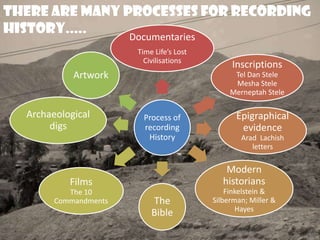
There are many processes for recording
history.....
                       Documentaries
                        Time Life’s Lost
                          Civilisations
                                                Inscriptions
            Artwork                              Tel Dan Stele
                                                 Mesha Stele
                                                Merneptah Stele

  Archaeological         Process of               Epigraphical
       digs              recording                 evidence
                          History                  Arad Lachish
                                                      letters

                                               Modern
           Films                              historians
           The 10                              Finkelstein &
        Commandments        The            Silberman; Miller &
                                                  Hayes
                            Bible
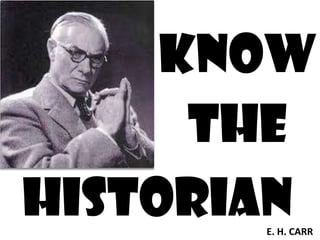
KNOW
      THE
HISTORIAN
       E. H. CARR
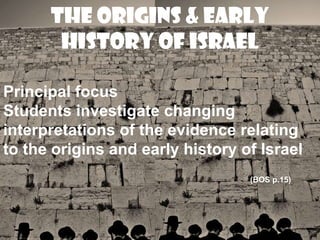
The Origins & Early
       History of Israel

Principal focus
Students investigate changing
interpretations of the evidence relating
to the origins and early history of Israel
                                  (BOS p.15)
Origins &                 Impact of
       naming                 archaeological
         of                      evidence
      Hebrews


                  Origins & Early                Conquest or
                                                 settlement?
                  History of Israel
                  Areas of debate


                                               Emergence of
 Textual                                       the monarchy
problems                                       & kingdom of
  of the                                           Israel
 biblical
narratives
Textual problems of the
   Biblical narrative


sources   dating   authenticity   inconsistencies
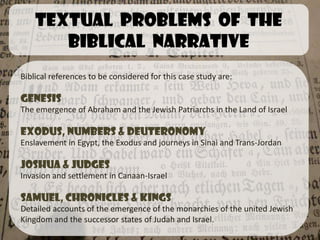
Textual problems of the
       Biblical narrative
Biblical references to be considered for this case study are:

Genesis
The emergence of Abraham and the Jewish Patriarchs in the Land of Israel

Exodus, Numbers & Deuteronomy
Enslavement in Egypt, the Exodus and journeys in Sinai and Trans-Jordan

Joshua & Judges
Invasion and settlement in Canaan-Israel

Samuel, Chronicles & Kings
Detailed accounts of the emergence of the monarchies of the united Jewish
Kingdom and the successor states of Judah and Israel.
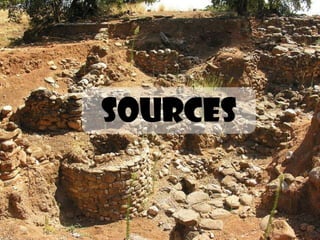
Sources
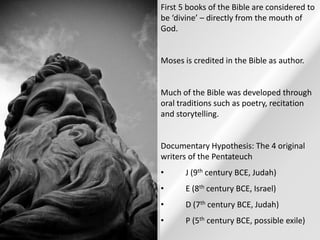
First 5 books of the Bible are considered to
be ‘divine’ – directly from the mouth of
God.


Moses is credited in the Bible as author.


Much of the Bible was developed through
oral traditions such as poetry, recitation
and storytelling.


Documentary Hypothesis: The 4 original
writers of the Pentateuch
•      J (9th century BCE, Judah)
•      E (8th century BCE, Israel)
•      D (7th century BCE, Judah)
•      P (5th century BCE, possible exile)
J&E
The oldest sources – sometimes difficult to separate. They often tell the
same or similar stories. Easiest way to differentiate is through the name used
for the deity. J uses YHWH. E first uses Elohim, and after the name is
revealed to Moses at the burning bush then moves to YHWH.


P
This source is more easily identifiable, as it tends to show a priestly interest.
The style is very formal and focuses on things like genealogies, numbers, cult
and religion, purity and holiness. Entire books such as Leviticus have been
assigned to P.


D
This has been suggested to be (by some scholars such as De Witte) the book
of law referred to in 2 Kings 22:8-13.
dating
Dates for the original oral sources cannot
be confirmed.

Dating of first written compilation
believed to be have been 1000 BCE and
650 BCE.

Reliance on fragments over a great
period of time.
inconsistencies
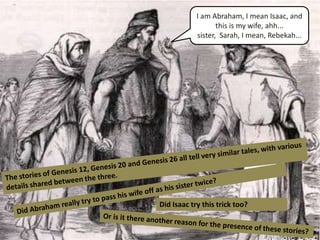
I am Abraham, I mean Isaac, and
                   this is my wife, ahh...
            sister, Sarah, I mean, Rebekah...


Did Isaac try this trick too?
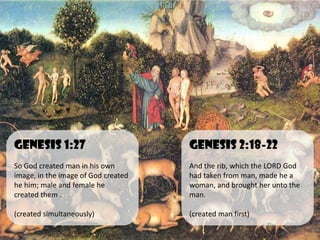
Genesis 1:27                         Genesis 2:18-22
So God created man in his own        And the rib, which the LORD God
image, in the image of God created   had taken from man, made he a
he him; male and female he           woman, and brought her unto the
created them .                       man.

(created simultaneously)             (created man first)
How will
     WE
  decide
     what constitutes

Authenticity
 in regards to
             the Bible?
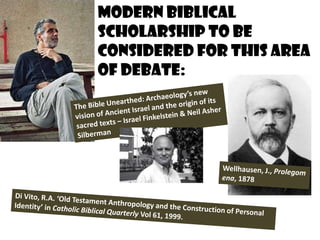
Modern Biblical
Scholarship to be
considered for this area
of debate:
references
Bloch-Smith, E., ‘Israelite ethnicity in iron I: Archaeology preserves what is remembered and what is forgotten in Israel’s
   history’ in Journal of Biblical Literature 122:3 (2003) pp.401-425
Bridge, E., HST155 Archaeology and the Early History of Israel, Macquarie University 2010, Lectures 1 & 3
Dever, W., ‘Archaeology and the emergence of early Israel’ in J. Bartlett (ed) Archaeology and Biblical Interpretation (1997)
   pp.20-50
Finkelstein, I. & Silberman, N., The Bible Unearthed: Archaeology’s New Vision of Ancient Israel and the Origins of Its Sacred
   Texts (The Free Press, New York: 2001)
Fritz, V., ‘Conquest or Settlement? The Early Iron Age in Palestine’ in Biblical Archaeologist 50:2 (1987) pp.84-100
Ian Lacey, ‘The Origins and Early History of Israel’ in Teaching History 42:2 (2008) pp. 38-42
Miller, J. & Hayes, J., A History of Ancient Israel and Judah, 3rd ed. (John Knox Press, Westminster: 2006)
NSW Board of Studies, History Extension Syllabus, (NSW BOS, Sydney: 2009)
Rendsburg, G. ‘The date of Exodus and the conquest/settlement: the case for the 1100s’ in Vetus Testamentum 42:4 (1992)
   pp. 510-527
Webb, K., Extension History: The Historians (History Teachers’ Association of NSW, Annandale: 2006)


Images
Anenberg, J., Ancient Bridge in the Eilat Mountains, retrieved from flickr http://www.flickr.com/photos/redsea_eilat/293183807/
Asquith, P., Moses in Myer’s Park Auckland, retrieved from flickr http://www.flickr.com/photos/wasabicube/3516719963/
Conger, S., Tel Dan022 Ancient Dan, retrieved from flickr http://www.flickr.com/photos/dukie1/3449591489/
Costa, E., [Israel] retrieved from flickr http://www.flickr.com/photos/edo-finelight/2394087158/
Cranach, L., Paradise, 1536, retrieved from http://en.wikipedia.org/wiki/File:Lucas_Cranach_d._%C3%84._035.jpg
Enos, J., Old Bible Text, retrieved from flickr http://www.flickr.com/photos/notjake13/2393304429/
jamestraceur, Arch, Dome of the Rock, Israel, retrieved from flickr http://www.flickr.com/photos/deivorytower/204735986/
LollyKnit, Uncovering Pottery shards at Beth Shemesh, Israel retrieved from flickr http://www.flickr.com/photos/lollyknit/425316237/
Patsy, Bible with Questions and Answers, 2011 http://patty-patcards.blogspot.com/2011_01_01_archive.html
Smolianitski, A., bible text, retrieved from flickr http://www.flickr.com/photos/smolianitski/3908339519/

History extension

  • 1.
    History Extension Topic 2: The Origins and Early History of Israel
  • 2.
    History is a PROCESS At its most basic, history is an attempt to record what has happened in the past. (Webb, p.1)
  • 3.
    There are manyprocesses for recording history..... Documentaries Time Life’s Lost Civilisations Inscriptions Artwork Tel Dan Stele Mesha Stele Merneptah Stele Archaeological Process of Epigraphical digs recording evidence History Arad Lachish letters Modern Films historians The 10 Finkelstein & Commandments The Silberman; Miller & Hayes Bible
  • 4.
    KNOW THE HISTORIAN E. H. CARR
  • 5.
    The Origins &Early History of Israel Principal focus Students investigate changing interpretations of the evidence relating to the origins and early history of Israel (BOS p.15)
  • 6.
    Origins & Impact of naming archaeological of evidence Hebrews Origins & Early Conquest or settlement? History of Israel Areas of debate Emergence of Textual the monarchy problems & kingdom of of the Israel biblical narratives
  • 7.
    Textual problems ofthe Biblical narrative sources dating authenticity inconsistencies
  • 8.
    Textual problems ofthe Biblical narrative Biblical references to be considered for this case study are: Genesis The emergence of Abraham and the Jewish Patriarchs in the Land of Israel Exodus, Numbers & Deuteronomy Enslavement in Egypt, the Exodus and journeys in Sinai and Trans-Jordan Joshua & Judges Invasion and settlement in Canaan-Israel Samuel, Chronicles & Kings Detailed accounts of the emergence of the monarchies of the united Jewish Kingdom and the successor states of Judah and Israel.
  • 9.
  • 10.
    First 5 booksof the Bible are considered to be ‘divine’ – directly from the mouth of God. Moses is credited in the Bible as author. Much of the Bible was developed through oral traditions such as poetry, recitation and storytelling. Documentary Hypothesis: The 4 original writers of the Pentateuch • J (9th century BCE, Judah) • E (8th century BCE, Israel) • D (7th century BCE, Judah) • P (5th century BCE, possible exile)
  • 11.
    J&E The oldest sources– sometimes difficult to separate. They often tell the same or similar stories. Easiest way to differentiate is through the name used for the deity. J uses YHWH. E first uses Elohim, and after the name is revealed to Moses at the burning bush then moves to YHWH. P This source is more easily identifiable, as it tends to show a priestly interest. The style is very formal and focuses on things like genealogies, numbers, cult and religion, purity and holiness. Entire books such as Leviticus have been assigned to P. D This has been suggested to be (by some scholars such as De Witte) the book of law referred to in 2 Kings 22:8-13.
  • 12.
  • 13.
    Dates for theoriginal oral sources cannot be confirmed. Dating of first written compilation believed to be have been 1000 BCE and 650 BCE. Reliance on fragments over a great period of time.
  • 14.
  • 15.
    I am Abraham,I mean Isaac, and this is my wife, ahh... sister, Sarah, I mean, Rebekah... Did Isaac try this trick too?
  • 16.
    Genesis 1:27 Genesis 2:18-22 So God created man in his own And the rib, which the LORD God image, in the image of God created had taken from man, made he a he him; male and female he woman, and brought her unto the created them . man. (created simultaneously) (created man first)
  • 17.
    How will WE decide what constitutes Authenticity in regards to the Bible?
  • 18.
    Modern Biblical Scholarship tobe considered for this area of debate:
  • 19.
    references Bloch-Smith, E., ‘Israeliteethnicity in iron I: Archaeology preserves what is remembered and what is forgotten in Israel’s history’ in Journal of Biblical Literature 122:3 (2003) pp.401-425 Bridge, E., HST155 Archaeology and the Early History of Israel, Macquarie University 2010, Lectures 1 & 3 Dever, W., ‘Archaeology and the emergence of early Israel’ in J. Bartlett (ed) Archaeology and Biblical Interpretation (1997) pp.20-50 Finkelstein, I. & Silberman, N., The Bible Unearthed: Archaeology’s New Vision of Ancient Israel and the Origins of Its Sacred Texts (The Free Press, New York: 2001) Fritz, V., ‘Conquest or Settlement? The Early Iron Age in Palestine’ in Biblical Archaeologist 50:2 (1987) pp.84-100 Ian Lacey, ‘The Origins and Early History of Israel’ in Teaching History 42:2 (2008) pp. 38-42 Miller, J. & Hayes, J., A History of Ancient Israel and Judah, 3rd ed. (John Knox Press, Westminster: 2006) NSW Board of Studies, History Extension Syllabus, (NSW BOS, Sydney: 2009) Rendsburg, G. ‘The date of Exodus and the conquest/settlement: the case for the 1100s’ in Vetus Testamentum 42:4 (1992) pp. 510-527 Webb, K., Extension History: The Historians (History Teachers’ Association of NSW, Annandale: 2006) Images Anenberg, J., Ancient Bridge in the Eilat Mountains, retrieved from flickr http://www.flickr.com/photos/redsea_eilat/293183807/ Asquith, P., Moses in Myer’s Park Auckland, retrieved from flickr http://www.flickr.com/photos/wasabicube/3516719963/ Conger, S., Tel Dan022 Ancient Dan, retrieved from flickr http://www.flickr.com/photos/dukie1/3449591489/ Costa, E., [Israel] retrieved from flickr http://www.flickr.com/photos/edo-finelight/2394087158/ Cranach, L., Paradise, 1536, retrieved from http://en.wikipedia.org/wiki/File:Lucas_Cranach_d._%C3%84._035.jpg Enos, J., Old Bible Text, retrieved from flickr http://www.flickr.com/photos/notjake13/2393304429/ jamestraceur, Arch, Dome of the Rock, Israel, retrieved from flickr http://www.flickr.com/photos/deivorytower/204735986/ LollyKnit, Uncovering Pottery shards at Beth Shemesh, Israel retrieved from flickr http://www.flickr.com/photos/lollyknit/425316237/ Patsy, Bible with Questions and Answers, 2011 http://patty-patcards.blogspot.com/2011_01_01_archive.html Smolianitski, A., bible text, retrieved from flickr http://www.flickr.com/photos/smolianitski/3908339519/

Editor's Notes

  • #2 Image of Jericho looking west from tell: Eddie Bridge HST155 Lecture 3 notes
  • #3 Recap – remind students that we are building on what they have discovered from the source book readings. Assess prior knowledge of topic – brainstorm with students sources that could be used for this topic.Caption: Ken Webb, Extension History: The Historians, 2006, History Teachers’ Association of NSW, Annandale. Image:LollyKnit, flickr, Uncovering Pottery shards at BethShemesh, Israel. http://www.flickr.com/photos/lollyknit/425316237/
  • #5 Know the personal context of the historian. Recap factors to consider with the students* identity of historians: biographical details, personal values and beliefs, philosophy of history, approaches to the construction of history, bias* the context of historians: gender, class, ethnicity, time, place, social and economic structures/change, political constraints, official and unofficial status (History Extension Syllabus p.12)
  • #6 Board of Studies Extension History Syllabus p.15Image: Edoardo Costa, flickr, [Israel] http://www.flickr.com/photos/edo-finelight/2394087158/
  • #7 Origin and naming of Hebrews: Biblical account tells of Patriarchs (Abraham, etc) and the Exodus. Naming of Hebrews – Ivri, or Hebrew, appears in Genesis 14:13; Habiru appears in the Tel El-Amarna Letters; Israel appears in both Genesis 32:28 and Merneptah Stele (Egyptian)Impact of archaeological evidence: Finkelstein and Silberman suggest that “a series of spectacular discoveries and decades of steady archaeological excavation and interpretation suggested to many that the Bible’s accounts were basically trustworthy in regard to the main outlines of the story of ancient Israel.” p.15 The Bible Unearthed. Excavation of tels has revealed much about the agriculture, living conditions and society and culture of these settlements. However, there are definite contradictions between what archaeology has revealed and the biblical account. – how influenced are archaeologists and other historians by the Biblical account when analysing archaeological finds?Conquest or settlement – this leads on from the impact of archaeological evidence debate – the book of Joshua speaks of a large military invasion. Albright bases his invasion or conquest hypothesis on Joshua, stating that migrant Israelites gained control of the land by conquest – this is not supported by any archaeological evidence. i.e. No defensive walls.Noth, Weippert and Alt support an infiltration hypothesis – Israelites were a nomadic tribe who eventually settled into a stationary life – counter to biblical but supported by archaeological evidence. Mendenhal, Gottwalt and de Geus support a revolution hypothesis whereby a social reorganisation among the people in Canaan and group from Egypt have a social reorganisation. Supported by biblical Exodus, the el-Armana letters.Emergence of monarchy and kingdom of Israel: Biblical – Samuel 8:10-19 speaks of people demanding a king – Saul. Looks into the obvious bias by the biblical authors against and for certain monarchs, including Saul. Looks at artwork (including cathedrals, sculpture, etc) representing these monarchs. Look at archaeological and epigraphical evidence to support/contradict the biblical evidence. Consult modern scholarship such as ‘David and Solomon’ by Finkelstein and Silberman.
  • #8 Image: Jacob Enos, flickr, Old Bible Text, http://www.flickr.com/photos/notjake13/2393304429/
  • #9 Ian Lacey, ‘The Origins and Early History of Israel’ in Teaching History 42:2 (2008) pp. 38-42
  • #10 Image: Steve Conger, Tel Dan022 Ancient Dan, Flickr, 2006, http://www.flickr.com/photos/dukie1/3449591489/
  • #11 Image: Peter Asquith 2009, Moses in Myer’s Park Auckland, flickrhttp://www.flickr.com/photos/wasabicube/3516719963/
  • #12 Adapted from notes by Eddie Bridge, HST155 Archaeology and the Early History of Israel, Macquarie University 2010, Lecture 1.
  • #13 Image: JudithAnenberg 2006, Ancient Bridge in the Eilat Mountains, flickr, http://www.flickr.com/photos/redsea_eilat/293183807/
  • #14 Image: Alexander Smolianitski, flickr, bible text, http://www.flickr.com/photos/smolianitski/3908339519/
  • #15 Image: jamestraceur, Arch, Dome of the Rock, Israel, Flickr, 2006, http://www.flickr.com/photos/deivorytower/204735986/
  • #16 There are many cases of repeats and contradictions contained in the Bible.Image: Patsy, Bible with Questions and Answers, 2011http://patty-patcards.blogspot.com/2011_01_01_archive.html
  • #17 Keeping in mind that the Bible as we have it today has been translated from Hebrew, Greek, Old Latin, Vulgate and Peshitta, as well as the 4 ‘authors’ of the Documentary Hypothesis, consider these two apparently contradictory stories of Genesis as told in Genesis 1 and Genesis 2.Image: Lucas Cranach,Paradise, 1536, retrieved from http://en.wikipedia.org/wiki/File:Lucas_Cranach_d._%C3%84._035.jpg
  • #18 Students will need to consider what they understand ‘authenticity’ to be.