The bengal tiger
The bengal tiger
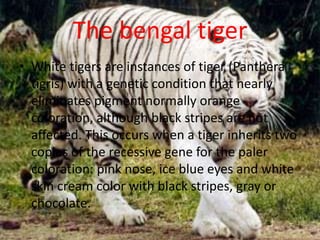
• White tigers are instances of tiger (Panthera
tigris) with a genetic condition that nearly
eliminates pigment normally orange
coloration, although black stripes are not
affected. This occurs when a tiger inherits two
copies of the recessive gene for the paler
coloration: pink nose, ice blue eyes and white
skin cream color with black stripes, gray or
chocolate.
The bengal tiger
• White tigers are not a separate subspecies and
are fertile with orange tigers, but all the
resulting offspring will be heterozygous for the
recessive gene, and its color is orange. The
only exception would be if the orange parent
was also a tiger heterozygous with the
recessive gene for pale coloration, which
would give it a 50% chance of being doubly
recessive white or heterozygous orange.
The bengal tiger
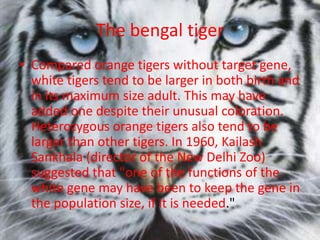
• Compared orange tigers without target gene,
white tigers tend to be larger in both birth and
in its maximum size adult. This may have
added one despite their unusual coloration.
Heterozygous orange tigers also tend to be
larger than other tigers. In 1960, Kailash
Sankhala (director of the New Delhi Zoo)
suggested that "one of the functions of the
white gene may have been to keep the gene in
the population size, if it is needed."
The bengal tiger
• White tigers are generally of the Bengal tiger
subspecies (Panthera tigris tigris) or Siberian tiger
(Panthera tigris altaica), although historical data
in several subspecies appearance. Currently,
several hundred white tigers are in captivity
worldwide, with 100 of them in India, and their
number is increasing. The current population of
Bengal tigers includes pure and hybrid Bengal and
Siberian, but it is unclear whether the recessive
white gene came only from Flare or Siberians.
The bengal tiger
• to unusual coloration of white tigers has made them popular in zoos and exotic
animal shows. The magicians Siegfried and Roy are famous for having bred and
trained white tigers for their numbers, referring to them as "royal white tigers"
perhaps because of the association with the Majaras white tiger of Rewa (India).
• It is a myth that white tigers did not thrive in the wild, where small groups have
been bred white for generations.
• A. A. Dunbar Brander wrote in Wild Animals in Central India (1923):
• White tigers occasionally occur. There are regular breeding these animals in the
neighborhood of Amarkantak, at the junction of the Rewa state and the Mandla
and Bilaspur districts. When I was last in Mandla in 1919, had a tigress and two or
three cubs. In 1915 a male was captured in the state of Rewa and was kept in
confinement. An excellent description of this animal by Mr. Scott of the Indian
police was published in Vol. 27, no. 47 of the Journal of Natural History Society
Bombay.
• A. A. Dunbar Brander
• However, most white tigers are currently bred in captivity, through inbreeding, to
ensure the presence of the recessive gene. Such inbreeding can occasionally lead
to birth defects.

The bengal tiger

  • 1.
  • 2.
    The bengal tiger •White tigers are instances of tiger (Panthera tigris) with a genetic condition that nearly eliminates pigment normally orange coloration, although black stripes are not affected. This occurs when a tiger inherits two copies of the recessive gene for the paler coloration: pink nose, ice blue eyes and white skin cream color with black stripes, gray or chocolate.
  • 3.
    The bengal tiger •White tigers are not a separate subspecies and are fertile with orange tigers, but all the resulting offspring will be heterozygous for the recessive gene, and its color is orange. The only exception would be if the orange parent was also a tiger heterozygous with the recessive gene for pale coloration, which would give it a 50% chance of being doubly recessive white or heterozygous orange.
  • 4.
    The bengal tiger •Compared orange tigers without target gene, white tigers tend to be larger in both birth and in its maximum size adult. This may have added one despite their unusual coloration. Heterozygous orange tigers also tend to be larger than other tigers. In 1960, Kailash Sankhala (director of the New Delhi Zoo) suggested that "one of the functions of the white gene may have been to keep the gene in the population size, if it is needed."
  • 5.
    The bengal tiger •White tigers are generally of the Bengal tiger subspecies (Panthera tigris tigris) or Siberian tiger (Panthera tigris altaica), although historical data in several subspecies appearance. Currently, several hundred white tigers are in captivity worldwide, with 100 of them in India, and their number is increasing. The current population of Bengal tigers includes pure and hybrid Bengal and Siberian, but it is unclear whether the recessive white gene came only from Flare or Siberians.
  • 6.
    The bengal tiger •to unusual coloration of white tigers has made them popular in zoos and exotic animal shows. The magicians Siegfried and Roy are famous for having bred and trained white tigers for their numbers, referring to them as "royal white tigers" perhaps because of the association with the Majaras white tiger of Rewa (India). • It is a myth that white tigers did not thrive in the wild, where small groups have been bred white for generations. • A. A. Dunbar Brander wrote in Wild Animals in Central India (1923): • White tigers occasionally occur. There are regular breeding these animals in the neighborhood of Amarkantak, at the junction of the Rewa state and the Mandla and Bilaspur districts. When I was last in Mandla in 1919, had a tigress and two or three cubs. In 1915 a male was captured in the state of Rewa and was kept in confinement. An excellent description of this animal by Mr. Scott of the Indian police was published in Vol. 27, no. 47 of the Journal of Natural History Society Bombay. • A. A. Dunbar Brander • However, most white tigers are currently bred in captivity, through inbreeding, to ensure the presence of the recessive gene. Such inbreeding can occasionally lead to birth defects.