The Basics of Dentistry
Nuface Dental Implant center
Phone no: +919814009431
info@jalandharimplant.com
This presentation will provide a
comprehensive overview of the basics of
dentistry, covering everything from oral
anatomy to common procedures and
equipment, as well as the importance of
maintaining good oral hygiene and scheduling
regular dental appointments.
1.Definition of
Dentistry
● Dentistry and its
importance for oral
health
Dentistry is a branch of medicine that focuses on the
study, diagnosis, prevention, and treatment of
diseases and conditions that affect the oral cavity
and surrounding structures. The field of dentistry
encompasses a wide range of specialties and
subspecialties, including general dentistry, pediatric
dentistry, orthodontics, endodontics, periodontics,
and oral surgery.
Oral health is an essential aspect of overall health
and wellbeing. It plays a crucial role in maintaining a
healthy body, as the mouth is the gateway to the
body and many systemic diseases have oral
manifestations. Poor oral hygiene and untreated
dental conditions can lead to a range of health
problems, including gum disease, tooth decay, bad
breath, and even more serious conditions such as
oral cancer and heart disease.
● Role of dentists in
maintaining healthy
teeth and gums
dentists play a vital role in maintaining healthy
teeth and gums. By providing regular check-ups,
cleanings, and other preventive services, they can
help their patients prevent dental problems before
they arise. And when issues do arise, dentists are
equipped with the skills and tools necessary to
diagnose and treat the problem, restoring their
patients' oral health and overall wellbeing.
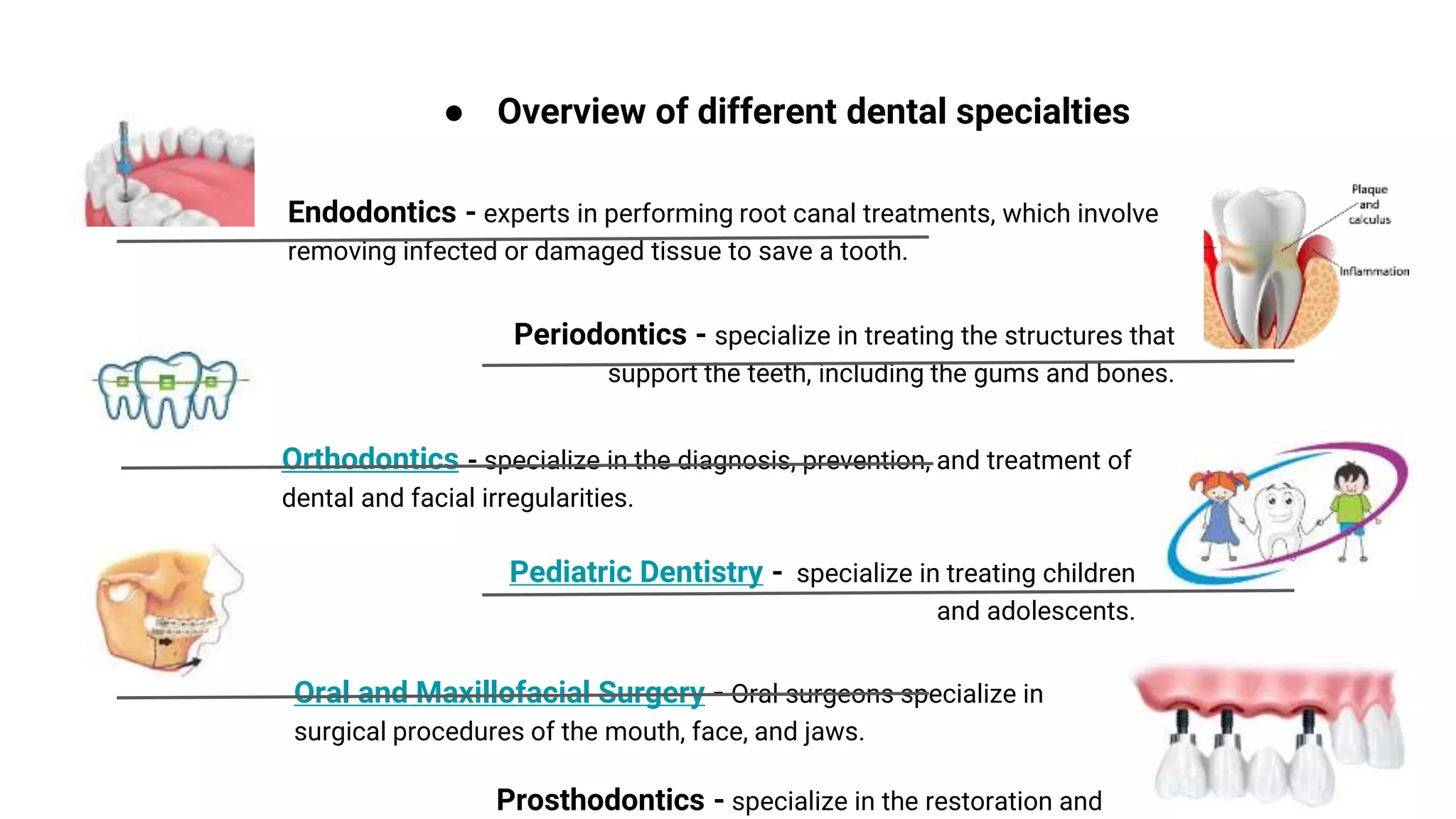
● Overview of different dental specialties
Endodontics - experts in performing root canal treatments, which involve
removing infected or damaged tissue to save a tooth.
Orthodontics - specialize in the diagnosis, prevention, and treatment of
dental and facial irregularities.
Pediatric Dentistry - specialize in treating children
and adolescents.
Periodontics - specialize in treating the structures that
support the teeth, including the gums and bones.
Oral and Maxillofacial Surgery - Oral surgeons specialize in
surgical procedures of the mouth, face, and jaws.
Prosthodontics - specialize in the restoration and
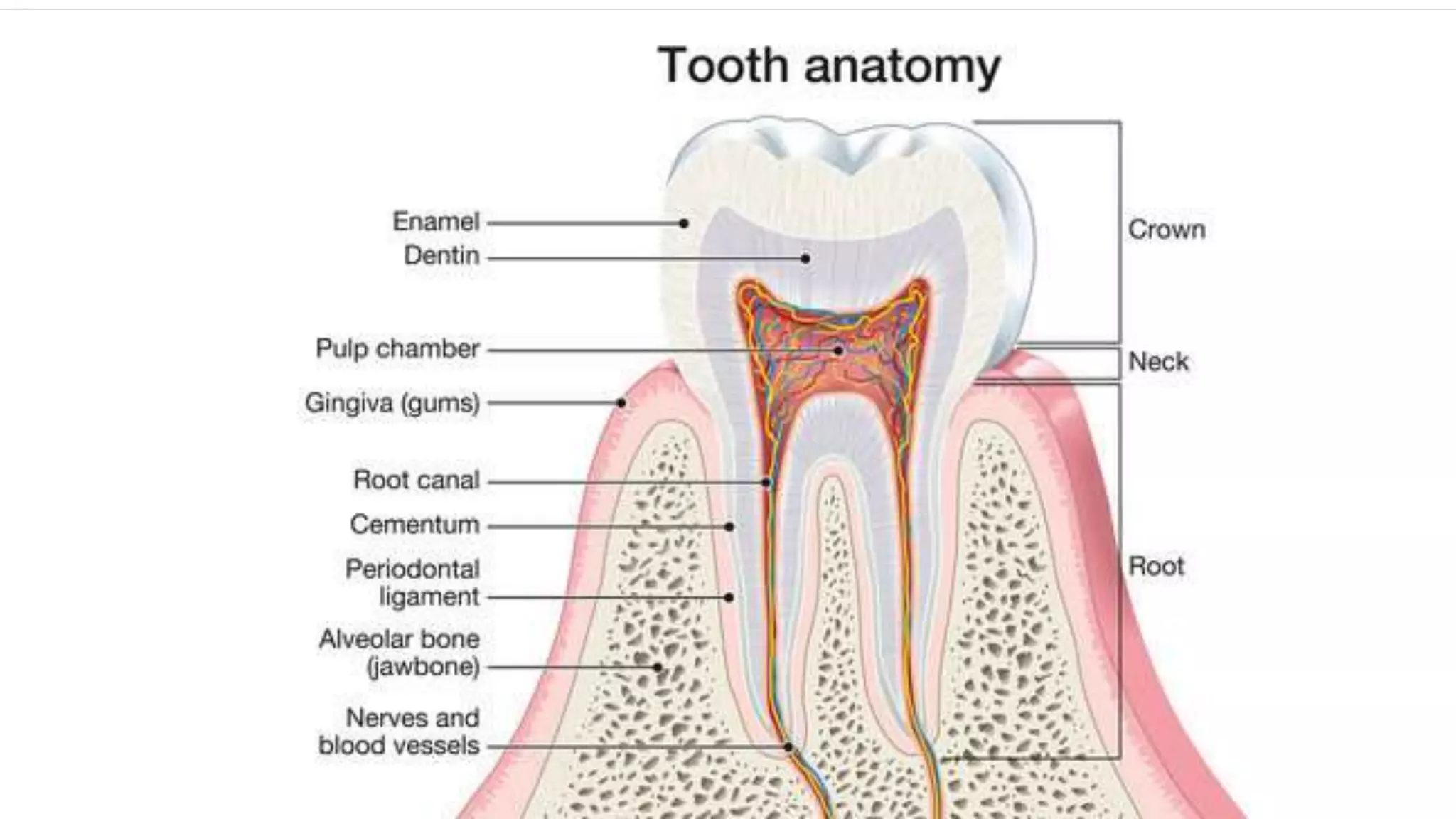
2. Oral Anatomy
● Overview of the different types of teeth and their functions
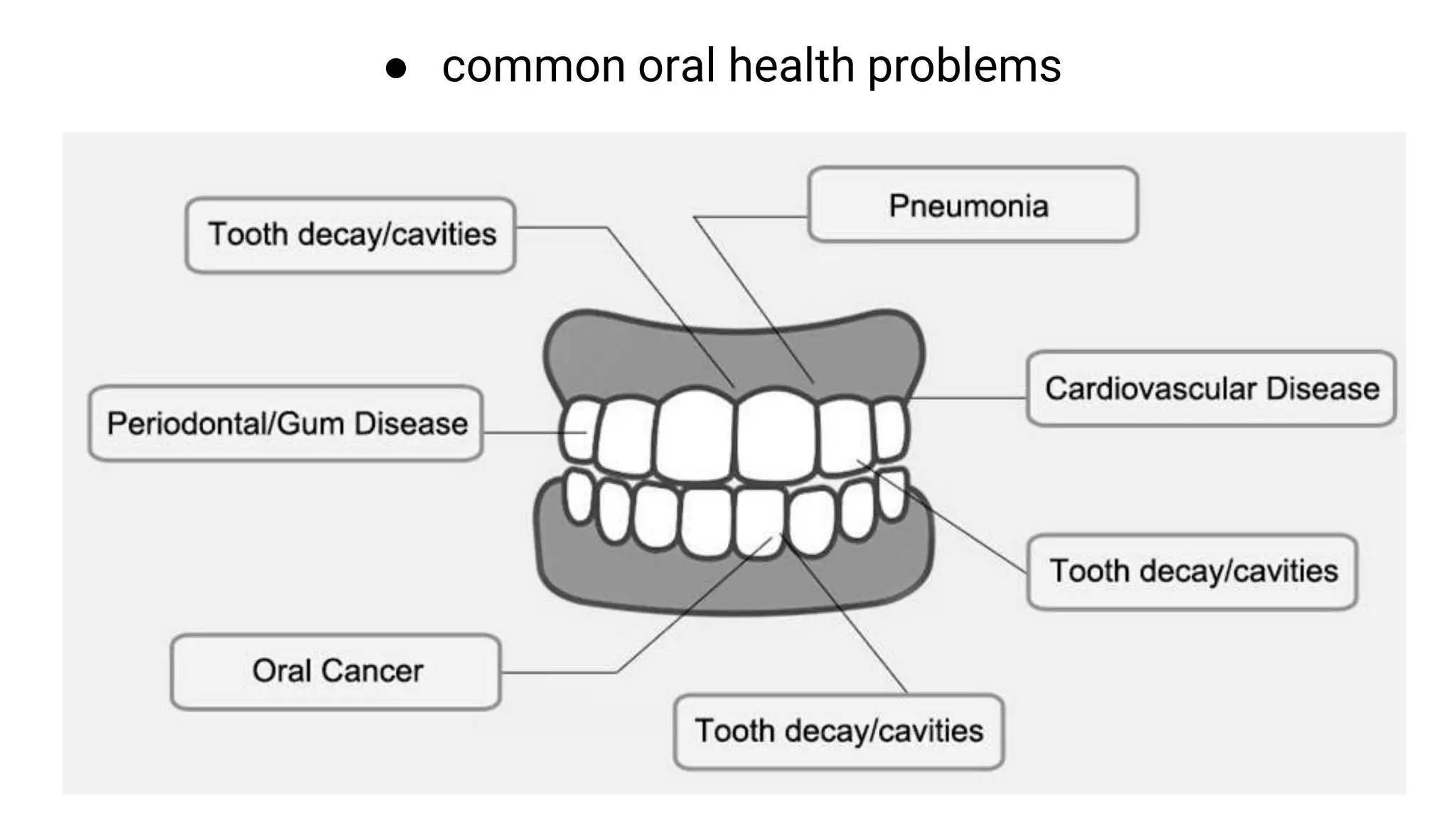
● common oral health problems
3. Oral Hygiene
1 2 3 4
● Importance of oral hygiene for maintaining healthy
teeth and gums
Preventing cavities
Brushing and flossing
your teeth regularly helps
to remove plaque, which
is a sticky film of bacteria
that can cause cavities.
Preventing gum
disease
Good oral hygiene can
help prevent gum
disease by removing
plaque and food particles
from the gum line and
preventing the build-up of
harmful bacteria.
Fresh breath
Regular brushing and
flossing can help to
eliminate bad breath
caused by food particles
and bacteria in the
mouth.
Maintaining overall
health
Poor oral hygiene has
been linked to a number
of health problems,
including heart disease,
diabetes, and respiratory
infections.
Brushing
Flossing
Mouthwash
Healthy diet
Regular dental check-ups
Overview of the recommended
daily dental care routine
4. Dental Procedures
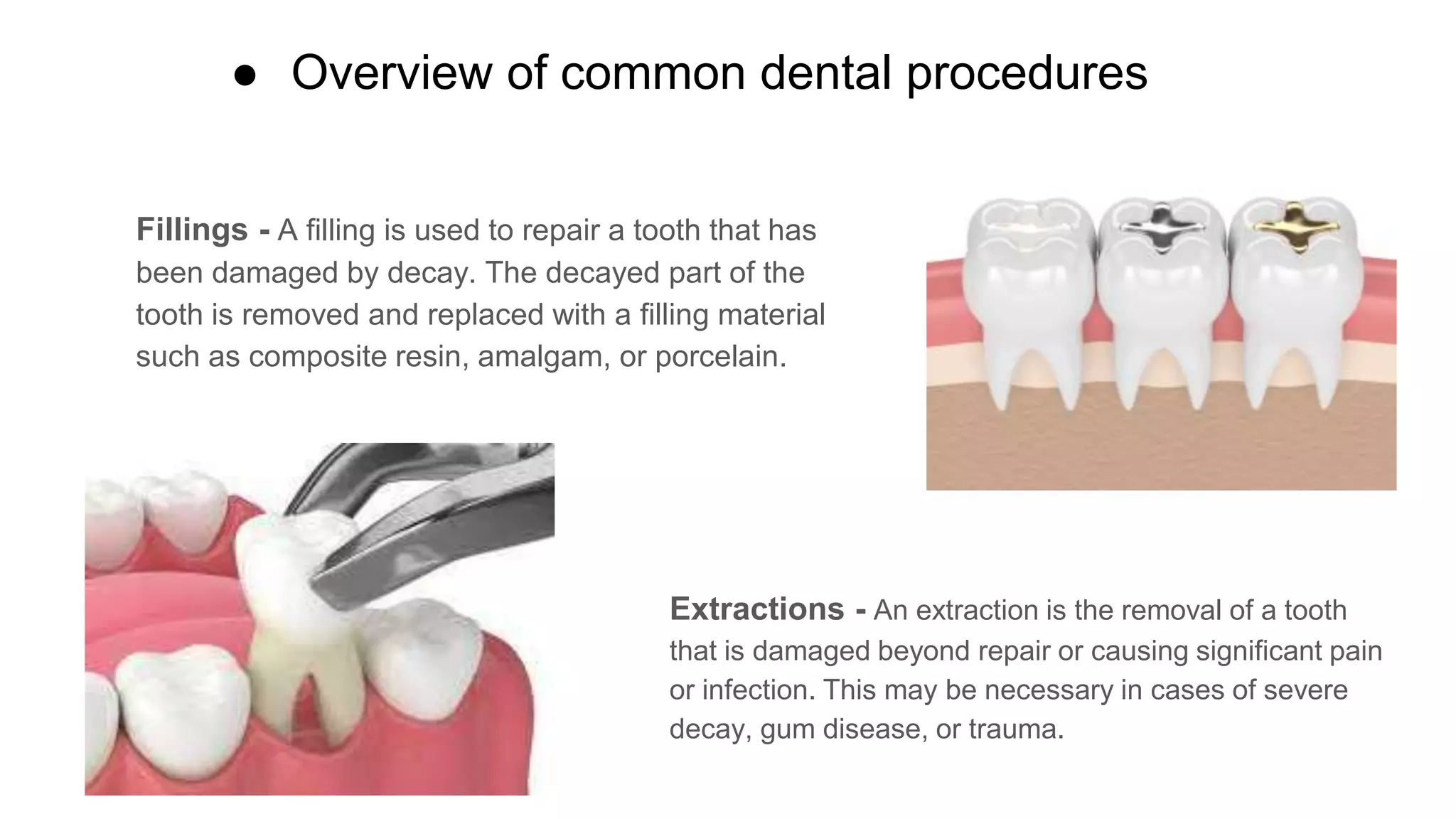
● Overview of common dental procedures
Extractions - An extraction is the removal of a tooth
that is damaged beyond repair or causing significant pain
or infection. This may be necessary in cases of severe
decay, gum disease, or trauma.
Fillings - A filling is used to repair a tooth that has
been damaged by decay. The decayed part of the
tooth is removed and replaced with a filling material
such as composite resin, amalgam, or porcelain.
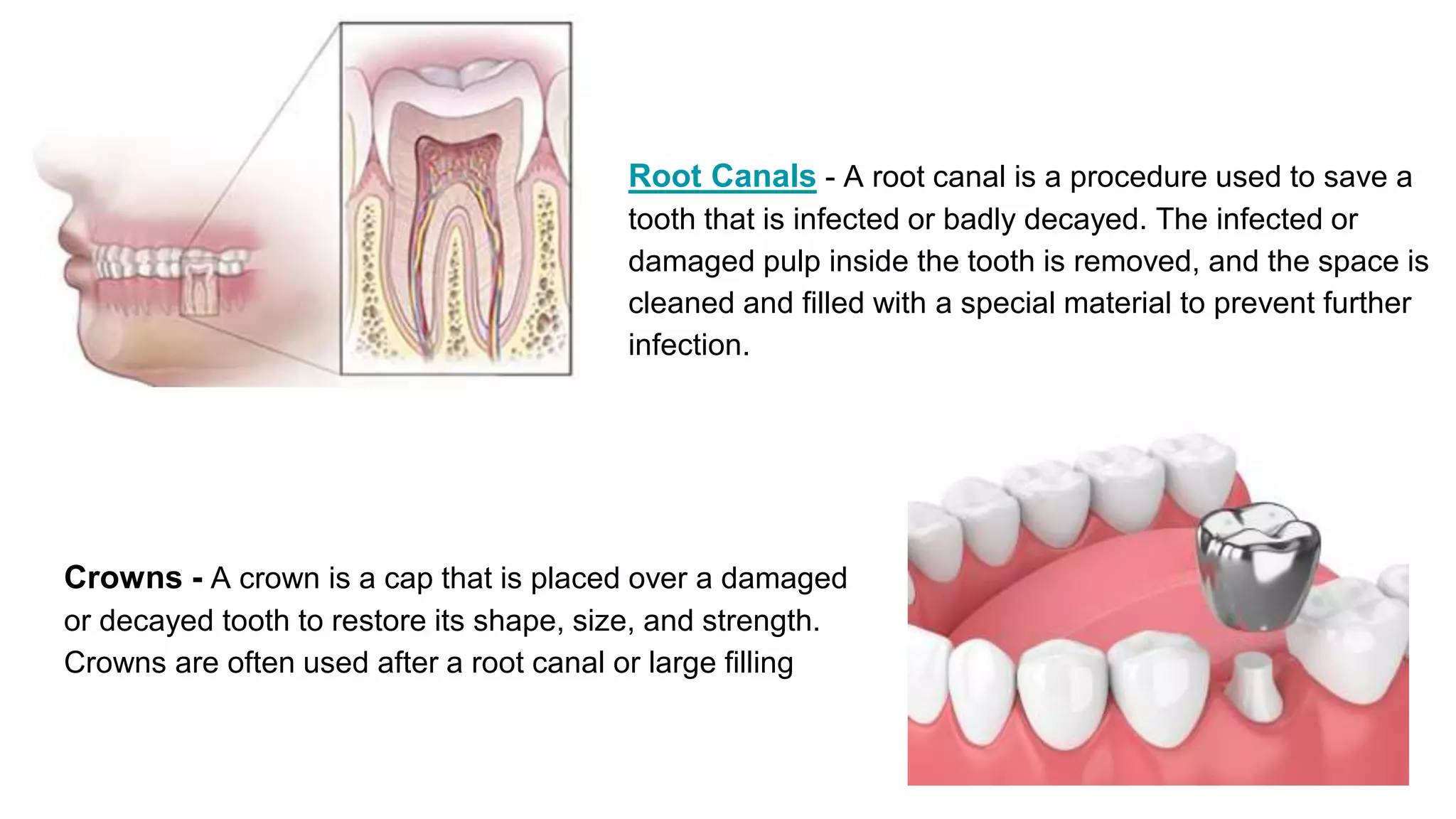
Root Canals - A root canal is a procedure used to save a
tooth that is infected or badly decayed. The infected or
damaged pulp inside the tooth is removed, and the space is
cleaned and filled with a special material to prevent further
infection.
Crowns - A crown is a cap that is placed over a damaged
or decayed tooth to restore its shape, size, and strength.
Crowns are often used after a root canal or large filling
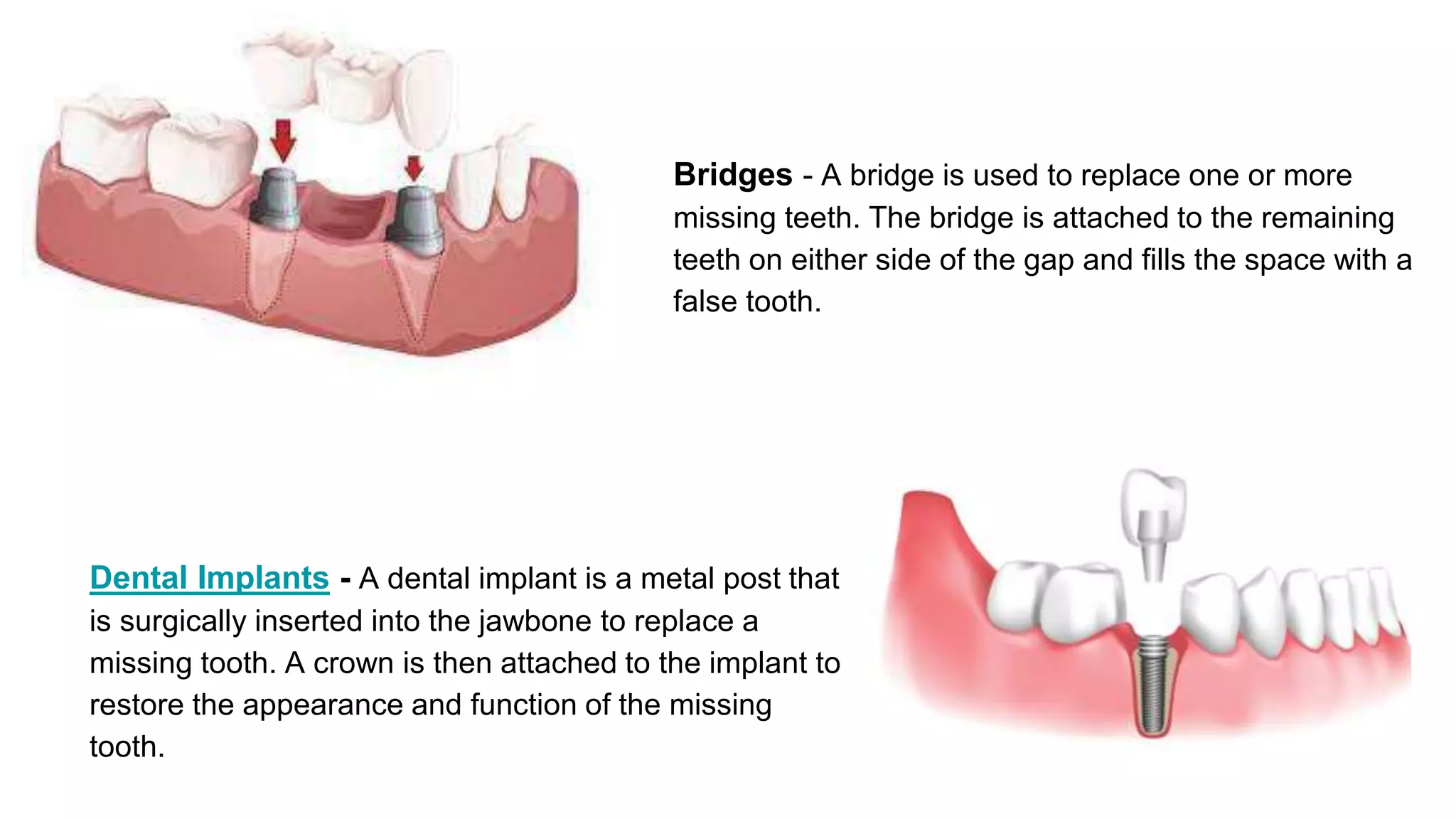
Dental Implants - A dental implant is a metal post that
is surgically inserted into the jawbone to replace a
missing tooth. A crown is then attached to the implant to
restore the appearance and function of the missing
tooth.
Bridges - A bridge is used to replace one or more
missing teeth. The bridge is attached to the remaining
teeth on either side of the gap and fills the space with a
false tooth.
● Cosmetic dental
procedures
1. Teeth Whitening
2. Veneers
3. Dental Bonding
4. Invisalign
5. Gum Contouring
● Overview of orthodontic
procedures
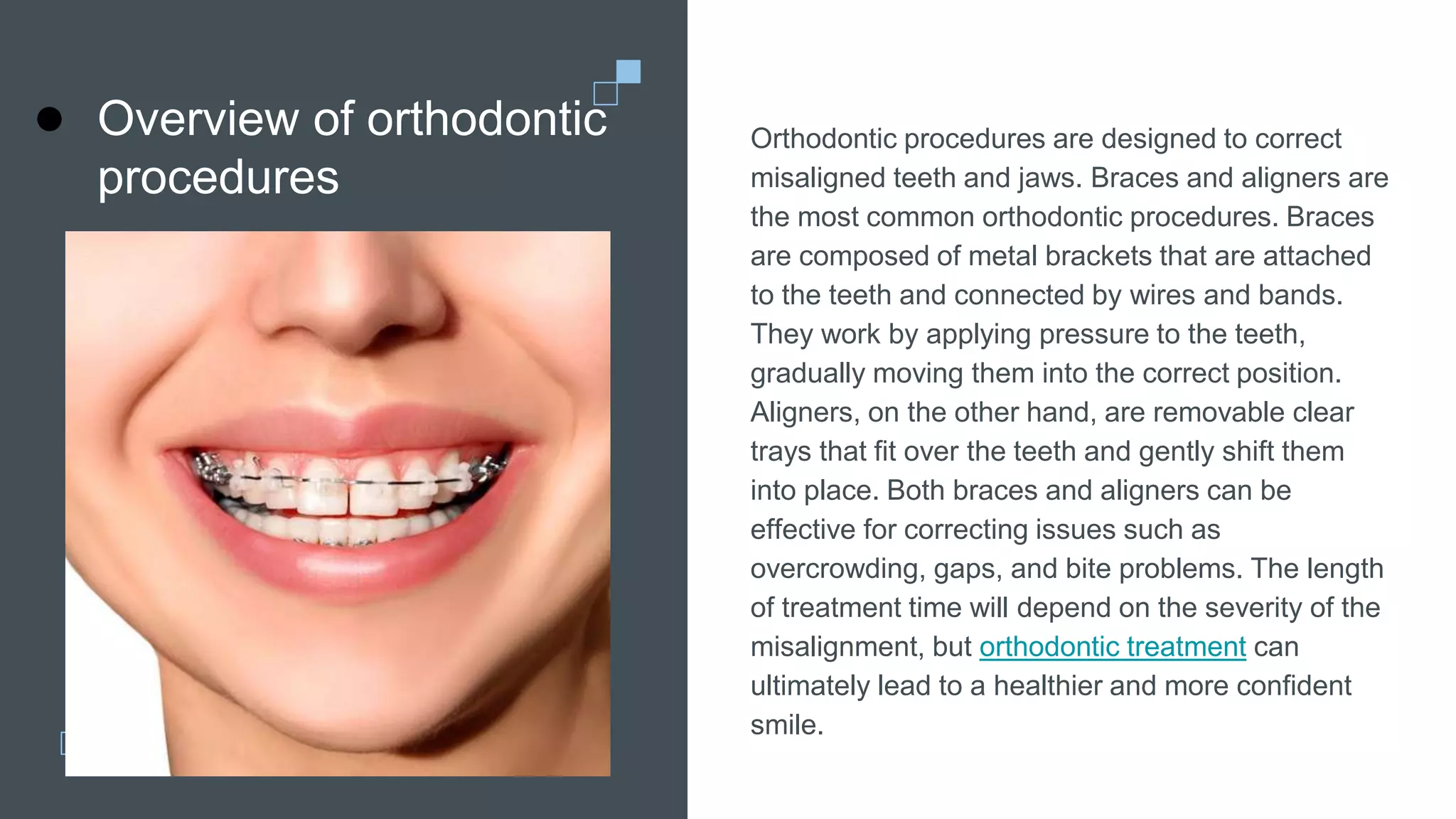
Orthodontic procedures are designed to correct
misaligned teeth and jaws. Braces and aligners are
the most common orthodontic procedures. Braces
are composed of metal brackets that are attached
to the teeth and connected by wires and bands.
They work by applying pressure to the teeth,
gradually moving them into the correct position.
Aligners, on the other hand, are removable clear
trays that fit over the teeth and gently shift them
into place. Both braces and aligners can be
effective for correcting issues such as
overcrowding, gaps, and bite problems. The length
of treatment time will depend on the severity of the
misalignment, but orthodontic treatment can
ultimately lead to a healthier and more confident
smile.
5. Dental Tools and
Equipment
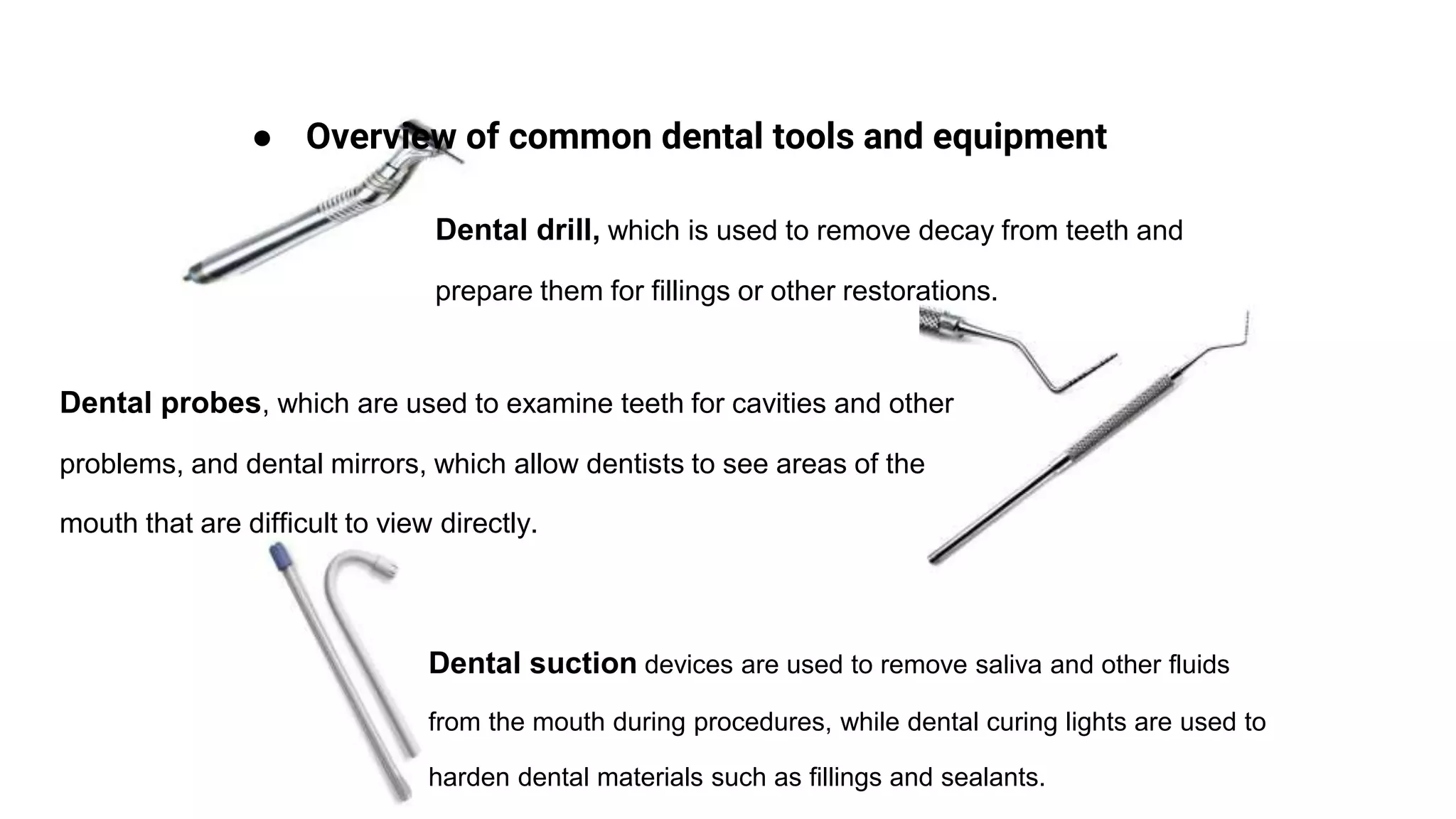
Dental drill, which is used to remove decay from teeth and
prepare them for fillings or other restorations.
● Overview of common dental tools and equipment
Dental probes, which are used to examine teeth for cavities and other
problems, and dental mirrors, which allow dentists to see areas of the
mouth that are difficult to view directly.
Dental suction devices are used to remove saliva and other fluids
from the mouth during procedures, while dental curing lights are used to
harden dental materials such as fillings and sealants.
In addition, dental professionals use a variety of specialized
instruments for specific procedures, such as root canals,
extractions, and periodontal treatments. These tools and
equipment are essential for providing high-quality dental care
and maintaining good oral health.
● Role of
technology in
modern
dentistry,
The role of technology in modern dentistry is significant, as it
has allowed for more accurate diagnosis and treatment
planning, improved patient comfort and reduced treatment
times.
Digital X-rays, for example, provide a more detailed image of
the teeth and surrounding structures, allowing dentists to detect
issues such as cavities or impacted teeth more accurately.
CAD/CAM systems have also revolutionized the dental field,
allowing for the creation of precise and customized dental
restorations, such as crowns and bridges, in a shorter amount of
time.
Overall, technology has greatly improved the efficiency and
effectiveness of dental procedures, leading to better outcomes
for patients.
7: Conclusion
In this presentation, we covered the basics of dentistry, including the definition and importance of dentistry
for oral health. We also discussed the role of dentists in maintaining healthy teeth and gums, as well as the
different dental specialties.
We then went on to explain the basic anatomy of the mouth, including teeth, gums, tongue, and other oral
structures. We discussed the different types of teeth and their functions, as well as common oral health
problems, such as cavities and gum disease.
We emphasized the importance of oral hygiene for maintaining healthy teeth and gums, and provided an
overview of the recommended daily dental care routine, including brushing, flossing, and mouthwash. We
also discussed the role of diet and lifestyle factors in maintaining good oral health.
Lastly, we touched on the role of technology in modern dentistry, including digital X-rays and CAD/CAM
systems, and explained dental materials such as dental composites and amalgam fillings.
● Importance of regular
dental check-ups and
cleanings for
maintaining oral
health
Regular dental check-ups and cleanings are an essential part of
maintaining good oral health. Even if you practice good oral
hygiene at home, there are areas of your mouth that can be
difficult to reach with regular brushing and flossing. A dental
professional can help to remove any built-up plaque or tartar
that can lead to gum disease, cavities, and other oral health
problems.
During a dental check-up, the dentist will examine your teeth
and gums for any signs of decay, gum disease, or other issues.
They may also take X-rays to get a more detailed look at your
teeth and jaw. If any issues are found, the dentist can
recommend a treatment plan to address them.
Regular dental cleanings can help to remove any built-up plaque
and tartar, as well as surface stains on your teeth. This can help
to prevent cavities, gum disease, and other oral health
problems. Dental cleanings also give the dental professional an
opportunity to examine your mouth for any issues that may
require further attention.
In conclusion, we hope this presentation has provided you with a better
understanding of the basics of dentistry, the importance of oral health, and
the various procedures and technologies used in modern dentistry. We
cannot stress enough the importance of maintaining good oral hygiene
habits and scheduling regular check-ups and cleanings with your dentist.
We encourage you to take action and prioritize your oral health by
scheduling a dental appointment today. Remember, a healthy smile is a
happy smile!
Don't let missing or damaged teeth affect your quality of life any longer.
Contact Nuface Dental Implant Center today to schedule a consultation
and learn more about how dental implants can improve your oral health
and confidence.

The Basics of Dentistry

  • 1.
    The Basics ofDentistry Nuface Dental Implant center Phone no: +919814009431 info@jalandharimplant.com
  • 2.
    This presentation willprovide a comprehensive overview of the basics of dentistry, covering everything from oral anatomy to common procedures and equipment, as well as the importance of maintaining good oral hygiene and scheduling regular dental appointments.
  • 3.
  • 4.
    ● Dentistry andits importance for oral health Dentistry is a branch of medicine that focuses on the study, diagnosis, prevention, and treatment of diseases and conditions that affect the oral cavity and surrounding structures. The field of dentistry encompasses a wide range of specialties and subspecialties, including general dentistry, pediatric dentistry, orthodontics, endodontics, periodontics, and oral surgery. Oral health is an essential aspect of overall health and wellbeing. It plays a crucial role in maintaining a healthy body, as the mouth is the gateway to the body and many systemic diseases have oral manifestations. Poor oral hygiene and untreated dental conditions can lead to a range of health problems, including gum disease, tooth decay, bad breath, and even more serious conditions such as oral cancer and heart disease.
  • 5.
    ● Role ofdentists in maintaining healthy teeth and gums dentists play a vital role in maintaining healthy teeth and gums. By providing regular check-ups, cleanings, and other preventive services, they can help their patients prevent dental problems before they arise. And when issues do arise, dentists are equipped with the skills and tools necessary to diagnose and treat the problem, restoring their patients' oral health and overall wellbeing.
  • 6.
    ● Overview ofdifferent dental specialties Endodontics - experts in performing root canal treatments, which involve removing infected or damaged tissue to save a tooth. Orthodontics - specialize in the diagnosis, prevention, and treatment of dental and facial irregularities. Pediatric Dentistry - specialize in treating children and adolescents. Periodontics - specialize in treating the structures that support the teeth, including the gums and bones. Oral and Maxillofacial Surgery - Oral surgeons specialize in surgical procedures of the mouth, face, and jaws. Prosthodontics - specialize in the restoration and
  • 7.
  • 9.
    ● Overview ofthe different types of teeth and their functions
  • 10.
    ● common oralhealth problems
  • 11.
  • 12.
    1 2 34 ● Importance of oral hygiene for maintaining healthy teeth and gums Preventing cavities Brushing and flossing your teeth regularly helps to remove plaque, which is a sticky film of bacteria that can cause cavities. Preventing gum disease Good oral hygiene can help prevent gum disease by removing plaque and food particles from the gum line and preventing the build-up of harmful bacteria. Fresh breath Regular brushing and flossing can help to eliminate bad breath caused by food particles and bacteria in the mouth. Maintaining overall health Poor oral hygiene has been linked to a number of health problems, including heart disease, diabetes, and respiratory infections.
  • 13.
    Brushing Flossing Mouthwash Healthy diet Regular dentalcheck-ups Overview of the recommended daily dental care routine
  • 14.
  • 15.
    ● Overview ofcommon dental procedures Extractions - An extraction is the removal of a tooth that is damaged beyond repair or causing significant pain or infection. This may be necessary in cases of severe decay, gum disease, or trauma. Fillings - A filling is used to repair a tooth that has been damaged by decay. The decayed part of the tooth is removed and replaced with a filling material such as composite resin, amalgam, or porcelain.
  • 16.
    Root Canals -A root canal is a procedure used to save a tooth that is infected or badly decayed. The infected or damaged pulp inside the tooth is removed, and the space is cleaned and filled with a special material to prevent further infection. Crowns - A crown is a cap that is placed over a damaged or decayed tooth to restore its shape, size, and strength. Crowns are often used after a root canal or large filling
  • 17.
    Dental Implants -A dental implant is a metal post that is surgically inserted into the jawbone to replace a missing tooth. A crown is then attached to the implant to restore the appearance and function of the missing tooth. Bridges - A bridge is used to replace one or more missing teeth. The bridge is attached to the remaining teeth on either side of the gap and fills the space with a false tooth.
  • 18.
    ● Cosmetic dental procedures 1.Teeth Whitening 2. Veneers 3. Dental Bonding 4. Invisalign 5. Gum Contouring
  • 19.
    ● Overview oforthodontic procedures Orthodontic procedures are designed to correct misaligned teeth and jaws. Braces and aligners are the most common orthodontic procedures. Braces are composed of metal brackets that are attached to the teeth and connected by wires and bands. They work by applying pressure to the teeth, gradually moving them into the correct position. Aligners, on the other hand, are removable clear trays that fit over the teeth and gently shift them into place. Both braces and aligners can be effective for correcting issues such as overcrowding, gaps, and bite problems. The length of treatment time will depend on the severity of the misalignment, but orthodontic treatment can ultimately lead to a healthier and more confident smile.
  • 20.
    5. Dental Toolsand Equipment
  • 21.
    Dental drill, whichis used to remove decay from teeth and prepare them for fillings or other restorations. ● Overview of common dental tools and equipment Dental probes, which are used to examine teeth for cavities and other problems, and dental mirrors, which allow dentists to see areas of the mouth that are difficult to view directly. Dental suction devices are used to remove saliva and other fluids from the mouth during procedures, while dental curing lights are used to harden dental materials such as fillings and sealants.
  • 22.
    In addition, dentalprofessionals use a variety of specialized instruments for specific procedures, such as root canals, extractions, and periodontal treatments. These tools and equipment are essential for providing high-quality dental care and maintaining good oral health.
  • 23.
    ● Role of technologyin modern dentistry, The role of technology in modern dentistry is significant, as it has allowed for more accurate diagnosis and treatment planning, improved patient comfort and reduced treatment times. Digital X-rays, for example, provide a more detailed image of the teeth and surrounding structures, allowing dentists to detect issues such as cavities or impacted teeth more accurately. CAD/CAM systems have also revolutionized the dental field, allowing for the creation of precise and customized dental restorations, such as crowns and bridges, in a shorter amount of time. Overall, technology has greatly improved the efficiency and effectiveness of dental procedures, leading to better outcomes for patients.
  • 24.
    7: Conclusion In thispresentation, we covered the basics of dentistry, including the definition and importance of dentistry for oral health. We also discussed the role of dentists in maintaining healthy teeth and gums, as well as the different dental specialties. We then went on to explain the basic anatomy of the mouth, including teeth, gums, tongue, and other oral structures. We discussed the different types of teeth and their functions, as well as common oral health problems, such as cavities and gum disease. We emphasized the importance of oral hygiene for maintaining healthy teeth and gums, and provided an overview of the recommended daily dental care routine, including brushing, flossing, and mouthwash. We also discussed the role of diet and lifestyle factors in maintaining good oral health. Lastly, we touched on the role of technology in modern dentistry, including digital X-rays and CAD/CAM systems, and explained dental materials such as dental composites and amalgam fillings.
  • 25.
    ● Importance ofregular dental check-ups and cleanings for maintaining oral health Regular dental check-ups and cleanings are an essential part of maintaining good oral health. Even if you practice good oral hygiene at home, there are areas of your mouth that can be difficult to reach with regular brushing and flossing. A dental professional can help to remove any built-up plaque or tartar that can lead to gum disease, cavities, and other oral health problems. During a dental check-up, the dentist will examine your teeth and gums for any signs of decay, gum disease, or other issues. They may also take X-rays to get a more detailed look at your teeth and jaw. If any issues are found, the dentist can recommend a treatment plan to address them. Regular dental cleanings can help to remove any built-up plaque and tartar, as well as surface stains on your teeth. This can help to prevent cavities, gum disease, and other oral health problems. Dental cleanings also give the dental professional an opportunity to examine your mouth for any issues that may require further attention.
  • 26.
    In conclusion, wehope this presentation has provided you with a better understanding of the basics of dentistry, the importance of oral health, and the various procedures and technologies used in modern dentistry. We cannot stress enough the importance of maintaining good oral hygiene habits and scheduling regular check-ups and cleanings with your dentist. We encourage you to take action and prioritize your oral health by scheduling a dental appointment today. Remember, a healthy smile is a happy smile!
  • 27.
    Don't let missingor damaged teeth affect your quality of life any longer. Contact Nuface Dental Implant Center today to schedule a consultation and learn more about how dental implants can improve your oral health and confidence.